
In this article
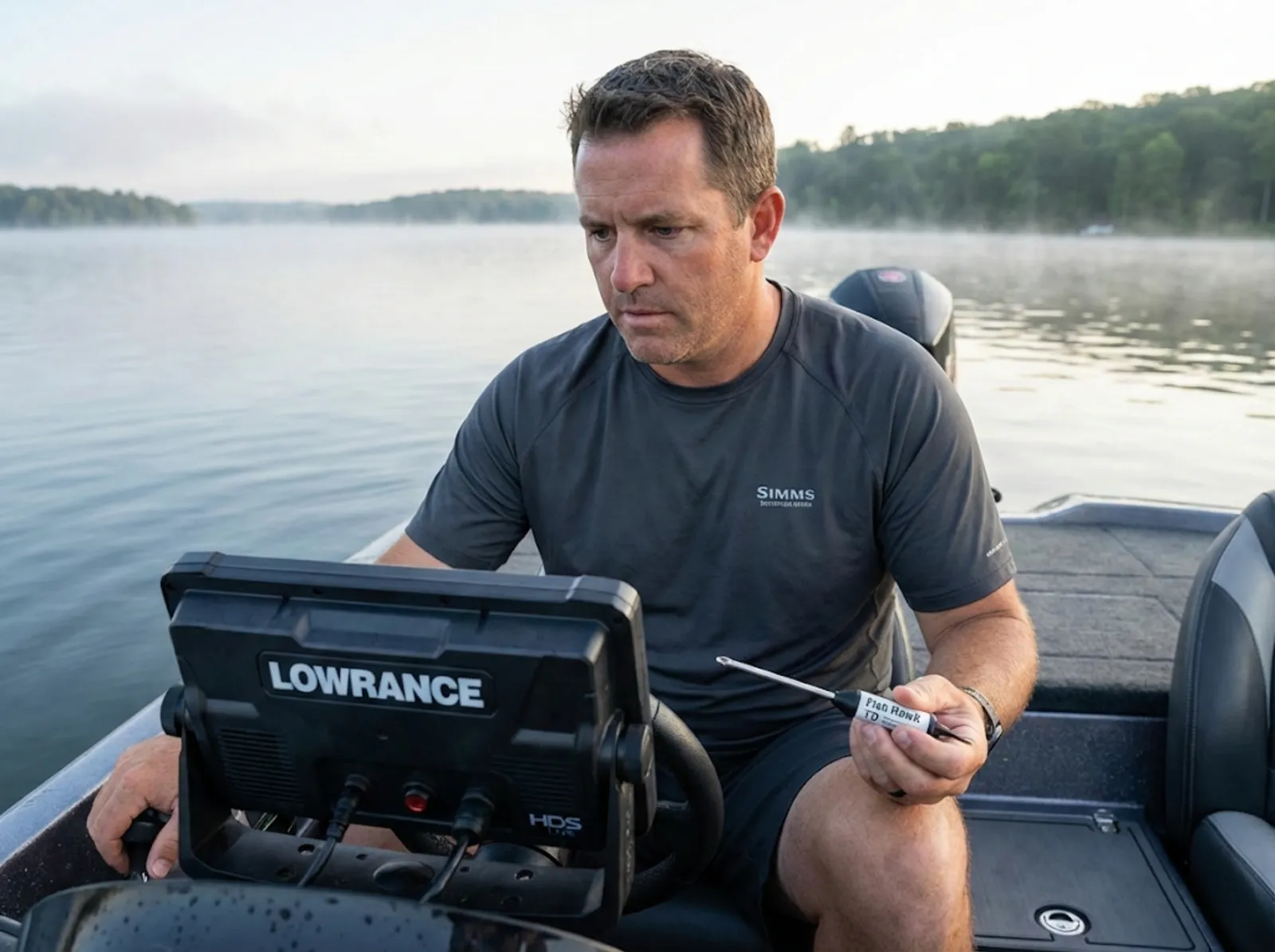
I watched the surface temp climb to 86°F on my Lowrance fish finder. Dead water, I thought—until my buddy dropped a Fish Hawk TD probe and found 72°F sitting just 15 feet down. We limited out in two hours fishing the thermocline while boats around us struggled on the surface. That was the day I stopped trusting what my hull sensor told me.
Most anglers glance at their surface temperature reading and make decisions based on a number that tells only part of the story. The reality is more nuanced: the water column below you is a layered system where temperature patterns vary dramatically with depth. Understanding this difference—and learning to read the thermal stratification beneath—will transform where you target fish, when you fish, and how you interpret your electronics.
⚡ Quick Answer: Surface water temperatures are volatile and often misleading because they represent only the top layer of a stratified lake. During summer and winter, fish position based on the temperature-oxygen combination at depth—not surface readings. Use your sonar to find the thermocline (visible as a “fuzzy line”) and target fish in the metalimnion just above that boundary where dissolved oxygen levels support active feeding.
The Science of Why Surface Temps Deceive You
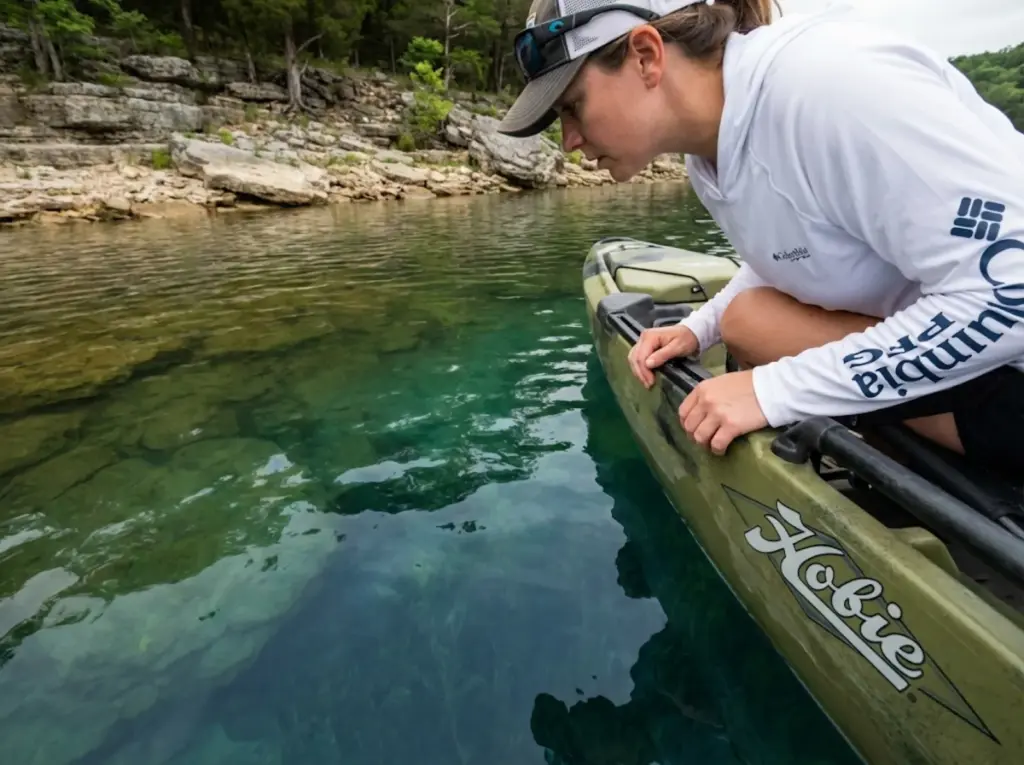
If you’ve ever wondered why your surface water temperature readings don’t match fish behavior, the answer lies in basic physics. Water has a unique property that drives everything from seasonal turnover to fish positioning: it reaches maximum density at 39.2°F (4°C), not at freezing. This quirk creates the layered system that makes surface readings unreliable.
How Water Density Creates Three Distinct Layers
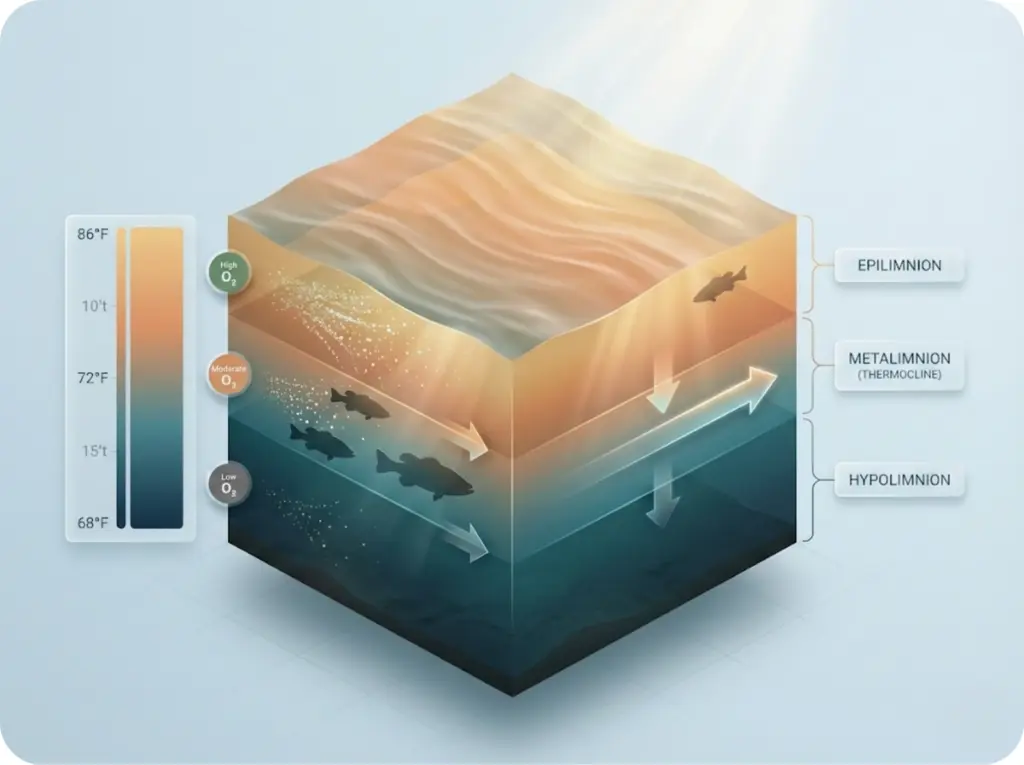
During summer, solar radiation heats the epilimnion (surface layer), making it lighter and floaty on the cooler water below. This creates three distinct zones: the warm, well-mixed epilimnion at top; the metalimnion (middle layer) where temperature drops rapidly; and the cold, dark hypolimnion at bottom. The thermocline—the boundary within the metalimnion where temperature plummets—acts as a physical barrier.
Breaking down this barrier requires substantial energy. High winds or dramatic cold fronts can do it, but on calm summer days, the layers stay locked in place. Meanwhile, surface water warms and cools by 3-4°F in a single 24-hour period. That pre-dawn surface reading of 78°F might hit 86°F by afternoon—while the water temperature at 15 feet stays rock-steady at 72°F.
Pro tip: Surface water cools 3-4°F overnight during summer. The best shallow bite is often just prior to sunrise when water is coolest—fish move shallow to feed in comfortable temps before the sun hammers the surface.
Why Your Hull Sensor Only Tells Half the Story
Hull-mounted transducers read the interface between air and water—the most volatile zone in the entire water column. If your surface reads 85°F, the water 15 feet down may be 72°F. That’s a 13-degree difference in just a few feet of depth.
Fish don’t position based on surface temperatures; they position based on the temperature-oxygen combination at their preferred depth. The “lie” is most pronounced in summer and winter. During summer stratification, surface extremes mask stable conditions below. During winter under ice, cold water sits on top while the densest 39.2°F water sinks to the bottom—creating a livable thermal sanctuary that surface readings completely miss.
Understanding thermoclines explained gives you the foundation to stop guessing and start targeting the water where fish actually live.
The Seasonal Playbook for Temperature Patterns
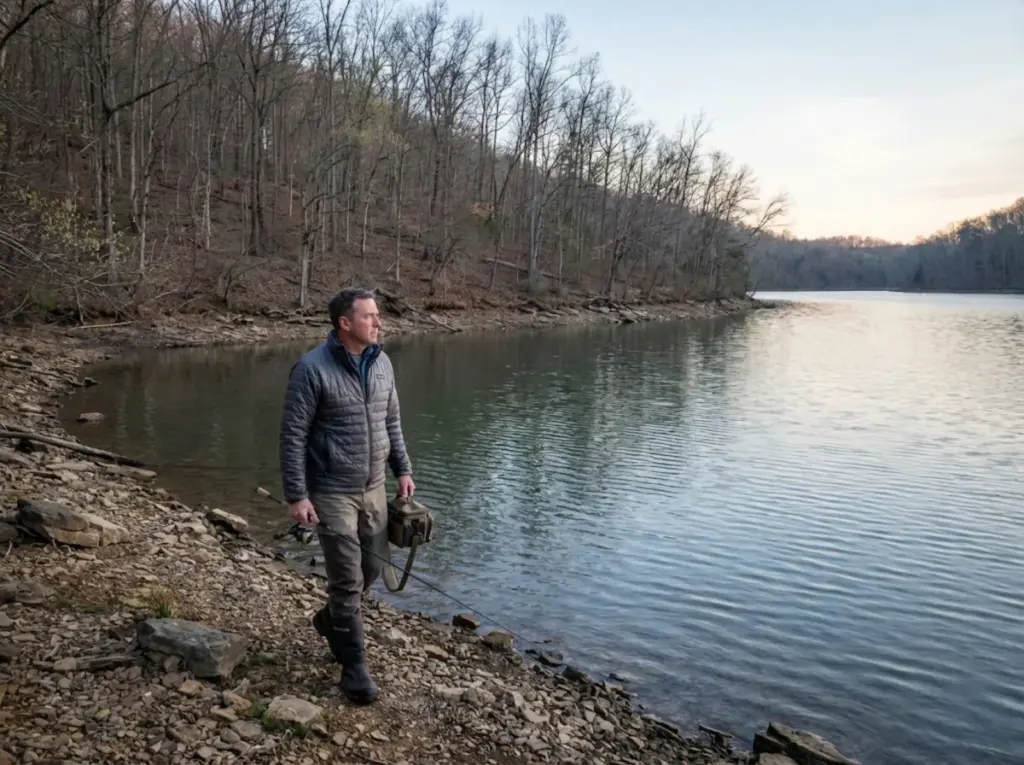
Water temperature dynamics follow a predictable annual cycle. Knowing when surface temps matter—and when they’re meaningless—helps you fish smarter across every season.
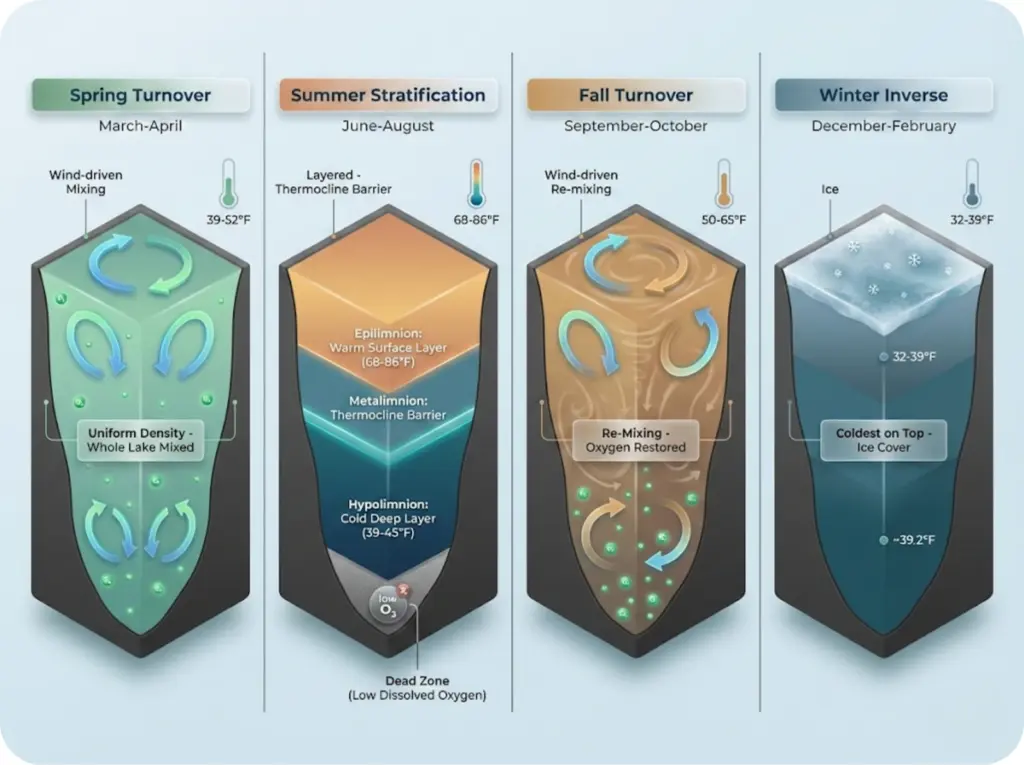
Spring Turnover Opens the Whole Lake
As ice melts and surface water warms toward 39.2°F, the entire lake reaches uniform water density. Wind forces complete mixing—dissolved oxygen distributes throughout the water column. During this brief window, surface temperature actually means something because the whole lake is the same temp from surface to bottom.
South-facing pockets warm first. These protected coves become “staging areas” where big prespawn females stack before the main spawn push. While main-lake surfaces might read 52°F, a south-facing pocket can be 5-10°F warmer.
Pro tip: Focus on small, south-facing pockets adjacent to deep water during early spring. These “spring pockets” warm faster than main lake surfaces and attract staging females before anyone else finds them.
Summer Stratification Creates the Habitat Squeeze
Continued solar heating locks in the three-layer model. The thermocline pushes deeper as summer progresses—starting at 15 feet in June, possibly reaching 25+ feet by August in clear lakes. The hypolimnion becomes a dead zone. Bacteria decomposing organic matter on the lake bottom consume available oxygen, creating hypoxic or anoxic conditions where fish simply cannot survive.
Striped bass and other gamefish face what biologists call the “habitat squeeze.” The surface is too warm (they avoid water temperatures above 84°F), and the bottom lacks oxygen (they need at least 5 mg/L of dissolved oxygen). This forces them into a narrow band in the metalimnion—the only viable corridor for active feeding.
This section of the water column becomes incredibly predictable. According to Illinois EPA lake stratification research, this squeeze effect intensifies throughout summer as the epilimnion warms and the hypolimnion loses oxygen.
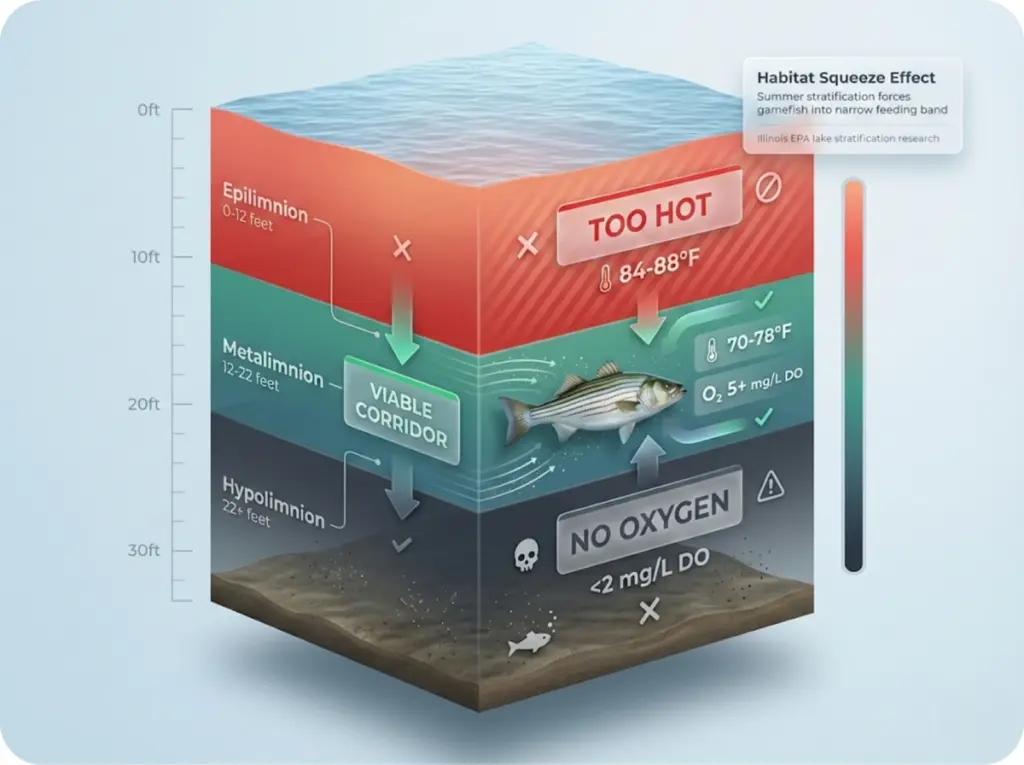
In ultra-clear oligotrophic lakes, you may even encounter double thermoclines—a primary and a secondary deeper layer—requiring you to probe multiple depths to find the productive zone.
Fall Turnover Scrambles Everything
As air temperature drops, the epilimnion cools and sinks, eroding the thermocline. The telltale signs are unmistakable: that sulfur smell rising from the water, murky appearance where it was clear days before. The lake is mixing.
When temperatures equalize, wind forces complete the mixing again. Fish scatter during active turnover—they’re confused and position randomly. But once mixing completes, they reposition vertically, and you can start trusting surface readings again, at least briefly.
Post-turnover patterns often push bass and other predators to chase baitfish near the surface. For specific tactics during this transition, check out fall bass transition patterns where depth selection becomes critical.
How to Find the Thermocline on Your Electronics
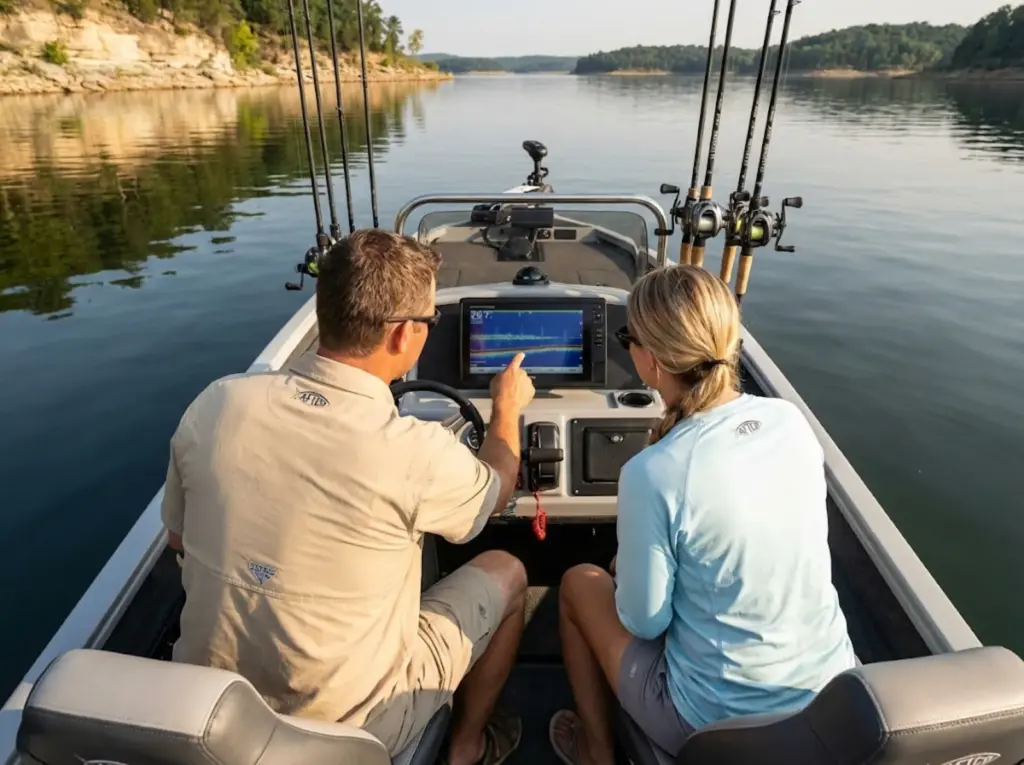
Knowing the thermocline exists is one thing. Seeing it on your screen is another. Most anglers have the equipment to locate it—they just don’t know what they’re looking at.
Reading the “Fuzzy Line” on 2D Sonar
The thermocline appears as a horizontal “fuzzy band” or “clutter line” stretching across your Humminbird, Garmin, or Lowrance display. This band represents the density transition where your sonar signal reflects off the boundary between warmer water above and colder water below.
Most anglers mistake it for interference and filter it out. That’s a costly mistake.
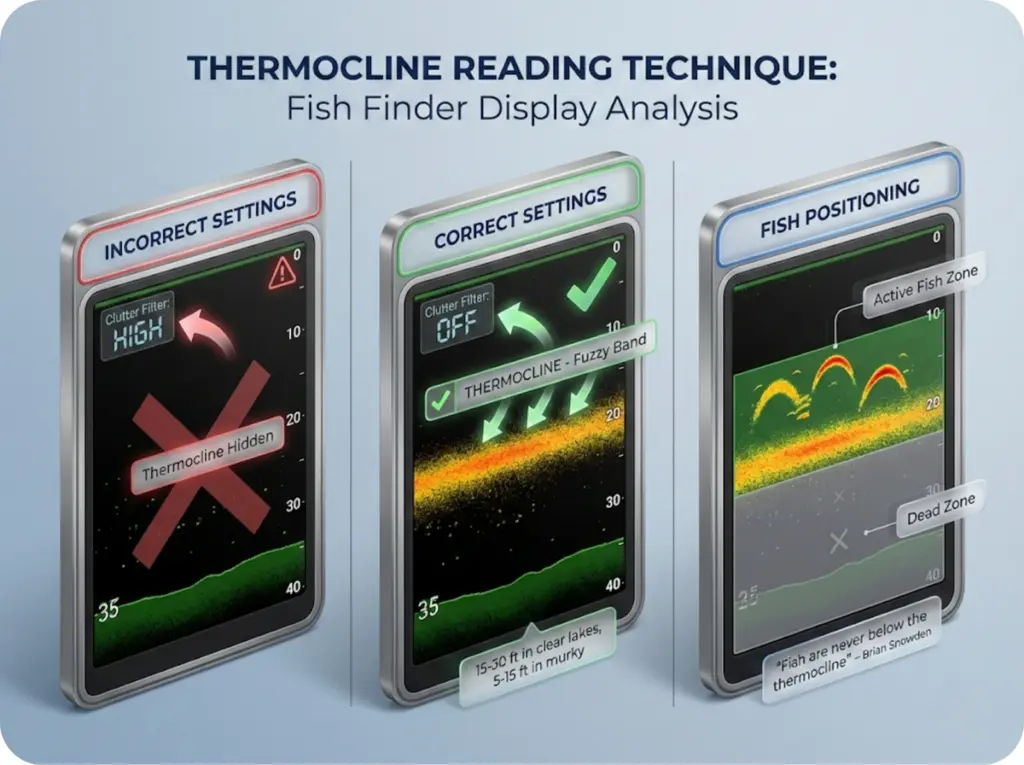
The band typically appears between 15-30 feet in clear summer lakes, 5-15 feet in murky lakes. Fish arches almost always appear ABOVE this line—because that’s where adequate dissolved oxygen levels support life. As Elite Series pro Brian Snowden puts it: “Fish are never going to be below the thermocline.”
Optimizing Sonar Settings to See the Thermocline
Default sonar settings filter out the very signal you need to see. To reveal the thermocline on your reading your fish finder display:
Disable TVG (Time Varied Gain) interference filter—this smooths out the density signal you want to see. Increase Gain on 2D sonar until you see noise, then back off slightly. For Down Imaging, maximize Contrast and Brightness to 100%.
Search the deepest basin of your lake first. You need a full vertical profile of the water column before hunting structure. The thermocline depth is relative to the surface regardless of location—identify it in open water, then hunt for where structure intersects that depth.
Using a Temperature Probe for Verification
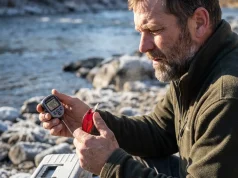
Sonar shows you the line. A probe tells you the actual temperature readings at specific depths. Devices like the Fish Hawk TD attach to a downrigger cable, lead core rig, or weighted line and digitally record water temperature at 5-foot intervals—down to 300 feet.
This verification matters because the “fuzzy line” on screen may not perfectly correspond to your target temp. Largemouth bass prefer 68-78°F. Stripers like it cooler. Knowing the exact temperature at the thermocline boundary lets you dial in your depth with precision.
The Fish Hawk TD has a 5-year battery lifespan and waterproof molded-in design. Set it, drop it, and trust the numbers. For seasonal stratification patterns from a government conservation authority, see the Missouri DNR pond stratification guide.
Fishing the “Temperature-Oxygen Corridor” Species-by-Species
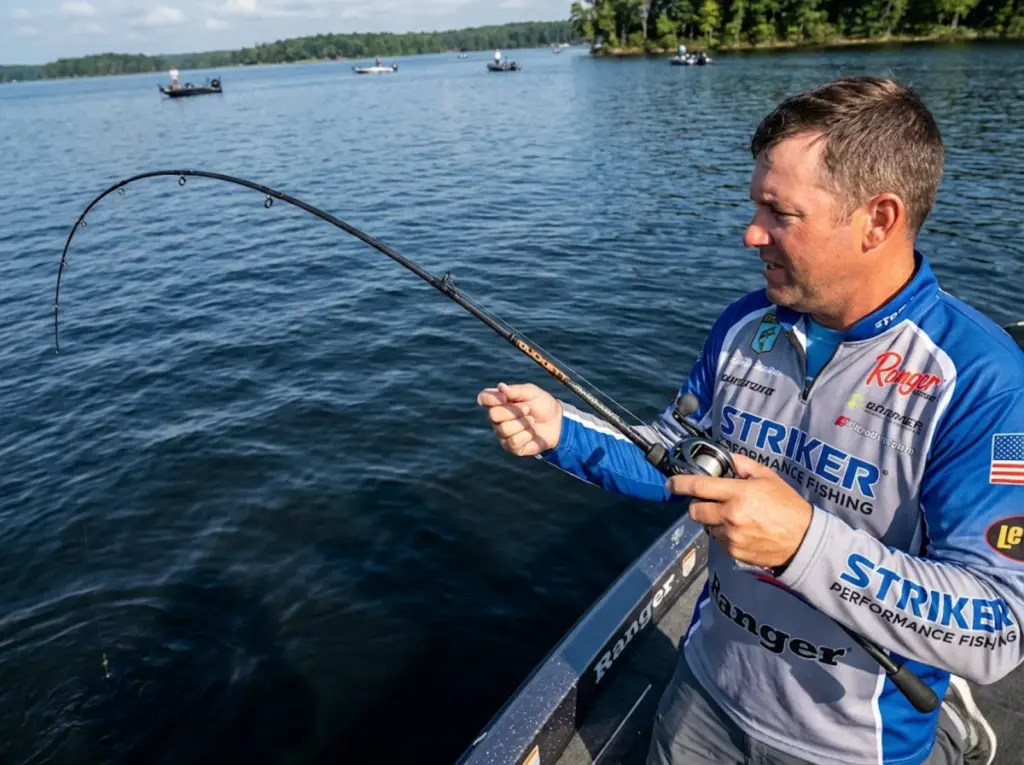
Different species respond to thermal stratification differently. Understanding their thermal and oxygen needs tells you exactly where in the water column to target them.
Bass Position Relative to the Thermocline
Largemouth bass rarely stay below the thermocline in summer—even if the best-looking structure sits deeper. They position along structure that intersects the thermocline depth—what some pros call the “motherload spot.”
Optimal bass temperature range: 68-78°F. They become stressed above 84°F and need at least 5 mg/L of dissolved oxygen to thrive. Jacob Wheeler explains it simply: “Locating the thermocline eliminates half of the water on any given lake. It tells you where the baitfish and bass want to be.”
Pro tip: Find where a submerged hump, point, or ledge intersects the thermocline depth. This “sweet spot” on structure concentrates baitfish and predators in a narrow band you can target with precision using drop shot rigs or crankbaits.
Striped Bass and the Summer Squeeze
Striped bass face the most dramatic squeeze. They require at least 5 mg/L dissolved oxygen and avoid water above 84°F—non-negotiable limits. The “Temperature-Oxygen Squeeze” (called the Coutant Hypothesis in scientific literature) forces entire striper populations into a 3-5 foot band of the metalimnion.
This compression makes them highly predictable. If you locate the thermocline in Chesapeake Bay or any stratified reservoir using Chesapeake Bay striper hotspots as a guide, you’ve found the fish.
Note: summer thermal stress leads to high delayed mortality in stripers. During peak heat, consider releasing them quickly at depth or practicing catch-and-release ethics to protect the fishery.
Cold-Water Species Need Different Math
Trout and walleye have lower thermal optima—50-65°F for trout, 55-70°F for walleye. They may position WITHIN or BELOW the thermocline in summer, the opposite of bass.
Trout need 6-7 mg/L dissolved oxygen—they’re even more oxygen-dependent. This pushes them to cold tailwaters and deep oxyclines during summer. In winter, the 39.2°F density maximum at the bottom provides a thermal sanctuary where cold-water species remain active while bass go dormant.
Strong winds can create a “seiche” effect that physically tilts the thermocline—creating deep warm water zones on one end of the lake and shallow cold zones on the other. If your normal spots aren’t producing, move downwind and check thermocline depths again.
Common Mistakes That Lose Fish
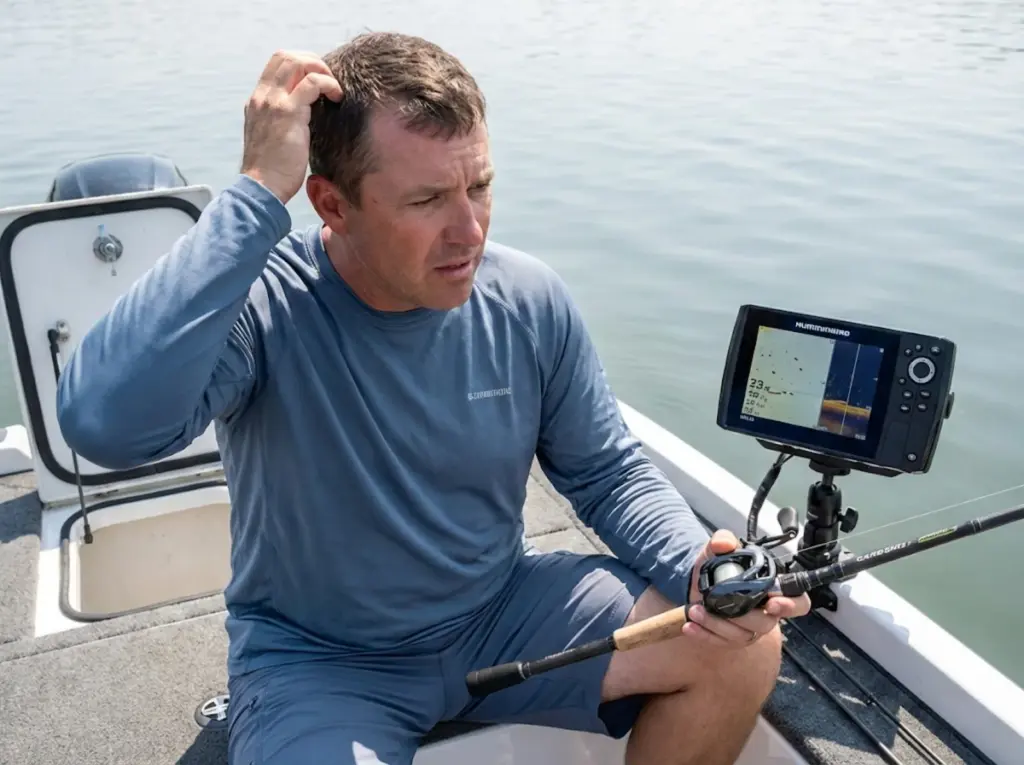
Knowing what to do is half the battle. Avoiding common errors completes the picture.
Fishing the Bottom When the Thermocline is Shallower
Many anglers target 40-foot structure in August when the thermocline sits at 15 feet. If your baits aren’t getting bit on deep structure, you’re probably fishing the dead zone where fish literally cannot survive.
Always verify thermocline depth before committing to a deep-water pattern. A five-minute scan of a deep basin with your sonar tells you where the ceiling is. Fish above it, not below.
Waiting for “Perfect” Surface Temps Before Fishing
Kevin VanDam cuts through the most persistent myth: “Water temperature is just a number… often overrated and trumped by photoperiod and moon phase.”
Lengthening days trigger prespawn movement before surface temps hit traditional “magic numbers.” Moon phases can pull fish shallow even in sub-optimal readings. VanDam has documented “false spawns” triggered by lunar cycles in water that should have been too cold.
Trust behavioral cues—baitfish activity, bite windows, visual feeding—over arbitrary temperature thresholds. Surface water temperature is useful directional data, but it’s not definitive for fish positioning.
For more on timing your fishing trips, understand that dissolved oxygen levels, light conditions, and seasonal photoperiod often matter more than the number on your screen.
Conclusion
Three things separate anglers who struggle in summer heat from those who limit out:
First, they understand that surface temperature is the most volatile layer of the water column—subject to 3-4°F swings every day while deeper water stays stable.
Second, they use sonar settings and probes to find the thermocline—the true boundary of fish habitat. That “fuzzy line” isn’t interference; it’s the most valuable target on your screen.
Third, they target the temperature-oxygen corridor where gamefish actually live, not the depths where they’d die from oxygen depletion.
Next time your hull sensor reads 85°F and you’re tempted to head home, drop a line to 15 feet and check what’s really happening. The fish aren’t suffering through the heat—they found the comfortable water temperatures an hour ago. Now you know where to find them too.
FAQ
Does surface water temperature match deeper water?
No. Surface temps can be 10-15°F warmer than water just 15-20 feet down during summer stratification. The three-layer structure means the epilimnion fluctuates dramatically while the hypolimnion stays relatively constant. Always assume significant temperature differences during stratified conditions.
How do you measure water temperature at depth?
The most reliable method is a dedicated probe like the Fish Hawk TD, which attaches to a weighted line and records temperature at specific depth intervals. You can also use sonar to visualize the thermocline as a fuzzy line, then correlate it with surface readings plus known stratification patterns.
What is a thermocline in fishing terms?
The thermocline is the boundary layer in a stratified lake where temperature drops rapidly with increasing depth. It appears as a horizontal fuzzy band on 2D sonar. Fish typically position above this line because the water below it lacks sufficient dissolved oxygen for survival.
At what depth does water temperature change?
It depends on water clarity and turbidity. In murky lakes, the thermocline may form at 5-10 feet. In clear lakes, expect 16-30+ feet. Search the deepest basin of your lake on sonar to find the exact depth for that day—it shifts through summer as the epilimnion expands.
Why cannot fish survive below the thermocline?
The hypolimnion is isolated from atmospheric oxygen. Bacteria decomposing organic matter on the lake bottom consume available oxygen, creating hypoxic or anoxic conditions. Bass need minimum 5 mg or L dissolved oxygen, trout need 6-7 mg or L. Without it, they simply cannot survive—making everything below the thermocline a biological dead zone during summer stratification.
Risk Disclaimer: Fishing, boating, and all related outdoor activities involve inherent risks that
can lead to injury. The information provided on Master Fishing Mag is for educational and informational purposes
only. While we strive for accuracy, the information, techniques, and advice on gear and safety are not a substitute
for your own best judgment, local knowledge, and adherence to official regulations. Fishing regulations, including
seasons, size limits, and species restrictions, change frequently and vary by location. Always consult the latest
official regulations from your local fish and wildlife agency before heading out. Proper handling of hooks, knives,
and other sharp equipment is essential for safety. Furthermore, be aware of local fish consumption advisories. By
using this website, you agree that you are solely responsible for your own safety and for complying with all
applicable laws. Any reliance you place on our content is strictly at your own risk. Master Fishing Mag and its
authors will not be held liable for any injury, damage, or loss sustained in connection with the use of the
information herein.
Affiliate Disclosure: We are a participant in the Amazon Services LLC Associates Program, an
affiliate advertising program designed to provide a means for us to earn advertising fees by advertising and linking
to Amazon.com. As an Amazon Associate, we earn from qualifying purchases. We also participate in other affiliate
programs and may receive a commission on products purchased through our links, at no extra cost to you. Additional
terms are found in the terms of service.