

In this article
The ramp was packed for opening day, trucks jammed bumper to bumper. When you turned the key—nothing. Just the hollow click of a starter solenoid struggling against a battery that spent four months quietly dying in your garage. That $2,000 LiveScope unit you ran all season? It was still drawing power, milliamp by milliamp, while you were shoveling snow. By December, your electrolyte had diluted enough to freeze solid during that cold snap. Now you’re watching the first boat of the morning idle out while you’re on the phone with a marine shop that won’t have a Group 31 AGM until Thursday.
After 20 years of winterizing fishing gear for clients and my own fleet, I’ve seen this scene play out hundreds of times. The good news: it’s completely preventable. This guide breaks down exactly why boat batteries fail over winter—from the parasitic loads of modern fishing electronics to the precise voltage thresholds that separate a preserved battery from a cracked case—so your batteries wake up ready when bass season does.
⚡ Quick Answer: Boat batteries die over winter primarily due to parasitic drain from modern electronics (Power-Pole pumps, sonar modules, NMEA networks) combined with the physics of discharged electrolyte freezing. Prevention requires physically disconnecting all cables—master switches aren’t enough—and maintaining 100% state of charge for lead-acid or proper storage charge for lithium. A fully charged battery won’t freeze until -92°F; a dead one freezes at +20°F.
The Electrochemistry of Winter Failure
Understanding why batteries fail in storage—not just how to prevent it—separates the anglers who show up ready on opening day from the ones making panicked phone calls.
Self-Discharge: The Silent Bleed
Even with no load connected, your battery is losing charge right now. Self-discharge is an internal chemical process where sponge lead and lead dioxide react with sulfuric acid to form lead sulfate, releasing energy as heat. This happens inside every lead-acid battery, every hour of every day—no parasitic draw required.
Temperature accelerates this process dramatically. The rate of chemical reactions roughly doubles for every 18°F increase in temperature. That’s why a flooded battery stored at 77°F in your heated basement loses charge faster than one in a cold shed at 40°F.
Here’s the paradox for anglers: cold storage actually slows self-discharge to 0.3-0.5× the rate at room temperature. But cold also introduces freezing risk if the state of charge drops too low. AGM batteries self-discharge at 1-3% monthly; flooded cells lose 4-8% monthly. Over a 4-month winter, even with zero parasitic load, a flooded battery can drop from 100% to 68% SoC—pushing toward the danger zone.
Pro tip: A cool, dry shed at 50°F is the sweet spot—cold enough to slow chemistry, warm enough that a charged battery won’t freeze. Heated basements and garages accelerate degradation.
The Freezing Point Equation
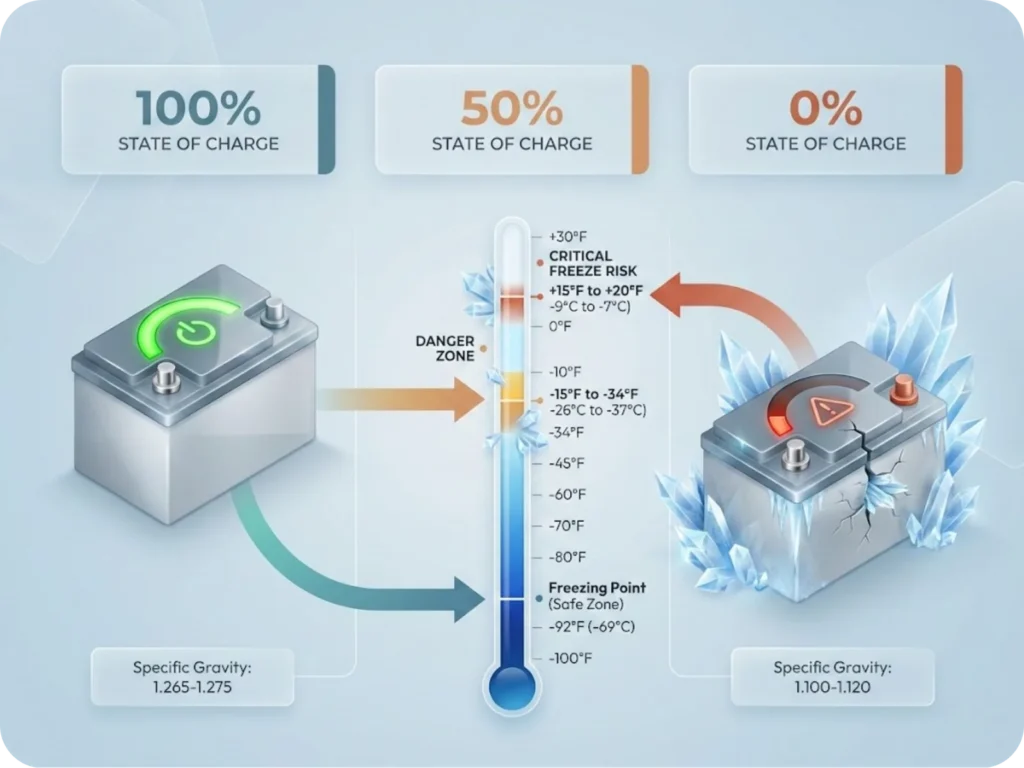
A fully charged lead-acid battery contains high-concentration sulfuric acid with a freezing point around -92°F—safe in any climate on Earth. But as the battery discharges, sulfate ions leave the electrolyte to form lead sulfate on the plates. What remains is increasingly diluted acid—essentially water.
At 50% state of charge, the electrolyte freezing point rises to -15°F to -34°F—the danger zone for Minnesota and Wisconsin anglers. At 0% charge, the electrolyte freezes at +15°F to +20°F—barely colder than a mild winter night in Texas.
When electrolyte freezes, ice expands by approximately 9% in volume. Inside a sealed battery case, this expansion exerts hydraulic pressure that cracks polypropylene cases, crushes lead plates, and punctures separators. This damage is permanent and irreversible. No charger can fix a frozen battery—you’re looking at a $300-500 replacement.
Lithium’s Hidden Vulnerability: The 32°F Charging Cutoff
LiFePO4 batteries don’t freeze like lead-acid—there’s no liquid electrolyte to expand. But they have a different fatal flaw that catches many anglers by surprise.
During charging, lithium ions move from the cathode through the separator to intercalate (insert) into the graphite anode. At normal temperatures, this process is efficient. But below 32°F, ion diffusion slows dramatically. If you force a charging current into the battery under these conditions, lithium ions accumulate on the anode surface as metallic lithium—a phenomenon called lithium plating.
Lithium plating is irreversible. It permanently reduces capacity and can form dendrites—sharp, needle-like structures—that puncture the separator and cause internal shorts. This is why LiFePO4 can be discharged safely to -4°F, but must never be charged when the internal cell temperature is below freezing.
For anglers, this creates a critical trap: if you store lithium batteries in an unheated garage and voltage drops during winter, you cannot plug them into a charger during a January cold snap. You must bring the batteries inside to warm up before charging—or risk permanent damage the manufacturer won’t warranty.
When choosing a trolling motor battery, understanding these low-temperature limitations is essential.
The Parasitic Load Ecosystem
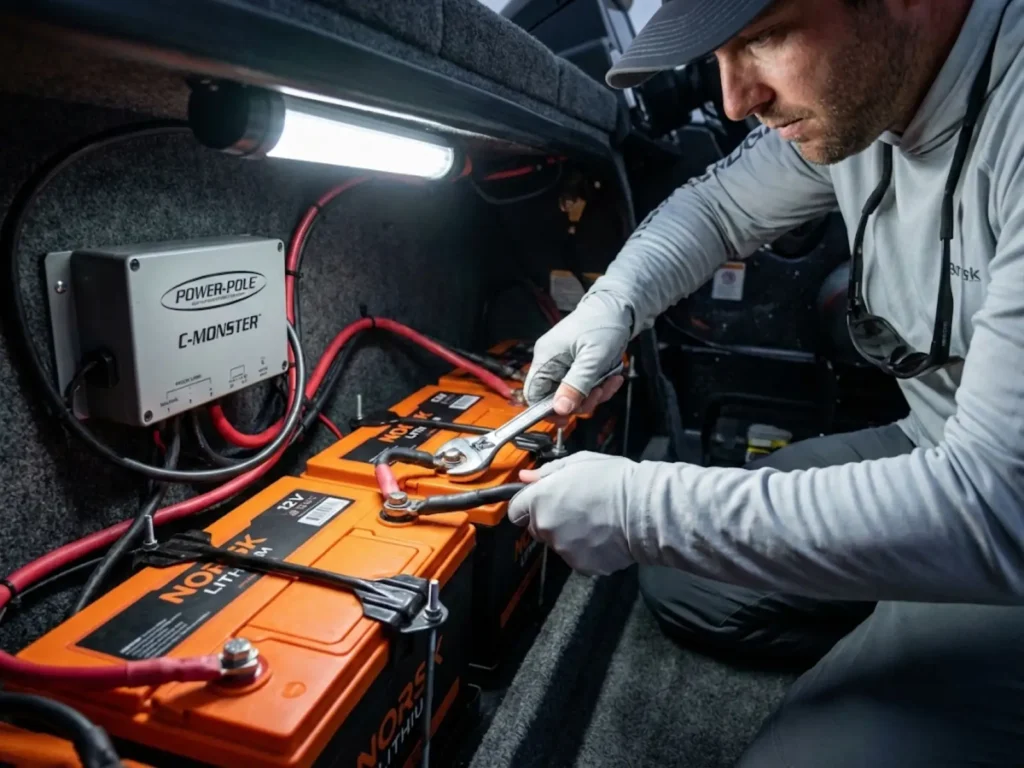
While thermodynamic principles set the boundaries for battery survival, the primary driver of failure in modern vessels is the ecosystem of parasitic loads—the milliamp-level draws from electronics that never fully turn off.
Modern Fishing Electronics: The Milliamp Killers
A Power-Pole C-Monster 2 system draws 25-40mA continuously to maintain wireless communication with remotes and apps. That’s 1Ah per day, 30Ah per month, 120Ah over a 4-month winter—more than a typical Group 31 battery holds.
A Garmin GLS10 LiveScope module wired to unswitched power can draw up to 1.5A when idle. A 100Ah battery depletes in under 3 days.
NMEA 2000 networks remain energized if the power drop connects to constant 12V. Each device on the network has a Load Equivalency Number where 1 LEN equals 50mA. A modest network with 5-6 devices draws 300-400mA continuously.
The standby trap is especially insidious. Lowrance units in “Standby” mode still draw significant current—”Standby” is not “Off.” Understanding how NMEA 2000 network wiring affects parasitic draw helps you identify which circuits need isolation.
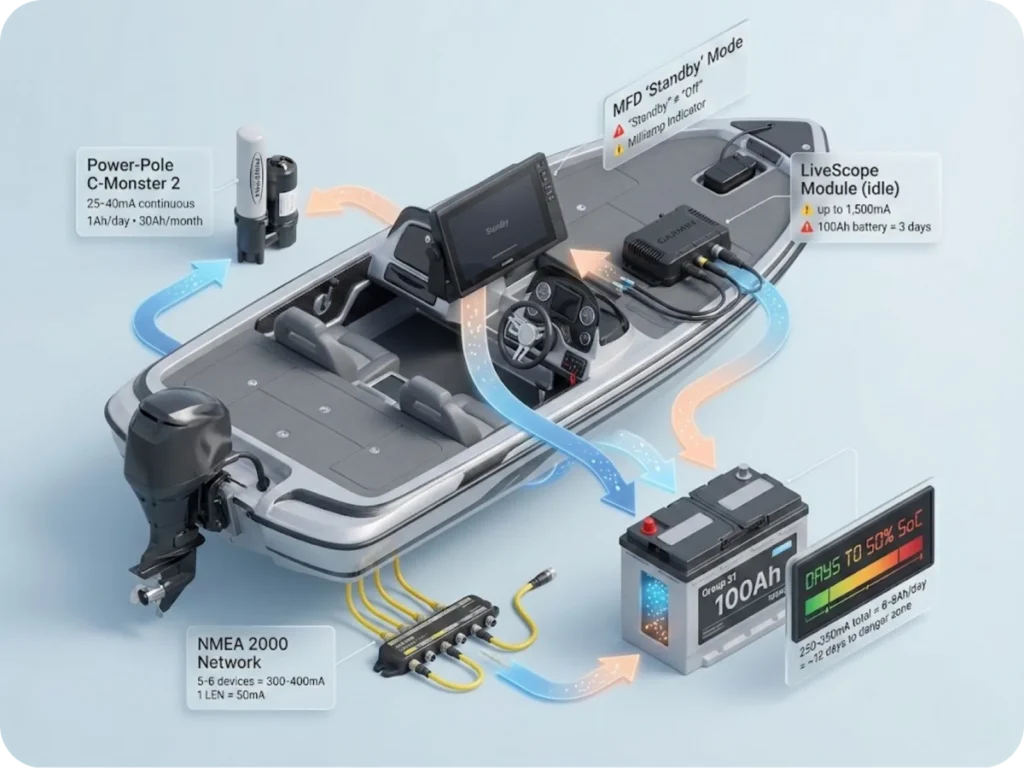
Pro tip: Add up every device on your boat—Power-Pole, graphs, transducers, Bluetooth gateways, livewell timers. Total standby draw on a rigged bass boat often hits 250-350mA. That’s 6-8Ah per day. Your 100Ah cranking battery is in the danger zone inside two weeks.
The Physical Disconnect Protocol
Master battery switches are insufficient. Many electronics bypass them or wake periodically. The only guaranteed solution is physical disconnection—removing the negative cable from the battery terminal entirely.
For 24V/36V trolling motor banks, disconnect the series jumper cables between batteries. This prevents a failing cell in one battery from draining neighbors through internal shorts. Trip all heavy-load breakers (trolling motor, windlass) even after disconnecting cables.
Take photos of terminal connections before disconnecting. Spring commissioning goes faster when you know exactly where every cable belongs.
Lead-Acid Pathology: Sulfation and Stratification
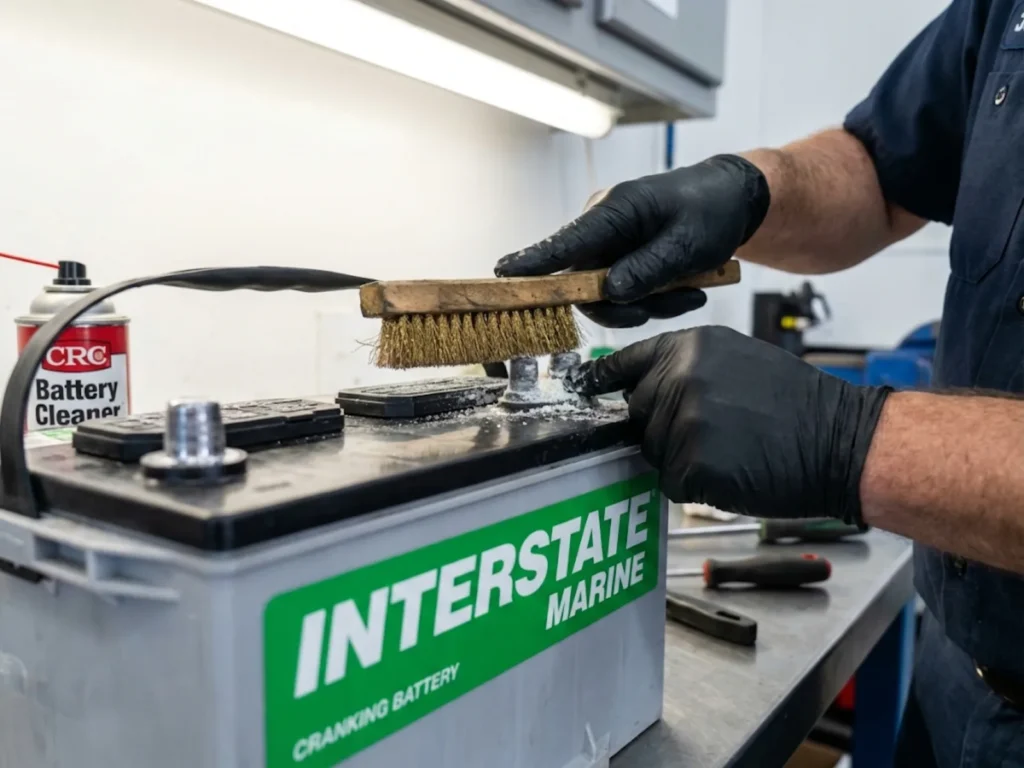
The dominant chemistry for marine applications remains lead-acid—including flooded (wet), AGM, and Gel types. Each has specific vulnerabilities during storage, but all share the common enemy of sulfation.
The Crystallography of Sulfation
During normal discharge, lead and lead dioxide convert to amorphous lead sulfate—a soft, finely divided form that’s easily reversed during charging. But if the battery sits discharged for weeks, thermodynamic restructuring transforms this into crystalline (hard) sulfate—electrically insulating and nearly irreversible.
Hard sulfation permanently reduces plate surface area, increasing internal resistance and reducing Cold Cranking Amps and Reserve Capacity. In spring, a sulfated battery may show 12.7V immediately off the charger—that’s just surface charge. When the starter motor engages, voltage collapses instantly. Click-click-click at the ramp.
The prevention threshold is simple: never let open circuit voltage drop below 12.4V during storage. If it does, recharge immediately. The connection between battery health and overall gear maintenance protocols cannot be overstated.
Stratification in Flooded Cells
For traditional flooded batteries, stationary storage introduces acid stratification. Heavier sulfuric acid settles to the bottom; water rises to the top.
The top of the cell becomes dilute electrolyte that accelerates plate corrosion and freezes more easily. The bottom becomes concentrated acid that artificially raises open-circuit voltage readings and promotes rapid sulfation on plate bottoms.
Stratification is normally corrected by boat movement or the gassing phase during charging. In winter storage, neither occurs. Flooded batteries need periodic equalization charges—controlled overcharges that cause gassing to mix the electrolyte—or maintenance on smart chargers with equalization mode.
AGM: The Odyssey Protocol
AGM batteries use glass mat separators that immobilize electrolyte, eliminating stratification. Self-discharge rates run 1-3% monthly, and manufacturers like Odyssey claim storage retention up to 2 years at 25°C.
But AGM batteries are not immune. If open-circuit voltage drops below 12.0V (approximately 35% SoC), hard sulfation begins. And recovering a deeply discharged AGM requires high-amperage charging—at least 40% of the C10 rating. A 2-amp trickle charger cannot break down sulfation on a 100Ah AGM bank.
Many AGM batteries declared “dead” in spring were simply too sulfated for a weak charger to recover. Before scrapping, try a charger with desulfation mode at 25A or higher.
Lithium Storage: The BMS Equation
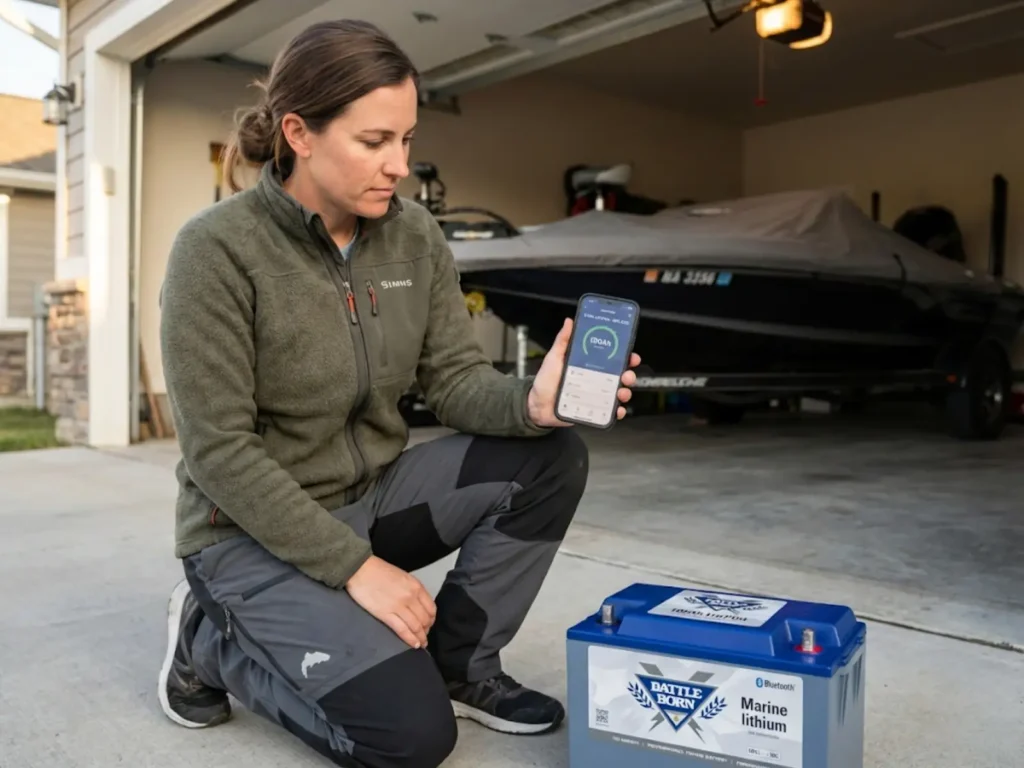
LiFePO4 batteries are replacing lead-acid in trolling motor applications due to their high energy density and voltage stability. But their reliance on a digital Battery Management System creates unique storage challenges.
The BMS Parasitic Loop
Unlike lead-acid—a purely chemical device—a lithium battery is a “smart” device containing a computer. The BMS monitors cell voltage, temperature, and current. To do so, it draws power from the cells it protects—continuously, internally, around the clock.
If lithium is stored at very low SoC (below 10%), BMS draw can eventually pull cell voltage below the critical low-voltage cutoff (typically 2.5V per cell). When this triggers, the BMS disconnects terminals internally. Your multimeter reads 0V, and in severe cases, electrolyte decomposition makes cells unrecoverable.
Manufacturers like Battle Born recommend charging to 100% before storage to provide maximum buffer against BMS drain. When selecting lithium trolling motor batteries, understanding BMS behavior is critical.
The Deep Sleep Alternative
Some manufacturers have solved the BMS parasitic problem. Norsk Lithium features a Deep Sleep mode—a button or app command that shuts down non-essential BMS functions, reducing self-discharge to near zero.
In Deep Sleep, the BMS severs terminal connections internally. No need to physically disconnect cables from the boat—the battery has already isolated itself. Norsk calculates over 11 years to discharge in this mode.
Storage SoC for Deep Sleep: 50-60% (lower stress on cathode). Storage SoC without Deep Sleep: 100% (maximum buffer against parasitic drain). Either way, never charge lithium if ambient temperature is below 32°F.
Smart Chargers: Your First Line of Defense
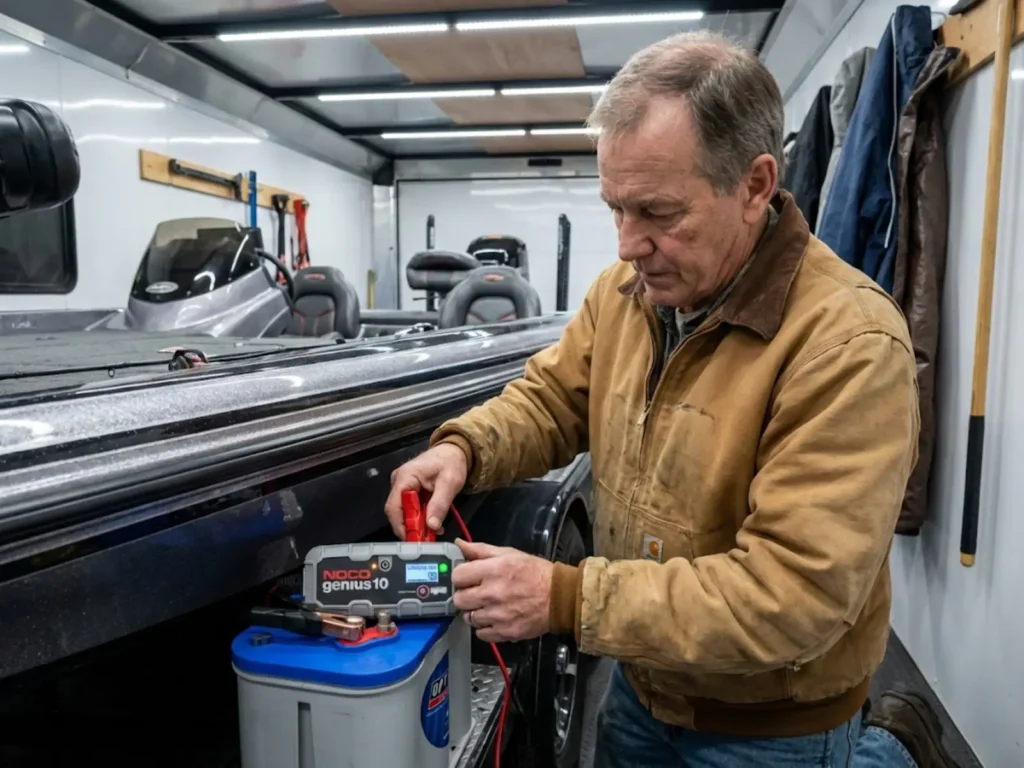
The charger used during winter lay-up is as critical as the battery itself. The common practice of using a cheap automotive trickle charger on a marine battery is a leading cause of failure.
Multi-Stage Charging Algorithms
Traditional trickle chargers apply constant low current. Left indefinitely, they overcharge the battery—boiling electrolyte in flooded cells or venting AGM valves into dry-out and failure.
Modern smart chargers (NOCO Genius, Minn Kota Precision, Victron) use multi-stage algorithms: Bulk (constant current to raise voltage), Absorption (constant voltage to complete charge), Float/Maintenance (low voltage to counteract self-discharge without overcharging), and Desulfation for lead-acid (high-voltage pulses to break down sulfate crystals).
For lithium, the charger must have a dedicated Lithium mode. This eliminates desulfation and equalization stages—which would destroy lithium with high voltage—and uses correct profiles (typically 14.4-14.6V bulk, no float or specific lower float).
Temperature Compensation
Lead-acid charging voltage requirements change with temperature. Cold batteries need higher voltage to fully charge. A charger set to 14.4V at 80°F delivers effectively 13.8V at 30°F—chronic undercharging results.
Smart chargers with integrated temperature sensors auto-adjust: higher voltage in cold, lower in heat. As Victron’s cold weather charging documentation explains, without temperature compensation, batteries charged in freezing garages remain undercharged—vulnerable to sulfation and freezing.
Temperature-compensated chargers run $80-150. They protect $300+ AGM batteries from cold-weather undercharge damage. The math works.
Regional Risk: Where You Store Matters
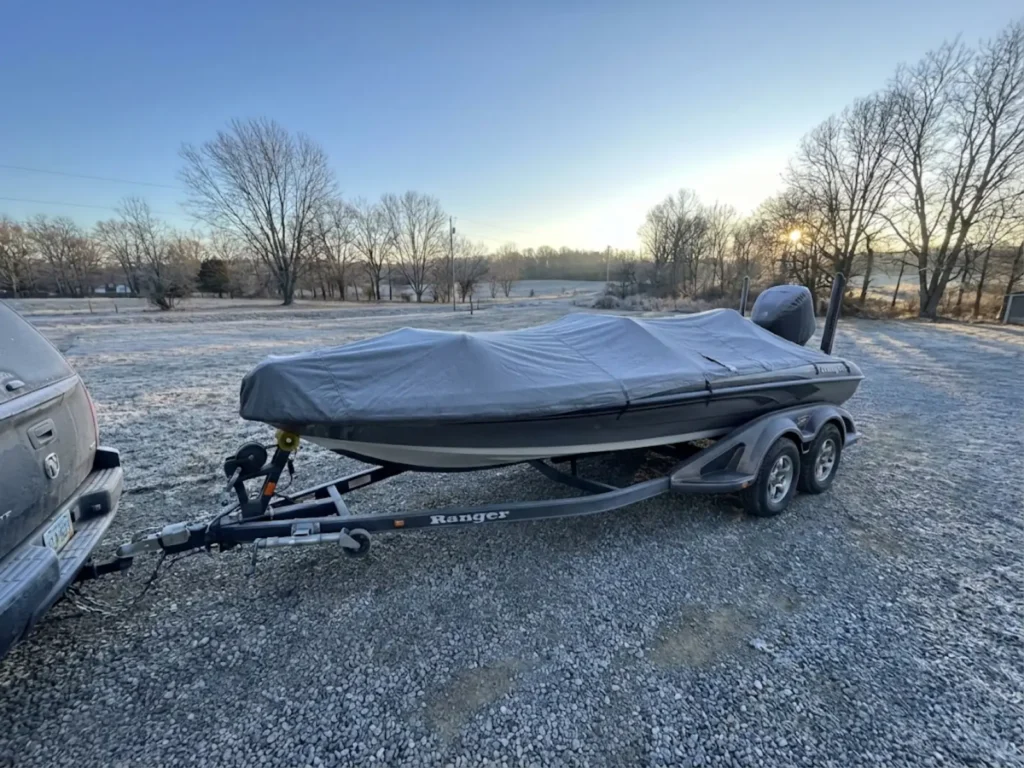
The risk of winter battery failure is geographically stratified based on climate patterns and—just as importantly—boater psychology.
The Guaranteed Freeze Zone
In Minnesota, North Dakota, and Maine, hard freeze (consistently below 28°F) arrives mid-October to early November. Boaters here winterize rigorously by necessity. The risk is typically component failure—leaving a battery in an unheated shed—rather than procedural ignorance.
The depth problem is real: freezing penetrates deep into these climates, and any battery below 75% SoC is at serious risk. Protocol: full charge to 100%, physical disconnect, storage in insulated space or with temperature-compensated maintainer.
The Unpredictable Freeze Zone
Counter-intuitively, Texas often leads the nation in marine freeze-related insurance claims. “Soft winter” psychology leads boaters to assume mild conditions. They leave boats connected with bilge pumps running on shore power, thinking the winter will be easy.
Then a polar vortex drops temperatures into the teens for 48 hours. Shore power fails or the charger trips. The bilge pump drains the battery. The electrolyte freezes and cracks the case.
For Texas coastal fishing enthusiasts and southern boaters generally, the protocol is the same as up north: full charge plus physical disconnect by November 1st, regardless of weather forecasts. Assume the worst.
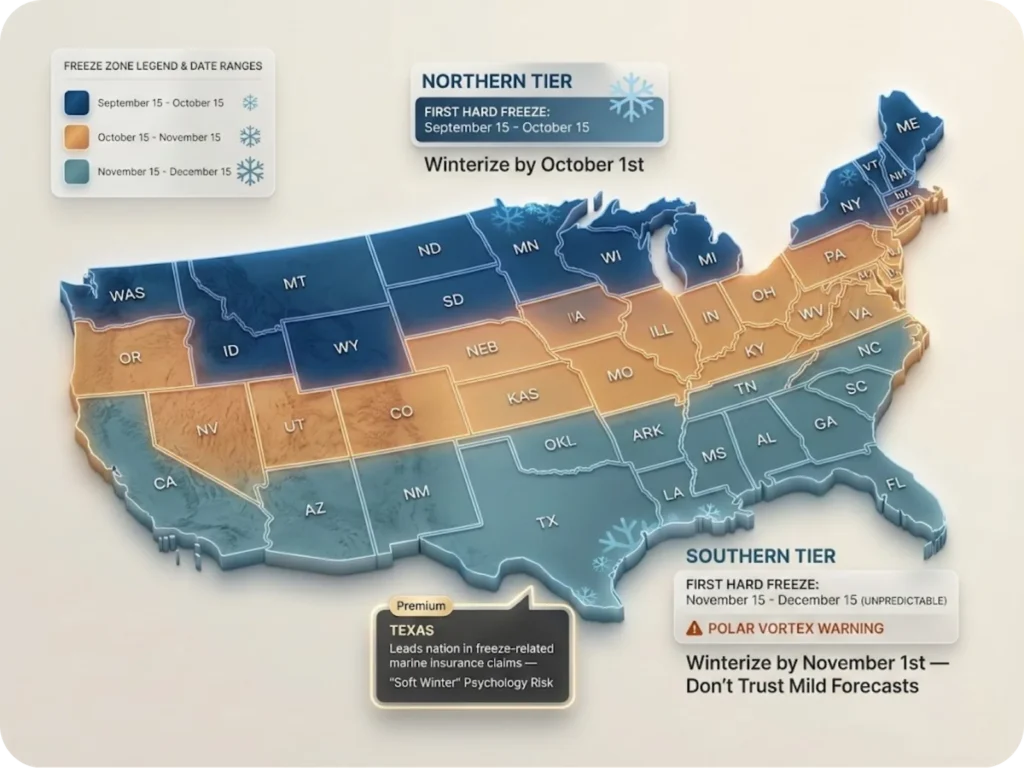
Pro tip: Southern anglers who think they don’t need to winterize are the ones filing insurance claims when the cold front hits. The polar vortex doesn’t check your latitude.
Conclusion
The “dead boat battery spring” isn’t bad luck—it’s predictable electrochemistry that you can prevent.
Three takeaways:
- Physical disconnect is the only guarantee. Master switches don’t stop Power-Pole pumps, NMEA networks, or sonar black boxes from drawing milliamps around the clock.
- Charge chemistry matters. Lead-acid wants 100% SoC; lithium depends on whether you have Deep Sleep mode. Neither can be safely charged below freezing.
- Your region defines your risk. Minnesota anglers know winter is coming. Texas anglers are the ones watching their electrolyte freeze during the one cold snap they didn’t prepare for.
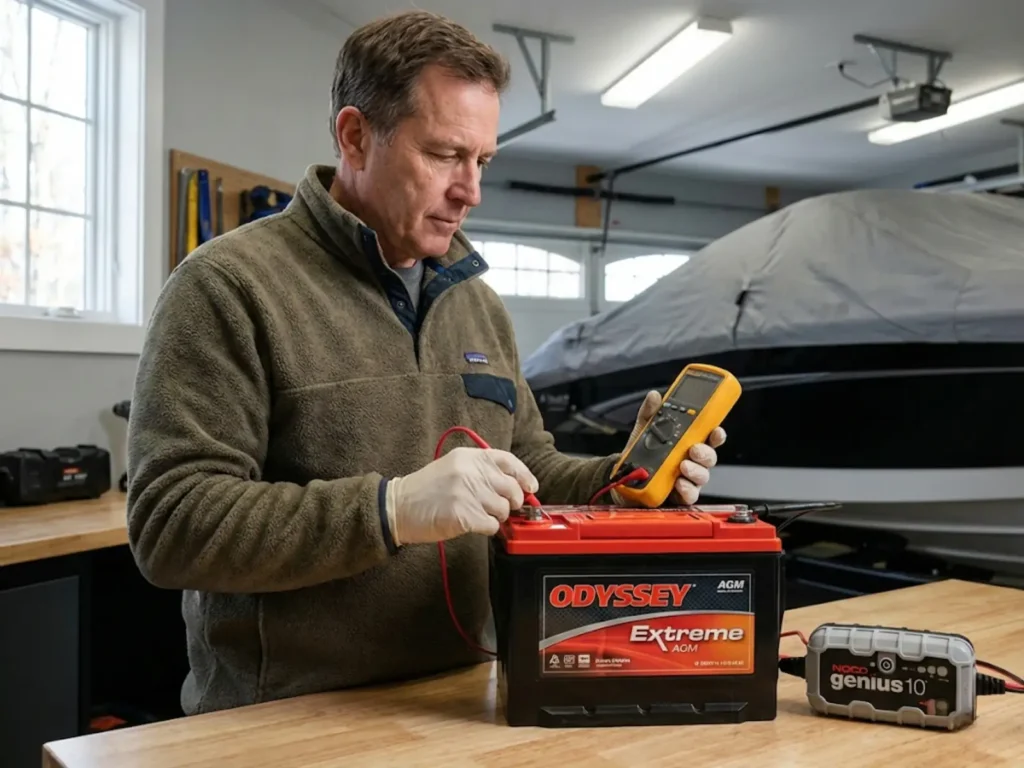
Before you cover the boat this fall, grab a multimeter. Document every battery’s voltage. Calculate your total parasitic draw. Then disconnect—physically—and set a calendar reminder to check voltage in 6 weeks. Your opening day depends on what you do today.
FAQ
Should I remove my boat batteries for winter storage?
It depends on climate and storage conditions. In northern states with consistent sub-zero temperatures, removing batteries to a climate-controlled space is safest. In moderate climates, batteries can remain onboard if fully charged to 100% SoC and physically disconnected. The key is eliminating parasitic drain and ensuring SoC stays above 50% throughout winter.
Can boat batteries freeze in winter?
Yes—but only if they are discharged. A fully charged lead-acid battery will not freeze until -92°F. At 50% charge, the freezing point rises to -15°F. A completely dead battery freezes at +20°F—barely below a mild winter night. Keeping batteries at 100% SoC is the primary freeze prevention.
Is it better to trickle charge or disconnect boat batteries?
Disconnect first, then decide on maintenance charging. A smart maintainer (not an old-style trickle charger) is beneficial for flooded lead-acid in accessible locations. For AGM or lithium, full charge plus physical disconnection is often sufficient for 4-6 month storage. The worst option is leaving batteries connected to parasitic loads with no maintenance.
How often should I charge boat batteries in winter storage?
Check voltage every 4-6 weeks. For lead-acid, recharge if OCV drops below 12.4V. For lithium, check via Bluetooth app if available; top up only if voltage drift is observed AND ambient temperature is above 32°F. Batteries on smart maintainers do not need manual checks.
Can I charge my lithium boat battery in a cold garage?
Only if internal cell temperature is above 32°F. Charging lithium below freezing causes permanent damage through lithium plating on the anode. If your garage is below freezing, bring the battery inside to warm up before charging. Most quality LiFePO4 batteries have BMS low-temperature protection that refuses charging below freezing—but do not rely on protection alone.
Risk Disclaimer: Fishing, boating, and all related outdoor activities involve inherent risks that
can lead to injury. The information provided on Master Fishing Mag is for educational and informational purposes
only. While we strive for accuracy, the information, techniques, and advice on gear and safety are not a substitute
for your own best judgment, local knowledge, and adherence to official regulations. Fishing regulations, including
seasons, size limits, and species restrictions, change frequently and vary by location. Always consult the latest
official regulations from your local fish and wildlife agency before heading out. Proper handling of hooks, knives,
and other sharp equipment is essential for safety. Furthermore, be aware of local fish consumption advisories. By
using this website, you agree that you are solely responsible for your own safety and for complying with all
applicable laws. Any reliance you place on our content is strictly at your own risk. Master Fishing Mag and its
authors will not be held liable for any injury, damage, or loss sustained in connection with the use of the
information herein.
Affiliate Disclosure: We are a participant in the Amazon Services LLC Associates Program, an
affiliate advertising program designed to provide a means for us to earn advertising fees by advertising and linking
to Amazon.com. As an Amazon Associate, we earn from qualifying purchases. We also participate in other affiliate
programs and may receive a commission on products purchased through our links, at no extra cost to you. Additional
terms are found in the terms of service.