
In this article
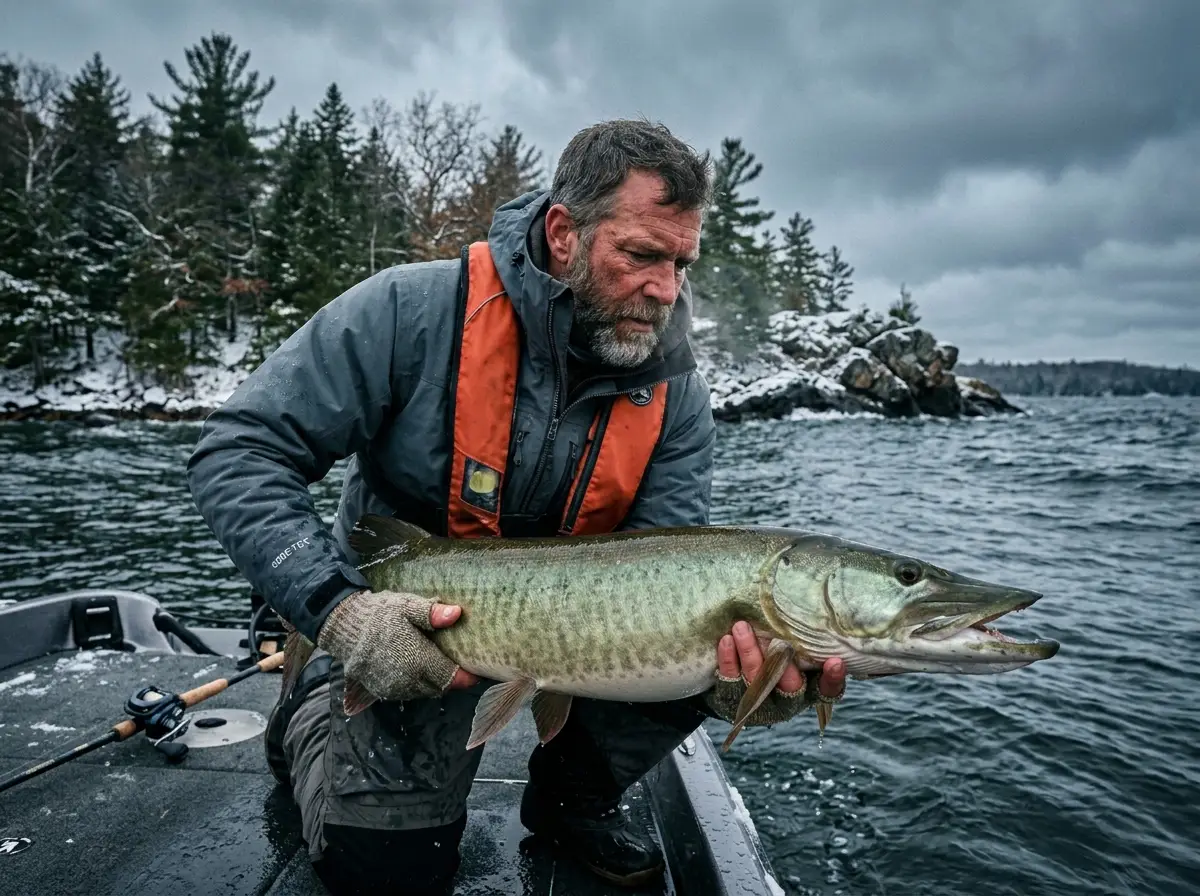
It’s 5:47 AM in late October. Your fingers are numb, rod guides iced over, when the line doubles clean to the grip. A 54-inch musky has picked up the sucker you nearly reeled in twenty minutes ago. You never heard it coming.
That fish didn’t bite out of luck. Everything that put it in that spot — its relationship to water temperature, its forage math, the pressure event two days prior — is predictable. If you understand the biology behind fall musky feeding patterns, you stop guessing and start fishing with intent.
⚡ Quick Answer: Fall musky behavior is temperature-indexed, not calendar-driven. As water temperature drops from 60°F to 38°F, muskies shift from aggressive hunters to calculated ROI predators — targeting large, high-calorie forage that justifies the energetic cost of a strike. The trophy window runs from 52°F to 44°F, when ciscoes and white suckers migrate to shallow rock reefs. Slow your retrieve, upsize your presentation, and don’t leave the water after a lake turnover event — the best bite of the whole fall follows within days.
Why the Fall Musky Is a Completely Different Animal Than the One You Fished in July
Most anglers assume musky behavior scales linearly across seasons — just slow it down a little. That assumption costs fish.
The Q10 Coefficient and What It Really Means for the Fish on Your Line
Muskies are ectothermic. Their body temperature tracks the water, and their metabolism tracks with it. The Q10 Temperature Coefficient describes this: for every 10°C (18°F) drop in water temperature, enzymatic reaction rates — digestion, muscle contraction, neural response — slow by a factor of 2 to 3. This is documented in research on the effect of temperature on fish metabolism.
When you transition from 70°F summer water to 45°F late-fall water, the musky’s metabolic capacity has been cut by more than 50%. A fish that crushed a bucktail at 12 feet of distance in August may only respond within 2–3 feet in October. Not because it’s passive — because the energy cost of accelerating over 12 feet doesn’t pencil out against a small caloric return.
Understanding fish metabolism and water temperature is the whole game in late fall. Every presentation decision — speed, size, depth, pause — flows from this one biological fact.
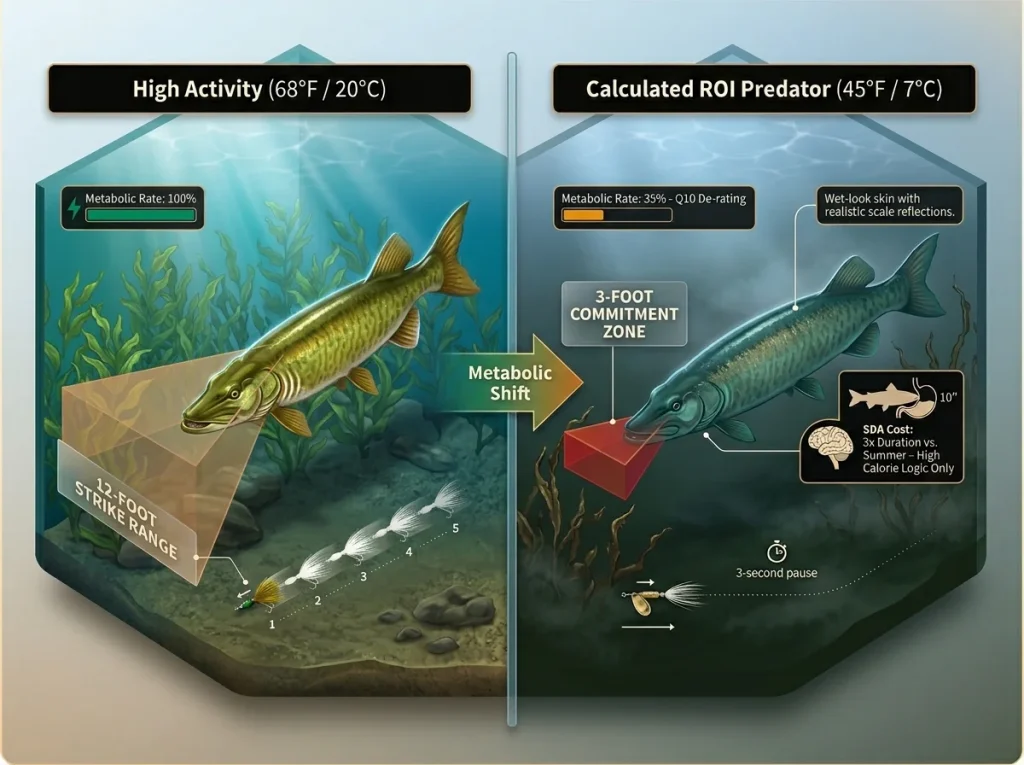
Pro tip: If you think you’re fishing slow enough in late October, slow down again. The strike happens on the third second of the pause — not the first.
The ROI Predator — Why Big Lures Win in Cold Water
In summer, a musky can chase small prey because digesting those calories is fast. In cold water, Specific Dynamic Action (SDA) — the energy cost of processing a meal — increases relative to what the fish can spare. The math flips.
According to muskellunge diet and prey size research, muskies consistently target forage averaging 20% of their body length. A 50-inch fish goes after 10-inch prey. In fall, that number trends up. Large female muskies consume roughly 48 lbs of forage annually, with the heaviest caloric loading hitting in October.
In cisco lakes, those high-fat salmonids account for up to 50% of the fall diet. In non-cisco lakes, bullheads can make up 90%. Your lure selection has to match what’s actually in the water, not what worked all summer. This is where muskellunge biology and ambush predator mechanics directly informs tackle choice.
Pete Maina said it plainly: “Watch the gulls. If they’re working a rock hump in 15 feet of water, the ciscoes are spawning underneath them — and so are the giants.”
Gonadal Maturation — The Drive Most Anglers Miss Entirely
Anglers frame fall feeding as “winter prep.” The biology says otherwise.
Starting in October, muskies develop eggs and milt for the following spring spawn. That demands a high-lipid diet specifically in October and November. The fall feed isn’t about surviving winter — it’s about building eggs. That’s reproductive urgency, and it’s stronger than any survival signal.
Dr. Ed Crossman’s telemetry research showed that once water temps drop below a critical threshold, musky home ranges expand or collapse into “gypsy” behavior — fish wandering well beyond their summer structure. The late-fall musky can show up anywhere. That is not a pattern failure. That’s biology running its own schedule.
The Three Stages of the Fall Descent — A Temperature-Indexed Field Guide
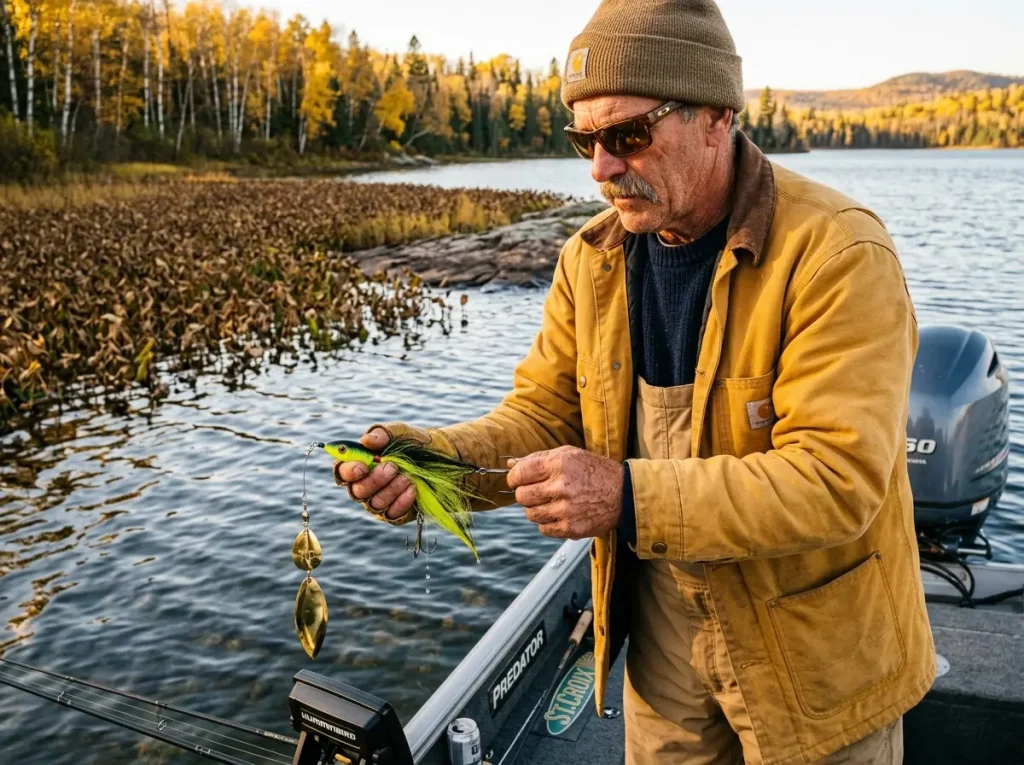
Forget the calendar. Watch your temperature probe.
Stage One — The Weed Edge Transition (60°F–55°F)
At 60°F, muskies still work weed edges and inside turns. The bite is faster and more predictable. As temps slide through 55°F, yellow perch lose their cover — dying vegetation drops oxygen output, perch move to flats — and you’ve got an exposed buffet forming at collapsing weed beds.
Work inside weed edges and points where weeds transition to rock. Run bucktails at reduced speed with longer pauses. South-facing shallows hold green weeds longer due to solar exposure; check those last before moving to deep rock structure.
If you’re not reading water temperature below the surface with a depth probe, surface gauge readings are lying to you — they lag significantly behind what’s happening at weed-edge depth.
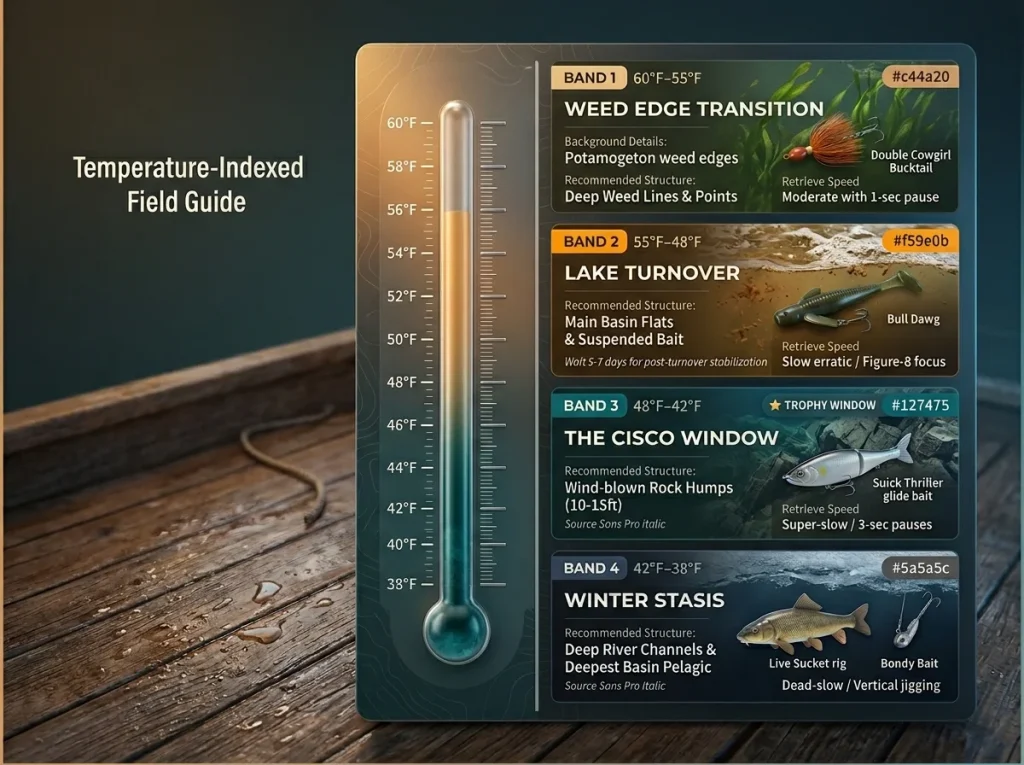
Stage Two — Lake Turnover and the “Turnover Funk” (55°F–48°F)
This is the most misunderstood event in fall fishing. When the surface layer cools to match the dense hypolimnion below, the thermocline dissolves. According to lake turnover and water density dynamics, water reaches maximum density at 39.2°F (4°C). A single high-wind event can fully mix the entire water column at that point.
The result: murky water, floating decaying vegetation, and a sulfurous odor from hypoxic bottom gases. You can’t miss it. The fish feel it too — rapidly fluctuating oxygen and chemistry push them into 3–5 days of near-shutdown.
Here’s where most anglers make the critical mistake: they leave. I watched a lake produce nothing for six straight days during turnover. On day seven, after the water hit isothermal equilibrium and stabilized, we had the best musky day I have ever seen on that body of water. Every angler who left the weekend before missed it.
Don’t leave. The Post-Turnover Stabilization Period can be a strike-per-cast environment. The physics of lake turnover explains what you’re waiting for and how to identify it.
Pro tip: When the water smells like rotten eggs and looks like tea, mark the date. Come back on day six or seven. That’s your window.
Stage Three — The Cisco Window and Peak Feeding (48°F–40°F)
This is the trophy window. Ciscoes and whitefish migrate from deep water to shallow rock reefs for autumn spawning. Large muskies abandon weed edges entirely to follow this oily, high-calorie forage to rocky structure. White suckers are simultaneously moving to food shelves. Two separate forage migration events happening at once.
Jim Saric puts it clearly: the difficulty of late-fall isn’t just metabolic slowdown — it’s shortened day length compressing feeding windows. When the window is 90 minutes instead of four hours, you need maximum time in the water.
Target shallow rocky reefs at 8–15 feet, wind-blown rock points, and food shelf transitions to deep basins. The structural logic for reading fall depth transitions applies across species — it’s the same thermodynamic reality at a larger scale.
Lure Hydrodynamics in Cold Water — What Physics Does to Your Presentation
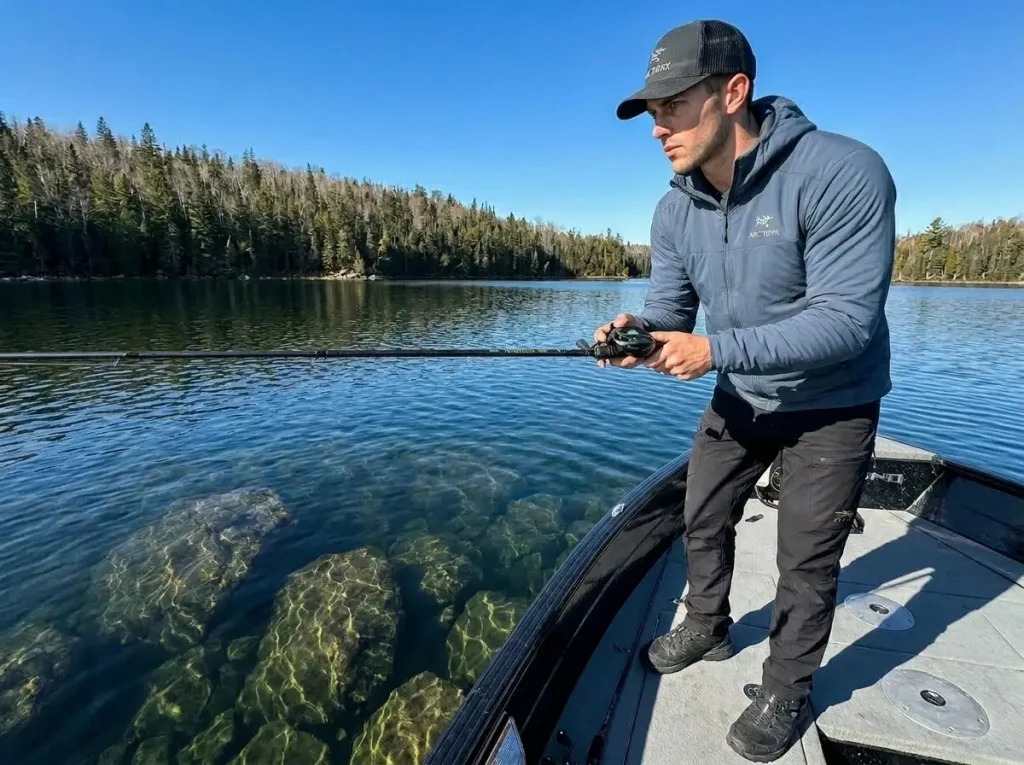
The “Thick Water” Effect — Why Your Lure Has Never Fished This Way Before
Cold water is physically denser and more resistant. The kinematic viscosity of water increases measurably as temperature drops — USGS and HEC-RAS models confirm it. You can feel this through the rod.
A #10 Colorado blade in 45°F water requires roughly 10–15% more rotational force than at 68°F. Its stall speed drops, the thump slows to a heavier cadence. If you’ve fished the same bucktail all season and noticed it “feels different” in October, that’s the viscosity increase. Your rod tip is reading temperature without a thermometer.
Burning blades at summer speed in cold water pushes the spinner past its effective RPM range. Slow the reel down. The musky’s lateral line is most sensitive at 10–20 Hz — frequency, not speed. You want displacement and presence, not velocity. Understanding how the lateral line detects low-frequency vibration tells you exactly what signal you’re trying to send.
The Buoyancy Problem — Why Your “Suspending” Jerkbait Now Floats
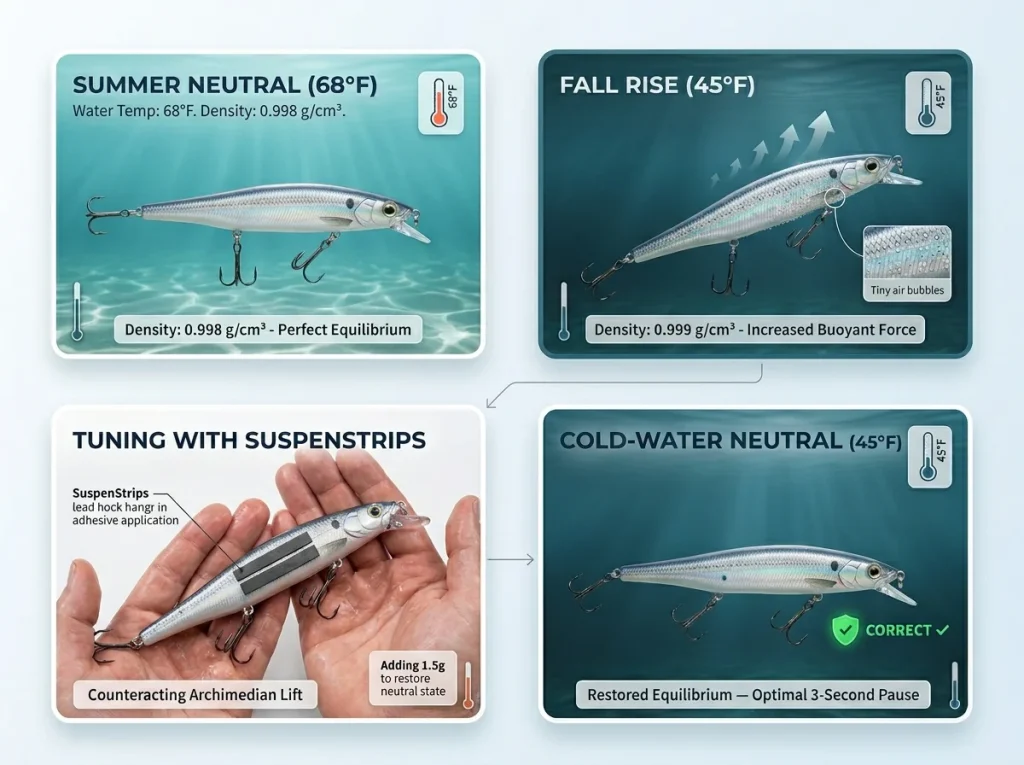
Denser water provides more upward buoyant force. A jerkbait tuned to neutral suspension at 68°F will rise in 45°F water. Not a manufacturing defect — thermodynamics. The fix is SuspenStrips applied to the belly until the lure returns to neutral. Test before you hit the water, not while you’re fishing.
Flip side: soft plastics like Chaos Tackle Medussa and Musky Mayhem Bull Dawg sink slower in dense cold water. Extended hang time in the strike zone for a fish that won’t chase more than two feet. Tuning lure buoyancy using Archimedes’ principle takes the guesswork out of cold-water lure prep.
The “Hang Time” Cadence — Engineering the Strike Window
Chas Martin’s data from late-fall guide trips: 90% of strikes happen when the bait is stationary. The motion attracts attention. The pause is the trigger.
Glide baits — Phantom Glider, Suick Thriller — are the right tool. A Suick dives on the pull, hangs on the pause. The lateral displacement without forward momentum is exactly what a slow-reacting cold-water musky can track and commit to. Summer retrieve: constant movement at 4–6 mph. Fall retrieve: erratic motion, 3-second pauses, 1.5–2 mph forward progress.
The third second of the pause. That’s when the fish commits. If you’re reeling through that moment, you’re fishing past every strike window. Mastering jerkbait cadence across water temperatures is worth an hour of your time before the season peaks.
The Barometric Variable — Reading Cold Fronts Like a Musky Does
The Pre-Front Feeding Binge — Why the Hour Before the Storm Is Gold
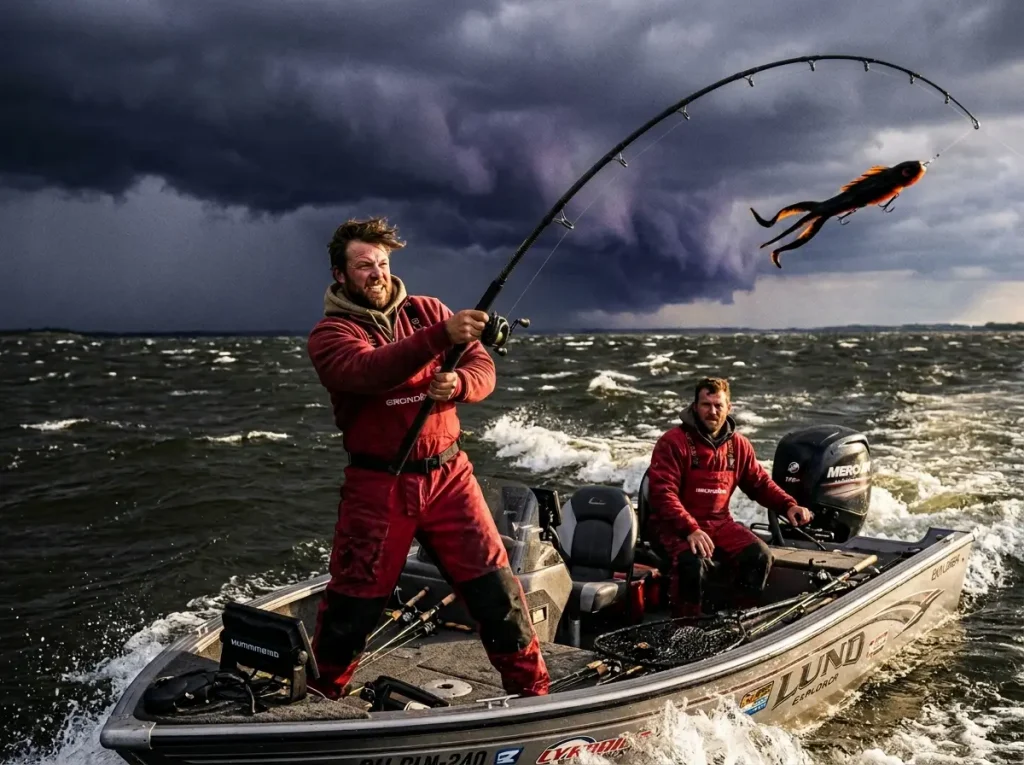
Muskies are physoclistous — their swim bladder is a closed system. They can’t vent gas the way trout can. Gas exchange runs through the Rete Mirabile, a capillary bed that diffuses slowly. When barometric pressure drops ahead of an incoming cold front, gas inside the bladder begins to expand. The fish feels something changing.
Response: before pressure fully drops, muskies feed aggressively — a 2–4 hour window that most anglers drive away from when storm clouds build. Watch for a rapidly falling barometer, northwest wind shift, darkening sky on the horizon. That combination is a pre-front feeding window. Use large rubber or live suckers — maximum caloric payload, minimum chase energy. How cold fronts affect fish behavior hour by hour lays out the full timing framework.
The Post-Front Shutdown — The 48-Hour Rule and Where Fish Hide
Once the front arrives, swim bladder gas has expanded and the fish is physically uncomfortable — internal pressure with no way to equalize. The Rete Mirabile off-gassing process takes 24–48 hours. The physoclistous swim bladder regulation failure is mechanical, not behavioral.
Fish move deeper where water pressure counteracts internal expansion, or retreat into heavy cover. The 48-Hour Rule: expect the bite to resume two days after the major front passes. Swim bladder mechanics under pressure changes explains the timeline in detail.
Location Logic — Reading Structure After the Thermocline Collapses
Why Deep Rock Is the New Weed Flat After Turnover
Before turnover, the hypolimnion is hypoxic — muskies can’t hold there. Post-turnover, oxygenated water floods those depths and rock structure at 20–35 feet becomes viable habitat for the first time since spring.
According to Wisconsin musky fishery management and population data, maximum musky growth potential occurs in lakes larger than 2,000 acres. In these systems, post-turnover rock humps, bluff walls, and steep transitions adjacent to deep basins are the primary targets. Cisco schools scatter post-spawn. Muskies follow.
Wind-Blown Rock Points — Where Forage Concentrates First
Sustained northwest winds at 15+ mph push surface water — and everything riding it — against windward structure. Ciscoes, perch, suckers: stacked against the face of that rocky point within hours.
Fish the windward face. Position upwind, cast into structure, work shallow to deep. It’s uncomfortable fishing. That’s why it works. Jim Saric’s late-fall trolling prescription: parallel to the windward face at 1.5–2 mph with large crankbaits or magnum soft plastics. How wind concentrates baitfish on windward structure gives you the full framework.
Using Sonar to Read the Post-Turnover Water Column
Post-turnover, the column is isothermal — no thermocline line on sonar. That’s normal. Look for baitfish clouds suspended 5–15 feet off the bottom in 20–40 feet of water. Muskies appear as single arches slightly below or beside those clouds, not inside them.
A Fish Hawk temp probe confirms isothermal state — uniform temperature top to bottom means turnover is complete and fish should be recovering or recovered. Reading sonar during thermocline collapse tells you exactly what you’re looking for on screen.
Late-Fall Gear Selection — The Physics-Informed Loadout
Lure Selection by Temperature Window
- 58°F–52°F: Bucktails at reduced speed — Double Cowgirl, #10 Colorado blades. Suick Thriller for windy rocky points.
- 52°F–46°F: Shift to large rubber — Chaos Tackle Medussa, Musky Mayhem Bull Dawg. One high-pay presentation over multiple small ones.
- 46°F–40°F: Glide baits with SuspenStrips added. Phantom Glider, Suick Thriller. Hang time over action.
- Below 40°F: Live or cut suckers on quick-set rigs. Bondy Bait for vertical jigging from deep rock. Trolling at 1.5 mph with magnum crankbaits.
Lure size: 20% of predator length minimum. A 48-inch musky wants a 9–10 inch presentation. Don’t size down hoping to trigger more bites. In cold water, smaller means ignored. See musky tackle selection and tactics overview for full specs.
Rod and Reel Requirements for Late-Fall Conditions
Heavy rubber baits require high-torque reels. The Shimano Tranx 400/500 is the field standard. In freezing rain and sub-40°F conditions, your grip strength drops sharply — a high-torque reel still executes a clean figure-8 through numb hands.
St. Croix Legend Tournament Musky at 9–10 feet, heavy action — the length gives you the arc needed for proper glide bait work. Line: 80–100 lb braid with a 130 lb fluorocarbon leader. Heavier leader handles teeth during long cold-water fights.
One direct thing worth saying: a $500 rod doesn’t replace understanding the Q10 metabolic curve. Gear is the last 10%.
Conservation in Cold Water — Why Survival Rules Are Different in October
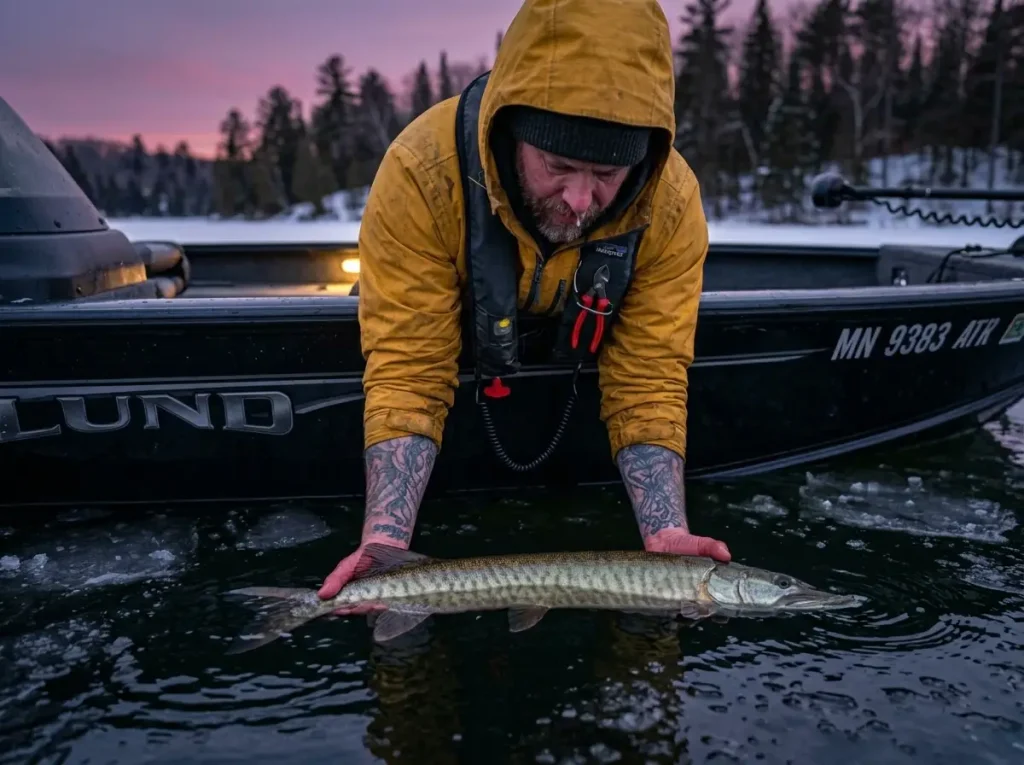
Cold Water, Lactic Acid, and the Silent Loss
Cold water holds more dissolved oxygen. That does not protect a musky from a long fight. Lactic acid from anaerobic exertion still accumulates, and metabolic processing of that acid is slower in cold conditions. A fish that swims away confidently after a 4-minute fight can perish 30–60 minutes later from delayed acidosis. “It swam away fine” is not a survival indicator.
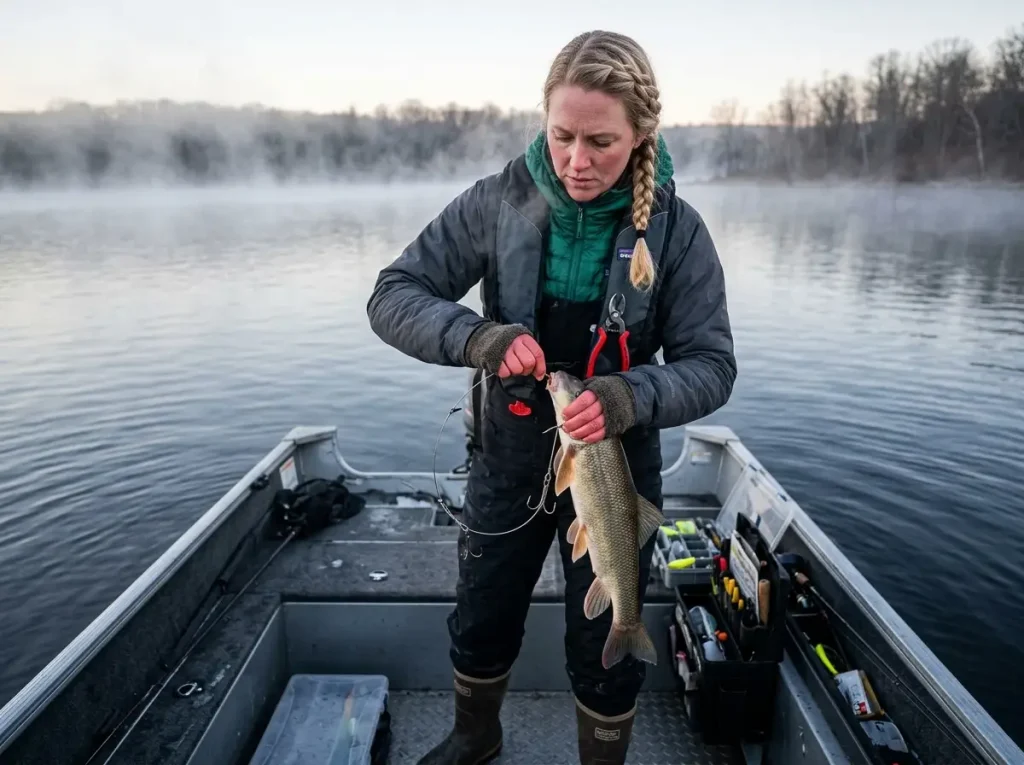
Cold air is more hazardous than cold water for the slime coat. At 30°F, a musky loses slime coat integrity faster than it would at 65°F. Target: 5-second maximum air exposure. Keep the fish in the net, submerged, until the hook is out and the camera is ready. Safe musky handling and cold-water release protocols covers everything from grip positions to net specs.
Barotrauma Risk in Deep-Water Vertical Jigging
Muskies caught from 25+ feet are at risk of swim bladder expansion during the fight. Minimize fight time — heavy gear brings a deep fish up quickly. Release immediately at the surface. No extended photo sessions.
Pro tip: Keep Knipex cutters on the life vest, not in the tackle box. Todd Schulz put it directly: “You have five seconds to react if you or the fish get pinned.” Cold hands are slow hands. Barotrauma and swim bladder pressure in deep-water fish explains the physiology.
The “Anti-Pumping” Protocol — Correcting 50 Years of Bad Revival Advice
Pumping a fish backward forces water across the gill filaments in the wrong direction. It’s counterproductive. Hold the fish horizontally in a natural swimming position, head facing current. Support the body — no vertical jaw-grip on a large musky. Wait for it to kick on its own.
In sub-38°F water, recovery takes 2–4 minutes. That’s normal. A fish rushed and released before it’s ready will roll at the surface. The correct fish revival and release technique has the full protocol.
Three Things That Change Your Next October Trip
The fall musky is an ROI predator. Its metabolism has been halved by cold water. Stop fishing for the fish you caught in July. Go big, go slow, go deep.
The Turnover is not your enemy. It’s a predictable physical event with a 3–5 day window. Stay on the water and the stabilization bite is yours. Most anglers never see it because they left.
Physics determines the strike, not luck. A suspending bait that floats, a blade at the wrong frequency, a fish off-gassing from a cold front — these are calculable. Apply the science, and what looked like luck starts to look like pattern recognition.
Mark water temperature on your phone before your next fall session. Not the date. If you’re at 48°F, you’re in the Cisco Window. Fish like you know it.
FAQ
What water temperature do muskies feed best in fall?
The most active window runs 52°F to 46°F. That’s when cisco and white sucker migrations coincide with gonadal maturation urgency. Fall stomach content surveys from the Minnesota DNR show food presence at 69% — nearly triple the spring rate of 25.4%. Below 42°F, feeding windows narrow sharply and presentations must approach stationary.
Where do muskies go in late fall after lake turnover?
Post-turnover, muskies shift to deep rocky structure — rock humps, bluff walls, and steep transition zones adjacent to deep basins. The Isothermal Mixing Event delivers oxygen to previously hypoxic depths, opening 20–35 foot zones that were off-limits all summer. Follow cisco schools on sonar: muskies hold just below or beside suspended baitfish clouds.
Is musky fishing good after a cold front?
Not for the 24–48 hours immediately following. The physoclistous swim bladder cannot rapidly vent expanded gas, and muskies retreat deeper or into heavy cover. The exception is the 2–4 hours before the front arrives — often the sharpest rapid-bite window of the entire fall season.
Why do muskies ignore small lures in fall but hit large ones?
Specific Dynamic Action increases in cold water relative to available metabolic energy. Chasing a small bucktail for a minor caloric return is a net-energy-loss. A 12-inch cisco or a full-pound Bull Dawg justifies the energy cost of the strike. This is Metabolic Optimization Theory in action — the musky becomes a bioenergetics calculator, not just a fish.
How do you release muskies safely in cold water?
The two most common errors: pumping the fish backward (wrong direction over gills) and releasing before full recovery. Hold horizontally, submerged, facing current. Wait for the fish to kick. In water below 40°F, allow 2–4 minutes. Keep air exposure under 5 seconds. Fish from 25+ feet — release immediately due to cold-water barotrauma risk.
Risk Disclaimer: Fishing, boating, and all related outdoor activities involve inherent risks that
can lead to injury. The information provided on Master Fishing Mag is for educational and informational purposes
only. While we strive for accuracy, the information, techniques, and advice on gear and safety are not a substitute
for your own best judgment, local knowledge, and adherence to official regulations. Fishing regulations, including
seasons, size limits, and species restrictions, change frequently and vary by location. Always consult the latest
official regulations from your local fish and wildlife agency before heading out. Proper handling of hooks, knives,
and other sharp equipment is essential for safety. Furthermore, be aware of local fish consumption advisories. By
using this website, you agree that you are solely responsible for your own safety and for complying with all
applicable laws. Any reliance you place on our content is strictly at your own risk. Master Fishing Mag and its
authors will not be held liable for any injury, damage, or loss sustained in connection with the use of the
information herein.
Affiliate Disclosure: We are a participant in the Amazon Services LLC Associates Program, an
affiliate advertising program designed to provide a means for us to earn advertising fees by advertising and linking
to Amazon.com. As an Amazon Associate, we earn from qualifying purchases. We also participate in other affiliate
programs and may receive a commission on products purchased through our links, at no extra cost to you. Additional
terms are found in the terms of service.