
In this article
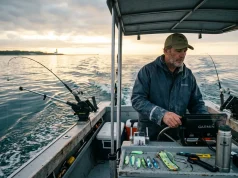
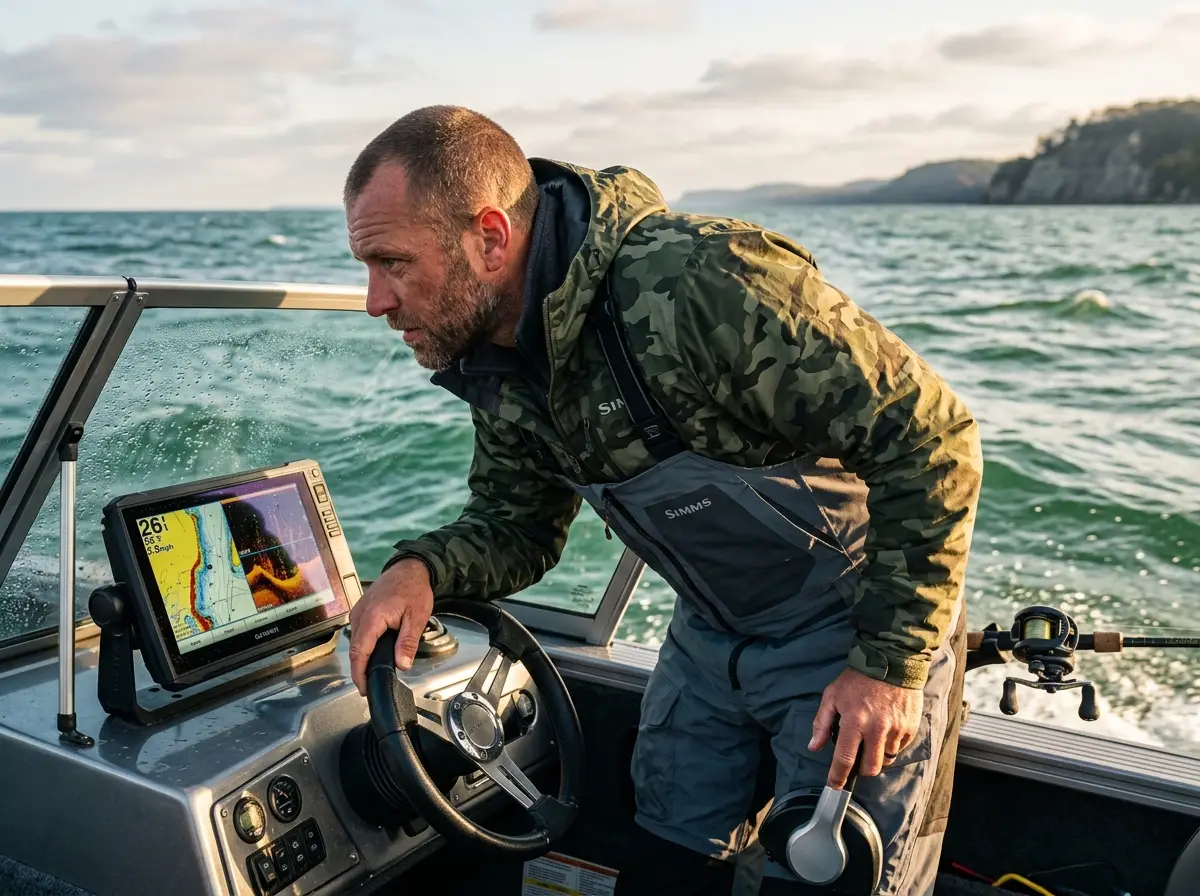
The sonar screen painted a hard black line at 45 feet, slicing the water column in half right above the Central Basin’s hypoxic layer. The outside wire-line rod suddenly buried into the gunwale under the weight of a fish running from the abyss. After twenty years of pulling planer boards and tracking massive schools across the tristate borders, I’ve learned that hoping for a random bite is a guaranteed way to burn expensive fuel. To successfully intercept this gigantic walleye population, you have to abandon blind spot-checking. You need to mathematically track the migration through thermal gradients, basin geomorphology, and dissolved oxygen thresholds.
Here is exactly how you map out the lake, adapt to the seasonal shifts, and put heavy fish in the net without the guesswork.
⚡ Quick Answer: Tracking Lake Erie walleye means following water temperature and dissolved oxygen. Start your spring in the shallow Western Basin reefs and rivers where 40°F water triggers the spawn. As summer heat pushes surface temps past 68°F, follow the massive female migration through the Central Basin thermal squeeze, eventually running deep wire line in the Eastern Basin trenches.
| Lake Erie Seasonal Fishing Guide | |||
|---|---|---|---|
| Season | Basin / Zone | Target Depth | Ideal Water Temp |
| Spring (March-April) | Western Basin / Maumee River | 3-15 ft | 40°F – 55°F |
| Summer (June-July) | Central Basin / Open Water | 35-50 ft (Thermocline) | 60°F – 69°F |
| Late Summer (Aug-Sept) | Eastern Basin / Trenches | 60-120 ft | Under 60°F |
The Population Science: Why 2025-2026 is Unprecedented
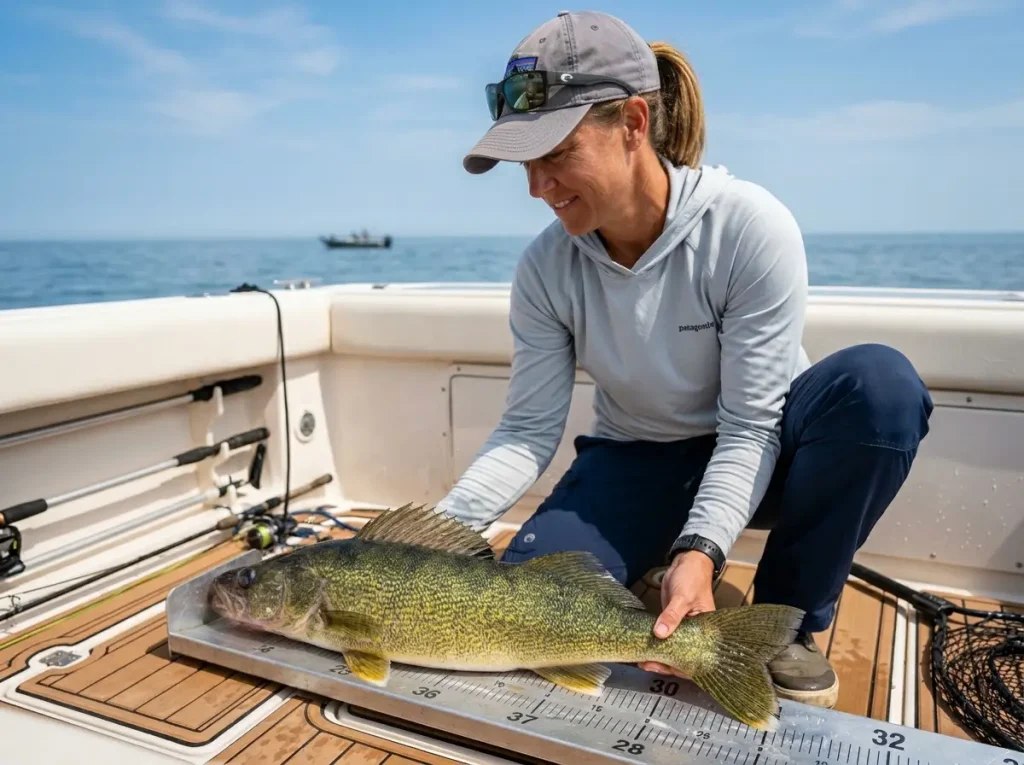
Right now, we are looking at numbers that veterans from the 1980s wouldn’t believe. The current biological state of the Lake Erie walleye fishery is staggering, but you have to understand the specific age classes to dial in your trolling program. The math dictates your presentation.
According to the Lake Erie Walleye Task Group 2025 projections, the lake maintains an abundance estimate of 77.4 million age-2 and older fish. That is an absurd density of predators. As of right now, the 2021 year class accounts for roughly 41% of the commercial harvest and represents the aggressive, mature spawning stock.
But the real story for the everyday angler is the record-setting 2023 hatch. That specific year produced an unheard-of 346 fish per hectare. Those violently feeding fish are actively pushing into the 15-inch legal keeping range in 2026, creating ideal limit-out conditions for anyone running right-sized gear. When analyzing bag limits against standing biomass, this massive abundance ensures a high-action bite for the next couple of seasons.
The mean age of harvested fish holds steadily right near 4.05 years, which tells you just how exceptional the recruitment survival rates have truly been. The 2025 hatch was recorded as the sixth largest in a 38-year time series, effectively securing the fishery’s extreme density through at least 2028.
Pro-Tip: Don’t ignore the 4.05-year mean age data. Calibrate your lure profiles downward slightly during high-density days to aggressively mimic the smaller forage that these hyper-abundant younger cohorts actively target. If everyone runs oversized stickbaits and strikes out, drop to a smaller spoon and fill the cooler.
Age-Class Distribution and the 2021 Cohort
This staggered abundance profile ensures you get both high density and a varied size distribution when you set your trolling spread. You are going to catch numbers, but you want size. The fish from the 2015 and older hatches make up the high-calorie “Fish Ohio” class. These are the giants that migrate the farthest.
If you specifically want to target the oldest year classes, you have to aggressively shift your trolling routes toward deep, stable thermal refuge areas instead of grinding out the volatile shallows with the crowd. Big fish despise wild temperature swings.
Statistical Catch-at-Age Models Demystified
The Walleye Task Group utilizes statistical catch models to calculate the allowable harvest effectively. These aren’t arbitrary numbers; the data inputs rely heavily on a combination of commercial harvest rates and biological sampling surveys. Understanding these outputs allows the technical angler to forcefully predict the exact size class dominating a specific basin. If you know the math, you know whether to deploy aggressive deep-diving plugs or subtle crawler harnesses.
The Spring Spawning Matrix: Western Basin Reefs and Rivers
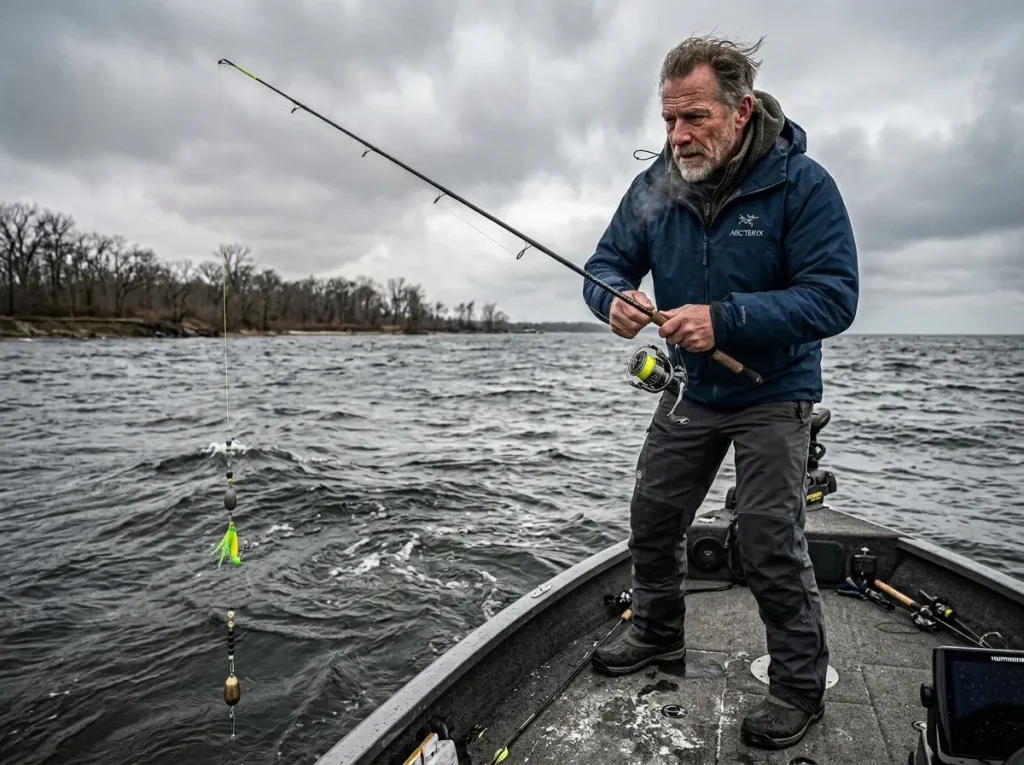
The Western Basin is the engine room of the entire lake. It averages just 24 feet deep, meaning it rapidly hits that critical 40°F spawning trigger weeks before any other section. To find the fish in March and April, you have to look at the bottom. The geology strictly dictates the fishing pressure.
The rock composition out here is key. Limestone and dolomite bedrock form the Bass Islands and Kelleys Island reef complexes. This extremely hard substrate actively resists the heavy siltation that smothers eggs on the deep mud flats. Limestone naturally provides articulated ledges, while dolomite is much harder and retains essential heat for the incoming spawn. The interstitial spaces inside these rocky reefs firmly protect the broadcast eggs from wave-induced mechanical damage. Substrate mapping proves that walleye prefer clean, hard-bottom areas over the adjacent mud during the entire spring run.
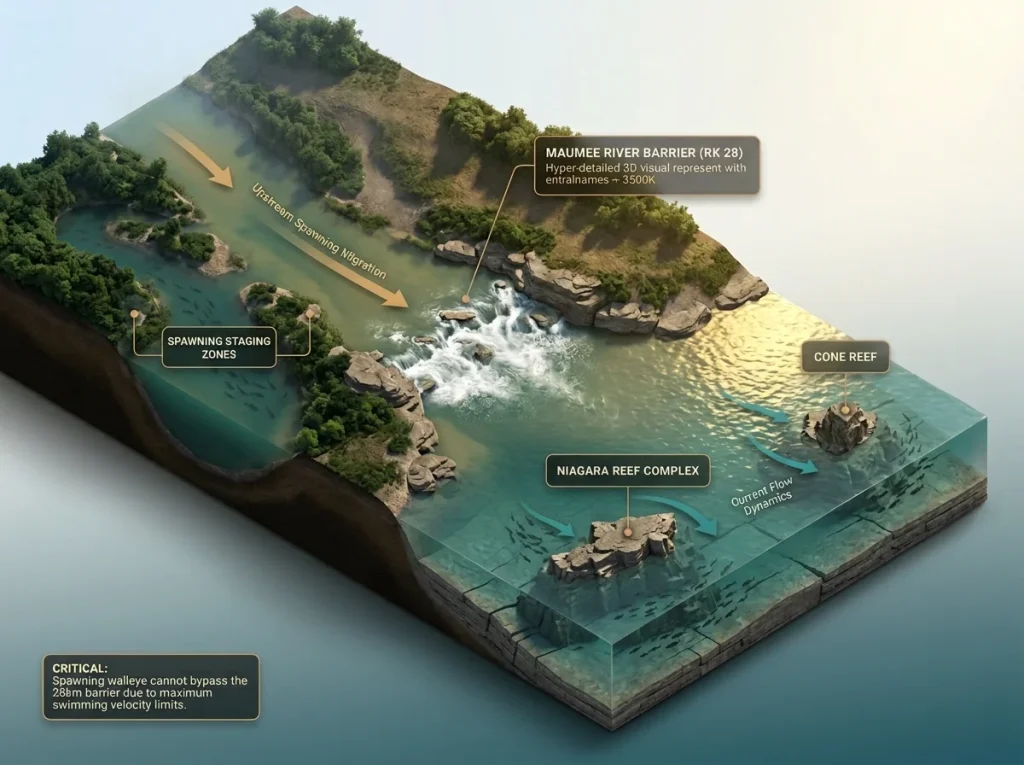
In the tributaries, the actual science gets even more specific. If you fish the Maumee River, you are dealing with violent river flow physics. Biologists evaluate river bottom friction and resistance to physically identify exactly where walleye stage to rest. Upward migration essentially hits a concrete wall at river kilometer 28, a point where water velocity abruptly surpasses a spawning walleye’s maximum swimming capacity.
I’ve watched hundreds of guys blow right past the Maumee rapids, completely ignoring that the highest concentration of spawning fish is biologically fenced in directly below that exact Maumee River walleye production spawning ground barrier. It is an energy equation, not magic. You have to start understanding complex flow profiles if you want to out-fish the guy standing shoulder-to-shoulder with you on the wet stones.
Geomorphology of Carbonate Reef Complexes
When running the open lake reefs, you have to account for harsh sunlight. The light-avoidance behavior of adult walleye forces them to painfully lie almost completely motionless pinned to the rocky bottom during intense midday sun. If the sun is high and incredibly bright, you have to drag your heavy jigs literally inches off the rocks to trigger a lazy reaction strike.
Hydraulic Bottlenecks and Friction Ratings
A river’s bottom roughness directly impacts the exact water speed hitting the substrate level where fish firmly hold. The peak spawning habitat suitability happens specifically at river discharges between 20 and 25 cubic meters per second. When the water rips faster than that, the fish bail out.
Pro-Tip: Focus exclusively on the heavily protected “slacker” pockets behind large submerged boulders or massive concrete pilings where the bottom friction jumps drastically and the current speed abruptly drops. That gives the fish a mandatory zone for post-spawn rest before they run back to the lake.
Spring Presentation Science
Metabolisms are severely suppressed in 40°F dirty water. You have to run an agonizingly slow horizontal and vertical jigging program. Heavy hair jigs and metal blade baits must be presented with minimal wild upward snaps and insanely extended stall times. Give the sluggish fish a fair chance to actually inhale the hook.
Post-Spawn Thermal Migration Dynamics
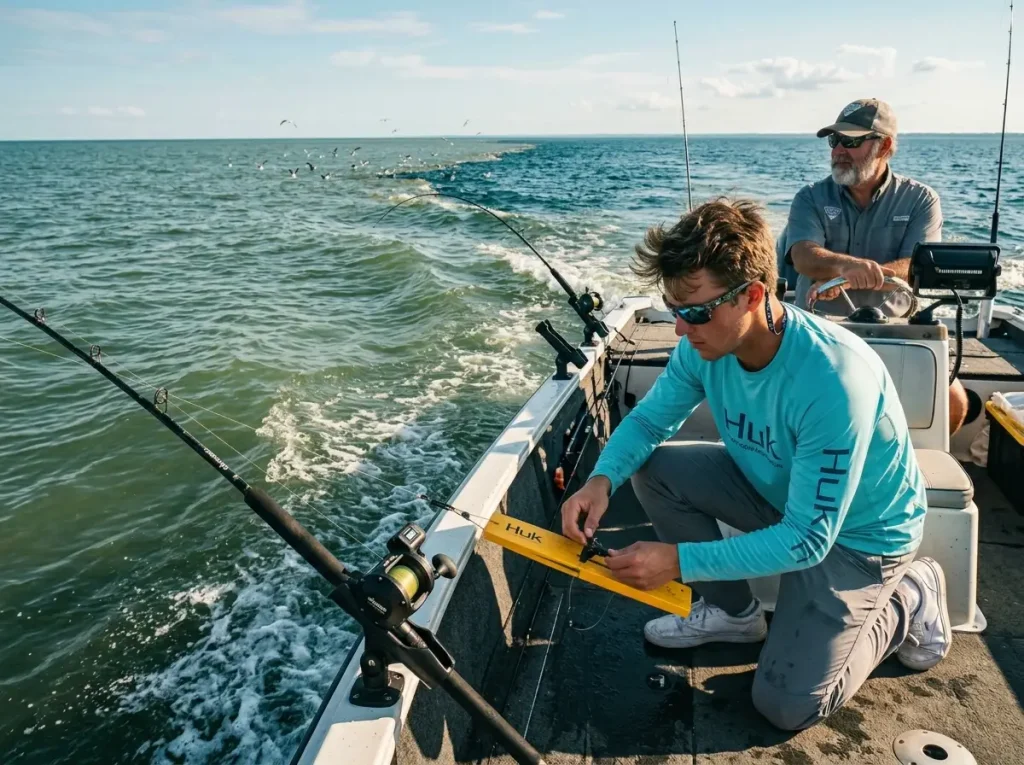
As the Western Basin surface temperature surges past 68°F, the hot shallow water becomes physically miserable for big heavy fish. This severe thermal discomfort predictably triggers a massive eastward push to aggressively lower their metabolic cost. They completely abandon the reef structures and follow the deep cold water straight down the lake.
This specific migration is incredibly sex-dependent. The behavioural thermoregulation underlying seasonal movements proves that heavy females are 1.8 times more likely to be tracked in the deep, freezing Eastern Basin than males. The strict target thermal optima for these massive, migratory females is rigidly fixed directly between 60.8 and 69.8°F. The very second they find that exact temperature band, they sit there and viciously gorge on baitfish.
To stay on the active bite during this chaotic transition, you have to absolutely master Secchi disk clarity. Light penetration fundamentally shifts the exact daytime feeding depths. If you read clarity over 3 meters (nearly 10 feet), that direct intense sunlight violently pushes the fish heavily down to the deep 40-to-60 foot range. When discussing adjusting presentation for light attenuation, you have to respect the physical limits of the fish’s sensitive eyes.
You should always be hunting hard for sharp mud lines. Where highly turbid brown river outputs forcefully collide with beautifully clear green lake water, it visually forms a razor-sharp, high-percentage ambush veil. The giant females sit hidden in the dirty water and hammer schooling baitfish heavily silhouetted against the incredibly clean edges.
Size-Dependent Sex Migration
Smaller resident males frequently stay in the Western Basin permanently, happily living out their days directly alongside massive schools of local white perch and oily gizzard shad. The heavily built females, however, fiercely prioritize massive high-protein foraging opportunities, actively chasing colossal rainbow smelt congregations straight into the deep black water. Acoustic telemetry data strictly proves that once they hit that cold 60.8°F isotherm, their aggressive eastward travel abruptly stops.
The Optics of Secchi Disk Targeting
Walleye possess a highly reflective layer directly behind their retina, granting them extreme precision regarding low-light vision but rendering high-intensity surface sunlight physically painful. Because larval bait density is highest nearshore in the dirtier, heavily stained water, it routinely serves as the primary twilight feeding ground for passing hunters.
Pro-Tip: Always actively record the exact Secchi disk reading looking over the side of the boat before frantically deploying a single rod. It gives you the immediate mathematical depth threshold for the day’s bite. If you can see the disk down five feet, don’t waste time running lures at three feet.
Central Basin Hypoxia: Navigating the Anoxic Layer
The Central Basin runs from Lorain, Ohio, straight up to Erie, Pennsylvania, and it easily presents the most physically demanding environment on the entire system. You have to aggressively navigate the Central Basin hypoxia phenomenon, widely feared and known as the anoxic layer.
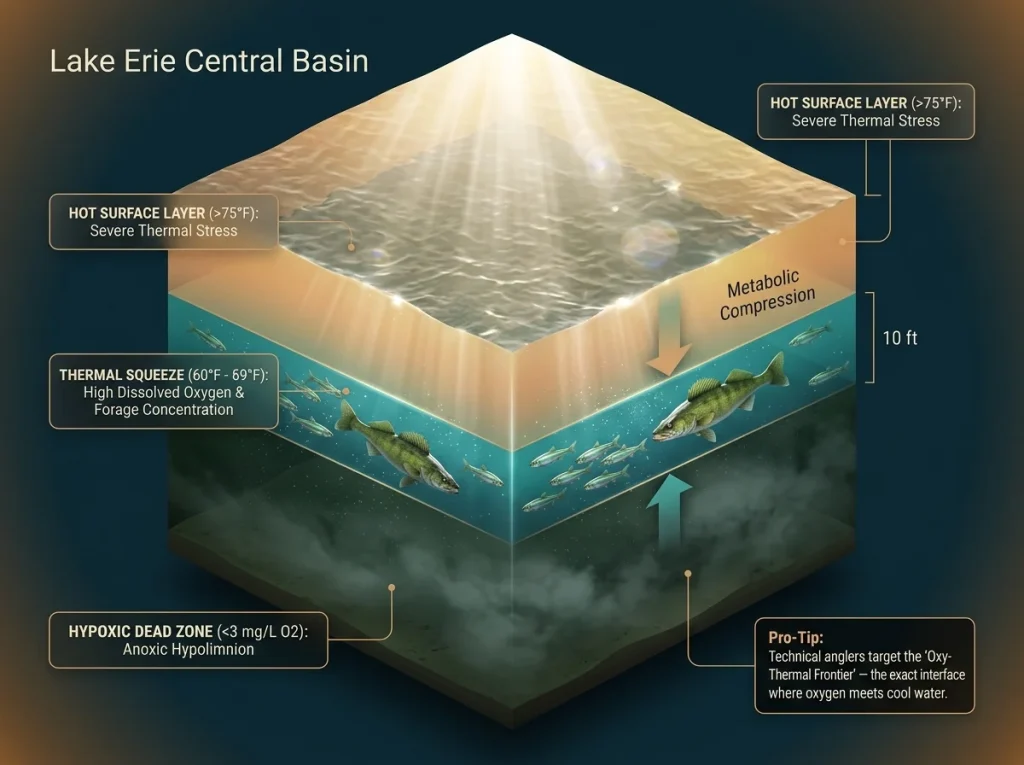
As sinking organic matter massively decomposes on the bottom, it strips dissolved oxygen right out of the cold lower water layer during the brutal dog days of summer heat. This violently drops the strict oxygen levels below 3 mg/L. When predicting how metabolic rates respond to decreased oxygen, you understand that this severe lack of breathable air physically chokes the fish off the bottom.
This aggressive summer hypoxia predictably creates an unavoidable depth squeeze that violently compresses the walleye exactly between the painfully hot surface layer and the totally suffocating bottom layer. It physically forces both the heavy predators and the schooling forage into a highly concentrated, unbelievably narrow horizontal band suspended over nothing.
Adding to the utter chaos, powerful wind action passing over the basin heavily drives a deeply unusual clockwise water circulation. This aggressively creates a deep, uniquely “bowl-shaped” inverted thermocline. Because this toxic bottom hypoxia rapidly obliterates the growth potential of young baitfish by up to 35%, it severely forces massive, terrified schools of emerald shiners to helplessly suspend completely off the bottom structure.
The Oxy-Thermal Habitat Squeeze
The fish are entirely physiologically trapped inside this specific middle layer. They cannot dive down into the deep cooler water without quickly suffocating, and they absolutely cannot rise higher without severely overheating. This distinct horizontal band concentrates both predators and prey tightly together, repeatedly creating unparalleled, incredibly violent open-water trolling conditions for those who find the seam.
When my heavy sonar tightly paints an incredibly thick, dirty visual band of clutter ten feet off the bottom, a charter client always thinks it is a massive school of hungry fish. A technical angler firmly knows that is effectively the top edge of the anoxic hypoxia layer visibly reflecting hard sonar interference—and directly dials his heavy deep-diving lures to rigidly run exactly two feet above it, right on the violent oxygen frontier.
Inverted Thermoclines and Clockwise Circulation
The Central Basin’s extremely unique clockwise current flow pattern firmly squashes the heavily oxygenated cold core water directly down against the lake bed. This violently concentrates the fish along very specific coastal benthic transition zones. You have to systematically map the exact physical depth where this heavily slanted thermocline forcefully intersects the slowly rising bottom contour. Check the Lake Erie Central Basin Hypoxia monitoring data relentlessly to track its exact GPS location daily.
Forage Base Energy Density Shifts
Caloric intake heavily dictates the predator migration path. As the aggressive hypoxia forcefully displaces the deep-water smelt schools upward, they quickly become highly vulnerable open targets to giant walleye visually waiting at the very edge of the anoxic layer. The baitfish energy density here drives the entire ecosystem.
Eastern Basin Deep Stratification and Trench Tactics
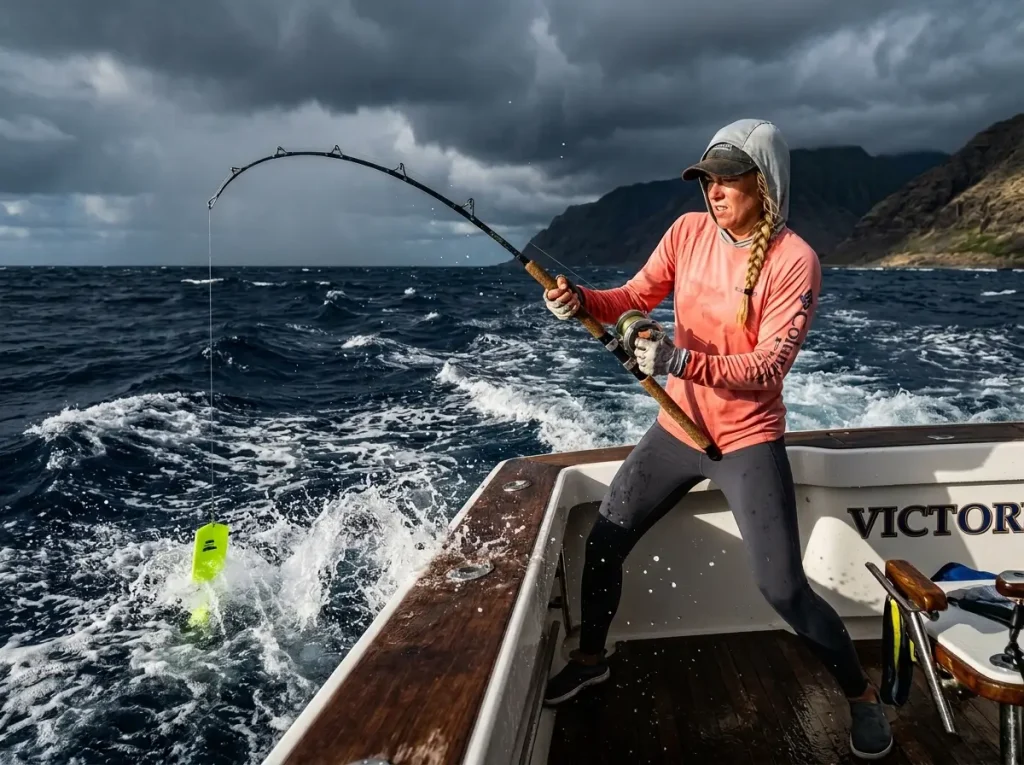
By incredibly hot late August, you have to cross the state line deep into Pennsylvania and New York waters if you want to hunt the biggest fish actively feeding in the system. The deep Eastern Basin reliably provides exactly what a ten-pound giant female desperately needs: incredibly deep, painfully cold water.
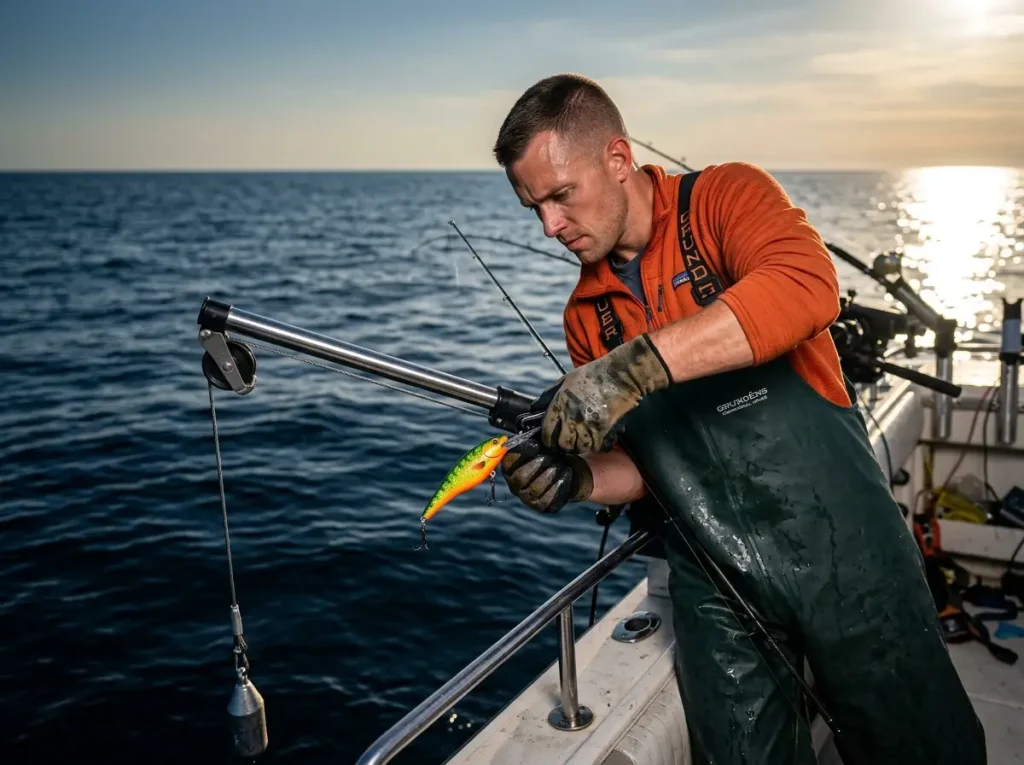
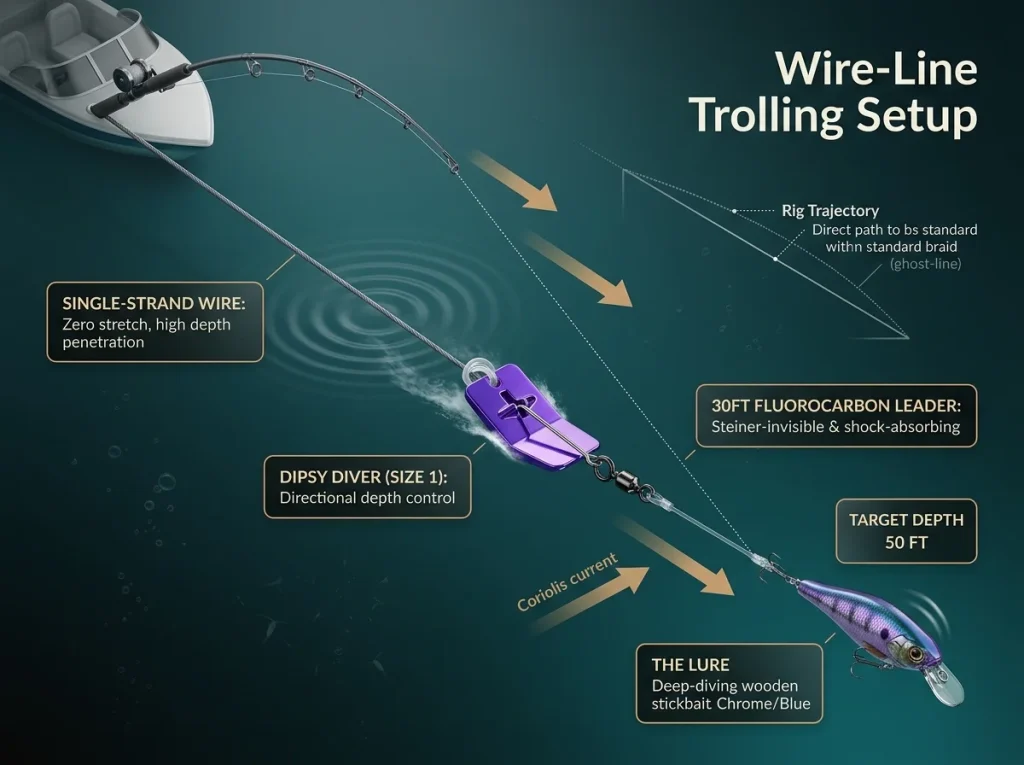
At extreme physical depths plunging completely past 200 feet, massive underwater structural features like The Mountain and The Trenches forcefully act as the ultimate cold thermal sanctuaries. Reaching aggressive, adult fish suspending firmly at 60 feet or even deeper solidly necessitates running heavy single-strand or seven-strand wire line setups. You simply cannot physically achieve these severely deep running dive curves pulling standard braided line because of the heavy water drag bowing the line upward.
The absolute lack of stretch in wire line firmly requires a specific, moderate gear ratio reel pulling around roughly 25 inches per turn of the handle. If you crank a high-speed reel attached to wire, you will brutally pull the heavy treble hooks right out of the walleye’s soft jaw tissue before you ever see the fish.
Because you are frequently dealing directly with the lake’s cyclical Coriolis effect, you absolutely have to factor in deep underwater current. Actively dragging your heavy deep lures directly straight upstream heavily enhances the chaotic vibration of the bait, while heavily running downstream tracking often totally deadens the crankbait’s swimming action completely. You have to aggressively push your throttle speed up to keep the lure’s lip actively biting the hard water when running with the flow.
Single-strand wire pulled tightly under heavy trolling tension actively generates a highly distinctive “harmonic hum” slicing through the water that forcefully acts as a surprisingly powerful low-frequency auditory attractant for these massive deep-water solitary fish.
Intercepting the “Pigs” at The Mountain
Late summer targets firmly revolve around aggressively hunting isolated 8 to 12-pound giant fish stubbornly holding precisely on the deep-water massive depressions specifically located off the New York and Pennsylvania rocky coasts. Aggressive, precise nighttime gear trolling effectively transitions these exact fish from their 50-foot daytime holding depth directly back up into the shallow 8 to 12-foot zone precisely as the heavy moon rises over the horizon. Before dropping the boat in, absolutely monitor the New York DEC Walleye Fishing regulations to ensure your creel counts are strictly legal across the line.
Wire Line Rigging and Drag Settings
When dragging thick wire, your specific mechanical drag settings must be drastically loosened compared to comfortably running braid. This is strictly required to completely compensate for having absolutely zero line shock absorption on the violent strike. By recognizing that surface inputs tell you nothing about the hypolimnion, you completely understand that aggressively dropping your gear safely down through the layers is everything. Utilizing heavy metal Jet Divers or directional Dipsy Divers is absolutely mandatory for effectively dragging long-billed wooden stickbaits deeply through the true active strike zone without washing out.
Pro-Tip: Never violently run heavy dark wire directly attached to a small lure in the undeniably ultra-clear Eastern Basin water. Always solidly deploy a massive minimum 30-foot clear fluorocarbon leader strictly to actively absorb the violent shock of a strike and guarantee total visual stealth at depth.
Coriolis Force Current Vectors
Treat these massive, completely submerged offshore structures exactly like running current on river points, carefully noting exactly how the heavy flow physically deflects violently off the deep structure and powerfully channels the baitfish tightly past waiting apex predators. Calibrate your GPS trolling speed constantly as you slowly cross these deep invisible edges.
The “Walleye Capital” Conservation and Combat Etiquette
The intense spring run forcefully initiates an incredibly chaotic seasonal ritual widely and infamously known as combat fishing on the reefs. Operating a boat safely in this massive amount of boat traffic strictly requires absolute, aggressive respect for another angler’s solidly established trolling radius. The strict unwritten rules dictate perfectly everything out there.
Standard protocol heavily dictates immediately yelling “Fish On!” at maximum volume the absolute second you firmly set the hook. This rigidly triggers adjacent boats into instantly and aggressively clearing their incredibly dense trolling spread to firmly avoid a catastrophic, gear-destroying massive tangle.
If you hit the chaotic public launch ramp, your standard boat prep tightly includes unstrapping everything, prepping gear, and heavily installing the drain plugs directly in the staging parking lot completely before slowly backing down the slippery ramp. Doing this strictly eliminates totally selfish, massive bottlenecks when a hundred angry guys are waiting to drop in at dawn.
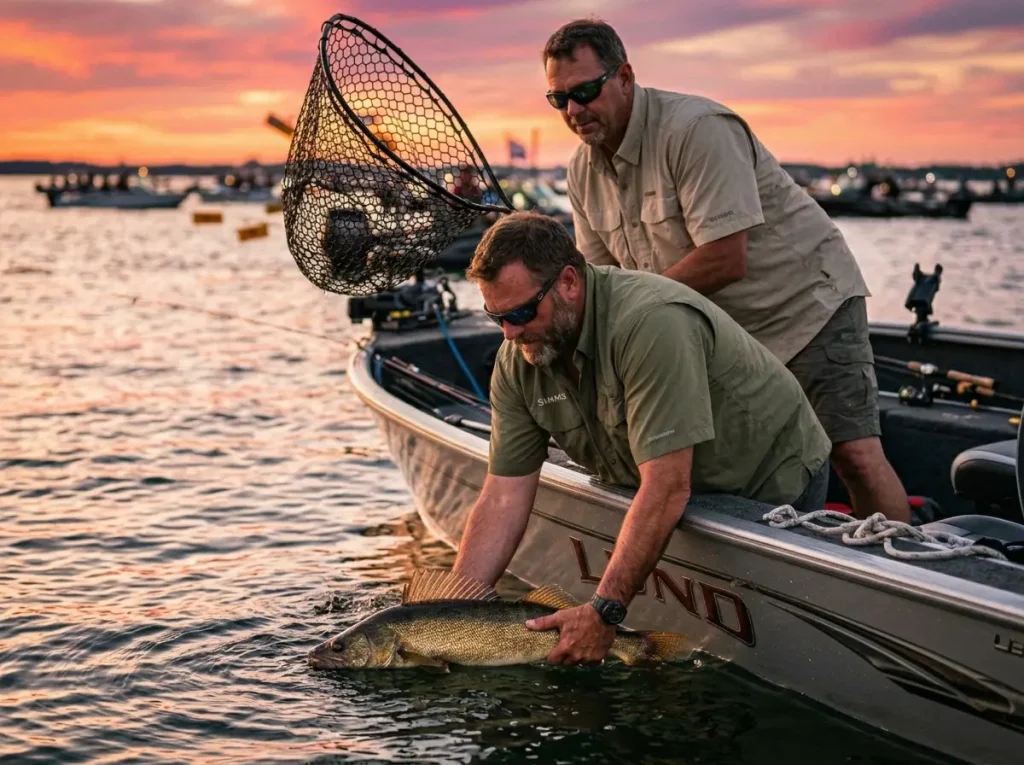
Catch-and-release mechanics deeply demand the immediate, strict use of heavy, thick raw rubber mesh nets. Dragging an exhausted fish through heavily knotted dry nylon strongly and violently shreds the fish’s highly vital protective slime coat, which aggressively leads to absolutely fatal, terrible bacterial rot. If you casually grab a completely dry walleye strongly with totally bare hands for a quick grip-and-grin photo and forcefully toss it roughly back over the gunwale, you might as well have firmly kept it in the cooler. That specific fish will very likely desperately suffer from severe infection within a heavily short week strictly from cleanly losing its vital mucosal barrier. You have to aggressively focus tightly on mitigating oxygen debt and mucous loss every single time the heavy net drops into the water.
Navigating the invisible tristate boundary lines repeatedly brings incredibly complex, harsh rule changes. Before you box a heavy fish, you absolutely have to verify the specific Ohio DNR Walleye limit regulations. Ohio, PA, and heavily pressured NY sections all firmly enforce a strict 15-inch keeping minimum, but the specific, fast-moving river systems routinely possess intensely strict, heavily policed single-hook restrictions during the entire spawn.
The Unwritten “Combat Fishing” Protocol
The brutal “first come, first serve” rules are absolute and are heavily enforced strictly on the water by the fleet. Willfully and aggressively encroaching directly on another specific boat’s heavily established, working drift path directly invites severe, immediate, wildly unpleasant on-water friction. Clear, loud verbal communication over the water is definitively your best available tool for peacefully navigating the wildly dense, chaotic maze of aggressively deployed orange planner boards heavily stacked near the intensely pressured reef complexes.
Slime Coat Protection Physiology
The vital glygoprotein coating barrier forcefully requires firmly wet, totally clean hands for absolutely every physical handling event to tightly prevent sudden intense thermal and harsh chemical shock completely destroying the big fish’s highly sensitive nervous system.
Pro-Tip: Vigorously have your aluminum bump board and all measuring tools completely wetted down significantly and heavily prior to successfully netting the green fish. Doing this aggressively helps to rigidly and successfully avoid totally dry scraping the heavy fish’s wet flank violently across terribly hot metal or totally dry plastic surfaces.
Legal Thresholds Across Tristate Borders
Always meticulously, constantly confirm your exact current digital GPS position tightly against the strict state jurisdiction lines perfectly painted on your map card screen. With the unpredictable, heavy current wind vectors blowing offshore, you can easily physically drift totally blindly from a highly liberal zone straight into a deeply restricted one with lines in the water.
Action Plan for Seasonal Targeting
Successfully conquering massive Lake Erie walleye directly means aggressively mapping heavily depleted dissolved oxygen pockets, strictly calculating Maumee River violent flow velocities, and systematically tracking the deeply striated invisible thermal boundaries violently dividing the three basins.
Stop heavily relying totally on lazy marina dock talk and instead strictly bypass the massive anoxic layers entirely to actively anticipate the highly predictable migration tracking of the staggering 2021 and massive 2023 cohorts. Forcefully apply this highly specific limnological blueprint aggressively to your very next trip to totally elevate your entire technical approach from blind luck guessing directly to highly calculated, precision targeting. Put far heavier fish firmly in the boat, actively respect the entire fragile resource, and aggressively get your lines tight.
FAQ
What month is best for walleye on Lake Erie?
July and August reliably offer the highest catch rates completely for heavy limits fishing deeply in the Central Basin, while the brutal cold of April is absolute peak for 10-pound trophies hunting the shallow Western Basin. The core walleye metabolism strictly dictates this massive geographical split, completely forcing huge, heavy fish into shallow warm water to spawn immediately before completely seeking extreme deep thermal relief later in the scorching summer.
Where is the best walleye fishing on Lake Erie right now?
Real-time active location heavily depends entirely on strictly tracking the exact current water temperature and precisely locating the exact presence of the hazardous hypoxia layer. In early frigid spring, absolutely target the shallow, hard limestone reefs heavily situated near Port Clinton, but by late violently hot August, you absolutely must completely shift your focus east to aggressively drag heavy wire directly toward the far deeper, colder trenches directly off Pennsylvania.
Can you fish for walleye from shore on Lake Erie?
Yes, aggressively night-casting piers heavily produces exceptional, massive results as the starving, aggressive fish strongly move directly into the dark shallows to wildly feed entirely under the black cover of night during April and late November. Strictly and fiercely use large, perfectly suspending hard jerkbaits solidly tied entirely on totally clear fluorocarbon line to tightly stay suspended directly just above the brutally snaggy, jagged rock breaklines.
Do walleye stop feeding during the summer hypoxia peak?
No, their highly aggressive daily feeding actually becomes wildly more concentrated and highly predictable working under these brutal, toxic conditions. The massive anoxic layer violently and fiercely confines the entire giant predator population strictly to a very specific, incredibly narrow horizontal strip of cold water physically located directly inside the slanted thermocline positioned heavily immediately above the intensely anoxic, completely dead bottom layer.
Risk Disclaimer: Fishing, boating, and all related outdoor activities involve inherent risks that
can lead to injury. The information provided on Master Fishing Mag is for educational and informational purposes
only. While we strive for accuracy, the information, techniques, and advice on gear and safety are not a substitute
for your own best judgment, local knowledge, and adherence to official regulations. Fishing regulations, including
seasons, size limits, and species restrictions, change frequently and vary by location. Always consult the latest
official regulations from your local fish and wildlife agency before heading out. Proper handling of hooks, knives,
and other sharp equipment is essential for safety. Furthermore, be aware of local fish consumption advisories. By
using this website, you agree that you are solely responsible for your own safety and for complying with all
applicable laws. Any reliance you place on our content is strictly at your own risk. Master Fishing Mag and its
authors will not be held liable for any injury, damage, or loss sustained in connection with the use of the
information herein.
Affiliate Disclosure: We are a participant in the Amazon Services LLC Associates Program, an
affiliate advertising program designed to provide a means for us to earn advertising fees by advertising and linking
to Amazon.com. As an Amazon Associate, we earn from qualifying purchases. We also participate in other affiliate
programs and may receive a commission on products purchased through our links, at no extra cost to you. Additional
terms are found in the terms of service.