
In this article
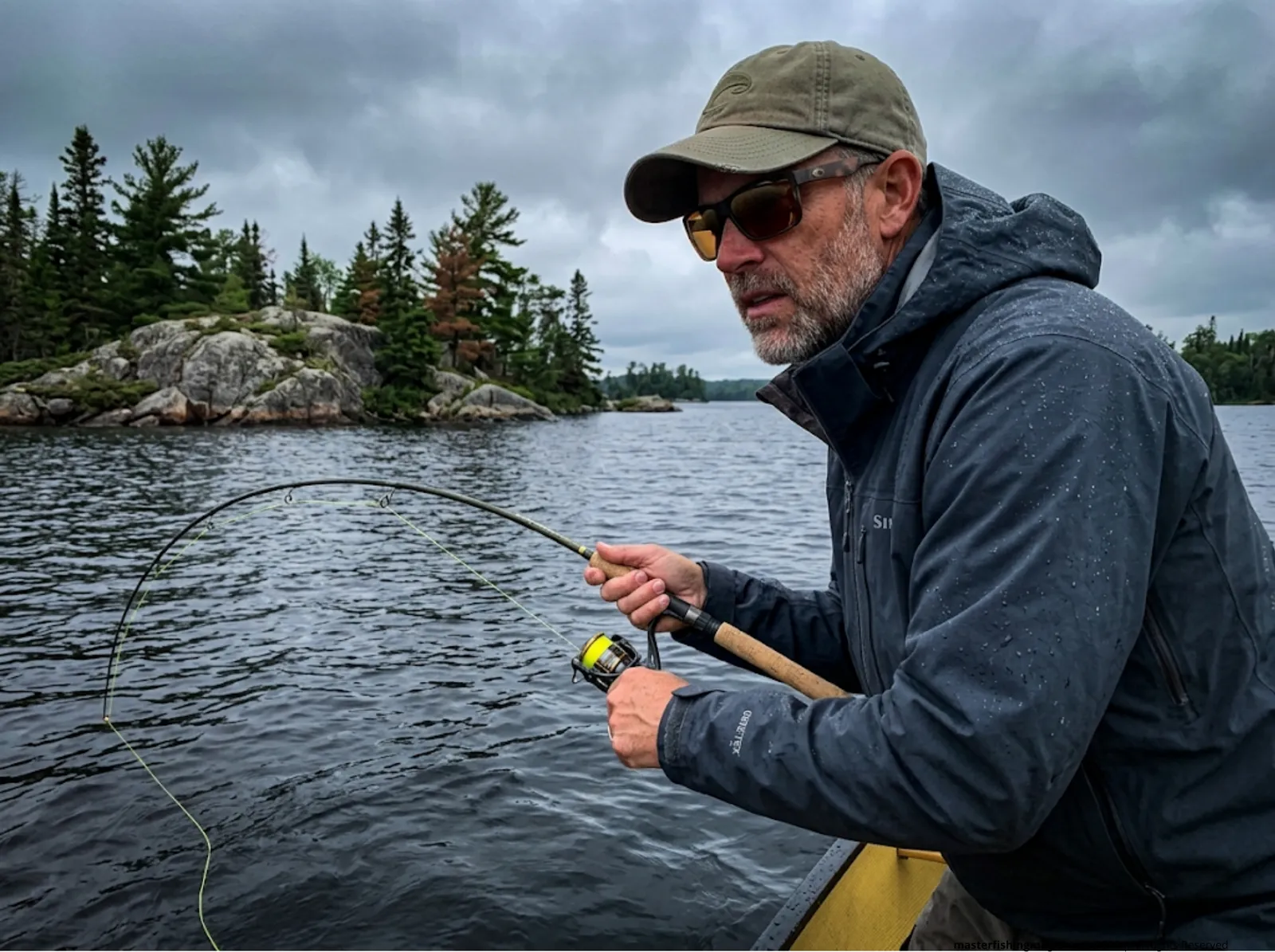
The jig hit the bottom at 28 feet and went still. The walleye had taken it so cleanly that the rod barely registered it — until the line cut sideways and I felt the weight of something serious making for the granite reef. Three minutes later, I reached into 72°F surface water to shake the hook. I wasn’t thinking about what that thermal jump was doing to a fish pulled from 55°F water twenty feet down. That fish didn’t survive. I know it now because I understand the physiology. I didn’t know it then because most BWCA guides don’t talk about it.
This guide doesn’t tell you which lake has the best walleye. It tells you why your line breaks on Precambrian granite, why the thermocline determines your depth strategy, and why a $400 graphite rod is a liability on a portage. The Boundary Waters is a complex biological and hydrodynamic system. Treat it that way.
⚡ Quick Answer: Fish the BWCA by reading the lake’s trophic state first, then targeting species at their thermal depth — walleye at the metalimnion-hypolimnion boundary (typically 18–28 ft in July), lake trout in the hypolimnion at 30–50 ft, smallmouth in high-friction eddy zones behind boulders. Use 20 lb braid with an 8–10 ft fluorocarbon leader as your Precambrian Shield buffer, and carry a descending device. Post-release mortality in lake trout exceeds 70% when surface temps are above 61°F — that’s not a caution, it’s arithmetic.
| BWCA Wilderness Trip Quick Reference | |
|---|---|
| Quick Reference | Detail |
| BWCA Permit Required | Yes — USFS Quota Entry Point system |
| Motor-Free Zones | Majority of interior lakes (paddles only) |
| Key Species | Walleye, Smallmouth, Northern Pike, Lake Trout |
| Primary Line System | 20 lb braid main + 8–10 ft fluorocarbon leader (10–12 lb) |
| Optimal Rod | 6’6″-7’0″ ML/M IM7 composite blank |
| No-Can/No-Bottle Rule | All food/drink in reusable containers |
The Limnological Foundation — Reading BWCA Water Before You Rig
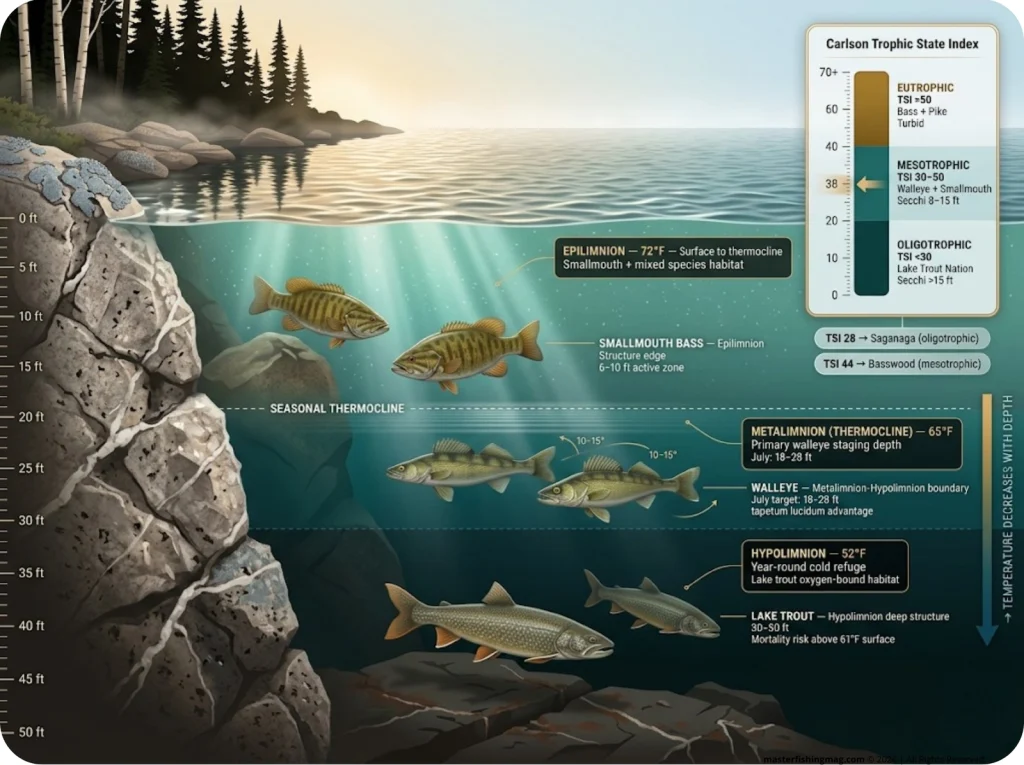
Here’s where most anglers lose the trip before they even launch: they treat all BWCA lakes as interchangeable. They’re not. Almost every lake in the region sits on Precambrian Shield granite — nutrient-poor, acidic bedrock that produces oligotrophic or mesotrophic water conditions, and the distinction matters enormously for where fish will be and how deep.
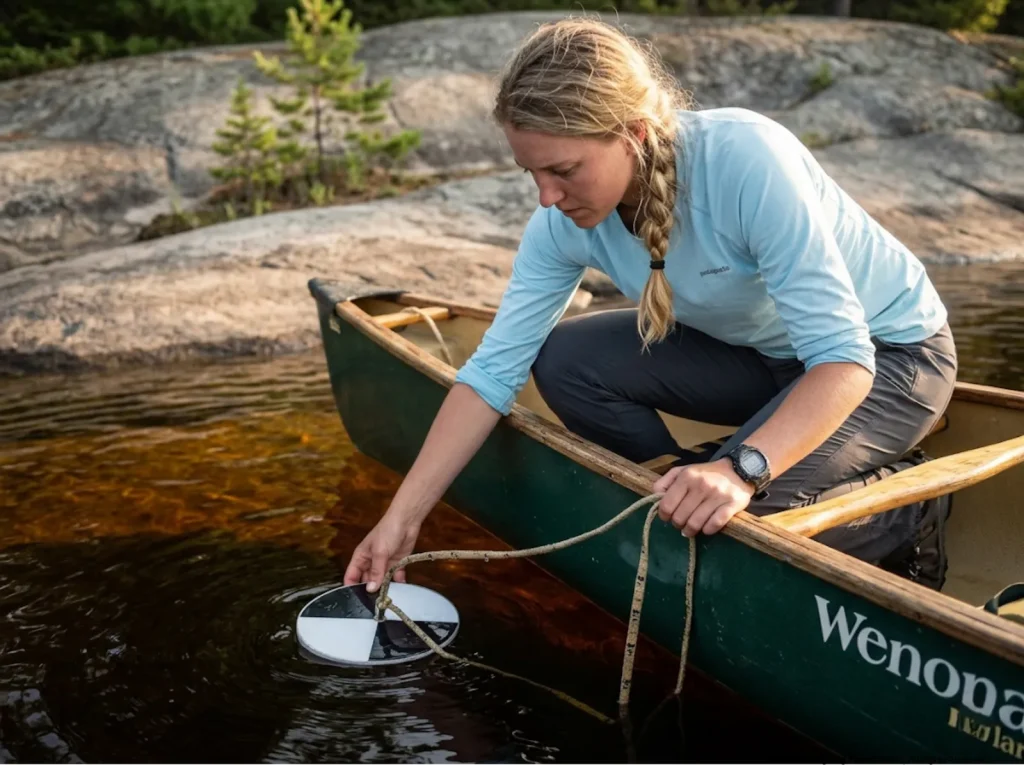
The Carlson Trophic State Index (TSI) gives you a number. TSI below 30 means you’re fishing a cold, clear, deep lake — lake trout territory, hypolimnion year-round, Secchi disk disappearing past 15 feet. TSI from 30 to 50 means a mesotrophic system with moderate clarity and walleye staging at the metalimnion-hypolimnion boundary in July. Download the Minnesota DNR LakeFinder data for your target lakes before the trip. Most BWCA lakes have historical clarity and phosphorus readings documented. The Secchi disk reading on your first morning at camp is the most diagnostic tool in your tackle bag — if it disappears at 8 feet or less, reach for chartreuse. If it disappears at 20, think natural patterns and go deeper.
By late June, the water column breaks into three layers: the epilimnion (warm surface), the metalimnion (thermocline), and the hypolimnion (cold, high dissolved-oxygen). For technical depth strategy, understanding how the thermocline actually controls where fish hold by depth is the starting point. Shallow BWCA lakes under 20 feet often stay mixed — wind keeps them isothermal, and fish behavior there tracks forage and structure instead of thermal depth.
The Tannin Effect — How “Tea Water” Rewires Fish Vision
The characteristic dark water of Basswood and Saganaga isn’t a water-quality problem. It’s humic and fulvic acids from boreal forest decomposition, and it changes everything about lure color selection.
Tannins selectively absorb blue and violet wavelengths from the top of the water column. By ten feet in stained water, the dominant light is in the red-orange range — and it dims fast. Walleye’s tapetum lucidum, the reflective layer behind the retina, is most sensitive to orange-red wavelengths. Stained water doesn’t put walleye fishing at a disadvantage; it creates an extended low-light window where walleye can see and you can’t. In these systems, contrast beats hue at every depth. An orange-black pattern or firetiger outperforms anything naturalistic below 10 feet. By 20 feet in tannin water, all color has degraded to silhouette — the fish is reading shape and edge, not color band.
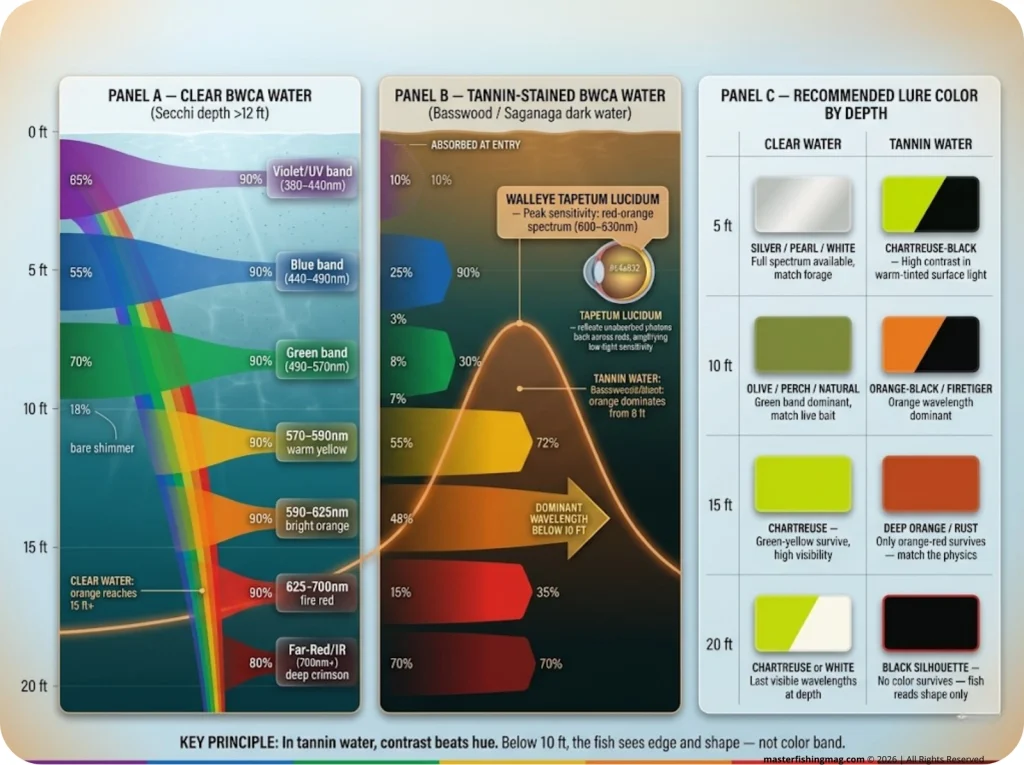
Pro tip: Switch from white or natural patterns the moment the Secchi disk disappears under 10 feet. In tannin water, you’re not trying to match nature — you’re trying to create a silhouette the fish can actually see. Orange-black jigs in Basswood and chartreuse-black rigs in the clearer interior lakes are not interchangeable.
Seasonal Thermal Map — When to Target Which Depth
Spring (ice-out to June) means isothermal conditions. Walleye and pike move in 5–15 ft warming bays. Lake trout spawn on deep reefs. Don’t overthink depth — fish are wherever the water is warmest.
Early summer (June–July) is when the thermocline establishes. Walleye stage at 18–25 ft on the metalimnion edge. Pike push to weedy shallows. This is the window when trophic state starts to matter — a TSI 35 lake and a TSI 48 lake produce different thermocline depths for the same calendar week.
Peak summer (August) gets interesting in mesotrophic systems. The hypolimnetic oxygen squeeze can push walleye into a 3–5 ft band — tightest, most predictable window of the year. If you’re getting frustrated by scattered fish in July, wait. August concentrates them.
Fall (September–October) the thermocline breaks, lake turnover mixes oxygen throughout, and fish scatter and feed aggressively before freeze. Depth becomes less predictive. Structure and forage concentration matter more.
The Technical Kit — Building a Portage-Ready Fishing System
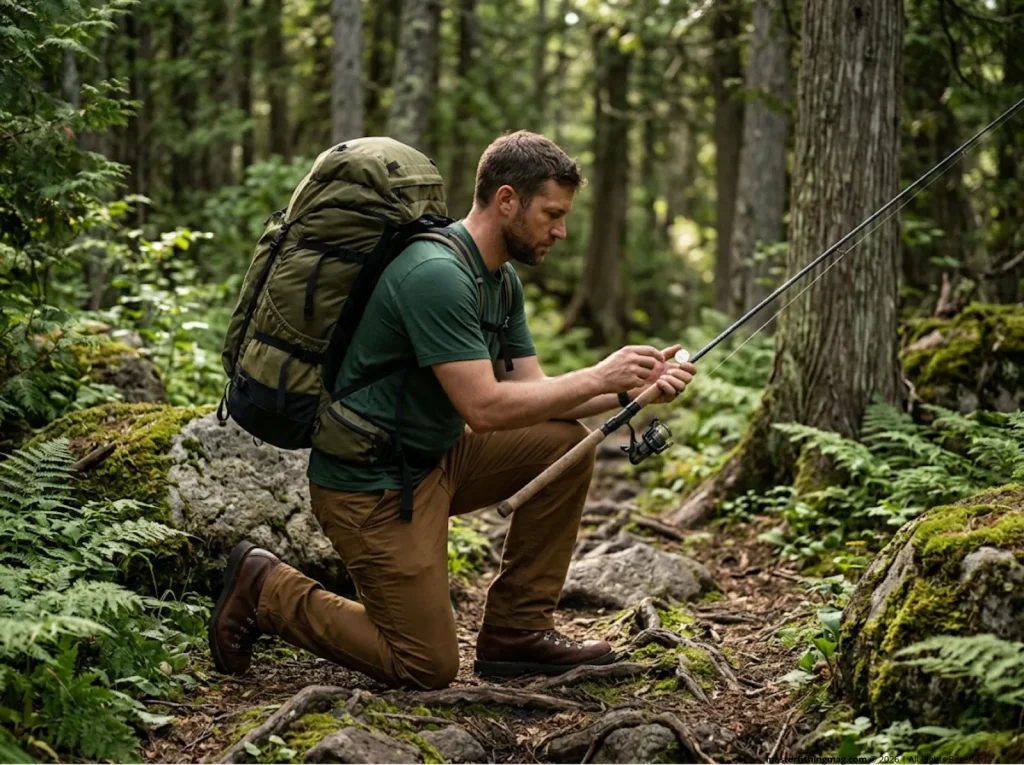
This is where anglers spend money wrong. A $500 high-modulus graphite rod in the BWCA is not a fishing advantage. It’s a fragile instrument designed for a tournament deck, not a 40-rod portage through boreal forest.
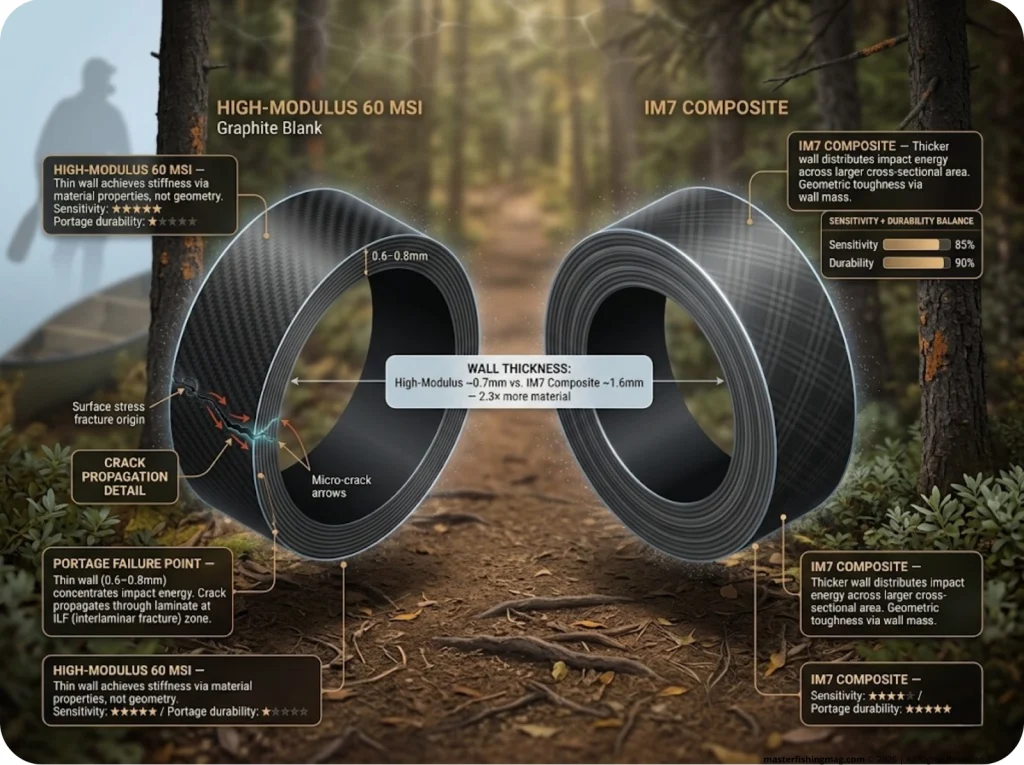
The problem is material physics. High-modulus graphite (50–65 MSI range) achieves its sensitivity by building thinner blank walls — less material at the same stiffness. That thin wall is what makes it responsive on the water, and exactly what makes it snap when the tip catches a canoe gunwale. The failure mode in the Boundary Waters is never a fish; it’s high-sticking through undergrowth, or smacking the blank on a Kevlar hull during canoe entry. I’ve portaged the same 1.5-mile carry with a 60-MSI rod twice. The first time it came back intact by luck. The third time I brought an IM7 composite and never debated it again.
The right specification: 6’6″ or 7’0″ Medium-Light or Medium power, composite or IM7 graphite, two-piece, moderate-fast to fast action. Understanding the physics of carbon fiber modulus and what it actually means for durability helps you avoid the high-modulus trap before you buy. Run a coin down the blank before every portage — any dull thud instead of a clean ring means microcracking has started.
The Braid-Fluorocarbon System — Physics Over Folklore
Don’t fish the BWCA without this setup: 20 lb braid main line with an 8–10 ft fluorocarbon leader at 10–12 lb test. This is not a preference — it’s a material response to the specific environment.
Braid gives you zero-stretch sensitivity to feel a jig at 28 feet. But braid has no solid surface; at the crossing points of 8-carrier braid, the individual fibers are thin enough that Precambrian granite shears them cleanly. This is the most common “unexplained” break-off on these waters. A 4-carrier braid resists better because thicker individual strands present more surface per contact point. The fluorocarbon leader handles the abrasion problem — at 1.85–1.9 times the density of water, fluorocarbon sinks and its molecular structure resists nicking against rock edges far better than monofilament, which absorbs water, softens, and gets cut. An FG Knot is the connection of choice: thinnest pass-through diameter, near-100% strength retention. Double Uni is your field backup.
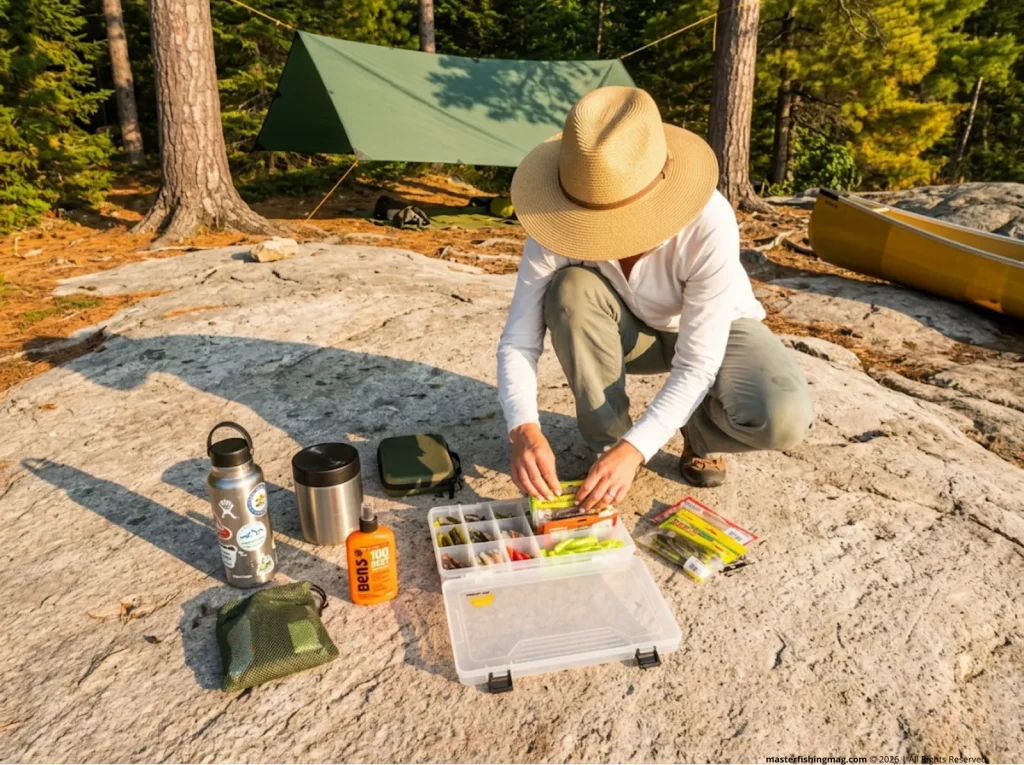
Pro tip: Store DEET and soft plastic baits in completely separate compartments. DEET contains lacquer solvents that permanently soften paint on hard bait finishes. This is not fixable once it happens.
Portage Packing — Weight vs. Utility at the Trail
Every piece of tackle you bring into the BWCA gets weighed twice: once at the trailhead, once at the second portage when your shoulders are burning. The 3-portage test is the real filter — if a piece of tackle is only useful for one technique, it doesn’t make the pack.
A Leech Locker or oxygenated bait bag replaces 5-gallon pails entirely. Same bait viability, a fraction of the weight over a 1.5-mile carry. Use a single rod tube with reel bag over individual rod cases — one handle, one trip. Soft plastic baits earn their spot because they require no bait mortality management and carry no invasive species risk. The only logistics issue is keeping them away from DEET, which migrates through tackle storage in a closed dry bag faster than most people expect.
Species-Specific Depth and Temperature Strategy
Walleye — The Metalimnion Ambush Layer
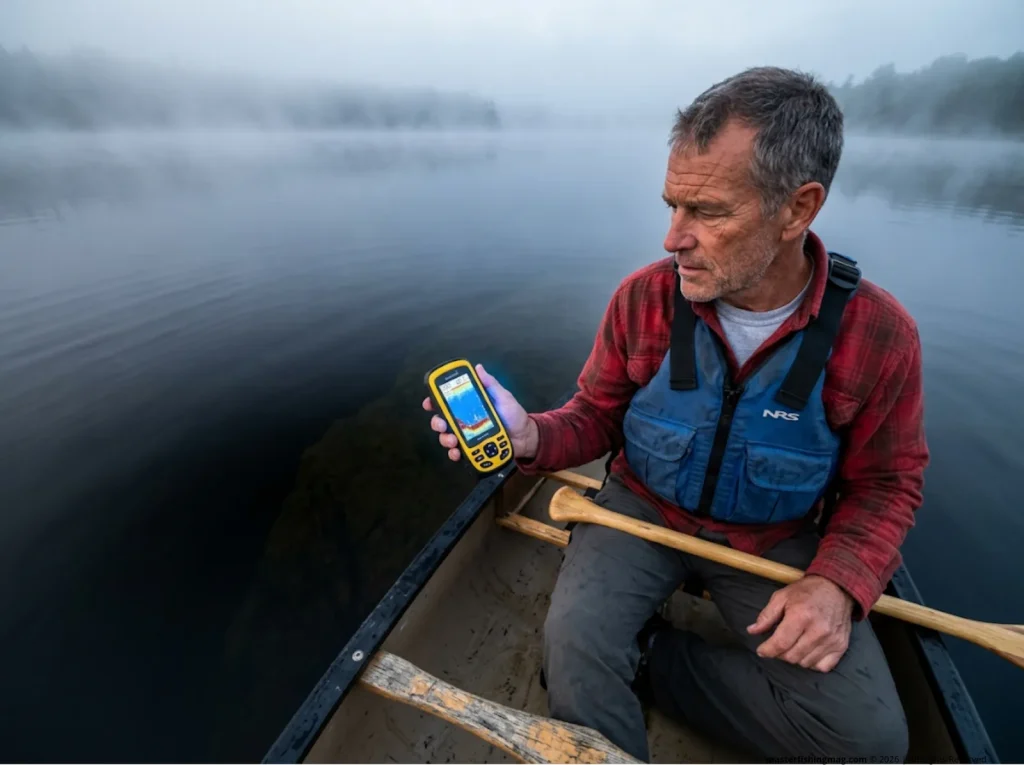
Adult walleye over 18 inches feed most efficiently at 60–65°F. Their metabolic rate roughly doubles per 10°C increase, which means a walleye sitting in 72°F surface water burns energy instead of building it. The fish that are eating in peak summer are at depth, in the cold, at that thermocline boundary. Target the metalimnion-hypolimnion boundary: typically 18–28 ft depending on lake depth in July. Use ¼ oz jigs in 15–20 ft, ⅜ oz in 20–30 ft to maintain contact through the thermal layers.
The BWCA’s no-motor rule is an actual fishing advantage. There is no trolling pressure. Fish have not been trained to flee boat noise. Drift-fish from upwind, let the canoe become part of the background, and work jig-and-leech or slip bobber presentations on wind-blown structural points. The biology behind walleye light sensitivity and how it determines when they strike explains why the 45–60 minute window before and after sun contact is mechanistically distinct, not folklore.
After dark, walleye push into 8–15 ft flats and feed actively. This is the hunt window. Black jigs and high-contrast silhouette lures are the tools — color is irrelevant, shape is not. Slip bobbers do serious work in this window when walleye are suspended precisely at the thermocline bottom. Set the stop bead 2–4 feet below where sonar shows the temperature break, let it drift on wind-blown points, and you’ll rarely need to reposition. The physics of the wind does the work.
Lake Trout — Deep Structure Specialists
Lake trout (Salvelinus namaycush) are bound to water below 55°F with high dissolved oxygen. When you find them, they’re in the hypolimnion, on deep reefs and submerged structure, 30–50 ft down in July. Saganaga, Basswood, and Trout Lake systems are known laker producers, and all qualify as oligotrophic. Vertical jigging with ¾–1 oz tube jigs or large spoons. Mark fish on sonar before anchoring — lakers rarely move far to eat a presentation.
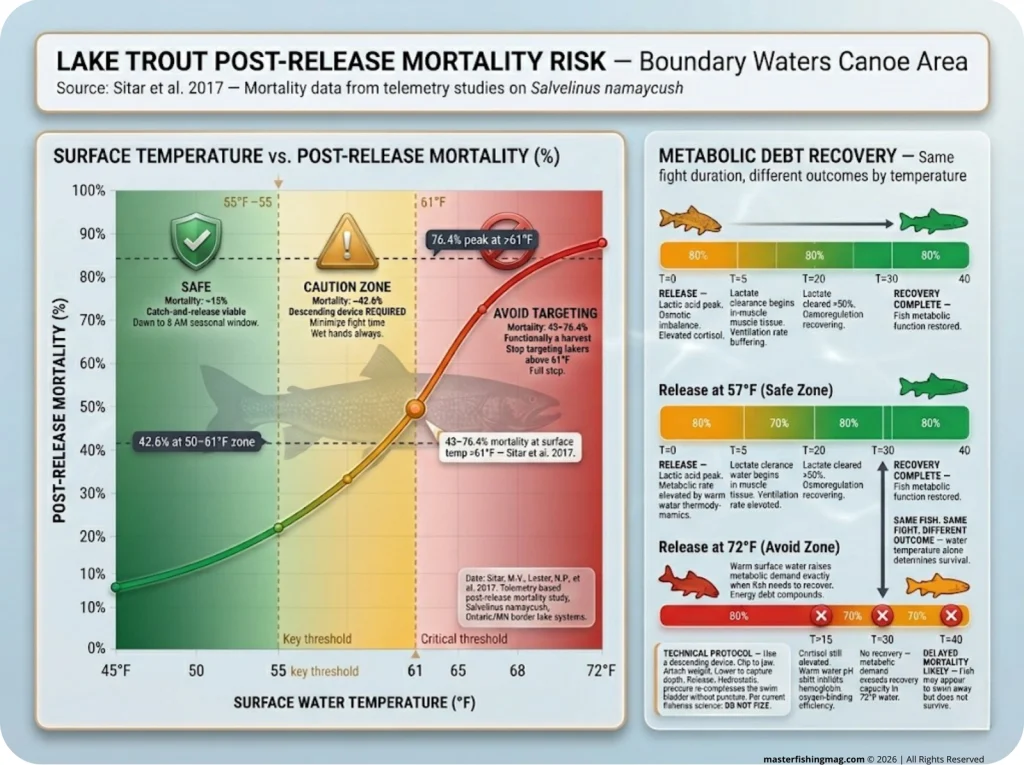
Here’s what the guides usually skip: if surface temps hit 65°F or above, fishing for lake trout is not catch-and-release. According to Sitar et al. 2017 data on Lake Trout post-release mortality by surface temperature, mortality exceeds 76% at those temperatures. Fishing them from the surface becomes functionally a harvest, not a release. The solution is cutting hours — fish lakers from dawn to 8 AM in high heat, release with a descending device directly, and stop before the surface temp window closes.
Smallmouth and Pike — The Structural Predators
Smallmouth use an energy-cost logic: they hold where food comes to them. Behind boulders, at current seam edges, in the calm water downstream of any obstruction where the hydraulics drop. These are the rough, irregular Precambrian riverbeds that create the eddies where smallmouth park. Work tube jigs, soft craw imitations, or inline spinners through the seam edge, not the calm water in the eddy’s center. The feeding position is at the leading edge of the reverse current.
Northern pike in summer want shallow weeds with spring holes — cool, oxygenated water where they can maintain aerobic capacity without thermal stress. A pike you find in open water in July is usually a stressed fish, not a feeding fish. Use weedless soft plastics or large flashy spinners woven through cabbage beds. Both smallmouth and pike benefit from lead-free tungsten weights — at 1.7 times the density of lead, you get the same weight in a smaller profile, and you stop putting lead sinkers on the bottom of a lake where common loons (Gavia immer) are diving for fish.
Pro tip: In high-water spring conditions, every eddy holding position shifts downstream. Recalibrate after significant rain events — the fish are still there, just 20 feet lower than your mental map.
The Physics of Lure Selection — Hydrodynamics in Tannin Water
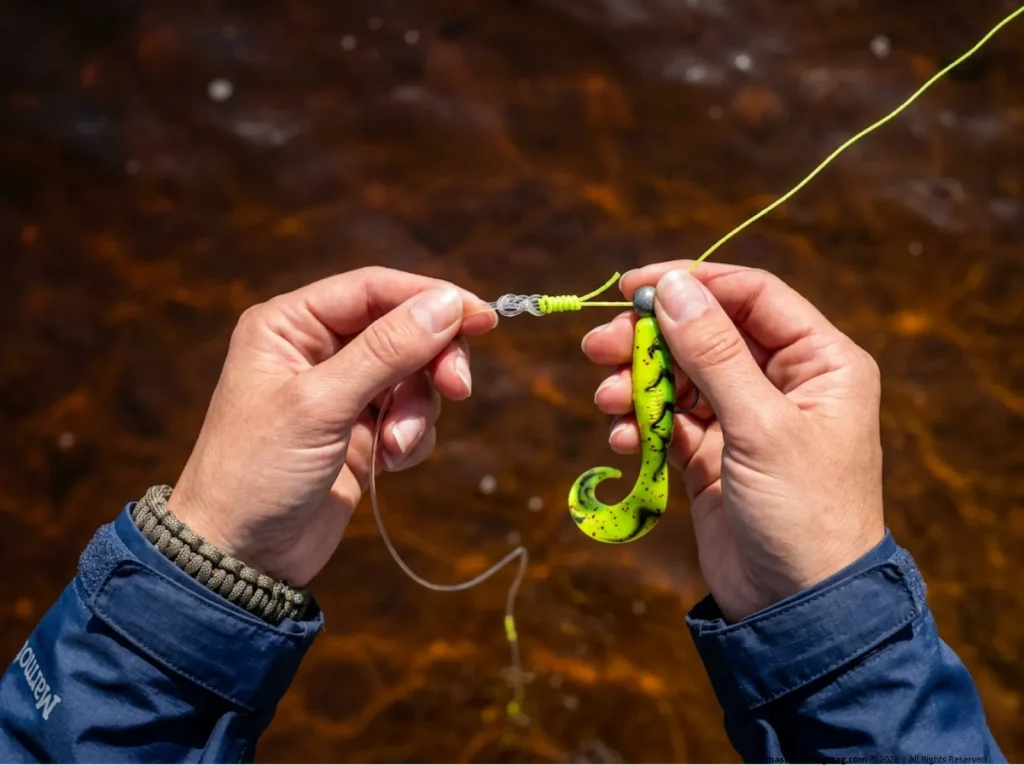
The first time I switched from a white tube to an orange-black craw in Basswood’s tannin water, I doubled my strikes in 40 minutes. The fish weren’t anywhere new. The lure color physics had finally matched the optical environment.
In stained BWCA water, light intensity decreases exponentially with depth — and tannins accelerate that extinction curve by filtering blue and violet wavelengths from the surface down, leaving a red-orange dominant environment below 10 feet. According to NOAA’s documentation of light and color behavior in water at depth, intensity drops exponentially with depth, and in stained water, that happens faster. Fluorescent lures absorb UV wavelengths and re-emit them as visible light, which is why they appear brighter than their surroundings even at depths where standard colors have faded gray. In clear BWCA lakes with Secchi depths past 12 ft, natural patterns — perch-imitating, olive/brown, silver — work to 15–20 ft. Deeper, switch to chartreuse or white.
For a broader framework on how water turbidity physically affects lure visibility and the lateral line, the same optical physics apply to any stained system. High-drag lure profiles also produce vortex shedding at the trailing edge — the wobble and pressure waves that trigger the fish’s lateral line, which detects injured baitfish frequencies. That’s why a soft plastic craw gets strikes in clear-water rocky shallows where a jig doesn’t; the drag profile is doing work the color never could.
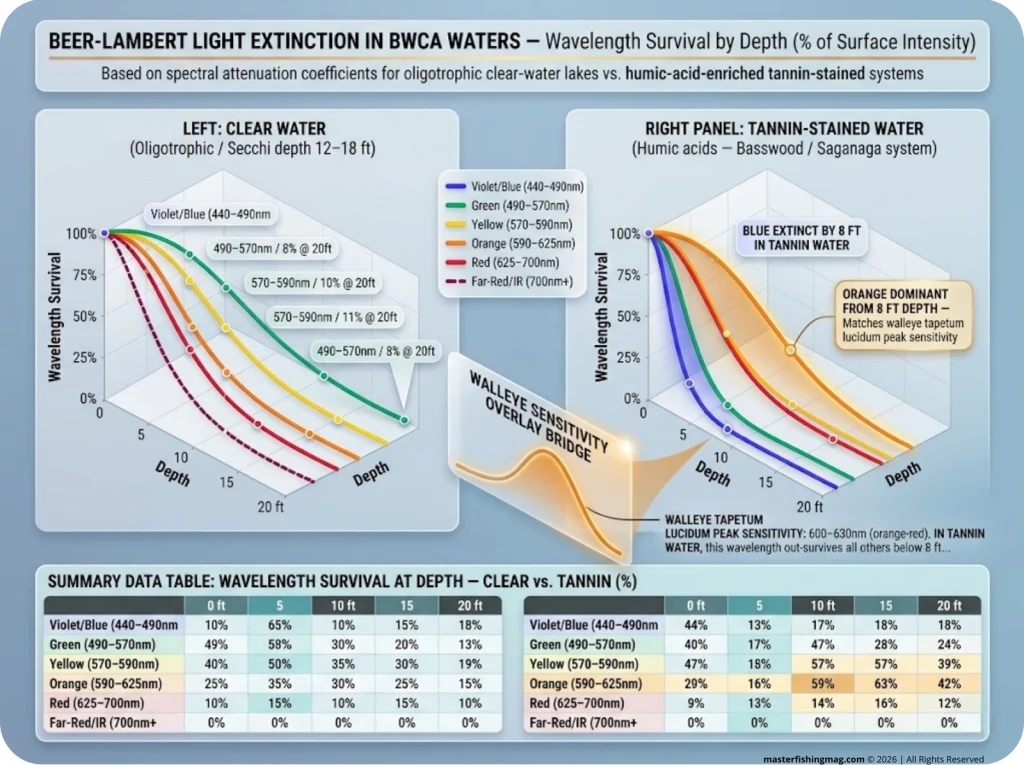
Calibrate jig weight to depth and drift speed. In calm water: ¼ oz at 0–20 ft, ⅜ oz at 20–30 ft, ½ oz at 30+ ft. In wind-driven drift or river sections, bump up one increment to maintain bottom contact. Fluorescent chartreuse and firetiger are your stained-water workhorses. Gold and copper spoons — not chrome — reflect the red-orange wavelengths that survive to depth in tannin systems. Counterintuitive, but consistent.
River Sections and Manning’s n — The Current Physics Framework
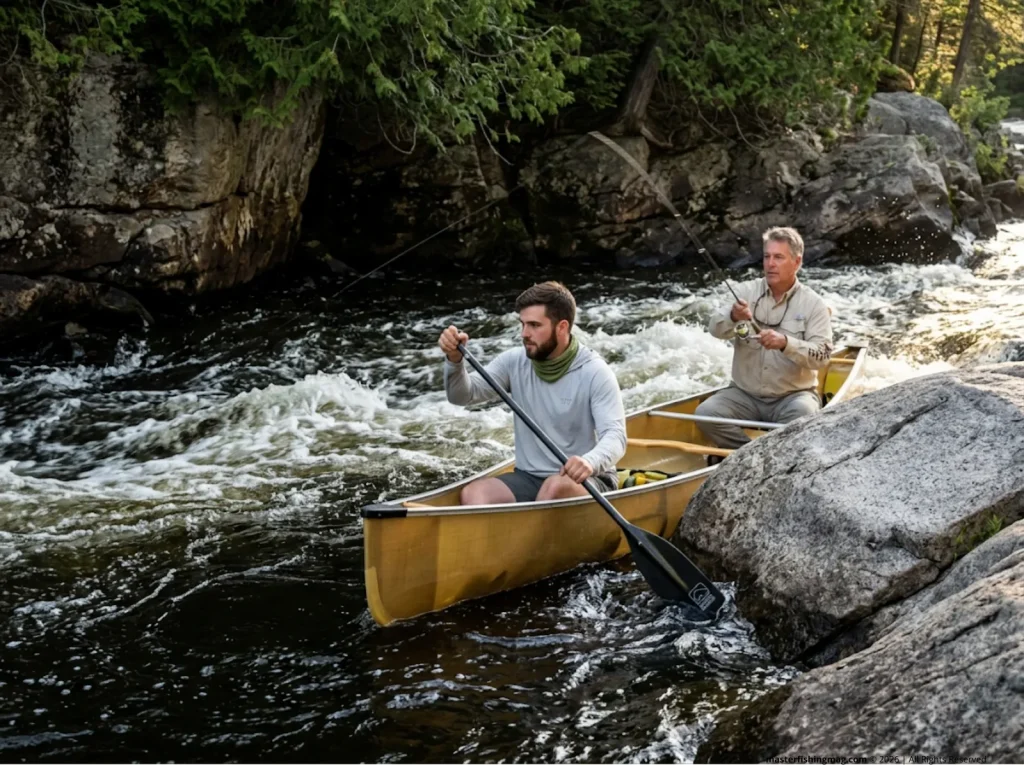
The river connections between BWCA lakes — the Kawishiwi, Isabella, and Basswood river corridors — hold fish that most visiting anglers completely misread. They look for “fishy spots” instead of reading the hydraulic physics.
The roughness of jagged Precambrian rock cuts creates intense turbulence that builds complex eddy systems behind every boulder. The fish know this. Smallmouth and pike sit at the edge of the calm zone downstream of any obstruction, where the energy cost of holding is near zero and the main current delivers prey past their nose. When I started thinking about BWCA rivers as a hydraulic roughness problem instead of “where does it look fishy,” I stopped fishing the middle of the current and started reading the eddy shadow behind every boulder over three feet. Catch rate in those sections tripled. According to the USGS Manning’s roughness coefficient guide for natural channels, uniform clean channels hold baitfish, not predators. The predator stations are in the jagged rock cuts and pool-shoal transitions.
Cast upstream of the eddy, let the lure be carried into the seam, and work it through the calmer zone behind the boulder. The strike happens at the eddy edge. Don’t fish the current itself; fishing the current deposits your lure into high-energy water where fish refuse to burn calories. Understanding the physics of current seams and how fish use the boundary layer to conserve energy is the framework that converts river sections from coin flips into predictable structure fishing.
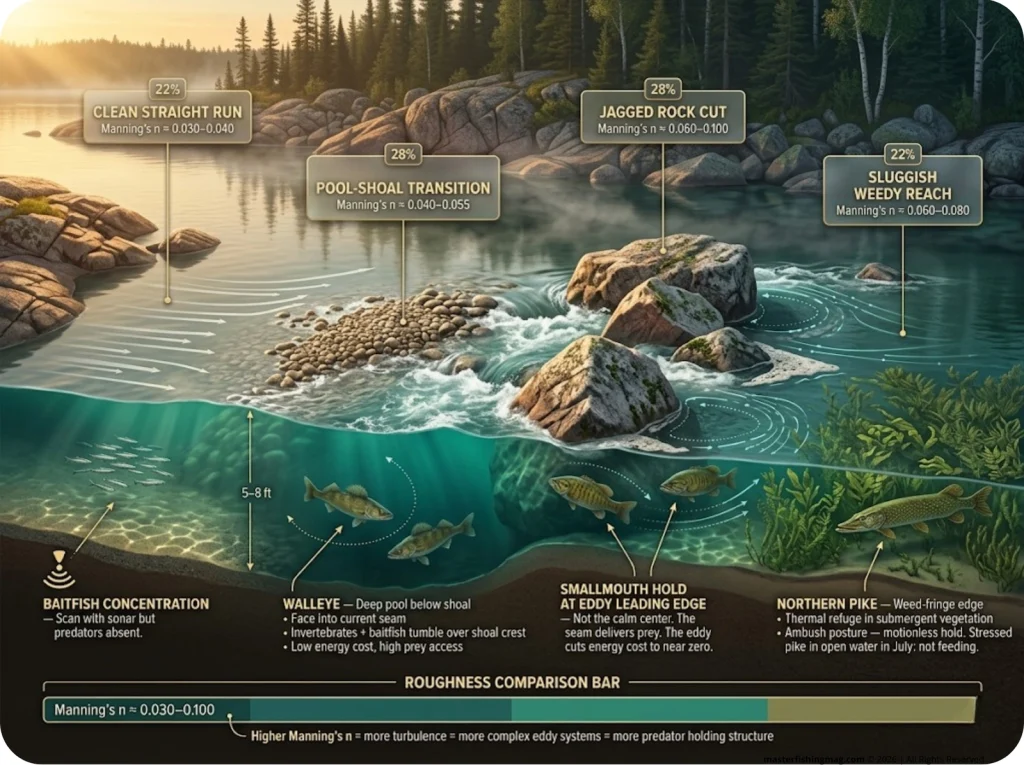
Here’s how to read the river types quickly: Clean, straight channels with even flow hold baitfish concentrations — scan them with sonar but don’t expect predators. Winding pool-and-shoal sections are your prime walleye and smallmouth water — the deep pool below each shoal concentrates invertebrates and baitfish. Jagged, irregular rock cuts are pike and large smallmouth ambush stations — work every surface-breaking boulder systematically. Sluggish weedy reaches are northern pike in matted vegetation — weedless tube jigs fished slowly through stems.
For canoe control: position in the smooth seam or reverse eddy and cast into the boulder fields. The Kevlar hull holds eddy position with fewer corrections than aluminum. Anchor with caution on rock-bed currents; a light trailing-paddle technique beats an anchor in anything above Class I.
Conservation Science — The Post-Release Survival Protocol
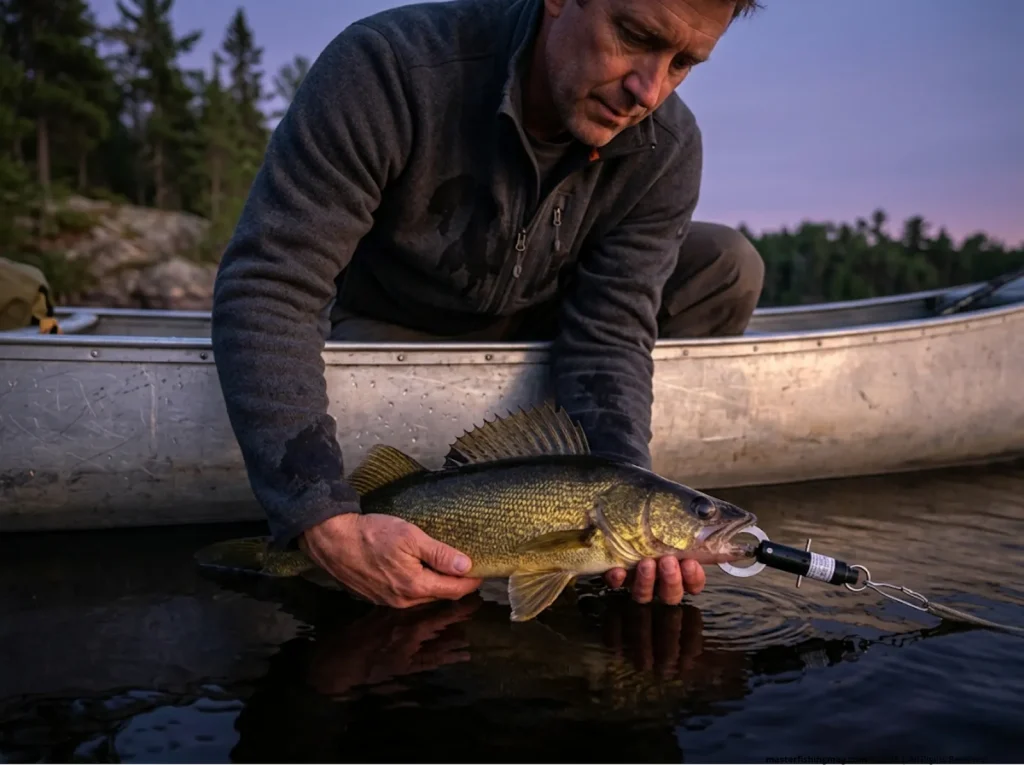
I used to think wetting your hands before handling was the main protocol that mattered. Then I understood what was actually happening to a fish put back in 72°F surface water: it spent the next 20–40 minutes fighting metabolic debt — clearing lactic acid built up during the fight — in water that raised its metabolic rate at exactly the moment it needed to recover. That’s not catch-and-release. That’s a delayed harvest.
The temperature-mortality data is not ambiguous. Lake trout post-release mortality at surface temps below 50°F runs around 15%. Between 50–61°F, it climbs to 42.6%. Above 61°F, it reaches 43–76.4% (Sitar et al. 2017). Peak summer BWCA surface temps hit 65–72°F regularly. Fishing lake trout in those conditions is a different activity than you think you’re doing.
Barotrauma makes it worse. Fish brought from depths over 25–30 feet experience gas expansion in the swim bladder — stomach protruding from the mouth, eyes bulging outward. The old answer was fizzing: puncturing the bladder with a needle to release gas. Current fisheries science rejects this. The infection risk from a non-sterile puncture, the potential for organ damage, and the proximity of the bladder to the reproductive tract make fizzing worse for the fish than the barotrauma itself. The technical protocol is a descending device: clip to the jaw, attach weight, lower to capture depth, release. Increased hydrostatic pressure re-compresses the swim bladder gas without puncture. The warm-water release protocols that determine whether your fish actually survives walks through this procedure in detail.
For walleye: 10 seconds of air exposure is the scientific standard. Above 64°F surface temperature, walleye post-release mortality becomes substantial. Keep them in the water. Apply the 10-second rule every time, on every fish.
Pro tip: Rinse any descending device with freshwater after every trip. The clip mechanism corrodes quickly in the humidity of multi-day BWCA conditions, and a device that won’t open at 30 feet is useless equipment.
Regulatory Constraints as System Variables
The BWCA regulations are not bureaucratic friction — they’re the conservation architecture that maintains the fishery that makes the trip worth taking. The analytical angler treats them as system variables.
Entry permits through the USFS Quota Entry Point system fill fast. July popular zones — Moose Lake Chain, Sawbill, Entry 1 Saganaga — exhaust quota within hours of the late-January booking window. Book through Recreation.gov. The USDA Forest Service official BWCA rules and regulations cover the no-can/no-bottle rule and related logistics.
Bait vector management is the rule most people misunderstand. I watched someone pour a bait bucket into a portage-accessed lake because the fish came from a Minnesota lake. They had no idea the water itself was the vector for the pathogens that collapsed walleye populations in nearby lakes. All water in bait containers must be exchanged with tap or well water before leaving any water body — this prevents VHS (Viral Hemorrhagic Septicemia) transmission. The broader science of aquatic invasive species and what anglers can do to stop the spread explains the full threat model.
The no-motor rule on interior lakes is a fishing advantage, not a concession. No trolling pressure, no boat noise. Lakes behind two or more portages consistently produce larger walleye than road-accessible entries under the same trophic conditions. That’s not anecdote — it’s direct function of reduced pressure on fish that haven’t learned to associate boat presence with threat.
What You Actually Bring Home
Three things determine whether this trip produces fish or frustrating scenery.
First, read the trophic state before you rig anything. A Secchi disk depth and mean depth number from LakeFinder tells you where each species will hold. Don’t fish depths someone recommended online — fish the physics predicted by the specific lake you’re on.
Second, your rod and line system will be tested by granite, not fish. The IM7 composite two-piece with a braid-fluorocarbon leader system is not a compromise. It’s the correct engineering response to Precambrian Shield conditions. The portage is the performance test, not the boat.
Third, conservation here requires doing the math. Post-release mortality in lake trout exceeds 70% when surface temps are above 61°F. That’s not a risk to manage — it’s a near-certain outcome. The BWCA exists in the condition it does because of 50 years of compounding good decisions by the people who fish it. Add your decisions to that sum.
Before your next BWCA trip, pull the LakeFinder report for your target lake, note the Secchi depth and mean depth, and use that data to set your depth strategy before you load the canoe. Fish the system, not the rumor.
FAQ
Do I need a special fishing license to fish in the Boundary Waters?
You need a valid Minnesota fishing license plus a USFS Quota Entry Permit for overnight access to the BWCAW. The fishing license comes from the MN DNR; the entry permit through the USFS Recreation.gov system. Day-use fishing near entry points may not require a quota permit, but overnight entry always does. Verify current requirements at the USFS Superior National Forest site — day-use rules have shifted in recent seasons.
What is the best lake for walleye in the BWCA?
The consistently productive walleye lakes are mid-sized mesotrophic systems with clear-to-moderate clarity — Basswood, Saganaga, and Crooked Lake are well-documented producers. The honest answer is that thermocline depth and fishing pressure determine walleye quality more than the lake name. Lakes requiring two or more portages from any access point consistently produce larger fish under the same trophic conditions as road-accessible lakes. Less pressure, same biology.
Are there motors allowed in the Boundary Waters?
The majority of interior BWCA lakes prohibit motorized vessels entirely. A limited number of lakes near the entry boundary permit motors up to 25 HP. From a fishing standpoint, the motor-free interior eliminates trolling pressure and boat noise, producing fish that are far less conditioned to flee than fish in equivalent accessible waters.
What lures work best in the tannin-stained lakes of the Boundary Waters?
In tannin-stained water, contrasting color patterns outperform natural patterns because tannins filter blue and violet wavelengths from the top down, leaving a red-orange dominant, rapidly dimming environment below 10 feet. Use chartreuse or black, orange or black, or firetiger patterns for walleye. Fluorescent lures that absorb UV and re-emit visible light perform well at depths where standard colors have gone gray. For smallmouth on rocky bottoms, craw-colored soft plastics exploit visual contrast at close range rather than at-depth visibility.
Can I bring live minnows from home to the Boundary Waters?
Live bait transport into the BWCA is subject to MN DNR bait transport regulations — all bait container water must be exchanged with tap or well water before entering any new water body. This prevents VHS and other pathogen transfer through water. Some individual BWCA lakes further restrict live bait use — check current MN DNR regulations for your specific entry point and target lakes before the trip. These restrictions change between seasons.
Risk Disclaimer: Fishing, boating, and all related outdoor activities involve inherent risks that
can lead to injury. The information provided on Master Fishing Mag is for educational and informational purposes
only. While we strive for accuracy, the information, techniques, and advice on gear and safety are not a substitute
for your own best judgment, local knowledge, and adherence to official regulations. Fishing regulations, including
seasons, size limits, and species restrictions, change frequently and vary by location. Always consult the latest
official regulations from your local fish and wildlife agency before heading out. Proper handling of hooks, knives,
and other sharp equipment is essential for safety. Furthermore, be aware of local fish consumption advisories. By
using this website, you agree that you are solely responsible for your own safety and for complying with all
applicable laws. Any reliance you place on our content is strictly at your own risk. Master Fishing Mag and its
authors will not be held liable for any injury, damage, or loss sustained in connection with the use of the
information herein.
Affiliate Disclosure: We are a participant in the Amazon Services LLC Associates Program, an
affiliate advertising program designed to provide a means for us to earn advertising fees by advertising and linking
to Amazon.com. As an Amazon Associate, we earn from qualifying purchases. We also participate in other affiliate
programs and may receive a commission on products purchased through our links, at no extra cost to you. Additional
terms are found in the terms of service.