
In this article
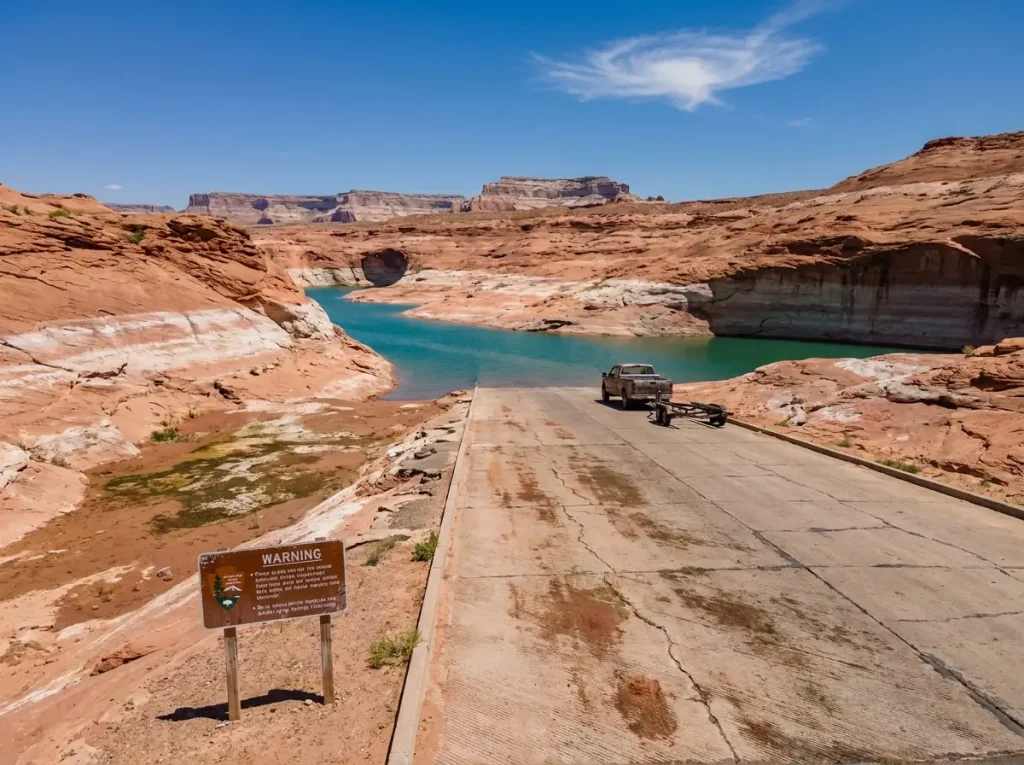
I drove five hours to Hite Marina last spring and found the boat ramp sitting forty feet above the waterline. Not a drop of lake anywhere near it. That was the first time Lake Powell taught me something the hard way, and it wasn’t the last.
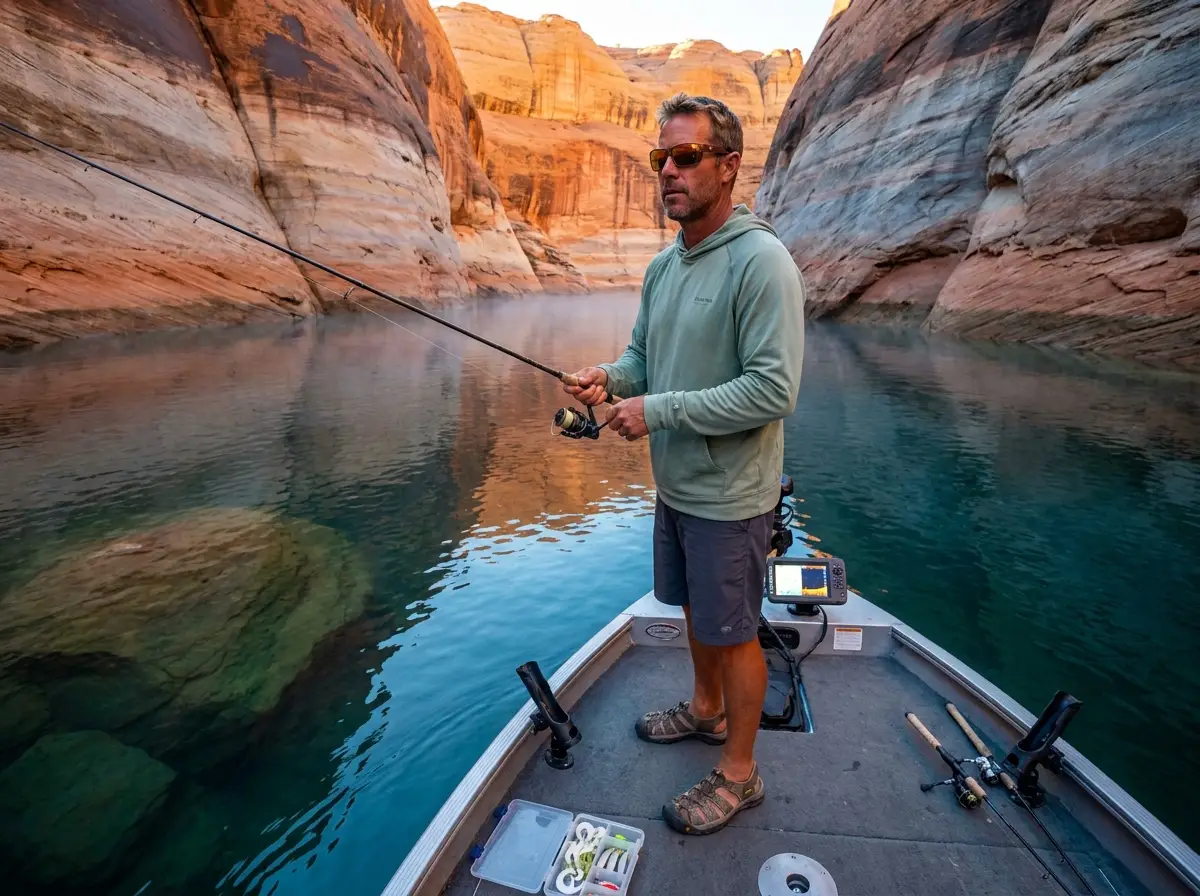
Powell is one of the most productive fisheries in the Southwest — stripers with no catch limit, smallmouth that fight harder than fish twice their size, and canyon scenery that makes you forget you’re holding a rod. But this lake punishes lazy planning harder than any water I’ve fished. Here’s what most people get wrong, and how to fix it before your next trip.
Quick Answer: The five biggest mistakes anglers make at Lake Powell are ignoring current water levels and ramp closures, fishing the wrong depth for the season, targeting stripers before boils actually start, skipping the dual-state license requirement, and assuming you need a boat to catch anything. Fix these and you’ll outfish most visitors on day one.
Why Water Levels Change Everything at Lake Powell
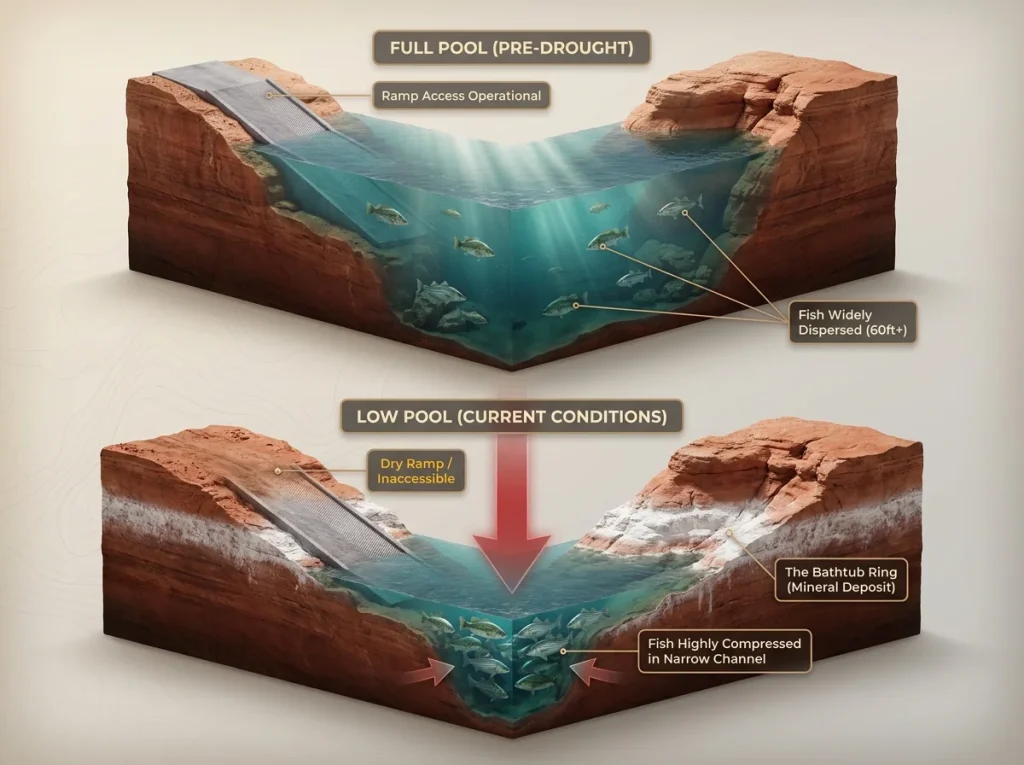
The Bathtub Ring Problem
Lake Powell sat 174 feet below full pool in April 2026. That’s not a typo. The white mineral lines on the canyon walls — locals call them bathtub rings — tell the story of two decades of drought, brief recoveries, and more drought. For anglers, this means the lake you studied on Google Maps doesn’t match the lake you’ll find.
Canyons that held water three years ago are dry red hardpan now. Points that were 15 feet deep are exposed rock. Structure that held bass is sitting in the sun. If you’re using a pre-2023 fishing report, throw it away.
Pro tip: Check lakepowellwaterlevel.com the week before your trip — not the month before. Water levels can shift several feet in a week during spring runoff or late-summer drawdowns.
Which Ramps Are Actually Open
As of spring 2026, only two of Lake Powell’s eleven launch ramps are operational — Wahweap Stateline Auxiliary near Page, Arizona and Bullfrog North in Utah. Hite is gone. Halls Crossing is closed. Antelope Point handles small motorized vessels only.
This means your trip starts with a binary decision: Page or Bullfrog. Page gives you access to the dam area and the best striper water. Bullfrog puts you on the upper lake where smallmouth are more numerous. Plan your launch based on what you want to catch, not which marina looks closer on a map.
How Low Water Moves the Fish
When water drops, fish don’t disappear — they compress into the remaining depth. Drop-offs that were 60 feet are now 30. Canyon arms that spread wide at full pool are narrow channels. The upside? Fish concentrate in less water, which means if you find them, you’ll find a lot of them. Use your fish finder aggressively in these conditions. Scan the remaining structure, mark the new depth contours, and you’ll be fishing where every bass on that canyon wall is now stacked.
If you want to understand how fish react to rapid water changes, our guide to predicting fish movements during water level changes breaks down the physics behind it.
The Seasonal Playbook — When to Target What
Spring (April–May): The Spawn Window
This is prime time. Largemouth bass move onto shallow flats — 15 feet or less — to build nests. Target them with spinnerbaits, jig-n-pigs, and weedless plastic tubes around brush and flooded trees in the back of canyons. Smallmouth follow the same calendar on rocky points and gravel flats, especially in the upper lake near Bullfrog.
Crappie stack up in brushy areas deep in canyon arms during the spawn. Small jigs or night crawlers under a bobber are all you need once you locate the school.
Stripers start staging in 30 to 80 feet of water near the river inlets — Colorado, San Juan, Escalante, and Dirty Devil arms. Heavy jigging spoons and cut anchovy on the bottom are the go-to presentations.
Summer (June–August): Boils and Deep Structure
Bass go deep. Smallmouth and largemouth hold on rock slides and shaded walls — you need weighted jigs or Carolina rigs to reach them. Morning and evening topwater bites still happen, but midday fishing means going vertical.
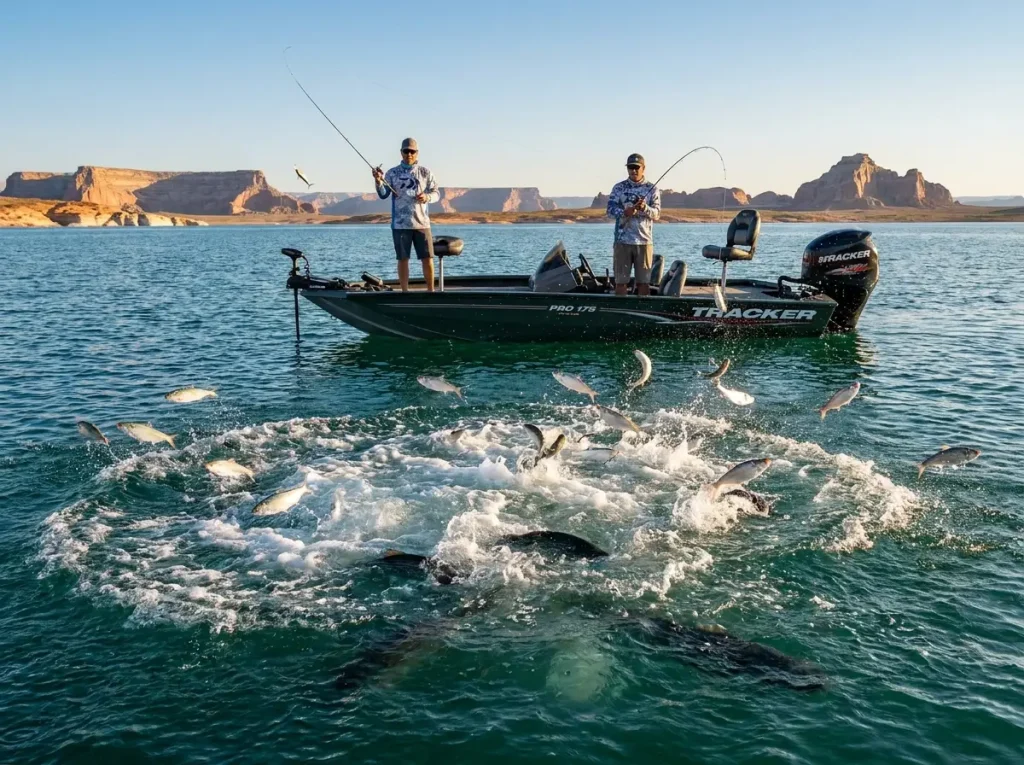
The headline event is the striper boil — more on that below. Schools of stripers herd threadfin shad against cliffs and into coves, and the surface erupts. This typically starts in late June and runs through early fall.
Fall (September–November): The Feed-Up
Everything bites. Every species senses winter coming and feeds hard. Bass move shallow again following shad. Crankbaits, jerkbaits, and small plastic grubs in shad colors produce across the board. Striper boils continue into October. This is arguably the best all-around fishing window at Powell.
Winter (December–March): Slowed but Not Stopped
Fish are less active below 50°F water temperature. Stripers group at 60 to 100 feet and respond to heavy spoons and bucktail jigs worked vertically. Downrigger trolling at 5 mph with shad-colored crankbaits covers water when fish won’t commit to stationary presentations. If you’re planning a winter trip, our blade bait fishing guide covers the techniques that work when everything else fails.
Pro tip: May is the consensus best month for overall fishing at Lake Powell. Bass are spawning, stripers are staging, crappie are concentrated, and the weather is comfortable. If you only get one trip a year, book it for May.
Lake Powell’s Big Five — Species That Bite and Where
Striped Bass — The Main Event
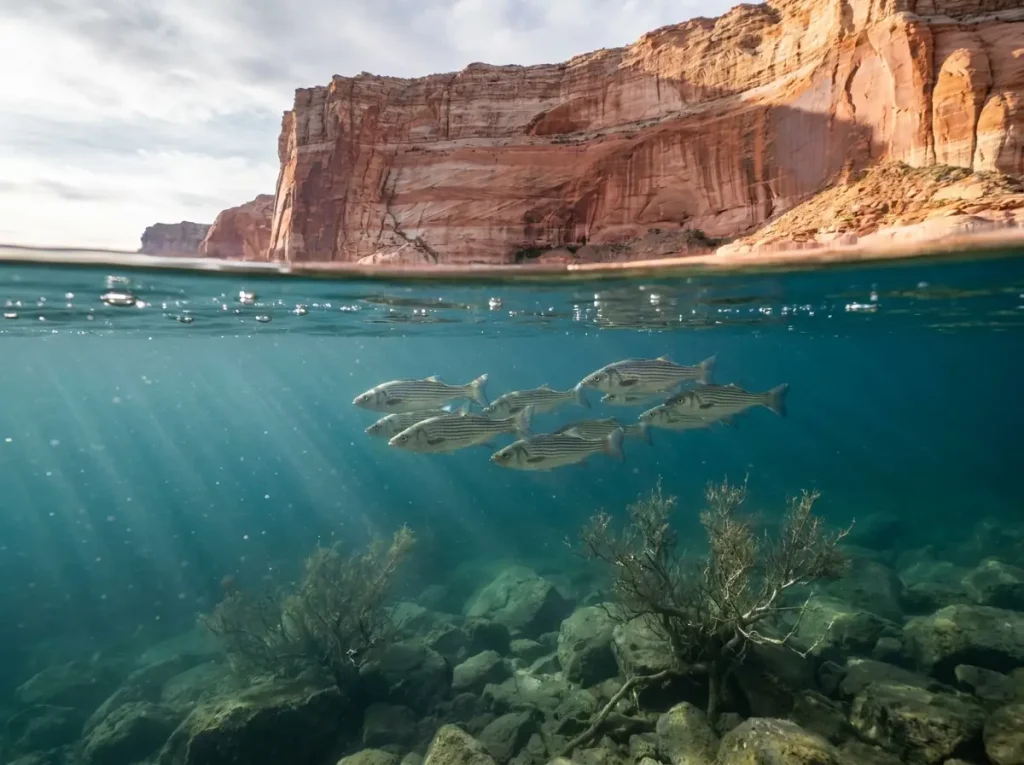
No daily limit. Chumming with anchovies is legal. The state actively wants you to harvest these fish because they’re overpopulated and competing with everything else in the lake. Trophy stripers run 20 to 40 pounds. They’re the reason most serious anglers visit Powell.
In spring, find them near river inlets in deep water. In summer, chase the boils. In fall and winter, jig deep off main channel points. For a deeper understanding of how stripers behave and why they move where they do, check out our striped bass biology guide.
Smallmouth Bass — The Scrappy Fighter
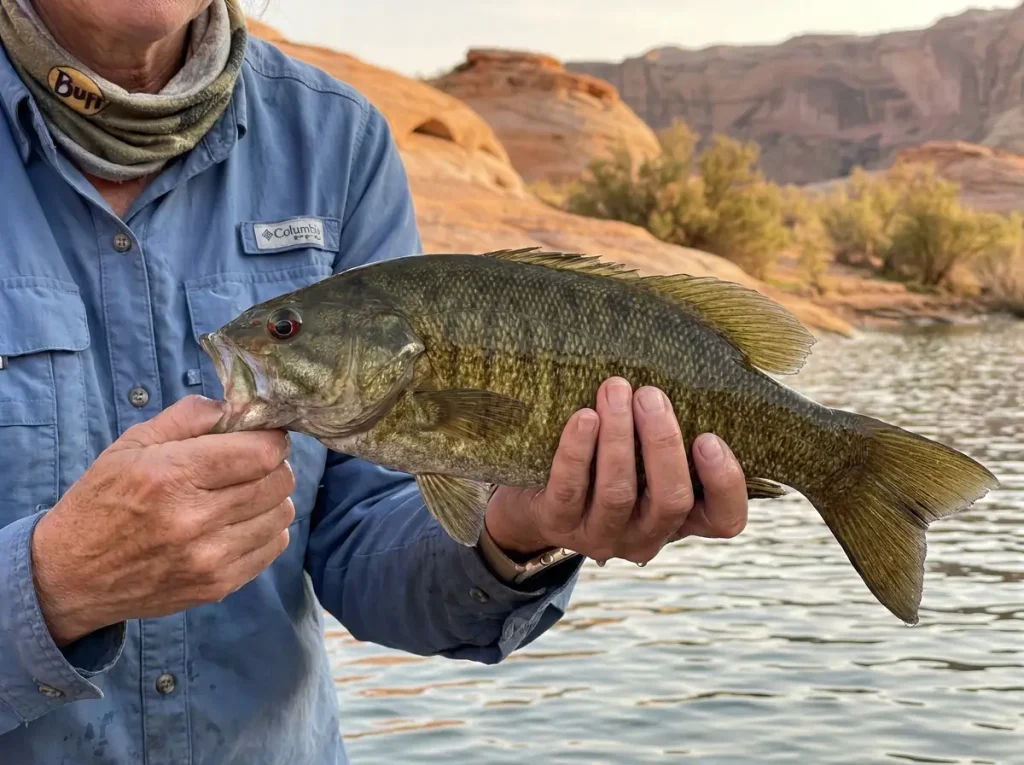
More numerous in the upper half of the lake. Target rocky shorelines, points, and rubble with tube baits, smoke-colored Yamamoto grubs, and small jerkbaits. Smallmouth on Powell hit harder per pound than almost any freshwater fish. Our complete smallmouth field guide covers the presentations that work anywhere they swim.
Largemouth Bass — Canyon Specialists
Found in shallower, warmer water — backs of canyons, brush piles, flooded timber. Spinnerbaits and plastic worms in watermelon and crayfish colors produce year-round. Less numerous than smallmouth but tend to run larger individually.
Walleye — The Underrated Target
Best fishing is May and June. They go quiet in winter but remain catchable. No daily limit, same as stripers. If you’re a walleye angler, Powell’s population is healthy and under-targeted compared to the bass species.
Catfish and Panfish — The Bonus Catch
Channel catfish are everywhere and absurdly easy to catch from a houseboat at night. Hot dogs on a #4 baitholder hook fished on the bottom is all it takes. Seriously. Bluegill and crappie provide constant action for families and light-tackle anglers, especially in spring.
Tackle and Techniques That Actually Work Here
The Striper Kit
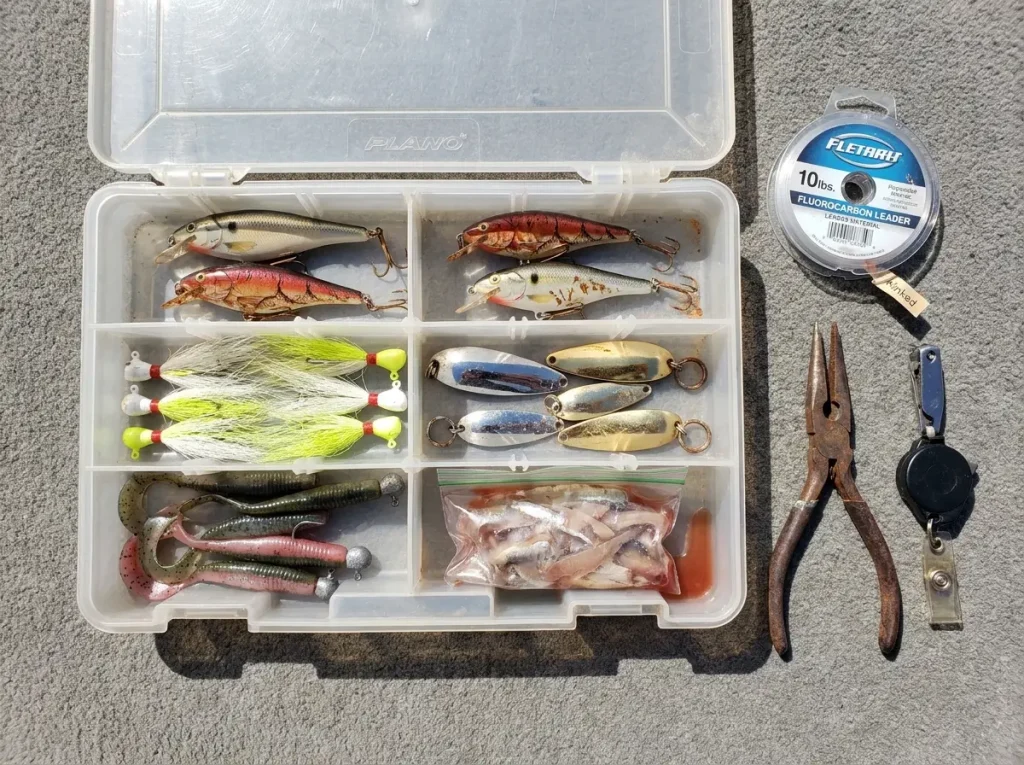
One medium-heavy spinning rod loaded with 20-pound braid and a fluorocarbon leader. Rig it for jigging spoons (1 to 2 ounce chrome or gold) for deep fish, or swap to topwater walking baits when boils appear. Carry Rapala Shad Raps in shad and crayfish patterns for trolling the main channel.
The Bass Setup
A medium spinning rod with 10-pound fluorocarbon direct. Stock smoke, watermelon, and pumpkin soft plastics — tubes, grubs, and small worms. A 1/4-ounce jig head covers most situations. Add a few spinnerbaits for shallow spring work.
Bait Notes
Anchovies are the traditional bait for stripers and catfish on Powell, but supply has been unreliable recently. Buy them early if you can find them. Bring frozen backup or plan on artificials. Cut sardines work as a substitute. For a deep dive on spoon fishing techniques that replace bait fishing entirely, we’ve covered the approach that guides use.
Pro tip: Chumming with anchovies is legal on Lake Powell for stripers — one of the only places in Utah where this is allowed. If you can get anchovies, use them to hold a school under your boat while you jig.
Reading the Striper Boil — A Step-by-Step Field Guide
How to Spot a Boil
Watch for disturbance on the surface — it starts as nervous water, then shad begin jumping. Gulls diving on a calm section of lake are a dead giveaway. Boils can happen anywhere but tend to repeat at the same locations and times. Start a log. If you see a boil at the mouth of Padre Bay at 4pm on Tuesday, check that spot at 4pm on Wednesday.
The Approach
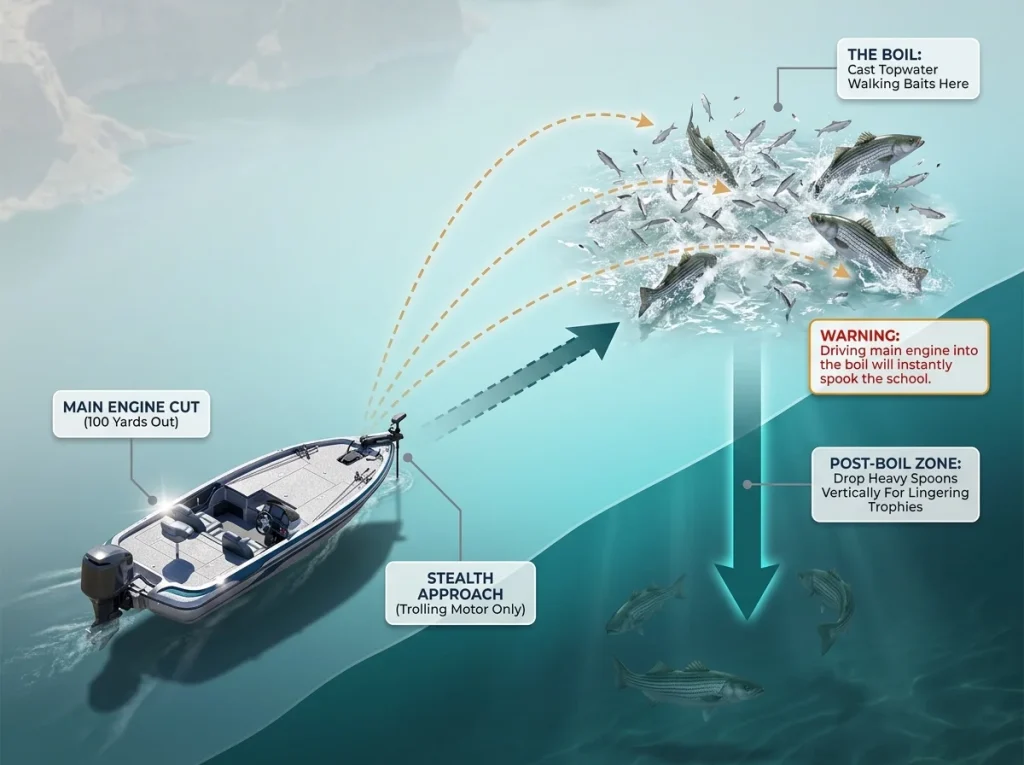
Cut your main engine at 100 yards and use the trolling motor to close the distance. Approach from downwind if possible. A loud motor spooks the school and ends the party for everyone.
What to Throw
Topwater walking baits and poppers first — the surface strike from a striper is the most exciting thing you’ll experience on this lake. When the boil slows, switch to chrome jigging spoons and rattling crankbaits cast through the area. The stunned and wounded shad attract lingering stripers even after the main frenzy ends.
When the Boil Dies
Don’t leave. Fish stay in the area looking for injured shad. Drop a heavy spoon straight down and jig vertically. Some of the biggest fish feed below the boil while the smaller ones attack the surface. This is the detail every visitor misses — they chase the next boil instead of working the one they already found.
Access Points, Marinas, and the Launch Ramp Reality
Wahweap (Page, Arizona) — The Main Gate
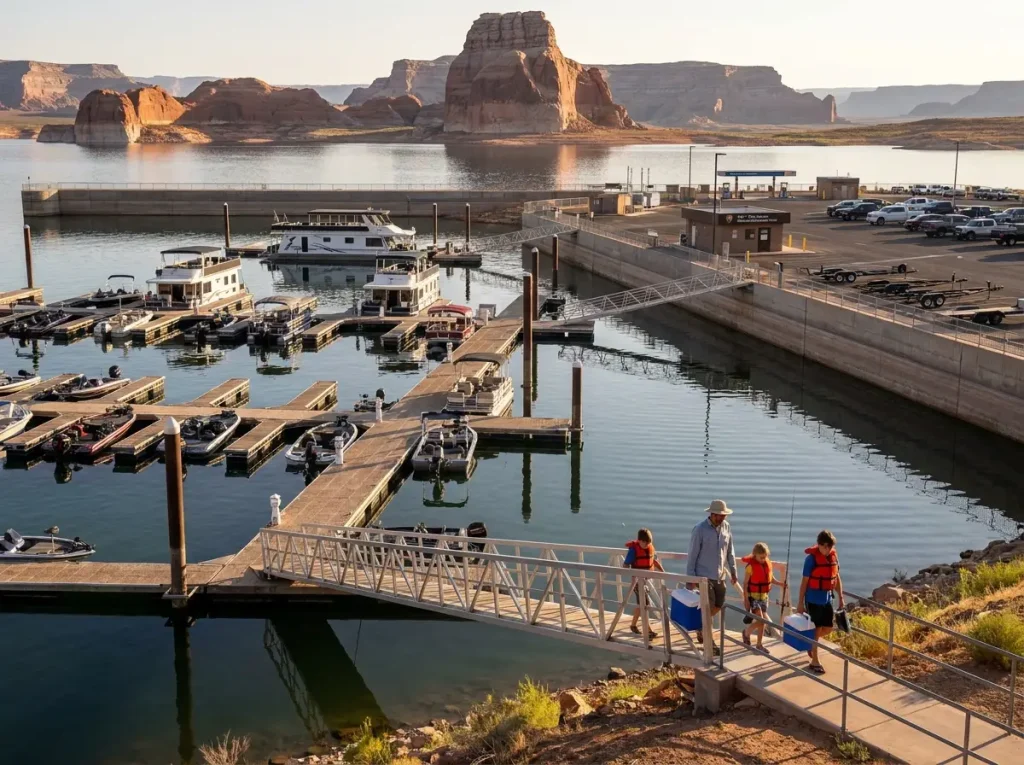
The most reliable access point in 2026. Wahweap Stateline Auxiliary Ramp handles most boat sizes. Page has hotels, restaurants, fuel, and tackle shops. This is your base for fishing the lower lake — dam area stripers, Wahweap Bay smallmouth, and Antelope Canyon arms.
Bullfrog (Utah) — The Upper Lake
Bullfrog North Ramp is open but sensitive to further water level drops. The drive from Salt Lake City is about 4.5 hours via Highway 95 through Hanksville. This puts you on the upper lake where smallmouth numbers are higher and fishing pressure is lower.
What’s Closed
Hite is completely inaccessible by boat. Halls Crossing is closed. Don’t plan around them regardless of what older guides or GPS maps show. Verify ramp status at the Glen Canyon National Recreation Area fishing page or call the marina directly before driving.
NPS entrance fee applies — $35 per vehicle for a 7-day pass or $80 for an annual America the Beautiful pass. Factor this into your budget alongside licenses and fuel.
Fishing Lake Powell Without a Boat
Shore Fishing That Actually Produces
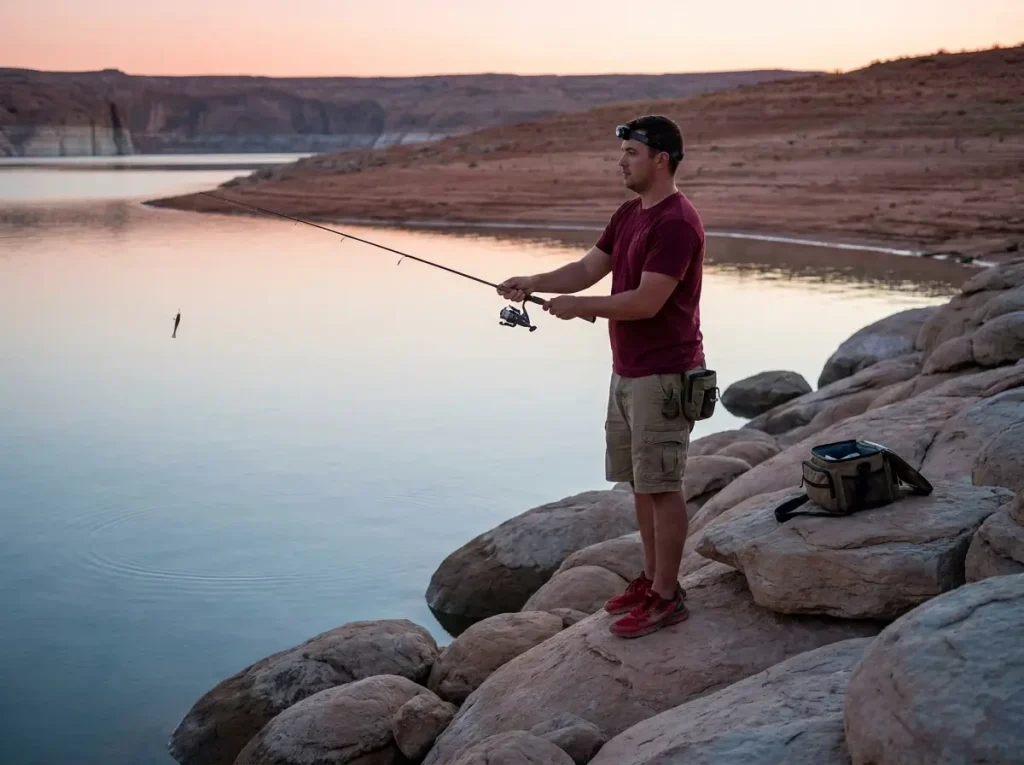
Shore fishing at Powell isn’t ideal, but it’s not hopeless. The best bank fishing is at Bullfrog and Stanton Creek where the shoreline has rubble and cantaloupe-sized rocks — the exact structure smallmouth use. Tube jigs and senkos in crawfish colors worked along the rocky edges produce fish, especially early morning.
For catfish, primitive camping at Lone Rock, Stanton Creek, or Farley Canyon puts you right on the water for night fishing. A chunk of hot dog or tortilla on the bottom catches channel cats consistently.
Kayak and Float Tube Options
Kayaks give you access to the narrow side canyons where bass hold against the walls. Rental kayaks and SUPs are available at the major marinas. The stealth advantage is real — no engine noise means fish don’t spook as you approach. Stick to the protected canyons and coves. Open-water paddling on Powell is hazardous when afternoon winds pick up.
Pro tip: If it’s your first time and you don’t have a boat, book a half-day guided trip. A single morning with a Lake Powell guide teaches you more about the lake’s current structure, where fish are holding, and which canyons are worth exploring than a week of figuring it out solo. Expect to spend $400 to $800 depending on the guide and trip length.
Licenses, Regulations, and the Dual-State Puzzle
Which License Do You Need?
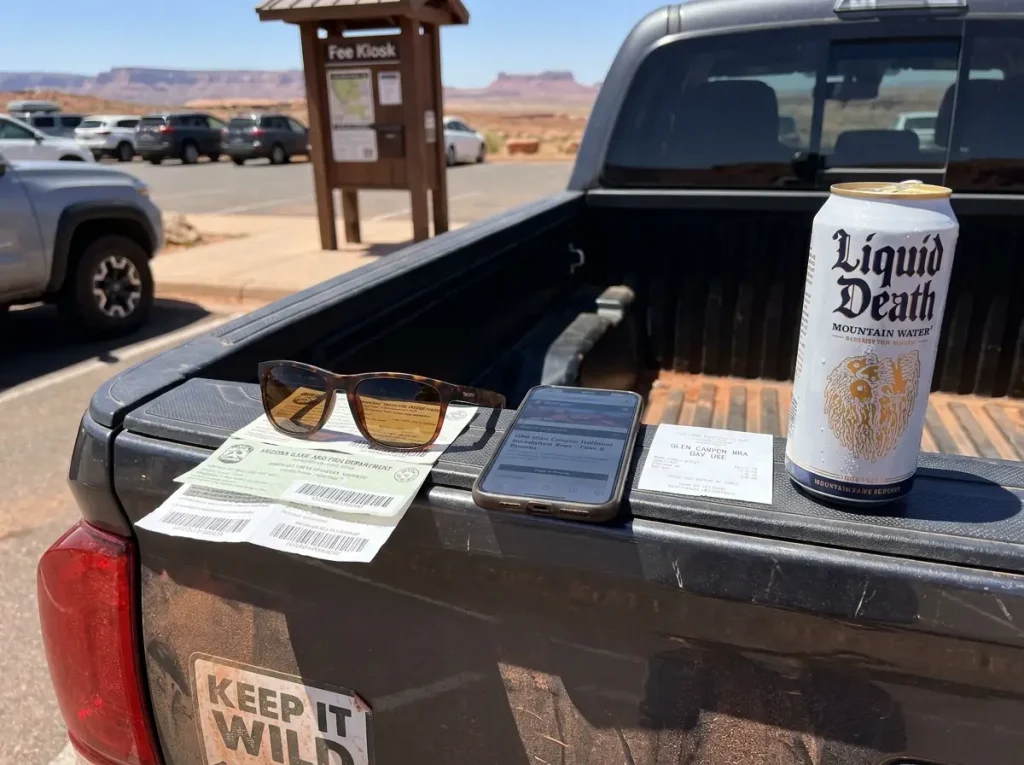
Lake Powell straddles the Arizona-Utah border. A valid Utah fishing license lets you fish both the Utah and Arizona portions of the lake. Same goes for an Arizona license — it covers both sides. You do NOT need both licenses.
However, you must follow the regulations of the state you’re physically in. Practically, this matters most for species limits and size requirements that may differ between the two states. Check Utah’s 2026 fishing guidebook for current rules.
The Striper and Walleye Exception
Both species have no daily bag limit on Lake Powell. Utah actively encourages anglers to harvest as many striped bass as possible to manage the overpopulation. This is rare and worth taking advantage of — fill your cooler.
Buy Before You Drive
Purchase your license online before you arrive. The marina stores at Wahweap and Bullfrog sell them, but starting your morning in a license line wastes prime fishing time. Both Utah and Arizona offer online purchases for residents and non-residents.
Conclusion
Lake Powell rewards anglers who do their homework and punishes those who wing it. Three things to lock in before your trip: check the current water level and confirm which ramps are open, match your target species to the right season and the right end of the lake, and bring tackle that covers both deep jigging and surface action because Powell can demand both in the same day.
The striper boil alone is worth the drive. But the angler who shows up understanding how this lake works right now — not how it worked five years ago — is the one filling the cooler while everyone else is still looking for an open boat ramp.
Get your license, check the water, and go catch some fish.
Q1 What fish can you catch in Lake Powell?
Lake Powell holds striped bass, smallmouth bass, largemouth bass, walleye, crappie, channel catfish, bluegill, and northern pike. Striped bass and walleye have no daily catch limit, making them prime targets for harvest.
Q2 Do you need a fishing license for both Arizona and Utah at Lake Powell?
No. A valid fishing license from either Utah or Arizona covers both sides of the lake. Follow the regulations of whichever state you’re physically fishing in. Buy your license online before arrival to save time.
Q3 What is the best time of year to fish Lake Powell?
May offers the best all-around fishing — bass are spawning in shallow water, stripers are staging near river inlets, and crappie are concentrated in canyon brush. Fall is a close second when everything feeds aggressively before winter.
Q4 Can you fish Lake Powell from shore without a boat?
Yes, but options are limited. Bullfrog and Stanton Creek shorelines produce smallmouth on tube jigs along rubble banks. Night catfishing from primitive camp spots is productive with simple bait. For serious fishing, rent a kayak or book a guided trip.
Q5 How much does a Lake Powell fishing guide cost?
Guided trips run $400 to $800 depending on the service, trip length, and how far up-lake you go. A half-day trip is the best value for first-time visitors who want to learn the lake’s current structure and productive spots before fishing it solo.
Risk Disclaimer: Fishing, boating, and all related outdoor activities involve inherent risks that
can lead to injury. The information provided on Master Fishing Mag is for educational and informational purposes
only. While we strive for accuracy, the information, techniques, and advice on gear and safety are not a substitute
for your own best judgment, local knowledge, and adherence to official regulations. Fishing regulations, including
seasons, size limits, and species restrictions, change frequently and vary by location. Always consult the latest
official regulations from your local fish and wildlife agency before heading out. Proper handling of hooks, knives,
and other sharp equipment is essential for safety. Furthermore, be aware of local fish consumption advisories. By
using this website, you agree that you are solely responsible for your own safety and for complying with all
applicable laws. Any reliance you place on our content is strictly at your own risk. Master Fishing Mag and its
authors will not be held liable for any injury, damage, or loss sustained in connection with the use of the
information herein.
Affiliate Disclosure: We are a participant in the Amazon Services LLC Associates Program, an
affiliate advertising program designed to provide a means for us to earn advertising fees by advertising and linking
to Amazon.com. As an Amazon Associate, we earn from qualifying purchases. We also participate in other affiliate
programs and may receive a commission on products purchased through our links, at no extra cost to you. Additional
terms are found in the terms of service.