In this article
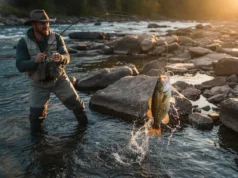
A smallmouth bass does not surrender. When you set the hook, the resistance isn’t just weight; it is a violent, kinetic energy that defies the fish’s physical dimensions. To the uninitiated in freshwater sport fishing, they are often dismissed as just a “brown largemouth,” but this is a fundamental error.
Micropterus dolomieu is a distinct biological engine, fine-tuned for heavy current, clear water, and endurance. They are the wolves of the river and the ghosts of the deep basin.
To consistently catch smallmouth bass, you must stop fishing for generic “bass” and start hunting this specific, rock-dwelling predator. Success requires decoding the environmental variables—temperature, flow, and geology—that dictate their every move. By the end of this guide, you will move from guessing at spots to dissecting the fishery with the confidence of a seasoned practitioner.
The Biological Foundation – What Makes a Smallmouth Tick?
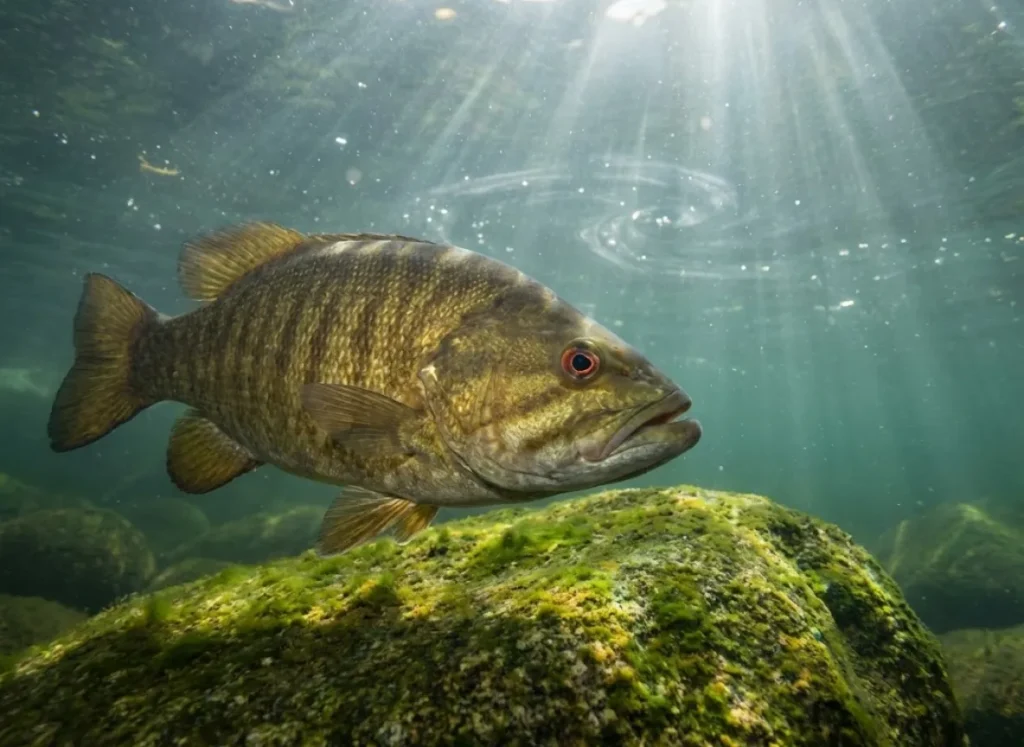
You cannot catch what you do not understand. Before tying on a lure, we must deconstruct the physiological and sensory attributes of the species to explain why they are where they are.
What distinguishes Smallmouth Bass physiology from other species?
Smallmouths are “cool-water obligates.” Their metabolic engine functions optimally between 65°F and 75°F (18°C–24°C). While a largemouth bass might happily sit in warm, stagnant soup, a smallmouth requires higher dissolved oxygen levels. This drives them to seek current or deep water the moment temperatures rise.
This thermal sensitivity is the primary driver for their fishing season migrations. It pushes them from deep wintering basins to shallow spawning flats and back again. Understanding these distinct biological profiles and metabolic rates is the first step in building a predictive model for your fishing day.
Physiologically, the species acts as a “visual dominance” predator. They utilize a high density of cone cells to hunt by sight in clear, glacial, or rocky waters. Their need for hard substrates—gravel, cobble, boulders—is tied directly to their primary forage fish and invertebrates: crayfish, hellgrammites, and gobies. The old axiom holds true: “If there is no rock, there is no smallmouth.”
Understanding this metabolic clock allows you to predict their aggression. Below 50°F, they are sluggish scavengers. Inside the optimal window, they become wolf-pack hunters. For a deeper study, review our collection of biological insights into smallmouth bass facts.
How do their senses dictate your lure and color selection?
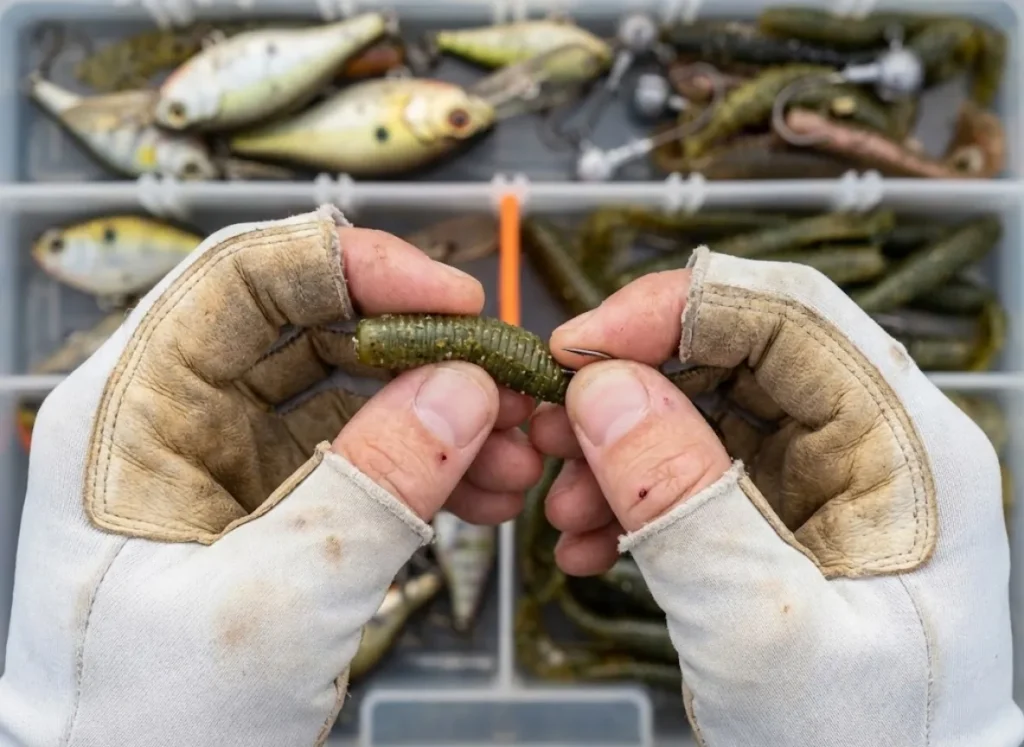
Because of their advanced visual acuity, smallies are highly sensitive to unnatural silhouettes and thick wire diameters. This necessitates naturalistic soft plastics and hard lures. The “Match the Hatch” philosophy is critical here. Colors should mimic the prevailing forage, specifically Green Pumpkin (benthic camouflage) and Watermelon or Red/Orange (molting crayfish).
However, the rules change with the environment. In low-light conditions or stained water, the fish shifts reliance from vision to its lateral line system to detect pressure waves and vibration. Academic research confirms their foraging abilities in varying turbidity rely on this sensory hand-off.
This dictates a tactical pivot. Use silent, ghost-like lures (spybaits, hair jigs, marabou jigs) in clear water. Switch to high-vibration lures (crankbaits, spinnerbaits) when visibility drops. The lateral line allows smallmouths to track moving prey in turbulent current seams without visual confirmation, explaining why erratic retrieves trigger reaction strikes.
Pro-Tip: In ultra-clear water, finesse fishing is a requirement, not a choice. You must often use fluorocarbon line to reduce light refraction. Read more about how fish see underwater to understand why line visibility matters.
The Unified Decision Matrix – Location Strategy
A lure in the wrong place is useless. We categorize location strategy into two distinct environments: river fishing strategies and lake fishing tactics.
How do you locate Smallmouth Bass in river systems?
River fishing requires reading “fluid dynamics.” You are looking specifically for the Current Seam, the visible line where fast water shears against slack water. Smallmouths are energy-efficient. They hold in the “Eddy Cushion”—the slow water immediately behind boulders or bridge pilings—facing upstream to ambush drifting shad, minnows, or crawfish.
You must also identify “Wing Dams” and rock jetties. Target the upstream face where high-pressure water forms a resting pillow, or the scour hole at the tip. For a breakdown on safety and boat control here, see our guide on fishing in current.
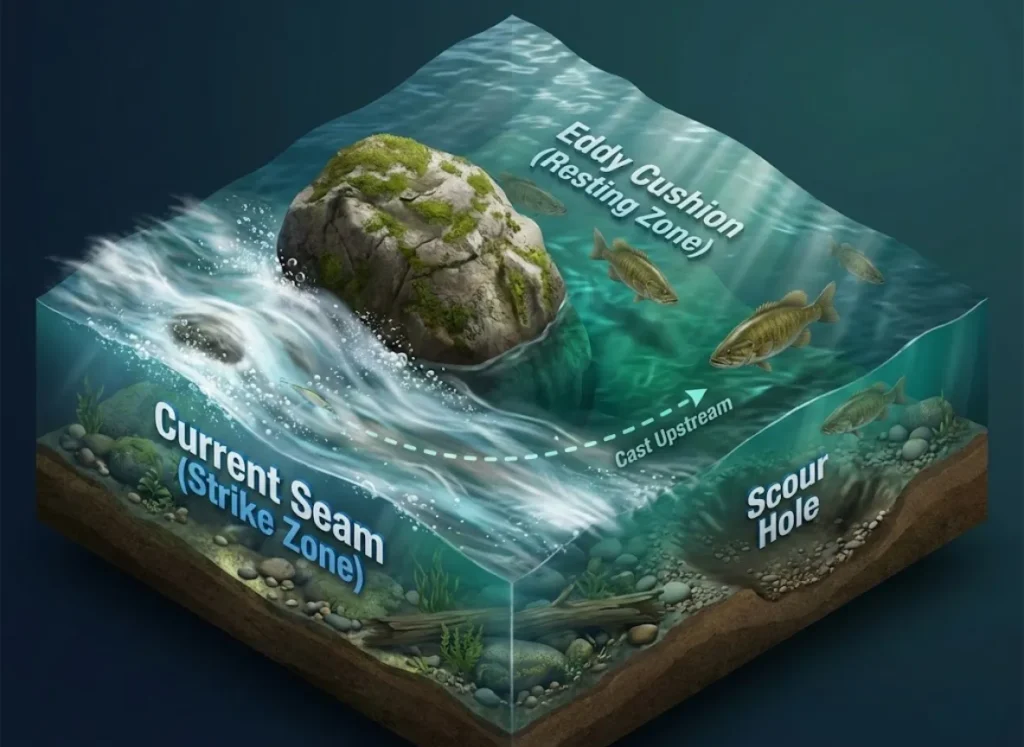
Avoid casting directly into the heaviest flow. Instead, cast upstream and manage your line to drift the lure naturally into the seam, mimicking an injured baitfish. Also, look for the “Venturi Effect” around channel constrictions. These current breaks accelerate flow and increase oxygen, attracting active fish during summer heat.
According to federal ecological risk screening and habitat preferences, these flow requirements are essential for their survival. In colder months, locate the deepest, slowest deep pools (wintering holes) where fish stack up to conserve energy away from the main channel velocity.
How does lake stratification influence depth selection?
In deep lakes and reservoir fishing, smallmouth location is governed by the Thermocline, the specific layer where warm surface water meets cold deep water. During summer stratification, fish often suspend just above this layer to balance their need for cooler temperatures with sufficient dissolved oxygen.
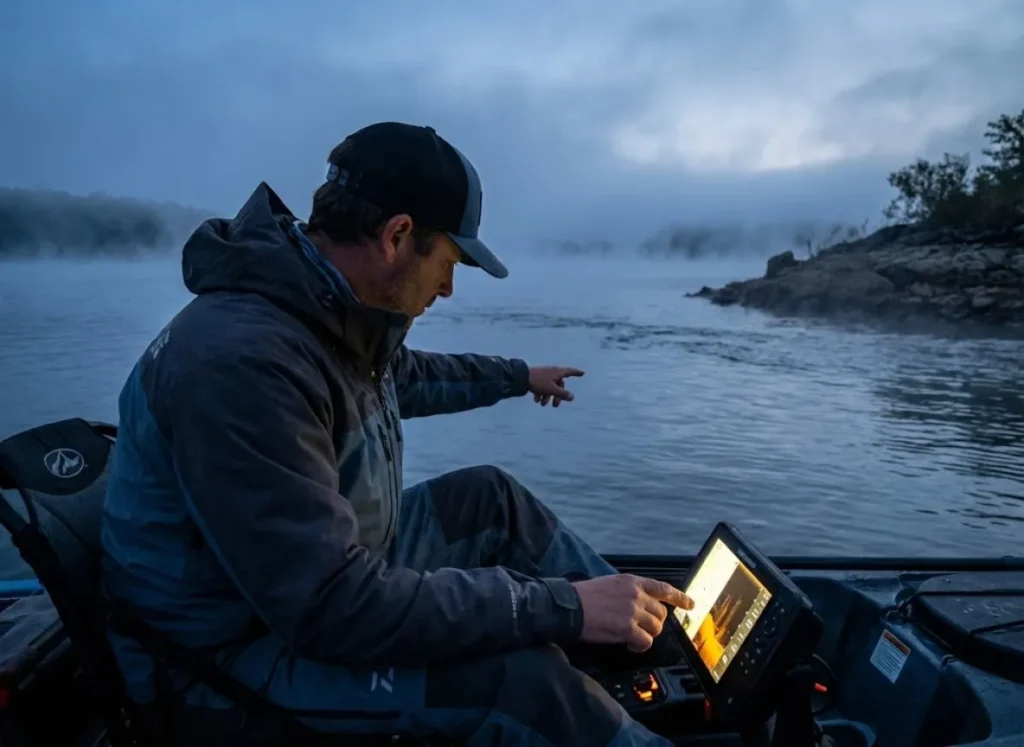
Focus on structural elements that intersect the thermocline. Look for sunken rockpiles, humps, steep drop-offs, and rocky shorelines. Mastering electronics is vital here; learn more about reading arches and structure to pinpoint these deep water schools.
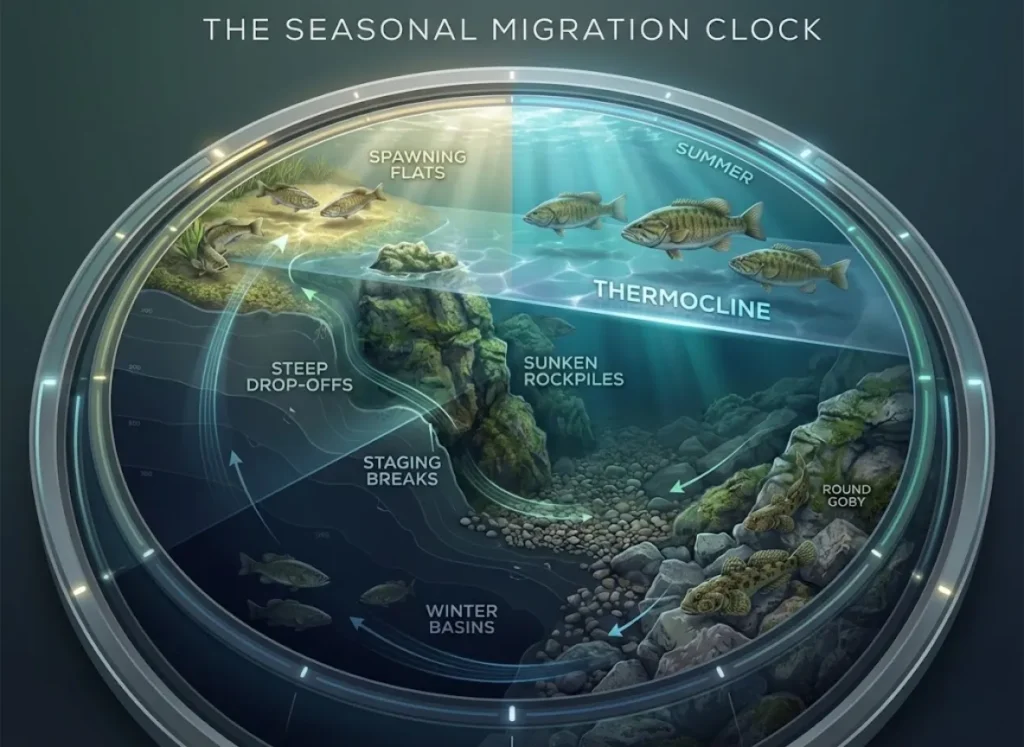
Use the “Transition Bank” concept. Target shorelines where the substrate changes composition—for instance, rip rap turning to gravel flats—as these are key migration highways. In the spring (pre-spawn), fish move from deep basins to “Staging Breaks,” which are the first major drop-offs adjacent to shallow spawning flats.
Authoritative data on species fact sheet and habitat description notes that the presence of invasive Round Goby in the Great Lakes has shifted biomass to the bottom. This makes bottom-bouncing with structure even more critical in these specific waters.
The Tactical Arsenal – Techniques & Presentations
Now that we have located the predator, we need the right baits to trigger the strike.
Why is the Tube Jig considered the “Gold Standard”?
The Tube Jig is the most versatile tool in the smallmouth arsenal because it perfectly mimics the profile of both crayfish and gobies. To rig effectively, insert a jig head inside the hollow body, pushing the eyelet through the plastic. For heavy cover, use a “Stupid Rig” with a snag-proof tex-posed hook.
Execute the “Drag” retrieve. Maintain bottom contact and pull the lure slowly across rocks to simulate a crawling crawfish imitator. Studies on dietary habits and prey selectivity confirm crustaceans are a primary food source, validating this bottom-crawling approach.
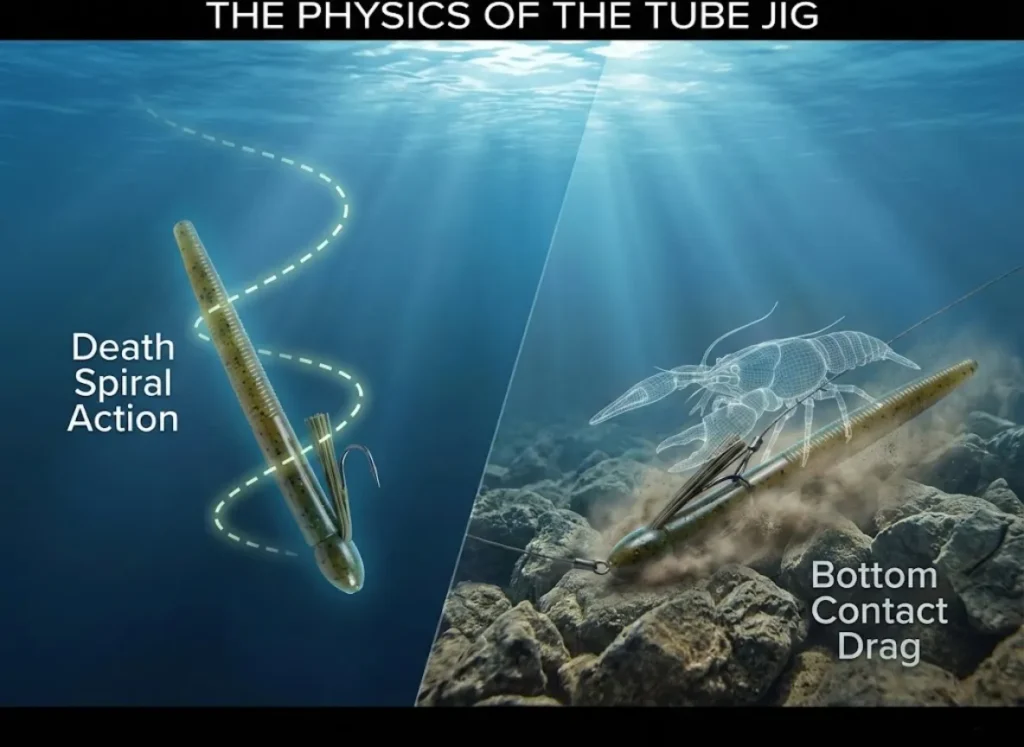
The magic of the tube lies in its “Death Spiral.” On a slack line drop, the cylindrical shape causes it to glide and circle erratically rather than falling straight down. This spiraling action triggers reaction strikes from suspended fish inspecting the lure. “Snapping” the tube—popping it sharply off the bottom—mimics a crayfish fleeing in panic, often triggering the predatory instinct in neutral fish.
When should you deploy finesse tactics vs. Power Fishing?
When fish are aggressive, especially in the fall feeding frenzy, engage in power fishing. Utilize crankbaits like the Square-bill crankbait for shallow deflections or a Deep diving crankbait to dredge the depths. For suspended fish, jerkbaits such as the Rapala Husky Jerk or RipStop are deadly when worked with a violent cadence. In low light, topwater lures like the Baby Torpedo, Jitterbug, or Evergreen Shower Blows draw explosive strikes from the surface.
However, when pressure is high, you must switch to finesse fishing. Deploy the Ned Rig (a mushroom head jig with a short stick bait like a Z-Man TRD) when water temperatures are extreme (<50°F or >80°F) and fish are lethargic. The “No-Feel” retrieve is critical here. Simply maintain tension and let the buoyant plastic float the tail up, mimicking a defensive crayfish.
Utilize the Drop-Shot Rig with a Roboworm or Keitech Easy Shiner when fish are suspending slightly off the bottom or when you need to keep a bait in the strike zone without moving it forward. We have a complete breakdown on how to drop shot for those new to the rig.
The Drop-Shot separates the weight from the hook. This allows soft plastics like a Senko or Yum Dinger to move fluidly with micro-currents, effectively “dead-sticking” for wary fish. These techniques excel in high-pressure scenarios where fish have seen aggressive spinnerbaits; the small profile appears non-threatening.
Advanced finesse also includes Spybaiting. This involves using sinking prop baits on light line to target suspended fish in ultra-clear water by creating a subtle hydrodynamic trail. The Maryland DNR outlines smallmouth bass life history and behavior, noting traits that necessitate these finesse approaches in pressured waters.
Gear, Conservation, and Stewardship
Your equipment is the connection between you and the fish, and your ethics determine if that fish survives to be caught again.
What are the critical gear specifications for Smallmouth fishing?
Rod length and selection must match the technique. A Medium-Light Power, Fast Tip Action spinning rod (typically 6’10″–7’2″ from brands like St. Croix or Shimano) is the foundational tool for Drop-Shots and Ned Rigs. The “Extra-Fast” tip acts as a visual strike indicator and allows the fish to inhale the bait without feeling resistance.
For Tube Jigs or Football Jigs, step up to a Medium Power rod. You need the backbone to drive the single hook through the plastic and into the hard mouth of the bass. Research on prey capture kinematics and suction feeding explains why sensitive tips are necessary for proper hooksets.
Line choice is governed by physics. Fluorocarbon leader (6-8lb test) is mandatory in clear water due to its light refraction index being nearly identical to water. Use a high-visibility Braided Main Line (10-15lb) to cut through river current and provide zero-stretch sensitivity. For a detailed comparison, read our guide on braid vs fluorocarbon vs monofilament.
How do you practice responsible handling and conservation?
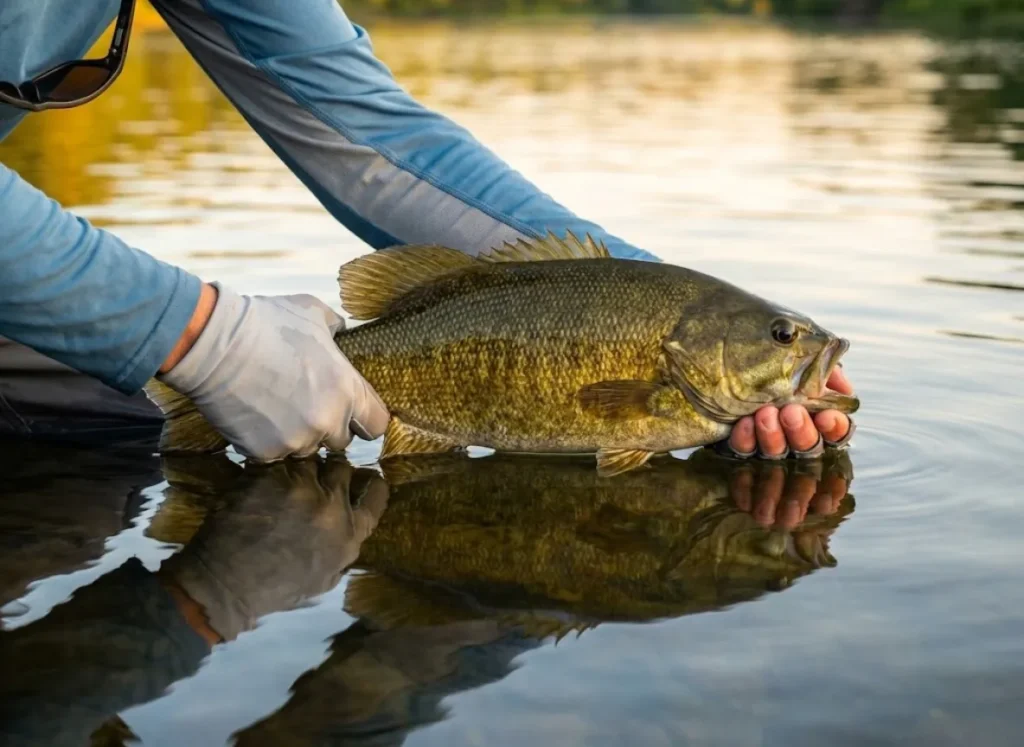
Never hold a trophy smallmouth over 3lbs horizontally by the jaw without supporting its weight. This torque can break the jaw or tear the isthmus, preventing the fish from feeding. The “Pro Hold” involves gripping the lower lip while cradling the belly with your second hand to distribute the weight evenly.
Practice Catch and Release, especially for larger specimens. Smallmouth populations are slow-growing; a 5lb trophy in northern waters may be nearly 20 years old. Review proper bass handling techniques to ensure you aren’t accidentally killing your catch.
Be aware of invasive species regulations. While Round Gobies are excellent bait, transporting them alive is illegal in many jurisdictions. Minimize air exposure during photos; a fish’s gills begin to dry out quickly. If a fish is deep-hooked, cut the line. For more details on ensuring survival, see our guide on how to hold a fish.
Final Thoughts
Catching smallies consistently is not about luck. It is about applying a specific set of rules to a dynamic environment. Remember the key propositions:
- Smallmouth are cool-water visual predators (“No rock, no fish”).
- Use the “Unified Decision Matrix” to fish current seams in rivers and thermoclines in lakes.
- Move from “Benthic Scavenging” lures (Tubes) in neutral moods to “Pelagic Hunting” lures (Spybaits, Jerkbaits) in active windows.
- Protect the fishery through proper jaw support.
Master these techniques on your local water this season.
FAQ – Frequently Asked Questions
What is the best water temperature for catching smallmouth bass?
The optimal metabolic window for smallmouth bass is between 65°F and 75°F (18°C–24°C). In this range, they are most aggressive and willing to chase reaction baits; below 50°F, you must slow down significantly.
Do smallmouth bass like current?
Yes, smallmouth bass are adapted to current and use it for oxygen and feeding opportunities. They typically hold in current seams or eddies (slack water) adjacent to the fast flow to ambush prey without expending excess energy.
What is the difference between smallmouth and largemouth bass habitat?
Smallmouth bass prefer cooler, clearer water with rocky bottoms (gravel or boulders), while largemouths tolerate warmer, stagnant water and prefer vegetation (weeds or pads). Think Brown and Grey structure for Smallmouth, and Green structure for Largemouth.
What is the best color lure for smallmouth bass?
Green Pumpkin and Watermelon are the most effective colors universally as they mimic natural camouflage and crayfish. In spring, Red or Orange hues are effective to mimic molting crayfish; use Ghost or natural shad colors in ultra-clear water.
Risk Disclaimer: Fishing, boating, and all related outdoor activities involve inherent risks that
can lead to injury. The information provided on Master Fishing Mag is for educational and informational purposes
only. While we strive for accuracy, the information, techniques, and advice on gear and safety are not a substitute
for your own best judgment, local knowledge, and adherence to official regulations. Fishing regulations, including
seasons, size limits, and species restrictions, change frequently and vary by location. Always consult the latest
official regulations from your local fish and wildlife agency before heading out. Proper handling of hooks, knives,
and other sharp equipment is essential for safety. Furthermore, be aware of local fish consumption advisories. By
using this website, you agree that you are solely responsible for your own safety and for complying with all
applicable laws. Any reliance you place on our content is strictly at your own risk. Master Fishing Mag and its
authors will not be held liable for any injury, damage, or loss sustained in connection with the use of the
information herein.
Affiliate Disclosure: We are a participant in the Amazon Services LLC Associates Program, an
affiliate advertising program designed to provide a means for us to earn advertising fees by advertising and linking
to Amazon.com. As an Amazon Associate, we earn from qualifying purchases. We also participate in other affiliate
programs and may receive a commission on products purchased through our links, at no extra cost to you. Additional
terms are found in the terms of service.