
In this article
The lake floor is a chaotic environment of silt, jagged rock, and decaying vegetation that swallows traditional tackle. Dragging a heavy jig through this terrain often deadens your signal or buries your bait in the mud, rendering it invisible to predators. If you cannot feel what your lure is doing, you are fishing blind.
In my years on the water, I’ve found that the drop shot rig solves this mechanical failure by decoupling the ballast from the payload. By anchoring the weight while suspending the lure, you create a presentation with zero inertia that moves independently of the bottom. This turns a static piece of soft plastic bait into a shivering, vulnerable target that even lethargic bass, walleye, or panfish cannot ignore.
This instructional guide will walk you through the physics of that separation, the critical knot mechanics required to keep your hook orientation upright, and how to adapt your leader length to the bottom composition.
What Is the Core Mechanics of the Drop Shot System?
How does decoupling the weight affect lure hydrodynamics?
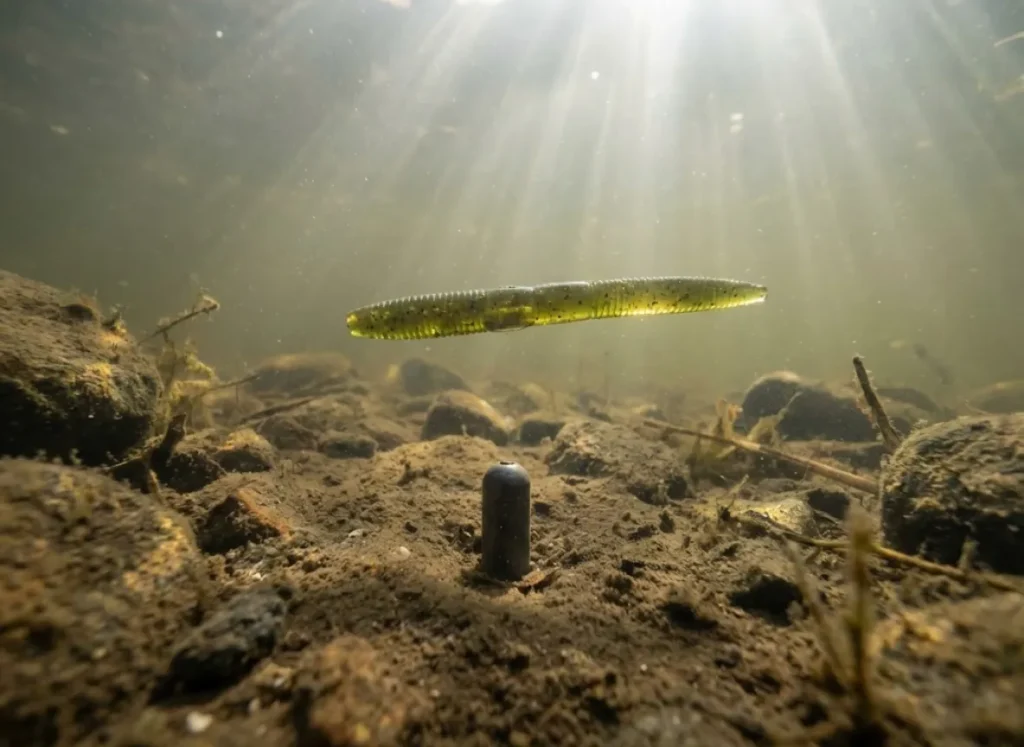
The drop shot functions as a “benthic decoupling system,” separating the weight from the lure to create a presentation with near-zero inertia.
Traditional angling techniques, like a Texas Rig or a Jig, are “coupled systems” where the weight and hook move as a single unit. This creates high inertia; the fish must move the mass of the lead to inhale the bait. The drop shot technique places the weight at the terminal end of the line, anchoring the system to the benthos (bottom substrate). The drop shot hook and lure are attached 6 to 24 inches above this anchor.
This separation allows for “in-situ manipulation.” You can vibrate the lure without moving the weight horizontally. This is critical because bass feed via negative pressure suction. A suspended, weightless plastic offers almost no resistance, flying into the fish’s mouth the moment they flair their gills. This corroborates findings in the Journal of Experimental Biology regarding the mechanical advantages of low-inertia prey during rapid buccal expansion.
Beyond suction mechanics, this setup ensures benthic isolation. In silty bottoms, a standard bullet weight might bury itself in the mud, creating a sediment cloud. With a drop shot, the weight may disappear, but your lure remains suspended above the cloud, perfectly visible. This mimics the behavior of a dying baitfish unable to hold its position, triggering the ambush biology detailed in our Largemouth Bass Facts guide.
How Do You Rig a Drop Shot for Maximum Efficiency?
How does the Palomar knot ensure proper hook orientation?
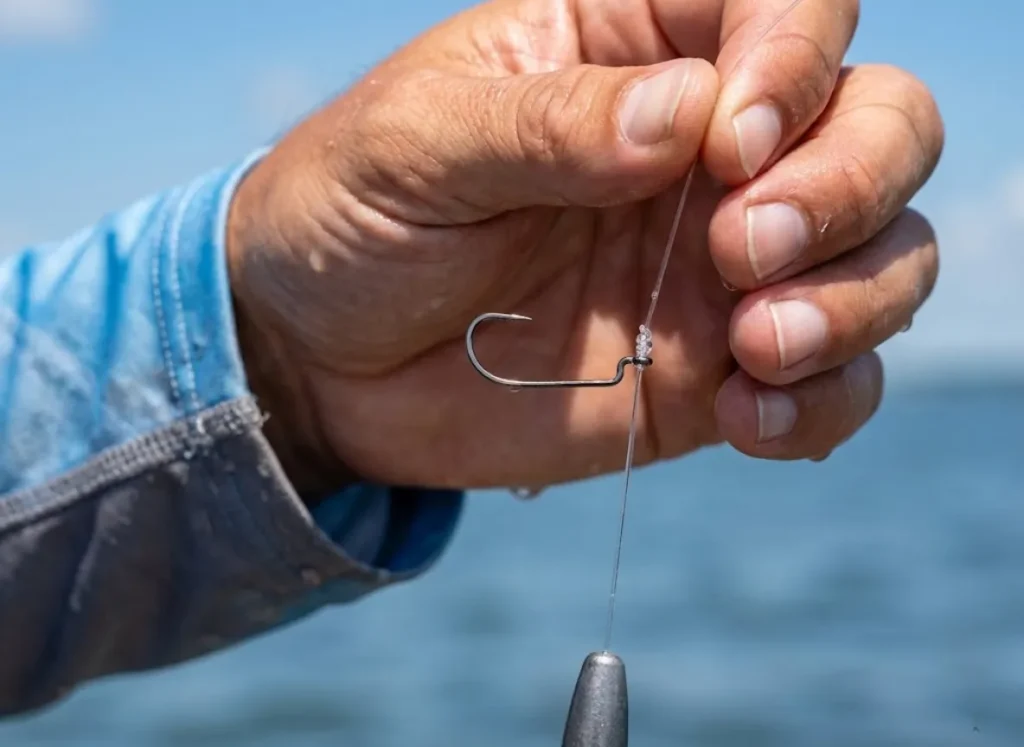
The Palomar knot, specifically with a “Tag End Return,” is the only knot that guarantees the hook stands perpendicular to the main line.
The fundamental requirement for a drop shot is a hook that stands proud; a drooping hook misses the roof of the mouth and results in lost fish. You begin with a standard Palomar knot—one of the essentials when mastering the Angler’s Knot Matrix—but you must leave a significantly long tag end (12 to 36 inches). This tag end becomes your leader.
Here is the critical step often missed in many rigging instructions: Pass the tag end back through hook eye, entering from the top (hook point side) toward the bottom. When you pull this tight, it utilizes the hook eye as a fulcrum. The tension from the weight creates an upward levering force on the shank, locking it into an orthogonal position where the hook stands at 90 degrees.
Pro-Tip: Always wet your line generously before cinching the Palomar. Drop shotting typically uses light fluorocarbon (6-8lb test), and the friction heat from a dry knot can reduce line strength by up to 50%.
For open water finesse fishing, use light wire hooks like the Owner Mosquito or Gamakatsu Split Shot (Size #1-1/0) to maximize natural action. NIH studies on aquatic suction feeders illustrate the necessity of proper hook geometry to capitalize on these directional forces. If you skip the tag end return, the hook will rotate downward under the weight of the plastic, drastically reducing your hookup ratio.
How do you determine the correct leader length using the Decision Matrix?
Leader length is a dynamic variable that must be adjusted based on bottom composition and the presence of vegetation.
Many anglers tie a standard 12-inch leader and never change it. This is a mistake. Your leader length dictates where your lure sits relative to the structure. On hard bottoms or rocky bottoms, use a short leader (6-10 inches). This keeps your bait mimicking bottom-hugging crawfish and maintains tight control near snaggy crevices.
If you are fishing soft bottoms (silt or mud), extend the leader to 12-18 inches. The weight creates a “mushroom cloud” of sediment upon impact; a longer leader ensures your bait stays above this visual obstruction. For grass fishing and vegetation, the rule is simple: the leader must exceed the height of the submerged canopy. Use 18-24+ inches to keep the lure visible above short grass.
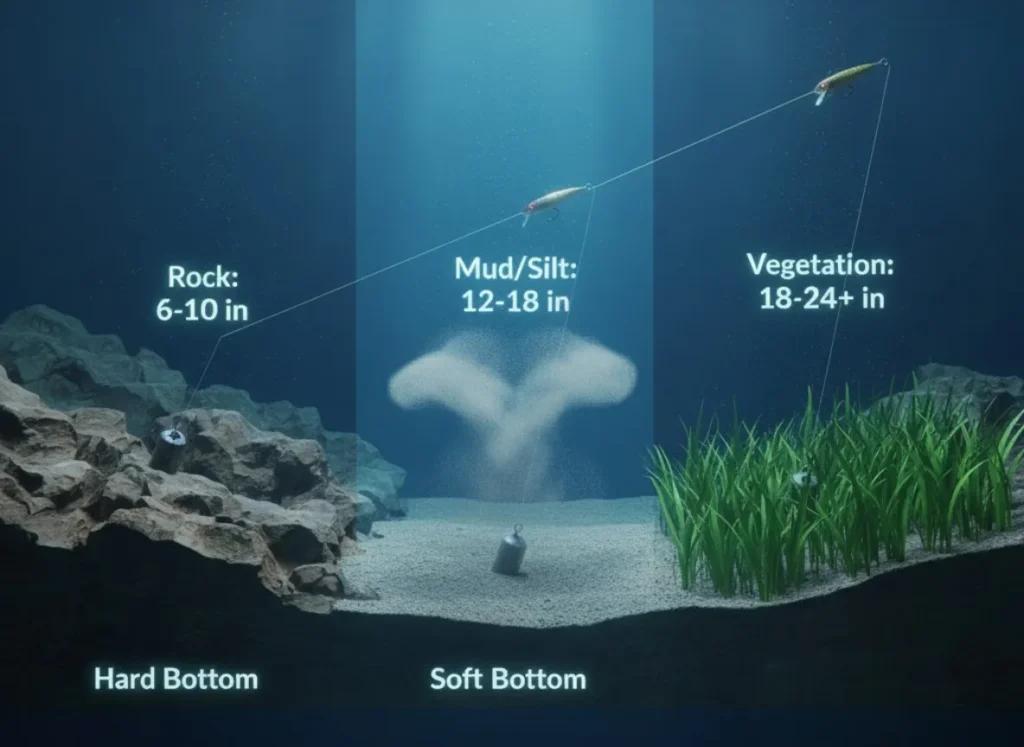
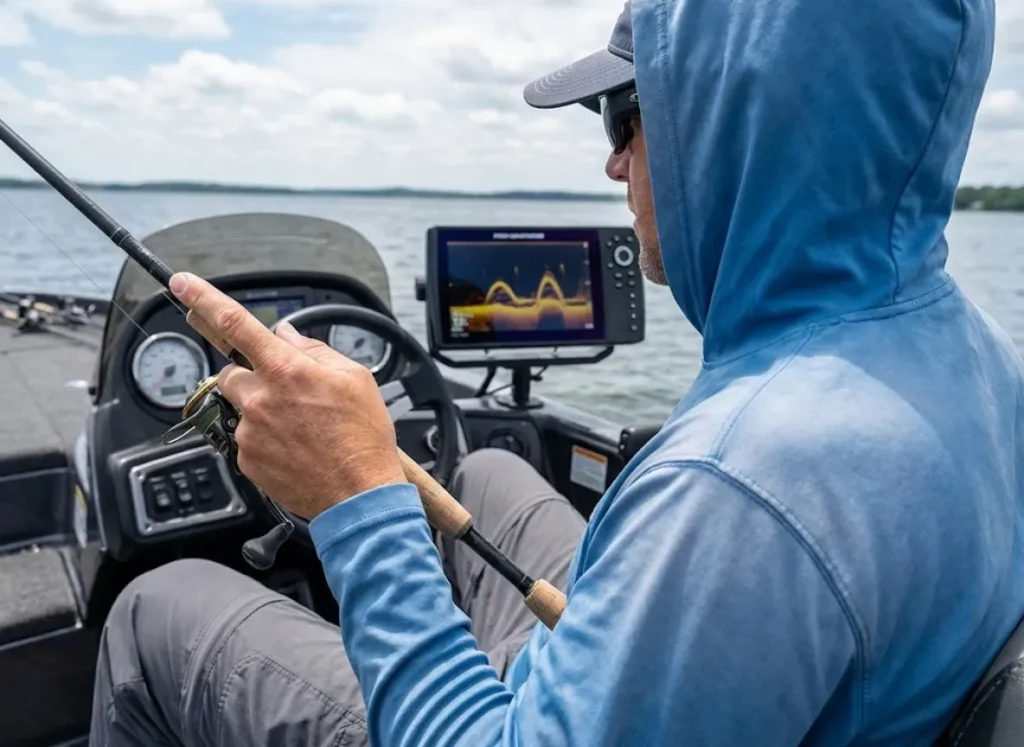
When interpreting arches on your fish finder, pay attention to where the fish are holding. If you see suspended bass off the bottom due to a thermocline, lengthen your leader to 36+ inches to place the bait directly in their visual field. Conversely, during the spawn for bedding fish, shorten the leader to 3-5 inches to anchor the bait directly inside the nest for “defensive aggression” triggers.
What Gear Architecture Is Required for the System?
Why is an Extra-Fast rod taper critical for detection?
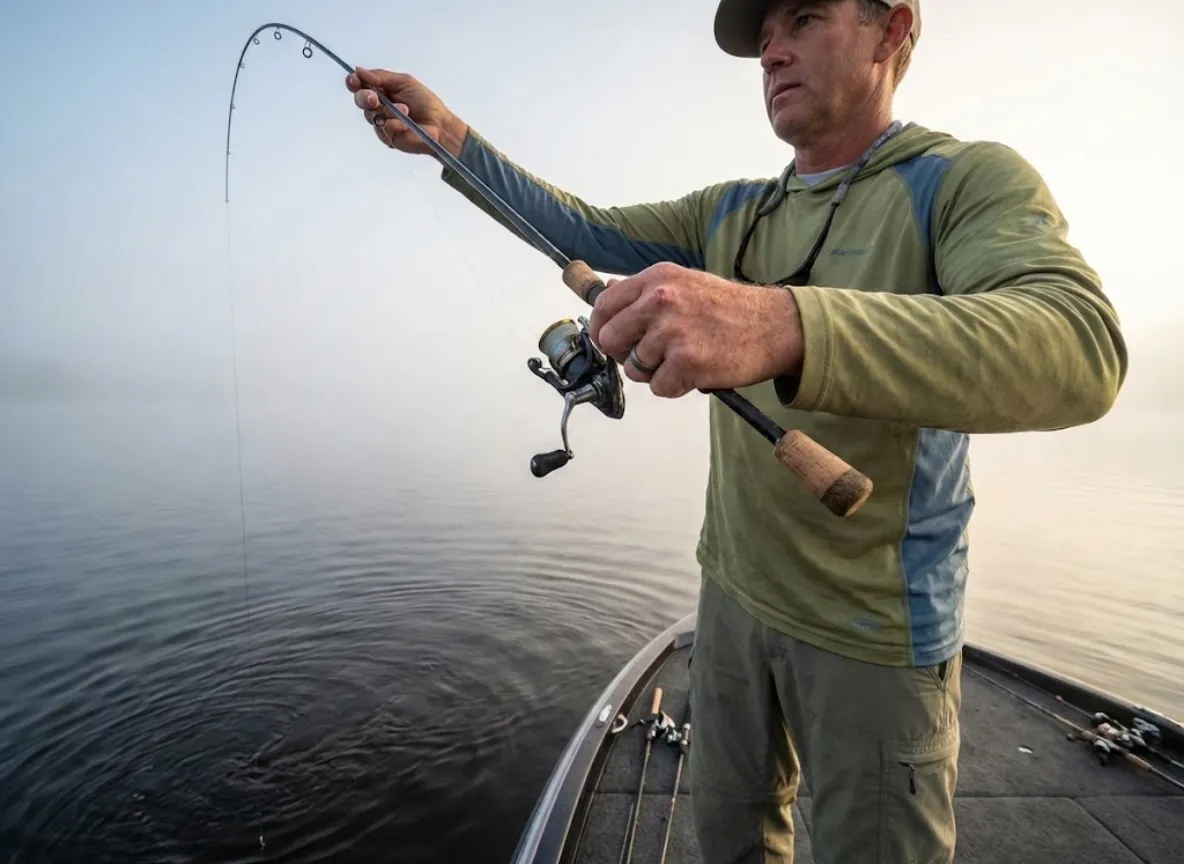
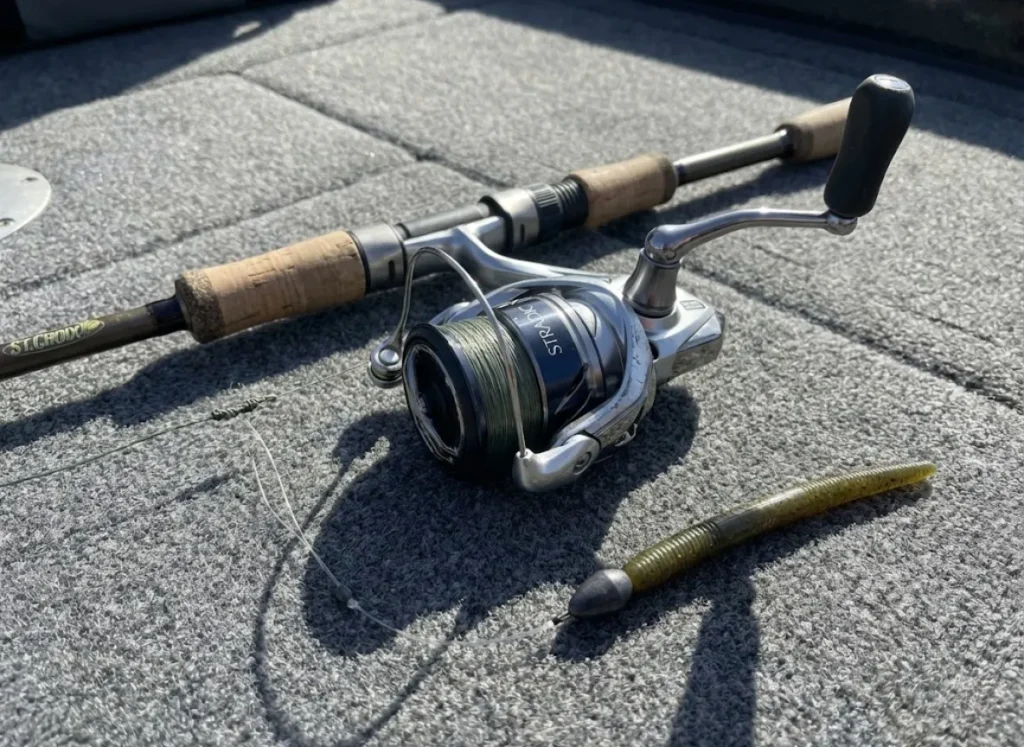
Drop shot rods require an Extra-Fast (XF) taper to provide a visual “load” indicator before the tactile sensation of the bite travels up the blank.
An Extra-Fast action taper means the rod bends primarily in the top 15-20% of the blank. This soft tip acts as a visual indicator, deflecting slightly before you feel the weight of the fish. More importantly, it accommodates suction. A stiff rod tip resists the fish’s inhale; an XF tip yields, allowing the bait to travel deep into the buccal cavity without resistance.
While the tip is soft, the lower 80% of the rod—typically a Medium-Light power blank—must possess sufficient backbone to drive the hook home. High-end specialized rods like the G.Loomis NRX, St. Croix, or Alpha Angler DSR are built specifically for this. To better understand the physics of Rod Power vs Action, remember that “action” is where the rod bends, and “power” is how much force it takes to bend it.
Pair this rod with a 2500-size spinning reel like a Shimano Vanford or Daiwa Certate featuring a smooth drag. You are often using light line, and research on fish locomotor kinematics shows that the initial surge of a hooked fish is violent enough to snap static lines instantly without a forgiving drag system.
Why is tungsten density superior to lead for sensing composition?
Tungsten is roughly 1.7x denser than lead, providing superior acoustic feedback that allows anglers to map bottom composition.
Tungsten is much harder than lead. When a lead weight hits a rock, it absorbs the shock, producing a dull “thud.” When tungsten weights hit a rock, they transmit a sharp, high-frequency “click” up the line. This acoustic impedance allows you to detect subtle transitions, such as where a mud bottom turns into pea gravel—a prime location for bass.
Because of its density, tungsten has a much smaller physical profile for the same mass. This reduces hydrodynamic drag, allowing the rig to sink faster and stay vertical in current. It also reduces snags, as the smaller diameter is less likely to wedge in rock crevices.
When selecting eco-materials in our Fishing Weights Guide, note that tungsten is also a non-toxic alternative to lead. Use specific shapes like a VMC cylinder weight or pencil weight for slipping through grass and rocks, and tungsten tear drop or ball weights to prevent burying in soft sand.
How does bass vision influence bait color and profile selection?
Largemouth bass possess dichromatic vision with peak sensitivity in green and red spectrums, making color selection a matter of contrast and biology.
Bass are most sensitive to wavelengths around $535 \text{ nm}$ (Green) and $614 \text{ nm}$ (Red). This is why “Green Pumpkin” is a universal staple; it directly stimulates their green cones and mimics ubiquitous forage like bluegill. “Morning Dawn,” a high-vis pink/purple, is effective because of that high sensitivity to red wavelengths, making the bait “pop” against a green weed background.
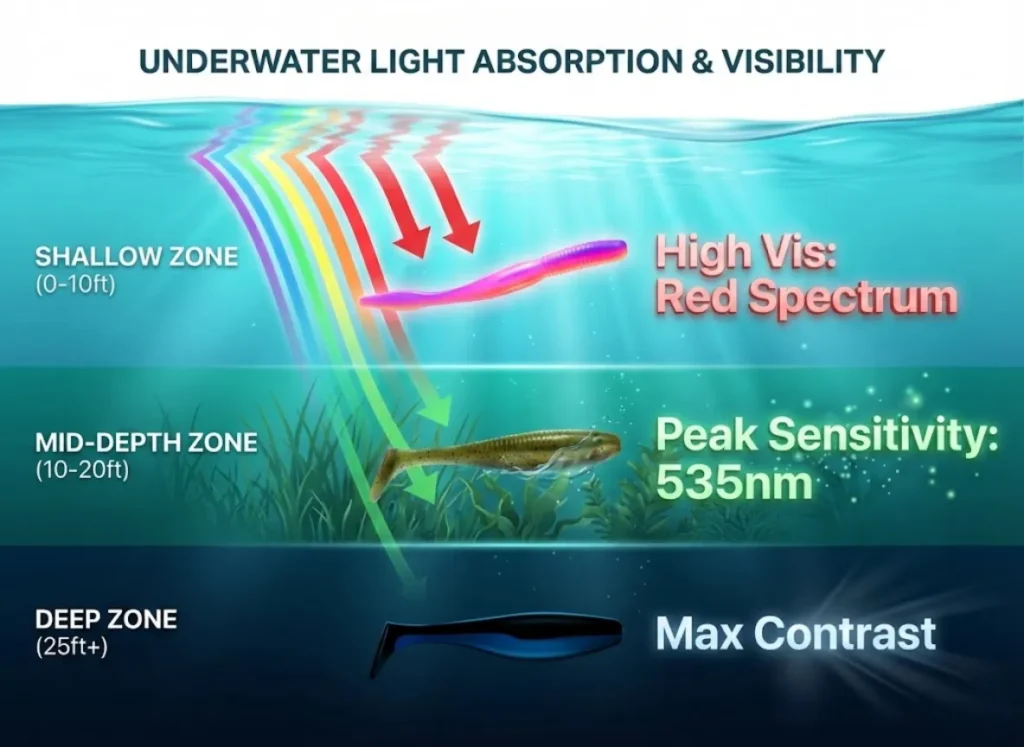
However, color behaves differently at depth. Red light is absorbed quickly in the water column. If you examine the Science of Fish Vision, you’ll learn that in deep basins (25ft+), contrast becomes more important than hue. This is corroborated by studies in Oxford Academic. In these depths, dark colors like Black or Blue silhouette strongly against the surface light.
For profile, Roboworm straight tail worms offer minimal drag for “dead-sticking,” while flat-bottomed worms like the Berkley MaxScent Flat Worm plane and glide. Other proven options include the Z-Man Trick Shotz for durability or the Keitech Shad Impact for baitfish imitation. Always use high-buoyancy plastics to ensure the bait stands horizontal when the line is slack, rather than drooping lifelessly.
How Do You Fish the Drop Shot Effectively?
How do you execute the “Dead-Stick” technique for passive fish?
The “Dead-Stick” technique involves holding the rod perfectly still, relying on micro-currents to animate the bait for lethargic or pressured fish.
This method is most effective in deep, clear water, particularly during Winter or Summer transition extremes when metabolic rates are low. Drop the rig vertically. Once the weight hits the bottom, hold the rod tip motionless. Do not hop it. Do not shake it. Follow the 10-second dead-stick rule before moving it.
The natural tremor of your hand and underwater currents will impart a subtle quiver to the neutrally buoyant bait. If you are adjusting for high-pressure lethargy using Barometric Pressure data, this is your go-to presentation. Bass under high pressure will inspect a bait for a long time; aggressive movements will often spook them.
If a fish inspects but refuses, impart a “micro-shake”—vibrating the slack line without lifting the weight off the bottom. Watch your sonar. If the fish noses down, freeze. If they turn away, a slight twitch can bring them back. This is the essence of video game fishing with active learning via sonar.
How does “Power Shotting” adapt the rig for heavy cover?
“Power Shotting” (or the Bubba Shot) adapts the finesse mechanics of the drop shot for heavy cover by upsizing the tackle and using weedless rigging.
When fish are buried inside brush piles, deep grass lines, or around docks, finesse gear will fail. Shift to a Medium-Heavy baitcasting rod and 20lb fluorocarbon (or 30lb braid). The critical adjustment is the hook: swap the nose hook for a heavy-wire EWG (Extra Wide Gap) hook (Size 2/0-3/0) like the Harmony Fishing Razor Series.
Texas rigging the plastic bait on the EWG hook makes the system weedless. This allows you to pitch a suspended bait inside cover where a jig would fall to the bottom and vanish. Use a short leader (4-8 inches) to keep the bait close to the structure without wrapping around limbs.
This technique is essential for extracting fish from Fishing Heavy Cover, particularly post-frontal bass that are holding tight to wood and refuse to chase moving baits.
How Do You Troubleshoot Common Issues?
How can you mechanically prevent line twist?
Line twist is the primary mechanical failure of the drop shot, caused by the bait spinning on the fall or retrieve.
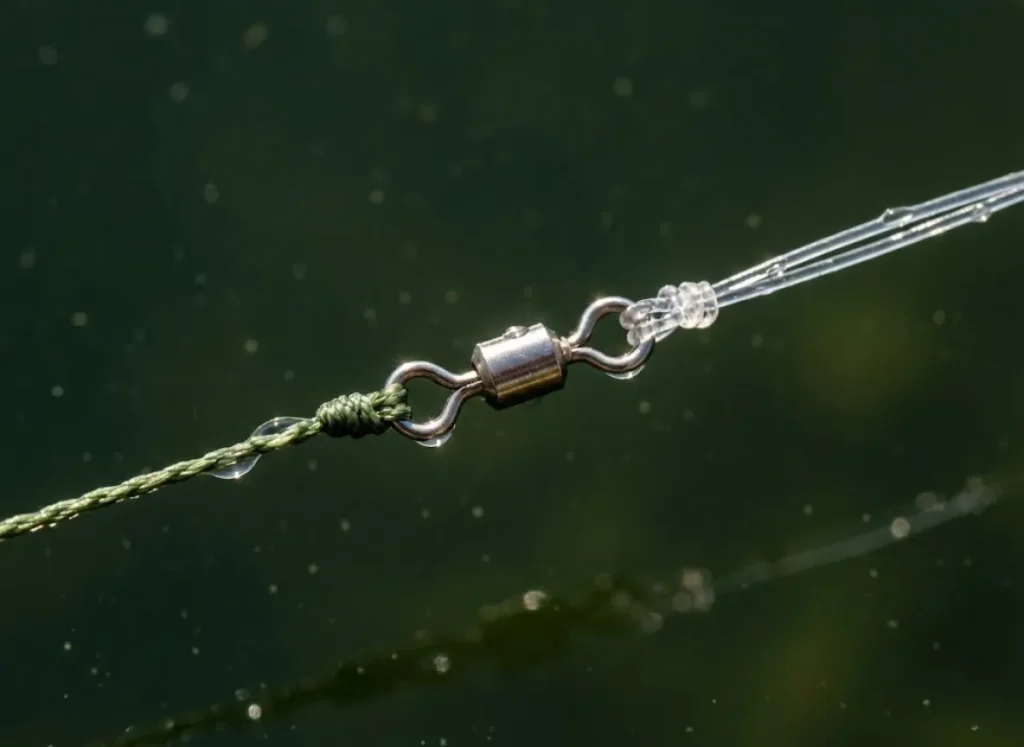
Soft plastic baits can act like a propeller if they are not rigged perfectly straight. Because spinning reels naturally introduce twists, this can turn your line into an unmanageable mess. The hardware solution is the VMC SpinShot hook or Gamakatsu Swivel Shot, which features an integrated swivel above the hook shank. This isolates the bait’s rotation from the main line.
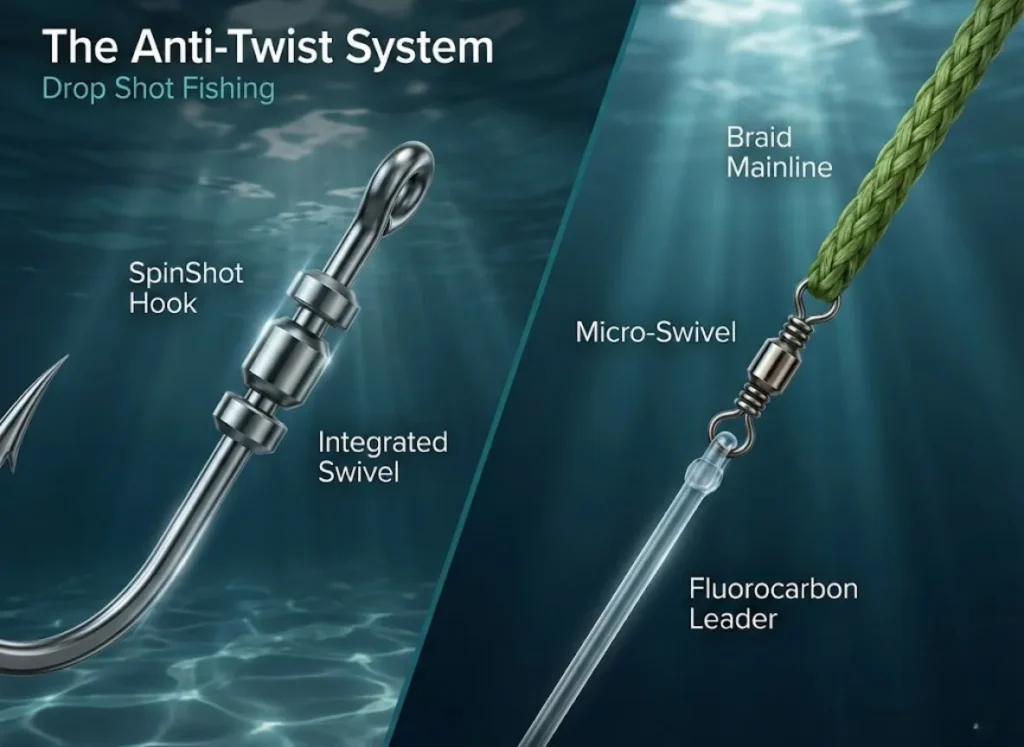
Alternatively, connect a braid mainline (like PowerPro or Sunline Shooter) to a fluorocarbon leader (like Seaguar Blue Label) using a micro-swivel rather than a connection knot like the FG knot or Double Uni knot.
Pro-Tip: Never “reel on the drop.” If you turn the reel handle while the bait is sinking and there is no tension on the line, you are inducing massive twist. Keep the bail open until the weight hits the bottom.
If you do encounter twist, cut the hook off and trail the free line behind the boat while idling to let it untwist naturally. To prevent this from the start, learn proper spooling methods in our guide on How to Spool a Reel.
Conclusion
The drop shot is more than a finesse rig; it is a benthic decoupling system that offers a low-inertia presentation optimized for the suction feeding mechanics of bass. Whether you are using a Palomar Knot with a Tag End Return to secure a nose hook in open water, or utilizing tungsten weights to map the bottom composition through an Extra-Fast rod, the physics remain the same.
This technique scales from the subtle “dead-sticking” required for winter bass to the heavy-duty Power Drop Shot needed to extract fish from brush piles. It allows you to present a lure exactly where the fish are, for as long as it takes them to eat.
Stop guessing what the bottom feels like. Rig up a tungsten drop shot this weekend, map the structure in your local lake—whether bank fishing or from a boat—and share your findings in the comments below.
FAQ – Frequently Asked Questions
What is the best rod action for drop shot fishing?
An Extra-Fast (XF) taper is essential. The sensitive tip allows for visual bite detection and yields to the fish’s suction feeding, while the backbone provides power for the hookset.
How far should the hook be from the weight?
Use the Leader Length Decision Matrix: 6-10 inches for hard bottoms or rock, 12-18 inches for silt or short grass, and 24+ inches for vegetation or suspended fish.
Why do I keep losing fish on the drop shot?
You are likely using the wrong hookset technique. For light wire hooks, use a Reel Set (reel rapidly and sweep); a violent snap set can tear the hook out or straighten the wire.
Can I use a drop shot in heavy grass?
Yes, by using the Power Shot technique. Switch to baitcasting gear, heavier line (15-20lb), and a Texas-rigged EWG hook to make the bait weedless.
Risk Disclaimer: Fishing, boating, and all related outdoor activities involve inherent risks that
can lead to injury. The information provided on Master Fishing Mag is for educational and informational purposes
only. While we strive for accuracy, the information, techniques, and advice on gear and safety are not a substitute
for your own best judgment, local knowledge, and adherence to official regulations. Fishing regulations, including
seasons, size limits, and species restrictions, change frequently and vary by location. Always consult the latest
official regulations from your local fish and wildlife agency before heading out. Proper handling of hooks, knives,
and other sharp equipment is essential for safety. Furthermore, be aware of local fish consumption advisories. By
using this website, you agree that you are solely responsible for your own safety and for complying with all
applicable laws. Any reliance you place on our content is strictly at your own risk. Master Fishing Mag and its
authors will not be held liable for any injury, damage, or loss sustained in connection with the use of the
information herein.
Affiliate Disclosure: We are a participant in the Amazon Services LLC Associates Program, an
affiliate advertising program designed to provide a means for us to earn advertising fees by advertising and linking
to Amazon.com. As an Amazon Associate, we earn from qualifying purchases. We also participate in other affiliate
programs and may receive a commission on products purchased through our links, at no extra cost to you. Additional
terms are found in the terms of service.