In this article
The worm hit the water, spiraled twice like a dying propeller, and by the third cast my fluorocarbon looked like a phone cord from the ’90s. I’d rigged hundreds of Texas rigs before that morning — twenty years of guiding clients on structure-heavy lakes across three states — and I still got humbled by the same invisible mistake. The soft plastic was bent. Not much. Maybe two millimeters off center. But the water doesn’t forgive two millimeters.
After re-rigging from scratch and watching the bait fall dead-straight for the first time that session, the difference was immediate. Two casts later, a four-pounder inhaled it on the drop.
This guide breaks down how to tie a Texas rig step by step — why your bait spins, the gear choices that actually matter, and the one rigging technique most guides mention but never explain correctly. By the end, your bait will fall straight, your line will stay clean, and your hooksets will connect.
⚡ Quick Answer: Thread a tungsten bullet weight onto your line (pointed end up), tie a Palomar knot to an offset hook, insert the hook into the exact center of the bait’s nose, push it through 1/4 inch down, rotate 180°, then re-insert the point using the Tex-pose method — barely skin-hooking the tip back into the plastic surface. The bait must hang dead-straight at eye level. Any curve means start over.
Why Your Texas Rig Spins — The Physics Nobody Explains
The Propeller Effect and Asymmetric Drag
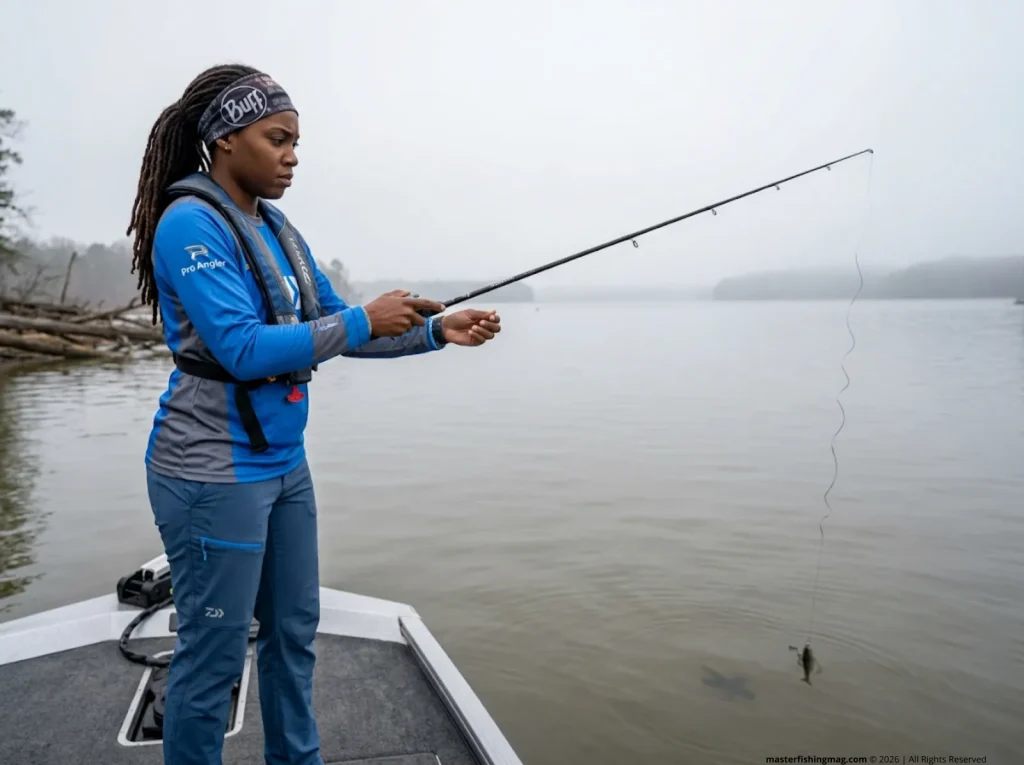
Here’s what nobody talks about. When you rig a soft plastic worm with even a slight curve, you create unequal surface area on each side of the bait. Water pushes harder on the wider side. That pressure difference generates spin — and once the bait starts rotating, it acts like a tiny propeller drilling through the water column.
The consequences stack fast. Every rotation adds a twist to your line. Fluorocarbon and monofilament have high structural memory, so that twist stays locked in. After ten casts, you’re fighting wind knots and bird’s nests that cut your casting distance by a third or more.
Speed makes it worse. Most anglers retrieve too fast, pushing the bait past its stability threshold. A ribbon-tail worm at moderate speed tracks fine. Crank the reel and that same worm turns into a helicopter. Let gravity do the work on the fall, and use slow, steady lifts on the retrieve.
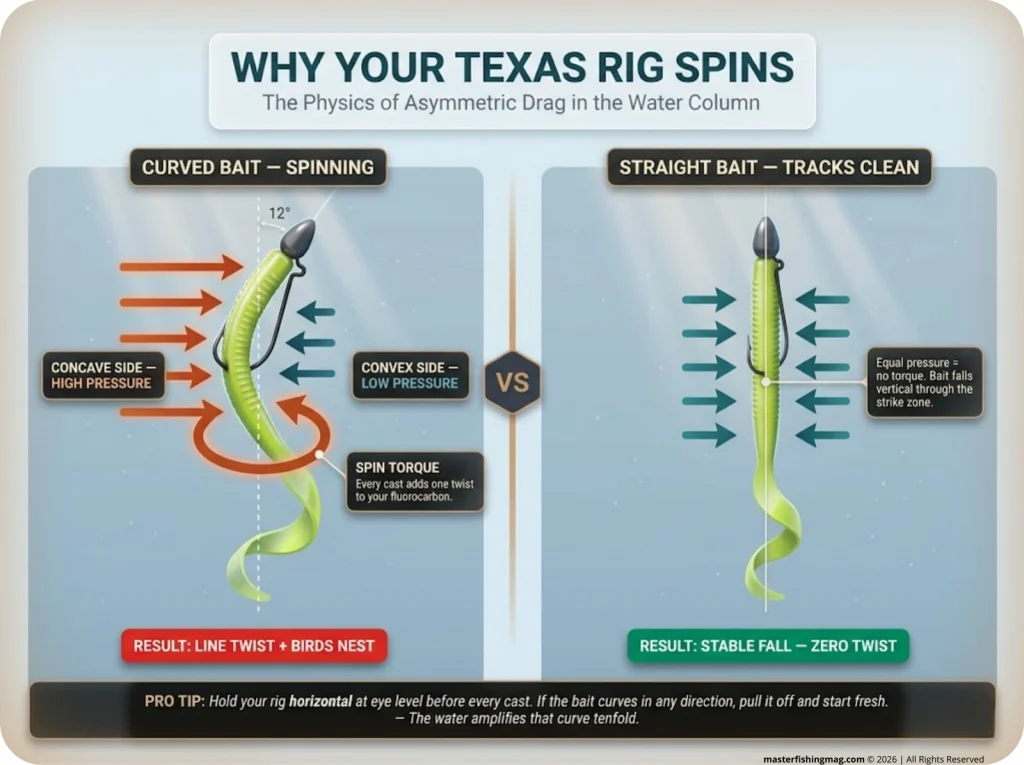
Pro tip: Hold your rig horizontal at eye level before every cast. If the bait curves in any direction — even slightly — pull it off and start fresh. The water will amplify that curve tenfold.
Why Line Type Changes the Damage
Line diameter directly affects how your rig behaves. Thinner line means less water resistance and a faster, more natural fall rate. A 12-pound fluorocarbon leader drops noticeably quicker than a 20-pound one on the same 3/16 oz weight.
If line twist persists despite a perfectly straight bait, the problem is upstream. On spinning reels, line should come off the supply spool in the opposite direction of the reel’s rotation. Get this wrong and you’re fighting factory twist on top of everything else — a problem you can solve by learning how spinning reels introduce factory twist.
Braided line handles twist better than mono or fluoro thanks to its multi-strand weave, but even braid accumulates twist over dozens of casts. No line is immune.
The Tackle Equation — Choosing Weight, Hook, and Line
Bullet Weights — Lead vs. Tungsten and When Each Wins
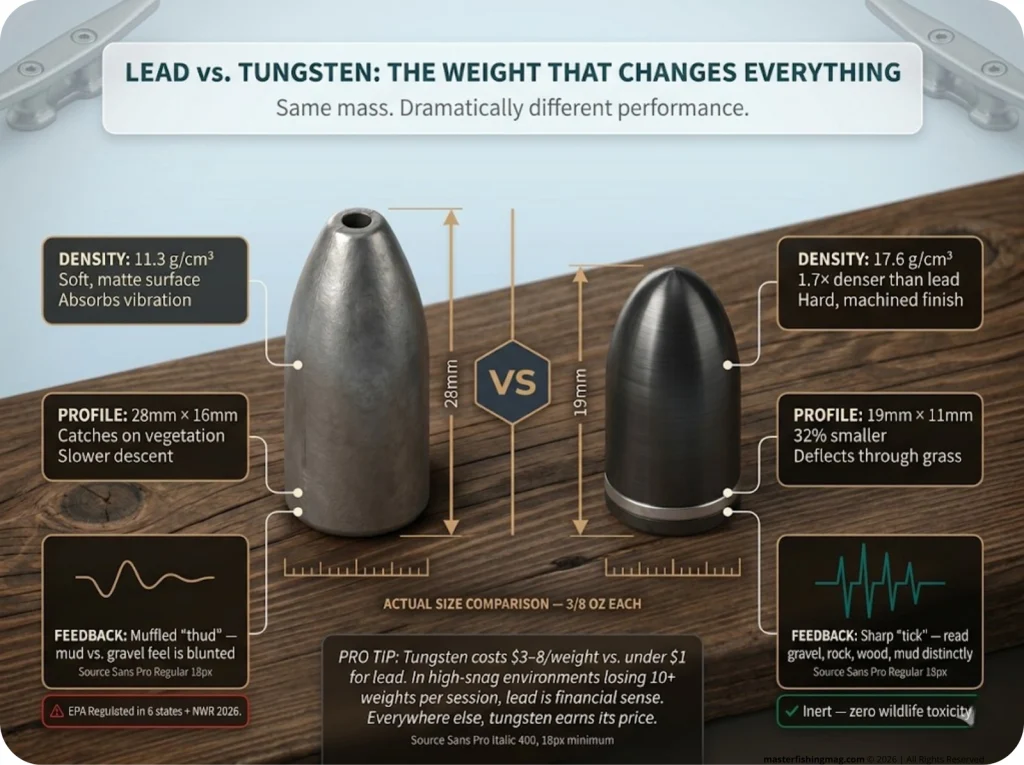
Tungsten is roughly 1.7 times denser than lead. That means a tungsten bullet weight is 30 to 50 percent smaller than a lead weight of the same mass. The sleeker profile cuts through vegetation that would deflect a bulkier lead counterpart and reaches the strike zone faster with less drag.
But the real advantage is feel. Lead is soft — it absorbs impact and muffles feedback. Tungsten is extremely hard and transmits vibration through your line with almost no loss. You can tell the sharp “tick” of gravel from the soft “thud” of mud. That kind of bottom composition feedback tells you exactly where bass are likely to hold.
Weight sizing follows depth. Use 1/8 oz for shallow flats under five feet, 3/16 to 1/4 oz in the five-to-fifteen foot range, 3/8 to 1/2 oz for deep structure, and 3/4 oz or heavier for punching through vegetation mats. For a broader look at weight geometry and eco-compliance, check out our complete fishing weights breakdown.
The cost gap is real — tungsten runs three to eight dollars per weight versus under a dollar for lead. In high-snag environments where you’re losing ten or more weights per session, lead still makes financial sense. But for everything else, tungsten earns its price.
Pro tip: Add a glass bead between the weight and the knot. It protects the knot from abrasion AND produces a high-frequency “click” on rock that bass read as a crawfish.
Hook Geometry — EWG vs. Round Bend vs. Straight Shank
The three dominant hook styles for Texas rigging each solve different problems.
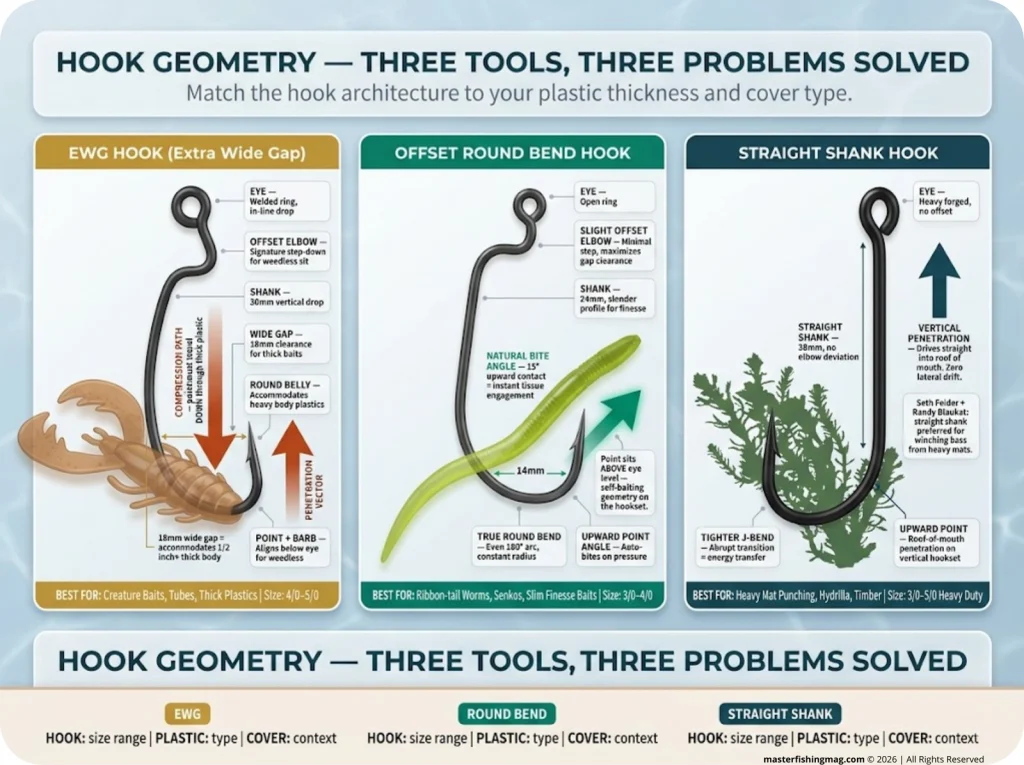
The EWG hook (Extra Wide Gap) has a deep belly that accommodates thick creature baits and tubes. Its hook point lines up directly with the eye, making it exceptionally weedless. The tradeoff: the point has to compress through more plastic before engaging fish.
An offset round bend hook positions the point slightly higher than the eye. That aggressive angle means the point naturally “bites” into tissue with minimal tension — and on slender baits like ribbon-tail worms and Senkos, the hookup percentage is noticeably higher.
The straight shank hook is the choice for heavy cover flipping and punching. Without an offset elbow, it drives the point straight up into the roof of a fish’s mouth. Pros like Seth Feider and Randy Blaukat rely on straight shanks when winching bass out of matted hydrilla.
Match hook to bait — 3/0 for 4 to 5 inch finesse worms, 4/0 for standard 6 to 7 inch plastics, 5/0 for big creature baits. If fish are biting but pulling free, your hook geometry is wrong for your plastic thickness. For more on pairing hooks to species and bait, see our hook sizing cheat sheet by species and bait.
Line Selection — Fluorocarbon Leader vs. Straight Braid
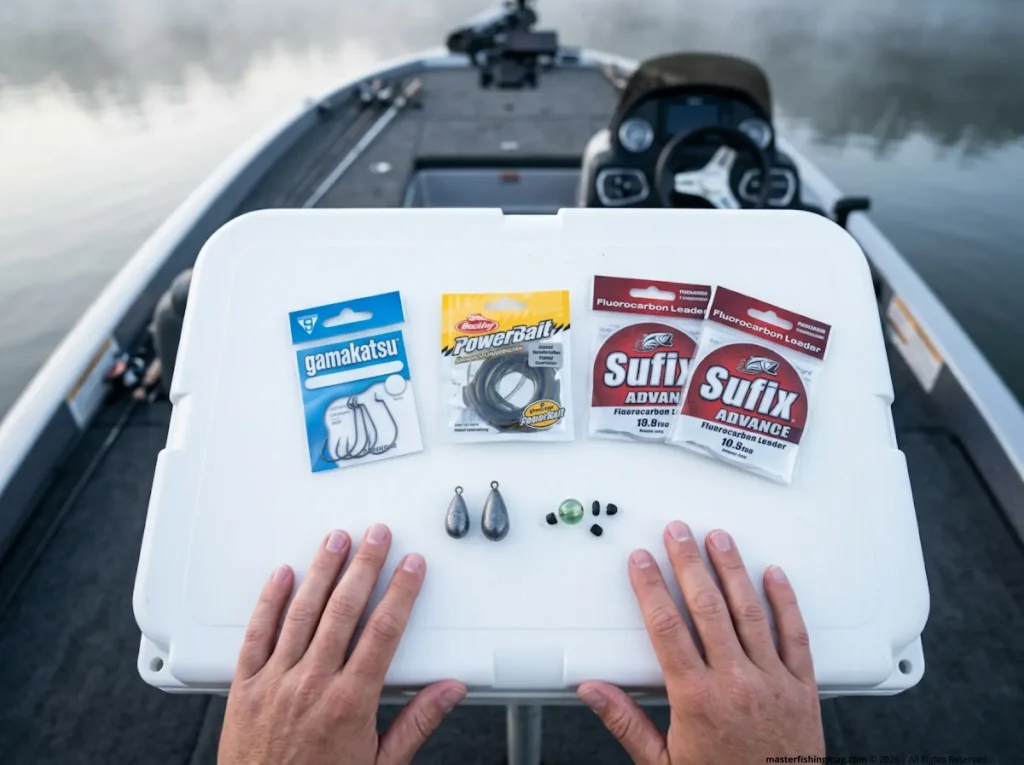
For pitching and casting around moderate cover, run 30-pound braid as your mainline joined to a 17 to 20-pound fluorocarbon leader. The braid gives you casting distance and sensitivity. The fluoro delivers near-invisibility and abrasion resistance near structure — its refractive index sits close to water, making it practically invisible in clear water.
For punching heavy mats, go straight 40 to 50-pound braid with no leader. A knot-to-leader connection becomes a failure point under the strain of punching and extraction — cut it out entirely.
Tying the Texas Rig Step by Step — The Zero-Twist Protocol
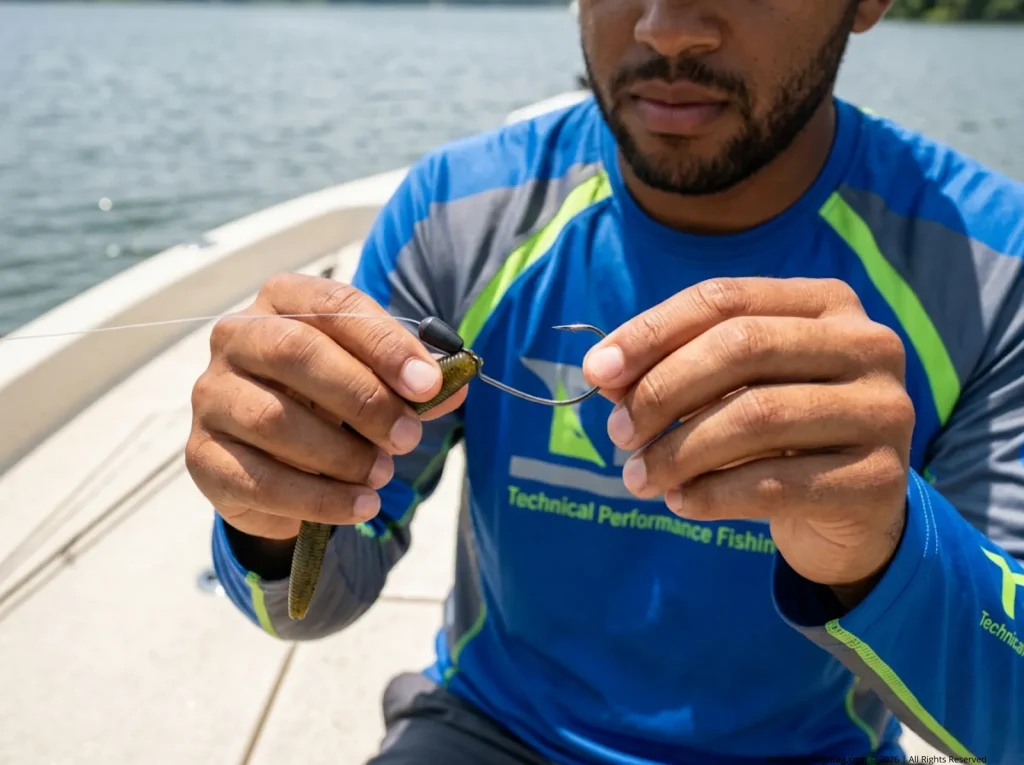
Step 1 — Slide the Bullet Weight and Tie the Knot
Thread your line through the bullet weight, pointed end first. The nose of the weight faces the rod tip. The flat base faces the hook. If you’re using a glass bead for knot protection, slide it on after the weight.
Tie a Palomar knot to the hook eye. The Palomar holds 95 percent or better knot strength across fluorocarbon and braid — it’s the default knot for Texas rigging, no debate. Trim the tag end to under 1/8 inch. A long tag catches debris and interferes with the weight’s slide. If you want options, our field guide to fishing knots covers every scenario.
For pegged setups in heavy grass, slide a bobber stop onto the line before the weight. This locks the weight against the hook and prevents separation when punching through vegetation mats.
Step 2 — The Nose Hook and 180° Rotation
Insert the hook point into the exact center of the bait’s nose. Not off to one side. Not at an angle. Center-axis insertion is non-negotiable for straight tracking.
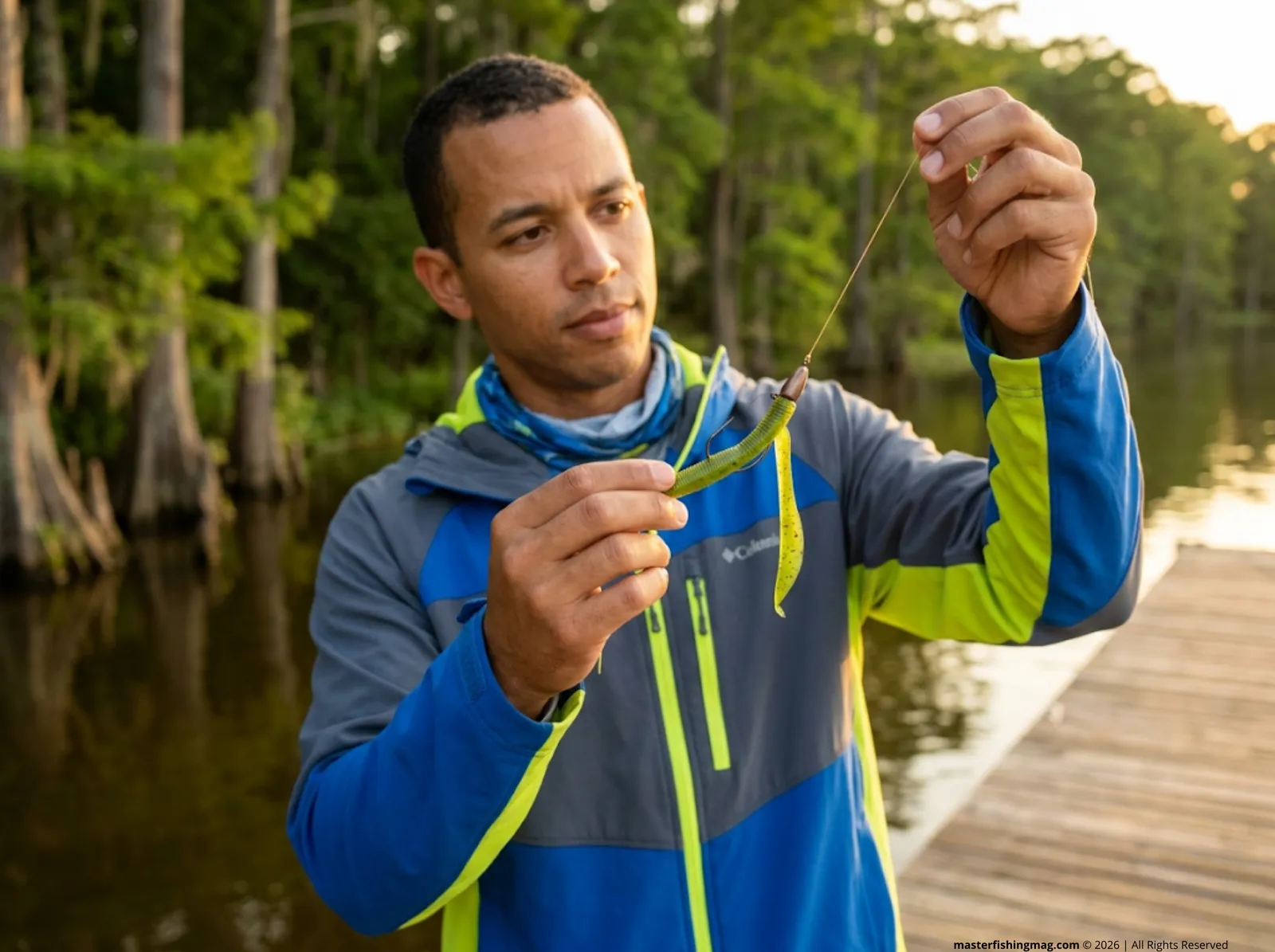
Push the point through and out the side of the bait exactly 1/4 to 1/3 inch down from the nose. Pull the hook through until the hook eye seats flush against the bait’s nose. Now rotate the bait 180 degrees so the hook shank lies flat against the body.
If you insert at an angle, you create a permanent “rudder” in the nose. No amount of adjusting will fix it — you’ll need to start fresh with a new puncture point.
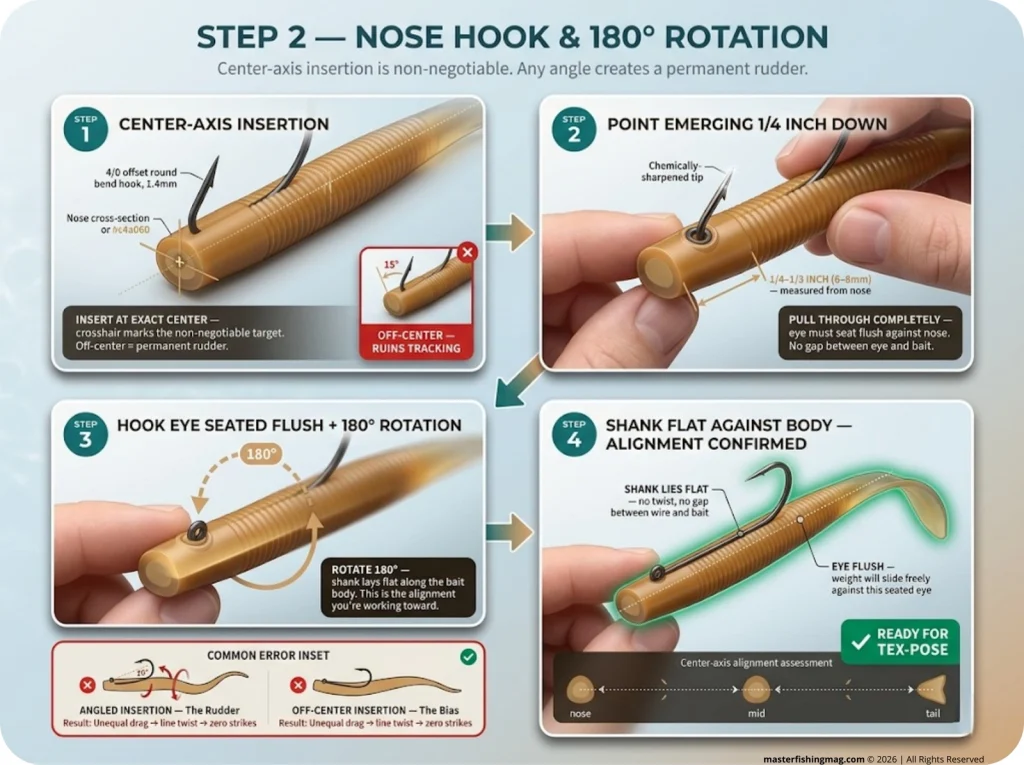
Pro tip: Dot the exact center of the bait’s nose with a Sharpie before inserting. Takes two seconds and eliminates guesswork.
Step 3 — The Tex-Pose — Burying the Point for Weedless Perfection
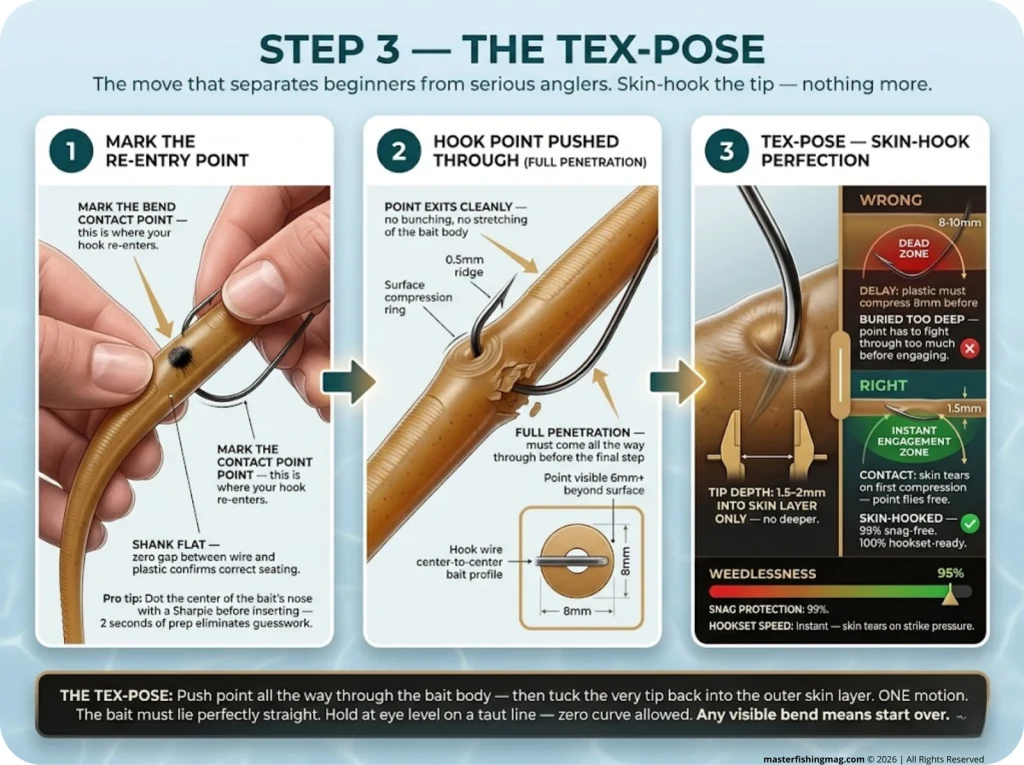
Mark where the hook bend meets the bait body. That’s your re-entry point. Push the hook point through the bait at that mark — the plastic should lie perfectly straight along the shank. No bunching. No stretching.
Now the move that separates beginners from serious anglers: the Tex-pose. Push the point entirely through the bait, then tuck the very tip back into the outer “skin” layer of the plastic. This gives you 99 percent snag-free presentation while allowing instant penetration on a strike.
Randy Blaukat calls burying the hook point deep into the center mass of the plastic the biggest mistake anglers make. Too much plastic between the point and the fish’s jaw means the hook can’t clear during that split-second strike window. The tip should barely dimple the surface — nothing more.
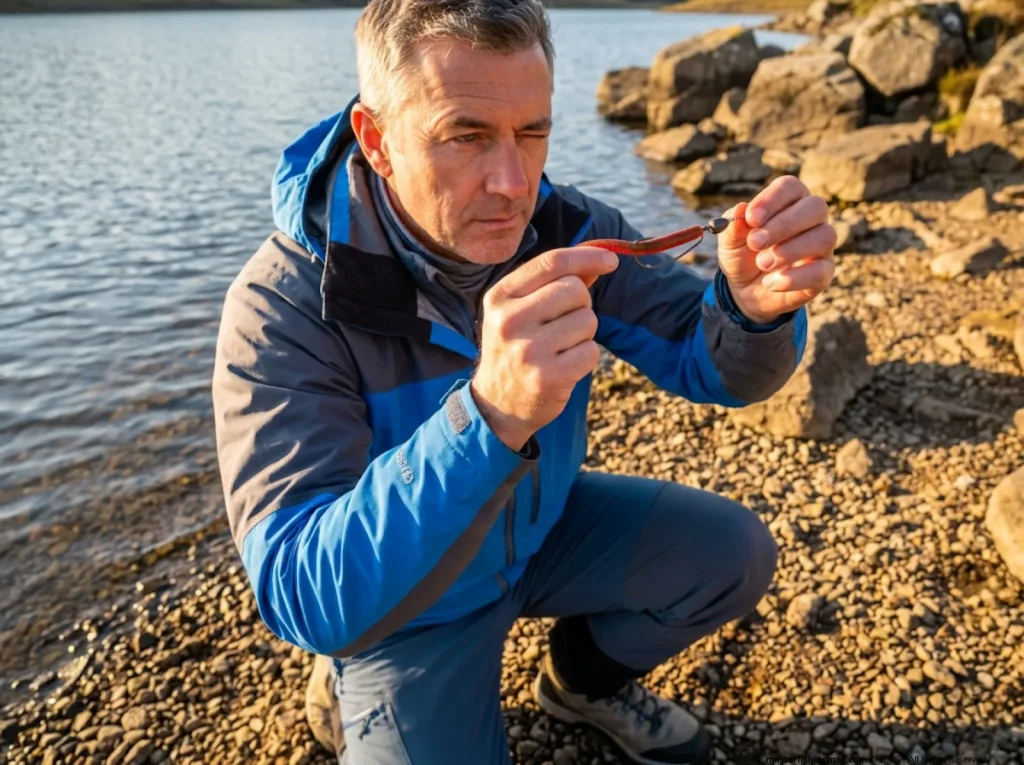
Finish with the straightness test. Hold the rig at eye level with the line taut. The bait must hang dead vertical with zero curve. Any visible bend means you start over. Period.
If you’re looking at the broader picture of making soft plastics ride clean, see weedless rigging fundamentals for soft plastics.
Troubleshooting the Three Failures That Cost You Fish
Still Spinning? Isolate the Variable
If the bait spins, check four things in order. First, bait alignment — hold the rig horizontal. Any curve means re-rig. Second, retrieval speed — slow down and let gravity work on the fall. Third, line spooling — if twist persists with a straight bait, open the bail, let 50 yards trail behind the boat in open water with no weight, and re-spool under tension. Fourth, bait material — thick, round-profile stick baits spin less than thin ribbon-tails at high speeds.
Missed Strikes? Check Your Hook-to-Plastic Ratio
Fish biting but pulling free tells you one thing: the hook point is buried too deep in plastic, or the hook-to-bait alignment is off. Switch to the Tex-pose or use a thinner bait. If a thick creature bait on an EWG keeps missing fish, swap to a straight shank flipping hook.
Set the hook with a sharp upward sweep — not a side pull. The Texas rig demands vertical force to drive the point through the roof of the mouth. For the deeper mechanics of what makes hooksets connect, read up on the physics of a proper hookset.
Snagging Despite “Weedless” Setup? Fix the Weight
An unpegged weight slides up the line on entry, leaving the soft plastic exposed to catch on branches and grass stalks. Peg the weight with a sinker stop when fishing heavy cover. In open water or sparse structure, leave it unpegged — the separation creates a natural “falling” action that triggers reaction strikes.
Rod angle matters too. Keep your rod tip at 10 o’clock and use slow lifts. Dragging with the tip at 3 o’clock catches every piece of cover in the path.
Pro tip: If you’re losing rigs to snags in timber, switch to a compact tungsten weight and peg it tight. The smaller profile deflects off branches instead of wedging between them.
Pitching vs. Punching — Two Tournament Systems for the Texas Rig
The Pitching System for Sparse to Moderate Cover
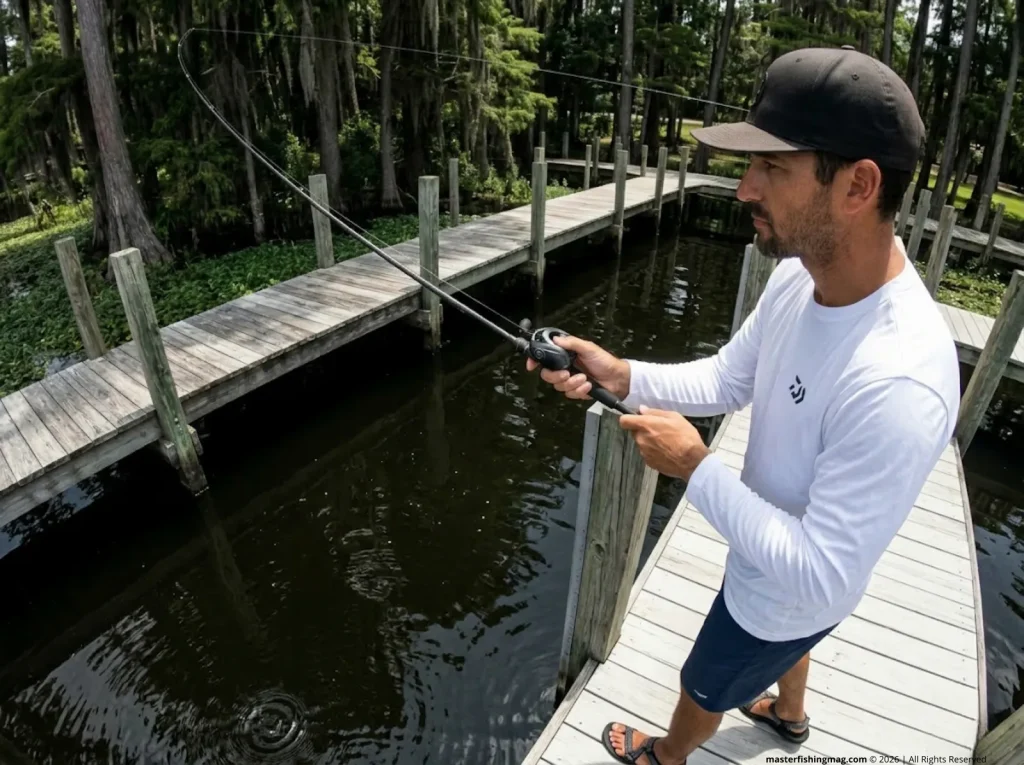
For docks, submerged grass edges, and isolated laydowns, Seth Feider runs a precision rig built around finesse and accuracy. A 7’3″ Medium-Heavy Fast rod (like the Daiwa Tatula Elite) paired with a high-speed baitcaster at 8.1:1 gives you rapid slack pickup on the hookset. Line is 30-pound Sufix 131 braid to a 17 to 20-pound fluorocarbon leader. Terminal tackle: 3/16 to 3/4 oz tungsten weight left unpegged, and a 4/0 VMC Ringed Wide Gap hook. The ringed eye allows the bait a micro-pivot that improves the natural fall over a fixed connection.
The Punching System for Heavy Vegetation Mats
When thick matted hydrilla or milfoil is the cover, everything changes. The rod jumps to 7’9″ Heavy power (like the Daiwa Rebellion) and the reel drops to 7.1:1 for torque — because every inch of line recovery fights dense grass. Go straight 40 to 50-pound braid with no leader. The weight climbs to 1 to 1.5 oz tungsten, pegged tight with a sinker stop, on a 3/0 to 5/0 Heavy Duty straight shank flipping hook.
An unpegged weight separates on mat entry, and the bait never reaches the fish holding beneath the canopy. For the full breakdown on heavy-cover techniques, see mastering heavy cover fishing tactics, and for the casting mechanics, our step-by-step flipping and pitching guide.
The Sustainable Angler — Why Your Weight Material Matters Beyond Performance
Avian Toxicology and the Grit Factor
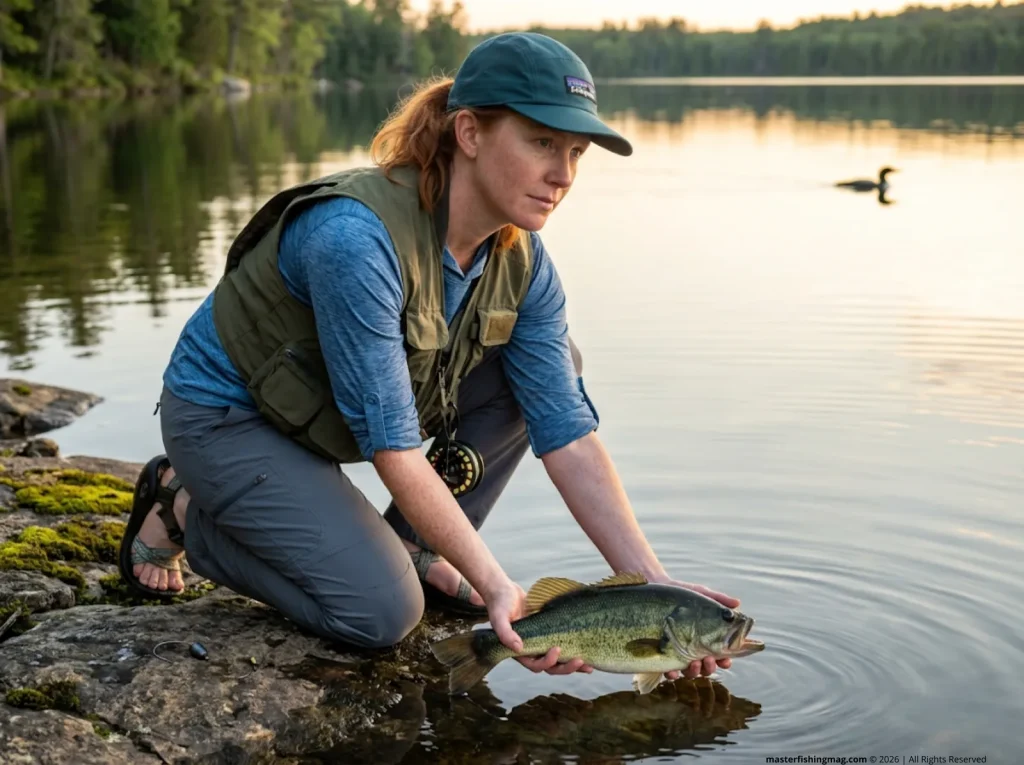
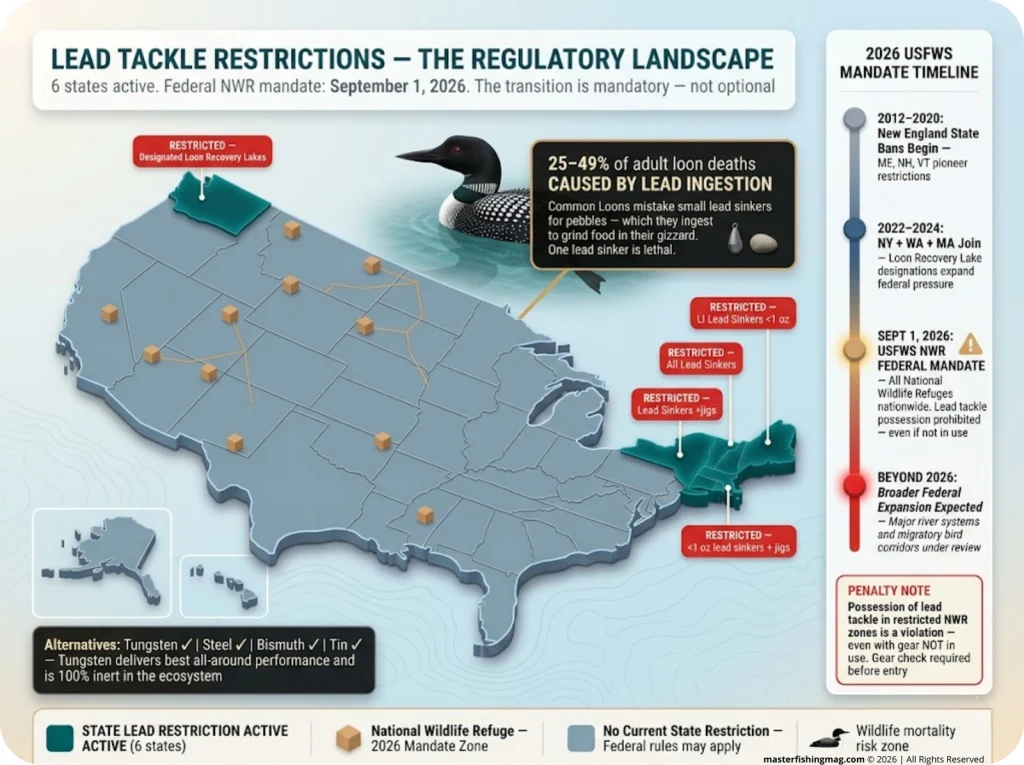
The Common Loon picks up pebbles from lake bottoms to help its gizzard grind food. Small lead sinkers look exactly like those pebbles. One is all it takes. The gizzard’s acidic environment grinds the lead into particles that enter the bloodstream, and lead poisoning accounts for 25 to 49 percent of adult loon deaths in states with heavy angling pressure.
This isn’t limited to loons. Bald Eagles, Trumpeter Swans, and dozens of waterfowl species are affected through secondary ingestion. Every weight you lose on a snag stays in the ecosystem. Tungsten is inert. Lead is a time bomb for the next bird that picks it up. For the full science, see the full science behind lead sinker dangers to wildlife, backed by Oklahoma State University research on lead sinker effects on wildlife.
The 2026 Regulatory Shift — What You Need to Know
The U.S. Fish & Wildlife Service has finalized a mandate prohibiting lead tackle on several National Wildlife Refuges starting September 1, 2026. Six states — Maine, New Hampshire, New York, Massachusetts, Vermont, and Washington (in designated Loon Recovery lakes) — already restrict lead. Possession of lead in restricted zones can be a violation, even if the gear isn’t in use.
Alternatives include tungsten, steel, bismuth, and tin. Tungsten delivers the best all-around performance. Switching now is the only “ranger-proof” strategy for the modern conservation-minded sustainable angler. For practical purchasing guidance, see our lead-free tackle brand and material guide.
Conclusion
Three things will make your Texas rig work the way it’s supposed to.
Straightness is everything. If your plastic has any curve when held at eye level, the water will turn it into a propeller. Re-rig until it hangs dead vertical. No exceptions.
Match the hook to the plastic, not the other way around. EWG for thick creature baits, Round Bend for slender worms, Straight Shank for heavy cover punching. Wrong geometry means missed fish.
Your weight choice is both a performance decision and an ethical one. Tungsten delivers superior sensitivity and stays inert in the ecosystem. With 2026 federal restrictions approaching, the transition from lead isn’t optional — it’s strategic.
Grab a pack of your go-to soft plastics, a handful of tungsten weights, and rig five Texas rigs at the kitchen table before your next trip. Do it slowly. Check the straightness test on each one. The muscle memory you build at home translates directly to faster, more precise soft plastic rigging on the water — where every second your bait isn’t in the strike zone is a second wasted.
FAQ
What is the best hook for a Texas rig?
For slender plastics like ribbon-tail worms and Senkos, a 3/0 to 4/0 offset round bend delivers the highest hookup percentage. For bulkier creature baits, switch to a 4/0 to 5/0 EWG. For heavy cover flipping, a straight shank hook provides maximum vertical leverage.
What is the difference between a Texas rig and a Carolina rig?
The Texas rig slides the weight directly against the hook for a compact, weedless, vertical presentation. The Carolina rig separates the weight from the bait with a 12 to 36 inch leader, letting the plastic float and drift naturally above bottom. The Texas rig dominates heavy cover; the Carolina rig covers open flats and deep structure more efficiently. See our Carolina rig setup guide for the full breakdown.
Do you need a weight for a Texas rig?
Not always. A weightless Texas rig is devastatingly effective in shallow water under five feet and around pressured fish. The bait falls at a slow, gliding rate that triggers cautious bass. Add weight only when you need to reach deeper structure or punch through vegetation.
Why is my Texas rig spinning?
Your bait is not straight on the hook. Even a slight curve creates asymmetric drag that turns the lure into a propeller. Re-rig with precise center-axis insertion and confirm straightness by holding the rig at eye level with taut line. If the bait curves at all, start over. Secondary causes include incorrect spooling direction on spinning reels and retrieval speed that exceeds the bait’s stability.
Can you Texas rig for saltwater species like redfish?
Absolutely. The Texas rig is a top presentation for redfish and snook in grassy flats and oyster bars. Use a 1/4 to 3/8 oz tungsten weight, a 4/0 EWG hook, and a paddle-tail in natural colors. The weedless presentation is essential for navigating turtle grass and mangrove roots. See our redfish grass flats guide for specific tactics.
Risk Disclaimer: Fishing, boating, and all related outdoor activities involve inherent risks that
can lead to injury. The information provided on Master Fishing Mag is for educational and informational purposes
only. While we strive for accuracy, the information, techniques, and advice on gear and safety are not a substitute
for your own best judgment, local knowledge, and adherence to official regulations. Fishing regulations, including
seasons, size limits, and species restrictions, change frequently and vary by location. Always consult the latest
official regulations from your local fish and wildlife agency before heading out. Proper handling of hooks, knives,
and other sharp equipment is essential for safety. Furthermore, be aware of local fish consumption advisories. By
using this website, you agree that you are solely responsible for your own safety and for complying with all
applicable laws. Any reliance you place on our content is strictly at your own risk. Master Fishing Mag and its
authors will not be held liable for any injury, damage, or loss sustained in connection with the use of the
information herein.
Affiliate Disclosure: We are a participant in the Amazon Services LLC Associates Program, an
affiliate advertising program designed to provide a means for us to earn advertising fees by advertising and linking
to Amazon.com. As an Amazon Associate, we earn from qualifying purchases. We also participate in other affiliate
programs and may receive a commission on products purchased through our links, at no extra cost to you. Additional
terms are found in the terms of service.