In this article
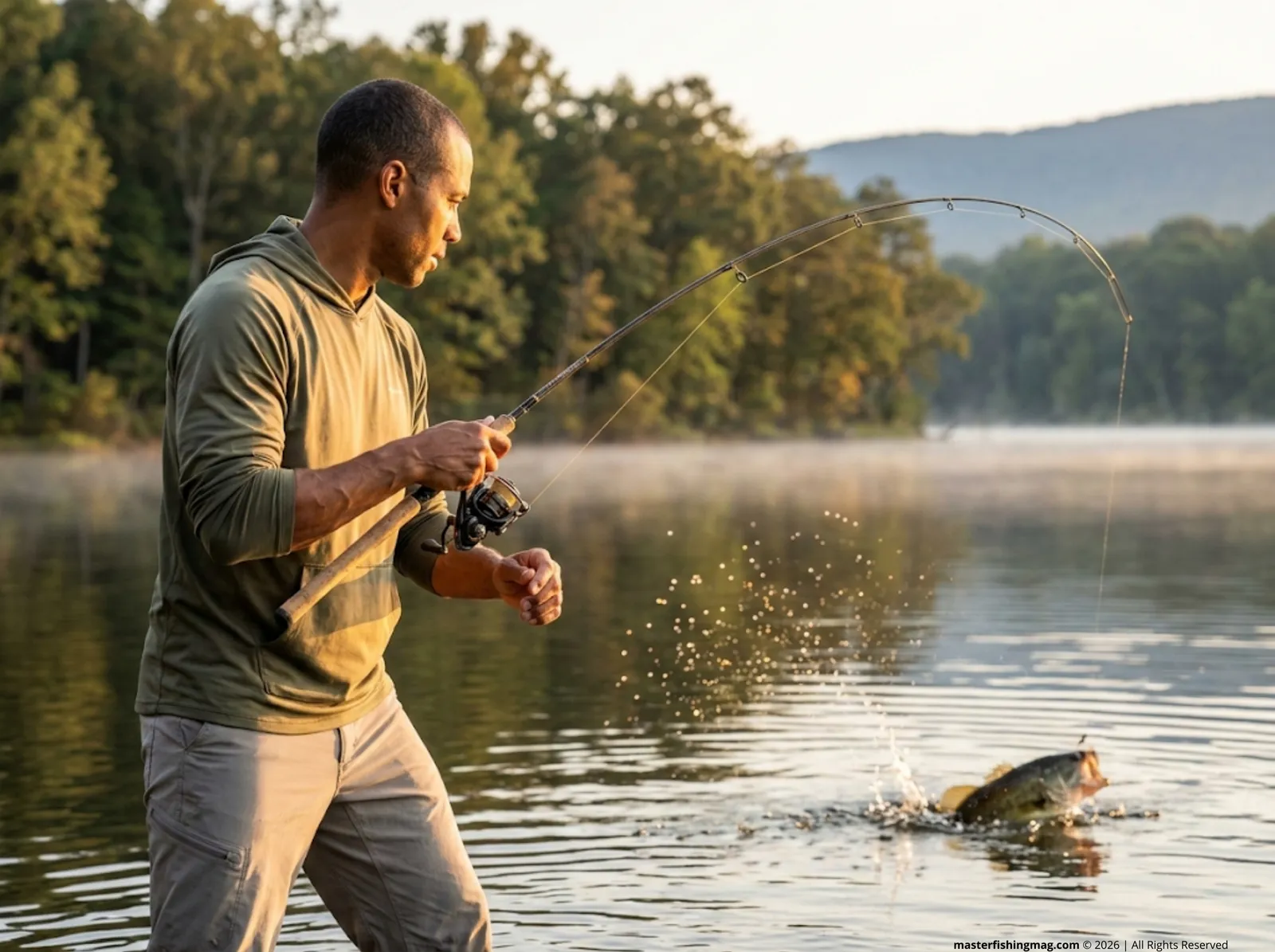
The Senko touched down on a flat so quiet I could hear my reel click. Ten seconds of slack line, a faint sideways twitch — then the rod loaded and a four-pounder peeled drag through scattered stumps. That fish had ignored a shaky head, a drop shot, and a Texas-rigged creature bait for two hours. The only thing she ate was the Neko rig, nose-down in the mud, doing its dying-baitfish shudder while I did absolutely nothing heroic.
After years of throwing finesse rigs on pressured fisheries from post-spawn flats to stained fall ledges, the Neko has become the presentation I reach for when nothing else works. This guide breaks it down from first O-ring to final hookset — how to rig it, which nail weights and plastics match which conditions, and the retrieve adjustments that turn lockjaw afternoons into bent-rod sessions on pressured waters.
⚡ Quick Answer: A Neko rig is a weighted wacky rig — a soft plastic stick bait with a tungsten nail weight inserted in the head end, creating a nose-dive fall action. Use 1/32–1/8 oz weights matched to water temperature, thread the hook under an O-ring 1–1.5 inches from the head with the hook point facing down, and fish it on slack line with subtle twitches. It catches bass that refuse every other finesse presentation.
What a Neko Rig Actually Is (And Why Bass Can’t Ignore It)
Neko vs. Wacky Rig: The Critical Difference
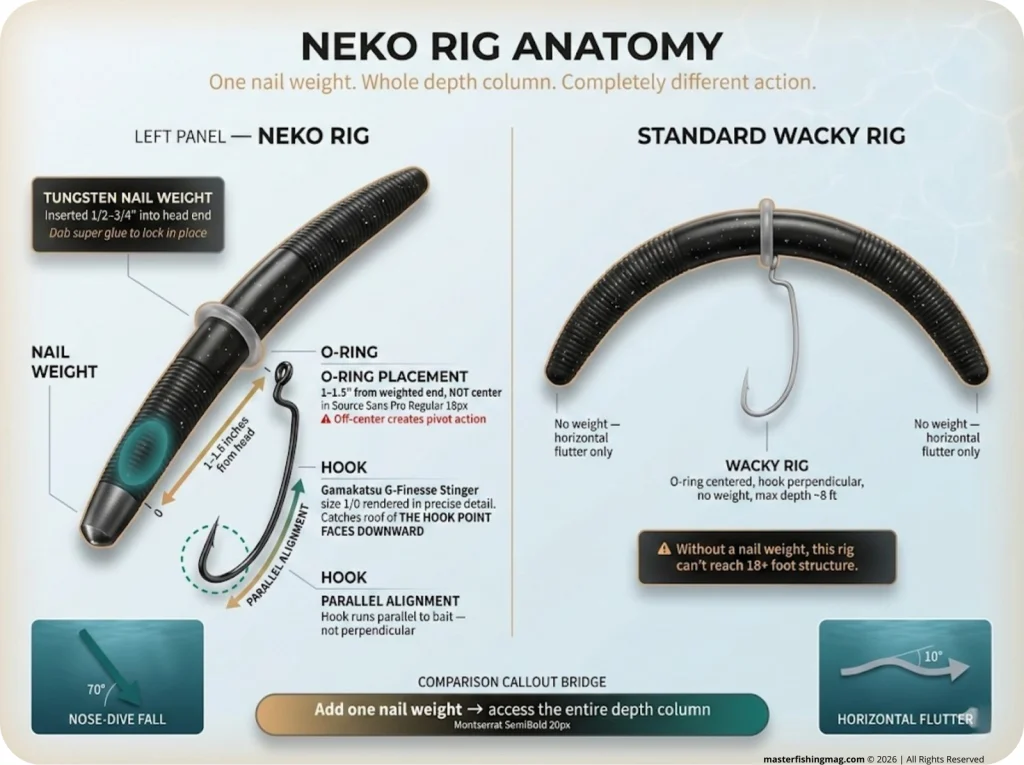
A Neko rig is a wacky-rigged stick bait with one addition that changes everything: a nail weight shoved into the fat end. That single weight transforms a horizontal shimmy into a nose-dive — the bait plunges head-first toward bottom while the tail quivers upward like a dying baitfish that can’t right itself.
The biggest difference from a standard wacky rig isn’t just the action. It’s the depth. A weightless Senko flutters beautifully in 3–8 feet of water, but it can’t reach a brush pile in 18 feet on a windy afternoon. Major League Fishing calls the Neko “the deep water wacky rig” because a single nail weight opens an entire depth column that weightless presentations miss — ledges, channel swings, and those 15–25 foot flats where pressured bass hold post-spawn.
If you already know the wacky rig fundamentals we covered in our Senko guide, the Neko is the natural next step when fish move deeper or stop committing to surface-level finesse.
How the Nose-Dive Action Triggers Strikes
On bottom contact, a straight-tail worm rigged Neko-style stands nearly vertical with the tail waving in micro-current. Bass can see that silhouette from 10 feet away. Unlike a shaky head that drags horizontally, the Neko’s vertical stand-up action holds the bait in the strike zone longer per cast.
The fall itself mimics a dying baitfish — head-heavy, struggling, nose-diving toward the substrate. That’s the trigger. Largemouth bass are ambush predators wired to intercept wounded prey, and the Neko’s wobble hits every checkbox in their feeding response.
When to Reach for a Neko Over Other Finesse Rigs
Post-spawn through fall is the prime window. Water temps between 55–85°F keep bass active but not aggressive enough for reaction baits. According to the U.S. Fish and Wildlife Service, largemouth bass feed most actively between 60–80°F — the exact range where a slow-falling Neko presentation shines.
Anytime fish are following but not committing — what tournament anglers call “the follower problem” — the Neko’s subtle fall triggers the reaction that a drop shot or shaky head can’t.
Pro tip: If your wacky rig stops getting bit after the spawn, don’t switch baits — just add a nail weight. Same plastic, twice the range, completely different action.
Rigging Step by Step: O-Ring, Nail Weight, and Hook Orientation
Inserting the Nail Weight (Head End)
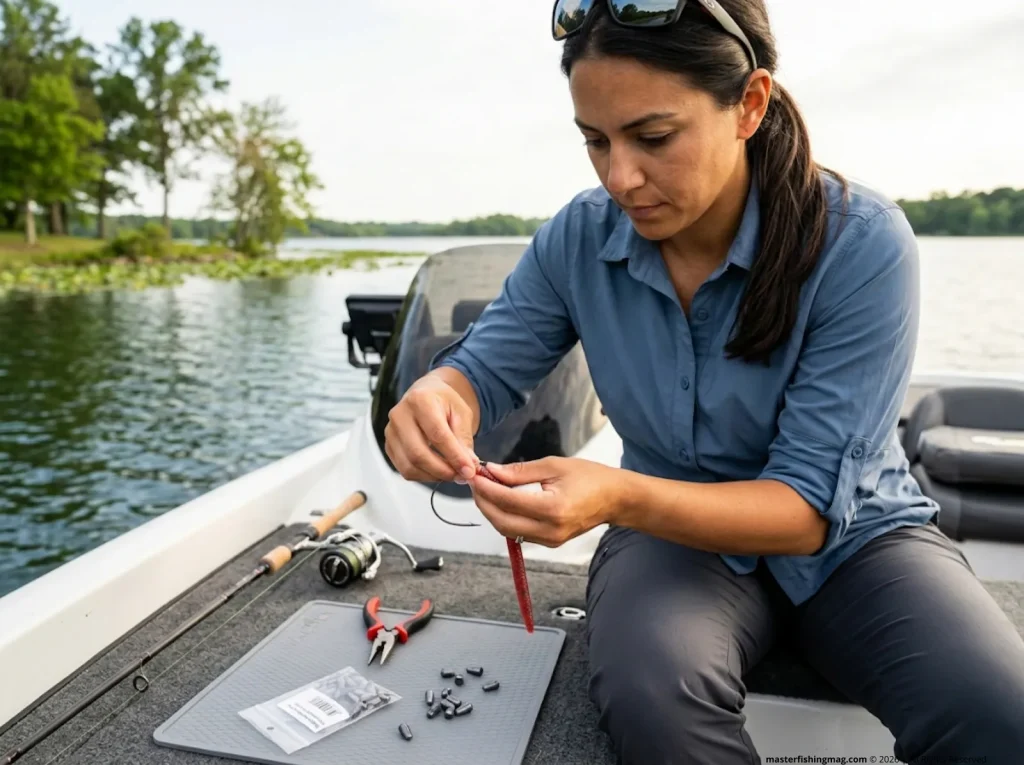
Push a tungsten nail weight into the fat head end of your stick bait — about half an inch to three-quarters deep so the weight is fully embedded. Tungsten is denser than lead, giving you a faster fall rate in a smaller profile.
A dab of super glue on the exposed end before pushing it flush keeps the weight from sliding out after repeated casts. This sounds minor until you’ve burned through a bag of Senkos in an hour because the nail keeps popping free.
DIY hack straight from MLF pros: drywall screw weights with a split ring threaded on the head work as emergency nail weights when you run out on the water. They’re ugly, they work, and they cost pennies.
Placing the O-Ring and Threading the Hook
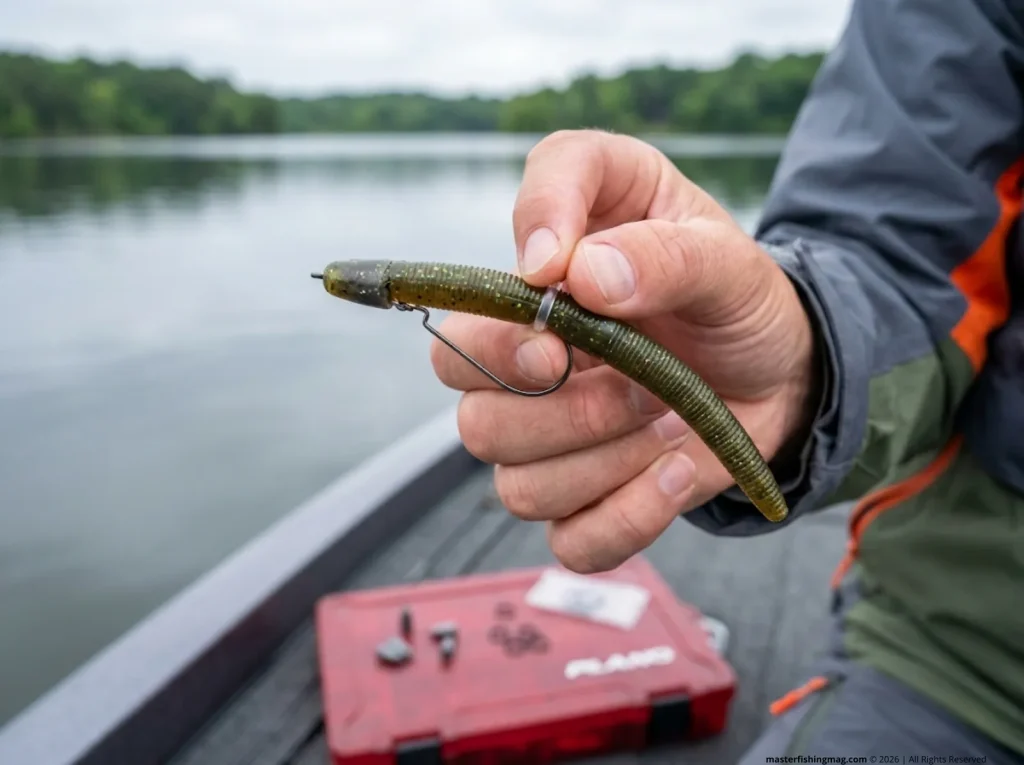
Slide the O-ring onto the worm approximately 1–1.5 inches from the head (weighted end) — NOT dead center. This off-center O-ring hook placement is what gives the Neko its signature pivot action, weighting the head so the tail end can float and wave freely.
VMC Crossover Rings (size 7) or similar silicone rings are purpose-built, but standard hardware O-rings work fine. Thread the hook under the O-ring so it runs parallel to the bait — not perpendicular like a standard wacky rig. This parallel alignment improves hookset penetration.
Hook Point Down: The Orientation That Changes Everything
Insert the hook from the bottom of the worm upward so the hook point faces down when the bait hangs naturally. This is the detail that separates consistent hookups from frustration.
When a bass inhales the Neko off bottom, a downward-facing hook catches in the roof of the mouth — the hardest, most secure tissue for hooksets. Point facing up hooks the softer lower jaw, which means more pull-outs on the fight. Recommended Neko hooks: Gamakatsu G-Finesse Stinger (sizes 4–1/0), VMC Finesse Neko Hook, or Owner Sniper Finesse Weedless (size 2) when you need to fish through cover. For more options, check our guide on weedless rigging techniques for bass.
Pro tip: Start with exposed hooks in open water. Switch to a weedless hook only when fishing cover — the guard cuts your hookup rate by roughly 15%, so it’s a trade-off you make deliberately, not by default.
Choosing the Right Weight, Plastic, and Setup
Weight Selection by Season and Depth
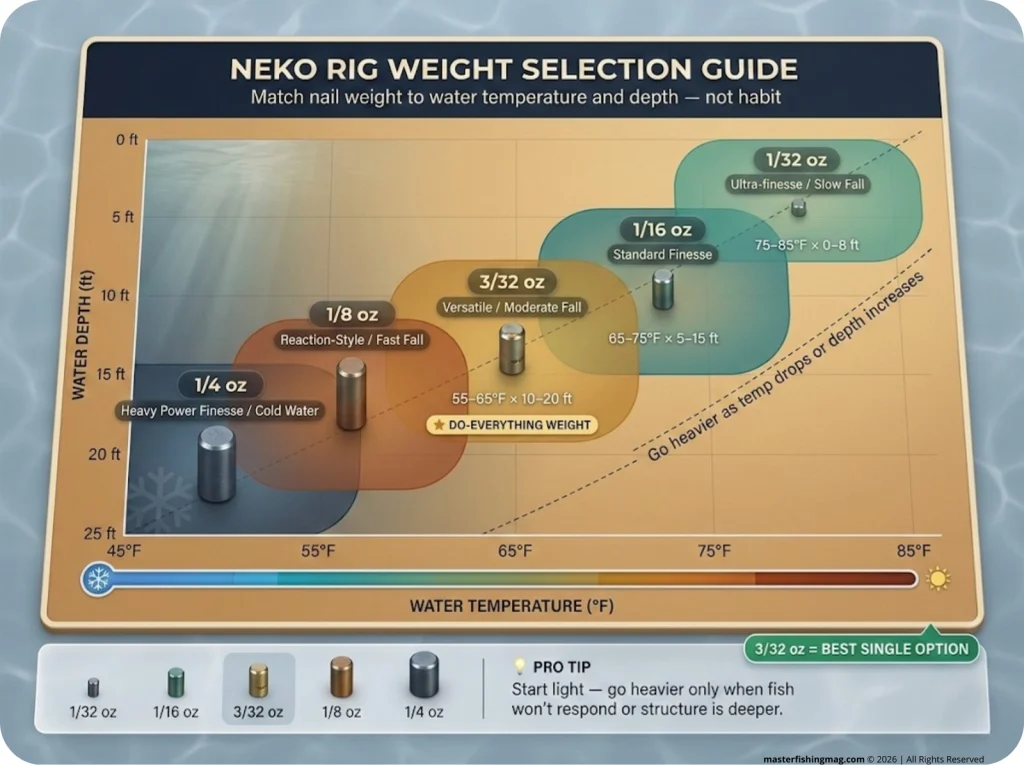
This is where most anglers stay stuck at beginner level. The Neko is actually two different presentations depending on your weight size: a slow finesse rig in warm water, and a reaction-style power finesse tool in cold water.
| Presentation Guidelines | |||
|---|---|---|---|
| Weight | Water Temp | Depth | Presentation |
| 1/32 oz | 75–85°F | 0–8 ft | Ultra-finesse, slow fall |
| 1/16 oz | 65–75°F | 5–15 ft | Standard finesse |
| 3/32 oz | 55–65°F | 10–20 ft | Moderate fall, versatile |
| 1/8 oz | 45–55°F | 15–25 ft | Reaction-style, fast fall |
| 1/4 oz | Below 45°F | 20+ ft | Heavy power finesse |
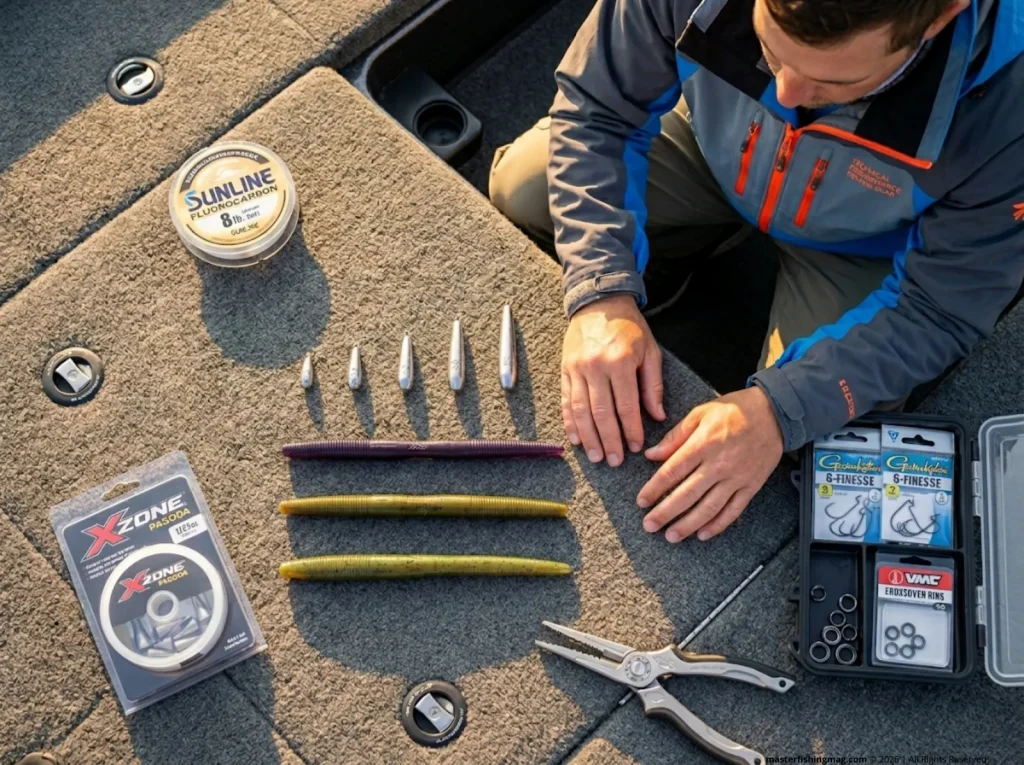
Start light and go heavier only if you’re not getting bites or need to reach deeper structure. Xzone Pagoda weights (3/32 oz) are a versatile “do-everything” option if you want one weight to cover most situations.
Bait Selection: Matching Plastic to Species and Depth
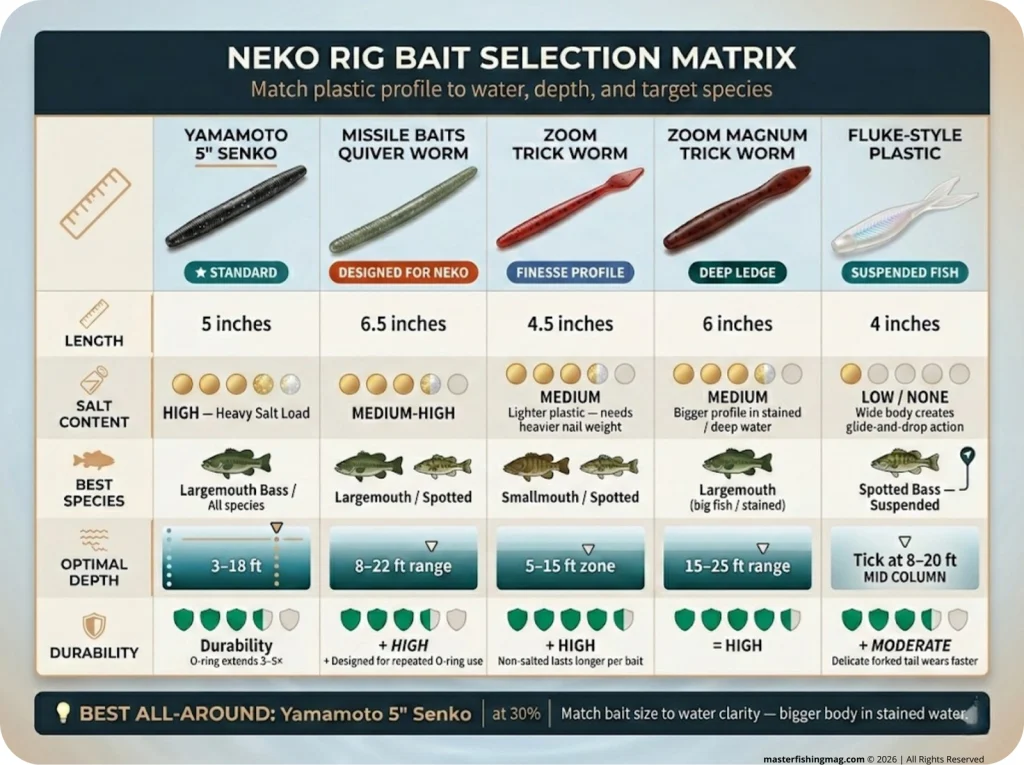
The Yamamoto 5″ Senko is the standard for a reason — heavy salt-impregnated plastic provides its own weight and a subtle shimmy that largemouth bass can’t resist. It’s the best all-around choice for most situations.
Missile Baits Quiver Worm (4.5″ and 6.5″ versions) was designed specifically for Neko rigging. The 6.5″ adds profile for stained water or bigger fish. Zoom Trick Worm and Magnum Trick Worm stand taller on bottom thanks to their longer profiles — the Magnum works on largemouth in deep ledge situations where you need presence.
For suspended spotted bass, try a fluke-style plastic on a Neko rig. The wider body creates a glide-and-drop action that spots track aggressively. Salt-impregnated plastics sink faster but tear sooner. Non-salted plastics last longer but need heavier nail weights. Know the trade-off before you commit to a bag.
Rod, Reel, and Line: The Full Setup
A 7′ to 7’4″ medium to medium-light power, fast action spinning rod gives you the casting distance and soft tip needed to telegraph subtle bites. Pair it with a Daiwa Tatula LT 2500 or similar 2500-size spinning reel — smooth drag is critical for light-line hooksets.
Line setup: 10–15 lb braid mainline to a 6–10 lb fluorocarbon leader tied with an FG knot or double uni. Braid for sensitivity, fluoro for invisibility. For dock-skipping finesse, downsize to a BFS combo (1000-size reel, 6 lb fluoro straight) — lighter gear lets you skip under low docks where pressured bass stage all summer. For a deeper look at light-line philosophy, check our breakdown of light line finesse principles.
How to Fish It: Three Retrieves That Fool Pressured Bass
The Fall-and-Twitch (Primary Retrieve)
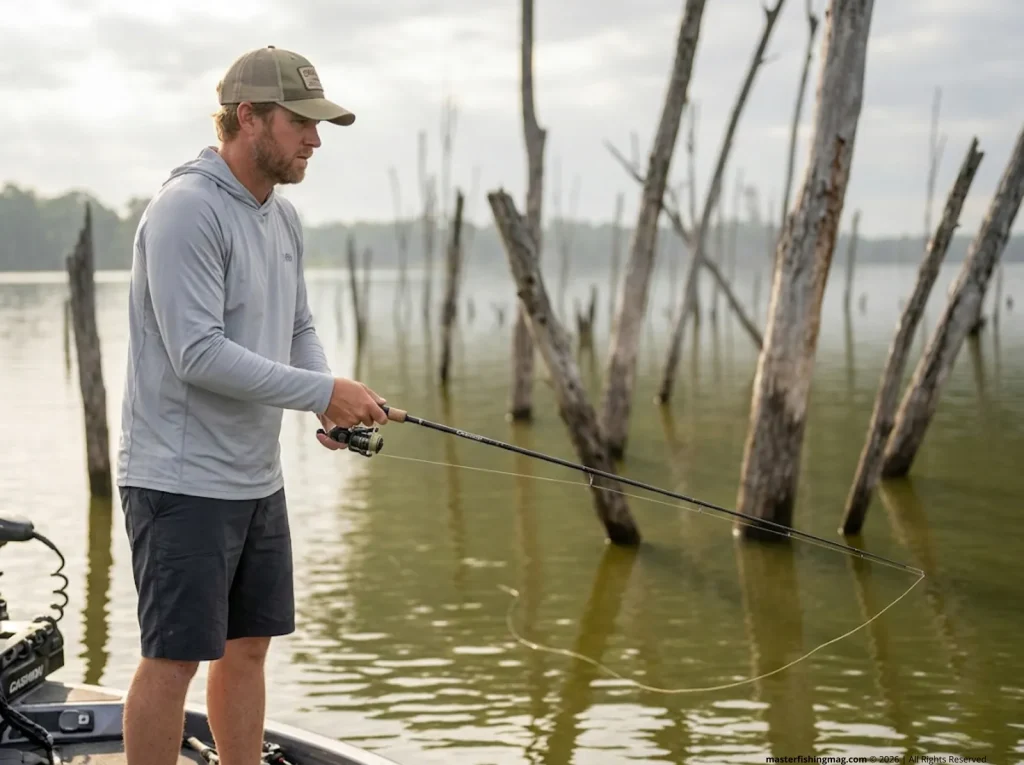
Cast, let the Neko fall on a slack line or semi-slack line. Watch the line — most bites come on the initial fall. Once on bottom, give 2–3 subtle twitches with the rod tip (6–8 inches of movement), then let it sit for 3–5 seconds.
The key: keep the rod tip LOW and slightly to the side. High rod equals too much line tension, which kills the natural nose-dive action. Bite detection on a Neko is mostly visual — watch for the line to jump, twitch sideways, or slowly swim off. If you’re new to reading visual cues, our guide on visual line watching for finesse bites covers the fundamentals.
Pro tip: The bite often comes during the fall when you can’t feel it. Keep your eyes on the line, not the rod tip. If the line does something your rod tip didn’t cause — set the hook.
The Drag-and-Pop (Bottom Contact)
Drag the Neko slowly along bottom for 12–18 inches, then pop the rod tip sharply to hop it 6–12 inches off bottom. The pop mimics a baitfish flushing off substrate — this triggers reaction strikes from bass holding tight to structure.
This dragging retrieve shines on rock transitions, ledges, and channel swing banks where bass stage post-spawn. If a fish follows but doesn’t eat on the fall, switching to the drag-and-pop often seals the deal. The sudden direction change short-circuits whatever hesitation the fish had.
The Swim-and-Drop (Suspended Fish Technique)
For suspended bass over brush piles, standing timber, or offshore structure: cast past the target, swim the Neko through the water column at a steady pace, then kill the reel and let it nose-dive.
With forward-facing sonar (Garmin Livescope, Humminbird MEGA Live), you can watch bass track the bait 5–10 feet before striking on the drop. This is the advanced technique that bass pros like Bryan Schmitt and Tristan McCormick use to target specific fish with precision. The swim speed should match a casual baitfish cruise — not a fleeing escape. Think “meandering, then dying.”
Hookset, Fight, and Common Mistakes to Avoid
The Sweep Hookset (Not a Power Set)
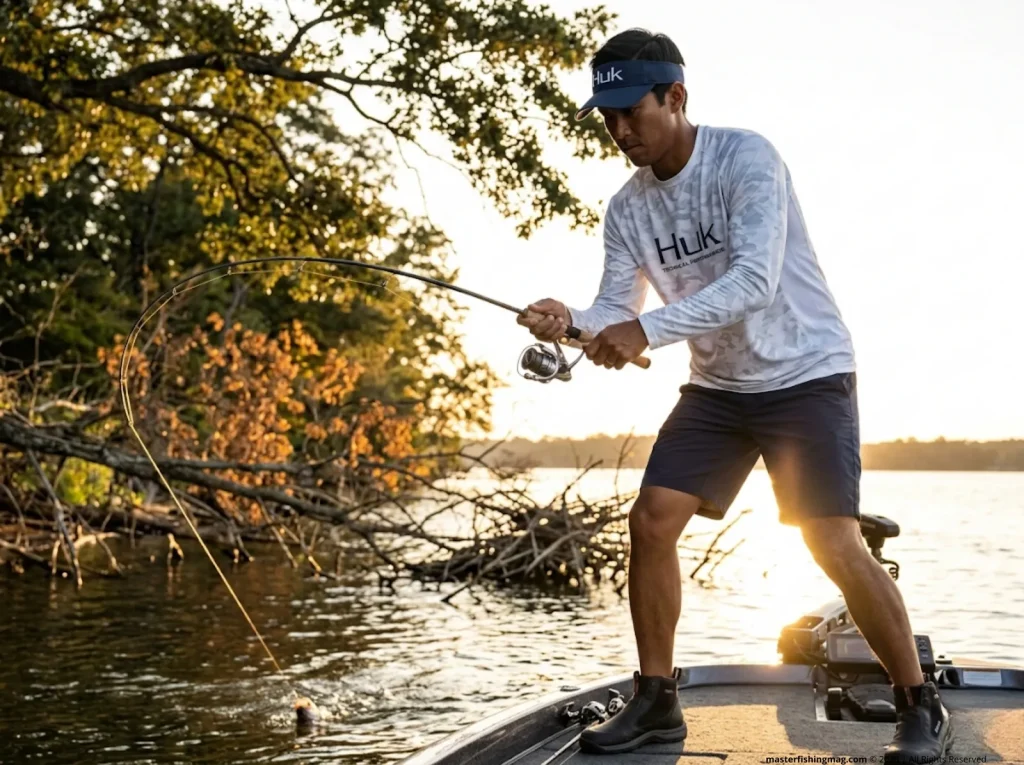
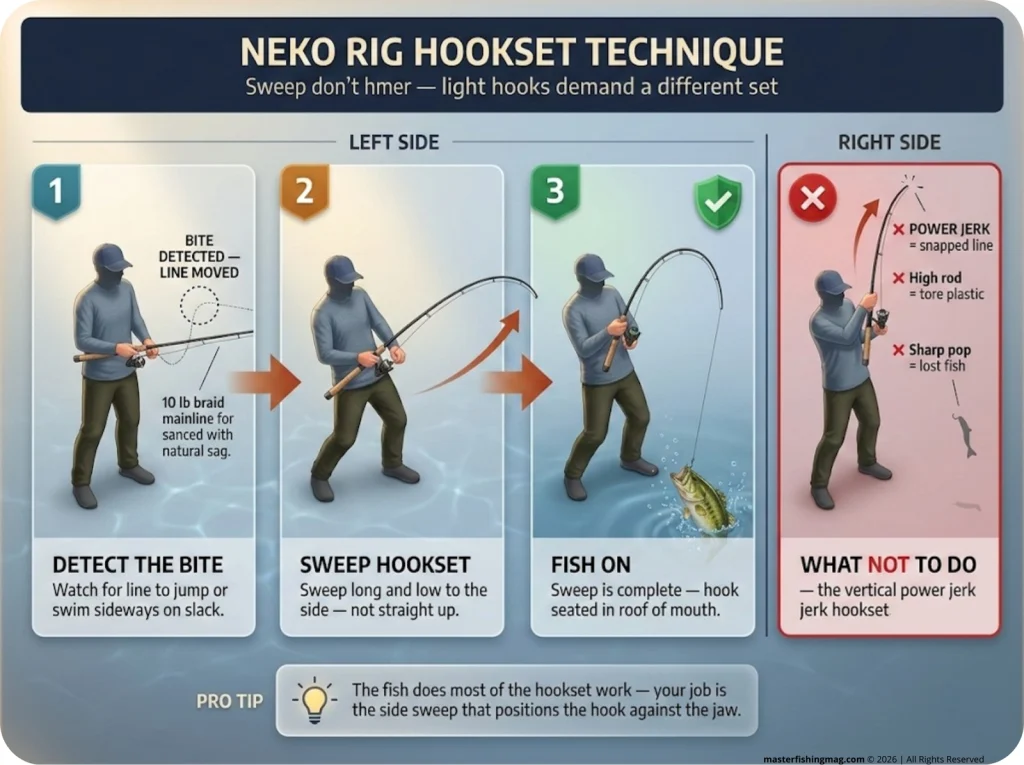
Do NOT jerk the rod upward like a jig hookset. Light hooks and light line can’t handle that force. Sweep the rod low and to the side — a long, firm pull rather than a sharp pop. This drives the hook into the roof of the mouth without tearing the soft plastic.
Keep the drag set lighter than usual, about 2–3 lbs of pull. The fish needs to turn before the hook fully penetrates. If you’re breaking off on the hookset, your drag is too tight. With finesse hooks, the fish does most of the hook-setting work for you.
Three Mistakes That Kill Your Neko Game
Too much line tension on the fall. The Neko needs slack to nose-dive properly. Tight line turns it into a horizontal fall — and at that point you’ve made a worse shaky head. Let the bait do its thing.
Using too heavy a line. Fifteen-pound fluorocarbon leader kills the action and spooks pressured fish. Stay in the 6–10 lb range. Yes, you’ll lose a few in cover. That’s the trade-off for actually getting bit. Learn to prevent line twist on spinning reels — it’s the most common line management issue with this setup.
Setting the hook too hard. Ripped plastics, pulled hooks, snapped 8 lb fluoro. Sweep, don’t hammer. Every season I watch anglers lose fish because they set like they’re throwing a jig into a laydown. The Neko is a finesse presentation. Treat it like one.
Extending Bait Life and Reducing Waste
O-rings multiply bait life 3–5x compared to direct wacky rig hooks. A single Senko can last 15+ fish with an O-ring versus 2–3 without. Super glue the nail weight and any tears after each fish — thirty seconds of glue equals three more fish per bait.
For catch-and-release waters, consider using quick-release hooks (inline singles rather than wide-gap hooks). The single penetration point reduces handling time and fish injury — research from the University of Nebraska-Lincoln confirms that hook type and placement are the largest factors in catch-and-release survival. Keeping the fishery healthy for the next angler starts with the hook you choose.
Seasonal Playbook: Adapting the Neko Rig Year-Round
Post-Spawn Through Summer (Prime Time)
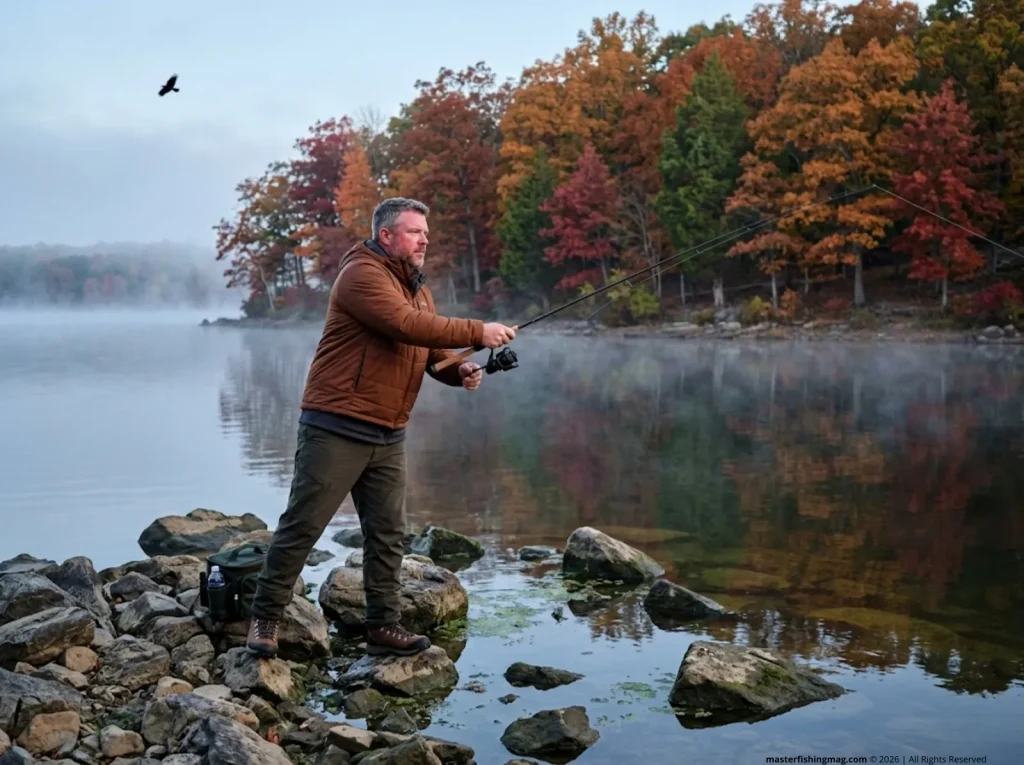
Water temps 65–85°F are the Neko’s sweet spot. Bass transition from beds to secondary points, humps, and brush piles. Use lighter weights (1/32–1/16 oz) with a slow, natural fall.
Target shade lines, dock pilings, and laydown trees where fish recover from the spawning effort. Post-spawn largemouth want easy meals but won’t chase — the slow vertical presentation puts the bait in their face without asking them to move.
Fall Transition (Follow the Bait)
Bass follow shad migrations toward creek arms and main-lake points. Bump up to 3/32–1/8 oz weights for faster fall and deeper bottom contact. Fan-cast flats adjacent to channel swings — the Neko covers water efficiently when fish are scattered.
Increase bait size too. A 6.5″ Missile Baits Quiver Worm or Magnum Trick Worm matches the bigger forage profile that fall baitfish present. Bigger profile, heavier weight, faster fall — you’re essentially power-fishing with a finesse mindset.
Cold Water and Winter (Power Finesse)
Below 55°F, bass are lethargic but will still eat a bait that falls right on their head. Use 1/8–1/4 oz Neko weights for reaction-style presentations. The heavier fall triggers involuntary strike responses even in cold, sluggish winter fish. For more on these conditions, see our cold water bank fishing tactics.
Vertical presentations over sonar-marked fish excel here. Drop the Neko directly to bass on deep structure, shake twice, reel up, repeat. The same simple rig that fooled post-spawn fish in eight feet of water now reaches fish offshore holding at 25.
Conclusion
Three things make the Neko rig worth tying on before every trip. First, it’s a weighted wacky rig that transforms a shallow finesse bait into a full-depth-column weapon for pressured bass. Second, weight selection drives everything — match your nail weight to water temperature and depth, not whatever’s already in the tackle box. Third, master the three retrieves (fall-and-twitch, drag-and-pop, swim-and-drop) and you’ll cover 90% of the situations where fish are present but not feeding aggressively.
Tie one successful Neko rig before your next trip. Fish it alongside whatever you’d normally throw for 30 minutes. The fish will tell you when to switch.
FAQ
What is the difference between a Neko rig and a wacky rig?
A Neko rig is a wacky rig with a nail weight inserted into one end of the bait. The weight creates a nose-dive fall action instead of the horizontal flutter of a weightless wacky rig, letting you fish deeper water and make bottom contact that a standard wacky rig can’t reach.
What is the best weight size for a Neko rig for bass?
Start with 1/32 oz in warm, shallow water and increase to 1/8 oz or heavier as water cools or depth increases. A 3/32 oz tungsten nail weight is the most versatile single option for anglers who want one weight to cover most conditions.
What hook size should I use for a Neko rig?
Sizes 4 to 1/0 cover most situations. Use smaller hooks (size 6–4) for 4–5 baits and larger hooks (1–1/0) for 6+ worms. Insert the hook point facing down for optimal hookup rates in the roof of the mouth.
When should you use a Neko rig instead of a drop shot?
Reach for the Neko when bass are on or near bottom structure (stumps, rock, brush) where a drop shot weight would snag. The Neko is also better for horizontal coverage — you can cast and drag it, whereas a drop shot excels in vertical, stationary presentations.
Can you fish a Neko rig in heavy cover?
Yes, but switch to a weedless hook like the Gamakatsu G-Finesse Cover Neko or Owner Sniper Finesse Weedless. The wire guard reduces snags while still allowing solid hooksets. Expect slightly lower hookup rates versus exposed hooks in open water.
Risk Disclaimer: Fishing, boating, and all related outdoor activities involve inherent risks that
can lead to injury. The information provided on Master Fishing Mag is for educational and informational purposes
only. While we strive for accuracy, the information, techniques, and advice on gear and safety are not a substitute
for your own best judgment, local knowledge, and adherence to official regulations. Fishing regulations, including
seasons, size limits, and species restrictions, change frequently and vary by location. Always consult the latest
official regulations from your local fish and wildlife agency before heading out. Proper handling of hooks, knives,
and other sharp equipment is essential for safety. Furthermore, be aware of local fish consumption advisories. By
using this website, you agree that you are solely responsible for your own safety and for complying with all
applicable laws. Any reliance you place on our content is strictly at your own risk. Master Fishing Mag and its
authors will not be held liable for any injury, damage, or loss sustained in connection with the use of the
information herein.
Affiliate Disclosure: We are a participant in the Amazon Services LLC Associates Program, an
affiliate advertising program designed to provide a means for us to earn advertising fees by advertising and linking
to Amazon.com. As an Amazon Associate, we earn from qualifying purchases. We also participate in other affiliate
programs and may receive a commission on products purchased through our links, at no extra cost to you. Additional
terms are found in the terms of service.