
In this article
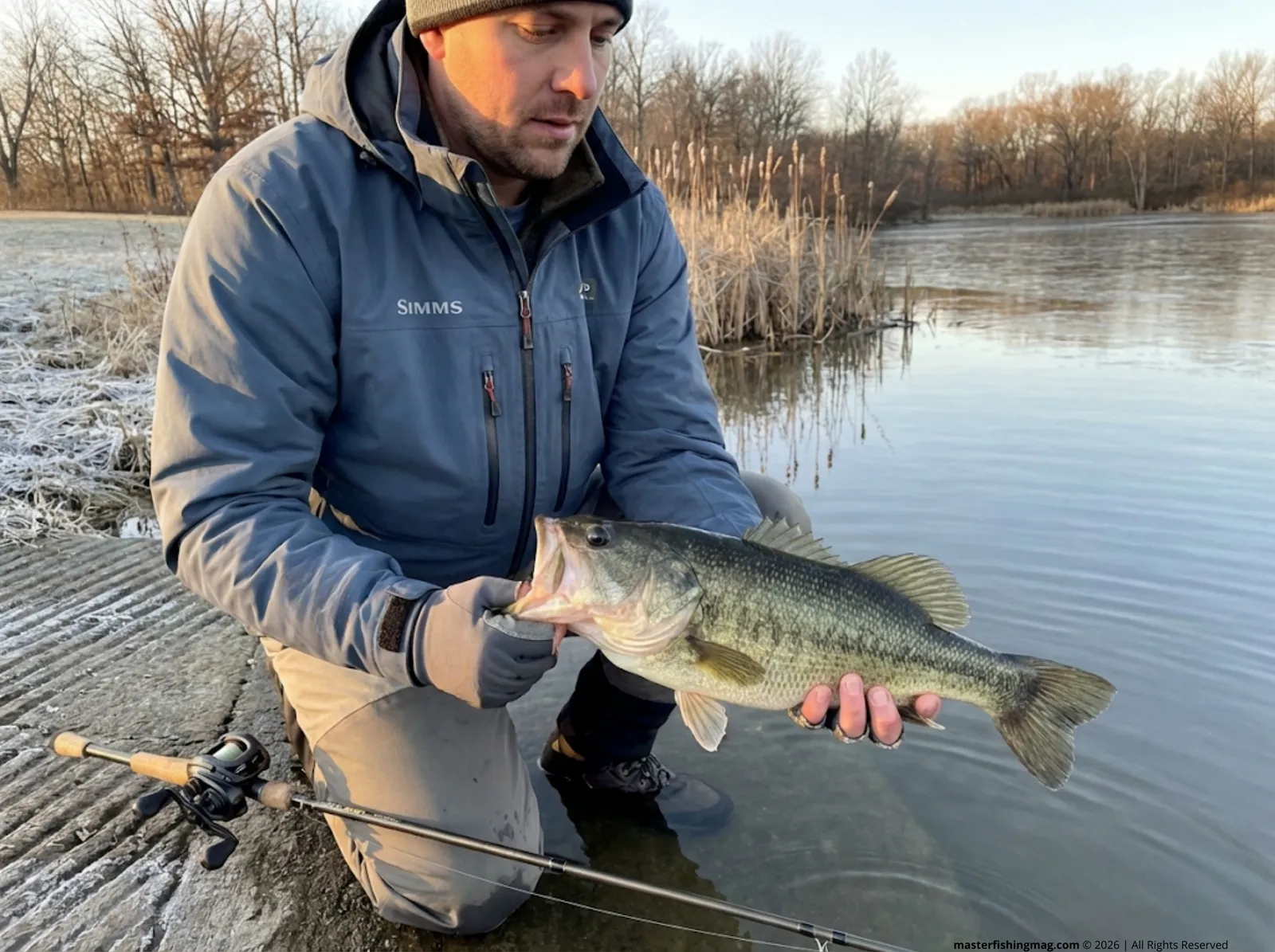
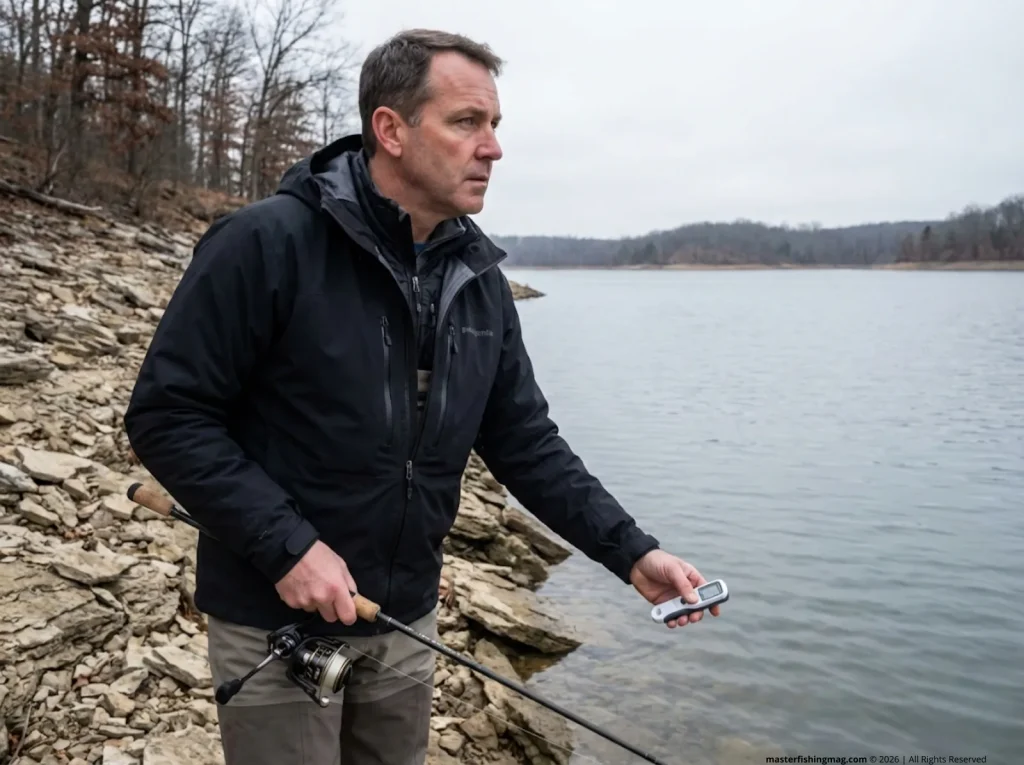
The jig sat motionless on the bottom for what felt like a full minute. Nothing. I’d been casting into the same laydown on my local pond for two hours — water temp reading 41°F on my handheld — and I was about to pack it in. Then, almost as an afterthought, I lifted the rod tip six inches and let the bait fall back. The line ticked. Not a thump. Not a pull. Just a soft, mushy heaviness, like someone had draped a wet washcloth over my hook. I set, and a 4.8-pound largemouth rolled on the surface.
That fish changed how I approach every cold-water bass fishing outing from the bank. Everything about my presentation — my retrieve, my pause, my fall rate — was calibrated for a fish running at summer speed. That bass was barely moving. I needed to slow down to match it.
This article works through the specific changes that turn a dead winter bank fishing session into a productive one — where bass go when water hits 45°F, how to calibrate your fall rate before you ever cast, and the four presentations that consistently put fish on the bank.
⚡ Quick Answer: When water drops below 50°F, bass slow to a crawl — literally. Slow your fall rate to 2–3 seconds per foot, extend pauses to 10–15 seconds, and target steep south-facing banks near deep water. Fish the 1–4 PM warming window. A suspending jerkbait on dead-slow retrieve or a weightless Senko freefall is your best shot from the bank between 40°F and 55°F.
| Cold Water Bass Fishing Metrics | |
|---|---|
| Key Metric | Cold Water Standard |
| Water Temp Threshold | 45°F — behavior shifts dramatically |
| Bass Swimming Speed at 45°F | 0.17 body lengths/second |
| Ideal Pause Duration | 10–15 seconds between movements |
| Target Fall Rate | 2–3 seconds per foot |
| C&R Mortality (Winter vs Summer) | 13% vs 47% |
Why Cold Water Rewrites the Rules of Bass Behavior
The Metabolic Shutdown Nobody Explains to Bank Anglers
Bass are cold-blooded creatures — their body temperature matches the water they swim in, so every physical process slows down when that water gets cold. Digestion, nerve signals, muscle contractions — all of it drops as temperatures fall. Understanding how ectothermy controls every feeding decision a bass makes is the foundation every serious winter angler needs.
At 45°F, a largemouth’s average swimming speed drops to roughly 0.17 body lengths per second. A 20-inch bass covers less than 3.5 inches per second. A meal that costs more energy to chase than it delivers won’t get eaten. That’s cold-water metabolism at work.
Feeding frequency shifts too. A summer bass feeds multiple times daily. A January bass on your local small pond may feed once every 2–3 days. You’re targeting a fish waiting for the easiest possible meal to drift within reach.
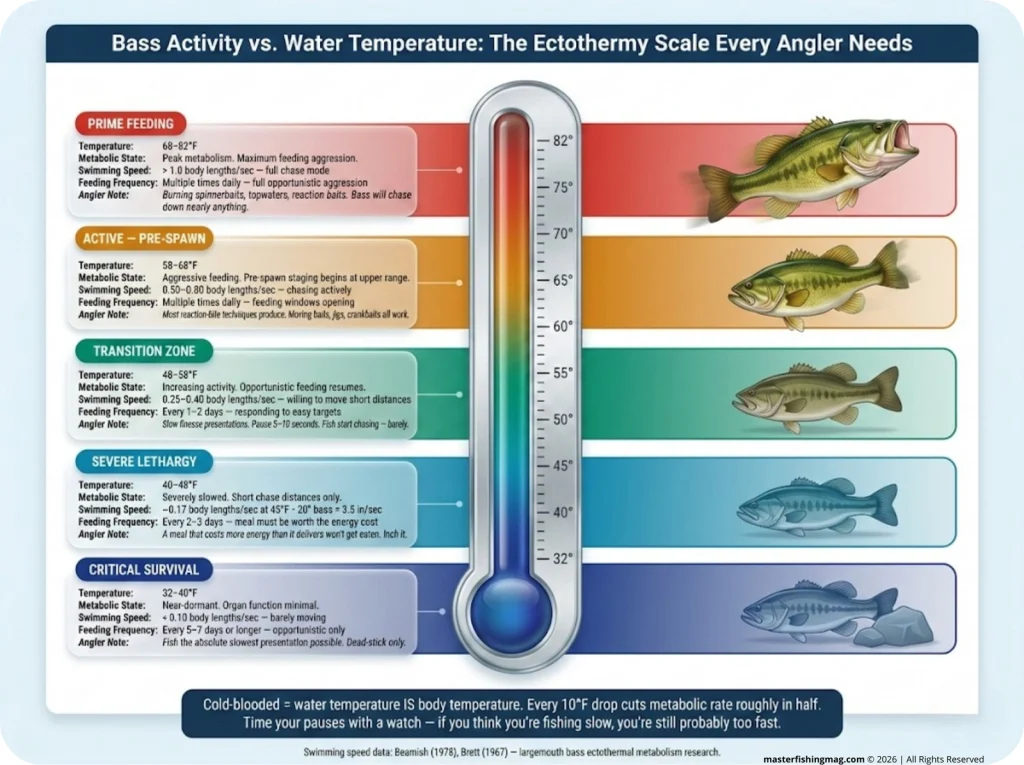
Pro tip: If you think you’re fishing slow, you’re still probably too fast. I started timing my pauses with the second hand on my watch. That one change produced more bites in two cold-water trips than the previous four combined.
Where Bass Actually Hold When It Gets Cold
Water hits maximum density at 39.2°F. Below that, the warmest water sinks toward the bottom, creating a stable thermal layer where cold-water bass stack up. They concentrate on structure adjacent to the deepest accessible water — not scattered randomly around the lake.
From the bank, the feature you’re hunting is the “Golden Intersection”: where a shoreline point meets a channel swing or drop-off. This puts 10+ feet of depth within a single cast. Bass hold in their thermal comfort zone and slide up the steep bank to feed without burning unnecessary energy.
On my local 12-acre pond, bass abandon the shallow cove entirely by mid-December. Every fish I’ve caught in January comes from the dam face where the water drops from 3 to 14 feet in a cast length.
The Solar Factor: Why Dark Banks Hold Warmer Water
Dark steep shorelines absorb solar radiation throughout the day. Black mud, red clay, dark rip-rap — all hold water that’s 2–5°F warmer than lighter-colored areas nearby. According to winter fishing guidance from the Oklahoma Department of Wildlife Conservation, fish concentrate near these thermal refugia during cold-water months.
Windblown banks are your enemy. Wind pushes warm surface water away and pulls up colder water from below. A bank getting hammered by north wind can be several degrees colder than a protected calm water cove 200 yards away. Choose the calm, sunny side every time.
Pro tip: Follow the sun during the day. The south-facing bank in full afternoon sun at 2 PM is almost always your most productive bank in winter. Fish it from 1–4 PM when surface water temperature has peaked.
The Slow-Down Mechanics That Actually Trigger Strikes
The 15-Second Pause: Why “Doing Nothing” Is Your Best Move
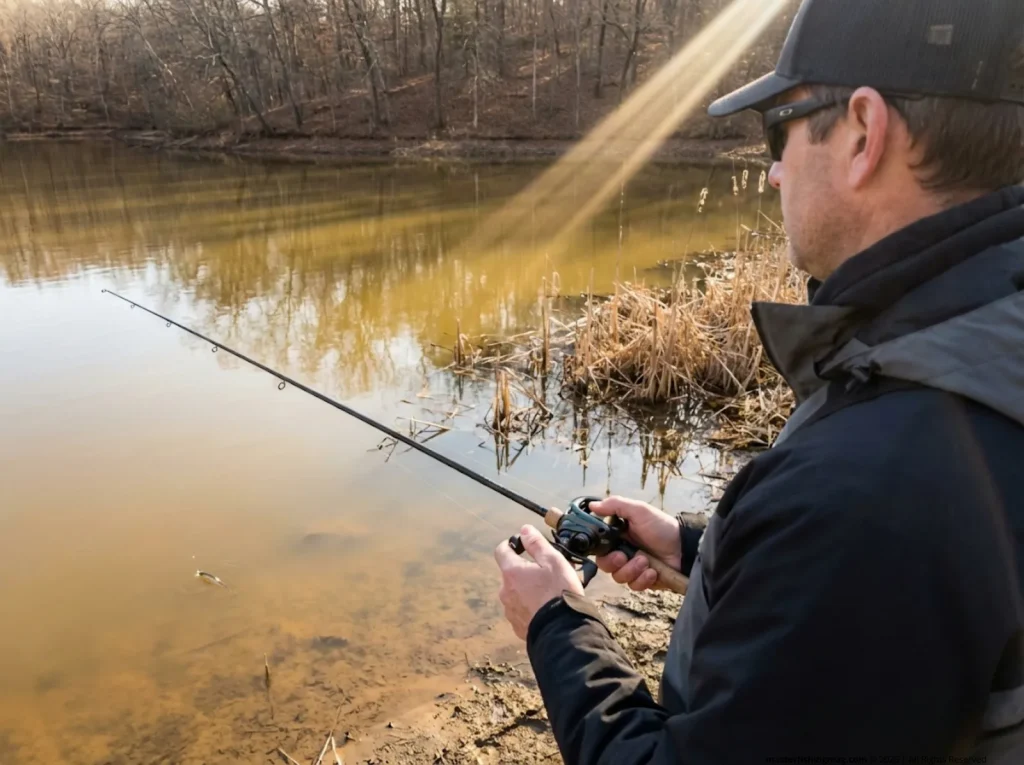
At 0.17 body lengths per second, a 20-inch bass covers about 3 inches per second. A 3-second pause means the bait “moves” faster than the fish can reach it from more than 9 inches away. Extend that pause to 10–15 seconds to give a cold bass enough time to identify, commit, and close.
With a suspending jerkbait like the Megabass Vision OneTen, the twitch is just a trigger. The suspend phase is where you catch the fish — one hard twitch, then 10–15 seconds of absolute stillness. The bass often strikes in the last 3 seconds of the pause, once it’s finally committed.
Watch the water column where your line enters the surface. Cold-water strikes are subtle — the line stops, you feel a soft heaviness, or the line ticks sideways. When something feels different, set the hook immediately.
Descent Rate Calibration: The Bank Angler’s Protocol
A lure that falls too fast reads as a projectile to a cold bass, not a meal. The bait freefall rate needs to match the tempo of a fish moving in slow motion. The target is 2–3 seconds per foot.
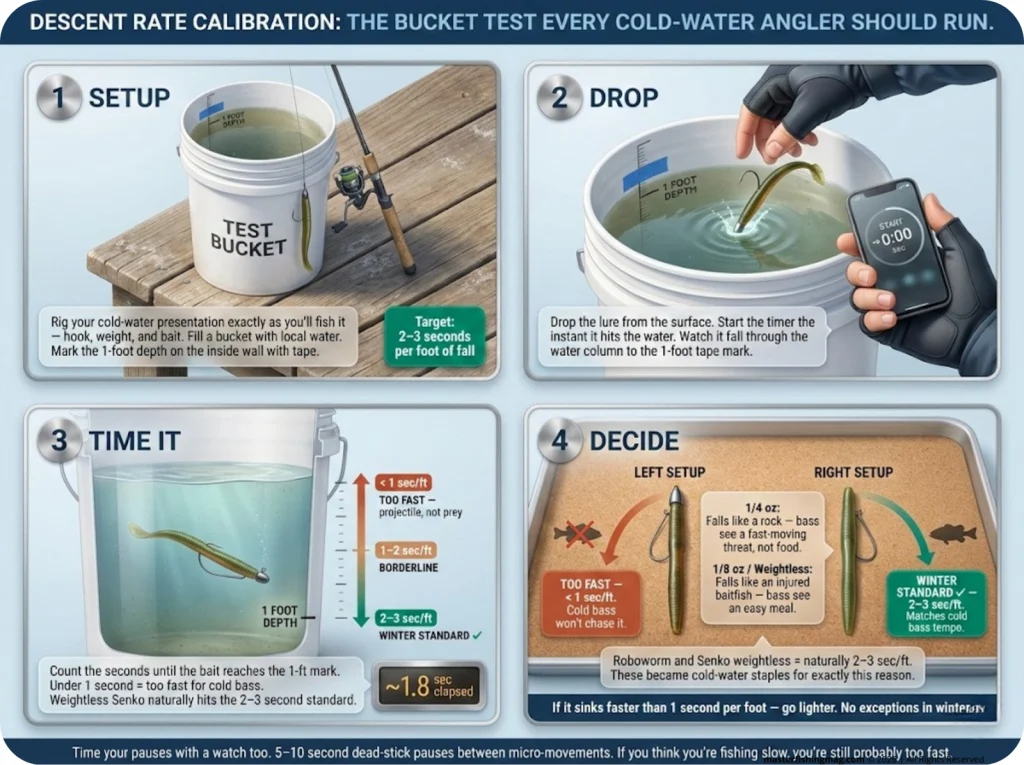
Here’s a field test most bank anglers skip: drop your rigged lure into a bucket of local water and time how long it takes to fall one foot. If it sinks faster than 1 second per foot, drop to a 1/8-oz weight or go completely weightless. A weightless Senko or Roboworm naturally hits the 2–3 second standard — that’s why these became cold-water staples. Understanding the finesse discipline that separates consistent cold-water anglers from frustrated ones starts with this one calibration.
Deadsticking: When Zero Movement Outperforms Any Retrieve
There are days in January when the only strikes come on a bait that isn’t moving at all. Deadsticking — leaving your lure completely still on the bottom for 30 to 60 seconds — is hard to execute psychologically, but it’s sound for cold-water periods. A wacky rig Senko on the bottom pulses gently with micro-currents. A long-tailed finesse worm flexes enough to signal “alive” without rod input. Leave it. Count to 30. Then lift it 6 inches, let it settle, and repeat.
The Four Bank Presentations That Produce in Cold Water
Suspending Jerkbaits: The Twitch-and-Wait Game
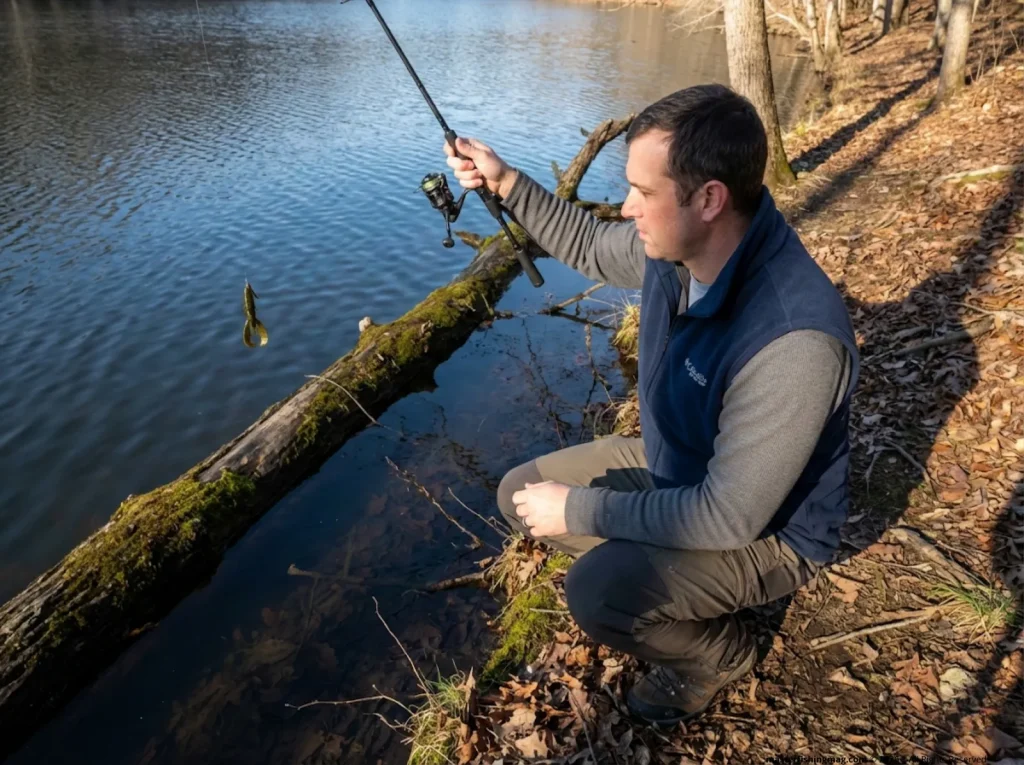
The Megabass Vision OneTen is the benchmark — 4-1/3 inches, 1/2 oz, with a tungsten balancer system that achieves true neutral buoyancy. In 10-lb fluorocarbon, it suspends at roughly 5.5 feet: deep enough to reach structure, shallow enough to cover with a bank cast.
One sharp twitch, then 10–15 seconds of complete stillness. Below 55°F, go to the Jr. model or smaller profile. Below 40°F, transition to bottom presentations entirely — the suspending jerkbait window closes when water gets genuinely frigid.
Finesse Football Jig: Dragging the Bottom for Reluctant Feeders
A 3/8-oz finesse football jig with a compact trailer is one of the most consistent winter bank fishing tools available. The football head rolls over rocks and telegraphs bottom composition directly through your rod. Drag slowly until you feel it tick a snag, shake the rod tip 2–3 times, then pause for a full 10 seconds.
Cut your trailer down — an oversized profile increases the energy cost of eating. Blue craw colors work consistently in cold-water clarity. Use a heavier weight than you’d normally choose: from the bank you’re casting toward deep water and retrieving uphill, so you need constant bottom contact.
Pro tip: Switch from 3/8 oz to 1/2 oz in any wind. The heavier head maintains bottom contact when line bow would otherwise lift a lighter jig off structure — staying on the bottom is everything in cold-water.
Weightless Stick Bait: The Perfect Fall-Rate Machine
A weightless Senko-style soft plastic naturally falls at the 2–3 seconds per foot standard. Rigged wacky rig style — hook through the middle — it flutters on every inch of the descent, triggering strikes from fish that won’t chase anything horizontal. Read more about mastering the wacky rig setup and its flutter physics to dial in your rigging.
Texas rig it with no weight for sparse cover. Cast over a brush pile, let it fall on slack line, then lift 12–18 inches and let it fall again. Work it 5–6 times per spot. Senko-type baits are consistent producers in cold water precisely because they spend so much time in the water column on the fall — which is where fish are hitting.
The Yo-Yo Technique: Vertical Precision from Shore
In 45°F water, a bass tucked into a laydown has a strike zone of roughly 12 inches. A horizontal retrieve passes through that zone in half a second. The yo-yo technique keeps your bait in that same zone for a full minute.
Cast a Texas rig over a submerged branch and reel up until the lure touches the top of the limb. Lift the rod to pull the bait up, drop the rod tip to let it fall vertically back down on the same side. Repeat 8–10 times. You’re working the same 18 inches over and over, until the fish decides the meal is worth the effort.
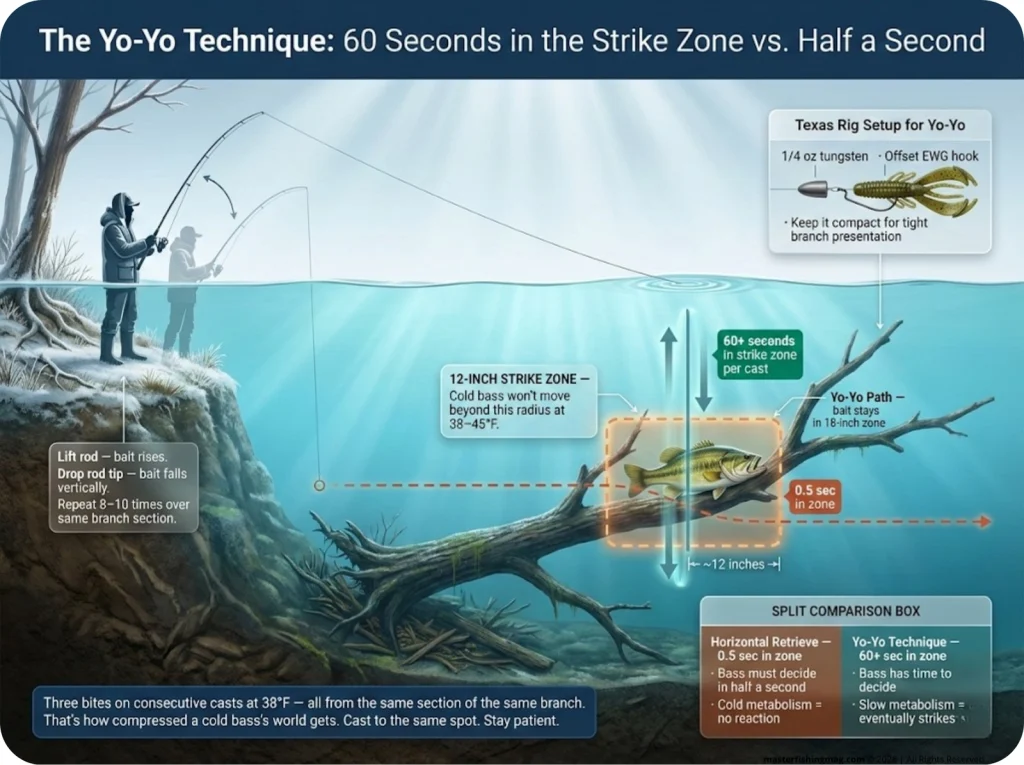
I got three bites on consecutive casts using this method at 38°F — all from the same section of the same branch. That’s how compressed a cold bass’s world gets in winter months.
Scouting Winter Banks: Where to Stand and Where to Cast
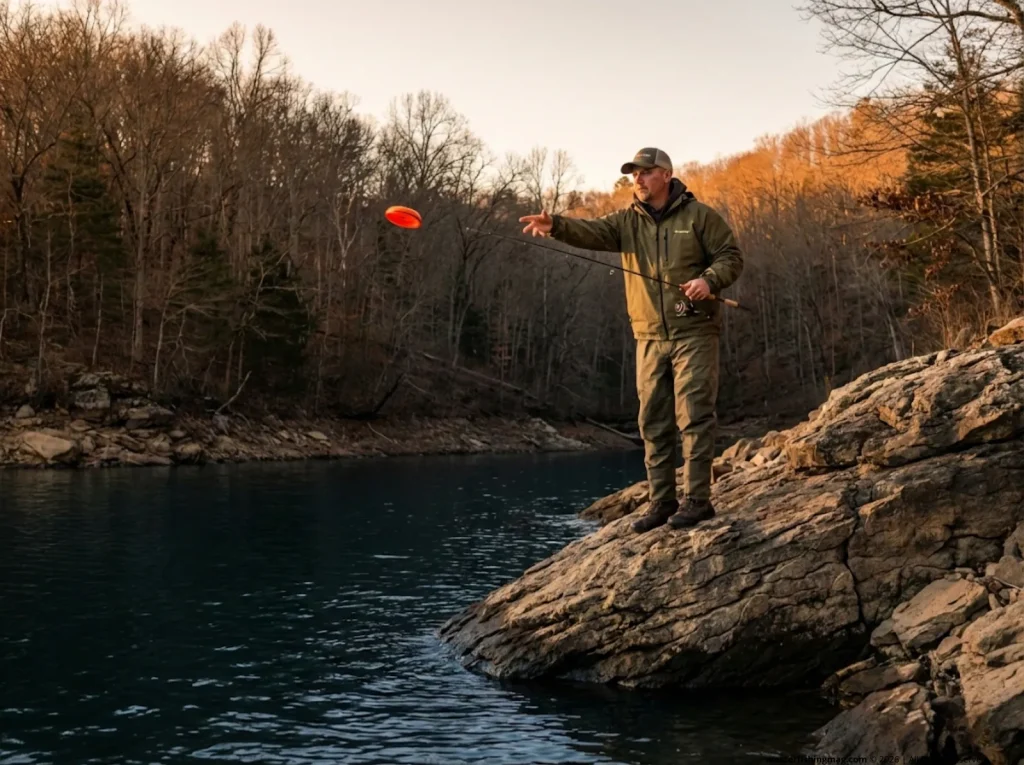
The “Golden Intersection”: Channel Swings Meet Shoreline Points
The single most productive winter bank fishing feature is where a channel swing cuts close to a shoreline point. This puts 10+ feet of stable thermal water within casting range. Bass hold deep, slide up to feed, and slide back — minimal energy spent.
Use the portable fish finders that give bank anglers a depth-reading edge to map contours before casting. A castable sonar puck shows you exactly where the channel runs and whether there’s structure worth targeting. Ten minutes of mapping saves two hours of blind casting.
Reading the Bank Without Electronics
Look for steep, fractured rock faces. Steep banks mean rapid depth change — a bluff wall or rip-rap that drops vertically is almost always flanked by deep water. Gradual, sloping mud flats cool too quickly for winter bass to use effectively.
Laydowns and brush piles adjacent to deep water are high-probability targets. Bass hold under the wood in their thermal comfort zone and feed without significant movement. Dock pilings in 8+ feet of water serve the same function. Fish vertically off pilings on the deep-water side.
Wind, Sun, and Timing: The Three-Variable Decision
Windblown banks are 4–5°F cooler than calm banks — enough to make a bank unproductive. Always start on the protected, calm side.
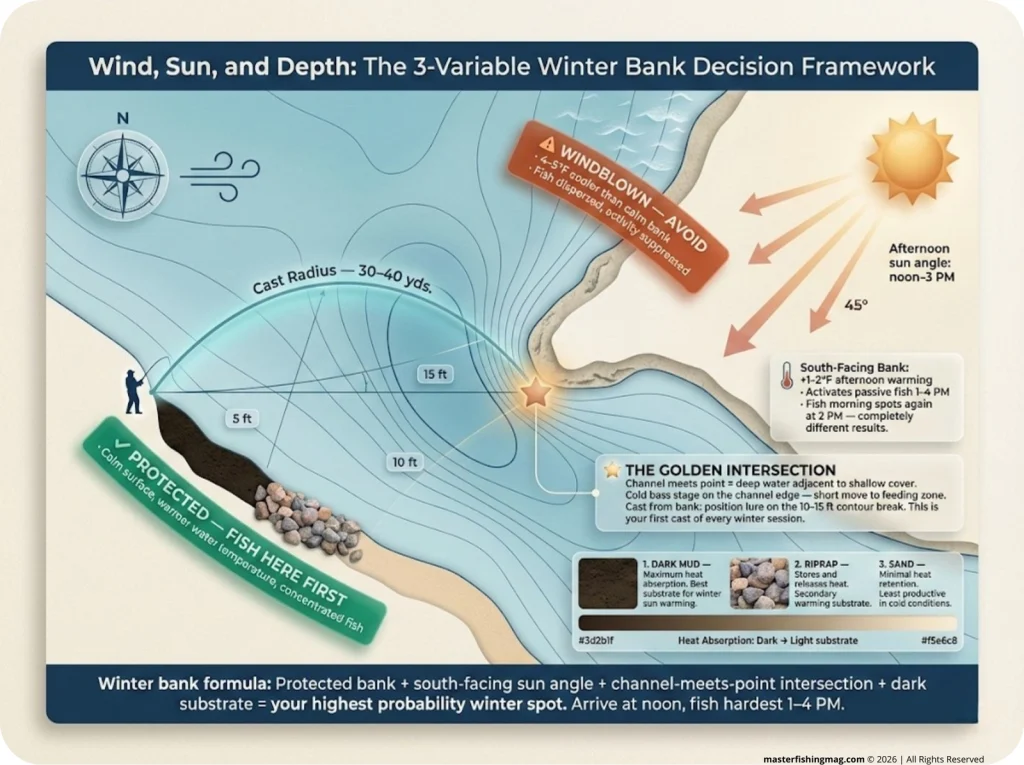
The afternoon warming window matters. South-facing banks can warm 1–2°F between noon and 3 PM — enough to shift bass from passive holding to active fish mode. The best winter bank fishing hours run 1–4 PM. Fish the same spots from morning — they’ll produce completely different results in the afternoon.
Winter Catch and Release: The 30-Second Protocol
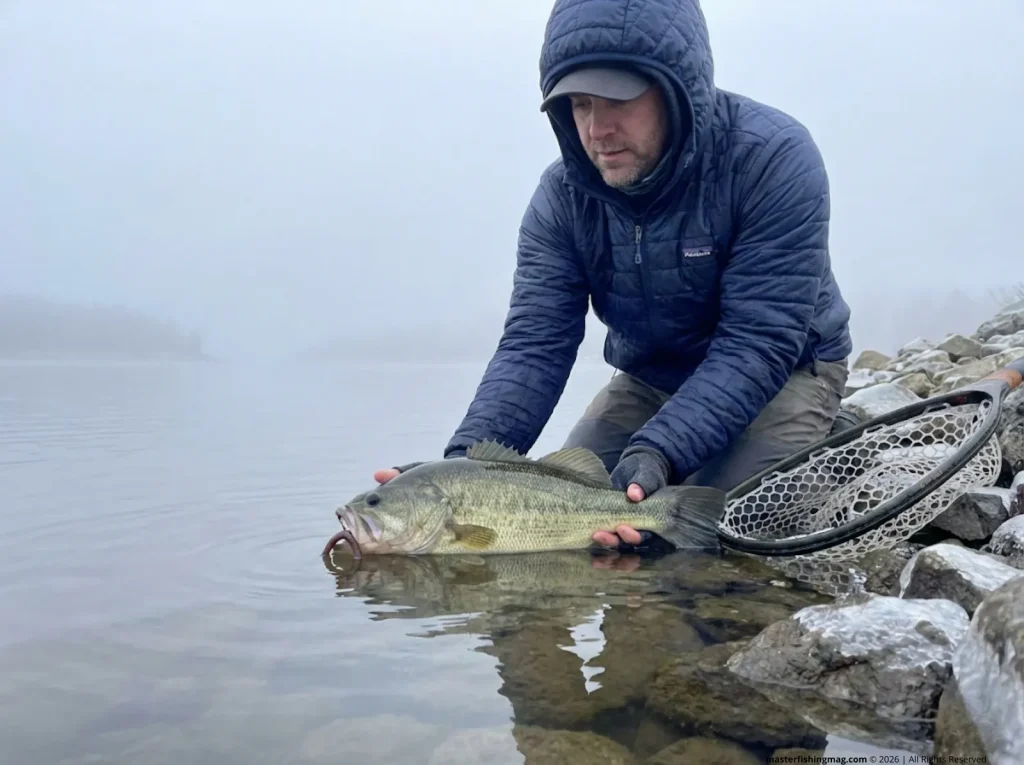
Why Winter Is Safer — and More Dangerous — for Released Fish
Catch-and-release mortality drops in winter. Studies published in peer-reviewed research on water temperature, angling time, and largemouth bass survival show mortality falls from around 47% in summer to roughly 13% in cold water — higher dissolved oxygen and lower metabolic stress from the fight are the main reasons.
But sub-freezing air creates a new threat. Gill filaments can begin to freeze within seconds of air exposure below 32°F. The protective slime coat can crystallize when touched with dry hands, leaving fish vulnerable to fungal infections. Mouth-hooked fish released within 30 seconds have a 2–3% mortality rate. Stretch that to 2 minutes in freezing air and you’ve fundamentally changed that fish’s odds.
The Step-by-Step Release Protocol
Keep the fish in the water while you unhook it. Wet your hands completely before touching the fish — a dry glove against a bass’s side can strip slime coat in a single contact during freezing conditions.
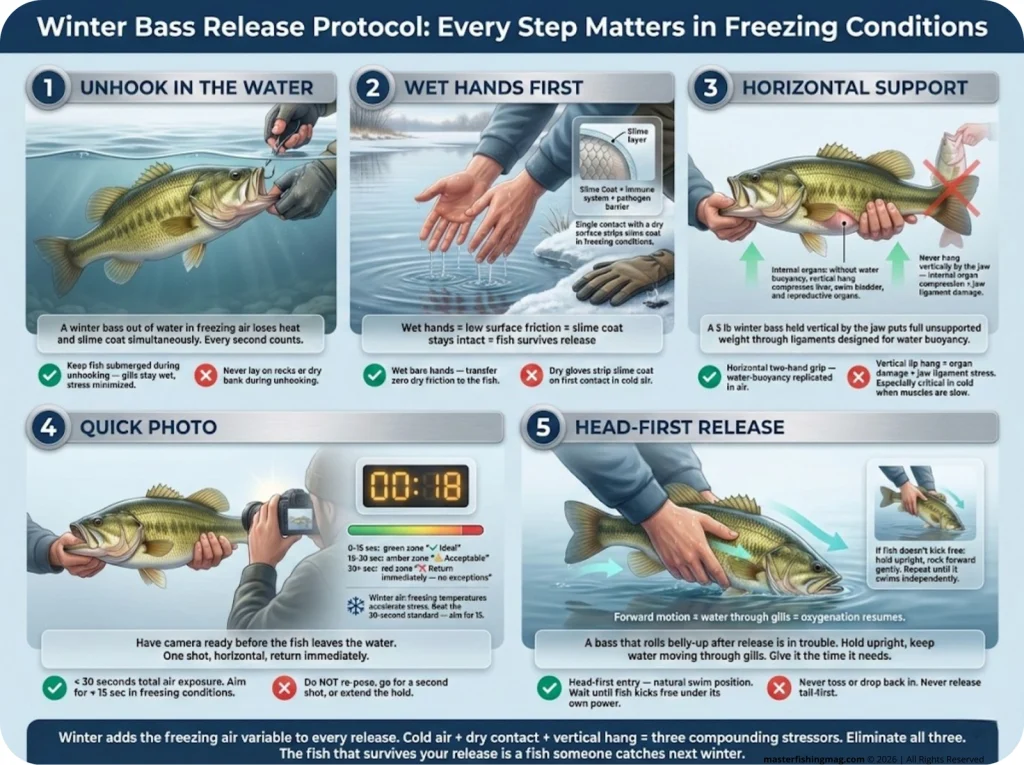
Support the fish horizontally with both hands. Never lip a heavy winter bass and hold it vertical — without water buoyancy, the jaw and internal organs take damage. Take the photo quickly, return it head-first, and let water flow over the gills. If it doesn’t swim off, hold it upright and move it forward gently until it kicks free. Review the full science-based catch and release protocol for the year-round framework — winter just adds the freezing air variable.
Conclusion
The “winter shutdown” is a story anglers tell themselves to justify staying home. Bass at 45°F still feed — they just do it on a timeline that punishes anyone moving at summer speed.
Calibrate your fall rate to 2–3 seconds per foot before you ever cast. Target steep south-facing banks during the 1–4 PM warming window and skip windblown banks entirely. Fish the yo-yo technique over submerged structure near deep water and count to 15 between movements.
Next time the thermometer reads 40°F and everyone says the bass have quit, walk to the steepest bank on your pond, tie on a suspending jerkbait, and give it 15 seconds of dead still after each twitch. The fish are there. They’re just waiting for you to slow down enough to let them eat.
FAQ
What is the best lure for bass in cold water from the bank?
A suspending jerkbait fished with 10–15 second pauses is the most effective bank presentation between 40°F and 55°F. Below 40°F, switch to a finesse football jig dragged slowly along the bottom — bass become too sluggish to rise for a suspended bait.
How slow should you retrieve lures in winter bass fishing?
Slower than you think. At 45°F, a largemouth bass covers about 3 inches per second. Pauses should last 10–15 seconds minimum, and the overall retrieve should feel painfully slow. Time pauses with a watch until the cadence becomes automatic.
Where do bass go in winter on lakes from shore?
Bass concentrate on steep-banked areas where deep water (10+ feet) is within a short cast. Hunt intersections of channel swings and shoreline points, laydowns near drop-offs, and south-facing banks with dark substrate. They leave shallow mud flats and windblown banks first.
What water temperature is too cold for bass to bite?
Bass feed at all survivable temperatures, but activity drops below 45°F. At 38–42°F, cold-water feeding windows compress to minutes per day. The question isn’t whether they’ll bite — it’s whether your presentation is slow enough for them to commit.
Is it worth bank fishing when water is below 45 degrees?
Yes — and winter may be your best shot at a personal best. Larger bass carry more thermal mass and stay slightly more active than smaller fish. They’re concentrated, predictable, and largely unpressured. Adjust your approach and year-round fishing becomes productive in every season.
Risk Disclaimer: Fishing, boating, and all related outdoor activities involve inherent risks that
can lead to injury. The information provided on Master Fishing Mag is for educational and informational purposes
only. While we strive for accuracy, the information, techniques, and advice on gear and safety are not a substitute
for your own best judgment, local knowledge, and adherence to official regulations. Fishing regulations, including
seasons, size limits, and species restrictions, change frequently and vary by location. Always consult the latest
official regulations from your local fish and wildlife agency before heading out. Proper handling of hooks, knives,
and other sharp equipment is essential for safety. Furthermore, be aware of local fish consumption advisories. By
using this website, you agree that you are solely responsible for your own safety and for complying with all
applicable laws. Any reliance you place on our content is strictly at your own risk. Master Fishing Mag and its
authors will not be held liable for any injury, damage, or loss sustained in connection with the use of the
information herein.
Affiliate Disclosure: We are a participant in the Amazon Services LLC Associates Program, an
affiliate advertising program designed to provide a means for us to earn advertising fees by advertising and linking
to Amazon.com. As an Amazon Associate, we earn from qualifying purchases. We also participate in other affiliate
programs and may receive a commission on products purchased through our links, at no extra cost to you. Additional
terms are found in the terms of service.