In this article
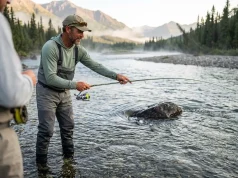
You plunge your hand into the river, and the water bites back, numbing your fingers instantly. For you, this is a sensory inconvenience solved by neoprene gloves or a warm pocket. For the fish holding in that current, this temperature is the absolute dictator of their biological reality.
It governs the speed of their digestion, the contraction rate of their muscles, and the precise amount of oxygen available to keep them alive.
In my years on the water, I’ve learned that success in angling requires moving past the concept of temperature as “comfort.” We must understand it as the master switch of aquatic biology and performance. We are going to look at the physics of metabolism, the paradox of oxygen in summer heat, and how to translate these fish physiology constraints into better lure presentations.
What Does It Actually Mean to Be Ectothermic?
How does the Q10 temperature coefficient dictate fish speed?
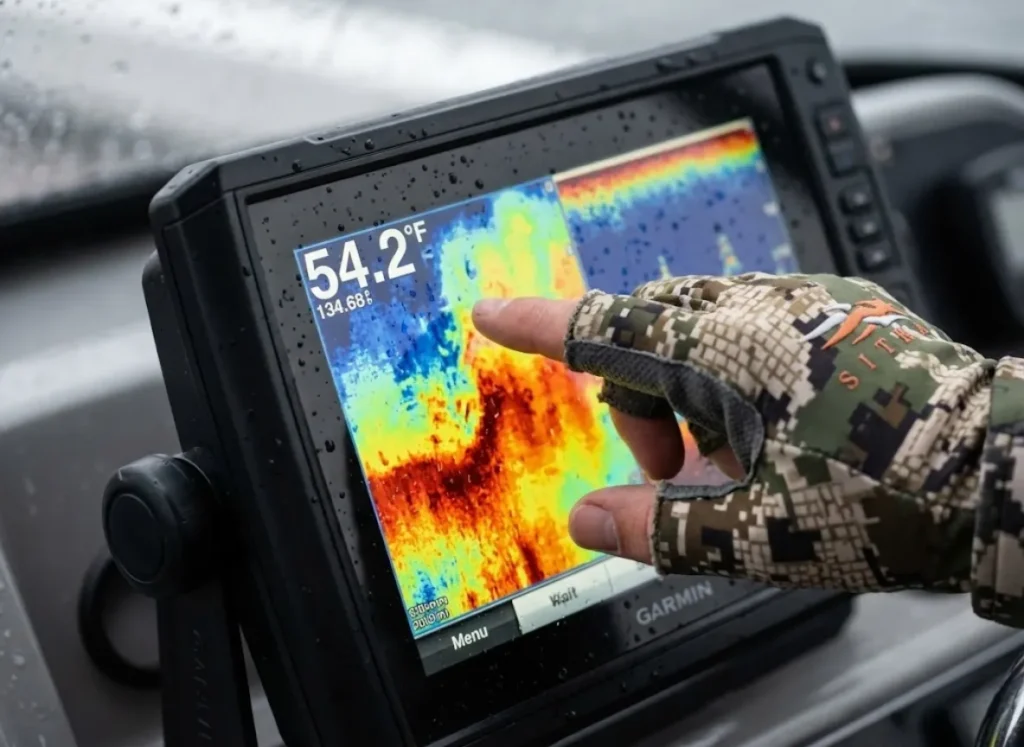
The speed at which a fish lives—how fast it swims, digests, and reacts—is mathematically tied to water temperature through the Q10 coefficient. This dictates that enzyme function and biological reaction rates roughly double for every 10°C rise in temperature.
Ichthyology defines these creatures as poikilotherms, or cold-blooded animals. Unlike warm-blooded mammals that regulate body temperature, fish are thermodynamic conformers. Their internal body temperatures equilibrate rapidly with the ambient water due to high thermal conductivity. A smallmouth bass in 50°F water is a 50°F animal.
To understand why this matters, we have to look at the Standard Metabolic Rate (SMR). Think of SMR as the idle speed of an engine. As the water warms, the idle speed increases. This isn’t a linear climb; it’s exponential.
Scientific models demonstrate a positive bilogarithmic relationship between metabolic rate and temperature. This means that ectothermic fishes in water 10°C warmer than their baseline require twice the calorie requirement just to exist. This shifts the biological priority from growth to survival.
This leads to the concept of Aerobic Scope. This is the energy budget a fish has left over after paying its “rent” (resting metabolism). As water warms and resting costs rise, energy efficiency drops, leaving less budget available for chasing prey or fighting a current.
This mathematical reality explains why fish seem lethargic in extremes. They are either chemically slowed by the cold or metabolically maxed out by the heat. For anglers, recognizing these high-metabolism periods is the foundation of a complete summer fishing system, allowing you to target active feeding windows before the heat closes them.
Why Is Warm Water Dangerous for Cold-Blooded Fish?
What is the ‘Oxygen Squeeze’ and how does it limit performance?
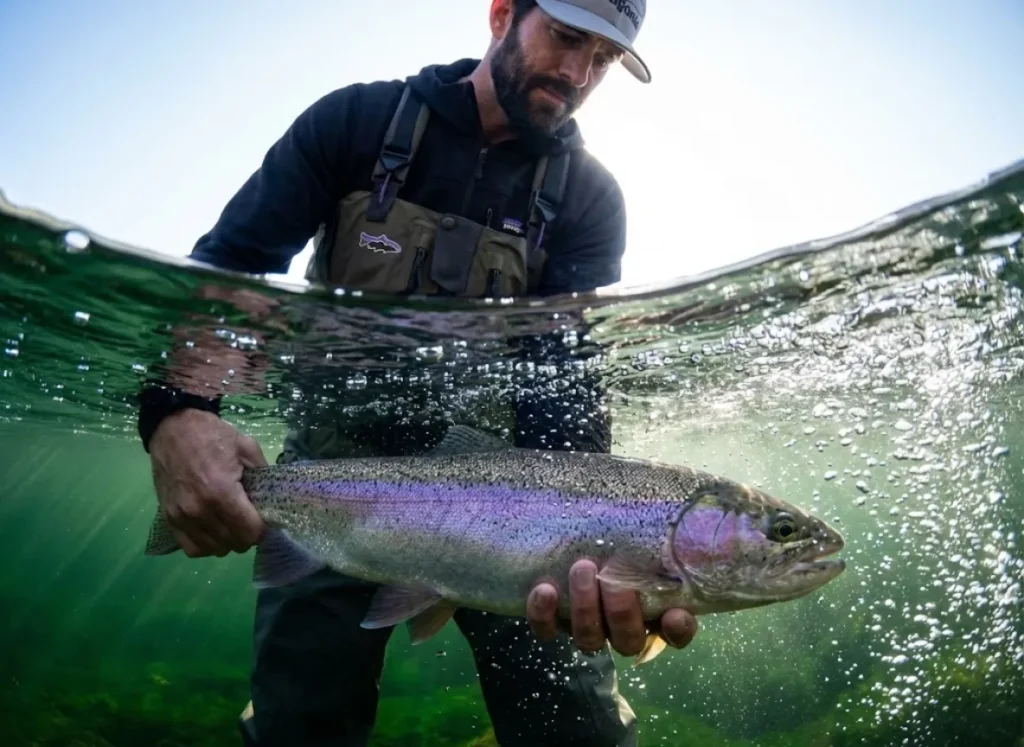
The “Oxygen Squeeze” is a physiological bottleneck where a fish’s demand for oxygen peaks exactly when the water’s ability to hold dissolved oxygen is at its lowest.
This is the cruelty of physics in an aquatic environment. Gases obey inverse solubility. As water temperature rises, oxygen solubility drops, and the DO levels precipitate out. Cold water can hold massive amounts of oxygen; hot water cannot.
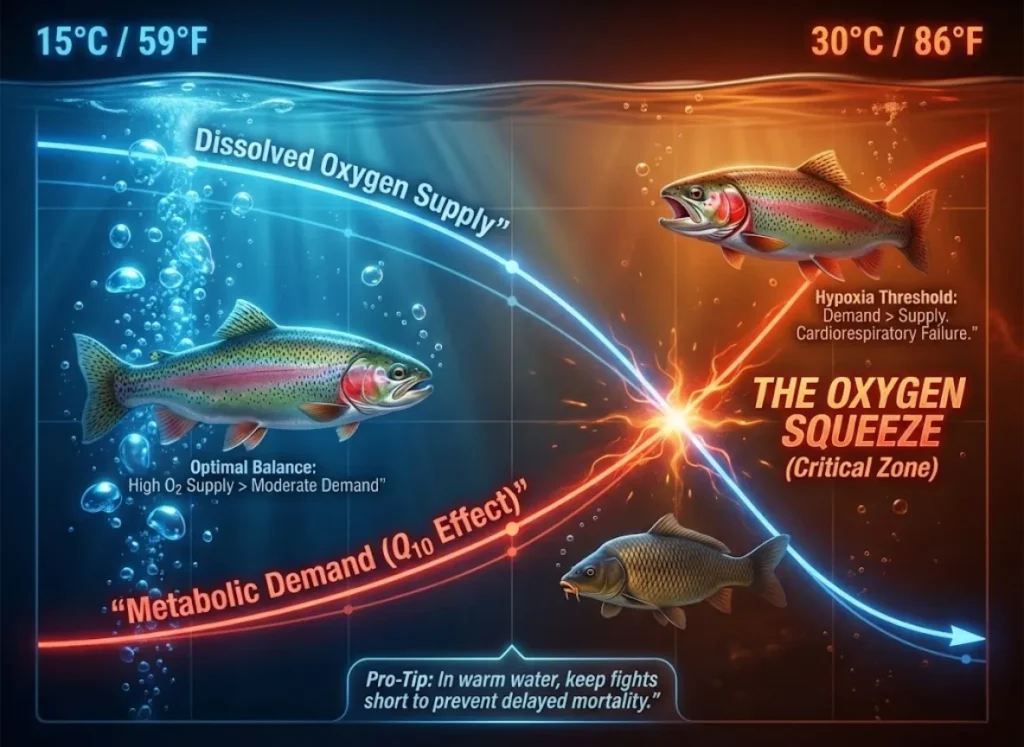
Simultaneously, the Q10 effect we discussed earlier is driving the fish’s engine to redline, demanding more fuel (oxygen) than ever. It is a pincer movement.
Biological research points to the Oxygen Limitation of Thermal Tolerance (OLTT) hypothesis. This suggests that when fish die in a heatwave, they don’t boil. They die because of a failure of the cardiorespiratory system to supply adequate oxygen to their tissues. The heart simply cannot pump enough blood to supply the oxygen the warming tissues demand.
This creates distinct survival thresholds for stenotherms (species with narrow tolerance like trout) versus eurytherms (species like carp or mummichog):
- Optimal Balance (approx. 15°C/59°F): High oxygen (~10.1 mg/L) meets moderate metabolism.
- Critical Zone (approx. 30°C/86°F): Low oxygen (~7.5 mg/L) meets maximum metabolism, approaching the upper lethal limit.
In the critical zone, sensitive species like rainbow trout and brown trout face hypoxia and severe thermal stress. This is also why understanding water column stratification is vital. You must use a guide to fishing thermoclines to identify the specific depth layers where cool, oxygenated water still exists.
Pro-Tip: If you are fishing catch-and-release in water temps over 70°F (for trout) or 80°F (for pike/musky), keep the fight short. The fish is already in oxygen debt before it strikes your lure. A long fight can push them past the point of no return, leading to delayed mortality hours after release.
Do All Fish Follow the Same Temperature Rules?
How do some species cheat the cold (or heat)?
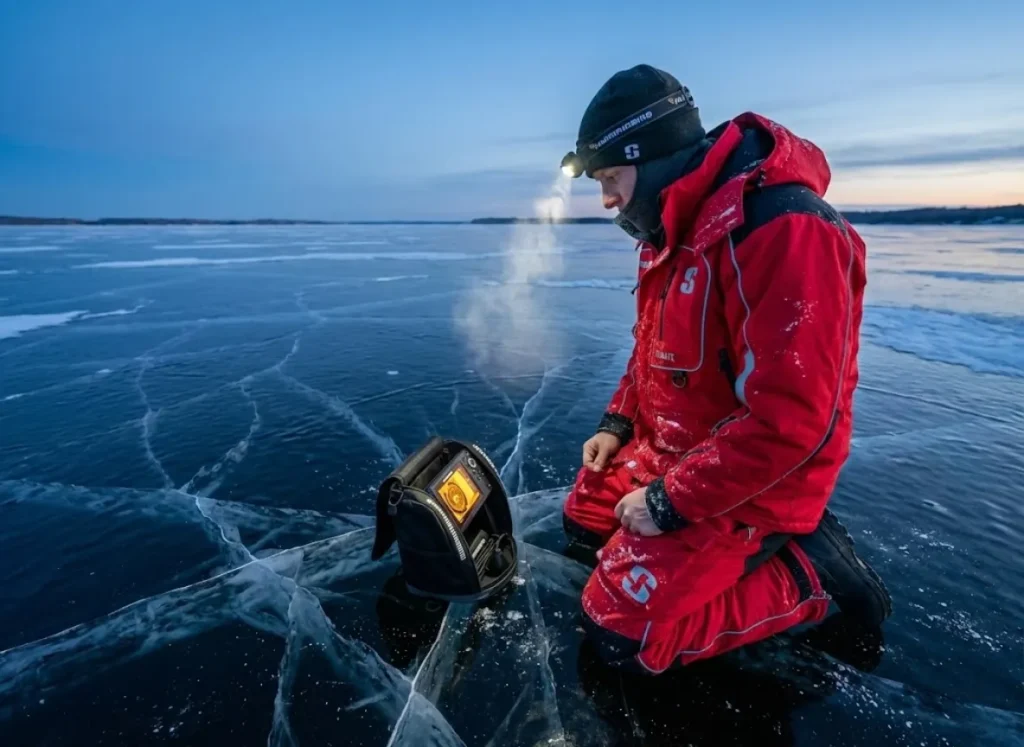
While most commercial fish species are prisoners of the ambient temperature, evolution has granted specific species biochemical or physiological “cheats,” such as antifreeze proteins or regional endothermy, to survive outside standard thermal limits.
In polar waters, temperatures can drop to -1.9°C, which is below the freezing point of typical fish blood (-0.9°C). Standard fish would turn into ice blocks. To counter this, Antarctic fishes like the Blackfin icefish developed Antifreeze Proteins (AFPs). These proteins bind to ice crystals in the blood, physically stopping them from growing via precise gene regulation.
Conversely, some species deal with heat and performance through Heat Shock Proteins (HSPs). These act as molecular chaperones, repairing proteins that have been warped (denatured) by thermal stress.
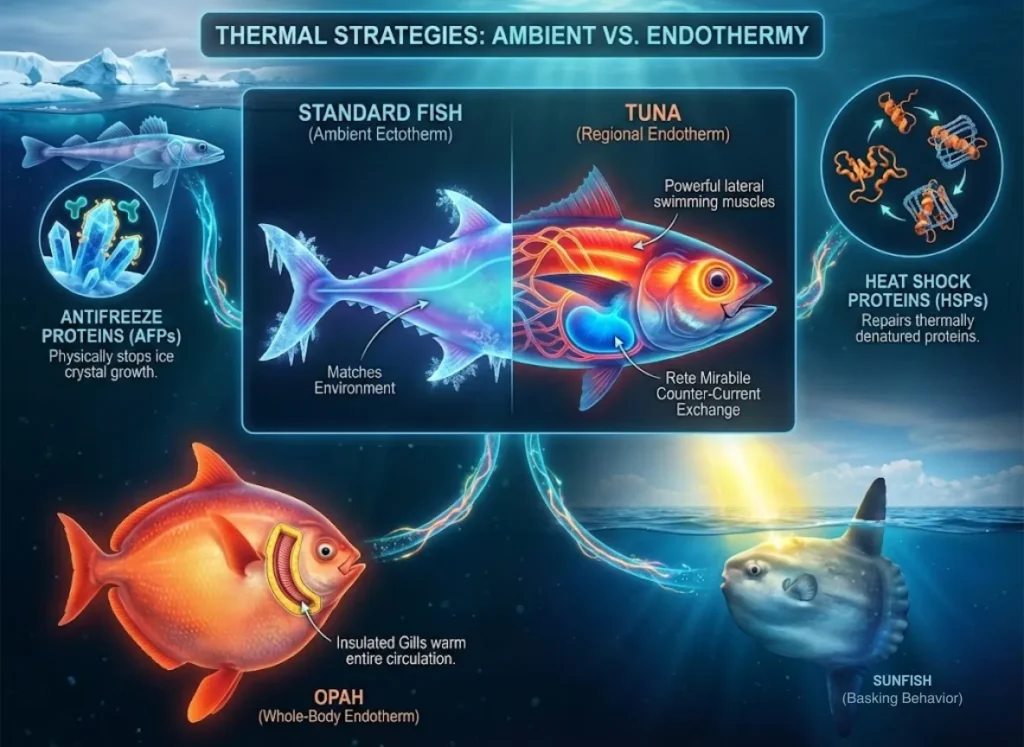
Then there are the high-performance predators like Tuna and Lamnid sharks. They utilize Regional Endothermy. Using a vascular network called the rete mirabile to facilitate counter-current exchange, they conserve metabolic heat to keep their eyes, brains, and swimming muscles warm.
This allows for rapid processing speed and muscle power in cold, deep water. If you want to understand how this biology translates to sport, look into bluefin tuna biology and angling insights to see how they utilize this heat for hunting.
The true anomaly, however, is the Opah (Lampris guttatus), also known as the moonfish. It is the first known whole-body endotherm. It insulates its gills with fatty tissue, warming the blood before it circulates to the rest of the body. This warm blood makes Opah an agile predator, giving it a massive speed advantage over the sluggish, cold-blooded animals inhabiting the deep ocean.
Even the Ocean Sunfish (Mola mola) has a strategy; it engages in basking behavior at the surface to raise its body temperature before diving into the cold depths to hunt invertebrates.
How Does Temperature Control Feeding and Digestion?
Why do fish stop biting after a cold front?
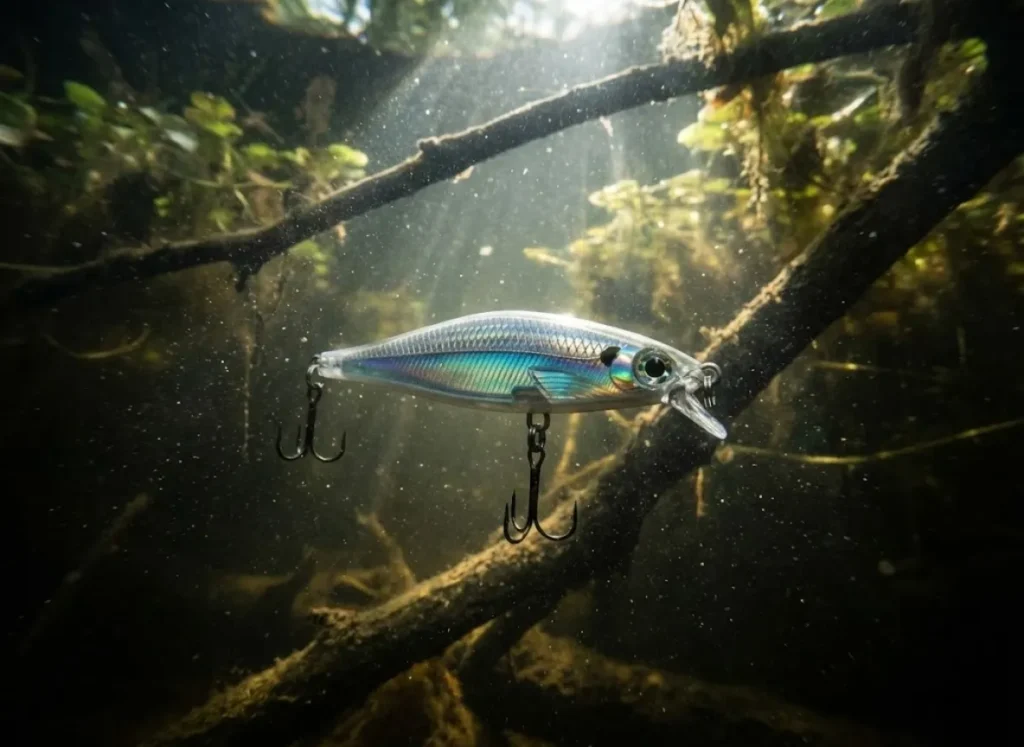
Fish stop biting after a sudden cold front not because they are stubborn, but because the drop in temperature drastically slows their Gastric Evacuation Rate (GER), physically preventing them from processing a new meal.
Digestion is a series of enzymatic reactions, and like all chemical reactions in a fish, it is governed by water temperature. A largemouth bass might digest a crawfish in 12 hours at 80°F. If a cold front drops the water to 50°F, that same meal might take 5 days to break down.
This relates to the concept of the Satiation Signal. As long as the stomach remains physically distended with undigested food, the fish’s brain receives no hormonal signal for hunger. This is the biological explanation for the “Lockjaw” myth.
Scientific data modeling the gastric evacuation rates of smallmouth bass confirms that consumption drops precipitously as the mercury falls.
We must also consider Specific Dynamic Action (SDA), which is the energy cost of digestion itself. In extremely warm water, the metabolic cost of processing food can sometimes exceed the energy gained from it, causing fish to stop eating to avoid a net energy loss.
This phenomenon is frequently exacerbated by weather patterns. Understanding the impact of barometric pressure on fishing helps you predict when these fronts will hit, but it is the resulting temperature drop that physically shuts the fish’s mouth.
Pro-Tip: After a severe cold front, downsize your presentation significantly. A fish with a 90% full stomach won’t strike a large swimbait, but it might instinctively snap at a tiny nymph or micro-jig that requires almost no energy to digest.
How Can Anglers Use Thermal Rules to Catch More Fish?
How should you adjust lure speed based on water temperature?
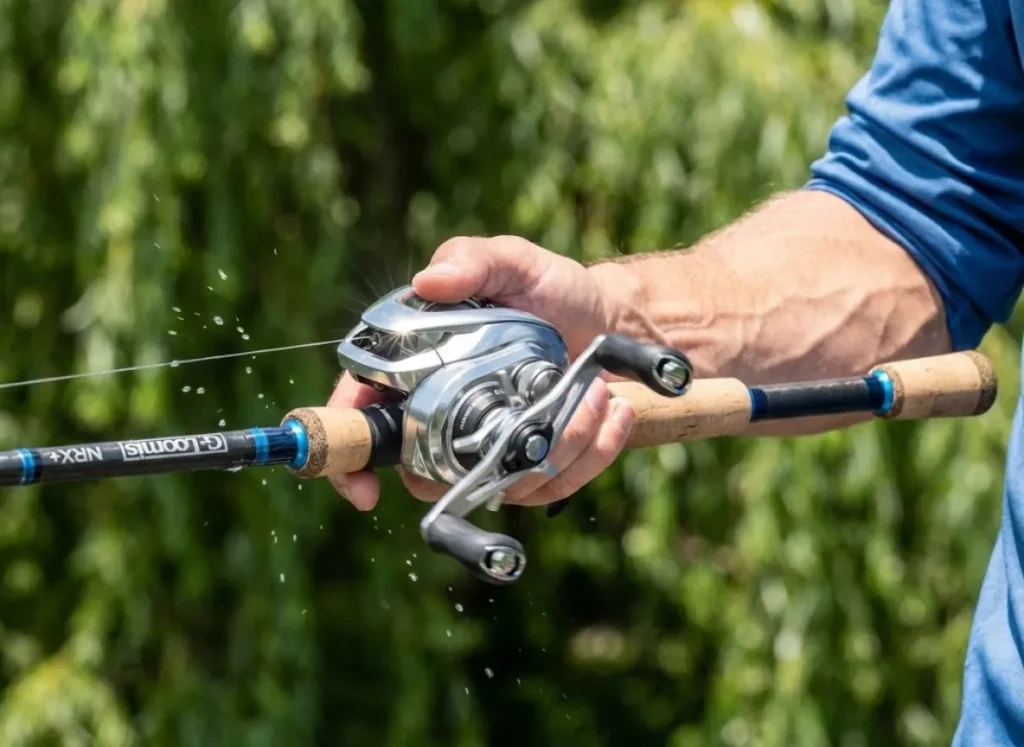
You should adjust your retrieval cadence to match the fish’s muscle contraction rate: use slow, pausing presentations in water below 50°F and fast, aggressive feeding triggers in water above 65°F.
Vertebrate muscle contraction rates generally follow the Q10 rule. In cold water, the chemical reactions that allow muscle fibers to slide past one another happen slowly. A pike in 40°F water is physically incapable of chasing a crankbait burned at high speed. It isn’t a choice; it’s a biomechanical limitation.
This leads to the “Speed Kills” Rule. In cold water, speed kills your chances. You must align your lure selection with the fish’s kinetic potential. I call this the Metabolic Lure Speed Index.
Fishing Strategy Guide
Adapting your tactics and lure cadence to water temperature and fish metabolic states.
Metabolic State
Torpor / Lethargy. Fish move very little to conserve energy in cold water.
Lure Cadence
Pause 10-15 seconds. Move bait inches, not feet. Extreme patience is required.
Metabolic State
Active / Transition. Fish are beginning to feed more regularly and move through water columns.
Lure Cadence
Standard cadence. Utilize a mix of pauses and movement to trigger natural feeding instincts.
Metabolic State
Peak Performance. High metabolism leads to aggressive hunting and fast movement.
Lure Cadence
High speed. Force a reaction strike by moving the lure quickly past the fish.
Beyond lure speed, temperature dictates location through Thermal Refugia. In river systems, when the main stem heats up (usually over 20°C for trout), fish migrate to the mouths of cold tributaries or groundwater springs.
Research tracking brook trout movement in response to thermal refugia shows that these areas are not just comfort zones—they are life support. This drives vertical movement patterns in lakes as well.
This brings us to a conservation mandate. When fish are stacked in these cool pockets, they are hyper-vulnerable. Targeting them here is often considered unethical. Applying science-based catch and release techniques includes knowing when not to fish, ensuring these populations survive the summer to reach their reproduction thresholds in the fall.
The Bottom Line
Recreational angling strategy is often viewed as an art, but at its core, it is a pursuit governed by physics and biology.
- Thermodynamics: Fish are engines that rev up or slow down based on the Q10 effect.
- The Oxygen Squeeze: High heat creates a dangerous paradox of high demand and low supply.
- Digestion: “Lockjaw” is a physical inability to process food due to cold, not a mood swing.
- Tactics: Your retrieve pause duration must match the fish’s muscle contraction capability.
Next time you hit the water, take the temperature first. Use this data to align your tactics with the ectothermic edge, and you will find yourself catching fish when others are just washing lures.
FAQ – Frequently Asked Questions
Do fish feel cold when the water temperature drops?
No, fish do not feel cold in the way humans do because they do not maintain a constant internal temperature. Instead of shivering, their entire metabolism slows down, putting them into a state of torpor.
At what temperature do fish stop eating?
This varies by species, but most fish cease active feeding when temperatures drop below their specific metabolic threshold (e.g., ~40-45°F for Largemouth Bass). However, they may still strike opportunistically if a meal is presented slowly enough.
Why do fish die in hot water even if there is plenty of food?
They die primarily from hypoxia (lack of oxygen) or cardiac collapse. As water warms, it holds less dissolved oxygen while the fish’s metabolic demand for oxygen skyrockets, eventually causing their heart to fail.
How do fish survive in frozen lakes during winter?
Fish retreat to the deepest basins where water remains densest at 4°C (39°F). Their metabolism slows drastically to conserve energy, and some freshwater creatures utilize antifreeze proteins to prevent their blood from freezing.
Risk Disclaimer: Fishing, boating, and all related outdoor activities involve inherent risks that
can lead to injury. The information provided on Master Fishing Mag is for educational and informational purposes
only. While we strive for accuracy, the information, techniques, and advice on gear and safety are not a substitute
for your own best judgment, local knowledge, and adherence to official regulations. Fishing regulations, including
seasons, size limits, and species restrictions, change frequently and vary by location. Always consult the latest
official regulations from your local fish and wildlife agency before heading out. Proper handling of hooks, knives,
and other sharp equipment is essential for safety. Furthermore, be aware of local fish consumption advisories. By
using this website, you agree that you are solely responsible for your own safety and for complying with all
applicable laws. Any reliance you place on our content is strictly at your own risk. Master Fishing Mag and its
authors will not be held liable for any injury, damage, or loss sustained in connection with the use of the
information herein.
Affiliate Disclosure: We are a participant in the Amazon Services LLC Associates Program, an
affiliate advertising program designed to provide a means for us to earn advertising fees by advertising and linking
to Amazon.com. As an Amazon Associate, we earn from qualifying purchases. We also participate in other affiliate
programs and may receive a commission on products purchased through our links, at no extra cost to you. Additional
terms are found in the terms of service.