In this article
The fluorocarbon leader looked fine. Seventeen casts into a structure-heavy morning session, nothing remarkable — just a standard retrieve, a long fight on a heavy fish. I clipped the leader at the knot and tossed the tag end toward the bottom of the boat. It wasn’t until I read the University of Saskatchewan study — the one where they immersed 16 common lures in water for 61 days — that I stopped thinking of that clipped fluorocarbon as “waste.” I started thinking of it as a polymer event. Because that’s exactly what the lab data says it is.
This article is a technical audit of how modern recreational tackle — monofilament, fluorocarbon, braided polyethylene, and soft plastic lures — becomes a source of microplastic pollution not because anglers are careless, but because of the chemistry and physics of the materials themselves. What the labs found is both worse and more actionable than most anglers expect.
⚡ Quick Answer: Modern fishing gear — mono, fluoro, braid, and soft plastics — generates microplastics through two main routes: mechanical shedding during normal use (line-guide friction, knot-tightening) and chemical leaching from soft plastic lures. A University of Saskatchewan study found 10 of 16 common soft plastic lures leached harmful phthalates within 61 days of water immersion. Braided PE sheds the most microscopic fibers during active fishing. Fluorocarbon sheds less operationally but any fragment it releases is effectively permanent. Practical mitigation starts with material selection, knot lubrication, and proper line disposal — not by quitting fishing.
The Polymer Chemistry Behind Your Tackle
Most environmental coverage of fishing gear focuses on the plastic bags and lost nets you can see. The more nuanced problem starts at the molecular level, inside materials that look perfectly fine.
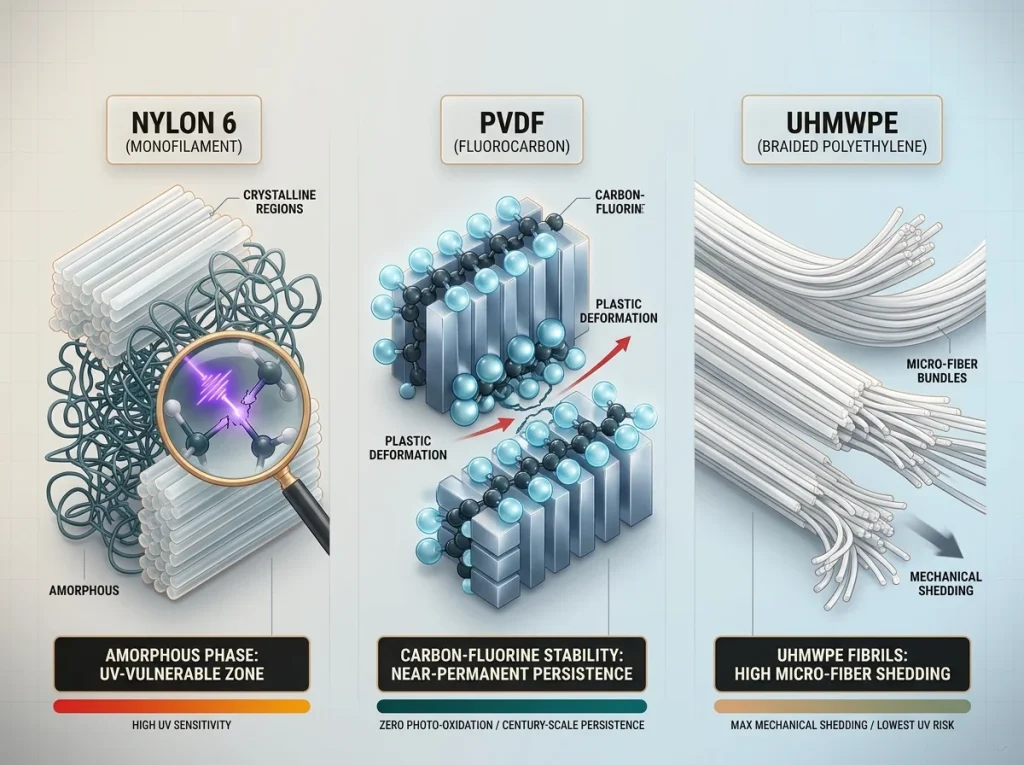
Modern fishing lines are semi-crystalline polymers — they have both ordered crystalline regions (which give them strength) and disordered amorphous regions (which give them flexibility). This is the piece that most environmental writing misses entirely. Degradation starts almost exclusively in the amorphous phase, not in the entire material at once. That distinction matters because it means your line begins breaking down in ways you cannot see, long before it shows visible damage.
Nylon 6 (standard monofilament) contains carbon-nitrogen bonds — relatively weak under UV radiation. When sunlight hits the amorphous regions, photo-oxidation induces chain scission: the long polymer chains snap into shorter segments. This reduces molecular weight and triggers what chemists call “chemi-crystallization” — the material becomes progressively more crystalline and more brittle simultaneously. Left on an open reel in direct summer sun, this process runs constantly. The line isn’t resting. It’s degrading.
PVDF (fluorocarbon) contains carbon-fluorine bonds — among the most stable chemical bonds in organic chemistry. Fluorocarbon is highly resistant to photo-oxidation, which is partly why anglers trust it. But that stability creates a different environmental problem: once any fragment is shed, it’s essentially permanent. Decades of persistence in sediment, minimum. And every significant fight puts fluorocarbon into what engineers call the plastic deformation region — the line is stretched beyond recovery, permanently altering at the molecular level even if it “looks” intact afterward.
Braided PE (UHMWPE — Dyneema, Spectra) doesn’t shave like mono or fluoro. It fibrillates. The individual micro-fibers within the braid snap and fray, releasing millions of microscopic polyethylene filaments per fishing session. Before choosing any line based on performance alone, understanding the engineering tradeoffs between braid, fluorocarbon, and monofilament puts the environmental cost into the equation too.
Photodegradation vs. Hydrolytic Degradation — They Are Not the Same
The two primary degradation mechanisms hit different materials differently, and both run simultaneously in real-world fishing conditions.
Photodegradation (photo-oxidation): UV light breaks polymer chains in the amorphous regions. Nylon is the most vulnerable — fluorocarbon is highly resistant. A mono spool sitting on an open reel in your garage is undergoing photo-oxidation right now.
Hydrolytic degradation: Water molecules attack and cleave polymer bonds directly. Nylon is hygroscopic — it absorbs water, which acts as a plasticizer and accelerates breakdown of the amide bonds. In saltwater environments, dissolved ions push this process faster. In mineral-rich freshwater (high TDS), studies on synthetic textile fibers show that hard water fragments already-shed particles into smaller pieces more rapidly than soft water. The freshwater angler fishing a mineral-heavy lake may actually be accelerating downstream fragmentation of any micro-polymer already in the water column.
In real-world conditions, both mechanisms run on every line simultaneously. A retrieved mono line has been UV-stressed on the spool and hydrolytically stressed in the water during the same session. The peer-reviewed ACS study on photo-oxidation of fishing line polymers in marine environments documents the degradation profiles for the exact polymer types in your tackle box — Nylon, PET, and PVDF.
Here’s the number that should stop every angler: experimental Nylon 4 biodegrades 48% in 30 days under specialized composting conditions. Standard Nylon 6 monofilament? Estimated 600 years in aquatic environments. That gap is the entire problem.
Pro tip: Line sitting on a reel in a sunny garage isn’t “resting.” UV degradation is running on the amorphous phase continuously. Rotate mono more frequently than you think necessary — not just for strength, but because degraded line sheds far more micro-polymer per cast than fresh line does.
Why the Amorphous Phase Is the Weak Point
When UV photons or water molecules hit the amorphous regions and trigger chain scission, the fragments released become what scientists classify as secondary microplastics. The amorphous phase is where the action is — crystalline regions are too dense and ordered for UV photons or water molecules to penetrate efficiently.
As the amorphous phase is progressively destroyed, something counterintuitive happens: the polymer becomes more crystalline. But more crystalline also means more brittle — which means it sheds particles more readily under the mechanical stress of every subsequent cast or guide contact. The degradation process accelerates its own consequences.
The Persistence Factor — What Gets Shed and How Long It Stays
Fluorocarbon fragments are the longest-lived: the C-F bond stability means PVDF micro-shavings can persist in sediment for centuries. Low shedding rate, near-zero breakdown once shed — a slow-accumulating hazard that doesn’t announce itself.
UHMWPE microfibers from braided line are particularly problematic because of their size and geometry. They’re thin enough to be ingested by zooplankton, setting up the trophic transfer chain at its lowest stage. Norwegian fishery data documented 208 tons of microplastics produced annually from commercial fishing operations — the majority from fiber-based materials like braid and netting. That’s commercial scale, but the recreational contribution is additive.
The Physics of the Cast — How Every Retrieve Sheds Microplastics
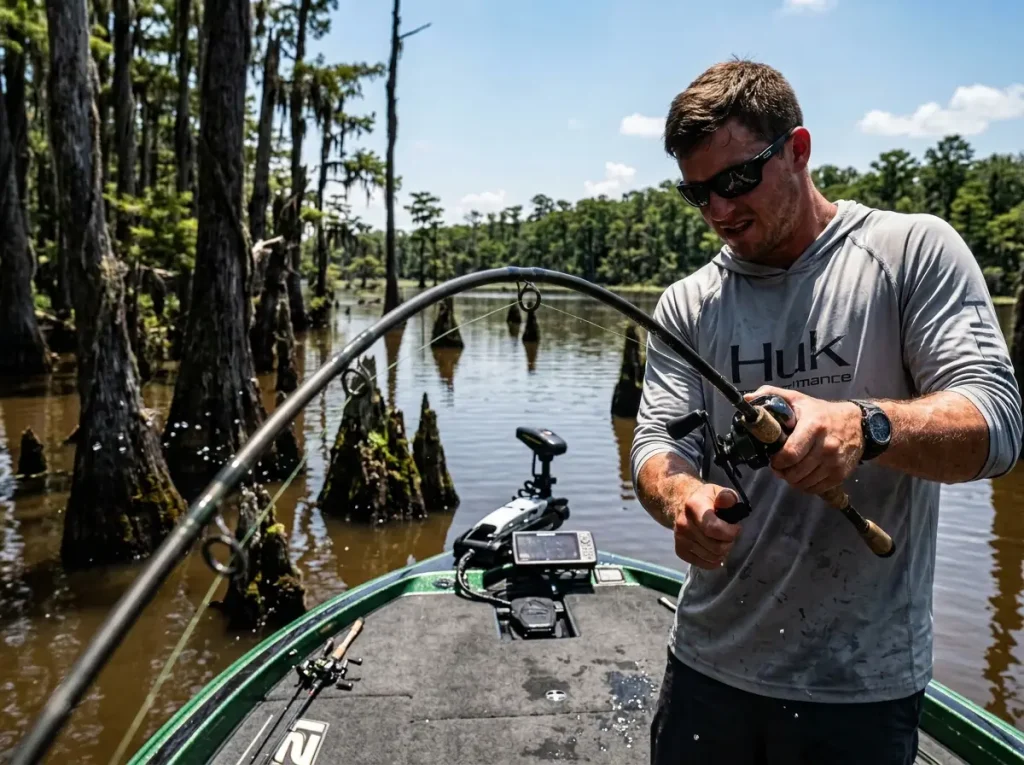
Here’s what most environmental coverage on fishing gear completely ignores: lost gear isn’t your main operational problem. Every cast is.
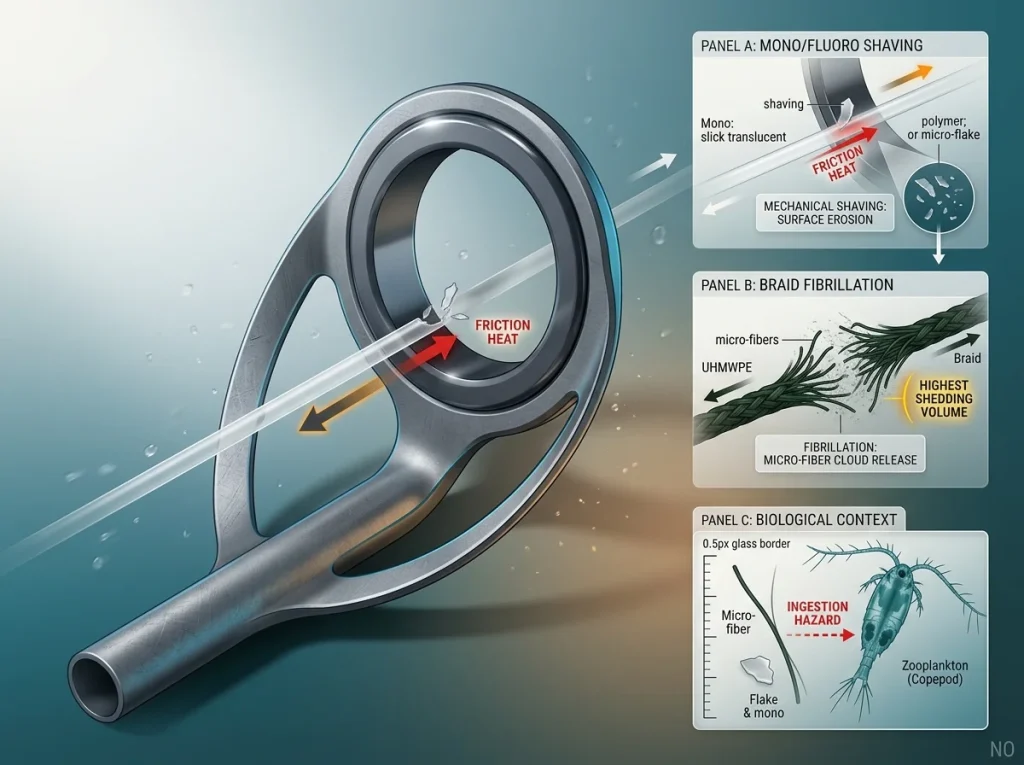
The interaction between fishing line and rod guide is a friction event — friction, wear, and heat transfer — 200 times per session if you’re counting casts. The “lubricant” is the water itself, which helps, but never zeros out the friction. Each retrieve moves line across the ceramic guide insert under load, generating micro-shavings of polymer that enter the water column directly. This is line-to-guide friction as a primary source of microplastic shedding during normal recreational use — an angle that institutional environmental sources almost never address.
The friction data tells the story. Braided PE (dry coefficient of friction: 0.30-0.35) generates the highest microplastic generation rate. In seawater, that drops to 0.22-0.28 — better, but not eliminated. Nylon in seawater runs 0.12-0.18. Fluorocarbon in seawater runs 0.10-0.15 — the lowest guide friction of any common line type. Less friction means less operational shedding per cast, but remember what you already know about fluoro persistence.
Lab research on polymer brush coatings that reduce microfiber shedding from synthetic fibers shows that liquid-like PDMS coatings reduce micro-fiber release by up to 96%. That’s a manufacturing technology not yet in recreational fishing tackle, but the friction data is directly applicable to understanding what your tackle is doing right now on every retrieve.
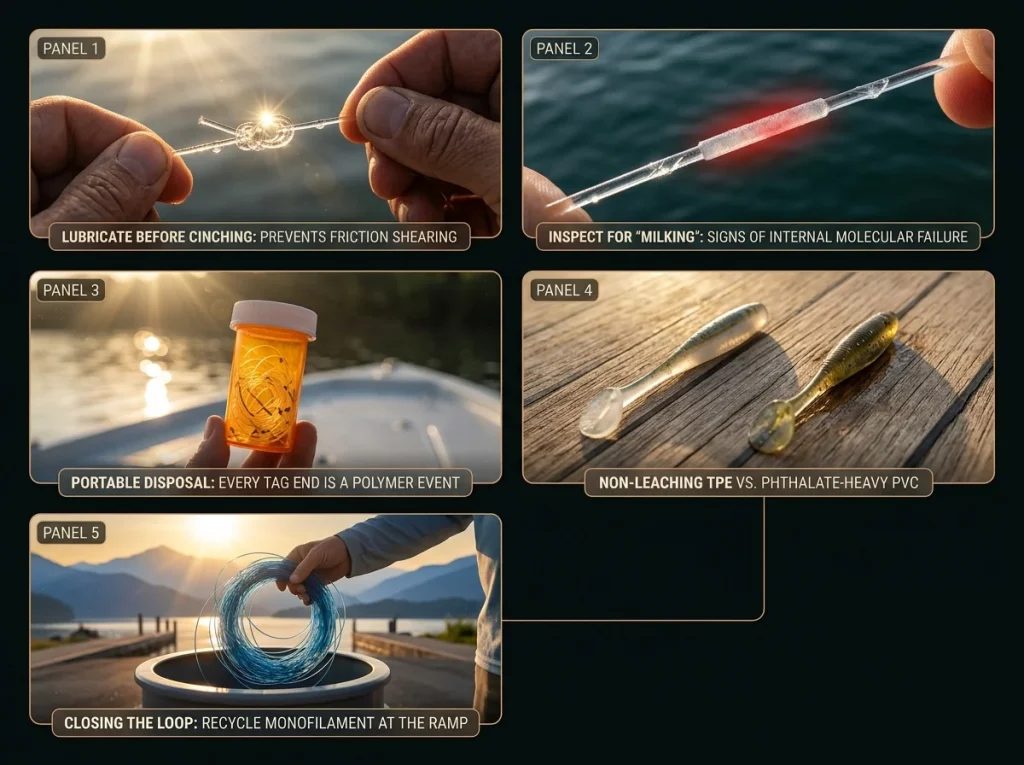
Knot-tightening is a second friction event. Cinching a dry knot generates localized heat — thermal shedding — that releases micro-polymer fragments at the knot site. Always lubricate with saliva before cinching. Not just for knot strength — for material integrity. The same friction forces that create thermal shedding at the knot also determine the friction physics that determine knot strength — two consequences of the same physical event.
After a long day of heavy structure fishing with braid, hold the last four or five feet of line up to the light. The visible fuzz you see is fibrillated UHMWPE — individual micro-fibers already separated from the braid body. That material enters the water column on your next cast.
Monofilament Under Load — Elastic Recovery and What It Costs
Mono stretches primarily through elastic deformation — it returns to roughly its original shape after a load is removed. This is why you feel that characteristic “spring” during a fight. From an environmental standpoint, this elastic recovery means less permanent molecular damage per stress event compared to fluoro. Mono is the lower cumulative micro-shedder of the two during active fishing.
The catch: UV degradation in the amorphous zones progressively erodes that elastic capacity. Old, sun-exposed mono sheds far more per stress event than fresh line does. In seawater specifically, its coefficient of friction drops to 0.12-0.18, lower than in dry conditions, because water partially lubricates the guide contact. Saltwater fishing actually reduces guide-contact shedding compared to dry or freshwater conditions — a nuance nobody talks about at the boat ramp.
Fluorocarbon’s Plastic Deformation Problem
Fluorocarbon performs much of its stress absorption in the plastic deformation region. That means it’s permanently altered at a molecular level during each significant loading event — every hard fight, every deep hook-set on heavy structure.
Salt Strong’s lab test documented fluorocarbon losing 20% of its breaking strength after just four stress events. Each of those events corresponds to internal molecular failure and micro-shedding you can’t see. Despite its low guide friction (lowest of any common line type in seawater), fluoro produces micro-polymers inside the polymer matrix during hard fights. It appears cleaner at the guide but has a deceptive internal environmental profile.
The practical implication: “using fluoro until it breaks” is exactly backward from a stewardship standpoint. Replace fluoro leaders based on fight count, not appearance.
Pro tip: After any fight that produced visible “milking” — that opaque, frosted look on your fluorocarbon leader — retire the leader before the next session. That milky sheen is visible plastic deformation. The internal molecular failure has already happened.
Braid Fibrillation — The Invisible Fiber Cloud
UHMWPE braided line doesn’t abrade into flakes. It fibrillates — individual fiber bundles within the braid snap and each becomes a microfiber in the water column. The mechanism is different from mono and fluoro, but the destination is the same: the water you’re fishing.
An old guide trick for extending braid life also happens to reduce cumulative shedding: reverse the line on the spool mid-season to distribute wear. The leading section near the guide takes the most friction and fibrillates fastest. Distributing that wear across more of the line means you’re shedding less at the critical section closest to your presentation.
The Chemical Audit of Your Tackle Box — Soft Plastics and What They Leach
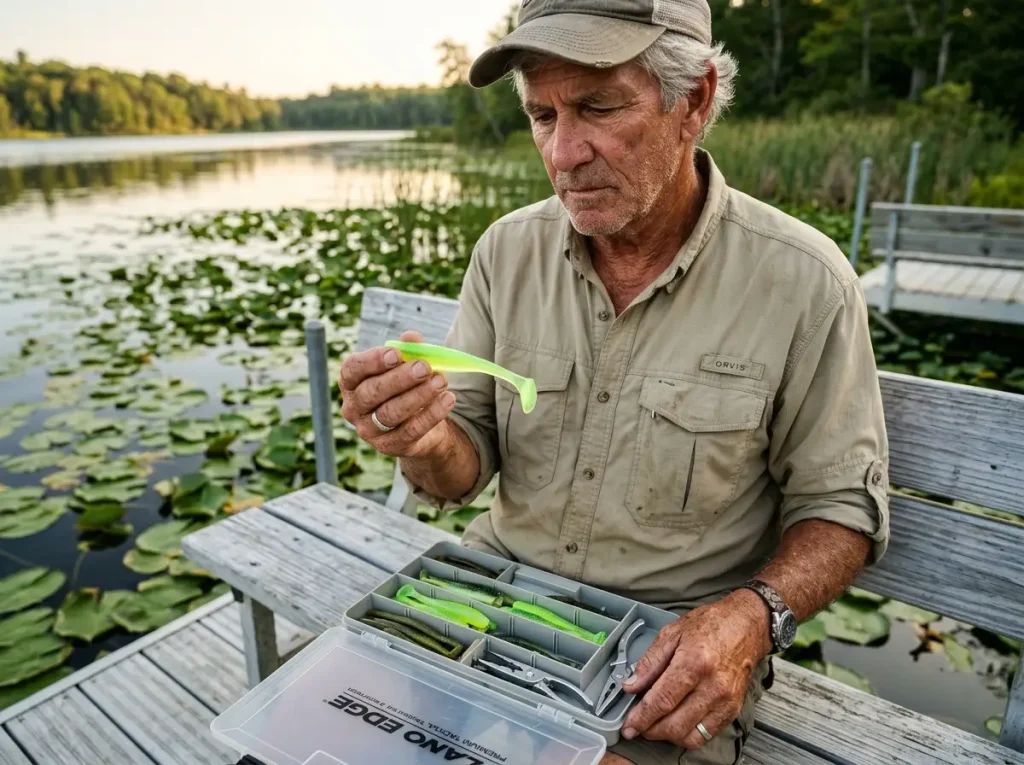
Line is a mechanical problem. Soft plastics are a chemical one. And it starts the moment the lure hits the water.
Soft plastic lures (SPLs) are primarily PVC plastisols — PVC particles suspended in liquid plasticizers. Unlike the structural polymers in fishing line, which are chemically inert until they fragment, the phthalates in soft lures are designed to be chemically mobile from the point of manufacture. They’re not bonded to the PVC matrix. They’re held in place by weak Van der Waals forces — water and digestive fluids easily displace them.
The University of Saskatchewan 61-day study put 16 common soft plastic lures in water. Ten of the 16 released harmful phthalates into the water column — 62.5% of tested samples. One in ten extracts showed high estrogenic activity. Dr. Markus Brinkmann from USask was direct: “The organic contaminant profile present in soft plastic fishing lures was not well understood… this can have potentially drastic environmental impacts, leading to the feminization of male fish.” That study’s full analysis of phthalate and estrogenic chemical leaching from soft plastic fishing lures is the primary source for these findings.
The estrogenic chemicals in lure leachate mimic estrogen. In waters with high angling pressure, cumulative leaching from lost and discarded soft plastics can reach concentrations sufficient to induce sex reversal and reproductive failure in local fish populations. This isn’t worst-case theorizing — it’s the mechanism documented in lab conditions.
Here’s a field observation that makes the chemistry visible: mix different brands of PVC plastisol lures in the same storage compartment and you’ll eventually find a gummy, melted mess. That’s plasticizer migration between incompatible formulations. The chemistry behind why different soft plastic brands melt together in storage is the same mechanism that drives phthalate leaching — and understanding it should change how you select, store, and discard your soft baits.
Z-Man’s ElaZtech is a TPE (Thermoplastic Elastomer), not a PVC plastisol. It doesn’t require phthalate plasticizers and is chemically incompatible with plastisol lures — which is why they melt each other in storage. The toxicological profile is demonstrably cleaner.
Phthalates and Endocrine Disruption — The Reproductive Threat
DMP (Dimethyl Phthalate) and DnBP (Di-n-butyl Phthalate) are classified as endocrine disruptors — they interfere with the hormonal signaling that governs fish reproduction, growth, and immune function. Phthalates don’t require ingestion to cause harm: dissolved concentrations in the water column around a soaking soft plastic are measurable within hours of immersion.
“Feminization” of fish populations isn’t a dramatic term — it’s a documented biological outcome. Male fish exposed to estrogenic leachate develop female characteristics: reduced sperm production, altered secondary sex characteristics, intersex morphology in severe cases. In closed or low-flow waters with heavy angling pressure, this operates at population scale.
UV Stabilizers and the Trophic Transfer of Additives
UV stabilizers (UV-327, UV-234) are added to fishing line and lure coatings to slow photodegradation. They work. But once a fish ingests a plastic particle carrying these stabilizers, the additives transfer from the plastic into the fish’s fat stores during digestion. A photo-stable material creates a biologically active toxin in the food chain through the mechanism of trophic transfer.
PubMed research on brominated flame retardants and UV stabilizers confirmed that these additives transferred significantly into fish tissue even via trophic ingestion — one fish eating another that had already ingested plastic. The accumulation chain extends to whatever eats that fish. Including you.
Hard Lures and BPA — The Epoxy Problem
Hard lures use epoxy topcoats that contain Bisphenol-A (BPA) — a documented endocrine disruptor. Physical abrasion of hard lure coatings against rocks, docks, and fish teeth releases BPA-bearing micro-particles directly into the water column. Every chipped coat on a crankbait worked through heavy structure is a BPA-release event. Lures with compromised epoxy should be retired from high-use or confined water bodies.
How Fish Ingest Microplastics — and What Happens Next
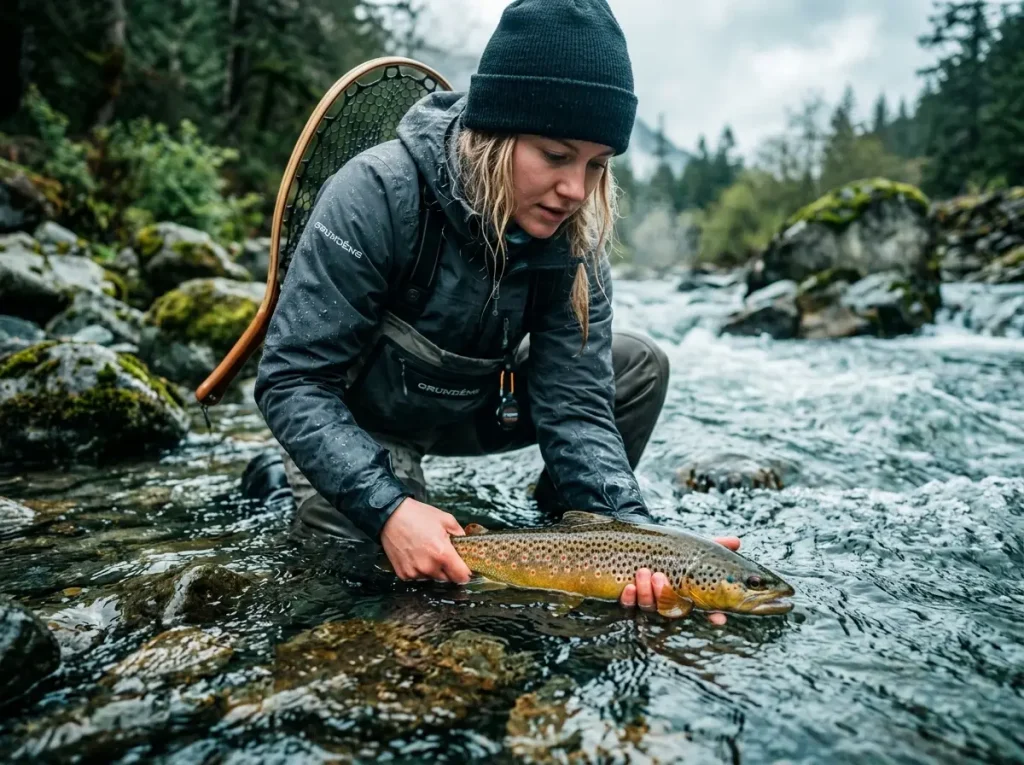
Stomach content analysis of sportfish in Lake Ontario confirmed anthropogenic particles in salmon, walleye, and pike. Up to 60% of Lake Trout sampled in some studies contained soft plastic lure fragments specifically — not generic debris, but identifiable fishing tackle material. The PMC-indexed study on microplastic exposure through freshwater fish consumption in the Great Lakes is the primary source for documenting this in recreationally caught North American sportfish.
Here’s how the ingestion hazard compounds. A microplastic particle is hydrophobic — it doesn’t mix with water. In the aquatic environment, it acts as a chemical sink, adsorbing persistent organic pollutants (PCBs, DDT, heavy metals) from the surrounding water. The fish doesn’t just ingest plastic — it ingests a concentrated package of environmental toxins.
Larger microplastic particles remain in the GI tract, creating satiation without nutrition and reducing growth rate. But nanoplastics (particles smaller than 1 micrometer) pass through the intestinal wall and enter the circulatory system, accumulating in liver, brain, and muscle tissue. This translocation is measured in tissue samples, not inferred.
The human endpoint matters here. Understanding the conservation obligations that come with eating what you catch extends beyond handling protocols — it includes the materials you introduce to the water column on every trip. Trophy predator fish are at the apex of the trophic accumulation chain. Older, larger fish have the highest bioaccumulated plastic-additive concentrations. The fish the analytical angler values most is the highest-exposure vector.
Pro tip: The question anglers post on Reddit — “am I messed up to worry about microplastics in the fish I eat?” — deserves a straight answer. The concern is real, the data supports it, and it’s proportional to the species you target and how frequently you eat your catch. Worry productively: adjust your material choices, don’t abandon fishing.
Ghost Gear and Secondary Microplastics — The Scale Problem
ALDFG — Abandoned, Lost, or Discarded Fishing Gear — contributes 640,000 tons of material to aquatic environments annually, according to UNEP and NOAA research. Lost gear ghost-fishes: entangled animals die, attract scavengers, perpetuate entanglement cycles. The gear keeps fishing for years after it’s gone. FTIR-ATR and Raman Spectroscopy analysis of sediment samples confirms the polymer fingerprints match commercial fishing line and netting materials. The NOAA Marine Debris Program tracks this specifically, documenting how synthetic fishing materials — nylon, polyethylene, polypropylene — become secondary microplastics as they weather and fragment in the marine environment.
For the recreational angler, the ghost gear statistics technically describe commercial-scale problems. But the cumulative operational shedding from millions of recreational fishing sessions — the line-to-guide friction problem — is the blind spot. It’s additive to the commercial problem, not separate from it.
Nanoplastics — When Particles Become Systemic
The transition from microplastic (1µm to 5mm) to nanoplastic (below 1µm) is when particles shift from mechanically obstructive to biologically systemic. Nanoplastics cross the intestinal epithelium and enter the circulatory system. They accumulate in fish liver, brain, and muscle — documented in tissue samples.
Fish digestive chemistry accelerates this: gut pH and surfactant-rich bile facilitate the breakdown of ingested micro-fragments into nano-scale particles and simultaneously facilitate desorption of adsorbed toxins. It’s a double-release mechanism inside the fish.
Comparing Materials — A “Clean Tackle” Hierarchy
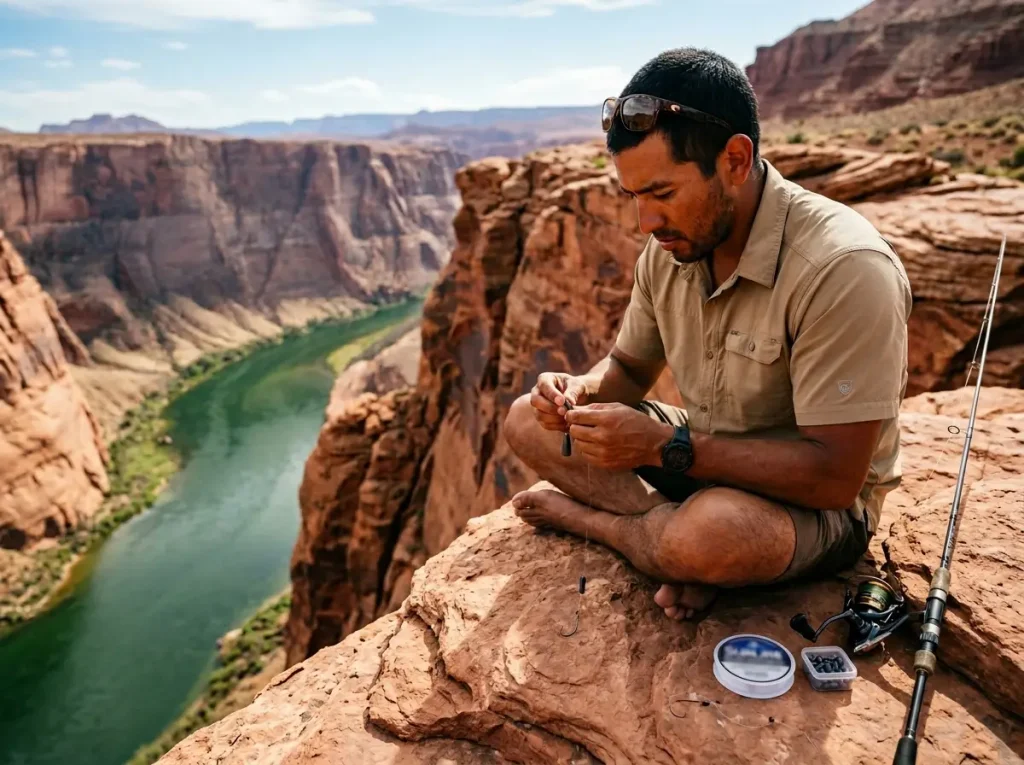
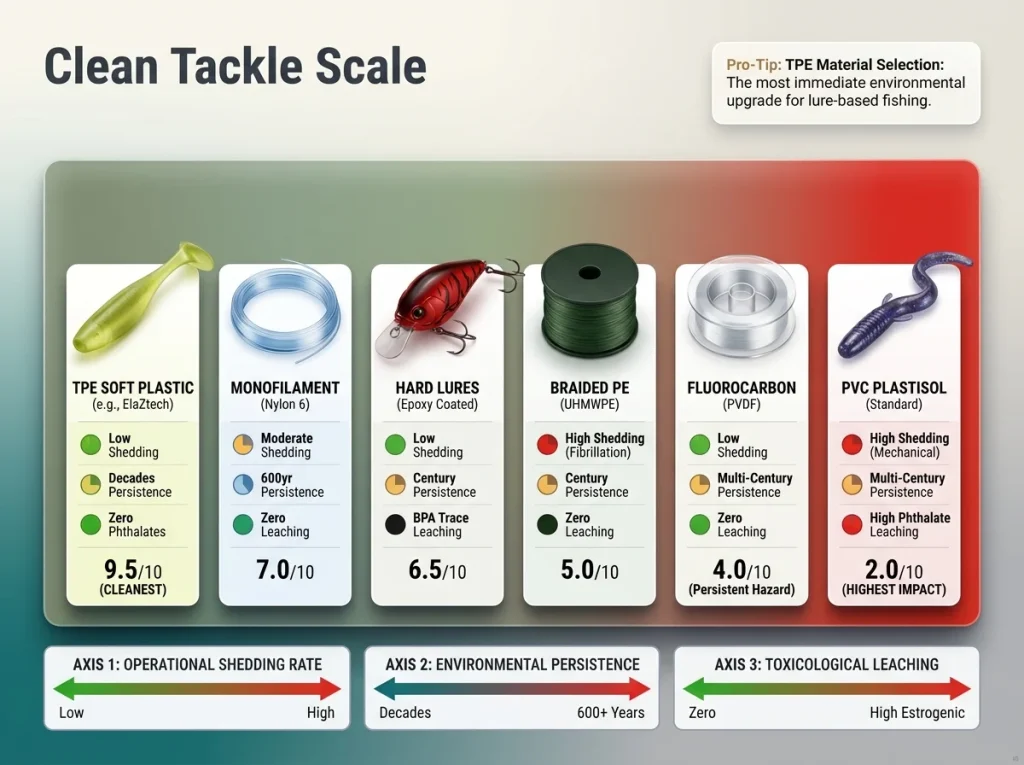
This is not a performance comparison. It’s a material accountability audit — ranked by combined environmental impact: operational shedding rate, persistence in the environment, and toxicological leaching potential.
Monofilament (Nylon 6): Highest UV susceptibility, fastest degradation of the three main line types (still ~600 years for standard Nylon 6 — but vastly better than fluorocarbon persistence). Sheds via surface peeling. Lowest stiffness-related microplastic generation under mechanical load. Best environmental profile of traditional line types if replaced regularly.
Fluorocarbon (PVDF): Very low guide friction means low operational shedding per cast. But PVDF’s resistance to photodegradation means any C-F bond fragment shed is essentially permanent. Internal plastic deformation generates molecular-level shedding invisible to the eye. The refractive index advantage that makes fluoro the go-to leader choice is real — the optics of fluorocarbon’s refractive index advantage explain why it works. Whether that advantage justifies the environmental persistence of every shed fragment is the calculus the analytical angler must make.
Braided PE (UHMWPE): Highest operational shedding rate via micro-fibrillation. UHMWPE is chemically stable but persistent. Volume of micro-fiber release over a season is likely the highest of any line type for high-use anglers. The degradation rates comparison with other materials, documented in the ACS study on environmental degradation rates for Nylon, PET, and PVDF fishing line fibers, is the only peer-reviewed source comparing all three major fishing line polymers under simulated environmental conditions.
Soft Plastics (PVC Plastisol): Highest toxicological impact in the tackle box regardless of fragmentation. Chemical leaching begins on immersion. Estrogenic activity confirmed in lab tests. Worst environmental chemical profile of any common tackle material.
TPE-Based Soft Plastics (ElaZtech type): No phthalate plasticizers means significantly lower chemical leaching. Still subject to mechanical degradation, but the toxicological fingerprint is genuinely cleaner. The data-driven upgrade choice.
Hard Lures (Epoxy Coated): BPA release on chip events. Lower volume contribution than soft plastics but chemically relevant in high-use, low-flow water bodies.
The anti-sell on premium fluorocarbon leader material: its low guide friction is real. Its persistence as shed micro-polymers is real too. Reserve fluoro leaders for clear-water, line-shy fish applications where the refractive index measurably changes your catch rate. Use mono where visibility isn’t the critical variable.
The Biodegradable Tackle Reality Check
Several products on the market claim “biodegradable” or “eco-friendly” status. The critical question is always: biodegradable under what conditions, and over what timeframe?
Nylon 4 (PA4) genuinely outperforms Nylon 6 in biodegradability — 48% degraded in 30 days under composting conditions. But composting conditions (high temperature, specific microbiome composition) are not what lake bottoms or river sediments provide. The ACS 2024 study on degradable vs. conventional gill net polymers confirms that accelerated lab conditions don’t accurately represent real-world aquatic biodegradation timelines.
If a product’s “biodegradable” claim applies only under industrial composting — which no recreational water body provides — that claim is functionally meaningless where you fish. Ask for the condition-specific data, not just the label.
Lead-Free Weights and the Clean Tackle Upgrade Path
Lead sinkers are documented wildlife toxicants — loon, eagle, and waterfowl poisoning from lead weight ingestion is well-established. Tungsten, bismuth, and tin alternatives address lead toxicity directly. The transition to tungsten is the most immediate conservation upgrade most anglers can make — the best lead-free fishing tackle brands and materials covers where to start if you haven’t made the switch.
The Conservation Protocol — Practical Stewardship for the Analytical Angler
This is not a sermon. It’s a system. Every recommendation here has a material science or chemistry rationale from the data covered in this article.
Material Selection: Use monofilament as the primary line for applications where fluorocarbon’s refractive index advantage isn’t demonstrably necessary. It recovers better from stress per session, has the fastest degradation timeline of mainstream options, and doesn’t carry the permanent persistence liability of every shed fragment. Reserve fluorocarbon for clear-water leader applications where you can honestly say the optical advantage changes your results.
Chemical Awareness: Move soft plastic selection toward TPE (ElaZtech-type) where available. Retire PVC plastisol lures with compromised surface integrity — cracks, tears, and separation accelerate leaching. Don’t mix PVC plastisol and TPE lures in the same storage bin. Chemical migration degrades both.
Mechanical Lubrication: Lubricate every knot with saliva before cinching. This reduces thermal shedding at the cinch point and produces a stronger, more stable knot. Two outcomes, one action.
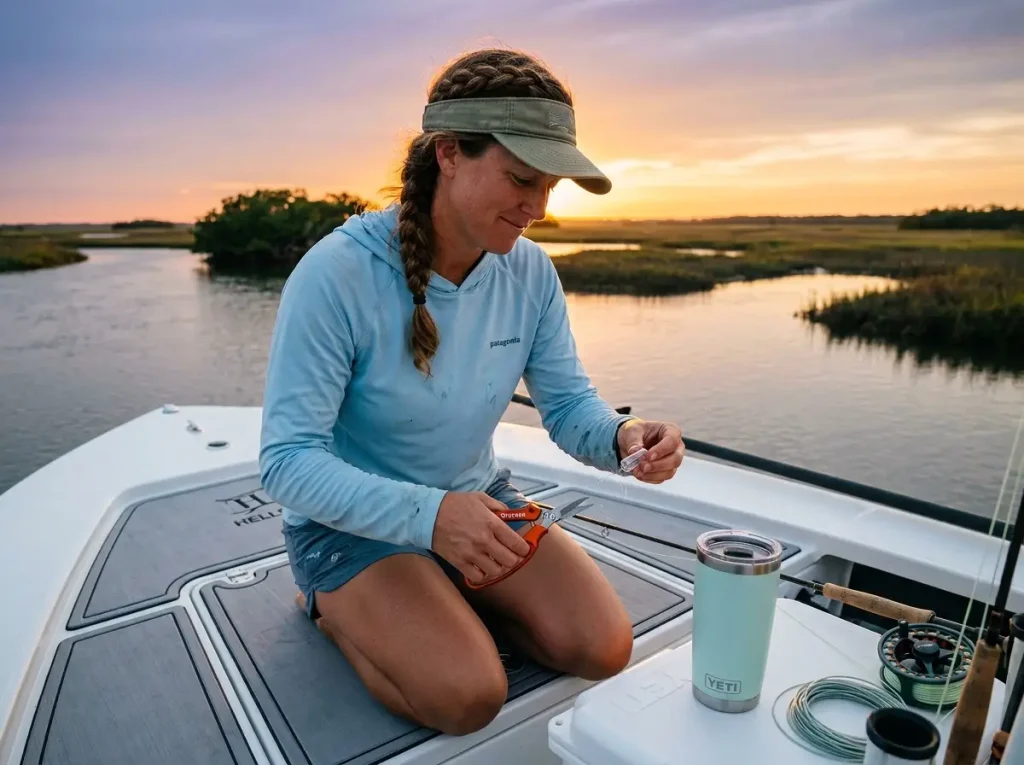
Disposal: Every tag end, line clipping, and retired leader is a polymer hazard. Use a dedicated pill bottle or waterproof container for line clippings on the water. Never allow them to drop into the water column — even small fragments are persistent polymer particles. Treating every tag end as hazardous is step one; knowing the correct way to dispose of every type of fishing line — including braid, fluorocarbon, and mono — is step two. Note: braid cannot be processed in standard recycling streams and should go to solid waste, not general recycling.
Line Rotation Frequency — The Data-Driven Schedule
Mono: Rotate annually under regular direct-sun exposure. Rotate after any season of heavy use even without visible damage — UV degradation in the amorphous phase runs ahead of any visual signal.
Fluorocarbon leaders: Replace after 3-5 significant fights, or any fight producing visible “milking.” The 20% strength loss after four stress events is the guide. Environmental shedding accelerates with each stressing cycle.
Braid: Monitor for visible fibrillation (fuzz) in the guide section. Reverse the line on the spool mid-season to distribute wear. Replace annually in high-use freshwater systems.
The accountability math is useful: one angler, 50 sessions per season, 100 casts per session = 5,000 line-guide friction events per year per rod. Across millions of recreational anglers, the aggregate micro-polymer release is measurable in polymer sediment analysis. It’s not theoretical.
Soft Plastic Management — Selection, Storage, and End-of-Life
Favor TPE-based lures wherever they’re a viable performance substitute for PVC. They’re more expensive and fish differently — but the toxicological profile is cleaner by documented measurement.
Store PVC plastisols in chemically inert, worm-proof trays. Don’t store different plastisol brands in direct contact — plasticizer migration degrades both and accelerates leaching if the lures subsequently enter the water.
Damaged soft plastics — torn, fractured, chemically degraded — should not go back in the water. Structural damage accelerates both mechanical fragmentation and chemical leaching rates simultaneously. The “it’s still catching fish” argument is financially convenient and environmentally incorrect.
What You Do With This Information
Three things worth pulling from this audit before your next trip:
Every cast is a micro-polymer event. The friction between your line and rod guide produces physical shedding on a per-cast basis. The chemistry of the material determines the particle type; your fishing frequency determines the volume.
Your soft plastics are the most chemically active items in your tackle box. Phthalates leach within hours of immersion, estrogenic activity is confirmed in lab tests, and the fish most likely to ingest them are the ones you most want to catch. Material selection and proper disposal create the highest conservation leverage of any single change you can make.
Stewardship is technical, not emotional. Lubricating your knots, rotating your line on the correct schedule, retiring degraded soft plastics, switching to tungsten — these aren’t gestures. They’re physics-informed decisions that reduce your operational footprint without sacrificing a catch.
Before the next trip, inspect every leader for milking, every soft plastic for structural damage, every spool for how long it’s actually been sitting there. Retire what’s degraded. Replace what’s past its friction cycle. The water doesn’t distinguish between carelessness and ignorance — but after reading this, you do.
FAQ
How long does fishing line take to decompose in the water?
Standard monofilament (Nylon 6) persists in aquatic environments for an estimated 600 years under normal conditions. Fluorocarbon (PVDF) is even more durable due to the stability of the carbon-fluorine bond. Experimental Nylon 4 degrades 48% in 30 days under composting conditions, but those conditions don’t occur naturally in lakes or rivers — making biodegradable claims only valid in industrial composting environments, not where you fish.
Is fluorocarbon worse for the environment than monofilament?
It depends on the failure mode. Fluorocarbon has lower guide friction, so it sheds fewer microplastics through operational abrasion than mono per cast. However, any fragment shed is effectively permanent due to PVDF’s resistance to photodegradation. Mono degrades faster once shed but sheds more readily during normal use. Lost gear (fluoro has a marginal advantage) vs. operational shedding per session (mono is slightly better) — the calculus depends on which problem is larger in your specific use case.
Do fish actually eat microplastics from fishing lures and line?
Yes, and it’s documented in freshwater sportfish. Stomach content analysis of salmon, walleye, and pike from Lake Ontario confirmed anthropogenic particles. Up to 60% of Lake Trout sampled in some studies contained soft plastic lure fragments specifically — identifiable fishing tackle material, not generic microplastic debris. These fragments reduce growth rates and serve as a vector for chemical toxin accumulation in fish tissue.
What is the least environmentally harmful fishing line for recreational use?
Based on current lab data, monofilament (Nylon 6) has the most favorable profile among mainstream options, provided it’s replaced regularly. It has the fastest degradation timeline of the three, sheds in larger particles less likely to reach nanoplastic size immediately, and doesn’t carry fluorocarbon’s permanent persistence liability. Experimental biodegradable options (Nylon 4, PBSAT) show promise but need real-world aquatic biodegradation data before making definitive claims.
What should I do with old fishing line instead of throwing it away or leaving it in the water?
Participate in specialized monofilament recycling programs — Berkley’s Tackle Take-Back and AnglerAction Foundation operate collection stations at boat ramps and tackle shops across North America. Braided line cannot be processed in most standard recycling streams and should go to solid waste. Fluorocarbon recycling infrastructure is currently limited; solid waste is the practical option. Never release any line type into the water — even small tag ends are persistent polymer particles.
Risk Disclaimer: Fishing, boating, and all related outdoor activities involve inherent risks that
can lead to injury. The information provided on Master Fishing Mag is for educational and informational purposes
only. While we strive for accuracy, the information, techniques, and advice on gear and safety are not a substitute
for your own best judgment, local knowledge, and adherence to official regulations. Fishing regulations, including
seasons, size limits, and species restrictions, change frequently and vary by location. Always consult the latest
official regulations from your local fish and wildlife agency before heading out. Proper handling of hooks, knives,
and other sharp equipment is essential for safety. Furthermore, be aware of local fish consumption advisories. By
using this website, you agree that you are solely responsible for your own safety and for complying with all
applicable laws. Any reliance you place on our content is strictly at your own risk. Master Fishing Mag and its
authors will not be held liable for any injury, damage, or loss sustained in connection with the use of the
information herein.
Affiliate Disclosure: We are a participant in the Amazon Services LLC Associates Program, an
affiliate advertising program designed to provide a means for us to earn advertising fees by advertising and linking
to Amazon.com. As an Amazon Associate, we earn from qualifying purchases. We also participate in other affiliate
programs and may receive a commission on products purchased through our links, at no extra cost to you. Additional
terms are found in the terms of service.