

In this article
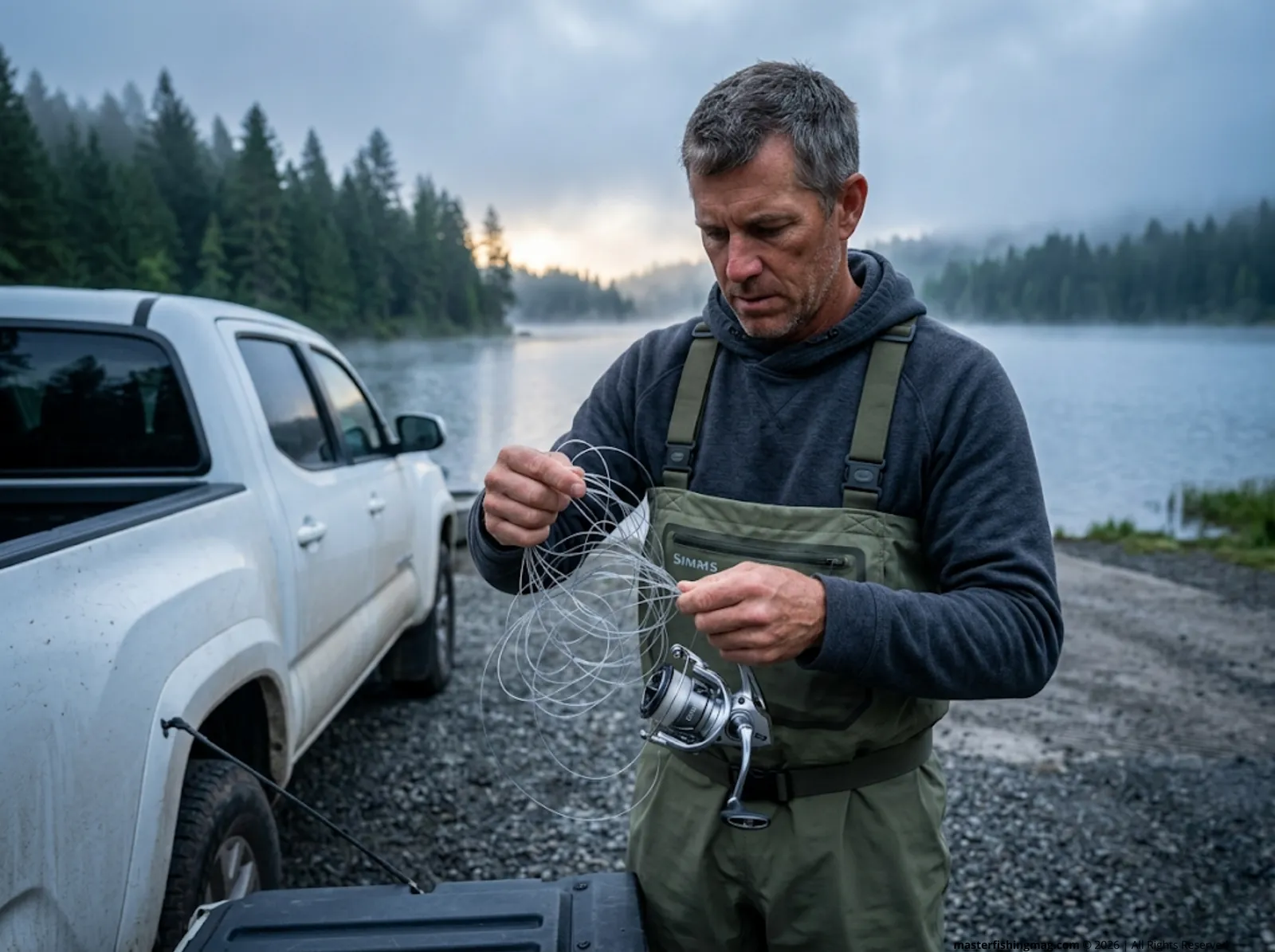
The 250 yards of memory-coiled monofilament you just stripped off your spinning reel is now sitting in a bird’s nest on the garage floor. Your blue curbside recycling bin is three feet to your left, and the trash can is to your right. I’ve stared at that same mess after countless guide trips, exhausted and just wanting to clean up before dinner. If you drop that line into the household recycling bin, you are about to cause thousands of dollars in mechanical damage. After twenty years of spooling and stripping reels, I’ve seen exactly what happens when anglers guess about waste protocols. Discarded fishing line requires highly specific disposal management because of the tough synthetic polymer construction we rely on to fight fish. This guide breaks down the chemical reasons why fishing lines destroy recycling centers, the critical differences between tossing fluorocarbon versus high-tensile braid, and the exact protocols you need to follow to keep your discarded polymers out of local waterways. Here’s exactly how to handle it—no panic, no emergency vet visit for nearby wildlife, and zero damage to the machines that process our trash.
⚡ Quick Answer: Never throw old fishing line into your household recycling bin, as it jams and shuts down sorting machinery. Mail nylon monofilament and fluorocarbon directly to the Berkley Conservation Institute or drop them in dedicated PVC bins at local boat ramps. Because it cannot be melted, you must cut braided line into 6-inch pieces with serrated shears and throw it in your normal household trash. Keep line out of the water to prevent permanent habitat damage.
The Environmental and Hydraulic Cost of “Ghost Line”
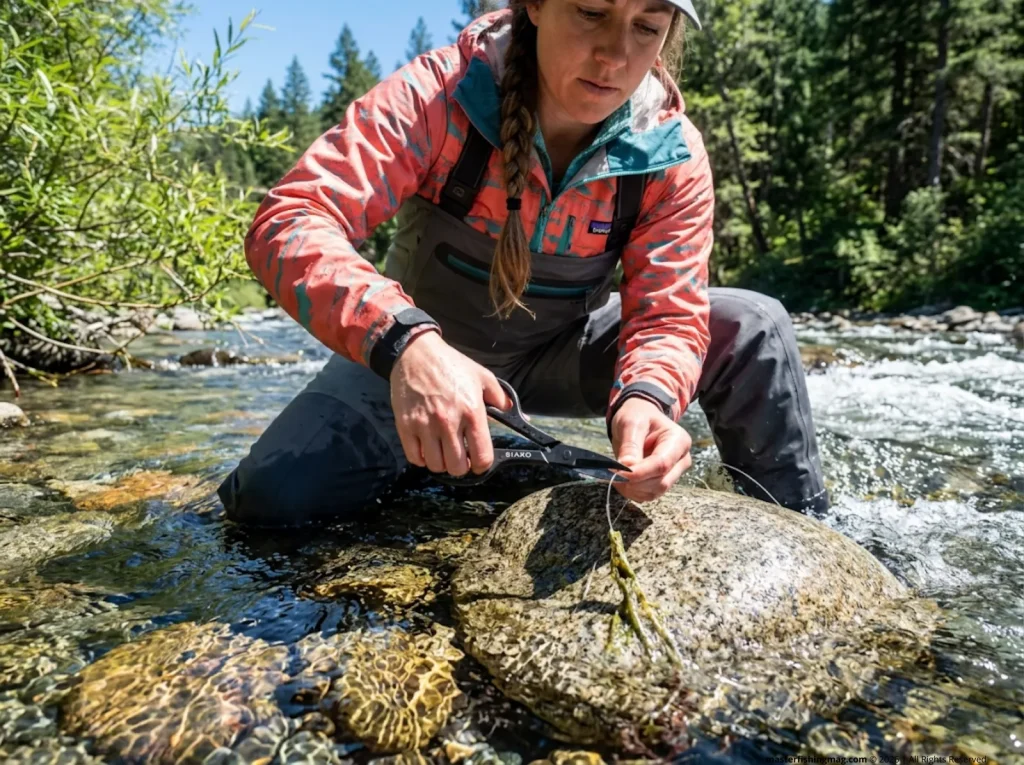
Every season, I pull wads of snapped line out of the river. It feels like a minor annoyance when you break off a snag, but that forgotten line creates a chain reaction of damage below the surface. This isn’t just about making the river look clean; it’s about the hard physics of water flow and the harsh reality of long-term pollution. The truth is, when you leave line behind, you are permanently altering the structure of the water. We need to stop looking at lost gear as a temporary mistake and start treating it as permanent structural litter.
The 600-Year Degradation Timeline
If you leave standard nylon monofilament fishing line out in the sun, it gets brittle and weak. You might think this means it breaks down quickly and disappears. It doesn’t. Standard nylon takes approximately 600 years to photo-oxidize and completely break down in the environment. That means the line you snapped off yesterday will outlive your great-grandchildren. It persists in the dirt and water for generations. Rather than naturally rotting away like wood or cotton, constant UV exposure from the sun only causes microscopic cracks on the surface. These cracks eventually lead to the line shedding tiny microplastics straight into the water column. The structural core of the line remains intact indefinitely, creating a persistent trap sitting right where you left it.
Altering Flow: Manning’s n and Stream Obstruction
Ghost fishing line from snagged rigs drastically alters stream hydrology. I’ve waded into runs that used to hold perfect trout, only to find them choked with old line and trapped debris. When tangled line anchors to rocks, the physical roughness of the stream bed spikes. In water management terms, the Manning’s roughness coefficient of the bottom jumps from a smooth 0.013 up to a jagged 0.040. What that means for you and me is that the water slows down artificially. This increased friction catches passing sticks, leaves, and sediment, creating unnatural sediment dams. Suddenly, you have a physical barrier that disrupts the natural movement of baitfish and migratory species, ruining the natural current seams that predatory fish rely on for feeding.
Biological Consequences: Entanglement and Blockages
Beyond messing up the current, discarded line physically grips and harms wildlife. We’ve all seen the dramatic photos of entangled birds, but the numbers are worse than you think. You can look at the NOAA marine debris data and see they report nearly 100 whale entanglements in one single year, driven heavily by commercial and recreational ghost gear. In our local ponds, it’s the turtles, ducks, and frogs that suffer the wildlife entanglement risk. The line wraps around legs and wings, and because it has zero stretch and massive strength, it cuts straight into muscle over time. If a fish happens to swallow a cut tag end, the line creates lethal blockages in their digestive tract.
Pro tip: Treat your fishing line as a permanent, immovable physical structure the second it crosses the water line; if it snags and breaks, it stays there forever. Do everything safely possible to retrieve it.
Why Curbside Recycling Machinery Fails
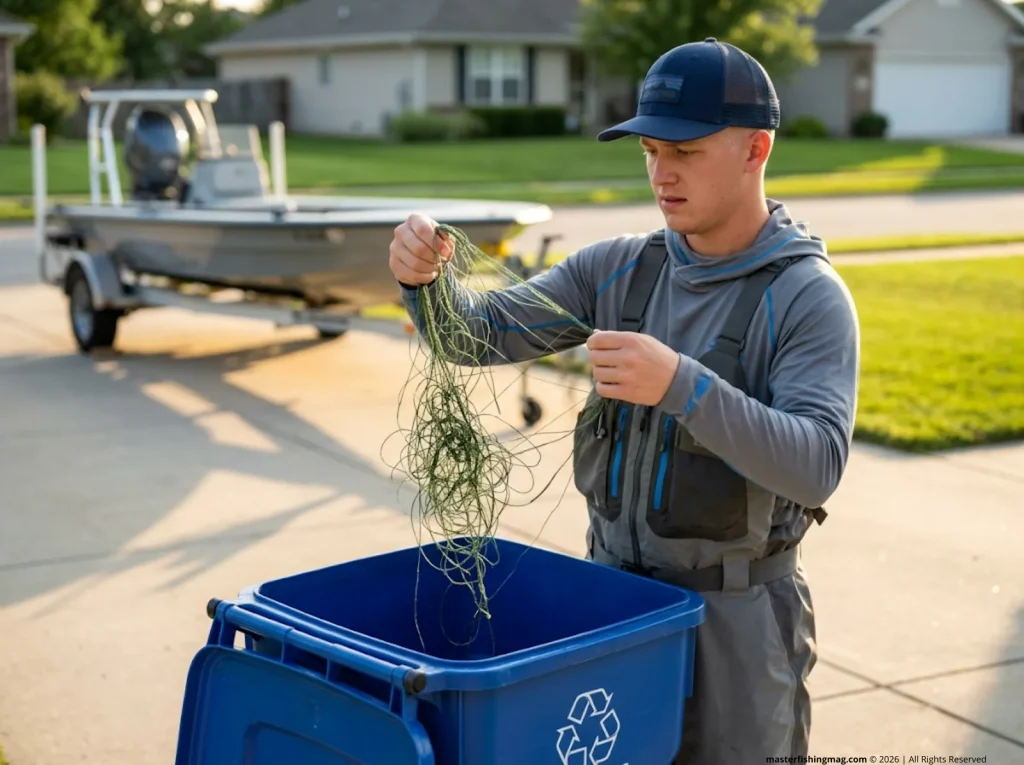
The arrows on your blue plastic bin imply you can throw anything plastic inside. It is a comforting thought, but tossing your old fishing line in there is a massive mistake. Your material recovery facilities are built to crush and separate hard plastics, cardboard, and aluminum cans. They are not engineered to handle high-tensile string. The very qualities that allow you to haul in a thrashing thirty-pound catfish are the exact same qualities that destroy heavy industrial machinery.
As part of your broader fish conservation efforts, keeping your waste out of the wrong streams is just as important as releasing a fish cleanly. Let’s look at what actually happens when the garbage truck dumps your old spool onto the tipping floor.
The Classification of “Tanglers”
Municipal waste managers officially classify high-tensile fishing line as a “tangler.” They group it in the same dreaded category as extension cords, Christmas lights, and old garden hoses. When the trucks dump the raw recycling onto the conveyor belts, the material moves through a series of rapidly spinning screens and star wheels designed to toss paper up and let glass fall down. Fishing line ignores these rules. Because it is long, flexible, and incredibly tough, it sneaks past the initial sorters and heads straight for the spinning axles.
The Physics of MRF Gear Jams
Unlike a brittle plastic water bottle that snaps and crunches, the high tensile strength of polymers like nylon and ultra-high-molecular-weight polyethylene means the line refuses to snap when it feeds into the rotating screens. Instead, the raw loose fishing line grabs onto a spinning metal axle and starts wrapping tightly around the bearings. With every rotation of the heavy machinery, the line acts like a tourniquet. It generates intense friction and heat, eventually creating a solid “condor nest” of melted plastic and grit that completely seizes the sorting machinery. The entire conveyor line physically stalls out because the motors can no longer turn the fouled axles.
The Economic and Operational Fallout
When the axles lock up, the entire plant shuts down. I’ve read Material Recovery Facility facility assessments showing that clearing these tangler jams requires two to four hours of manual, hazardous downtime per shift. Technicians physically climb into the dirty machinery with heavy saws to slowly hack the melted mass of fishing line off the steel axles. The curbside recycling machinery is completely useless during this time. A major mechanical breakdown caused by your discarded line can shut down an entire facility for days. When that happens, municipalities are forced to divert all incoming loads straight to the local landfill anyway. Your attempt at recycling ends up creating more trash.
Pro tip: Never assume the universal recycling triangle symbol applies to multi-strand or high-tensile polymers—density and strength dictate recyclability at the facility. If it can wrap around your finger, keep it out of the blue bin.
The Berkley Conservation Institute (BCI) Pipeline
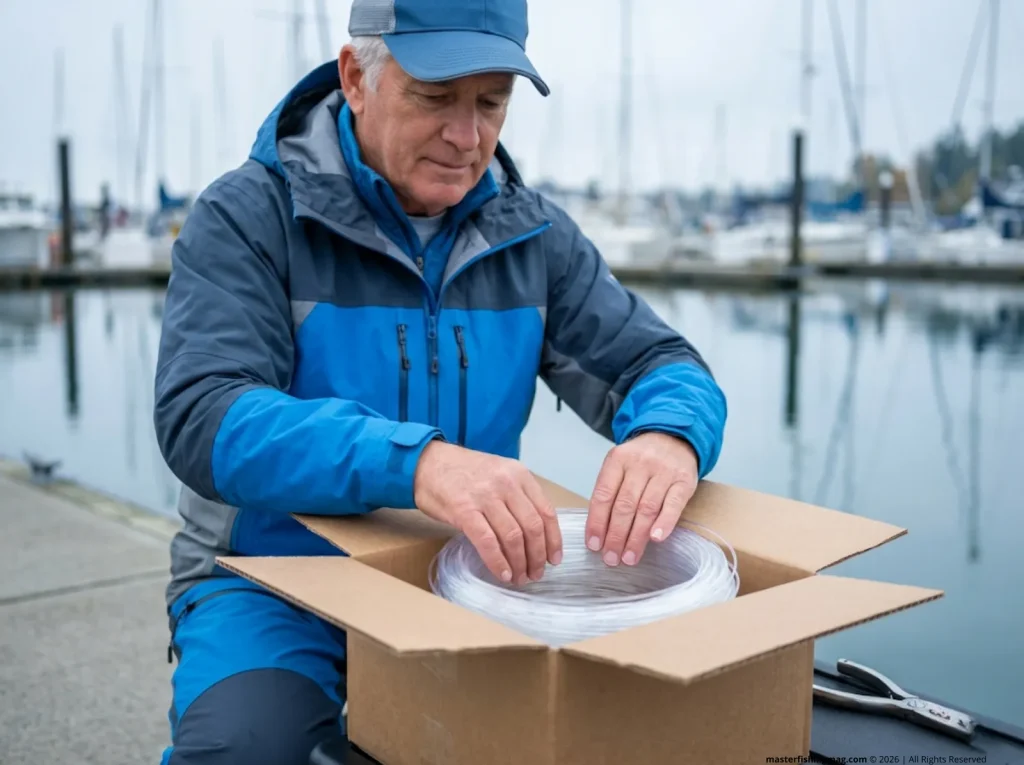
So, if you can’t throw it in the blue bin, what do you do with miles of bad line? Thankfully, the fishing industry created a dedicated pipeline strictly for our polymer waste. The Berkley Conservation Institute figured out the logistics decades ago, giving us a clean, proven way to process thermoplastic lines. You just need to know the rules of the melt stream before you send your trash away.
Adding the task of sorting your old line into your fishing gear maintenance routine takes maybe five minutes, but it ensures your plastic is handled by professionals instead of county workers.
Processing Mono and Fluoro for the Melt Stream
Nylon and fluorocarbon strings are thermoplastic. This means they can be successfully melted down by extreme heat and extruded into new solid shapes without catastrophic molecular loss. The chemical bonds hold up to the heat treatment. However, the machines that melt these materials are incredibly sensitive. Before you even think about recycling, you must manually remove absolutely all terminal tackle. I mean every single hook, brass swivel, tungsten weight, and tiny split shot. If one metal hook sneaks into the melt stream, it ruins the entire batch and damages the extrusion dies. Cut your line clean.
How to Ship Direct to Spirit Lake
You have two simple options for offloading your cleaned mono and fluoro. First, look for the tall, white PVC drop-off bins at dedicated monofilament drop-off locations like your local marina or boat ramp. These are serviced by volunteers who package the line and send it off. If your local lake doesn’t have one, you use the standard mail-in option. You simply pack your clean coils of line into a cardboard box. Do not wrap the line around paper or cardboard tubes; just send the raw coils. Tape the box shut and mail it directly to: Berkley Recycling, 1900 18th Street, Spirit Lake, Iowa 51360. I keep a small cardboard box in my garage and toss all my stripped line in there from spring through fall, making one cheap bulk shipment in December.
Repurposing into Fish Habitats
People always ask me if their old line gets spun into brand new fishing line. It doesn’t. When nylon is melted, the long polymer chains that give the line its intense stretch and knot strength actually shorten. The recycled plastic is too weak to trust on a big fish. Instead, Berkley takes the pelletized nylon and injects it into heavy molds. They create hard plastic tackle boxes, spooling stations, and massive artificial fish habitat structures. These habitats are sunk into barren lakes, creating complex cover for baitfish and bass to thrive around. Your old trash actually builds new spots to fish.
The Braid Protocol: Why Melting Fails and What to Do
Here is the biggest lie in outdoor waste management right now: the blanket advice that you can simply recycle all “fishing line.” I see it on forums and state websites constantly. They entirely fail to specify that braided fishing line is completely non-recyclable in standard programs. The physical properties that make braid cut through lily pads like a chainsaw also make it immortal in a melting vat. If you handle this stuff wrong, you create a permanent snare wire in the landfill.
Understanding the chemical differences between line materials proves exactly why throwing a spool of braid into a Berkley recycling box is a terrible mistake. It ruins the good work everyone else is doing.
The Thermal Mismatch in Polymer Chemistry
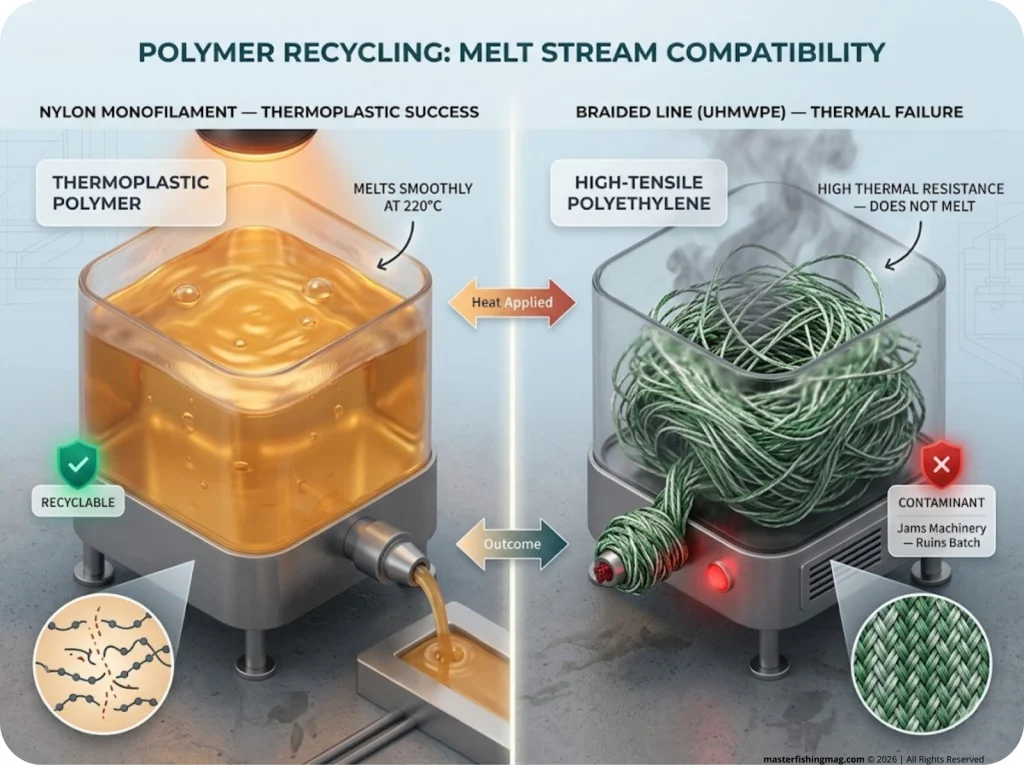
Braid is engineered from Ultra-High-Molecular-Weight Polyethylene (UHMWPE), sold under brand names like Dyneema or Spectra. It is structurally similar to Kevlar. This material has a distinct thermal mismatch compared to nylon. It requires vastly higher temperatures to melt properly. If you mix your green braided line into a box of clear monofilament and ship it to Iowa, the nylon melts into a smooth liquid, but the braid stays completely solid. Those solid strands of UHMWPE then flow into the injection molding equipment, clogging the tiny nozzles and ruining the entire batch of recycled plastic. It poisons the melt stream.
Executing the “6-Inch Rule” for Safe Disposal
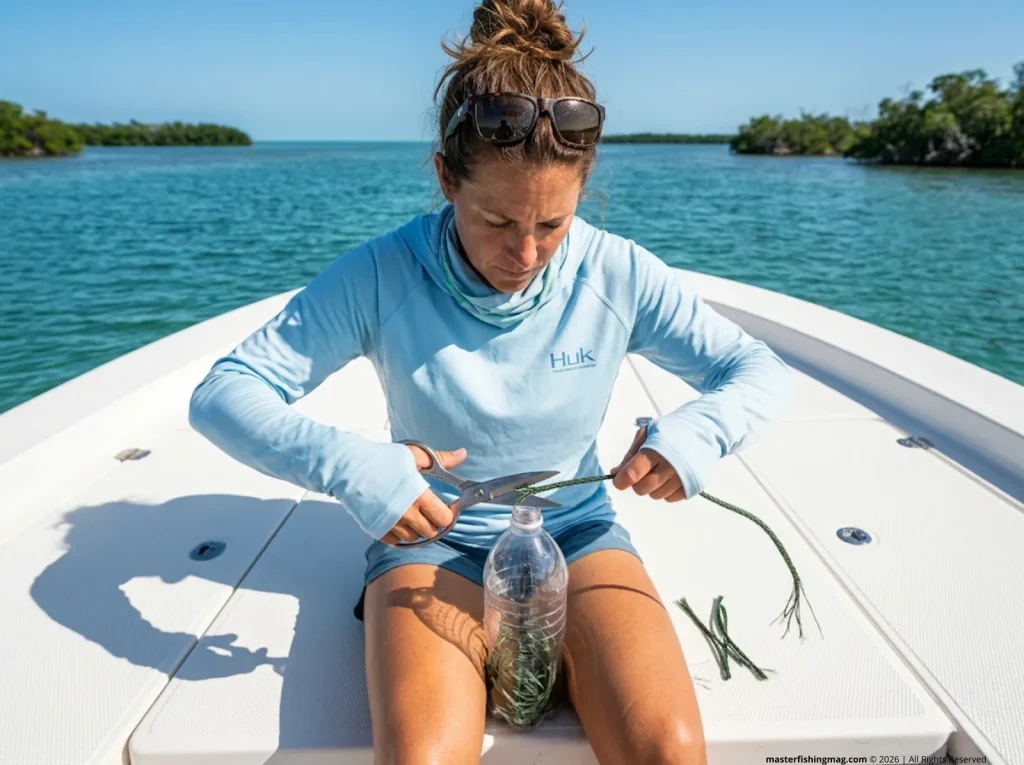
Because it cannot be melted and recycled through the normal channels, braided line must go safely into your household trash. But you cannot simply throw a massive bird’s nest of high-tensile string into the garbage bag. If that bag rips open at the dump, the line blows around and creates a severe wildlife entanglement risk for scavenging birds and raccoons. It can also wrap around the dump truck axles, causing the same propeller damage risk you see on boat motors. You must follow the safe-trashing protocol. Use professional-grade serrated shears to cut into 6-inch pieces. Short segments of line are fundamentally incapable of forming hazardous tension loops around an animal’s leg or neck.
Lidded Containment Before the Landfill
Snipping two hundred yards of braid into six-inch chunks creates a huge pile of feather-light fibers. The second a breeze hits your workbench, those fibers blow everywhere, ending up in your yard or washing down the storm drain. Control the mess. As you snip the line with your shears, drop the tiny cut segments directly inside an empty plastic soda or water bottle. Once the entire spool of braid is reduced to small clippings inside the bottle, screw the hard plastic lid on tight. You can now safely throw the sealed bottle into your normal household garbage, guaranteeing the discarded line makes it straight to the landfill without blowing away.
You can verify these separation protocols by reading the Florida Fish and Wildlife Conservation safe disposal guidelines, which strictly mandate keeping braid out of the monofilament bins.
High-Speed Line Stripping Workflows
To strip old line efficiently, you need a system. Hand-wrapping 200 yards of deep-cranking fluorocarbon around your palm is ridiculous. It hurts your wrist, takes ten minutes, and leaves you with a loose, springy coil that expands the second you drop it, blowing straight out of your recycling box. When it’s time to spool new line for the spring season, you need a fast, mechanical way to empty your reels without creating a massive, unmanageable mess.
Before you rip everything off to the bare arbor, learn the signs that it’s time to replace your fishing line so you aren’t throwing away perfectly good material. If it is permanently clouded, violently coiled, or nicked up, follow this workflow to clear the reel in seconds.
Mechanical Stripping with Power Drills
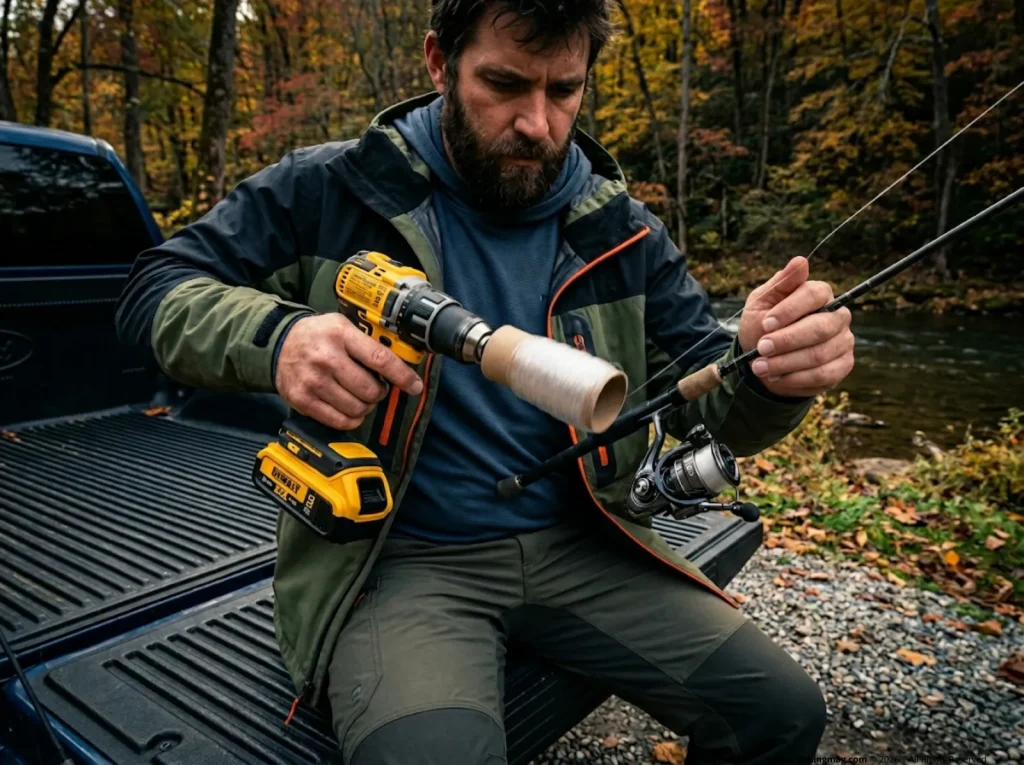
The absolute fastest and cleanest method I use in the garage is drill stripping. It turns a chore into a highly satisfying five-second job. You are turning your standard cordless drill into a high-speed line stripper tool. Take an empty cardboard toilet paper core or cut a paper towel tube in half. Slide the cardboard cylinder over a thick drill bit and chuck it tight, or just open the chuck jaws wide enough to grip the inside of the cardboard directly. Tap the drill trigger to ensure the cardboard runs relatively straight without wobbling wildly.
Securing the Line Core
Run the tag end of your fishing line from the rod tip directly to the cardboard tube. Use a small piece of electrical tape to stick the loose end firmly to the cardboard. Turn the drag dial on your spinning reel almost all the way down, or click the button on your baitcaster so the spool spins freely. Now, grip the rod hard with your left hand, and slowly squeeze the drill trigger with your right. The drill will winch the stiff line off the reel at lightning speed. Once the reel is bare, slide a utility knife blade horizontally down the cardboard core to snap the massive coil. You now have a dense, perfectly stacked wad of line ready for the BCI recycling box.
Pro tip: When using a power drill to strip line, maintain constant, severe tension on the line with your rod hand; if given slack, it will immediately jump the cardboard core and seize your drill chuck, forming a knot you have to cut out with a knife.
The MonoMaster for On-Water Micro-Waste
Stripping whole reels happens in the garage, but what about the water? Every time you tie a new palomar knot or clip off a frayed leader, you create micro-waste. Those tiny two-inch tag ends usually end up floating in the bottom of the boat, eventually getting washed down the bilge drain by rain. Stop doing that. Buy a MonoMaster or any cheap pocket line-catcher. It is a small plastic tube with internal wire brushes. You just stick the clipped tag ends into the slot, spin the wheel, and it winds the tiny waste pieces inside the tube securely. You empty it once a season into the trash or recycling bin depending on the material.
Engineering a Local PVC Drop-Off Bin
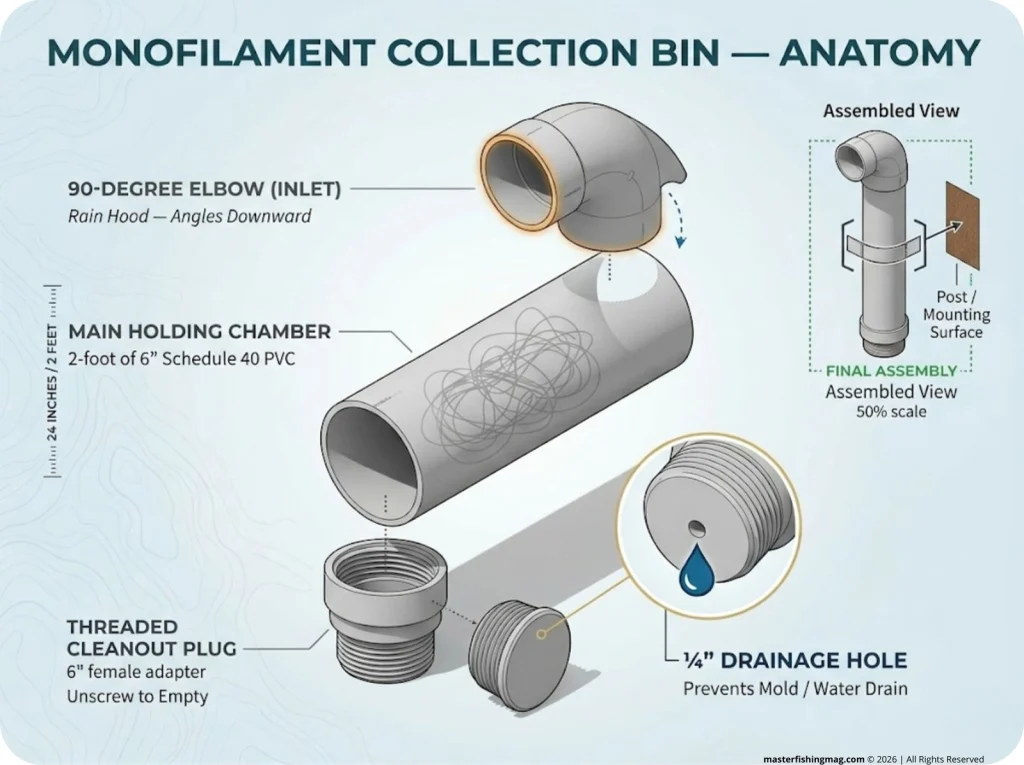
If you frequently fish a public launch that doesn’t have a dedicated disposal station, don’t wait for your state parks department to notice. It takes about forty dollars in plumbing supplies and twenty minutes of work to build a PVC collection bin yourself. Building these stations goes hand-in-hand with broader angler habitat restoration initiatives, providing a physical focal point for environmental stewardship right where the problem starts. The BoatUS Foundation actually runs programs granting money and decals for exactly this type of project. I’ve built three of these for remote reservoirs, and they fill up surprisingly fast.
Sourcing the Schedule 40 PVC Parts
Go to your local home improvement store and head to the heavy plumbing aisle. You want thick Schedule 40 PVC, not the thin drainage pipe. You need exactly two feet of 6-inch diameter straight PVC pipe to act as the main holding chamber. For the bottom, buy a heavy 6-inch female threaded adapter and the matching screw-in plug, so the volunteers can unscrew the bottom to empty the line. For the top entry port, buy a 6-inch 90-degree elbow joint. PVC glue is optional if you want to permanently fuse the top elbow, but standard friction fit usually works fine if you pound it on with a rubber mallet.
Moisture Management and Drainage
A fatal flaw in many amateur bins is water accumulation. If it rains sideways, water will eventually push past the elbow and settle in the bottom holding chamber. When monofilament sits in stagnant water for weeks, it grows thick coats of mold and hard mildew. This heavily contaminates the plastic, rendering the entire batch useless for the Berkley melt stream. To fix this, flip the bottom threaded plug upside down on your workbench and use your drill to punch a simple 1/4-inch drainage hole straight through the center. This lets water weep out immediately without letting any balled-up line escape.
Labeling and Securing to the Boat Ramp
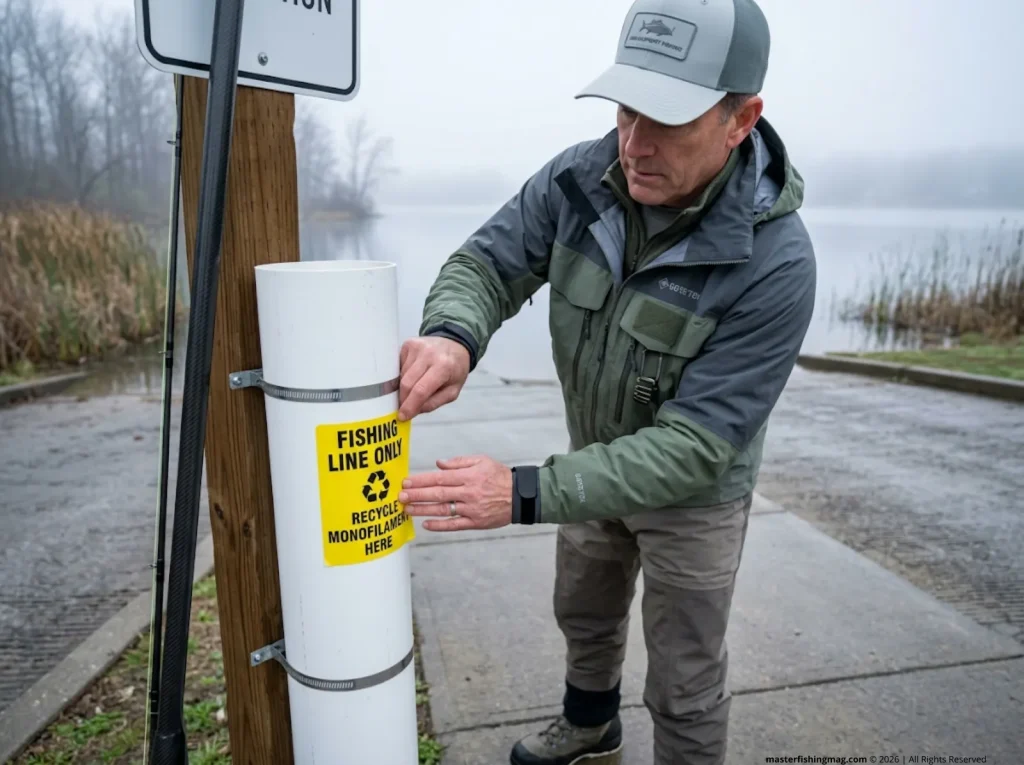
Once assembled, mount the bin. You can’t just screw through the side of the PVC pipe, or the sharp screw heads inside will snag the line when someone tries to empty it. Instead, wrap heavy-duty galvanized steel strapping tape entirely around the outside of the tube, securing the metal straps directly to a heavy wooden post at the boat launch. When installing the top 90-degree elbow, make sure to angle the open mouth slightly downward toward the ground. This acts as a heavy-duty rain hood stopping wind-driven moisture. Finally, apply clear, UV-resistant decals directly to the front face stating “Fishing Line Only” to deter people from shoving garbage inside. You can grab official BoatUS Foundation bin specifications and waterproof decals straight from their Reel In and Recycle program portal.
Conclusion
The complex polymers that provide our fishing tackle with incredible tensile strength and abrasion resistance are the exact same materials that threaten aquatic ecosystems and shut down industrial recycling facilities. You now know for a fact that blue curbside bins are dangerous, that braided polyethylene must be chopped into 6-inch sections for the trash, and that pure monofilament should be routed entirely through the Berkley pipeline. Take ten seconds to prep your line correctly during your next gear teardown in the garage—protecting our marine wildlife protection goals is the easiest conservation win in fishing, demanding practically nothing but your attention. Next time you spool up fresh fluorocarbon, you’ll know exactly what to do with the waste.
FAQ
Can you put fishing line in the recycle bin?
No, you should never throw fishing line into a regular curbside recycling bin. The high-tensile polymer acts as a dangerous tangler, wrapping tightly around the rotating gears of municipal sorting machinery and causing mechanical failures that halt the entire plant.
Does Berkley still recycle fishing line?
Yes, the dedicated Berkley Conservation Institute actively accepts and recycles nylon monofilament and fluorocarbon. They process the used plastic and pelletize it to create molded secondary products like hard plastic tackle boxes and large-scale artificial fish habitats.
How do you cut up fishing line for disposal?
Because it cannot be melted and recycled, you must use high-quality, serrated shears to cut braided fishing line into short segments measuring exactly 6 inches or less. This strict measurement ensures that if the line escapes the landfill, the chopped segments are physically too short to form hazardous tension loops that entangle birds or turtles.
Where can I throw away fishing hooks and line?
Fishing line should be placed loosely into the dedicated PVC drop-off bins at local boat ramps or mailed directly in a cardboard box to the Berkley Conservation Institute. All terminal tackle, including metal hooks, brass swivels, and lead weights, must be manually removed and safely discarded in your standard household trash to avoid contaminating the sensitive recycling melt stream.
Risk Disclaimer: Fishing, boating, and all related outdoor activities involve inherent risks that
can lead to injury. The information provided on Master Fishing Mag is for educational and informational purposes
only. While we strive for accuracy, the information, techniques, and advice on gear and safety are not a substitute
for your own best judgment, local knowledge, and adherence to official regulations. Fishing regulations, including
seasons, size limits, and species restrictions, change frequently and vary by location. Always consult the latest
official regulations from your local fish and wildlife agency before heading out. Proper handling of hooks, knives,
and other sharp equipment is essential for safety. Furthermore, be aware of local fish consumption advisories. By
using this website, you agree that you are solely responsible for your own safety and for complying with all
applicable laws. Any reliance you place on our content is strictly at your own risk. Master Fishing Mag and its
authors will not be held liable for any injury, damage, or loss sustained in connection with the use of the
information herein.
Affiliate Disclosure: We are a participant in the Amazon Services LLC Associates Program, an
affiliate advertising program designed to provide a means for us to earn advertising fees by advertising and linking
to Amazon.com. As an Amazon Associate, we earn from qualifying purchases. We also participate in other affiliate
programs and may receive a commission on products purchased through our links, at no extra cost to you. Additional
terms are found in the terms of service.






Do you recycle or dispose fly fishing fly line….I cut the loops into pieces but have no clue what to do with it. Can you offer any suggestions. I cut it before I realized that some places take it to make things out of.
Hi Carole! Great question. Instead of tossing cut-up fly line in the trash, check if there’s a fishing line recycling bin at your local tackle shop — many partner with Berkley’s Fishing Line Recycling Program and accept all types including fly line. If there’s no bin nearby, you can mail it directly to Berkley (their address is on the program’s page). As for repurposing, some crafters use old fly line for jewelry, coil art, or even garden ties — but honestly, recycling is the cleanest option since monofilament and PVC coatings don’t break down. Thanks for thinking about this instead of just tossing it!