
In this article
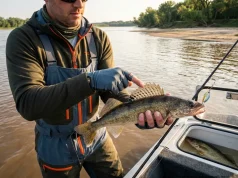
The fish came up heavy from twelve feet of chocolate-milk water at Indian Lake — golden flanks, fangs like a walleye, but something felt wrong. The dorsal fin had vertical streaks instead of the clear membrane I expected, and the cheek felt like 80-grit sandpaper under my thumb. I’d been catching saugeye for two years and calling them walleye.
That mistake cost nothing except pride. But it costs fisheries managers millions in misreported harvest data every year, and it costs anglers who apply the wrong tactics to the wrong fish. This guide shows you how to separate the three percids in under thirty seconds on the bank, then walks through the seasonal tactics, modern gear systems, and conservation practices that turn a misidentified bycatch into a targeted pursuit.
⚡ Quick Answer: The saugeye is a hatchery hybrid created by crossing a female walleye with a male sauger. Identify it using the Dorsal Test: look for dark vertical bars and 1-2 rows of spots on a dusky, opaque membrane — neither the clear fin of a walleye nor the spotted fin of a sauger. Confirm with the cheek scale roughness test — if the cheek feels rough like sandpaper, it’s a hybrid. Ohio alone stocks over 23 million saugeye annually, and the current world record stands at 15 lbs 10 oz from Fort Peck Reservoir, Montana.
The Dorsal Test — How to Tell Walleye, Sauger, and Saugeye Apart
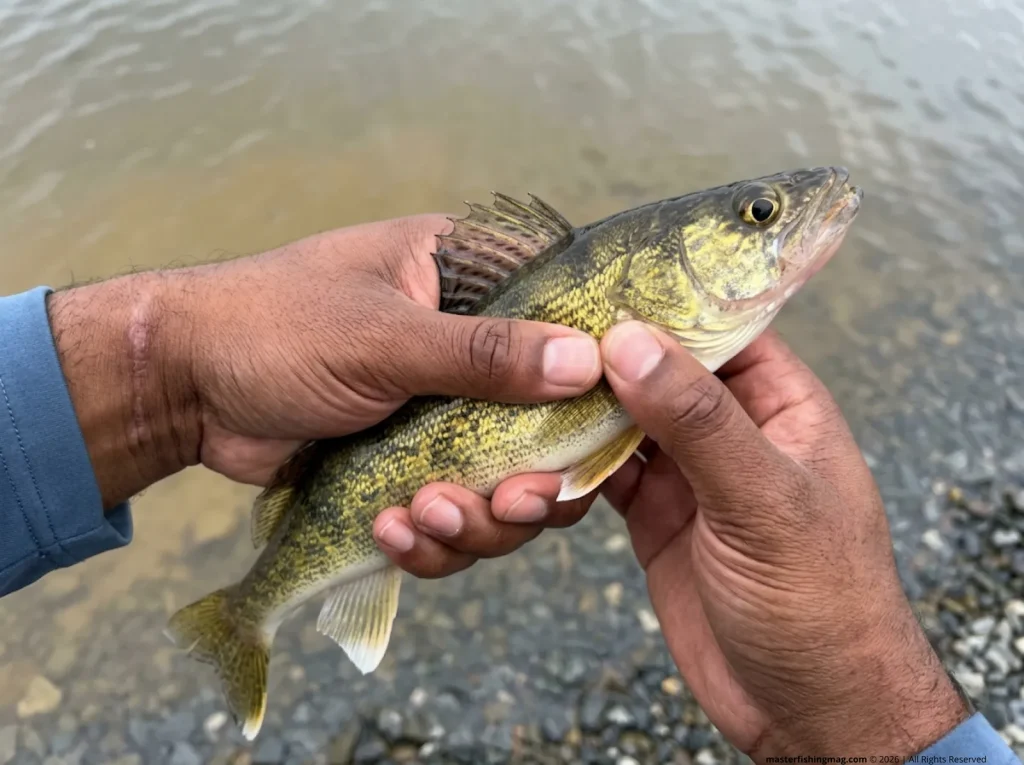
Most anglers guess species by body color. That approach fails before it starts. A “Greenback” walleye pulled from Lake Winnipeg looks nothing like a golden one from an Ohio reservoir. Color shifts with water clarity, diet, and age. You need structural markers — anatomy that doesn’t change with the seasons.
Reading the Spiny Dorsal Membrane
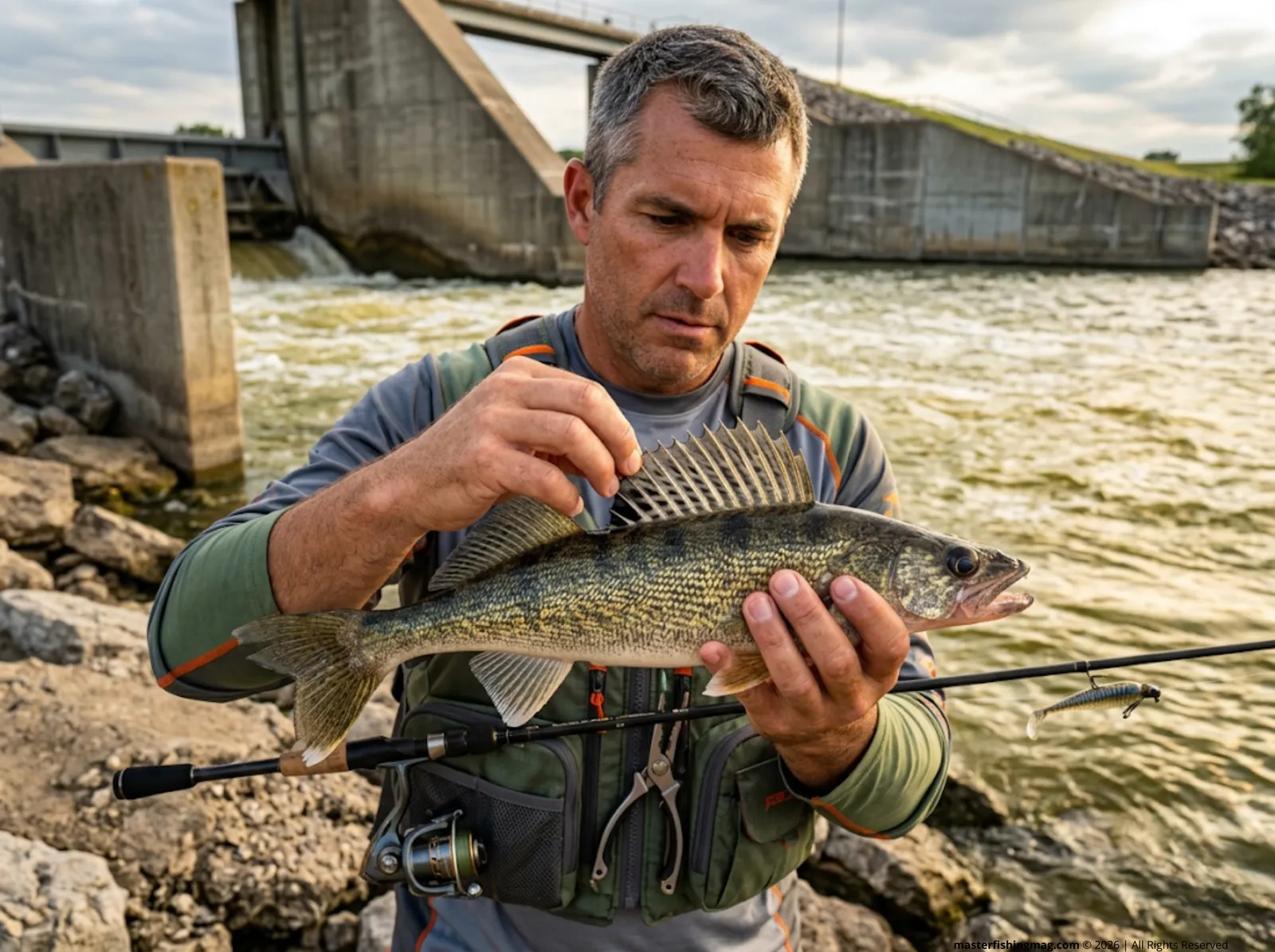
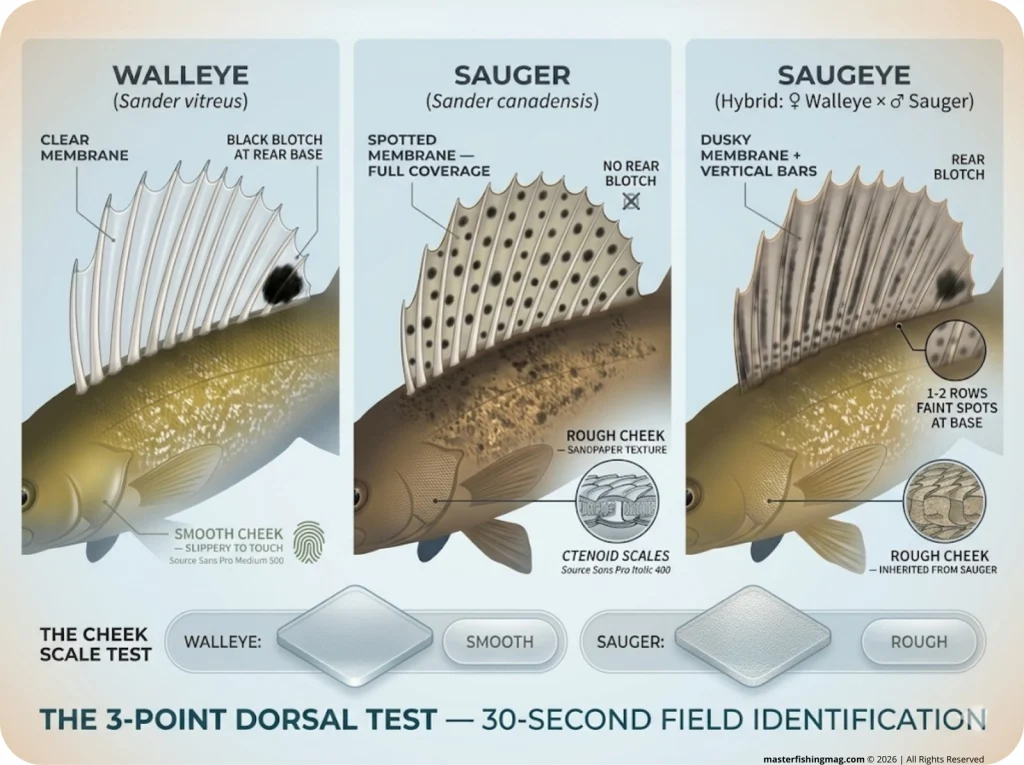
The spiny dorsal fin is your primary diagnostic tool. Spread it upright with a wet thumb and read the membrane between the spines.
A walleye dorsal is translucent to clear with no spots. The only pigment is a single large black blotch at the rear base — a dense cluster of melanophore cells at the posterior edge. Clean membrane, rear blotch — walleye. Full stop.
A sauger dorsal is the opposite. Distinct circular dark spots spread across the entire fin, no rear blotch. If spots cover the whole membrane like a scatter pattern, you’re holding a sauger.
The saugeye dorsal is where it gets interesting. The hybrid inherits competing genetic instructions — “spot it” from the sauger and “clear it” from the walleye. The result is a mosaic that exists in neither parent: dark vertical bars and streaks along the spines, with 1-2 rows of faint spots near the base. The membrane itself is dusky and opaque. That dusky membrane with vertical streaking is the saugeye’s fingerprint.
The Tactile Cheek Test — The 100% Field Confirmation
When the dorsal fin is torn up from a fight or collapsed in a net, you need a backup. The cheek scale roughness test is the only non-genetic method that’s 100% reliable.
Run your wet thumb firmly across the fish’s cheek, just below the eye. Walleye cheeks are smooth — almost slippery. Sauger and saugeye inherit ctenoid scales on their cheeks from the sauger parent, giving them a sandpaper texture.
Daryl Bauer from Nebraska Game and Parks puts it plainly: “If I have a fish that has at least some walleye characteristics and rough ‘cheeks,’ I conclude it is some combination of saugeye.”
According to peer-reviewed genetic analysis, SNP analysis resolves 20,038 polymorphisms, but that is lab work. On the bank, a smooth cheek means walleye. A rough cheek on a walleye-looking fish means hybrid. Every time. Understanding why your walleye tactics fail on sauger every time is the tactical payoff of getting the ID right.
The Caudal (Tail) Fin — Third Diagnostic Layer
The tail tip offers one more anatomical clue. A walleye possesses a large, high-contrast white patch on the lower tail lobe. A sauger has a thin, uniform pale margin with essentially no white patch. The saugeye displays an intermediate state — the white tip is more pronounced than a sauger’s line but less expansive than a walleye’s patch.
Pro tip: The white patch on a walleye’s tail is a patch. On a sauger, it’s a line. On a saugeye, it’s a mystery in between. Use the caudal fin as your secondary check after the dorsal.
Why Saugeye Exist — Hybrid Vigor and the Reservoir Problem
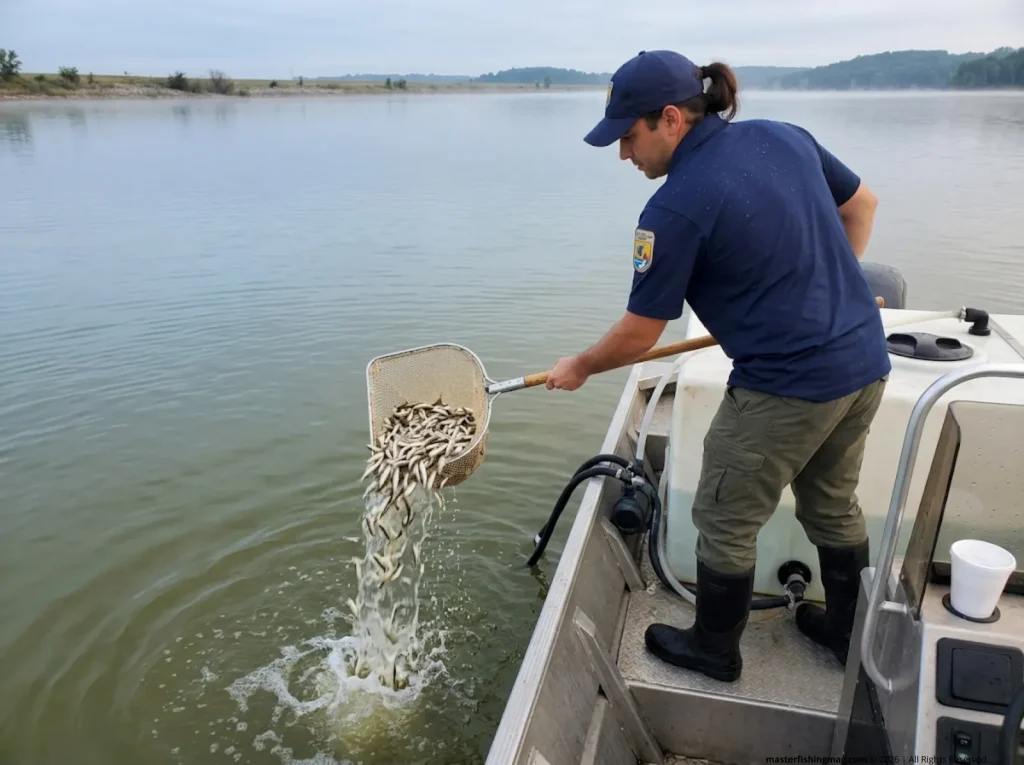
Saugeye aren’t an accident. They’re engineered fish built to solve a specific problem: walleye can’t survive in most midwestern reservoirs.
Hatchery Engineering and the Walleye’s Weakness
Pure-strain walleye need clear littoral zones to spawn successfully. Most midwestern flood-control reservoirs offer the opposite — high turbidity, heavy flow-through, and minimal spawning habitat. Walleye stocked into these systems fail to reproduce.
The fix was the saugeye hybrid: female walleye eggs fertilized with male sauger sperm. That cross direction is deliberate — walleye eggs are larger and produce hardier fry. The resulting fish inherits walleye size potential and the sauger’s ability to thrive in turbid water where walleye cease activity.
Hybrid vigor pushes growth rates to 2.0 grams per day — three to four times faster than yellow perch. Fish in Virginia’s Lake Anna hit 21 inches by age two. Ohio stocked 23 million saugeye across 50-plus reservoirs in 2024, the largest stocking program in the country. Natural hybridization occurs at only 2-4.1% in sympatric waters — nearly every saugeye you catch came from a hatchery tank.
Triploid Sterility — Protecting Native Walleye Genetics
When saugeye reproduce — and some can — their foreign genes infiltrate native walleye populations. Genetic studies on the Missouri River found that 12 of 173 fish identified as pure walleye were actually hybrids. That’s a 7% contamination rate.
The solution is triploid sterility. Hatchery workers expose fertilized eggs to high pressure immediately after fertilization, forcing the embryo to retain a third chromosome set rendering adults completely sterile. Ohio’s Grand Lake St. Marys received 217,000 triploid fingerlings in 2025 specifically to protect drainage systems feeding Lake Erie. In unmanaged systems like Tennessee’s Normandy Reservoir, backcrossing occurs at 68.6% frequency.
These same hybrid engineering principles apply across species. Our hybrid fish identification field guide for wipers and tiger muskies covers the broader family and the genetics behind each cross. The Ohio Division of Wildlife saugeye species identification guide provides the state’s official diagnostic reference.
Seasonal Saugeye Tactics — Matching Lure Speed to Metabolism
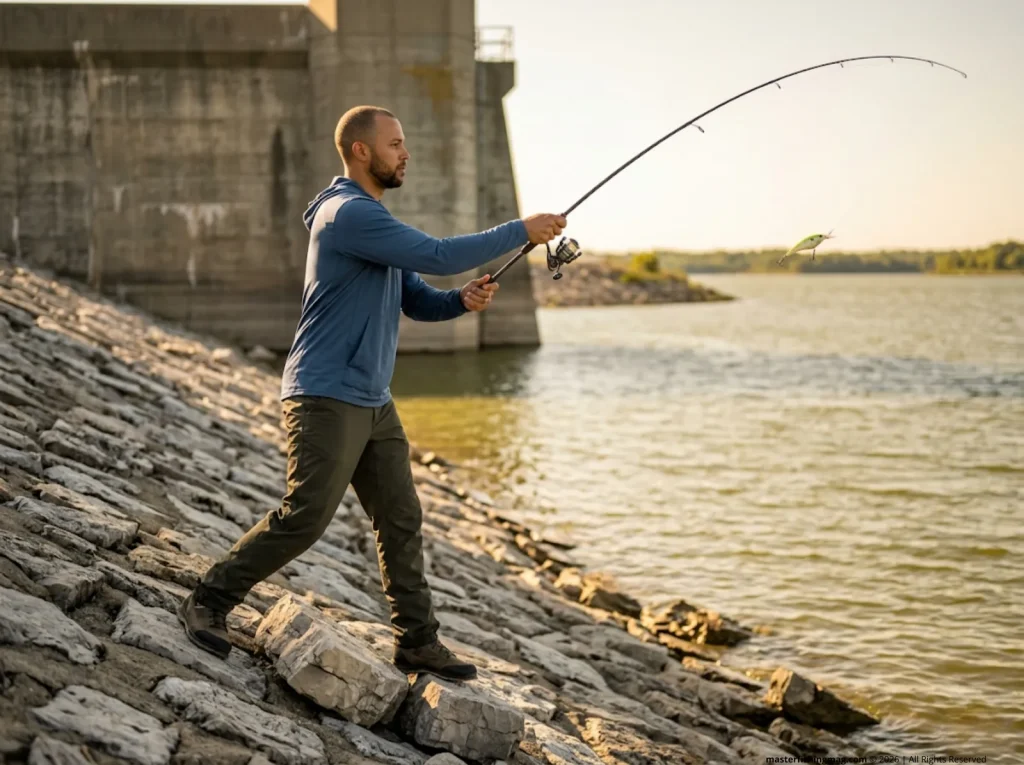
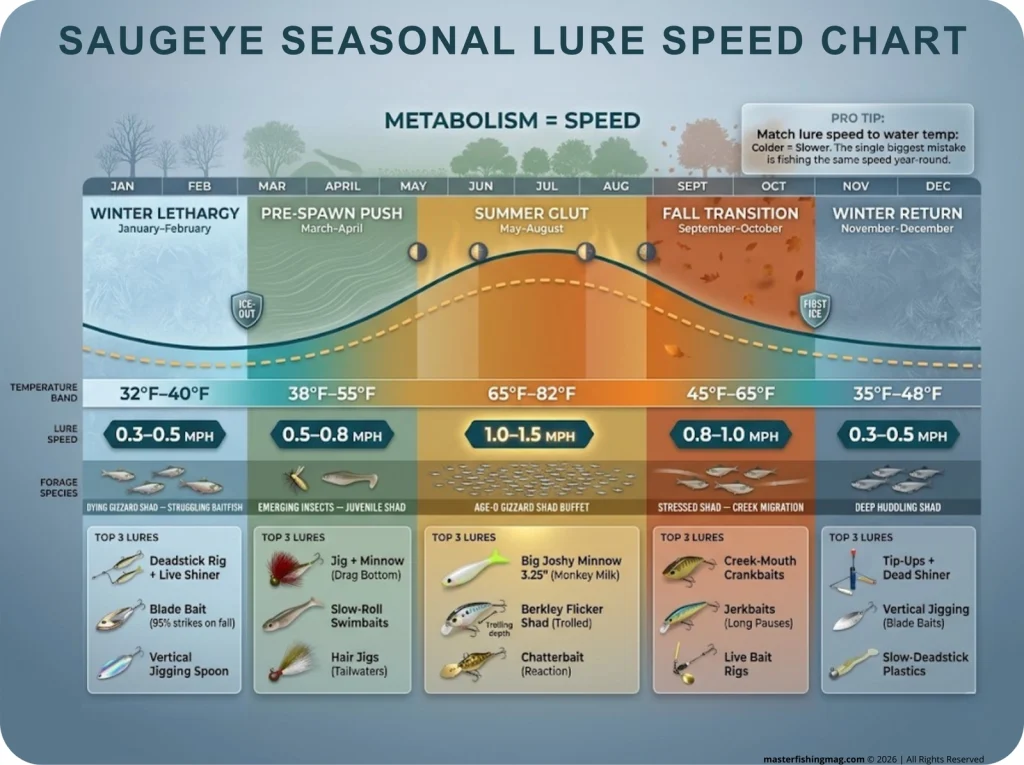
The single biggest mistake saugeye anglers make is fishing the same speed year-round. A saugeye’s metabolism dictates feeding aggression, and that metabolism swings hard between February and August.
Ice-Out Through Pre-Spawn (February–April)
Saugeye exhibit a mock spawn urge — a shoreward migration in February and March despite limited reproductive viability. They push into tailwaters and along riprap during full moon phases, sometimes holding in inches of water.
The hardcore regulars who fish below spillways in freezing rain know the current seam created by discharge turbulence is the high-percentage feeding zone. Movement triggers at 38-42°F, and lure speed needs to match: 0.5-0.8 mph, slow-rolling swimbaits or dragging a jig and minnow across bottom.
Pro tip: Cast parallel to the shoreline at sunset. Saugeye will often be in inches of water along the riprap, and a jig dragged parallel keeps your bait in the strike zone twenty times longer than a perpendicular cast.
Summer Glut (June–August)
Peak metabolic demand drives swimming speeds to 1.5 mph, and reservoirs flood with age-0 gizzard shad. The “buffet effect” makes your lure just another option in a sea of real food, confirmed by bioenergetics studies tracking prey demand.
Counter with reaction bites. Switch to high-vibration swimbaits — a Big Joshy 3.25-inch Minnow in Monkey Milk triggers the instinctive chase response. Rotate colors every twenty minutes. The saugeye switch turns on and off instantly.
During daylight, fish hold at 15-30 feet near submerged roadbeds and brush piles. After sunset, they push shallow onto flats. Only 7% of saugeye survive to age four — you’re targeting young, aggressive feeders. Understanding how water turbidity affects lure visibility and lateral line triggers is critical for color selection in stained water.
Fall Transition and Winter Lethargy (September–January)
Below 45°F, gizzard shad fade out in massive numbers and saugeye trail the struggling bait into creek arms and river mouths. Winter drops metabolism to a crawl — gentle vertical jigging with long pauses becomes the only reliable play. Deadstick rigs with live shiners and tip-ups produce through the ice. With blade baits, 95% of strikes happen on the downward pendulum.
The Twilight Edge — How the Tapetum Lucidum Dictates When Saugeye Feed
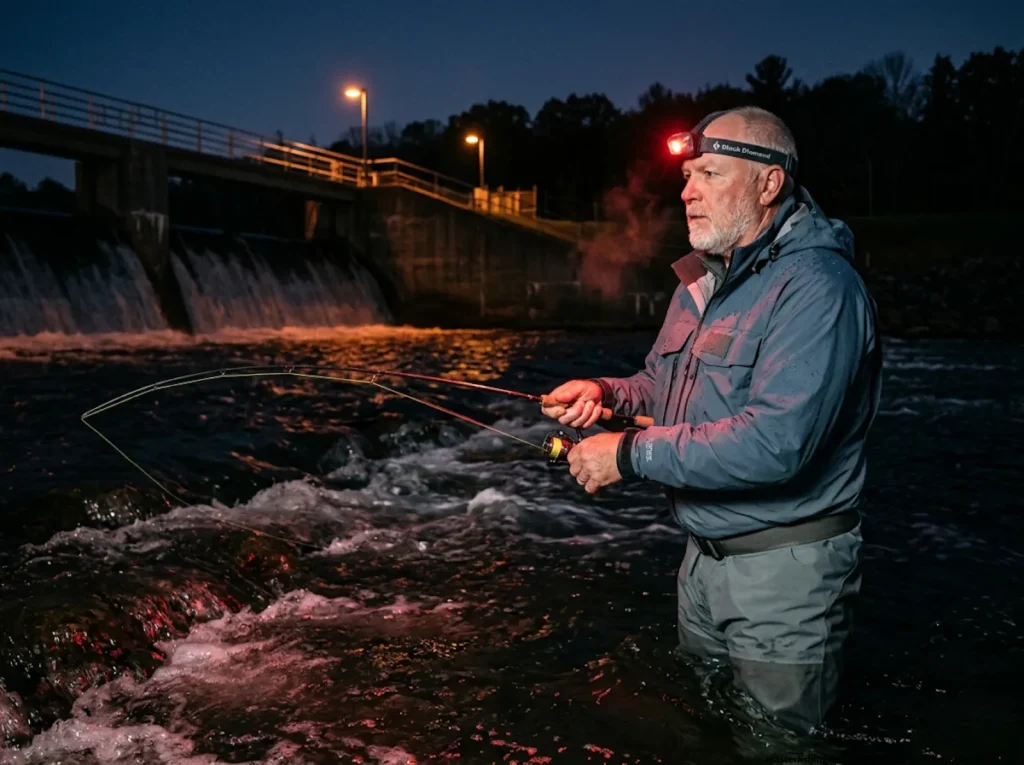
Saugeye eyes glow in the dark. That’s the tapetum lucidum — a layer of guanine crystals behind the retina that retroreflects photons through the photoreceptors a second time, doubling light absorption. Inherited from the sauger parent, this adaptation makes them the most effective low-light predator in any midwestern reservoir.
The Reflective Eye and Why Sunlight Drives Them Deep
In clear reservoirs, that sensitivity pushes saugeye to 40-plus feet during peak daylight to avoid retinal saturation. They’re not inactive — they’re hiding from the sun. Midday targeting in clear water is largely pointless unless you’re running forward facing sonar to pinpoint deep holding fish.
Two Tactical Windows — Twilight vs. Chocolate Milk
The twilight window — dusk until roughly two hours after sunset — is the classic feeding peak. Fish push from deep structure to shallow flats as ambient light drops into their comfort zone.
The chocolate milk window is rarer but more productive. After heavy spring runoff turns water opaque, saugeye become apex predators in knee-deep water. Their visual acuity gives them a mechanical advantage over functionally blind prey. Shorecasting from dams after dark with a red-light headlamp to preserve your night vision becomes the advanced play.
For a full guide on how to night fish safely and preserve your dark adaptation, that resource covers the tactical and safety framework you’ll need before your first twilight session.
Advanced Gear Systems — BFS Casting and Forward Facing Sonar
 Garmin LiveScope to target saugeye on midwestern lake” class=”wp-image-11665″/>
Two innovations transformed saugeye fishing from towing crankbaits blindly into precision one-on-one hunting.
The Bait Finesse System (BFS) — Precision on Ultra-Light Tackle
A Bait Finesse System optimizes baitcasting gear for lures between 1/32oz and 1/8oz on 4-6lb test. For saugeye, BFS solves three problems spinning gear can’t.
First, startup resistance. Shallow spools — like the 5.6-gram unit in a KastKing Kestrel — rotate with almost no lure mass, so a 1/32oz tungsten jig head actually casts. Second, precision. Thumbing the spool parks a micro-jig against rock crevices where saugeye hold during daylight. Third, haptic sensitivity. Palming the reel frame lets you feel the strolling bite — where the bait goes weightless instead of producing a tick.
Pair BFS with field-tested tungsten jig heads ranked by sonar visibility and sensitivity for the best combination of casting distance and bottom contact feel. Tungsten’s 70% density advantage over lead means a smaller profile, sharper feedback, and better FFS returns.
Pro tip: If you can’t feel the bite, you’re not holding the reel correctly. Palm it — don’t grip it. The weightless strolling bite transmits through the frame, not through the rod.
Forward Facing Sonar (FFS) — Reading the Saugeye Signature
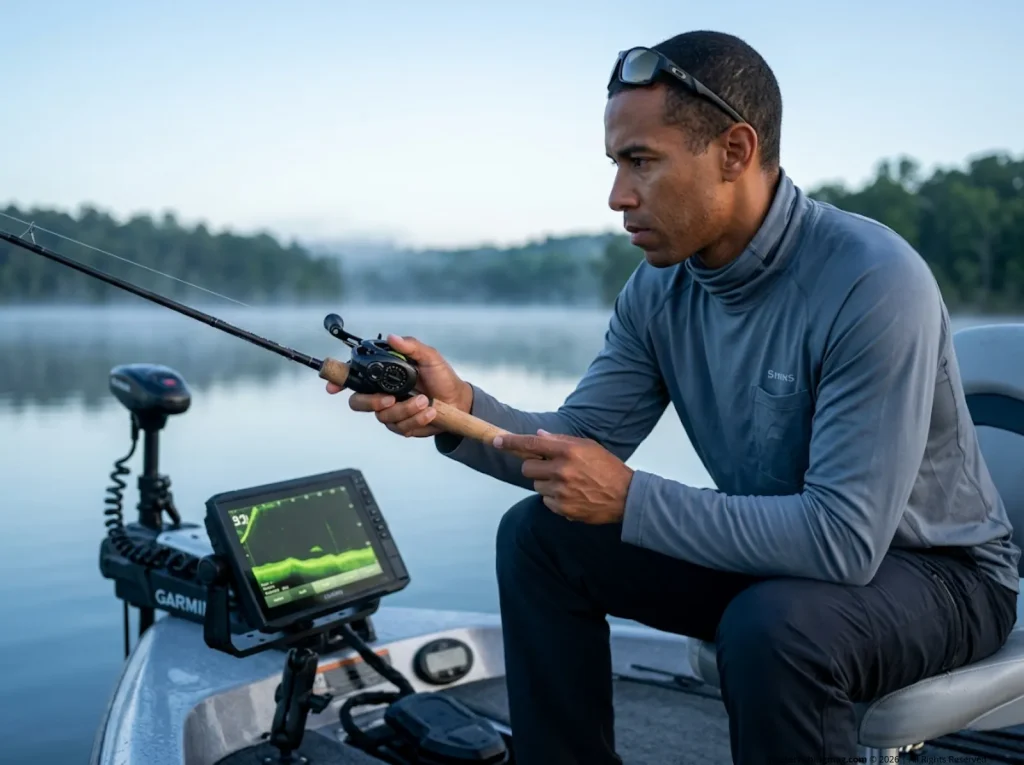
Forward facing sonar — Garmin LiveScope, Lowrance ActiveTarget, Humminbird MEGA Live — replaced blind trolling with sight-fishing on sonar. But reading the screen matters as much as owning the unit.
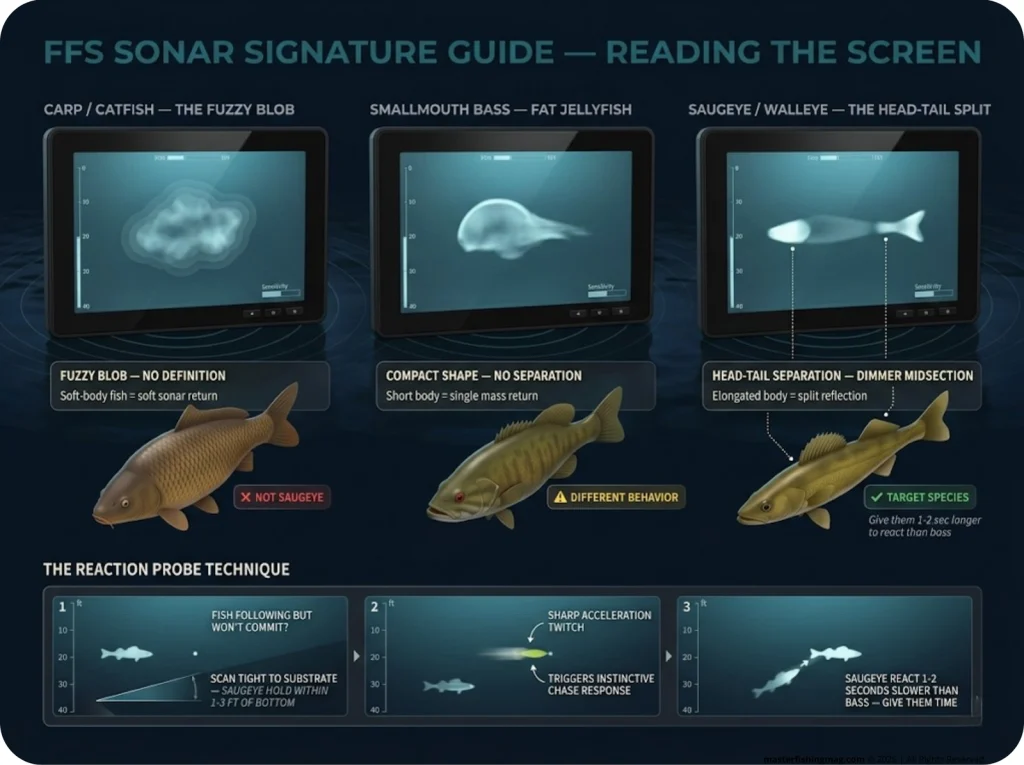
Saugeye paint as solid, crisp images. Carp and catfish paint fuzzy blobs. The diagnostic is the broadside signature: a mature fish turns perpendicular to the transducer and appears as two separate marks — head mass and tail mass reflecting independently, with a dimmer midsection. Dylan Nussbaum describes the shift: “FFS helps us pinpoint and cast to individual big fish, one-on-one with a favorite lure, as opposed to towing lures around the general vicinity of a school.”
Scan tight to the substrate — saugeye hold within the bottom one to three feet. If a mark follows but won’t commit, try the reaction probe: a sharp acceleration twitch that triggers the instinctive chase. Saugeye react one to two seconds slower than bass, so give them time.
Reading the physical line complements what you see on screen. Our guide on visual line watching for finesse bite detection in clear water covers the technique for catching the weightless bite that FFS won’t show you.
Ethical Stewardship — Barotrauma Physics and the Lead-Free Transition
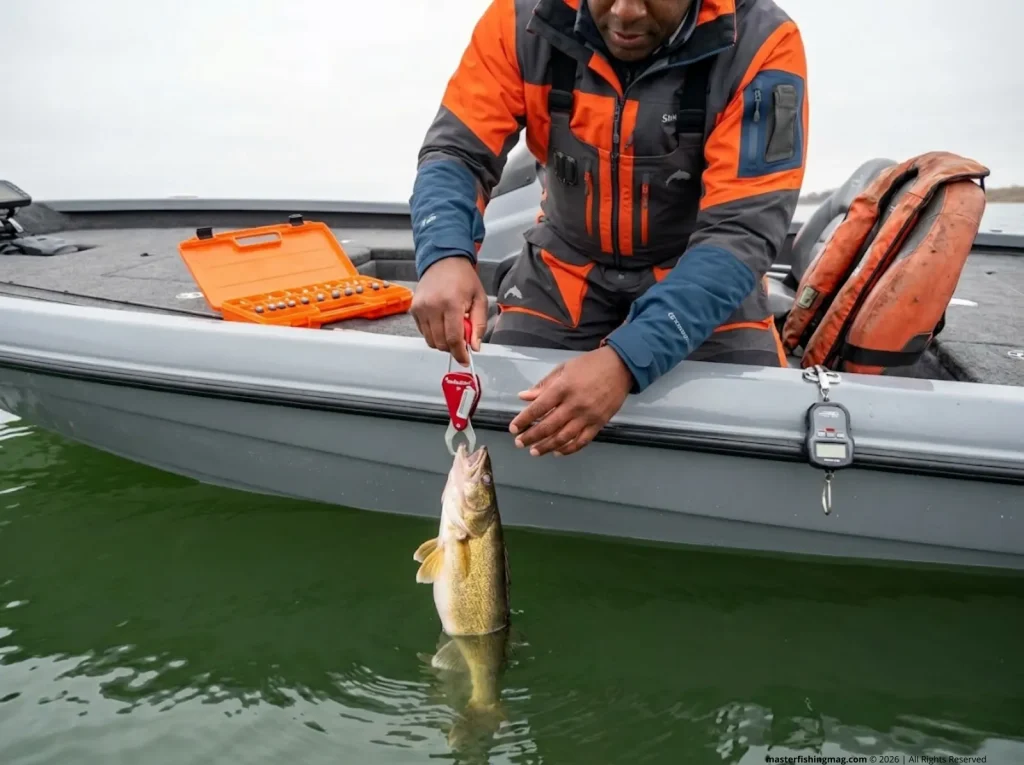
You aren’t a serious saugeye angler if you ignore what happens after the fish leaves your hands.
Boyle’s Law and Mechanical Recompression
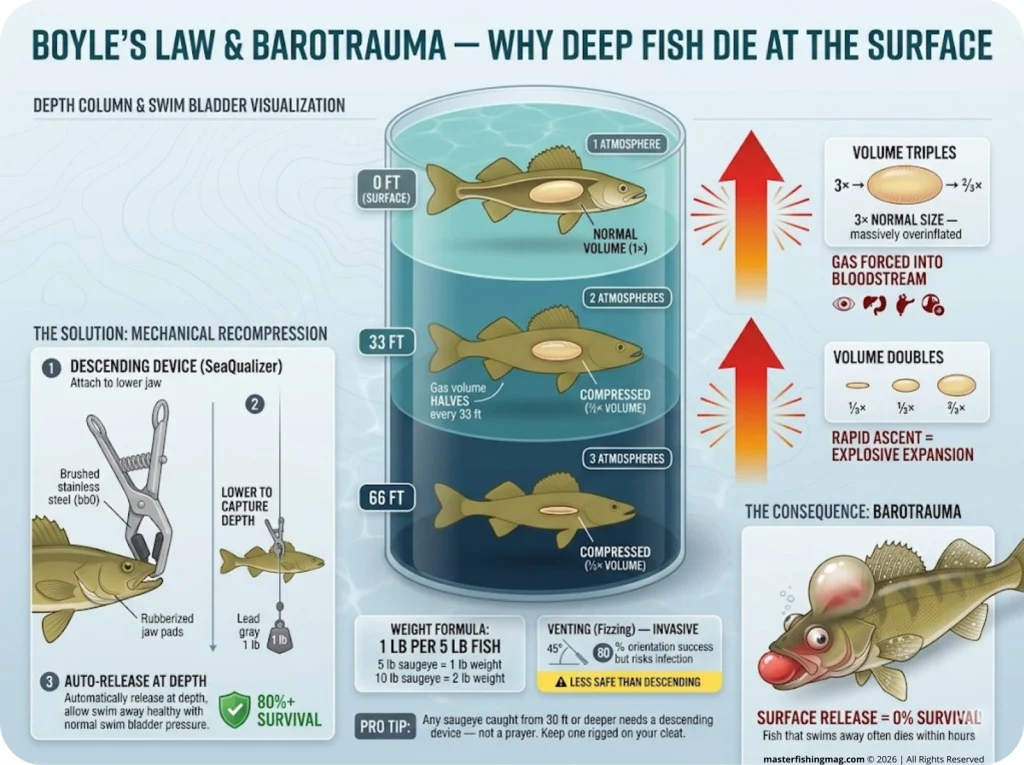
Saugeye have a closed swim bladder (physoclistous) — a sealed chamber with no duct to the esophagus. Unlike bass, they can’t burp excess air.
Every 33 feet of water depth equals one additional atmosphere of pressure. Pull a fish from 33 feet and gas volume doubles on the way up. From 66 feet, it triples. That expansion forces gas into the bloodstream, creating embolisms in the eyes and organs. The fish that swims away at the surface doesn’t always survive.
Mechanical recompression with a descending device — the SeaQualizer is the standard — is the safest correction. Clip the jaw and lower using one pound of weight for every five pounds of fish. Venting with a fizzing needle at 45 degrees produces 80% orientation success, but it’s invasive and risks infection. Untreated surface release shows 0% descent success in controlled studies.
For the best fish descending devices rated for one-handed use, we’ve ranked the major options by reliability. The South Dakota Game, Fish and Parks barotrauma research for percids details the depth thresholds behind these recommendations.
Pro tip: Any saugeye caught from 30 feet or deeper needs a descending device, not a prayer. Keep one rigged and ready on your cleat — by the time you dig through a tackle bag, delayed mortality becomes likely.
Lead Toxicity and the Tungsten Performance Upgrade
One hundred thousand pieces of lead are lost annually in just five Minnesota lakes. Common loons perish within 10-21 days of ingesting a single split-shot sinker. Maine bans lead sinkers and bare jigs weighing one ounce or less. New Hampshire, New York, Vermont, and Massachusetts have active or pending restrictions.
The switch to lead-free tackle isn’t just regulatory compliance — it’s a performance upgrade. Tungsten is 70% denser than lead, producing a smaller profile, sharper haptic feedback off structure, and cleaner FFS returns. The Scribe Test is how enforcement checks: a key scratched against lead leaves a shiny streak because it’s soft. Tungsten and steel won’t scratch. Steel reacts to a magnet.
For a full understanding of why lead sinkers are a danger to wildlife and waterfowl, that resource covers every alternative currently available. The American Fisheries Society policy statement on lead tackle toxicity provides the ecological impact data.
Conclusion
Three things separate the angler who catches saugeye on purpose from the one who catches them by accident.
Identify first, fish second. The 3-Point Dorsal Test — membrane pattern, cheek roughness, tail tip — separates the three percids in under thirty seconds. A rough cheek on a walleye-looking fish means hybrid. Period.
Match your speed to the season. Drag a jig at 0.5 mph through a February tailwater. Run a Big Joshy at 1.5 mph through a July shad buffet. Lure speed is the most underappreciated variable in percid angling.
Handle deep fish like the pressure-sensitive animals they are. Anything from 30 feet needs a descending device. The fish that swims away at the surface often perishes within hours.
Next time you pull a golden percid from a turbid reservoir, run the cheek test before you run the camera. If it’s rough, you’ve identified one of the most deliberately engineered fish in North American freshwater. Fish it like you understand what it is.
FAQ
How do you tell the difference between a sauger and a saugeye?
Run the Dorsal Test. Sauger show distinct circular spots across the entire dorsal membrane. Saugeye show dark vertical bars with 1-2 rows of spots at the base. Both have rough cheeks, so the dorsal pattern is the separator.
Are saugeye good to eat?
Yes — fillets are virtually identical to walleye. Firm, white, mild-flavored meat. Standard percid cleaning: fillet, skin, remove the dark lateral line strip. Faster growth rates mean legal-size fillets sooner.
What is the best bait for saugeye?
A 1/8oz tungsten jig tipped with a Big Joshy Minnow in Monkey Milk covers 80% of situations. Summer: Berkley Flicker Shad trolled at 1.0-1.2 mph. Winter: deadstick with a live shiner.
Where do saugeye go in the summer?
They follow the gizzard shad. Daytime: 15-30 feet near structure to avoid retinal saturation. Dusk: shallow flats and riprap. Forward facing sonar is the most efficient locating tool.
Are saugeye sterile?
Functionally, most are — especially triploid-stocked fish. However, male saugeye crossed with female walleye can produce viable offspring at roughly 10% hatching rate. Ohio stocks triploid hybrids near Lake Erie specifically to prevent genetic introgression into wild walleye populations.
Risk Disclaimer: Fishing, boating, and all related outdoor activities involve inherent risks that
can lead to injury. The information provided on Master Fishing Mag is for educational and informational purposes
only. While we strive for accuracy, the information, techniques, and advice on gear and safety are not a substitute
for your own best judgment, local knowledge, and adherence to official regulations. Fishing regulations, including
seasons, size limits, and species restrictions, change frequently and vary by location. Always consult the latest
official regulations from your local fish and wildlife agency before heading out. Proper handling of hooks, knives,
and other sharp equipment is essential for safety. Furthermore, be aware of local fish consumption advisories. By
using this website, you agree that you are solely responsible for your own safety and for complying with all
applicable laws. Any reliance you place on our content is strictly at your own risk. Master Fishing Mag and its
authors will not be held liable for any injury, damage, or loss sustained in connection with the use of the
information herein.
Affiliate Disclosure: We are a participant in the Amazon Services LLC Associates Program, an
affiliate advertising program designed to provide a means for us to earn advertising fees by advertising and linking
to Amazon.com. As an Amazon Associate, we earn from qualifying purchases. We also participate in other affiliate
programs and may receive a commission on products purchased through our links, at no extra cost to you. Additional
terms are found in the terms of service.