

In this article
Ten miles offshore, the sun acts differently than it does on land. It doesn’t just shine down on you; it strikes from below. The sunlight bounces off the waves with an intensity that standard weather apps and the daily heat index don’t account for.
To make matters worse, a strong breeze can strip the moisture right off your skin before you even feel a bead of sweat. I’ve seen experienced commercial fishermen and dedicated hobbyists collapse not because they weren’t tough, but because they treated summer fishing operations like a hiking trail.
The open water hides its dangers well. Staying safe out here isn’t just about checking a box; it’s about understanding how your body works.
Heat exhaustion on a boat isn’t an annoyance. It is a major problem that can end your trip or land you in the hospital. This guide, built on guide-verified tips and MD-reviewed facts, will help you spot the difference between a hot afternoon and a medical emergency, so you can act with confidence.
Why is Heat Stress Different on the Water?
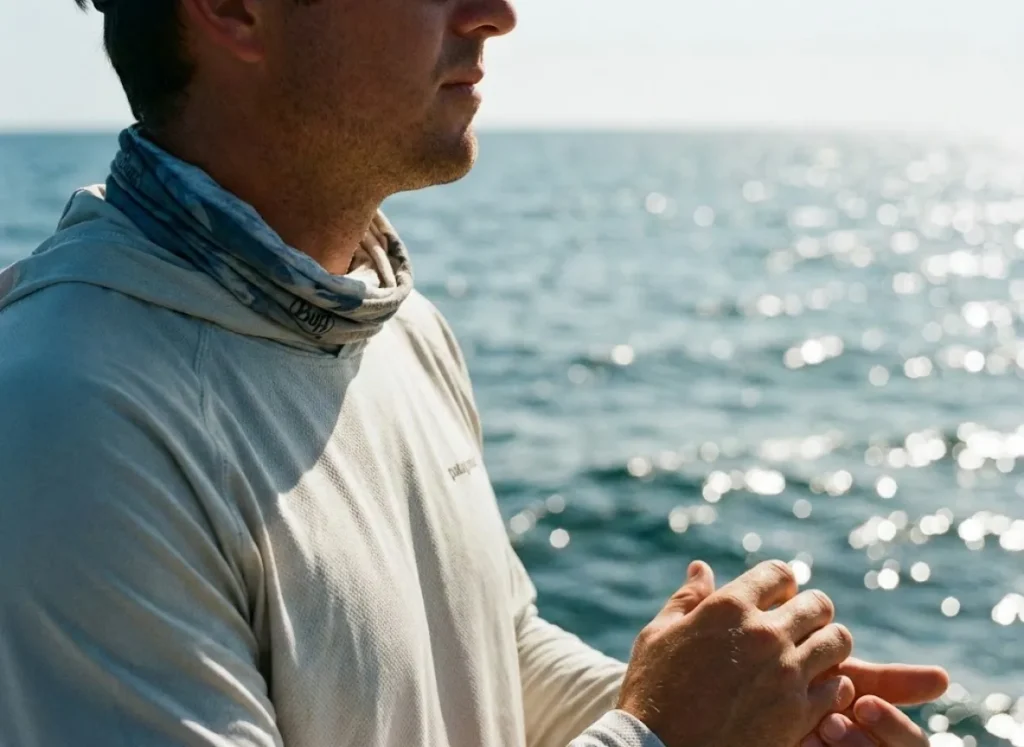
The ocean exposes your body to forces you simply don’t find in a forest or backyard. Understanding these invisible pressures is the first step toward preventative medicine on the water.
How the “Maritime Heat Multiplier” works
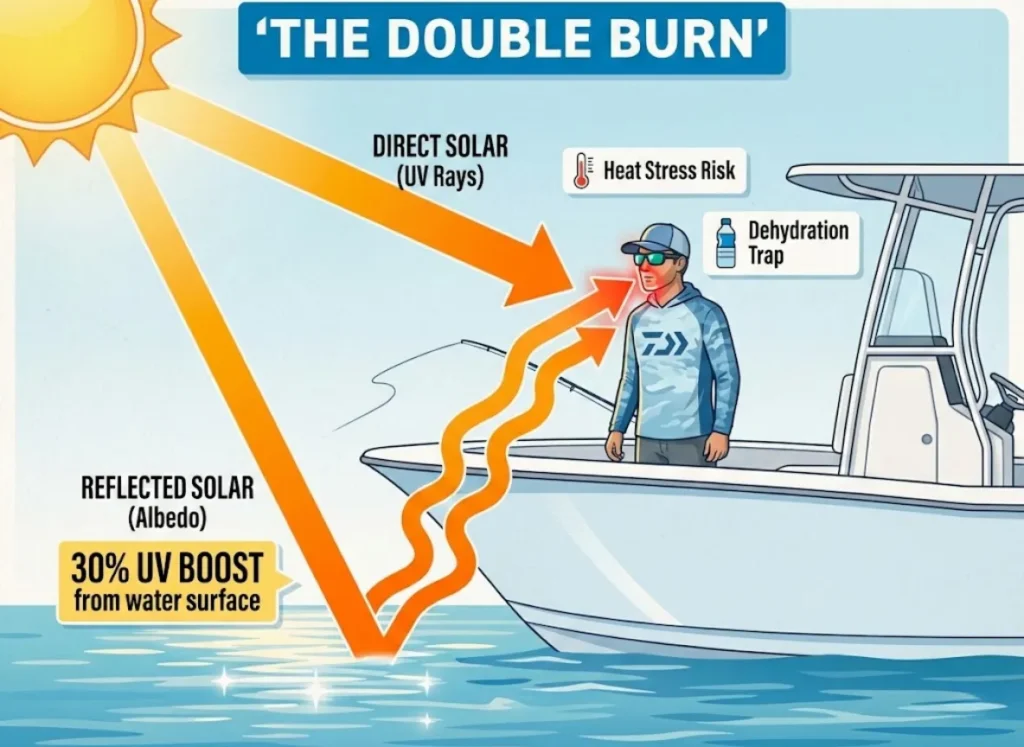
When you are on a boat, you deal with a “double burn.” You get direct UV rays coming down from the sky, just like on land. But you also get hit by radiation reflecting off the water’s surface.
White water and sea surf can reflect up to 30% of reflected UV rays. These rays bounce upward due to water surface reflection, hitting areas of your face that are usually shaded, like under your chin and nose.
This is why a standard baseball cap often isn’t enough to prevent sunburn risk or overheating. You need to understand the EPA Guide to UV Index and Albedo Effect to see why full-face protection is so important.
The “cool breeze” is often a trap, too. There is a specific turning point where the wind stops helping. If the air temperature is hotter than your body temperature (98.6°F), the wind doesn’t cool you down. It actually heats you up.
A boat running at 30 knots in 100°F air works like a convection oven. It dries out your skin without lowering your internal temperature. This tricks your brain. You don’t feel sweaty, so you don’t feel thirsty, even though you are drying out.
Just as you use the physics of glare and polarized sunglasses axis to see through the water, you have to understand this heat stress trap to survive on top of it.
Why humidity stops you from cooling down
Your body’s cooling mechanisms rely heavily on sweating. But for that to work, the sweat has to evaporate into the air.
When it is very humid, the air is already full of moisture. It cannot take any more water from your skin. You end up with “useless sweat.” It drips off your nose and elbows, draining your body of salt and water, but it doesn’t regulate body temperature at all.
The CDC and NIOSH Heat Stress Overview explains how this causes your core temperature to spike.
This creates a tug-of-war inside your chest. Your heart has to pump blood to your skin to try to cool off. But it also has to pump blood to your muscles so you can keep your balance on a rocking boat or reel in a fish.
Your heart ends up fighting itself. If you are suffering from dehydration, you don’t have enough blood volume to do both jobs. This can lead to fainting. It is hard to execute science-backed summer fishing strategies when your brain isn’t getting enough blood.
How Do You Recognize the Stages of Heat Illness?
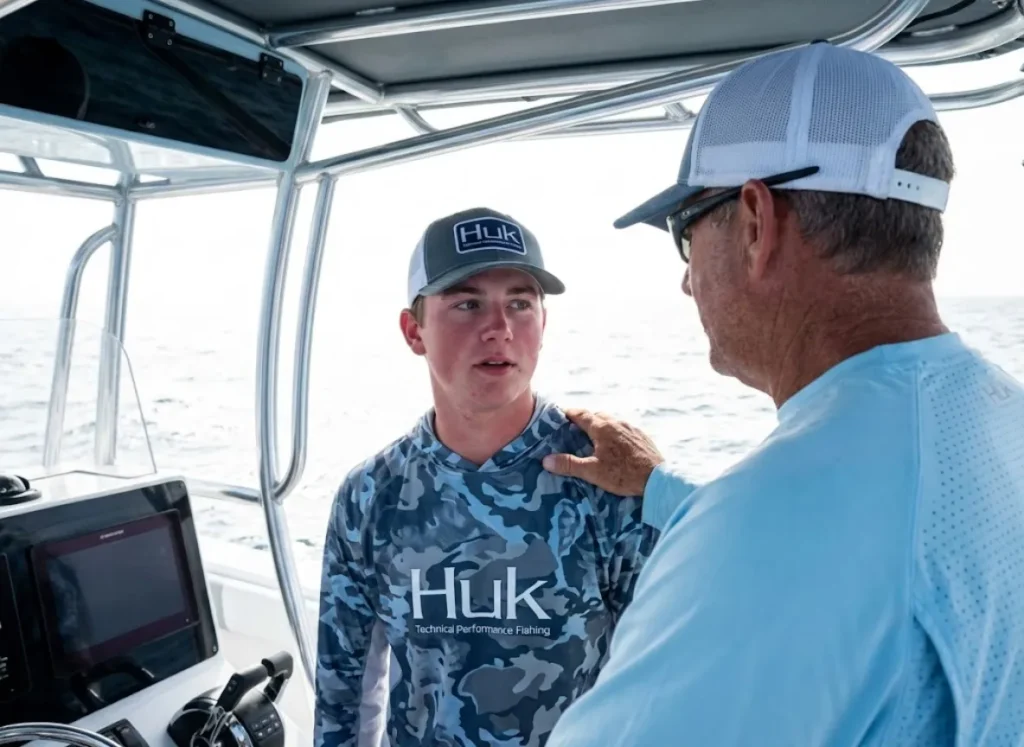
On land, you can just call an ambulance and wait. On the water, you are the first responder. You need simple ways to tell if your buddy is just hot or suffering from heat-related illnesses.
The difference between Heat Exhaustion and Heat Stroke
Think of Heat Exhaustion as a “Red Flag” and Heat Stroke as a “Mayday.”
Heat Exhaustion: The body is struggling, but the cooling system is still working. The biggest clue is the skin. It will be pale, cool, and clammy.
If they are sweating and feel cool to the touch, they are likely in heat exhaustion. They might also feel dizziness, nausea, muscle cramps, or have a rapid pulse.
Heat Stroke: This is a system failure. The main sign is that they stop sweating (though not always right away). Their skin will be hot, red, and dry. Lack of sweat combined with high heat is a critical warning.
| Heat Exhaustion vs. Heat Stroke Comparison | ||
|---|---|---|
| Feature | Heat Exhaustion | Heat Stroke |
| Skin Feel | Cool, pale, and clammy (moist). Profuse sweating is typically present. | Hot, red, and dry (classic presentation) or moist but radiating heat (exertional). Sweating often stops. |
| Pulse | Fast but weak (thready). | Rapid and strong (bounding). |
| Mental State | Alert and oriented. Patient may feel miserable, irritable, weak, dizzy, or nauseous. | Confused, delirious, irrational, slurred speech, or unconscious. |
| Action Required | Immediate Intervention: Stop all activity (“Lines In”), move to shade or AC, loosen clothing, apply cool wet cloths, and sip electrolytes/water slowly. | Medical Emergency: Call MAYDAY (VHF 16) immediately. Initiate aggressive cooling (immersion or ice packs to armpits/groin). Do NOT give fluids by mouth. |
The most dangerous sign is confusion. If the angler is confused, talking nonsense, or passes out, they have heat stroke.
Note: If someone just fought a big fish, they might still be wet from sweat. But if you touch their arm and it radiates heat like a radiator, that is a bad sign of high body temperatures.
You can look at the National Weather Service Heat Illness Symptoms list, but remember: on a boat, confusion is the ultimate warning. This is just as important as your other comprehensive fishing safety tips and protocols.
Immediate “Boat Tests” for diagnosis
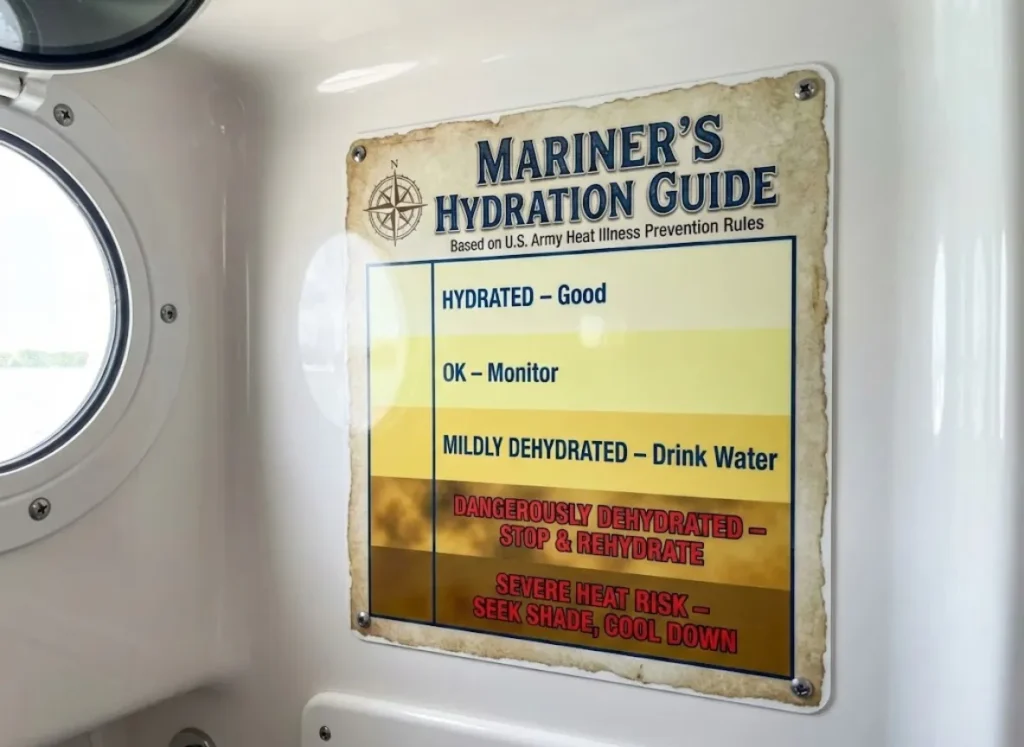
You don’t need medical gear to check your crew. Use the Urine Color Test and the Captain’s Quiz.
Keep an eye on hydration before things get bad. Follow the U.S. Army Heat Illness Prevention Pocket Guide rule: Dark yellow or tea-colored urine means you are dangerously dehydrated.
If someone looks sick, use the Captain’s Quiz to check their brain function. Ask simple questions:
- “Which way is North?”
- “What type bait are we using?”
- “What is my name?”
If they hesitate, slur their words, or look confused, assume it is Heat Stroke.
You also need to tell the difference between seasickness and heat injury. Seasickness usually comes with a cold sweat and misery, but the person is still mentally sharp. Heat stroke comes with confusion and a pounding pulse.
Warning: Do not trap them in the cabin. Never send a confused, hot person into a stuffy cabin to “sleep it off” thinking they are seasick. If it is heat stroke, the lack of air could be fatal.
What Are the Emergency Treatment Protocols?
Once you spot the danger, stop observing and start treating. You have to act fast with what you have on board.
How to treat Heat Exhaustion
Step 1: Lines In.
Stop fishing immediately. You cannot help someone while trying to drive the boat or watch lures. Just as cortisol in fish fight stress can kill a catch, the body heat from moving around can hurt your crew member.
Step 2: Relocate and Strip.
Get them into the shade, under the T-Top, canopy, or bimini top. Take off life jackets, bibs, and heavy shirts so the air can hit their skin.
Step 3: Active Cooling.
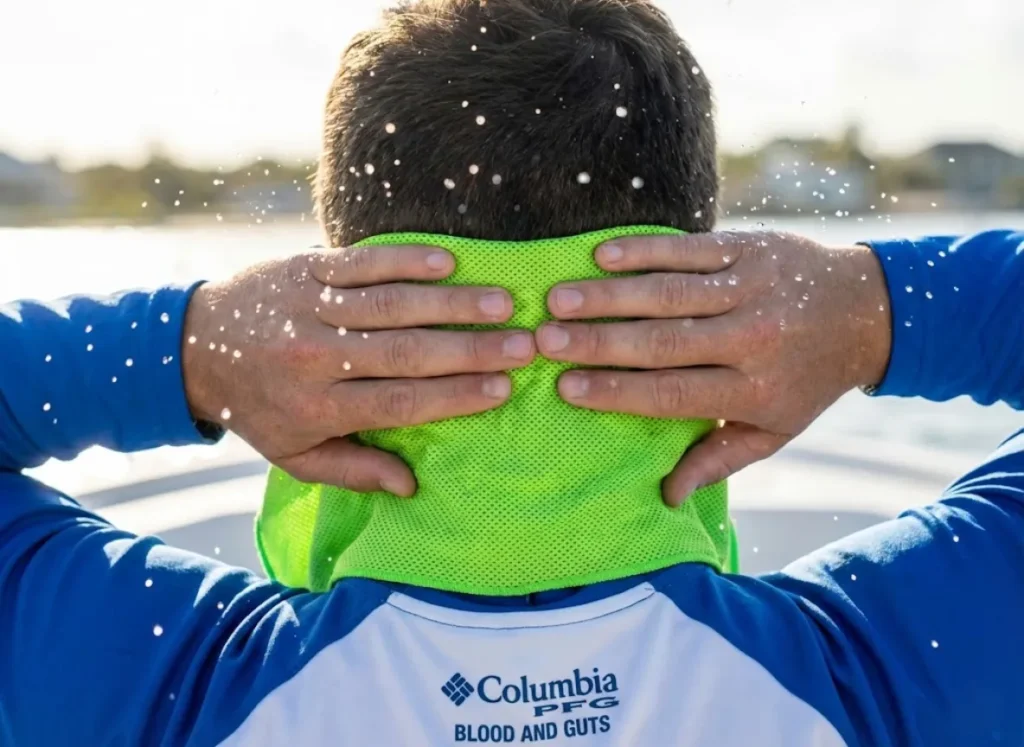
Put cool, wet towels on areas where blood flows close to the skin. This means the neck, armpits, and groin. This cools the blood as it moves through the body.
Step 4: Drink Slowly.
Give them cool water or electrolyte drinks. You need to replenish salt loss, specifically sodium and potassium. Have them sip slowly—about 4 ounces every 15 minutes.
Warning: Don’t let them chug the water. Drinking too fast can make them vomit, which loses more fluid and burns the stomach. Follow the Red Cross First Aid for Heat Exhaustion advice: no salt tablets and no caffeine.
The “Mayday” protocol for Heat Stroke
If the person is confused, passed out, or burning up, this is a Medical Emergency.
Immediate Signal:
Call for help on VHF Channel 16. Use “Pan-Pan” or “Mayday” depending on how bad they look. Heat stroke damages the brain, so time matters.
The “Polar Bear” Method:
While you talk to the Coast Guard, cool the patient down instantly. If it is safe, put them in cool water (like a large live well or shallow water at a sandbar) up to their neck.
If you can’t put them in water, wrap ice in a towel and pack it around their neck, armpits, and groin.
Airway Management:
If they are unconscious, roll them onto their side. This prevents them from choking if they throw up.
No Water by Mouth:
If they are confused or unconscious, do NOT try to force them to drink. Their swallowing muscles might not work, and they could choke.
Coordinate with the Coast Guard. Use your marine GPS units for precise navigation to meet the rescue boat. Reading the USCG Forcecom Heat/Cold Stress Manual ahead of time can help you stay calm during these moments.
How Can Gear and Biology Prevent Heat Failure?
A smart angler prevents the emergency before it happens by choosing the right technical apparel and watching nature.
Hydration and cooling gear that works
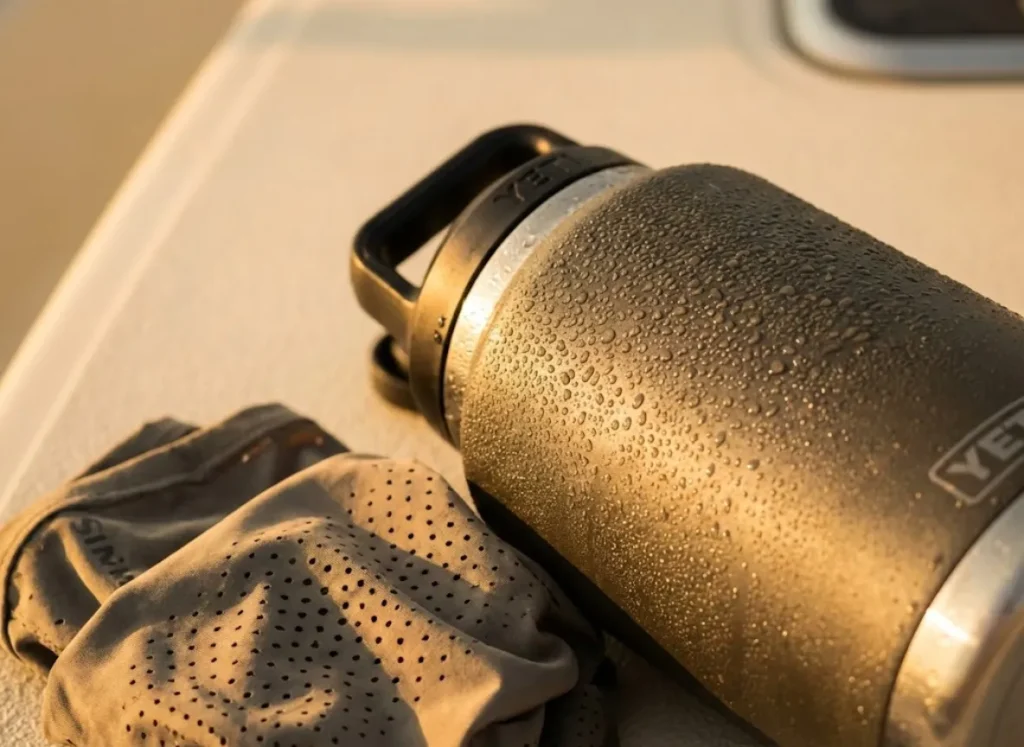
Prevention starts with your cooler. Use a high-quality, thick-walled cooler (like Yeti or RTIC) to make sure your ice lasts. You need to know you’ll have cold drinking water and ice for the whole trip.
Pro-Tip: Pre-cool your cooler the night before. If you put ice into a hot plastic cooler, the ice melts just trying to cool down the plastic. Put a “sacrifice bag” of ice in 12 hours before you leave to chill the insulation.
For staying cool, use cooling towels (like a PVA towel) or a neck gaiter / buff dipped in water. These are different from regular gym towels. They hold water for a long time and stay cool against your neck.
When picking clothes, look for UPF 50+ fishing shirts. This means the Ultraviolet Protection Factor is built into the thread, not just sprayed on. Look for moisture-wicking fabric made of breathable nylon or breathable polyester. Wear light-colored clothing to reflect the sun, and a wide-brimmed hat with polarized lenses to protect your head and eyes.
Understanding UPF clothing physics and protection helps you buy gear that actually works. The Cancer Council NSW on UV Factors explains why these small details matter so much.
How fish behavior predicts danger
The ocean gives you warnings if you know where to look. We call this the “Biological Sentinel.” It basically means: the same conditions that hurt the fish can hurt you.
Trout get stressed when water hits 68°F. Striped Bass get stressed over 75°F. If the summer heat is raising water temperatures enough to kill a fish—as shown by Canadian Science Publishing on Salmon Mortality—the sun is likely hot enough to hurt you, too.
Watch for sluggish fish behavior or fish holding in deep water structure to escape the heat.
Pro-Tip: Use your ethics as a safety check. If it’s too hot to safely release a fish because of low dissolved oxygen levels and fishing thresholds, it is probably too hot for you to be fighting it. If the fish are struggling to breathe, take a break, drink water, and get in the shade.
Final Thoughts
The “Maritime Heat Multiplier” makes a day on the water much harder on your body than a day on land.
Your safety comes down to knowing the symptoms.
- Sweaty and clammy? Treat for exhaustion.
- Dry and confused? Evacuate for stroke.
Developing a hydration strategy with pre-hydration works better than any medicine. Safety is a team effort. Use the “Captain’s Quiz” and keep an eye on your friends. Use the buddy system and take shaded rest breaks.
Before you leave the dock next time, print the “Heat Drill” checklist and talk it over with your crew. A five-minute chat can ensure everyone comes home safely.
FAQ – Frequently Asked Questions
Is it safe to take salt tablets to prevent heat cramps while fishing?
No. Salt tablets can upset your stomach and make you throw up, which dehydrates you even faster. It is safer to get your salt from sports drinks or snacks like pretzels and nuts, along with plenty of water.
Why do I feel colder when I’m actually overheating on a boat?
This is often a sign of heat exhaustion or impending stroke. When your body’s cooling system starts to fail, or if you go into shock from low fluids, you might get cold sweats and feel chills even if it’s 100 degrees out.
Can I drink beer to stay hydrated if it has low alcohol?
No. Alcohol avoidance is key. Alcohol makes you pee more than you drink. It stops a hormone in your body that helps you hold onto water. Drinking alcohol in the heat dries you out faster and messes up your judgment, so you might not realize you are getting sick.
What is the biggest risk for solo anglers?
The biggest risk is confusion. If you practice solo angler safety but get heat stroke, you might get too confused to drink water, call for help, or drive the boat home. You could end up helpless on the water.
Risk Disclaimer: Fishing, boating, and all related outdoor activities involve inherent risks that
can lead to injury. The information provided on Master Fishing Mag is for educational and informational purposes
only. While we strive for accuracy, the information, techniques, and advice on gear and safety are not a substitute
for your own best judgment, local knowledge, and adherence to official regulations. Fishing regulations, including
seasons, size limits, and species restrictions, change frequently and vary by location. Always consult the latest
official regulations from your local fish and wildlife agency before heading out. Proper handling of hooks, knives,
and other sharp equipment is essential for safety. Furthermore, be aware of local fish consumption advisories. By
using this website, you agree that you are solely responsible for your own safety and for complying with all
applicable laws. Any reliance you place on our content is strictly at your own risk. Master Fishing Mag and its
authors will not be held liable for any injury, damage, or loss sustained in connection with the use of the
information herein.
Affiliate Disclosure: We are a participant in the Amazon Services LLC Associates Program, an
affiliate advertising program designed to provide a means for us to earn advertising fees by advertising and linking
to Amazon.com. As an Amazon Associate, we earn from qualifying purchases. We also participate in other affiliate
programs and may receive a commission on products purchased through our links, at no extra cost to you. Additional
terms are found in the terms of service.