
In this article
The South Platte River runs through downtown Denver at rush hour. Two lanes of gridlocked commuters on one side, 750 trout per mile on the other. One of the densest wild trout fisheries in Colorado flows under four interstate bridges and alongside a bike trail where food trucks park on Fridays.
After fishing urban water across a dozen cities, here’s the honest truth: some city spots outfish rural destinations people drive four hours to reach. This guide covers 9 of the best urban fishing spots near major US cities, how to find equivalent water in any city you happen to be in, and the presentation adjustments that actually produce when the fish have seen every lure in the catalog.
Quick Answer: Some of the most productive urban fishing spots in the US are hiding in plain sight:
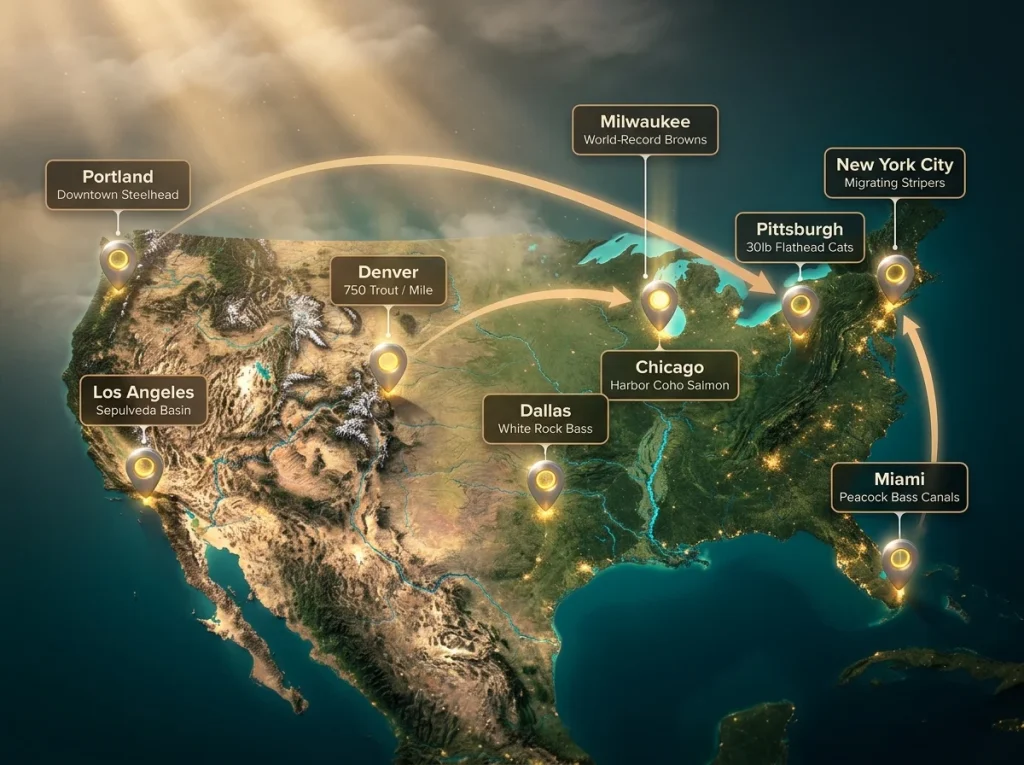
- Milwaukee — ice-free harbor holds former world-record brown trout
- Denver — South Platte runs 750 trout per mile through downtown
- Pittsburgh — flathead catfish pushing 30 lbs under city bridges
- New York City — striped bass migrate past Manhattan twice yearly
- Miami — only US city with peacock bass in its canal system
- Portland — chinook salmon and steelhead on the Willamette downtown
9 Urban Fishing Spots Worth the Subway Fare
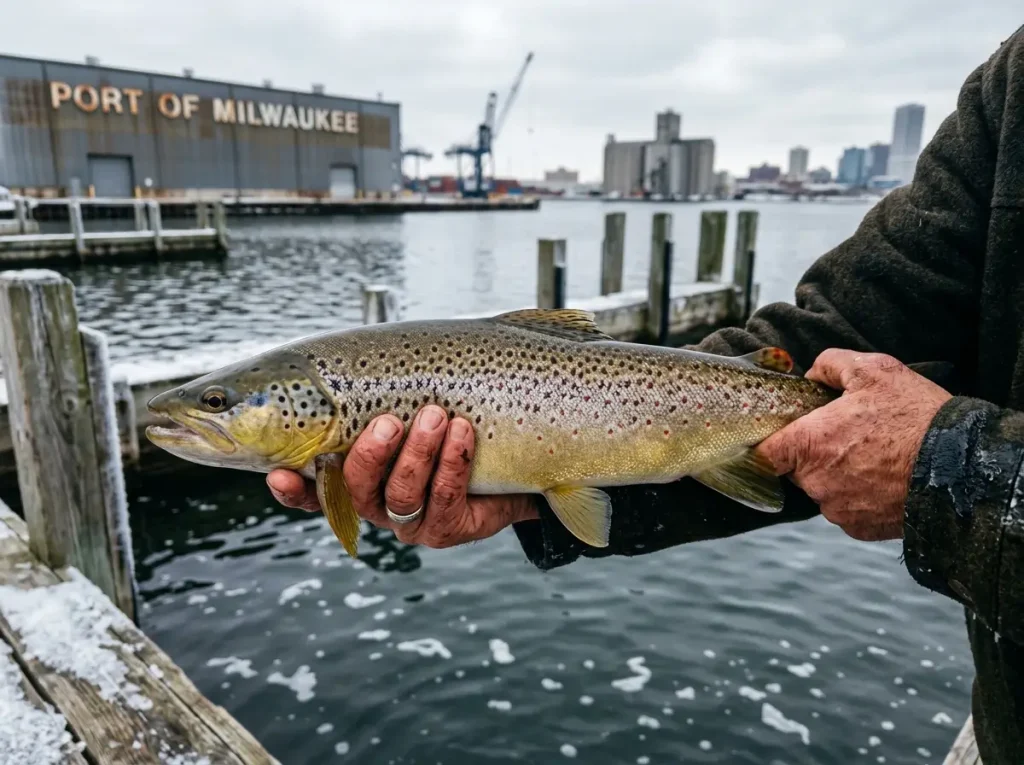
Every city on this list has water that produces. Not “produces for a city” — produces, period. These aren’t consolation fisheries for anglers who can’t get to the country.
Great Lakes Cities: Milwaukee and Chicago
Milwaukee’s Lake Michigan harbor doesn’t freeze. Warm water discharges from the city’s industrial infrastructure keep it open all winter while everything around it locks up. That ice-free window creates one of the best brown trout fisheries on the Great Lakes — a 41.8-pound brown, the former IFGA world record, came out of Racine harbor just up the shore.
Seventy-five percent of all annual brown trout catches in the Milwaukee and Racine harbor areas happen during a narrow window in late March and early April. Miss that window by two weeks and the fish scatter into open water.
The Milwaukee River itself runs steelhead in fall and winter, fishable on foot from downtown parks.
Chicago’s lakefront harbors — Monroe, Burnham, DuSable — stack coho salmon and brown trout in spring when lake-run fish stage near the breakwalls. Year-round, the harbors hold channel catfish and panfish for anglers who work the concrete piers.
Pro tip: In Milwaukee, the brown trout window is late March through mid-April. Get there during that three-week stretch and you’re fishing the densest urban trout concentration in the country. Show up in May and you’re wondering what everyone was talking about.
Inland Rivers Worth the Commute
Denver’s South Platte is the one that changes minds about city fishing. The 26-mile urban section from Chatfield Reservoir to 120th Avenue runs through the heart of the metro area, and Trout Unlimited’s documentation of the South Platte’s transformation shows fish counts hitting 750 per mile in the best stretches. The upper miles past C-470 hold wild trout in winter when water cools. In warmer months, the downtown stretch becomes a serious carp fishery — fish over 30 inches on the fly, right alongside the bike path.
Pittsburgh sits at the confluence of three rivers — the Allegheny, Monongahela, and Ohio. The same banks where Pirates fans tailgate hold flathead catfish pushing 30 pounds. The Allegheny produces solid smallmouth bass from its rocky structure, reachable by city bus.
Coastal, Sunbelt, and West Coast Options
New York City is surrounded by saltwater, and twice a year migrating striped bass and bluefish swim past the Manhattan skyline. The Hudson River’s west bank offers legitimate shore fishing during the spring and fall runs. Inland, Harlem Meer and Central Park Lake are stocked with bass, catfish, and bluegill — catch-and-release only, but the fish are real and the skyline backdrop is hard to beat.
Miami’s canal system holds peacock bass — Cichla ocellaris, a South American cichlid that fights harder than any largemouth and lives nowhere else in the continental US at this scale. The canals throughout Dade and Broward counties are accessible by bike or on foot. Tidal sections near the coast hold snook.
Portland’s Willamette River runs chinook salmon in fall and steelhead in winter and spring. Multiple bank fishing access points line the downtown stretch, no boat needed.
Dallas has White Rock Lake — a city-owned reservoir with documented largemouth bass over 8 pounds and regular urban angling events hosted by the city. Los Angeles has the Sepulveda Basin Wildlife Reserve in the San Fernando Valley, stocked with bass and catfish, and consistently more productive than the LA River stretch most people think of first.
Most of these fisheries exist because of stocking programs that keep urban waters productive — programs funded by license sales and run quietly by state agencies behind the scenes.
What Species Are Actually Living in City Water
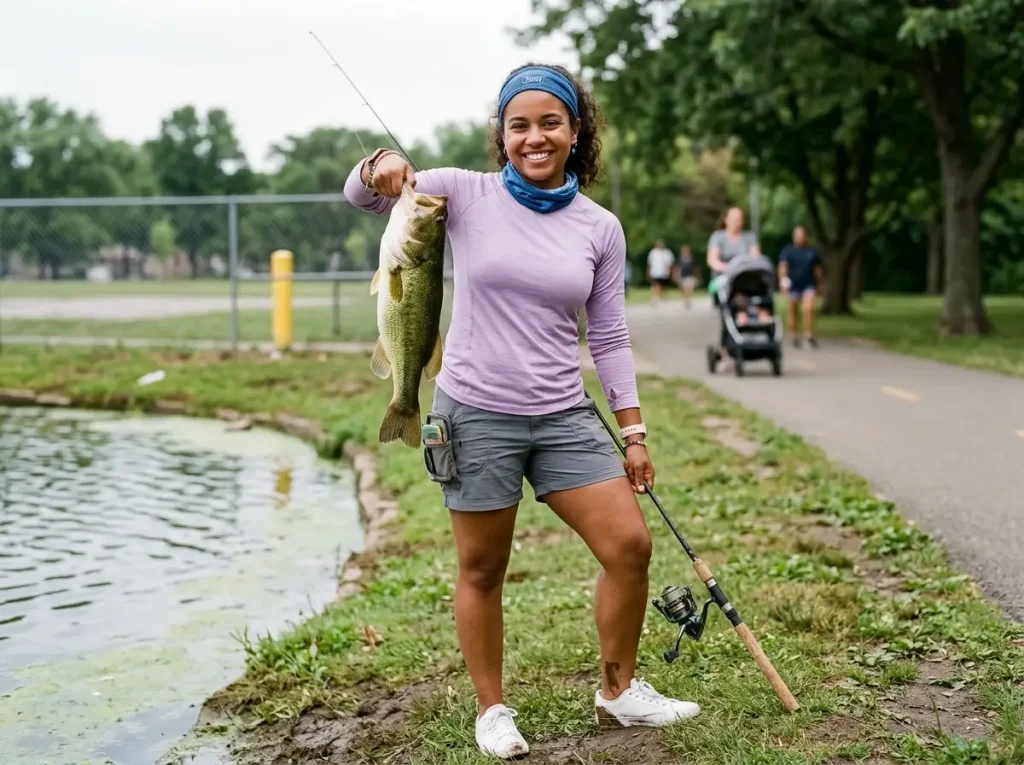
If you show up to an urban pond rigged for bass and the place is full of 15-pound common carp, you’re going to have a frustrating day. Know what’s swimming before you gear up.
The Core Urban Four
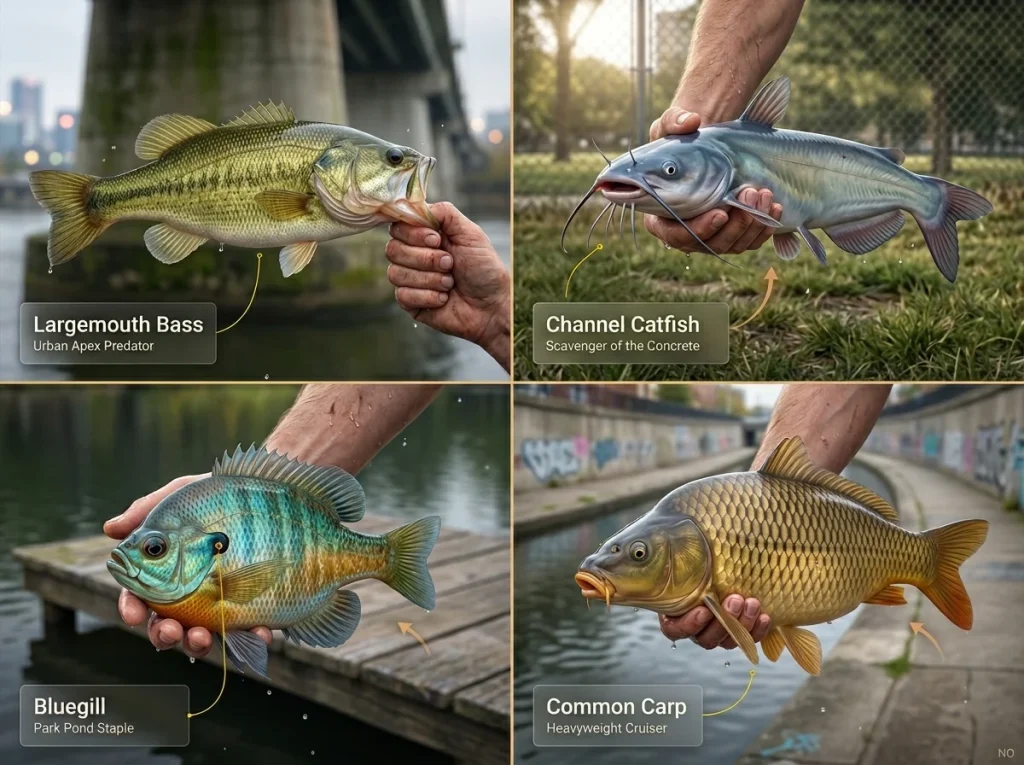
Four species dominate urban lakes, ponds, and canals from coast to coast: largemouth bass, channel catfish, bluegill and sunfish, and common carp. These fish tolerate lower water quality better than most freshwater species, reproduce reliably in stocked city ponds, and eat a wide range of bait and forage.
If you’ve never fished a particular city water before, assume these four are what’s down there.
Carp in particular get overlooked by American anglers who grew up chasing bass. In urban rivers and canals, carp are often the biggest and hardest-fighting fish available — and there are a lot of them. If you haven’t spent time understanding carp biology and what makes them the dominant urban species, you’re walking past some of the best fishing city water has to offer.
When Trout Shows Up in City Water
Trout in cities only happens under specific conditions. Cold tailwater inflow creates year-round habitat — that’s why Denver’s South Platte holds wild fish even through summer. Many state DNR programs stock rainbow trout in city ponds during winter months when water temperatures drop below 60°F. Indiana’s urban fishing program posts exact stocking dates online, and fishing within 48 hours of a plant is about as close to guaranteed action as this sport gets.
In Great Lakes cities, the game changes entirely. Lake-run brown trout, coho salmon, chinook, and steelhead pile into harbor areas and urban river mouths during their seasonal runs. Milwaukee and Chicago anglers intercept these fish from concrete piers and park banks — no boat, no charter, just showing up at the right time.
The Miami Exception: Peacock Bass and the Unexpected
Miami’s canal system is genuinely unique in the United States. Peacock bass were released in the 1960s as a biological control agent, and they now thrive throughout Dade County’s warm, connected canal network. The fight is explosive — faster and more aggressive than any largemouth of the same size.
If you fish the canals near Miami International Airport, you’ll encounter a species most US anglers have only seen in YouTube videos shot on the Amazon. There is nothing else like it in the country.
Coastal cities add another layer entirely. Striped bass and bluefish migrate past NYC, Boston, Baltimore, and DC during spring and fall runs. You can intercept world-class saltwater fish from public parks during peak windows — fishing that costs a plane ticket to reach in most contexts, available by subway here.
How to Scout Any Urban Fishing Spot Before You Leave the House
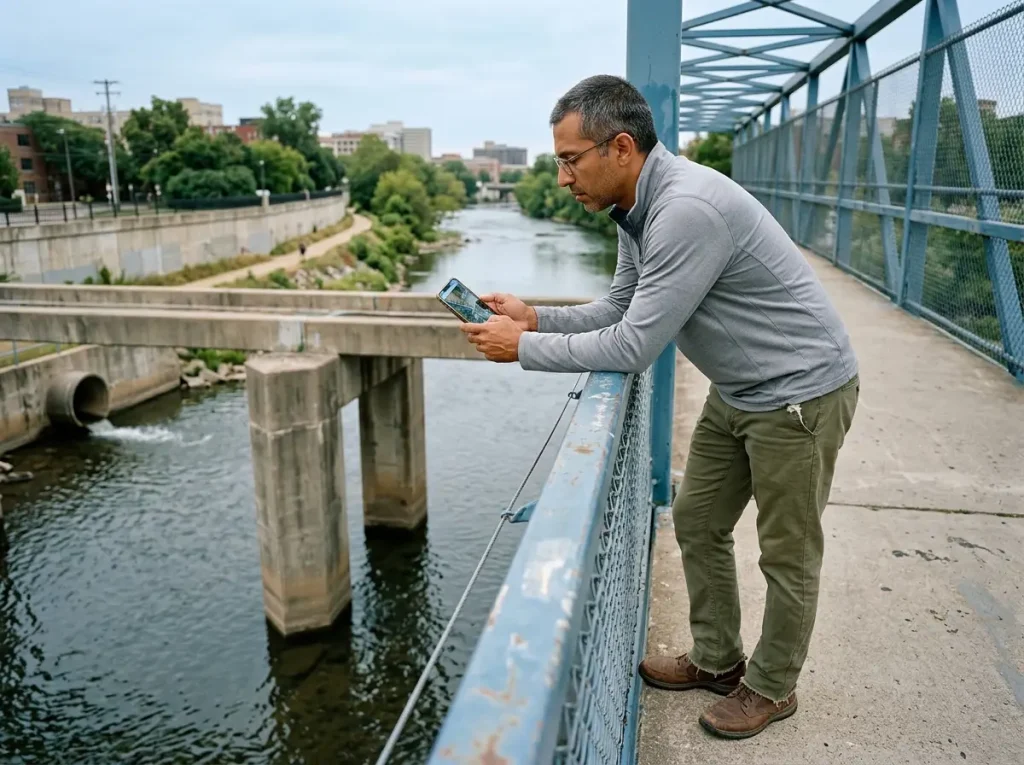
The single biggest advantage experienced urban anglers have isn’t technique — it’s homework. An hour of research before you leave the house puts you on fish. Showing up cold to city water gets you skunked more often than not.
Satellite Recon: What to Actually Look For
Open Google Maps in hybrid or satellite view and look for five things: public access points (trail markers, boat ramp icons, fishing pier labels), water color changes (darker water usually means deeper water), visible structure (bridge shadows, outflow pipes along the banks), worn foot trails on the banks where locals have already beaten a path to the productive spots, and sections where the water narrows or bends — current concentrates fish at pinch points.
This isn’t guesswork. Experienced city anglers use the same satellite approach described in scouting bank access points boats never touch. You can do it from your couch in 15 minutes and arrive knowing exactly where to set up.
Before committing to a spot, run it through the EPA’s How’s My Waterway tool — type any address and it flags impairments, advisories, and restoration status for every nearby waterway. Three minutes of checking eliminates bad water before you pack gear.
Stocking Schedules and State Agency Resources
If the city you’re targeting has a stocking program, find the schedule before you go. Many states publish quarterly stocking reports on their fish and wildlife websites. Some, like Indiana’s DNR Urban Fishing Program, post specific dates and species for every stocked city pond.
Fishing within 48 hours of a fresh plant is the urban angler’s cheat code. The fish haven’t acclimated. They’re hungry and naive. Take advantage of that window before the weekend crowd educates them.
The Bait Shop Call
One phone call to the closest bait shop near your target spot will get you more useful information than an hour of searching online. Ask specifically: what’s producing this week, from where, and what bait are people using?
Pro tip: Bait shop staff fish their local waters year-round. They know which stocked pond recovered first after the last heat wave and which bridge is producing catfish this week. This phone call is free, takes three minutes, and is the most underrated scouting tool in urban fishing.
Also monitor city-specific fishing subreddits and local Facebook groups. Anglers post real-time catches with location photos — follow for two weeks before your trip and you’ll have a working map of what’s producing.
Urban Fishing Regulations You Can’t Afford to Ignore
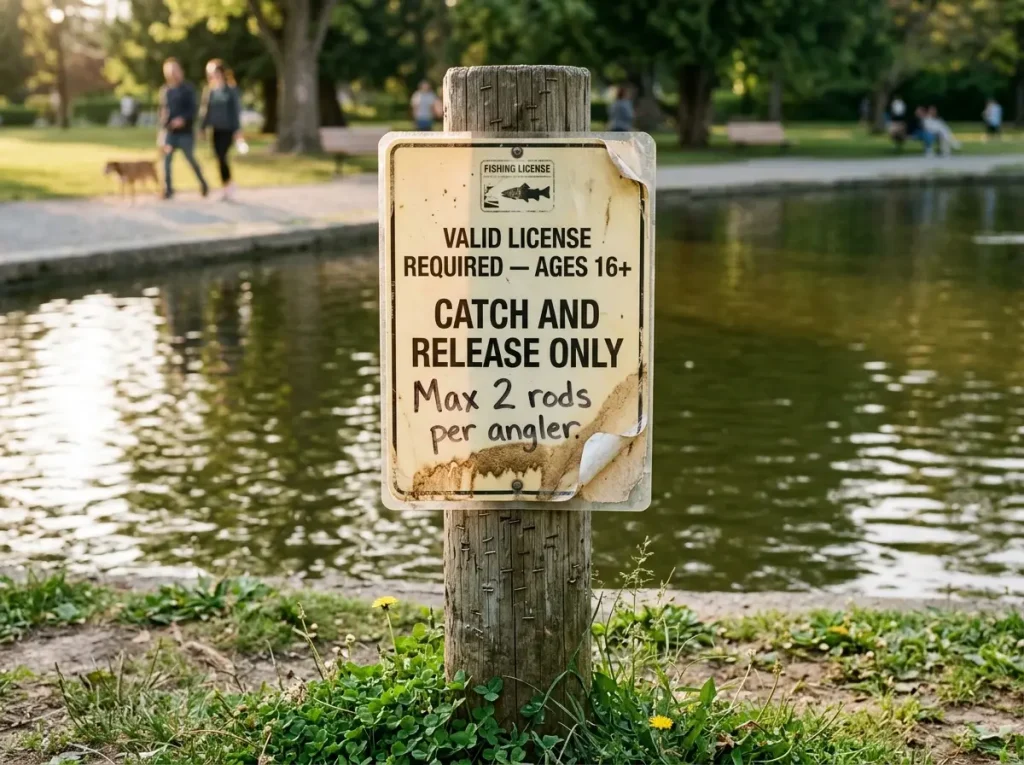
The rules at a city park pond managed by a parks department look nothing like the rules at a state reservoir. Most urban anglers discover this after they’ve already made a mistake.
License Requirements: City Parks Are Not License-Free
You need a valid state fishing license in virtually every urban fishery — stocked city pond, catch-and-release park lake, municipal canal. Don’t assume a city park is exempt. Most states offer exemptions for anglers under 16 and run free fishing days a few times per year, but outside those windows, the license requirement applies everywhere.
In New York City, you need a free NYS Freshwater Fishing License for anyone 16 and older. The license costs nothing, but the citation for not having one costs plenty.
Catch-and-Release Zones and Bag Limits by City
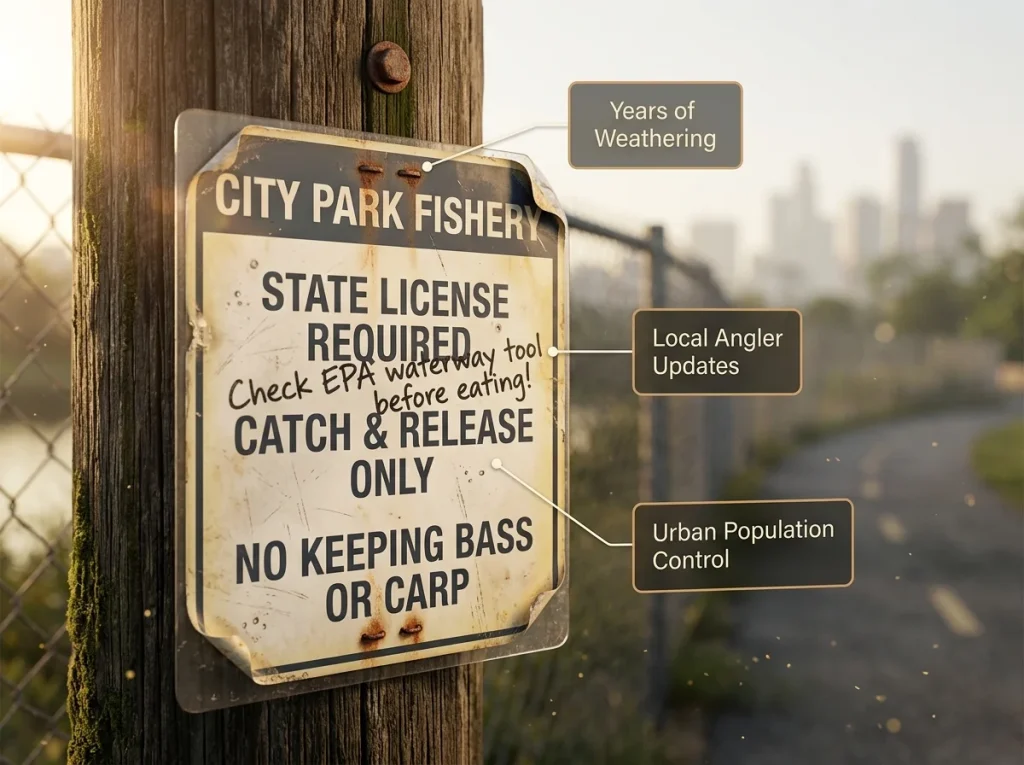
Catch-and-release zones are standard in heavily stocked urban fisheries designed to maintain fish populations under pressure. All fish caught in NYC parks must be released immediately — no exceptions. Other cities impose species-specific bag limits that differ from statewide regulations. A city pond stocked by the state may follow standard state limits, while a city-operated pond two miles away has its own rules entirely.
Check posted signs at the access point. If there are no signs, check the city parks department website before you cast. The jurisdiction distinction matters here — violations in city park waters are often enforced by parks police rather than game wardens, and the citations are different.
Eat or Release? Reading Urban Water Quality Advisories
Catching fish from city water is fine. Eating them is a separate question. Many urban rivers carry historical contamination from industrial use, and some have active fish consumption advisories for specific species — bass might be safe to eat but catfish from the same water might not be.
Before you keep anything, check the EPA’s How’s My Waterway tool — type any address and see the impairment status of every nearby waterway. For species-specific consumption guidance, EPA guidance on checking if urban-caught fish are safe to eat covers what to look for. If you want a deeper look at how to read these advisories without getting confused, we covered the common misreads in our guide on why most anglers read fish advisories wrong.
The Compact Gear Setup That Works in Urban Water
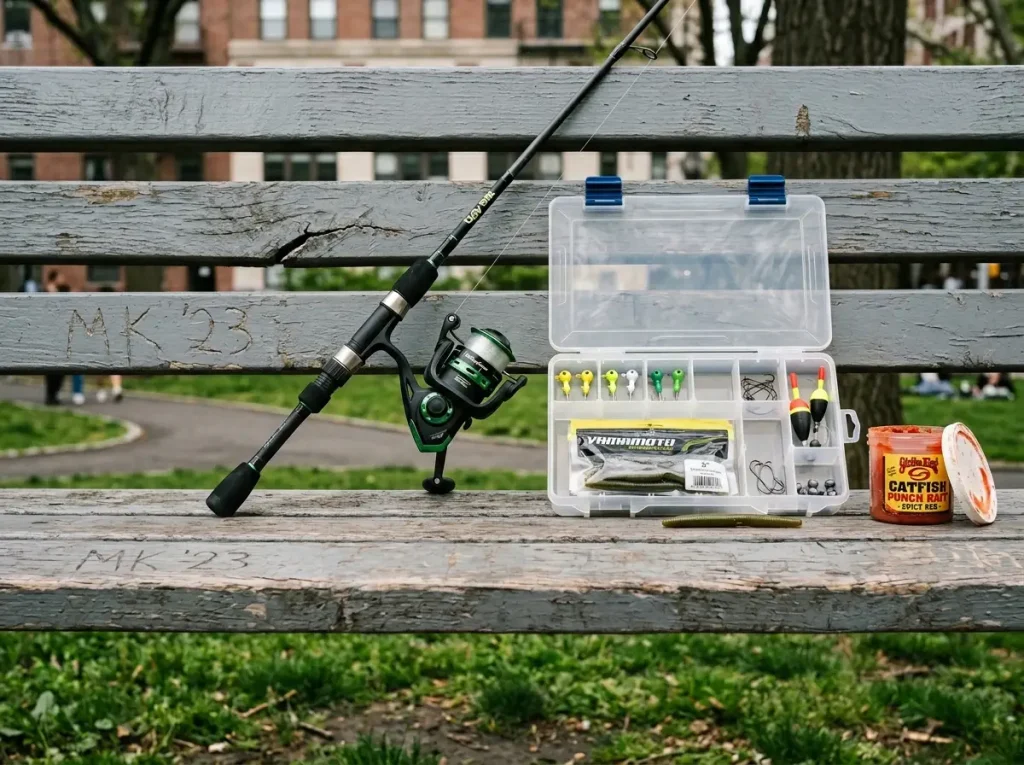
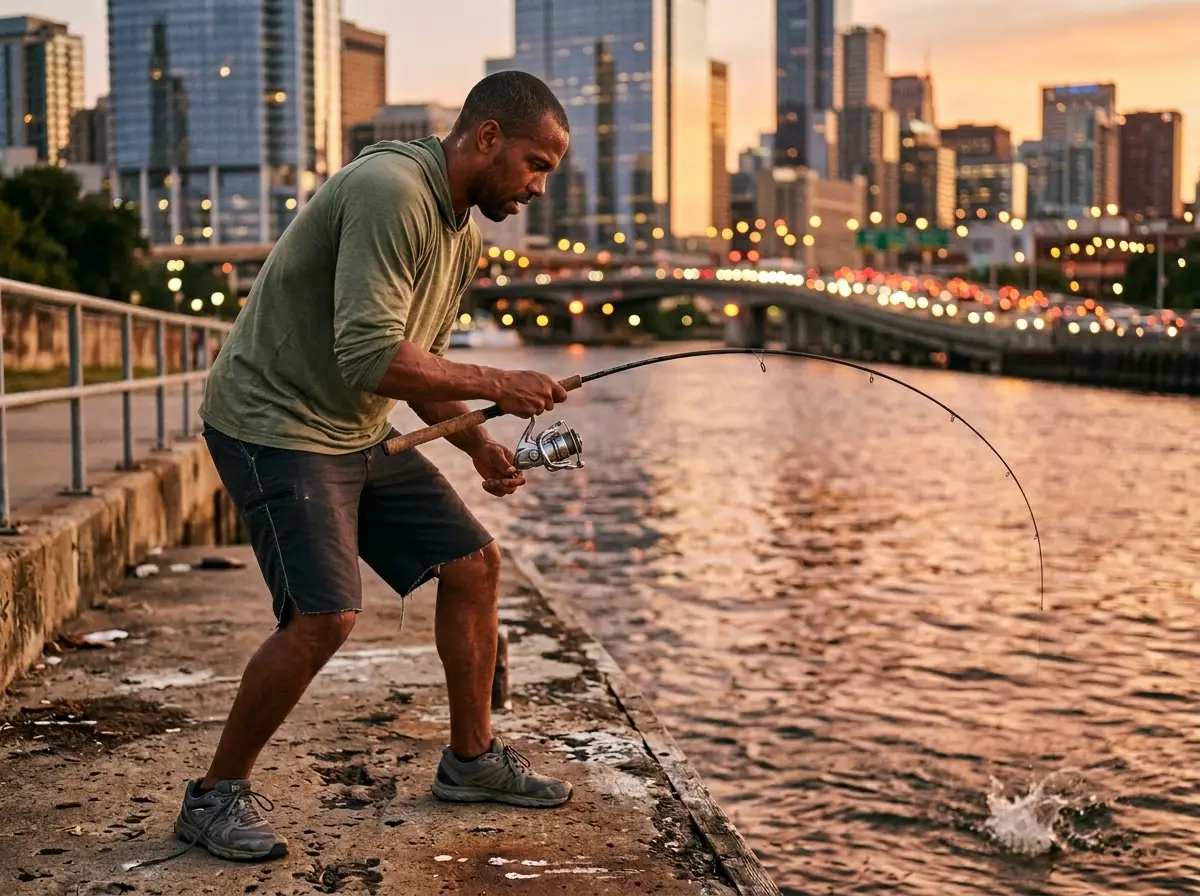
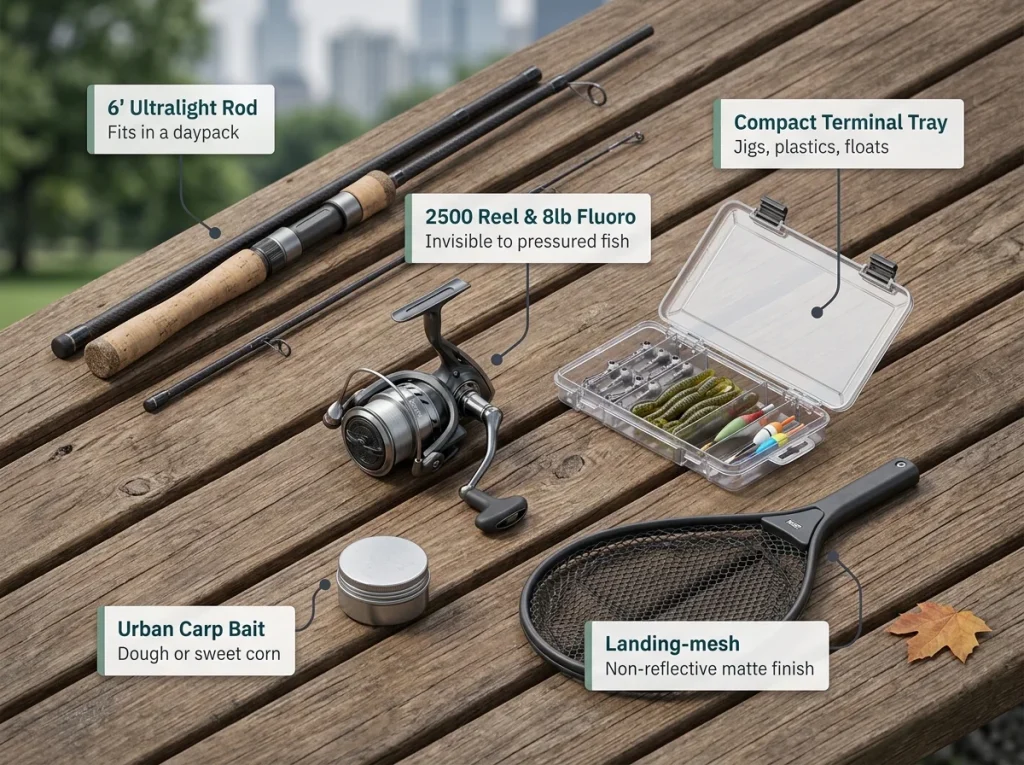
Urban fishing is mobility work. You might fish five ponds in one morning. The angler carrying one rod and a small tray in a day pack covers twice as much water as the one dragging a rolling tackle bag across a parking lot.
The Rod, Reel, and Line Setup
The core urban rod is a 6 to 6.5-foot ultralight spinning rod in a two-piece or four-piece travel format. Light enough for panfish and scrappy bluegill, strong enough to handle a 15-pound carp if one shows up. The Ugly Stik GX2 Spinning Combo ($40) is the honest recommendation for city water — cheap enough that you won’t stress about banging it on concrete, sensitive enough to feel light bites from line-shy fish, and tough enough to handle anything urban water holds. The two-piece format fits in a day pack or rides a city bus without getting in anyone’s way.
For line, spool with 8 to 10-pound fluorocarbon. In clear-water park ponds where pressured fish reject visible line, fluoro consistently outperforms mono. On urban rivers where casting distance matters, 10 to 15-pound braid with a fluorocarbon leader handles both needs.
Terminal Tackle: The Tray That Does Everything
Everything you need fits in a single waterproof Plano tray: a row of 1/8-ounce jig heads in three colors, a pack of 3-inch soft plastics in green pumpkin and watermelon, size 2 and 4 worm hooks for Carolina rigs, a few slip floats and split shot, and a couple of size 6 treble hooks for simple catfish rigs. That’s it.
If you need a panfish and catfish rig that works under bridges and in stocked ponds equally well, the slip bobber setup handles both species without changing your rod or reel.
Bait for the Urban Four
Chicken liver or punch bait for channel catfish — simple, cheap, effective. Bread ball, sweet corn, or dough bait for carp. Neither requires a tackle company’s endorsement. These are what actually work in city water.
For bass and panfish, the jig-and-soft-plastic combination from your tray covers 90% of situations. On days when artificial bait gets ignored, a nightcrawler under a slip float reminds you why live bait has worked for centuries.
What to leave home: trolling gear, lures over 3/8 ounce, rods over 7 feet, and anything you’d be devastated to lose when it catches a piling and snaps off.
Reading Urban Structure Like a Local
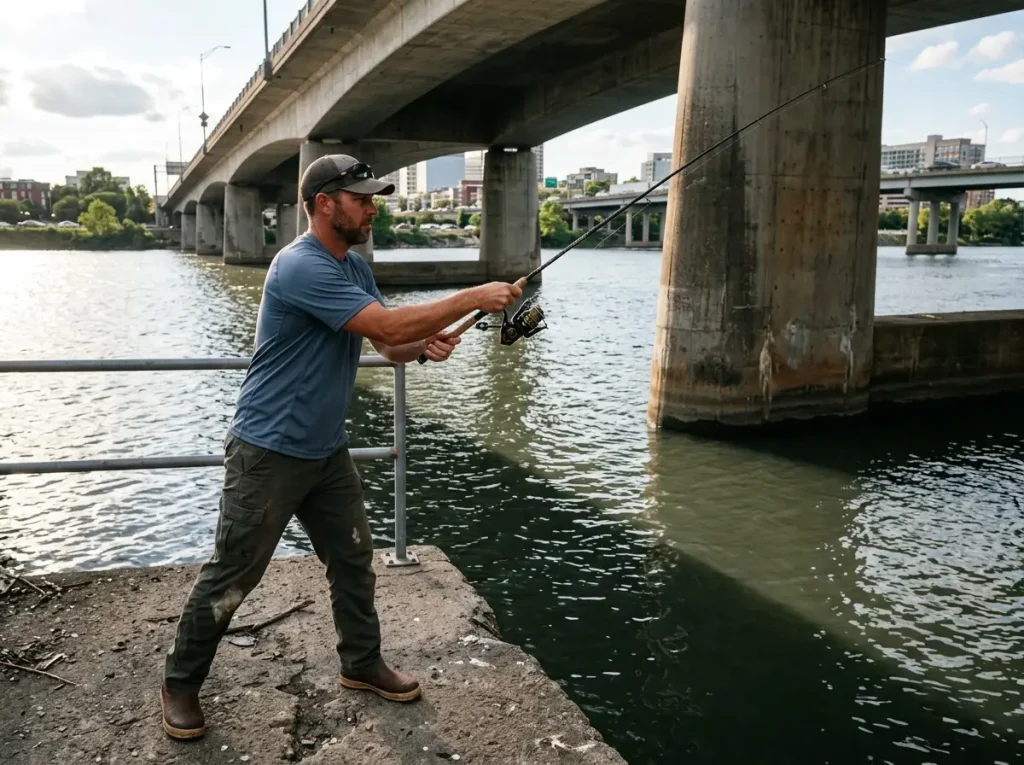
This is where most guides fall apart. They tell you to “look for structure” and leave it at that. In city water, the structure is concrete, steel, and engineered outflows — and reading it requires a different eye than reading a log pile in a natural lake.
The good news: the feeding logic is identical. Fish want current seams, ambush points, and cover. The geometry is just made of different material.
Storm Drain Outlets and Bridge Pilings
Storm drain outlets are the spring creeks of urban fishing. During and after rain events, these outflows carry displaced worms, insects, and baitfish into otherwise static ponds and canals. They push oxygenated water into systems that sometimes run low on it.
Fish stack at the edge of the current tongue — not directly in the flow, but immediately downstream where the current slows and food settles into a concentrated seam. That transition zone is the prime target. Cast three feet past the seam and retrieve back through it.
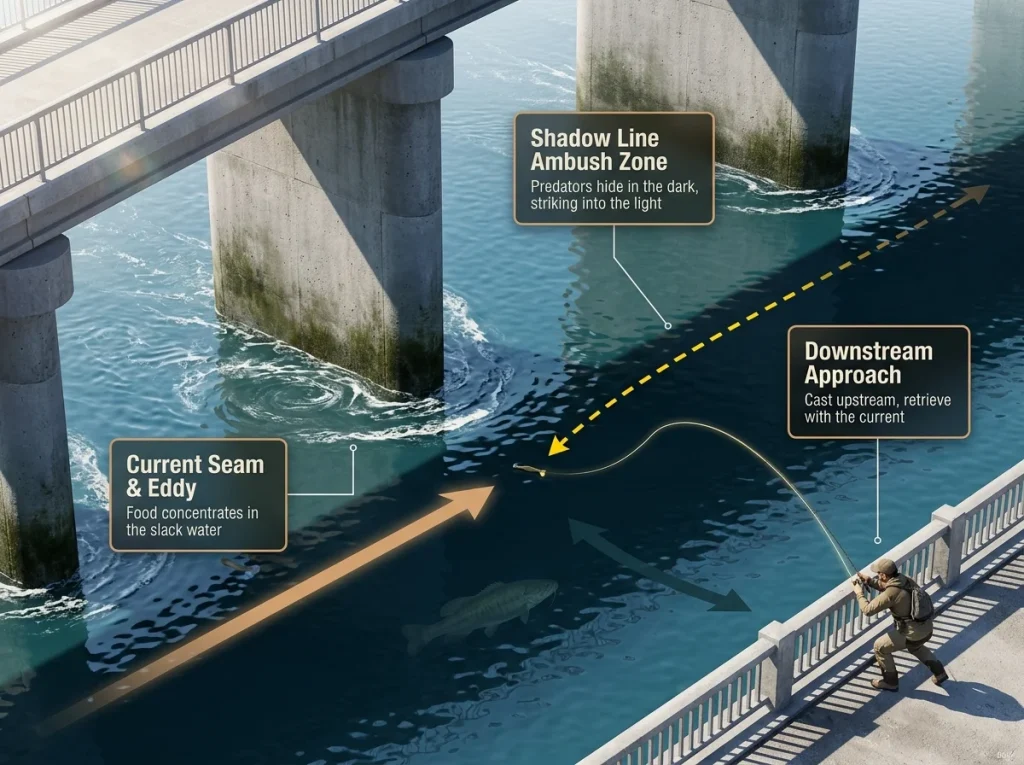
Bridge pilings are the second-most-misunderstood piece of city structure. The common instinct is to fish behind the piling, in the obvious dead water. That’s the wrong spot.
Fish hold on the downstream shadow line — the sharp edge where the bridge deck’s shade meets direct sunlight. That boundary is the ambush zone. Baitfish moving through lit water hesitate when they cross into shade, and predators sitting on the shadow line pick them off.
The approach matters as much as the cast. Come from the downstream side. Cast upstream to the shadow line and work your presentation back toward you.
The approach angles that get your presentation into structure without spooking fish apply directly to urban pilings. And remember: the shadow moves through the day. A spot that’s dead at 10am produces at 2pm from the opposite casting angle.
Pro tip: After a rain event, check every storm drain outlet within walking distance of your spot. Fish move to these seams within minutes of flow starting. The window lasts until the outflow stops — sometimes just 2 to 3 hours after the rain ends. Get there while the water’s still moving.
Low-Head Dams, Weirs, and Boat Ramps
The tailwater pool immediately below a city weir or low-head dam concentrates fish year-round. In an otherwise static urban waterway, the dam creates the only permanent current — and the dissolved oxygen below it is consistently higher than anywhere else in the system.
Walk any urban river until you find a weir. Fish the pool below it. These spots barely appear in generic city fishing guides, which means the pressure on them is a fraction of what the open banks receive.
Boat ramps create structure too. The concrete-to-natural-bottom transition at every city launch ramp forms a depth break. Fish use it as a ledge the same way they’d use a drop-off in a natural lake.
The banks adjacent to ramps are almost always public access. Arrive before the first boaters on weekend mornings and you’ll find undisturbed fish holding on the ramp ledge.
Seawall Corners, Dock Edges, and the Shadows Between
Ninety-degree geometry traps baitfish. Every right-angle corner in a seawall or retaining wall creates an eddy pocket where current pushes food against the wall and holds it there. Predators know this. Target the inside corners — especially where you see surface disturbance or baitfish dimpling the surface.
Dock edges work the same principle at a smaller scale. The underside of a floating dock creates a permanent shade zone. Fish hold along the edge of that shadow, facing the light, waiting for food to drift past. The same shadow-line logic that applies to bridge pilings applies here — cast past the shadow edge and retrieve back through it.
Why City Fish Are the Hardest to Catch — and What Actually Works
City bass are not rural bass. Every fish swimming in your city’s park pond has been caught, released, hooked, broken off, and spooked by hundreds of anglers before you showed up. The survivors are, by definition, the fish that learned to say no. They’re not less intelligent than rural fish — they’re more experienced.
What “Pressured” Actually Means in City Water
A fish caught and released even once begins associating the lure profile, vibration, and retrieve speed that fooled it with something to avoid. Research on hook avoidance shows fish can discriminate between presentations they’ve been caught on before — and urban bass sitting in a park pond that’s been fished daily for years have seen hundreds of those presentations. They’re pattern-matching against their own experience every time something enters the water.
This isn’t speculation. The behavioral conditioning that drives urban fish refusals is well-documented in how fish learn to avoid lures after repeated exposure to angling pressure. What it means for you: your standard Texas-rigged worm, retrieved at a normal pace, triggers a refusal from any bass that’s been caught on a similar rig before. You need to change the pattern they’ve been trained to reject.
Presentation Adjustments That Beat Educated Fish
Three changes make the biggest difference on pressured fish.
Drop your line weight. Switch to 6 to 8-pound fluorocarbon for finesse fishing in clear-water urban ponds. Mono’s stretch and visibility work against you on fish that have been caught on visible line before. If the water has any clarity at all, lighter fluorocarbon is the single most impactful change you can make.
Slow everything down. Reduce your retrieve speed by 30 to 40 percent. Add 3 to 5-second pauses during jig falls.
City fish reject lures at normal speeds more often than rural fish because they associate standard retrieve cadences with “that thing that stung me last time.” The slower, more erratic presentation falls outside the pattern they’ve been conditioned to recognize.
Go smaller. Drop from your standard 5-inch soft plastic to a 3-inch version. Smaller baits trigger less of the “I’ve been stung by something that size” reflex that conditioned fish carry. The size change alone can turn a day of refusals into a productive session — it’s the adjustment most anglers resist making because it feels wrong to go small for big fish.
The Noise Paradox: Shadow and Approach Matter More Than Traffic
City fish live with constant noise. Traffic, construction, music from parks — they’re acclimated to all of it. A truck passing 20 feet from the bank doesn’t register as a threat.
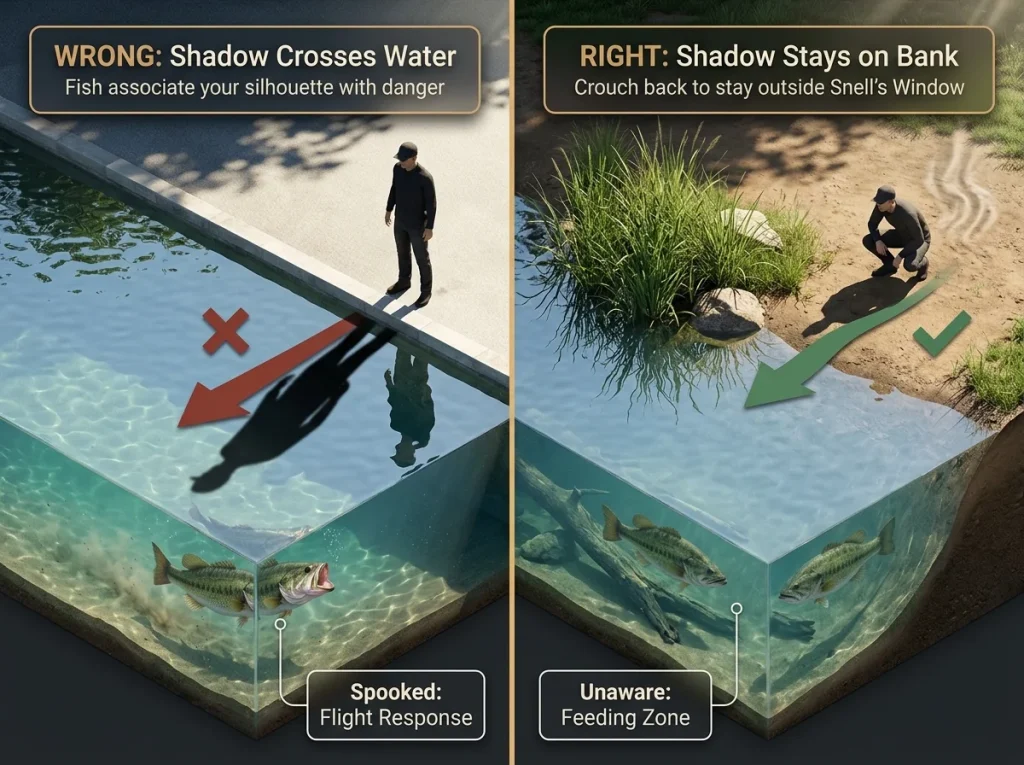
But your shadow crossing the water does. Heavy footsteps on concrete register. Gear clanging against a metal railing registers.
These are novel, close-range disturbances that city fish associate with immediate hazard — because the last time a shadow crossed the water and gear clanked on the bank, a hook followed. The behavioral split is consistent: ambient noise acclimation paired with heightened sensitivity to new, direct disturbance from the bank.
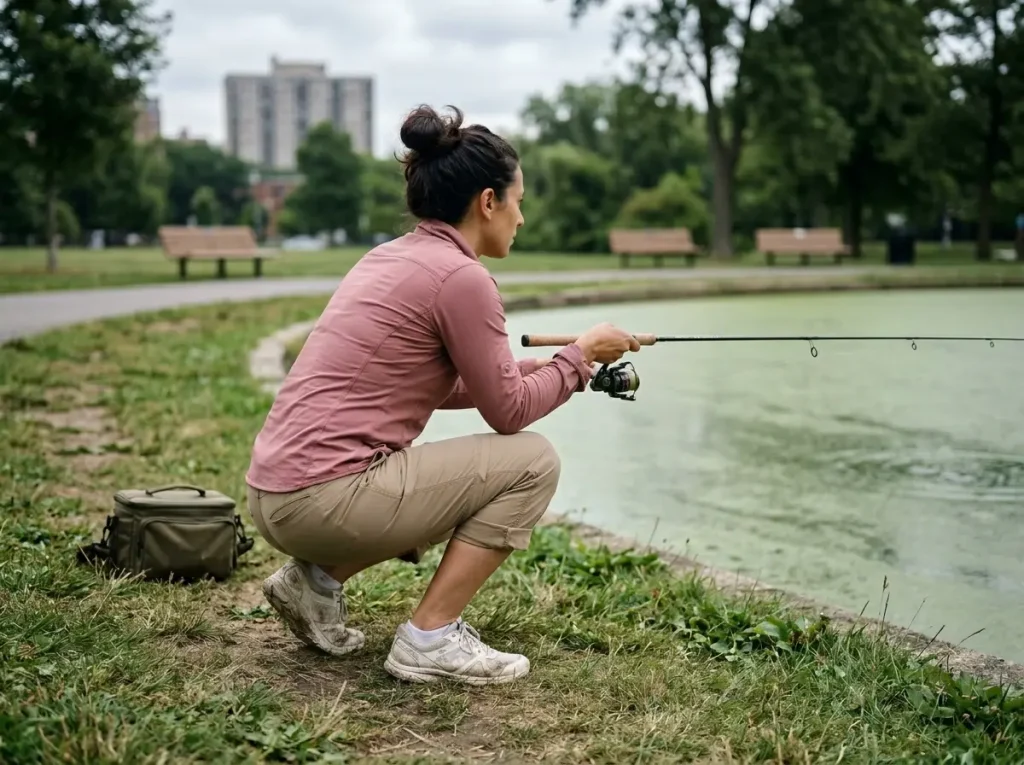
Pro tip: Approach any urban bank in a crouch. Stop 10 to 15 feet back from the water’s edge and make your first casts from there. If you walk straight to the water’s edge, the fish that were holding within 30 feet of your position are already gone — spooked by your silhouette crossing their cone of vision. The low approach works because city fish aren’t scanning the sky. They’re watching the bank for you.
The best timing on pressured city water is early morning on weekdays. Fish partially recover overnight from the previous day’s pressure. A 5:30am arrival on a Tuesday at a pond that gets hammered every weekend produces something approaching normal fishing. The overnight recovery is real — 12 hours of no angling pressure allows fish behavior to reset enough that the first few casts of the morning actually get honest strikes.
Fish Your City — Here’s What to Remember
Three things separate anglers who catch city fish from those who assume the water’s no good.
Urban fisheries are real fisheries. Milwaukee harbor browns, Denver’s South Platte trout and carp, Pittsburgh’s flathead catfish, Miami’s peacock bass — these are not compromise fisheries. Some of them outproduce rural destinations anglers drive hours to reach.
The scouting system works everywhere. Satellite recon, EPA water quality check, stocking schedule research, and one bait shop call. Run that sequence for any city you visit and you’ll know more about the local water than most residents do.
City fish play by different rules. Lighter line, slower presentations, smaller baits, and a low approach from 10 feet back. Adjust for the pressure and you’ll catch fish that everyone else walks past assuming they aren’t biting.
Next time you’re stuck in a city — for work, for travel, for life — check the EPA’s How’s My Waterway tool for the nearest fishable water, call the closest bait shop, and get there before sunrise. You’ll be surprised what’s living 20 minutes from downtown.
Q1 Do you need a fishing license to fish in city parks?
Yes — a valid state fishing license is required in virtually all city parks, including stocked municipal ponds. Most states exempt anglers under 16 and offer free fishing days a few times per year. Check your state fish and wildlife agency website or posted signs at the access point before you cast.
Q2 What fish can you catch in urban rivers and lakes?
Largemouth bass, channel catfish, common carp, and bluegill are the most common urban species nationwide. Great Lakes cities add brown trout, coho, and steelhead. Miami holds peacock bass. Coastal cities see seasonal striped bass and bluefish. Stocked ponds often hold rainbow trout in cooler months.
Q3 Is it safe to eat fish caught in city waters?
Many urban rivers carry legacy contamination with active consumption advisories that vary by species and location. Before keeping anything from city water, check your state health department advisory database or use the EPA’s How’s My Waterway tool to confirm the water has no restrictions for the species you caught.
Q4 What’s the best gear for urban fishing?
A 6 to 6.5-foot light spinning rod paired with a size 2500 reel spooled with 8 to 10-pound fluorocarbon handles most urban species. Add a small tackle tray with jig heads, 3-inch soft plastics, slip floats, and basic catfish hooks. Keep it compact — you’re covering ground, not setting up camp.
Q5 What are the best cities in the US for urban fishing?
Milwaukee, Denver, Pittsburgh, New York City, and Miami each offer something no rural destination can match — from Milwaukee’s harbor browns to Miami’s peacock bass. Portland, Chicago, Dallas, and Los Angeles round out the top nine with productive fisheries within city limits or a short transit ride away.
Risk Disclaimer: Fishing, boating, and all related outdoor activities involve inherent risks that
can lead to injury. The information provided on Master Fishing Mag is for educational and informational purposes
only. While we strive for accuracy, the information, techniques, and advice on gear and safety are not a substitute
for your own best judgment, local knowledge, and adherence to official regulations. Fishing regulations, including
seasons, size limits, and species restrictions, change frequently and vary by location. Always consult the latest
official regulations from your local fish and wildlife agency before heading out. Proper handling of hooks, knives,
and other sharp equipment is essential for safety. Furthermore, be aware of local fish consumption advisories. By
using this website, you agree that you are solely responsible for your own safety and for complying with all
applicable laws. Any reliance you place on our content is strictly at your own risk. Master Fishing Mag and its
authors will not be held liable for any injury, damage, or loss sustained in connection with the use of the
information herein.
Affiliate Disclosure: We are a participant in the Amazon Services LLC Associates Program, an
affiliate advertising program designed to provide a means for us to earn advertising fees by advertising and linking
to Amazon.com. As an Amazon Associate, we earn from qualifying purchases. We also participate in other affiliate
programs and may receive a commission on products purchased through our links, at no extra cost to you. Additional
terms are found in the terms of service.