
In this article
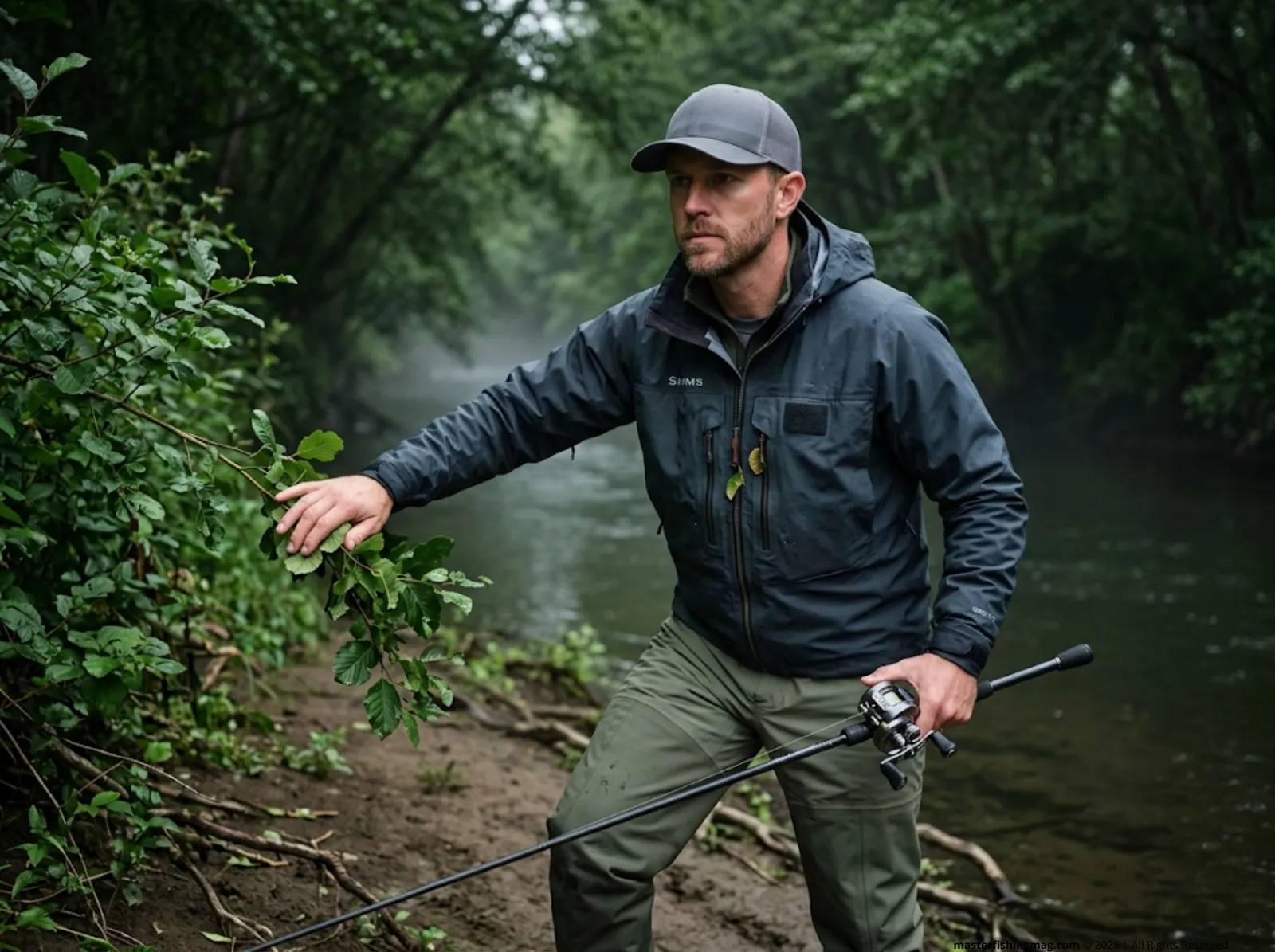
The alders closed over my head like a green coffin. Somewhere upstream, on the other side of a blowdown field that had already taken one rod tip and most of my dignity, was the pool — a wide, slow bend nobody had fished since the drought of 2018. I’d marked it in Google Earth Pro eight months earlier, during a reservoir drawdown, from a satellite image eleven years old. My legs were burning. My GPS said 0.4 miles. My body said four.
That trip produced the best trout fishing I’d had in a decade. Not because I’m a better angler than the guys with boats and live-sonar — I’m not. Because I was the only one willing to go there.
This guide covers the exact system I use: digital scouting with LiDAR and historical imagery, the biology behind why fish prefer inaccessible water, the physics of staying invisible, and the BFS gear stack that lets you cast under 360-degree canopy coverage. Put it all together and you’ll find bank fishing spots that boat anglers literally cannot reach.
⚡ Quick Answer: The spots that produce consistently are the ones that require genuine effort to reach. Use Google Earth Pro’s historical imagery to identify submerged structure during drought years, then cross-reference with LiDAR-derived terrain data in Gaia GPS or OnX Hunt to find creek corridors blocked to boats. When you arrive, stay low, step on mud, and cast short with a Bait Finesse System setup — a ported spool reel under 9g paired with a moderate-action 30-ton carbon rod. Fish in these unpressured waters are biologically naive. Standard presentations outperform “secret weapons” because the fish have never seen a drop shot.
Digital Reconnaissance: Building Your Geospatial Intelligence Stack
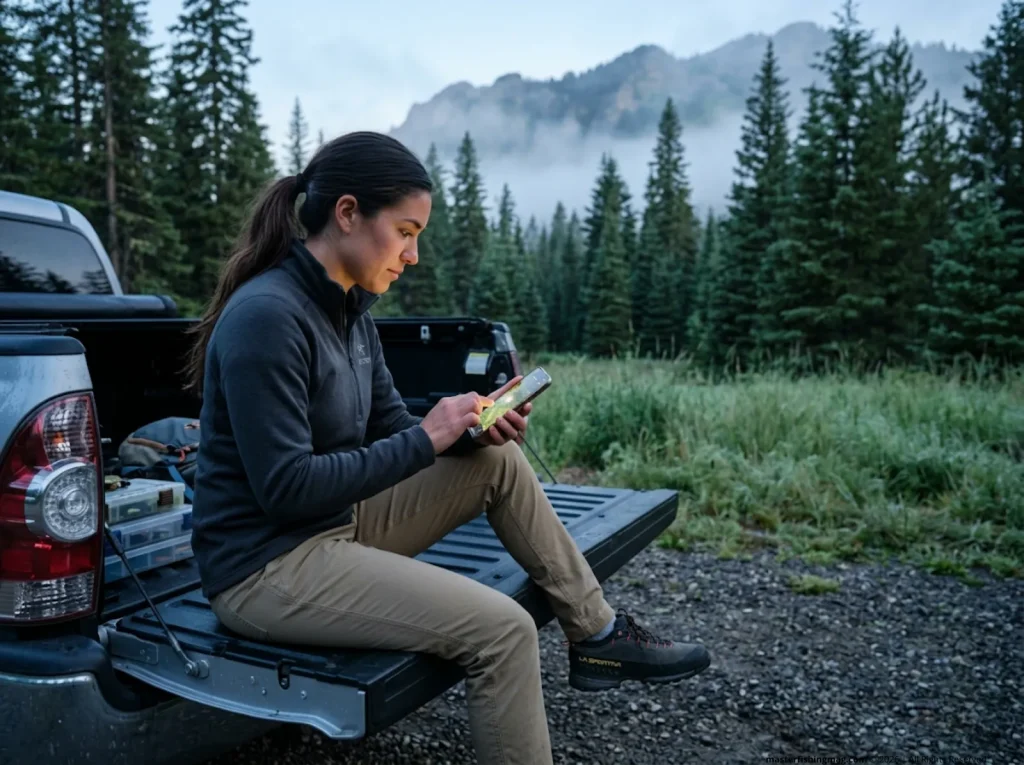
Most anglers scout by driving roads and looking for water. That gets you the same spots everyone else fishes. The effective digital scouting workflow starts weeks before you put boots on the ground, and it uses tools most people have never opened.
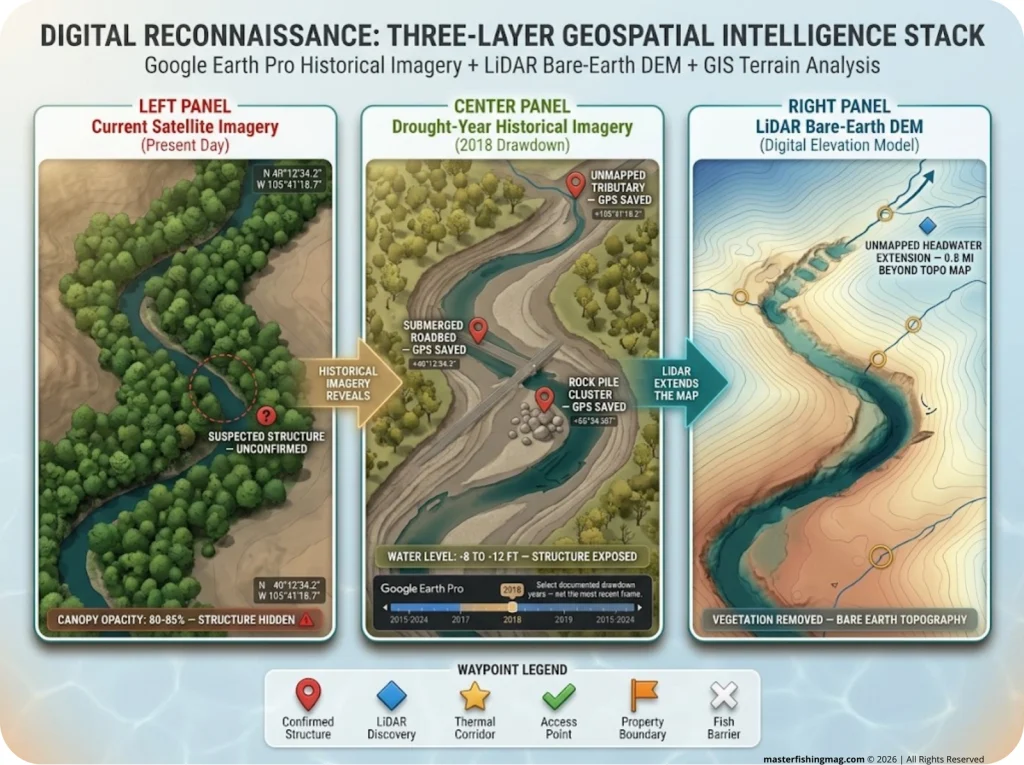
The foundation is Google Earth Pro’s historical imagery slider. Current satellite images show green tree canopy. Drought-year images show the bottom. Slide the timeline to the driest year on record in your watershed — documented drawdown years, not the most recent frame — and the channel geomorphology comes alive. Submerged roadbeds appear. Rock piles reveal their GPS coordinates. Creek channels show you the “river within the lake” that modern depth charts interpolate past entirely. That submerged structure is the “spot within the spot” that boat anglers can’t find on their depthfinders because their charts use interpolated depth data over it. This is a solid digital scouting protocol for selecting fishing spots before you ever pack a bag.
One technical detail that costs people accuracy: center your crosshair directly on the target object, not on the tip of the pin icon. That offset kills your waypoint precision on high-percentage ambush zones. Save those discoveries as a named set — “2018 Drawdown,” for example — separate from your active fishing waypoints so you’re not sorting through 200 markers at the launch ramp.
Advanced Historical Imagery Analysis (The Drought-Year Diagnostic)
Cross-referencing multiple drought-year images matters more than people realize. One year of low water might expose temporary debris accumulation. Two or three years of low water on the same spot confirms permanent substrate — a rock pile that’s actually there versus a log that washed downstream after the first rain.
The features worth marking: extended lake points and their true substrate transitions, isolated brush and rock pile coordinates, undercut bank angles, and creek channel paths that reveal thermal corridors. Modern digital charts miss all of it because they interpolate depth, not structure.
Pro tip: Save your Google Earth Pro discoveries as a separate named waypoint set — “2018 Drawdown” or similar — distinct from your active fishing markers. Mixing them creates navigational clutter at the worst possible moment: when you’re standing in water deciding where to cast.
Virtual Watershed Mapping with LiDAR and GIS
When the canopy is too dense for satellite imagery to show anything useful — which describes most of the best small-stream habitat — LiDAR fills the gap. Airborne laser pulses penetrate riparian canopy and measure the Earth’s surface beneath it, producing a “bare-earth” digital elevation model. This is how researchers have mapped thousands of kilometers of previously unlisted salmonid streams. The effects of culverts on stream habitat connectivity documented in USGS peer-reviewed work validates exactly this methodology for identifying blocked or concentrated fish populations.
Both Gaia GPS and OnX Hunt integrate LiDAR-derived terrain layers. Toggle the elevation shading and look for headwater corridors where “blue lines” on standard topo maps terminate where canopy begins — LiDAR extends the map into unmapped headwaters those lines never show. High-gradient sections where the channel drops more than 2% over its length produce step-pool morphology: trout stacked in the deep calming pocket behind each hydraulic jump, often just one or two rod-lengths wide. Those pockets demand precision that standard tackle can’t deliver.
Fish barriers — perched culverts, waterfalls — are migration concentration points. Target the sections immediately below them before worrying about anything upstream.
Property Line Intelligence and Legal Access Mapping
Here’s where most anglers skip a critical layer and either miss legal water or risk trespass charges. Tax Assessor parcel data is available as a GIS layer in OnX Hunt, and it shows you the exact property boundaries adjacent to your target water.
The federal navigability standard: waters subject to tidal flow or historically used for interstate commerce carry a public easement up to the Ordinary High-Water Mark (OHWM). The OHWM is the physical line where continuous water action destroys terrestrial vegetation — permanent shrubs and trees typically stop there. But state-specific variance is enormous. Montana broadly allows access to the OHWM on all “pleasure” streams. Colorado treats private bed ownership as effectively blocking access. The Douglaston Manor ruling in New York established that private deeded fishery rights can override public wading access on otherwise navigable waters. Research your state’s supreme court precedents for your specific reach, not just the state standard. The Wisconsin DNR’s navigability and OHWM guidance is a good example of how state agencies lay this out — check your own state’s equivalent agency before you commit to a limited-access spot approach.
The Biological Logic of Seclusion: Why Fish Choose Inaccessible Water
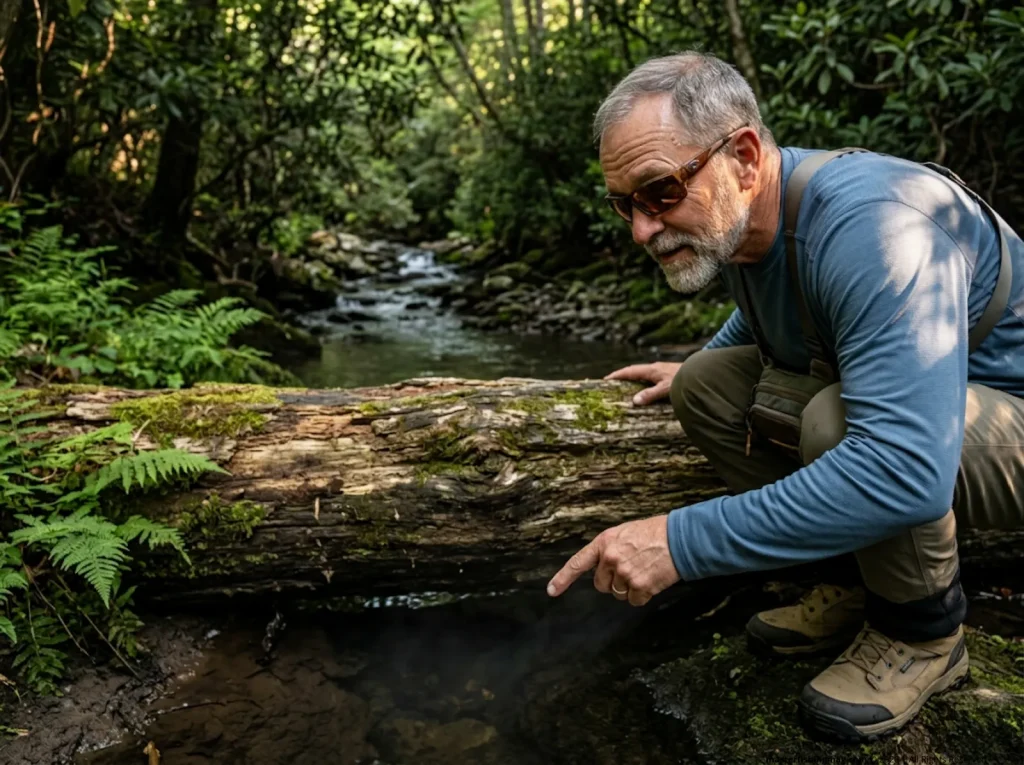
People say fish in remote spots are “smarter.” They’re not. They just lack a reinforcement history.
A 2003 study by Young et al. compared pressured and unpressured rivers directly. Catch rates in the unpressured Ugly River reached 47% of total population. In the pressured Owen River, they ranged from 11–23%. That gap isn’t explained by population size — it’s explained by learned avoidance. Fish in high-traffic corridors don’t startle at the color of a lure; they recognize the retrieve cadence and silhouette profile through continuous negative-stimulus reinforcement. They develop a “familiarity filter.” The fish aren’t hiding. They just know better.
The good news: short-term memory of a traumatic event — like being hooked — persists roughly 48 hours. Long-term consolidation requires protein synthesis that occurs 90–100 minutes post-event. In water visited less than monthly, the learning chain decays before it’s reinforced. The fish reset to baseline aggressive feeding. In remote water, a standard drop shot or Ned rig outperforms “secret weapons” because the fish have never been burned by common presentations. This connects directly to cold-water thermal refugia and stream salmonid behavior — the same fish that are thermally stressed are also the most concentrated and most naive.
Fish Memory, Learned Avoidance, and the 48-Hour Reset
This is the thing that changes your entire approach strategy. Pressured fish aren’t smarter — they’re conditioned. Unpressured fish aren’t dumber — they’re unconditioned.
The 48-hour short-term memory window means that in water you visit once a month or less, the fish functionally reset between visits. You’re not fishing educated trout. You’re fishing fish that have never seen a presentation fail. That’s why thermal refugia and its effect on fish distribution in confined water compounds the advantage — heat-stressed fish pack into small, cool-water microclimates that are often the same complex terrain that blocks boat access.
Pro tip: In remote water, stop overthinking your lure selection. Standard presentations — drop shot, Ned rig, unweighted soft plastic — outperform elaborate “pattern” setups. The fish haven’t seen a Ned rig. You don’t need a custom edge.
Thermal Refugia: Reading the Cold-Water Map
When river temperatures push past what salmonids can tolerate, they don’t scatter randomly. They relocate with spatial precision to discrete cool-water patches — thermal refugia — and they return to those patches predictably.
The hierarchy by temperature delta: groundwater seeps (aquifer discharge can run up to 14°C cooler than ambient), tributary plumes from higher-elevation feeders, riparian shading, deep pools, and hyporheic exchange zones where surface water enters and exits gravel beds. In the field, look for bank vegetation that stays green through summer drought — that’s a surface indicator of subsurface cold-water discharge. Soft mud at the bankline with no drought browning means seep pressure nearby.
When fish pack into a small thermal sanctuary, it’s a “fish traffic jam.” One productive approach cleans the entire zone. The fly fisherman’s nightmare, and the technical bank angler’s best day.
The Physics of Stealth: Becoming Invisible and Inaudible
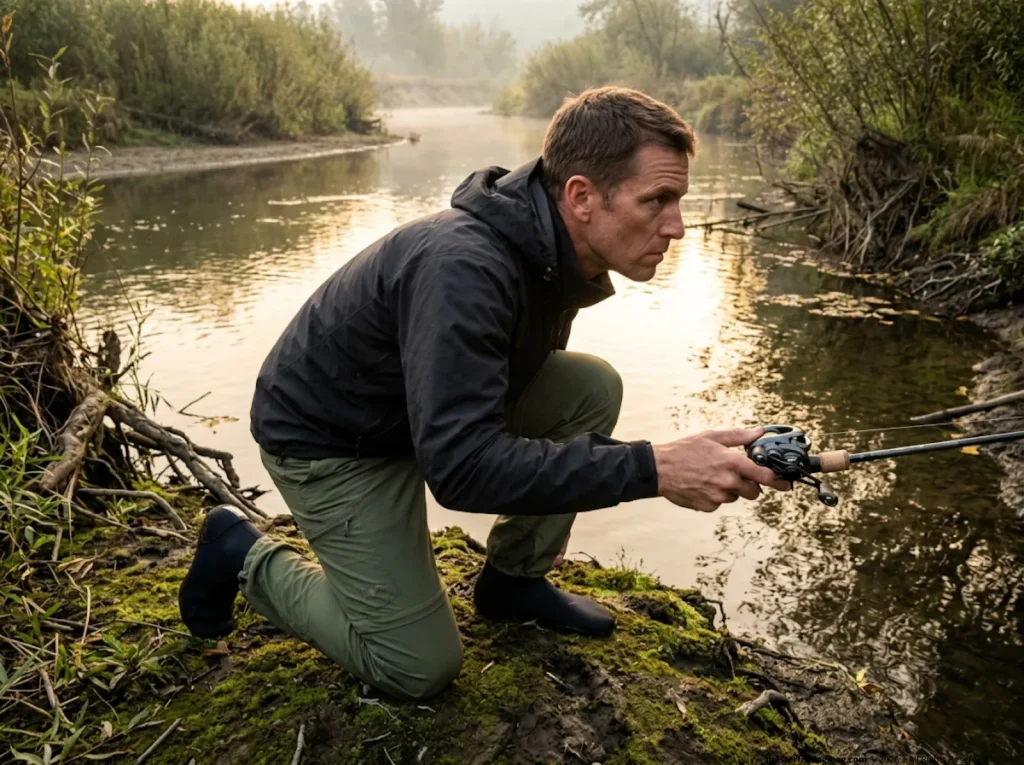
Most people know to be quiet near the water. Almost nobody understands the actual physics of why — and that gap costs fish.
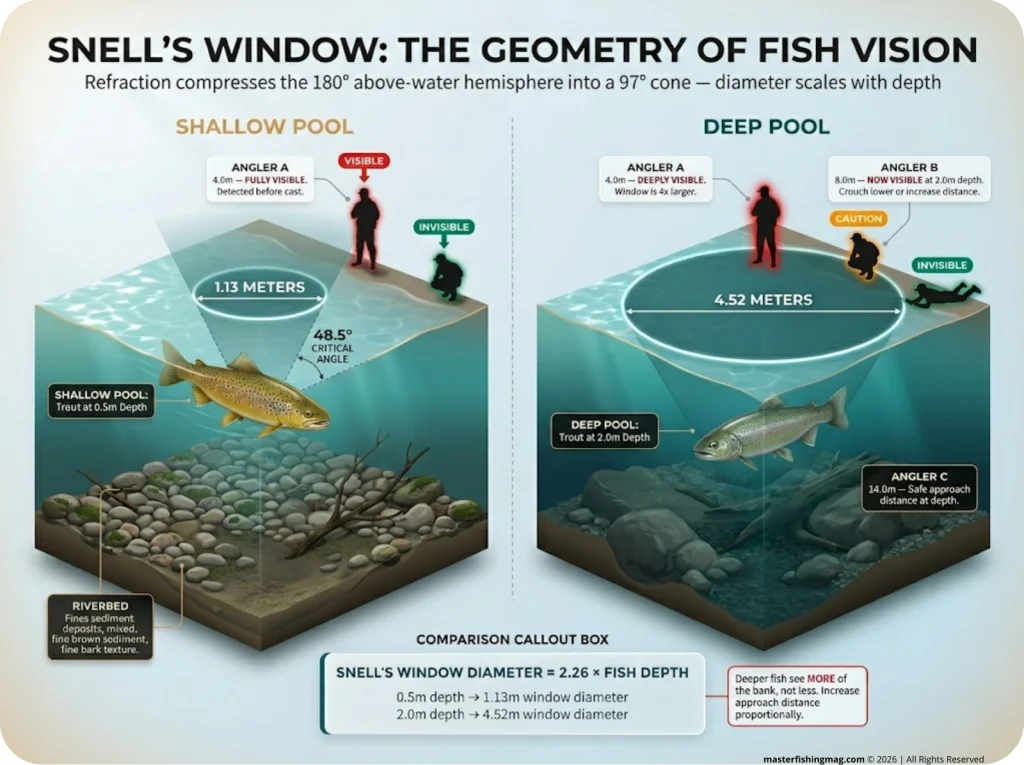
Snell’s Law of Refraction compresses the entire 180° above-water hemisphere into a 97° cone of fish vision called Snell’s Window. The diameter of that window is approximately 2.26 times the fish’s depth. A trout sitting half a meter down sees a circle of above-water world roughly 1.13 meters across. At 2 meters depth, that window expands to 4.52 meters. The deeper the fish, the more of the bank it can see.
The critical number: for a trout at 0.5 meters, a 1-meter-tall crouching angler becomes visible at about 6.2 meters distance. Most anglers walk to within 4 meters before they even think about presenting. You were already spotted before you made a cast. Understanding how Snell’s Window governs fish vision from below the surface tells you the exact geometry of your approach problem.
Objects at the edge of the window — less than 10° from the horizon — are distorted and compressed. That’s the blind spot to exploit. Keep your silhouette below the critical angle. Crouch or kneel. Use bank vegetation as a screen. Approach from downstream where the current provides some acoustic masking.
Snell’s Window: The Geometry of Fish Vision
Fly line flash is what ends most approaches before the fly hits the water. Anglers who aim high and float the fly down routinely flash their line across the 97° cone during the cast itself. The fish doesn’t spook at the fly — it spooks at the line that preceded it.
The field fix: aim low, keep your rod tip below the horizon, and use the bank vegetation as a visual screen on your backcast. On approach, move from downstream. The current provides ambient acoustic masking that works in your favor on the acoustic detection front too.
Pro tip: On fish behavioral responses to sound exposure, research confirms naive fish in quiet environments respond strongly to intermittent sounds that habituated urban-water fish ignore entirely. One gravel footstep in remote water can trigger a flight response that pressured fish have learned to disregard. Step on mud. Step on vegetation. Avoid rock.
Substrate Acoustics and the Quiet Approach Protocol
Sound travels 4.5 times faster in water than in air. Low-frequency vibrations from footsteps are picked up by the lateral line with sensitivity that most anglers drastically underestimate. The substrate you walk on determines how far ahead your approach broadcasts itself.
Mud acts as a “lossy fluid” — high porosity and electrochemical forces in fine-grained sediment absorb acoustic energy. Rock and gravel propagate vibration at speeds faster than water, sending a pressure wave well ahead of each step. The field rule: step exclusively on soft mud or thick vegetation. The final 10 meters to your position should happen on the bank, low, and without touching the water’s edge. A wave impact on a bank creates rapid hydrostatic pressure changes that fish detect through their swim bladders — don’t wade into position when you can walk and cast from the bank instead. This is the core of acoustic damping as a stealth approach discipline, and it’s what separates anglers who “know about” impenetrable shorelines from the ones who actually fish them.
Mechanical Engineering for Access: The BFS Arsenal
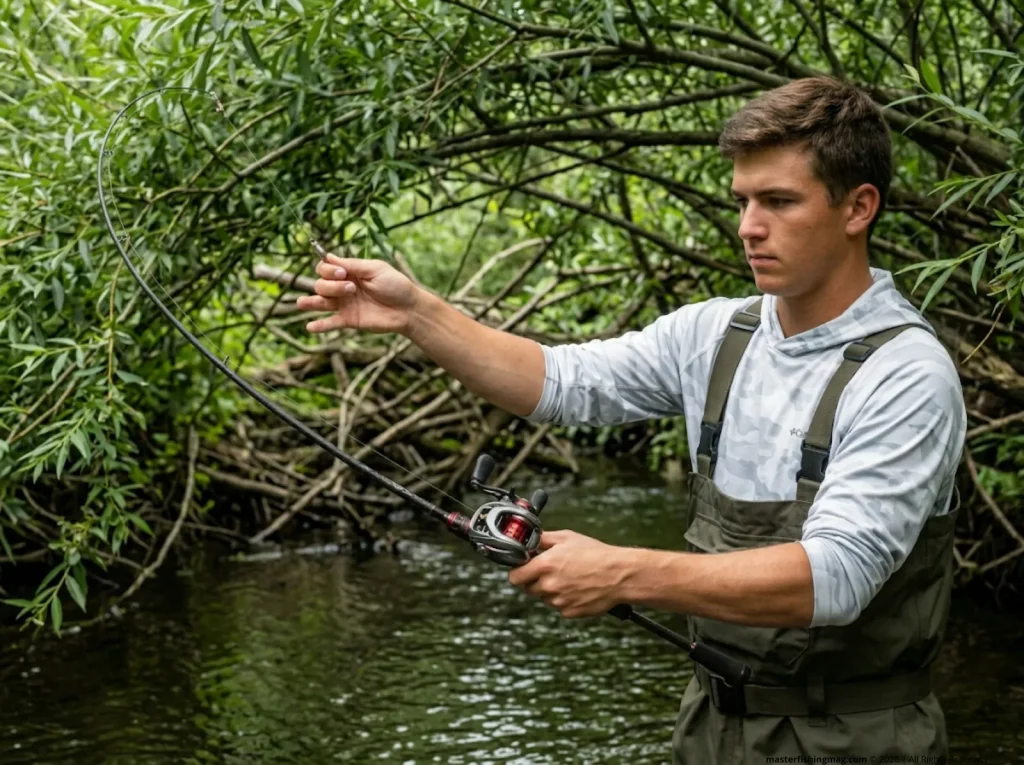
Standard spinning tackle fails in dense brush. The casting arc is wide, it fouls on branches constantly, and ultralight lures under 1/8 oz produce dead casts or tangles. This is not a solvable problem with better technique — it’s a physics mismatch.
The Bait Finesse System solves a specific engineering problem: how to throw ultralight lures (1/32–1/8 oz) with a baitcasting reel without backlash. The answer is spool mass. In a standard baitcasting reel, the spool is too heavy for a light lure to overcome its rotational inertia at the start of a cast. BFS reels use ported aluminum or magnesium spools weighing 9 grams or less — some aftermarket Roro spools reach 3.68g. Add Shimano’s Finesse Tune Braking (FTB), which moves braking components to the side plate to remove their mass from the rotating spool entirely, and you’ve addressed startup inertia from two directions simultaneously.
The result: short, flat, controlled casts and roll casts that clear low-hanging branches no spinning rod’s wide arc can navigate. This is the mechanical prerequisite for under-the-canopy casting in brushy bank water.
BFS Reel Physics: Spool Mass and Startup Inertia
The physics here are straightforward. Rotational inertia is a function of spool mass plus line mass on the spool. Both variables need to be minimized. Ported spools drill material from the largest circumferential areas of the spool, where the moment arm is longest — a gram removed at the rim saves more inertia than a gram removed at the hub. Shallow spool design carries less total line, which is a non-trivial fraction of rotating mass — 100 yards of line contributes meaningfully to total spool weight.
The field calibration test: with your thumb removed from the spool, the lure should drop at a slow, controlled rate. If it drops free with zero brake engagement, you’re tuned. If it doesn’t drop at all, you’re over-braked and you’ll dead-cast ultralight presentations.
Rod Taper Dynamics for Under-the-Canopy Casting
BFS rods use a moderate to moderate-fast taper — they share loading characteristics with fly rods rather than standard spinning tackle. That progressive bend under minimal lure weight is what generates a flat, controlled trajectory. A fast-action rod with a stiff tip doesn’t load under 1/16 oz. The result is a flick with no stored energy — not a cast.
The two techniques that work in brushy terrain: the roll cast and the bow-and-arrow cast (also called the pendulum release). The bow-and-arrow is the one worth practicing. Nock the lure against the rod tip, load the blank by drawing back, and release. Zero backcast required. Maximum five feet of clearance needed. The loaded moderate blank catapults the lure on a flat trajectory that threads under branch canopy that would catch any conventional cast. This is hydrodynamics of tight-quarter casting solved at the mechanical level — not through wishful thinking about spinning gear.
Multi-Piece and Travel Rod Integrity Audit
The modulus question matters more in brushy terrain than anywhere else. The mechanics of rod blank failure from surface fiber damage from North Fork Composites is the technical reference here: a single bark nick from a branch can fracture surface fibers on a high-modulus blank and cause catastrophic failure under fighting load.
The breakdown is clear. 24-ton carbon is durable but heavy and less sensitive. 40-ton-plus graphite is maximally sensitive but brittle — one branch contact at rod speed is a liability. 30-ton modulus is the only defensible choice for dense riparian terrain: sensitivity sufficient to read bottom composition through the blank, structural integrity sufficient to take incidental brush contact without micro-fracturing. For carbon fiber modulus selection by species and technique, 30T is where this analysis consistently lands for technical bushwhacking.
For multi-piece travel rods: evaluate the ferrule. The assembled rod should show zero micro-play at the joint when twisted. Any rotational slack means ferrule wear or a manufacturing tolerance error — and the failure mode under load is worse than a single-piece break because it happens at the moment you least expect it. The real performance trade-offs of multi-piece rod construction makes this case in full. Cheap telescopic rods collapse inward when the tip contacts a branch at casting speed. That’s the moment you’ve been working toward for two hours of bushwhacking. Not the time for a gear failure.
Biomechanical Logistics: Calculating the Metabolic Cost of Getting There
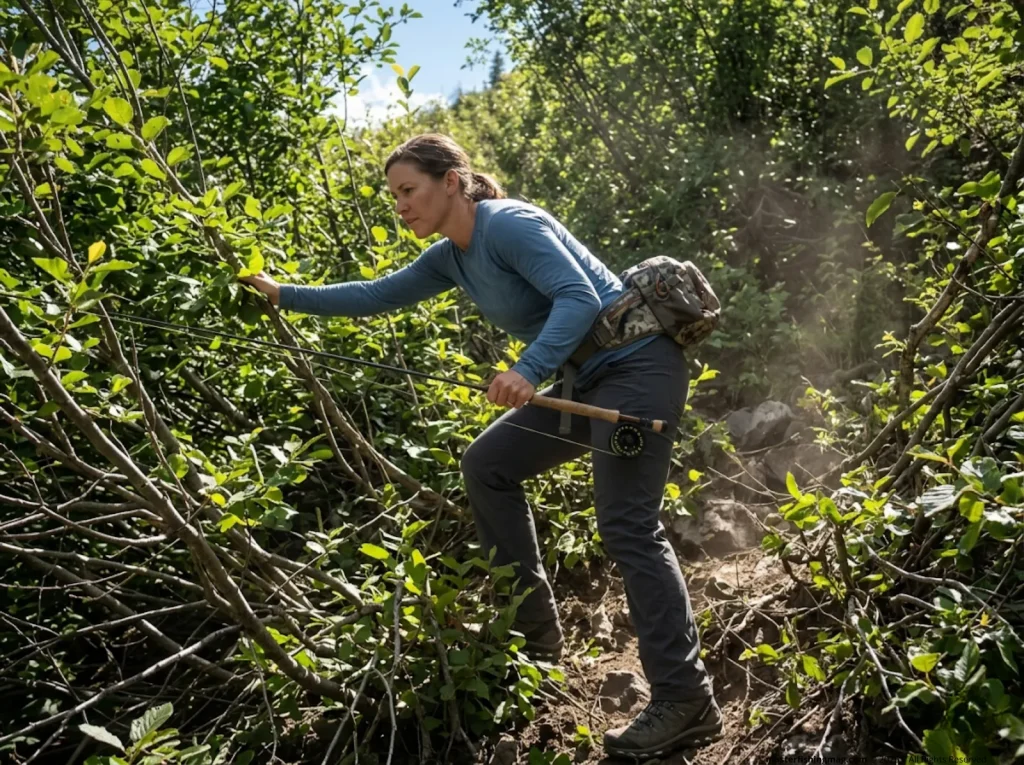
Here’s where most anglers make their worst decisions. A spot looks like 0.4 miles on a 2D map. It’s actually a slide alder corridor with blowdowns. You arrive physically compromised — legs empty, hands trembling from stabilizer muscle fatigue — and you can’t execute the precision casts that the spot demands. That’s “Type Three Fun.” You told the story wrong on the drive home.
The Metabolic Difficulty Ratio (MDR) framework puts numbers on this. It’s a multiplier applied to terrain distance: an MDR of 4.0 means one mile costs four times the caloric energy of a flat treadmill mile. The terrain types, ranked: flat trail (1.0–1.3), willow flats (1.5–3.5, primarily brush work), blowdowns (2.5–4.5, broken cadence), slide alder (4.0–6.0, combined), unbroken krummholz (5.0–8.0), talus and slick boulders (7.5–12.5, dominant stabilizer load). Three mechanisms drive MDR up: brush work (torso rotation against branch resistance — described as “swimming while pulling a drag chute”), impedance work (broken stride cadence wastes recycled kinetic energy of normal walking), and hazard work (firing stabilizer muscles for slick rock or steep gradients burns calories and induces cognitive fatigue).
For selecting a hiking pack built for the biomechanics of a hard approach: the MDR cost should directly inform your pack setup. A hip belt transfers load to the pelvis on approaches above MDR 4.0. Sling packs shift everything to one shoulder and induce asymmetric fatigue over a mile of brush.
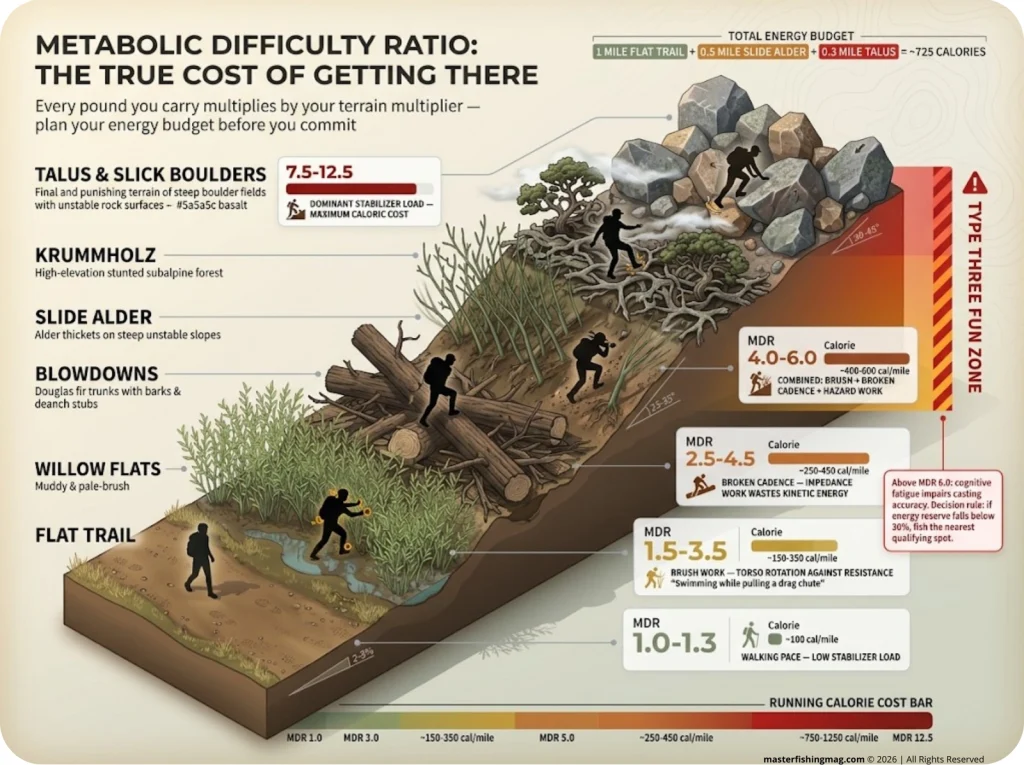
The MDR Framework: Rating Your Approach Before You Go
Build an MDR score for each terrain segment of your approach separately, then sum them. Total MDR score above 4.0 requires an energy budget: at minimum 200 calories pre-approach, 100 calories per MDR-mile on the hike in. Cognitive fatigue above MDR 6.0 impairs proprioception — the same spatial attention you need for pinpoint casting accuracy. The decision rule: if your MDR score leaves less than 30% energy reserve estimated subjectively, fish the nearest qualifying spot, not the farthest optimal one.
Pro tip: Use Google Street View at the point where road access ends to pre-assess vegetation density before committing to your approach. Satellite view from overhead is almost always more optimistic than ground-level reality. What reads as “light brush” from above is often impenetrable alder at eye level.
Gear Compression Principles for Remote Access
The BFS system compresses the tackle footprint to a manageable load: one compact baitcasting reel, a two-piece rod that fits in a daypack’s side pocket, one small tackle box. Total fishing kit under three pounds. That weight advantage is a real input to your MDR calculation — every pound you carry multiplies by your terrain multiplier. This is gear compression as a technical discipline, not just a weight preference. It’s what makes the geospatial requirements and mechanical requirements of remote bank angling actually achievable in the same trip.
Boot sole selection is load-dependent. Rubber lug soles outperform felt on soft substrate and wet vegetation, and they don’t carry aquatic invasives. Felt outperforms on algae-covered cobble — but check your state regulations. Many states have banned felt soles for invasive transport reasons. For boot sole selection for mixed terrain wading approaches, the terrain type of the final approach determines the call, not your preference.
Reading the Water with a Hydrodynamic Lens: Manning’s n and the Physics of Fish Position
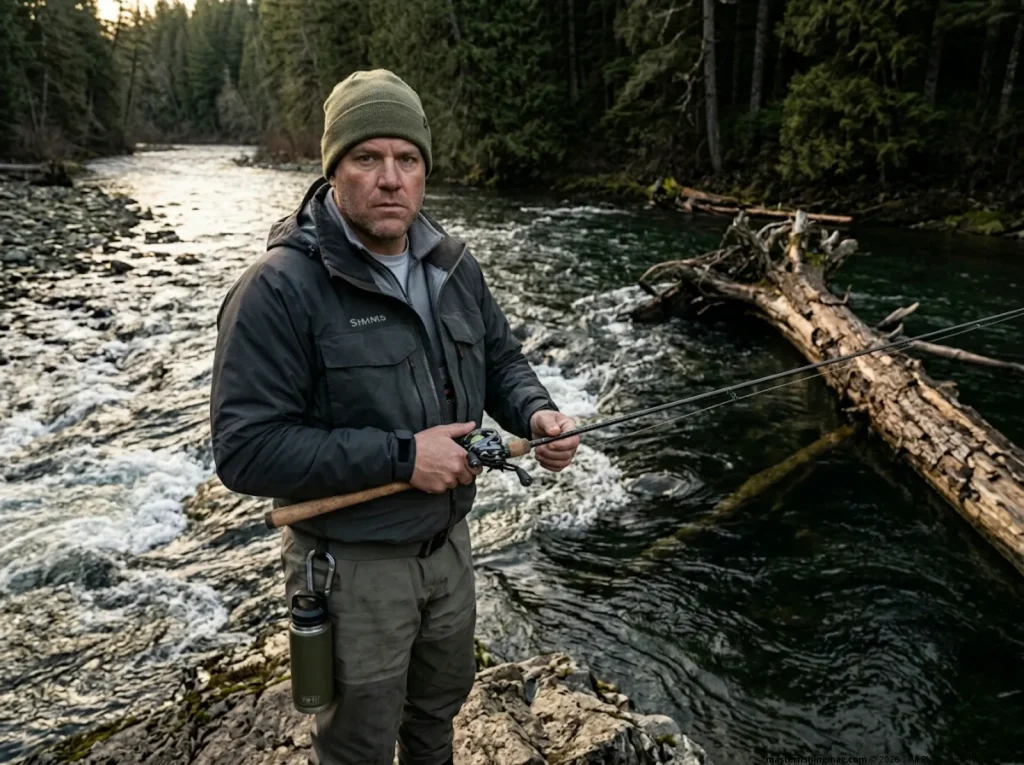
You made it. Now the question is where, exactly, to cast.
Dense riparian brush “clutters” the channel cross-section, raises water depth, and reduces velocity — creating deep, slow pools in exactly the locations boats cannot enter. This is the hydrodynamic reality behind why hard-to-reach spots produce. The roughness coefficient (Manning’s n) quantifies it. Heavy timber and dense brush carries an n value of 0.100–0.150, meaning severe turbulence and dramatically slowed current. Mountain cobble runs 0.030–0.050, creating hydraulic pockets. Clean straight earth at 0.022–0.025 is fast and uniform — low probability for holding fish. The USACE hydraulic engineering guide to resistance to flow documents the full roughness coefficient table. For a working framework on reading river hydrology from pool-riffle to thalweg seams, this hydraulic logic translates directly to field reads.
Fish are metabolic optimizers. They position in the lowest-velocity zone adjacent to a food-delivery conveyor — the main current seam — and wait for prey to arrive. High Manning’s n environments create natural energy sinks where that equation is solved for the fish. Large woody debris (LWD) and protruding boulders create “spill resistance” and hydraulic jumps; target the downstream face of those features.
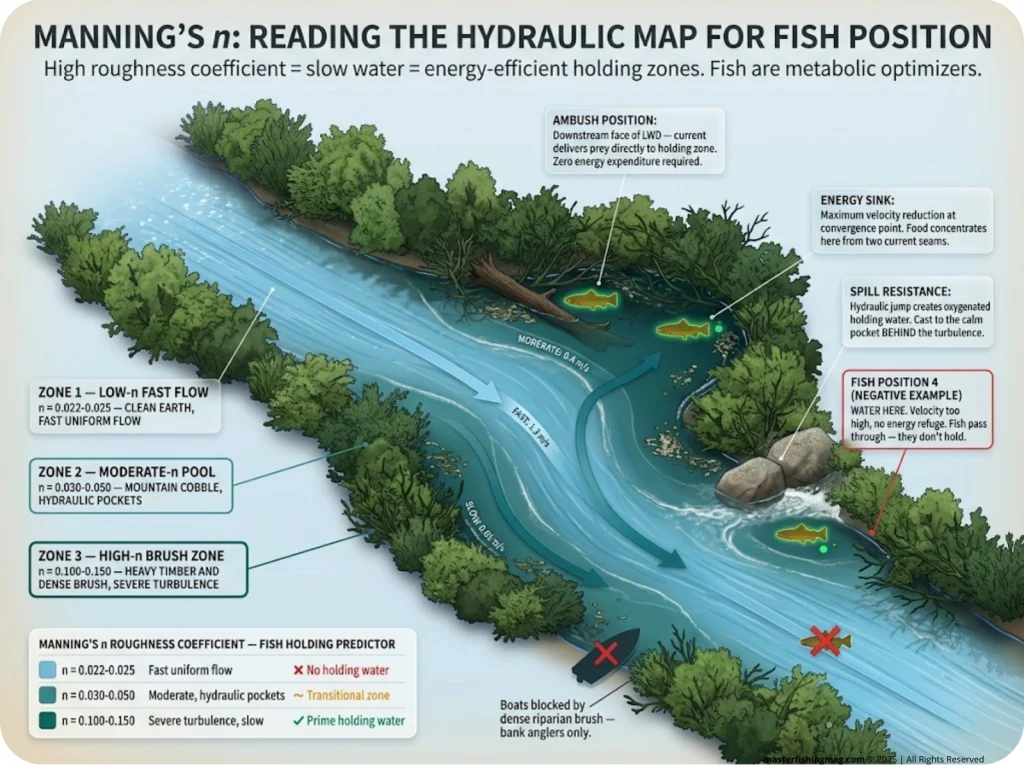
Manning’s n in Practice: Identifying the Ambush Zones
Three field signatures of high-n environments: visible bank brush extending into the channel, water that appears deeper and slower inside a bend than expected, and foam lines collecting debris at the surface. Surface foam is an indicator of energy convergence — the current slows, density changes, and floating material concentrates. That line is often directly above where the fish are posted.
Step-pool morphology runs on steep gradient (above 2% drop over length): trout stack in the deep calming pocket behind each hydraulic jump. Those pockets are often just one to two rod-lengths wide. The precision that BFS enables — the bow-and-arrow cast that delivers a lure on a flat trajectory into a 3-foot gap under branch canopy — is the only delivery system that reaches those pockets reliably.
The Barometric Pressure Myth: Calibrating Your Fishing Schedule
Barometric pressure does not directly control fish behavior through the swim bladder. At sea level, standard air pressure is roughly 14.7 psi. A powerful low-pressure system might drop it to 13.5 psi — an 8% shift. Meanwhile, hydrostatic pressure in the water column increases 0.44 psi per foot of depth. A fish swimming 3 feet vertically experiences a pressure shift equivalent to the most extreme barometric event on earth. They do this constantly without noticing.
The observable feeding correlations people attribute to barometric pressure are actually responses to changing light levels — cloud cover disrupts the bottom of the food chain (zooplankton behavior), which cascades up. The Third Day Rule is more reliable for planning remote bank approaches: after any meteorological shift, rain or bright sun, fish return to predictable feeding routines on the third day of stable conditions. Plan your MDR-8 approaches around stable weather windows. Overcast days on day three are the target — superior fishing conditions and lower heat stress for the approach.
Conclusion
Three things separate the anglers who find these spots from the ones who don’t.
First, location is a multi-layer system, not a hunch. Google Earth Pro historical imagery plus LiDAR-derived terrain data in Gaia GPS or OnX Hunt plus Tax Assessor parcel data is the minimum viable reconnaissance stack. Skip any layer and you’re guessing where boats already aren’t.
Second, fish in hard-to-reach water are biologically naive. The science of memory decay — 48-hour short-term windows, protein synthesis requirements for long-term consolidation — explains why standard presentations outperform elaborate patterns in unpressured waters. The fish haven’t been conditioned. You’re not fighting their learned avoidance.
Third, the BFS with a 30-ton carbon rod is the mechanical prerequisite. Standard spinning tackle is a liability under full canopy coverage. The BFS is purpose-built for the short, flat, precision delivery that brushy bank water demands — and the bow-and-arrow cast is the single skill that opens more water than any other technique adjustment.
Take one morning this week. Open Google Earth Pro. Slide the historical imagery back to the driest year on record in your watershed. Mark everything that becomes visible. You don’t need to hike in tomorrow — you need to build the intelligence layer first. When you do go, everything else in this guide is the operating system for turning those waypoints into fish.
FAQ
Is it legal to fish from the bank of a river if someone owns the land?
On federally navigable waterways, a public easement exists up to the Ordinary High-Water Mark (OHWM), regardless of adjacent land ownership — you can fish and wade in that zone without permission. This protection is not universal across states, though. Montana broadly protects access to the OHWM on all pleasure streams, while Colorado allows private bed ownership to effectively block access. Research your state’s stream access law and the navigability status of your specific reach before assuming access. The OHWM itself is identifiable by the physical line where continuous water action eliminates terrestrial vegetation — permanent shrubs and trees stop there.
What is the best gear for bank fishing tight, brushy spots?
The Bait Finesse System — a baitcasting reel with an ultralight ported spool (≤9g) paired with a moderate-action, 30-ton carbon modulus rod — is the purpose-built answer. It enables short roll casts, bow-and-arrow releases, and skip presentations under branch canopy that a spinning rod’s wide casting arc cannot execute. Pair it with 10–14lb fluorocarbon and unweighted or lightly-weighted finesse plastics in the 1/32–1/8 oz range.
How do you fish in thick brush without losing every lure?
Three-part answer: use a weedless rigged soft plastic (ElaZtech material works well for cover penetration), master the low-angle bow-and-arrow cast that keeps lure trajectory below branch height, and position yourself to cast slightly downstream so a direct retrieve pulls the lure away from obstructions. Drop the expectation of a clean, open-water hookset — strip-set from below and lift into the fish.
How do you find hidden fishing holes near me without a boat?
The three-phase digital scouting protocol: open Google Earth Pro and slide historical imagery to the driest documented year in your watershed — mark every structure that becomes visible. Overlay LiDAR-derived elevation data in Gaia GPS or OnX Hunt to find unmapped blue-line tributaries blocked to boats by shallow riffles, log jams, or steep gradients. Cross-reference with Tax Assessor parcel GIS data to confirm legal access. That stack identifies secret fishing spots that have never appeared on any publicly shared fishing map.
Do fish in remote, unfished areas actually bite more often?
Yes — measurably, not just anecdotally. Research comparing pressured and unpressured waters shows catch rates of 47% of total population in remote rivers versus 11–23% in heavily pressured ones. The mechanism is learned avoidance: fish in high-traffic corridors develop a familiarity filter for common lure profiles through continuous negative-stimulus reinforcement. In low-pressure spots visited infrequently, that learned avoidance decays within the 48-hour short-term memory window. The fish functionally reset to pre-exposure aggressive feeding. You’re not fishing wary fish. You’re fishing fish that haven’t learned the lesson yet.
Risk Disclaimer: Fishing, boating, and all related outdoor activities involve inherent risks that
can lead to injury. The information provided on Master Fishing Mag is for educational and informational purposes
only. While we strive for accuracy, the information, techniques, and advice on gear and safety are not a substitute
for your own best judgment, local knowledge, and adherence to official regulations. Fishing regulations, including
seasons, size limits, and species restrictions, change frequently and vary by location. Always consult the latest
official regulations from your local fish and wildlife agency before heading out. Proper handling of hooks, knives,
and other sharp equipment is essential for safety. Furthermore, be aware of local fish consumption advisories. By
using this website, you agree that you are solely responsible for your own safety and for complying with all
applicable laws. Any reliance you place on our content is strictly at your own risk. Master Fishing Mag and its
authors will not be held liable for any injury, damage, or loss sustained in connection with the use of the
information herein.
Affiliate Disclosure: We are a participant in the Amazon Services LLC Associates Program, an
affiliate advertising program designed to provide a means for us to earn advertising fees by advertising and linking
to Amazon.com. As an Amazon Associate, we earn from qualifying purchases. We also participate in other affiliate
programs and may receive a commission on products purchased through our links, at no extra cost to you. Additional
terms are found in the terms of service.