In this article
Three miles out on a grass flat, the cadence felt perfect. Legs pumping smooth, rod in hand, a pair of redfish tailing at ten o’clock. Then the pedal went soft. One cable snapped inside the drive housing, and just like that, a $4,000 kayak became a 120-pound drift sock with no backup plan.
That afternoon rewired how I think about propulsion. After years of testing both pedal and paddle kayaks across saltwater flats, freshwater reservoirs, and tidal creeks, I’ve learned that the stuff manufacturers leave out of the brochure matters more than the stuff they put in. This piece covers the real physical toll, the true economics, and the field failures that separate an informed buyer from somebody who just read a spec sheet.
⚡ Quick Answer: Pedal drive kayaks give you hands-free fishing and serious range on open water, but they come with hidden trade-offs: lower back compression from the recumbent pedaling position, $800-$1,200 in hidden costs above MSRP, and mechanical failure risks that demand backup plans. Paddle kayaks remain superior for shallow water, rivers, and tight creeks. Your water type, not brand loyalty, should drive the decision.
The Biomechanics Nobody Warns You About
Why Your Legs Work Harder Than You Think
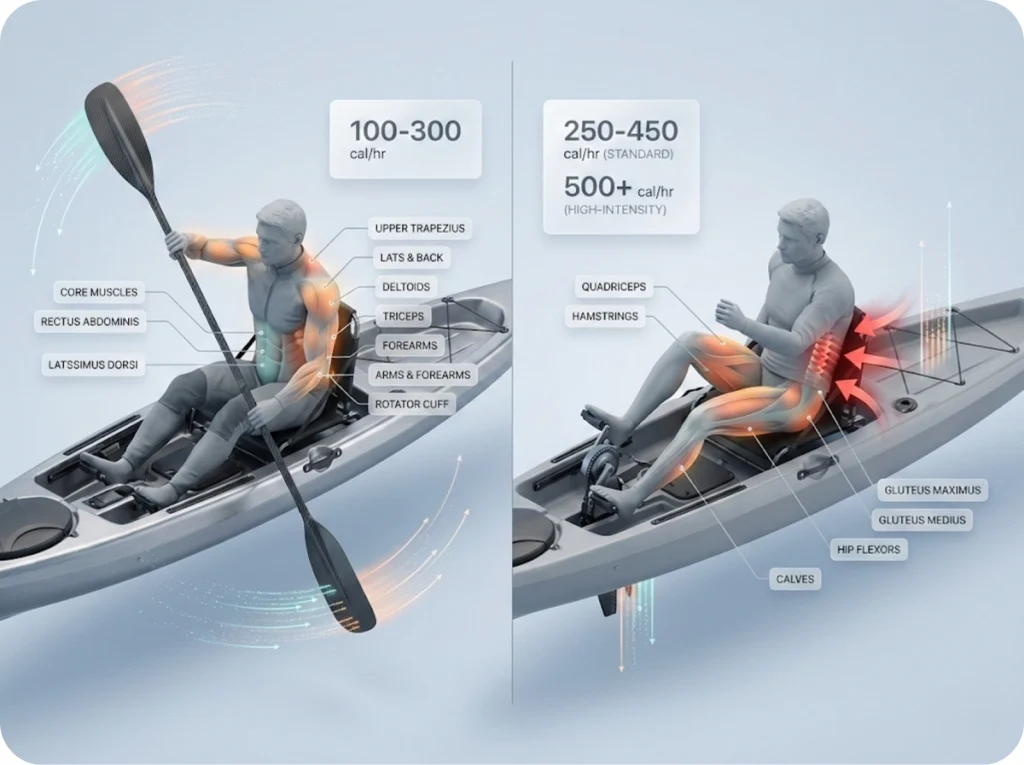
Traditional kayaking engages about 12 major muscle groups. Your core, lats, deltoids, and biceps share the load across a rotational stroke that distributes effort naturally. Switch to a pedal drive system and the entire workload shifts to your quadriceps, hamstrings, and glutes.
That shift sounds like a good deal until you look at the numbers. The American Council on Exercise puts traditional paddling at roughly 100 to 300 calories per hour for a 150-pound person. Pedal propulsion pushes that range to 250 to 450 calories per hour, depending on current and wind resistance. Fight a headwind or strong tidal current, and you can spike above 500 calories per hour. That’s high-intensity interval territory, and most anglers aren’t prepared for it.
The perception that pedaling is “easier” comes from the size of the muscles doing the work. Your legs can generate more sustained torque than your arms, no question. But leg muscles fatigue differently. On a three-hour trip, your quads will burn out gradually rather than all at once. You won’t notice the wall coming until you’re already past it.
Pro tip: Keep your pedaling cadence low, around 50 to 60 RPM. Think cruising gear, not sprint. Experienced pedal anglers treat it like a long bike ride, not a race.
The “L-Position” Problem and Your Lower Back
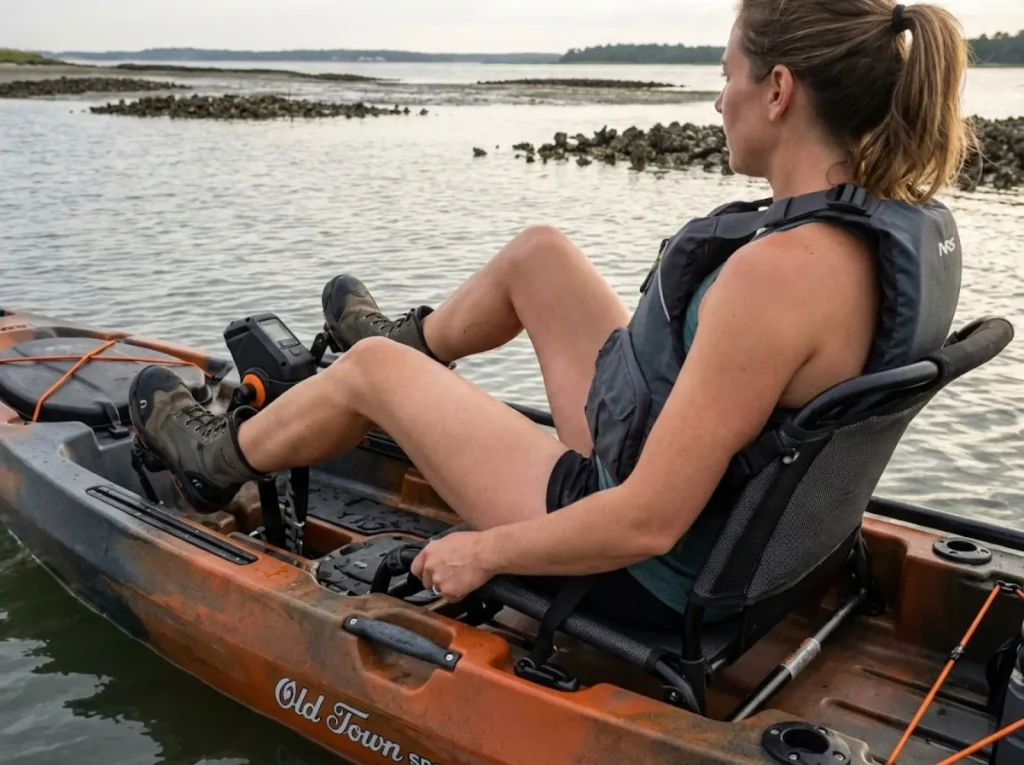
Here’s the part nobody puts in the marketing material. Unlike upright cycling, where gravity helps your downstroke, kayak pedaling forces your legs to push forward while your lumbar spine absorbs the counterforce against the seatback. You’re essentially doing leg presses for hours.
This compression creates three conditions that the pedal kayak community has given their own names. “Yak-Back” is acute lower back fatigue from sustained spinal compression. “Yak-Ass” is poor circulation in your glutes from blood flow restriction during the pedal cycle. And sciatica from chronic vertebral impingement shows up in anglers who ignore the warning signs.
Medical research from the National Institutes of Health indicates that up to 25% of axial low back pain originates from the sacroiliac joint, which absorbs the primary torsional force of each pedal stroke. The older you are or the longer your sessions run, the more pronounced these effects become. Four hours is the typical breaking point.
Pro tip: After every 45 minutes of pedaling, stand up on the gunwales if your stability allows, or stow the drive and paddle for 10 minutes. Your spine needs the decompression break.
How Paddling Keeps Your Whole Body in the Game
Paddle propulsion uses a rotational core movement that distributes load across more joints. No single muscle group absorbs repeated force in one plane the way your quads do on a pedal drive. Your forearms will fatigue faster, sure, but your lower back stays out of the fight entirely.
The skill gap matters here too. The sculling technique, those quiet lateral repositioning strokes that let you sneak into position on skinny water, is a craft that pure pedal anglers never develop. And it’s the stealthiest approach method on shallow water flats where fish spook at anything louder than a mullet jump.
Chad Hoover, a professional kayak angler who could afford any rig on the market, specifically chooses paddle craft for super-shallow water. “I take them into super shallow water,” he says. “Stick up above the surface. I feel like a paddle craft is best suited for that type of fishing… it helps me catch them where others can’t.” If you have pre-existing lumbar issues, a paddle kayak might be the medically safer choice regardless of water type. Understanding how to prevent angler’s elbow with proper tackle ergonomics also matters when you’re adding repetitive arm strokes to your fishing day.
What Pedal Drives Actually Cost You (Beyond the Sticker Price)
The 5-Year Cost of Ownership Nobody Calculates
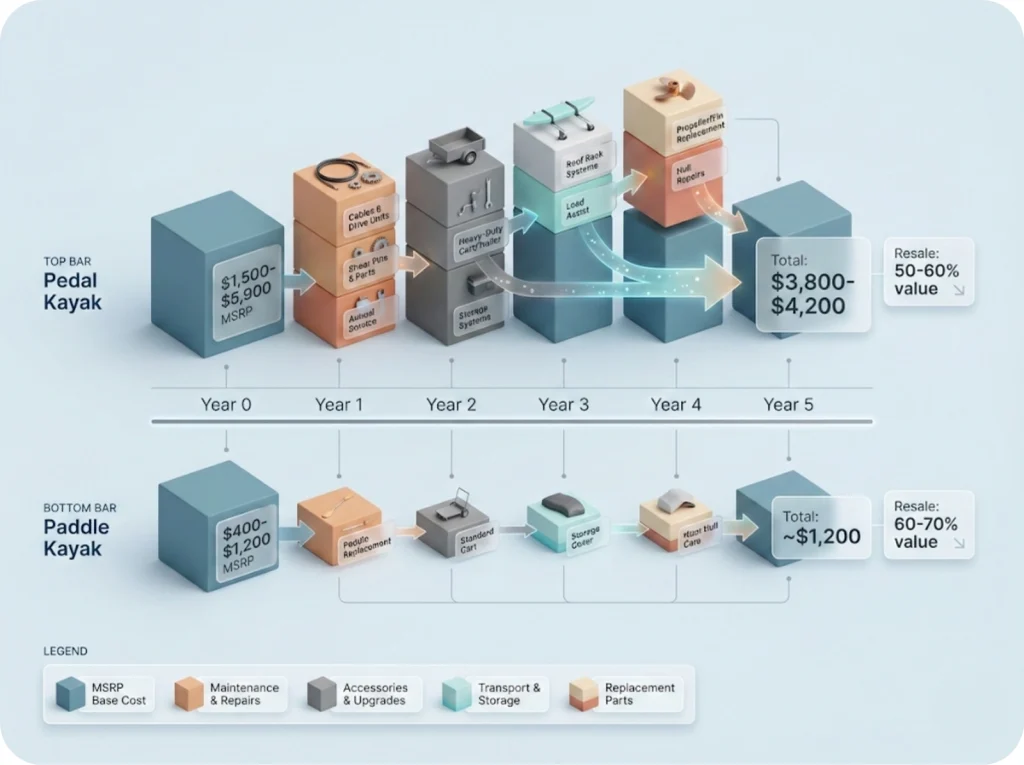
A pedal kayak starts at around $1,500 for an entry-level Vibe Makana and climbs past $5,900 for a fully loaded Hobie Pro Angler 14. A comparable paddle fishing kayak runs $400 to $1,200. That price gap is obvious. What isn’t obvious is the depreciation curve.
The moment you register a pedal kayak as “used,” even unfished, it loses 20 to 30 percent of MSRP. By year five, a well-maintained unit holds 50 to 60 percent of its original value. Paddle kayaks hold 60 to 70 percent over the same period because there’s no mechanical system to inspect or fail.
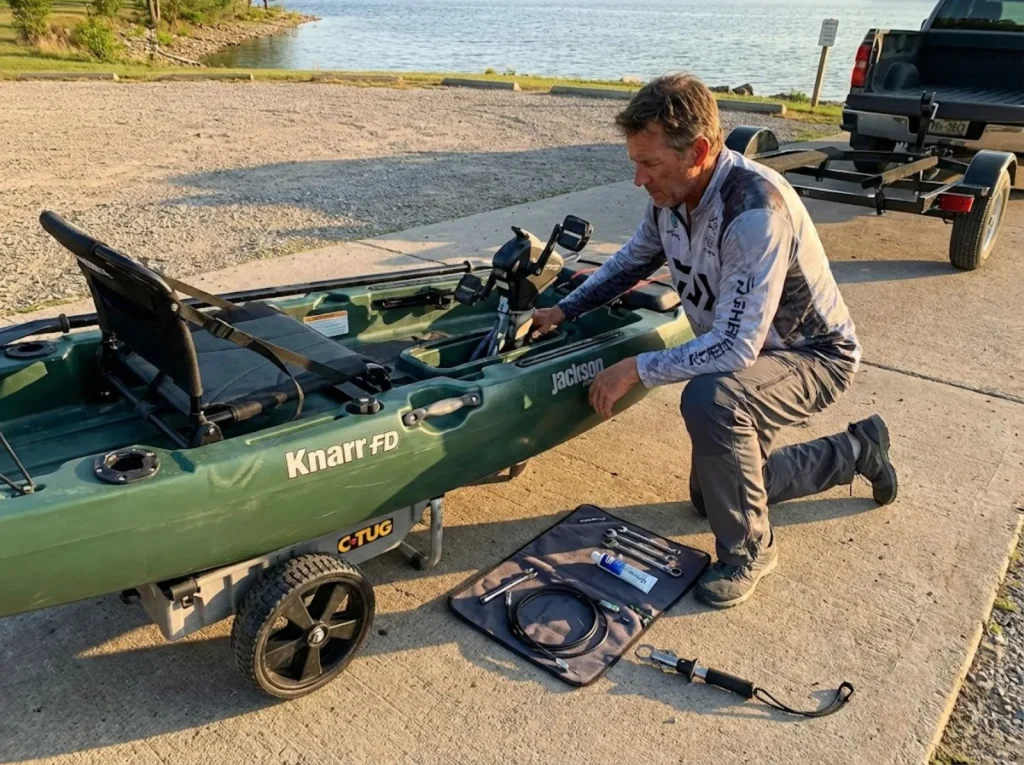
Then add the hidden costs nobody includes in the “Is it worth it?” conversation. A heavy-duty cart or trailer runs $150 to $500 because you aren’t carrying a 120-pound boat on your shoulder. Drive cables cost $15 to $40 per pair. Shear pins run about $5 for a 5-pack. Seasonal drive teardown supplies add $20 to $30. And at some point, you will drop a prop nut in the water. That’s a $12 lesson you only learn once.
A realistic 5-year total cost of ownership for a $3,000 pedal kayak lands somewhere between $3,800 and $4,200. A $900 paddle kayak with premium accessories? Maybe $1,200 total over the same period. Understanding what happens to gear left unprotected over winter adds context to the seasonal maintenance costs that pedal systems demand.
When the “Budget” Pedal Kayak Isn’t Actually a Deal
Budget pedal driven kayaks from Vibe or Pelican sacrifice drive durability for price. You get thinner gears, plastic components where metal should be, and lighter warranty coverage. The “pedaling uphill” complaint you see on forums? It’s most common in budget propeller systems with loose gear tolerances.
Here’s the uncomfortable comparison. A well-rigged $800 paddle kayak often outperforms a base-model $1,600 pedal kayak in actual fishing functionality: more rod holders, better tackle storage, and a more stable platform.
Pro tip: If your budget sits under $2,000, buy the best paddle kayak you can afford and save for a mid-tier pedal system later. You’ll catch more fish in a good paddle rig than a compromised pedal one.
Fin Drive vs Propeller Drive (The Real Comparison)
How Hobie’s Fin System Actually Works
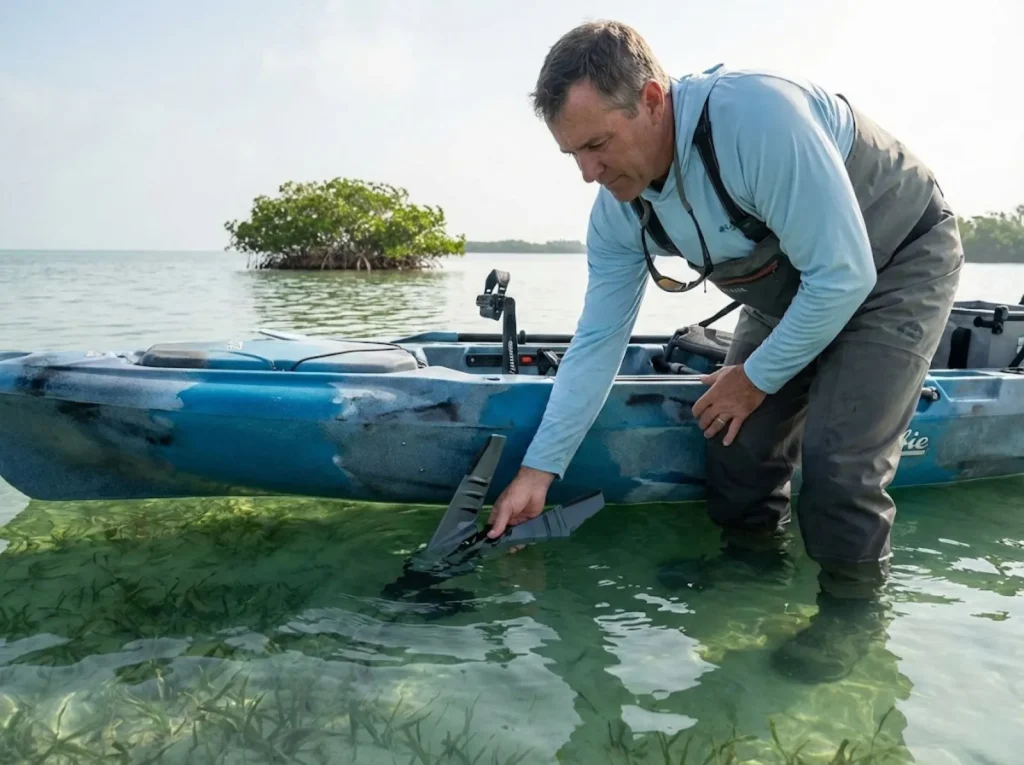
The Hobie MirageDrive uses bio-mimetic oscillation. Instead of a spinning propeller, lateral fin movement converts to forward thrust without the rotational cavitation common in prop systems. The practical result? Kick-up fins “feather” flat against the hull in sub-12-inch water, and that’s the defining advantage for marsh, flat, and grass-bed fishing.
The MirageDrive 360 adds true 360-degree rotation and instant reverse capability. Older 180 models require a manual lever to engage reverse. Both versions shed weeds naturally during the oscillation cycle, which is why fin-style drives let anglers spend less time clearing vegetation and more time with a line in the water.
Why Propeller Drives Win in Current and Structure
Old Town’s PDL system delivers true instant forward and reverse without any mode switching. That’s not a small thing when you’re holding position against bridge pilings in a tidal surge or fighting a redfish that’s trying to wrap you around a dock piling.
Propeller drives generate more consistent thrust at low RPM, which makes them superior for slow trolling and what experienced anglers call “manual spot-lock”, using the pedals to hold a fixed position against wind without an electric motor. For those who spend full days mastering boat control in heavy wind, that consistent low-RPM thrust becomes the difference between working a spot and getting blown off it.
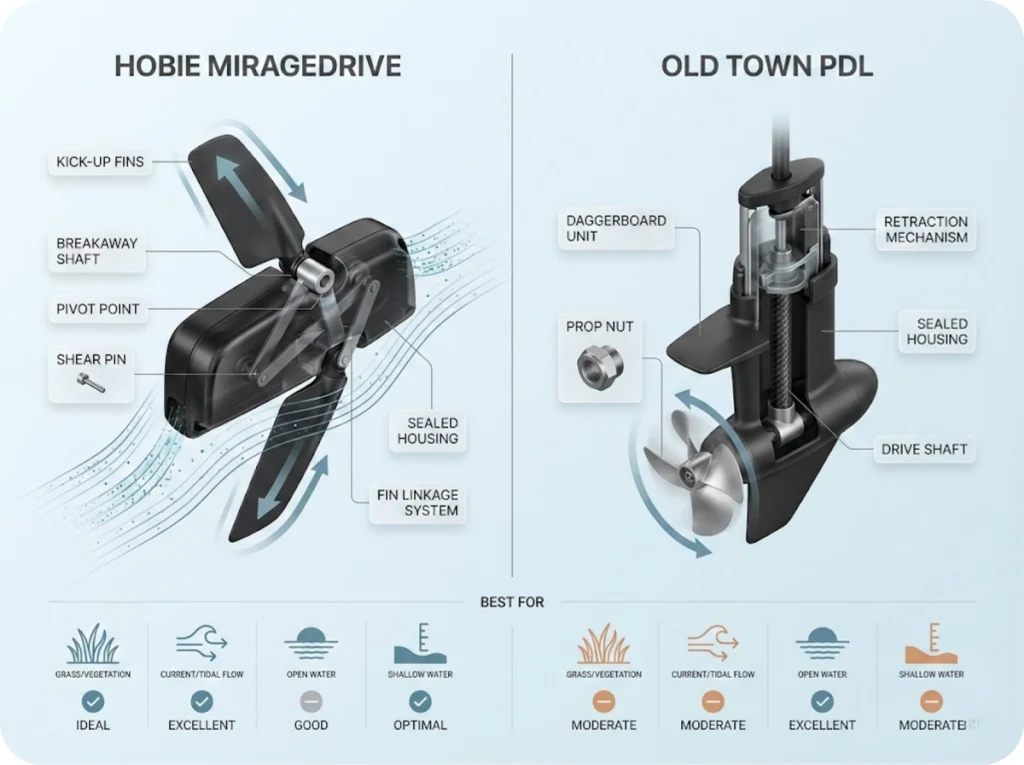
Jackson’s FlexDrive Mark IV uses a daggerboard-style lower unit that retracts on impact, which saves the drive on rocky substrates where Hobie fins would bend. The trade-off: propeller drives require 15 to 18 inches of minimum draft depth versus 12 inches for feathered fins.
When the Drive Fails 3 Miles Out (The Protocols Nobody Teaches)
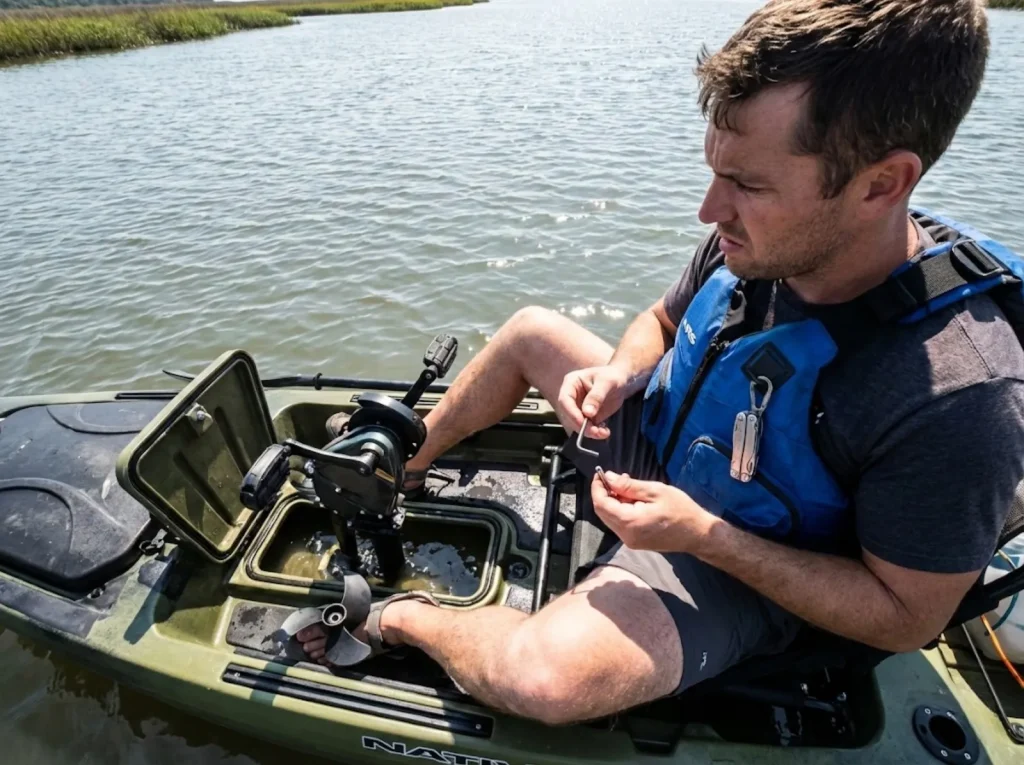
Old Town PDL Shear Pin Failure and Field Repair
Your pedals spin freely but the propeller freewheels with zero resistance. That’s a sheared pin. The fix takes five minutes if you’re prepared and costs about two dollars.
Grab the 4mm hex wrench from your gear (or the thumb-screw if you upgraded). Remove the prop nut, pull the propeller off the shaft, and locate the spare pin. Old Town stores one in a small cavity on the drive handle. Slide the new pin into the shaft hole, align the slot on the back of the propeller with the pin, and tighten the nut snug plus one-half turn.
That $2 pin just saved you a $109 to $165 transmission repair. Every time you launch, a spare pin and a hex wrench should be clipped to your PFD or stowed in a waterproof container within arm’s reach.
Hobie Cable Snap and the “Reverse Fix”
One pedal goes limp. Collapses forward or backward with no resistance. That’s a snapped cable on your MirageDrive, and you’re about to learn why experienced Hobie owners always carry a backup paddle.
If the front cable breaks, the rear fin can still provide limited power. If the rear cable goes, the pedals drop forward and you’re done pedaling. But there’s a workaround the old-timers on the Hobie forums passed down: the “Reverse Fix.” Pull the drive unit out of the well. Re-insert it backwards. Now pedaling “forward” moves the boat backward toward the launch. It’s awkward, it rocks laterally with every stroke, and you need to find a gentle rhythm to maintain tracking. But it gets you home.
A $40 backup paddle aboard a $4,000 kayak is the cheapest insurance in fishing. If you capsize during a drive failure, knowing how to re-enter a flipped kayak in deep water could save your life. Heavy pedal-driven hulls above 100 pounds are significantly harder to flip back over than lighter paddle kayaks, which makes self-rescue training worth every minute you spend on it.
The “Hole in the Boat” Problem Nobody Mentions
When a pedal drive is pulled out for shallow water transitions, it leaves a wide-open scupper well in the deck. That’s a direct path to the water below, and community forums are full of anglers who lost smartphones, tackle, and even fish finders through that opening.
In rough chop, water surges up through the well and floods the cockpit. A neoprene drive well cover or aftermarket scupper plug solves both problems, but neither comes standard from any manufacturer. Thread a lanyard through your phone case and clip it to your PFD before pulling the drive. That’s the kind of field lesson nobody puts in the owner’s manual.
Matching Your Water to Your Propulsion (The Decision Matrix)
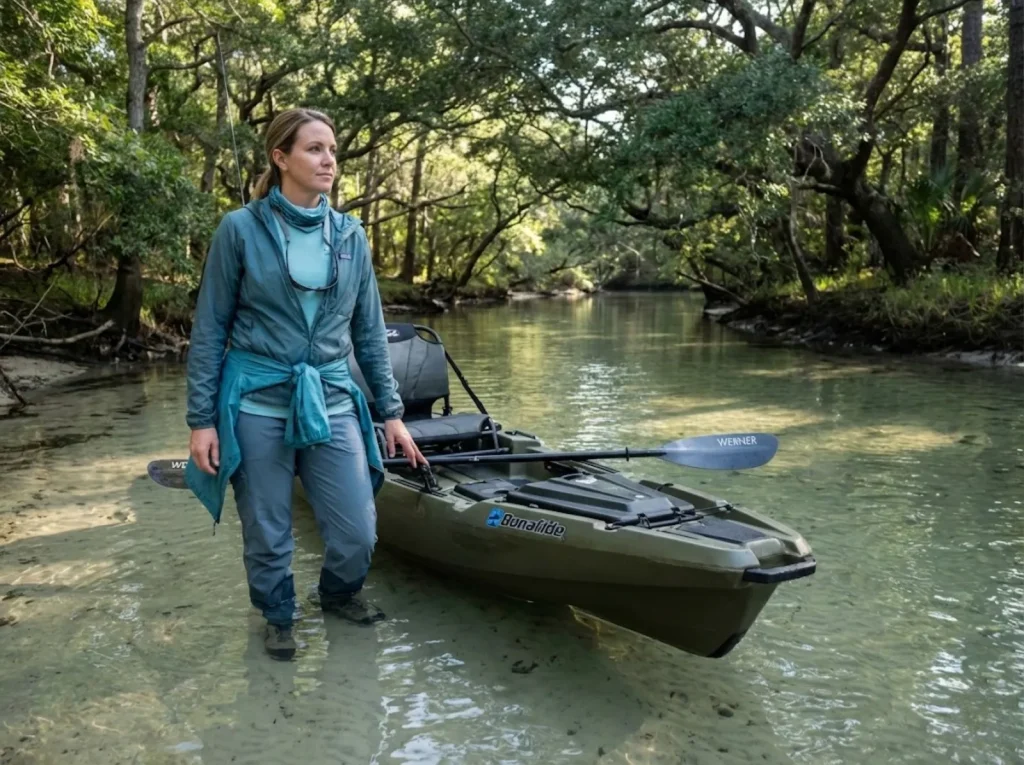
Rivers, Creeks, and Moving Water
Frequent obstacles, variable depths, and tight banks make the added weight and draft depth of a pedal drive a liability on moving water. A 55-pound paddle kayak navigates class I rapids and shallow rock gardens where a 120-pound pedal rig grounds out.
Paddling offers instant directional changes. Pedal drives have a significantly wider turning radius, requiring three-to-five-point turns in tight mangroves. Kayak Kevin Whitley from the Appomattox River Company put it simply: “Paddle and pedal fishing are two different sports.” He’s right. Most pedalers on rivers are actually boaters looking for a smaller platform, and the river has a way of teaching that lesson fast.
Open Water, Bays, and Long Transits
Any transit over two miles in open water tips the equation hard toward pedal propulsion. Leg muscle endurance allows all-day coverage of 8 to 12 miles, compared to 3 to 5 miles realistic for arm-powered paddlers.
Hands-free fishing is where pedal drive systems earn their price tag. As Marty Mood puts it: “You control with the rod in your hand which allows you to literally feel everything that lure is doing.” Try that while holding a paddle. Tournament anglers on open waters choose pedal systems almost universally because coverage equals catches. If your home water includes any of the wide-open Texas coast kayak fishing spots that demand pedal range, a paddle-only setup will leave you watching other anglers work the far flats.
Grass Flats and Vegetated Shallows
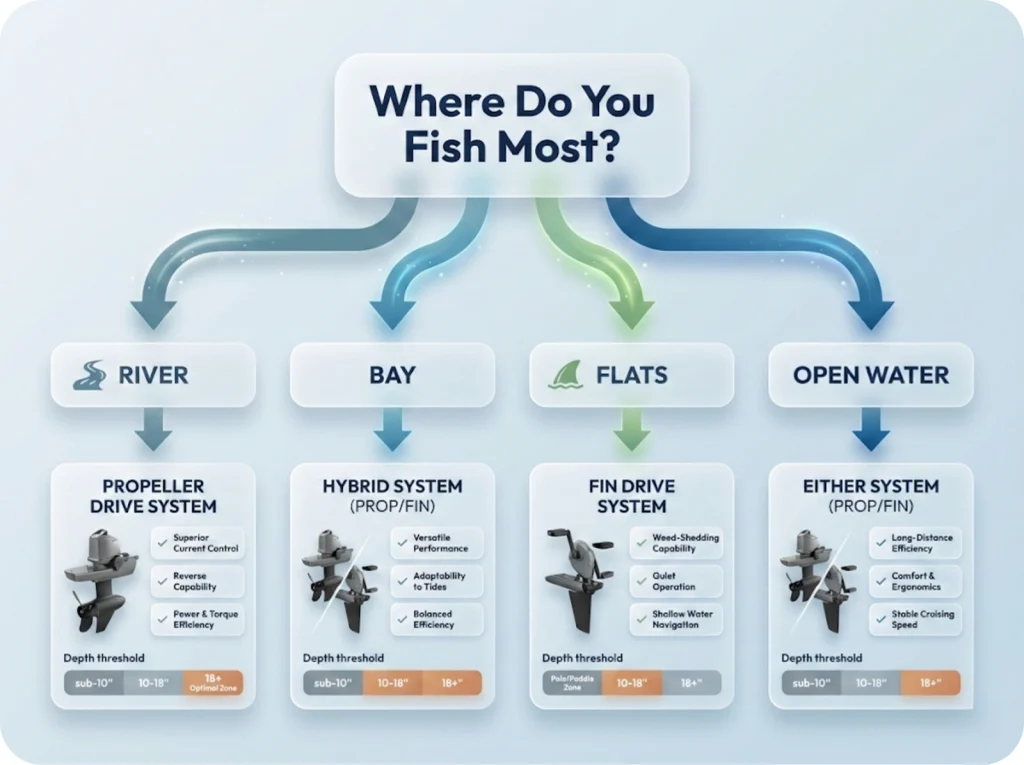
Fin-style drives shed weeds during the oscillation cycle. Propeller drives accumulate weed wrap around the shaft and force you to stop and clear every 10 to 15 minutes. That pause kills your fishing tempo on vegetated lakes.
Below 10 inches of water, neither system works. Retract the drive entirely and switch to poling with your paddle. That’s where kayak fishing started, and it still works. Between 10 and 18 inches, Hobie fins operate fine. Propellers are marginal. Above 18 inches, anything goes, but fins still handle vegetation more cleanly.
Conclusion
Your body pays a price either way. Pedal drives trade arm fatigue for lumbar compression and quad burn. Know your body’s limits before you commit $2,000 or more to a propulsion system that might work against you on long days.
The sticker price is a down payment. Budget $800 to $1,200 above MSRP for carts, maintenance, and the fishing accessories manufacturers assume you’ll buy separately.
Water type decides the argument. No single system wins everywhere. Rivers and creeks favor paddles. Open bays and long transits demand pedals. Grass flats depend on your drive type. Before your next kayak purchase, take a demo paddle and a demo pedal kayak on the exact water you fish most. Thirty minutes on your home lake will tell you more than any spec sheet ever could.
FAQ
Are pedal kayaks worth the extra money for fishing?
It depends on where you fish. If you cover open water, bays, or need hands-free trolling, the speed efficiency and range justify the investment decision. For rivers, creeks, and skinny water under 12 inches, a well-rigged paddle fishing kayak outperforms at half the cost.
Do pedal drive kayaks scare fish away?
Fin-style drives produce less noise than propeller drives because they mimic natural fin movement rather than rotational cavitation. At low cadence, either system is quieter than a paddle splash. The real stealth advantage comes from approaching perpendicular to the fish’s line of sight, regardless of propulsion.
Can you use a pedal kayak in shallow water?
With limitations. Hobie kick-up fins operate in as little as 12 inches when feathered flat against the hull. Propeller drives need 15 to 18 inches minimum. Below 10 inches, retract the pedal drive entirely and use a paddle to pole through the flat. Forcing a driven system in shallow waters risks shearing a pin or bending fins.
How often do pedal drives need maintenance?
Manufacturers recommend a full drive teardown and re-greasing every 75 hours of use or once per fishing season, whichever comes first. Between services, rinse the drive with freshwater after every saltwater trip, check cables for fraying, and inspect shear pins for deformation. Budget 30 minutes per month during active season.
What happens if your pedal drive breaks far from the launch?
Carry a backup paddle. Always. For Old Town PDL shear pin failure, the repair takes five minutes with a hex wrench and a spare pin. For a Hobie cable snap, the Reverse Fix (re-inserting the drive backwards) can get you home using one fin. Both protocols are covered step-by-step in this article.
Risk Disclaimer: Fishing, boating, and all related outdoor activities involve inherent risks that
can lead to injury. The information provided on Master Fishing Mag is for educational and informational purposes
only. While we strive for accuracy, the information, techniques, and advice on gear and safety are not a substitute
for your own best judgment, local knowledge, and adherence to official regulations. Fishing regulations, including
seasons, size limits, and species restrictions, change frequently and vary by location. Always consult the latest
official regulations from your local fish and wildlife agency before heading out. Proper handling of hooks, knives,
and other sharp equipment is essential for safety. Furthermore, be aware of local fish consumption advisories. By
using this website, you agree that you are solely responsible for your own safety and for complying with all
applicable laws. Any reliance you place on our content is strictly at your own risk. Master Fishing Mag and its
authors will not be held liable for any injury, damage, or loss sustained in connection with the use of the
information herein.
Affiliate Disclosure: We are a participant in the Amazon Services LLC Associates Program, an
affiliate advertising program designed to provide a means for us to earn advertising fees by advertising and linking
to Amazon.com. As an Amazon Associate, we earn from qualifying purchases. We also participate in other affiliate
programs and may receive a commission on products purchased through our links, at no extra cost to you. Additional
terms are found in the terms of service.