
In this article
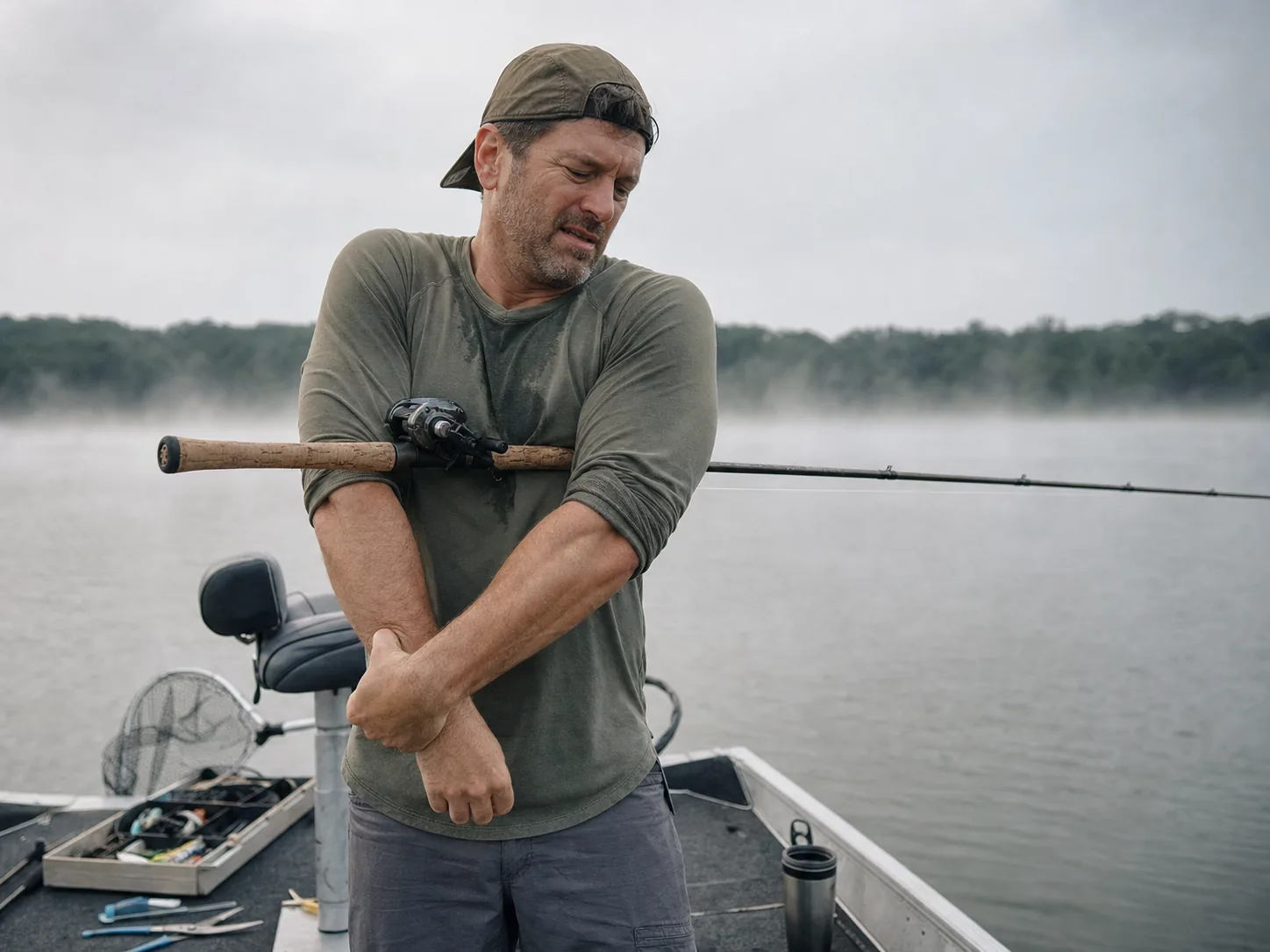
You set the hook on a decent smallmouth, and something on the outside of your forearm answers back. Not during the fight, though. It shows up the next afternoon, right on schedule, the same way it did after the last trip and the one before that, and forum threads are full of anglers describing that exact 24-hour delay before they ever had a name for it.
The name is angler’s elbow, sometimes fisherman’s elbow, and the anglers who beat it almost never beat it with willpower. They beat it by changing the handle they were holding.
What Angler’s Elbow Actually Is (And What It Isn’t)
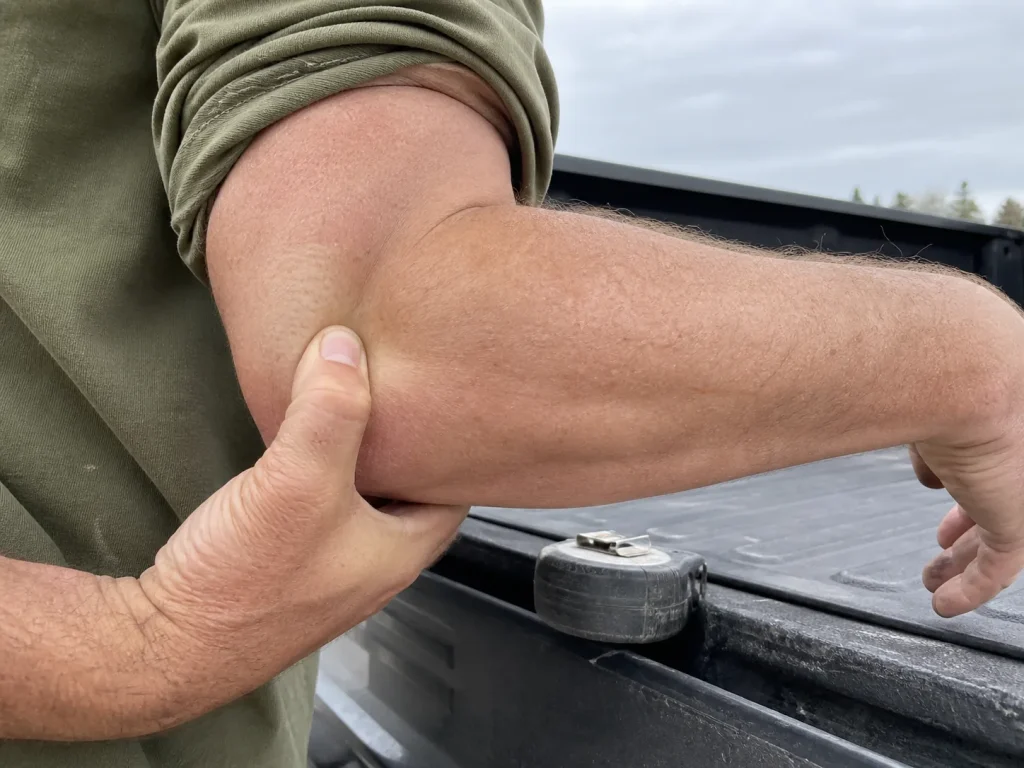
Everyone at the ramp calls any elbow pain tennis elbow. Half of them are pointing at the wrong side of their arm, and the fix depends entirely on which side hurts. So start there: put a finger on it.
Lateral vs Medial (Which Side Is Yours?)
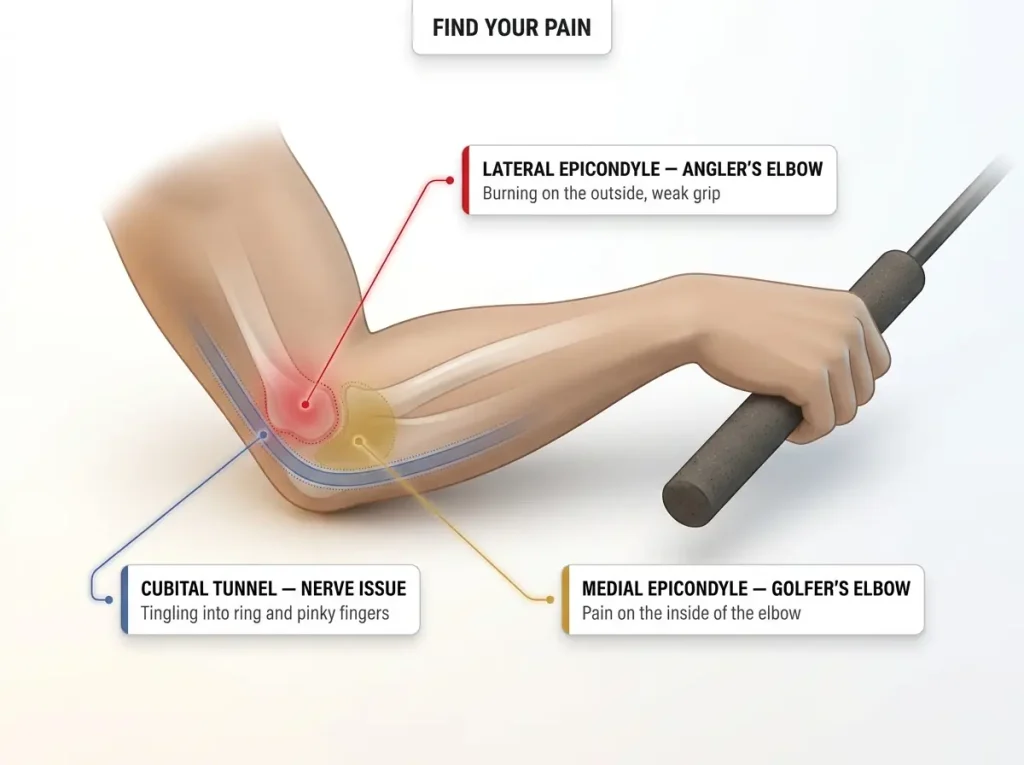
Pain on the outside of the elbow is lateral epicondylitis. That’s angler’s elbow, and it’s the same injury tennis players get. The structure failing is the ECRB tendon, short for extensor carpi radialis brevis, the tendon that anchors your wrist extensors to that bony bump you’re pressing on right now.
Pain on the inside of the elbow is medial epicondylitis, known as golfer’s elbow. Different tendon, different loading pattern, different rehab. Following lateral-elbow advice for a medial problem is how people spend a season getting nowhere.
None of this is rare. ECRB tendinopathy affects roughly 1 to 3% of the general population and lands most often between ages 30 and 60, which is exactly the window most of us do our best fishing, and a clinical study published through the National Institutes of Health found a measurable link between elbow anatomy and tennis-elbow risk. Some people are built closer to the edge than others.
The symptoms that confirm it are specific. Burning over that outer bump. Grip strength that quietly disappears, so you fumble a reel you’ve handled for years. And pain lifting anything palm-down, which is why the coffee cup is the test everybody fails first.
The One That Isn’t a Tendon at All
There’s a third thing that gets misfiled here. Cubital tunnel syndrome is a nerve problem, not a tendon problem, and it feels different: tingling and numbness running into your ring and pinky fingers rather than a hot spot on the bone. If your fingers are going to sleep, you’re in a different conversation, and that one goes to a doctor rather than a blog.
Why Fishing Causes It (And Why Rest Alone Stops Working)
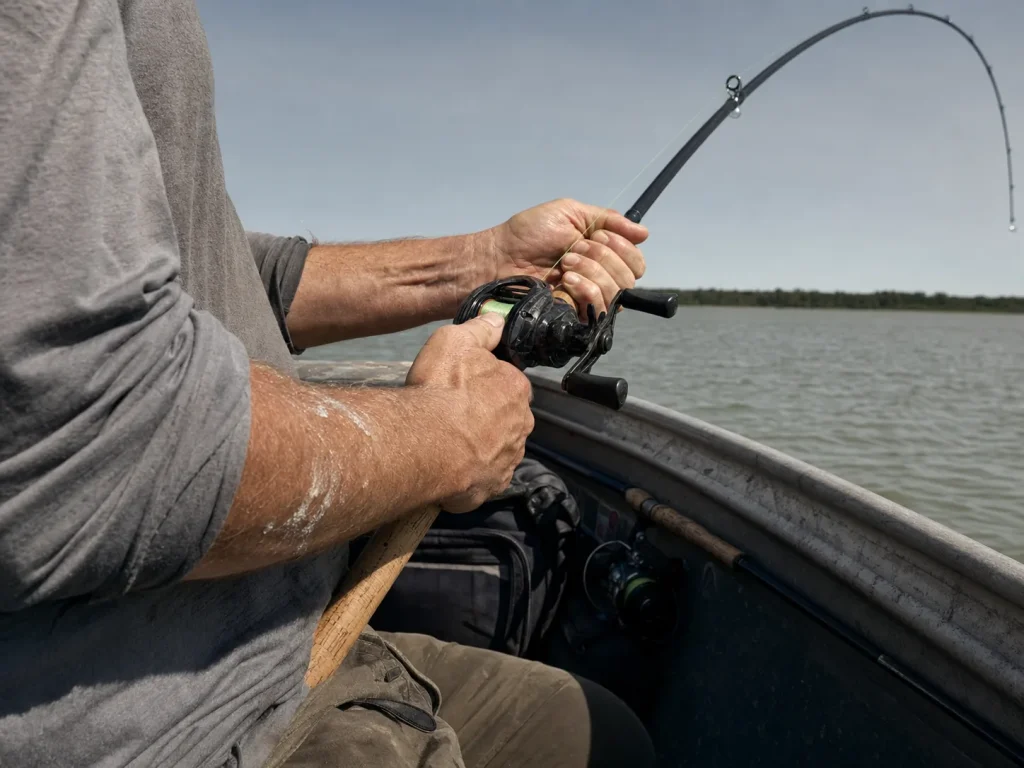
It isn’t one bad hookset. It’s the same grip-and-flick, a few thousand times, on a day you didn’t even think was hard.
The Cast-Reel-Hookset Loading Cycle
Here’s the mechanism. You clamp a power grip on the handle, and at the same moment your wrist extensors fire to load the blank and drive the hookset. Squeezing hard and extending the wrist hard, simultaneously, puts maximum tensile load right where the ECRB attaches to the bone.
Then you do it again. And again. Eight hours of that, and the tendon starts losing the repair race.
Nothing about that cycle feels violent, which is the trap. A single rep is nothing. Three thousand reps is a repetitive strain injury with a delayed invoice.
Tendinitis vs Tendinosis (Why Your Ice Pack Quit Working)
Now the part almost nobody in fishing gets right. Past the first few weeks, this is not inflammation. Chronic cases are classified as angiofibroblastic tendinosis, which is tissue degeneration: the tendon’s collagen structure breaking down and being replaced by disorganized junk. The “-itis” on the end of the name is medically wrong for anything but a fresh flare-up.
That single distinction rewrites your entire treatment plan. If there’s no inflammation left, then ice and anti-inflammatories are treating a problem you no longer have, which is why the ice pack that helped in the first week stops doing anything once this has settled in. Heat and controlled loading do more for the established case.
And total rest is a trap of its own. Tendons remodel under load. Take six weeks completely off, and you come back to a tendon that is just as degenerated as when you left, minus six weeks of fishing.
Rest removes the symptom and preserves the cause. That’s also why the most common mistake in the field, fishing through it indefinitely with a strap on and never touching what caused it, fails in the opposite direction: both approaches skip the actual repair.
The 24-hour delay is your diagnostic. Pain that arrives during the session is usually a muscle complaining about work. Pain that shows up the next afternoon, every time, on schedule, is a tendon telling you it lost the repair race overnight. Track which one you have before you decide what to do about it.
Check Your Rod Grip First (The Handle Is a Bigger Lever Than Your Cast)
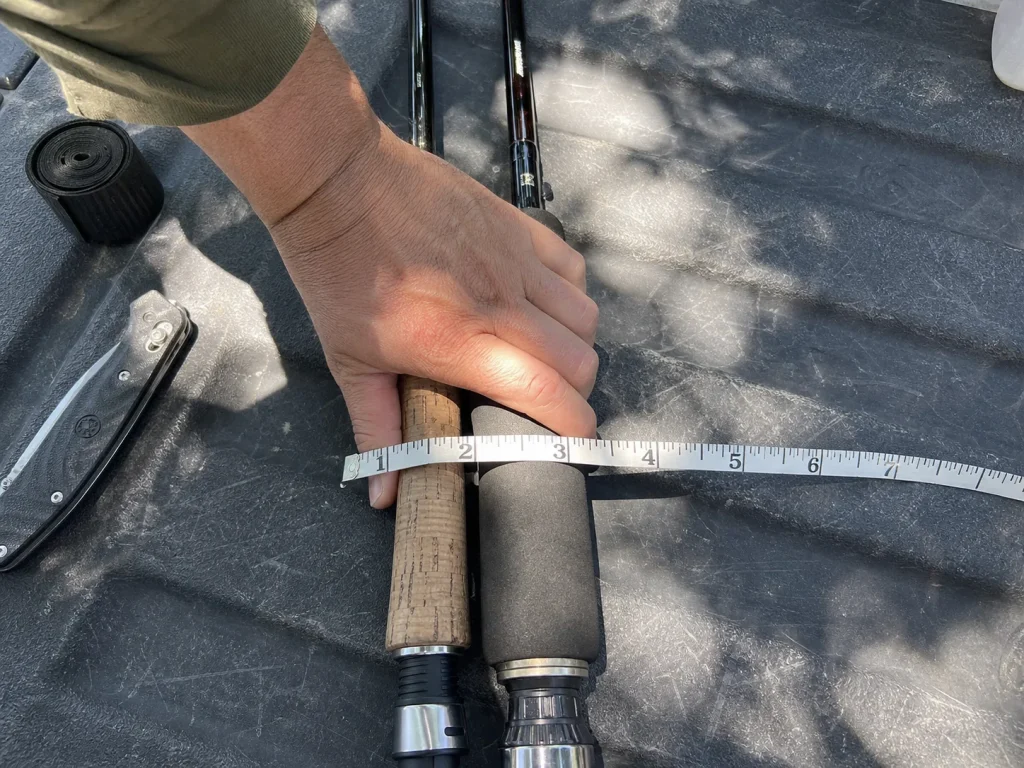
Nobody buys a rod by handle diameter. You buy it by power, action, maybe price, and then you hold that handle for eight hours. A grip that’s a size off doesn’t feel wrong at the shop. It feels wrong at 3pm.
The Handle Diameter Your Hand Actually Wants
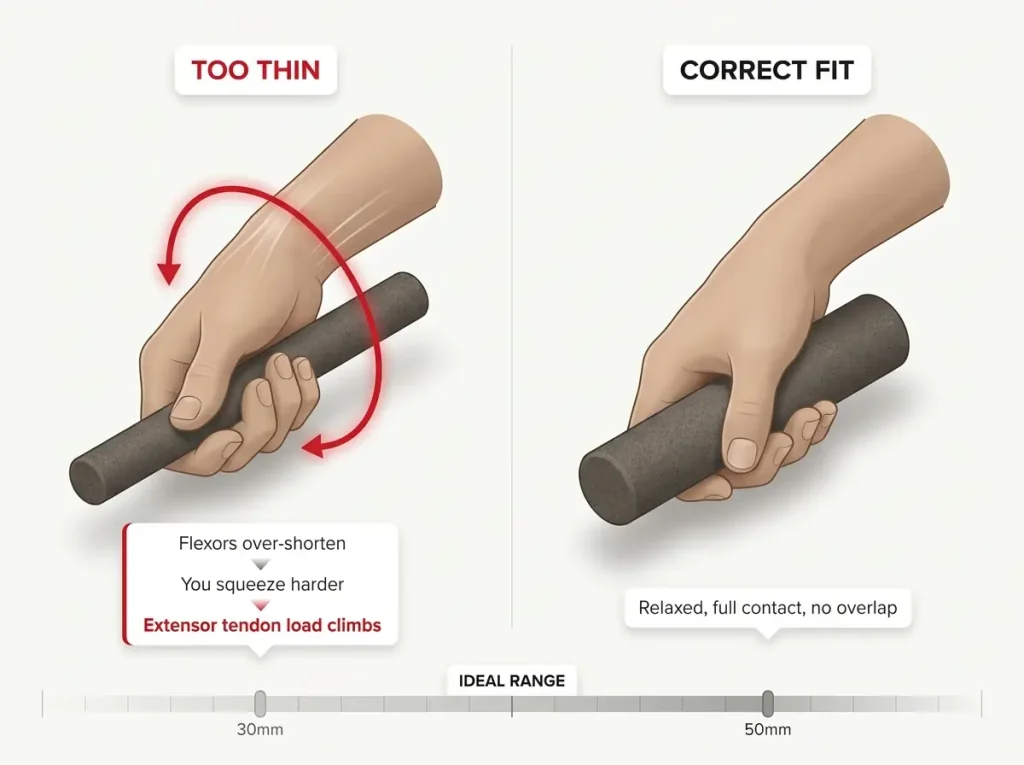
There are real published numbers for this, they just live in occupational ergonomics rather than fishing. Those occupational ergonomics guidelines from the Canadian Centre for Occupational Health and Safety recommend a 30 to 50mm handle diameter for power-grip tools, with 35 to 45mm rating most comfortable in testing and roughly 33mm suggested as the compromise that needs the least muscle contraction to hold. A rod handle is a power-grip tool. The same physics applies whether the thing in your fist is a hammer or a cork handle.
As a rough field check, measure your hand length, palm crease to the tip of your middle finger, and figure somewhere around a fifth of that as your target grip diameter. Treat that as a rule of thumb rather than a law. The test that actually matters is simpler: wrap your hand around the grip. If your fingers reach all the way around and overlap the base of your thumb with slack to spare, the handle is too thin for your hand.
Why a Thin Grip Makes You Squeeze Harder
This is the part no one explains, and it’s the whole article in one paragraph. A handle that’s too thin forces your finger flexors to over-shorten just to close the grip. Muscles are weakest at the end of their range, so now you’re generating grip force from a bad position, and you have to overgrip just to stop the rod rotating in your palm on the hookset.
That extra squeeze raises extensor tendon tension in a straight line. So the thin handle isn’t just uncomfortable. It’s manufacturing the load that’s degrading your tendon.
Anglers figured this out before the research did. Overgripping is the community’s own word for it, and it’s the root cause people name themselves in forums the moment somebody points at their hand.
Tip-Heavy Rods and the All-Day Isometric Hold
Diameter is lever one. Rod balance is lever two. A rod with the balance point sitting forward of the reel seat demands constant wrist-extensor tension just to hold the tip level, and unlike the hookset, that load never stops. It’s an isometric hold that runs from launch to takeout with no rest between casts.
Fixing that is cheap. Grip wrap builds a thin handle up toward the range your hand wants, and it’s worth knowing that cork and EVA foam behave differently under a wet, tired hand, since a grip that slips is a grip you squeeze harder. A butt weight pulls the balance back behind the reel seat. And the cheapest fix of all costs nothing: squeeze less.
Worth saying plainly, since tackle marketing has muddied it: an ergonomic grip is not a shape or a sticker on the blank. It’s a diameter that matches the hand holding it, which means the same handle can be ergonomic for your buddy and wrong for you. If you’re replacing the rod anyway, How to Pick a Fishing Rod Without Overpaying covers what to check on the blank before you commit, and handle diameter belongs on that list right next to power and rod action.
Spinning vs Baitcasting (Where Your Hand Actually Sits)
Reel type is lever three, and it changes your hand position completely. A spinning reel hangs under the rod with your fingers straddling the stem and the weight pulling down through your palm. A baitcasting reel sits on top with your hand wrapped over it and your thumb on the spool, which puts your wrist at a different angle using a different set of muscles to hold the rod level.
You’ll read that spinning reels pendulum below the rod and therefore need less grip force. It sounds reasonable and it might be true, but we couldn’t verify it against anything solid, so treat it as an idea rather than a finding. What is solid: reel weight and size feed straight into the balance point, and the balance point is what your extensors hold up all day. If you’re rethinking the whole setup, Why Your First Reel Isn’t Always a Spinning Reel walks through which type suits which hands and which fishing.
The Casting Habit That’s Hurting You
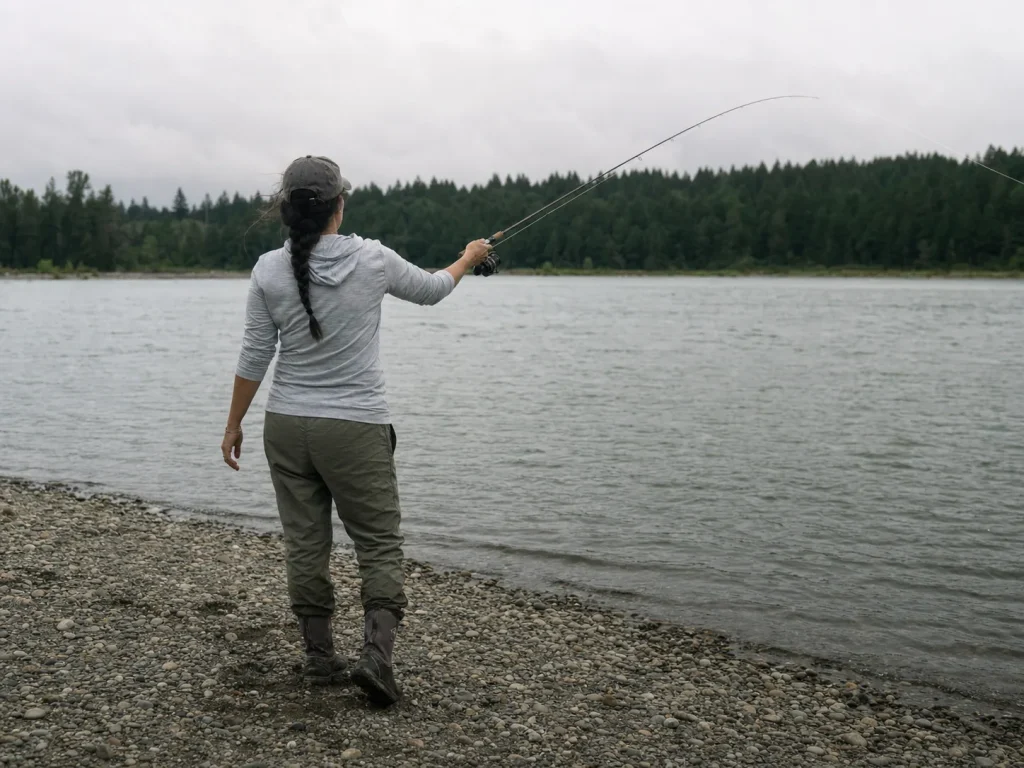
The advice that wrecks people is the advice they were given on purpose, by someone trying to help, usually in their first season.
Let the Wrist Break (Yes, Really)
Almost everyone was taught to lock the wrist through the cast. Keep it stiff, they said. Rod and forearm move as one unit. It turns out that instruction is part of the problem: researchers in Loughborough University’s Design Ergonomics group have studied wrist mechanics during casting motions and found that allowing slight wrist-break during the cast reduces forearm-muscle strain compared with holding it rigid.
That testing came out of fly casting, where the locked-wrist rule is preached hardest and a fly rod loads over a longer stroke, so read it as a principle rather than a spec for your baitcaster. The mechanism travels, though, because the joint doesn’t know what’s attached to it.
Think about what locking a joint actually requires. To keep a wrist from moving while a loaded rod tries to move it, the extensors have to fire continuously against that force. A wrist that gives a little lets the blank absorb what your forearm was absorbing.
You’re not being sloppy. You’re letting the rod do the job you bought it for.
Grip Pressure vs Casting Distance
The other habit is muscling the cast for distance. The harder you try to force the rod, the harder your extensors fight the handle, and the ironic part is that it doesn’t buy distance. Distance comes from loading the blank and letting it unload, which is exactly what a clean baitcasting stroke that loads the blank instead of muscling it is built around. Squeezing harder just adds tendon load and takes the timing away.
Where your hand sits matters too. The V-grip, thumb running along the top of the handle rather than wrapped around it, changes which muscles do the work of holding the rod level, and that’s the quiet half of casting mechanics nobody coaches. Thumb on top, the blank rides the web of your hand. Thumb wrapped, your extensors carry it.
So how hard should you hold it? Hard enough that the rod doesn’t rotate in your hand on the hookset, and no harder. For most anglers that’s dramatically less than what they’re using.
The evidence that this alone can be the whole fix is uncomfortably simple: one angler in a casting forum had forearm pain after every single session for years, until an instructor watched him cast, told him he was gripping way too hard, and had him loosen it. The pain went away almost immediately. No brace, no gear, no time off.
Run the pressure test on your next trip. Cast normally, then consciously drop your grip pressure one notch and cast again. Then drop it another notch, and keep going until the rod actually turns in your hand on the hookset. Back off one notch from there. That’s your real number, and most people find it two or three notches below where they’ve been living.
Your Technique Tells You Where It’ll Hurt First
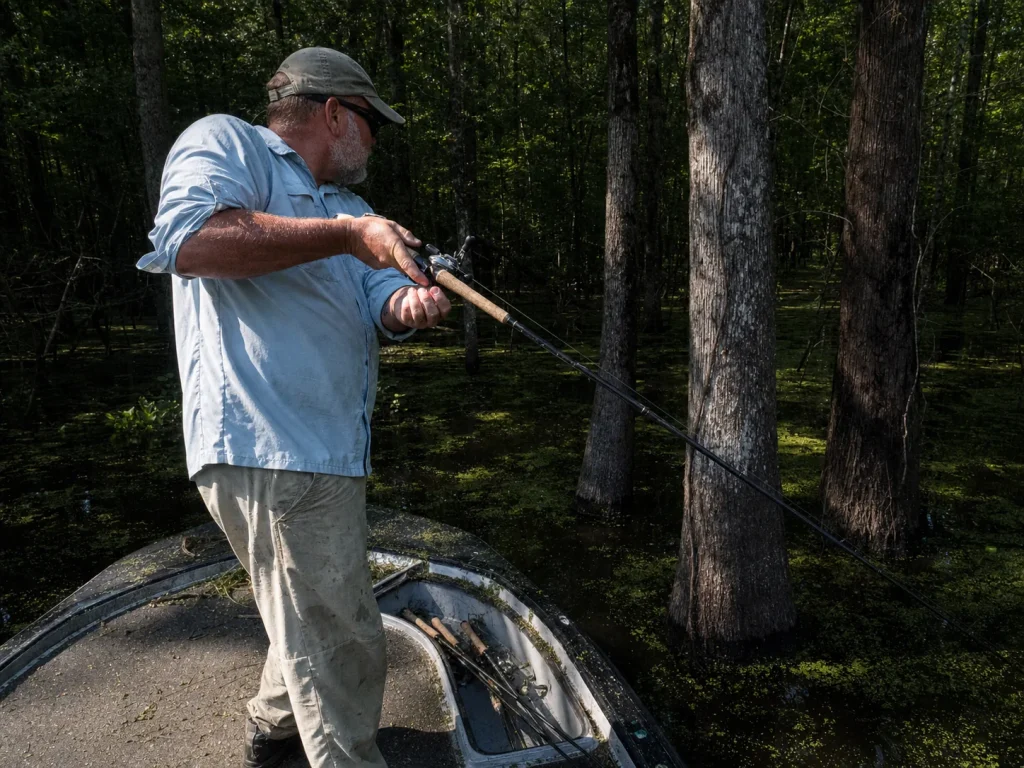
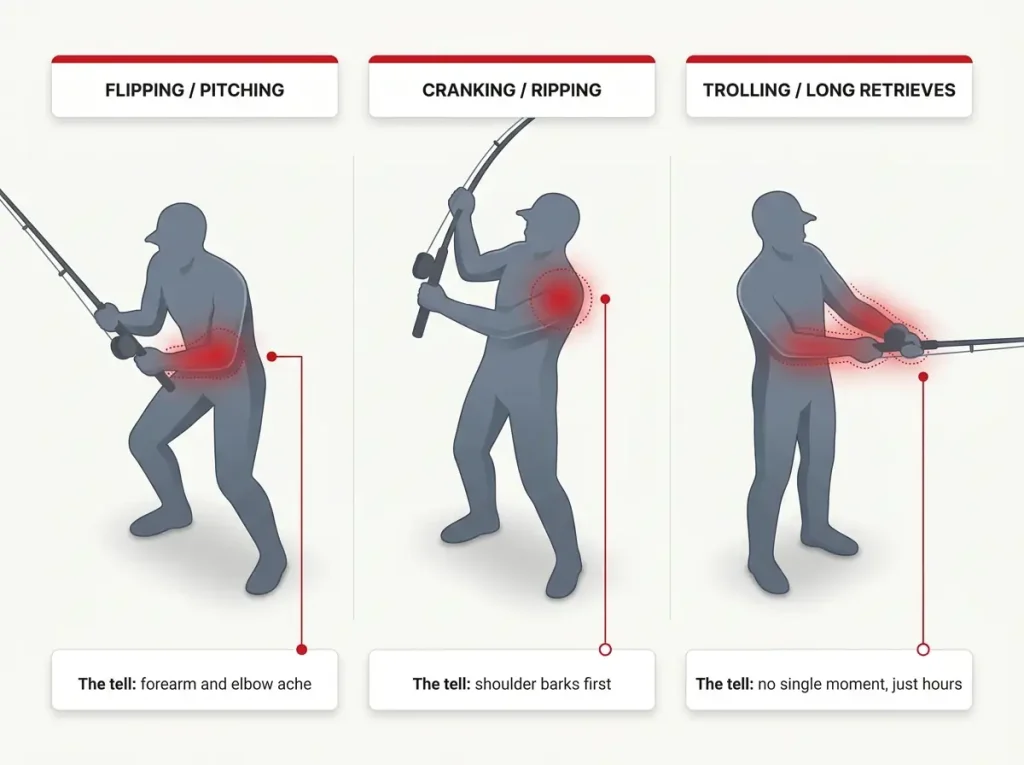
A guy who flips heavy cover all day and a guy who rips rattle traps all day are not going to hurt in the same place. They’re loading completely different chains, and knowing which chain is yours means you can see it coming.
Flipping and Pitching (The Forearm Crowd)
If you spend your day flipping and pitching heavy cover, your elbow works inverted and out of alignment with your wrist, over and over, with a short violent load at the end of each rep. Bass anglers comparing notes about this are consistent enough that they can nearly guess your technique from your complaint: the flipping and pitching crowd reports wrist and forearm pain, and this is the group angler’s elbow comes for.
The alignment part is what makes it worse than the rep count suggests. When your elbow and wrist stack up in line, the load spreads across a chain of muscle that’s built to share it. Invert the elbow and take the wrist out of that line, and the ECRB is left absorbing what the chain used to split, which is the same tendon the grip force is already loading.
Then the gear compounds it. A flipping stick is long and heavy at the tip, which is exactly the tip-heavy balance problem from earlier, and it’s held in a fist for hours between short bursts of hard work. Every lever in this article stacks in the same direction on that one technique.
That’s not bad luck. That’s the setup and the motion agreeing on a target.
Cranking and Ripping (Why Your Shoulder Went First)
Ripping rattle traps and cranking ledges loads the shoulder far more than the elbow. Same trip, same fatigue, different casualty. If your shoulder is the thing barking at you, the fix isn’t a rod handle, it’s a different conversation entirely.
Trolling and long retrieves are the third pattern, and the sneakiest. There’s no violent rep to blame, just hours of holding a rod at the same angle, which is the isometric load from earlier running uninterrupted instead of in bursts. Nobody walks off the water thinking a slow troll hurt them. The tendon disagrees the next afternoon.
Rod length feeds the same equation, since a longer blank is more swing weight held further from your hand, and rod length matched to how you actually fish changes what your extensors hold all day. The practical move is to know your tell and rotate techniques inside a session before it shows up, rather than after.
Warm Up, Take Breaks, Watch the Cold
The trip that hurts you is almost never the hard one in August. It’s the first easy one in March.
The Early-Season Trap
Early season is the riskiest window of the entire year, and two multipliers stack on day one. Your muscles are deconditioned after a winter of not casting, so the tendon is taking load from tissue that lost its tolerance months ago. And cold hands grip harder without asking your permission, so on the one day you’re least ready, you’re squeezing hardest.
Anglers describe the pattern the same way every spring: a season opener they’d call an easy day, followed by a week of forearm pain. That’s the deconditioning tax, and it’s collected on the way in.
This is also the honest reason gloves that actually keep your hands warm enough to stop over-squeezing matter here. It’s not comfort. It’s shutting off the cold-grip multiplier before it compounds with everything else.
The Two-Minute Warm-Up
A short forearm flexor and extensor stretching routine before a session measurably cuts pain incidents, especially early season, and it costs about two minutes. Extend one arm, palm down, gently pull the fingers back and hold. Flip the palm up and repeat. That’s the whole thing.
Breaks work differently than people assume. They’re not about tiredness, they’re about interrupting the isometric hold. Setting the rod down between spots gives the extensors the only real rest they’ll get all day, and running from spot to spot with the rod in your hand quietly cancels that.
What to Do When It Already Hurts
You’re not going to stop fishing. Nobody does. So here’s how to keep going without making it permanently worse.
Heat, Ice, and When Each One Earns Its Place
Ice has one job left: the evening after a hard session, when there genuinely is a fresh flare-up to calm down. That’s also the window where NSAIDs earn their keep, and the same logic retires them afterward. Past the first few weeks, remember what you’re dealing with is degeneration and not inflammation, so there’s very little for ice to reduce. Heat plus controlled movement does more, and a moist microwavable heating pad is the least complicated way to get it: warm it up, put it on the forearm before you do your loading work rather than after, and let the tissue come up to temperature before you ask it to move.
What a Strap Actually Does (And What It Doesn’t)
An elbow strap works by compressing the muscle belly just below the joint, creating a secondary insertion point so force gets absorbed there instead of at the damaged tendon attachment. It works. It also fixes nothing. The ACE Sport Tennis Elbow Strap is the name that keeps surfacing in bass-fishing injury threads, adjustable so you can dial the compression as the day goes on, and the CAMBIVO 2 Pack Tennis Elbow Brace does the same job for less, with a spare in the bag or one for whoever you fish with.
Be honest with yourself about what you just bought, though. A strap is palliative, not curative. It buys you the trip.
It does not remodel a degenerated tendon, and wearing one while skipping the actual work is how a manageable problem becomes a bad one in a year. The cheapest fix in this entire article is still squeezing less and fixing the handle. The strap is what you wear while you do that, not instead of it.
When to See a Doctor
Some things aren’t ours to solve. Persistent pain that isn’t trending better, swelling, numbness, or lost range of motion means an orthopedic visit rather than another month of forum advice. Supervised physical therapy is the step most anglers skip on the way there, and it’s the one that usually makes the rest unnecessary. Cortisone injections, platelet-rich plasma, the Tenex procedure and arthroscopic surgery all exist for the cases that don’t respond, and choosing between them is a doctor’s call.
Wear the strap below the sore spot, not on it. The whole point is to compress the muscle belly down your forearm so the load transfers there. Strapped directly over the bony bump, it’s just a tight band doing nothing, which is why plenty of anglers decide braces don’t work when what didn’t work was the placement.
The Rehab Protocol That Actually Works
Everyone says do strengthening exercises. Nobody says which ones, how, or why the twisting one beats the curling one.
How the Tyler Twist Works
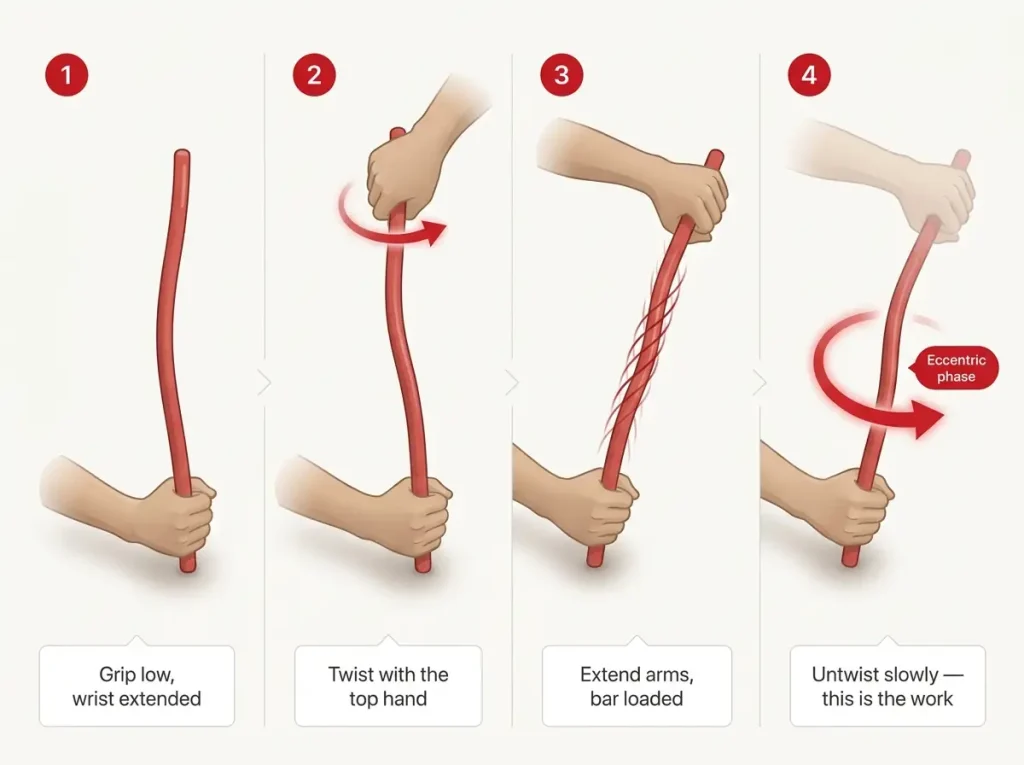
The protocol with the real evidence behind it is the Tyler Twist, done with a flexible resistance bar. The study that put it on the map reported an 81% reduction in elbow pain and a 72% increase in tendon strength, which is one of the best-documented at-home results for this injury anywhere.
The reason it works is eccentric loading. Eccentric means the lengthening phase under tension, the controlled lowering rather than the lifting, and that’s the phase that drives tendon remodeling. Ordinary wrist curls spend most of their effort on the lifting half, which is exactly the half that does the least for a degenerated tendon.
So here’s the movement. You hold the bar in the sore hand with the wrist cocked back, twist it with the good hand, extend both arms out so the bar is wound tight, and then slowly let the sore wrist untwist it against the resistance. That slow untwist is the entire exercise. Everything before it is just setup.
Why Eccentric-Only Isn’t Enough
Here’s where this stops being an advertisement. A combined eccentric, concentric and isometric protocol produces a larger effect on pain and function than eccentric loading alone. The bar isn’t a silver bullet. It’s the single best-documented piece of a routine that should also include straight resisted work and static holds, and anyone selling you the twist as the whole answer is selling you a third of one.
Where to Start and How to Progress
Start soft. The TheraBand FlexBar in red is the beginner resistance tier, and it’s the correct entry point for a tendon that’s already unhappy. Starting on a stiffer bar because red looks too easy is the standard way people quit in week one.
Then the honest part about timing. Tendon remodeling is measured in weeks and months, not sessions. The protocol works if you keep doing it after the pain fades, which is precisely when everyone stops.
The pain leaving is not the tendon being repaired. It’s the tendon getting quiet enough to fool you.
Conclusion
Three things worth keeping. It’s a tendon on the outside of your elbow, degenerating rather than inflamed once you’re past the first couple of weeks, and that single fact changes what works. The handle in your hand is a bigger lever on that tendon than your casting stroke is, so diameter and balance come first and willpower never comes at all. And if it already hurts, load it progressively with the right protocol instead of resting it into a longer layoff.
On your next trip, run one experiment before you spend a dollar. Pay attention to how hard you’re actually squeezing between casts, then loosen it a full notch. Most anglers find out they’ve been white-knuckling a rod for years without ever noticing they were doing it.
Frequently Asked Questions
01What is the difference between angler’s elbow and golfer’s elbow?
Angler’s elbow, or lateral epicondylitis, hurts on the outside of the elbow. Golfer’s elbow, or medial epicondylitis, hurts on the inside. Different tendons, different loading, different rehab. Put a finger on the sore bump before following any advice, because half the fixes online assume the other one.
02Can a fishing rod actually cause elbow pain?
Yes, in two ways. A handle too thin for your hand forces you to overgrip just to keep the rod from twisting, and a tip-heavy rod makes your wrist extensors hold weight all day without a break. Both raise tension on the same tendon that fails.
03Should you keep fishing with angler’s elbow?
Usually yes, with changes. Total rest does not remodel a degenerated tendon, so a long layoff often leaves you where you started. Fix your grip pressure and handle, shorten sessions, and start a loading protocol. See a doctor for swelling, numbness, or lost range of motion.
04Is heat or ice better for angler’s elbow?
Ice earns its place the evening after a hard session. Past the first few weeks it is tendinosis, meaning tissue degeneration rather than inflammation, so there is little left for ice to reduce. Heat plus controlled loading does more for the established case.
05What is the best exercise for angler’s elbow?
The Tyler Twist, an eccentric loading exercise done with a flexible resistance bar. The study behind it reported an 81% pain reduction and a 72% gain in tendon strength. Mix in resisted curls and static holds, since combined loading beats eccentric work alone.
Risk Disclaimer: Fishing, boating, and all related outdoor activities involve inherent risks that
can lead to injury. The information provided on Master Fishing Mag is for educational and informational purposes
only. While we strive for accuracy, the information, techniques, and advice on gear and safety are not a substitute
for your own best judgment, local knowledge, and adherence to official regulations. Fishing regulations, including
seasons, size limits, and species restrictions, change frequently and vary by location. Always consult the latest
official regulations from your local fish and wildlife agency before heading out. Proper handling of hooks, knives,
and other sharp equipment is essential for safety. Furthermore, be aware of local fish consumption advisories. By
using this website, you agree that you are solely responsible for your own safety and for complying with all
applicable laws. Any reliance you place on our content is strictly at your own risk. Master Fishing Mag and its
authors will not be held liable for any injury, damage, or loss sustained in connection with the use of the
information herein.
Affiliate Disclosure: We are a participant in the Amazon Services LLC Associates Program, an
affiliate advertising program designed to provide a means for us to earn advertising fees by advertising and linking
to Amazon.com. As an Amazon Associate, we earn from qualifying purchases. We also participate in other affiliate
programs and may receive a commission on products purchased through our links, at no extra cost to you. Additional
terms are found in the terms of service.