
In this article
You climb out of the river after four hours, peel down the straps, and your thighs are damp. Not soaked through, but definitely not dry, and the waders were supposed to be bone dry inside. So you drive home already pricing replacements, convinced there is a hole somewhere you cannot find. Ask around the boat ramp and you will hear the same story from half the people standing there, which should tell you something: the fabric is usually not the thing that failed. Here is how waterproof breathable gear actually works, why it leaves you damp anyway, and how to tell in thirty seconds whether yours is broken or just neglected.
This is a guide to that fabric on waders and wading jackets specifically, not on hiking shells, because the way a garment fails while you stand in moving water for four hours is nothing like the way it fails on a dry trail. Wading gear is one piece of a larger system, and if you want the wider view of how it fits together, our breakdown of fishing apparel and sun protection beyond the UPF tag covers the rest of what you put on before you step in.
What Waterproof Breathable Actually Means
Three separate claims get compressed into one phrase on every hang tag, and they are not interchangeable. Waterproof means the fabric holds out liquid water under pressure, and it carries a number to prove it. Water-resistant means the fabric sheds a light shower and then gives up, with no number attached because there is nothing to measure. Breathable means water vapor can pass outward through the same material that is stopping liquid from coming inward.
That last part is the whole engineering problem. Anything can be waterproof if you are willing to wear a trash bag. The trick is doing it with a material that also lets your own sweat out, which is why this category exists at all and why it costs what it costs.
The distinction matters most when you are shopping. A water-resistant wading jacket is genuinely fine for an hour of drizzle and completely useless the moment you kneel down in the shallows to unhook a fish. If you want the honest comparison between fully sealed and fully breathable construction, our look at neoprene versus breathable waders lays out where each one wins, and our guide to rain gear built for anglers covers the jacket side in more depth.
How the Membrane Actually Works
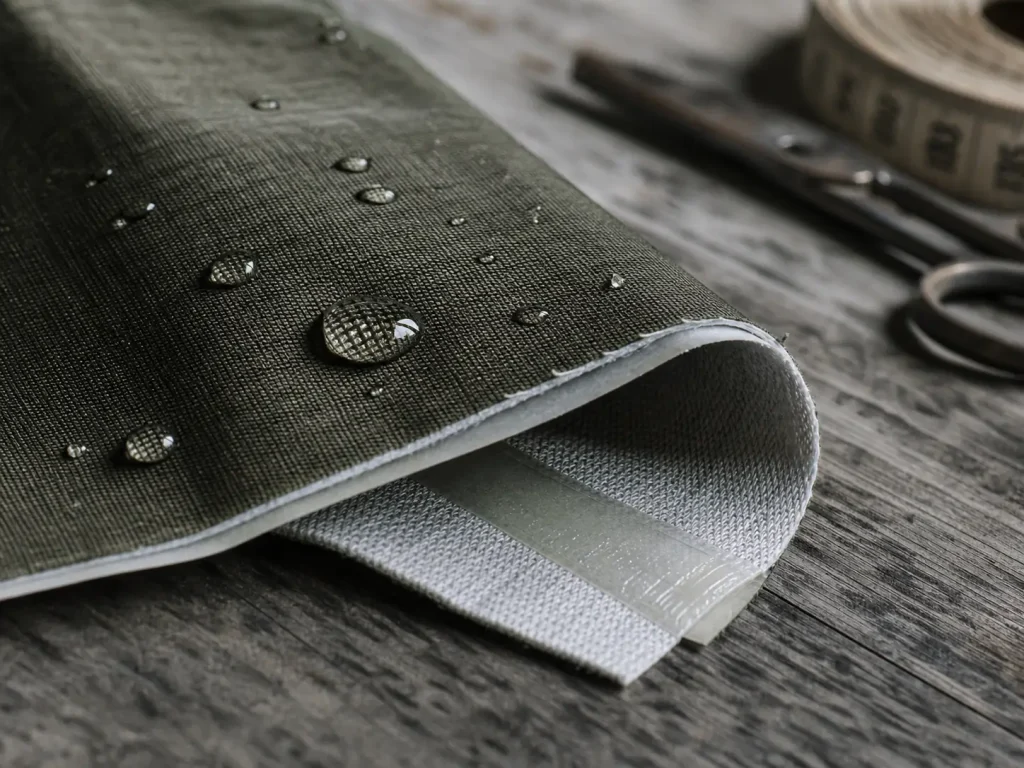
The magic is a size filter, not a marketing claim. Every square inch of an ePTFE membrane carries roughly nine billion pores. Each one is about 20,000 times smaller than a water droplet and about 700 times larger than a water vapor molecule. Liquid water cannot squeeze through. Vapor walks out unopposed. That is the entire mechanism, and it has been the industry standard since the seventies.
There are two families of membrane, and the difference shows up on the water rather than on the spec sheet.
- Microporous or hydrophobic membranes use actual physical holes. This is ePTFE and its relatives: Gore-Tex, eVent, and Polartec NeoShell all live here.
- Monolithic or hydrophilic membranes are a solid film with no holes at all. TPU (thermoplastic polyurethane), PVDF, and polyurethane laminates like Toray Dermizax pass moisture chemically, handing water molecules along the polymer chain from the wet side to the dry side.
Neither is universally better. Pore-based membranes hold up noticeably better under sustained pressure, which in angler terms means kneeling on gravel and leaning into current for an hour at a time. Solid films can out-breathe them in cold, dry conditions and usually cost less to build. If you want the manufacturer’s own version of the pore explanation, Gore’s technical write-up on how its microporous membrane blocks liquid while passing vapor walks through it in detail.
Above the membrane sits the face fabric, usually a ripstop weave. A nylon face fabric takes abrasion better and is what you want on waders; a polyester face fabric resists sun better and shows up more on jackets. Either one is specified by thread weight in denier and fabric weight in GSM. Below it, in better garments, sits a tricot backer that keeps the membrane from rubbing against your base layer. Those three pieces are what people mean when they say a garment is three-layer.
Why You Still Feel Wet in Gear That Isn’t Leaking
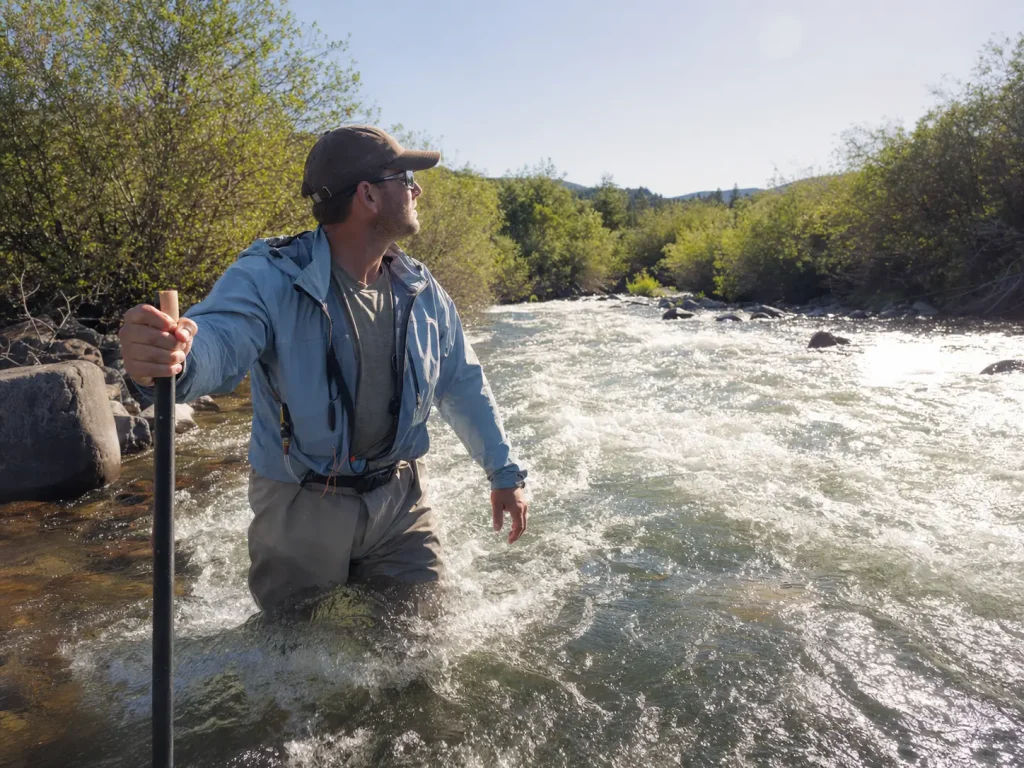
This is the part nobody explains, and it is the single most common reason a perfectly good garment gets returned.
Every breathability number you have ever read was measured under conditions close to resting. Lab testing for MVTR puts fabric in a controlled chamber with a stable temperature and a stable humidity gradient. Nobody runs the test while you grind a quarter mile upstream against heavy current on a July afternoon with a pack on your back.
The mechanism is straightforward once you see it. Vapor moves from high humidity to low humidity, and the size of that gap is what drives the whole system. When you work hard, you generate sweat vapor faster than the membrane can transport it. The air inside your shell gets more and more humid. On a warm, muggy day the air outside is already humid too. Once those two numbers get close, the gradient collapses, vapor stops moving, and it condenses on the inside of the shell. That condensation runs down your chest and pools at your waist, and it feels exactly, precisely like a leak.
It is not a leak. It is a physics ceiling, and every membrane on the market hits it. A premium hardshell and a budget softshell both fail here, just at different points on the effort curve. What the expensive one buys you is a later arrival and better venting once you get there.
So the practical fix is not a better fabric. It is managing your own output: slow down before you start pouring sweat, open the front of the jacket, use the pit zips if the garment has them, and lift the storm flap when the rain eases. Ask around and you will find that most of the people fighting clammy gear are wearing it fully zipped in seventy-degree weather.
If you are going to walk a long way to the water, walk it with the jacket off and stowed. Ten minutes of hard hiking inside a sealed shell puts more moisture in there than two hours of standing and casting in rain will. Put it on when you arrive, not when you park.
What you wear underneath decides how much of that condensation you actually notice. A synthetic layer moves it off your skin and spreads it out to evaporate. Cotton holds it against you and makes a mild problem feel like a soaking, which is why our layering system for anglers treats the base layer as part of the waterproofing conversation rather than a separate topic.
DWR Is Not the Membrane (and It’s Usually What Failed)
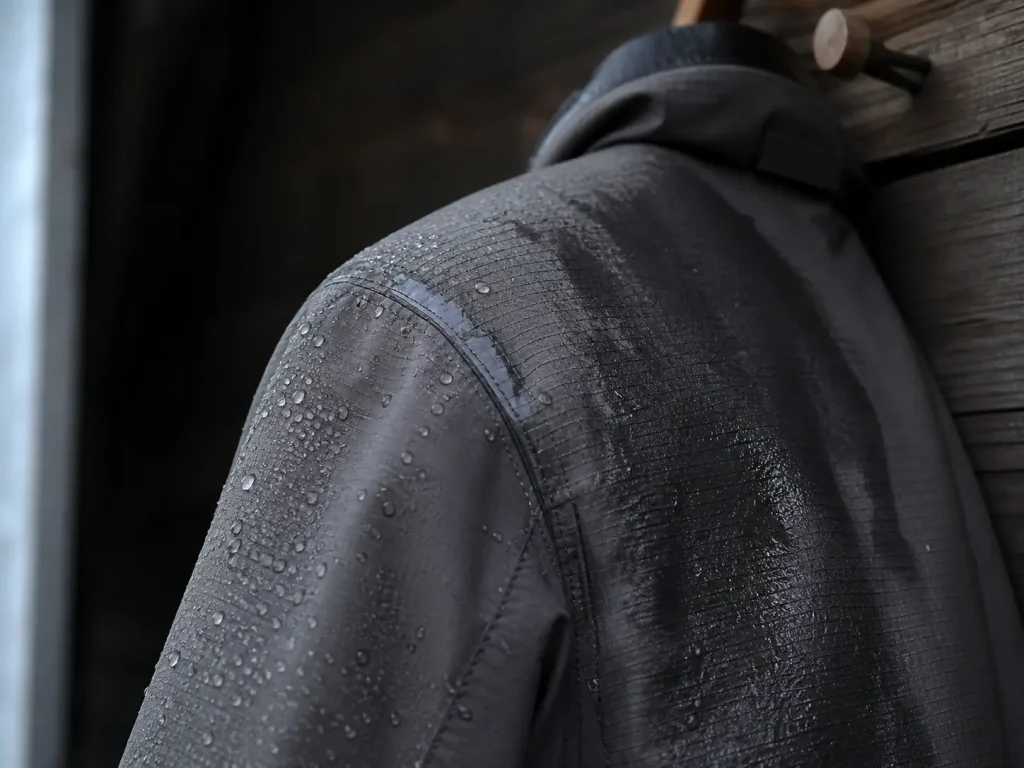
If you take one thing from this article, take this. DWR, or durable water repellent, is a completely separate coating applied to the outside of the face fabric. It is not the membrane. It is not part of the membrane. It sits on top of the membrane and it wears off, on a schedule measured in trips rather than years.
Here is what happens when it dies. Water stops beading and starts soaking into the face fabric, which darkens and gets heavy. Anglers call this wetting out. Now the outer layer of your garment is a saturated sponge, and a saturated sponge is a vapor barrier. The membrane underneath is completely intact and still perfectly waterproof, but nothing can get out through the wet fabric sitting on top of it, so your own sweat has nowhere to go. You get cold, you get damp, and you go home certain you have a hole.
That is the reframe worth internalizing: a leaking wader is very often just an exhausted coating. The repair is a spray can and an afternoon, not a replacement.
DWR dies faster than most people expect, and it dies from specific things. Dirt and skin oils are the biggest culprits, because contamination on the surface breaks up the water-repelling behavior. Salt is worse. Heat and improper drying wreck it too, which is why our guide on drying waders the right way exists as its own article rather than a footnote here.
2-Layer, 2.5-Layer, 3-Layer, 4-Layer
The layer count on a hang tag describes how the membrane is sandwiched. Here is what each number actually gets you.
- 2-layer: face fabric bonded to membrane, with a loose hanging liner inside. Cheap to build, bulky, and fine for a jacket you wear a few times a year.
- 2.5-layer: face fabric, membrane, and a printed or sprayed half-layer instead of a real liner. The lightest option and the most packable. It also wears out fastest, because that half-layer abrades away.
- 3-layer: face fabric, membrane, and a bonded knit backer, all laminated into one piece. This is the working standard for serious wading gear.
- 4-layer: a three-layer laminate with an additional abrasion layer bonded in. Heavier, stiffer, and used where the garment takes real punishment.
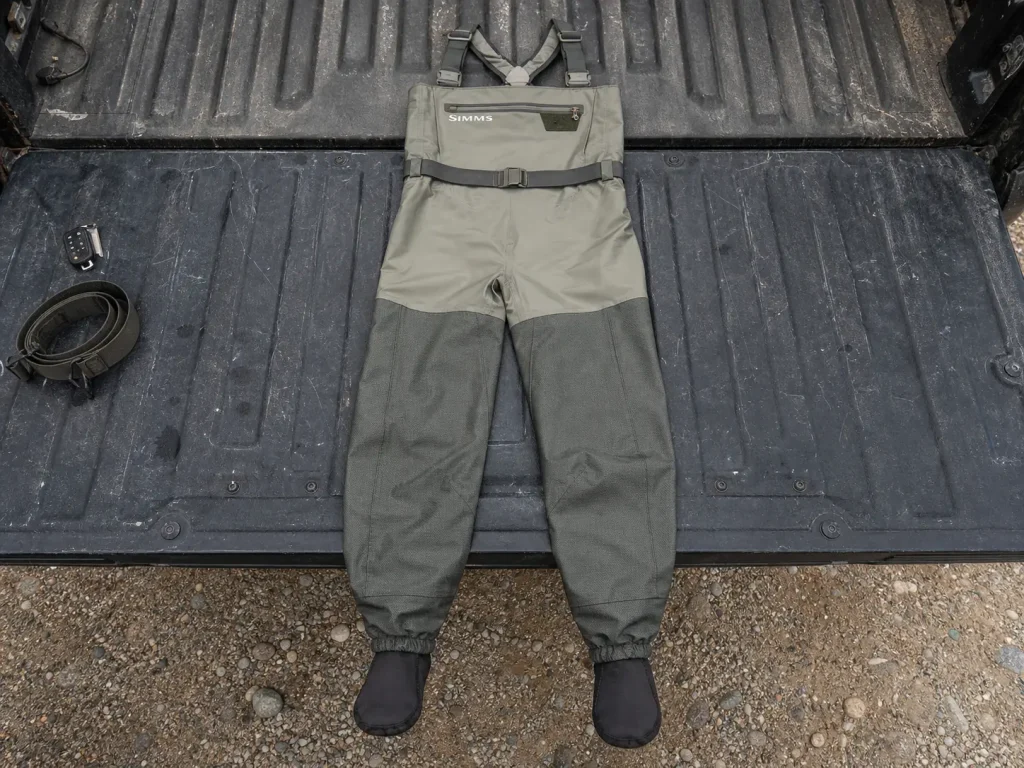
Now the part most buying guides skip. Layer count is not one number for a whole garment. Good waders use zone construction, meaning different layer counts on different parts of the same piece based on what actually rubs against rock.
The Simms Tributary stockingfoot waders (men’s · women’s) are a clean example of the idea: three-layer construction through the torso, four-layer through the legs and seat. The upper half stays lighter and breathes better because it never touches anything abrasive. The lower half gets the extra material because that is the half that kneels in gravel, slides across logs, and takes the beating.
So when you read a spec sheet, look for where the layer count changes rather than fixating on the headline number. That transition line tells you exactly where the maker expects the garment to get chewed up, which is more useful information than the number on the front of the tag.
A four-layer seat panel is worth more to most anglers than a bump in the waterproof rating. Nobody wears out waders from water pressure. They wear them out sitting on truck tailgates, sliding down banks, and kneeling on rock, and every one of those happens below the waist.
Layer count also does nothing for you if the fit is wrong, since a garment that binds at the knees stresses seams that were never meant to carry load. The same goes for the choice between stockingfoot and bootfoot construction, which changes where the wear concentrates.
Waders Aren’t Jackets, and They Don’t Fail the Same Way
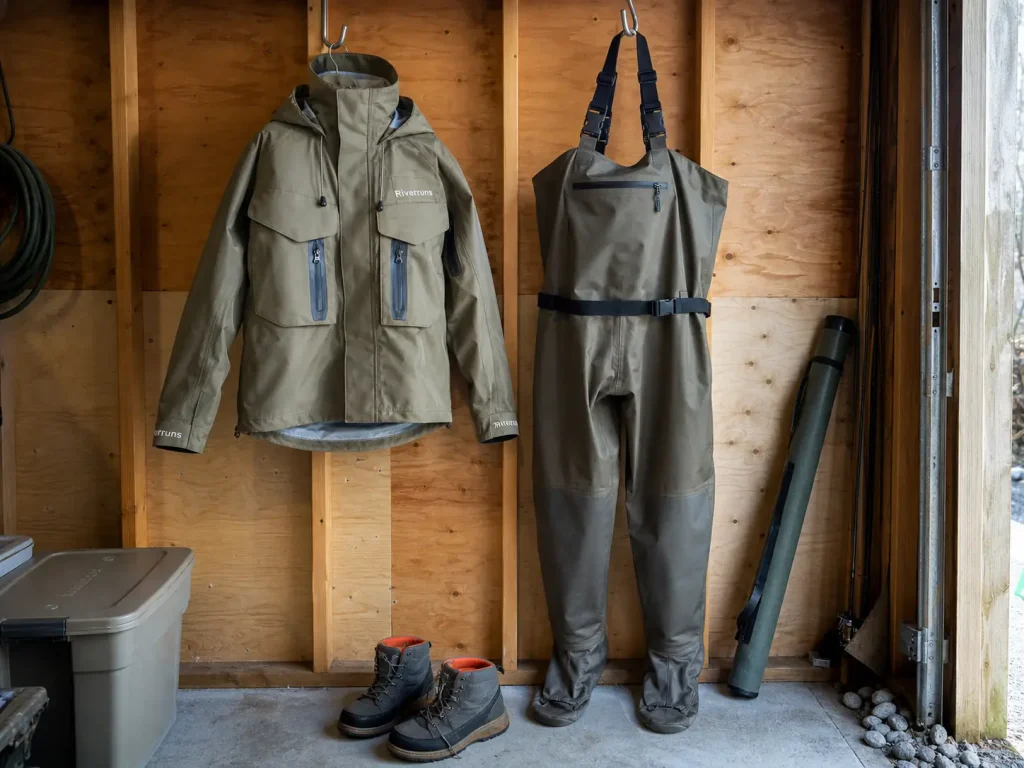
Identical numbers on two spec sheets do not mean identical performance, because waders and jackets face completely different stresses. This gets glossed over constantly, and it leads people to buy waders using jacket logic.
Waders spend hours in genuine submersion. There is real hydrostatic pressure pushing inward across the whole lower garment, continuously, for as long as you are standing there. On top of that, the knees and seat take constant gravel wading abrasion. The characteristic failure is a pinhole leak worn through by rock, or a boot-seam leak where the fabric meets the neoprene foot. Both start small and both get worse.
Jackets face none of that. Rain is intermittent, there is no submersion, and nobody kneels in a jacket. Their failure points are seams, storm flaps, and the waterproof zipper on the front, plus wetting out across the shoulders where rain hits hardest and a pack strap rubs. A jacket that is failing usually leaks in a line, not a spot.
The practical consequence: on a wading jacket, a high water column rating and good taped seams genuinely tell you most of what you need. On waders, laminate durability and abrasion resistance matter more than the headline number, because the fabric will get worn through long before it gets pressured through.
For the jacket side, the Riverruns fishing wading jacket is a straightforward three-layer build with fully taped seams, which is the specification that matters most in a garment whose weak point is stitching rather than fabric. If you want something lighter on the wallet, the Drryfsh waterproof fly fishing wading jacket is a three-layer nylon shell covering the same ground, though its listing has been running thin on stock lately.
One more thing that has nothing to do with fabric and matters more than all of it: cinch your wading belt. Virginia’s Department of Wildlife Resources recommends buckling a wading belt every time you step into moving water, and no membrane ever made is a substitute for that.
Reading the Ratings Without Getting Sold
Two numbers describe a waterproof breathable fabric, and both are easy to misread.
Hydrostatic head, written in mmH2O and sometimes called the water column rating, measures how tall a column of water the fabric holds before liquid pushes through. A rating of 10,000mm or better is adequate for most conditions. 20,000mm or better is what you want for heavy rain and hard use. Anything under 10,000mm is a raincoat with ambitions.
MVTR, the moisture vapor transmission rate, is written in g/m2/24h and measures how much vapor escapes. Ten to fifteen thousand is fine for moderate activity. Twenty thousand and up is what high-output work genuinely needs.
Now the reality check. Gore-Tex ePTFE runs up toward 28,000mm of hydrostatic head and holds its performance steady across a wide range of temperature and humidity. A hydrophilic film like Toray Dermizax sits closer to 20,000mm but can reach 30,000 to 50,000 g/m2/24h of breathability in cold, dry, high-output conditions. Read those side by side and there is no winner, only a match to conditions. The pore-based membrane is more consistent. The solid film can breathe harder when the weather cooperates.
And remember what the last few sections established: a big MVTR figure is a ceiling measured in a lab, not a promise about your July. It tells you what the fabric can do when conditions are ideal. It does not tell you what you will do to it on a hard afternoon.
What the Extra Money Actually Buys
Time for the uncomfortable part. A meaningful share of the price gap between a Gore-Tex garment and a comparable house-brand one is licensing and brand-standard fees, not a raw performance difference. Proprietary membranes, whether Toray-based or a maker’s own laminate, hit similar day-one waterproof and breathable numbers for less money. That is not a knock on Gore. Those brand standards are also why a Gore-labeled garment is built to a consistent spec, and consistency has real value.
Where the premium genuinely shows up is durability under sustained pressure and abrasion across multiple seasons. The extra money buys year three, not day one. A budget membrane and a premium membrane will both keep you dry on your first trip. They diverge somewhere around trip eighty, when one has started delaminating at the knees and the other has not.
So the honest recommendation splits by how much you actually fish. If you are on rocky water sixty-plus days a year, buy the durable laminate and stop thinking about it. If you fish a dozen weekends a season, a mid-tier proprietary membrane will serve you just as well, and the money you save is better spent on boots and a reproofing habit. Entry-level breathable waders and top-tier ones sit a few hundred dollars apart, and for most weekend anglers that gap buys longevity they will never reach.
If you have decided you want the durable end of the range, our breakdown of fly fishing waders and how their durability and fit compare is the next stop.
The Bead-Up Test, and What It Tells You
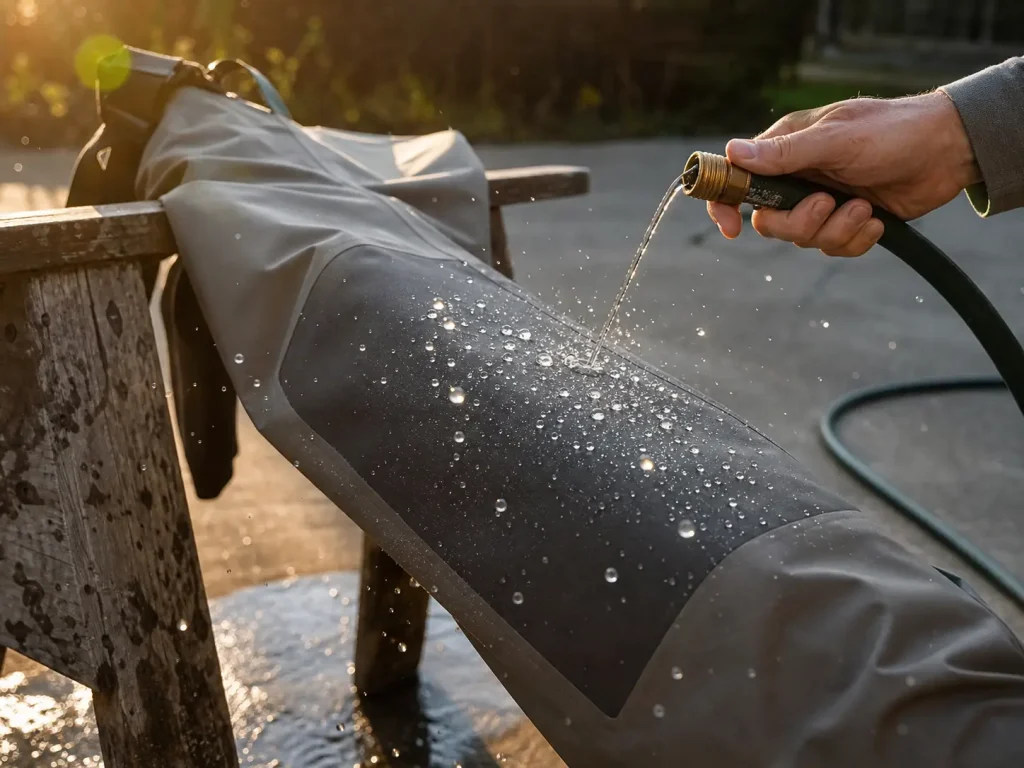
Everything above becomes actionable here. This is the field diagnostic, it takes thirty seconds, and it needs no equipment beyond a garden hose.
Splash or pour water on the shoulders, the knees, and the seat. Watch what it does.
Water that beads up and rolls off means the DWR is alive and doing its job. Water that soaks in and darkens the fabric means the DWR is gone and the garment is wetting out. That is the whole bead-up test, and it is worth running the night before a trip rather than discovering the answer standing in a river.
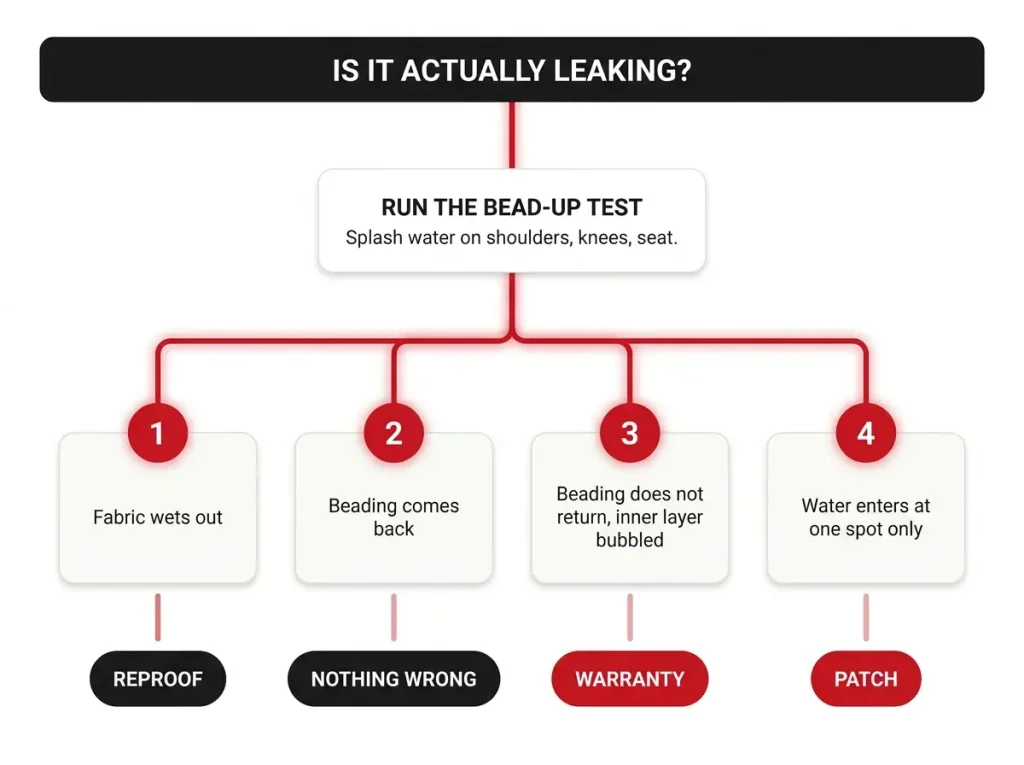
What you do next depends on what you saw:
- Fabric wets out. Wash it properly, reproof it, and test again.
- Beading comes back. It was DWR the whole time. The membrane was never the problem and nothing is broken.
- Beading does not come back, or the inner layer looks bubbled and peeling. That is delamination or failed seam tape. It is a warranty conversation, not a DIY project.
- Water enters at one spot while everything else beads fine. That is a pinhole or a boot-seam leak, and it is a patch job.
For step one, Nikwax TX.Direct spray-on waterproofing is the standard reproofing treatment and the reason this instruction is not abstract. For step four, our wader repair guide to patching leaks covers finding and sealing the hole.
The false alarm this prevents is the most common one in the sport. An angler feels soaked through mid-thigh, assumes the worst, and starts shopping. Back home, the fabric has simply been wetting out for months because nobody ever reproofed it. A wash and a spray, and the same waders go back to work. Trout Unlimited’s pre-launch checklist for wading gear is worth a read for the rest of the pre-trip routine.
Washing and Reproofing Without Wrecking the Fabric
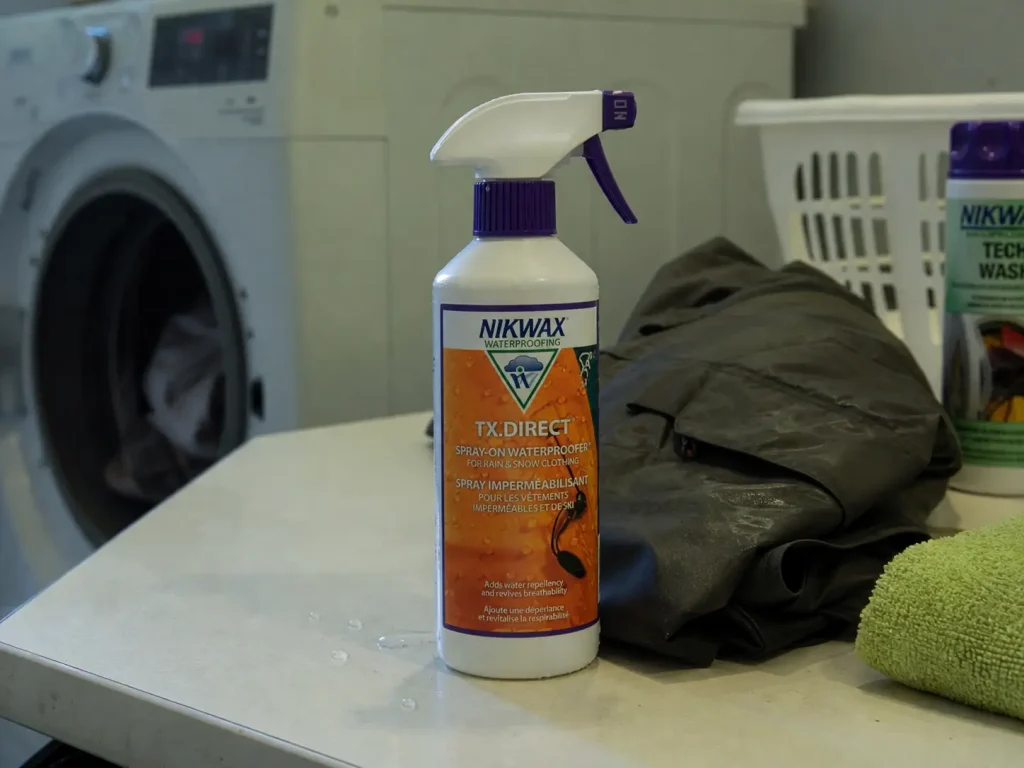
The single most useful rule in wader care is that you wash by symptom, not by the calendar. The trigger is the fabric no longer beading water. Everything else is guesswork.
Look at how differently the manufacturers phrase the same underlying rule. Simms tells customers to wash when the fabric begins to saturate or wet out. Skwala points at every fifteen to twenty days of use. Redington suggests roughly every ten trips. Patagonia asks for a fresh-water rinse after every outing. Four different numbers, one identical principle underneath: clean it before the contamination ruins the coating.
Two prohibitions are universal, and every maker surveyed agrees on both. No fabric softener. No bleach. Softener leaves a residue that coats the fabric and shuts down breathability faster than normal wear ever will, and it is the single most common way people destroy expensive waders in a single laundry cycle. Use a mild additive-free detergent or a dedicated tech wash made for technical fabrics.
The reproofing sequence itself is short:
- Clean the garment first. DWR will not bond to a dirty surface, so skipping this step wastes the spray.
- Apply the treatment evenly while the fabric is still damp, paying extra attention to the shoulders, knees, and seat where wear concentrates.
- Dry it per the label. Some treatments need low heat to cure, others air dry.
- Retest with the bead-up test before you trust it on the water.
Run the bead-up test on the shoulders and knees the night before a trip, not the morning of. Reproofing takes a wash cycle plus drying time, and finding out at 5am that your gear is wetting out means either fishing wet or not fishing.
The same reproofing logic applies to anything with a coated fabric in your kit, from a wading jacket to a gear bag. Same wash, same spray, same bead-up test afterward.
The Short Version
Most gear that seems to be leaking is not leaking. It has wetted out because the DWR wore off, it has been outrun by your own sweat on a hard day, or it is failing at a seam rather than across the fabric. Those three causes cover the overwhelming majority of damp days, and none of them require a new pair of waders.
Three things worth acting on:
- Run the bead-up test before every trip. Thirty seconds tells you whether you need a spray can or nothing at all.
- Wash by symptom, never by the calendar, and keep fabric softener nowhere near your gear.
- Buy layer construction that matches where the garment takes abuse, not the biggest number on the hang tag.
The cheapest meaningful upgrade available to most anglers is a reproofing habit. A can of DWR treatment and one honest look at your gear will do more for how dry you stay this season than another few hundred dollars of membrane ever would.
Frequently Asked Questions
01What material is lightweight and waterproof?
ePTFE and TPU membranes in a 2.5-layer or 3-layer build are the lightest genuinely waterproof options available. For anglers that means a packable wading jacket rather than a heavy shell. The 2.5-layer builds pack smallest but wear out fastest.
02Can a fabric be both breathable and waterproof?
Yes. The membrane pores are far too small for liquid water droplets but far larger than water vapor molecules, so vapor passes while liquid does not. The catch is rate: breathability has a ceiling, so working hard still leaves you damp inside.
03How to make fabric waterproof but breathable?
It is made at the factory by laminating a membrane between a face fabric and a backer, then taping every seam. You cannot create that at home. What you can do is maintain it by washing with a tech wash and reproofing the DWR when water stops beading.
04What fabric is totally waterproof?
Rubber, PVC, and neoprene are effectively total barriers because they have no pores at all. The tradeoff is that they trap every bit of your own sweat, so you end up wet from the inside instead. That is the core neoprene versus breathable waders decision.
05What is the difference between waterproof and water-resistant fabric?
Waterproof fabric holds out water under pressure and carries a hydrostatic head rating in mmH2O; water-resistant fabric only sheds light rain and carries no rating. Anything you kneel or wade in needs the first. A shower jacket can get away with the second.
Risk Disclaimer: Fishing, boating, and all related outdoor activities involve inherent risks that
can lead to injury. The information provided on Master Fishing Mag is for educational and informational purposes
only. While we strive for accuracy, the information, techniques, and advice on gear and safety are not a substitute
for your own best judgment, local knowledge, and adherence to official regulations. Fishing regulations, including
seasons, size limits, and species restrictions, change frequently and vary by location. Always consult the latest
official regulations from your local fish and wildlife agency before heading out. Proper handling of hooks, knives,
and other sharp equipment is essential for safety. Furthermore, be aware of local fish consumption advisories. By
using this website, you agree that you are solely responsible for your own safety and for complying with all
applicable laws. Any reliance you place on our content is strictly at your own risk. Master Fishing Mag and its
authors will not be held liable for any injury, damage, or loss sustained in connection with the use of the
information herein.
Affiliate Disclosure: We are a participant in the Amazon Services LLC Associates Program, an
affiliate advertising program designed to provide a means for us to earn advertising fees by advertising and linking
to Amazon.com. As an Amazon Associate, we earn from qualifying purchases. We also participate in other affiliate
programs and may receive a commission on products purchased through our links, at no extra cost to you. Additional
terms are found in the terms of service.