In this article
Standing knee-deep in a Montana tailwater at 6 AM, the guy next to me was already doing the cold-feet shuffle—that restless dance every angler knows too well. His brand-new bootfoot waders looked great on the rack. But after an hour in 38°F water, he couldn’t feel his toes. Meanwhile, I’d been out since 4:30, and my feet were dry, warm, and stable on the slick cobble.
The difference wasn’t luck. It was understanding when each wader type actually works.
After guiding over 250 days a year in conditions ranging from August low-water to January steelhead runs, I’ve learned the hard way that the stocking foot vs boot foot waders debate has no single winner. The right answer depends on where you fish, when you fish, and how long you plan to stay out there. This guide breaks down exactly what professional guides wear—and why—so you can match your wader choice to your water, your climate, and your style of fishing.
⚡ Quick Answer: Most professional guides wear stockingfoot waders for three-season use because separate wading boots provide superior ankle support and allow traction customization. However, they switch to bootfoot waders for extreme cold (below 35°F water) and surf fishing, where integrated boots provide better thermal circulation and prevent sand ingress. The best-equipped guides own both.
The Core Difference: What You’re Actually Choosing Between
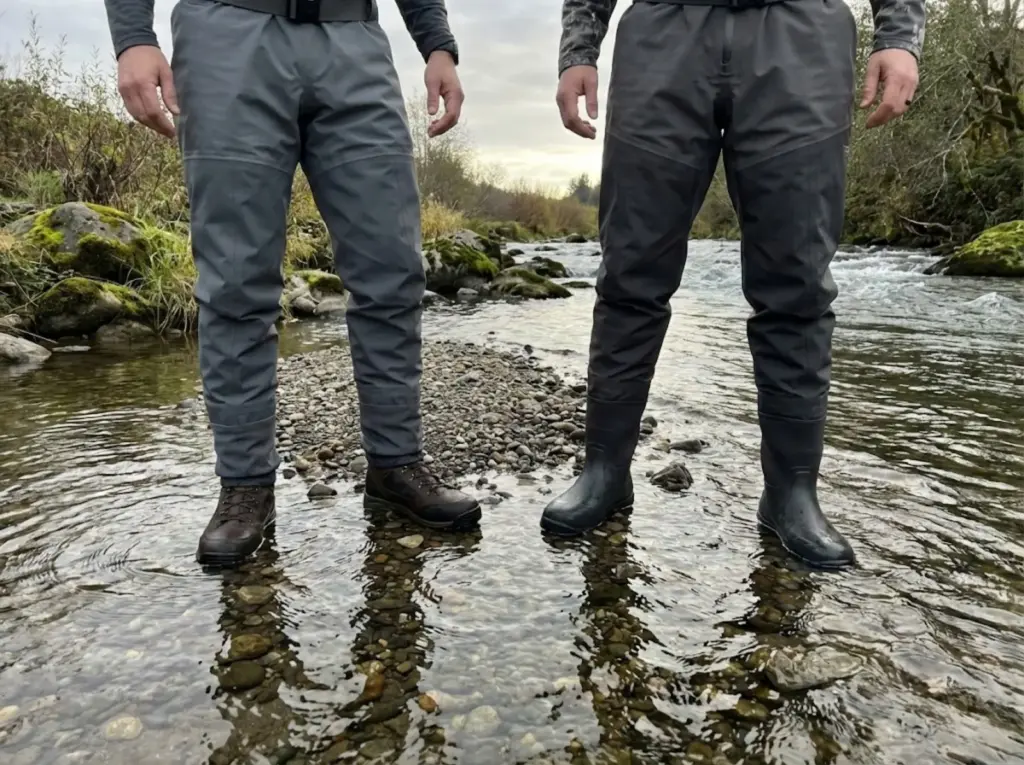
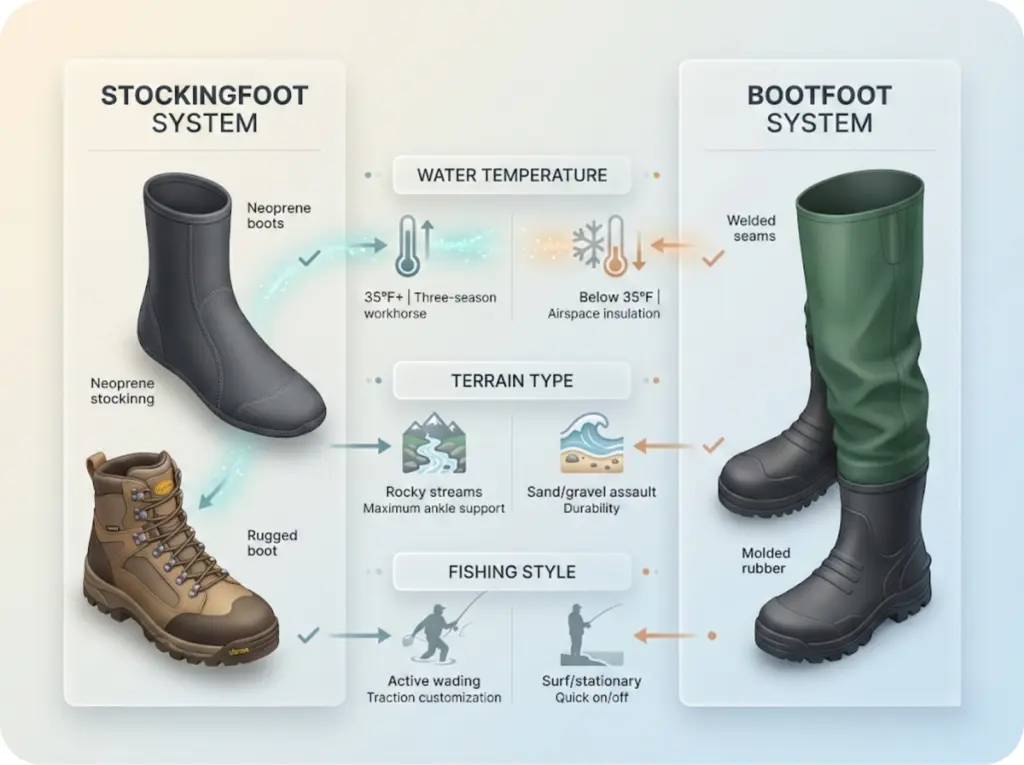
Stockingfoot waders terminate in thin neoprene booties—typically 1mm to 5mm thick—and require the addition of separate wading boots. You’re buying two systems that work together. Bootfoot waders feature a permanently attached rubber or neoprene boot. No separate footwear needed. One piece, done.
That structural difference drives everything else.
The attached boot in bootfoot models creates what’s called airspace insulation—a pocket of warm air around your foot. Stockingfoot systems, by contrast, compress the foot between the neoprene bootie, the wading boot walls, and external water pressure. When it works, this compression provides exceptional ankle stability. When it fails—usually in bitter cold—it restricts blood flow and leaves you with numb toes.
Professional guides globally favor stockingfoot waders for three-season use. The ankle support, traction customization, and lighter weight make them the workhorse of spring, summer, and fall. But when water temperatures drop below 35°F, or when surf fishing puts sand and gravel assault on the agenda, the attached-boot design of bootfoot waders earns its place in the truck.
Pro tip: The best-equipped guides own both systems. A premium stockingfoot for 80% of the season, and an oversized bootfoot for those bitter January runs.
Why Stockingfoot Systems Dominate the Guide Market
The neoprene bootie plus separate wading boot combo allows anglers to dial in a precision fit for their specific foot shape. BOA lacing systems and traditional lace-up boots provide rigid ankle stabilization that prevents “heel lift”—that unsettling sensation of your heel sliding up inside the boot when you step on uneven substrate.
For guides spending ten-hour shifts wading aggressive freestone rivers, heel lift isn’t just annoying. It’s a recipe for a blown ankle and a cancelled season.
The reduced bulk of stockingfoot systems also makes them significantly easier to pack. If your fishing demands hiking a mile to reach the water—and the best spots usually do—every ounce of packability matters. The lighter, more streamlined stockingfoot setup wins that calculus every time.
Then there’s traction. The modularity of separate wading boots lets you swap between felt soles, rubber soles, and studded soles based on the substrate you’re fishing and the regulations in that watershed. Bootfoot waders have a fixed sole. If it doesn’t match the conditions, you’re out of luck.
Expert tester Ryan Chelius notes that premium boots like the Simms G3 Guide or Korkers River Ops are designed to withstand hundreds of days of hard use per season. That durability, combined with the precise fit only possible through independent footwear, explains why stockingfoot dominates the guide-approved market.
When Bootfoot Wins: Cold Water and Coastal Conditions
The physics of cold feet are straightforward: restricted blood flow equals numb toes. And nothing restricts blood flow faster than compression.
In a stockingfoot setup, you’re stacking layers inside a rigid boot. The neoprene bootie, an extra pair of socks, compression from the boot walls, and external water pressure all work together to squeeze the foot—exactly when you need circulation to deliver warmth.
Bootfoot waders solve this with a rigid air-gap architecture. The oversized, non-compressible attached boot allows a pocket of air to circulate freely around your foot. Your core body heat radiates down the wader legs, warms that pocket of air, and keeps your toes functional in water cold enough to freeze a stockingfoot angler out.
That’s why professional guides specializing in winter steelheading frequently recommend sizing bootfoot waders one to two sizes larger than your standard shoe size. Maximize the air volume. Give those thick Merino wool socks room to work without constricting blood flow. Adding foot warmers becomes practical with that extra space.
In surf zones, the calculus shifts to debris exclusion. Breaking waves on the Atlantic and Pacific coasts routinely wash fine grit and sand into the gravel guards of stockingfoot waders. That debris acts like sandpaper, abrading the neoprene booties and causing miserable hot spots on your feet. The seamless, one-piece construction of bootfoot waders creates an impenetrable barrier—complete mud exclusion and sand exclusion.
No laces also means no frozen laces—a real problem when fishing air temperatures below 20°F. And for older anglers or clients with limited mobility, eliminating the need to bend over and tie boots improves ease of on/off dramatically.
Material Science: What’s Actually Keeping You Dry
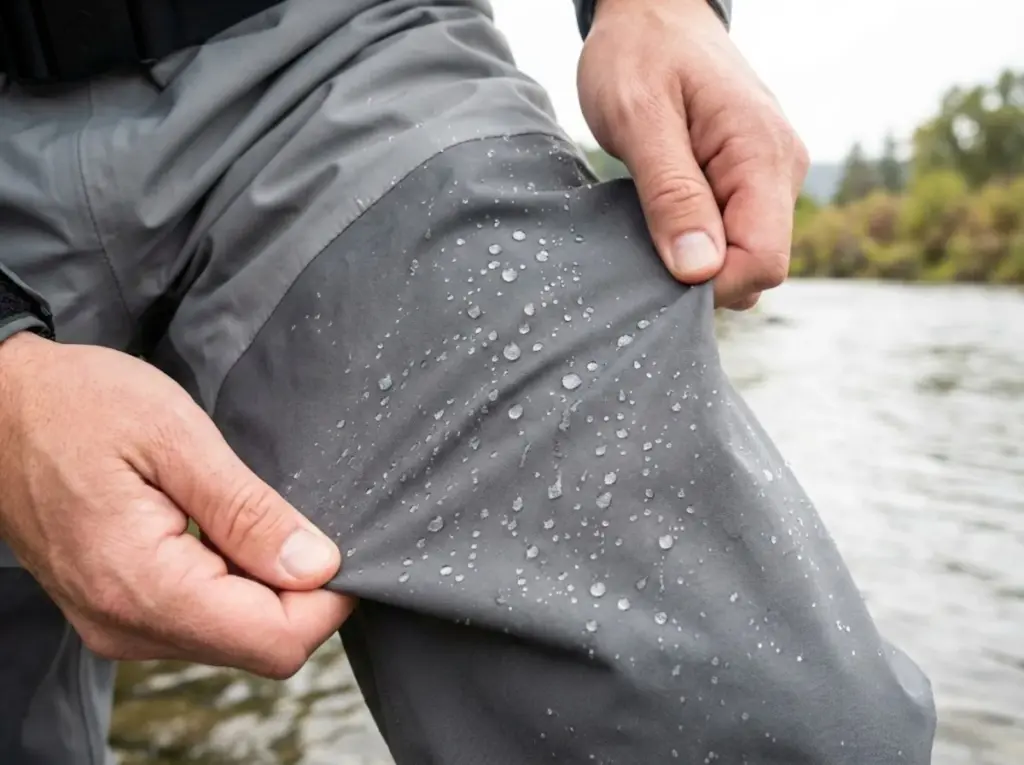
Modern premium waders are marvels of material engineering. The transition from traditional rubber and heavy vulcanized fabrics to advanced breathable laminates has revolutionized what’s possible on the water.
The science is elegant. Multi-layer breathable membranes like GORE-TEX Pro Shell and high-denier Cordura feature pores smaller than water molecules but larger than water vapor molecules. Liquid water stays out. Your sweat escapes. For a professional guide who might spend eight hours wading continuously, this breathability isn’t a luxury—it’s fatigue management.
Trap moisture inside your waders and you’ll feel fine during high activity. But the moment you stop to eat lunch or stand still working a run, that dampness becomes a heat sink. The chill sets in fast and doesn’t leave. Breathable waders break that cycle.
Manufacturers also employ layer construction strategies to balance mobility against durability. Lighter 3-layer waders in the torso maintain freedom of movement for casting. Heavier 4-layer waders reinforce the lower legs and seat—the zones where 80% of wader failures occur.
Pro tip: If you’re bushwhacking through thorny riverbanks to reach backcountry water, prioritize a 4-layer Cordura shell (like the Orvis PRO) over pure breathability. Puncture resistance matters more than marginal gains in vapor transfer when the willows are trying to kill your waders.
Understanding how breathable wader membranes actually work helps you maintain them properly—and spot quality differences between budget and premium options.
The Layer Matrix: 3-Layer vs 4-Layer vs 5-Layer
Not all breathable waders are created equal. The layer count directly impacts durability, breathability, and price.
3-layer constructions (like the Simms G4Z upper) place the waterproof membrane between an outer shell fabric and an inner lining. This maximizes breathability and minimizes weight—ideal for high-activity guides who generate significant body heat.
4-layer waders (like the Simms Freestone) add reinforcement for better abrasion resistance across the entire garment. They sacrifice a percentage of breathability for consistent durability. Seasonal anglers and guides who don’t need the absolute lightest option often find the best bang for your buck here.
5-layer lower legs (featured on the Orvis PRO) represent the maximum in puncture and abrasion protection. Guides who work in terrain with thorns, sharp rocks, and aggressive brush benefit most.
Premium waders combine strategies—3-layer uppers for lightweight breathability, 4-layer lowers for durability where failures actually happen. Wader longevity metrics show this asymmetric approach has become the industry standard for guide-approved gear, typically delivering 5-6 years of hard use.
Understanding Denier and Where Waders Fail
Denier measures fiber mass per 9,000 meters of thread. Higher ratings indicate thicker, more abrasion-resistant fabrics. Lower deniers mean lighter, more flexible material.
Statistics from gear manufacturers consistently show the same pattern: 80% of wader failures occur below the knee. The culprits are predictable—sharp rocks, thorns, and the mechanical friction of legs brushing together during long hikes to the water.
That’s why quality waders concentrate heavier materials in the lower legs, seat, and knees while using lighter fabrics in the torso. The result balances protection where you need it with mobility where you don’t.
Compression-molded booties on stockingfoot waders also demand attention. They’re subjected to constant flexing, pressure, and abrasion against boot interiors. Check them annually for pinhole fatigue, especially at the seams. A leak in the bootie ruins an entire day faster than almost any other gear failure.
Ankle Support and Traction: Where the Real Safety Lives
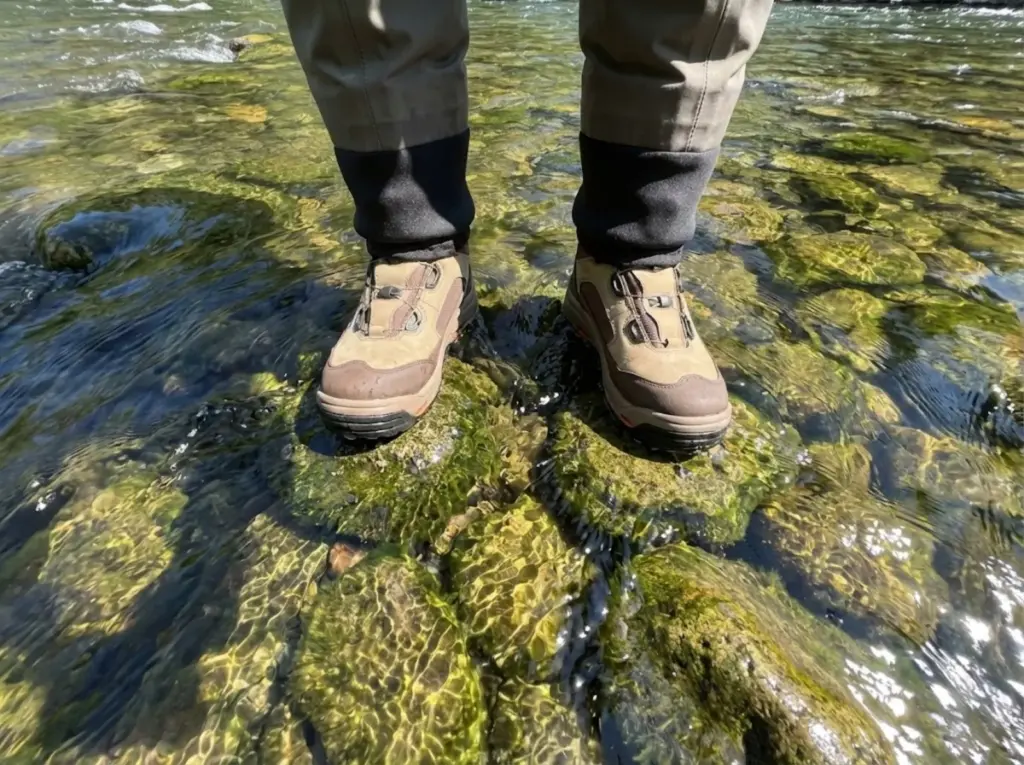
The moment your boot shifts unexpectedly on a slick rock, you remember why ankle support matters. A blown ankle doesn’t just end your trip. It can end your season—or worse.
The stockingfoot system’s greatest advantage is mechanical ankle stabilization. Independent wading boots create a rigid chassis around your foot that prevents the lateral shifting and heel lift that lead to injury. High-ankle designs lock your joint in place while still allowing the natural flex needed for walking.
Bootfoot waders sacrifice some of this rigidity to achieve their thermal advantages. The attached boot simply can’t be adjusted the way a separate, lace-up boot can. For gentle wading conditions—flat sand bottoms, calm water, easy access—this tradeoff is acceptable. For aggressive freestone rivers with uneven cobble, strong currents, and long days on the water, the stability of a quality separate boot is non-negotiable.
Pro tip: If you find yourself constantly readjusting your footing or feeling unstable, the problem usually isn’t technique. It’s insufficient boot support. Upgrade before you blow an ankle.
Understanding matching your sole type to the substrate you’re wading helps you select the right proper wading boots for each fishing situation.
The Felt Sole Dilemma: Regulations and Alternatives
For pure grip on algae-slicked stones, nothing beats felt soles. The fibrous material conforms to rock surfaces and provides traction that rubber simply can’t match on mossy substrates.
But felt comes with a serious problem: it’s banned in multiple states.
The same fibrous structure that grips rocks also creates an ideal environment for microscopic organisms to embed and survive between trips. New Zealand mudsnails, whirling disease parasites, and the invasive algae Didymosphenia geminata (rock snot) can hitch rides on felt soles from one watershed to the next. States like Alaska, Maryland, and Missouri have implemented outright bans on felt-soled wading footwear.
Maryland imposes $125 fines for first violations, with repeat offenders facing up to $2,000 in penalties. The Minnesota DNR provides detailed guidance on felt sole regulations and invasive species prevention that applies broadly to multi-watershed anglers.
Rubber soles with sticky compounds like Vibram have become the standard alternative in regulated waters. They lack felt’s grip on algae-covered rocks but work well on most substrates. Adding tungsten carbide studs or aluminum cleats—like those compatible with studded soles—provides an aggressive mechanical bite for mossy boulders.
This is where stockingfoot systems shine brightest: swap the boot options to match both conditions and regulations. Bootfoot waders lock you into a single traction configuration that may not be legal—or effective—everywhere you fish.
The Economics: What Guides Actually Pay Per Season
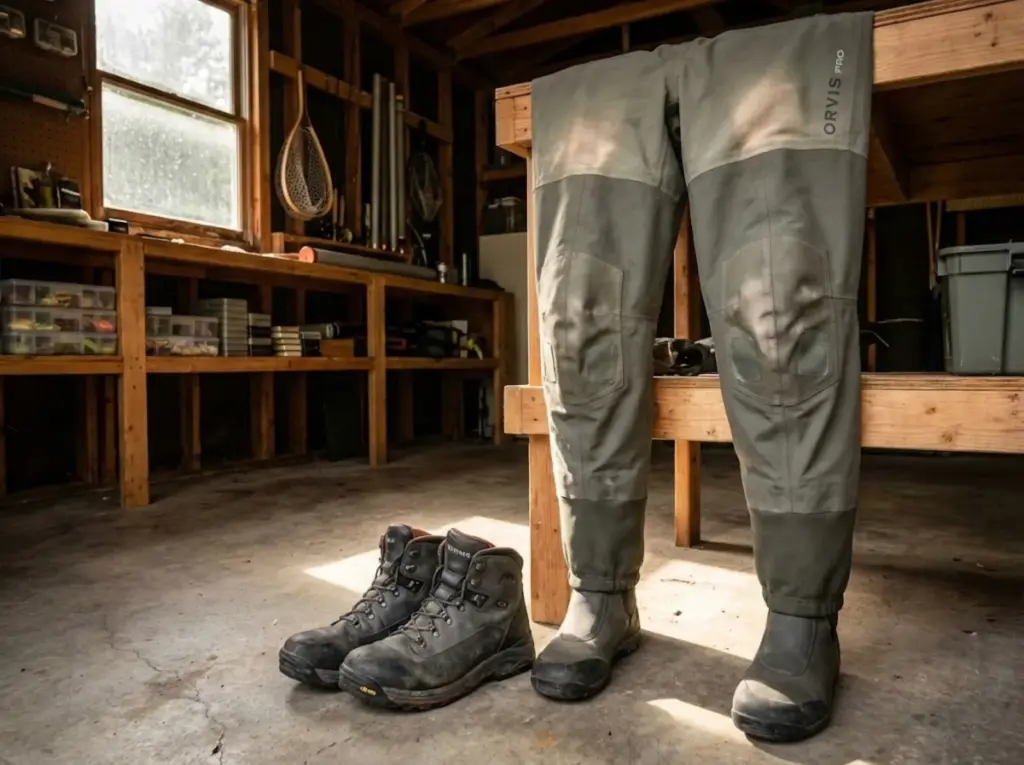
Professional guides don’t see wader purchases as expenses. They see them as capital investments analyzed through the lens of total cost of ownership.
Budget waders priced under $200 typically deliver 1-2 years of heavy use before irreparable seam failures or bootie compression force replacement. Premium models like the Simms G4Z (~$950) or Orvis PRO (~$650) are documented to last 5-6 years when properly maintained—solid wader longevity metrics that justify the upfront cost.
Run the cost-per-year math: a $200 budget wader replaced every two years equals $100 annually. A $700 premium wader lasting six years equals $117 annually. The premium option costs nearly the same—while providing dramatically better comfort, drier fishing days, and access to factory repair programs.
That factory repair component matters. Both Simms and Orvis offer standardized repair services—typically a $60 flat fee for evaluation and refurbishment of waders past their original warranty. Guides routinely send primary waders in for tune-ups between seasons, fixing pinhole leaks and reinforcing wear points to extend garment life into a second or third service cycle.
Pro tip: Send your primary waders in for a factory tune-up every 2-3 seasons. It’s a $60 insurance policy against catastrophic mid-trip failure.
Learning how to patch wader leaks yourself extends the value of every wader you own and keeps you fishing when small damage would otherwise sideline you.
Boot Replacement Economics: A Hidden Stockingfoot Cost
When calculating stockingfoot total cost of ownership, don’t forget the boots.
Wading boots wear out 2-3 times faster than waders. The soles see constant abrasion. Lace eyelets corrode. Upper materials break down from repeated flex cycles. High-frequency guides (100+ days per year) should budget for annual boot replacement in the $150-$350 range.
Factor that into a six-year ownership window: a $700 stockingfoot wader plus two pairs of $200 boots totals $1,100. A $800 bootfoot wader—with its attached boots—requires no separate footwear purchases.
For casual anglers fishing 20-30 days annually, quality wading boots can stretch 3-4 seasons with proper care. But guides logging triple-digit days per year should view boot replacement as a planned annual expense, not a surprise.
Maintenance and Biosecurity: Extending the Life of Your Investment
Your waders are only as good as how you treat them off the water.
Dirt, body oils, and fish slime accumulate in the pores of breathable membranes, degrading their moisture-vapor transfer and promoting mildew growth. Beyond gear longevity, there’s the issue of watershed biosecurity—preventing the spread of invasive species between rivers.
Professional guides follow the “Clean, Drain, Dry” protocol:
Clean: Scrub all debris, mud, and vegetation from waders and boots after every use. A soft brush and clean water remove 90% of potential hitchhikers.
Disinfect: For multi-watershed anglers, a solution of 409 cleaner, diluted bleach (1:10 ratio), or specialized aquatic disinfectant kills organisms that cleaning alone misses.
Dry: Allow gear to dry completely—at least 48 hours in open air, ideally in direct sunlight. Complete desiccation is the most effective way to eliminate organisms like New Zealand mudsnails.
Storage matters too. Hang waders by the booties or fold loosely in a temperature-controlled environment. Never store them crumpled in a gear bag or leave them in sustained direct UV for weeks—both degrade seam tape and breathable membranes.
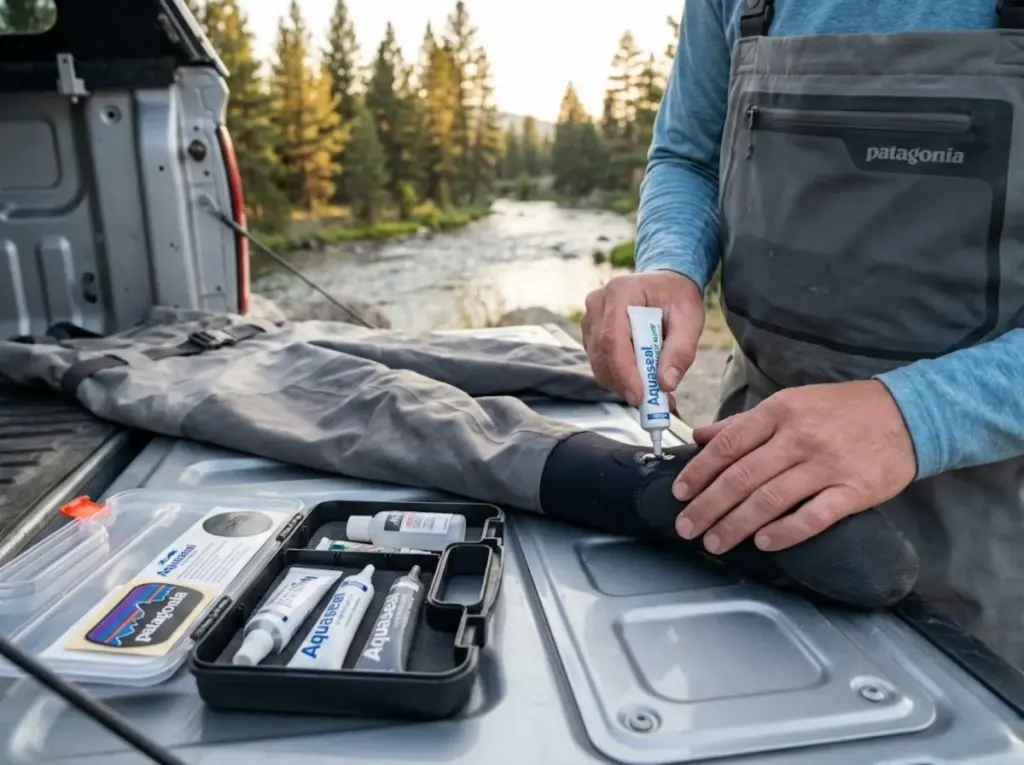
Pro tip: Spray rubbing alcohol on the inside of your wader booties to find pinhole leaks. Dark spots reveal where the liquid penetrates the fabric. Mark them, dry thoroughly, then repair with Aquaseal.
The full post-trip gear cleaning protocol covers everything from waders to reels, extending the life of all your equipment.
DIY Leak Repair: What Actually Works
Pinhole leaks are inevitable. Every guide with miles on their waders has patched them.
Aquaseal and UV-cure resins remain the industry standard for durable, long-lasting repairs. Clean the area with rubbing alcohol, apply a thin layer extending past the damage, and let it cure fully before use. Done right, these patches outlast the surrounding fabric.
For seam failures or complex damage, factory repair is worth the $60 investment. But for simple pinhole leaks in the field, a small Aquaseal tube in your truck can save a trip.
Conclusion
For most anglers, the answer isn’t stockingfoot or bootfoot—it’s understanding when each system earns its place in your gear bag.
Three takeaways: Stockingfoot wins three-season use through superior ankle support, customizable traction, and lighter weight for hiking into remote water. Bootfoot wins the extremes—freezing water temperature, surf zones with sand and gravel assault, and rapid on-off scenarios. And when you’re evaluating cost, think total cost of ownership over years, not sticker price at the register.
Match your wader to the conditions you actually fish. The angler who showed up to that Montana tailwater with the wrong system didn’t lack quality gear. He lacked the judgment to pick the right tool for the job.
Your feet—and your fishing—are counting on you to make a better choice.
FAQ
Can I use stockingfoot waders in freezing water?
Yes, but performance requires careful boot sizing (one size up to accommodate thick socks) and quality layering. Even then, bootfoot’s superior thermal circulation often outperforms stockingfoot in water below 35°F due to the rigid air-gap architecture that prevents blood flow restriction.
Are felt soles still the best option?
For pure grip on algae-slicked rocks, felt remains unmatched. However, felt bans in Alaska, Maryland, Missouri, and other jurisdictions make studded rubber the practical choice for anglers who fish multiple watersheds. Check local regulations before choosing.
How often should I replace my wading boots?
High-frequency anglers logging 100+ days annually should budget for replacement every 1-2 seasons. Casual anglers fishing 20-30 days per year can stretch quality boots 3-4 seasons with proper care. Sole wear and lace eyelet corrosion are the first failure points to monitor.
What’s the biggest mistake new wader buyers make?
Buying the wrong size. Always measure your largest girth (usually hips or waist) and floor-to-crotch inseam before ordering. When in doubt between sizes, go up. Excess fabric is mildly inconvenient. Restricted movement and strained seams lead to failure and injury.
Do I really need premium waders if I only fish 20 days a year?
Not necessarily. Mid-range options in the $300-$500 range provide excellent durability for seasonal use without the price tag. Premium waders—$650 and up—pay off for guides and anglers logging 100+ days annually, where the extended lifespan and repair program access justify the investment.
Risk Disclaimer: Fishing, boating, and all related outdoor activities involve inherent risks that
can lead to injury. The information provided on Master Fishing Mag is for educational and informational purposes
only. While we strive for accuracy, the information, techniques, and advice on gear and safety are not a substitute
for your own best judgment, local knowledge, and adherence to official regulations. Fishing regulations, including
seasons, size limits, and species restrictions, change frequently and vary by location. Always consult the latest
official regulations from your local fish and wildlife agency before heading out. Proper handling of hooks, knives,
and other sharp equipment is essential for safety. Furthermore, be aware of local fish consumption advisories. By
using this website, you agree that you are solely responsible for your own safety and for complying with all
applicable laws. Any reliance you place on our content is strictly at your own risk. Master Fishing Mag and its
authors will not be held liable for any injury, damage, or loss sustained in connection with the use of the
information herein.
Affiliate Disclosure: We are a participant in the Amazon Services LLC Associates Program, an
affiliate advertising program designed to provide a means for us to earn advertising fees by advertising and linking
to Amazon.com. As an Amazon Associate, we earn from qualifying purchases. We also participate in other affiliate
programs and may receive a commission on products purchased through our links, at no extra cost to you. Additional
terms are found in the terms of service.