In this article
You peel off your waders after a full day on the flats. They’re still dripping. You drape them over a plastic chair in the garage, crack open a cold one, and call it a good day. Three days later, you pull them out for the next trip. The seam tape along the inner thigh is curling at the edge like an old bumper sticker. The inside smells like something crawled in there and gave up. That $800 pair of GORE-TEX waders just aged five years in a weekend—and it was entirely preventable.
I’ve watched this story repeat itself across hundreds of anglers over two decades of guiding coastal waters. Good gear, bad habits. The truth is, saltwater wader care isn’t complicated. But the margin for error is razor thin, and most of us get it wrong in the first 30 minutes after stepping out of the water.
This guide lays out the complete Saltwater Longevity Protocol—a three-stage wader maintenance protocol grounded in how these fabrics actually work—that prevents wader rot and fabric failure, kills the bacteria hiding in your liner, and restores breathability after every coastal session. Think of it as outdoor gear maintenance for your most expensive piece of angling equipment.
⚡ Quick Answer: Rinse your waders with freshwater within 30 minutes of every saltwater session. For brackish environments, follow up with a 1:4 white vinegar-to-water spray to dissolve mineral buildup. Wash with a technical wash like Nikwax Tech Wash every 15–20 days of use—never household detergent. Finish with a low heat dryer cycle (100°F–105°F) to reactivate the DWR coating. This three-stage protocol prevents premature fabric failure, kills pathogens, and keeps your waders breathing for years.
Why Salt Destroys Your Waders Faster Than Freshwater
The Desiccant Effect and the Osmotic Reverse
Here’s what most cleaning guides get wrong. They tell you salt is “corrosive.” That’s not quite what’s happening. Salt is hygroscopic—it pulls moisture out of the air and holds it against the face fabric of your waders like a wet rag you can never wring out.
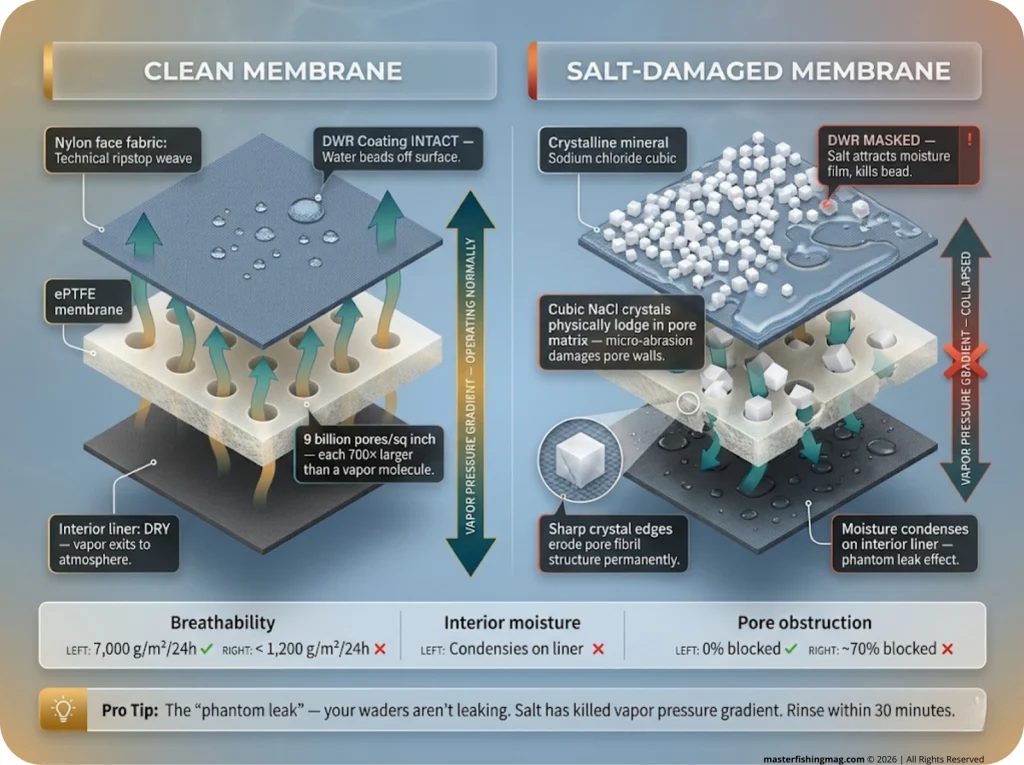
Your waders breathe because of a pressure trick. The air trapped between your skin and the membrane is warm and humid. The air outside is drier. That difference pushes your sweat through those billions of microscopic pores in the ePTFE membrane. GORE-TEX membranes pack roughly 9 billion pores per square inch—each one 20,000 times smaller than a water droplet but 700 times larger than a single vapor molecule. It’s an elegant system, and salt destroys it.
When dried salt sits on the outside of the fabric, it attracts atmospheric moisture and creates a film of water on the surface. That film kills the pressure gradient. Your sweat has nowhere to go. It condenses against the interior tricot liner, soaking you from the inside.
You think you’ve sprung a leak. You haven’t. It’s a phantom leak—hygroscopic salt damage shutting down your membrane’s micro-porous fabric performance.
Gore-Tex Lab Technicians put it plainly: “Salt is a desiccant… it attracts moisture and will mask the DWR of the garment.” If you want to understand how waterproof breathable fabrics actually work, the key is that vapor pressure differential—and salt is the one thing that kills it dead.
Cubic Crystals and Pore Obstruction
It gets worse at the microscopic level. Sodium chloride doesn’t dry flat. It forms sharp-edged cubic crystals that physically lodge into the pore structure of the membrane. This salt crystallization damage is invisible to the naked eye but devastating over time.
These same crystals act as micro-abrasives against the Durable Water Repellent coating—the molecular “spikes” that make water bead on the surface. As those spikes get flattened by salt, dirt, and body oils, the fabric starts to absorb water instead of shedding it. That’s wetting out, and it’s the visible sign that your wader’s first line of defense is down. The difference between wet-out fabric and beaded fabric is the difference between a functional wader and a sweat bag.
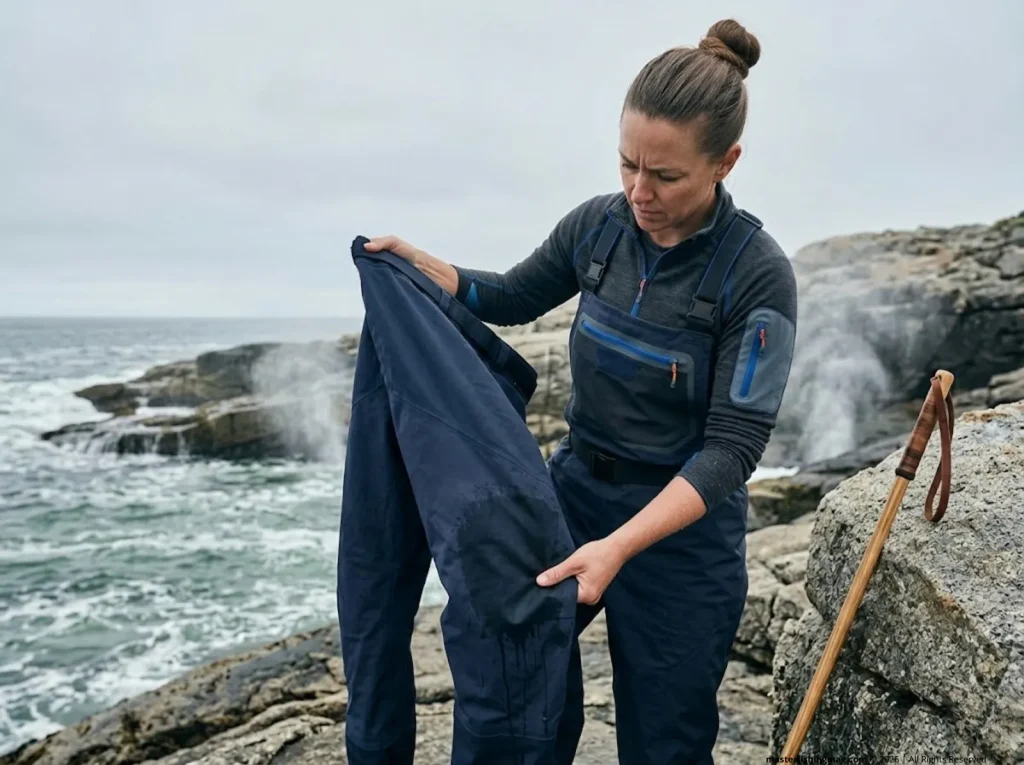
Pro tip: Splash a handful of water on the knees and chest of your waders before your next trip. If it beads and rolls off, the DWR is intact. If it soaks in and darkens the fabric, your waders need the full protocol before you fish again.
The Saltwater Longevity Protocol — Stage 1: The Field Rinse
The 30-Minute Window
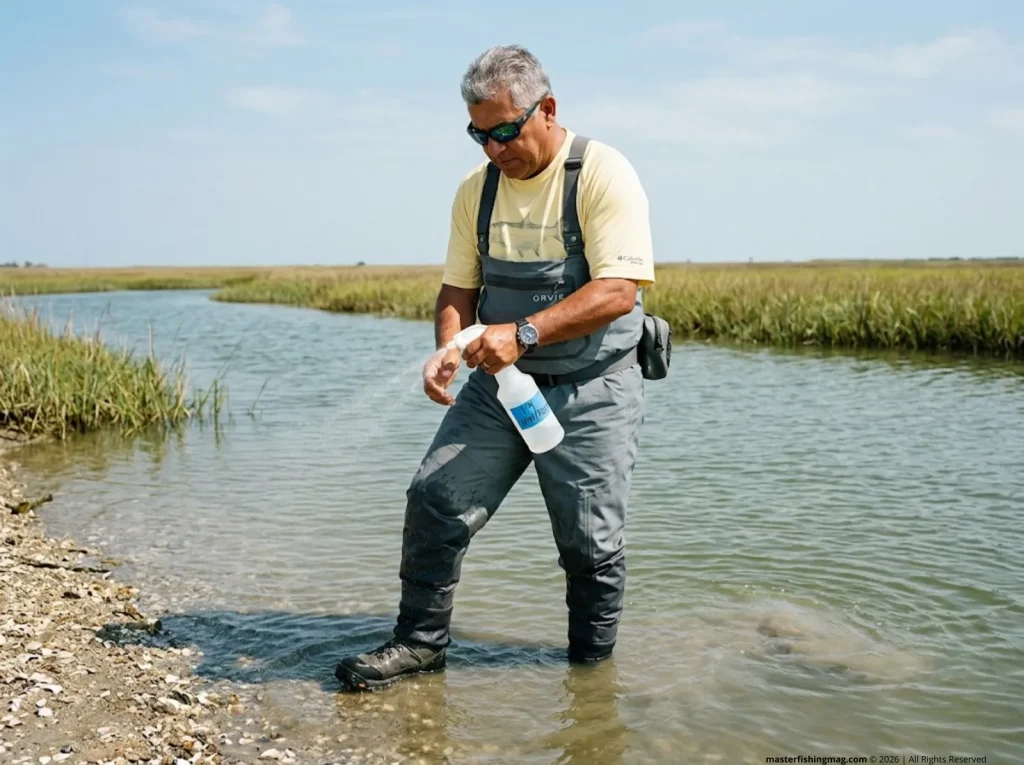
Salt crystals start forming the moment fabric dries. Your window to prevent crystallization is roughly 30 minutes after you peel off your waders. Even a quick blast from a garden hose makes a measurable difference—seawater is about 3% salt by weight, so diluting that with fresh water drops the mineral load dramatically.
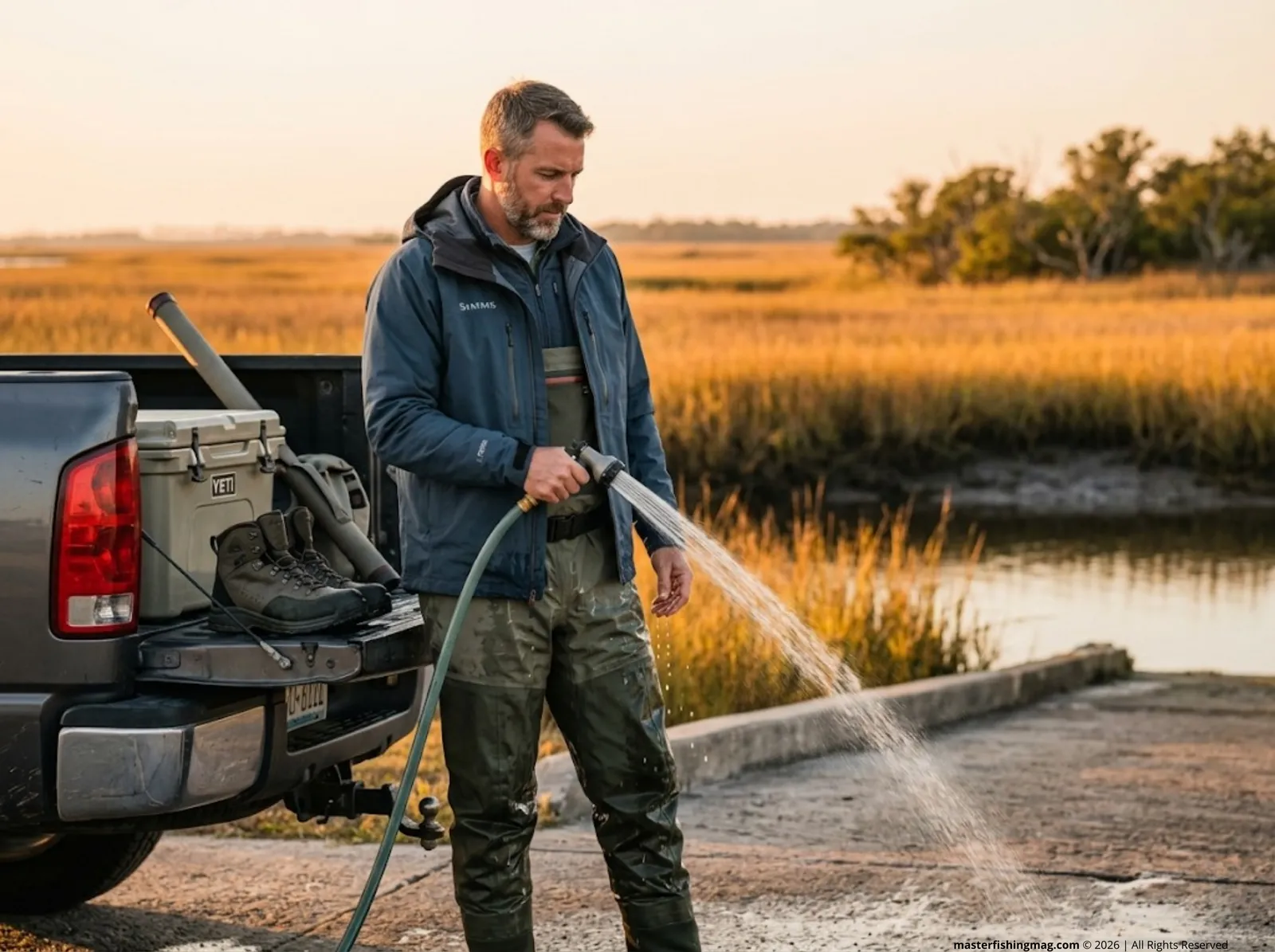
Focus the spray on the high-wear zones. Knees. Seat. Crotch seams. Gravel guard attachment points. These are the areas where salt concentrates and where the fabric takes the most mechanical abuse during a day of wading. If you hose down waders thoroughly every time, you’ve already won half the battle for angling equipment longevity.
Pro tip: Wear your waders while you hose them off. You’ll immediately see any areas that are wetting out—the dark patches where water soaks in instead of beading. That’s your DWR telling you it needs help.
The 1:4 Vinegar Flush for Brackish Residue
A plain freshwater rinsing works for light saltwater sessions. But if you’re fishing tidal marshes, estuaries, or brackish flats, straight water won’t cut it. The mineral scale from brackish residue bonds to the fabric in a way that rinsing alone can’t break. This is where brackish water care requires a different approach.
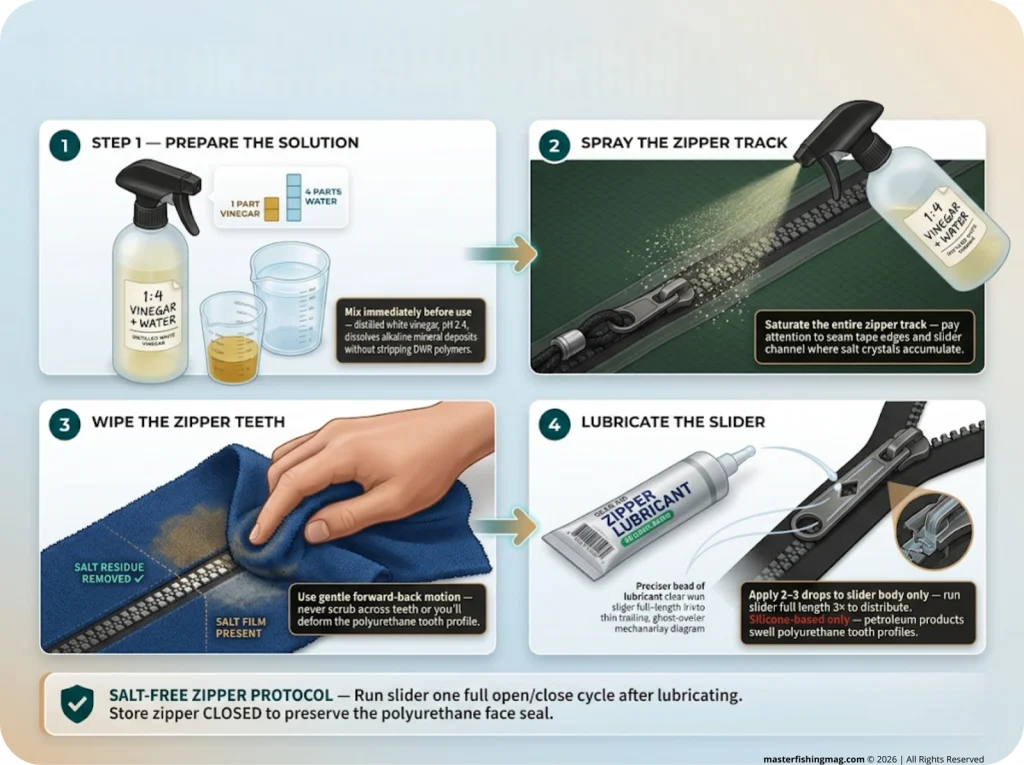
The fix is cheap and sitting in your pantry. A 1:4 ratio of distilled white vinegar to water—that’s one part vinegar, four parts water. The mild acid in the vinegar reacts with the alkaline bond of mineral deposits and breaks them into water-soluble compounds that rinse clean. That specific vinegar-to-water ratio is strong enough to dissolve salt scale but gentle enough to leave your DWR polymers intact. Keep a labeled spray bottle in your truck. Hit the zipper tracks, seam tape edges, and the bootie-to-boot interface where salt loves to hide.
This is especially critical for T-Zip waterproof zippers. Salt crystals wedge into the teeth like tiny glass shards, grinding away at the polyurethane seal every time you open or close the slider. A vinegar-soaked cloth run along the teeth prevents zipper corrosion and slider seizure. Follow it with a light application of silicone-based zipper lubrication from Gear Aid, and the zipper stays smooth.
If you’re serious about saltwater corrosion prevention for all your fishing gear, this vinegar protocol is the foundation.
The Saltwater Longevity Protocol — Stage 2: The Technical Deep Clean
Why Household Detergent Is Your Wader’s Enemy
This is where most anglers make the mistake that kills their gear. You toss the waders in the washing machine with a scoop of Tide or a squeeze of liquid All, and you think you’re doing them a favor. You’re not. You’re chemically sabotaging them.
Household soaps are designed to be hydrophilic—their entire purpose is lowering water’s surface tension so it penetrates fabric. That’s the exact opposite of what your DWR needs. If those surfactant residues stay in the face fabric, they turn your wader’s outer layer into a sponge. Instant wetting out. Every time.
Fabric softeners are even worse. They coat the inside of the membrane with a waxy film that blocks the pores from the interior side—killing breathability from within. One angler put it best: “I washed my waders in regular detergent, and now they feel like a plastic bag. They’ve stopped breathing entirely.”
The Correct Wash Protocol
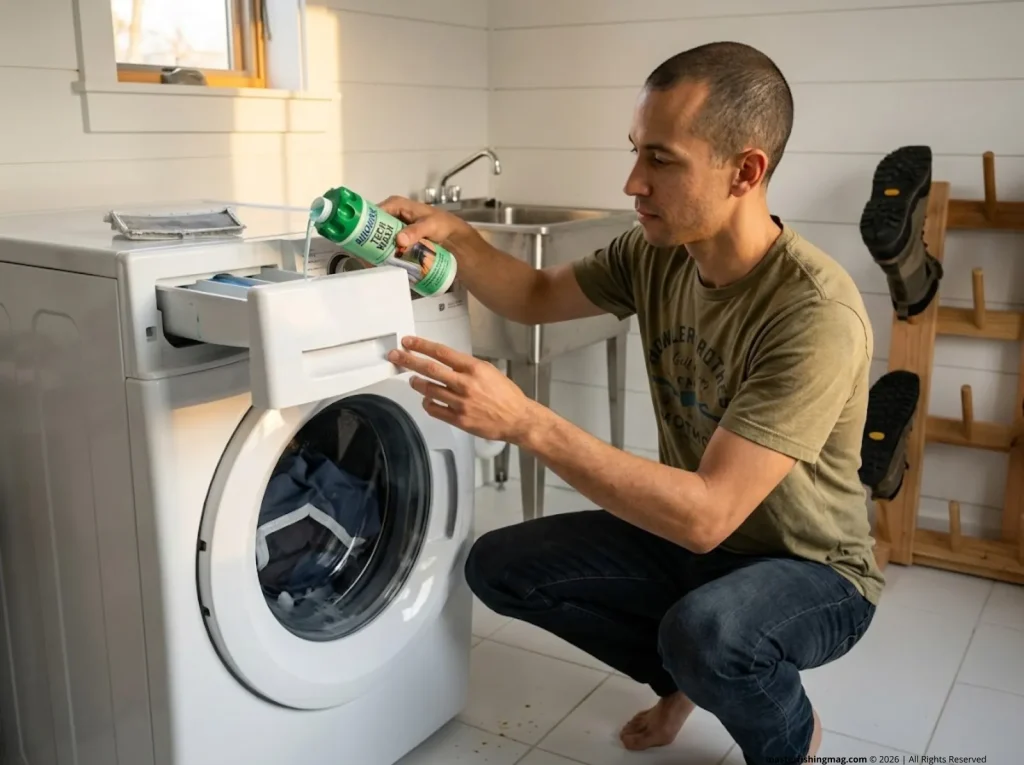
Use a technical wash formulated for waterproof breathable fabrics. Nikwax Tech Wash and ReviveX are the two standards. They clean without leaving hydrophilic residues behind. This is the backbone of any serious deep cleaning cycle for technical fabric care.
The machine matters too. Use a front-loader—or a top-loader without a central agitator. Agitator-less washing machines protect seam tape and laminate joints from the mechanical stress that destroys expensive waders from the inside out. Set the cycle to delicate with cold or warm water. Max 104°F. Never hot.
Turn your waders inside-out before loading them. The interior tricot liner is where bacteria and body oils accumulate, and it needs direct contact with the cleaning solution.
One emergency backup worth knowing: if you’re on a trip without Nikwax, powder detergent (like Ivory Snow) is a safer substitute than liquid formulas. Liquids contain more persistent surfactants that are harder to rinse clear. It’s not ideal, but it beats the alternative.
Zipper Maintenance After Washing
After every wash, apply Gear Aid Zipper Lubricant to all waterproof zipper teeth. Zipper lubrication isn’t optional in saltwater environments—it’s the difference between a functioning wader and one with salt-damaged zippers that you can’t open without a plier.
Store waders with zippers in the closed position to minimize strain on the polyurethane seal. For anglers who want the 3-phase protocol for washing all fishing gear, the same principles apply across your entire saltwater kit.
The Saltwater Longevity Protocol — Stage 3: DWR Reactivation
How the “Heat Reset” Works
DWR isn’t a paint job. Think of it as a forest of microscopic polymer “spikes” standing straight up from the fabric surface. When those spikes are upright, water touches only the tips—and rolls off. When dirt, salt, and body oils flatten them, water makes full contact with the fabric. That’s wetting out.
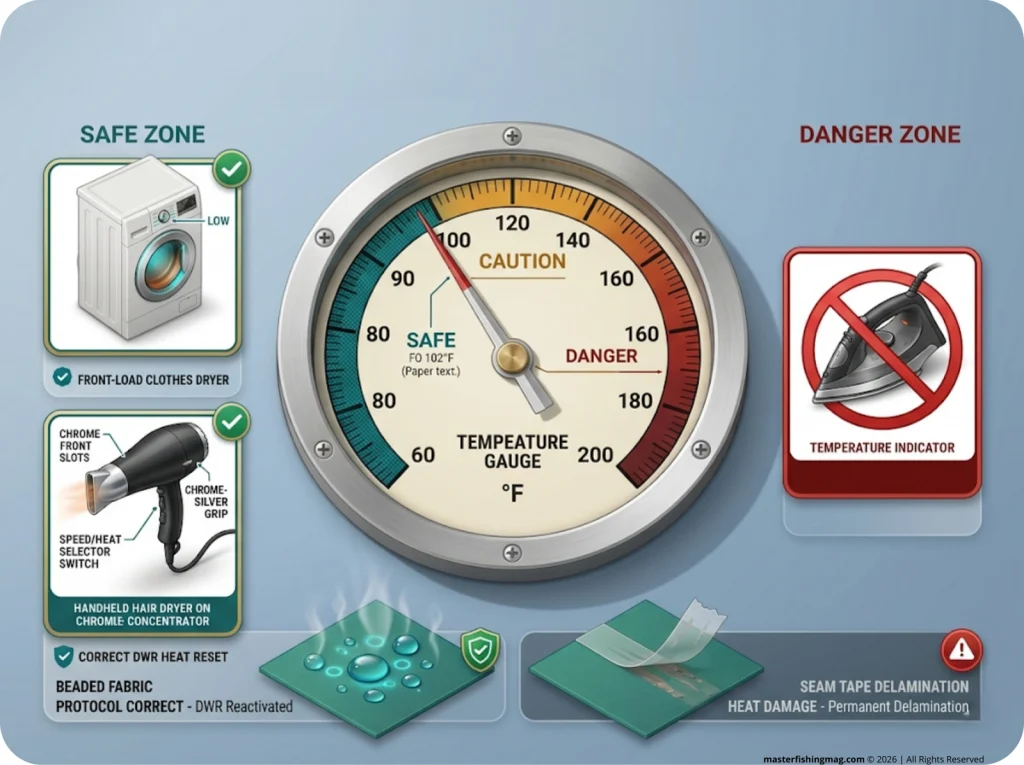
Cleaning removes the contaminants pushing those spikes down. Heat gives them the energy to stand back up. The target temperature for DWR reactivation is 100°F–105°F—warm enough to reset the coating, cool enough to leave seam tape adhesive intact. The Skwala RS Design Team confirms it: “washing and drying helps restore the durable water repellent.”
The Dryer Method vs. The Hairdryer Method
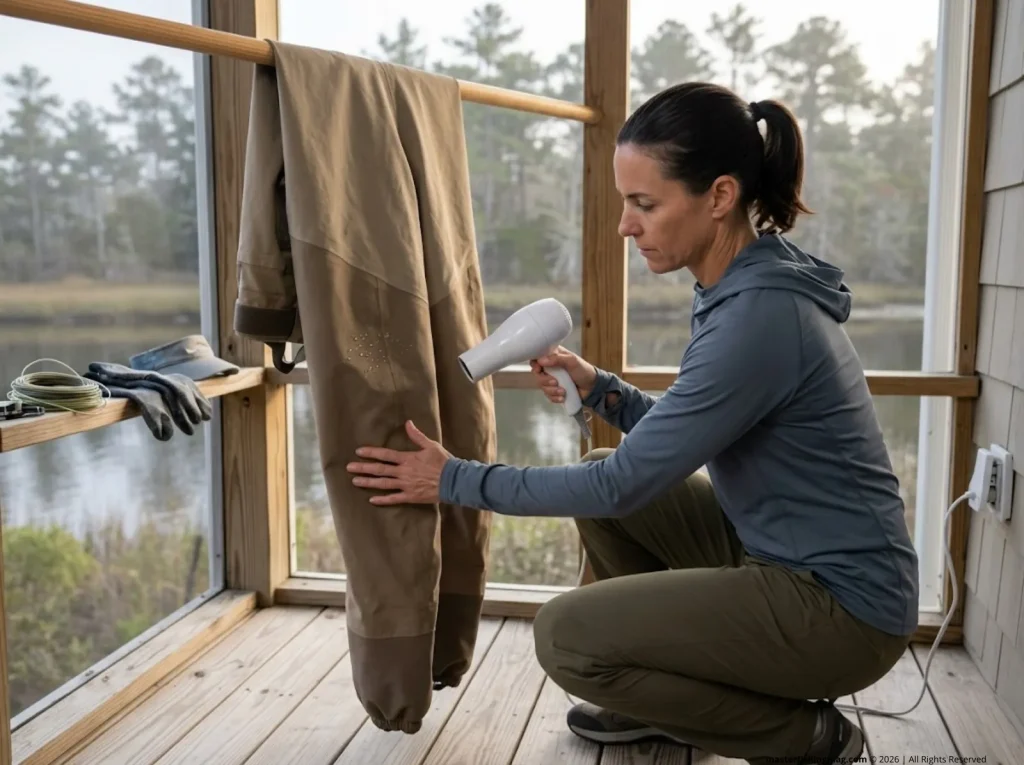
The most effective approach is a standard household dryer on Low or Warm for 15–20 minutes. That provides even heat across all the fabric. For waders that can’t go in a dryer—or when you’re on the road—a hairdryer on medium heat works. Keep the nozzle moving. Never park it on one spot.
⚠️ Heat alert: Never use a high-heat iron or run your dryer on the hot cycle. Excessive heat melts the adhesive under your seam tape, causing catastrophic seam delamination that is functionally unrepairable. The temperature sweet spot is narrower than most anglers realize.
After the heat reset, run the bead test again. Splash water on the fabric. If it beads, you’re good. If it still soaks in, apply a spray-on DWR restoration treatment like Nikwax TX.Direct and repeat the heat cycle. For our complete guide to drying waders without destroying them, the same phased approach applies.
The Hidden Threat Living Inside Your Waders
Bacteria, Staph, and the Wader Rash Risk
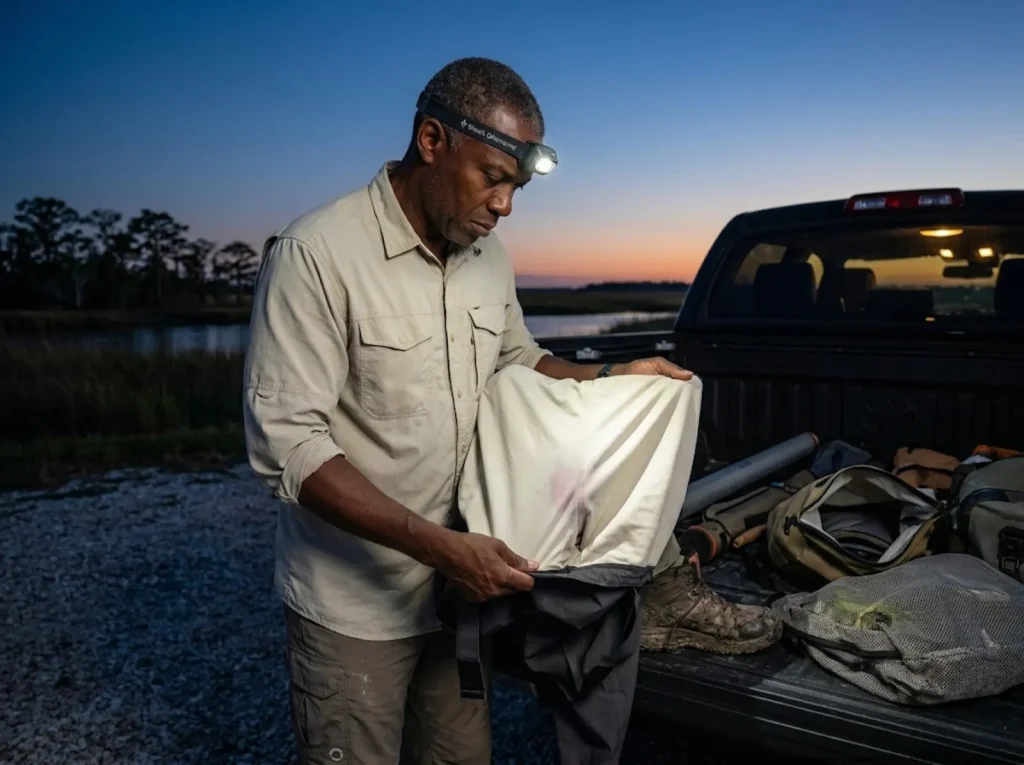
This is the part nobody wants to think about. The interior of your waders is a warm, dark incubator. It’s fueled by the salts, oils, and urea in your sweat. Left damp and unventilated, that environment breeds bacterial biofilms at an alarming rate.
The primary colonizer is Staphylococcus aureus—staph. Hatch Magazine put it bluntly: “The culprit behind the malodorous stench that well-worn waders emit is bacteria… they can cause some nasty infections.” In severe cases, those bacteria enter through a tiny cut or a mosquito bite and escalate to MRSA infections that put anglers in the hospital.
One guide I know picked up a full-blown staph infection from a mosquito bite on his shin after wearing swampy, unwashed waders for a week-long marsh trip. The smell should have been his first warning. Inside-out drying after every session isn’t about convenience. It’s about cutting off the warm, moist environment where pathogens and mold thrive.
Invasive Species and Biosecurity Between Watersheds
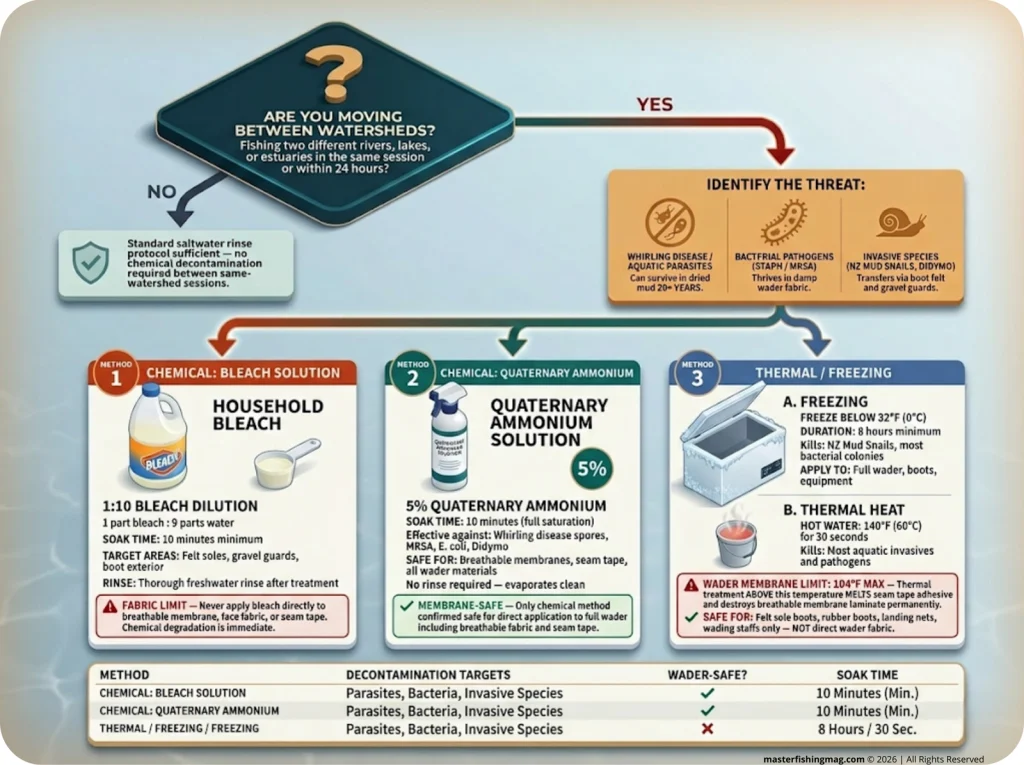
Then there’s the environmental angle. Whirling Disease spores—specifically the parasite Myxobolus cerebralis—can survive in dried mud on your gravel guards for more than 20 years. Twenty. Years. The public “Clean, Drain, Dry” message is a starting point, but professional-level biosecurity requires chemical neutralization.
Effective options include a 5% Quaternary Ammonium solution (brands like Clear Gear or Vital Oxide) soaked for 10 minutes, or a 1:10 bleach solution for suspected pathogen zones. Thermal treatment at 140°F for 30 seconds kills most aquatic invasive species—but that temperature will melt your wader’s seam tape, so reserve hot water for boots and landing nets only. Freezing below 32°F for 8 hours handles New Zealand Mud Snails and most bacterial colonies.
For authoritative decontamination standards, the Virginia Department of Wildlife Resources maintains current biosecurity protocols for aquatic pathogens. The Wisconsin DNR also publishes detailed invasive species decontamination guidelines worth bookmarking. And while you’re thinking about wading safety, make sure your wading belt is actually doing its job—it’s the other piece of safety equipment most anglers overlook.
Drying and Storage That Extends Wader Life
The Inside-Out Drying Protocol
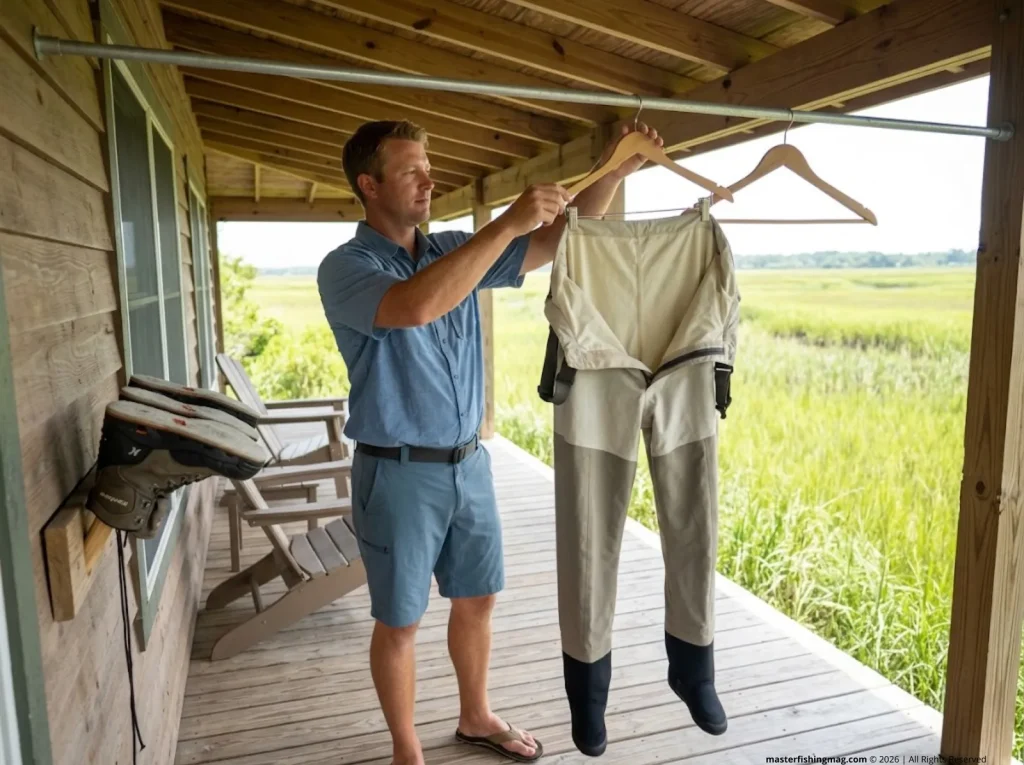
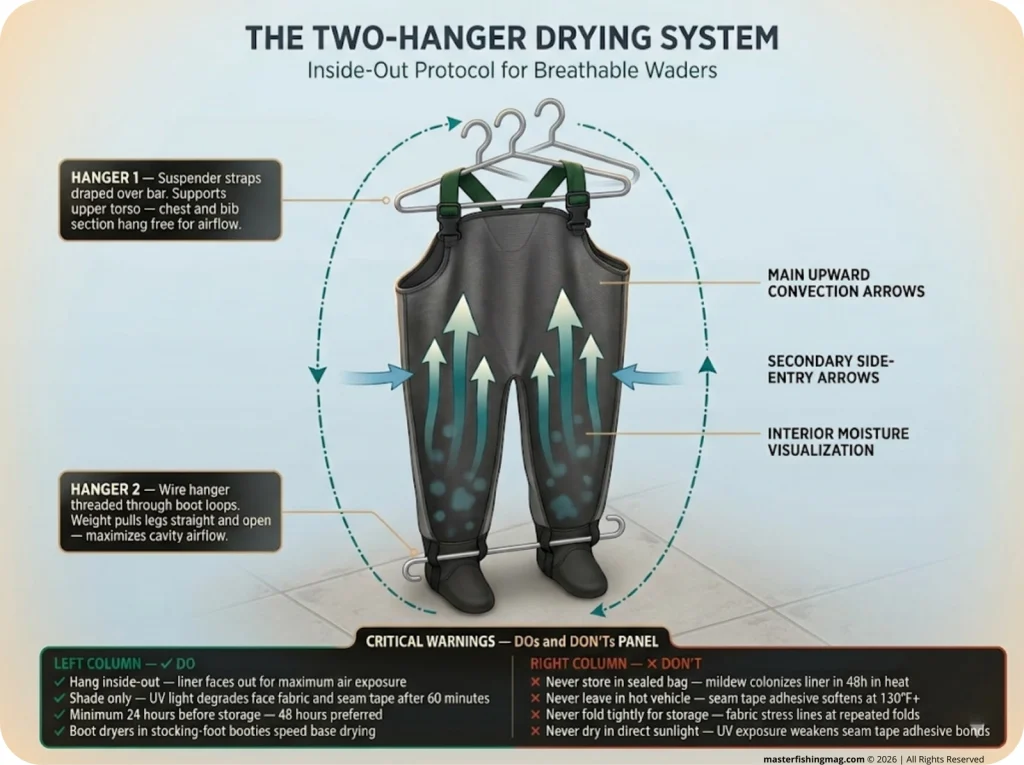
Always dry the inside first. Turn your waders completely inside-out so the tricot liner faces outward and gets direct airflow. Use a two-hanger system—wader hangers through the boot loops for the lower section, a second hanger or clothespin grip on the suspender straps at the top. This opens the leg cavities fully and lets air circulate through. If you have boot dryers, use them on the stockingfoot booties to speed up the process.
Air drying in a shaded, ventilated area is the goal. UV light is a natural disinfectant in short bursts, but prolonged sun exposure degrades nylon face fabric and weakens seam tape. Avoid UV/sunlight exposure beyond the first hour. A covered porch or garage with a fan is ideal.
⚠️ Storage alert: Never store damp waders in a sealed bag or a hot vehicle. Mildew can destroy a $900 pair of waders in as little as 48 hours. One angler learned the hard way: “I left my waders in the trunk for three days in July, and the seam tape just peeled off like an old sticker.”
Long-Term Storage Best Practices
For off-season storage, drape waders loosely in a ventilated bag—Simms makes a purpose-built “Taco Bag” for this—or hang them in a closet with room to breathe. Never fold them tightly. Avoid prolonged hanging by the suspenders alone; the elastic degrades under constant tension, especially when damp. A proper wader suspender height and adjustment setup prevents both field discomfort and storage damage.
Before storing for the season, run the full protocol: technical wash, DWR reactivation, zipper lube, and confirmed-dry for a minimum of 48 hours. Salt residue left sitting for months accelerates permanent damage that no amount of spring cleaning can undo. That’s the difference between sustainable gear care and throwing money away every season.
ePTFE vs. PU Membranes in Saltwater

GORE-TEX (ePTFE) — High Breathability, High Maintenance
GORE-TEX membranes use an ePTFE structure—billions of physical pores that let vapor through while blocking liquid water. This is the gold standard for breathability in breathable waders. Simms G4Z, Orvis Pro, and Patagonia Swiftcurrent all build on this technology.
But those pores are vulnerable. Salt, sunscreen, and fish oils clog them. Without strict adherence to the Saltwater Longevity Protocol, GORE-TEX waders become the worst-performing option in your closet. High gear performance demands equally high maintenance discipline.
Hydrophilic PU (Toray/Proprietary) — More Forgiving, Less Breathable
Some waders use solid polyurethane (PU) membranes—like Toray-based proprietary laminates—that move moisture through a chemical gradient rather than physical pores. There are no holes to block, which makes these waterproof membranes more resistant to saltwater corrosion. The tradeoff: they can feel “clammier” on cool, dry days since they need higher interior humidity before they start transmitting vapor.
For dedicated saltwater anglers who fish coastal flats daily and can’t commit to a post-session rinse every time, a PU membrane may offer better long-term durability with less maintenance overhead. If you’re still weighing fabric types, our breakdown of choosing between neoprene and breathable waders by water temperature covers neoprene waders as the third option in that equation.
Pro tip: If you own GORE-TEX waders and fish saltwater more than twice a week, keep a pre-mixed vinegar spray bottle and a gallon of fresh water in your truck at all times. The 30-minute rinse window is everything. It’s the single best habit to protect high-dollar investment gear from premature death.
Conclusion
Three things decide whether your waders last one season or five.
Rinse immediately, rinse thoroughly. Salt crystallization starts the moment fabric dries. That 30-minute window after you strip down is your first and most important defense.
Never use household detergent. Technical washes exist for a reason. One load with Tide or Downy can chemically ruin the breathability of a $700 wader. It’s the single most expensive laundry mistake in fishing.
Heat resets DWR—but too much kills seam tape. The 100°F–105°F sweet spot is narrow. A dryer on low for 15 minutes restores restoring water beading. A dryer on high for 5 minutes melts the adhesive holding your waders together.
Run the bead test before your next trip. Splash water on the knees and chest. If it soaks in instead of rolling off, your waders are asking for help. One hour of maintenance now saves you $900 and a season of fishing inside a sweat bag. Your gear works hard for you. Return the favor.
FAQ
Can I put fishing waders in the washing machine?
Yes—but only in a front-loading machine or a top-loader without a central agitator, set to delicate with cold water and a technical wash like Nikwax Tech Wash. Standard detergent leaves surfactant residue that causes wetting out, and agitators stress seam tape to the point of delamination.
How do you get the smell out of fishing waders?
The smell is bacteria colonizing the damp interior liner. Turn the waders inside-out, soak in a 1:4 vinegar-to-water solution for 30 minutes, then wash with a technical wash. For stubborn odor, Mirazyme is an enzyme-based treatment that breaks down the bacterial biofilm at its source.
Does salt water actually ruin waders?
Salt doesn’t puncture your waders—it sabotages the way they breathe. Salt is hygroscopic, meaning it pulls moisture against the membrane and flattens the pressure gradient that drives breathability. Left untreated, salt residue can cut a premium wader’s lifespan by 50% or more.
Is it okay to use Dawn dish soap on waders?
In an absolute emergency, a tiny amount of Dawn dish soap works for a basic rinse. But Dawn is a surfactant designed to attract water into fabric—the opposite of what DWR needs. Repeated use causes chronic wetting out. Always default to a technical wash built for waterproof-breathable fabrics.
How often should I wash my waders?
After every saltwater session, perform the Stage 1 field rinse with freshwater and vinegar. A full technical deep clean should happen every 15–20 days of active use, or whenever you see the fabric wetting out. DWR reactivation follows every deep clean.
Risk Disclaimer: Fishing, boating, and all related outdoor activities involve inherent risks that
can lead to injury. The information provided on Master Fishing Mag is for educational and informational purposes
only. While we strive for accuracy, the information, techniques, and advice on gear and safety are not a substitute
for your own best judgment, local knowledge, and adherence to official regulations. Fishing regulations, including
seasons, size limits, and species restrictions, change frequently and vary by location. Always consult the latest
official regulations from your local fish and wildlife agency before heading out. Proper handling of hooks, knives,
and other sharp equipment is essential for safety. Furthermore, be aware of local fish consumption advisories. By
using this website, you agree that you are solely responsible for your own safety and for complying with all
applicable laws. Any reliance you place on our content is strictly at your own risk. Master Fishing Mag and its
authors will not be held liable for any injury, damage, or loss sustained in connection with the use of the
information herein.
Affiliate Disclosure: We are a participant in the Amazon Services LLC Associates Program, an
affiliate advertising program designed to provide a means for us to earn advertising fees by advertising and linking
to Amazon.com. As an Amazon Associate, we earn from qualifying purchases. We also participate in other affiliate
programs and may receive a commission on products purchased through our links, at no extra cost to you. Additional
terms are found in the terms of service.