

In this article
The ocean does not forgive; it only decomposes. From the moment your fishing reel leaves the salt spray, a silent, molecular war begins. Sodium chloride ions organize into abrasive salt crystals that shatter ceramic guides, while galvanic currents invisibly devour the aluminum frame of your favorite equipment.
I have spent decades watching fishermen ruin top-tier rods and reels not through abuse, but through improper outdoor gear maintenance. This isn’t just cleaning; it is a financial strategy for gear longevity. Preserving your investment is not about a quick rinse with a garden hose—that often does more harm than good. It is about executing a rigorous, chemically grounded 3-phase post-trip protocol that neutralizes threats before they become failures.
This guide outlines a comprehensive approach: implementing “The Lockdown” field maintenance at the water’s edge, utilizing chelation chemistry for deep home maintenance, and fortifying mechanical barriers for storage maintenance.
What Must Be Done Immediately at the Water’s Edge? (Phase 1: Field Neutralization)
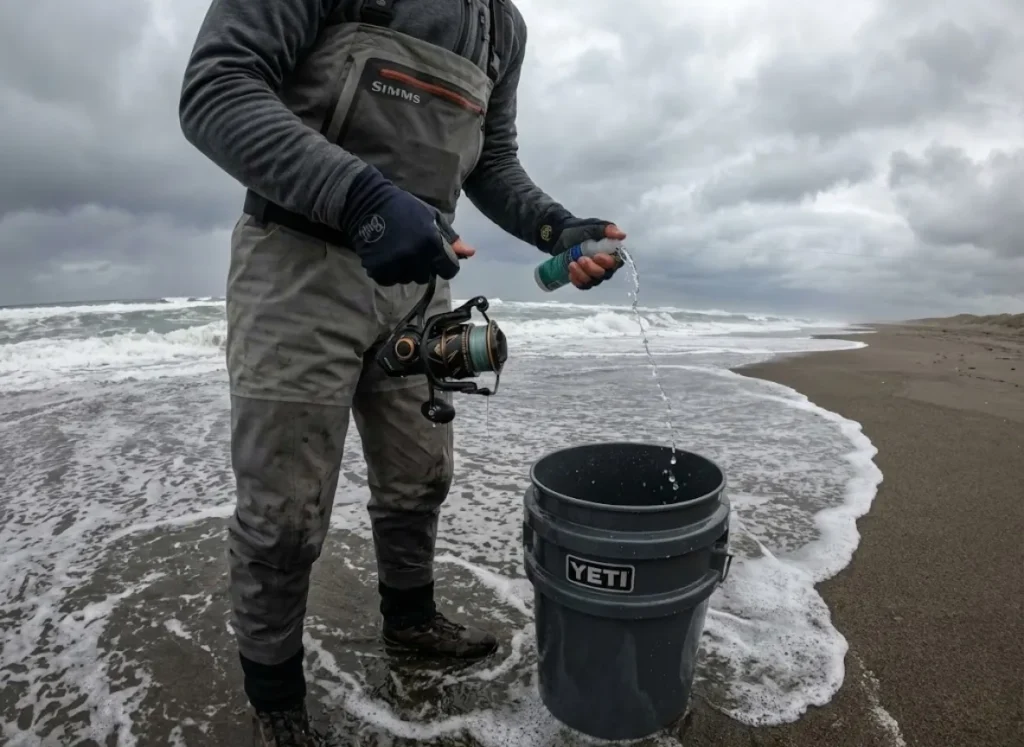
The “Golden Hour” of angling equipment hygiene happens before you even start the engine to drive home. This is when you must stabilize the personal fishing gear before oxidation begins during transport.
How Do I Prevent Salt Intrusion Before the Drive Home?
You must execute the “Mechanical Lockdown” immediately upon exiting the water. Whether handling a spinning reel, baitcasting reel, or fly reel, tighten the drag system to its maximum setting. This compresses the internal drag washers, creating a monolithic barrier against water intrusion.
Once sealed, utilize a portable freshwater source—like a pump sprayer or a RinseKit—set to a gentle mist setting. Never use high pressure. Position your fishing bag and gear vertically with tips pointing upward, allowing gravity to assist the water in cascading down and away from the reel seat. Apply a heavy mist specifically to the braid or fishing line on the spool, as the weave acts like a sponge for saltwater retention.
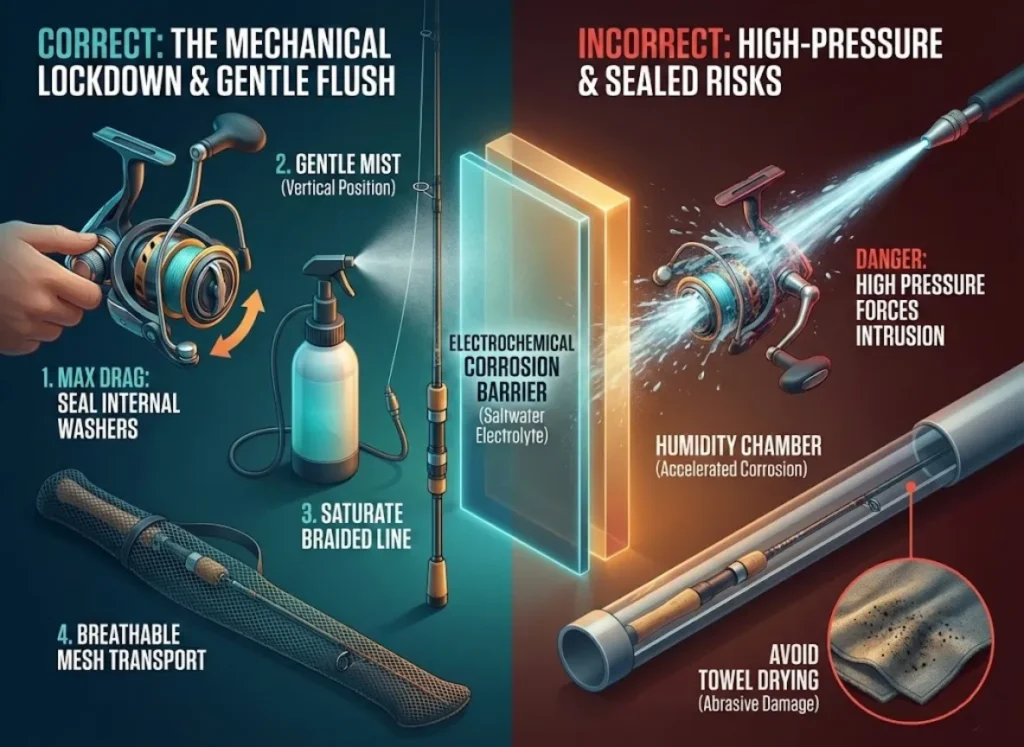
High water pressure is the primary cause of premature reel failure. It forces saline water past the anti-reverse bearings and into the gearbox, trapping the electrolyte inside. By ensuring a tightened drag, you prevent capillary action from drawing moisture into the washer stack.
Additionally, transporting wet rods in sealed tubes creates a “humidity chamber” that accelerates corrosion. Instead, use breathable mesh rod socks to allow airflow while protecting rod blanks and guides during transit. Avoid trunk-storage on a hot day fishing, as the heat can cause monofilament and fluorocarbon to degrade and rod blanks to warp.
Pro-Tip: Never dry your reel with a towel immediately after rinsing. Wiping a wet reel simply grinds abrasive sand and salt particles into the finish. Shake it off gently and let it air dry.
This process displaces surface salt, but the chemical threat remains. We must understand the galvanic series of metals in seawater to realize why aluminum and stainless steel are always at risk when exposed to these electrochemical processes where saltwater acts as an electrolyte.
How Do I Chemically Neutralize Salt and Pathogens at Home? (Phase 2: Deep Decontamination)
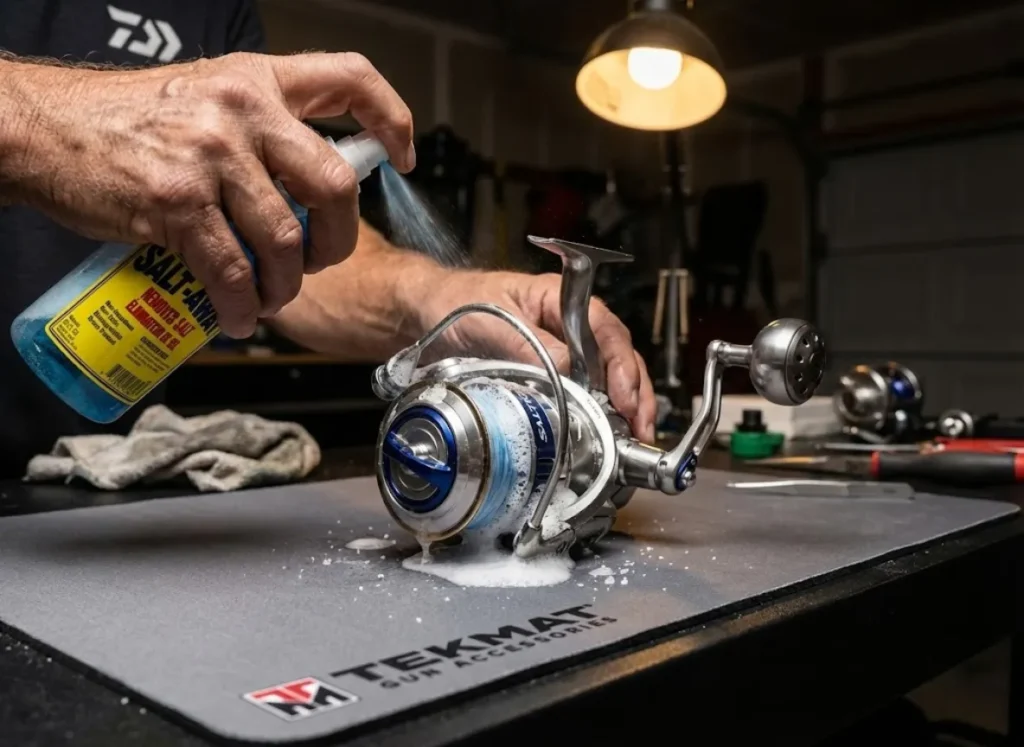
Once you are home, tap water is no longer enough. We must use chemical agents to break molecular bonds and ensure ecological compliance for everything from hooks to kayaks.
Why Is Water Alone Insufficient for Salt Removal?
You need to prepare a solution using a dedicated salt removal agent, such as Salt-Away, which features chelating agents rather than relying on simple solubility. Spray this solution liberally into the nooks and crannies of the reel seat, under the line roller, across the level wind of your baitcaster, and over the rod guides.
The critical step here is “dwell time.” Allow the chemistry to work for 5-10 minutes, letting it sequester the salt deposits, but do not allow the solution to dry completely on the surface. Finally, rinse thoroughly with fresh, low pressure water. You can use lukewarm water to help dissolve salt, but avoid hot water which can damage grease.
Water only dissolves surface salt; chelating agents chemically “cage” the metal ions, preventing them from re-depositing. It is vital to avoid using mild dish soap or heavy degreasers on the reel body. Surfactants found in products like Dawn can penetrate seals and emulsify the factory reel grease on the main shaft and gears, stripping essential lubrication.
This chemical removal is necessary because the pressure induced by salt crystallization in confinement—such as inside guide frames—can cause micro-fractures in your equipment. This is a cornerstone of sustainable fishing gear maintenance practice. Don’t forget to rinse your lures, plugs, bucktails, and terminal tackle like swivels and sinkers in a separate mesh bag.
How Can I Disinfect Waders Without Destroying Them?
Submerge your wading boots and waders in a tub containing a 1-2% solution of a broad-spectrum disinfectant like Virkon S. Ensure the felt soles are fully saturated and allow them to soak for a minimum of 10-20 minutes.
This contact time is required to penetrate the biofilm where aquatic hitchhikers reside. Rinse with fresh water to protect metal eyelets from corrosion, and always hang waders inside-out to dry first to prevent internal condensation. Avoid heated dryers, as they will delaminate the seam tape.

Porous materials act as vectors for microscopic threats. Simple rinsing is biologically ineffective against these hardy pathogens. Adhering to these biosecurity protocols is essential for preventing the spread of aquatic invasive species, such as zebra mussels, Didymosphenia geminata (didymo), or Whirling Disease. Every angler has a responsibility to understand the risks posed by aquatic invasive species when moving between watersheds.
What Is the “Cotton Ball Diagnostic” for Rod Guides?
Take a standard cotton swab (Q-tip) or a cotton ball and gently run it through the inner ring of every ceramic guide (or eye) on the rod. Pay specific attention to the tip-top guide, as it endures the highest mechanical stress.
If the cotton snags, pulls fibers, or leaves lint behind during this cotton ball test, it indicates a microscopic crack, guide nick, or guide chip in the ceramic insert. You must replace any damaged guides immediately; do not attempt to sand or repair cracked ceramic.
Ceramic inserts are harder than steel but inherently brittle. The properties of ceramic materials mean that even invisible hairline cracks act like razor blades under tension. This can cause inexplicable line breaks during a fight with a heavy fish. Performing this test while the rod is wet allows for early detection, ensuring the parts of a fishing rod responsible for line management are intact.
How Do I Fortify Gear for Long-Term Dormancy? (Phase 3: Preservation & Storage)
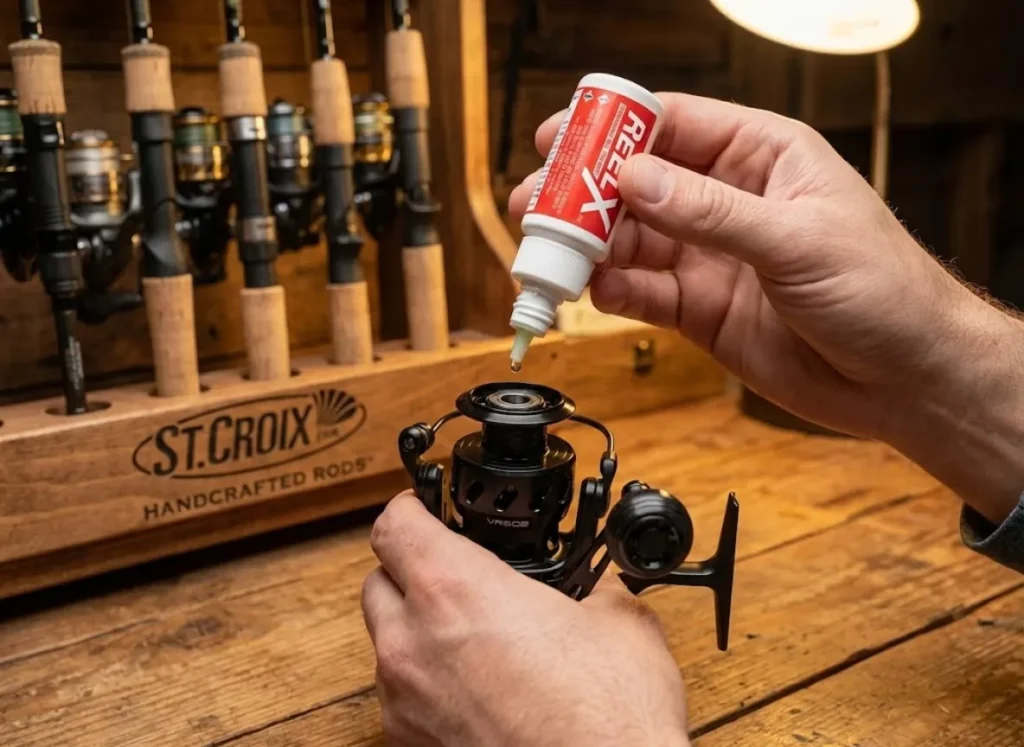
The final phase of the rinse-dry-lube cycle focuses on tribology—the science of wear and friction—to prevent seizure and degradation during storage.
Which Lubricants Actually Protect Against Galvanic Corrosion?
Apply exactly one drop of a high-quality reel oil, such as TSI 321, Ardent Reel Kleen, or Loon reel lube, to the lubrication points: the line roller, bearings, and handle knobs. Wipe down the external body of the reel, the rod blanks, and even your pliers and nippers with a microfiber cloth dampened with a corrosion inhibitor like CorrosionX.
Avoid WD-40 (the standard blue can). It is a solvent, not a lubricant, and will strip factory grease while leaving a gummy residue. If you are performing internal maintenance on carbon drag washers, use specific drag grease like Cal’s.
Fishing Reel Maintenance Comparison
Comparing solvents, greases, and oils for optimal reel performance and longevity.
Recommended Use
DO NOT USE. Active hazard to reels; dissolves factory grease and traps grime.
Water Resistance
Negative. Displaces water initially, but residue is hygroscopic and becomes gummy over time.
Viscosity
Very High. Tacky and heavy; causes “sluggish” performance in small reel mechanisms.
Recommended Use
Boat trailers and props. Generally overkill and too thick for fishing reel internals.
Polar Bonding
High resistance via polar bonding that creates a self-healing film. Low to Medium viscosity matched to load.
Recommended Use
High-speed spool bearings, line rollers, and external body wipe-downs for corrosion protection.
Properties
PTFE (Teflon) fortified. Heat resistant and hydrophobic to prevent “start-up inertia” in drags.
Recommended Use
Carbon fiber drag washers and main gears. Designed for high-pressure, high-shear areas.
Corrosion inhibitors utilize “polar bonding” to adhere to the metal substrate. This creates a dielectric barrier that repels atmospheric moisture. Over-lubrication is a common error that attracts sand and dust, creating a grinding paste. The goal is to maintain the passive state of the metal, requiring an understanding of galvanic corrosion mechanisms. This maintenance step is just as critical as selecting durable saltwater spinning reels in the first place. Don’t forget to wipe down the screens of fish-finder units and GPS units with a suitable electronics cleaner, not reel oil.
Why Must Drag Systems Be “Relaxed” During Storage?
Loosen the drag knob completely until there is zero resistance on the spool, ensuring a loosened drag state. Ensure this is done on every reel in your arsenal—from heavy boat gear to carp fishing gear—before placing it on the rack. Store rods via vertical storage or proper rack storage to prevent the blank from taking a permanent warp. Maintain a storage environment with moderate humidity to prevent cork from drying out.
Leaving the drag tight keeps the spring washers under constant compression. Over time, felt washers lose their memory, and the effects of compression set on elastomers can ruin the smoothness of your drag. This leads to “start-up inertia,” a spike in force that snaps lines. This relaxation technique is a key component of winterizing fishing gear storage.
Pro-Tip: If you use spinning reels, verify that the bail arm is closed during storage. Leaving it open keeps the bail spring under tension, which can weaken it over the off-season.
The Long Game
Preserving your gear requires more than a simple rinse. We must use chelation to remove salt, not just water to move it around. We must prioritize low-pressure misting to avoid forcing salt into the gearbox. We must be diligent about biosecurity to protect our fisheries from invasive species. Finally, we must relax our drag systems to ensure performance remains consistent.
This post-trip fishing gear maintenance protocol transforms cleaning from a chore into a strategic advantage, ensuring your gear is an extension of your will, not a liability. Share your own gear maintenance routine or questions about specific saltwater corrosion issues in the comments below, and explore our library of foundational techniques to keep your skills as sharp as your hooks.
FAQ – Frequently Asked Questions
Can I use WD-40 to lubricate my fishing reel?
No. WD-40 is a solvent that strips away high-quality factory grease and leaves a gummy residue that attracts dirt and holds moisture. Use dedicated reel oil like ReelX or TSI 321 instead.
Should I dunk my reel in a bucket of fresh water to rinse it?
Never submerge your reel. Dunking creates hydrostatic pressure that forces water past the seals and into the gear box; always use a gentle mist from above to let gravity shed the water.
Is dish soap safe for washing fishing reels?
Generally, no. While safe for rod grips and coolers, mild dish soap acts as a degreaser that can penetrate reel seals and break down the internal lubrication of the gears. Use a specialized salt remover or just fresh water for the reel body.
How do I check my rod guides for damage?
Use the cotton ball test. Run a Q-tip or cotton ball through the ceramic inserts; if the cotton snags or pulls fibers, it indicates a microscopic crack that could cut your line.
Risk Disclaimer: Fishing, boating, and all related outdoor activities involve inherent risks that
can lead to injury. The information provided on Master Fishing Mag is for educational and informational purposes
only. While we strive for accuracy, the information, techniques, and advice on gear and safety are not a substitute
for your own best judgment, local knowledge, and adherence to official regulations. Fishing regulations, including
seasons, size limits, and species restrictions, change frequently and vary by location. Always consult the latest
official regulations from your local fish and wildlife agency before heading out. Proper handling of hooks, knives,
and other sharp equipment is essential for safety. Furthermore, be aware of local fish consumption advisories. By
using this website, you agree that you are solely responsible for your own safety and for complying with all
applicable laws. Any reliance you place on our content is strictly at your own risk. Master Fishing Mag and its
authors will not be held liable for any injury, damage, or loss sustained in connection with the use of the
information herein.
Affiliate Disclosure: We are a participant in the Amazon Services LLC Associates Program, an
affiliate advertising program designed to provide a means for us to earn advertising fees by advertising and linking
to Amazon.com. As an Amazon Associate, we earn from qualifying purchases. We also participate in other affiliate
programs and may receive a commission on products purchased through our links, at no extra cost to you. Additional
terms are found in the terms of service.