In this article
A single drop of water trapped in your livewell intake line, bilge pump, or transom well can harbor a microscopic army capable of collapsing a fishery. While the “Clean, Drain, Dry” and “Stop Aquatic Hitchhikers” slogans are plastered on every boat ramp sign from Florida to the Great Lakes, they often fail to address the technical reality of modern fishing gear.
Most recreational boaters treat AIS mitigation (Aquatic Invasive Species) as a regulatory chore—something to do quickly to avoid a ticket from state DNR officers. But the responsible angler treats it as a critical component of gear maintenance, requiring the same precision as tying a knot or tuning a sonar unit.
If you want to protect your favorite waters and avoid hefty fines under state-specific transport laws, you need to look beyond the visible weeds. We will cover why visual inspections fail against 70-micron veligers and how to manage the thermodynamics of the kill—specifically the critical difference between 140°F killing temperature and 120°F water temperature. We will also discuss how to use chemical tools without corroding your aluminum hulls or poisoning your next catch, and walk through a zone-by-zone audit of your rig.
Why is “Clean, Drain, Dry” Often Insufficient for Modern Rigs?
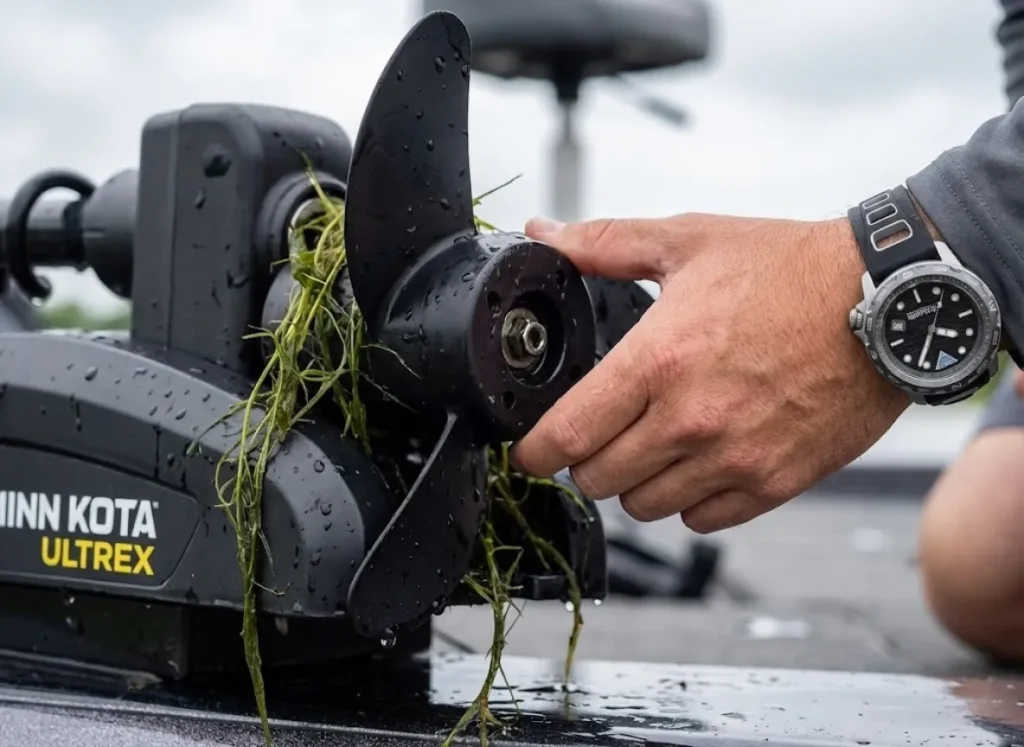
To truly protect a body of water, we have to shift our mindset from “looking for weeds” to “managing biological vectors.” The threat isn’t just milfoil fragments hanging off the trailer pads; it is what you can’t see floating in the residual raw water.
What is the “Veliger Factor” and why does it change the rules?
The primary enemy is the veliger. This is the microscopic, planktonic larval stage of Dreissenid mussels (Zebra mussels and Quagga mussels). They range from 70 to 200 microns in size—roughly the size of a grain of salt—making them effectively invisible to the naked eye when suspended in standing water.
While Eurasian watermilfoil, Giant Salvinia, Spiny water flea, New Zealand mudsnail, Starry Stonewort, and Round goby eggs are all valid threats, mussels are unique. Unlike native mussels that require a host fish to reproduce, invasives spawn millions of eggs directly into the water column. This turns any residual water in your ballast tank or lines into a transport vector.
According to US Fish & Wildlife Service data on dreissenid prevention, this biological reality dictates that simple drainage is not enough; systems must be flushed, heated, or treated to ensure sterility against these pathogens.
Late-stage veligers are particularly insidious because they secrete proteinaceous “byssal threads.” These bond to hard surfaces with a strength exceeding many marine adhesives, resisting simple rinsing at car washes. Worse still, in cool, damp environments like a livewell line, they can survive for days. This is why identifying aquatic invasive species is the first step in realizing that a garden hose often isn’t enough to win the battle.
How Do We Manage Thermal Energy for Decontamination?
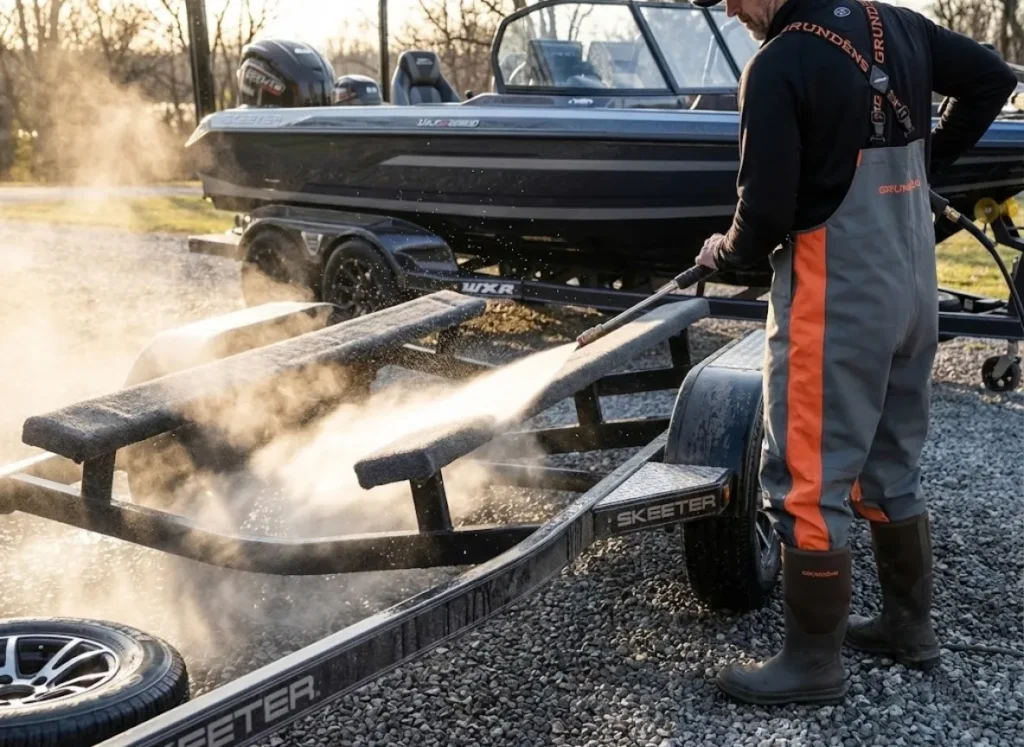
Heat is the most effective killer of aquatic nuisance species, but it is also a threat to your safety equipment and components. The goal is to apply specific physical forces to kill the biology without destroying your watercraft.
What is the critical difference between 140°F and 120°F?
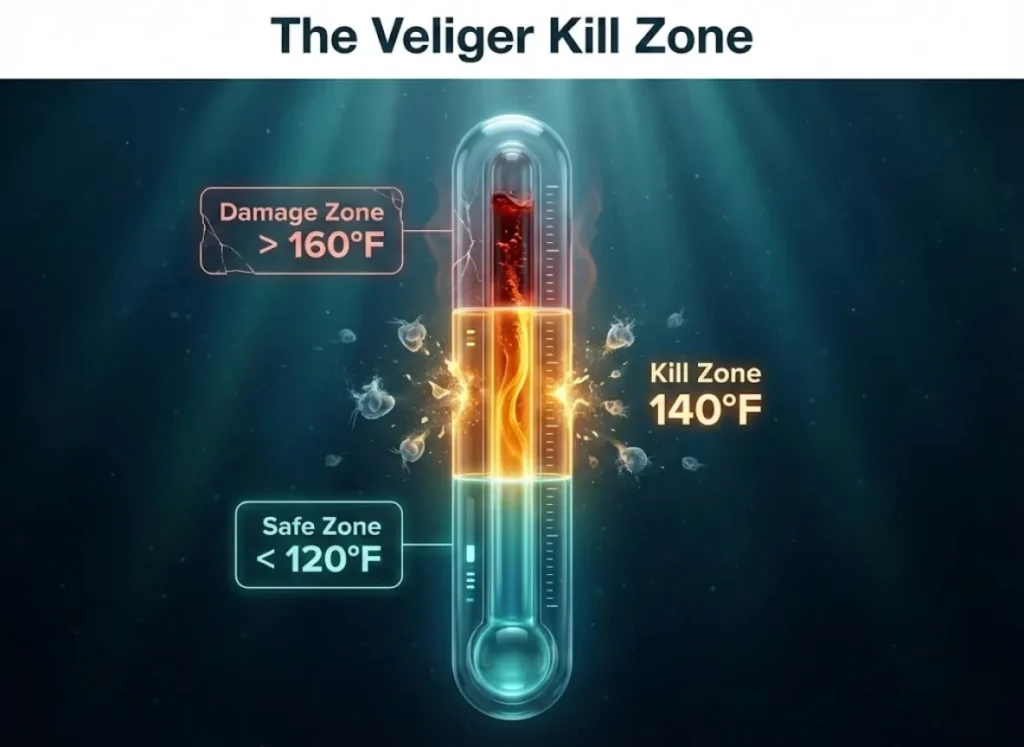
There are two temperature standards you must memorize for effective cleaning. The first is the “External Standard” or 140°F killing temperature (60°C). This is the thermal shock threshold required for instantaneous mortality of mussels and veligers on hard surfaces like your hull or trailer frame. Generally, a contact time of just 10 seconds hot water at this temperature achieves 100% lethality.
However, you must be careful. Prolonged exposure at this temperature can warp decals or strip wax from modern boat finishes.
The second number is the “Internal Standard” or 120°F water temperature (49°C). This is the safety limit for internal components. Pump impellers, rubber gaskets, and livewell plumbing can soften and fail at higher temperatures. Because the temperature is lower, the research on water temperature impact on zebra mussel mortality indicates that the contact time must increase to 2 minutes to achieve the same kill rate.
Decontaminating internal systems requires patience and recirculation, not just a quick blast of hot water. This attention to thermal limits is a key part of sustainable fishing gear maintenance, ensuring your equipment lasts as long as the fisheries you are protecting.
Pro-Tip: Use an instant-read meat thermometer to check the water temperature exiting your hose or pressure washer tip. Water loses heat rapidly as it travels through the air; what reads 140°F at the machine might only be 110°F when it hits the hull.
How much pressure is safe for gelcoat and seals?
When applying this heated water via pressure washing, PSI requirements matter. The “Safe Zone” is generally between 1000 PSI and 2,000 PSI. This is optimal for shearing off organic matter without damaging the boat. Most electric washers fall into this range naturally.
If you are using a gas unit, you may need a regulator or a wider nozzle tip (like a 40° fan) to keep the pressure down. The Connecticut DEEP vessel decontamination protocols validate these pressure ranges to avoid “etching” the gelcoat or lifting vinyl wraps on bass boats.
Be wary of the “Danger Zone” above 2500 PSI. This pressure can force water past sealed bearings in your trailer wheels or damage sensor faces. Never spray directly at your transducer or the pitot tube on the lower unit. We use pressure to remove visible mud and debris, but we rely on heat—not force—to kill the microscopic threats. This gentle approach also helps prevent the need for premature boat hull oxidation restoration.
What is the Responsible Angler’s Chemical Protocol?
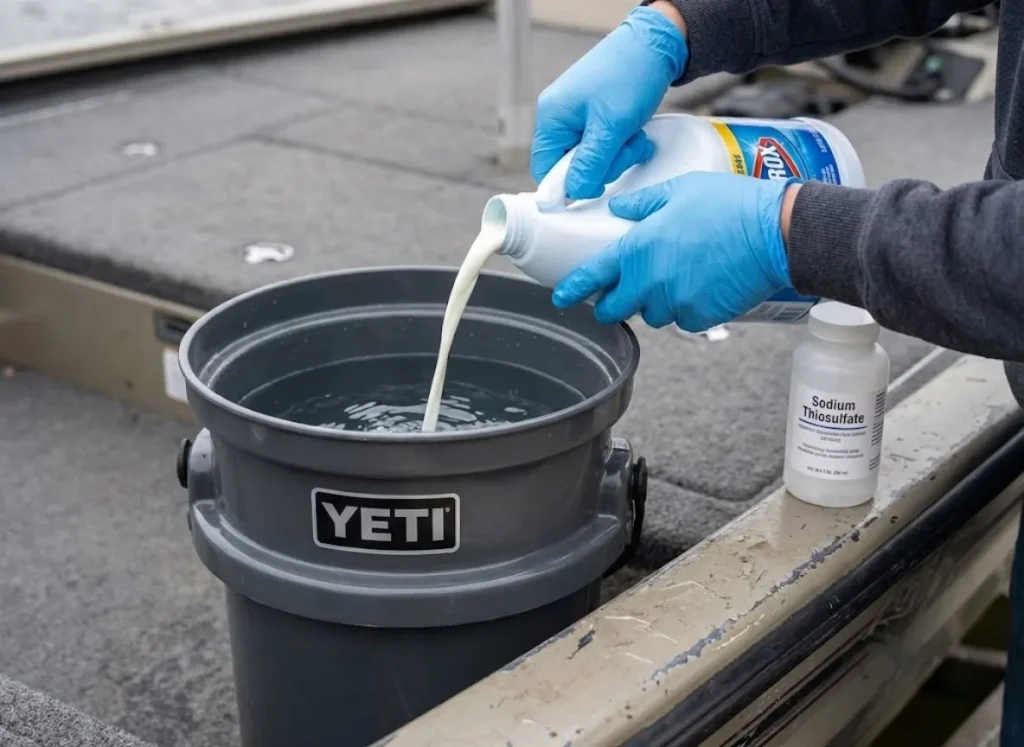
Sometimes, thermal shock isn’t an option for sensitive gear, felt-soled boots, or internal plumbing. In these cases, we turn to chemistry. However, using chemicals requires a strict protocol to avoid damaging your aluminum or the environment.
How do you safely use bleach without ruining your boat or killing fish?
For effective pathogen and veliger control, a 2% bleach concentration (Sodium Hypochlorite solution) is the standard. This translates to roughly 3 ounces (or 1/3 cup) of household bleach per gallon of tap water. This solution is ideal for flushing livewells or wiping down smooth surfaces.
However, bleach is an oxidizer. It can corrode aluminum and degrade rubber seals if left in the system. More importantly, you cannot dump bleach solution or gray water into a lake.
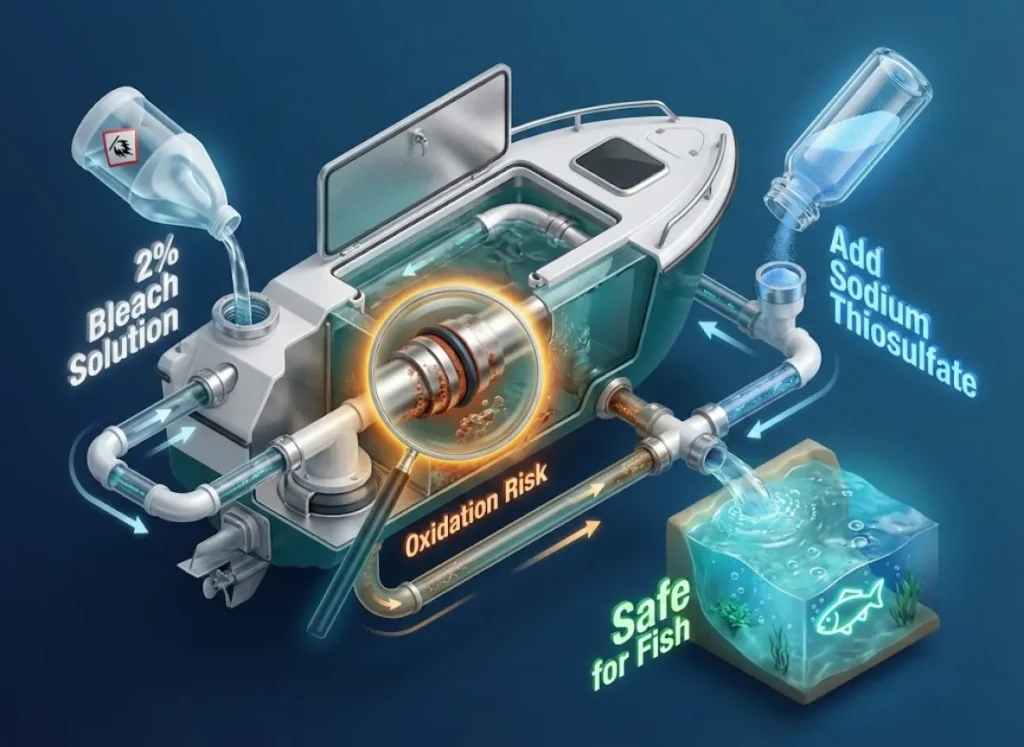
The most critical step in chemical decontamination is neutralization. You should introduce Sodium Thiosulfate—a common aquaculture dechlorinator found in pet stores—as a mandatory follow-up. According to Wisconsin DNR disinfection manual code 9183.1, proper neutralization prevents toxicity.
After a bleach flush, rinse the system with fresh water treated with thiosulfate. This instantly neutralizes residual chlorine. If you skip this, you risk “livewell poisoning,” where chemical residue kills the next fish you place in the tank. This practice also helps with saltwater corrosion prevention by removing the corrosive oxidizers from your metal fittings.
How Do We Execute a Zone-by-Zone Gear Audit?
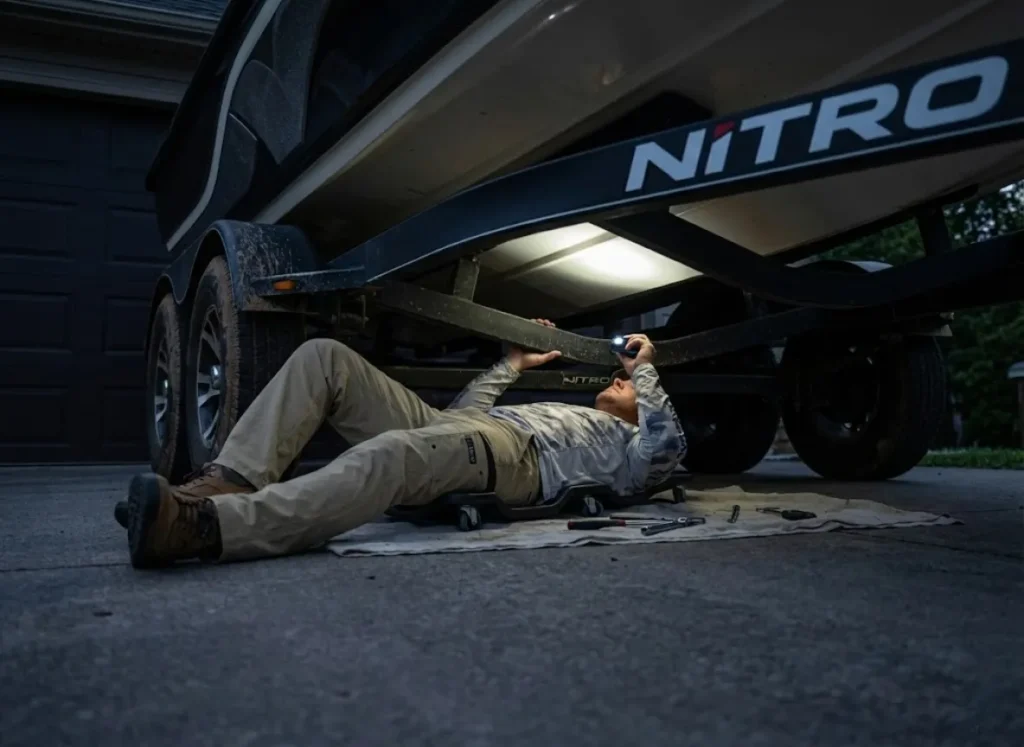
With your thermal and chemical tools ready, it is time to systematically apply these methods across the four critical zones of your vessel. This is your personal gear integrity audit.
How do you effectively flush the livewell and bilge?
Livewell plumbing is a major trap. It contains “dead legs”—dips in the hoses that trap water and veligers even when you remove the drain plug. To clean this, use the “Recirculation Method.”
Fill the tank with your 120°F water temperature or chemical solution and run the system on “Recirculate” for the required contact time (2 to 10 minutes). This ensures the solution reaches the intake pump, the spray heads, and the hidden hosing behind the bulkheads.
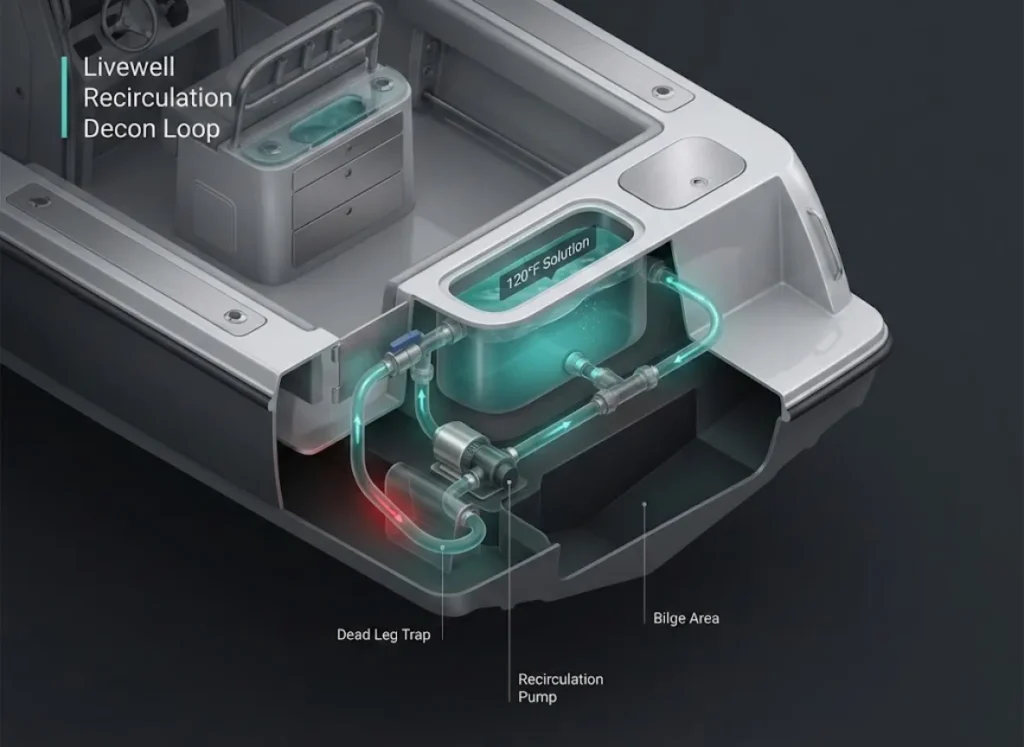
For the bilge pump area, pour the decontamination solution directly into the compartment. Use the trailer jack for bow elevation—raising and lowering the front—forcing the fluid into all corners before draining. The Western Regional Panel inspection and decontamination procedures highlight that the bilge is often the darkest, wettest part of the boat—a perfect nursery for invasive material.
Finally, leave all compartment lids open during storage. Desiccation (drying) is the ultimate fail-safe killer. Proper airflow is a cornerstone of pro livewell use, keeping the system dry and sweet-smelling between trips.
Why are trailer bunks the “Hidden Vector” and how do you clean them?
Carpet bunks act as a biological sponge. They trap moisture and organisms between the fabric and the hull, shielding them from the sun. The Invasive Mussel Collaborative guide on decontamination methods identifies this as a primary failure point in many mandatory inspection laws.
To deep clean, use the “Jack-Up” method. Chock your wheels securely. Lower the trailer tongue to raise the stern, support the stern with jack stands, and then raise the tongue to lift the hull off the bunks. This creates the gap necessary to pressure wash the carpet and flush out trapped sand, milfoil fragments, and veligers.
Boat Trailer Bunk Material Comparison
A detailed look at how Carpet vs. Synthetic Bunks affect invasive species risk and hull maintenance.
Water Retention
High. Acts as a “biological sponge,” trapping moisture directly against the hull.
Drying Time
Slow. Can remain damp for days or weeks, creating a microclimate for invasive survival.
Veliger Risk
High. Fibrous texture traps microscopic veligers and protects them from decontamination.
Hull Abrasion
Moderate to High. Traps silt and sand, creating a sandpaper effect; promotes osmosis blistering.
Water Retention
Minimal. Non-porous materials shed water immediately and do not absorb liquid.
Drying Time
Fast. Dries almost instantly after retrieval, eliminating moisture for organism survival.
Veliger Risk
Low. Ribbed, non-fibrous surfaces offer no harborage for organisms to hide or attach.
Hull Abrasion
Low. Designed to minimize surface contact and prevent entrapment of abrasive particulates.
If you are serious about biosecurity, consider upgrading to synthetic (foam bunks or plastic) bunk covers. They are non-porous, drain immediately, and do not provide a substrate for byssal threads to attach to.
How do you flush the engine cooling system correctly?
The final piece of the puzzle is the power plant. To flush this, you need “Ear Muffs” for outboards or a Fake-a-Lake tool for inboards. Connect your water source (ideally 120°F, though fresh tap water works for flushing) and start the engine in neutral.
Ensure a strong “telltale” stream is visible to verify the water pump is priming. The most critical factor here is the thermostat. You must run the engine long enough—typically 5 to 10 minutes—for the thermostat to open.
Until the thermostat opens (usually at 140°F-160°F engine temp), cooling water bypasses the engine block. You must cycle the engine long enough to ensure the fresh water reaches the internal water jackets. The NY.gov guide to cleaning and disinfecting boating equipment emphasizes that after flushing, you must allow the engine to drain completely in a vertical position to prevent water from pooling in the prop exhaust or lower unit.
Final Thoughts on Biosecurity
True outdoor competence is about more than catching fish; it is about stewardship. By understanding the invisible enemy—the 70-micron veliger—you realize why visual checks aren’t enough to satisfy boat stewards or protect the ecosystem. Remember the thermal rules: 140°F for the hull, 120°F for the pumps. Use bleach responsibly by neutralizing it with Sodium Thiosulfate, and never ignore the hidden vectors in your trailer pads.
Download our “Launch-Ready Checklist” to keep in your truck, comply with pull the plug mandates, and browse our detailed gear guides to ensure every part of your rig is tournament-ready and legally compliant.
FAQ – Frequently Asked Questions
Will bleach ruin my aluminum boat hull?
Yes, prolonged exposure to a bleach solution can cause corrosion and pitting on aluminum. Always rinse thoroughly with fresh water and use a neutralizing agent like Sodium Thiosulfate immediately after cleaning.
How long does my boat need to dry to kill zebra mussels?
It depends on humidity and the 5-day rule (or longer). In hot, dry weather it may take 5 days, but in cool, wet weather it can take up to 30 days. Always leave compartments open to accelerate the drying time.
Is vinegar effective against zebra mussels?
Undiluted vinegar is effective for dissolving the calcium in shells and byssal threads, possibly with a 20-minute soak, but it is not a fast-acting killer for all life stages compared to heat or bleach. It is best used for removing water spots and scum lines rather than primary biological decontamination.
Do I really need to flush my engine if I let it drain?
Yes. Draining only removes gravity-fed water; it does not clean the water jackets inside the engine block. Flushing with the engine running ensures the thermostat opens and fresh water circulates through the entire cooling system.
Risk Disclaimer: Fishing, boating, and all related outdoor activities involve inherent risks that
can lead to injury. The information provided on Master Fishing Mag is for educational and informational purposes
only. While we strive for accuracy, the information, techniques, and advice on gear and safety are not a substitute
for your own best judgment, local knowledge, and adherence to official regulations. Fishing regulations, including
seasons, size limits, and species restrictions, change frequently and vary by location. Always consult the latest
official regulations from your local fish and wildlife agency before heading out. Proper handling of hooks, knives,
and other sharp equipment is essential for safety. Furthermore, be aware of local fish consumption advisories. By
using this website, you agree that you are solely responsible for your own safety and for complying with all
applicable laws. Any reliance you place on our content is strictly at your own risk. Master Fishing Mag and its
authors will not be held liable for any injury, damage, or loss sustained in connection with the use of the
information herein.
Affiliate Disclosure: We are a participant in the Amazon Services LLC Associates Program, an
affiliate advertising program designed to provide a means for us to earn advertising fees by advertising and linking
to Amazon.com. As an Amazon Associate, we earn from qualifying purchases. We also participate in other affiliate
programs and may receive a commission on products purchased through our links, at no extra cost to you. Additional
terms are found in the terms of service.