
In this article
You’ve fished the same reach for three seasons. You know where the pool is, where the trout hold in low water, and where the current breaks against that root ball on the far bank. You also know about the refrigerator that’s been wedged in those roots for two of those three years. Turns out the person who deals with that refrigerator is you — and getting started is easier than you think.
This guide covers every level of stream cleanup volunteering, from your first morning hauling trash bags to running funded habitat restoration projects. It’s written for anglers because anglers bring skills to this work that most volunteers simply don’t have.
Quick Answer: Here’s how to get started with stream cleanup volunteering:
- Find local events through Trout Unlimited or American Rivers
- Wear rubber boots, waterproof gloves, and long sleeves
- Check USGS Water Watch for safe streamflow conditions
- Show up, sign the waiver, and follow the coordinator’s briefing
- Flag sharps and chemical containers — never handle them yourself
- Join an adopt-a-stream program to stay involved long-term
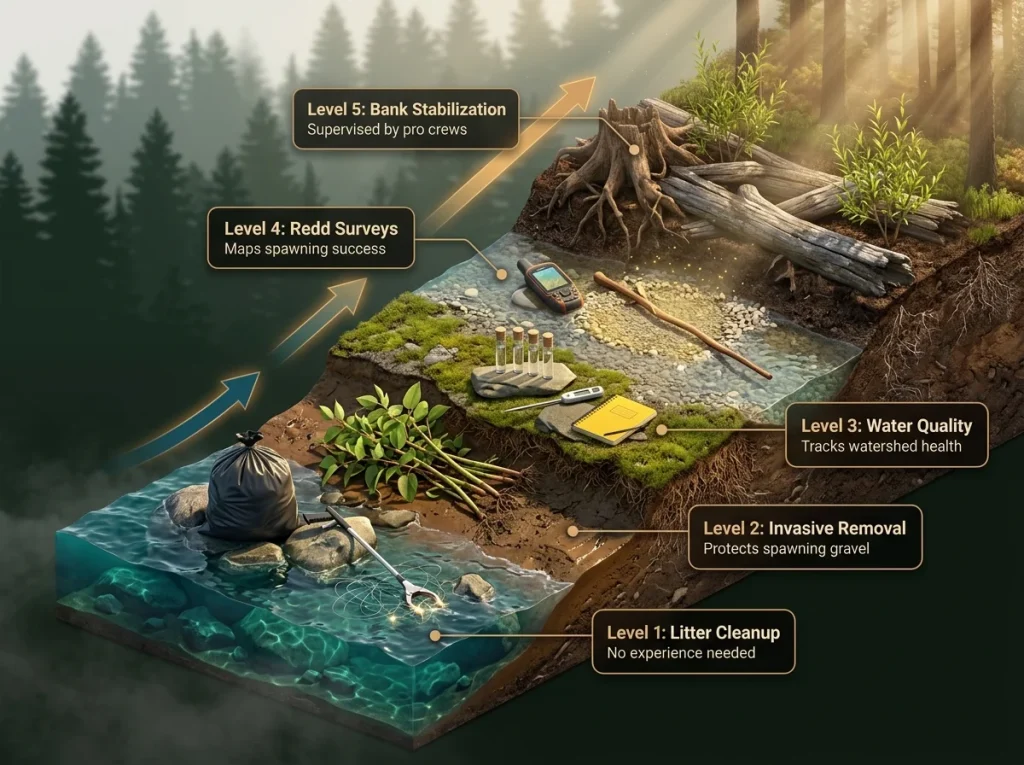
The Different Kinds of Stream Volunteer Work
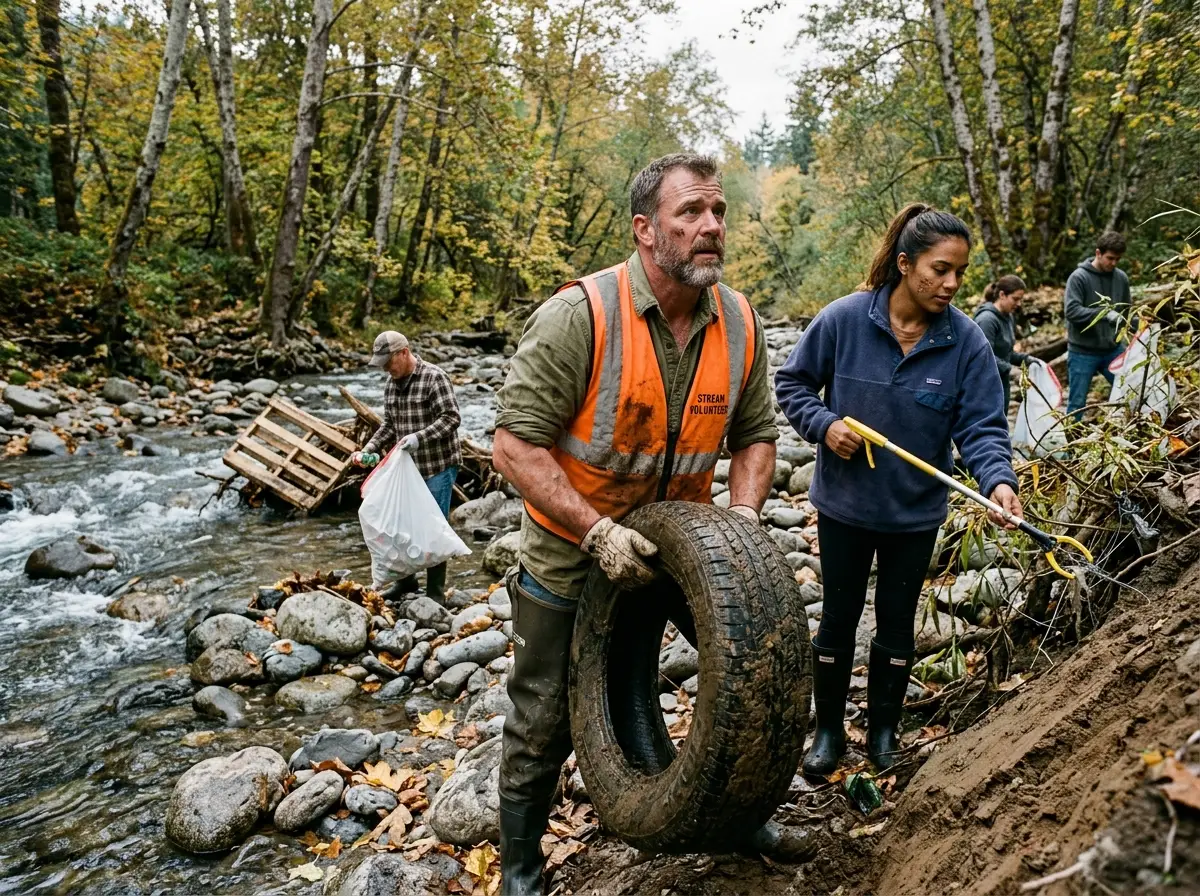
Most people show up to their first stream cleanup expecting to fill some trash bags along a creek bank. That’s the entry point. It’s not the whole picture.
Litter Cleanup: Where Almost Everyone Starts
Zero experience needed. You get gloves, bags, and a grabber. You walk a section of bank and pick up what’s there — aluminum cans, fishing line tangles, plastic bottles, the occasional shoe.
What you won’t expect is the car tire, the three propane canisters, and the couch cushion you find before 10am. In heavily impacted streams — especially near urban areas or highway crossings — a half-day event fills a dumpster with appliances, furniture, and industrial debris that’s been piling up for years. American Rivers’ National River Cleanup Program has mobilized over one million volunteers who’ve collectively removed 13 million pounds of litter from U.S. waterways. That number sounds abstract until you’re the one hauling a bicycle frame up a clay bank at 9am on a Saturday.
Most events run a half-day, typically 8am to noon. Some run full-day for larger reaches. Either way, the county or organizing group handles dumpster delivery in advance.
Invasive Species Removal: The Next Level
This requires basic training to correctly identify target plants before you pull anything. Garlic mustard, Japanese knotweed, and multiflora rose are the most common riparian invaders in the eastern U.S. Your state’s cooperative invasive management program runs ID training sessions — attend one before you volunteer for removal work. Pulling the wrong plant wastes time and can destabilize the bank you’re trying to protect.
Why it matters to the fish: invasive vegetation displaces the native root systems that hold streambanks together. When those banks erode, sediment buries the gravel substrate that brook trout and brown trout need for spawning. A choked-out riparian buffer also means less overhang, less shade, and higher summer water temperatures in the runs where cold-water fish are already struggling.
Citizen Science: Water Quality Monitoring and Redd Surveys
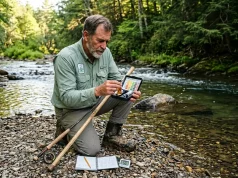
This is where volunteer work becomes fisheries data. Through programs like Trout Unlimited’s volunteer monitoring initiative, anglers collect samples and record water quality metrics — pH, temperature, dissolved oxygen, turbidity — that go directly to the biologists managing your watershed. Only about 10% of restoration projects get monitored nationally. Volunteer citizen scientists fill that gap with data the agencies don’t have staff to collect.
Redd surveys take it further. In Pennsylvania and several other states, TU organizes volunteer anglers to walk streams during spawning season and GPS-locate active trout nests. That data tracks whether restoration work is actually pulling spawning fish into newly accessible reaches — information that shapes where the next round of grant money goes.
Bank Stabilization and Habitat Structure Work
Physical construction — placing log vanes, root wads, and rock weirs — under the direction of a restoration contractor or fisheries biologist. Volunteer labor reduces project costs enough that many habitat structure projects couldn’t happen without crews willing to haul materials by hand.
These projects are typically run by TU chapters or watershed associations with active restoration plans. Trout Unlimited’s Embrace A Stream grant program has funded over $5 million across 1,250+ volunteer-led projects since 1975. That’s how a local chapter gets resources to fix a chronically eroded bank rather than just cleaning around it year after year.
The spectrum from litter pickup to habitat construction is a real ladder, and you can step on at any rung. For a look at how dam removal and barrier fish passage connects to the broader restoration picture, that piece breaks down what happens when fish get access to water they haven’t reached in decades.
How to Find Stream Cleanup Events Near You
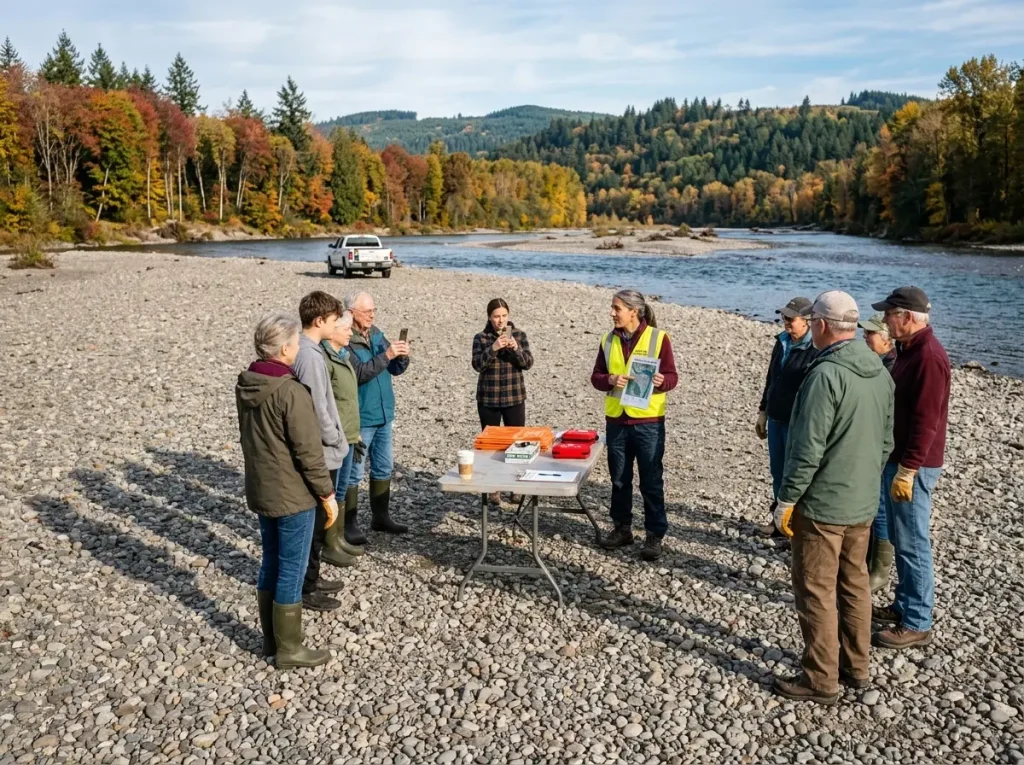
The hardest part of volunteering is figuring out where to show up. Once you know where to look, events are happening within driving distance of most anglers year-round.
National Organizations with Local Chapters
Trout Unlimited has 300+ chapters nationally, and each one runs its own events calendar. Start at tu.org/events to find what’s happening near you. TU chapters are the best entry point for angler-specific work because the people organizing the cleanup fish the same water you do. They know which bank has been eroding and which tributary gets hit hardest after rain.
American Rivers runs the National River Cleanup Program. Register at their site four weeks before your target date to receive an organizing kit if you want to run your own event, or browse existing cleanups on their map. Keep America Beautiful runs Great American Cleanup events each spring with a locator for events near you.
If you’re not sure where to start, finding your local TU chapter is the shortest path from “I want to help” to “I’m on the bank this Saturday.”
State, County, and Watershed Group Programs
Every state has a fish and wildlife agency that coordinates habitat restoration volunteer work — search “[your state] stream volunteer” or “[your state] adopt-a-stream program.” County programs vary widely. Some, like Anne Arundel County in Maryland, will deliver dumpsters, lend gloves and grabbers, and handle trash pickup — all you do is show up and work.
Watershed associations are the most locally focused option. They’re organized around a single river basin, they know the specific problem sites, and they can point you to the stretch of bank that needs you most. The Alliance for the Chesapeake Bay runs Project Clean Stream, a coordinated regional program with dozens of events across the mid-Atlantic each year.
How to Set Up Your Own Cleanup
Register with American Rivers four weeks out for an organizing kit. Scout the site first: parking, safe stream access, restroom access, and whether the land is public or private. Get written landowner permission for any private bank sections before the event — county auditor offices can confirm ownership quickly.
Line up trash disposal before the day arrives. Most municipalities handle standard bag pickup. Oversized items — tires, appliances — need a separate dumpster arrangement or coordination with your county’s bulk waste program. If you’re a TU member, reach out to your chapter president before you start planning solo. Chances are they’ve done this before and can save you a dozen phone calls.
What to Wear and Bring on Cleanup Day
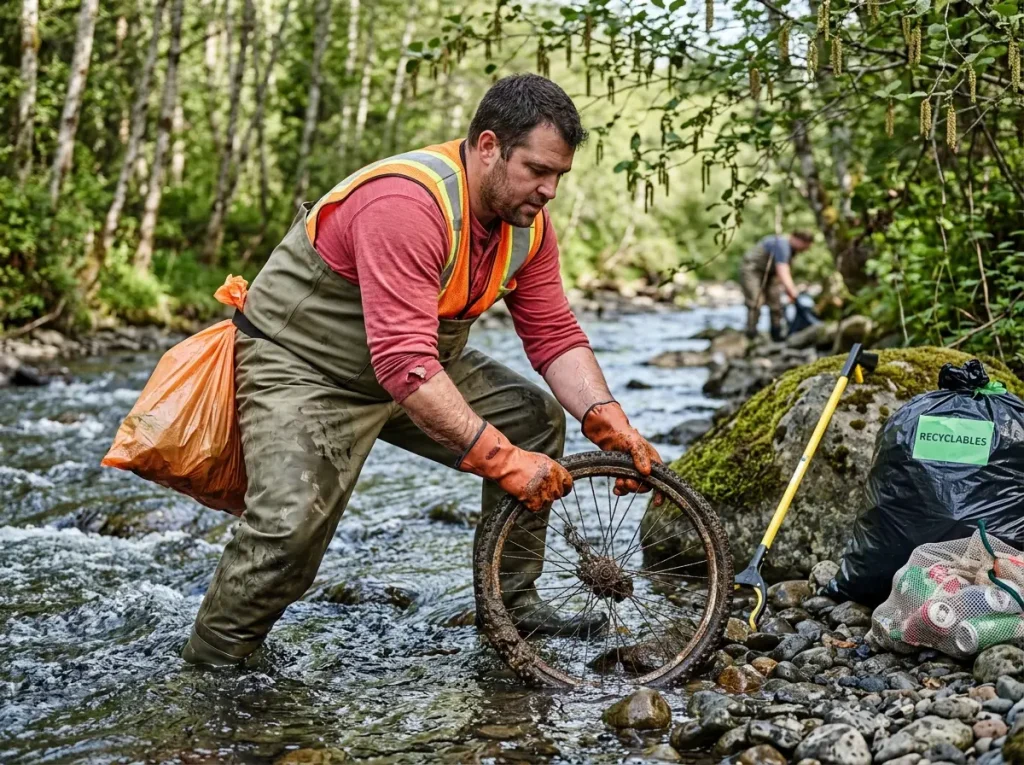
The gear list is short. Getting it wrong is what makes a bad first experience.
Footwear: The Decision That Affects Everything
Rubber boots — knee-height or hip — are the best choice for most stream bank work. They’re more stable on soft mud than waders, easier to pull off fast if you slip and fill them, and they don’t turn into a sweat chamber on a warm morning. Uninsulated rubber for summer, neoprene-lined for early spring and late fall.
If you’ll be wading to retrieve debris mid-stream, waders are the right call — but they slow you down on steep banks. Go rubber-soled rather than felt for cleanup work. Felt soles can transfer aquatic invasive species between waterways, and a cleanup might take you to a stream you’ve never fished. Our felt vs rubber sole wading boot comparison covers the traction tradeoffs in detail.
Pro tip: Rubber boots over waders for bank work where you’re not wading deep. More stable on uneven terrain, cooler on warm days, and faster to remove if you take an unexpected step into a soft spot.
Clothing and Hand Protection
Waterproof work gloves — thick rubber-coated, not thin gardening gloves. The thin ones shred in about 15 minutes against rusty metal and broken glass hiding under algae. That’s how you end up with a cut hand before the day gets going.
Long sleeves and pants, even in summer. Bank vegetation is dense, and poison ivy is extremely common along streams in the eastern U.S. You won’t always recognize it until it’s too late. Sunscreen matters more than you’d expect — stream banks are almost always exposed, and three hours with no shade will get you.
What You Don’t Need to Bring (Usually Provided)
Most events provide bags, grabbers, and basic gloves — check when you register so you’re not doubling up. Water and snacks vary by event size. Larger organized events include them; smaller watershed group events typically don’t. Sharps containers and hazard kits are coordinator equipment, not yours to improvise.
Safety Before You Step Into the Water
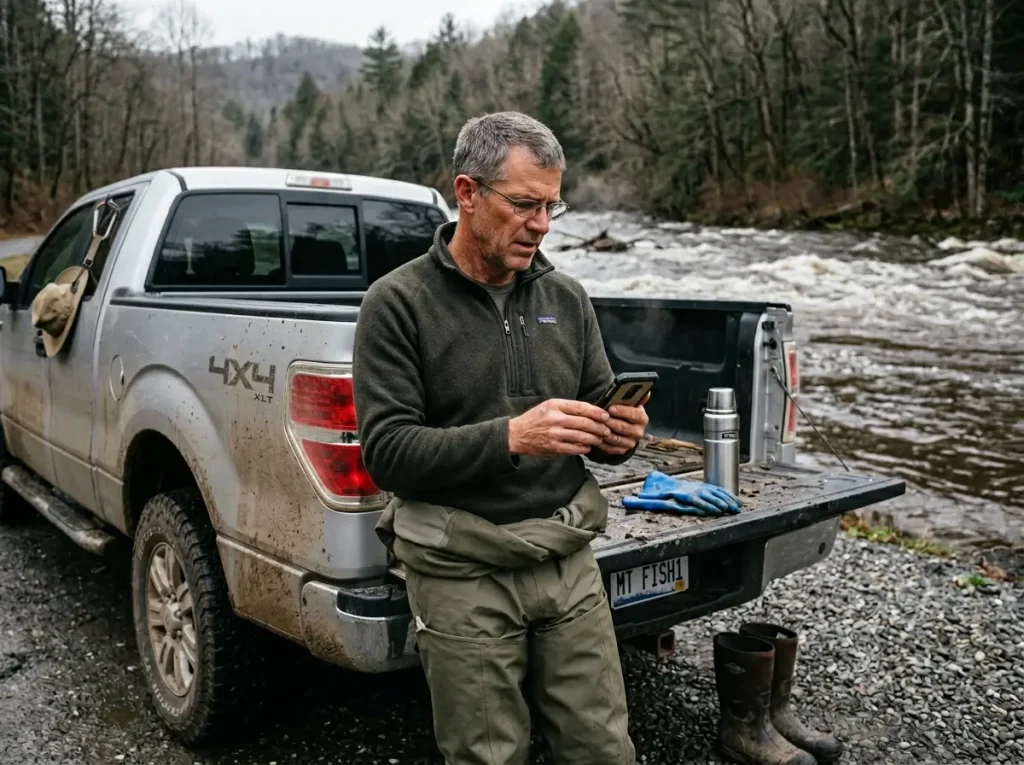
Two things will catch you off guard if you don’t prepare: the stream itself, and what’s in it.
Check Streamflow Before You Drive Out
Stream cleanup events sometimes go forward in conditions that aren’t safe for all volunteers. Know the condition yourself before you make the drive.
USGS Water Watch shows real-time CFS and gage height at thousands of stations nationally — the same tool you already use to decide whether to wade after rain. If the stream is running significantly above normal (colored red or dark orange on the map), it’s too fast for volunteer wading and too murky for effective bank assessment. Message the coordinator before you leave the house.
If you’re not familiar with interpreting streamflow data, our guide on how to read a USGS stream gauge covers the basics. You already know what a stream at 200% of median flow looks like from fishing it. Same skill, different application.
Pro tip: Check USGS Water Watch the morning of the event to confirm conditions. If CFS is running well above normal, tell the coordinator — most organizers appreciate a volunteer who already knows how to read a gauge.
Hazardous Materials: The Protocol Most Organizers Forget to Explain
This is the part no one covers well. In urban and suburban streams, you will encounter materials that require a specific response. Not “might.” Will.
Sharps — needles, syringes: never touch. Drive a tall stick into the bank beside them. Move on. Report to the coordinator before you handle anything else. Every organized event should have a sharps container. The problem is most organizers don’t mention this during the pre-event briefing because they assume it’s obvious. It’s not obvious the first time you see a syringe wedged under a rock.
Propane canisters and spray cans: Common in heavily impacted streams. Do not drag by the valve, do not toss into a debris pile, do not attempt to puncture. Treat as full until confirmed otherwise. Separate pile, flag it, report to the coordinator.
Chemical containers: Unknown contents; treat as hazardous waste. Do not crush or shake. Mark the location and report. County environmental departments typically coordinate disposal for chemical items found during stream cleanups.
Tires: Legal to collect, but tires are banned from standard landfills in many states. Check in advance whether your county has a tire recycling program or if the organizing group has arranged separate tire disposal.
Pro tip: When the coordinator gives the safety briefing, ask specifically: “What’s the protocol if we find sharps or chemical containers?” If they don’t have a clear answer, sort it out before you start working the bank.
Property Permissions and Waivers
Most organized events require signing a liability waiver before the work starts — standard procedure, not a red flag. For cleanups that cross private land, the organizing group handles landowner permission. If you’re running your own event, contact the county auditor’s office to confirm ownership and reach landowners directly for written consent. Never enter a stream through clearly posted private property without permission, even if the creek itself is technically public water.
Why Anglers Make Better Stream Volunteers Than Most People Realize
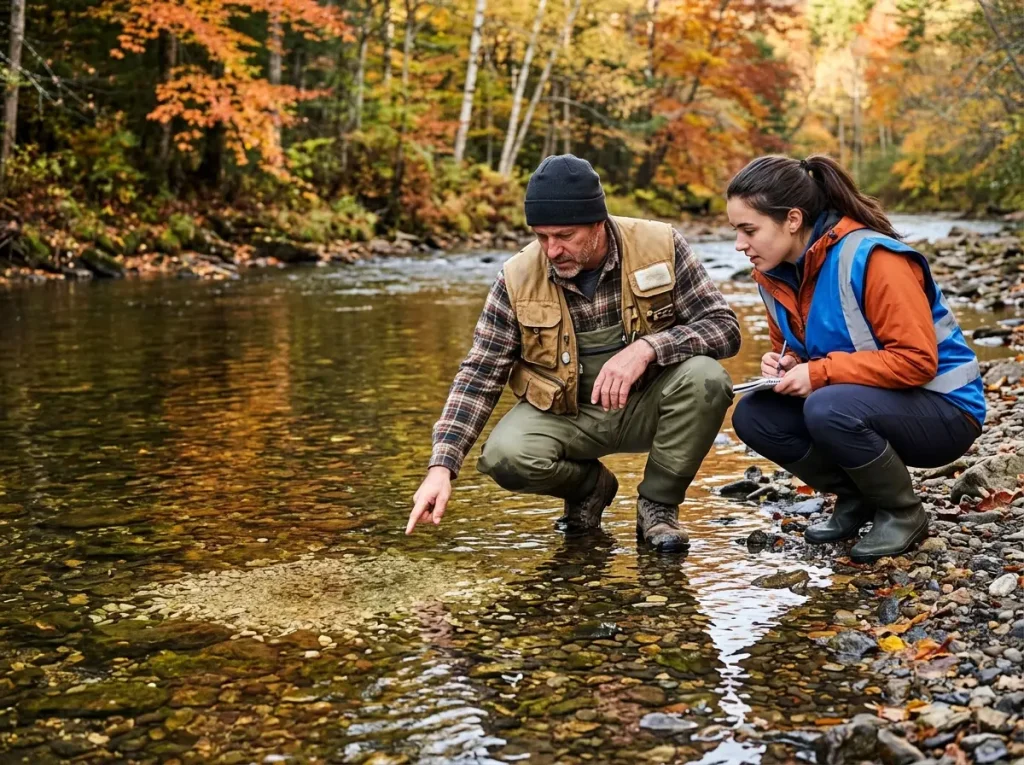
This isn’t about enthusiasm. It’s about a skillset you’ve been building for years on the water without thinking of it as transferable.
Reading the Water to Work the Right Bank Sections
A non-angler walks a stream bank and treats all sections equally. They work in order, cleaning what’s in front of them.
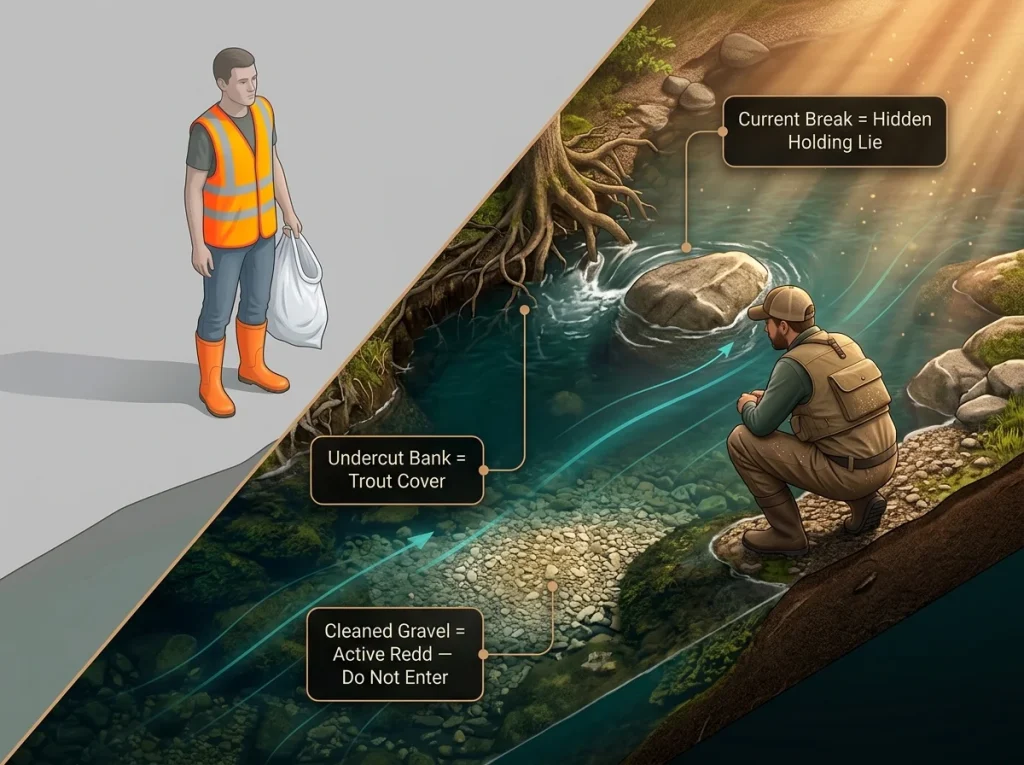
An angler sees the pool, the undercut bank, the current break behind that boulder, and the root system that creates three feet of depth in otherwise shallow water. They know where fish hold. They know that the debris pile jammed against those exposed roots is sitting in the best lie on the reach.
Prioritizing the high-value habitat sections — the pools, the cover structure, the temperature refuges — means the cleanup produces a bigger fish-per-hour impact than working methodically from one end to the other. This isn’t instinct. It’s what you learned reading water over hundreds of hours. It transfers directly.
Knowing Where Not to Walk: Spotting Spawning Redds
Brown trout, brook trout, and rainbow trout all build visible spawning nests — redds — in shallow, clean gravel during fall spawning runs. A redd looks like a freshly cleaned gravel patch in a riffle, distinctly lighter and cleaner than the surrounding substrate. Sometimes there’s a fish holding right over it.
Walking through a redd destroys the eggs buried in the gravel — eggs that need clean, oxygenated flow around them to survive. Most volunteers who damage redds do it unknowingly because they don’t know what they’re looking at. During fall cleanups, an angler walking the bank can mark redd locations and tell the crew where not to step. Non-anglers can’t do this. It’s the direct intersection between the cleanup and the fish the cleanup is meant to protect.
Using Gauge Data for Safety Decisions, Not Just Fishing Decisions
Every angler who’s planned a trip around water conditions already knows how to read a USGS gauge — CFS, gage height, and the graph that shows whether the stream is rising, falling, or stable. Applying that skill to a cleanup day takes 30 seconds and can flag conditions that an organizer may not have checked since the night before.
A stream running at twice its median flow the morning of a cleanup is not safe for wading, regardless of what the event calendar says. Share what you see with the coordinator. Anglers who bring field knowledge — not just labor — are the volunteers organizations want to keep coming back.
For a deeper look at how your fishing experience connects to conservation outcomes, our piece on your role in angler-led habitat restoration covers the full range of ways anglers contribute beyond cleanup days.
From One-Time Cleanup to Long-Term Stream Steward
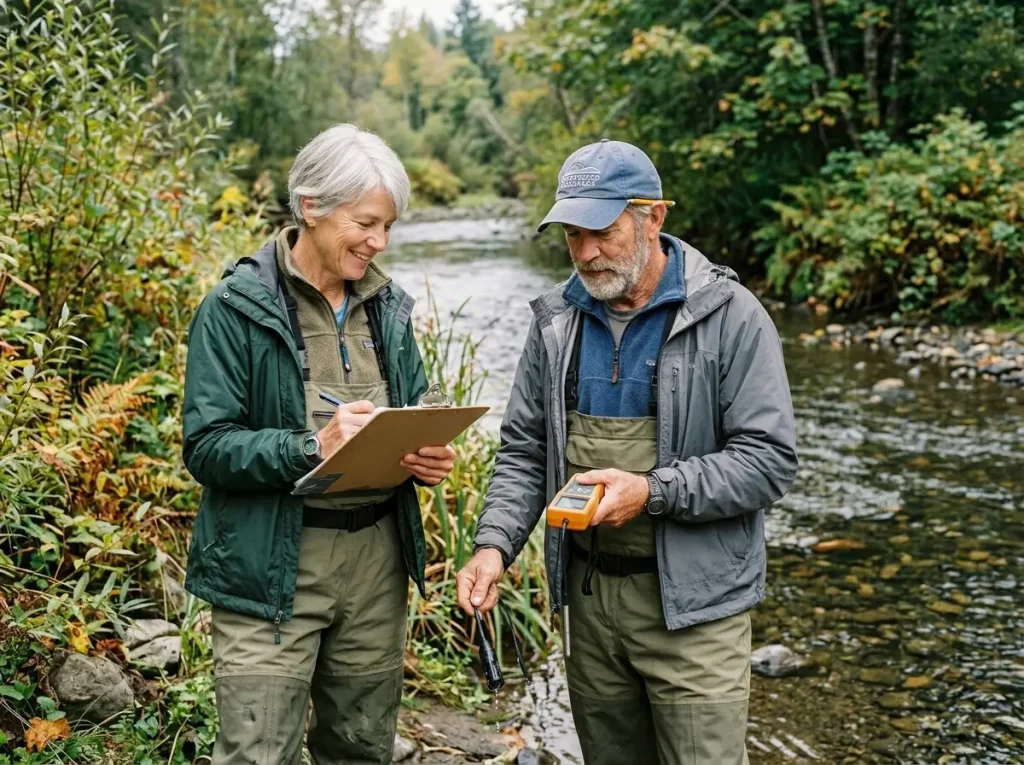
One cleanup teaches you what’s in the water. Staying with it teaches you what’s happening to the water.
The Adopt-a-Stream Commitment
Many state programs and watershed groups run adopt-a-stream programs where individuals or groups commit to maintaining a specific section on a regular schedule — monthly, quarterly, or seasonally. The commitment is what you make it. Some programs require data collection. Others just need consistent cleanup work. Some combine both.
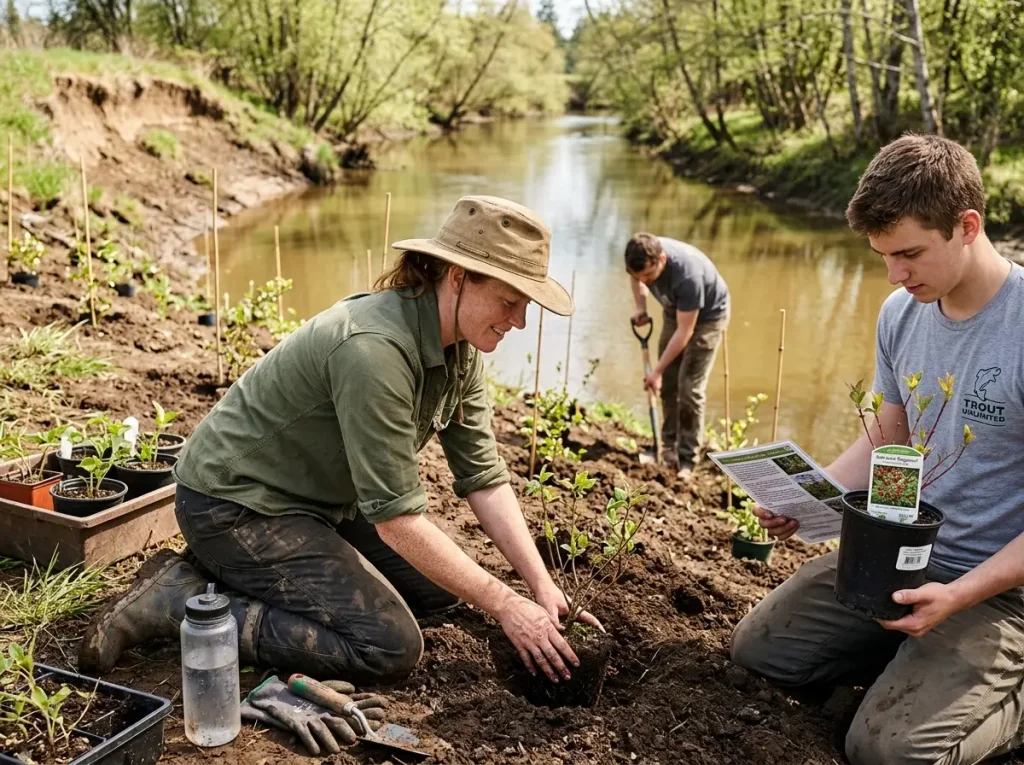
The payoff comes slowly but it comes. A bank you cleaned in spring holds noticeably less debris by fall when the buffer vegetation you planted starts filling in. A section you replanted with native willows starts shading the run within two growing seasons. The water temperature in August drops almost two degrees at the head of that pool. You can see what you did when you fish there.
Getting a Project Funded Through Embrace A Stream
Trout Unlimited’s Embrace A Stream provides grants to volunteer-led habitat restoration projects — not just cleanups but actual structural and biological restoration. The program has funded over $5 million across 1,250+ projects since 1975. The average grant falls in the $1,000–$5,000 range, enough to cover materials and contractor supervision for a bank stabilization project.
To access it: you need to be part of a TU chapter (or partner with one) and submit a project proposal describing the work, the stream, and the expected habitat outcome. If your local reach has a specific problem — a chronically eroded bank, a blocked tributary, a stretch choked with invasives — the grant program is how you get resources to fix it.
Linking Field Work to Fisheries Advocacy
Volunteer stream monitors and cleanup regulars have direct standing with state fish and wildlife agencies — they’ve physically been on the water. They know which tributary runs cloudy after every rain, which bank never recovers between cleanups, which culvert blocks migration every spring.
That field knowledge translates into public comments on permits, dam licenses, and land development applications near your watershed — the kind of comment an agency reviewer can’t dismiss because you actually walked that bank last month. The most effective conservation advocacy isn’t written from a desk. It’s written by someone who can say “I was at that culvert in October when the steelhead couldn’t get through, and here’s what I saw.”
Brook trout have lost roughly 80% of their native habitat in the eastern U.S., and most of that loss traces back to the same problems stream volunteers address: erosion, sedimentation, thermal stress from lost canopy, and blocked passage. Our piece on brook trout habitat loss covers the full scope of what happened — and why the work you do on a cleanup day is the same work that reverses it.
Start With One Morning
Three things to carry out of this:
- Stream cleanup volunteering covers a real spectrum — from picking up trash to running funded restoration projects. You can enter at any level and grow into deeper involvement as your skills and your chapter allow.
- Anglers bring specific skills — reading water, identifying redds, interpreting gauge data — that make their volunteer hours produce better outcomes than a generic volunteer’s.
- The connection between cleanup work and the fish you chase is direct. It’s the same stream. The trout holding in the pool behind that root ball next August are holding there because someone hauled the couch out of it this spring.
Find your local TU chapter’s next cleanup event. Show up once. Pay attention to what you notice that nobody else on the crew does. That’s where it starts.
Q1 How do I find stream cleanup events near me?
Start with Trout Unlimited’s event calendar at tu.org/events, then check American Rivers’ cleanup map and your county’s watershed protection department. Local watershed associations and river keeper organizations run smaller events that don’t always show up in national databases — a quick search for your river name plus watershed group often turns up the right contact.
Q2 What’s the difference between a stream cleanup and habitat restoration?
Cleanup events remove litter and debris from the stream and its banks. Restoration involves structural or biological changes — planting native vegetation, stabilizing eroded banks, or installing habitat structures like log vanes and root wads. Cleanups are the entry point. Restoration is what sustains the improvements over time.
Q3 Do I need experience to volunteer for stream restoration?
For litter cleanups, no experience is needed — just show up with the right footwear. For invasive species removal, basic plant ID training is required; contact your state’s cooperative invasive management program. For structural restoration, you’ll work under supervision of a restoration professional who handles the technical decisions.
Q4 Can I organize my own stream cleanup without a big organization?
Yes. Register with American Rivers four weeks in advance for organizing materials. Confirm landowner permission for any private bank sections, arrange trash disposal through your county’s public works department, and scout the site for parking and safe stream access before setting the date.
Q5 Will I encounter hazardous materials like needles or chemicals?
In urban and suburban streams, this is more common than most guides acknowledge. The protocol is straightforward: mark the item with a stick, don’t touch it, and report to the event coordinator immediately. Never handle sharps, propane canisters, or chemical containers without specific training and the right equipment.
Risk Disclaimer: Fishing, boating, and all related outdoor activities involve inherent risks that
can lead to injury. The information provided on Master Fishing Mag is for educational and informational purposes
only. While we strive for accuracy, the information, techniques, and advice on gear and safety are not a substitute
for your own best judgment, local knowledge, and adherence to official regulations. Fishing regulations, including
seasons, size limits, and species restrictions, change frequently and vary by location. Always consult the latest
official regulations from your local fish and wildlife agency before heading out. Proper handling of hooks, knives,
and other sharp equipment is essential for safety. Furthermore, be aware of local fish consumption advisories. By
using this website, you agree that you are solely responsible for your own safety and for complying with all
applicable laws. Any reliance you place on our content is strictly at your own risk. Master Fishing Mag and its
authors will not be held liable for any injury, damage, or loss sustained in connection with the use of the
information herein.
Affiliate Disclosure: We are a participant in the Amazon Services LLC Associates Program, an
affiliate advertising program designed to provide a means for us to earn advertising fees by advertising and linking
to Amazon.com. As an Amazon Associate, we earn from qualifying purchases. We also participate in other affiliate
programs and may receive a commission on products purchased through our links, at no extra cost to you. Additional
terms are found in the terms of service.