In this article
The first time I walked up to a club tournament weigh-in, I stood by the rope for twenty minutes pretending to check my phone. Nobody talked to me. Nobody had to. After joining four clubs over the years, hiring three guides, and figuring out two of them weren’t worth the gas to drive there, I learned the real problem isn’t finding a fishing club or mentor — it’s finding one that actually fits how you fish, where you fish, and how much time you have. This is the field map I wish I’d had: where to look, how to walk in without feeling like a stranger, and how to tell within a single trip whether the fit is right.
Quick Answer: Five practical paths to find a local fishing club and mentor that actually fit your style:
- Visit the busiest independent bait shop within 30 miles and ask the owner.
- Search your state fish and wildlife agency for “angler education” or “mentored fishing program.”
- Use BASS, Fly Fishers International, or Trout Unlimited chapter locators by zip code.
- Attend a club’s open meeting twice before paying any dues.
- Consider a guided trip as paid mentorship — sometimes the fastest learning curve.
Where Local Fishing Clubs Actually Live
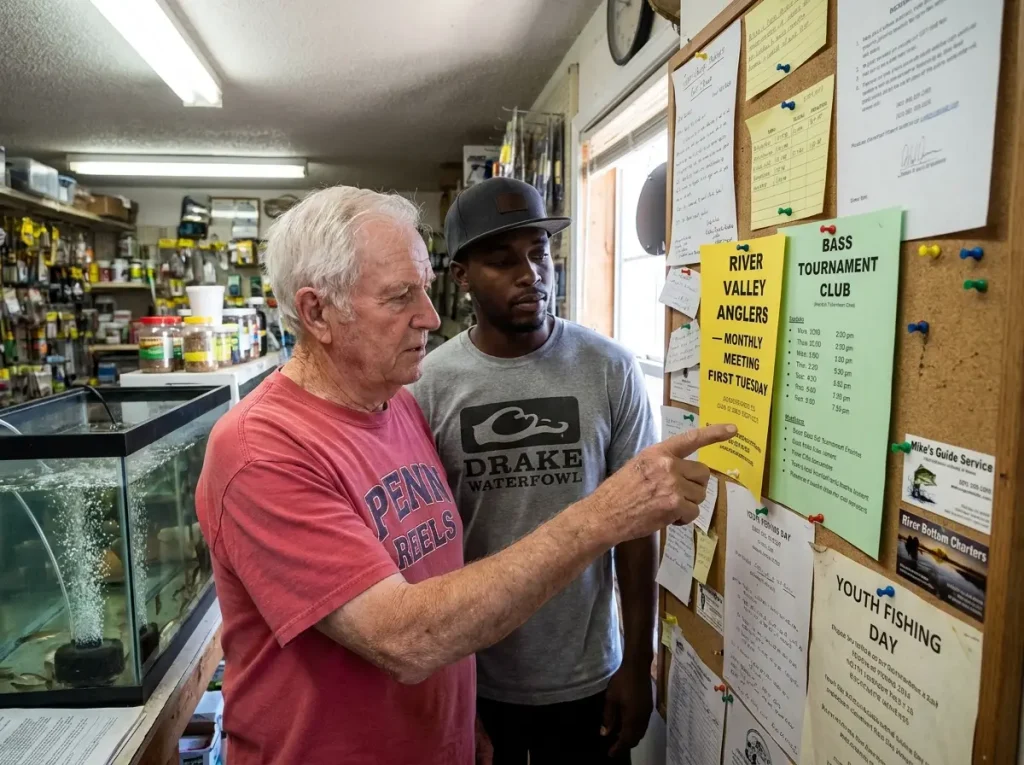
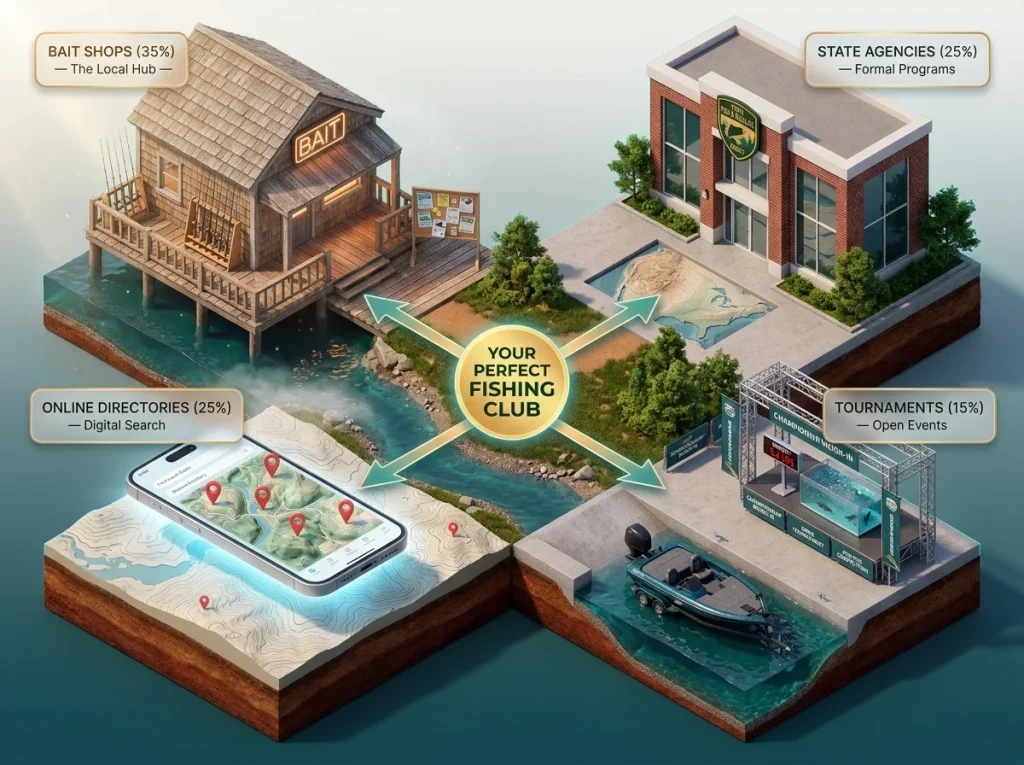
Forget Google for the first round. Real local clubs live in three places: bait shops, state agency directories, and bulletin boards at marinas. The bait shop owner knows every active angler in a 30-mile radius — what they fish for, when they fish, who runs the local bass club, and which fly fishing chapter is still alive versus the one that fizzled out two years ago. Befriend that person before you need anything from them.
Bait Shops and Marinas
Walk in with a small purchase and a specific question. “Any bass clubs that fish Lake Norman regularly?” beats “got any club info?” by a wide margin. Owners help anglers who help themselves first. Most independent shops keep a corkboard with flyers for monthly meetings, club tournaments, and youth fishing days. Tournaments and youth events are public — they’re how clubs recruit, and showing up signals you’re serious without forcing anyone to vouch for you yet.
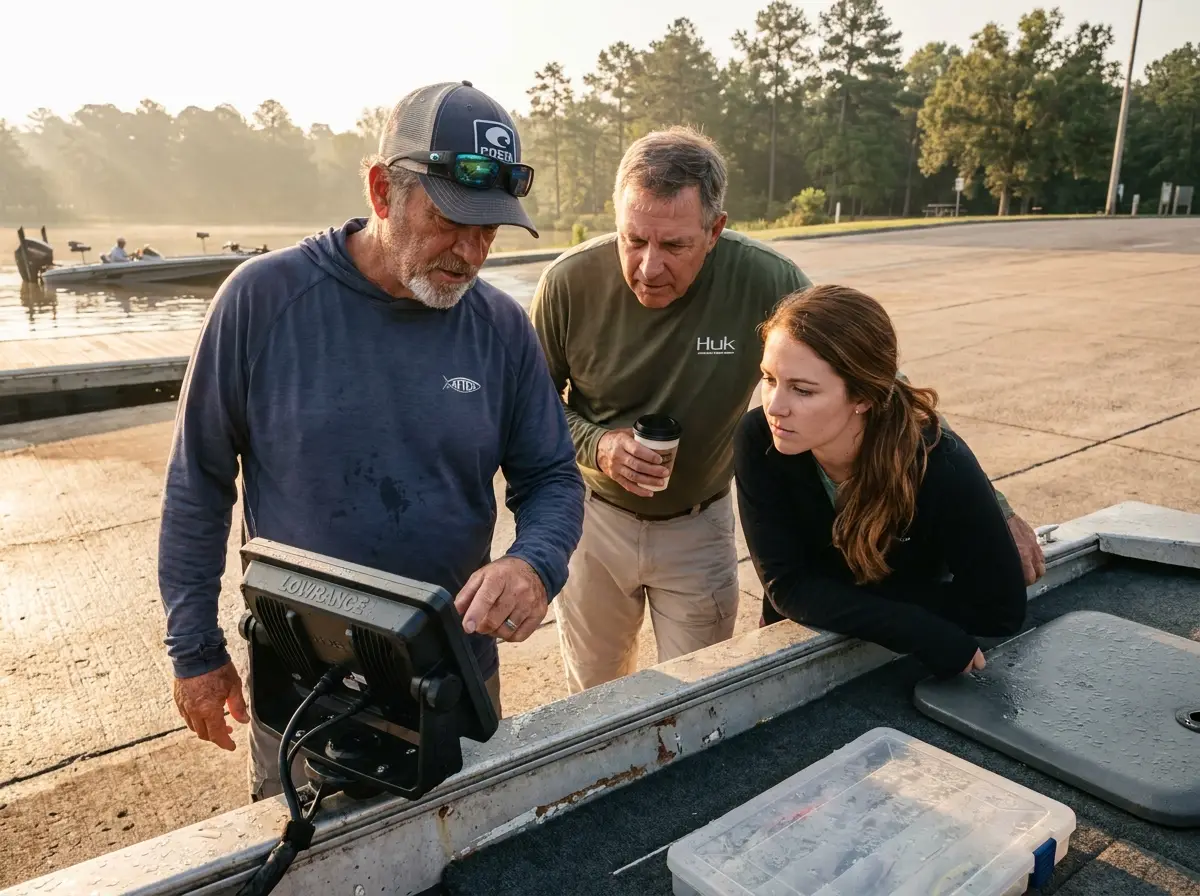
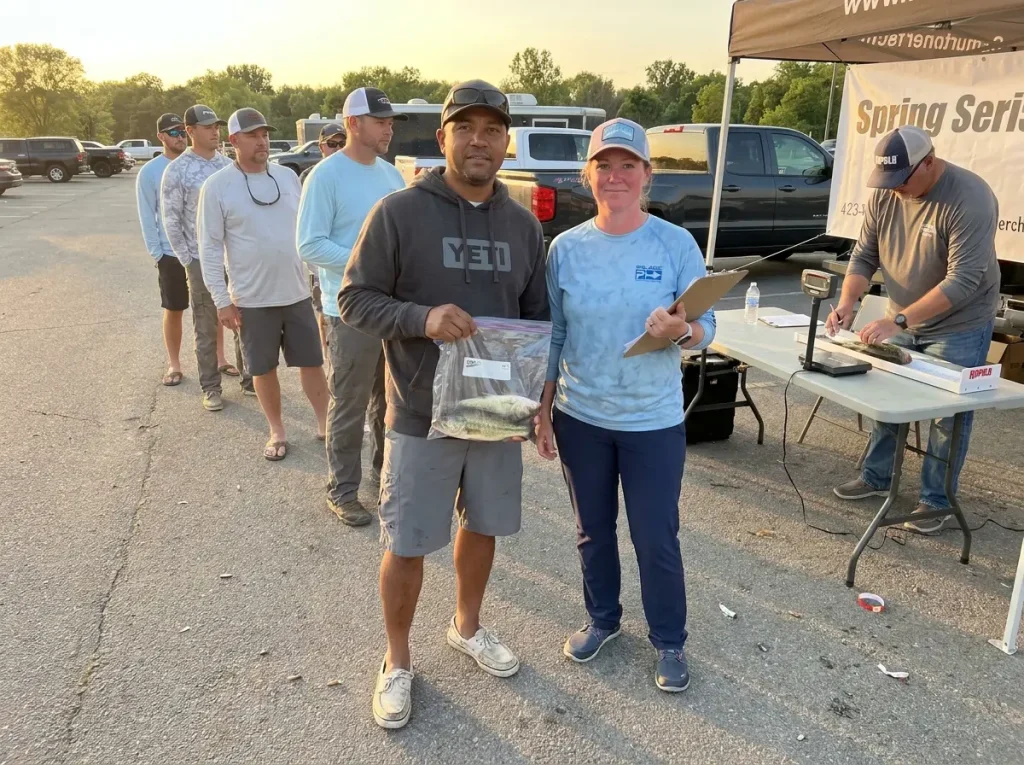
Pro tip: Show up at a county boat ramp at 3pm on a Saturday during a club tournament weigh-in. Every angler unloading their boat is a potential teacher, and they’re in a good mood because the day’s over. Bring a cooler with cold drinks. Watch how they handle fish. You’ll learn more in 30 minutes than you would in a month of YouTube.
Online Directories
Beyond the bait shop, three sites do most of the heavy lifting: FishExplorer (state-by-state club directory), Bassmaster’s club locator, and Meetup for casual fishing groups. The state F&W agency website usually has a regional clubs page tucked under “education” or “community programs” — most beginners never click that deep. Search your state name plus “angler education” or “mentored fishing program” and you’ll find paths that don’t show up in a generic Google search.
Social Media Groups
Facebook groups and Reddit’s r/fishing are useful for asking around, but treat them as scouting tools, not destinations. A Facebook group with 5,000 members and three posts a month is dead. A 200-member group with daily activity is alive. Read the comments before you post anything. Anglers who actually fish leave fingerprints — photos with location tags removed, complaints about wind, debates over line. Anglers who don’t fish post inspirational quotes. You’ll spot the difference fast.
National Organizations With Local Chapters
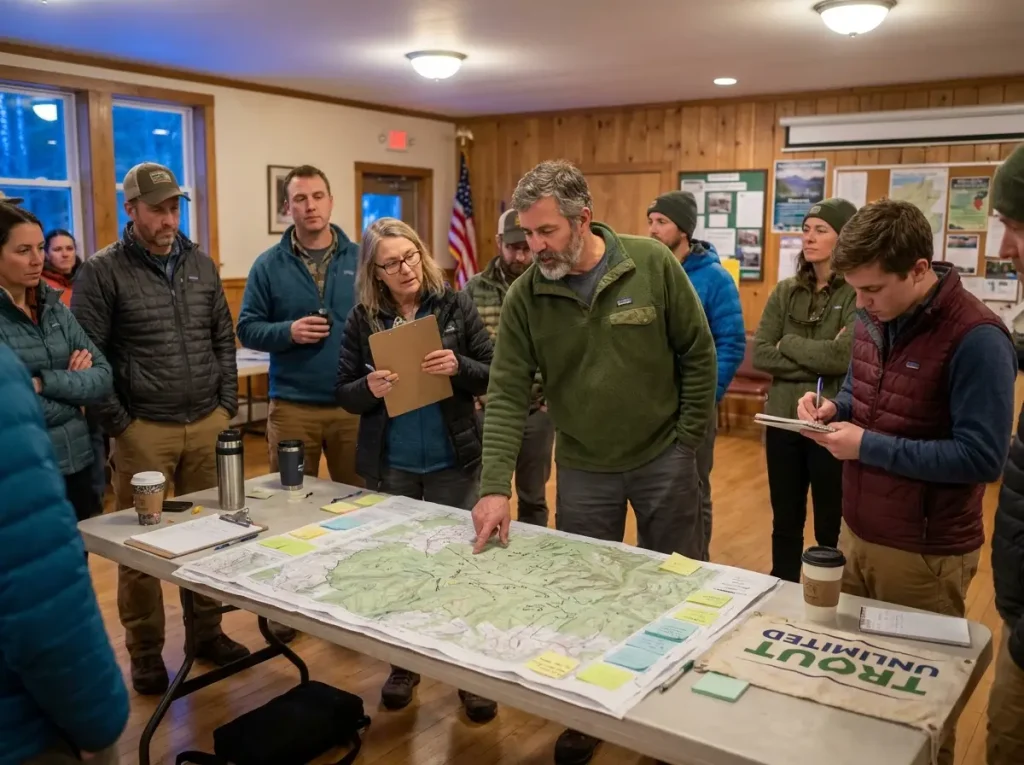
Four national organizations have hundreds of local chapters running real meetings, real tournaments, and real mentorship. They’re a safer first move than a one-off Facebook group because the structure is already there. You don’t have to build trust with a stranger — you build it with the chapter, which has been operating for years.
BASS and the Bassmaster Network
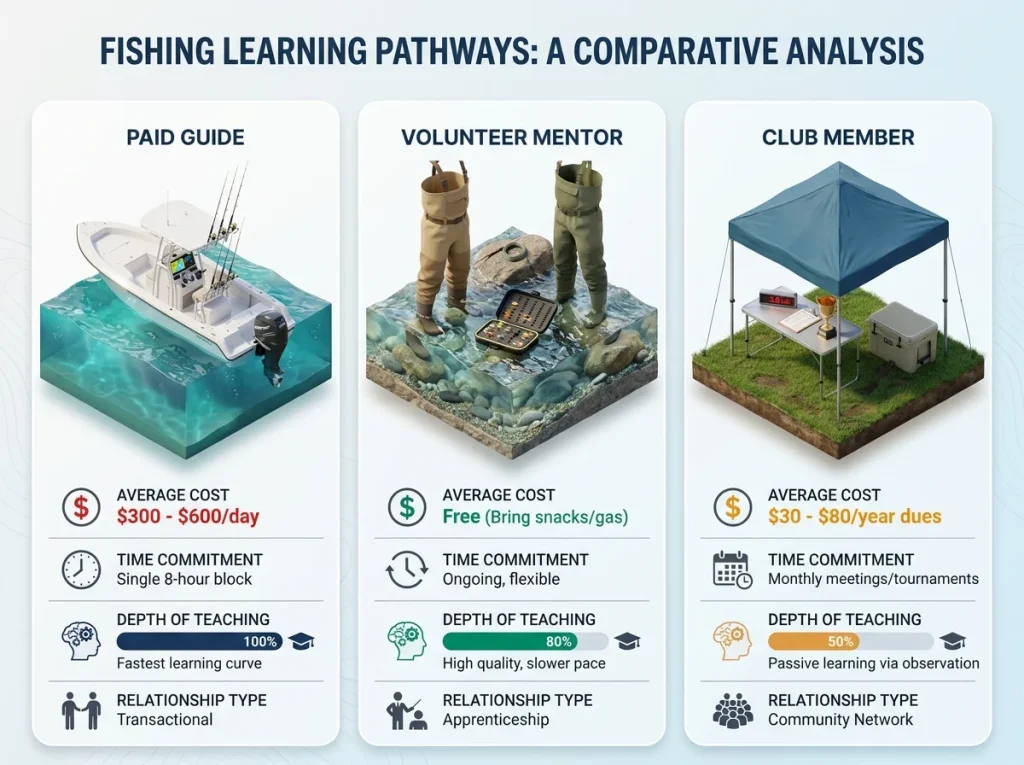
The Bass Anglers Sportsman Society runs a network of locally organized clubs across all 50 states. Most BASS-affiliated clubs run a monthly tournament series, host conservation events, and accept new members year-round. Dues run $30 to $80 a year on top of the national BASS membership. The benefit beyond fishing: club tournaments are the cheapest competitive fishing in the country, and the post-weigh-in conversation is where the real learning happens. Bass Resource has a thorough breakdown of what to look for when joining a bass club, including red flags and what dues actually pay for.
Fly Fishers International
Fly Fishers International runs over 200 clubs across 6 regions. Fly clubs tend to be smaller, more mentorship-driven, and less tournament-focused than bass clubs. If you’re learning to cast, tie flies, or read trout water, an FFI chapter is the single best mentorship-to-dollar ratio in the sport. Most chapters host casting clinics, fly tying nights, and stream cleanups — all of which double as low-pressure ways to meet veteran members.
Trout Unlimited and Conservation Clubs
Trout Unlimited assigns members to a chapter based on zip code automatically — you don’t get to pick. That sounds restrictive but it works in your favor: you end up connected to anglers who fish your local water. Show up to a chapter meeting before paying dues. Each chapter has its own personality — some are tree-planting, stream-restoration heavy, others are more about fishing trips and clinics. A quick visit to Trout Unlimited’s chapter meeting guide shows the typical meeting format and what to expect. Coastal Conservation Association works the same way for saltwater anglers along the Gulf and Atlantic coasts.
State Fish and Wildlife Mentor Programs (Most Anglers Miss These)
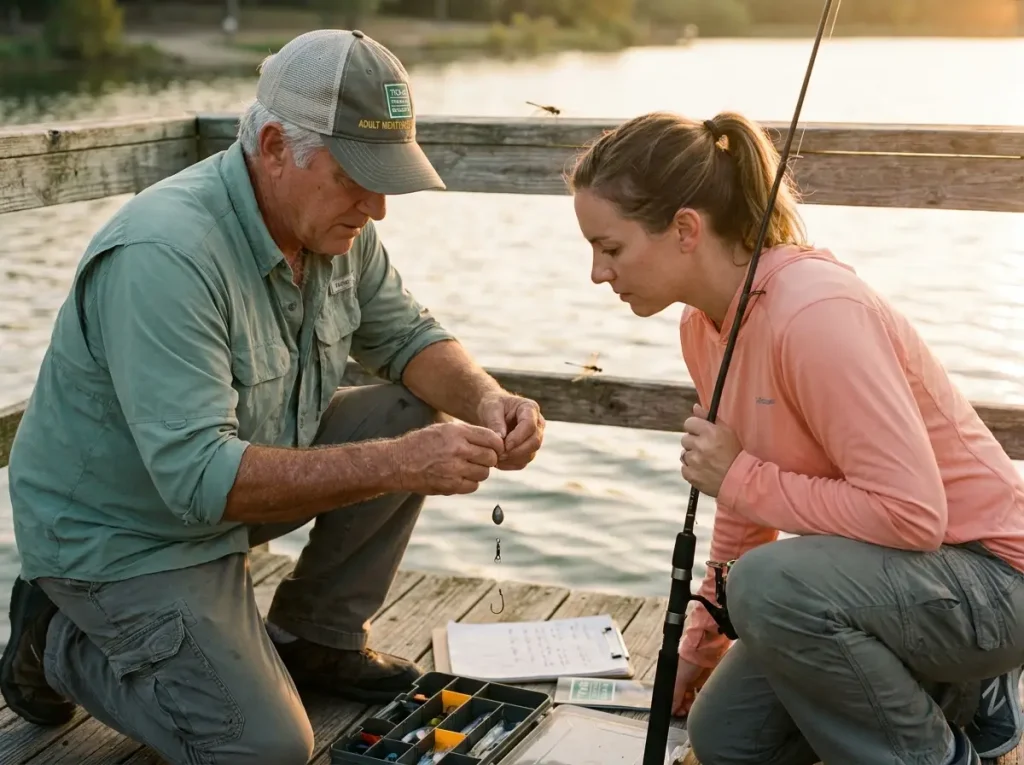
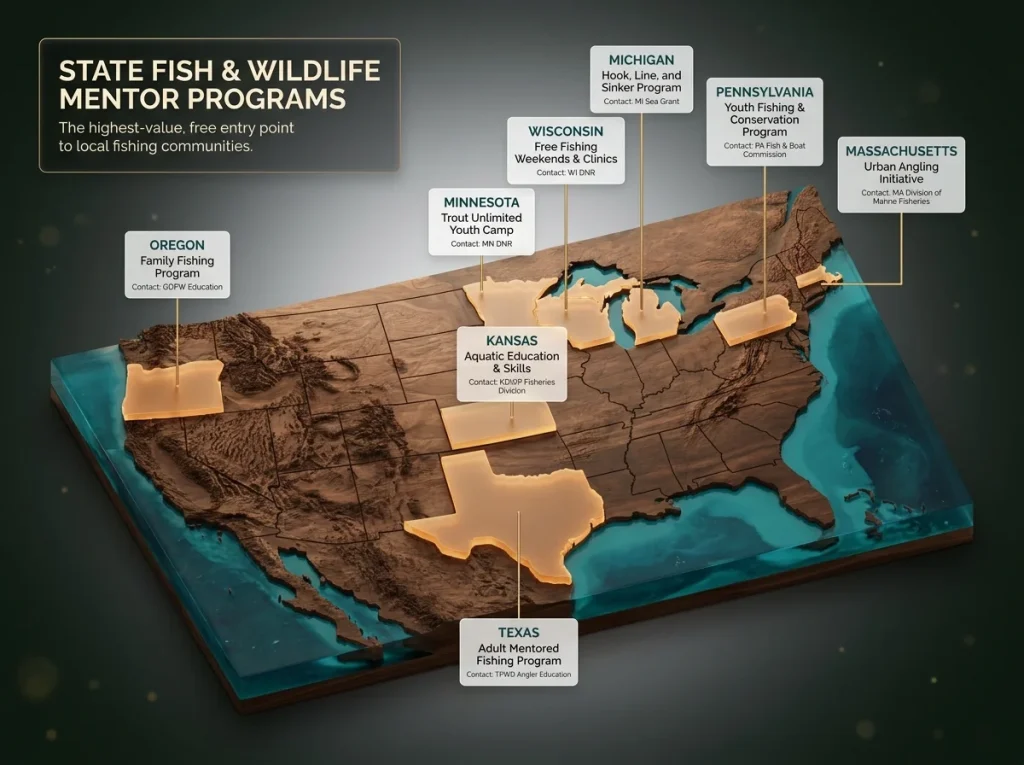
This is the section nobody writes about, and it’s the highest-value door of all. Most state fish and wildlife agencies run formal mentor programs — free, vetted, multi-session, and structured. They’re not advertised hard because the agencies don’t have marketing budgets. Most beginners have no idea they exist.
Texas’s Adult Mentored Fishing Program
The Texas Parks & Wildlife Department runs an Adult Mentored Fishing Program that runs April through June. Mentees are matched with mentors in small groups based on location, experience level, and fishing method preference. Each group schedules and executes four sessions during the program. Mentors go through background checks and curriculum training — these are vetted volunteers, not random strangers. There’s no fee. If you live in Texas, this is the single best entry point in the country.
Oregon and Pennsylvania Models
Oregon’s Department of Fish and Wildlife runs a Family Fishing Program that stocks ponds across the state and stations volunteers and ODFW staff on-site to help anyone show up and fish — equipment provided. Pennsylvania’s Fish and Boat Commission runs a Mentored Youth Permit that lets kids fish under a licensed adult before getting their own license, building the mentor-mentee relationship into the licensing structure itself. Massachusetts and Kansas have similar volunteer instructor programs that go through training, background checks, and ongoing support.
How to Find Your State’s Version
Search your state’s F&W website for “angler education,” “mentored fishing,” or “volunteer instructor program.” If your state doesn’t have a formal mentor program, the agency education coordinator can usually point you toward the active local clubs and the volunteer instructors who run kid’s fishing days. Those instructors are exactly the kind of patient, vetted teachers you want as a mentor — they already chose to teach for free.
Pro tip: State agency mentors went through background checks and curriculum training. The bar is higher than a random Facebook group offer to “show you how to fish.” Treat that vetting as a feature, not a formality.
How to Walk Into a Club Without Looking Like a Stranger
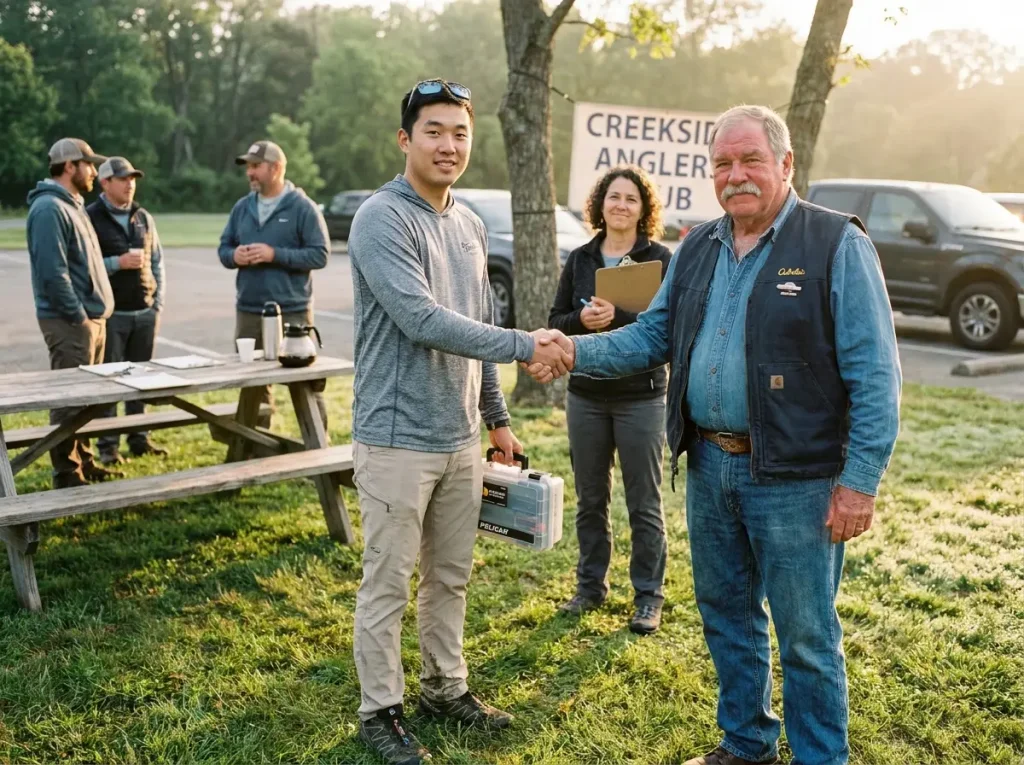
The intimidation problem is real. Most beginners feel like they’re walking into a high school cafeteria — which means they don’t walk in at all. Here’s the soft-entry playbook that actually works.
The Two-Meeting Rule
Show up to a club’s open meeting twice before paying any dues. The first visit is friendly — everybody welcomes a new face. The second visit tells you whether you’re invisible or invited. If three people remember your name on visit two, the fit is real. If nobody remembers you, that club isn’t going to mentor you, and your dues are better spent on a guided day instead.
What to Bring (And What to Ask)
Bring your fishing license, a notebook, and a question or two about local water. Don’t bring a list of demands or “secret spot” requests. The fastest way to get ignored at a club meeting is asking where the big fish hold. The fastest way to get adopted is asking what the club’s been working on lately — conservation projects, recent tournaments, upcoming clinics. Veterans want to talk about their work. Let them.
The Volunteer Backdoor
The lowest-pressure first contact is volunteer work — stream cleanups, youth fishing day setup, conservation projects, banquet help. You’re not asking for anything. You’re showing up to give. After two cleanups, the same five members will know who you are and start inviting you to actual fishing trips. This is how the strongest mentor relationships form: out of shared work, not out of asking for help. Picking up the same skills as a beginner fly tier learning their first patterns puts you in the room with the people who already know the answers.
Finding a Mentor (Different From Finding a Club)
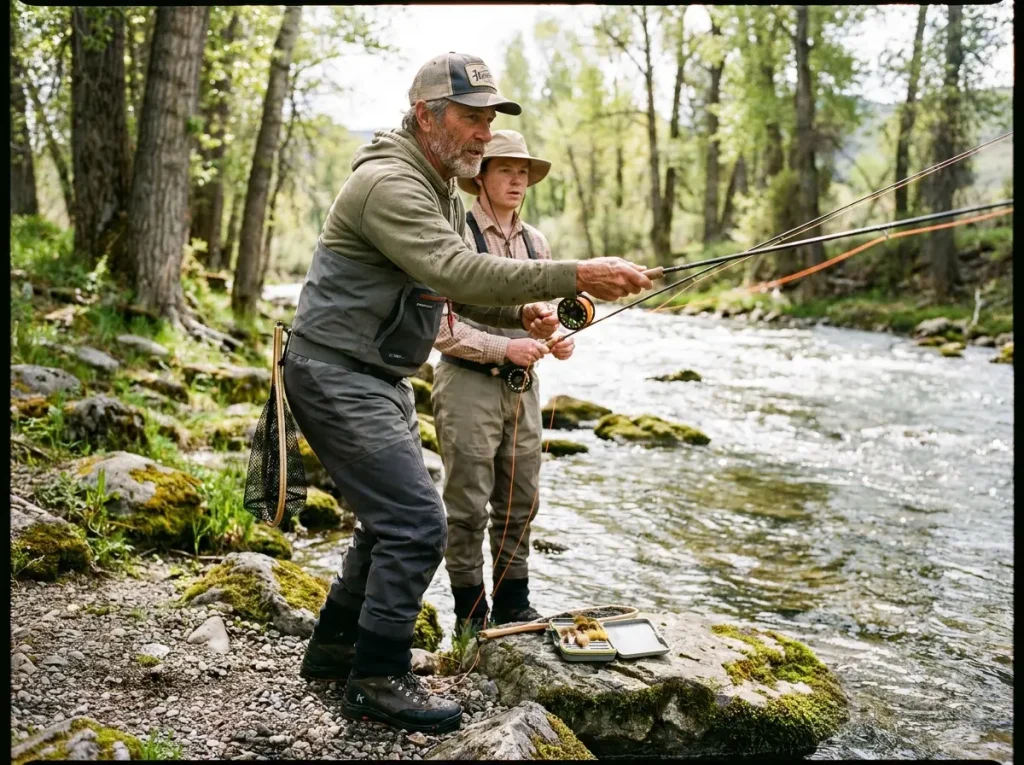
A club teaches you the lake. A mentor teaches you the cast. They’re related problems with different solutions, and most articles conflate them. Here’s the distinction in practice.
The Paid Mentor Path
Hiring a guide for a day is paid mentorship. $300 to $600 buys eight hours with a working pro on water they know cold. The faster learning curve compared to a year of YouTube videos is hard to overstate. Tell the guide upfront that you’re there to learn, not just to catch — most will adjust the trip toward instruction. Take notes between fish. Ask why they made each rigging choice. The good guides love teaching anglers who actually want to learn — they’re tired of clients who just want a hero shot.
Pro tip: Don’t treat a paid guide like a free mentor. They’re working, they expect to be paid for follow-up trips, and they remember bad clients. The trip ends when the trip ends. If you want a long-term mentor, build that relationship through clubs, volunteer work, or repeat business.
The Volunteer Mentor Path
Volunteer mentors usually find you, not the other way around. They show up at boat ramps, in club meetings, at conservation events. The retired guy who taught a kid more in 20 minutes at the boat ramp than a $400 charter ever could is real, and that kind of mentor is everywhere if you’re patient. State F&W volunteer instructor programs are the most reliable path to this kind of mentor — those volunteers signed up because they want to teach. They’ve already self-selected for the right reasons.
What You Bring to the Relationship
Most articles treat the new angler as a passive receiver. Veterans don’t see it that way. They want reciprocity. What you bring matters: gas money on shared trips, snacks for the cooler, willingness to drive, willingness to row, knowledge of one specific lake or river you fish often, a clean truck cab. Show up early, leave the boat cleaner than you found it, and offer to fillet the fish at the end of the day. The relationship deepens when veterans see effort, not requests. Picking up basic line knowledge most beginners get wrong before your first trip with a mentor is exactly the kind of effort that signals you’re serious.
How to Tell in One Trip Whether a Club or Mentor Is Right for You
The first trip is an audition for both sides. Most beginners don’t know what to evaluate. Here are the four checks I run on every new club or mentor — and any one of them failing is reason enough to walk.
The Pace and Pressure Test
Do they fish at a pace that matches yours? Some anglers hammer 200 casts an hour, some take their time. Tournament-driven clubs run hot — fast, competitive, low-tolerance for mistakes. Recreational clubs and most volunteer mentors run cool — patient, conversational, willing to stop and explain. Neither is wrong. But the wrong match wastes both your time. Pay attention to how they react when you tangle a line or lose a fish. The reaction tells you everything.
Conservation and Ethics Check
Watch how they handle fish. Watch how they handle other anglers’ water. A mentor who keeps every fish that’s legal regardless of size, or who crowds another angler’s spot, or who tells you to lie to a warden, is showing you who they are. Conservation isn’t a separate consideration — it’s woven into how a competent angler operates. The same goes for tournament clubs: the weigh-in handling that costs tournament fish their lives is a fast tell about whether a club takes the resource seriously.
The Specific-Learning Test
Did you walk away with one specific thing you didn’t know that morning? Not “I had fun” — that’s not the test. The test is whether you can describe one new technique, one new piece of water knowledge, or one new gear insight by the time you put your boots in the truck. If a mentor or a club outing produces nothing specific, the fit isn’t real, no matter how friendly everyone was.
Pro tip: Before paying dues at any club, ask the membership chair what their member retention is. Healthy clubs hold members for years. A club losing 40% of its members annually is a club with a problem you’ll discover six months in.
Conclusion
Three takeaways worth carrying into your next move. First, the cheapest fastest entry to local fishing community is bait shops plus state F&W programs plus club open meetings — not Google, not Facebook, not paid courses. Second, finding a mentor and finding a club are different problems with different solutions, and treating them the same wastes time. Third, one trip tells you everything if you know what to evaluate: pace, ethics, specific learning, and whether anyone remembers your name on the second visit.
Skip a Saturday on the water this month. Visit a club tournament weigh-in instead, walk into your busiest local bait shop with a small purchase and a specific question, and search your state’s F&W site for “mentored fishing program.” Three small moves will tell you more about your local fishing community than a year of online research ever could.
Q1 How do I find a fishing club near me?
Start with your busiest independent bait shop, your state fish and wildlife agency’s education page, and the chapter locators at BASS, Fly Fishers International, and Trout Unlimited. Local club tournaments at public boat ramps are also open viewing — show up at weigh-in time.
Q2 Are fishing clubs worth it for beginners?
Yes, especially clubs tied to national organizations or state agency mentor programs. Beginners gain access to vetted mentors, structured learning, and local water knowledge that takes years to build alone. Skip clubs with no active monthly meetings or visible new-member events.
Q3 How much do fishing clubs cost?
Most local clubs charge $20 to $80 in annual dues, plus a one-time application fee in some cases. National BASS or Trout Unlimited memberships add another $35 to $50 per year. State-run mentor programs are usually free.
Q4 How do I find a fishing mentor?
The reliable paths are state F&W volunteer instructor programs, club veterans you meet through volunteer work, and paid guides hired specifically for instruction. Volunteer mentors usually find you through repeated visibility — show up consistently, contribute to events, and the relationship forms naturally.
Q5 What is an angler education program?
An angler education program is a state-run effort to teach fishing skills, regulations, and conservation ethics to new anglers. Most include certified volunteer instructors, free public events, and in some states, formal multi-session mentored fishing programs for adults and youth.
Risk Disclaimer: Fishing, boating, and all related outdoor activities involve inherent risks that
can lead to injury. The information provided on Master Fishing Mag is for educational and informational purposes
only. While we strive for accuracy, the information, techniques, and advice on gear and safety are not a substitute
for your own best judgment, local knowledge, and adherence to official regulations. Fishing regulations, including
seasons, size limits, and species restrictions, change frequently and vary by location. Always consult the latest
official regulations from your local fish and wildlife agency before heading out. Proper handling of hooks, knives,
and other sharp equipment is essential for safety. Furthermore, be aware of local fish consumption advisories. By
using this website, you agree that you are solely responsible for your own safety and for complying with all
applicable laws. Any reliance you place on our content is strictly at your own risk. Master Fishing Mag and its
authors will not be held liable for any injury, damage, or loss sustained in connection with the use of the
information herein.
Affiliate Disclosure: We are a participant in the Amazon Services LLC Associates Program, an
affiliate advertising program designed to provide a means for us to earn advertising fees by advertising and linking
to Amazon.com. As an Amazon Associate, we earn from qualifying purchases. We also participate in other affiliate
programs and may receive a commission on products purchased through our links, at no extra cost to you. Additional
terms are found in the terms of service.