

In this article
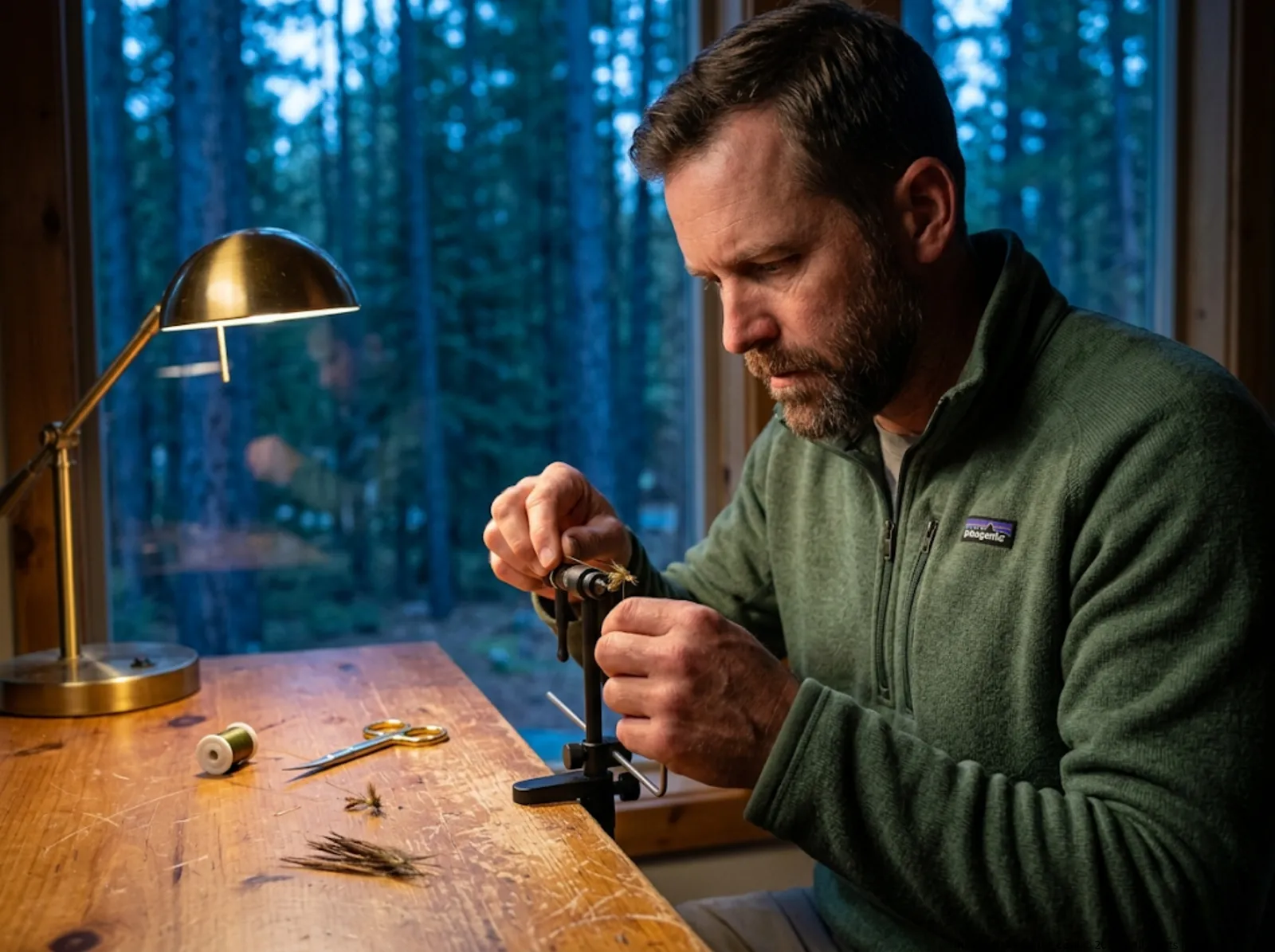
The spool of 6/0 thread snapped on the third wrap. The chenille kept sliding around the shank — fourth time in ten minutes. The scissors that came with the kit were chewing through pheasant tail fibers instead of cutting them. That was $89 of bundled mediocrity sitting on the bench, and exactly zero flies worth fishing. I’ve watched this exact scenario play out on dozens of tying benches, and the story always ends the same way: the kit goes into a drawer, and the person gives up before they ever tie a fly that actually works.
This article is the curriculum I wish someone had handed me at the start. You’ll learn why beginner fly tying kits are a false economy, how to build a functional bench from individual components, and which three foundational patterns will cover 80% of the fish you’ll ever target on freshwater. No wasted money, no wasted materials, no wasted time.
⚡ Quick Answer: Start fly tying by skipping the kit entirely. Buy a true inline rotary vise with hardened steel jaws ($120–$180), a ceramic-insert bobbin, and micro-serrated scissors. Then purchase materials only for three patterns: the Woolly Bugger, Zebra Midge, and Pheasant Tail Nymph. These three cover 80% of freshwater prey categories and teach every foundational technique you need. Total investment: $200–$350, all of it permanent.
The Economics of the Tying Bench — Why Kits Fail
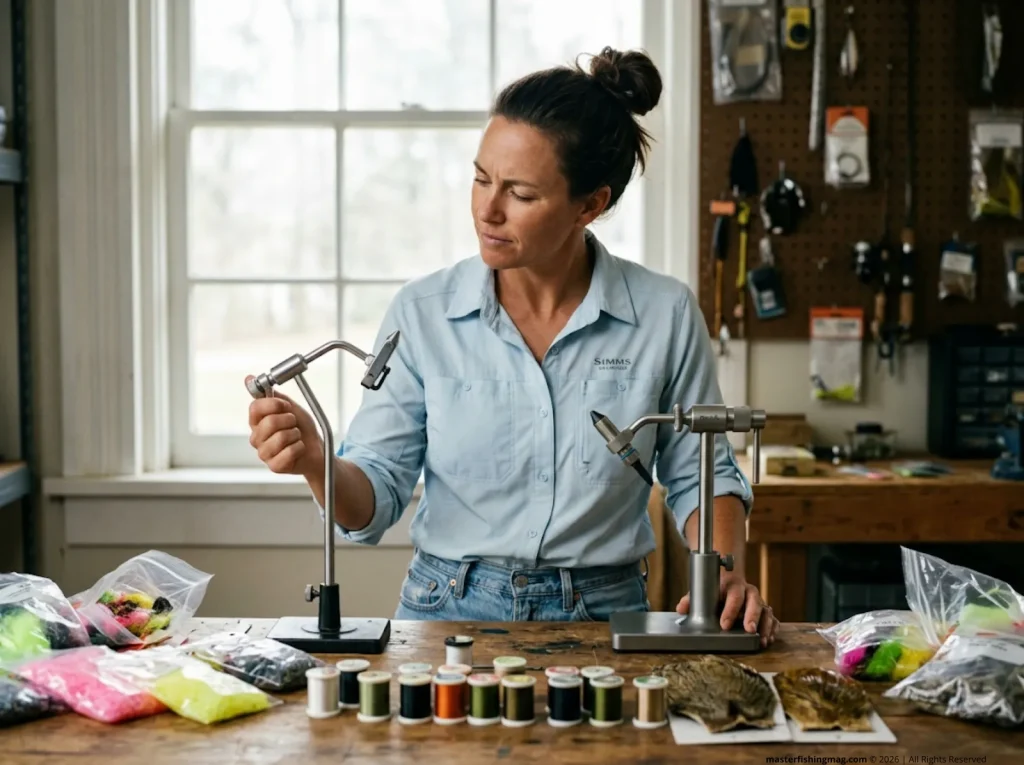
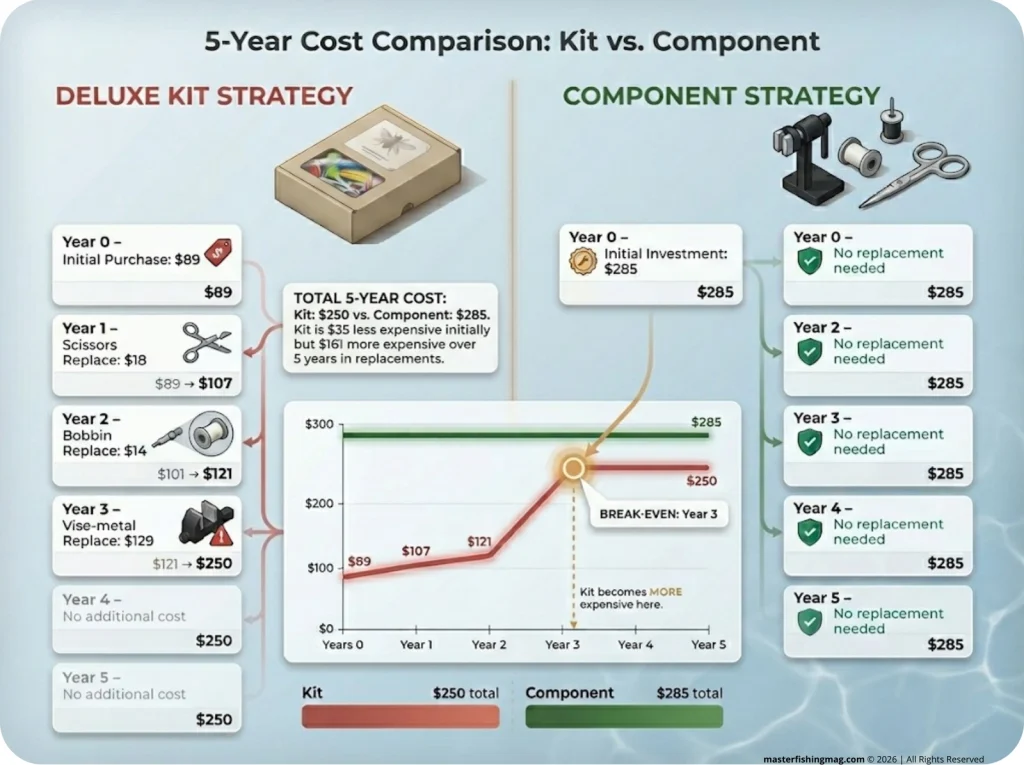
Here’s the math nobody tells you at the fly shop: a $100 beginner fly tying kit costs more over three years than a $250 component-based setup. That’s not a typo.
The problem is material utility rate. A typical $60–$150 “Deluxe” kit includes materials with only 30–50% actual usefulness — the rest is filler that has nothing to do with the patterns you’ll actually tie. If you’re fishing a Colorado tailwater, you don’t need the random assortment of peacock swords and rubber legs that pad out every kit. You need marabou, chenille, saddle hackle, wire, and thread. That’s it.
The deeper problem is the tools. Vises in beginner fly tying kits use soft-metal jaws that last one to three years before they start slipping under load. A component vise with hardened steel jaws lasts 10–30 years. The scissors in kits are straight-bladed, stamp-cut, and incapable of gripping fibers before cutting them — they push the fibers sideways. The bobbins are metal-tubed, which means within two or three spools of abrasive thread, microscopic burrs develop and start severing your thread at the worst possible moment. I went through two separate kit purchases before I understood this. The same $89 I spent twice over would have fully covered a Renzetti Traveler and a ceramic bobbin — the same budget-vs-performance trap found in beginner fly rod systems applies here. This is the beginner kit trap in its clearest form, and the anti-kit manifesto isn’t ideology — it’s arithmetic.
Pro tip: Price each component individually before buying a kit. If the kit costs more than the sum of its actually useful parts — vise, bobbin, scissors — then it was built to meet a price point, not a performance standard.
Comparative Economics — Kit vs. Component-Based Setup
The initial outlay for a component setup runs $150–$350, versus $60–$150 for a kit. That gap closes inside 18–36 months because the kit’s vise, scissors, and bobbins all require replacement. The component setup never does.
There’s also an instructional advantage nobody talks about. When you buy recipe-specific materials for a specific pattern, you’re forced to understand what each material does and why. The anti-kit manifesto isn’t ideology — it’s practical: forced purchasing discipline means your material utility rate is 95–100% from day one instead of 30–50%.
The Anti-Sell Audit — What to Throw Away if You Already Bought a Kit
If you already own a kit, here’s the triage. Check the vise jaws first: apply firm thumb pressure to the jaw. If you can deflect it at all, the metal is too soft to hold wire tension without slipping. Throw it out. Check the scissors: if they’re straight-bladed without micro-serration, they’ll push fibers instead of cutting them. Throw them out. Check the bobbins: if they’re metal-tubed, they’re on borrowed time. Replace them before you break your thread mid-pattern on a hard-won marabou tail.
What can stay: hooks (verify they’re high-carbon by checking the shank for flex resistance), basic wire ribbing, and any hare’s ear or rabbit dubbing in the materials. The cheap thread with no published denier rating — “6/0” without a gram-force break-strength spec is a marketing label, not a specification — that goes too.
The Vise — Engineering the Pivot Point of Your Bench
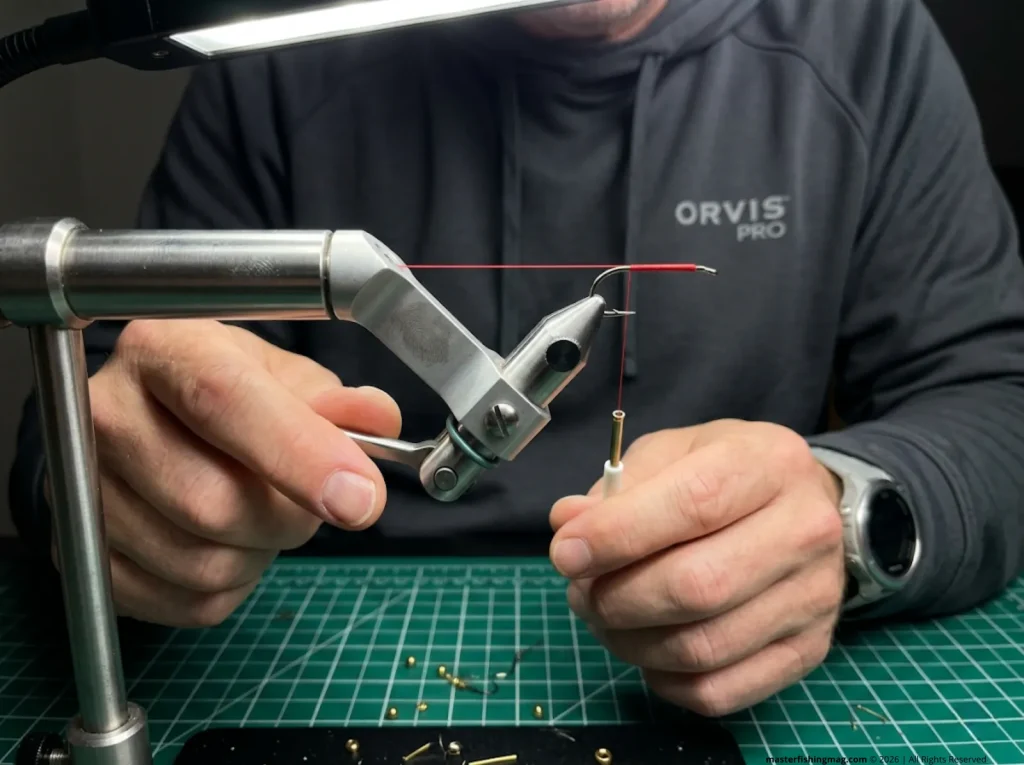
The vise does one thing: hold the hook motionless against the rotational and vertical forces you apply while tying. Every other decision on the bench is secondary to this.
Jaw metallurgy is the first question. Hardened tool steel or high-carbon steel jaws are necessary to clamp against a hardened hook wire without deforming either surface. Soft-metal jaws — chromed brass, zinc alloy — score your hook wire under repeated use. Once the jaw’s contact geometry changes, the hook begins to rotate under load, and everything you’ve just tied on it moves. The technical term is “hook scarring,” and it creates a weak point in the hook bend that can cause deformation during a fight. You can test jaw hardness at the shop: mount a #12 high-carbon nymph hook, apply firm lateral pressure. Zero movement is the standard. Any movement means the jaw is too soft for serious tying. This is also worth understanding in the context of the hook geometry that your vise must hold without deforming.
The second question is rotary type. Three vise categories exist: stationary, 360° rotating, and true inline rotary. Buy the third one.
Jaw Metallurgy and the Physics of Clamping Force
Here’s where most buying guides stop short: they tell you “get hardened steel jaws” without explaining why consistency matters. When the jaw’s clamping force changes — because the jaw surface has worn or the geometry has shifted — the hook starts to slip under tension. That’s “thread creep“: your wraps loosen and rotate on the shank as you work. Once you’ve experienced it, you’ll understand immediately why jaw quality is the single biggest factor in bench frustration.
Pro tip: When shopping entry-level gear, the Peak Rotary (made in the USA, solid steel construction, bare-bones mechanism) runs $120–$160 and holds hooks from #28 through #2/0 without complaint. The Renzetti Traveler is the mid-range step up. Both are permanent equipment. Don’t buy anything cheaper.
True Inline Rotary vs. Simple Rotating Vises — The Critical Distinction
This is the distinction most beginners get wrong, and it costs them the most money.
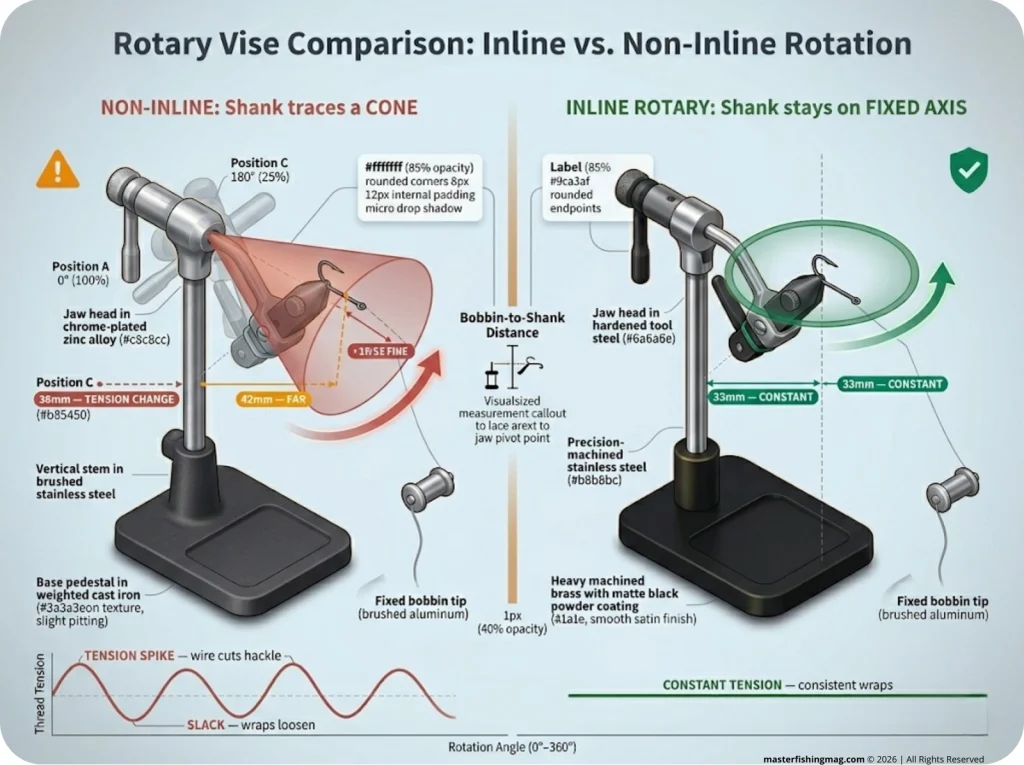
A simple rotating vise spins around an axis that may not align with the hook shank. As it rotates, the hook shank traces a cone, not a cylinder. The distance from your bobbin tip to the hook shank changes through the rotation. That changing distance means changing thread tension — and when applying wire ribbing or hackle, tension spikes create “hot spots” where the ribbing bites too deeply and cuts through the hackle stem.
In a true inline rotary vise, the axis of rotation runs through the center of the hook shank. The bobbin tip-to-shank distance stays constant through a full 360° rotation. Constant distance equals constant thread tension. You can verify inline alignment before you buy: mount a hook, attach your thread to the bobbin tip, rotate the vise 180°, and watch whether the thread tension changes. No change means true inline rotary. Any change means it isn’t.
A stationary vise forces you to re-grip and re-inspect after every few wraps. An inline rotary vise lets you spin the hook and see exactly what’s happening on all four quadrants of the shank without touching the thread. The rotary vise advantage isn’t aesthetic — it’s mechanical consistency you can feel immediately.
Thread and the Physics of Torque Management
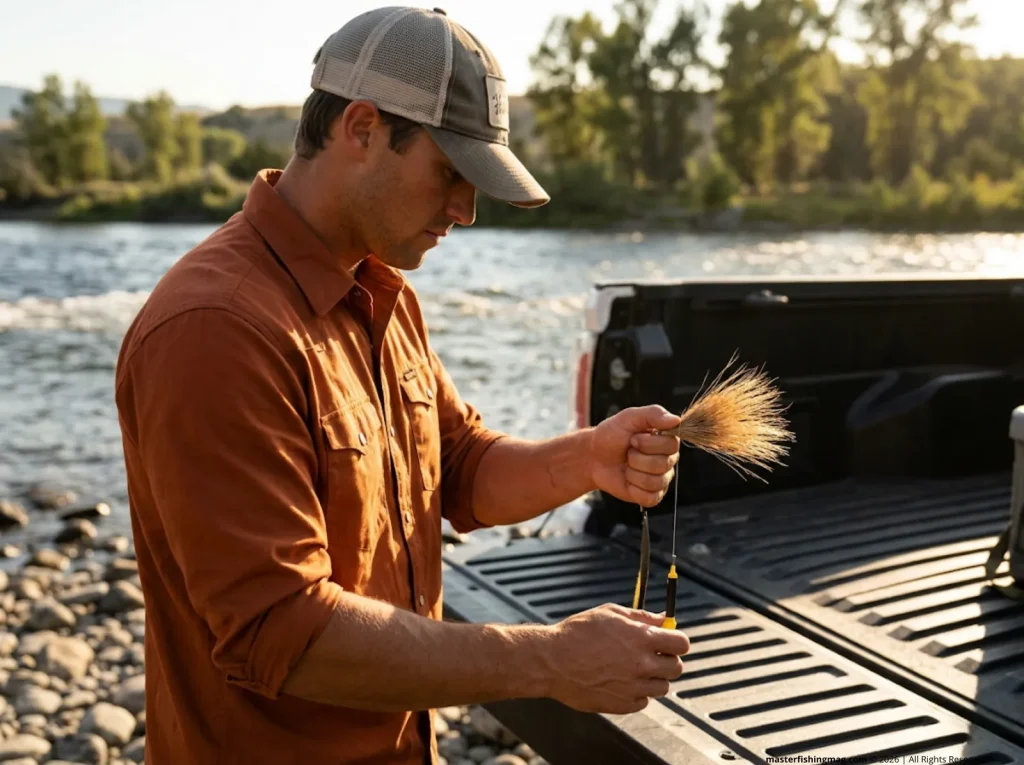
Thread is the structural adhesive of the fly. Every material you add to a hook depends on thread placement and tension to stay where you put it. Getting this wrong means your flies fall apart on the water — or never work correctly in the first place.
Thread denier is the first thing to understand. Thread is measured in Denier — the weight in grams of 9,000 meters of fiber — or the older “Aught” system: 6/0, 8/0. Denier is more precise and more useful: 70D is roughly 8/0, 140D is roughly 6/0, 210D is roughly 3/0. Smaller denier means less bulk, fewer wraps needed to anchor material — critical for midges and technical dry flies. Use two spools to cover 95% of patterns: 70D for dry flies and midges, 140D for nymphs and streamers.
The most common beginner failure is over-wrapping. Excessive thread adds bulk, raises the fly’s diameter, and reduces sink rate on nymphs. The moment I switched from metal-tubed to ceramic-insert bobbins, my thread breakage rate dropped by roughly 80%. The consistency in tension improved immediately — no more micro-tugs from burring. The same friction and tension principles here also govern fishing knot integrity — worth understanding if you haven’t looked at knot failure modes through that lens.
Understanding Denier and Selecting Thread by Pattern
Match the thread denier to the pattern and hook wire gauge: fine thread on fine wire, heavy thread on heavy wire. Using 210D thread on a #18 nymph creates so much head bulk that the fly’s weight distribution shifts, causing erratic drift in the current column. Using 70D on a Woolly Bugger means the head compresses under material tension and fails.
The practical guide: 70D for Zebra Midges (#16–#22) and technical dry flies. 140D for Pheasant Tail Nymphs and standard freshwater nymphs (#12–#16). 210D for Woolly Buggers and heavier streamers. That’s the whole system. This is step-by-step curriculum logic: lock in the right thread before you touch a single piece of material.
The Pinch Wrap and Torque Neutralization
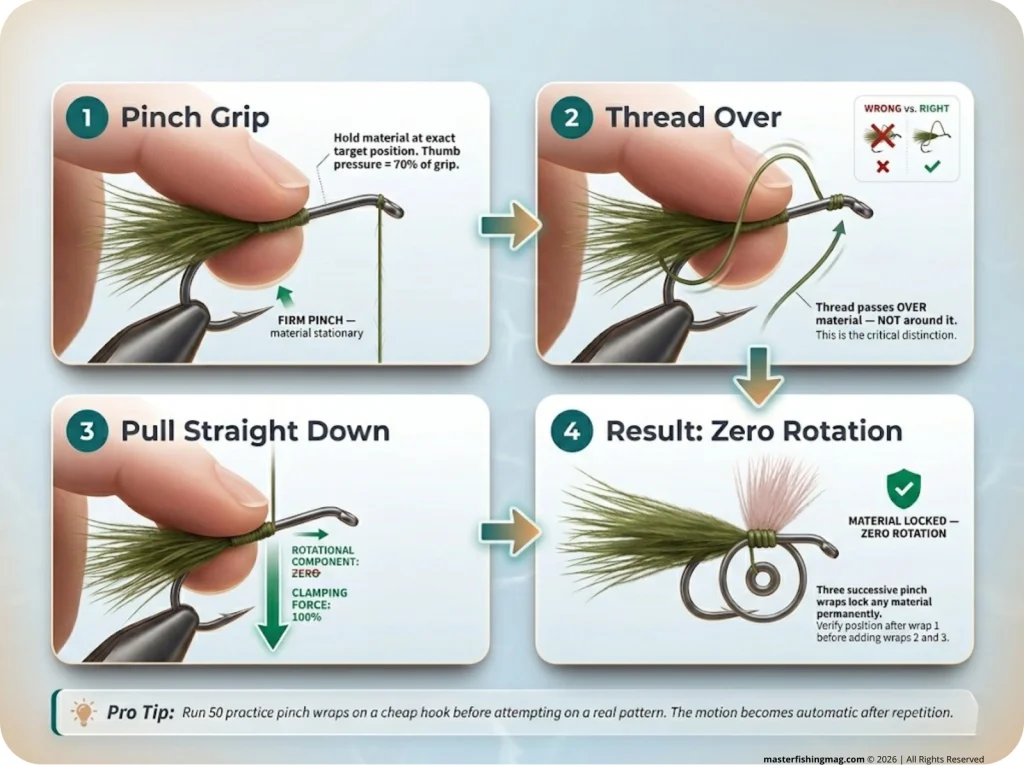
Here’s where people go wrong every time: when thread wraps over a material, the lateral component of that wrapping force rotates the material in the direction of the wrap. After three wraps, your tail has spun 90° around the shank. The material isn’t where you put it.
The fix is the pinch wrap. Grip the material between thumb and index finger at the exact position you want it. Pass the thread over the top of the material — not around it — then pull the thread straight down toward the vise base. That downward pull converts the rotational force into a vertical clamping force. The material is compressed against the shank instead of rotated around it. Three successive pinch wraps will lock any material in place.
The most common beginner error: applying the second wrap while the material is still mobile. Check material position after the first pinch wrap before you add the second. It takes ten seconds and saves the pattern.
Pro tip: Tie on a cheap practice hook and run fifty repetitions of the pinch wrap before attempting it on a real pattern. The 50-rep drill internalizes the geometry. After that, it’s automatic.
Material Science — What Makes a Fly Alive in the Water

Fly tying materials aren’t decorative. They’re functional, fluid-dynamic components that determine whether a fish strikes or ignores your fly. This is where the real technical depth of the craft starts.
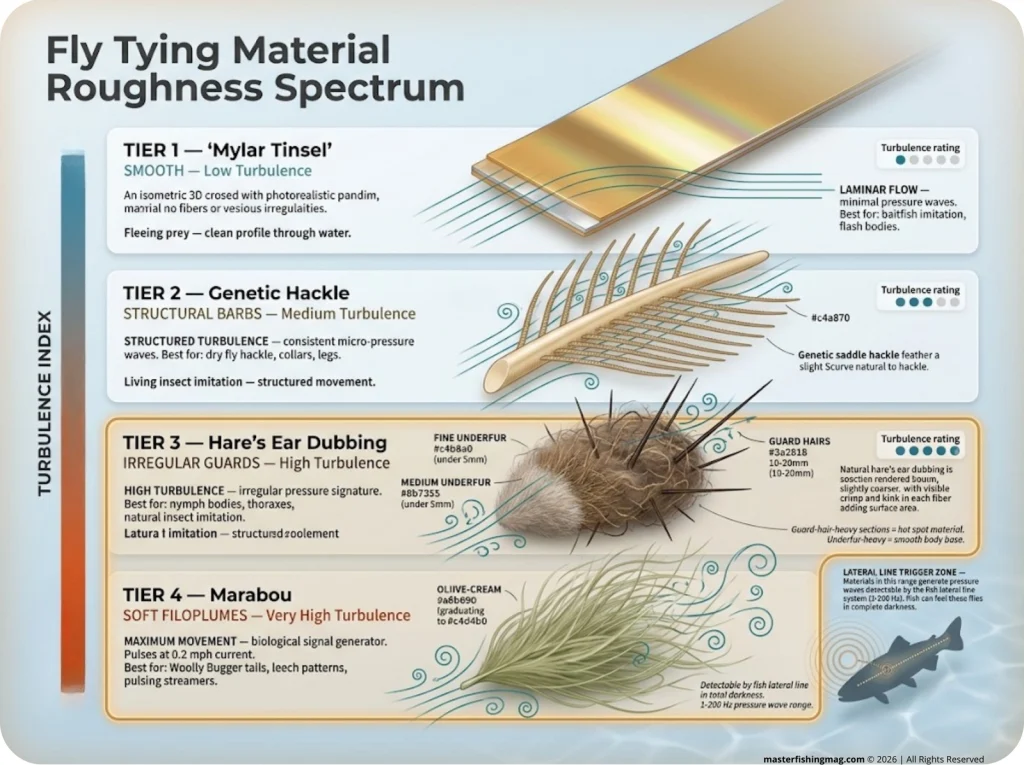
Think of it this way: some materials create turbulence in the water — irregular surfaces, protruding fibers, irregular edges — while others cut cleanly through it. The rougher and more irregular a material’s surface, the more pressure waves and micro-eddies it creates in the water column. That’s what makes a nymph look alive. A practical hierarchy: Synthetic Mylar (smooth, laminar) → Genetic Hackle (medium texture) → Hare’s Ear Dubbing (high turbulence) → Marabou (maximum movement).
Marabou feathers generate pressure waves in the 1–200 Hz range, detectable by the fish lateral line’s pressure-gradient sensors. A trout can “see” a pulsing Woolly Bugger in total darkness because of this. The lateral line pressure gradient detection in fish is documented in peer-reviewed research and has direct implications for material selection in fly construction. The difference between a marabou tail and a rubber leg tail on a Woolly Bugger isn’t aesthetic — marabou animates at 0.2 mph of current, rubber legs need 1.5 mph before they move at all.
Pro tip: Pinch a small amount of hare’s ear dubbing between your fingers and backlight it. You should see distinct guard hairs protruding from the fiber mass. If it looks uniform and dense, it’s over-spun. Start with less. Sparse dubbing traps more air and looks more alive underwater than a packed, tight body.
Manning’s n Applied — Choosing Materials for Turbulence vs. Profile
The practical rule: if you’re imitating a living invertebrate, maximize fiber hydrodynamics by selecting high-turbulence materials like hare’s ear, rabbit dubbing, and marabou. If you’re imitating a fleeing baitfish, minimize material texture by using smooth, low-resistance materials like Mylar tinsel, synthetic flash, and smooth tying thread.
Hare’s ear contains three fiber types — fine underfur, medium underfur, and guard hairs. Professional tiers select guard-hair-heavy sections for the hot spot and underfur-heavy sections for the body, building a gradient of surface texture into a single fly. This is the kind of detail that separates patterns that fish well from patterns that fish occasionally.
Understanding how fly materials trigger the lateral line’s pressure-gradient sensors changes the way you think about every purchase decision at the fly shop. You’re not buying materials — you’re selecting the physical signature your fly will broadcast in the water. Manning’s n is the shorthand, but the practical translation is simple: more texture means more biological signal.
Buoyancy Physics — Why Dry Flies Float and When They Don’t
Deer hair is hollow. The trapped air volume inside each fiber provides internal buoyancy without adding mass — an Elk Hair Caddis can float without floatant for 15–25 casts on a flat surface purely because of this hollow structure.
CDC (Cul-de-Canard) feathers trap air through capillary action in their micro-barbule structure. They’re the most delicate floatant-free material available, but they require complete drying between fish. The critical rule: never apply Gink or silicone-based floatant to CDC flies. Floatant destroys the capillary structure permanently.
After repeated casts, water infiltrates hackle and body through wicking along hydrophilic fiber surfaces. The fix is to shake the fly dry, false cast three or four times, and redress with floatant if it’s not a CDC pattern. Genetic hackle — from farms like Whiting Farms or Metz — has been selectively bred for barb density, fine stem diameter, and hydrophobic surface coating. Budget “Chinese hackle” lacks these properties, and your dry flies will sink on the second or third drift. This is a place where the cost difference is real. This matters for entry-level gear decisions just as much as for the vise.
The Biological Three — Mastering the Only Patterns You Need
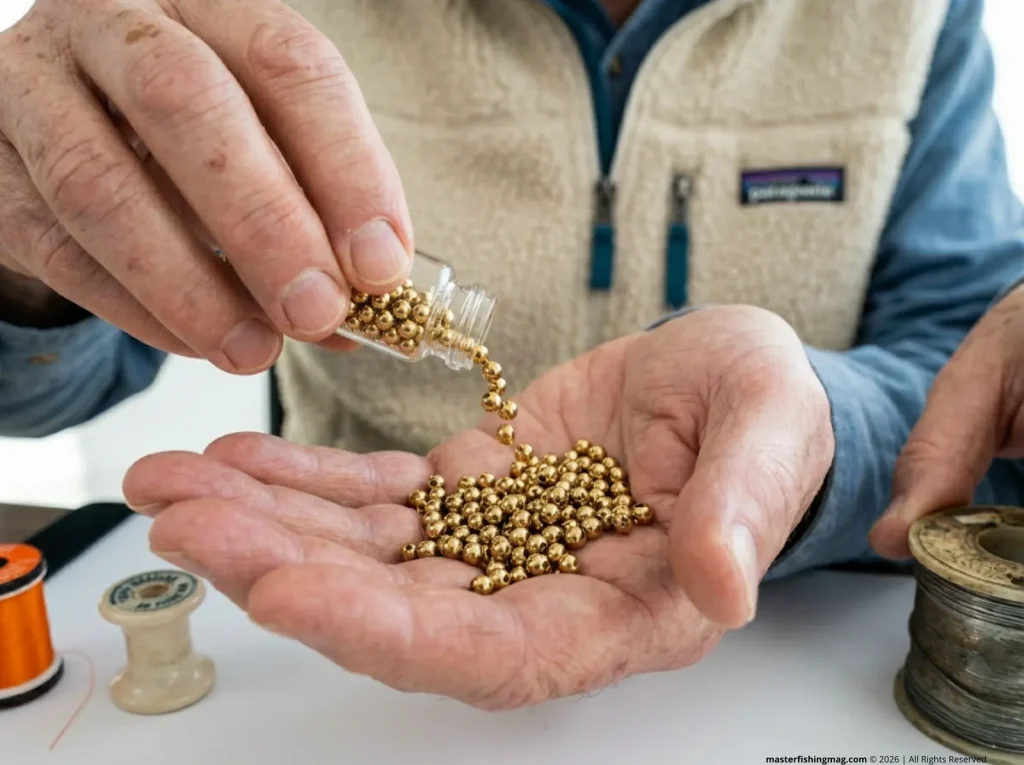
Tie 100 of each of these three patterns before you buy a single additional recipe. Not because it’s a clever rule — because by iteration 43, you’ll understand what the pattern is actually doing, and the geometry of each tie will start happening automatically instead of consciously. That shift is what separates flies that fish from flies that sit in a box.
The three patterns work because they cover the aquatic insect life cycles your foundational patterns must imitate — specifically, mayfly and stonefly life cycles that define what trout are eating across all seasons and water types. Ephemeroptera (mayfly) nymphs, Chironomidae larvae, and vertebrate prey items (leeches, baitfish) together constitute the bulk of freshwater trout biomass. Three patterns, three prey categories, one focused investment in materials. These are your high-reward patterns — the ones that belong in every serious tying step-by-step curriculum.
The Woolly Bugger — Proportions and Palmering Mechanics
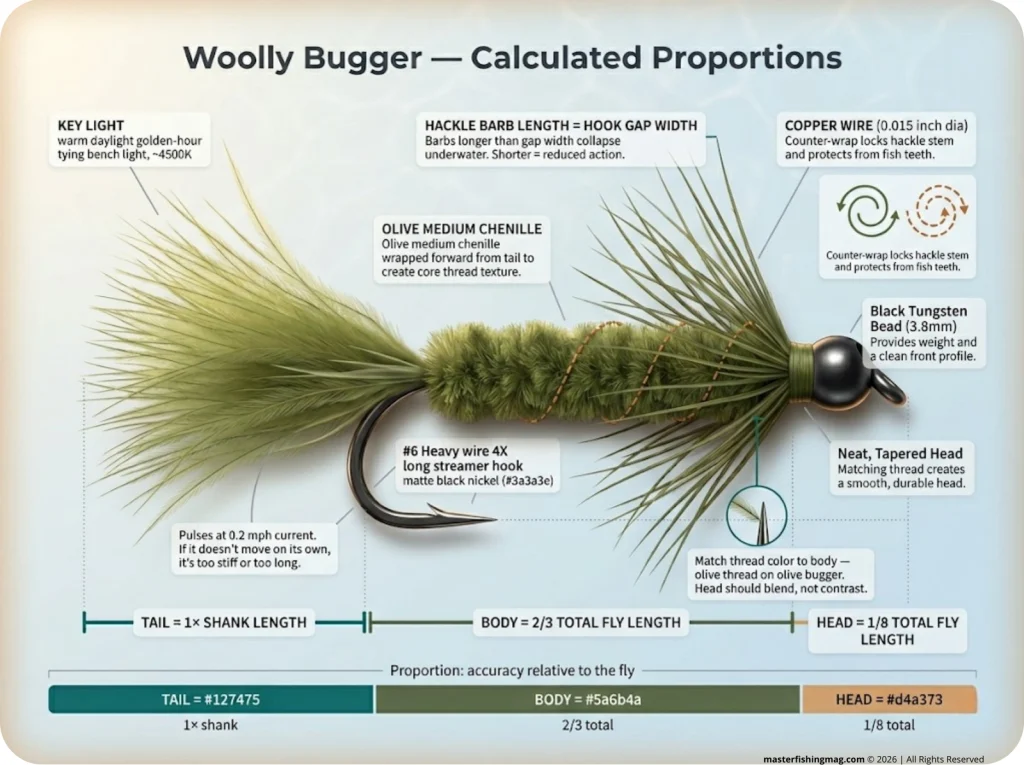
Hook: 4X long streamer hook, sizes #4–#10. The extended shank gives the marabou tail its correct proportion — exactly one shank length — without fouling the hook on the cast.
Strip an entire marabou plume, measure it against the hook shank, trim at the butt end. The tail should pulse on its own when held in moving water at walking speed. If it doesn’t move by itself, it’s too stiff or too long.
Palmering technique: wind a saddle hackle forward over the chenille body under consistent tension. Barbs should splay 90° perpendicular to the shank. Uneven tension causes “traffic jam” hackle — barbs clumping forward or back instead of radiating outward. Counter-wrap fine copper wire forward in the opposite direction after palmering. This locks the hackle stem and protects it from fish teeth that would strip the fly on its second strike.
Saddle hackle fiber length should match or slightly exceed the hook gap width. Fibers that are too long collapse under water pressure and lose their pulsing action. Match your thread color to the body — olive thread on an olive bugger, black on black. Exposed thread at the head should blend, not contrast. This is hackle-to-gap ratio in practice — not just aesthetics.
The Zebra Midge — Minimalism and Bead-Head Physics
Hook: standard dry fly hook (1X fine, short shank), sizes #16–#22. This is a Chironomidae larva imitation — it should look slender and proportionally small.
Bead: tungsten, 2–2.5mm for sizes #18–#20. Tungsten sinks 1.7× faster per unit mass than brass — measurable in the strike zone during a dead drift in 3+ feet of water. The bead-head physics are real. Don’t substitute brass when tungsten is available.
Taper management is the entire skill taught by this pattern. Build a smooth, conical body using thread wraps alone — start at the bend, build forward with increasing thread layers, then counter-wrap back. Maximum three layers. Trout in clear water inspect the Zebra Midge closely. A lumpy body from over-wrapping reads as artificial. Wind Ultra Wire (small diameter) forward in five to seven evenly spaced turns for the segmentation — this wire ribbing also adds weight and improves sink rate.
Tie Zebra Midges in three color combinations: black/silver, red/silver, and olive/gold. These cover 95% of Chironomidae larval coloration in North American waters. That’s the whole box. This is recipe logic at its most efficient.
The Pheasant Tail Nymph — Fiber Alignment and Natural Material Logic
Hook: 1X long nymph hook, sizes #14–#18. This matches the length-to-width ratio of Ephemeroptera nymph abdomens — the pattern works because the geometry is right, not because of magic.
The entire fly comes from one source: a single pheasant tail feather provides tail fibers (3–4 fibers, one shank length), the body (fiber bundle wrapped forward), and the wing case (fiber bundle folded over the thorax). Fiber alignment is everything here. Pheasant tail fibers are directional — wrap with the rib of the fiber facing forward, convex side out. Wrapping the wrong direction creates gaps and a ragged body profile that doesn’t hold together under tension.
The peacock herl thorax is the part that makes this pattern work. Herl fibers have a metallic sheen and irregular barbule structure that traps micro-bubbles, mimicking the air bubble an emerging mayfly nymph traps as it rises to the surface. The first Pheasant Tail Nymph that actually fished well for me came from my 43rd attempt. The previous 42 weren’t wrong — each taught me something about the wing case geometry that finally locked in automatically on attempt 43.
Wing case proportion: exactly 1/3 of the total fly length, positioned over the thorax only. A wing case extended too far back de-segments the abdomen visually and reduces the pattern’s effectiveness. Calculated proportions are what separate a fly that catches fish from one that sits ignored.
Conservation-Rooted Stewardship — Lead-Free from Day One
Lead wire for weighting nymphs and lead eyes for streamers work fine mechanically. They are also a documented hazard to avian wildlife.
Lead fragments from lost flies enter the avian food chain when waterfowl ingest them as grit. Loon mortality studies in New England correlate strongly with lead tackle density in freestone streams — populations in catch-and-release-only waters show 30–40% lower lead body burden. The U.S. Fish & Wildlife Service lead-free fishing initiative exists because the documented avian mortality pathway from lead tackle is a real, measurable problem, not an abstract conservation concern.
The practical case for tungsten isn’t just ethical — it’s about performance. Tungsten is 19.3 g/cm³ versus lead’s 11.3 g/cm³. A tungsten bead weighs 70% more per unit volume — meaning a smaller fly sinks faster and reaches the strike zone more efficiently. A #16 nymph with a 2.5mm tungsten bead will out-sink a lead-wrapped equivalent — a measurable difference during dead drifts in 3+ feet of water. Bismuth-tin alloys work as a cost-effective lead alternative for larger weighted flies where tungsten bead size becomes impractical.
The switch to tungsten costs roughly $0.08 more per fly. That’s the price of a nymph that reaches the bottom 0.4 seconds faster, and a loon that doesn’t ingest lead this season.
Pro tip: Make tungsten beads your default from day one. Your wallet won’t notice the difference; the watershed will.
Conclusion
Three things to take from this:
First, the bench investment is front-loaded. A $100 kit costs more over five years than a $250 component setup because the kit’s soft-metal vise, metal-tube bobbins, and filler material all require replacement. The minimum viable toolset — inline rotary vise, ceramic bobbin, micro-serrated scissors, whip finisher — is a one-time cost. Buy it once, buy right.
Second, thread control runs the whole operation. Torque management via the pinch wrap, correct denier selection by pattern, and consistent tension from a ceramic bobbin are mechanical principles that directly determine whether your materials stay where you place them. Learn them before you try to tie a perfect fly.
Third: three patterns, one hundred repetitions each. The Woolly Bugger, Zebra Midge, and Pheasant Tail Nymph cover 80% of freshwater prey categories. The geometry locks in through repetition, not through reading more about it.
Before your next tying session, strip your bench down to only the materials for one of these three patterns. Tie ten flies. Evaluate each honestly against proportion standards — tail length, body taper, thread bulk. Then fish them and see if the investment in precision changes what comes to the net.
FAQ
Is it cheaper to tie your own flies than to buy them?
For most beginners, no — at least not initially. The break-even horizon for fly tying typically runs 2–4 years if you invest in quality tools. Savings come only through pattern discipline: a narrow range of high-use patterns with near-100% material utility. The real value isn’t financial. It’s tactical — you understand exactly what your fly does underwater, and you can modify it in response to what you see on the water.
What tools do I need to start fly tying without wasting money?
Five: a true inline rotary vise with hardened steel jaws, a ceramic bobbin, micro-serrated scissors, a whip finisher, and a hair stacker if you plan to tie elk hair patterns. Everything else — dubbing needles, bodkins, hackle pliers — can be sourced cheaply or improvised. The vise and bobbin account for 90% of the quality differential between a functional bench and a frustrating one.
What are the 3 best fly patterns for beginners?
The Woolly Bugger (streamer — imitates leeches, baitfish, and large stonefly nymphs), the Zebra Midge (midge larva — Chironomidae imitation effective in all seasons), and the Pheasant Tail Nymph (mayfly nymph imitation, covers 60%+ of trout stomach contents during non-hatch periods). These three patterns require approximately 15 distinct materials combined, which keeps your initial investment focused and your utility rate near 100%.
How much does it cost to start fly tying properly?
Component-based: expect $150–$350 for tools (vise, bobbin, scissors, whip finisher), plus $50–$75 for materials specifically selected for the three foundational patterns. A realistic total of $200–$400 builds a permanent bench using technical-standard gear. Treat the tool investment as a one-time cost.
Why do my materials keep spinning around the hook shank?
This is a torque management failure, not a material problem. Thread wraps rotate material in the direction of the wrap — the lateral force component pulls everything with it. Fix: hold the material in position, pass thread over the top of the material, then pull the thread straight down toward the vise base. The vertical force pins the material against the shank instead of rotating it. Three successive pinch wrap repetitions lock any material in place before applying additional wraps.
Risk Disclaimer: Fishing, boating, and all related outdoor activities involve inherent risks that
can lead to injury. The information provided on Master Fishing Mag is for educational and informational purposes
only. While we strive for accuracy, the information, techniques, and advice on gear and safety are not a substitute
for your own best judgment, local knowledge, and adherence to official regulations. Fishing regulations, including
seasons, size limits, and species restrictions, change frequently and vary by location. Always consult the latest
official regulations from your local fish and wildlife agency before heading out. Proper handling of hooks, knives,
and other sharp equipment is essential for safety. Furthermore, be aware of local fish consumption advisories. By
using this website, you agree that you are solely responsible for your own safety and for complying with all
applicable laws. Any reliance you place on our content is strictly at your own risk. Master Fishing Mag and its
authors will not be held liable for any injury, damage, or loss sustained in connection with the use of the
information herein.
Affiliate Disclosure: We are a participant in the Amazon Services LLC Associates Program, an
affiliate advertising program designed to provide a means for us to earn advertising fees by advertising and linking
to Amazon.com. As an Amazon Associate, we earn from qualifying purchases. We also participate in other affiliate
programs and may receive a commission on products purchased through our links, at no extra cost to you. Additional
terms are found in the terms of service.