
In this article
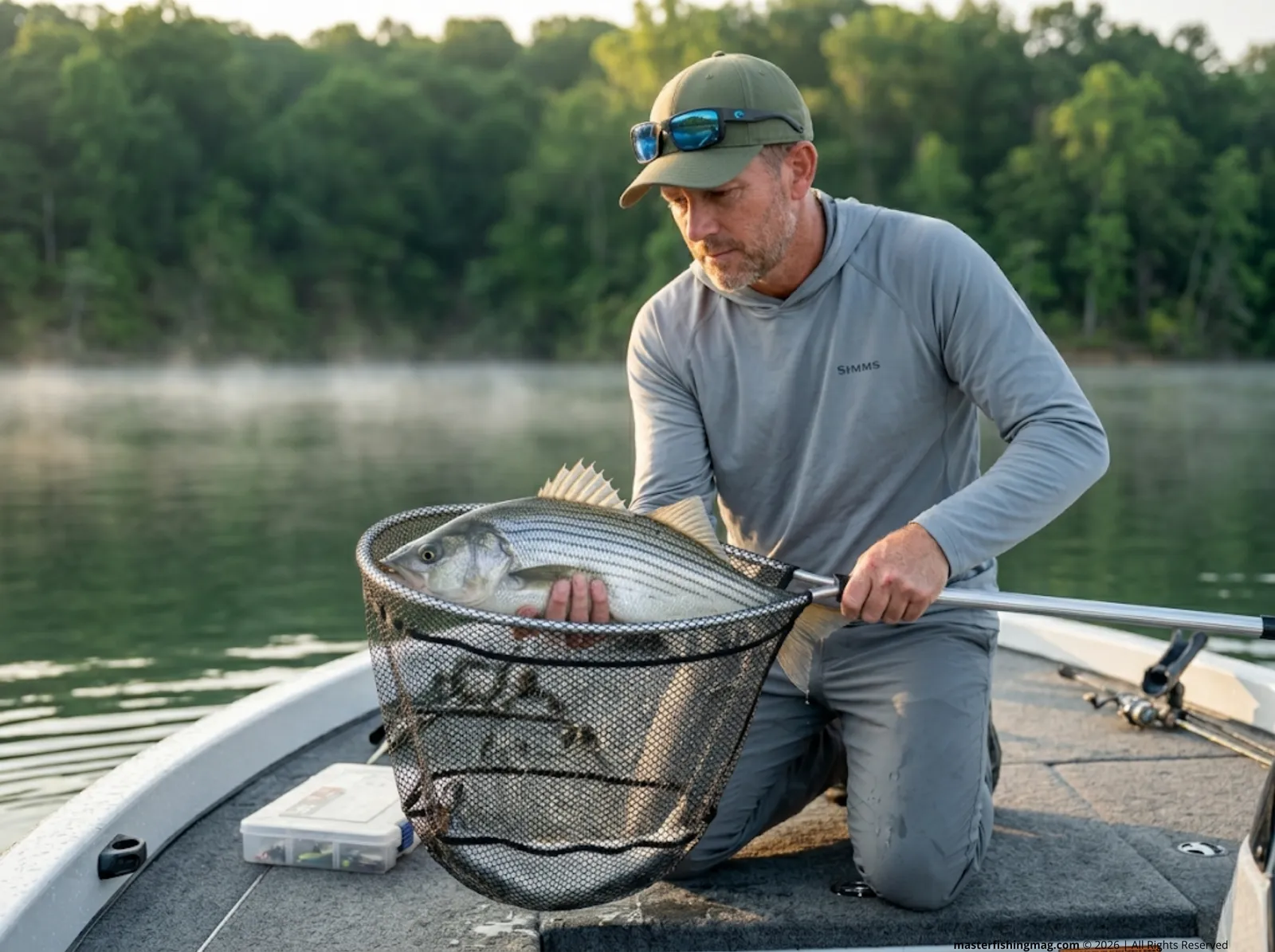
You’ve got a keeper-sized fish in the net, a cooler already holding two others, and a tournament weigh-in in 45 minutes. You flip the fish on its side. The stripes look bold. They look continuous. But your partner leans in and says, quietly: “That could be a Wiper.” Everything stops. If he’s right and you stow it, you’re looking at a disqualification — or a game warden’s citation. If he’s wrong and you toss it back, you’ve thrown away a certified keeper.
This exact scenario plays out on lakes from Texoma to Melton Hill every season. The anglers who handle it in under 10 seconds are the ones who took the time to understand the biology — not just memorize a shortcut.
This guide covers the four-step diagnostic protocol used by fisheries biologists and experienced tournament anglers to definitively identify Morone chrysops (White Bass), Morone saxatilis (Striped Bass), and their hybrid (Morone saxatilis × chrysops) using objective, measurable anatomical markers — not subjective impressions of color or “humpiness.”
⚡ Quick Answer: White Bass have a single, round tooth patch on the tongue. Striped Bass and Hybrids both have two parallel patches. That one test — run your wet finger down the tongue midline — resolves every regulatory ambiguity in 3 seconds. For faster visual screening, count the bold stripes that reach the base of the tail: one line = White Bass, four or more = Striper or Hybrid. Support that with a body profile check and a glance at the anal fin, and you’ve got a legally defensible ID before the fish has been out of the water 10 seconds.
| Bass Species Comparison | |||
|---|---|---|---|
| Feature | White Bass | Striped Bass | Hybrid (Wiper) |
| Tongue Patches | 1 central patch | 2 distinct parallel patches | 2 patches (close or joined) |
| Body Depth Ratio | Exceeds 1/3 of fork length | Less than 1/3 of fork length | Exceeds 1/3 of fork length |
| Stripe-to-Tail Count | 1 bold line to tail | 4-5 continuous lines to tail | 3-5 lines (jagged/broken) |
| 2nd Anal Spine Ratio | ≈ 2/3 of 3rd spine | ≈ 1/2 of 3rd spine | ≈ 2/3 of 3rd spine |
| Back Arch | Strongly arched | Level / flat | Moderate arch |
The Biology Behind the Body Shape Differences
The differences you’re about to learn aren’t random. They’re engineering decisions made by millions of years of natural selection — each species shaped by the physical demands of where it lived and how it chased food.
The Moronidae family splits along that exact line. Morone saxatilis evolved as an anadromous coastal predator, running the Atlantic and the Chesapeake before being stocked into landlocked reservoirs. Morone chrysops is a freshwater fish through and through — a river specialist from the Mississippi and Great Lakes drainages. The Hybrid Striped Bass arrived in the mid-1960s, a deliberate cross designed to take the Striper’s size potential and bolt it to the White Bass’s thermal toughness. The “Palmetto” cross uses a female Striper and male White Bass; the “Sunshine” reverses that. Either way, the product is what anglers call a Wiper.
The Striped Bass as a Pelagic Cruiser
A full-grown Striper at 5 lbs looks lean. Not just lean — it looks like a chrome spike. There’s nothing deep or blocky about it. That silhouette is function, not accident. The Striped Bass chases nomadic shad schools across open reservoir water, and sustained cruising requires a fusiform body shape — a torpedo profile that keeps drag low and lets the fish hold speed without burning through energy reserves.
The body depth stays consistently below one-third of the total fork length. The back runs nearly flat from the dorsal to the caudal peduncle. The gill cover — the opercle — carries two sharp points, which is one of the few external markers worth noting on Stripers. For more on how that body shape translates to open-water behavior, the Striped Bass biology for anglers breakdown at MFM covers the habitat and seasonal movement angles in detail.
According to the Indiana DNR profile of Striped and Hybrid Striped Bass, the Striper’s reproductive needs are also extreme — it requires 65–72°F water with sustained current for egg viability, which is why landlocked populations rarely reproduce successfully.
The White Bass as a River Maneuverer
A White Bass at 5 lbs looks like it was pumped up. Deep belly, pronounced shoulder arch, a body that starts high right behind the head. That hump isn’t a defect — it’s a deep-bodied profile built for turbulent river currents. The White Bass evolved in the Mississippi and Great Lakes drainages, where burst-speed acceleration and lateral maneuverability mattered more than long-distance cruising.
Body depth exceeds one-third of fork length. The arch behind the head is abrupt, not gradual. One sharp opercle point, same as the Striper — so that marker alone doesn’t settle anything. White Bass can also tolerate water temperatures up to 90°F, which makes a significant difference when you’re fishing warm southern reservoirs in July where pure Stripers have gone deep looking for cool water.
Pro tip: If a fish seems “fat” for its length — like it absorbed something the Striper didn’t — that’s the White Bass or Hybrid body architecture talking. Pure Stripers don’t carry that depth.
The Hybrid’s Intermediate Architecture
The Wiper looks like an oversized White Bass. Same deep belly, same pronounced arch — but in a much larger overall package. That’s the White Bass parentage showing through. What changes at the cellular level is what makes the Hybrid a different animal entirely in reservoir conditions.
Hybrids carry higher hematocrit and hemoglobin concentrations in freshwater than pure Stripers, which means better oxygen delivery in warm, low-oxygen water. They grow through hyperplasia — an increase in actual muscle fiber count, not just fiber size — and can reach 10–15 lbs in 5–6 years. That’s faster than either parent in the same system. The opercle on Hybrids is variable: sometimes nearly one point, sometimes approaching two. Don’t rely on it. Check the tongue and spine instead.
The Glossohyal Test — The Only Definitive Field Marker
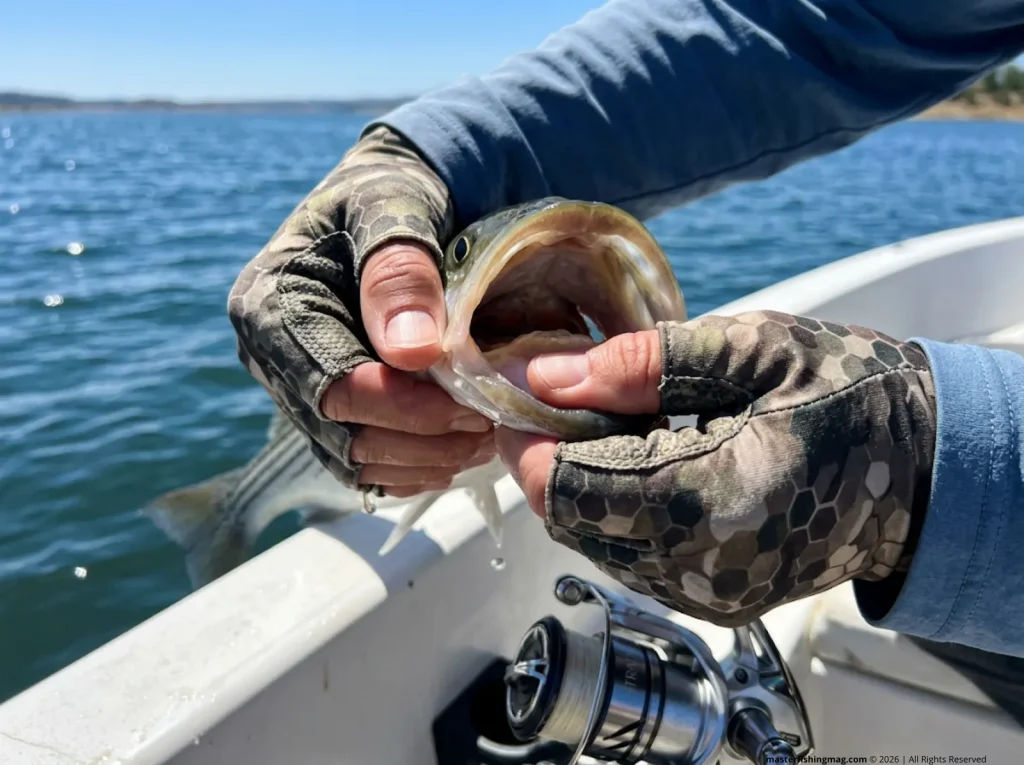
If you only learn one thing from this guide, make it this. The glossohyal test is the only marker that doesn’t change based on water clarity, lighting, or the angle you’re viewing the fish. A pure Striper’s lines can look faint in turbid water. A large White Bass can fool you at a glance. The tongue doesn’t lie.
Anatomy of the Glossohyal Bone
The glossohyal — also called the basihyal — is the tongue bone on the floor of the mouth. It carries small, ctenoid-like tooth patches used to grip and manipulate prey during ingestion.
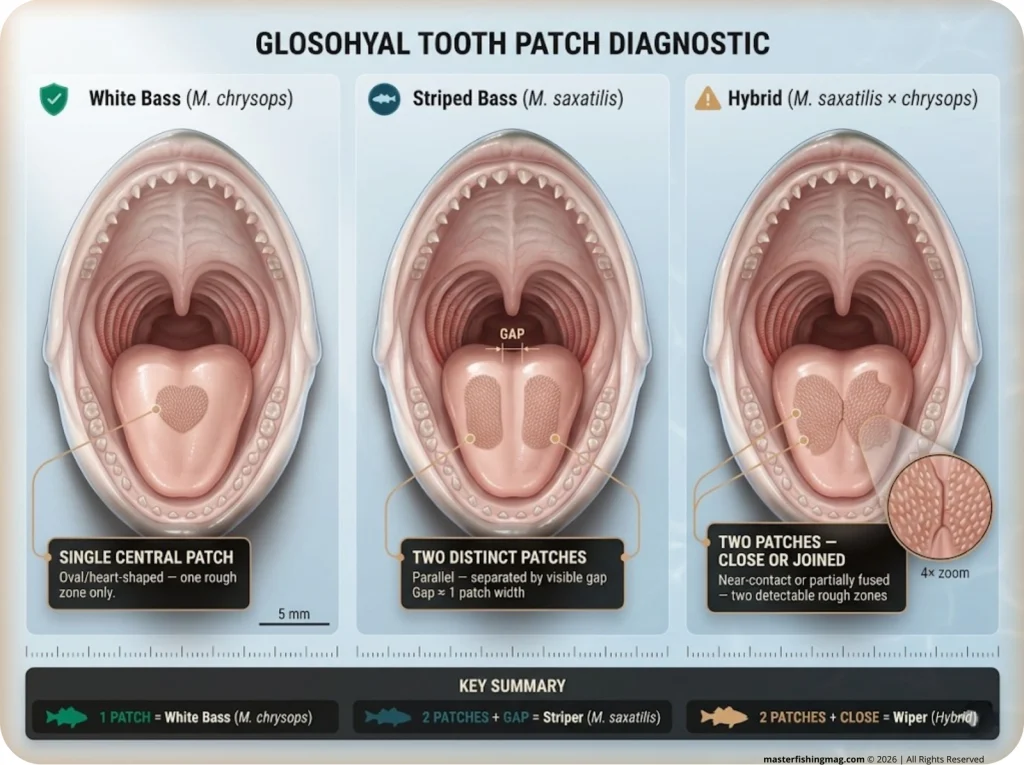
Here’s how it splits by species: White Bass (M. chrysops) has a single, central tooth patch. Round or heart-shaped, toward the posterior midline. One rough spot. That’s the whole story. Striped Bass (M. saxatilis) has two distinct, parallel patches. In large specimens, the gap between them can be as wide as one patch. Hybrids also show two patches — sometimes very close together, sometimes nearly joined — but two detectable rough zones are the smoking gun. You’re not looking at a pure White Bass.
Field technique: wet your index finger, run it slowly along the center of the tongue from front to back. One rough area = White Bass. Any sensation of a second rough zone = Striper or Hybrid. Do this before placing the fish in a livewell, and keep the fish partially submerged during the check.
Pro tip: When you’re doing the tongue check at the boat ramp with three other fish in the livewell and a partner asking questions — slow down. Run the whole midline in one smooth pass. Rushing this is where the mistakes happen.
The Legal Stakes of Getting the Glossohyal Test Wrong
Here’s where this stops being academic. The creel limits for these species differ significantly across states, and the ID has to be made before the fish enters the livewell — not after.
In Texas, White Bass carries a 25-fish daily bag. Striped Bass and Hybrids combined run 5 fish at most venues. Lake Texoma allows 10 combined but only 2 fish over 20 inches. In Oklahoma, White Bass has no statewide limit, Hybrids run 20 per day (only 5 over 20 inches), and Stripers are capped at 5. In Kentucky, the combined Hybrid and White Bass limit is 15, with Stripers at 5 fish with a 15-inch minimum.
The part most guides skip: culling is illegal for Striped Bass and Hybrids in several states, including Texas. Culling — putting a smaller fish back to keep a larger one — isn’t permitted for these species because of their high post-confinement mortality. Pure Stripers show significantly elevated cortisol and plasma glucose under stress, which makes livewell confinement genuinely hazardous for them. So if you get it wrong and stow a Hybrid thinking it’s a White Bass, you can’t fix that by releasing it when you notice. The violation already happened.
For a deeper look at how these asymmetric limits work and why trophy fishery management operates this way, the MFM article on bag limits, slot limits, and trophy fishery management breaks down the regulatory logic. The Texas Parks & Wildlife official Morone identification guide is the primary government source confirming the single-vs-double patch distinction and the creel limit differences.
Meristic Ratios — The Math That Eliminates Guesswork
Most anglers know the tongue test. Very few know the anal spine ratio. That gap is exactly why this section exists.
The Anal Spine Ratio Method
The anal fin has three hard spines followed by soft rays. The critical measurement — documented in peer-reviewed fisheries literature through the SEAFWA meristic study distinguishing White, Striped, and Hybrid Bass — is the relationship between the 2nd and 3rd spine.
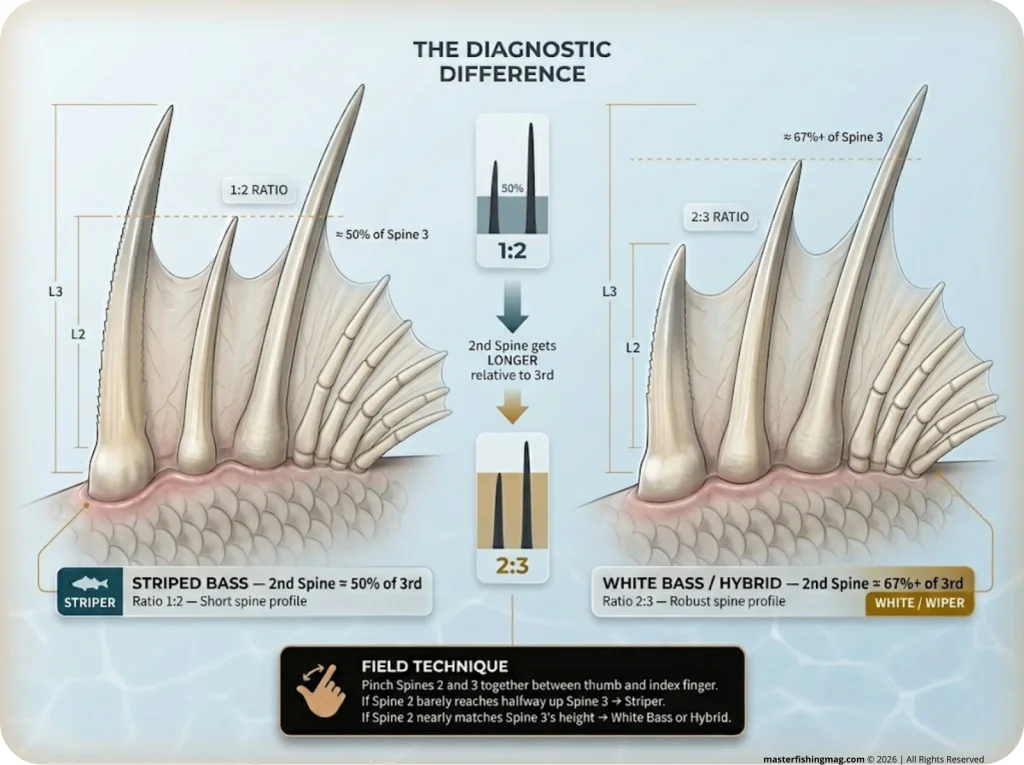
In a Striped Bass, the 2nd anal spine reaches approximately half the length of the 3rd. In both White Bass and Hybrids, the 2nd spine reaches two-thirds or more of the 3rd spine’s height. The fin profile is noticeably more robust — structural support for a deep-bodied fish that makes fast lateral moves.
No ruler needed. Pinch both spines between your thumb and index finger at the same time. If the 2nd barely reaches halfway up the 3rd: Striper. If the 2nd is almost as tall as the 3rd: White or Hybrid. This ratio holds consistent across juvenile and adult specimens, which makes it useful when body shape is ambiguous on smaller fish.
The Body Depth Ratio Method
The body depth ratio replaces “it looked fat” with something you can actually defend. Striped Bass body depth — measured at the deepest point of the body — is consistently less than one-third of total fork length. White Bass and Hybrids both exceed that threshold. In Hybrids, despite their larger overall size, the body still grows deeper relative to head length.
Visualize three equal sections from nose to tail. If the deepest point of the body exceeds one of those thirds, you’re not looking at a pure Striper. That’s the 1/3 rule applied in the field. For a broader framework that applies this kind of systematic approach across species — not just Morone — the MFM guide on the BAMFAD method for avoiding fish misidentification fines is worth bookmarking.
Gill Cover Spines — The Backup Confirmation
The opercle at the rear edge of the gill cover provides secondary confirmation in larger specimens. Striped Bass carry two sharp, distinct points. White Bass carry one. Hybrids are variable — ranging from near-one to near-two. That variability is exactly why gill cover spines are a supporting data point, not a primary identifier.
Yellow Bass (M. mississippiensis) have no tooth patches on their tongue and show abruptly offset lower stripes. White Perch (M. americana) have no horizontal stripes at all and nearly equal 2nd and 3rd anal spines. Those markers exclude both species quickly at the genus level.
Stripe Morphology and “Broken Line Syndrome”
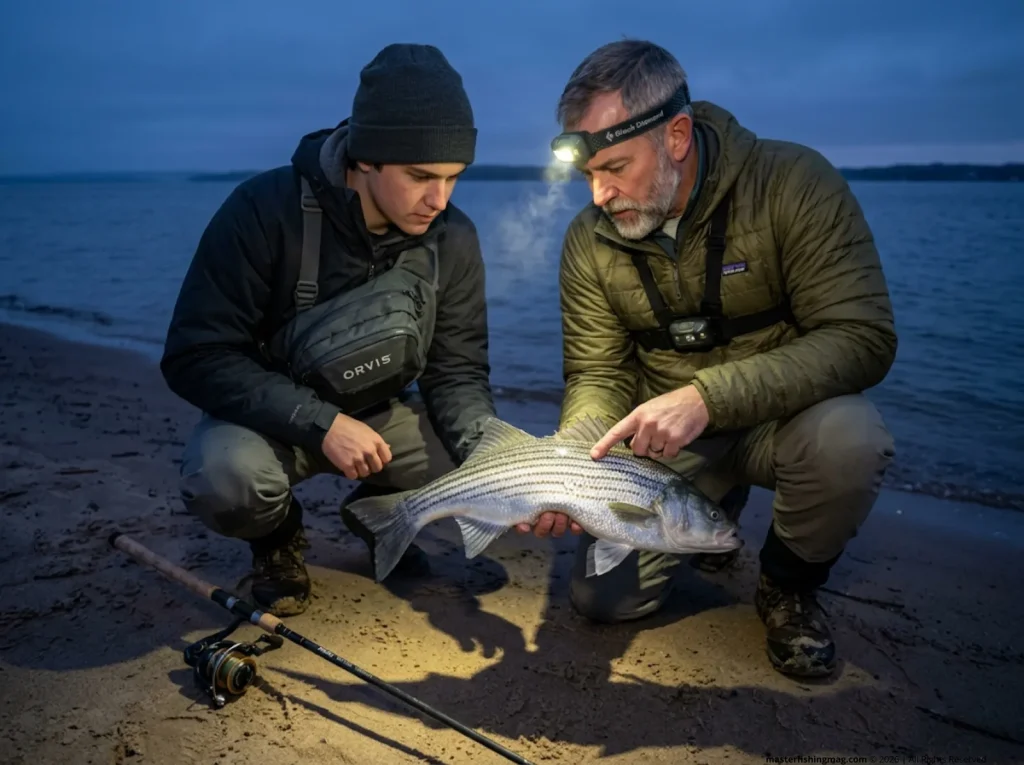
Stop leading with stripes. Stripe pattern is the most common identification tool and the most unreliable one. If you’re making a regulatory call based primarily on whether lines look continuous or broken, you’re guessing.
Why Stripes Mislead (Broken Line Syndrome)
“Broken Line Syndrome” is what happens when any fish with jagged or interrupted stripes gets called a Hybrid automatically. It cuts both ways. Pure Stripers in turbid water look faint, so they get misidentified as Hybrids. Hybrids with unusually clean markings get passed off as pure Stripers. Neither is defensible.
The actual stripe picture: Striped Bass carry 7–8 dark, continuous horizontal stripes. Rarely broken. Clear contrast against silver-white flanks. White Bass stripes are generally fainter, with most fading before the caudal peduncle — only the line tracking the lateral line itself typically runs clear to the tail base. Hybrids show stripes in “chains” or “morse code” patterns — jagged, misaligned, broken. Multiple lines usually reach the tail base, but not cleanly.
The problem is “usually.” Environmental conditions contaminate visual stripe data every time.
The Tail Line Protocol — The Fastest Visual Shortcut
The Tail Line Protocol cuts through that variability by focusing on stripe termination at the caudal peduncle, not stripe quality along the body.
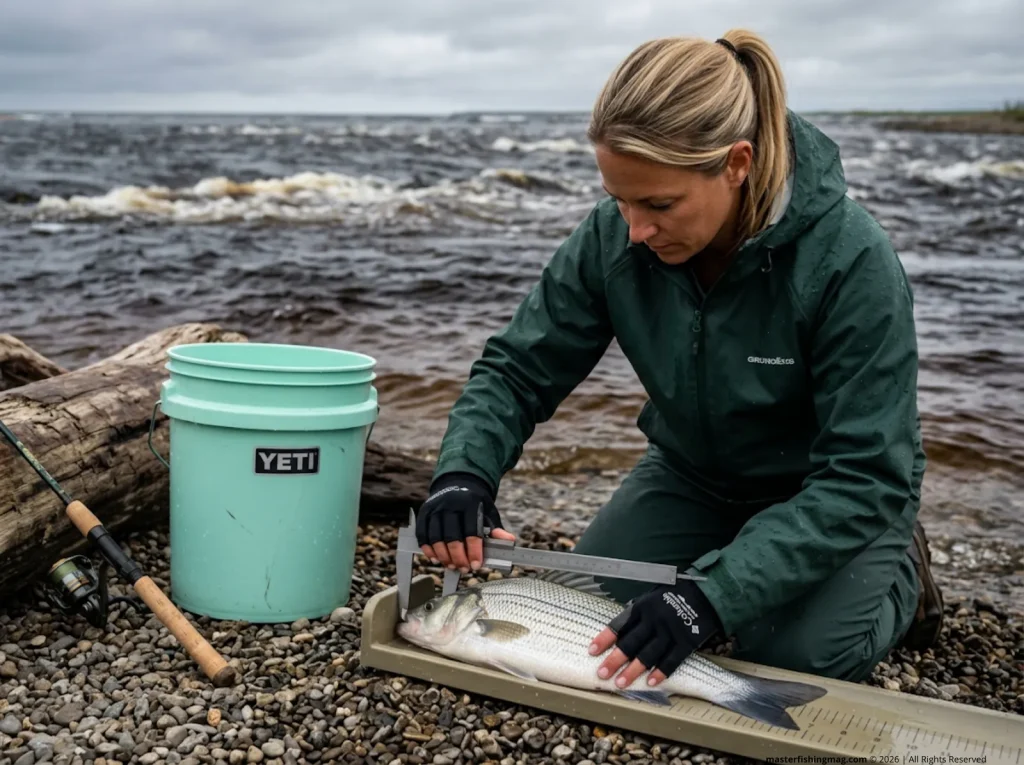
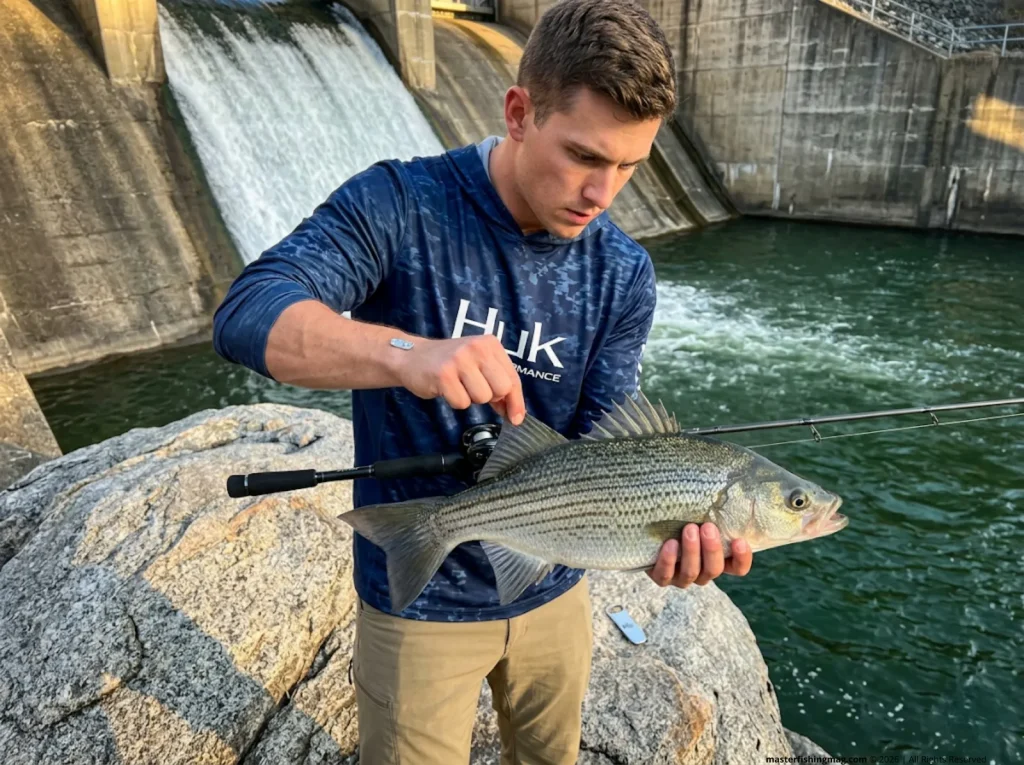
Look at the base of the tail. Count how many horizontal stripes run clearly to that base. White Bass = 1 bold line to the tail. The others fade. Striped Bass = 4–5 distinct lines to the tail. Hybrid = 3–5 lines to the tail, usually broken or jagged as they approach. The “1-line vs. 5-line” rule is the fastest visual field cut in the non-academic literature, peer-validated across Reddit’s r/Fishing and r/bassfishing by anglers posting photos of their hybrid vs. white bass ID confusion for years.
Pro tip: When in doubt after the Tail Line Protocol, the answer is always the same — check the tongue.
Once you’ve confirmed you’ve got a Wiper, you’ll want to know how to fish for one. The MFM guide on Hybrid Striped Bass behavior and fishing tactics covers the shad-school patterns, thermocline work, and vertical jigging setups.
The 10-Second Diagnostic Protocol — Field Checklist
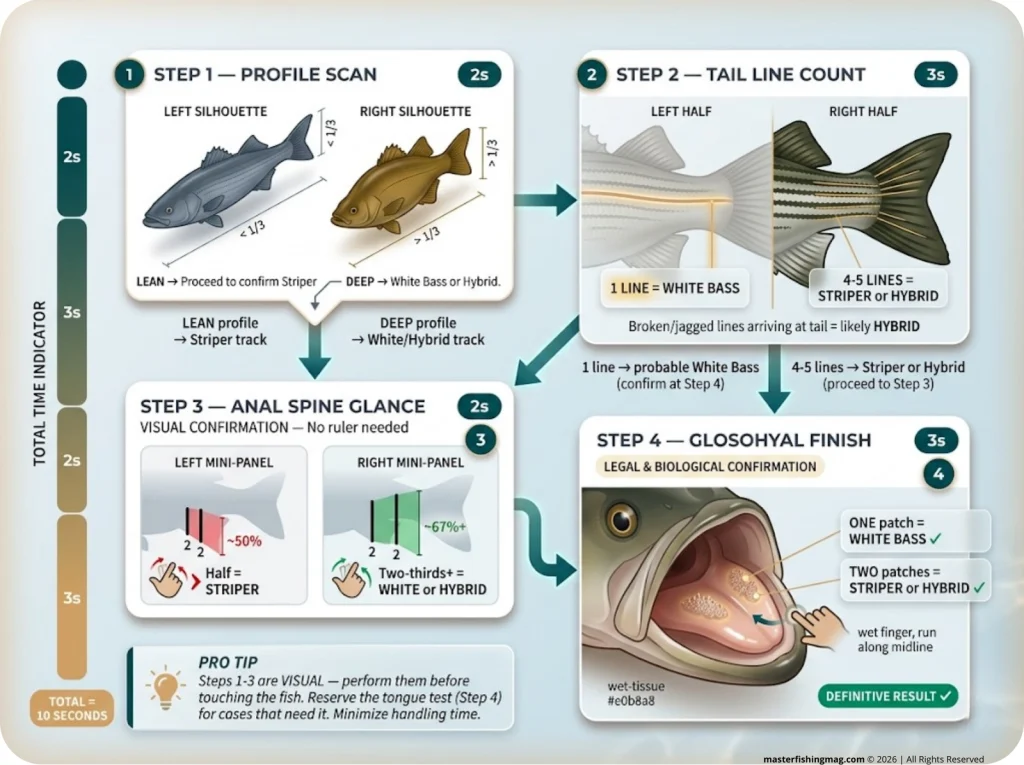
Nobody else gives you this as a sequential, timed field protocol. Texas Parks & Wildlife gives you a clinical table. Wired2Fish gives you a species guide. What neither provides is a numbered decision tree designed for use while the fish is still in the net, with a game warden possibly watching from the next dock.
Step 1 — The Profile Scan (2 Seconds)
Observe the fish in the net from the side. Is the body long and slender — practically a torpedo — with a flat back from dorsal to tail? That’s your Striper baseline. Or does the back arch abruptly behind the head with a deep belly that noticeably exceeds one-third of the body’s length? That points to White Bass or Hybrid.
A full-grown Striper at 5 lbs looks lean and elongated. A Hybrid at 5 lbs looks like it has broad shoulders — a different body depth entirely, even at identical weights. This step narrows the field immediately. If the body shape is ambiguous, move to Step 2.
Step 2 — The Tail Line Count (3 Seconds)
Look at the caudal peduncle. Count the number of bold horizontal lines that reach the tail base clearly. One bold line = White Bass. Multiple lines — 4 or more — reaching the tail = Striper or Hybrid. If multiple lines reach the tail but they’re broken or jagged as they arrive: likely Hybrid. If they’re continuous and clean: likely Striper.
This step builds probability, not certainty. Use it to direct your next move.
Step 3 — The Anal Spine Glance (2 Seconds)
Look at the anal fin. Does the 2nd spine reach roughly halfway up the 3rd, or does it come close to two-thirds or more? Half = Striper. Two-thirds or higher = White or Hybrid. Combined with the tail line count, this gives you a high-confidence ID without touching the fish’s mouth.
Step 4 — The Glossohyal Finish (3 Seconds)
If any doubt remains after Steps 1–3, do the tongue test. Wet your finger, run it along the midline. One rough patch = White Bass. Two distinct rough areas = Striper or Hybrid.
This is the legal and biological ground truth. According to the Kentucky Department of Fish & Wildlife temperate bass identification standards, the anatomical markers — tongue patches, body depth, spine ratio — are the definitive diagnostic tools in species identification for this genus. When creel limits differ between species, the tongue test is the check that holds up in court.
Minimize handling: perform Steps 1–3 visually before touching the fish. Reserve the tongue test for the cases that need it. The same systematic approach works for other hybrid species — see the MFM field guide to identifying hybrid fish species for Wiper and Tiger Musky protocols.
Habitat, Behavior, and When You’ll Actually Encounter Each Species
Knowing the ID protocol matters most when you understand where your identification problems are most likely to occur — which means knowing how these species actually use the water.
Where Striped Bass Live and Why
The Striper’s native range is the Atlantic Coast and the Chesapeake Bay, running into freshwater rivers only to spawn. It needs 65–72°F water with sustained current for egg viability — which is why landlocked Stripers in places like Lake Texoma and Kerr Reservoir don’t naturally reproduce. State agencies have to keep stocking them.
In reservoirs, Stripers chase nomadic Gizzard Shad schools across open water. The boil events are fast, violent, and over quickly. They’re also temperature-sensitive — striped bass need water below approximately 75°F for metabolic comfort, which creates the “thermal squeeze” events in summer where fish concentrate near the thermocline. If you’re marking fish at depth on sonar between June and August, the Stripers are probably down there, not near the bank where the White Bass are.
Where White Bass Live and Why
White Bass are native freshwater residents of the Mississippi and Great Lakes drainages. Their spawn is far less demanding than Stripers — they need 63–70°F water in tributary streams with moderate current. Inflowing creeks after spring rains are enough.
The defining behavioral marker: surface boils. White Bass form enormous feeding frenzies where schooling fish push shad against the top of the water column. If you want to learn how to position on those events and convert strikes, the MFM guide on catching schooling White Bass during surface boil events covers the jigging spoon and shad lure setups in detail.
The critical point for ID purposes: White Bass and Striped Bass are often stocked into the same multi-species reservoirs, particularly in the southern US. You cannot always know which species you’ve caught based solely on where you’re fishing. The Oklahoma Department of Wildlife Conservation White Bass angler guide confirms this co-occurrence pattern across Oklahoma’s major reservoir systems.
The Hybrid’s Reservoir Dominance
Hybrid Striped Bass are almost always stocked, not naturally occurring. They’re stocked because they can survive in conditions that would stress a pure Striper — warmer water, lower oxygen, more pressure. Their superior hematocrit allows it. They can reach 10–15 lbs in 5–6 years, and they share water simultaneously with White Bass and pure Stripers in many systems. In a single livewell after a productive morning on a mixed reservoir, you may have all three species. The 10-second protocol isn’t optional in that scenario. It’s the protocol.
Pro tip: Community experience is consistent on this — the “record-sized White Bass” that people post online are routinely reclassified as average-sized Wipers once someone checks the tongue. If a White Bass looks remarkable for its size, check the mouth before you claim the record.
Conclusion
Three things matter when a Morone of uncertain identity is in your net.
First: one rough tongue patch means White Bass, two means Striper or Hybrid — that single test resolves every regulatory ambiguity in 3 seconds, and it’s immune to water clarity and lighting conditions.
Second: the 10-second protocol is sequential, not simultaneous — profile scan, tail line count, anal spine glance, tongue confirm. Each step builds confidence before the next. Don’t skip to the tongue immediately every time; use the visual markers to direct the ID efficiently.
Third: stripes are the least reliable primary marker — stop making identification decisions based solely on whether lines look continuous or broken. The meristic ratios — tongue patches, anal spine ratio, body depth ratio — don’t change based on water conditions. The stripes do.
The next time a Morone comes over the gunwale and someone says “What is that?” — run the protocol. Profile, tail, spine, tongue. Done before the fish has been out of the water for 10 seconds. That’s not a trick. That’s mastery.
FAQ
Do White Bass have two tooth patches on their tongue?
No. White Bass (Morone chrysops) have a single, central tooth patch on the glossohyal bone — this is their definitive identification marker. Striped Bass and Hybrid Striped Bass both have two distinct, parallel patches. In Stripers, those patches are often separated by a visible gap. In Hybrids they may be very close together, but two detectable rough areas are always present.
Is a Wiper the same as a Striped Bass?
No. A Wiper is a Hybrid Striped Bass (Morone saxatilis × Morone chrysops) — an artificial cross between a Striped Bass and a White Bass. Wipers are larger and deeper-bodied than White Bass but carry two tongue patches like their Striper parent. They’re typically infertile and managed as stocked trophy fish under more restrictive creel limits than White Bass.
How many stripes reach the tail on a White Bass?
One bold line — the one corresponding to the lateral line — typically reaches the base of the caudal fin on a pure White Bass. The other stripes fade before the tail peduncle. Striped Bass and Hybrids both show four to five distinct lines to the tail, making the caudal peduncle a quick visual screening point before you touch the mouth.
Can Hybrid Striped Bass have continuous, unbroken stripes that look like a pure Striper?
Yes, and that’s exactly why stripe pattern alone isn’t sufficient for a regulatory decision. Some Hybrids deviate from the broken line pattern and display stripes that appear partially or fully continuous — what the community calls failing the broken line test. The correct response to any stripe ambiguity is the Glossohyal Test. Two rough patches confirm the fish as a Hybrid or Striper regardless of stripe quality.
What is the Anal Spine Ratio and why does it matter?
The anal fin has three hard spines. In a Striped Bass, the 2nd spine is approximately half the length of the 3rd (a 1:2 ratio). In White Bass and Hybrids, the 2nd spine reaches two-thirds or more of the 3rd spine’s length (a 2:3 ratio). This meristic ratio gives you an objective, measurable field marker with no equipment beyond your eyes. It’s documented in peer-reviewed fisheries literature but appears in almost no angler-facing content — which makes it one of the most underused identification tools available.
Risk Disclaimer: Fishing, boating, and all related outdoor activities involve inherent risks that
can lead to injury. The information provided on Master Fishing Mag is for educational and informational purposes
only. While we strive for accuracy, the information, techniques, and advice on gear and safety are not a substitute
for your own best judgment, local knowledge, and adherence to official regulations. Fishing regulations, including
seasons, size limits, and species restrictions, change frequently and vary by location. Always consult the latest
official regulations from your local fish and wildlife agency before heading out. Proper handling of hooks, knives,
and other sharp equipment is essential for safety. Furthermore, be aware of local fish consumption advisories. By
using this website, you agree that you are solely responsible for your own safety and for complying with all
applicable laws. Any reliance you place on our content is strictly at your own risk. Master Fishing Mag and its
authors will not be held liable for any injury, damage, or loss sustained in connection with the use of the
information herein.
Affiliate Disclosure: We are a participant in the Amazon Services LLC Associates Program, an
affiliate advertising program designed to provide a means for us to earn advertising fees by advertising and linking
to Amazon.com. As an Amazon Associate, we earn from qualifying purchases. We also participate in other affiliate
programs and may receive a commission on products purchased through our links, at no extra cost to you. Additional
terms are found in the terms of service.