
In this article
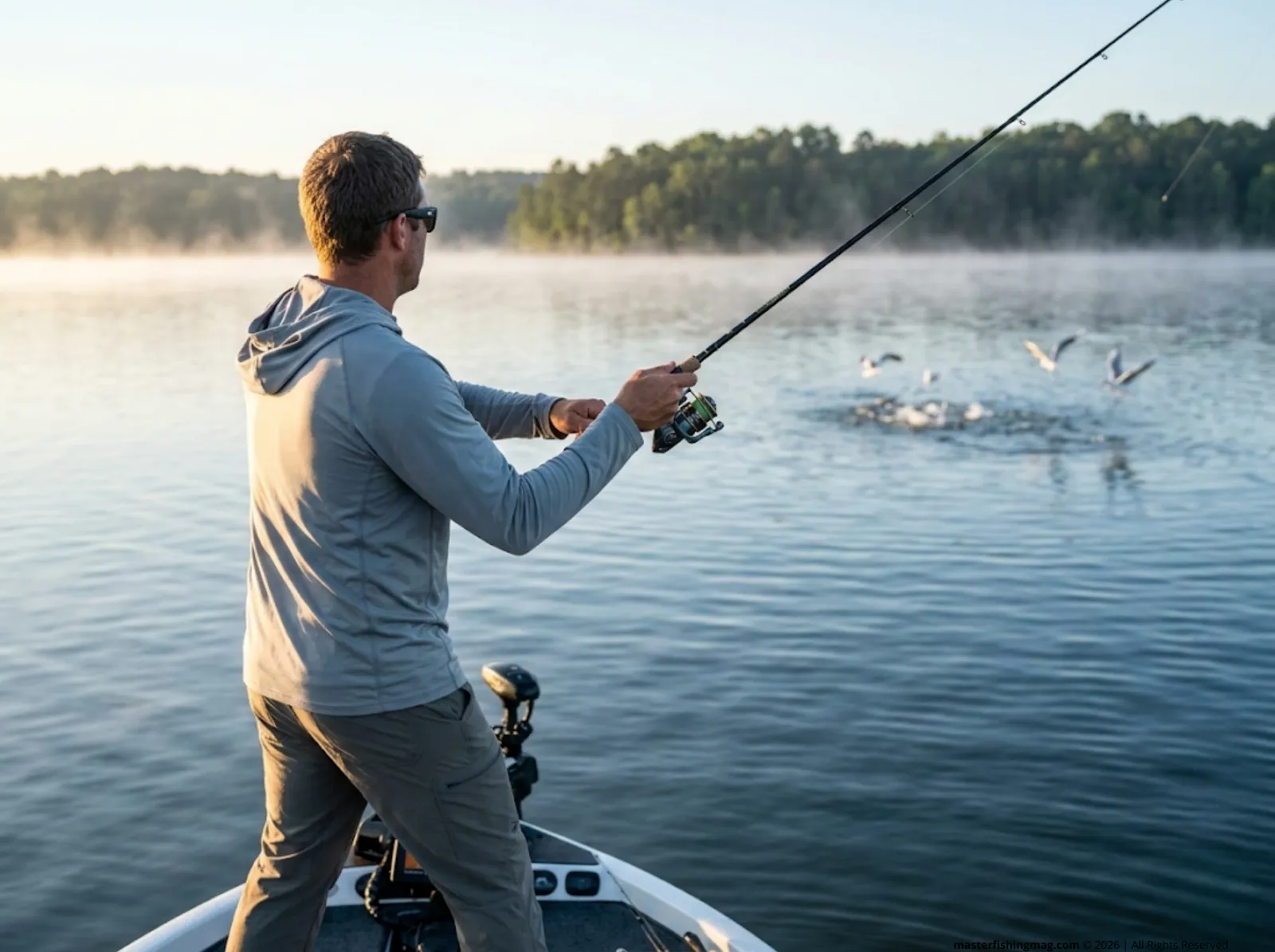
The flat erupts fifty yards off the bow. Acres of surface water turn white with gizzard shad, gulls fold their wings and dive, and your heart rate doubles. You fire a cast into the middle of the chaos. Nothing. Another cast. Nothing. By the time you reel in, the boil has moved two hundred yards east and you’re chasing ghosts across open water.
I’ve spent the better part of fifteen years chasing white bass across southern reservoirs, and that frustration was my default mode for the first three of them. The turning point came when I stopped reacting to what I saw on the surface and started reading what was driving the frenzy underneath.
This article breaks down the biology of competitive feeding school behavior, the gear and presentation that actually connect during a surface boils blitz, and the post-boil tactics that keep you catching after everything goes quiet.
⚡ Quick Answer: Schooling white bass push baitfish to the surface in explosive feeding frenzies called “the jumps.” To catch them consistently, position your boat ahead of the moving school, cast to the outside edges (never through the center), use shad-mimicking lures in white or chartreuse (1/4–3/4 oz jigging spoons, Road Runner grubs, or Bandit Series 200 crankbaits), and switch to vertical jigging the moment the surface goes quiet. The fish didn’t leave — they sank.
Why White Bass School the Way They Do
The Shad Connection and Competitive Feeding Biology
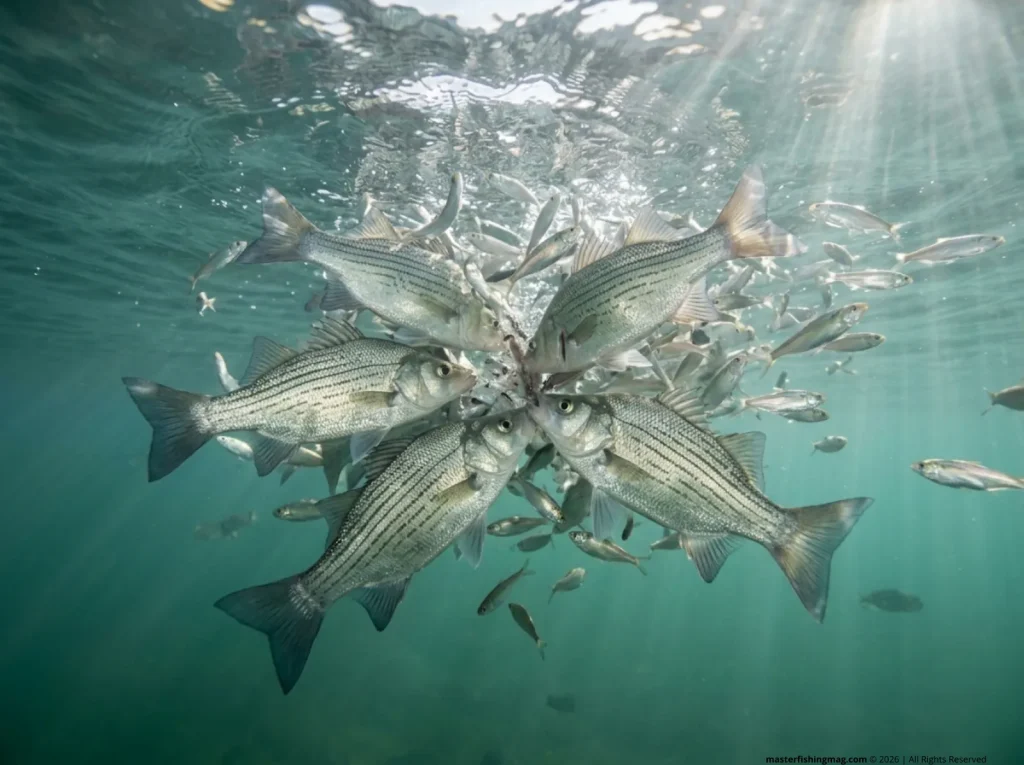
White bass (Morone chrysops) are open-water pack hunters built for speed. They chase schools of fish — primarily gizzard shad and threadfin shad — across reservoirs year-round, and their entire feeding strategy depends on numbers. A single white bass can’t herd a bait ball. Thirty of them can.
Males mature at age one around 8-9 inches. Females hit 12-13 inches by their second year. Few live past age five. That compressed lifespan creates a biological urgency — these fish feed aggressively because they don’t have decades to grow. Every meal matters.
The competitive feeding dynamics are what make schooling behavior so explosive. When one bass strikes, the commotion triggers a chain reaction. Schoolmates rush in, each one competing for a share before the baitfish scatter. Professional guide Bob Maindelle out of Salado, Texas, documented something most anglers never notice: “Hooked white bass often regurgitate stomach contents, defecate, or both. On sonar, you often see schoolmates swim up with a hooked fish, attracted by such snacks.”
That single observation explains why keeping a hooked fish splashing at the surface works. It’s not superstition. It’s competitive biology on full display.
Reading the Signs Before and During a Blitz
Diving birds are your earliest intel. Gulls and terns don’t dive randomly — they follow the same shad concentrations that white bass are hammering from below. Watch the direction birds fly FROM, not just where they land. That tells you where the school is heading.
Surface boils themselves are circular disturbances where shad get pushed up from below. On calm mornings they’re easy to spot. On windy days they blend in, but the feeding school activity actually intensifies. Fall brings the best sustained surface action, particularly on cloudy, windy days near creek channels and lake points.
Pro tip: Dawn and dusk are predictable feeding windows, but don’t overlook overcast days. Cloud cover effectively stretches the low-light window all day long, producing sustained surface activity that clear-sky anglers miss entirely.
Seasonal Depth Shifts That Decide Your Approach
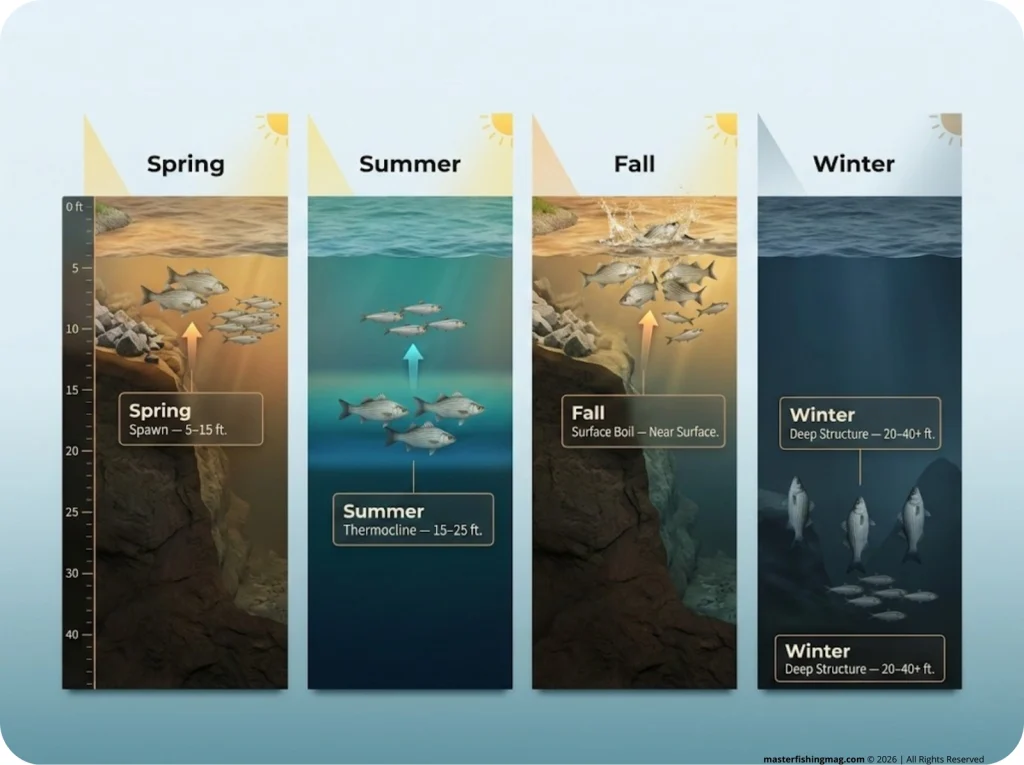
White bass move vertically through the water column with the seasons, and understanding how thermoclines shape fish depth is the difference between finding them and wasting fuel.
Spring (February through March) pushes fish into tributaries and riprap areas for spawning. Post-spawn in April and May creates hungry, aggressive schooling in tight groups near creek channels at 5-15 feet. This is the easiest fishing of the year.
Summer drives white bass down to the thermocline, typically 15-25 feet deep. Surface blowups happen early and end fast. Most of your time should be spent with electronics.
Fall is prime time. Cooling water triggers the most sustained surface boils of the year. Target creek channels, main-lake points, and anywhere baitfish movements concentrate near the bank.
Winter means deep structure — river channel ledges, lake humps, and main-lake points in 20-40 feet or deeper. It’s all vertical jigging from here, according to Texas Parks and Wildlife Department biology reports.
Gear That Matches the Frenzy
Light Spinning Tackle Setup
Forget your heavy bass fishing gear. White bass fight hard for their size, but they average 10-15 inches and rarely break two pounds. A 6’6″ to 7-foot medium-light spinning rod with a fast tip gives you the casting distance to reach distant boils and the sensitivity to feel the subtle thud of a lift-drop retrieve strike.
Pair it with a 2500-size reel spooled with 6-8 pound fluorocarbon or 10-pound braid with an 8-pound fluoro leader. White bass have soft mouths, so dial your drag lighter than you’d expect. A tight drag tears hooks free on that first explosive run.
Shad-Mimicking Lures That Produce
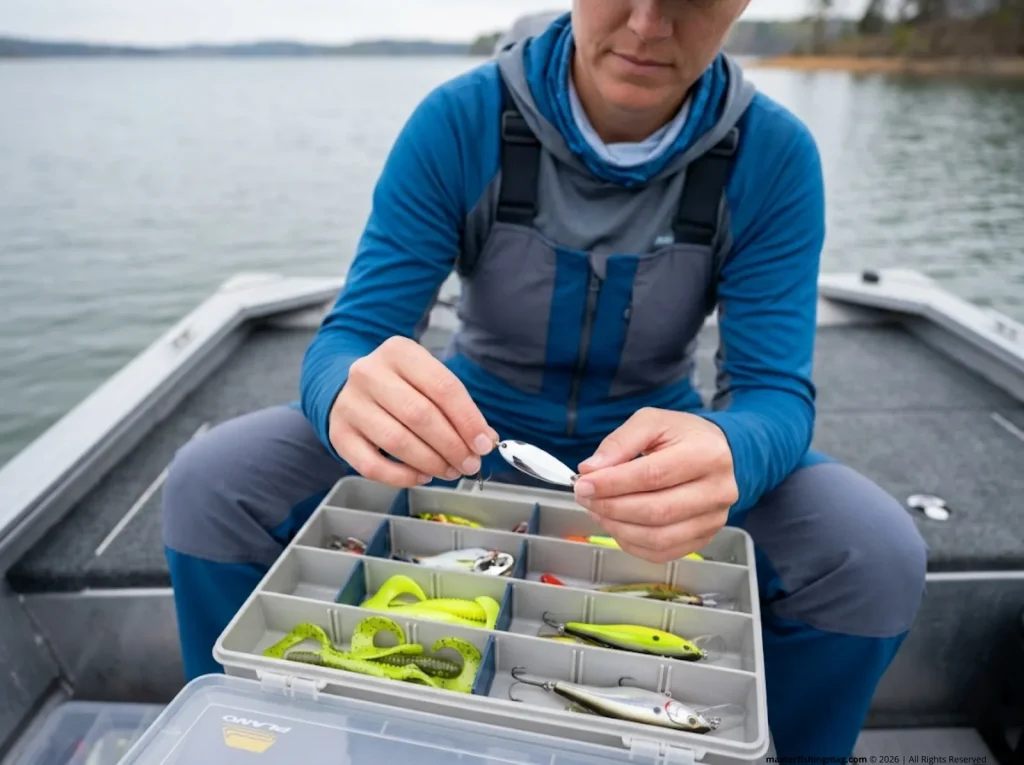
Your tackle tray for white bass fishing doesn’t need to be complicated. Four lure types cover every situation you’ll face.
War Eagle Jiggin’ Spoons (1/4 to 3/4 oz) are the workhorse. The fluttering descent on freefall mimics a dying shad, and that’s when most strikes happen. Heavier weights punch through to deep schools in summer and winter.
Bandit Series 200 crankbaits dive to about 8 feet and work as search baits when you’re covering water after post-spawn or during shallow power fishing situations. Crank them parallel to riprap banks.
Road Runner spinner heads with curly-tail grubs (1/8 to 1/4 oz) combine flash with tail action. These shine when fish are actively chasing near the surface and you need a horizontal presentation.
Marabou jigs in white or chartreuse round out the kit. They’re cheap, they work, and their soft pulsing action triggers bites when bass refuse hard baits. Stick to white lures and chartreuse lures — these colors match threadfin shad and gizzard shad profiles across all water clarities.
Pro tip: If fish follow your lure but won’t commit, downsize. A 1/8 oz curly-tail grub on a light jighead lands the hesitant fish that reject heavier presentations. I keep a rod pre-rigged with a small grub specifically for this situation.
When to Switch Lures Mid-Frenzy
Start with a casting lure when you see surface boils. The moment the blitz dies and fish sound, switch immediately to a jigging spoon and go vertical. This transition is where most anglers lose the bite — they keep casting to dead water instead of dropping straight down where the fish went.
Night sessions near dock lights call for smaller-profile marabou jigs. Whether you’re tying direct to a jig versus using a snap swivel matters here — the jig needs maximum freedom to pulse in that tight light cone.
Boat Positioning and Approach Tactics
How to Approach a Visible School
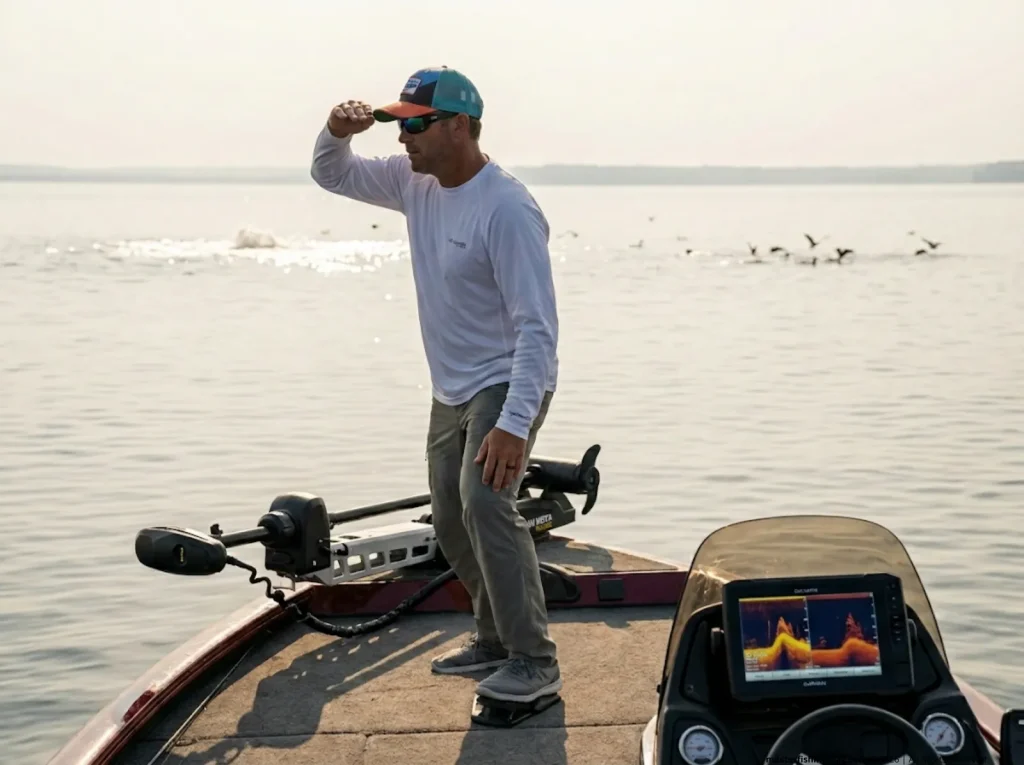
This is where most anglers blow it before they even make a cast. Running your bass boat motor directly into a visible school scatters the bait ball and disperses the fish in seconds. Kill the main engine at 100 yards and use your trolling motor on low to drift into casting range.
Position yourself ahead of the school’s direction of travel, not behind it. You want the feeding school to come to you, not the other way around. Cast to the outside edges of the boil — never fire through the center.
The Splashing Fish Technique
When you hook a white bass, resist the urge to rip it straight into the boat. Instead, keep hooked fish splashing at the surface beside the boat for 10-15 seconds. The vibration and commotion draw schoolmates upward through competitive instinct.
While that first fish kicks at the surface, drop a second rod straight down. You’ll often hook another within seconds. This builds a self-sustaining cycle — more noise, more investigation, more bites. It’s the single most effective tactic I’ve found for turning one fish into a limit.
Electronics and Sonar for Locating Deep Schools
When the surface goes quiet, your electronics sonar signatures become everything. Mark bait balls first — white bass hold just above or below concentrated shad. Those tightly packed arches on your screen separated from a denser cloud of baitfish are exactly what you’re looking for.
In summer, scan for arches suspended near the thermocline on structure — lake humps, lake points, and channel ledges. After a boil dies, check directly below the last surface activity. Fish often drop 10-20 feet and hold. Side imaging lets you cover horizontal distances along breaklines to find them when they scatter, and reading structure points and humps on your sonar gives you the framework for interpreting what those marks mean.
Presentation Techniques That Close the Deal
Horizontal Casting for Surface Feeders
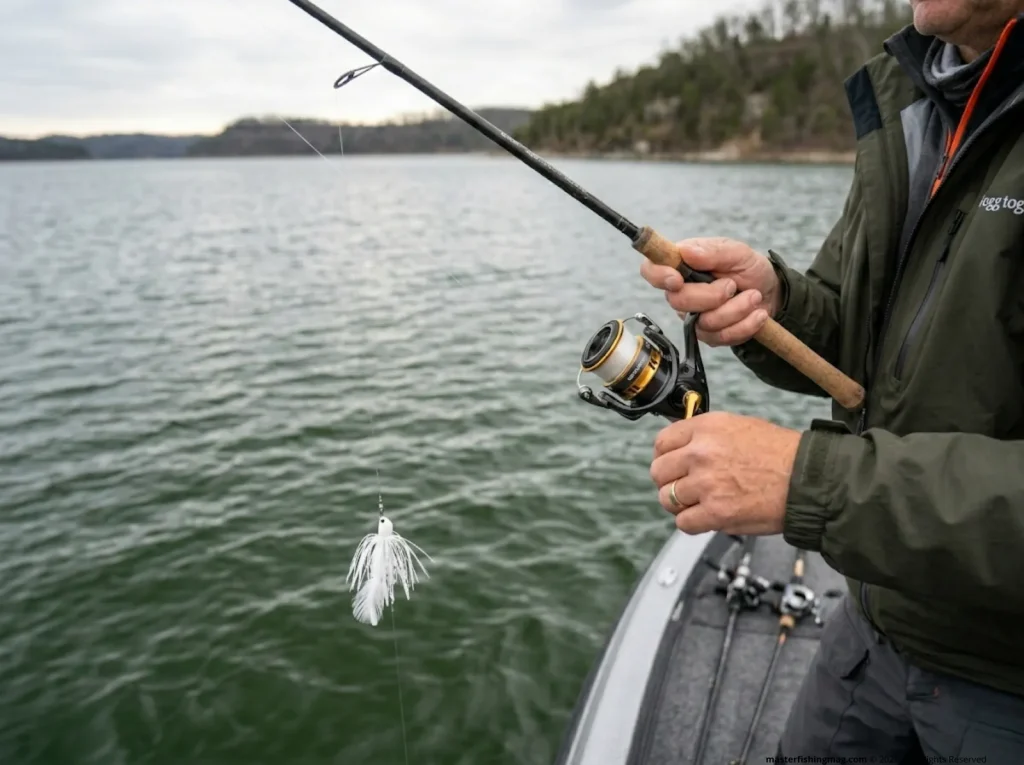
When white bass are visibly blitzing, fan-cast a 1/4 oz Road Runner or Bandit Series 200 across the boil’s edge. Retrieve at a steady, moderate pace — just fast enough to keep the spinner blade turning or the crankbait vibrating.
If fish are feeding just below the surface without actually breaking, count your lure down 3-5 seconds before starting your retrieve. Short, sharp twitches work when steady retrieve fails. The erratic movement mimics a panicking shad separating from the school, and that separation trigger is what draws the strike.
Vertical Jigging Strokes for Deep and Post-Boil Fish
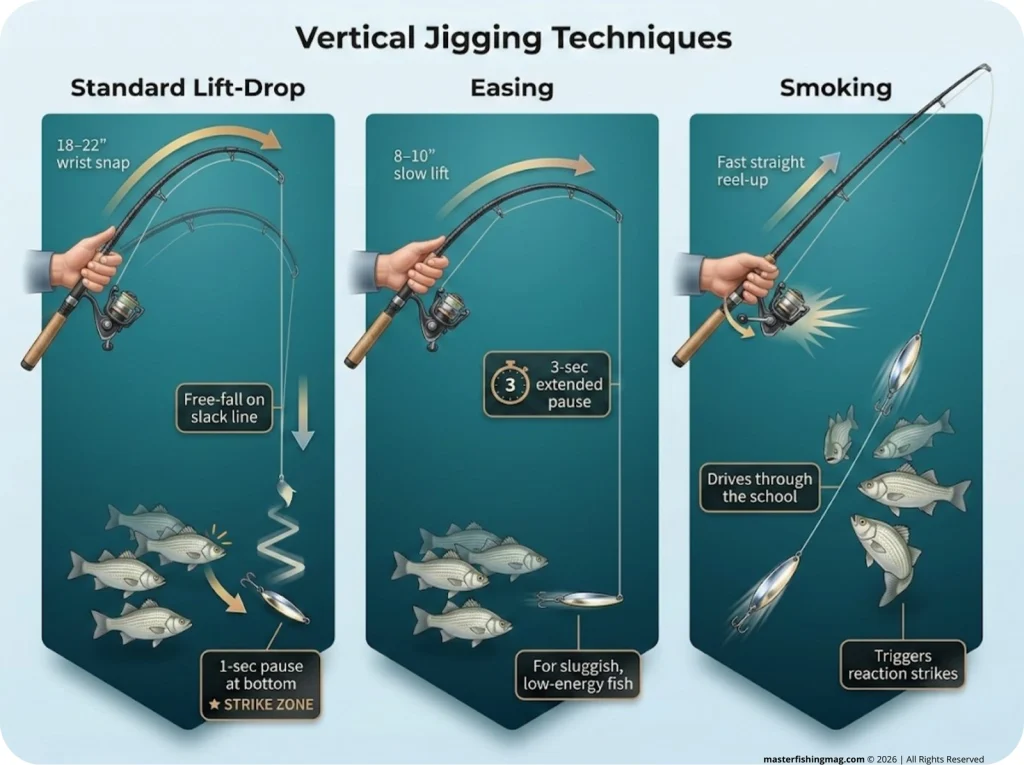
The standard lift-drop retrieve is an 18-22 inch wrist snap upward, then free-fall on slack line. Most strikes come on the drop when the spoon flutters. That one-second pause at the bottom of each drop is mandatory — it’s when the fluttering action converts follows into commitments.
For sluggish deep schools that reject the standard stroke, try “easing” — slow 8-10 inch lifts with extended 3-second pauses. This matches low-energy fish that won’t chase.
When fish are suspended and ignoring subtle presentations, flip the script. “Smoking” the spoon means reeling fast straight through the school. The aggressive speed triggers competitive reaction strikes from fish that wouldn’t budge for a standard cadence. I learned this from the fundamentals of deep vertical jigging and adapted it specifically for white bass behavior.
Retrieve Variations by Season
Spring post-spawn fish respond to aggressive retrieves. They’re hungry and competitive after burning energy on spawning.
Summer demands slow vertical approaches. Let the spoon do the work on the freefall and resist the urge to speed up.
Fall is fastest. Match the frenzy energy with speed — white bass during fall surface jumps are the most aggressive versions of themselves.
Winter calls for the slowest presentations of the year. Three to five-second pauses between subtle lifts. Patience wins, as noted by the U.S. Fish and Wildlife Service in their species behavioral profiles.
Night Fishing and Low-Light Tactics
Dock Lights and How They Concentrate Fish
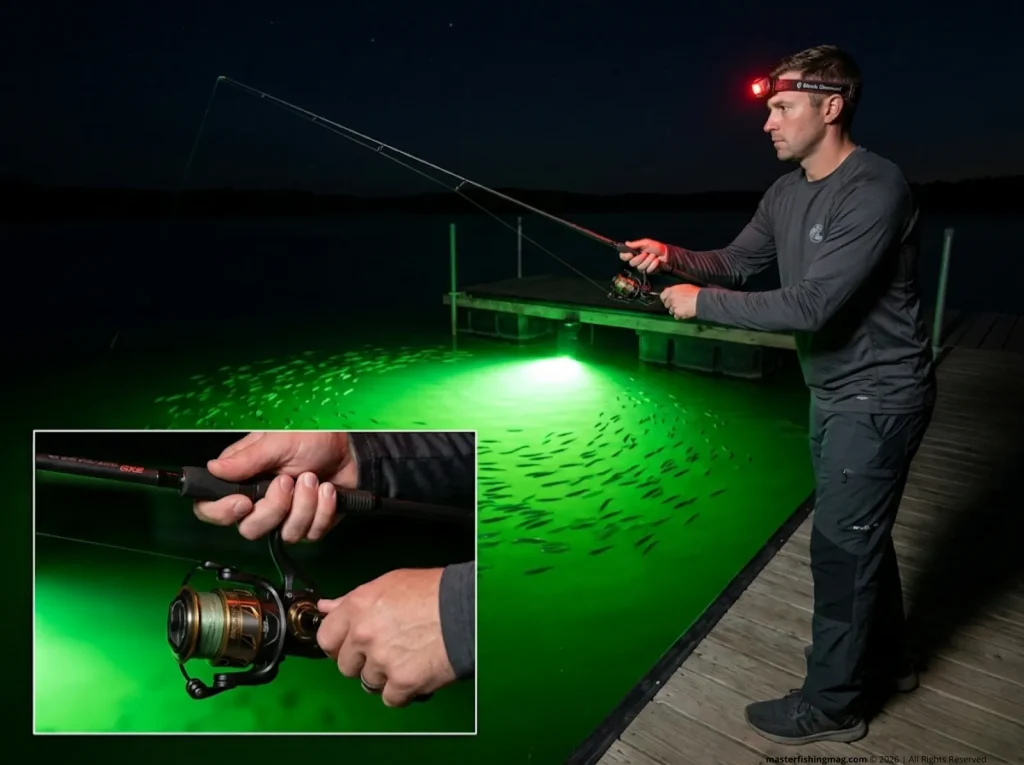
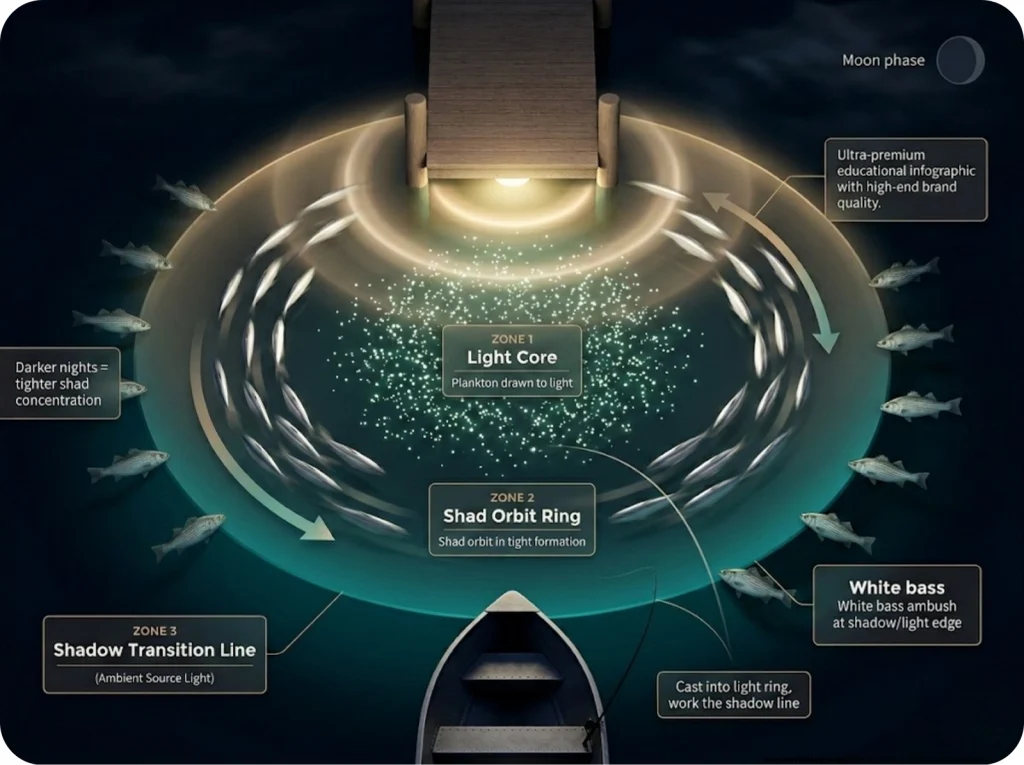
Night fishing under lights is the most underused tactic in the white bass playbook. Artificial dock lights attract plankton, which draws shad into tight orbiting circles beneath the surface. White bass follow.
The timing detail most people miss: darker nights produce better results. Moonlight dilutes the concentrating effect of artificial light on baitfish. New moon periods with minimal ambient light create the tightest shad concentration and the most aggressive feeding. Understanding how moon phases affect feeding behavior gives you a massive edge in planning these sessions.
Position your boat just outside the light ring and cast into the illuminated zone. Work the shadow-to-light transition line where white bass ambush shad leaving the bright zone.
Dawn and Dusk Windows
First light and last light remain the most reliable white bass action windows across all seasons. In fall, extend your evening session 30-45 minutes past sunset. Schooling activity often peaks in fading light when shad are most vulnerable and struggling to maintain school formation.
Pro tip: On calm evenings, kill your trolling motor completely during the last 20 minutes of light. In dead-calm conditions, even a quiet trolling motor pushes enough vibration to scatter a nervous surface school. Drift in silence and let your ears find the next boil.
Conservation and Handling for the Table
Why Selective Harvest Works for This Species
White bass are one of the few freshwater fish where generous harvest actually makes biological sense. In Texas, the bag limit is 25 fish per day with a 10-inch minimum — the most generous limit among gamefish species. That’s not reckless management. It reflects the biological reality of a fish that grows to 9-10 inches in its first year and rarely sees its sixth birthday.
Keep eating-size fish in the 10-14 inch range and release larger spawning females. Those bigger fish produce exponentially more eggs, and strong spring spawning runs depend on healthy female populations. Reservoir inflows in spring directly correlate with spawning success — years with strong flows produce banner schooling seasons one to two years later.
The science behind selective harvest regulations applies directly here. White bass can handle harvest pressure that would collapse a largemouth population, but protecting the breeding stock still matters.
Proper Handling on the Water
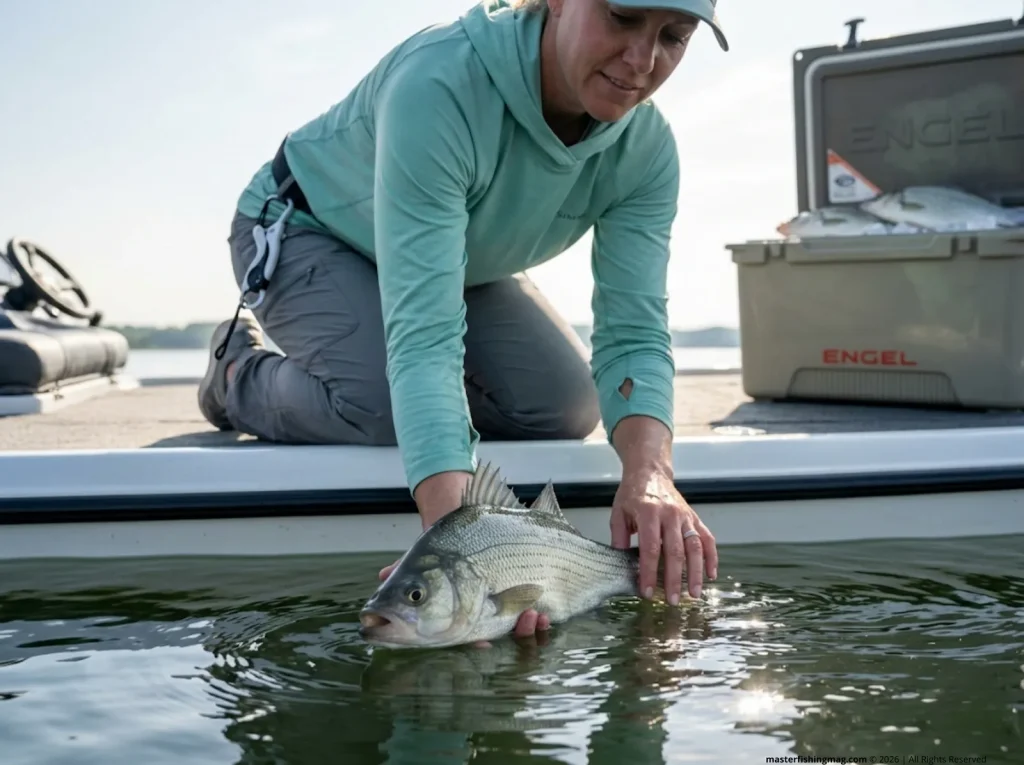
White bass have sharp gill plates and dorsal spines that will remind you to pay attention. Use lip grips or wet hands, and handle them with the same care you’d give any catch and release species you plan to let go.
For keepers, get them on ice immediately. White bass flesh deteriorates faster than most freshwater fish in warm conditions, and any delay between catch and cooler shows up on the plate. If releasing, minimize air exposure to under 15 seconds and revive in moving water before letting go. Table quality handling makes the difference between a memorable fish fry and a mushy disappointment.
Pro tip: Bleed white bass immediately after catching by snipping one gill arch with scissors. This removes the blood from the lateral line meat and produces noticeably cleaner-tasting fillets, especially on larger fish.
Conclusion
Three things separate anglers who consistently fill coolers from those who chase boils all day and come home frustrated.
First, stop chasing. Position ahead of the moving school, cast to the edges, and let the frenzy come to you. Second, when the surface goes quiet, drop straight down with a jigging spoon. The fish didn’t leave — they sank. Your sonar will prove it. Third, master the splashing fish technique. One hooked white bass kept vibrating at the surface creates a competitive chain reaction that turns a single catch into a limit.
Next time you see diving birds folding over a flat, resist the urge to run the boat straight into the action. Cut the motor early, drift into range, and work the edges. The difference is immediate, and once you feel it click, you’ll never go back to chasing.
FAQ
What is the best lure color for schooling white bass?
White and chartreuse consistently outperform other colors because they closely match threadfin shad and gizzard shad profiles. In stained water, chartreuse provides better visibility. In clear water, pearl or white produces more natural flash.
How do you find white bass when they aren’t surfacing?
Use your sonar to scan structure — lake humps, lake points, and channel ledges near the thermocline. Look for bait balls first. White bass typically hold just above or below concentrated shad. Side imaging helps cover horizontal water when schools are scattered.
What size jigging spoon works best for white bass?
1/4 oz for shallow or suspended fish under 15 feet, 1/2 oz for 15-30 feet, and 3/4 oz for winter fishing beyond 30 feet. Match spoon weight to depth so the flutter action stays in the strike zone on freefall.
Can you catch white bass from shore?
Absolutely. Focus on dam tailraces during spring spawning runs, bridge pilings near creek channels, and riprap banks where shad congregate. Long casts with 1/4 oz Road Runner spinner heads or Bandit Series 200 crankbaits cover the most water from a fixed position.
Why do white bass stop biting during a surface frenzy?
They haven’t stopped. Your lure is usually above or below their feeding depth. Count down a few seconds before retrieving, or switch to a vertical jigging spoon once the surface activity quiets. The school is still active — they just moved down in the water column.
Risk Disclaimer: Fishing, boating, and all related outdoor activities involve inherent risks that
can lead to injury. The information provided on Master Fishing Mag is for educational and informational purposes
only. While we strive for accuracy, the information, techniques, and advice on gear and safety are not a substitute
for your own best judgment, local knowledge, and adherence to official regulations. Fishing regulations, including
seasons, size limits, and species restrictions, change frequently and vary by location. Always consult the latest
official regulations from your local fish and wildlife agency before heading out. Proper handling of hooks, knives,
and other sharp equipment is essential for safety. Furthermore, be aware of local fish consumption advisories. By
using this website, you agree that you are solely responsible for your own safety and for complying with all
applicable laws. Any reliance you place on our content is strictly at your own risk. Master Fishing Mag and its
authors will not be held liable for any injury, damage, or loss sustained in connection with the use of the
information herein.
Affiliate Disclosure: We are a participant in the Amazon Services LLC Associates Program, an
affiliate advertising program designed to provide a means for us to earn advertising fees by advertising and linking
to Amazon.com. As an Amazon Associate, we earn from qualifying purchases. We also participate in other affiliate
programs and may receive a commission on products purchased through our links, at no extra cost to you. Additional
terms are found in the terms of service.