
In this article
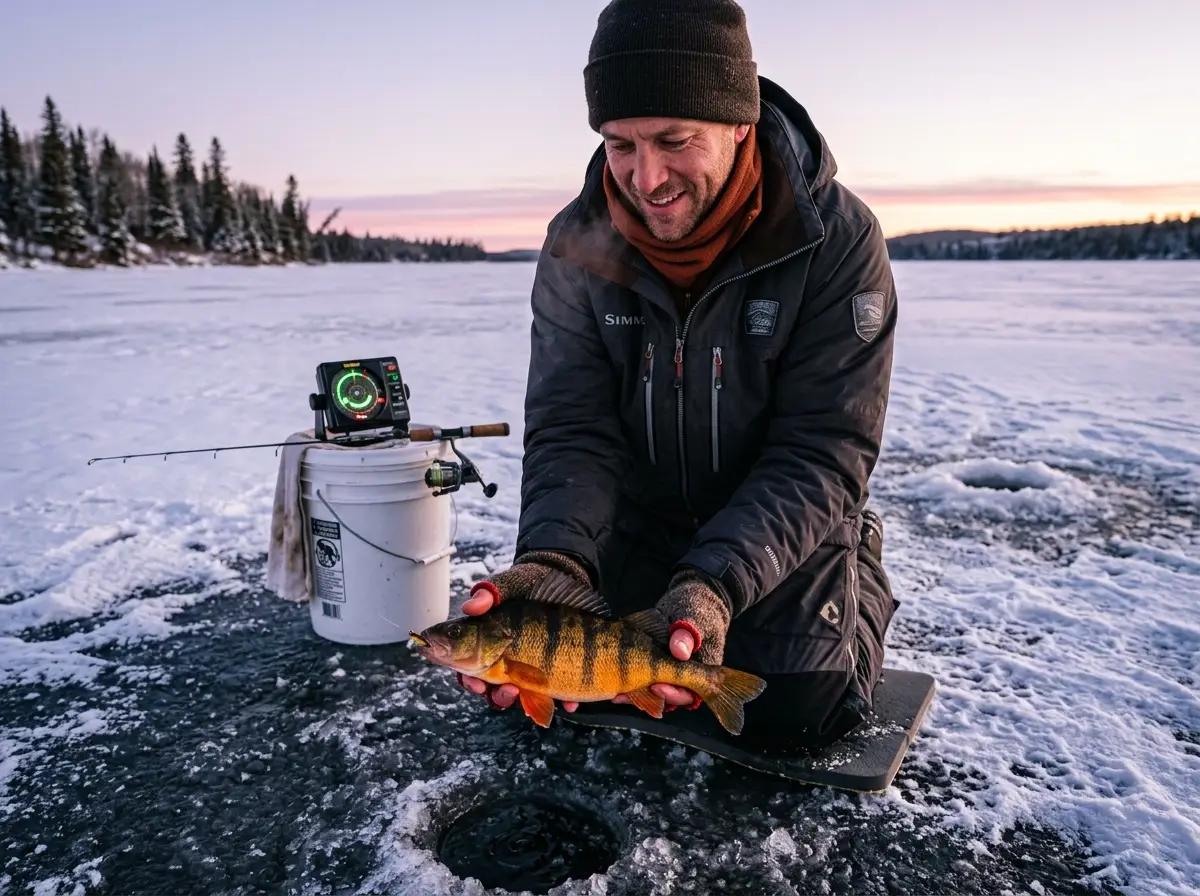
You’ve drilled fifteen holes, fished each one for twenty minutes, and the only thing biting is the wind. I’ve been there more times than I’ll admit. After years of chasing yellow perch through the ice across lakes in Minnesota, Wisconsin, and the Dakotas, I’ve figured out that most people don’t have a perch problem — they have a pattern problem. Here’s how to catch yellow perch through the ice by following where they actually go, reading what they’re telling you on electronics, and using the two-rod system that guides rely on every single day.
Quick Answer: Here’s how guides consistently catch yellow perch through the ice:
- Follow seasonal migration from shallow weeds to deep basins to pre-spawn staging areas
- Use 2-4 pound fluorocarbon and tungsten jigs sized 1/32 to 1/64 oz
- Tip artificials with wax worms or wigglers for extra conversion
- Run a two-rod system with one jigging rod and one dead-stick
- Read perch behavior on your flasher and adjust presentation in real time
- Fish falling barometric pressure windows for aggressive feeding
- Drill a grid pattern and move every 5-10 minutes until you find active fish
Where Yellow Perch Hold From First Ice to Last
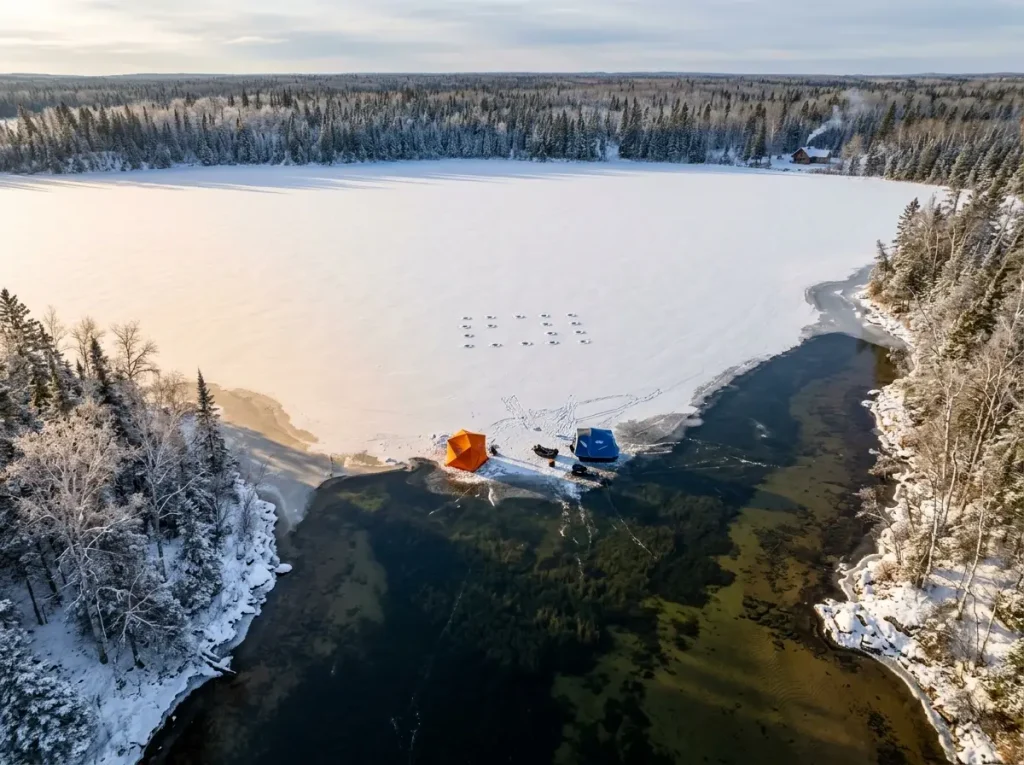
Most anglers pick a spot in November and fish it until March. The perch left that spot six weeks ago. Understanding the three-phase seasonal migration is the single biggest factor separating limits from skunks.
Early Ice — Shallow Weeds and Warm Edges
First ice perch are still thinking like fall perch. They hang around the last green weeds in less than ten feet of water, usually along shoreline flats or inside turns where vegetation survived into December. Those weeds trap residual warmth, hold invertebrates, and shelter the minnow schools that perch follow.
Look for patches of still-living vegetation on your electronics — they show up as green clutter on the bottom. Set up on the edges, not in the middle. Fishing directly over thick weed growth tangles your jig, and perch cruise the perimeter anyway.
Pro tip: Drill all your holes at once during early ice. Sound travels fast through thin ice, and a drill-fish-drill approach pushes shallow perch off the flat. Get your grid set, wait ten minutes, then start fishing the edges.
Mid-Winter — Deep Basins and Hard-Bottom Flats
By January on most northern lakes, dissolved oxygen drops in the shallows and perch relocate. They slide out to mid-lake flats and hard-bottom basins in 20 to 40 feet of water, staging along the transition where sand or gravel meets softer muck. That transition line is where bottom organisms concentrate, and perch know it.
This is where understanding the oxygen squeeze that moves winter panfish makes a real difference. The same dissolved oxygen dynamics that push crappie and bluegill to deeper water affect perch in exactly the same way. Find the oxygen, find the fish.
A contour map app on your phone is worth more than a $300 flasher during mid-winter. Pull up the lake map before you drive out, identify the hard-bottom flats between 25 and 35 feet, and start there.
Late Ice — Pre-Spawn Staging Near Spawning Bays
Late ice is the window most anglers miss entirely — and it produces the biggest perch of the season. As days get longer and water starts warming under the ice, perch migrate back toward spawning bays and sit in 12 to 20 feet of water near areas with a mix of rocks and remaining vegetation.
The U.S. Fish & Wildlife Service’s species profile for yellow perch confirms they prefer moderate water temperatures and are found in lakes and slow-moving rivers across the northern U.S. According to the Minnesota DNR’s perch fishing guide, they spawn when water temperatures reach 45 to 52 degrees, which in most northern states happens between April and early May. The weeks before that are when pre-spawn females are loading up on food. They’re aggressive, they’re concentrated, and they’re big. If you only fish perch one week a year, make it late ice.
Gear and Tackle for Perch Through the Ice
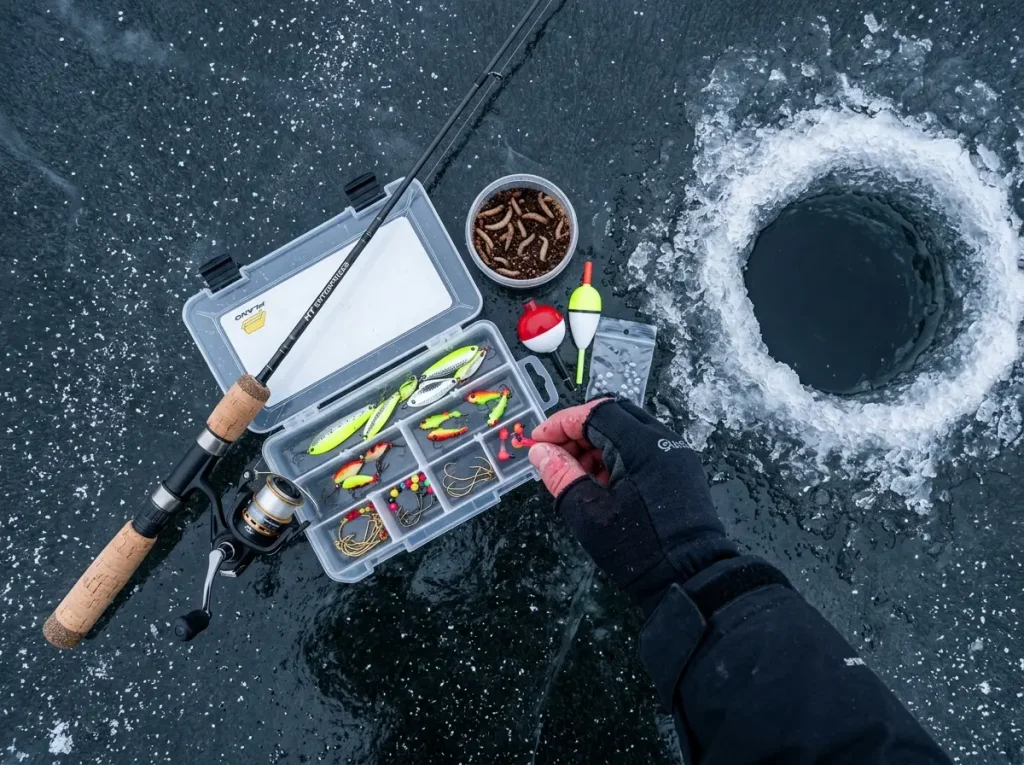
Most beginners grab whatever panfish rod they already own and wonder why they miss half the bites. Perch bite differently than bluegill — they inspect, they mouth, and they reject faster than you’d think. Your gear needs to match that behavior.
Rods, Reels, and Line Selection
An ultralight ice rod between 24 and 28 inches with a fast tip is the standard. You want enough sensitivity to feel a perch mouthing a wax worm at 30 feet, but enough backbone to set the hook through the water column. Pair it with a small spinning reel spooled with 2 to 4 pound fluorocarbon. Perch have good eyesight and they inspect bait before committing — heavy line gets looked at and rejected.
If you’re shopping for ultralight setups, our ultralight spinning combo breakdown covers the same sensitivity and backbone balance for open-water work. The principles transfer directly to ice rods.
Tungsten vs Lead Jigs — Why Weight Density Matters
Tungsten jigs are denser than lead, meaning a 1/32 oz tungsten jig is physically smaller than a 1/32 oz lead jig. Smaller profile, same weight, faster fall rate. For perch in 25+ feet of water, that matters. You get your bait down faster and the smaller presentation matches what finicky mid-winter perch want to eat.
Common sizes for perch run from 1/16 oz (early ice, aggressive fish) down to 1/64 oz (mid-winter, negative fish). Start with 1/32 oz and adjust based on what you’re seeing on electronics.
The Slip Bobber Setup That Catches Lazy Perch
Your second rod should run a slip bobber rig. Thread a bobber stop onto the line, add a small slip bobber, and tie on a plain gold hook or small jig tipped with a minnow or wax worm. Set the depth so your bait hangs 6 to 12 inches off the bottom. This is your dead-stick rod. It sits, it waits, and on plenty of days it outfishes the rod in your hand.
For the full breakdown of slip bobber mechanics, setting up a slip bobber rig covers the depth-setting technique in detail.
Best Baits and Lures for Yellow Perch Under the Ice
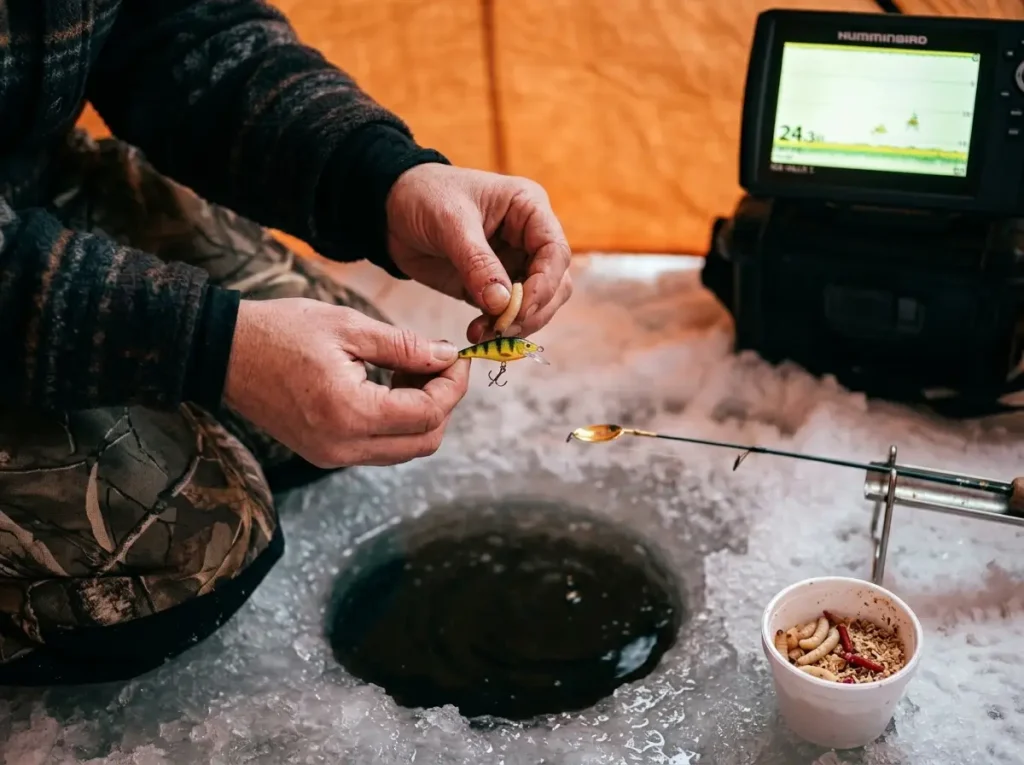
Every angler you meet on the ice has an opinion about bait. Most of them are right — for that particular day. The trick is carrying enough options to match what the perch want right now, not what worked last Saturday.
Live Bait That Perch Can’t Refuse
Wax worms are the standard for a reason. They’re small, they stay alive in cold weather, and perch eat them without hesitation. Wigglers (mayfly larvae, also sold as Eurolarvae) are even better when you can find them — their natural movement under water triggers strikes that plastic never will.
Minnows work best on the dead-stick rod. Hook them through the back just behind the dorsal fin for a dead-stick presentation, or through the lips if you’re jigging. If you want your minnows to stay lively all day, how to rig live minnows properly covers the hooking methods and bait care that most people skip.
Pro tip: Keep your bait container inside your jacket, not sitting on the ice. Cold-stunned wax worms don’t move, and a dead wax worm on a jig catches half as many fish as one that’s still squirming.
Artificial Lures That Outfish Live Bait on Tough Days
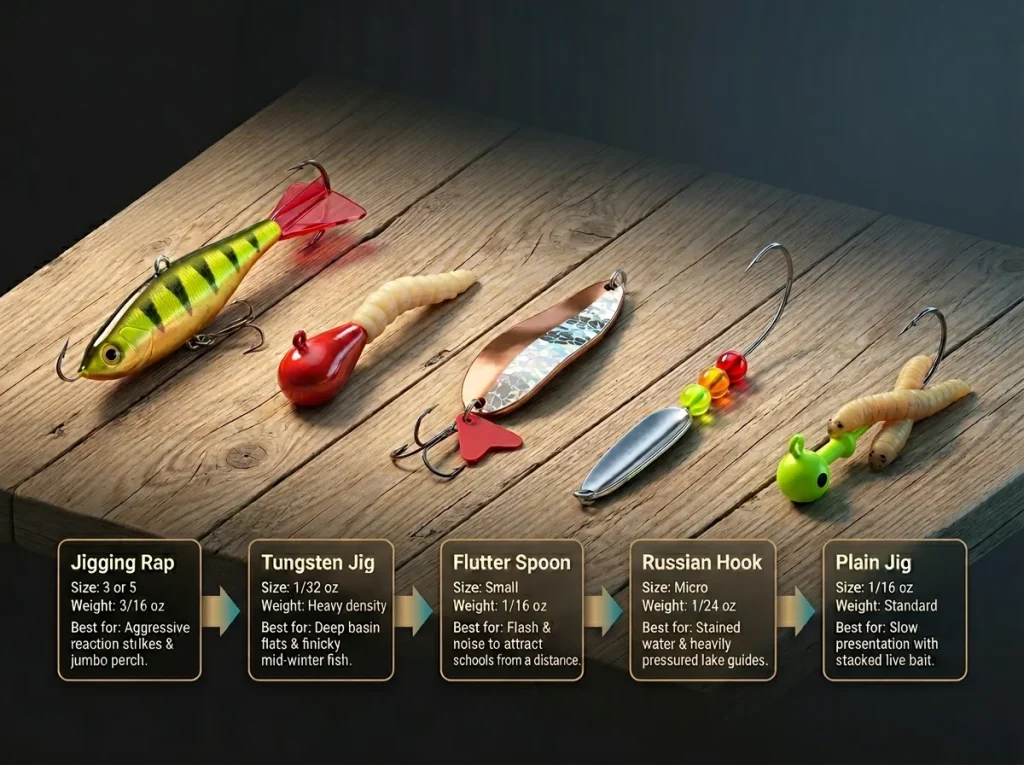
The Rapala Jigging Rap in perch pattern has probably caught more ice perch than any other single lure. Its darting horizontal action on the jig stroke triggers reaction strikes from perch that won’t touch live bait. Size 3 or 5, depending on whether you’re targeting keepers or jumbos.
VMC Tungsten Fly Jigs in glow red or firetiger are the go-to for micro presentations. Small flutter spoons like the Northland Buck-Shot Rattle Spoon add flash and noise to pull fish in from a distance. And Russian Hooks with colored beads are a sleeper pick — guides on Lake Simcoe and Devils Lake have been using them for years before they caught on everywhere else.
Color matters more than most people think. Chartreuse and glow colors work on overcast days and in stained water. Natural browns, coppers, and silvers outperform on bluebird days with clear ice. Carry both and switch when the bite dies.
The Two-Rod System Guides Won’t Explain
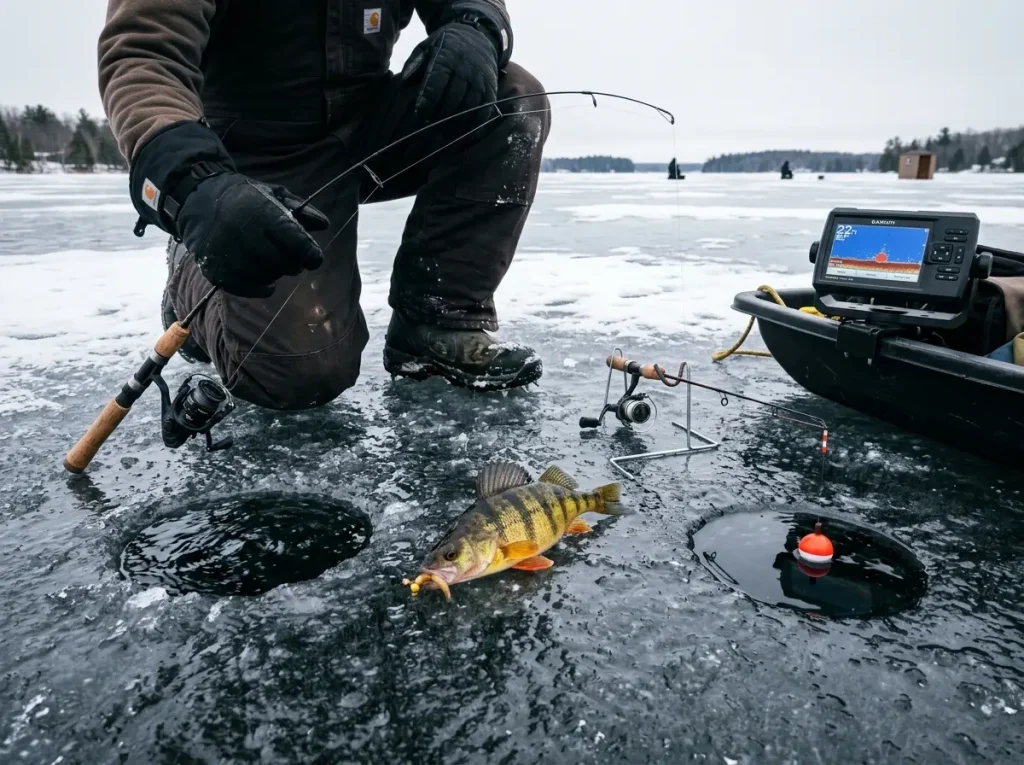
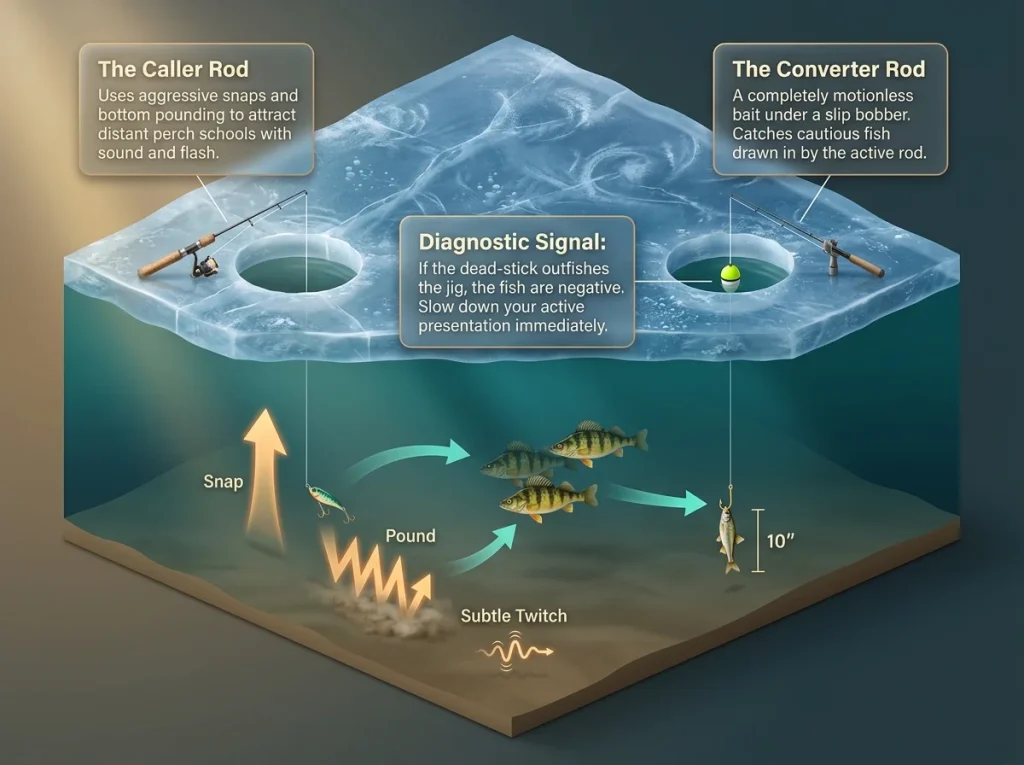
In states like Minnesota, you can legally fish two lines through the ice. Most people set up two rods doing the same thing. Guides don’t. They run a system — one rod attracts fish, the other converts them. Which rod gets bit tells you what the perch are feeling that day.
The Aggressive Rod — Jigging Cadence and Rhythm
Your jigging rod is the caller. It makes noise, moves water, and pulls perch toward your area from twenty or thirty feet away. Start aggressive — pound the bottom two or three times to kick up sediment, then snap the jig up 12 to 18 inches and let it flutter back down. Perch hear that and come investigate.
Once you see marks on your flasher, change gears. Switch from aggressive snaps to subtle lifts of one to two inches. Hold the jig still for three seconds. Tiny twitch. Hold again. This is where most people blow it — they keep jigging aggressively after the fish arrive and spook them right back out.
The rhythm goes: loud to attract, quiet to convert. Think of it like calling in a dog. You whistle from across the yard, but once they’re close, you just hold out your hand.
The Dead-Stick — Let the Fish Tell You What They Want
Set your dead-stick rod three to four feet from your jigging hole. A minnow or wax worm under a slip bobber, hanging 6 to 12 inches off bottom, motionless. That’s it.
Here’s the part nobody explains: which rod catches more fish is diagnostic information. If the jigging rod catches most of the perch, the fish are active and aggressive. Keep jigging. If the dead-stick starts outfishing the jig, the perch are negative. They’re interested enough to drift over (your jig attracted them) but too cautious to hit an active presentation. That’s your cue to slow everything down. Go to a smaller jig on the active rod, slow your cadence to nearly nothing, and let the dead-stick do the heavy lifting.
I’ve had days where the dead-stick caught four out of every five fish. That tells you everything. The fish are there, they’re feeding, but they want a motionless bait. You’d never know that if you only fished one rod.
Reading Perch on Your Flasher Like a Guide
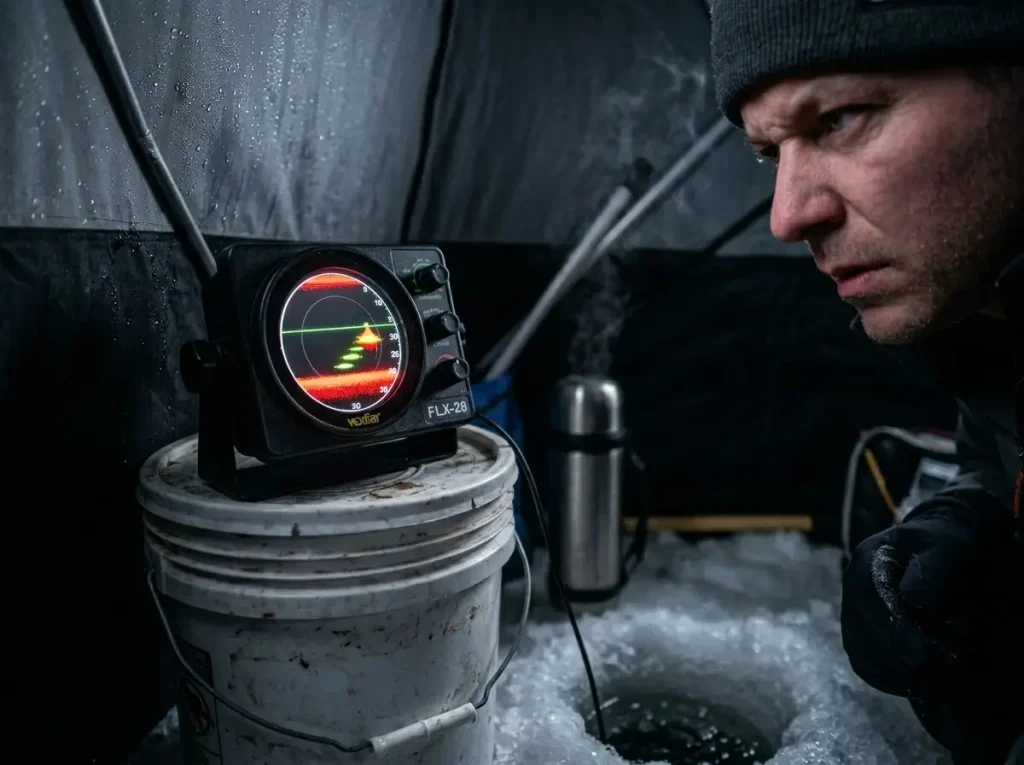
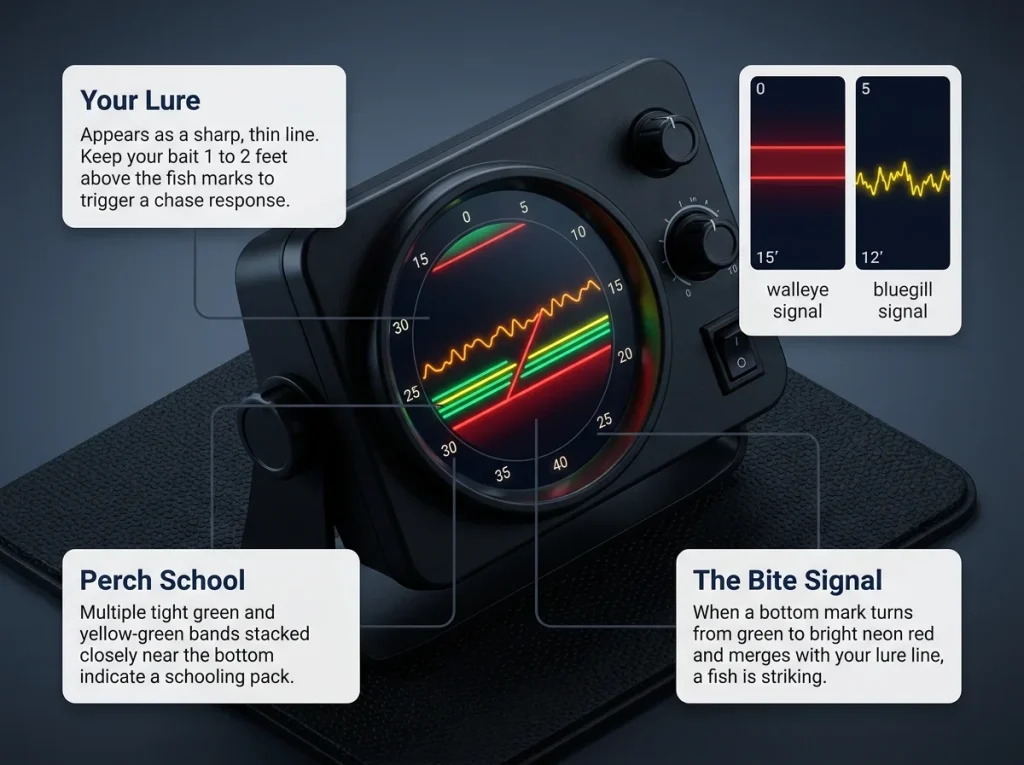
A flasher is not a fish-finder in the way most people think. It doesn’t just tell you if fish are down there. It tells you what they’re doing, how they feel about your bait, and what to change. Most people stare at it like a television. Guides read it like a conversation.
What Perch Marks Look Like vs Other Species
Perch marks on a flasher show up as tight clusters of green or yellow-green near the bottom, often within two to four feet of it. They travel in schools, so you’ll see multiple marks appear at roughly the same depth. Walleye marks, by contrast, are larger, usually solitary, and tend to suspend higher in the water column.
When a perch investigates your jig, you’ll see a green mark rise from the cluster toward your lure. If it transitions from green to yellow to red, the fish is directly below your jig and likely about to bite. That color progression — green to red — is the fish closing distance. Once it goes red, be ready.
If you’re having trouble getting clear marks at all, check that your gain is set right. Turn it up until you see interference on the screen, then back it off just until the screen clears. That gives you maximum sensitivity. If your fish finder is showing no bottom reading at all, troubleshooting fish finder issues covers the most common fixes.
How to Adjust When Fish Won’t Commit
You see marks rise toward your jig and then drop back down. This is the most frustrating thing on ice. It means the perch are interested but something about your presentation is wrong.
Try these adjustments in order: first, stop jigging entirely and hold the bait dead still. If that doesn’t convert, downsize your jig by one size. If that doesn’t work, switch colors. If nothing converts, change bait — go from a wax worm to a wiggler, or tip your artificial with a small piece of live bait. Sometimes one perch eye threaded onto the hook is what breaks the stalemate.
Pro tip: When perch marks rise toward your jig but won’t commit, try raising your jig slowly — pull it up a foot, then hold. This triggers a chase response. A perch that won’t go down for a bait will sometimes race up to catch one that’s leaving.
Why Barometric Pressure Matters More Than You Think
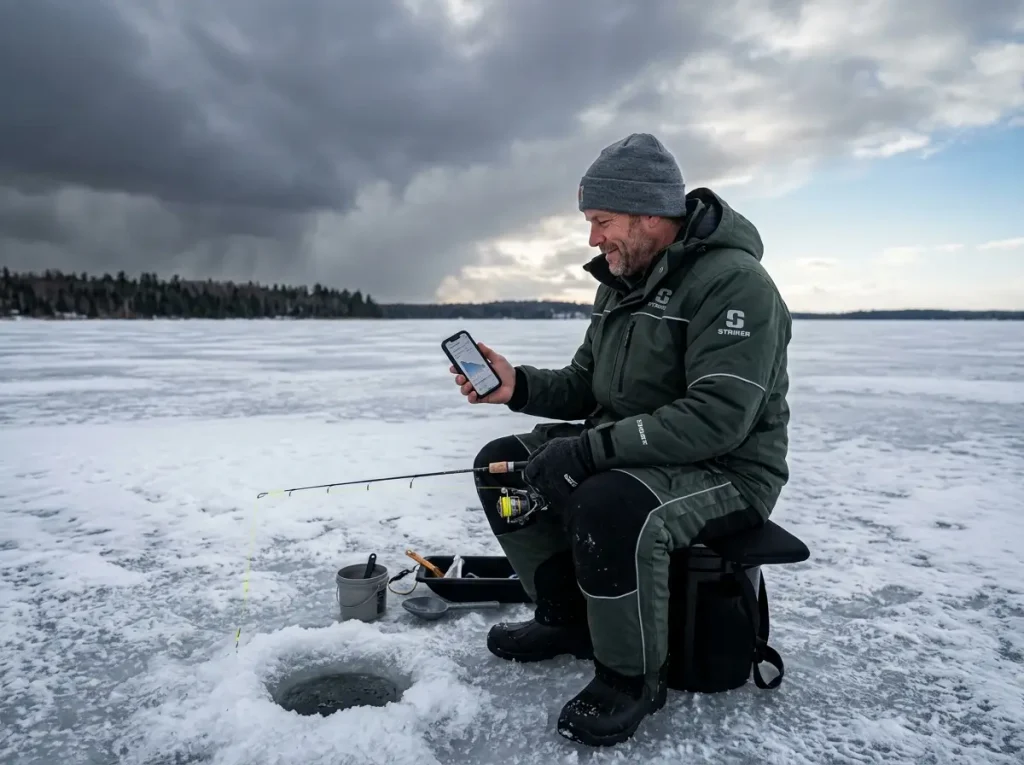
Most ice anglers check the weather forecast for temperature and wind. Almost nobody checks barometric pressure. That’s a mistake. A 2014 study from Bemidji State University found that changes in barometric pressure directly correlate with yellow perch feeding activity. Not all weather is equal when it comes to putting fish on the ice.
The Falling Pressure Feeding Window
When a low-pressure system approaches and the barometer starts dropping, perch feed aggressively. They move higher in the water column, chase lures with more conviction, and hit the jig rod instead of waiting for the dead-stick. If you see a storm system arriving in the next 12 to 24 hours, that’s your green light.
The best bites I’ve had through the ice have been on days when the sky was getting gray and the pressure was actively falling. It sounds counterintuitive — you’d think calm bluebird days would fish better. They don’t. Stable high pressure tends to push perch tight to the bottom and make them lock their jaws. The fish are still there, but they’re barely interested.
High Pressure Lockjaw and What to Do About It
On post-front bluebird days with high, stable pressure, perch get difficult. You’ll mark fish on the flasher but they won’t commit to anything. When this happens, go small. Drop to your lightest tungsten jig, use a wiggler instead of a wax worm, and barely move the rod. Dead-stick presentations outperform jigging almost every time during high-pressure windows.
The practical takeaway: check a weather app with barometric pressure before you load the truck. A falling barometer is worth getting up early for. A rising barometer after a front means you’ll work harder for every fish. Plan your trips around pressure trends when you can.
Drilling a Grid and the Hole-Hopping Approach
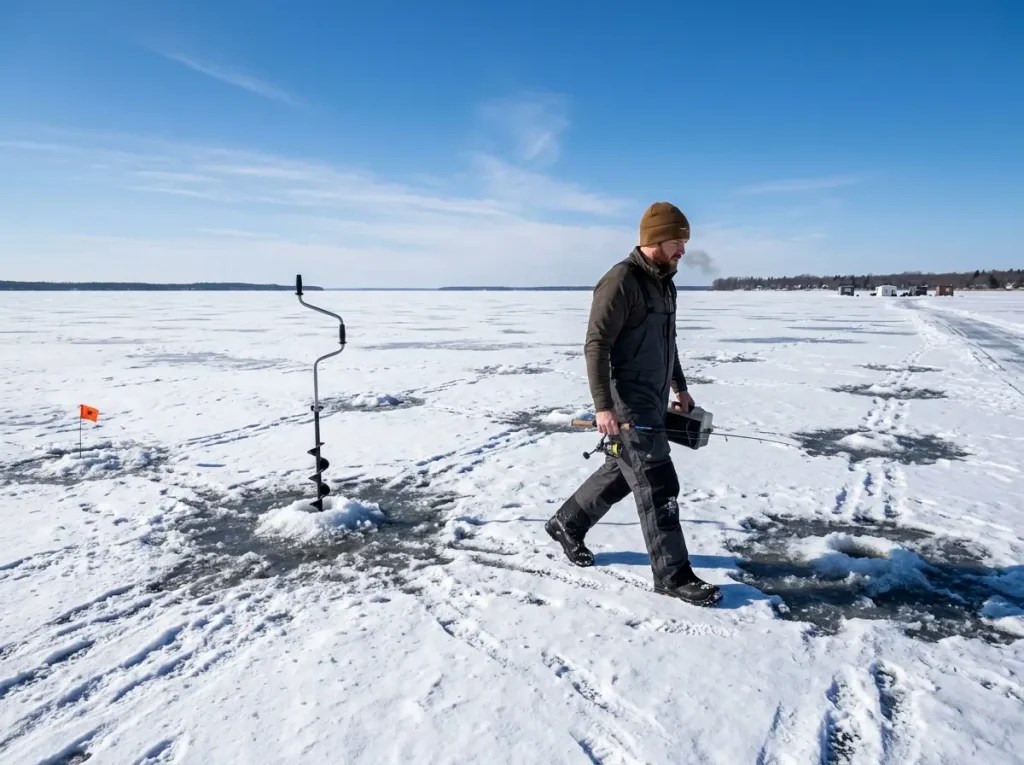
Patience is a virtue in most fishing. Ice fishing for perch is the exception. Sitting over one hole for two hours while the fish are 50 yards away is the most common mistake I watch people make. Perch move. Your holes need to cover ground.
How to Set Up a Productive Hole Pattern
Before you wet a line, drill a grid. Space your holes 20 to 30 feet apart along the structure edge you identified from your contour map — the weed line during early ice, the hard-to-soft bottom transition during mid-winter, or the edge of a spawning bay during late ice.
Eight to twelve holes is a good starting grid. Drill them all at once, then walk away and give the area ten minutes to settle. For understanding how to identify and fish structure like points and humps, the same principles that work in open water apply under the ice.
When to Move and When to Wait
Fish each hole for five to ten minutes. If you don’t mark anything on your flasher, move. If you mark fish but can’t get them to bite after switching baits and presentations, move. The only time you stay put is when you’re catching fish or when you’re marking active fish that are clearly feeding.
One hack: look at other anglers on the lake. Where the crowd congregates tells you where fish were biting yesterday or earlier that morning. Start there if you don’t have your own intel, then adjust based on what you find.
Catch More Perch by Thinking Like a Guide
Three things separate the anglers who fill a bucket from the ones staring at still bobbers all day. First, follow the seasonal migration — stop fishing the same spot from December through March. Perch move from shallow weeds to deep basins to pre-spawn staging areas, and your holes need to follow them. Second, let your two rods talk to you. Which rod gets bit tells you whether the fish want action or stillness, and adjusting based on that signal is worth more than any lure swap. Third, watch the barometer. Falling pressure is your green light for an aggressive approach; high pressure means go small, go slow, and let the dead-stick work.
Next time out, drill twice as many holes as you think you need and move faster than feels comfortable. The perch are there. You just haven’t found them yet.
Q1 What depth do yellow perch sit at under the ice?
Yellow perch depth changes through the season. Early ice, they hold in 5 to 10 feet near surviving weeds. Mid-winter pushes them to 20 to 40 feet on hard-bottom flats. Late ice brings them back to 12 to 20 feet near spawning bays.
Q2 What is the best bait for yellow perch ice fishing?
Wax worms tipped on a small tungsten jig are the most consistent bait for yellow perch through the ice. Wigglers and Eurolarvae outperform wax worms on tough days. Minnows work best on a dead-stick rod under a slip bobber.
Q3 What time of day are perch most active under the ice?
Perch bite best during low-light periods, especially one hour before sunrise through two hours after dawn. Evening windows from 4 to 7 PM produce consistent action too. Midday fishing works during falling barometric pressure or overcast conditions.
Q4 Do you need a flasher to ice fish for perch?
You can catch perch without a flasher, but one dramatically improves your success. A flasher shows you fish depth, how they react to your jig, and whether they are active or negative. Even a basic unit like the Vexilar FLX-28 pays for itself in saved time.
Q5 What pound test line for perch through the ice?
Two to four pound fluorocarbon is the standard for yellow perch. Perch inspect bait closely before biting, and heavier line gets noticed. Use 2 pound test in clear water or when fish are finicky, and 4 pound test in stained water or around structure.
Risk Disclaimer: Fishing, boating, and all related outdoor activities involve inherent risks that
can lead to injury. The information provided on Master Fishing Mag is for educational and informational purposes
only. While we strive for accuracy, the information, techniques, and advice on gear and safety are not a substitute
for your own best judgment, local knowledge, and adherence to official regulations. Fishing regulations, including
seasons, size limits, and species restrictions, change frequently and vary by location. Always consult the latest
official regulations from your local fish and wildlife agency before heading out. Proper handling of hooks, knives,
and other sharp equipment is essential for safety. Furthermore, be aware of local fish consumption advisories. By
using this website, you agree that you are solely responsible for your own safety and for complying with all
applicable laws. Any reliance you place on our content is strictly at your own risk. Master Fishing Mag and its
authors will not be held liable for any injury, damage, or loss sustained in connection with the use of the
information herein.
Affiliate Disclosure: We are a participant in the Amazon Services LLC Associates Program, an
affiliate advertising program designed to provide a means for us to earn advertising fees by advertising and linking
to Amazon.com. As an Amazon Associate, we earn from qualifying purchases. We also participate in other affiliate
programs and may receive a commission on products purchased through our links, at no extra cost to you. Additional
terms are found in the terms of service.