
In this article
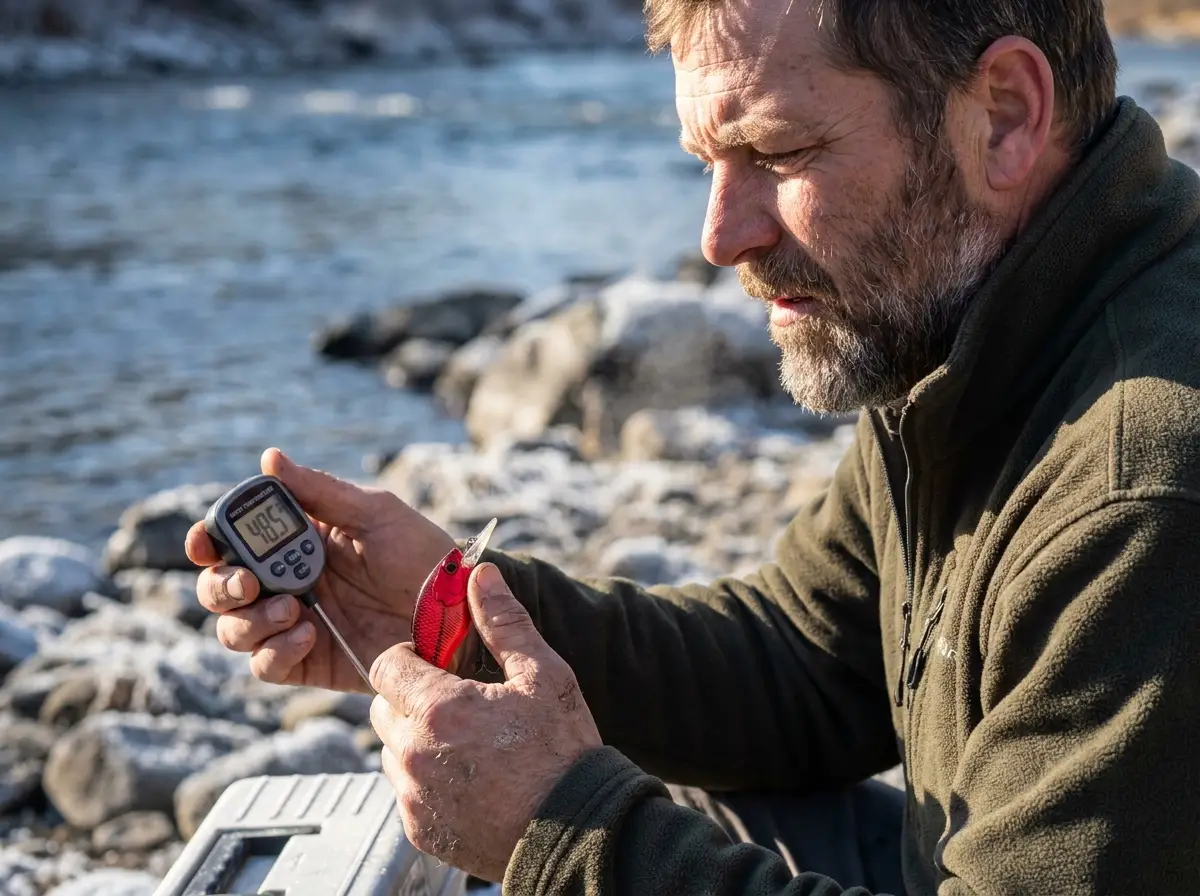
The ice has only been gone a few days, the water is a dense 39°F, and you’re vibrating a Sex Shad crankbait through the water column without a single strike. Then, frustrated, you tie on a muted, flat-sided Rayburn Red balsa bait and immediately get annihilated on the first laydown. What felt like an intuitive decision was actually just limnology playing out at the end of your line.
After a few decades chunking hardbaits across the country, you learn that crankbait color selection is an exact physical equation, not a guessing game on the boat ramp. The water temperature dictates everything you do. It physically alters how light penetrates the lake and biochemically throttles the processing speed of a predatory fish’s optic nerve. When you adjust your condition-to-color strategy around the thermometer instead of pulling a random box from your dry storage, you stop hoping and start calculating.
If you want to catch fish consistently, you must understand how the environment manipulates the lures you buy. Let your thermometer dictate your next cast, and you will dramatically shift the odds in your favor. Here is exactly how to leverage physics and biology to put more fish in your boat this year.
⚡ Quick Answer: Crankbait color visibility is biologically and physically dictated by water temperature. In cold water below 50°F, maximum water density bends light severely, requiring sharp contrast like Rayburn Red or chartreuse so lethargic bass can process the image. As water warms past 60°F, visual processing speed increases, demanding matching forage phenotypes like translucent shad or natural craws. Let the thermometer decide your color.
| Forage State and Target Spectrum by Temperature | ||
|---|---|---|
| Temperature Range | Forage State | Target Spectrum |
| Sub-50°F | Cold Shocked Shad / Pre-Molt | High-Contrast Red / Solid Chartreuse |
| 50°F – 65°F | Recovering Molt / Transitional | Orange/Brown Bellies / Semi-Translucent |
| 65°F+ | Active / Fleeing Baitfish | High-Flash Chrome / Natural Ghost |
The Optical Physics of Freshwater Spectral Penetration
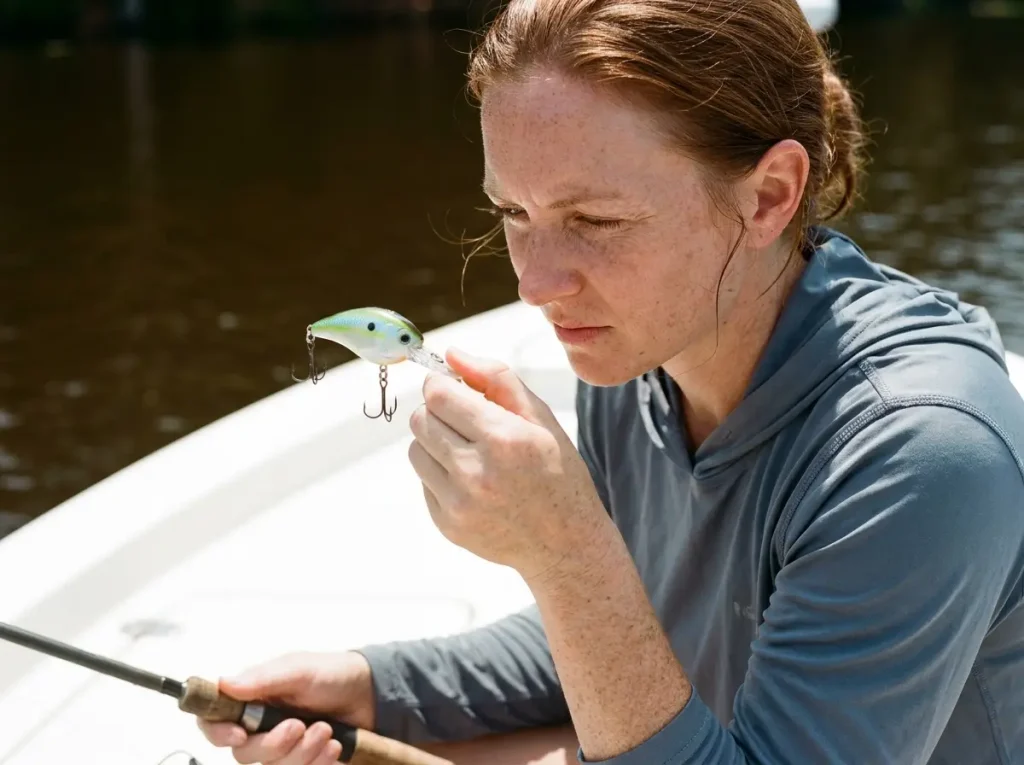
Most guys look at a lake and judge water clarity by how deep they can see their trolling motor prop. That misses the entire point. The optical physics of the water column are driven by density, and density changes based entirely on the thermometer. When sunlight hits the surface, it immediately undergoes refraction, absorption, and scattering. This fundamentally filters the visible spectrum before the image of your bait ever reaches the predator.
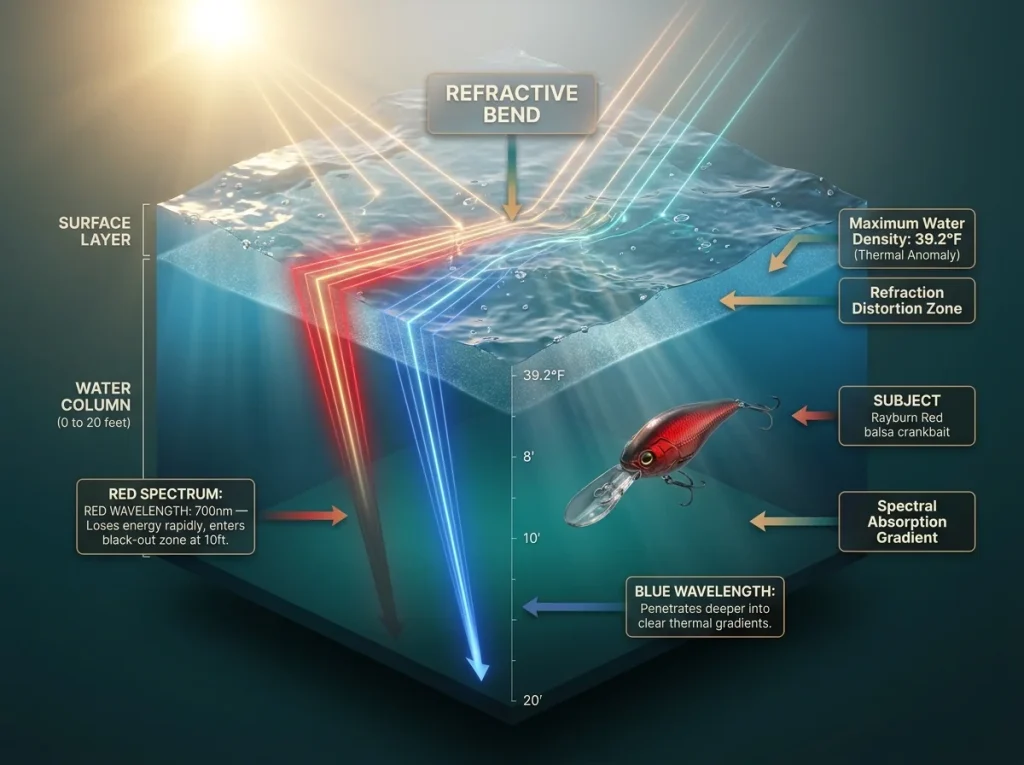
You have to respect the refractive index of the aquatic environment. Light bends when it hits the water, and it bends the most aggressively at exactly 39.2°F, which represents the point of maximum water density.
The 39.2°F Density Anomaly and Refractive Distortion
At that specific 39.2°F threshold, the freezing liquid acts like an imperfect, warped lens. A bass sitting fifteen feet down looking up through steep thermal gradients experiences massive visual distortion. The edges of your lure blur completely, and the profile effectively shrinks in their vision.
If you throw a small, subtle bait in these conditions, you force the fish to track a microscopic, fuzzy image that makes zero biological sense to attack. You need to bump up to a wide-bodied, solid profile so the refractive distortion has enough physical mass to act upon without entirely erasing the bait from the strike zone.
Wavelength Attenuation: Why Red Fades First
As light pushes deeper, you get wavelength-specific attenuation. Every color carries a different energy level. According to NOAA oceanographic light studies, red sits at 700 nanometers and possesses the lowest energy in the visible spectrum. That means it physically burns out and disappears first in pristine conditions.
If you cast a cherry-red bait into ultra-clear water and crank it down to twenty feet, the red light simply stops reflecting. To the bass below, that lure is essentially a stark black or dark grey silhouette. The color wavelength visibility simply drops to zero.
When you move out of clear water and into systems choked with heavy sediment, the way light filters through the column completely changes the rules of engagement. What disappears fast in clear water suddenly cuts through the mess in a murky lake.
Scattering and Contrast in Stained Systems
The rules flip aggressively when you fish inland lakes full of suspended silt and dissolved tannins. Tannic water vigorously absorbs blue light and scatters everything else. This scattered light acts like driving with your high-beams on in a massive snowstorm. Solid chrome or fire tiger finishes maximize local flash to cut through that visual fog.
Because tannins eat the blue end of the spectrum, standard white baits fade to a dirty brown. Your light penetration factor collapses. To reflect any available light back to the fish, you are practically forced to throw chartreuse or neon orange. Because of the distinct spectrophotometry of the water column, those specific colors possess the necessary reflectance to survive the harsh tannin filter. When you correctly match your bait’s reflectance to the specific water distortion, you completely eliminate the guesswork of targeting bass in heavy cover.
Bass Visual Neurobiology and the Metabolic Cost of Sight
We spend hundreds of dollars on custom paint jobs without stopping to ask if the fish possesses the biological hardware to actually see the art. The largemouth bass features a dichromatic fish vision system. They rely heavily on single and twin cone cells, which peak at 535 and 614 nanometers. That gives them highly acute perception of green and red.
But they completely lack blue cones. They absolutely cannot differentiate a true blue from shades of grey or black. Keep that in mind next time you agonize over two different shades of blue on an expensive jerkbait.
Dichromatic Dominance: The Real Colors Bass See
Because of their skewed rod-cones ratio, bass are practically blind to specific ends of the spectrum but hypersensitive to others. That biological blind spot is exactly why chartreuse is the ultimate optical illusion on the water.
A chartreuse bait simultaneously excites both the red and the green receptors in the bass’s eye. The fish doesn’t see a yellow-green lure; they process a blinding, aggressively luminous object that dominates their visual field. It creates a massive chromatic response that triggers an immediate reaction strike regardless of the weather.
Pro-Tip: When fishing severely stained water, take a black sharpie and draw thick, vertical lines down your solid chartreuse baits. The sheer contrast between the hyper-visible chartreuse and the dead-space of the black lines creates a visual strobe effect the fish cannot ignore.
The Temperature Factor and Frame Rate Drops
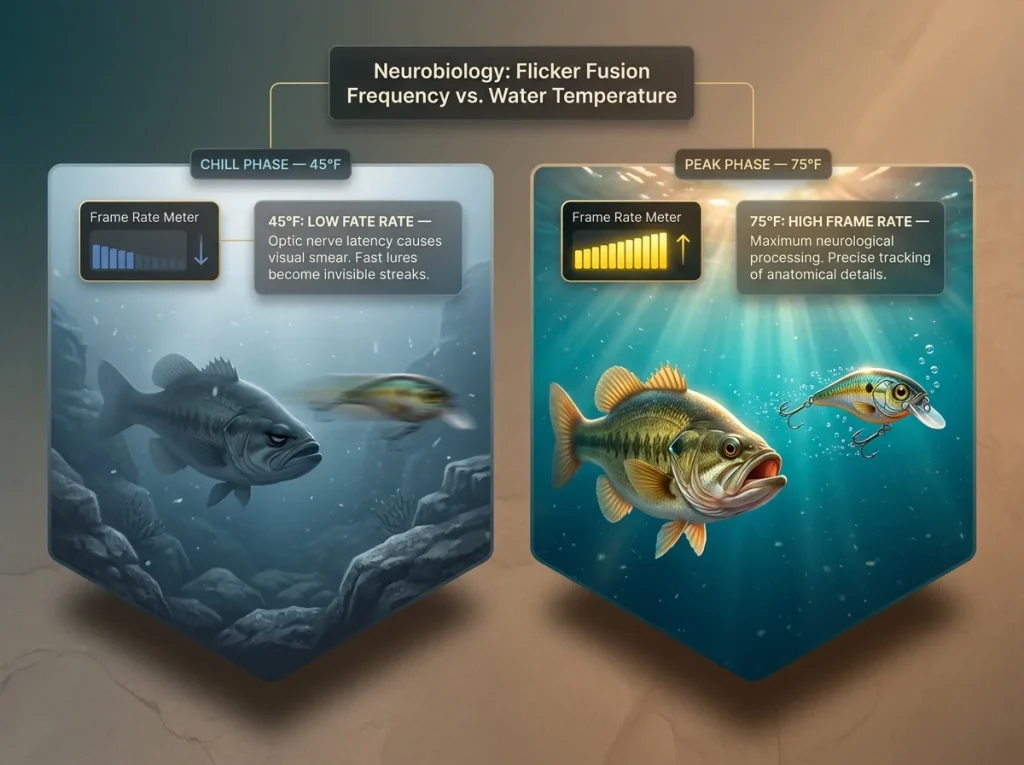
Fish are cold-blooded creatures. Every chemical reaction in their body is severely limited by temperature, meaning their nerve conduction slows drastically as temps fall. This outlines the direct impact of water temperature on bass metabolism.
As their internal systems freeze up, their Flicker Fusion Frequency (FFF) plummets. A bass in 45°F water literally processes moving images at a slower frame rate than one hunting in 75°F water. If you burn a high-speed squarebill past a winter bass, it registers as an invisible blurry streak. Their optic nerve physically cannot fire fast enough to process the shape.
The inability to process fast-moving images is tied directly to the overwhelming energy expense required to keep their eyes functioning. Their vision slows down simply because their body can no longer afford the caloric price tag.
The Metabolic Cost of Retinal Tracking
Optical tracking is extremely taxing. Your eyes use a staggering amount of energy, and so do a fish’s. Taking in visual data costs up to 15% of a bass’s resting metabolic rates.
In bleak February weather, a bass refuses to chase a subtle ghost minnow pattern because their metabolic cost accounting simply won’t allow the massive caloric expenditure. They will lazily inhale a slow-moving, high-contrast bait strictly because it requires virtually zero optical processing power to identify as an easy meal. This physiological boundary ensures you must dictate your retrieve speed by the water’s chill rather than your own impatience.
Forage Phenotypic Shifts: Biological Triggers for Color
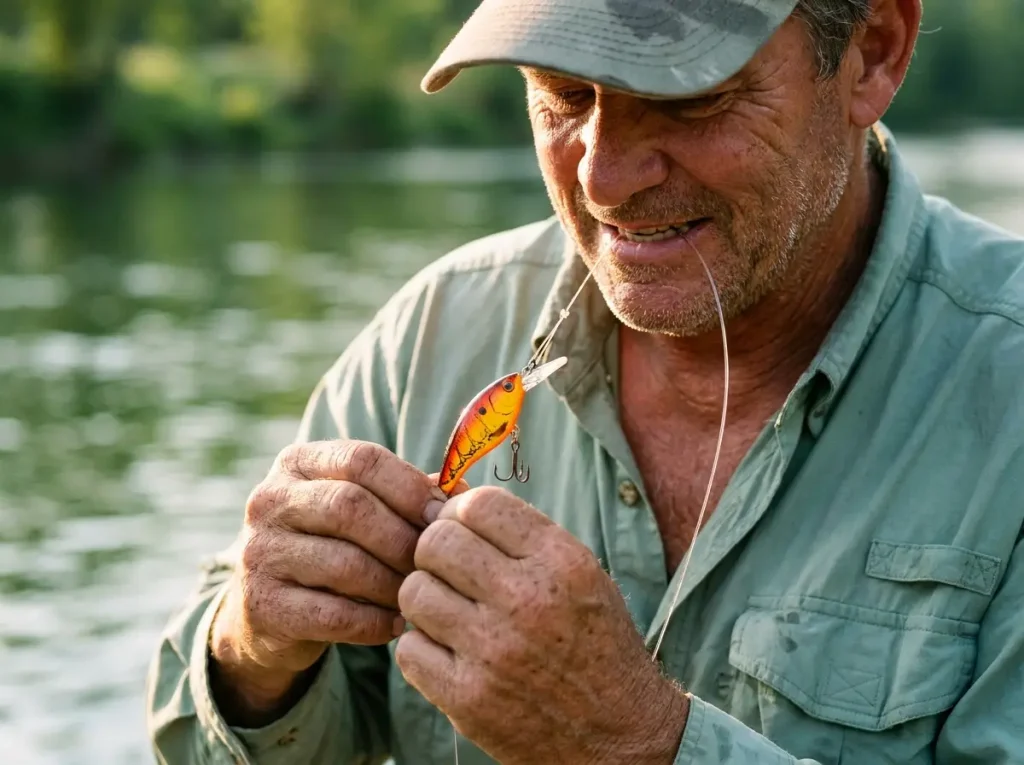
You can memorize physical light charts all winter, but you still need to match the actual biological reality of the lake. The two primary forage species—shad and crawfish—transform radically based on the seasons. Your forage metabolism knowledge determines your strike rate heavily on tough days.
There is a persistent myth that crawfish magically turn bright red across the entire lake as soon as spring hits. They don’t. Their color changes are strictly tied to the physiological trauma and timeline of the molting cycle.
A few years back, I spent a whole winter throwing pure red squarebills on a reservoir because guys at the bait shop swore the craws turned red at 45 degrees. I caught nothing but snags until I realized the local craws were still wearing dark brown winter shells. The red phase only lasts a few days right when they molt, meaning if you throw it blind all season, you’re looking like an alarm bell to every bass on the bank.
The Molting Crayfish Reality (Debunking “Spring Red”)
Pre-molt crawfish are heavily camouflaged in dark olive or heavy brown. They only flash vibrant reds and oranges when they drop their old hardened shell. These fresh, soft-shell individuals represent incredibly vulnerable targets that bass actively hunt down.
Anglers get this twisted because of the digestion-color feedback loop. A guy catches a bloated bass, sees a bright red craw claw sticking out of its throat, and assumes all the lake’s craws are red right then. Wrong. The bass’s stomach acid essentially boils the digested crawfish mimicry red, just like cooking a lobster in a pot. You are trying to match a specific, temporary baitfish activity window, not a permanent forage color phase.
Shad Cold Shock and Winter Bleaching
Let’s look at the open water columns. Threadfin shad cannot handle genuine cold. Once the water plummets below 45°F, they suffer catastrophic equilibrium loss. The severe cold shock literally bleaches the silver pigment out of their scales, turning them into pale, milky ghosts floating helplessly toward the surface.
This is exactly how you start predicting sudden shad die-offs and migrations. A struggling, cold-shocked shad reflects practically zero UV light. Put the flashy metallic baits away immediately. When you notice those bleached floaters struggling on top, switch to flat, opaque whites directly to match the exact phenotype of their thermal distress.
There are secondary forces acting on the lake that run deeper than just the temperature drops, pushing forage species into very predictable biological rhythms during these cold spells.
Celestial Synchronization (The Secondary Trigger)
Nature runs on a tight biological clock. Crayfish coordinate their major molts around the full moon phases to exploit tidal pulls and shifting ambient light.
If you get a major full moon overlapping with a massive 55°F spring warming trend, you have hit the absolute jackpot. The bass push aggressively shallow looking for those soft-shells. That is the exact moment you tie on a loud “Fire Craw” scheme and refuse to take it off until you load the boat limit. Recognizing these overlapping biological triggers guarantees you are casting the right profile at the exact moment the active predators slide up to feed.
The Cold-Water Phase (32°F – 50°F): The High-Contrast Imperative
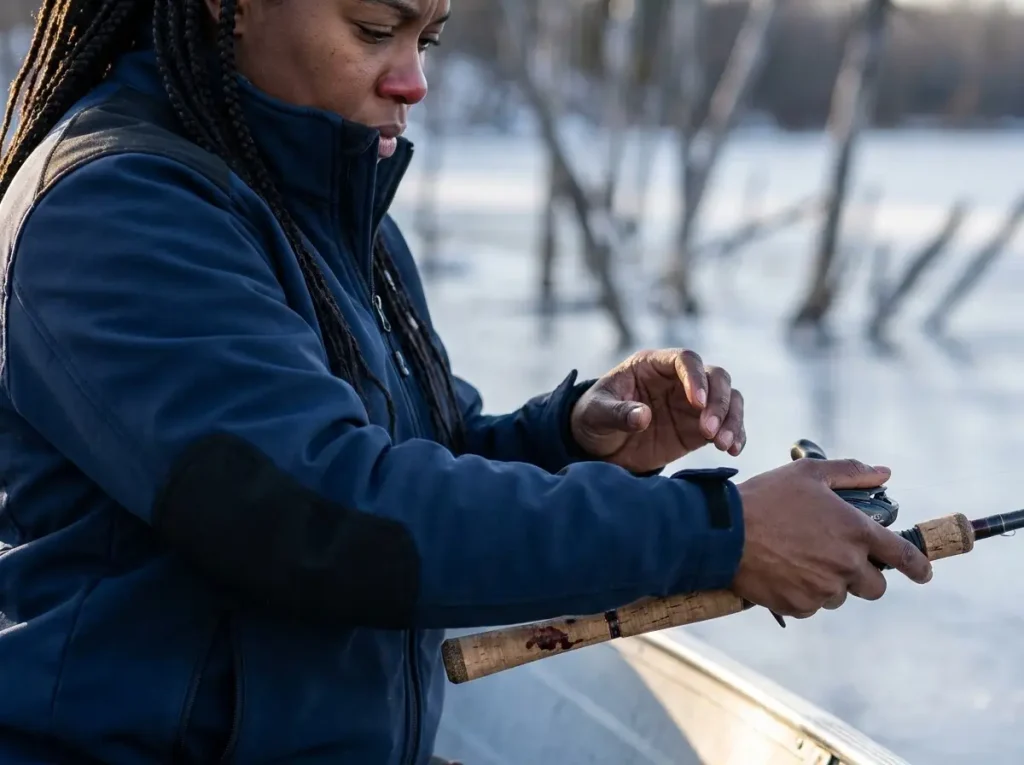
When you deal with extreme cold, subtlety gets you a skunked day. You absolutely need to combine glaring visual contrast with aggressive acoustic displacement to force a reaction.
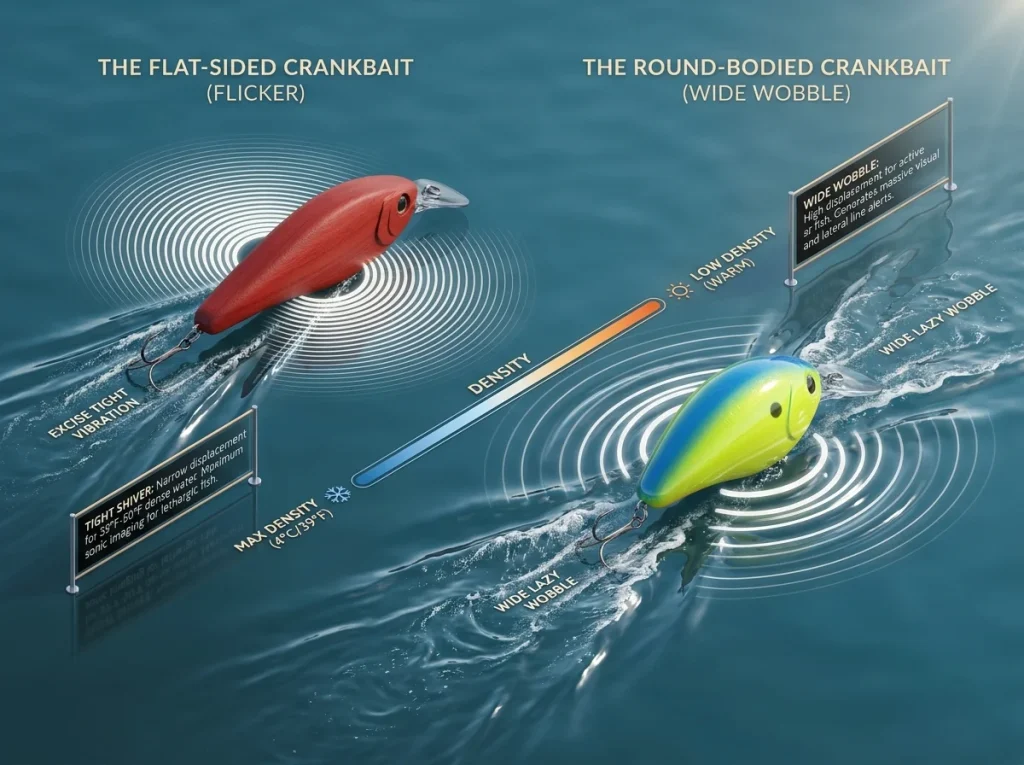
A standard rounded profile crankbait produces a wide, sweeping wobble. That lazy action completely dies in thick, 40-degree environments. The dense liquid physically restricts the lure. To overcome this limitation, you throw a flat-sided balsa crankbait like a Deep Little N or a heavy Norman. These baits execute a tight wobble tightness that shivers violently, moving cold dense water efficiently without stalling.
Overcoming Lethargy with Red and Chartreuse
The bass’s brain operates incredibly sluggishly below fifty degrees. To force an engagement, you must burn undeniably harsh high-contrast silhouettes directly into its lethargic retinas.
If you face a deep, relatively clear winter reservoir, trust a ghost red profile. But if you have cold, turbid runoff flowing in heavily, demand a solid, opaque red. You have to force the uv light penetration issue aggressively. You are not trying to look exceptionally natural; you are trying to cut through a muddy, low-light environment with maximum visual force.
Combining Color with the “Sonic Image”
Tournament veterans dominate the brutal early months by marrying color with vibration to create a hybrid sonic-visual image.
This acts as the core of crankbait hydrodynamics and lateral deflection. The flat sides push a tight acoustic signature that the bass tracks heavily with its lateral line. By the time the fish physically spots the bright chartreuse or red flash, it has already locked onto the target acoustically. You must engage the lateral line first when their optic nerve is severely failing them.
Once you have grabbed their attention with vibration and blaring color, you still have to give that lethargic fish a reasonable target window to actually intercept the bait.
Extreme Suspending and Lateral Tracking
You cannot fish continuously in freezing January conditions. The dead-stop pause serves as your absolute deadliest tool.
When you deflect off a submerged stump or large rock, stop reeling immediately. Let the bait sit completely motionless for up to five full seconds. This allows that high-contrast color flash to linger perfectly in front of the bass. Because their FFF rate sits entirely bottomed out, extending the visual window gives their frozen brain the necessary time to calculate the geometry of the strike.
Pro-Tip: Following heavy contact with submerged wood in sub-45°F water, count to five seconds in your head before starting the retrieve again. Most guys pull away too fast, snatching the bait right out of the predator’s delayed strike zone.
Applying these deep freezes translates directly to how you handle the shifting spring patterns when the entire thermal matrix of the lake begins to rapidly change.
The Transition Phase (50°F – 65°F): Matching the Thermal Phenotype
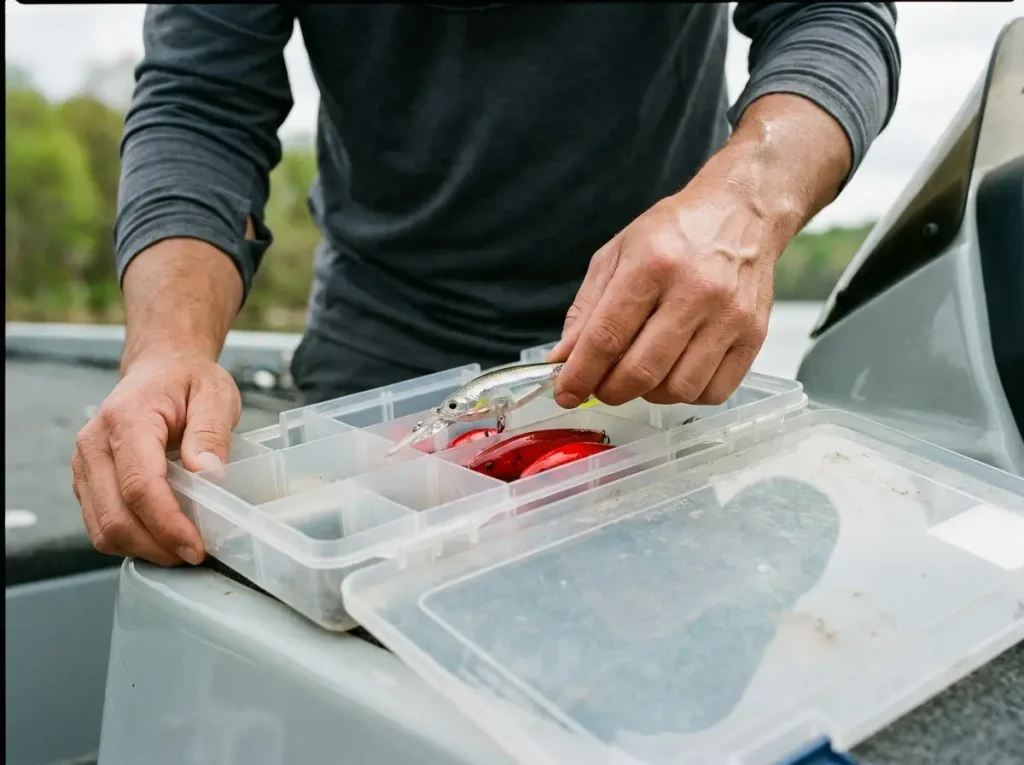
As the last ice fully melts and the spring rains back off, the water stabilizes nicely. The suspended sediment drops out, the sunlight finally penetrates deep, and the bass’s biological systems roar back online. The entire seasonal temperature matrix shifts drastically, requiring you to fundamentally alter your tackle selection.
You can no longer rely on shocking the fish with solid neon profiles. With increased visibility and a drastically faster frame rate, the predator requires significant realism to commit to biting hard plastic.
Timing the Post-Molt Craw Sequences
As the water temperature crests 60°F, crawfish shells harden fast. They successfully transition away from bright reds into camouflaged olive, orange, and heavy brown.
I used to force red cranks way too late into April. Once I realized the local craws had fully hardened and gone olive green, I swapped to a subtle matte brown pattern and immediately started boating fish behind guys who were still chunking the loud early-spring stuff.
Your lure choices should follow suit exactly. An olive-green body featuring a subtle orange throat strike hits the vital biological sweet spot for navigating pre-spawn temperature benchmarks. You signal to the bass that you represent a crawfish fully recovering from a recent molt, maintaining the feeding illusion without insulting their much improved vision.
Transitioning to Translucent Shad
Warmed shad stop losing equilibrium from cold shock and start fleeing rapidly. Once the lake pushes past 55°F, those crippled white floaters completely disappear from the banks.
You need to retire the milky whites and grab a translucent finish or ghost finish. These semi-transparent patterns harness the abundant sunlight shooting through the now-clear shallows. But respect the rule: if a massive spring thunderstorm unexpectedly turns the lake to heavy mud, the ghost finish completely vanishes. Revert immediately to your solid chartreuse until the thick mud particulate settles back out.
You also have to recognize exactly where that sunlight hits the hardest, because it physically changes the density of the water sitting right on top of the lake.
Navigating the Emerging Thermocline
The sun starts baking the upper layers of the lake, creating a warm, low-density water cap sitting directly over the freezing depths. This steep temperature boundary line violently refracts incoming light.
Focus your squarebills straight down the sun-heated riprap banks. The stone rocks absorb heavy solar radiation, minimizing the refractive visual distortion locally. You ensure your metallic flakes actively throw a continuous, unbroken flash exactly where the most active fish patrol the shallows, pushing aggressive bites in the exact zone where the water feels the warmest.
The Warm-Water Phase (65°F – 85°F): High-Speed Chromatic Flash
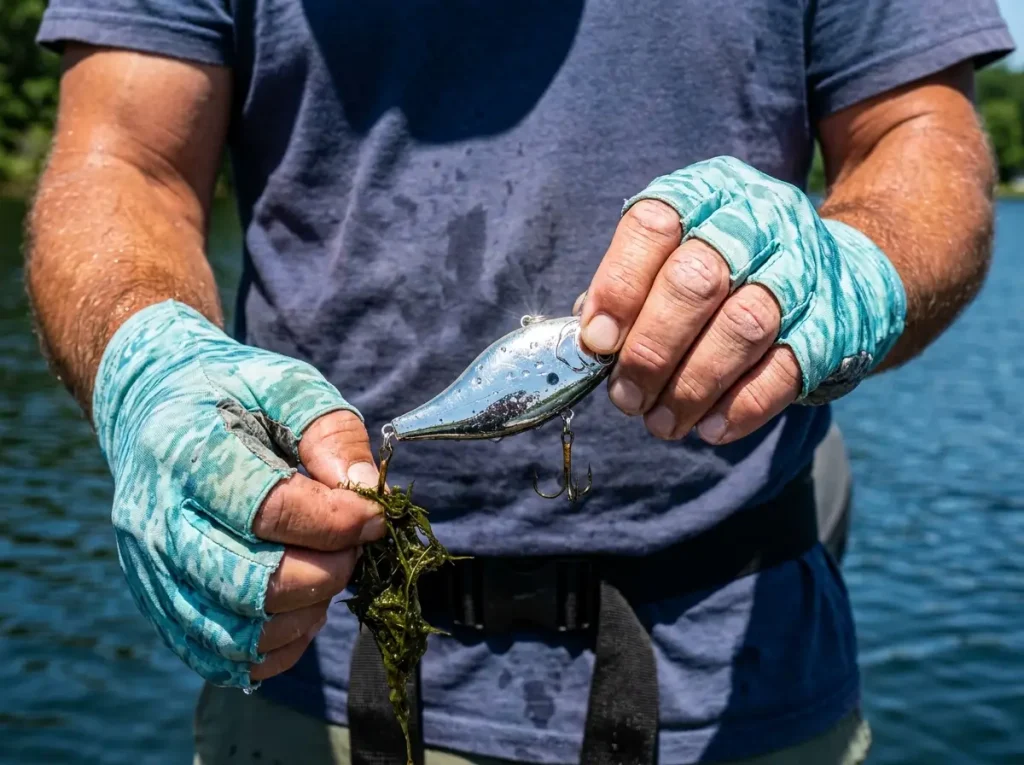
Summer fishing brings excellent low optical density but extreme biological opacity. Every major lake essentially turns into a thick phytoplankton soup. This situation completely changes the thermodynamics of color by absorbing specific wavelengths while violently bouncing others around.
You find yourself burning a Strike King Red Eye Shad or a loud Bill Lewis Rat-L-Trap through massive hydrilla flats at top speed. It doesn’t matter if it’s a deep-diving Rapala DT Series or a shallow lip-less bait—the bass’s FFF tracking sits practically flawless now. They hit their peak aerobic scope and possess the maximum metabolic efficiency to easily chase down fast-moving prey.
Exploiting Peak Metabolic Tracking
The fish process detailed images perfectly at 80°F. Based on research from federal energy studies on fish tracking functionality, bass hitting 75°F experience maximized visual frame rates. If your water holds incredibly clear, you desperately need anatomically correct 3D eyes and hyper-realistic bluegill paint scaling.
Because you aren’t dealing with heavy refractive layers constantly breaking up the visual in the upper six feet of the column, your lure looks the same to the bass directly as it does sitting perfectly dry in your palm. Subtlety heavily rewards you in clear summer glass. Keep the chromatic temperature gradient strictly natural to ensure you are mimicking exactly what the keen-eyed predators are expecting to hunt.
Utilizing “Citrus Shad” in Phytoplankton Blooms
Pro anglers highly respect the system. Icons like Kevin VanDam lean heavily on bright patterns like “Citrus Shad” in thick summer algae mats.
That thick algae bloom chemically shifts pure sunlight penetration heavily into the green spectrum. A Citrus Shad paint scheme generates a massive neon-glow optical bounce. A solid opaque white belly reflects scattered green light drastically better than a standard translucent belly, efficiently illuminating the bait from underneath in the darkest grass shadows.
When you find yourself stuck in situations where the water goes completely stained with floating summer slop, the standard subtle paints disappear entirely, leaving you with one aggressive option.
When to Rely on Extreme Flash
Sometimes you just need to blind them entirely. A hard chrome or highly reflective metallic foil finish actively throws aggressive, sharp light vectors horizontally right through the upper layers.
Pro-Tip: Reserve foil-finished crankbaits strictly for days when heavy wind chop breaks the surface tension. The violent wind chop shatters the surface tension, resulting in a strobe-light effect constantly filtering down. Your flashing chrome perfectly syncs with the chaotic ambient sunlight, aggressively mimicking the exact frantic spasms of a distressed summer baitfish trying to outrun a predator.
The Bottom Line on Crankbait Colors
Water temperature sits as the absolute regulator of your angling environment. It dictates the harsh physical bending of light in the lake and strictly commands the neurological processing speeds of your target predator. When you face massive 39.2°F water density, you actively compensate with stark reds and harsh sonic vibrations. When the fish’s metabolic rate roars to extreme life in the summer heat, you switch aggressively to high-speed translucent realism. Put down your nostalgic “lucky colors” forever. Bring out an accurate thermometer, assess your visual optical clarity, and let sheer physics dictate what you tie on next. You will consistently put more weight in your livewell.
FAQ
What color crankbait for 50 degree water?
A high-contrast Fire Craw or heavy chartreuse and black pattern. At exactly sub-50°F, bass strongly suffer from reduced Flicker Fusion Frequency and cannot visually track subtle or fast-moving natural hues properly. Your retrieval speed must slow down significantly to give them a fighting chance to track it.
Do red lures work in summer?
Strictly as an anomaly rather than a reliable rule. Long red wavelengths are the very first to fade in warm, low-density water, and since the specific crawfish molting vulnerability phase has safely concluded, a perfectly natural brown or ghost shad pattern yields a drastically higher percentage strike rate everywhere.
What color lure for muddy cold water?
Opaque Rayburn Red or solid, aggressively blinding chartreuse. Thick mud scatters incoming blue and green light instantly, heavily forcing you to effectively use the low-energy red spectrum powerfully combined with a flat-sided bait. Those lure action mechanics efficiently push hard sonic pulses far to heavily compensate for the massive visual handicap.
Why do bass hit red in spring?
They exploit the drastic biological weakness of freshly molted, completely soft-shell crawfish that exhibit temporary bright red and deep orange highlights. This specific high-contrast profile is easily acquired by their dichromatic vision, actively triggering a fierce predatory instinct despite the incredibly cold water holding them back.
Risk Disclaimer: Fishing, boating, and all related outdoor activities involve inherent risks that
can lead to injury. The information provided on Master Fishing Mag is for educational and informational purposes
only. While we strive for accuracy, the information, techniques, and advice on gear and safety are not a substitute
for your own best judgment, local knowledge, and adherence to official regulations. Fishing regulations, including
seasons, size limits, and species restrictions, change frequently and vary by location. Always consult the latest
official regulations from your local fish and wildlife agency before heading out. Proper handling of hooks, knives,
and other sharp equipment is essential for safety. Furthermore, be aware of local fish consumption advisories. By
using this website, you agree that you are solely responsible for your own safety and for complying with all
applicable laws. Any reliance you place on our content is strictly at your own risk. Master Fishing Mag and its
authors will not be held liable for any injury, damage, or loss sustained in connection with the use of the
information herein.
Affiliate Disclosure: We are a participant in the Amazon Services LLC Associates Program, an
affiliate advertising program designed to provide a means for us to earn advertising fees by advertising and linking
to Amazon.com. As an Amazon Associate, we earn from qualifying purchases. We also participate in other affiliate
programs and may receive a commission on products purchased through our links, at no extra cost to you. Additional
terms are found in the terms of service.