
In this article
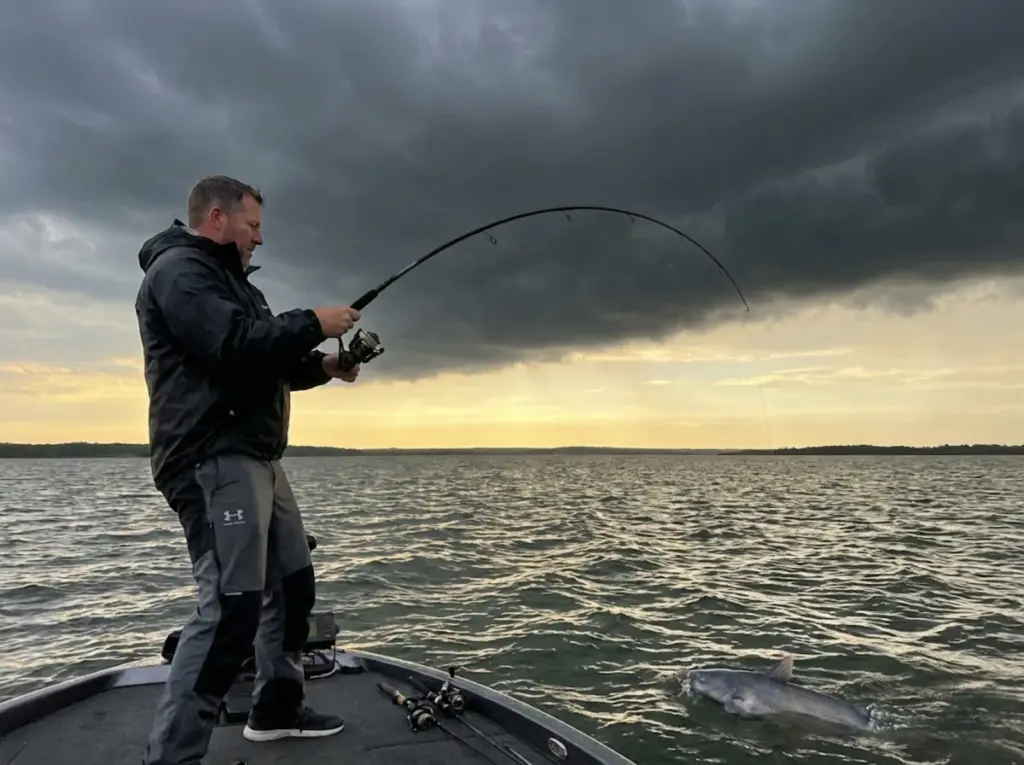
The rod doubled over and the drag screamed for forty-five minutes straight. Three grown men wrestled a fish onto a pontoon boat near Clarksville, Virginia — 143 pounds of blue catfish that rewrote the world record books. That fish didn’t eat a stink bait parked on the bottom. It chased down a fresh chunk of skipjack in the current, the way every trophy Ictalurus furcatus actually feeds.
The folklore says blue catfish are lazy bottom-dwellers. Scavengers that sit in the mud and wait. The biology — their sensory systems, their hunting mechanics, their seasonal behavior patterns — says something completely different.
This guide breaks down the biology of the blue catfish and translates each finding into actionable tactics. From sensory anatomy to weather patterns, from bait selection to rig design, every recommendation here traces back to a biological mechanism you can exploit on the water. If you’ve ever wondered why blue catfish reject cut bait that seems perfectly good to you, the answer usually lives in the fish’s physiology — not in luck.
⚡ Quick Answer: Blue catfish are sensory predators — not lazy scavengers. Their Weberian apparatus gives them hearing up to 13,000 Hz, and their barbels detect amino acids at trace concentrations. Fresh-cut gizzard shad or skipjack herring outperforms frozen bait by a factor of ten. Identify them by the anal fin (30–36 rays, straight margin), plan trips around falling barometric pressure, and use the “Rule of 4” to predict feedin windows after weather fronts pass.
The Sensory Arsenal — How Blue Catfish Actually Find Your Bait
Most catfish advice starts with “use stink bait.” That advice misunderstands the animal it’s trying to catch.
Blue catfish don’t stumble onto food. They track it across distance using a sensory suite that combines high-frequency hearing, chemical detection, and pressure sensitivity — a triple-threat system that makes them one of the most efficient predators in North American freshwater.
The Weberian Apparatus — Why Noise Rigs Work
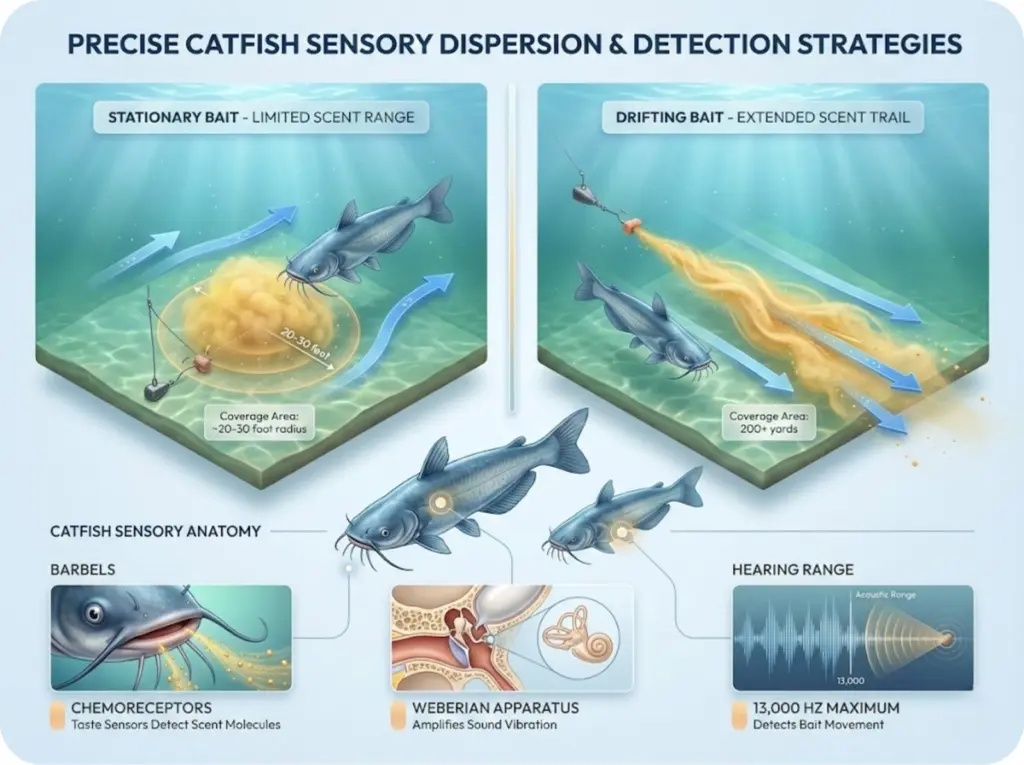
The blue catfish’s hearing is anchored by a structure called the Weberian apparatus — a chain of small bones connecting the two-chambered swim bladder to the inner ear. The swim bladder acts as a resonance chamber, amplifying vibrations from the surrounding water and transmitting them directly to the auditory system.
The result is hearing that reaches up to 13,000 Hz, well beyond the detection range of most freshwater species. For context, that’s higher than many bass hearing frequencies.
What this means for your rigging is simple: noise is a legitimate attractant, not a gimmick. Rattle-equipped floats, clicking weights bouncing along rocky substrates, and even the vibration of a trolling motor can serve as long-range beacons that draw blues toward your spread long before they pick up any scent signal.
One practical limit applies. In clear water with visibility over twelve inches on a Secchi disk, excessive noise can spook fish rather than attract them. Reserve your rattle rigs for stained or muddy conditions where the auditory channel is the primary detection pathway.
Chemoreception — The Case for Fresh Bait
While hearing provides the long-range alert, the blue catfish’s sense of smell handles the final approach. Their skin and all eight barbels are covered with highly sensitive chemoreceptors capable of detecting minute concentrations of amino acids in the water column.
Here’s where the biology gets tactically relevant. Scent disperses in a cone pattern from the bait, shaped by current speed and direction. In still water, that cone stays localized — a small pocket of chemical signal that a cruising catfish might or might not intercept. In moving water, or when you’re drifting, the scent trail stretches into a long plume that covers dramatically more real estate downstream.
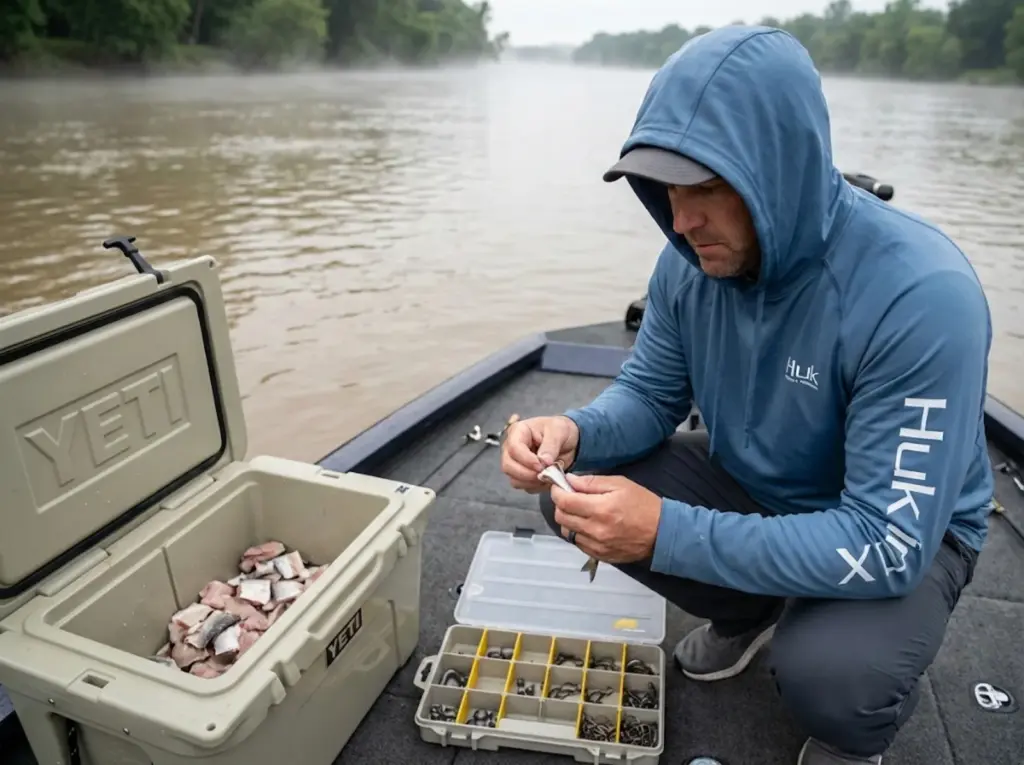
Fresh-cut gizzard shad or skipjack herring outperforms frozen bait by roughly a factor of ten. The reason is biochemical: ATP and its breakdown products degrade rapidly once bait is frozen and thawed. Fresh-cut flesh releases a flood of amino acids and blood that creates exactly the chemical trail these receptors evolved to follow.
This is also why how scent triggers strikes from inactive fish matters far more for catfish than most anglers realize. The chemistry is doing the work your lure can’t.
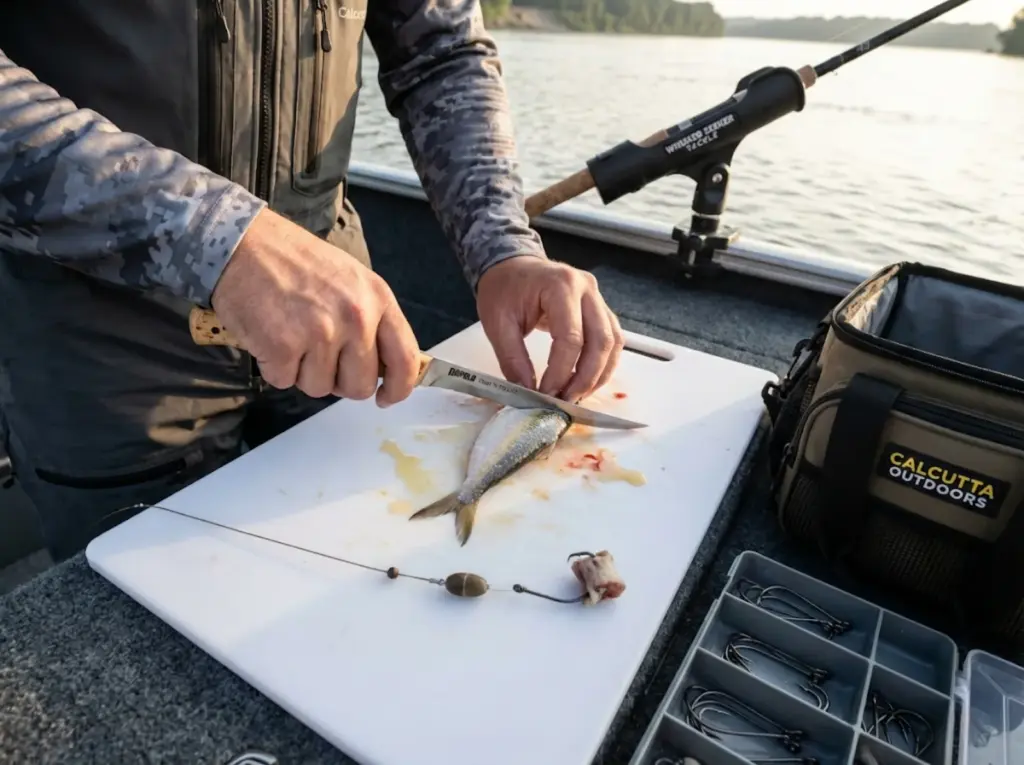
Pro tip: Cut your bait so the flesh side is fully exposed and the blood flows freely. A chunk roughly two inches square with skin on one side holds the hook well and maximizes scent output simultaneously.
Why Drifting Beats Anchoring
Combine the hearing and the chemoreception and one tactical conclusion emerges: movement outperforms stationary presentations.
“Bumping” — holding bait in current while moving downstream with a trolling motor — exploits both sensory channels at once. The moving rig generates vibration that acts as a long-range ping, while the drifting bait stretches the scent trail over hundreds of yards of river channel.
Tournament catfish professionals operate on this principle religiously. Many spend the day before events solely catching fresh bait, building a stockpile of gizzard shad and skipjack because they know the scent trail of fresh-cut fish is their most powerful weapon.
One common mistake among recreational anglers: staying in one spot too long. If you’re sitting on a marked spot with good structure and sonar marks but getting no bites within fifteen to twenty minutes, move. Trophy blues are roaming predators, not homebodies.
Identification Science — Beyond the Color Myth
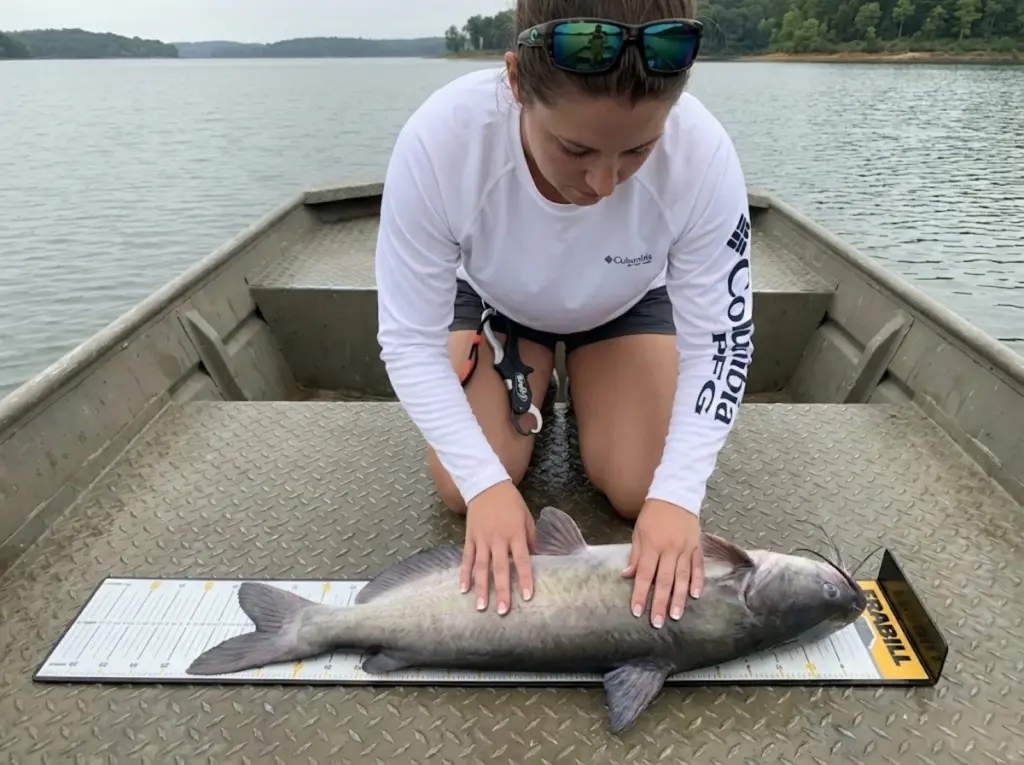
Getting the species identification wrong can mean a fine, a miscounted bag limit, or just the embarrassment of posting a channel catfish on social media and calling it a blue. Color is the worst tool for the job, and it’s the one most people reach for first.
Blue catfish can appear silver, slate-gray, or nearly black depending on water clarity, light angle, and seasonal hormones. Male channel catfish during the spawn can turn a deep blue-gray that looks almost identical to a blue cat at first glance. Regional names like “chuckle-head” and “high-fin blue” describe morphological variants within the species, not different fish entirely.
The Anal Fin Checklist
The definitive field identification lives in the anal fin — the fin on the underside of the fish between the pelvic fins and the tail.
Blue catfish carry 30 to 36 anal fin rays arranged in a broad fan with a perfectly straight distal margin — the trailing edge looks like it was cut with a ruler. Channel catfish (Ictalurus punctatus) have 24 to 29 rays with a rounded, convex margin that curves noticeably.
Two additional visual checks reinforce the call:
- Spots. Juvenile blue catfish never have dark spots. Juvenile and many adult channel catfish display scattered black spots across their flanks. By the time a channel cat reaches trophy size, those spots may have faded, but they were there once.
- Tail fork depth. Both species have forked tails, but the blue catfish fork is typically deeper and more sharply angled.
In low light or when handling a wet, slippery fish, the straight-versus-rounded margin shape is usually easier to confirm at a glance than counting individual rays. Run your thumb along the trailing edge — if it feels perfectly flat, you’re holding a blue.
If you want the full comparison between these two species and how their biology affects your approach, the channel catfish biology and angling tactics guide covers the channel side of the equation in detail.
When Color Lies — Regional Variations
Water chemistry alters pigmentation significantly. A blue catfish pulled from a blackwater tannin river can look nearly as dark as a flathead catfish. One pulled from a clear reservoir in late fall may appear bright silver with almost no blue tint at all.
Spawning hormones compound the problem. Males of both species undergo color shifts during the reproductive period, and in overlapping habitats, the visual confusion between the two reaches its peak during May and June.
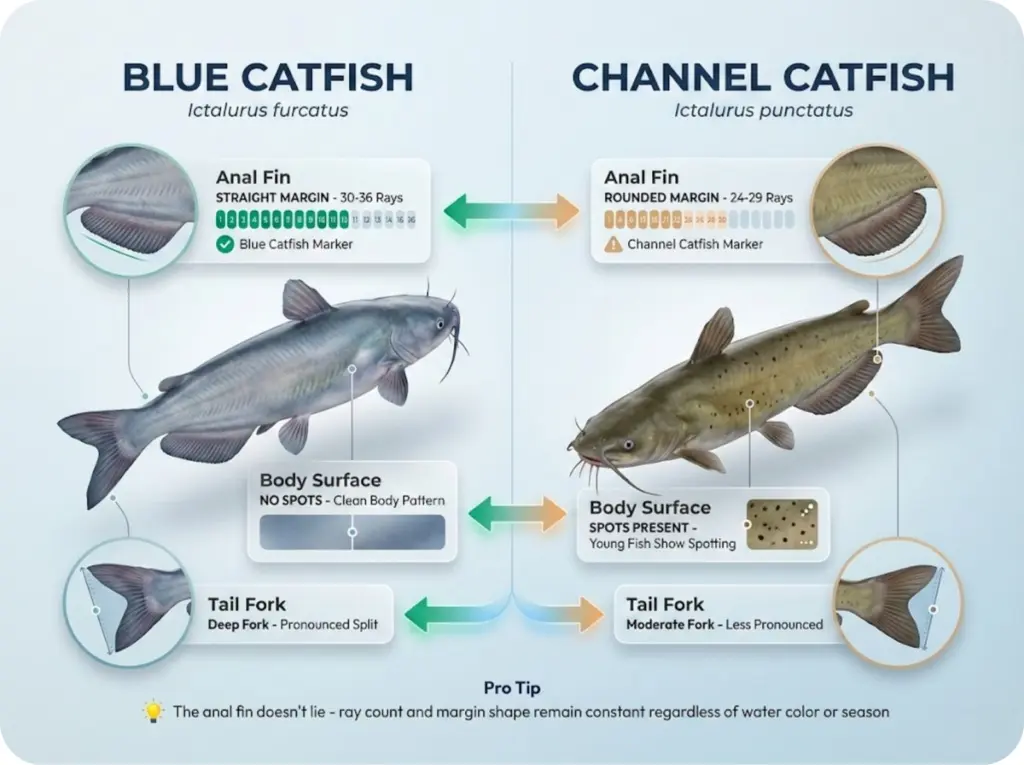
The anal fin doesn’t lie. Regardless of water type, season, or hormonal state, the ray count and margin shape remain constant throughout the fish’s life. If you’re unsure, flip the fish, spread the fin, and let the anatomy speak.
For the field-level comparison from a state wildlife perspective, the Texas Parks & Wildlife catfish identification guide provides the standard reference.
The Invasive Paradigm — Chesapeake Bay and the Blue Catfish Explosion
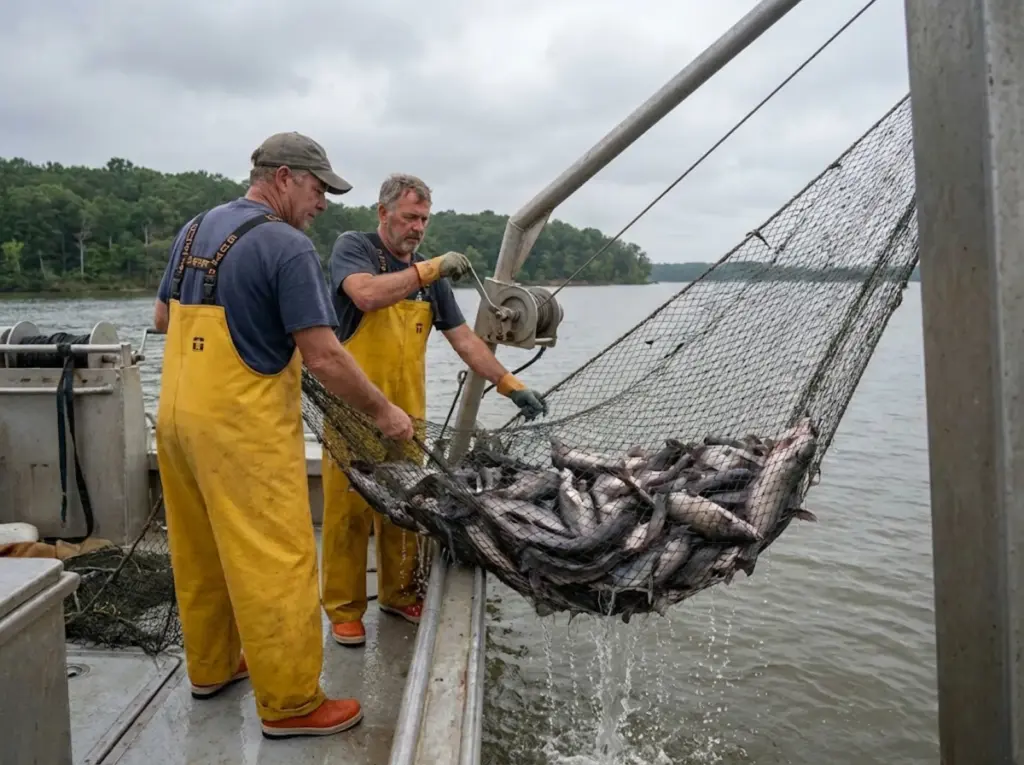
Blue catfish are native to the Mississippi River, Missouri River, and Ohio River basins — massive waterways with deep channels and heavy current that match their evolved biology. The problem started in the 1970s, when fisheries management teams introduced them to Virginia’s tidal rivers to create a new recreational fishery.
What they didn’t predict was the salinity tolerance.
How Salinity Tolerance Rewrote the Map
Most freshwater catfish species can’t survive in brackish water. Blue catfish can tolerate salinities up to approximately 22 parts per thousand, which is well into estuarine territory. That single biological trait allowed them to migrate out of the James River’s freshwater reaches, push through the main stem of the Chesapeake Bay, and colonize every major tributary from the Susquehanna to the Potomac River.
Today, the James River alone is estimated to hold well over 100 million blue catfish. They’ve become the dominant predator in multiple tidal river systems, consuming millions of pounds of native species — blue crabs, Atlantic menhaden, river herring, and the critically endangered Atlantic sturgeon are all documented prey.
The scale of colonization is staggering. What was supposed to be a contained recreational fishery became one of the most significant aquatic invasive species events in the Mid-Atlantic.
For context on where blue catfish fall in the broader invasive species landscape, the invasive fish species identification and removal guide covers the full picture across North American waterways.
The Conservation Paradox — Harvest Small, Release Big
The management response has created what looks like a contradiction: harvest the small ones, release the monsters. But the biology supports it.
NOAA Fisheries and the Virginia Department of Wildlife Resources actively encourage anglers to harvest blue catfish under 24 inches. Removing small, reproductively active fish reduces their impact on native species — particularly blue crabs and menhaden that support the bay’s broader ecosystem.
But trophy-class fish — the 50-pound, 80-pound, 100-pound specimens — represent something different. These fish are 20 to 30 years old or more. They exhibit indeterminate growth, meaning they continue gaining size for their entire lifespan. Removing a single 80-pound blue catfish eliminates decades of genetic potential from the waterway.
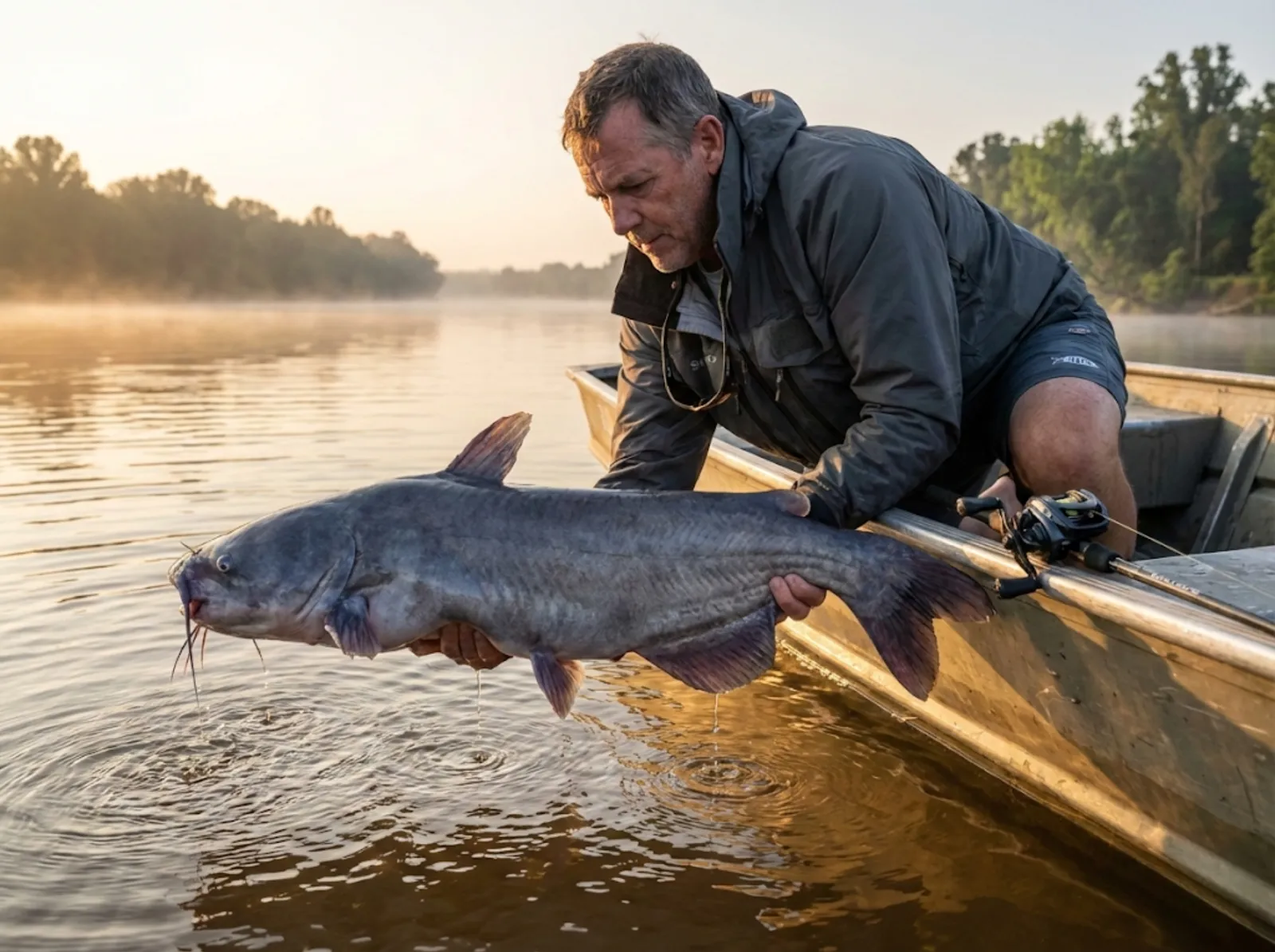
Post-release mortality for blue catfish is less than 3% when handled properly. That makes science-based catch and release techniques both practical and ecologically rational for trophy fish.
Eating Invasive — Safety and the Size Rule
The marketing slogan from NOAA Fisheries’ invasive blue catfish advisory is blunt: “Invasive and Delicious.” They’re encouraging consumption as a management tool.
But there’s a size-based safety boundary to respect. Large blue catfish — particularly those over 24 inches pulled from the Chesapeake region — may carry elevated levels of PCBs and mercury due to bioaccumulation. The contaminants concentrate in the fatty red meat along the lateral line and belly.
The recommendation is straightforward: eat fish under roughly 2 pounds, and when filleting larger fish, trim all red meat aggressively.
⚠️ Transport Warning: In Maryland and Virginia, it is illegal to transport live blue catfish between water bodies. This regulation exists to prevent further range expansion. Any blue catfish you catch in one system stays in that system — dead or alive.
Weather, Pressure, and the “Rule of 4”
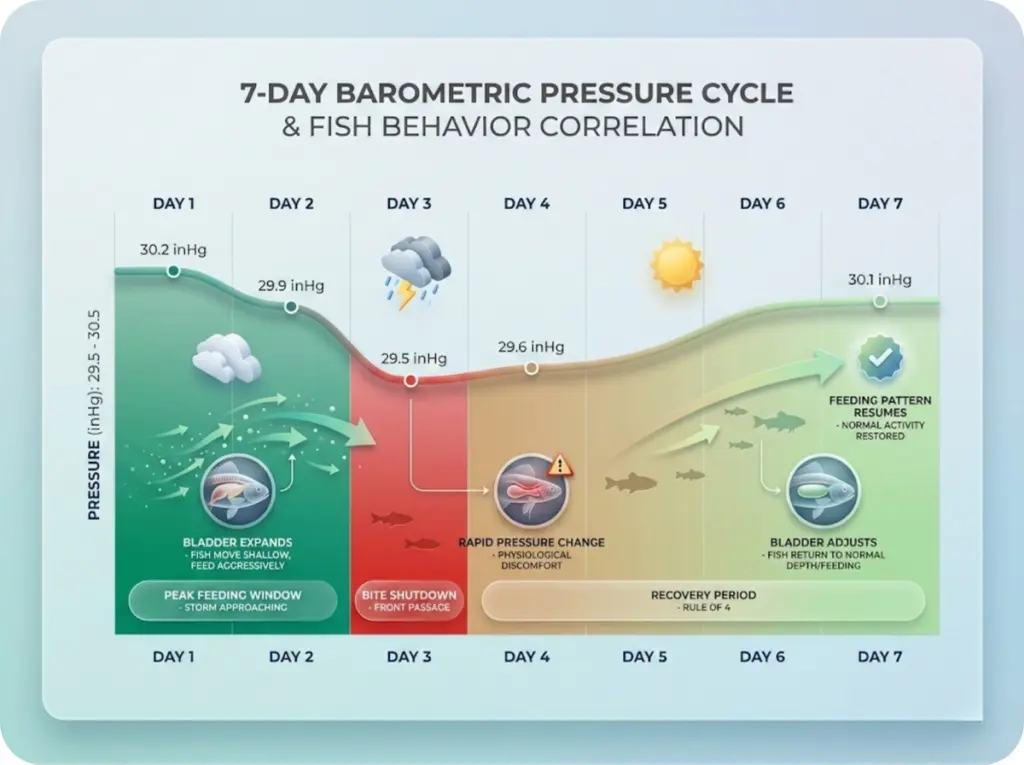
The blue catfish’s two-chambered swim bladder doesn’t just enhance its hearing. It makes the fish a living barometer — literally responsive to changes in atmospheric pressure.
The Swim Bladder and Pressure Sensitivity
When barometric pressure falls — a storm approaching — the reduced air pressure allows the swim bladder to expand slightly. That expansion creates physical discomfort and disrupts buoyancy control. Fish respond by moving deeper, where the increased water column pressure above them compensates for the reduced atmospheric pressure.
But the period before the front reaches you is where the fishing magic happens. The so-called “Falling Barometer Feeding Frenzy” occurs as blue catfish gorge themselves in advance of the disturbance. They seem to sense the impending metabolic shutdown and feed aggressively while conditions still allow it.
If you track your phone’s barometer app and see a steady drop of 0.02 inches of mercury or more over several hours, that’s your cue. Drop everything and go. The pre-frontal window can produce some of the most aggressive blue catfish feeding of the entire season.
For how this pressure dynamic plays out across all freshwater species, the how barometric pressure affects fish behavior guide covers the general mechanics in depth.
Brad Durick’s Rule of 4
Professional catfish guide Brad Durick codified a pattern that most recreational anglers never track: the post-frontal metabolic reset takes approximately four days.
After a major weather front passes and the barometer rises and stabilizes, the catfish effectively shut down. They move to neutral positions, reduce feeding activity, and wait for their physiology to recalibrate. Durick’s observation — confirmed over thousands of guided trips — is that it takes roughly four days after front passage for a predictable, catchable feeding pattern to re-emerge.
“A big heat up or cool down, without a major front, the bite can hold for up to four days before making the pattern shift with the temperature,” Durick explains. The key distinction is that gradual temperature changes without a frontal system don’t trigger the same metabolic crash.
The tactical takeaway: plan your trips around weather, not around your schedule. Fish the pre-frontal bite, skip the two days after a major front, and return on day four when the USGS species profile for Ictalurus furcatus behavioral patterns suggest the metabolism has stabilized.
Summer Stratification — Fishing Above the Thermocline
In summer, a different pressure dynamic takes over. As water stratifies by temperature, the thermocline creates a sharp boundary between warm, oxygen-rich water above and cool, low-oxygen water below.
When dissolved oxygen drops below roughly 5 mg/L in the deeper water, blue catfish have no choice but to move up. They suspend above the thermocline in what guides call the “strike zone” — often following bait balls of shad or menhaden that are also forced into the compressed upper layer.
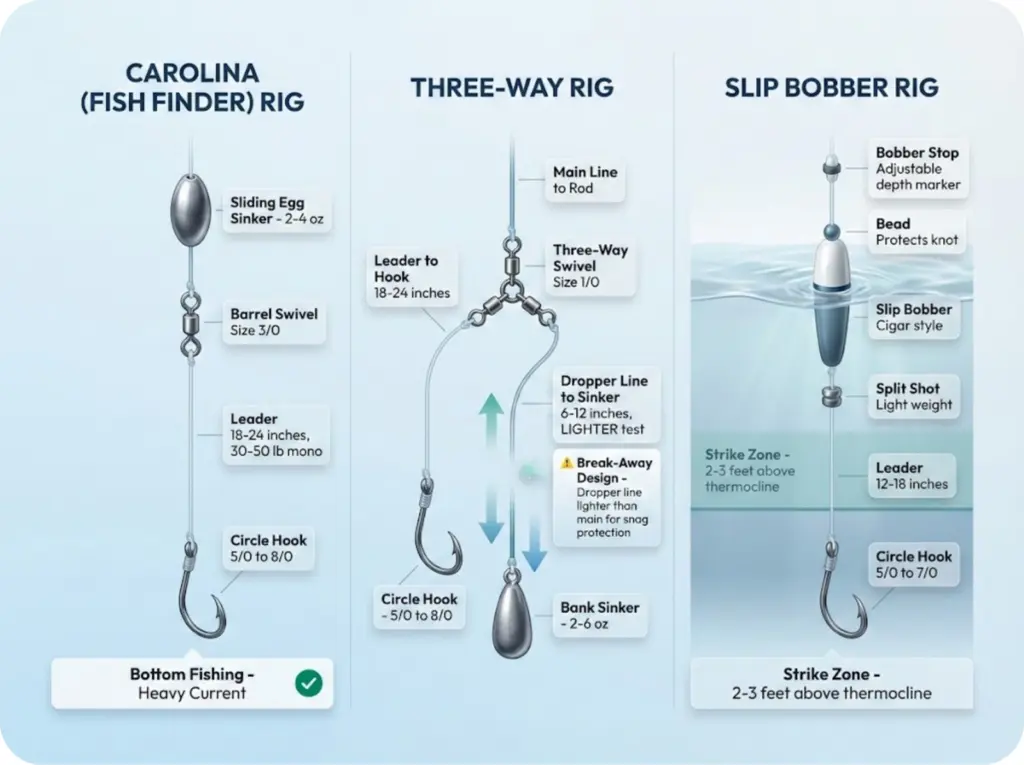
This is where the slip bobber rig becomes essential. By setting a bobber stop at the precise depth of the thermocline — say, 15 feet deep in 30 feet of water — you can park a chunk of fresh-cut bait right in the zone where catfish are actively hunting.
Professional guide Zakk Royce built his reputation on exactly this approach: “Blue catfish are not just bottom-feeders. Once the lowest layer of water is depleted of oxygen in late summer, big blues have to change their game plan.”
Pro tip: Use your fish finder to identify the thermocline — it shows up as a dense band on the sonar screen. Set your slip bobber stop 2 to 3 feet above that line. That’s where the big ones are cruising.
Rigs, Baits, and Presentations — The Tactical Playbook
Every rig design for blue catfish traces back to a specific biological behavior. Bottom rigs exploit their tendency to cruise channel floors. Suspending rigs intercept them when oxygen forces them off the bottom. Drift rigs leverage their reliance on scent trails in current. Match the rig to the biology, and the rig works.
Bottom Rigs — Carolina and Three-Way
The Carolina (Fish Finder) Rig is the baseline blue catfish setup. Thread a sliding egg or no-roll sinker — typically 1 to 8 ounces depending on current — onto the main line, then tie to a barrel swivel. From the swivel, run an 18-to-36-inch leader of 50 to 80 pound fluorocarbon to a circle hook.
The mechanics are straightforward: a blue catfish picks up the bait and moves off with it. The mainline slides freely through the sinker, so the fish feels no weight resistance during that initial run. By the time the angler’s rod loads up, the circle hook has migrated to the corner of the jaw.
If you fish heavy current or rocky structure, the Three-Way Rig provides a critical advantage. A three-way swivel connects the main line to two separate leaders — a heavier one for the hook, and a lighter “dropper” for the sinker. When the sinker snags on a river rock or ledge, the lighter dropper breaks away, and you save the fish, the hook, and the main line. The sinker is expendable by design.
For the physics of how these rigs move underwater and why leader length matters, the Carolina rig setup physics and hydrodynamics guide breaks down the mechanics. If you’re fishing smaller ponds and want a simpler approach for channels, the Santee Cooper rig for pond catfish covers an alternative setup worth knowing.
Slinky weights — paracord filled with lead shot — offer another bottom-contact solution for snag-heavy environments. They slither over rocks and through debris without wedging, keeping your cut bait in the strike zone and your tackle out of the recycling bin.
Suspending Rigs — Slip Bobbers and Planer Boards
The slip bobber rig solves a specific problem: how do you present bait at a precise depth when the fish aren’t on the bottom?
A small bead and bobber stop on the mainline set the depth. The slip bobber slides freely until the stop catches, suspending your bait at exactly the level where your sonar shows fish activity — typically just above the thermocline in summer. A chunk of fresh-cut shad on a circle hook hangs motionless in the water column, right in the path of cruising blues.
Planer boards, pioneered for catfish by guides like Zakk Royce, take the concept horizontal. Boards clip to the mainline and plane outward from the boat as it drifts downstream, spreading baits across a wide swath of channel. Instead of dropping all your lines straight below the hull, you’re covering water 50 to 100 feet out on each side.
This spread matters because trophy blues — the 50-plus-pound fish with decades of survival instincts — often won’t approach directly under a boat. The motor noise, the shadow, the pressure wave from the hull all push wary fish to the margins. Planer boards move the bait to where the fish feel safe.
The Bait Selection Matrix — Matching Forage to Season
Bait selection for blue catfish isn’t about what smells bad to a human — it’s about matching the chemical signature of the local forage base.
Gizzard shad is the year-round workhorse. High fat content, abundant in reservoirs, and when cut fresh, it releases a burst of amino acids that blue catfish chemoreceptors lock onto immediately.
Skipjack herring dominates the fall and winter playbook. Extremely oily and bloody, it maintains a strong scent trail even in cold water where chemical dispersion slows. In heavy current, a chunk of fresh skipjack is the most persistent scent source available.
In the Chesapeake region during summer, blue crab becomes a high-value option. Blue catfish have evolved alongside this prey in the tidal rivers and will crush shells to get to the protein-rich meat inside.
White perch serves as a durable drifting bait in tidal rivers — sturdy enough to stay on a hook through long drifts without falling apart.
In winter, when catfish metabolism slows, downsize. Whole small shad — “bite-sized” pieces that a lethargic, cold-water cat can inhale without effort — consistently outperform large chunks that require aggressive feeding behavior the fish simply aren’t exhibiting.
The common thread: always fresh. “Fresh is king” isn’t a slogan — it’s the chemoreception science in three words.
Spawning, Growth, and the Case for Catch-and-Release
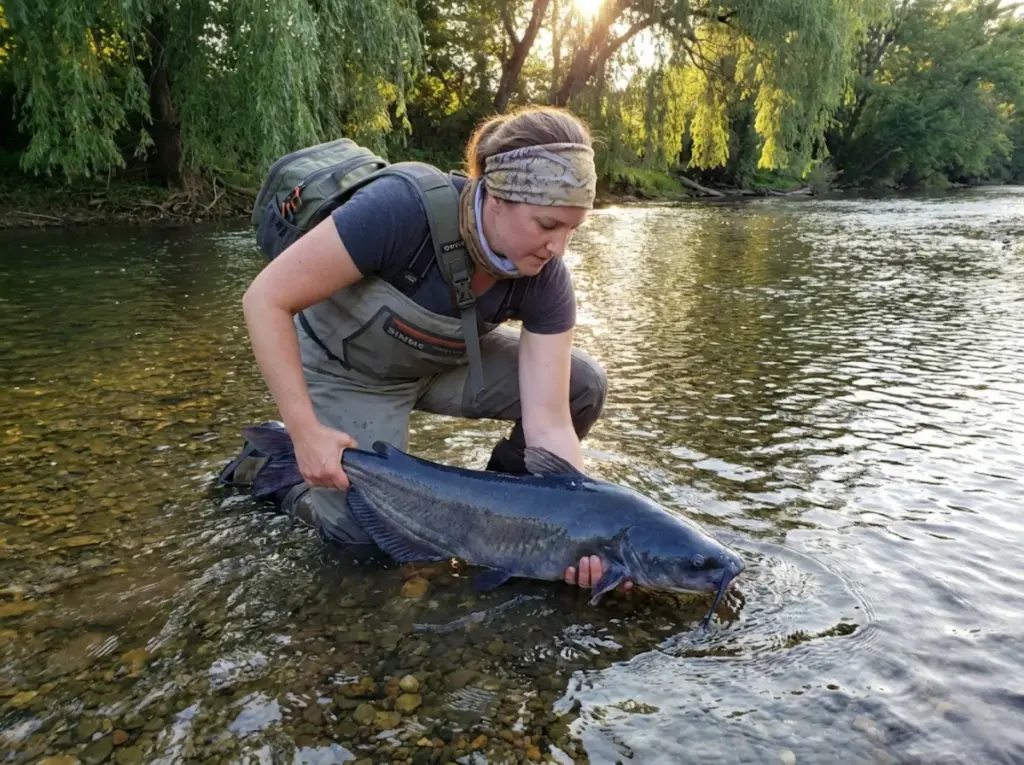
Understanding when and how blue catfish reproduce changes both your expectations on the water and your responsibilities off it.
The Spawning Cycle — When Trophy Males Go Quiet
Blue catfish spawning initiates when water temperatures reach 70 to 84 °F, typically late spring into early summer depending on latitude. Unlike species that scatter eggs in open water, blue catfish are cavity spawners.
The male selects the nesting site — an undercut bank, a hollow log, a submerged barrel, any cavity that provides a hard bottom and overhead cover. Using vigorous tail sweeps, he clears the substrate of silt and debris until a clean, hard surface is exposed. The site preparation can take days.
A single female blue catfish may deposit 4,000 to 8,000 eggs per kilogram of body weight. After fertilization, she leaves. The male assumes sole guardianship — fanning the eggs continuously with his pectoral fins to maintain oxygenation, removing dead eggs to prevent fungal spread, and defending the nest against natural predators.
For anglers, the implication is direct: during June and July, the biggest males in the river are holed up in heavy structure guarding nests. They’re not feeding actively, and they’re not roaming channels or hitting cut bait on drift rigs. If your trophy fishing bite dies in early summer, it’s not because the fish disappeared. They’re just occupied with something more important than your skipjack.
Indeterminate Growth — The “Hockey Stick” Curve
Blue catfish exhibit what biologists call indeterminate growth — they continue gaining size and mass for their entire lifespan, which can extend 20 to 30 years or more given adequate forage and habitat.
Growth isn’t linear, though. It follows a “hockey stick” curve driven by a critical dietary transition. Young blue catfish eat invertebrates — insects, crayfish, and other aquatic organisms. But once they reach approximately 12 to 14 inches, they become primarily piscivorous — fish-eating predators.
That dietary shift unleashes accelerated growth. In the James River, where invasive blue catfish have access to enormous schools of Atlantic menhaden and gizzard shad, the growth trajectory is dramatic. A blue cat can reach significant size in just a few years, but the jump from mid-size to trophy happens rapidly once the piscivory switch flips.
The 143-pound world record blue catfish caught by Richard “Nick” Anderson at Kerr Lake was estimated to be between 25 and 30 years old — documentation from the University of Michigan’s species profile on Ictalurus furcatus confirms the lifespan ranges that make fish of that caliber possible.
Why the Big Ones Should Swim
The math on trophy blue catfish release is straightforward.
Post-release mortality is less than 3% when fish are handled properly — minimal air exposure, horizontal support, wet hands, and rapid return to the water.
A 50-pound blue catfish is likely 15 to 20 years old. An 80-pounder might be 25 or older. Removing that fish removes decades of genetic material that cannot be replaced on any human-relevant timeline. A 50-pound blue catfish doesn’t get replaced by next year’s class. It takes another 15 to 20 years of survival, feeding, and growth to produce its replacement — if everything goes right.
The conservation equation is clear: harvest the small invasives (under 24 inches) to protect native species in colonized waterways. Release the trophies to maintain genetic diversity and the fishery’s long-term potential.
The next world record is currently swimming somewhere in the Missouri, Mississippi, or James River systems, likely fueling its growth on an invasive diet of menhaden or gizzard shad. Whether it reaches full potential depends partly on whether the angler who hooks it next understands why letting it swim matters more than a grip-and-grin photo and a freezer full of fillets.

Conclusion
Three things separate anglers who consistently catch trophy blue catfish from those who sit and wait:
First, respect the sensory system. These fish hear up to 13,000 Hz and track amino acid gradients across long distances. Fresh-cut bait in moving water covers more ground than any stink bait in a holder ever will. Use noise rigs in stained water, drift instead of anchoring, and never fish frozen bait when fresh is available.
Second, read the weather, not just the water. The Rule of 4 isn’t folklore — it’s a pattern confirmed over thousands of guided trips. Fish the pre-frontal bite aggressively, skip the two days after a major system passes, and return on day four when the metabolism has stabilized. In summer, find the thermocline and park your slip bobber just above it.
Third, know what you’re holding. Flip the fish, check the anal fin, and count the rays. Thirty to thirty-six with a straight margin means you’ve got a blue. That identification determines your bag limit, your legal obligations, and whether you’re helping the ecosystem by keeping it or protecting the fishery by letting it swim.
Next time you’re rigging up for blues, check the barometer, cut your bait fresh, and drift the channel edges. The biology is on your side — fish it with intention, and the folklore becomes irrelevant.
Frequently Asked Questions
What is the best bait for blue catfish?
Fresh-cut gizzard shad or skipjack herring consistently outperforms all other options. The amino acid release from freshly cut flesh creates a scent trail that frozen or processed baits cannot replicate. Cut your bait with the flesh side exposed and blood flowing freely — a two-inch chunk with skin on one side holds the hook and maximizes chemical signal downstream.
How do you tell the difference between a blue catfish and a channel catfish?
Count the anal fin rays. Blue catfish carry 30 to 36 rays arranged in a fan with a perfectly straight trailing edge. Channel catfish have 24 to 29 rays with a visibly rounded, convex margin. Juvenile blues never have spots; juvenile channels almost always do. Color is unreliable for identification — both species can look nearly identical depending on water clarity and hormonal state.
Are blue catfish invasive?
Blue catfish are native to the Mississippi, Missouri, and Ohio River basins. They are classified as invasive in the Chesapeake Bay region and across several Mid-Atlantic states after their introduction to Virginia’s tidal rivers in the 1970s. Their unexpected salinity tolerance allowed them to colonize the entire bay system, threatening native blue crabs, menhaden, and Atlantic sturgeon.
What is the world record blue catfish?
The IGFA All-Tackle world record stands at 143 pounds, caught by Richard Nick Anderson at Kerr Lake (Buggs Island), Virginia, on June 18, 2011. The battle lasted approximately 45 minutes and required three men to land the fish. The specimen was estimated to be 25 to 30 years old, illustrating the species’ indeterminate growth potential.
How does barometric pressure affect blue catfish fishing?
The blue catfish’s two-chambered swim bladder is highly sensitive to atmospheric pressure changes. A falling barometer triggers aggressive pre-frontal feeding as the fish gorge before the disturbance arrives. After a major front passes and the barometer stabilizes, catfish enter a metabolic slowdown that typically lasts about four days — the Rule of 4 identified by professional guide Brad Durick. Planning trips around weather fronts rather than calendar dates is one of the most underused competitive advantages in catfishing.
Risk Disclaimer: Fishing, boating, and all related outdoor activities involve inherent risks that
can lead to injury. The information provided on Master Fishing Mag is for educational and informational purposes
only. While we strive for accuracy, the information, techniques, and advice on gear and safety are not a substitute
for your own best judgment, local knowledge, and adherence to official regulations. Fishing regulations, including
seasons, size limits, and species restrictions, change frequently and vary by location. Always consult the latest
official regulations from your local fish and wildlife agency before heading out. Proper handling of hooks, knives,
and other sharp equipment is essential for safety. Furthermore, be aware of local fish consumption advisories. By
using this website, you agree that you are solely responsible for your own safety and for complying with all
applicable laws. Any reliance you place on our content is strictly at your own risk. Master Fishing Mag and its
authors will not be held liable for any injury, damage, or loss sustained in connection with the use of the
information herein.
Affiliate Disclosure: We are a participant in the Amazon Services LLC Associates Program, an
affiliate advertising program designed to provide a means for us to earn advertising fees by advertising and linking
to Amazon.com. As an Amazon Associate, we earn from qualifying purchases. We also participate in other affiliate
programs and may receive a commission on products purchased through our links, at no extra cost to you. Additional
terms are found in the terms of service.