
In this article
The third minnow floated belly-up before I’d even made my first cast. The bait shop was 40 minutes behind me, the crappie were stacked on brush at 12 feet, and my bucket was turning into a graveyard. That morning cost me $8 in dead bait and a limit of slabs. It took a charter captain on Cherokee Lake to show me what I was doing wrong—and it had nothing to do with my hook.
Turns out, keeping live minnows breathing and rigging them so they actually swim right are two halves of the same problem. Get one wrong and you’re fishing with dead weight. This guide covers both: the water chemistry that decides whether your baitfish survive the drive to the ramp, the five hooking methods that match every presentation, and the species-specific rigs that working guides build for crappie, walleye, and bass.
⚡ Quick Answer: Keep your minnow bucket below 60°F with frozen water bottles (never loose ice), run an aerator to maintain dissolved oxygen above 5 ppm, and change 25% of the water every two hours to flush ammonia. For rigging, match your hook placement to the situation: lip hooking for trolling and current, dorsal hooking for float rigs, and tail hooking when you want maximum vibration to call fish in from a distance.
Why Live Minnows Still Outperform Plastics
The Lateral Line Advantage
A live minnow broadcasts something no plastic can fake. Every tail beat pushes a pressure wave through the water, and predatory fish pick it up through their lateral line system—a row of sensory cells called neuromasts that run from head to tail. These cells are so sensitive that electrophysiological studies on lateral-line sensing in fishes have shown that deflecting a single neuromast in a five-day-old larva can trigger a swimming response.
That sensitivity is exactly why rigging matters. A minnow pinned with a thick-gauge hook or weighed down with too much lead sends out a broken, unnatural vibration. Predators read that signal the same way you’d read a neon sign that says “trap.” Guides use thin-wire Aberdeen hooks specifically because they let the minnow’s tail-beat frequency stay in the predator’s preferred window. If you want to understand how the lateral line system drives strike decisions, it changes the way you think about every hook you tie on.
Compound Signaling: Scent, Vibration, and Sight Working Together
Fish don’t commit to a strike based on one sense. They stack inputs: vibration detects activity at long range, amino acid emission from the minnow’s skin creates a scent trail at mid-range, and vision confirms the target up close. This layered approach—Detection, Localization, Identification, Verification—is why even the best scented plastic lures can’t match a healthy live bait presentation. Those amino acid trails dissolve off a soft bait in minutes. A live minnow keeps pumping them out as long as it’s breathing.
In stained water below two feet of visibility, the lateral line becomes the primary strike trigger. That’s where live-bait fishing owns every other approach.
Pro tip: In muddy or stained water, tail hooking your minnow creates the most erratic swimming pattern and the strongest low-frequency vibrations—exactly what bass and walleye key on when they can’t see.
The Bait Bucket Problem: Why Your Minnows Die
Dissolved Oxygen: The Invisible Killer
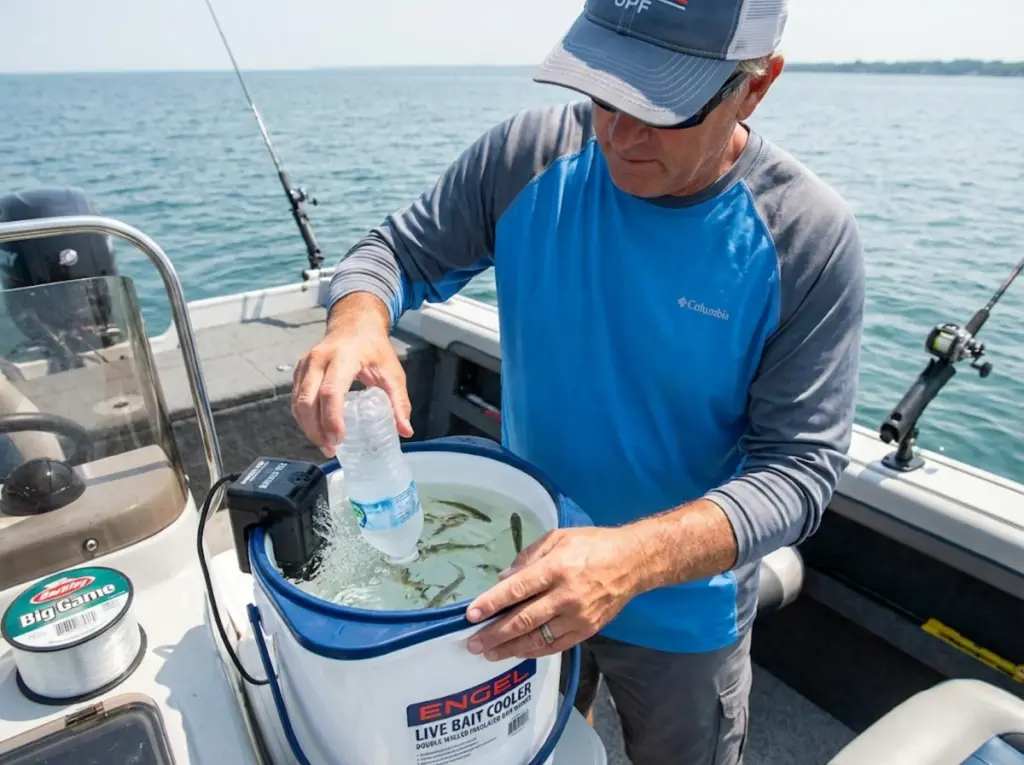
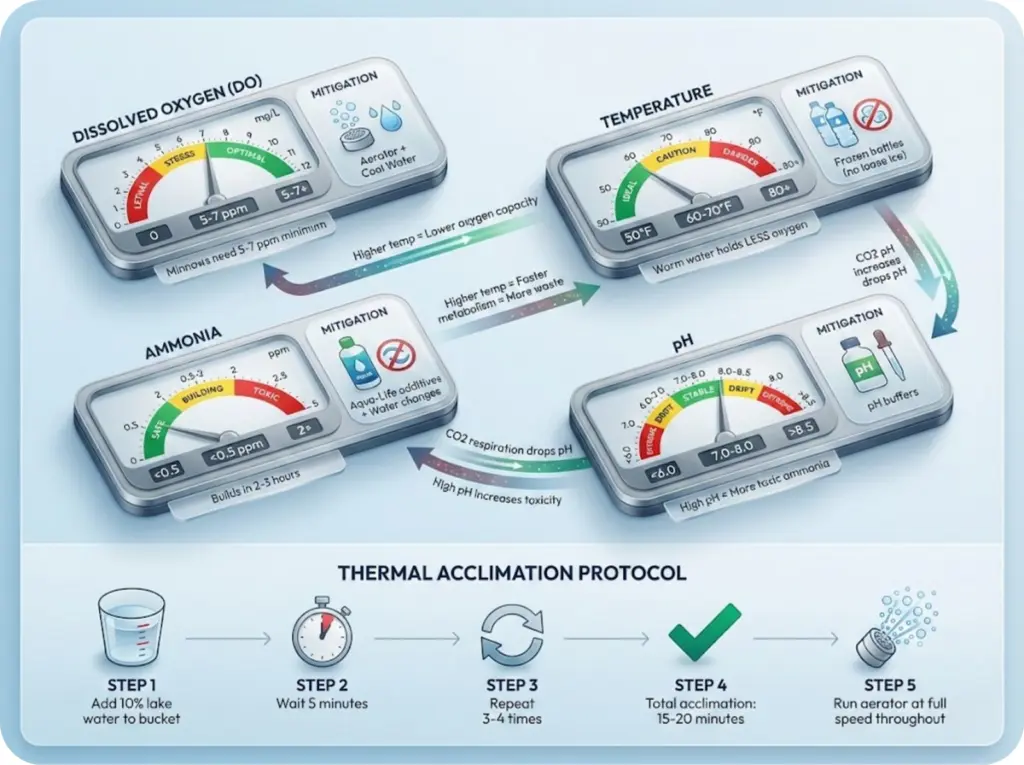
Most baitfish need 5-7 ppm of dissolved oxygen just to function. Drop below 3 ppm and they’re dead. Here’s the problem: warm water holds less oxygen than cold water. At 50°F, freshwater saturates around 11 mg/L. At 80°F, that drops to roughly 8 mg/L. Meanwhile, your minnows are burning through oxygen faster because their metabolism spikes with the heat.
A calm minnow sips oxygen. A stressed, overcrowded minnow gulps three times as much. Cram too many into a small bucket on a July morning, and you get a cascade failure—water temperature climbs, oxygen crashes, and your $12 bucket of fathead minnows goes belly-up before you clear the marina. For a deep dive into long-term storage setups, check out the complete guide to keeping bait alive.
Pro tip: Freeze water bottles and use those instead of loose ice. Ice from your kitchen faucet carries chlorine, which is directly toxic to minnow gill tissue. The bottles cool the water without poisoning it.
Ammonia, pH, and the Nitrogen Time Bomb
Every minnow in your bucket is exhaling ammonia through its gills. In a closed system, toxic levels build in two to three hours. Higher pH makes it worse—it shifts ammonia into its un-ionized form, which is far more lethal. At the same time, the minnows’ respiration dumps carbon dioxide into the water, forming carbonic acid, which drops the pH. You get a chemistry failure that feeds on itself, validated by Texas A&M research on bait minnow tank management.
Commercial bait care additives like Frabill’s Aqua-Life neutralize ammonia buildup and buffer pH. For multi-day trips, a small cycled sponge filter mimics the nitrogen cycle and buys you hours of extra bait life.
The Thermal Shock Protocol
Moving minnows from 65°F bait shop water straight into 80°F lake water can produce total mortality within an hour—even if everything else is perfect. The fix is simple but non-negotiable: add small amounts of lake water to your bait container every five minutes, about 10% of total volume per dose. Let the baitfish acclimate for 15-20 minutes before you hook a single one. Run your aerator at full speed during the process to offset the handling stress.
Five Ways to Hook a Minnow (And When Each One Wins)
Snout Hook: Maximum Longevity for Current and Trolling
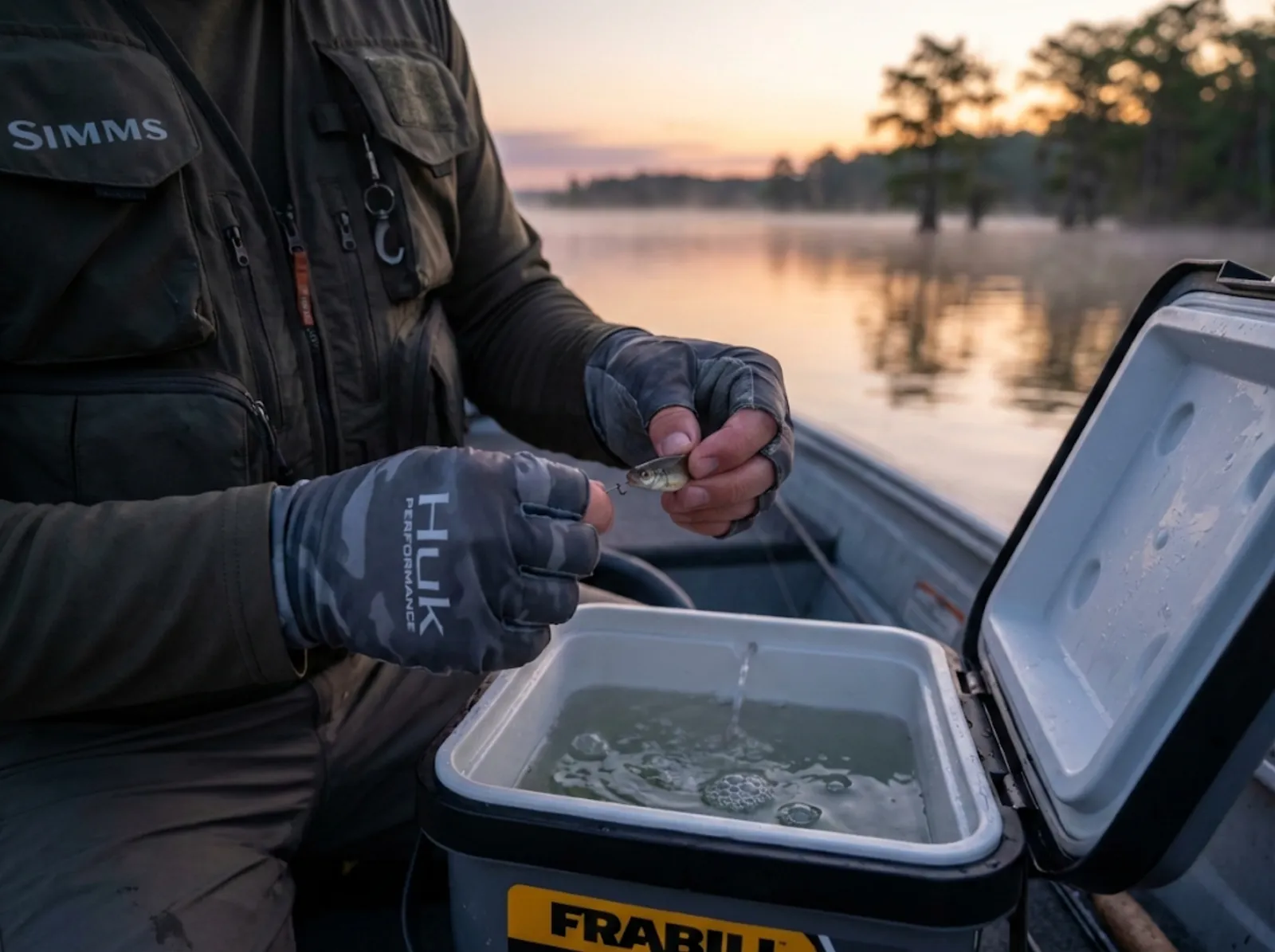
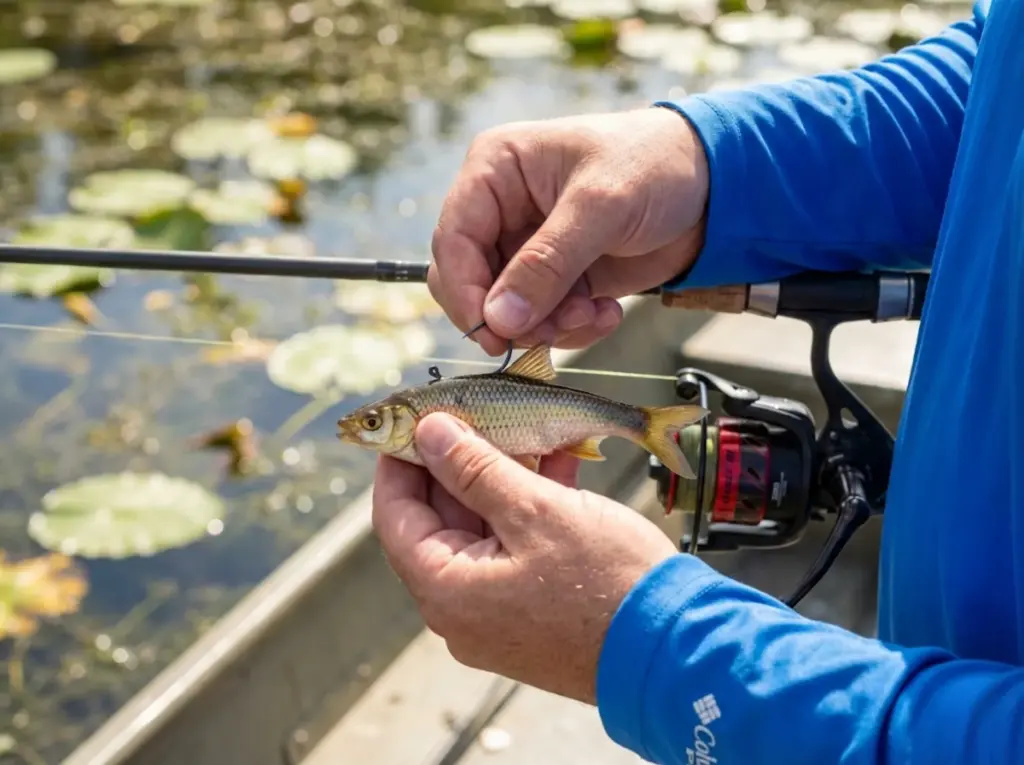
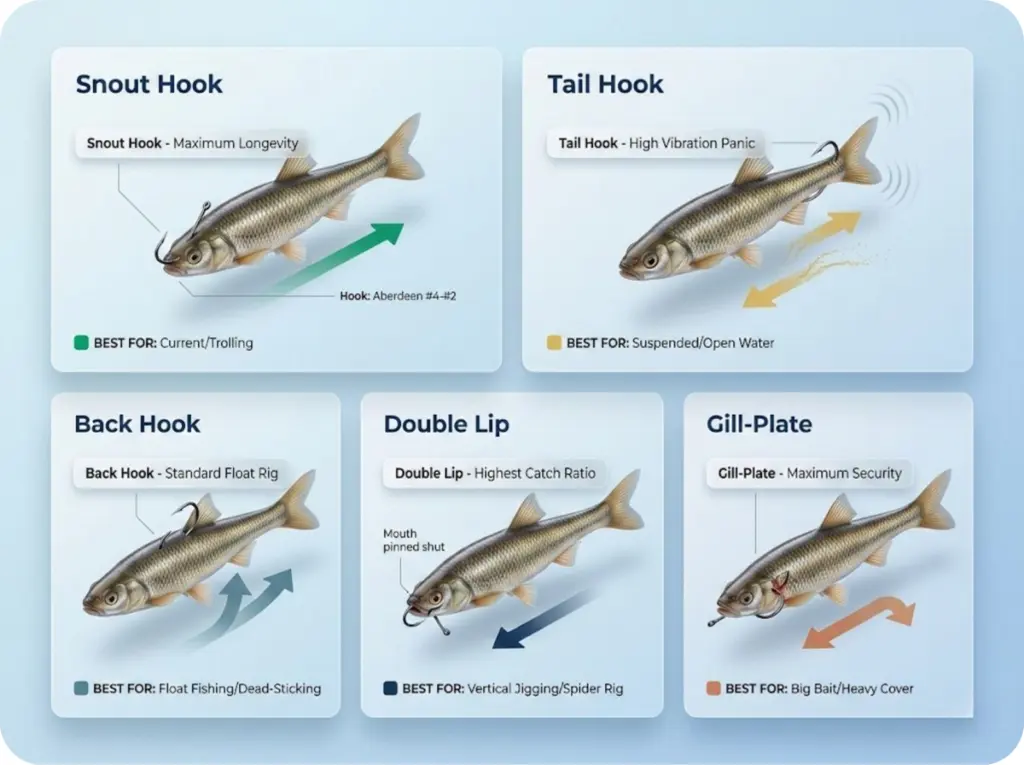
Pass the hook through the snout, forward of the eyes, and out through the mouth. This does not pin the jaws shut, so the minnow can still breathe while it swims—a process called ram ventilation. It’s the longest-lasting hook placement of any method, which makes it ideal for trolling, drifting, and heavy current where the bait is constantly being pulled forward. Use thin-wire Aberdeen hooks—size #4-#2 for crappie minnows, #1-1/0 for bass-sized golden shiners. Understanding the physics of hook placement and bait swimming direction helps you see why tow-point position changes everything about how a minnow moves.
Where it fails: still-fishing in slack water. The minnow just sits there broadcasting nothing.
Tail Hook: High-Vibration Panic Mode
Pierce the musculature just in front of the tail fin. The minnow fights to swim forward while being anchored from behind, creating wild, erratic movement and broadcasting intense low-frequency vibrations. This is the highest-vibration method in your toolbox, and it’s deadly for suspended fish in open water and weightless free-lining near timber. The catch: predators strike the head first, so wait three to five seconds before setting the hook.
Back Hook: The Standard Float Rig Setup
Insert the hook just behind the dorsal fin—not through it, or it’ll tear out fast. The minnow fights to stay upright, generating constant commotion that predators key on from a distance. This is the industry standard for slip float rig fishing and stationary dead-sticking. It also gives you better minnow longevity than lip hooking because it doesn’t interfere with breathing.
Double Lip Hook: The Crappie Spider-Rig Standard
Pass the hook from the bottom jaw up through the top lip. The mouth is pinned shut, which means the minnow suffocates faster—but the hook sits right at the point of strike, giving you the highest catch ratio of any method. This is the go-to for vertical jigging and spider rigging when you’re cycling through minnows quickly and need every bite to connect.
Gill-Plate Hook: Security for Big Bait Presentations
The hook enters the mouth and exits behind the gill cover. It’s the most secure hold you can get—it survives aggressive casts that would throw every other placement. Mainly used for large golden shiners targeting trophy largemouth bass in heavy vegetation. It’s usually fatal to the minnow, so this is predominantly a dead-bait or angler-provided-action technique.
Species-Specific Rig Setups That Guides Actually Use
Crappie: Slip Floats, Spider Rigs, and the Vertical Game
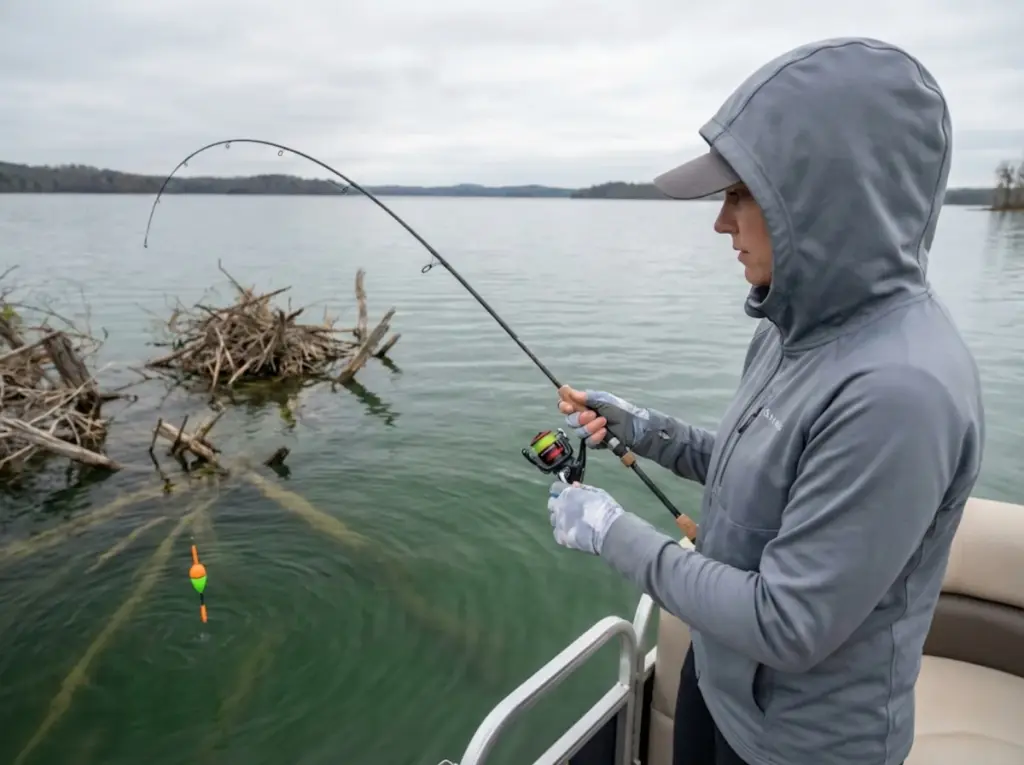
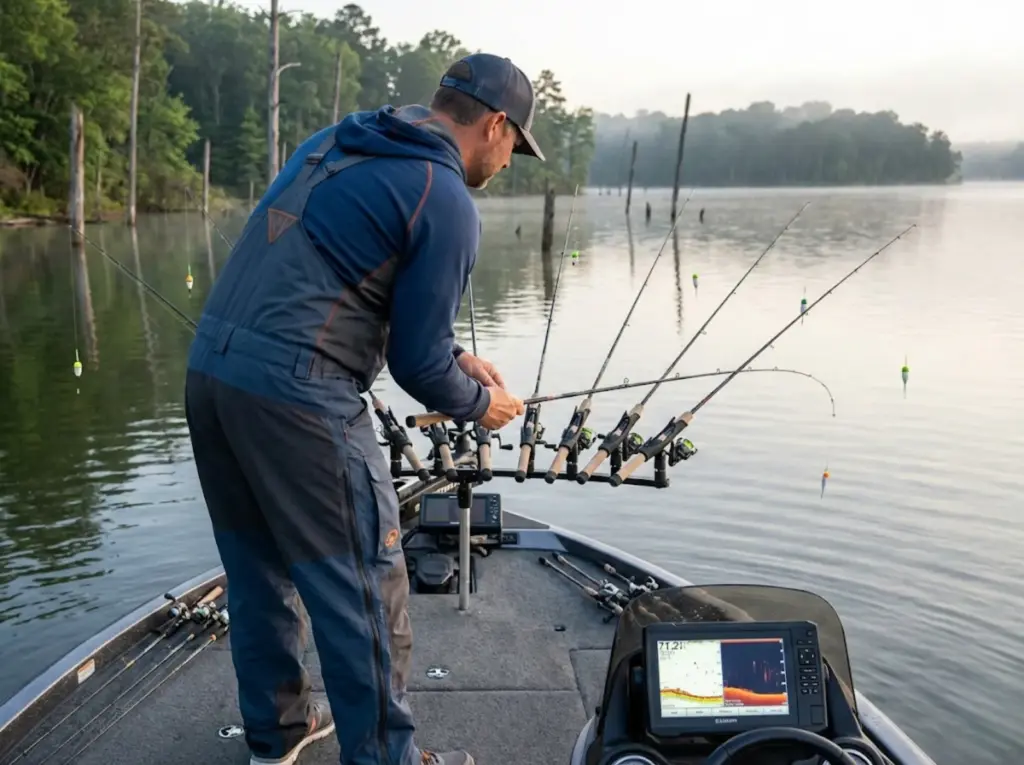
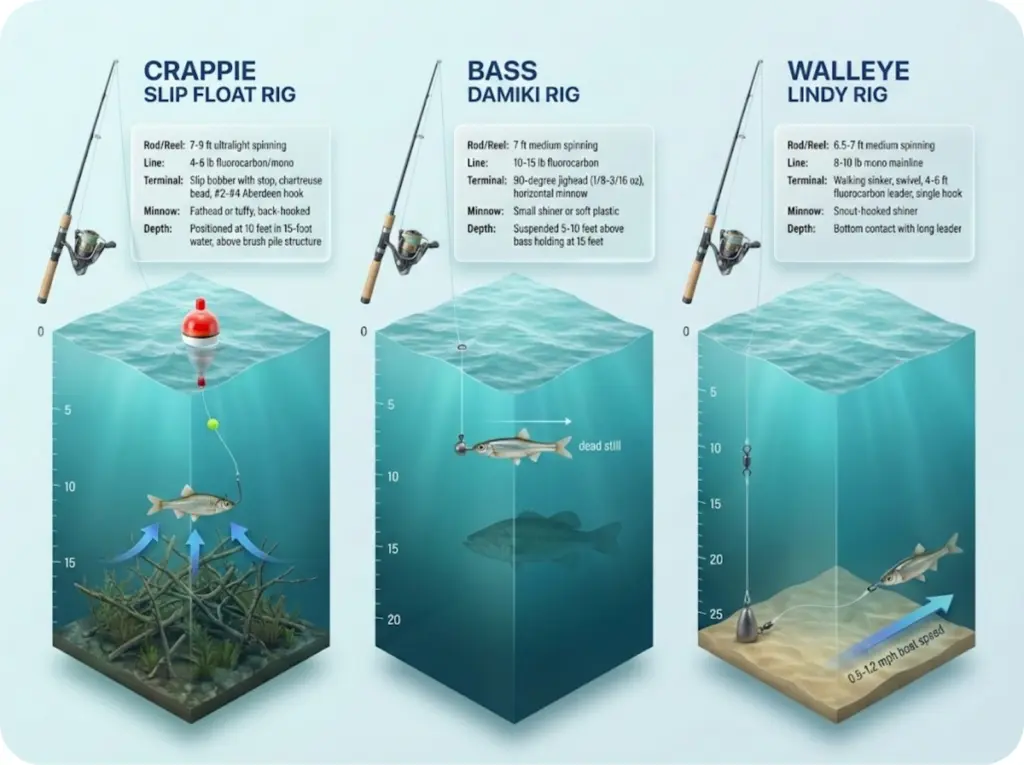
Crappie feed upward. Every rig has to position the minnow above the fish, not below it. The slip float rig handles this with a bobber stop that sets precise depth—critical when fish are holding at 10 feet in a 15-foot brush pile. Run 4-6 lb fluorocarbon or monofilament for transparency, a #2 or #4 Aberdeen hook, and a fathead minnow or tuffy. In stained water, clip a small chartreuse bead above the hook for visual pop.
Spider rigging scales this up. Deploy 8-16 rods from a slow-trolling boat with double minnow rigs at staggered depths to scan the water column. Jeff Gustafson ties his knot on the jighead so the bait hangs perfectly horizontal—not nose-down. That subtle detail triggers roughly 30% more strikes on neutral fish. For a complete breakdown of crappie patterns, check out the precision crappie fishing guide.
Bass: From Free-Lining Shiners to the Damiki “Mope”
For trophy largemouth bass in heavy vegetation, lip-hook a 4-6 inch golden shiner on a 3/0 circle hook and free-line it with zero weight. Let the shiner swim and find the fish—it knows where the predators are before you do.
The Damiki rig (also called moping) is a different game entirely. Rig a small minnow or a realistic soft-plastic like the Z-Man Scented Jerk ShadZ on a 90-degree jighead (1/8-3/16 oz) so it hangs perfectly horizontal. Find suspended bass on your electronics, drop the rig 5-10 feet above them, and hold the rod dead still. The trigger is pure psychology: a lonely minnow that looks too cold or tired to move. An easy meal for any bass watching.
Walleye: Precision Boat Control and the Live-Bait Rig
The Lindy rig is still the standard. A walking sinker on the mainline slides along bottom without snagging, a swivel connects to a 4-6 foot fluorocarbon leader, and a single hook carries a snout-hooked minnow. Drift at 0.5-1.2 mph and let the long leader give the bait room to swim naturally.
For walleye stacked on steep breaks and humps, a three-way swivel rig suspends the minnow above bottom where the fish are actually feeding. Tungsten dropper weights telegraph bottom composition—you can feel the difference between rock, mud, and sand—so you know exactly when to adjust depth. When you feel a tap, feed 3-5 feet of slack, wait for the rod to load, then set.
Terminal Tackle Selection: Hooks, Line, and Weights That Matter
Hook Size Chart by Minnow Length
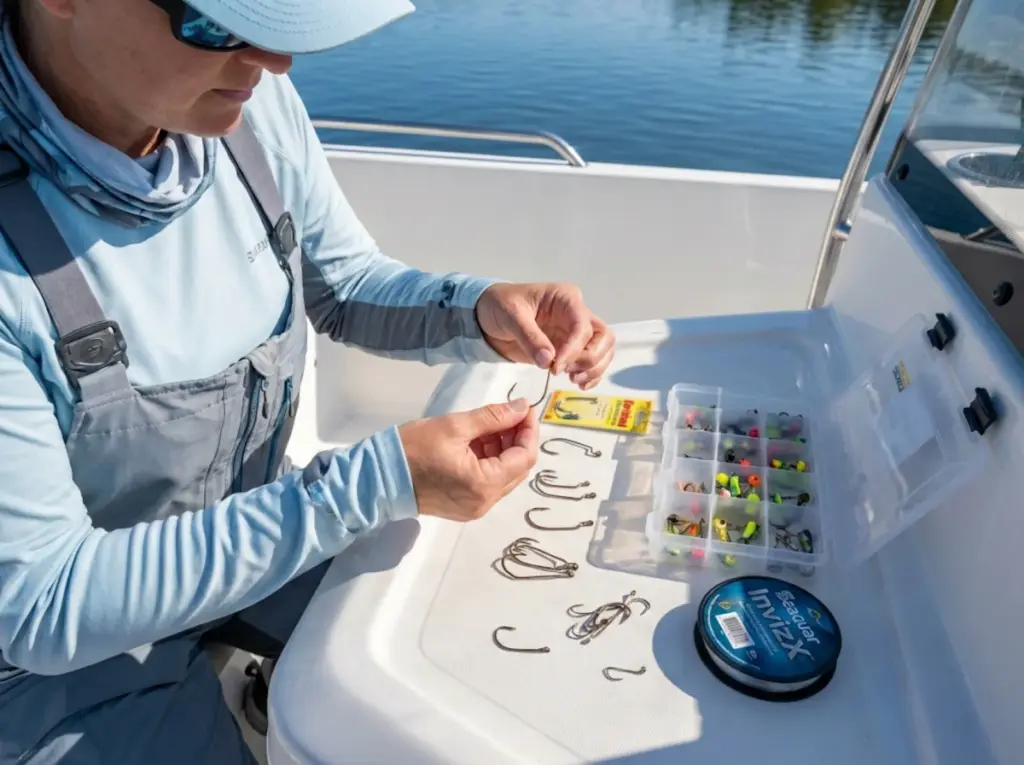
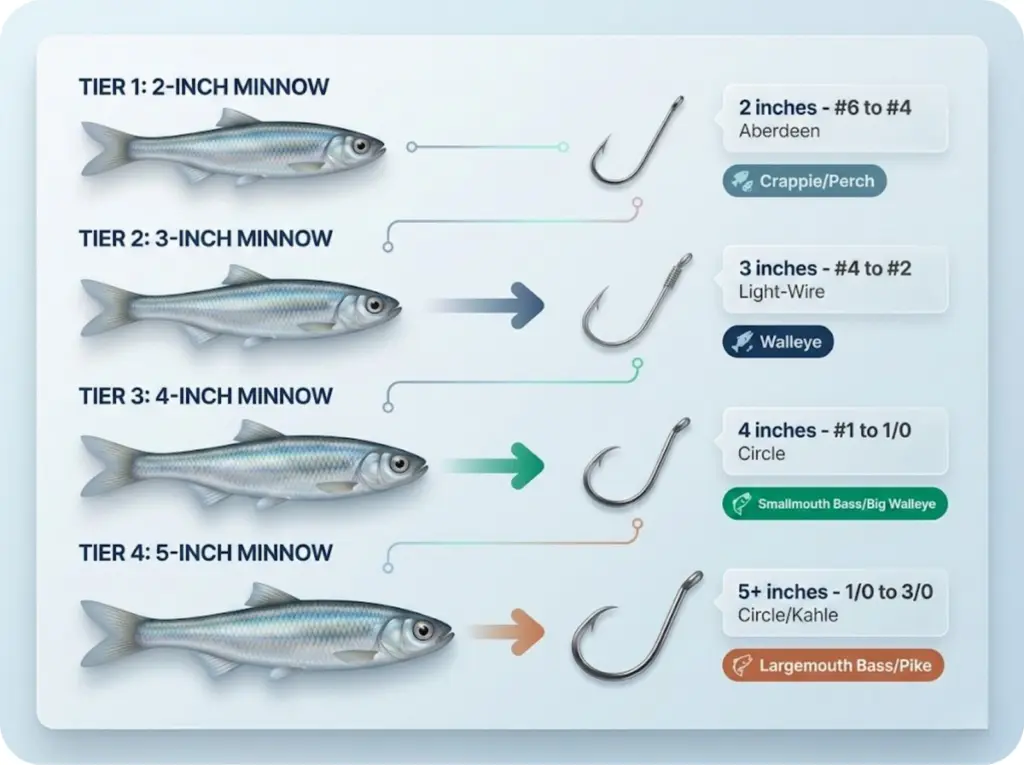
The rule is straightforward: match hook size to minnow size. Under 2 inches, go with a #6-#4 light-wire Aberdeen for crappie and perch. At 2-3 inches, step up to #4-#2 Aberdeen or light-wire octopus for walleye. For 3-4 inch minnows, a #1-1/0 circle hook covers smallmouth bass and big walleye. And for 4-5+ inch shiners targeting largemouth bass or pike, you need 1/0-3/0 circles or kahle hooks. Always favor thin-wire hooks over thick ones—they create smaller entry wounds and let the minnow swim longer. For a full breakdown, reference the complete hook sizing cheat sheet.
Line Selection: Matching Visibility to Species
Crappie and panfish demand invisibility: 4-6 lb fluorocarbon or monofilament. Walleye setups run 6-10 lb fluorocarbon leaders on braid mainline for sensitivity plus stealth. Bass finesse rigs need 8-12 lb fluorocarbon in clear water, 15-20 lb braid for punching vegetation. For pike and musky, a 20-30 lb fluorocarbon or titanium wire leader is non-negotiable—teeth will cut anything lighter.
Weight Systems: Matching Sink Rate to Presentation
Split shot pinched 12-18 inches above the hook is the simplest approach for basic float rigs. Walking sinkers (Lindy-style) slide along bottom without hanging up—the standard for walleye live-bait rigs. Tungsten weights cost more than lead but they’re 1.7x denser, transmit bottom-contact vibrations better, and are more environmentally responsible. For neutral fish on structure, a drop-shot rig weight positioned below the hook suspends the minnow at a precise height off bottom.
Pro tip: Use the Eagle Claw Slinky Sinker or similar snag-resistant designs when fishing timber or rock. They slide over structure instead of wedging into cracks and costing you your whole rig.
Forward-Facing Sonar and the Live-Bait Revolution
Reading Fish Reactions in Real Time
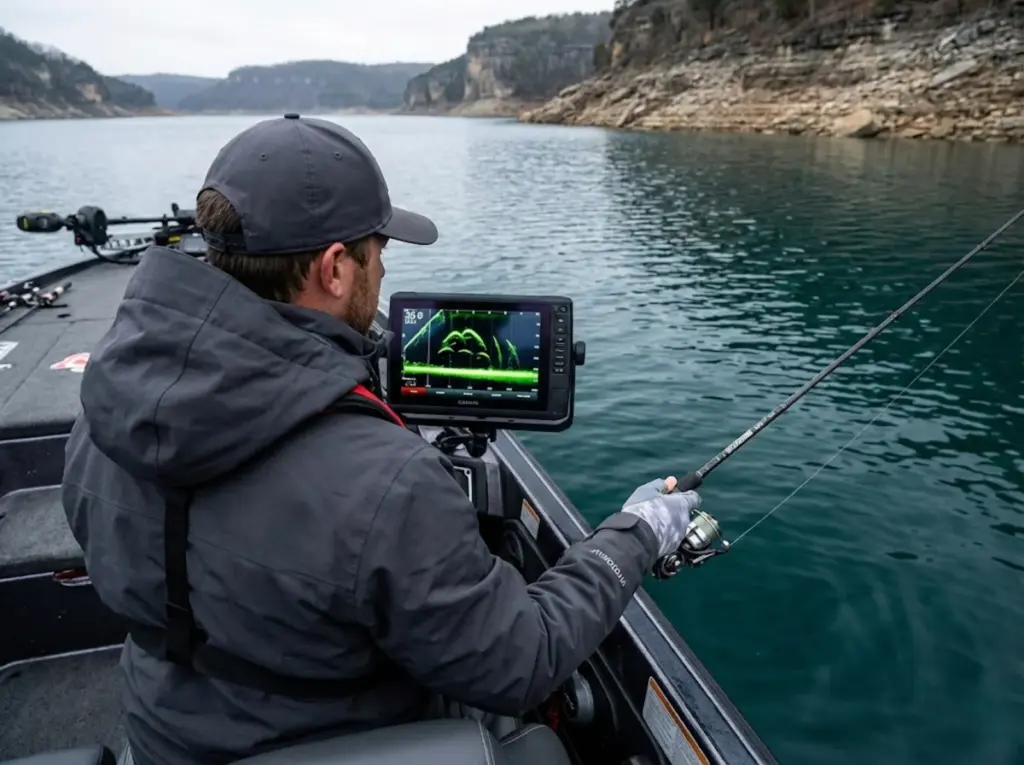
Forward-facing sonar units—Garmin LiveScope, Lowrance ActiveTarget, Humminbird MEGA Live—let you watch your minnow swim and see the predator reacting in real time. An active fish moves toward the bait immediately. A neutral fish follows for 10+ feet, then turns away. That behavioral data changes your approach instantly: speed up the retrieve for active feeders, slow down and twitch for followers.
If a crappie tracks your minnow on LiveScope but won’t commit, a slight twitch followed by a dead pause often triggers the strike reflex. The technology has made live minnow fishing more precise than it’s ever been—but also more technically demanding.
The Sonar Pressure Problem
Here’s what most guides won’t tell you: constant sonar transmission spooks fish in pressured waters. The fix is a technique some call “stealth mode”—identify your target on the screen, make your cast, then put the unit to sleep and rely on feel to finish the play. For crappie in timber, narrow the range to 20-40 feet to separate fish returns from structure clutter. Keep gain around 60% to prevent ghosting, and max color gain at 100% so your bait return stands out.
Pro tip: On heavily pressured lakes, kill your forward-facing sonar after you spot your target. Fish can sense the constant ping, and wary crappie or walleye will turn away from bait presented under active sonar transmission.
Biosecurity: VHS, Invasive Species, and Your Legal Responsibility
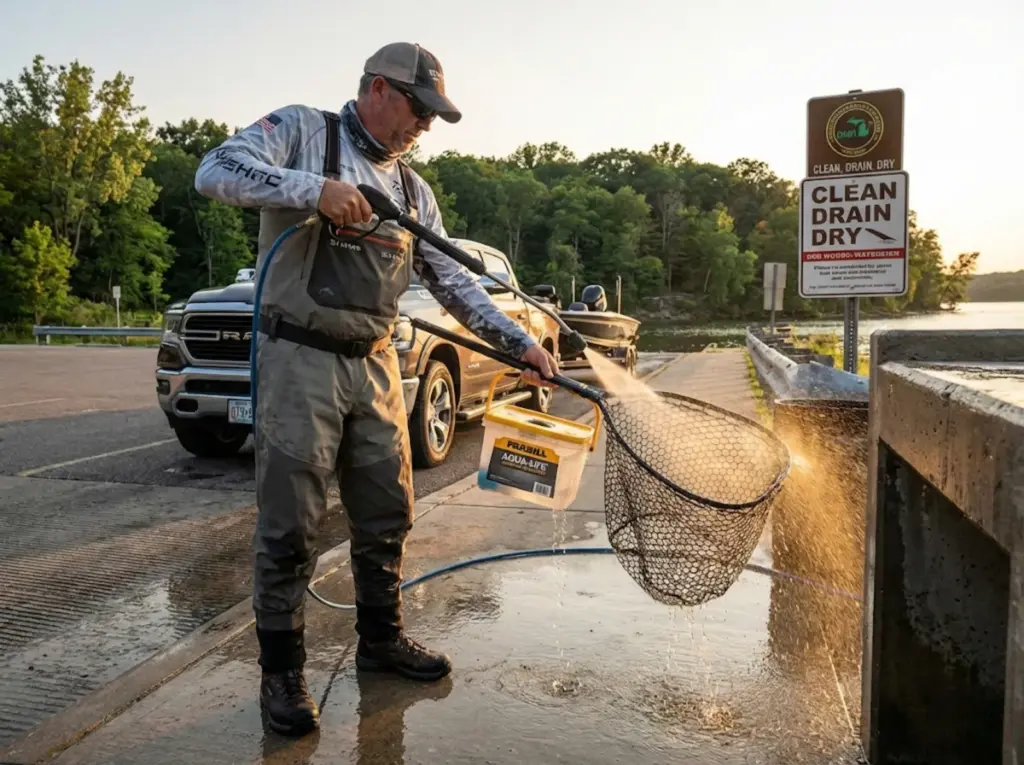
Viral Hemorrhagic Septicemia Protocols
Viral hemorrhagic septicemia is a rhabdovirus that has caused massive kills across the Great Lakes watershed, hitting common baitfish like emerald shiners, gizzard shad, and bluntnose minnows. States including Wisconsin, Minnesota, Michigan, and Pennsylvania now require you to drain all water from livewells, bilges, and minnow buckets before transporting a boat over land. Moving bait across state lines often requires certified documentation. And it’s illegal in most places to dump unused live bait into any waterbody—throw it in the trash. You can review the full regulatory framework through Pennsylvania Sea Grant’s VHS fact sheet.
Gear Decontamination for the Responsible Angler
Dry all gear for at least five days before moving to a new lake. Rinse everything with 140°F water to kill invasive larvae like zebra mussels and spiny water fleas. A solution of 1/3 cup bleach in five gallons of water disinfects minnow buckets and nets—just rinse thoroughly before reuse. Check your state’s specific VHS regulations before every trip, because rules change and fines are steep. For a broader look at protecting the waters you fish, read the angler’s guide to stopping invasive species.
Conclusion
Three things separate a guide’s bait fishing game from everyone else’s.
First, the bucket matters as much as the rig. Dissolved oxygen, temperature, and ammonia management are the foundation. If your minnows are dead before you cast, nothing else matters.
Second, match your hooking method to the job. Snout for current and longevity, tail for vibration, back for float rigs, double lip for crappie hook-up ratios. There’s no universal “best” method—only the right one for the situation.
Third, think in systems, not just tackle. The best minnow anglers connect bait selection, water chemistry, hook placement, and electronics into one integrated approach. Each piece reinforces the others.
Next time you stop at the bait shop, spend an extra two minutes tempering your bucket water before you head to the ramp. That one step alone will keep more minnows alive than any piece of fishing gear you can buy.
FAQ
What is the best hook size for live minnows?
Match hook size to minnow length: #6-#4 for minnows under 2 inches, #4-#2 for 2-3 inch minnows, and #1-1/0 for minnows over 3 inches. Always use thin-wire hooks like Aberdeen or light-wire octopus styles—they create smaller entry wounds and let the baitfish swim naturally for longer.
How do you keep minnows alive while fishing?
Maintain dissolved oxygen above 5 ppm with a battery-powered aerator, keep water temperature below 60°F using insulated buckets and frozen water bottles (not loose ice), and change 25% of the water every two hours to dilute ammonia buildup. Overcrowding is the number one killer—give your minnows room to breathe.
How do you rig a live minnow for bass?
For largemouth bass in vegetation, lip-hook a 4-6 inch golden shiner on a 3/0 circle hook and free-line it with no weight. For deep suspended bass, use the Damiki rig (moping technique): a 90-degree jighead (1/8-3/16 oz) with the minnow rigged for horizontal presentation, dropped 5-10 feet above fish found on forward-facing sonar.
What is the Lindy rig for minnows?
The Lindy rig uses a walking sinker on the mainline, a swivel, a 4-6 foot fluorocarbon leader, and a single hook tipped with a snout-hooked minnow. The sinker slides along bottom without snagging while the long leader lets the minnow swim freely. It’s the standard professional walleye rig for controlled drifting at 0.5-1.2 mph.
Can you use minnows for crappie fishing?
Minnows are the most effective live bait for crappie. Use a #2 or #4 Aberdeen hook with a fathead minnow on a slip float rig set to the fish’s depth. For spider rigging, double-lip hook the minnow for maximum hook-up ratio and deploy multiple rods at staggered depths to cover the water column.
Risk Disclaimer: Fishing, boating, and all related outdoor activities involve inherent risks that
can lead to injury. The information provided on Master Fishing Mag is for educational and informational purposes
only. While we strive for accuracy, the information, techniques, and advice on gear and safety are not a substitute
for your own best judgment, local knowledge, and adherence to official regulations. Fishing regulations, including
seasons, size limits, and species restrictions, change frequently and vary by location. Always consult the latest
official regulations from your local fish and wildlife agency before heading out. Proper handling of hooks, knives,
and other sharp equipment is essential for safety. Furthermore, be aware of local fish consumption advisories. By
using this website, you agree that you are solely responsible for your own safety and for complying with all
applicable laws. Any reliance you place on our content is strictly at your own risk. Master Fishing Mag and its
authors will not be held liable for any injury, damage, or loss sustained in connection with the use of the
information herein.
Affiliate Disclosure: We are a participant in the Amazon Services LLC Associates Program, an
affiliate advertising program designed to provide a means for us to earn advertising fees by advertising and linking
to Amazon.com. As an Amazon Associate, we earn from qualifying purchases. We also participate in other affiliate
programs and may receive a commission on products purchased through our links, at no extra cost to you. Additional
terms are found in the terms of service.