

In this article
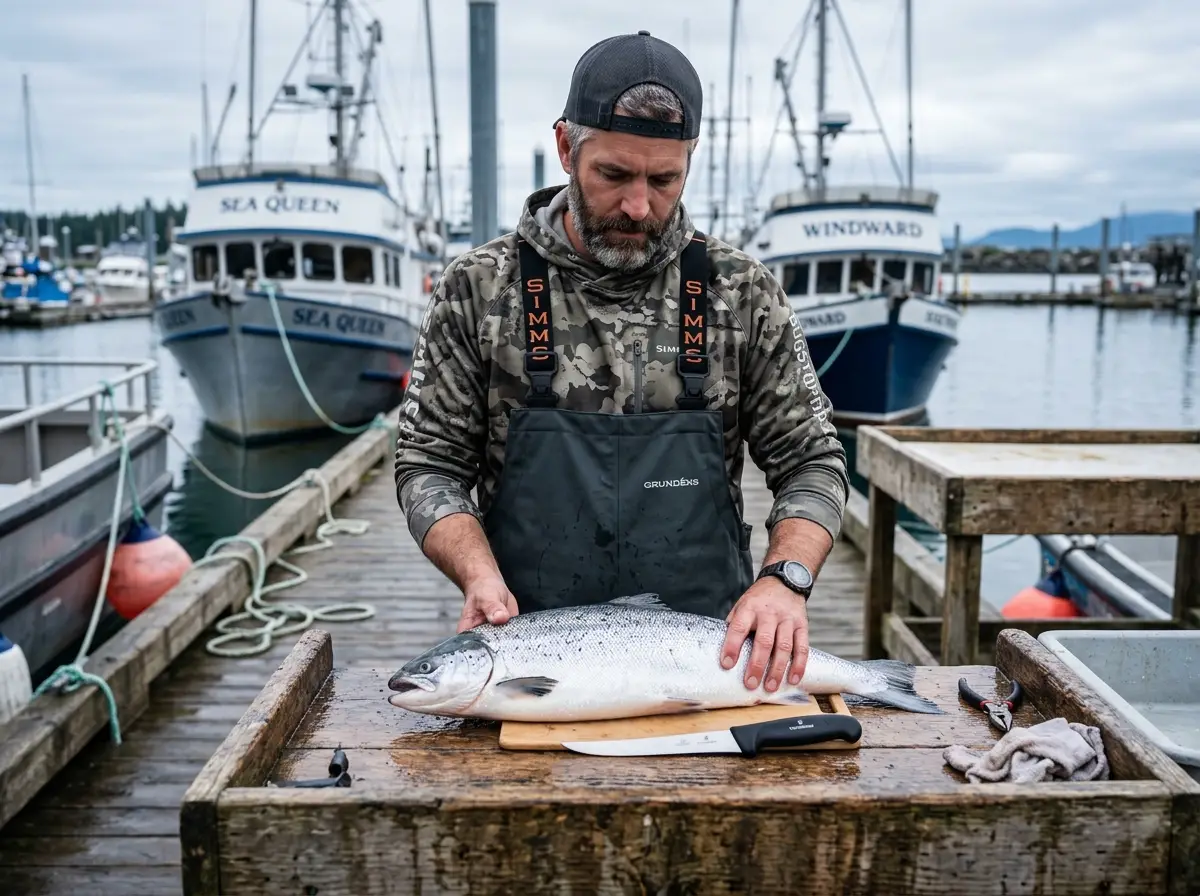
The knife skipped off the rib — you know that feeling — and you left a quarter-inch of meat still on the bone. I’d done it a hundred times before I understood why: I was fighting the skeleton instead of reading it.
Most anglers learn to fillet the same way. Someone hands them a knife, shows them a general direction, and they hack their way through. They get a fillet eventually. But they also leave protein on the bone, tear through the meat when they hit rigor wrong, and wonder why their fish tastes off by the time they cook it.
Here’s what nobody tells you: filleting is a biology problem, not a knife problem. Once you understand what you’re actually cutting through — the skeletal architecture, the biochemical state of the muscle, the way blade geometry interacts with bone — everything clicks. You’ll recover more meat, cut cleaner, and never again lose a good fillet to bad timing or a dull edge.
⚡ Quick Answer: Fillet fish either before rigor sets in (within roughly one hour of dispatch) or after it resolves (4–24 hours chilled). Never cut during rigor — the muscle is mechanically stiff and tears rather than separates. Use a flexible 7–9 inch blade (18–22° bevel for most species), ride the backbone by feel until you hear the vertebrae tick under the steel, and keep the fish cold throughout. De-slime before the first cut, sanitize surfaces between stages, and freeze only after rigor has fully passed.
The Biology You’re Actually Cutting Through
Every species has a skeletal architecture that either channels or resists your blade. Get it wrong and you’re fighting bone. Get it right and the knife almost guides itself.
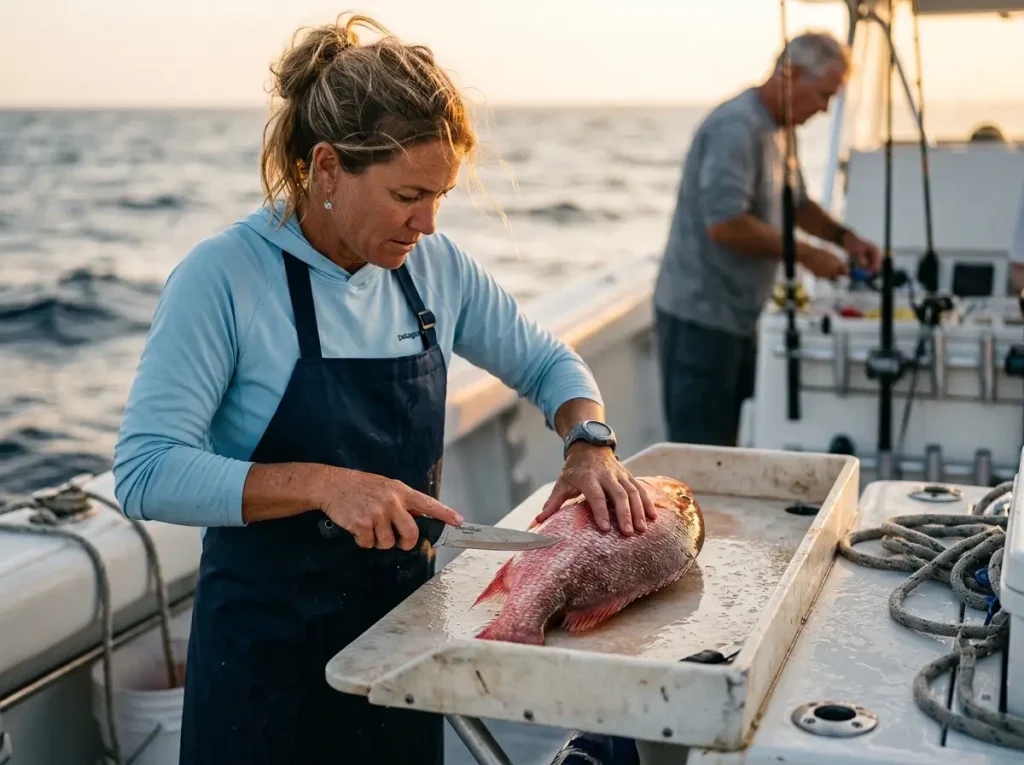
The fish skeleton divides into two systems: the axial skeleton (vertebral column and skull) and the appendicular skeleton (fin supports). The vertebrae themselves have two critical arches — the neural arch above the centrum, which protects the spinal cord, and the haemal arch below, which protects blood vessels in the tail region. These arches form the rail your blade rides during the backbone pass. The centrum is concave at both ends, which is exactly why pros can feel each vertebra as the blade moves through — that rhythmic ticking is your blade skipping over bone, not cutting meat.
Round fish like trout, salmon, and cod yield two fillets with the backbone running along the upper edge. Flat fish like flounder and halibut yield four fillets — two per side — with the backbone running horizontally through the center. The entry geometry is completely different. If you’re treating a halibut like a trout at the cutting board, you’re already working against yourself.
Scale type changes your first move. Cycloid scales (salmon, trout) have smooth, rounded edges — low resistance, easy to cut clean through. Ctenoid scales (halibut, perch) have spined projections that snag blade tips. Know what you’re working with before you pick up the knife.
The slime coating deserves real attention. That glycoprotein film reduces hydrodynamic drag in the water, but on your cutting board it becomes a bacterial reservoir and a blade-slip hazard. You can read more about the glycoprotein slime coat that protects every fish to understand exactly why de-sliming before the first cut isn’t optional — it’s a direct intervention in your contamination risk.
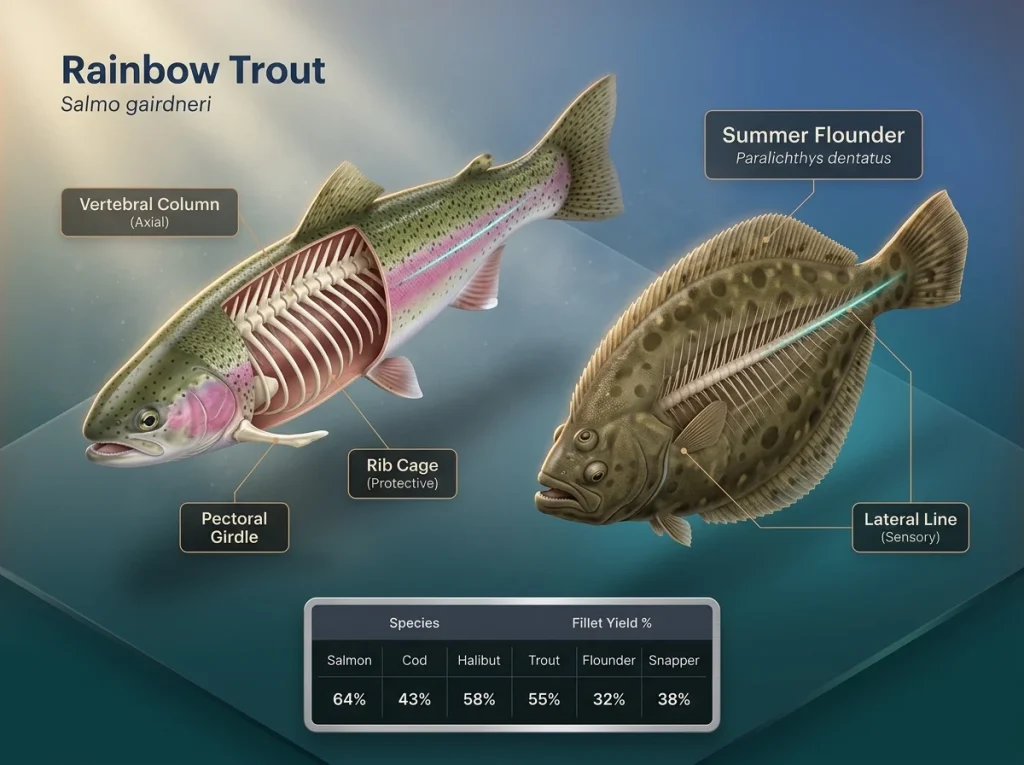
Pro-Tip: If you’ve never “listened” to your knife before, try it on your next perch: close your eyes, make the backbone pass, and count the ticks. Each one is a rib you’ve cleared without penetrating the meat. When the ticking stops, you’ve drifted. That feedback loop is the whole skill.
The Biochemical Clock: Why Timing Your Cut Matters
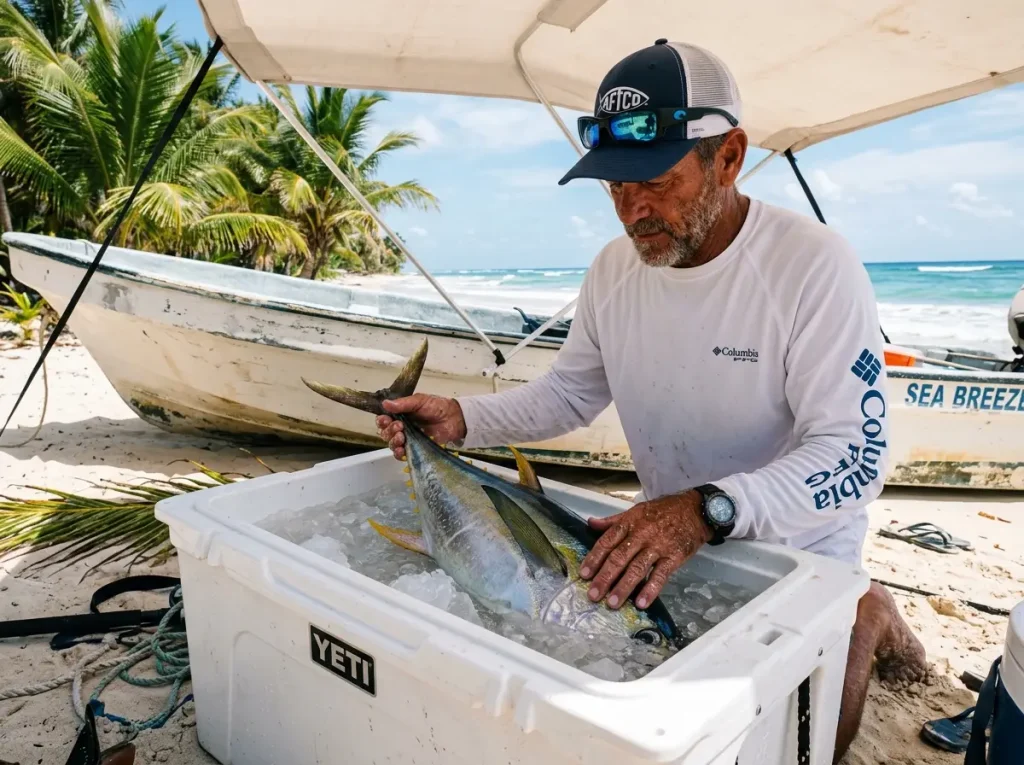
This is the part most fishing guides skip entirely. It’s also the part that separates a fillet that tastes like fresh fish from one that tastes like it sat in a cooler too long.
At the moment of harvest, aerobic ATP production stops. The remaining ATP degrades through a predictable sequence: ATP → ADP → AMP → IMP (Inosine Monophosphate) → inosine → hypoxanthine. IMP is what gives fresh fish that clean, slightly sweet, umami flavor. As it degrades into hypoxanthine, that flavor shifts to bitter. The K-value used in commercial fisheries science measures this ratio — the lower it is, the fresher the fish. This is why fish processed close to landing tastes categorically different from fish that sat on ice for two days before the knife touched it.
When ATP drops below its critical threshold, actin and myosin proteins bind to form actomyosin — this is rigor mortis. The muscle locks up hard. Temperature determines how fast this happens: warm water accelerates onset, cold slows it. A fish that fought hard before landing depleted its glycogen reserves faster, which means rigor hits harder and sooner. As covered in our guide on how stress before landing accelerates biochemical degradation, a properly dispatched fish processes better at the table — this isn’t just a conservation argument, it’s a culinary one.
The professional rule is simple: never fillet during rigor. The stiff muscle tears rather than separating cleanly, and you lose meat. Fillet either pre-rigor (within about an hour of harvest, for sashimi-grade precision work) or post-rigor (after enzymes begin resolving the actomyosin lock, typically 4–24 hours chilled).
Pro-Tip: The squeezed-thumb test still works. Press the fillet meat firmly with your thumb. If it springs back immediately, you’re pre-rigor. If it stays compressed and feels like stiff cardboard, you’re in rigor — put the fish back on ice and wait. If it springs back slowly with some give, you’re post-rigor. That’s your green light.
One more thing most people don’t know: never freeze a fish before it has passed through rigor. Freeze it pre-rigor and at thawing the muscle will contract intensely — “thaw rigor” — rupturing connective tissue and expelling moisture. The result is a mushy, waterlogged fillet. Let the fish resolve through rigor first, every time. According to FAO’s technical analysis of post-mortem quality changes in fresh fish, this sequence is well-documented and directly affects the texture and water-holding capacity of the final product.
The Physics of the Blade: Steel, Bevel Angles, and Flex
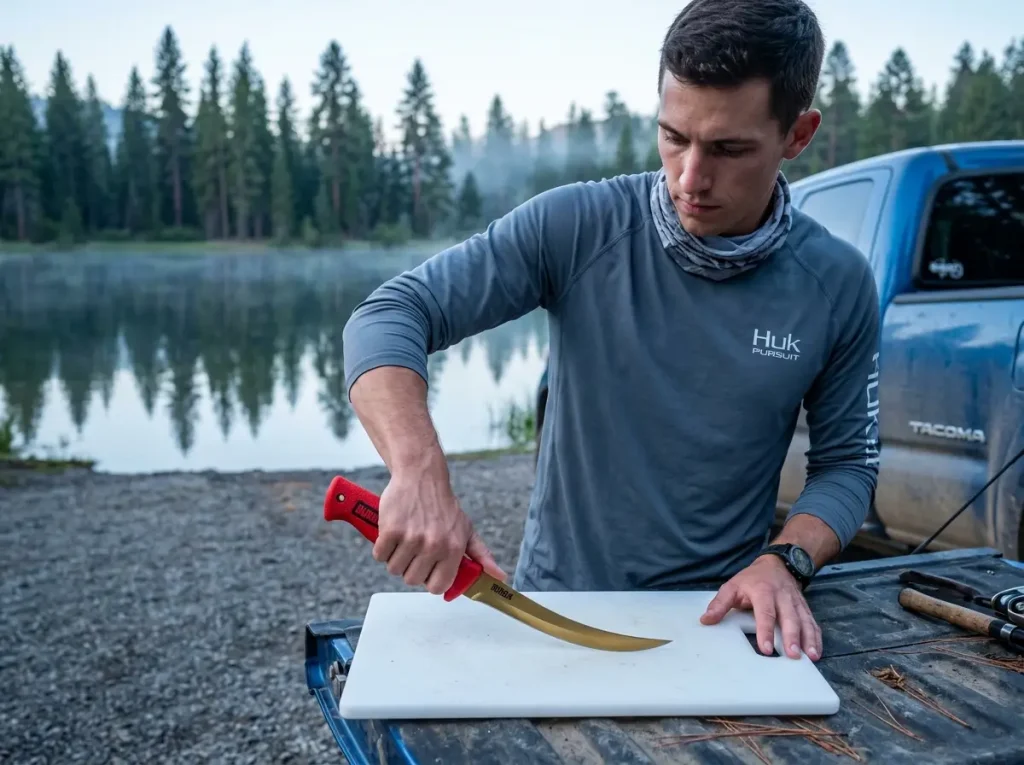
A fillet knife isn’t just a sharp piece of steel — it’s a tool designed around the physical realities of cutting through a specific kind of tissue. The wrong blade for the job costs you meat and increases your injury risk.
Rockwell Hardness (HRC) is the standard rating for knife steel. Think of it as a scale from “tough but dulls faster” to “holds an edge but chips on bone.” Professional fillet knives fall in the HRC 56–67+ range. Softer steel in the HRC 56–60 range is more forgiving on bone contact but needs more frequent sharpening. Harder steel holds a keener edge longer but chips if you hit bone at the wrong angle.
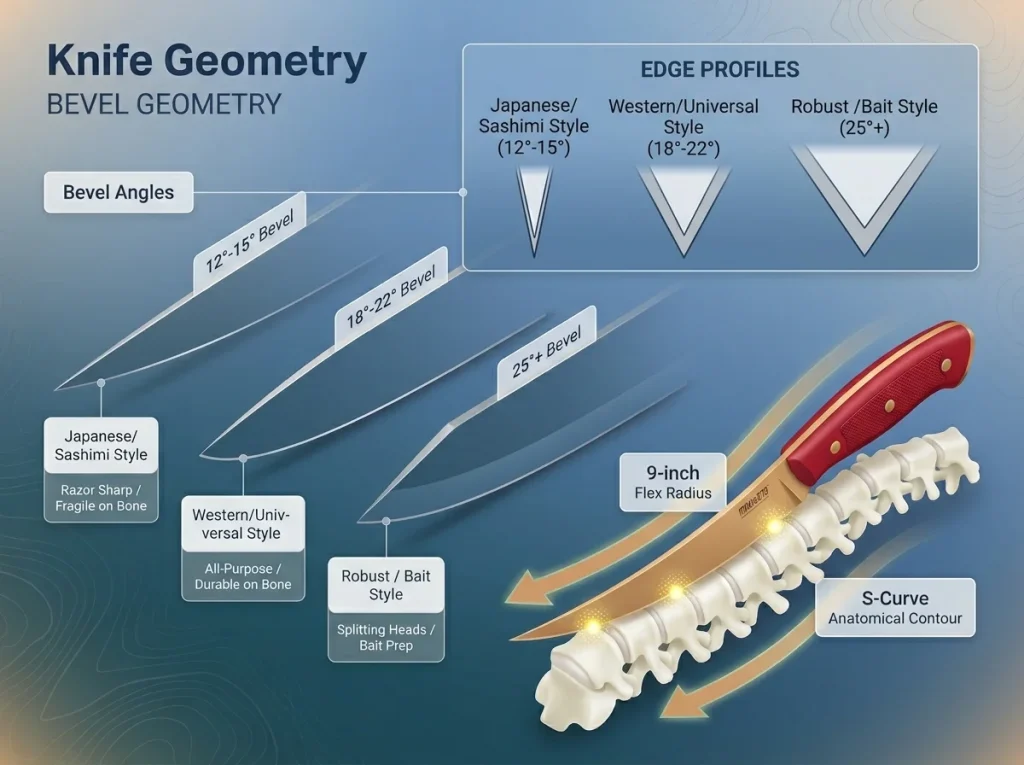
Bevel angle determines the character of the cut:
- 12°–15° (Japanese/Asian style): Razor-sharp. Excellent for sashimi-grade work and delicate separation. Chips on bone contact. Use this angle on high-end stainless or powder steel.
- 18°–22° (Western/Universal): The general-purpose choice for most angling situations. More durable on bone. Correct for tough-skinned species like red snapper.
- 25°+ (Robust): For splitting heads or bait prep, not precision filleting.
Blade flex is a design feature, not a flaw. A 9-inch flex blade bends significantly without taking a permanent set, allowing it to follow the S-curve of the vertebral column. A rigid chef’s knife physically cannot do this — it will fight the curve and lift off the bone, costing you meat on every pass. The Bubba 9\” Flex (titanium nitride coating, saltwater-rated) is built specifically for this; the Rapala R12 electric prioritizes volume and torque for high-count processing; and the Victorinox 8\” Fibrox delivers superior tactile feedback for the S-curve technique.
If you want a full side-by-side breakdown of the primary options, our review of the best fillet knives tested for flexibility, yield, and field durability covers each in detail.
A dull blade is a safety problem. The extra force required when the edge fails to grab consistently increases blade slip and loss of direction. Run your thumb across (not along) the edge before every session. A sharp fillet knife catches skin — you feel micro-teeth grab. If it slides clean, resharpen before you start.
Pro-Tip: Don’t trust the nail test for a fillet knife. It’s too coarse. The micro-bite test with the pad of your thumb is the right call. You’re looking for grip, not just sharpness.
You can also read about seafood processing safety and blade-related microbial concerns to understand why a contaminated blade running through multiple fish compounds your food safety risk with every pass.
The Professional Execution: S-Cut, Ticking, and Skinning
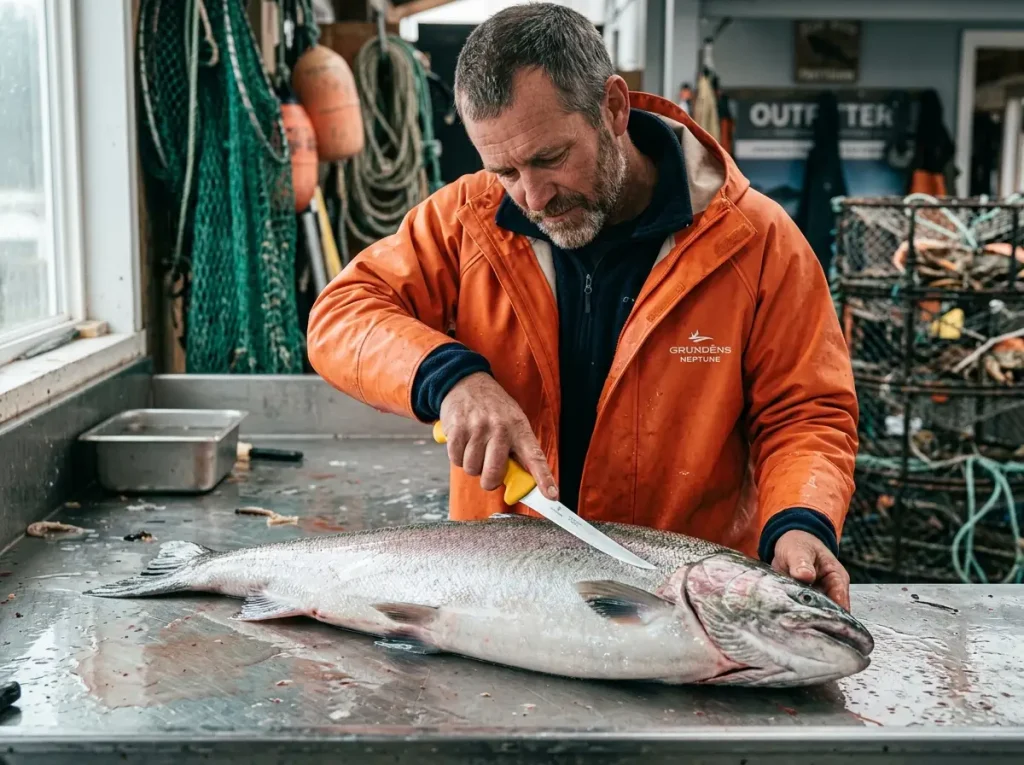
The quality of your pre-catch handling directly affects what happens at the cutting board — decisions you made immediately after the catch affect fillet quality. Once you’re at the table, here’s what a professional fillet sequence actually looks and feels like.
The Pectoral Entry and Backbone Rail
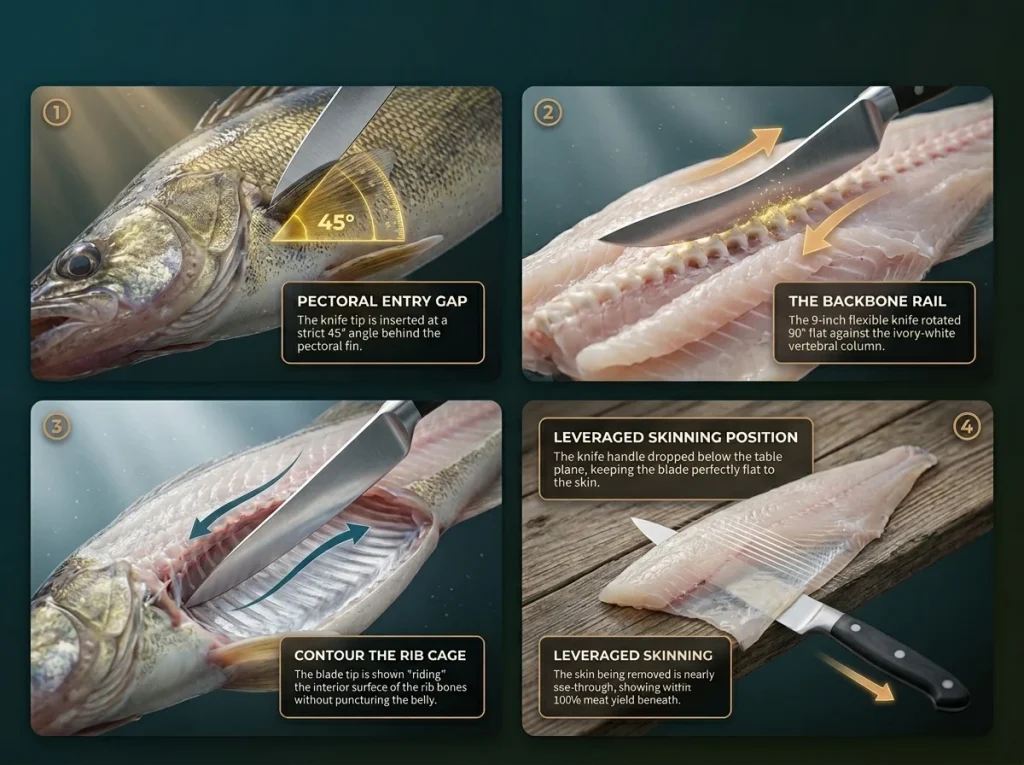
Insert the knife behind the pectoral fin at approximately a 45° angle toward the head. This exploits the natural gap at the operculum (the gill cover), and it saves the high-value meat tucked inside the pectoral girdle — meat most beginners cut away and discard. Once the blade contacts the backbone, rotate the handle roughly 90° to lay the blade flat. You’re not trying to cut through bone. You’re trying to rest against it and ride it.
The ticking sensation is your primary sensory feedback. Each tick is the blade skipping over a neural arch. If the ticking stops, your blade has either drifted into the meat or been blocked. Pause, reposition, re-establish contact. Use one fluid stroke where possible — sawing motions at the wrong angle score the meat.
Navigating the Rib Cage and Pin Bones
The rib cage is where most beginners waste the most protein. After the backbone pass, angle the blade slightly downward and trace the interior surface of the rib cage — along it, not through it. You’re peeling the fillet away from the ribs, not cutting across them.
Pin bones can’t be removed during the initial fillet pass. Two professional options: V-strip removal (cut a narrow channel on each side of the bone row and lift out the strip), or pull them individually with needle-nose pliers post-fillet. The latter gives better yield for presentation-grade work. Direction matters: in salmon, pin bones angle forward toward the head; in trout, they run roughly perpendicular to the spine. Pull in the direction the bone is pointing or you’ll tear the flesh.
Chilling the fillet first makes connective tissue firmer and pin bones easier to extract cleanly. This is another reason why cold-chain management from catch to cutting board pays off.
The Table-Edge Skinning Technique
Move the fillet to the very edge of your processing table so the knife handle drops below the table plane. This geometry keeps the blade perfectly flat against the skin. Hold the knife at a 5–10° downward angle and use short, controlled sawing motions while pulling the skin forward — you’re drawing the skin through the blade, not the blade through the skin.
For 100% yield skinning, the skin you remove should be nearly translucent. If you can’t almost see through it, you left meat behind. On tough-skinned species like red snapper or grouper, use a slight rocking motion at the tail entry point to get under the dermis before committing to the long stroke.
Food Safety: Managing the Vibrio Clock and Cross-Contamination
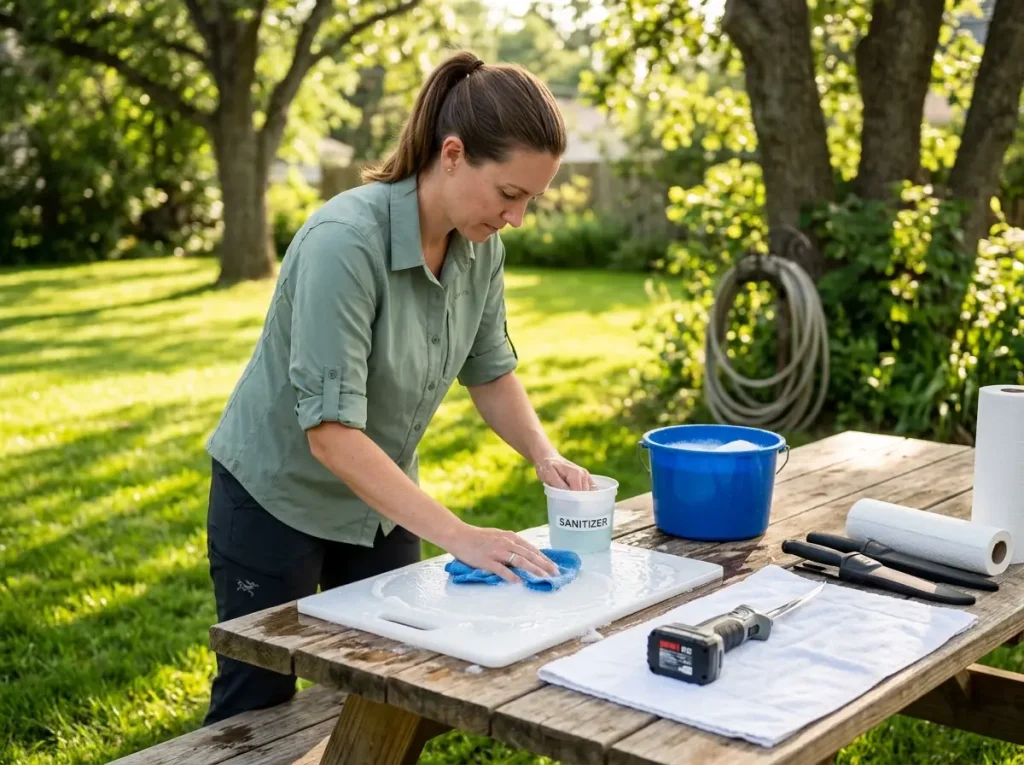
Most fishing guides say “keep fish cold.” That’s true, but it doesn’t tell you anything you can act on. Here’s what you actually need to understand.
The primary pathogen in marine and brackish-water processing environments is Vibrio — specifically Vibrio parahaemolyticus and Vibrio vulnificus, both salt-loving bacteria that occur naturally in coastal waters. Vibrio growth generally begins at 40°F. At 86–104°F (optimal summer dock temperatures), populations can double every hour. In unrefrigerated conditions on a 90°F summer afternoon, you have roughly a 2-hour processing window before bacterial load crosses from manageable to genuinely risky — not just on the surface, but in the flesh itself.
The FDA guidelines for safe seafood handling temperatures and contamination prevention define 40°F as the threshold for raw product. Anything above that, limit exposure to 2 hours maximum.
Initial de-sliming protocol: Rinse the whole fish in a 10% brine solution or run it through a mechanical descaler before the first cut. This knocks down the initial surface bacterial load significantly before your knife opens the body cavity.
Surface sanitization: Between species and between raw and processed stages, sanitize cutting boards with 1 tablespoon of unscented chlorine bleach per gallon of water, per FDA guidance. Never use the knife you gutted with to portion fillets without cleaning it first. Never put processed fillets back on a surface that held whole fish.
Pro-Tip: Keep a spray bottle of diluted bleach solution at the cleaning station. Mix it fresh, spray the board, let it sit 30 seconds, rinse. It takes 45 seconds and eliminates a contamination vector that ruins otherwise excellent fish.
If you’re working in field conditions without a proper kitchen setup, a waterproof first aid kit designed for anglers handling raw fish is worth having on the boat — cuts from a contaminated blade in a saltwater environment carry real infection risk.

Fillet Yield: The Metric That Separates Beginners from Pros

If you’ve never weighed your yield, you don’t actually know how you’re doing. These are the benchmarks that professional processors hit with correct technique:
- Atlantic Salmon: ~64% skin-off
- Atlantic Cod: ~43% skin-off
- Halibut: ~58% skin-off
- Wild Trout: ~55% skin-off
- Flounder: ~30–35% skin-off
- Red Snapper: ~36–40% skin-off
If you’re consistently coming in below these numbers, you’re leaving protein behind. The three zones where most beginners lose meat: behind the pectoral girdle (rushing the entry cut), alongside the rib cage (lifting off the ribs too early), and above the loin on the pin bone strip.
Several variables drop yield outside of pure technique. Rigor state is the most controllable — in-rigor muscle tears; post-rigor tissue separates cleanly. Blade sharpness is the single largest variable within your control on any given day. A dull blade compresses tissue before cutting. Processing temperature matters too: chilled fish at 38–40°F has firmer connective tissue that holds fillet structure intact. Process warm fish and it goes soft, drapes off the bone unpredictably, and becomes difficult to handle cleanly.
Seasonal biology shifts things too. Atlantic Cod yield can drop several percentage points during spawning as energy diverts to gonad development. This also connects to how tournament fish handling affects the quality of any fish destined for the table — a stressed, exhausted fish going to the cooler is a biologically depleted fish. The aggressive metabolic burn during a long fight shows up later at the cutting board.
Don’t throw out the carcass immediately. The collars on large trout and salmon — the pectoral girdle area — hold some of the fattiest, most flavorful meat on the whole fish. Most beginners don’t know to separate and cook these. Carcasses with remaining meat can be simmered into fish stock, which eliminates processing waste entirely.
Pro-Tip: Weigh your next three catches before and after filleting. Calculate the yield percentage and compare it to the benchmarks above. The gap tells you exactly which part of the technique to fix — you won’t need anyone to guess for you.
Storage, Freezing, and the Enzymatic Countdown
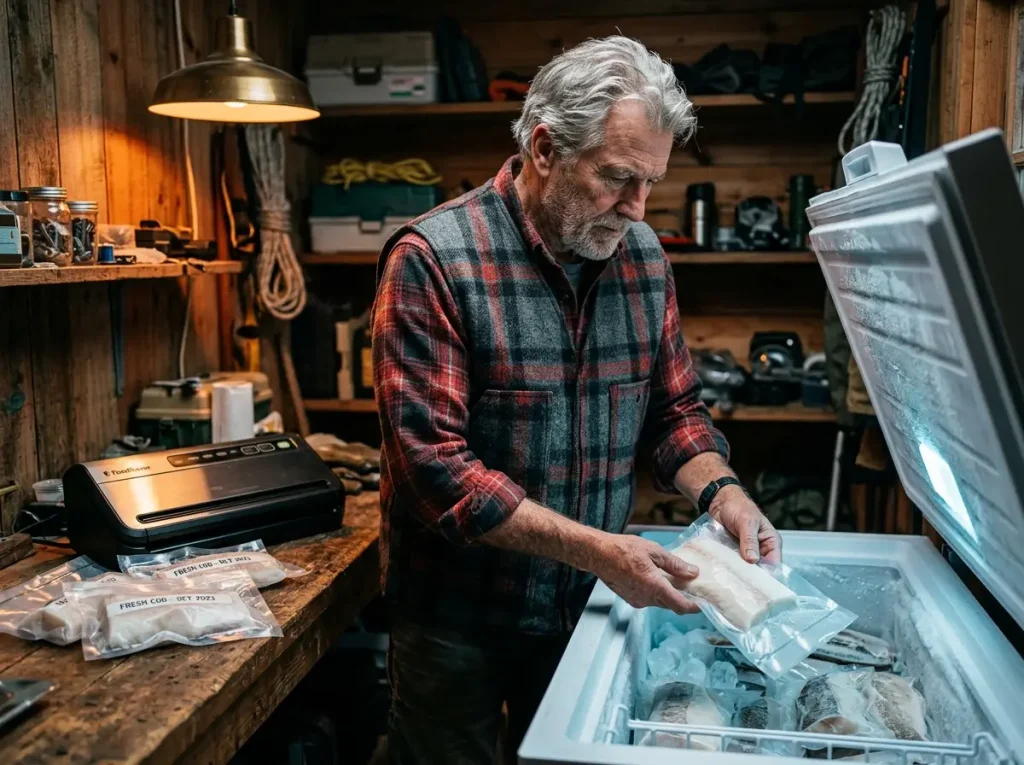
Once rigor resolves, endogenous enzymes — primarily proteases and lipases — begin autolysis (self-digestion of the flesh). Unlike beef aging, which produces desirable tenderization, fish autolysis moves straight to texture breakdown and bacterial nutrient enrichment. The window between “resolved rigor” and “starting to degrade” is real, and it’s shorter than most people think.
Fresh fillets packed in ice at 32°F last 5–10 days, depending on initial bacterial load from your processing environment. At standard refrigerator temperatures (38–40°F), plan for 2–3 days maximum. The cleaner your processing hygiene, the longer your shelf life. Don’t submerge fillets directly in ice meltwater — it leaches flavor. Use a drip-away container or sealed bag.
Vacuum sealing before freezing is worth doing for any fish you’re not eating within 48 hours. High-fat species — salmon, mackerel — are susceptible to lipid oxidation (rancidity) as oxygen attacks polyunsaturated fatty acids. Vacuum sealing removes that oxygen and extends freezer life from 3–4 months (unsealed) to 12+ months.
And again: never freeze before rigor. Freeze a fish in rigor and “thaw rigor” will rupture connective tissue and expel moisture on thawing. Let the fish resolve fully — typically 4–24 hours chilled — before the vacuum sealer touches it.
The FDA seafood storage temperature standards and freezing guidelines set quick-freeze at -4°F (-20°C) or below to halt most bacterial growth. The faster the freeze, the smaller the ice crystals, and the less cellular rupture — which directly translates to less drip loss when you thaw.
For the conservation angle, frame fish waste as a resource problem, not a disposal problem. Zero-waste angling means using everything — collars, carcasses, trim — and handling fish waste responsibly as part of a zero-waste angling practice starts well before the cleaning table.
Conclusion
Three things that matter more than any single technique tip:
Read the skeleton before you make a cut. Every species has specific anatomical entry points and planes of least resistance. The fillet starts in your head, not with your blade — you need to know whether you’re working with a round fish or a flat fish, which scale type you’re dealing with, and where the pectoral girdle sits.
Respect the biochemical window. The ATP clock starts at harvest. Fillet pre-rigor or post-rigor, manage the Vibrio timeline with temperature, and freeze only after rigor has fully passed. Get these wrong and no amount of technique saves the meal.
Match the knife to the fish. The right bevel angle, the right flex, and a genuinely sharp edge are not refinements — they’re the foundation of every good yield.
Next time you’re at the cleaning table, stop before the first cut and ask: what species geometry am I working with? What’s the rigor state? Is my blade right for this fish? That 30-second assessment will recover more meat than any single tip I could give you.
FAQ
Do you have to scale a fish before filleting?
For species with cycloid scales like trout and salmon, you can skip scaling entirely — the skin comes off during the fillet step, scales and all. For ctenoid-scaled species like perch or walleye where you intend to keep the skin on, descaling before filleting prevents scale fragments from contaminating the meat during skinning. When in doubt, scale first. It adds two minutes and eliminates a quality problem downstream.
What is the best knife for a beginner who wants to fillet fish correctly?
A flexible blade in the 7–9 inch range with a Western bevel (18–22°) is the most forgiving combination. The Victorinox 8 Fibrox handle is commonly recommended for its tactile feedback and honest price point. Avoid electric knives at first — they mask the sensory feedback that teaches correct technique. Until you can tick the vertebrae by feel, a fixed blade is the better teacher.
Can you fillet a fish without gutting it first?
Yes, on most round fish. The standard pectoral entry, run correctly, planes both fillets off the backbone without opening the body cavity — the viscera stay attached to the carcass frame. This requires a clean, precise entry to avoid puncturing the gut. It works best on fish you’ll process immediately. If the fish will sit before cutting, gutting first remains the better call.
How do you remove pin bones from a fillet?
Run your fingertip along the lateral line of the fillet — you’ll feel the pin bones as a row of small protrusions. Pull them with needle-nose pliers or dedicated fish tweezers, angling your pull in the direction the bone is pointing (forward in salmon, roughly perpendicular in trout) to extract cleanly without tearing. Chill the fillet first to firm up the tissue. For presentation-grade work, V-strip removal — cutting a narrow channel on each side of the bone row — eliminates them efficiently at the cost of a small amount of meat.
How long does fresh fish last in the refrigerator after filleting?
Properly cleaned fillets packed in ice or held at 32–34°F will stay at peak quality for 3–5 days. At standard refrigerator temps (38–40°F), plan for 2–3 days maximum. The real variable is your processing hygiene: a fillet cleaned under excellent sanitation conditions with low initial bacterial load management lasts longer than one processed on a contaminated surface. Vacuum-seal and freeze anything you won’t eat within 48 hours.
Risk Disclaimer: Fishing, boating, and all related outdoor activities involve inherent risks that
can lead to injury. The information provided on Master Fishing Mag is for educational and informational purposes
only. While we strive for accuracy, the information, techniques, and advice on gear and safety are not a substitute
for your own best judgment, local knowledge, and adherence to official regulations. Fishing regulations, including
seasons, size limits, and species restrictions, change frequently and vary by location. Always consult the latest
official regulations from your local fish and wildlife agency before heading out. Proper handling of hooks, knives,
and other sharp equipment is essential for safety. Furthermore, be aware of local fish consumption advisories. By
using this website, you agree that you are solely responsible for your own safety and for complying with all
applicable laws. Any reliance you place on our content is strictly at your own risk. Master Fishing Mag and its
authors will not be held liable for any injury, damage, or loss sustained in connection with the use of the
information herein.
Affiliate Disclosure: We are a participant in the Amazon Services LLC Associates Program, an
affiliate advertising program designed to provide a means for us to earn advertising fees by advertising and linking
to Amazon.com. As an Amazon Associate, we earn from qualifying purchases. We also participate in other affiliate
programs and may receive a commission on products purchased through our links, at no extra cost to you. Additional
terms are found in the terms of service.