


In this article
A standard fishing first aid kit fails the moment it meets the water. I learned this the hard way years ago. I opened a “marine-rated” fabric bag during a tuna trip, only to find my shears seized by rust. Even worse, the aspirin had turned into a vinegar-scented paste.
Saltwater doesn’t just corrode cheap stainless steel. High humidity destroys medication long before you ever unscrew the cap.
For the fisherman—whether you are bank fishing for brook trout or captaining a fishing boat forty miles offshore—safety isn’t about checking a box. It is about building a system that works when wet, cold, and isolated. Whether you rely on a pre-made solution from brands like My Medic or Adventure Medical Kits, or prefer DIY assembly, you must adapt it for the water. Generic kits are designed for offices, not for wilderness medicine.
In this guide, we are going to rebuild your fishing first aid gear from the ground up. We will look at why you need a specific type of hard case, how to choose hook removal tools, and the right way to treat marine stings.
What Defines the Angler’s Medical Risk Profile?
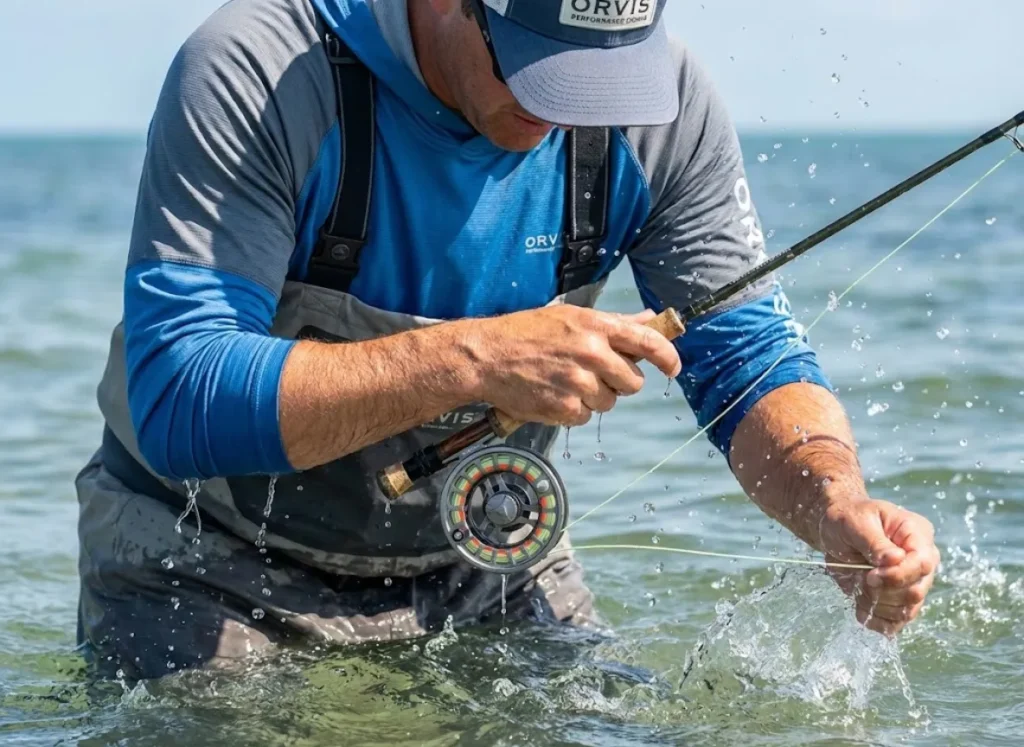
Fishing places you in an environment that actively attacks your gear. Understanding this is the first step in protecting yourself on your next fishing trip.
How does the marine environment destroy medical supplies?
The main enemy of your boat safety kit isn’t just water; it is the air itself. Standard fabric zippers on a dry bag or soft kit fail to block out the air. Even if the bag says “water-resistant,” salt air will get inside. Once that happens, the humidity starts to ruin your meds module.
Current research on the hydrolysis of acetylsalicylic acid shows that moisture breaks down aspirin quickly. It turns into acid and loses its ability to help during a heart attack. If your bottle smells like vinegar, throw it away.
This damp air also attacks your daily relief meds. Ibuprofen, acetaminophen, and antihistamines like Benadryl degrade in these conditions. Even motion sickness meds like Dramamine or Bonine can spoil if the seal is poor.
Wet air also ruins sterile gauze and adhesive bandages. Most aid supplies come in paper wrappers. In a humid cabin, that paper acts like a sponge. It pulls moisture in, which invites mold.
Pro-Tip: Don’t trust the store packaging. For important gauze and bandages, use a household food sealer to vacuum seal them in small batches before putting them in your kit.
Corrosion is the second threat. The term “stainless” is misleading. It really just means it stains less than iron. Tweezers, hemostats, and side snips will rust quickly in salt air.
This is similar to the chemistry involved in saltwater corrosion prevention for your fishing reels. If you don’t keep the air out, your tools will freeze up at the joints. Your scissors will get dull and become useless when you need them most.
We also have to deal with the “Condensation Trap.” If you open your kit on a humid afternoon and close it before the temperature drops at night, water will condense inside the box. This rots your antiseptic wipes and alcohol wipes from the inside out. You must use silica gel packs to soak up that moisture.
What is the Best Box for Marine First Aid?
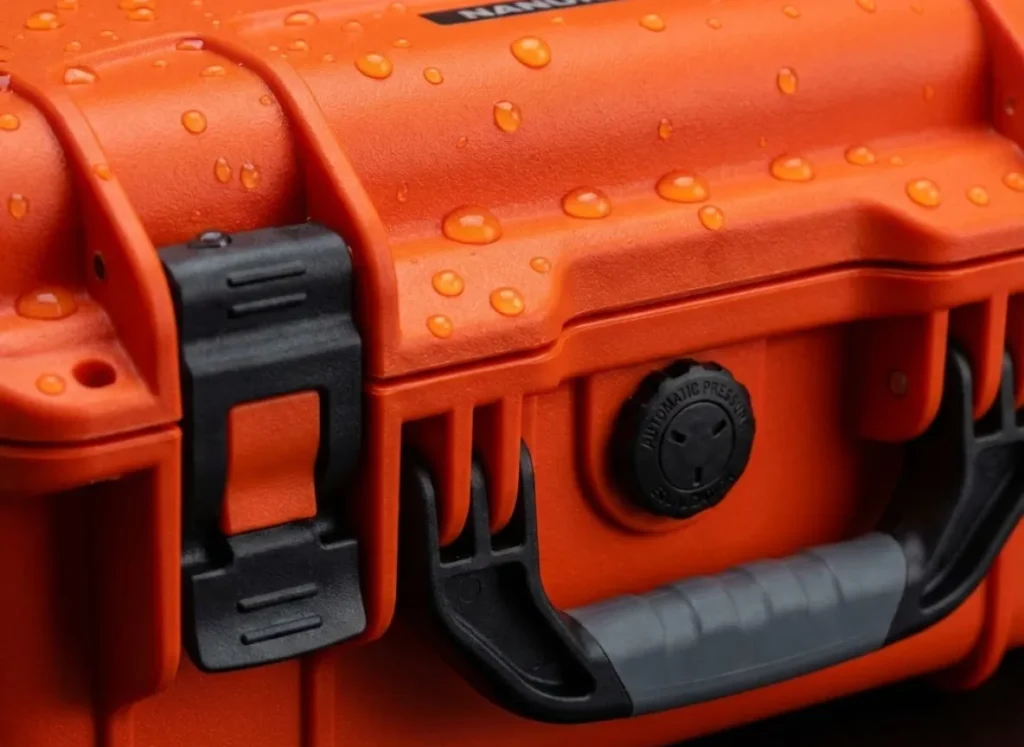
Since the air is the enemy, your container is your shield. It can’t just be a bag; it has to be an engineered vault focused on waterproofing and durability.
How do IP ratings determine survival?
We use the Ingress Protection (IP) code to know what actually works. For angling safety, the defined technical standards for IP67 enclosures are the sweet spot.
An IP67 case rating means the box is dust-tight. It can also be dunked in one meter of water for 30 minutes without leaking. This covers the most common accidents, like dropping the kit in the surf or a flooded bilge.
Most importantly, a sealed IP67 case holds air. This means it floats. If you are on a fly-fishing travel trip to Belize or Alaska and your gear goes overboard, a sinking kit is gone forever.
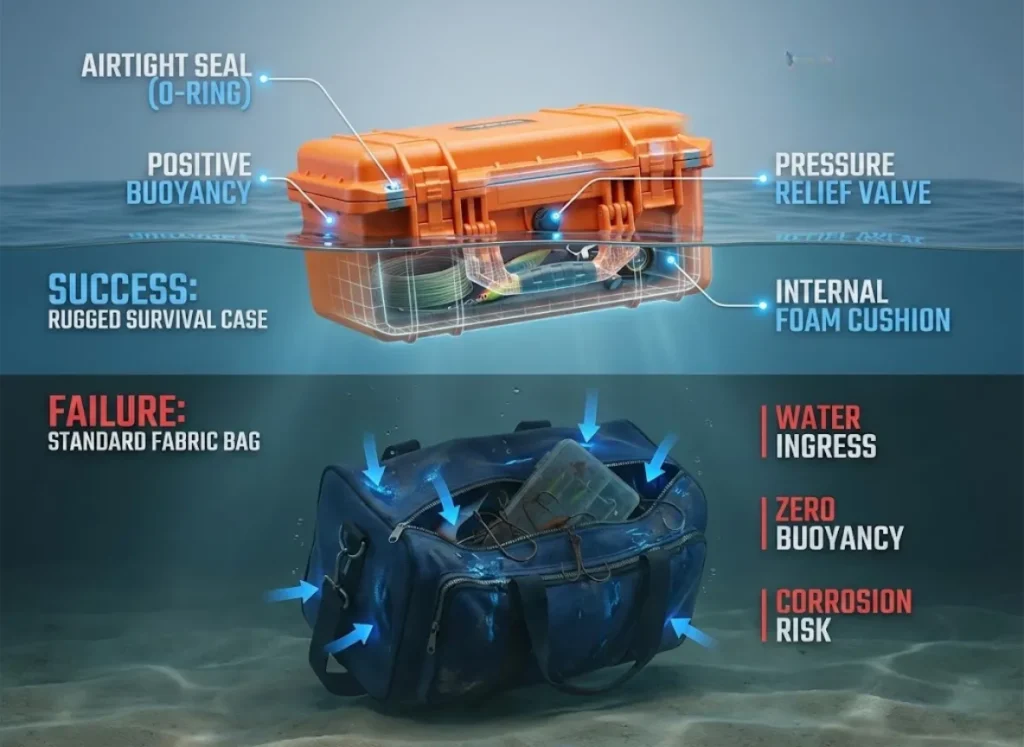
There are higher ratings, like IP68, but those cases are often hard to open quickly. In an emergency, you need speed. You also need to look for automatic pressure valves.
These valves let air pass through but block water. Without them, changes in temperature or altitude can create a vacuum. This can suck the lid tight, making it nearly impossible to open without a pry bar. This is the same issue verified in our extensive best fishing tackle box rust tests, where air flow is key to keeping things dry.
Which hard case is best: Nanuk or Pelican?
When choosing a hard case for your modular angler’s first aid masterclass, we usually look at two main brands: Nanuk and Pelican.
Nanuk cases are made from a resin designed to absorb impact. It flexes slightly to handle hits. Pelican uses a harder plastic known for being rigid. Understanding the impact resistance of polypropylene copolymers helps us see why these cases survive on boat decks.
For the fisherman, the latch is the deciding factor. Nanuk uses a “PowerClaw” system. It clamps down and locks. It cannot fly open if the case is dropped or slides into the side of the boat. Standard latches on some older designs can pop open if they hit something hard.
| Nanuk 905 vs Pelican 1200 Comparison | ||
|---|---|---|
| Feature |
Nanuk 905 Buy on Amazon |
Pelican 1200 Buy on Amazon |
| Material | NK-7 Resin (Engineered for impact absorption through micro-flexing; lightweight). | Polypropylene Copolymer (Extremely rigid; proven in military applications). |
| Latch Type | PowerClaw (Dual-stage compression with slide lock to prevent accidental opening). | Double-Throw Latches (Effective but can be louder and harder to manipulate; occasionally pop open on impact). |
| Buoyancy | Floats. Text notes the smaller Model 904 provides 7.0 lbs of buoyancy; sufficient for a loaded kit (3-5 lbs). | Floats. Text notes the smaller Model 1150 provides ~8 lbs of buoyancy; sufficient for a loaded kit (3-5 lbs). |
| Price | Value Winner. Generally lower price point for equivalent protection specifications. | Standard Market Price. Generally higher than the Nanuk alternative. |
I recommend the Nanuk 904 or 905 because of this latch. It offers good portability while allowing for organization via labeled compartments. No matter which brand you pick, avoid black or green cases. Get high-vis colors like Orange or Yellow. If your boat flips or the kit falls overboard at dusk, you need to be able to spot it.
Pro-Tip: Taking care of your case is just as important as your reels. This requires following a dedicated fishing gear maintenance protocol. Specifically, rub a little silicone grease on the rubber O-ring once a season to make sure it stays watertight.
How Should You Manage Trauma and Tools?
Band-aids don’t save lives on a boat. We need to prepare for real injuries: deep embedded hooks and lacerations. This is your trauma module.
Why do you need special cutters for hooks?
Regular needle-nose pliers and medical scissors will fail against modern fish hooks. High-quality hooks are made of heat-treated, hardened steel.
If you try to cut a thick fishhook with standard stainless pliers, the tool will chip or dent. The hook won’t break. This leaves the person attached to a thrashing fish or a heavy fishing lure. The metallurgical properties of stainless hand tools simply aren’t strong enough for this job.
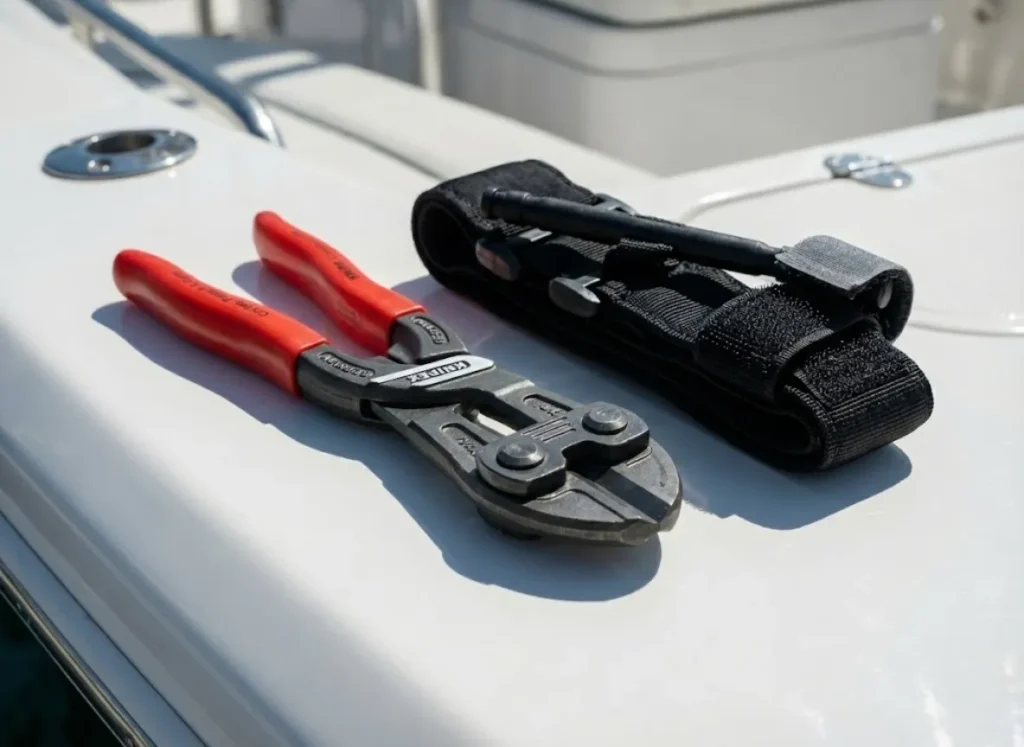
You need a Knipex CoBolt Compact Bolt Cutter (Model 71 31 200). These are the ultimate hook removal tools with specially hardened edges that can snap thick hooks with one hand.
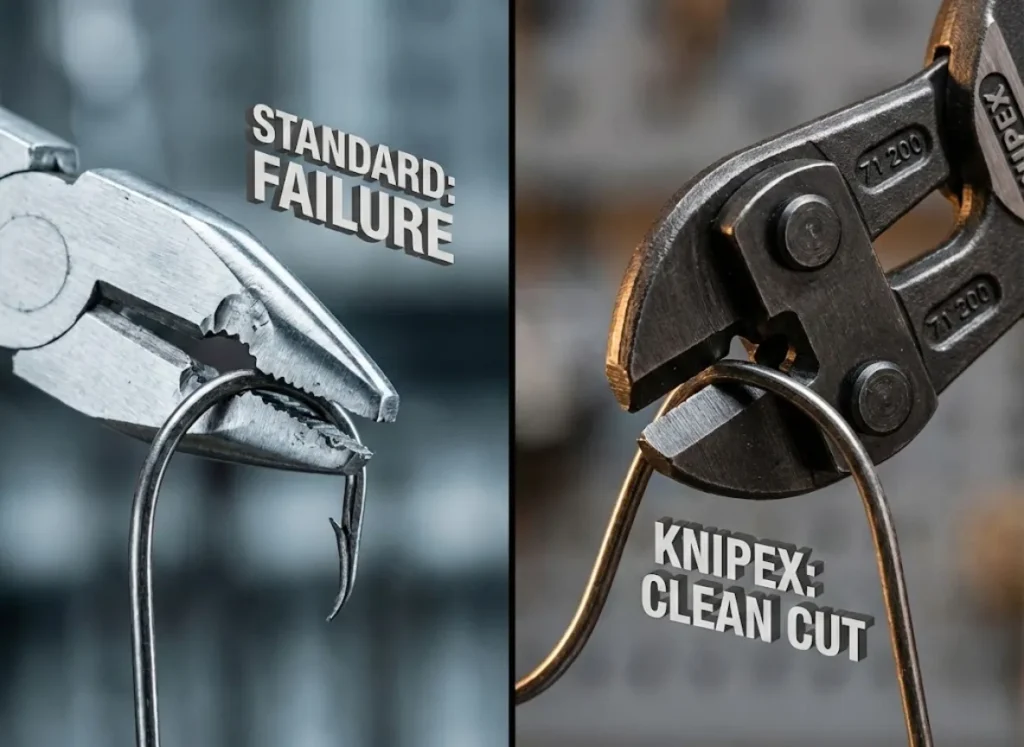
Look for the model with the notch near the hinge. This holds the hook in place so it doesn’t slide out when you squeeze. The leverage allows you to cut through heavy fishing line or wire easily. This is vital if you are the one hooked and only have one hand free.
This need for strong metal is demonstrated in our comparison of best fishing pliers. We found that even expensive titanium pliers often can’t cut through heavy hooks like a bolt cutter can.
How do you stop severe bleeding?
On the water, you are surrounded by sharp objects. Fillet knives, gaffs, and propellers are everywhere. A muskie tooth laceration or a slip on the rocks can be fatal in minutes.
You must carry a Combat Application Tourniquet (C-A-T) Gen 7 or a SOF-T Tourniquet. The C-A-T model is the standard because it uses a plastic rod that resists rust better than metal ones. Crucially, you can put it on yourself with one hand.
The efficacy of commercial tourniquets in prehospital settings is proven. Having a real C-A-T can save a life. Keep it at the very top of your kit so you can grab it in seconds.
For wounds where a tourniquet won’t work (like the groin or shoulder), carry QuikClot Combat Gauze (Z-Fold) or another hemostatic agent. The Z-fold style is better than a roll because it won’t roll away across a rocking deck.
Sticking a bandage to wet, slimy skin is hard. Regular tape won’t hold. You should include a roll of self-sticking “Coban” wrap and Tincture of Benzoin to make the skin sticky. These items sit alongside other essential fishing tools for safety as must-have gear for any remote expedition kit.
Don’t forget the basic module items: moleskin for blisters, finger splints, and a SAM splint for fractures on slippery rocks. Add an emergency blanket and a CPR face shield to round out the safety gear.
How Do You Treat Stings and Infections?
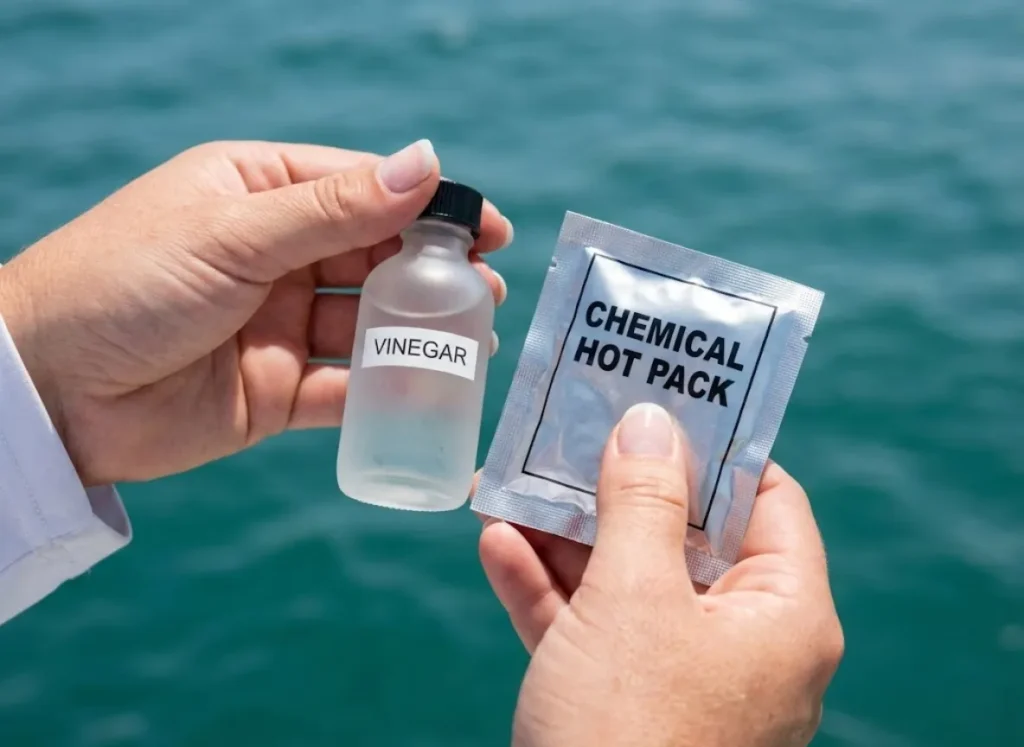
Marine injuries are often chemical or biological. You need to know exactly what to do based on what stung you.
Hot water or vinegar?
Treating a sting depends on the creature. We split this into two groups: spined fish and jellyfish.
If you suffer a catfish fin sting, or get hit by a Stingray or Lionfish, the venom is made of protein. Heat breaks this protein down. The standard of care for hazardous marine life injuries is to soak the fin-spine punctures in hot water (about 113°F / 45°C). This destroys the toxin and stops the pain.
If you don’t have hot water, use the cooling stream from your outboard motor. It is usually the perfect temperature.
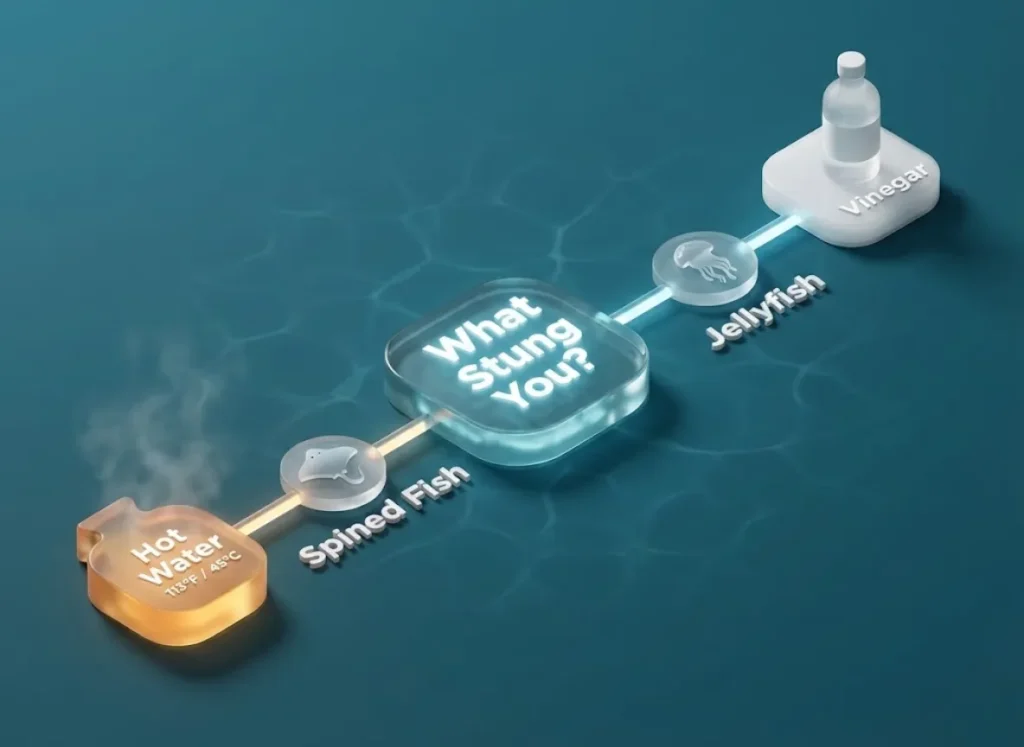
On the other hand, for jellyfish stings or Man o’ War contact, you must use vinegar. These creatures leave tiny stinging cells on your skin. Vinegar shuts them down.
Never rinse a jellyfish sting with fresh water. Fresh water upsets the balance of the cells, causing them to fire and release more venom. This is a common injury often encountered during inshore fishing in the Gulf of Mexico, where both stingrays and jellies live.
How do you prevent dangerous infections?
The most dangerous thing in the water might be invisible. Vibrio vulnificus is a bacteria found in warm saltwater. It causes a very serious infection.
The bacteria gets in through small holes—hook pricks or slips with a knife. These are the exact injuries caused by spines when learning how to hold a fish.
If you get a puncture wound in warm water, clean it immediately. Your kit should have a plastic syringe. Use it to blast the wound with fresh water or saline eye wash to flush out the bacteria.
Follow this with a good cleaner like Iodine or first aid spray. Then apply triple antibiotic ointment or Neosporin. According to CDC guidelines on Vibrio vulnificus infection, fast cleaning is the only way to stop the infection. If the wound gets red, draw a circle around the redness with a marker. If the redness moves past the line quickly, go to a hospital right away.
Final Thoughts
Building a fishing first aid kit is about being realistic. We know that waterproof is not enough; you need a sealed hard case to keep your gear dry. We prioritize tools module items like Knipex cutters over simple bandaids.
And we have cleared up the chemistry: knowing when to use vinegar versus hot water can save your trip.
For commercial captains, keep a sealed kit that meets Coast Guard requirements on board for the inspector. But build this custom waterproof first aid kit for actually treating patients.
Do not wait for an emergency to test your gear. This weekend, perform a kit audit schedule. Check your expiration date tracking, look for rust on your scissors, and practice using your tourniquet.
FAQ – Frequently Asked Questions
What is the best way to remove a fish hook from a finger?
Use the Advance and Cut method. Push the point through the skin, cut the barb off with your Knipex cutters, and back the hook out. The string-yank hook removal technique (or line trick) works too, but it takes practice.
Does a standard first aid kit meet Coast Guard requirements?
Not always. For certain passenger vessels, the kit must meet specific legal standards (46 CFR 160.041). It is best to buy a sealed, approved kit to stay legal, and build a separate, better kit for actual use.
Can I use fresh water to rinse a jellyfish sting?
No. Fresh water causes the stinging cells to fire, which makes the pain much worse. Use vinegar or salt water.
How often should I replace items in my fishing first aid kit?
Check your kit every 6 months. Replace aspirin if it smells like vinegar, throw away any paper packages that look damp, and get new medications once a year. Be sure to check your electrolyte powder and sunscreen expiration dates as well.
Risk Disclaimer: Fishing, boating, and all related outdoor activities involve inherent risks that
can lead to injury. The information provided on Master Fishing Mag is for educational and informational purposes
only. While we strive for accuracy, the information, techniques, and advice on gear and safety are not a substitute
for your own best judgment, local knowledge, and adherence to official regulations. Fishing regulations, including
seasons, size limits, and species restrictions, change frequently and vary by location. Always consult the latest
official regulations from your local fish and wildlife agency before heading out. Proper handling of hooks, knives,
and other sharp equipment is essential for safety. Furthermore, be aware of local fish consumption advisories. By
using this website, you agree that you are solely responsible for your own safety and for complying with all
applicable laws. Any reliance you place on our content is strictly at your own risk. Master Fishing Mag and its
authors will not be held liable for any injury, damage, or loss sustained in connection with the use of the
information herein.
Affiliate Disclosure: We are a participant in the Amazon Services LLC Associates Program, an
affiliate advertising program designed to provide a means for us to earn advertising fees by advertising and linking
to Amazon.com. As an Amazon Associate, we earn from qualifying purchases. We also participate in other affiliate
programs and may receive a commission on products purchased through our links, at no extra cost to you. Additional
terms are found in the terms of service.