
In this article
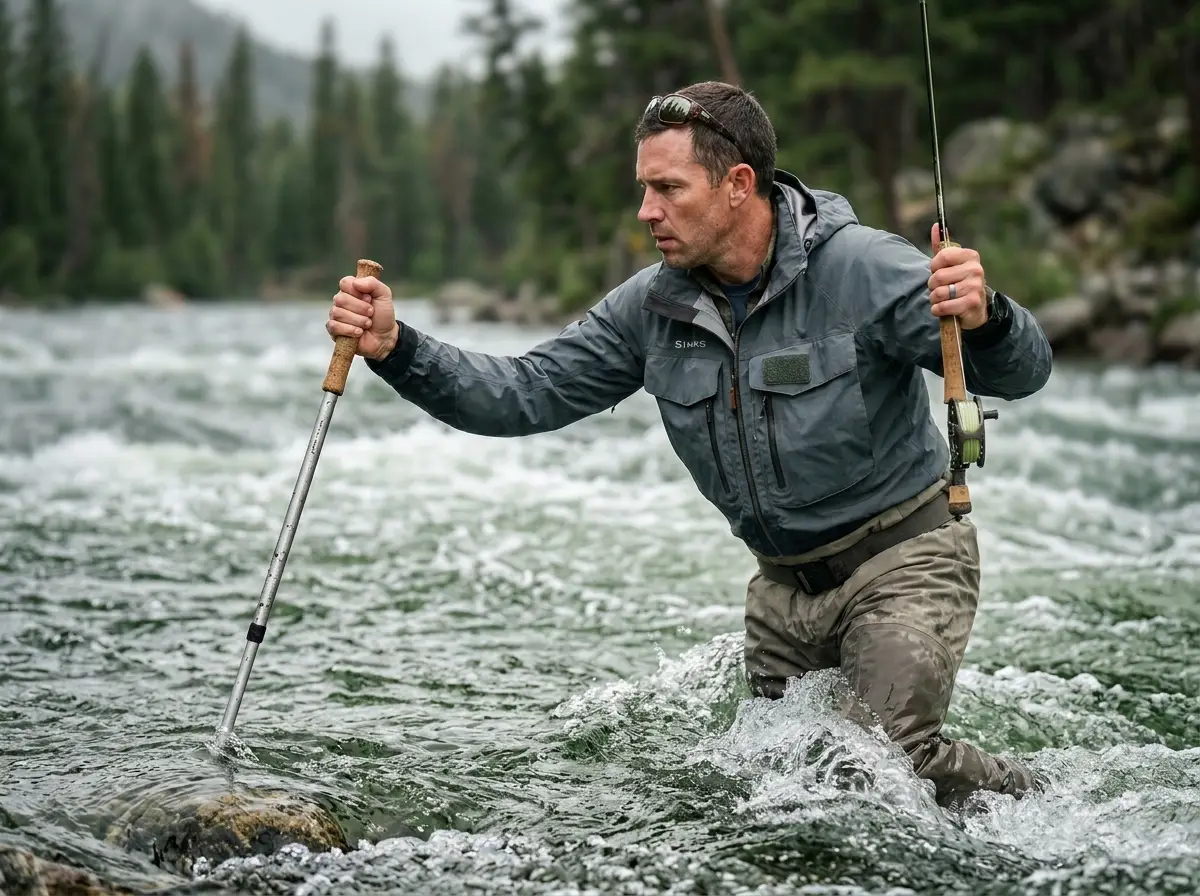
I felt the “lift”—that weightless moment when a heavy spring flow transformed my buoyancy into a liability. My boots floated off the gravel bed. I had pushed my luck trying to reach a seam, and the river almost collected. Survival out there isn’t about strength. It’s about applied physics.
After twenty years guiding heavy water, I know guys who muscle through currents right up until they get washed away. Staying upright relies entirely on understanding the physics of the wade. We need to abandon boat-ramp folklore and treat moving water as a solvable energy equation. This breakdown of wading technique in strong river current safety explains the exact biomechanics required to stay upright in high-velocity water and access untouched fish without a helicopter rescue. Here’s how you handle it.
⚡ Quick Answer: Wading safely in strong current requires applying the Rule of Ten: never cross if water depth in feet multiplied by velocity in feet per second exceeds 10. Minimize your hydrodynamic profile by turning sideways, establish a three-point contact tripod with a rigid wading staff, and select boot studs (aluminum or tungsten) based on the river’s geologic substrate. Review basic fishing safety tips before entering heavy flow. If you fall, immediately enter the defensive swim position on your back with feet downstream to prevent entrapment.
| River Flow and Wading Profile Guide | ||
|---|---|---|
| CFS Level | Description | Wading Profile (Small-to-Mid River) |
| < 100 | Low / Base Flow | Accessible to most; slow current. |
| 100 – 300 | Normal Flow | Ideal; some deep runs require caution. |
| 300 – 550 | Moderate Flow | Experienced waders only; knowledge of bottom required. |
| 550 – 800 | High Flow | 50% of the river is unwadeable; high risk of fall. |
| > 900 | Flood / Blown Out | Do Not Wade. Swiftwater conditions. |
The Physics of Wading: Understanding River Hydrodynamics
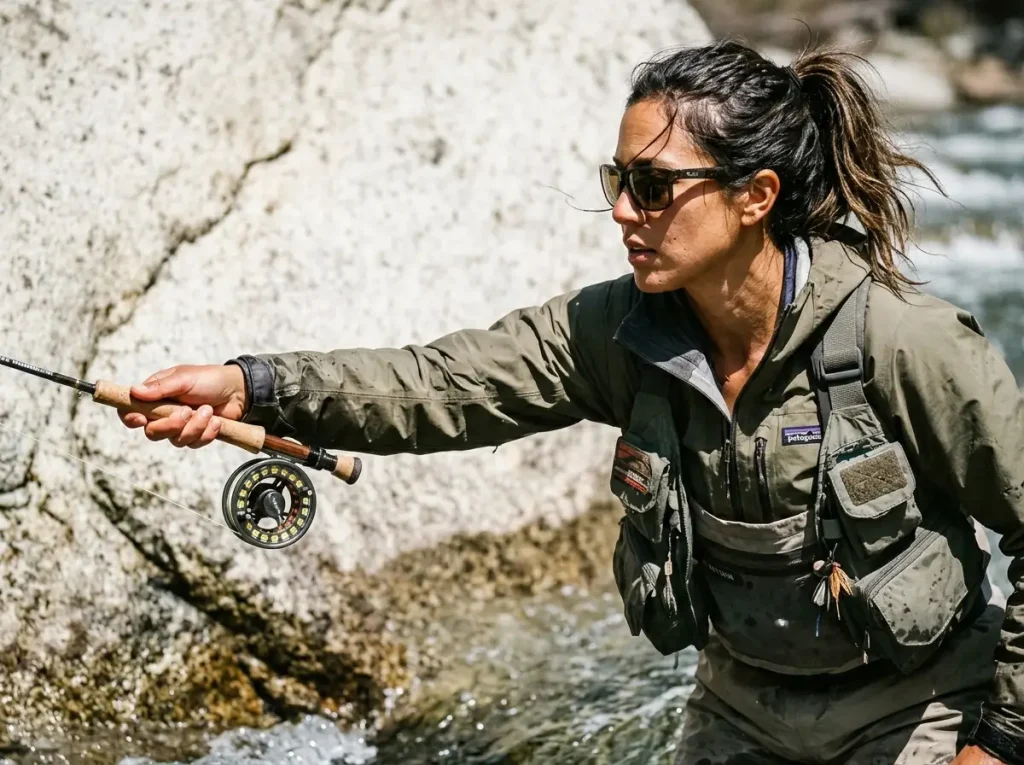
The water pushing your legs isn’t just a nuisance; it’s a suspended load of energy. Water behavior down a channel follows firm rules, defined by how velocity interacts with the riverbed’s physical traits—often called manning’s roughness coefficient.
A rough bed of heavy cobble vs silt slows water near the bottom, forming protective pockets for boots. These values shift dynamically. Bank flooding submerges tall grass, sending roughness spiking and creating violent current seam hydrodynamics.
Check USGS Gauge Sites for USGS Guide to Manning’s Roughness Coefficients data to calculate baseline dynamics before stringing your rod.
The Quadratic Nature of Drag Forces
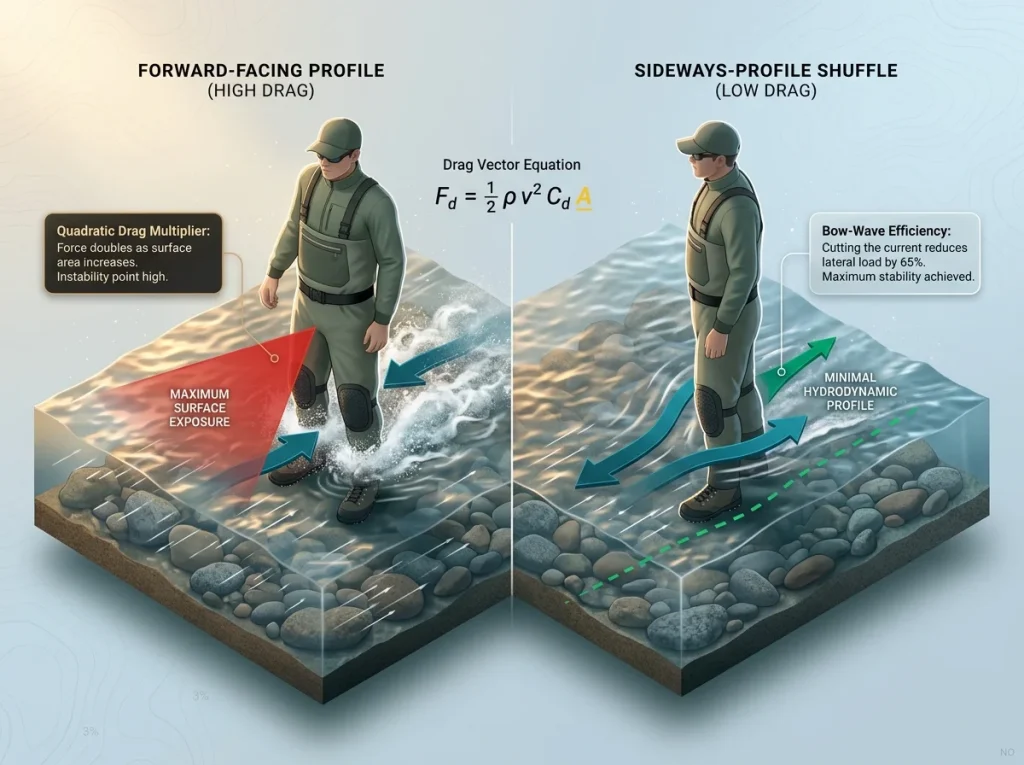
River current doesn’t fight fair; drag forces are quadratic. If velocity doubles from 2 to 4 feet per second, the force against your legs quadruples. You cannot simply walk straight across.
Facing the current exposes the broad, flat front of your legs. To survive, turn your hips and execute the sideways profile shuffle. You lead with the side of one leg, cutting the water like a boat’s bow, drastically reducing drag. Slide the lead foot forward without lifting it high, then drag the trailing foot up to meet it. If you lift your foot completely, the river claims it. It feels awkward at first. Do it anyway.
Laminar vs. Turbulent Boundary Layers
Water flows two ways: laminar and turbulent. Laminar flow occurs in straight channels with no obstructions. The water moves in neat, parallel layers—fastest near the surface. It looks glassy and safe from the bank, but it packs a steady right hook.
When smooth water hits boulders, it shatters into turbulent boundary layers. This is exactly what you want. A large rock absorbs the current, casting a hydrodynamic shadow. You wade safely in that slower water to recover.
If the bed consists of fine sediment, however, turbulence can grab the sand straight from under you—scouring the bottom. Stand still for three minutes, and you suddenly sink into a hole.
Pro-Tip: Use massive boulders upstream as physical shields. Stand in the slack water behind them to lower your heart rate before making your next move across the main channel.
Water hydraulics dictate that turbulence protects you structure, but you also have to account for how deep the water gets before it threatens to float you.
The Buoyancy Calculation
Waders are essentially waterproof balloons. Trapped air turns you into a cork. When fighting fifty pounds of lateral current, you cannot afford vertical lift pulling your boots off the bottom.
This brings us to displacement-to-weight ratios. Your wading belt safety is mandatory, keeping water out if you fall. But snapping it tight over unvented waders traps waist-down air. The deeper you wade, the more that air compresses and tries to float.
Always burp your waders. Pinch the chest fabric open, squat to force the air out of the legs, and cinch the belt tightly while crouched. You want negative buoyancy. Your boots need all the downward force gravity provides. To actually calculate when those fluid forces overwhelm your body weight, you need a hard mathematical limit.
The “Rule of Ten”: Calculating Your Wading Safety Limits
Fear is a terrible gauge for safety. Some guys panic in knee-deep ripples, while others confidently stride into a raging tailwater right before they disappear. You need math to establish a hard red line. Enter the Rule of Ten.
If water depth in feet multiplied by velocity in feet per second hits 10, the line is crossed according to the SOP for Discharge and Wading Safety. A 2-foot stretch moving at 5 feet per second is the ceiling for a 180-pound adult.
The Mathematical Threshold
A 3-foot depth moving at 4 feet per second equals 12. You stay on the bank.
Drag increases aggressively; pushing from a product of 8 to 10 feels like an anvil strapped to your waist. This threshold suits average adults. If you weigh 140 pounds or carry a bulky pack, drop to the Rule of Eight.
Flow Velocity Field Tests
Never trust your eyes to judge river speed. Smooth flow over featureless gravel looks deceivingly slower than water crashing over a shallow shelf.
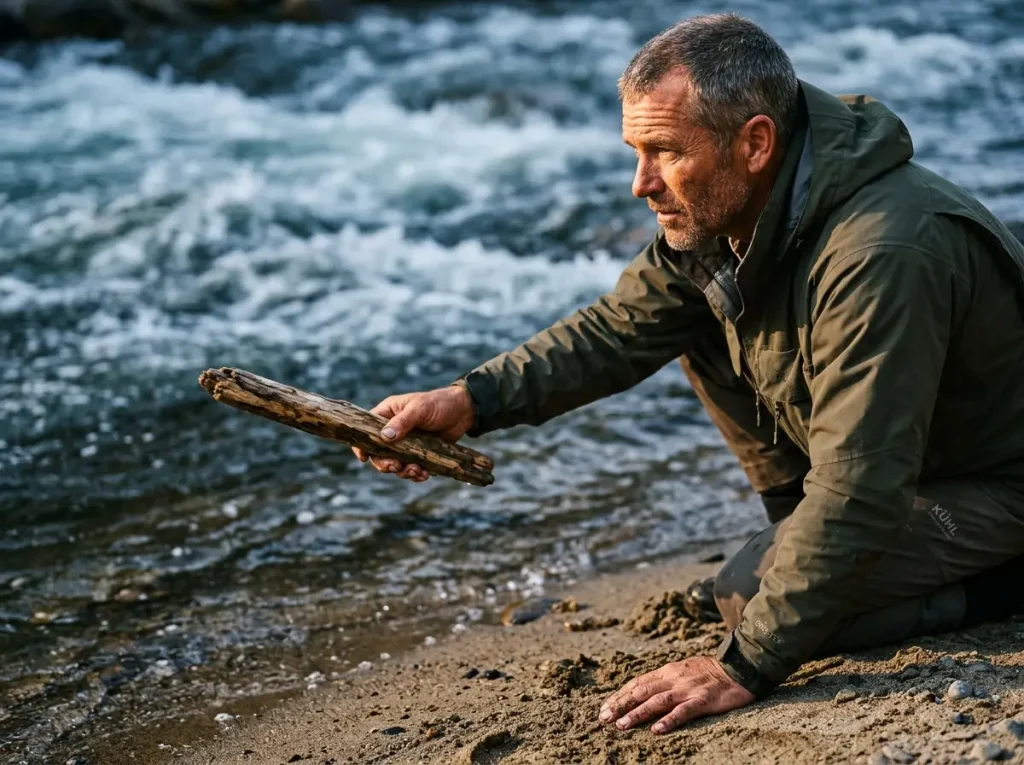
Perform the Float Method test. Mark a 10-foot stretch along the bank. Toss a stick into the main current thread. Time its travel. If it covers 10 feet in 2 seconds, the top column travels at 5 feet per second. Surface velocity represents the fastest water, giving a conservative calculation baseline.
Check this multiple times a day, especially below tailwater trout fishing zones where release schedules change flows instantly.
The raw flow velocity dictates your crossing ability, but you must pair those visual tests with remote data from official hydrographs to get the full picture.
Deciphering the USGS Hydrograph
Checking your local USGS gauge sites is step one of any trip. The cfs (cubic feet per second) measurement predicts the river’s energy state.
CFS alone isn’t enough. 500 CFS on a wide delta is a stroll; but 500 CFS choked into a thirty-foot gorge is a deadly torrent. Correlate CFS with gauge height to understand depth. If you learn to predict fish movements during rapid water level changes, you simultaneously realize exactly when a crossing becomes an impassable barrier.
You solve the math so you know when to step in—now you need the physical structure to stay there.
Structural Mechanics: Mastering the Three-Point Wading System
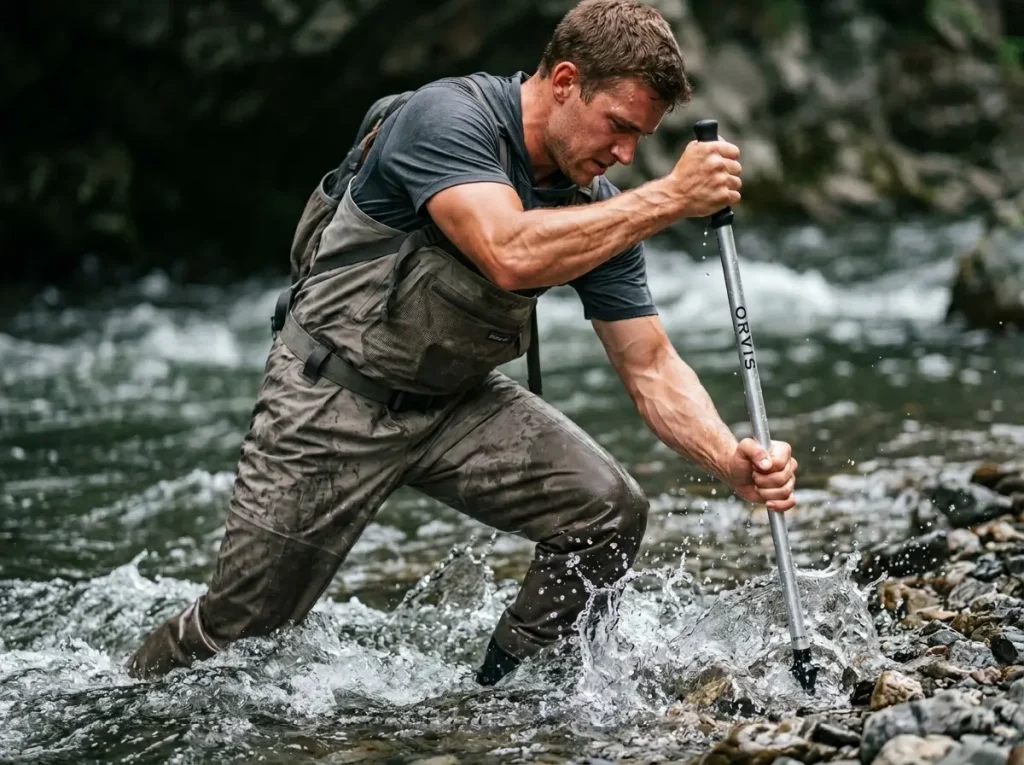
Stepping into a river turns your body into a cantilevered beam. The current applies force, and your only defense is managing your center of gravity.
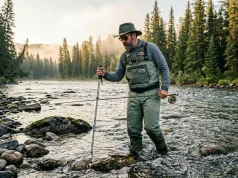
Bipedal stances are inherently unstable in water. Defeating the current means building a structure. The wading staff serves as a third leg, transforming your stance into the tripod stability model. Three contact points keep you anchored when the bottom feels like bowling balls coated in grease. Review the Guidance for Stream Restoration and Hydrology for foundational insights. Don’t use a flimsy ski pole; if it bends, you go exactly when the river is strongest. Find a rigid best wading staff for slippery rocks that holds your weight.
The Upstream Staff Placement
Your staff needs to sit directly against the flow. Upstream vs downstream angle matters entirely.
Leaning against an upstream staff lets the water drive the tip harder into the riverbed, anchoring your support. Placed downstream, the water sweeps it out from under you. Always maintain the 3-point contact rule: keep two points planted before moving the third.
Use a retractor leash to prevent a dropped stick from tangling your legs.
Defeating the Downstream Fold
The single most hazardous failure is the downstream fold, catching seasoned guys who relax for just three seconds.
I got folded on the Madison River a decade ago because I turned downstream to holler at my buddy. The water grabbed the back of my knees, collapsed my legs instantly, and flushed me fifty yards before I surfaced.
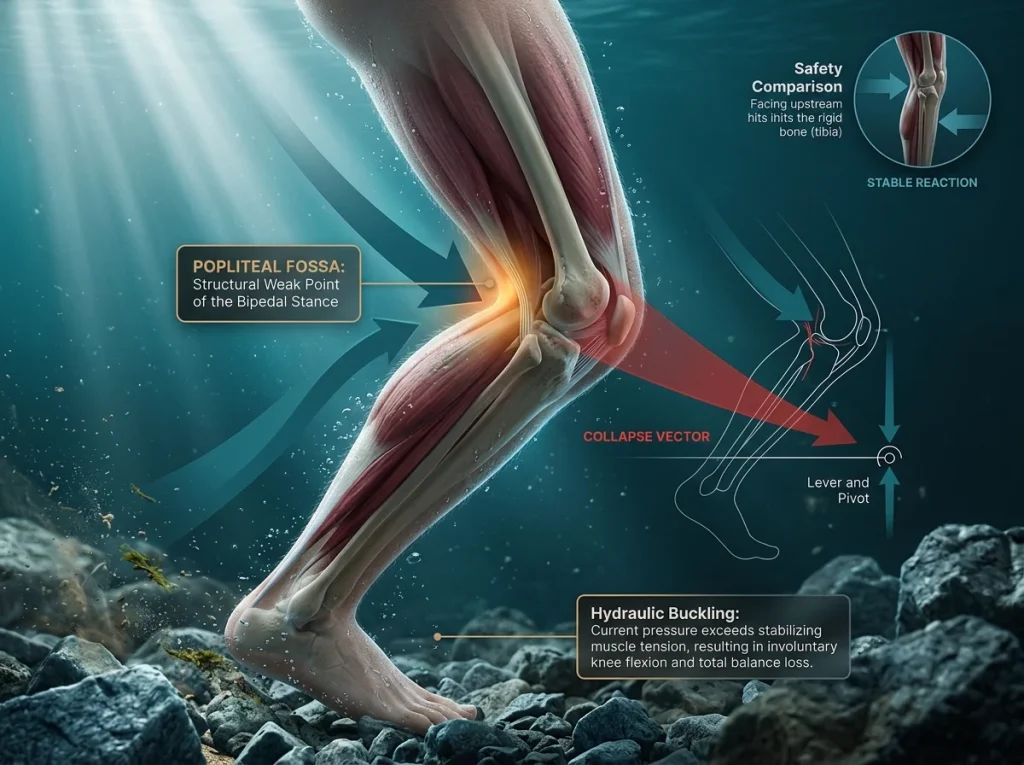
When facing upstream, current hits the rigid front of your shins. If you pivot downstream while locking your legs, hydraulic pressure hammers the popliteal fossa—the back of the knees. The joint bends the exact way it wants to naturally, buckling your legs and ripping your boots from the bottom.
Keep a slight bend in your knees. This athletic stance uses muscles as shock absorbers. Never lock your joints when facing away from the current.
Establishing solid mechanics handles the current flow, but managing your base placement ensures you don’t get flipped backward.
Managing the Pivot Point
Pivot point physics determine who stands and who swims. Your center of gravity must sit slightly forward over your midfoot.
Leaning back onto your heels shrinks your footprint. The current gains leverage, making your heel a single pivot point that tips you backward like a felled tree. The three-point vector provided by an upstream staff ensures that if your weight shifts unexpectedly, the third column catches the load before you cross the tipping threshold.
Pro-Tip: Before lifting your back foot, physically push your weight down onto your upstream staff with your shoulder. You want the staff carrying thirty percent of your body mass during transitions.
A rigid structure won’t save you if your soles slide off the rock. That requires selecting the right boots for the underlying stone.
Substrate Roughness: The Science of Boot Friction and Metallurgy
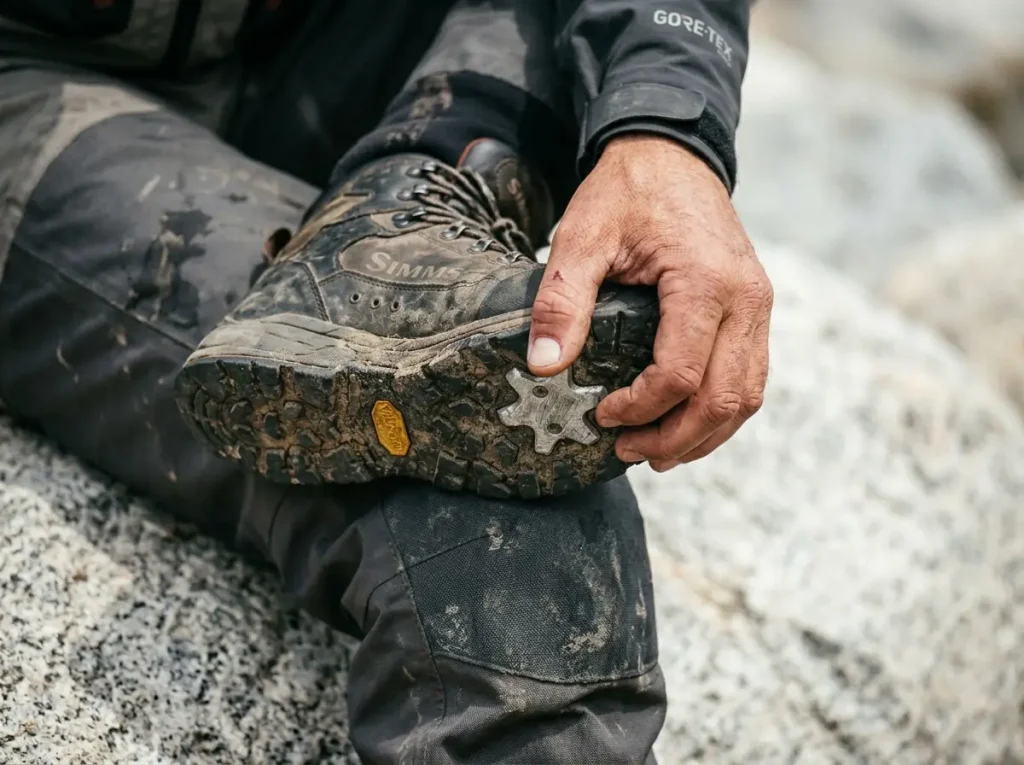
Traction in a river isn’t magic. It’s a localized interaction defined as the coefficient of friction. A boot that grips like glue on a Pennsylvania limestone creek might act like an ice skate on a slick Washington granite river.
Stud selection should be tied entirely to geology, not brand loyalty. I’ve seen guys shatter expensive rods because their zinc-coated hardware screws offered zero metallurgical bite. You have to evaluate the difference in fishing boot traction rock vs mud.
Aluminum Galling on Igneous Rock
Aluminum studs are the perfect weapon for hard igneous rocks like granite or basalt since aluminum is softer than the stone.
Pressuring an aluminum bar against granite forces the metal to crush and deform into microscopic dimples. This galling drastically boosts surface area contact, delivering a sticky grip. You will replace them often as the metal sacrifices itself, but the grip is worth it.
Tungsten Penetration on Sedimentary Stone
Tungsten carbide sits just below diamond in hardness. Tungsten studs (like hardbite studs from Simms or Orvis) refuse to deform, relying on sheer point penetration.
They excel on softer sedimentary rocks like limestone, biting directly into the stone. But take them onto smooth, algae-covered basalt and they won’t bite. Acting like ice skates, they create a terrifyingly low coefficient of friction. Use tungsten exclusively when the rock yields.
You can select the ideal metal matrix for the geology, but you have to pair it with the corresponding boot sole material.
Porosity Limitations of Felt and Rubber
We must address porosity vs mechanical grip. Felt soles dominated for decades because dense interlaced fibers absorb water and mechanically mold over slick surfaces.
However, felt fails instantly on muddy banks, turning into a greasy sled once dirt packs the fibers. Modern lugged best fishing boots lug sole shed mud effectively, but bare rubber cannot touch felt’s capability on snot-slick rocks without added studs.
Ensuring maximum grip anchors you to the bottom, but keeping yourself pinned there drains your energy reserves rapidly.
Biomechanics and the Metabolic Cost of Moving Water
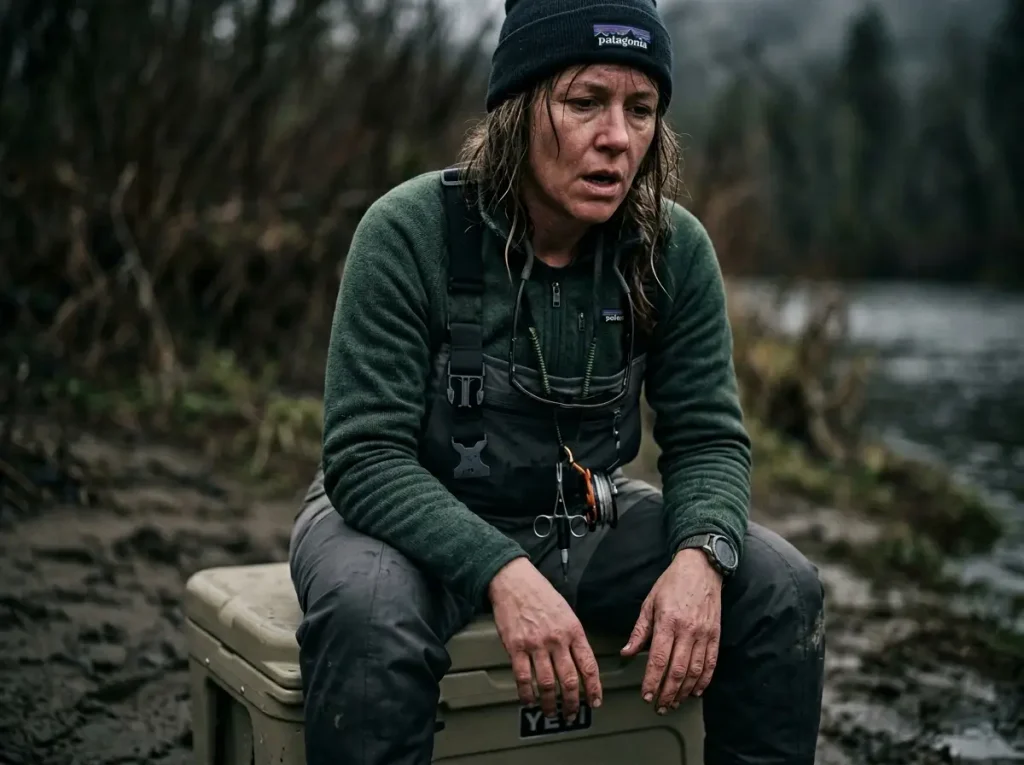
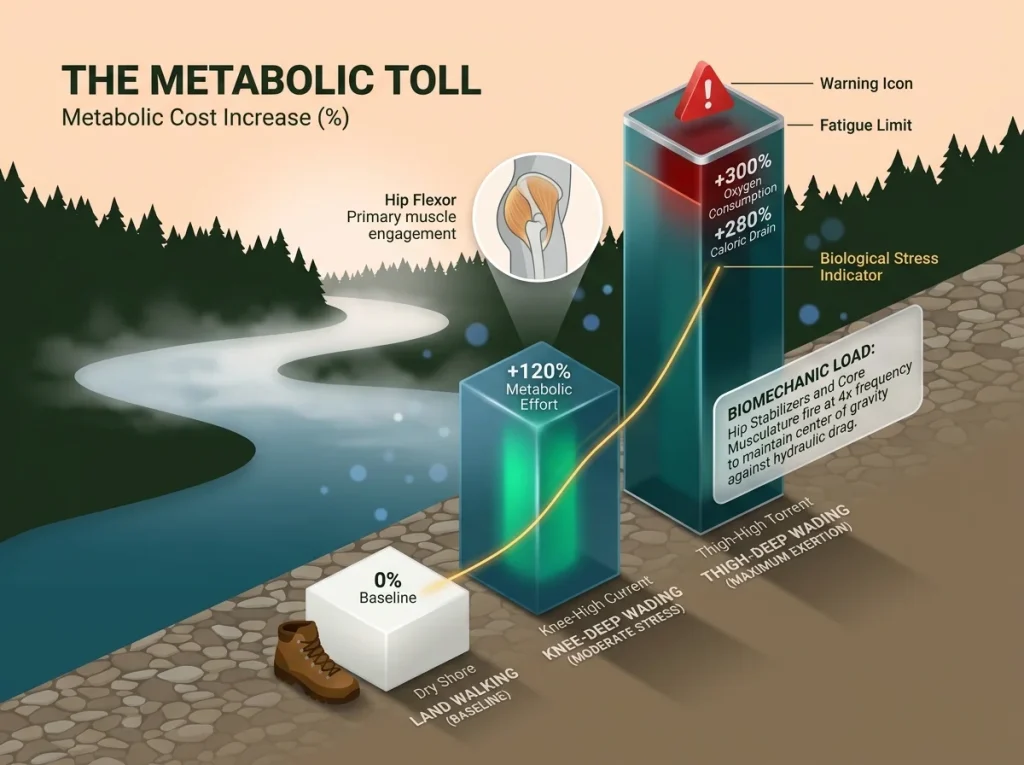
Wading isn’t just walking. Pushing legs through a dense fluid medium extracts a massive biological toll.
This resistance instantly spikes metabolic cost. Studies on aquatic locomotion suggest hips perform 62% more positive work just to overcome drag. Oxygen consumption jumps nearly 300% when wading at thigh depth. Waking up the next day feeling like you ran a marathon isn’t a lack of fitness; it’s the toll of river hydrodynamics.
Hip Flexor Drain
Every forward step requires hauling your thigh against a thick boundary layer, punishing your hip flexors.
You spend hours lifting knees to clear submerged ledges while fighting fifty pounds of current. Whenever possible, use a low, sliding gait. Once hip flexors fatigue, your strides get lazy. Boots catch on submerged rocks, ripping your balance apart.
Eccentric Contractions and Stabilizers
Standing perfectly still is exhausting. You constantly undergo eccentric muscle contractions as stabilizers fire thousands of discrete corrections to stop the current from knocking you flat.
I learned this lesson the hard way in Colorado. I felt invincible all morning, but when I finally turned around to hike back, my legs felt like wet cement. The fatigue sneaks up on you.
These micro-corrections cause the silent fatigue that only registering you step toward the shore. Give yourself ten minutes to rest on a dry bank before tackling a tough crossing back to the truck. Muscular exhaustion clouds cognitive judgment.
Fatigue causes sloppy wading patterns that inevitably lead to missteps and full immersion events.
Deep Water Displacement Limitations
The deeper you go, the more energy you burn, and the worse your balance gets. It is simple math.
A thick pair of neoprene waders offers excellent insulation, but it masks the physical exertion heavily by padding your movements. By the late afternoon, stick to the shallows. The fish move into the slower edge seams during low light anyway. You do not need to fight the thalweg at dusk.
When your muscles eventually hit their breaking point and your structure collapses, you transition instantly from a fisherman to a rescue victim.
Emergency Contingencies: The Hydrodynamics of Self-Rescue
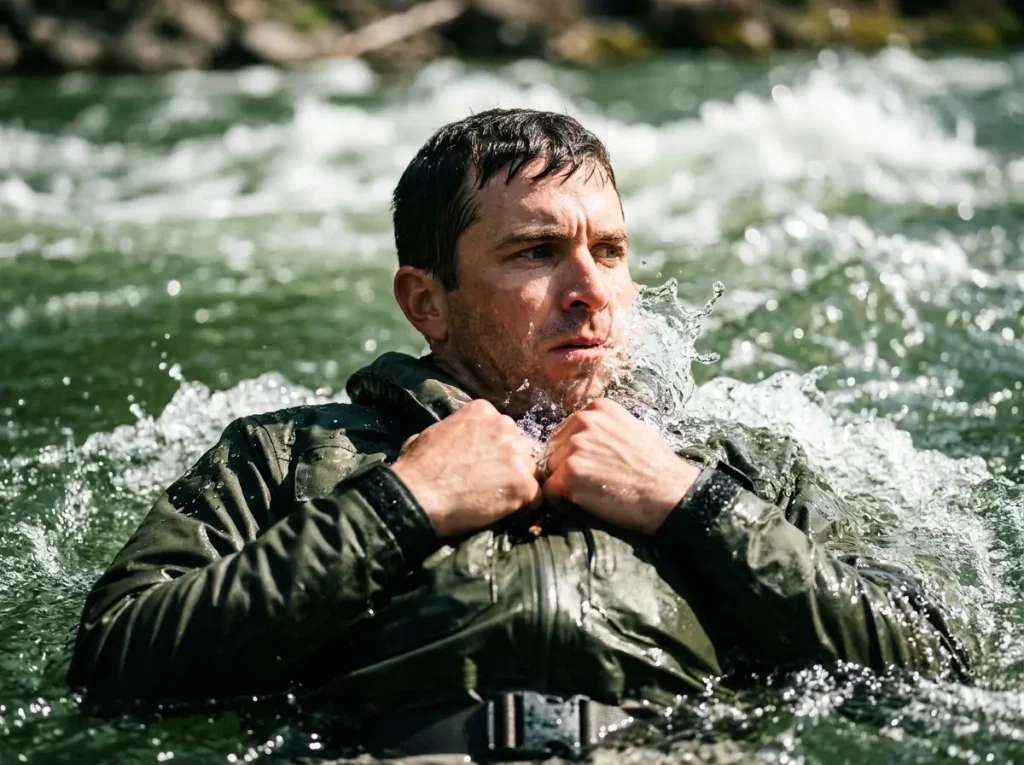
If you fish heavy water long enough, the river will win a hand. A rock rolls, your boots slip, and you hit the water.
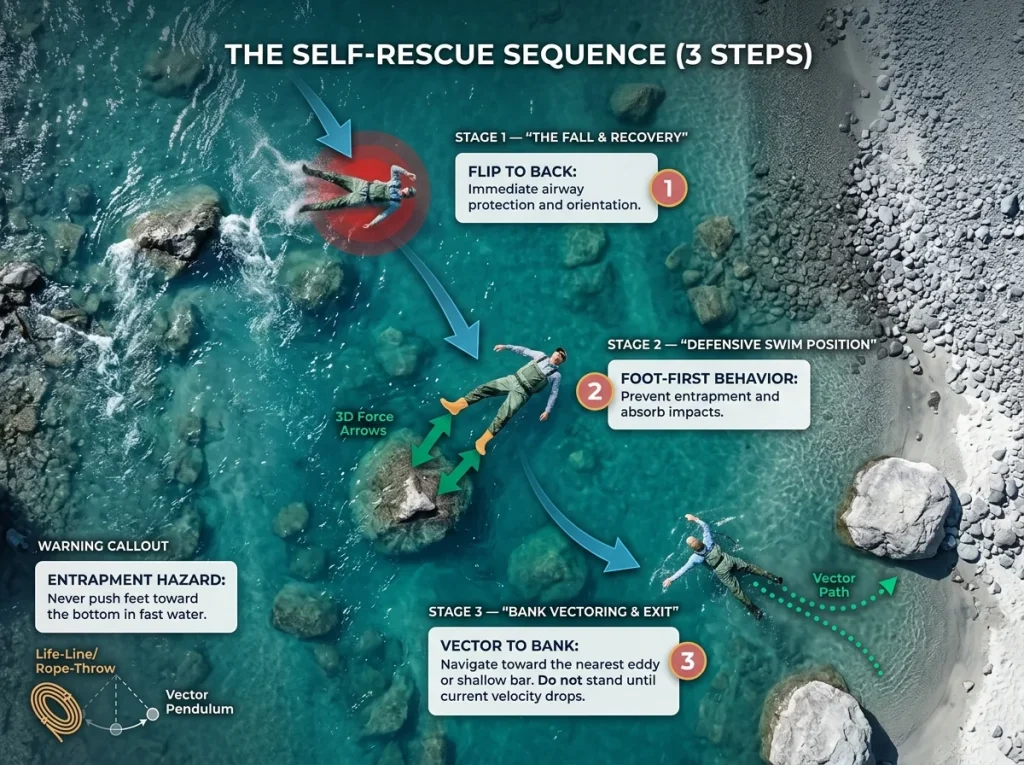
You transition immediately from an anchored structure to a suspended load moving at current speed. You must execute a planned self-rescue swim. Panic gets people seriously hurt. According to the ACA Swiftwater Rescue and Safety Handbook, your first instinct shouldn’t be scrambling to your feet—it should be rolling to your back.
The Defensive Swim Position
The second your chest hits the water, flip over. Point toes downstream and keep your head elevated. This is the defensive swim position.
It keeps your airway clear while your feet act as physical shock absorbers, bouncing off large boulders so your torso doesn’t. Keep toes pointed up toward the sky. Pushing feet toward the riverbed risks foot entrapment—where a boot wedges between underwater rocks. Once trapped, the current pushes your torso violently underwater, carrying a pressure too great for you to resist.
Scan downriver. Let the water carry you until you spot a calm pool or a gradual bank.
Vector Pull Mathematics
If a buddy throws you a rope, the math changes. The vector pull pendulum effect takes over.
Grabbing an anchored rope in fast water creates a massive lateral drag force. Dependent on the angle of the rope relative to the shore, tension multiplies radically. A lifeline thrown directly across the current at a 170-degree angle exerts over five times your body weight onto the line. Do not try muscling your way straight in. The rope essentially swings you across the current. Hold tight, stay on your back, and let the geometry pull you shallow.
Even if you execute a perfect defensive swim, your goal remains maneuvering yourself out of the flow as quickly as possible.
The Eddy Exit Strategy
Ideally, you vector toward the bank on your own. Use your arms to paddle backward at an angle, executing vectoring toward the bank.
Look for back-eddies behind boulders where water velocity drops. Once you drift into a calm pool that sits below your shins, roll onto your stomach and bear crawl onto dry land.
Do not try to stand up while the water is still moving fast. Stay low to the rocks and drag yourself completely out of the flow before checking gear or resting. Get out of the current first.
Conclusion
Treating the river as a solvable energy equation separates the masters from the statistics. Your boots are the only thing anchoring you, and the water never takes a break. By calculating your Rule of Ten limits, driving your rigid tripod system into the streambed, trusting proper boot metallurgy, and avoiding vector stability failures, you neutralize the river’s greatest physical threats.
Practice the defensive swim pose in your mind so it activates purely on instinct. Put in the effort to assess your equipment honestly and execute every crossing with total mechanical control. Look at your local flows, gear up accordingly, and take control of the current on your next outing.
FAQ
How deep can you wade in a strong current?
You should only wade as deep as the Rule of Ten allows. If your wading depth in feet multiplied by the current velocity in feet per second equals 10, the water is mathematically too hazardous to stand in. Crossing deeper water relies on pure luck since your displacement causes you to float, rendering your boot’s traction completely useless.
What is the Rule of Ten for wading technique in strong river current safety?
It is a threshold calculation used to evaluate drag forces before entering the water. A 180-pound adult must abandon the wade if depth times velocity exceeds 10; smaller anglers rely on a Rule of Eight. It stands as an absolute red-line limit based on real fluid dynamics.
Is aluminum or tungsten better for wading boots?
It depends entirely on the geologic makeup of the riverbed. Aluminum galls and provides sticky mechanical grip on hard igneous rock like granite, while tungsten pierces through biofilms on soft sedimentary stone like limestone. Taking hard tungsten onto smooth basalt acts like strapping ice skates to your boots.
Why do my knees buckle when wading downstream?
Facing upstream puts the current’s pressure against the rigid front of your shins and thighs. Turning downstream exposes the back of your knees to hydraulic pressure, aligning precisely with the joint’s natural flexion and forcing an involuntary buckle. Always maintain a sideways or upstream profile when navigating deep water.
Risk Disclaimer: Fishing, boating, and all related outdoor activities involve inherent risks that
can lead to injury. The information provided on Master Fishing Mag is for educational and informational purposes
only. While we strive for accuracy, the information, techniques, and advice on gear and safety are not a substitute
for your own best judgment, local knowledge, and adherence to official regulations. Fishing regulations, including
seasons, size limits, and species restrictions, change frequently and vary by location. Always consult the latest
official regulations from your local fish and wildlife agency before heading out. Proper handling of hooks, knives,
and other sharp equipment is essential for safety. Furthermore, be aware of local fish consumption advisories. By
using this website, you agree that you are solely responsible for your own safety and for complying with all
applicable laws. Any reliance you place on our content is strictly at your own risk. Master Fishing Mag and its
authors will not be held liable for any injury, damage, or loss sustained in connection with the use of the
information herein.
Affiliate Disclosure: We are a participant in the Amazon Services LLC Associates Program, an
affiliate advertising program designed to provide a means for us to earn advertising fees by advertising and linking
to Amazon.com. As an Amazon Associate, we earn from qualifying purchases. We also participate in other affiliate
programs and may receive a commission on products purchased through our links, at no extra cost to you. Additional
terms are found in the terms of service.