

In this article
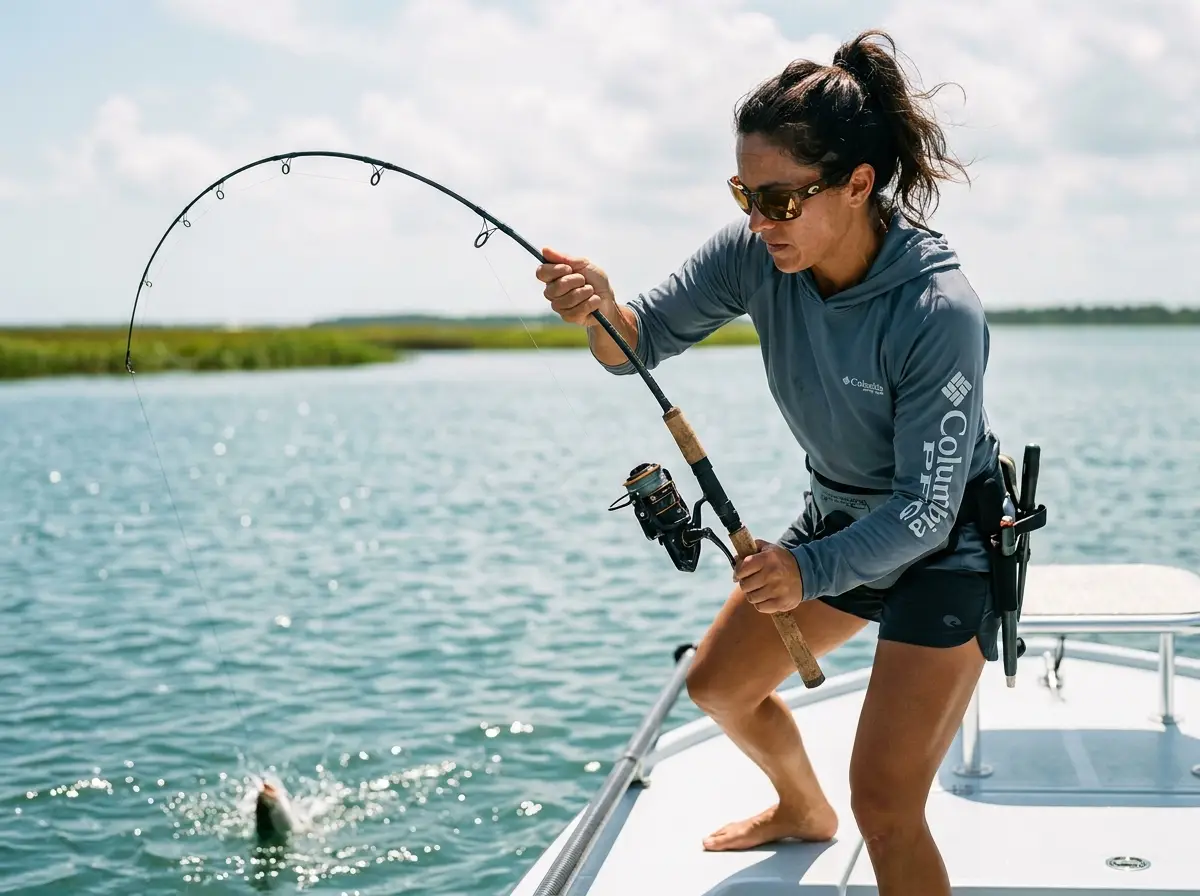
The extra-fast action rod doubled over against the weight of what I assumed was a mud-embedded oyster reef—until the “reef” clamped down with bony teeth and violently thumped toward the incoming tide. If you want to know how to catch flounder, fluke inshore tactics require treating the water column as a hydrodynamic equation rather than a guessing game. By deconstructing boundary layer mechanics and the metabolic demands of the summer flounder, the analytical angler can drastically increase their strike-to-land ratios.
After twenty years guiding the salt, I’ve watched brilliant anglers fail spectacularly because they treat flatfish like striped bass. You cannot force a highly evolved predator to chase a poorly presented lure through ripping currents. Here is exactly how to handle it—no panic, no blank trips, just mechanical execution based on an analytical guide to inshore fluke tactics.
⚡ Quick Answer: Consistently landing summer flounder means targeting the low-velocity boundary layer. Throw out stretchy lines in favor of zero-stretch braided line and extra-fast rods. When you feel the signature isolated thump of a strike, ignore the urge to rip the rod back right away. Instead, employ a measured hookset delay—wait one to three seconds for the fish to commit the bait past its teeth, then drive the hook with authority.
How to Catch Flounder: Bio-Mechanics for Inshore Tactics
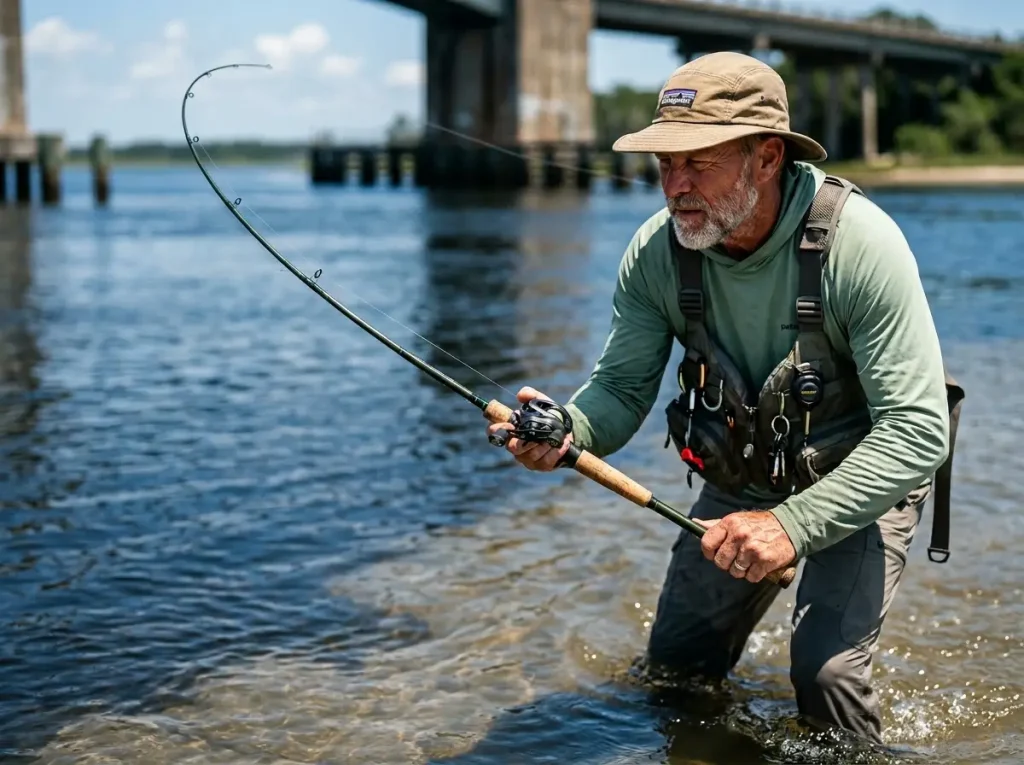
You have to accept the biological hardware of the flounder to catch them inside normal 0-30ft depth constraints. As a master of benthic ambush predation, this flatfish evolved to occupy the very edge of the seafloor where its physical profile operates in perfect tandem with tidal inertia. They wait in flawless disguise, burning minimal energy, anticipating the moment a confused mullet washes directly overhead.
Ocular Migration and Benthic Disguise
A flounder naturally hatches looking like a standard baitfish, swimming upright. The true transformation happens at sixteen millimeters in length. At this tiny stage, the right eye detaches and migrates over the crest of the skull, settling onto the left side. This severe ocular migration restructures their skeleton, massively expanding the jaw musculature to support an upward-facing horizontal strike vector.
When you study a legal flatfish on the deck, you notice the chromatic pores dotting the upper skin. These specialized cells grant the fish the ability to actively shift its skin texture and color to replicate surrounding bottom substrates in a matter of minutes. They melt into the sand, ensuring the baitfish drifts cleanly into strike range.
The Specific Dynamic Action (SDA) Energy Equation
Flounder execute a strict metabolic waiting strategy. The heavy caloric cost of processing a large meal—what researchers call Specific Dynamic Action (SDA)—forces ambush predators into a recovery state. After securing a heavy meal, the flatfish practically shuts down all predatory functioning.
This explains the days when you are working a prime tidal flat with zero results. You might be drifting over a heavy population that successfully gorged itself twenty-four hours earlier during a massive tide movement. Locked deep in this digestive recovery phase, they adopt a total metabolic shutdown. You can employ a perfect slow retrieve or resort to dead-sticking the bait, and they won’t even flair their gills.
Hypoxia Thresholds and Summer Dead Zones
During the dog days of late August, you’ll consistently find historical inlets totally barren. Always monitor the dissolved oxygen. Flounder push the absolute limits of hypoxia, but they have a breaking point. In normal summer water, their critical oxygen threshold hovers around 2.0 milligrams per liter. But when the water cooks past eighty degrees, that critical threshold spikes. They require vastly more oxygen to offset the thermal stress.
If you are researching the current biomass and management status of summer flounder, you must acknowledge how temperature spikes evict the fish from stagnant backwaters. They retreat from shallow bays and stack up around cooler, oxygen-rich upwelling zones bordering inlets. Recognizing how they use broader saltwater flats ecosystems will consistently enable you to track these temporary oxygen refuges. Finding those refuges requires reading the water flow, which brings us directly to bottom friction.
Estuarine Hydraulics: The Manning’s Roughness Coefficient
Water velocity dynamically alters from the top of the column to the mud. Fluid mechanics rule the estuary tight to the ground, and the flatfish leverages bottom friction to locate slow-water sanctuaries under ripping currents. Manning’s n serves as the metric for bottom roughness. A pure silt bottom generates high current speeds right on the deck. Jagged oyster bars pack high values. By computing this roughness, you isolate the exact ambush points where flatfish intercept passing crabs.
The Turbulent Boundary Layer Explored
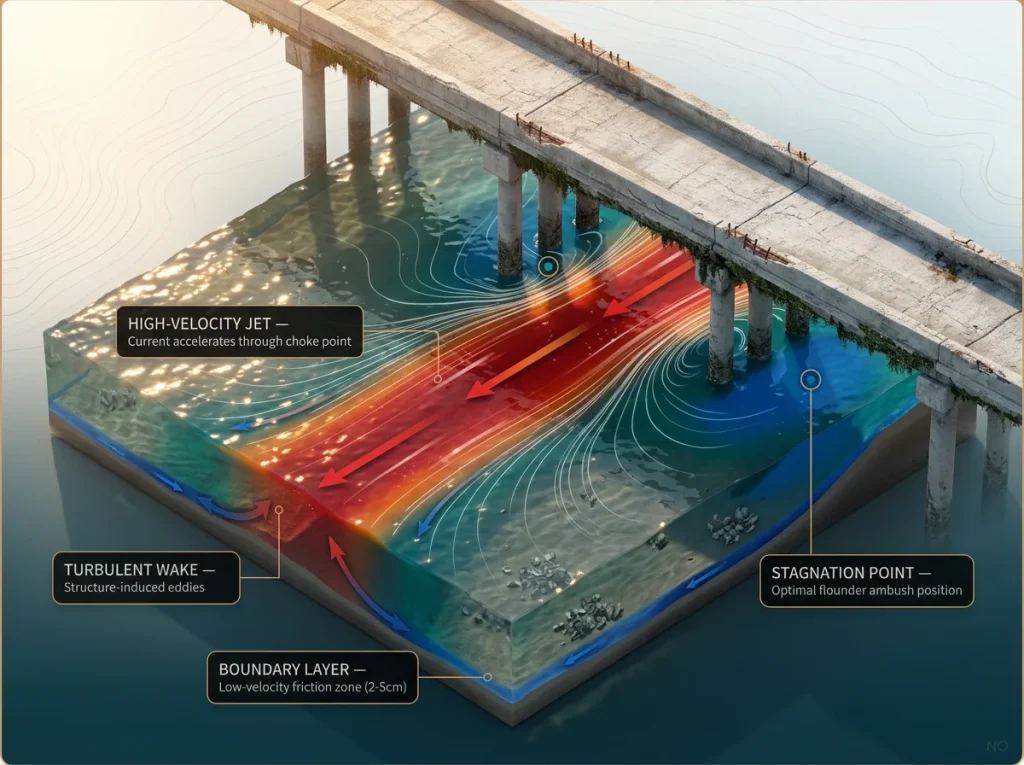
Inshore tidal flow operates highly turbulently, casting a velocity curve that directly governs flatfish positioning. The current screams past the surface while dropping aggressively to near zero only inches from the soil. That critical friction zone right against the earth is the boundary layer.
Flounder flatten their frames to slip entirely underneath the fast-moving column. If your lure pulls two feet off the soil, you force the fish to launch upward fighting heavy resistance. The metabolic cost of ambush vs pursuit shifts negatively, causing them to reject the strike. Your jig heads must remain explicitly within that tight two to five centimeter layer.
Pro-Tip: When the outgoing tide rips, swap standard lead for high-density tungsten barrel weights. Tungsten occupies forty percent less volume than lead at the same physical weight. The reduced profile slices strictly through the heavy current unhindered, keeping your plastic pinned inside the boundary layer.
Substrate Selection Based on Bottom Friction
The mathematical roughness coefficient explicitly dictates where flatfish congregate to feed. Fine silt guarantees incredibly low friction, resulting in faster deep water that forces the fish to expend energy. However, aggressive structure like heavy reef chunks acts precisely like a massive speed bump against the flow.
This targeted roughness generates a thickened boundary layer. The chaotic shells absorb and destroy the current’s energy, providing an effortless hideout. Reviewing the standardized Manning’s n values for varied bottom substrates verifies that extreme roughness traps scent trails beautifully. Water crashing over shell beds creates tiny micro-eddies that lock the scent of your soft plastic tight to the mud vs shell boundaries.
Leveraging Tidal Choke Points
Tidal velocity invariably matters exponentially more than the actual tidal height. The hydraulic context dictates that massive volumes of water pulling off the spartina grass must funnel baitfish through narrow gaps. These funnels serve as literal choke points. The current accelerates through these gaps, and the predators stage directly downstream in the structure-induced eddies.
During astronomical high-velocity spring tides, the water heavily rips the bottom sediment raw, inducing scouring. It launches a mud cloud mimicking fleeing crabs. When you start reading tidal velocity instead of height, you target the very moment that scour breaks loose. The flatfish register the turbid wash and initiate their attack phase. Throw your terminal tackle directly into the plume and let it tumble, preparing for the mechanical violence of the actual strike.
The Physics of the Strike: Suction Forces and the Mandibular Clamp
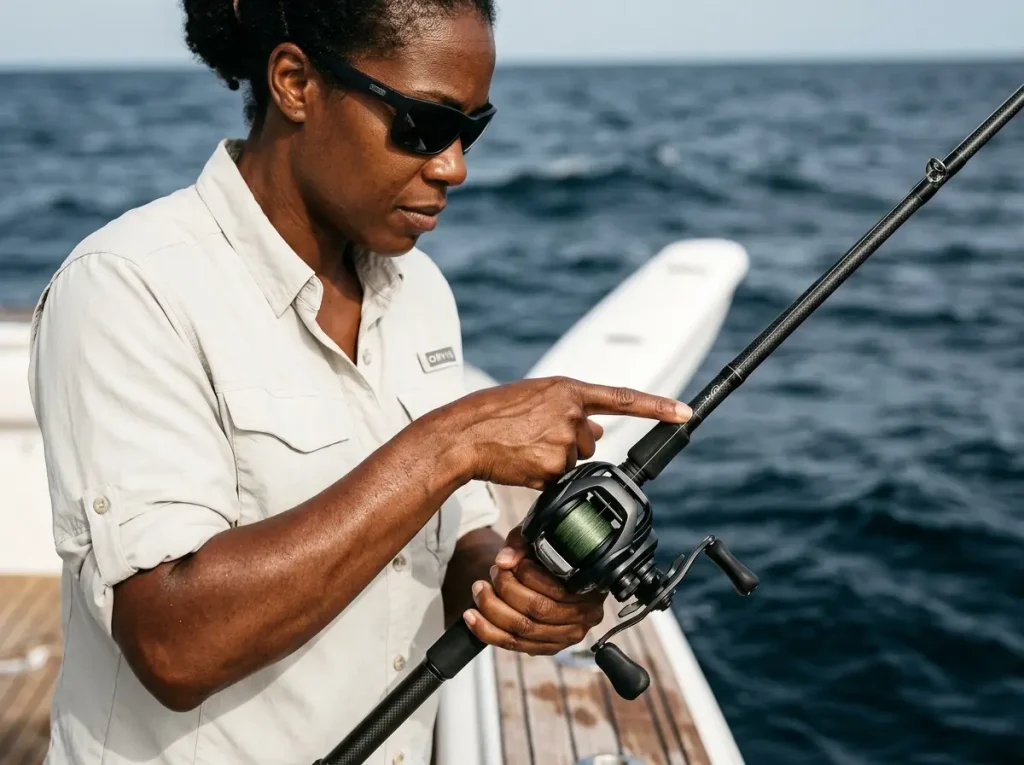
Casual weekend warriors assume a flatfish swims forward and bites a jig exactly like a bluefish. That remains biologically impossible based on their mechanics. The true strike manifests as an explosive, incredibly fast hydrodynamic event. They craft massive negative pressure gradients inside their throat, physically vacuuming the rig out of the wash.
The Bernoulli Vacuum Effect
When a fluke snaps its jaws, it performs a radical buccal expansion. The tight mouth cavity blasts open perfectly within four to forty milliseconds. This terrifying speed triggers a catastrophic pressure drop immediately inside the fish. The exterior water column, along with the bucktail, gets sucked inward. This represents the Bernoulli vacuum effect.
If you tie on rigidly fixed heavy sinkers that resist this instant draw, you manually sabotage the vacuum. The fish attempts to inhale the offering, but the lead anchors it violently outside the jaws. A detailed mechanical perspective on suction feeding confirms that independent, sliding component rigs grant the bait freedom to instantly travel down the throat on the pressure wave unhindered.
Anatomy of the “Thump” and the Mandibular Grip
Pelagic predators hit high-speed lures and continue running, ripping massive drag. A summer flounder executes the suction blast, slams its jaws shut, and drops straight back into the silt. They deploy a heavy mandibular clamp, locking razor-sharp teeth tightly directly across the lead.
I learned this lesson the hard way off Montauk. You feel that sharp knock and your instinct says to swing for the fences immediately. All you get back is a soft plastic neatly sliced in half. They don’t have the hook; they just have the tail pinched between their front teeth.
This unyielding jaw lock shoots an isolated, distinct vibration up your line. This is the physics of the flounder thump. If you run a soft, spongy rod, you register the hit, rip a hookset, and the blank simply bows uselessly against the vise-grip holding the jig.
Recognizing the Difference Between a Clamp and a Swallow
Massive short strikes result entirely from anglers crossing their eyes the exact second the thump hits. During this preliminary clamp phase, the bait remains severely pinched directly between the frontal teeth. The hook point floats in empty space, away from vulnerable soft throat tissue.
When observing the massive hydrodynamic displacement during a strike, you understand why pausing forms the backbone of success. Waiting physics demand you grant the fish fractions of a second to transition the plastic off the teeth back into the crushing plates. Your true skill rests heavily in possessing the nerve to wait for the swallow. That patience only matters if your rod has the backbone to drive the steel home.
Gear Architecture: Overcoming the “Flounder Rod” Trap

Countless tackle manufacturers market cheap, buggy whip fiberglass sticks as dedicated flounder-specific rods. They push the folklore that sluggish, slow-action blanks allow the fish to peacefully chew the bait without registering resistance. With highly advanced circle hooks, sticky sharp jigs, and unyielding superlines, deploying a slow rod acts as a mechanical catastrophe directly causing lost fish.
The Extra-Fast Action Graphite Requirement
You require a high-modulus trout rod (repurposed distinctly for heavy flats duty). An extra-fast blank intentionally bends exclusively in the upper twenty percent of its length. The lower eighty percent maintains absolute rigid leverage.
When you swing hard on a trophy doormat, you are physically fighting to overpower the rigid mandibular clamp. The Kahle hook or stout jig must violently puncture through top-tier bone. A mushy, slow-action rod acts as a shock absorber. The blank folds entirely in half, and the fish barely registers the delayed pull. You demand a tool built solidly to transfer massive driving force into the steel.
Drag Vectors: Why Braid Outperforms Monofilament
Water column drag systematically destroys natural presentations. Standard monofilament cord holds a massive diameter relative to its breaking limit. As harsh tidal currents push heavily against it, a massive bow develops, spiking the drag vector pulling the lure out of the strike zone.
Zero-stretch braided line packs a true micro-diameter footprint. It slices through incoming tides like piano wire. By slicing the drag profile, you can effectively utilize significantly lighter weights to verify tight bottom contact. Braid guarantees a true one-to-one energy transfer right into the jaws.
Pro-Tip: Run high-vis braid attached to an eight-foot fluorocarbon leader. When drifting in heavy current, watching the physical line slice through the water tells you where your jig is positioned long before you feel the bottom vibration.
Kinetic Transfer and High-Ratio Reels
When fishing aggressive currents around bridge pilings and jetties, the moving water constantly sweeps your offering downstream. This generates massive slack constantly bowing your line. If you detect the bite while carrying slack, your massive swing literally just pulls slack line taught, missing the bone entirely.
We attribute the physics behind the Carolina rig largely to the hooks, but applying raw tension remains paramount. Operating a reel carrying a high gear ratio—like a dedicated Daiwa BG, Shimano Stradic, or equivalent pulling thirty-eight inches of line per crank—hands you the ability to violently rip the slack tight before striking. With the right rod and line, it all comes down to presentation.
Tactical Execution: Engineering the Perfect Setup and Retrieve
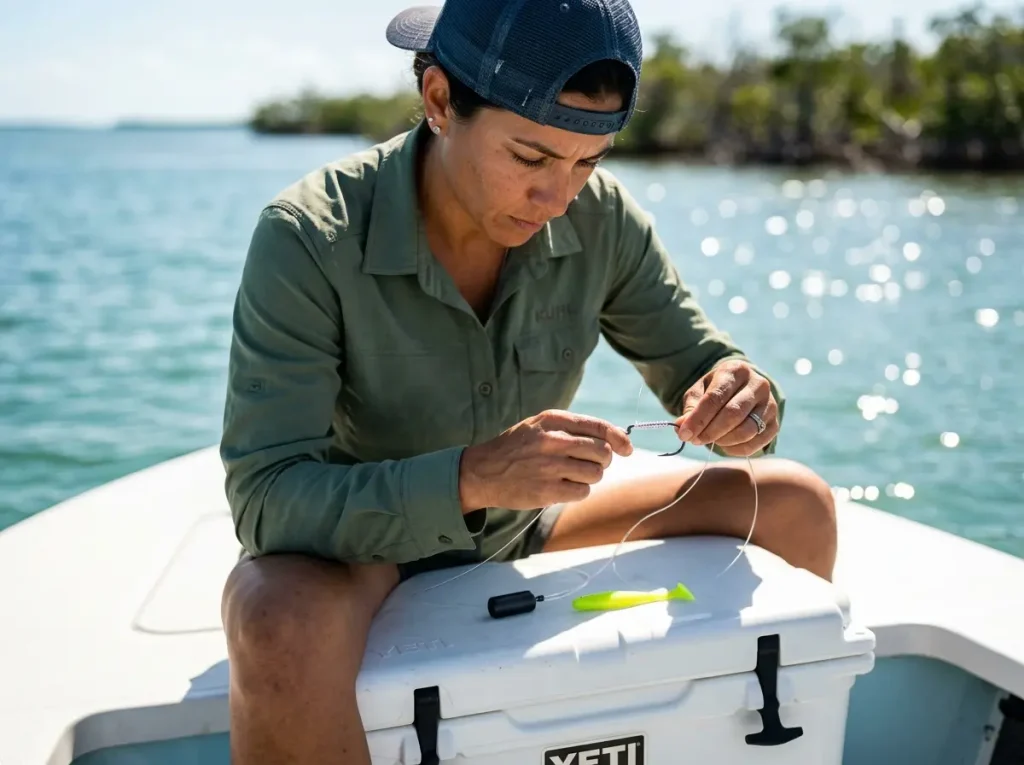
Firing tackle randomly across the inlet bay predominantly yields dogfish and skates. You have to tune your terminal rigging to slide efficiently directly inside the mud friction zone while behaving naturally when fishing the wash. It heavily boils down to depth discipline and respecting the delayed timing.
The Tandem Carolina Rig Hydrodynamics
Deploy a highly effective Carolina tandem variation incorporating a clean sliding egg sinker riding on your braided main line. The primary line runs freely through the lead, terminating at a compact barrel swivel. Underneath the swivel, a highly invisible fluorocarbon leader drops to swing-head jigs, with a separate dropper loop mounted higher suspending a second hook. Forget basic chicken rigs or standard hi-lo setups; they are way too stiff.
This tandem rig crushes the competition because it actively deletes inertia. When a solid fish deploys its suction strike, the heavy sliding weight remains pinned totally flush on the soil. The line slides frictionless through the core, meaning the prey feels zero counter-resistance.
The Snell Knot Advantage for Mandibular Hooksets
Your knot choice physically dictates the trajectory of the metal during the strike. The basic improved clinch holds strongly, but it physically allows the eyelet to pivot loosely on the line. When you apply raw tension, the hook can literally drag flat sideways across the tongue.
Substitute that instantly with a stiff Snell knot to bend the physics of the engagement entirely in your favor. A Snell knot lashes the heavy fluorocarbon tightly straight down the shank itself. When you snap the rod back on a Berkley Gulp trailing swimming mullet, the line forces massive pressure firmly onto the top of the eyelet, camming the point outward at a severe ninety-degree angle. This sharp jackknife effect leverages the metal specifically upward straight into the hardened roof plate, drastically skyrocketing optimal penetration.
I refused to tie snell knots for years because they take longer on a rocking boat. Then I lost an eight-pounder at the net because the clinch knot let the hook rotate out. Trust me: spend the extra thirty seconds tying a true snell.
The Mathematically Optimized Hookset Delay Table
You must religiously memorize the tactical hookset delay. Striking on the first knock pulls the plastic far out of the suction zone. The precise delay relies strictly upon the bait deployed.
If you bounce highly scented artificials, strictly wait 0.5 to 1.5 seconds. The fish vacuums the plastic, clamps fiercely, actively registers the flavor trail via internal olfactory receptors, and holds tight. If you prefer drifting heavy live bait or a large live shrimp, the predator has to physically flip the struggling prey backward in its mouth to swallow it headfirst. An extended 10-60 second delay before hooksetting handles giant baits, but the golden standard rule means you click to free-spool and hold for five seconds.
Hard data inside the bioenergetics model for southern flounder heavily validates that gifting the fish time to safely complete ingestion multiplies your landed odds massively. Keeping the weight pinned while matching subsurface current speed ensures your rig flawlessly mimics natural drift rates. Once you stick the fish, how you handle it determines if it survives the release.
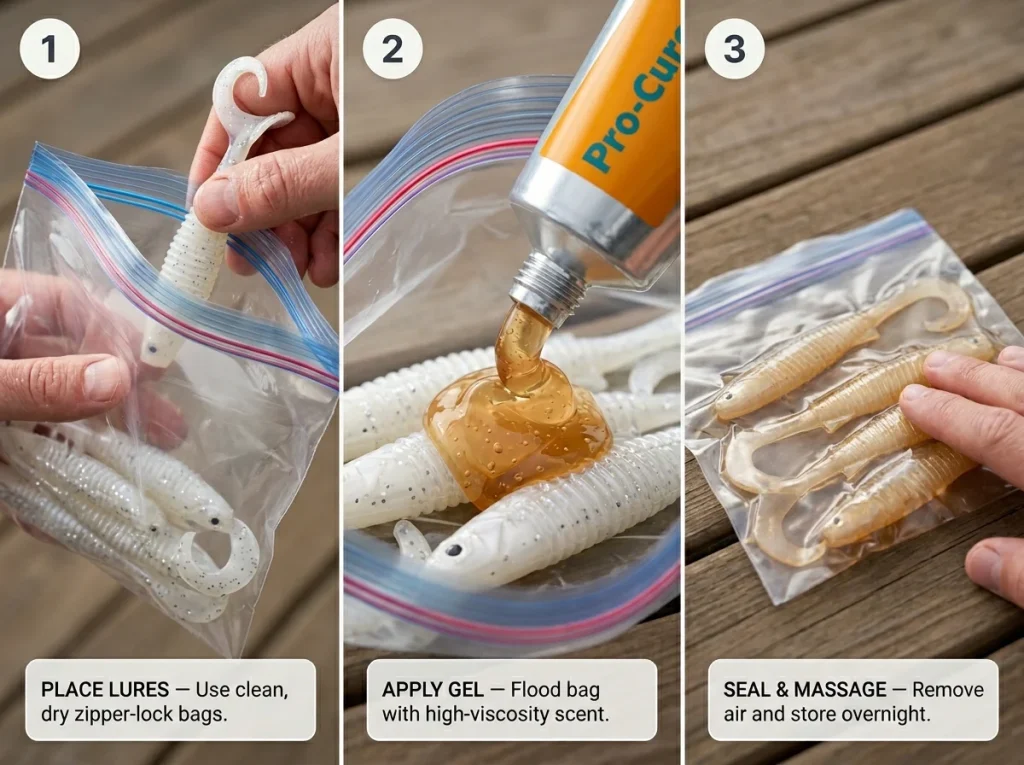
Pro-Tip: The “Marinate Method” radically outfishes standard presentation. Dump your synthetic baits out of the factory bags directly into a heavy zipper-lock bag. Flood it heavily with sticky gel scent and leave it alone overnight. The extended soaking completely forces the chemical scent deep inside the plastic’s microscopic pores, laying down a persistent scent trail.
Catch and Release Ethics: Mitigating Barotrauma
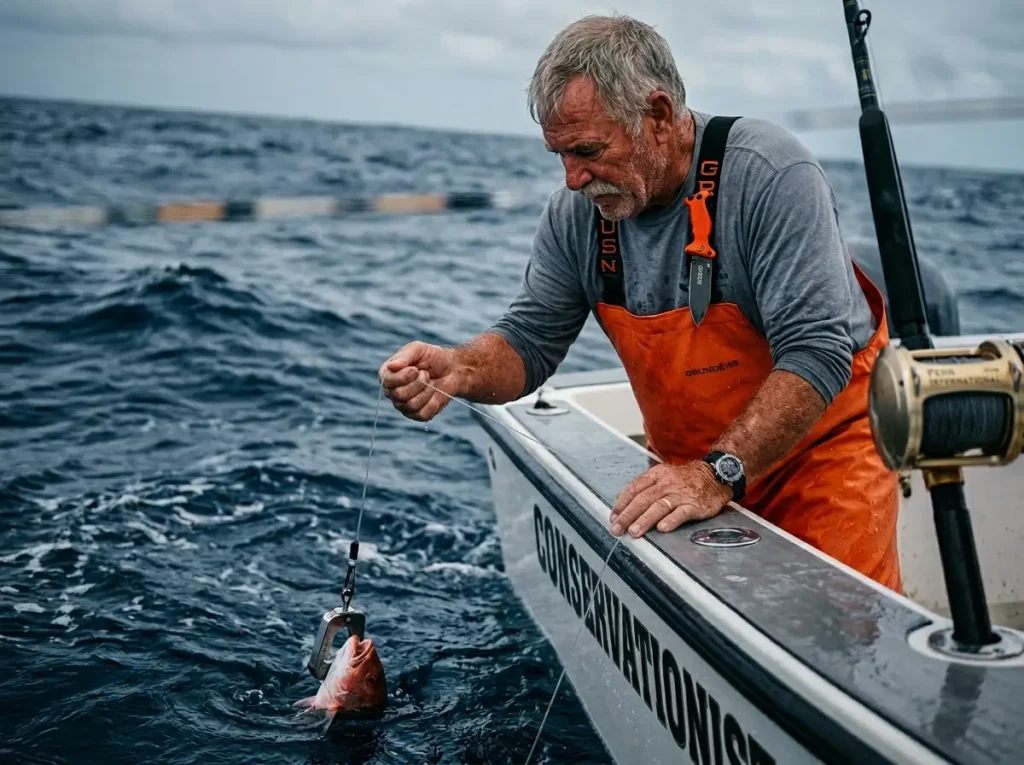
If you plan to practice conservation, managing the extreme hydrostatic pressure gradient occurring under your hull is mandatory. Cranking groundfish rapidly upward out of deep inlet cuts creates brutal gas expansion mechanics. Treat a flatfish pulled from thirty feet identically to a fish caught in two feet of water, and that fish floats away dead due to barotrauma.
The Physics of Physoclistous Swim Bladders
Flatfish feature a sealed physoclistous swim bladder. They lack the physical biological plumbing to belch or vent air rapidly to release rising internal compression. When they hold tightly against the mud in a deep channel, the environmental pressure runs drastically higher than the surface.
Boyle’s Law defines that pressure surges by one full atmosphere mathematically for every thirty-three feet of straight depth. When you unceremoniously winch the fish directly up from the bottom, the gases locked entirely inside their sealed bladder expand aggressively. This radical internal expansion inflicts massive injury, forcefully crushing internal organs.
Assessing Exophthalmos and Pressure Injuries
You must visually inspect for pressure injuries before simply dropping the fish back overboard. The physiological symptoms display brutally. Look cleanly at their eyes. If the eyes are physically bulging aggressively outward past the skull cavity, that presents as exophthalmos—a guaranteed sign of dangerous internal gas expansion.
Check the mouth cavity. Frequently, the expanding bladder forces the stomach inside-out directly into the jaw area. You might also spot trapped bubbling just underneath the lateral line scales. If you register any visible damage markers, tossing the fish overboard guarantees lasting harm. When warning against heavy handling times to cut toxic lactic acid, actively reducing the accumulation of fight stress and cortisol links directly to minimizing surface exposure.
Venting Needles vs. Descending Devices
Many boat captains punch a hollow needle aggressively behind the pectoral fin to vent the locked gas. While this highly debated choice technically bleeds pressure, the margin for error remains razor thin. Missing the inflated bladder and stabbing the vital liver drops the survival odds to zero.
The undisputed safe release standard remains the weighted descending device. It is essentially a pressure-release clamp tying to their lip on a heavy line. You sink the fish straight down to the deck. The heavy returning water pressure functions as an external compressor, gently crushing the runaway gases back to original size completely without piercing internal tissue. The specific physiology and symptoms of inshore barotrauma can be totally reversed cleanly using safe depth recompression. It takes minimal effort to ensure the localized flats population thrives.
Conclusion
Mastering this species requires shifting away from generic guessing and treating the mud as absolute physical science.
- Find the friction: Hunt estuarine hydraulics through the rigid lens of Manning’s roughness coefficient. You want uneven, high-friction bottom compositions where flatfish leverage drastically expanded boundary layers to conserve energy.
- Respect the delay: The intense physics of the strike confirm immediate mandibular locking. Count to one second to let the entire rig slide securely backward over the hard teeth.
- Eliminate the slack: To drive thick hooks rapidly through top-tier skull structure, you rely entirely on an extra-fast stiff blank operating flawlessly with zero-stretch superlines to blast driving force home.
Stop relying on blind casts and focus heavily on true mechanics. The next time your rod abruptly doubles over on the edge of the channel, you will carry the composure to hold the sweep tightly for that specific required second, lean punishingly back against the graphite, and set the steel violently into the jaw.
FAQ
What is the most effective hookset delay when utilizing fluke inshore tactics?
When targeting fluke with soft plastics on jig heads, you must delay your sweep 0.5 to 1.5 seconds flat after surviving the initial hit. This isolated pause allows the predator to transition effectively from the explosive negative-pressure hit straight into a permanent mandibular clamp, heavily gifting you the necessary split-second required to leverage the steel violently through the thick jaw.
How do tides dictate where to catch flounder?
These highly adapted predators utilize heavy moving water religiously, staging right around hard estuarine choke points tight to outgoing tides to ambush baitfish systematically swept completely off the high flats. Alternatively, during the devastating slack tide doldrums, the total lack of moving water terminates the oxygen feed and bait drift, plunging the flatfish fully into an unmoving resting period.
Why are my flounder shaking the hook at the surface?
Short strikes notoriously destroy catch rates entirely because the angler deploys a spongy fiberglass rod that easily folds underneath the dead weight of the fish rather than sharply pushing metal through the jawbone. The fluke physically holds the plastic strictly pinched inside its teeth the whole fight up, and the precise moment it spots the boat and unclamps its jaws, the jig pulls loose.
What is the best bottom structure for inshore flounder?
You demand zones broadcasting a severely high Mannings roughness coefficient, exclusively targeting chaotic oyster lumps, dense shell aggregates, or jagged gravel drop-offs. These harsh configurations deliberately establish heavily expanded low-velocity boundary layers, mechanically trapping heavy scent trails inside micro-eddies while systematically dropping the predators required caloric burn sharply as they hold location.
Risk Disclaimer: Fishing, boating, and all related outdoor activities involve inherent risks that
can lead to injury. The information provided on Master Fishing Mag is for educational and informational purposes
only. While we strive for accuracy, the information, techniques, and advice on gear and safety are not a substitute
for your own best judgment, local knowledge, and adherence to official regulations. Fishing regulations, including
seasons, size limits, and species restrictions, change frequently and vary by location. Always consult the latest
official regulations from your local fish and wildlife agency before heading out. Proper handling of hooks, knives,
and other sharp equipment is essential for safety. Furthermore, be aware of local fish consumption advisories. By
using this website, you agree that you are solely responsible for your own safety and for complying with all
applicable laws. Any reliance you place on our content is strictly at your own risk. Master Fishing Mag and its
authors will not be held liable for any injury, damage, or loss sustained in connection with the use of the
information herein.
Affiliate Disclosure: We are a participant in the Amazon Services LLC Associates Program, an
affiliate advertising program designed to provide a means for us to earn advertising fees by advertising and linking
to Amazon.com. As an Amazon Associate, we earn from qualifying purchases. We also participate in other affiliate
programs and may receive a commission on products purchased through our links, at no extra cost to you. Additional
terms are found in the terms of service.