

In this article
The push pole creates a soft hiss as it cuts the surface, the only sound in a world composed entirely of water and light. You are not just fishing; you are standing inside a living clockwork mechanism where the movement of the tide, the respiration of the seagrass, and the oxygen levels of the water dictate every opportunity.
Success on these intertidal coastal ecosystems is not a function of luck—it is a result of alignment. To catch the “Big Three”—Bonefish, Tarpon, and Permit—you must first understand the rigid biological and physical laws that govern their world, and then align your tactics and gear to match them.
This biological angler’s guide moves beyond casting loops and knot strength. Whether you are stalking the sand flats of the Bahamas, the mangroves of Cuba, or the remote St. François Atoll in the Seychelles, the principles remain constant. We will break down the benthic indicators that signal safe navigation, the hydrodynamic rules that determine when fish feed, and the physiological constraints that tell you exactly where to look. By the end, you will see the saltwater flats not as a vast expanse of water, but as a readable map of biological necessity.
What defines the benthic foundation of the flats?
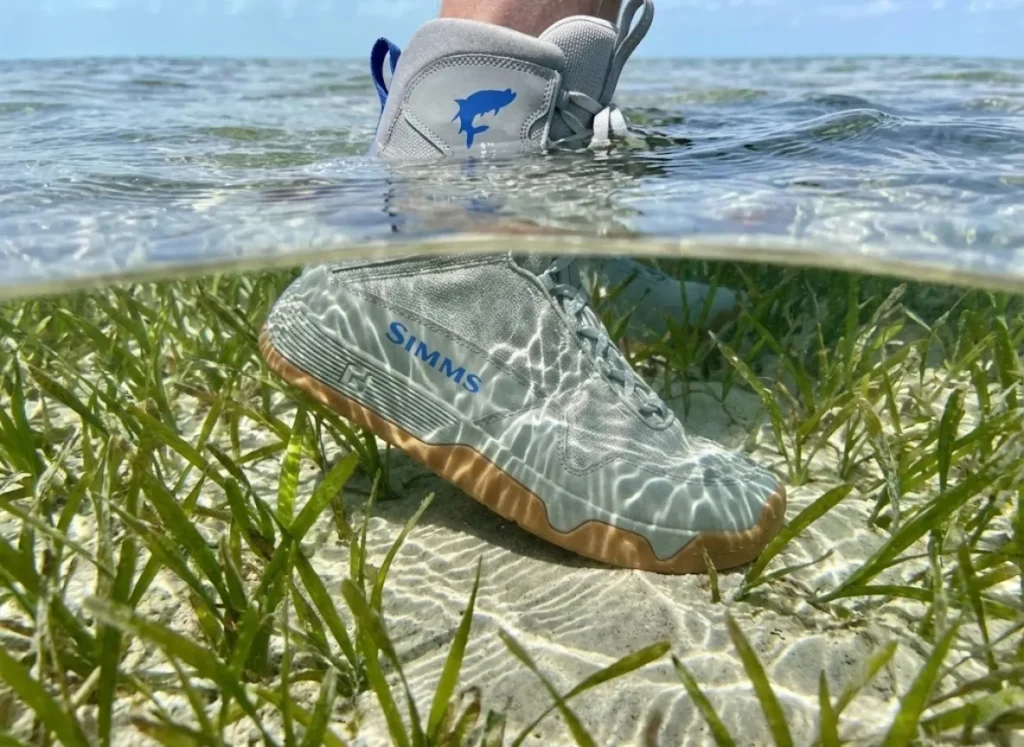
The composition of the sea floor, specifically the species of seagrass beds and the density of the aquatic sediments, acts as the primary indicator for both navigation safety and wading viability. Before you look for fins, you must look at the bottom type.
How do seagrass zones dictate navigation and depth?
The species of grass beneath your hull is a precise depth gauge that never lies. Identifying these zones prevents the ecological disaster of prop scarring and ensures you don’t run a heavy boat aground on the lagoon floor.
- Shoal Grass (Halodule wrightii): This is the pioneer species. It thrives in the shallowest, most disturbed waters, often less than 6 inches deep in the upper subtidal zone. Its narrow, flat blades are a warning sign. If you see Halodule, you are in “skinny water.” Only technical poling skiffs with drafts under 6 inches belong here.
- Turtle Grass (Thalassia testudinum): Recognized by its wide, flat blades, this is the climax species. It indicates deeper, stable water and a softer bottom rich in benthic infauna like shrimp, mud snails, and bristle worms. This is prime Permit territory. However, the dense root systems here can trap soft mud and obscure hazards like stingrays or sea urchins.
- Manatee Grass (Syringodium filiforme): Distinguished by its cylindrical, spaghetti-like leaves, this grass signals deeper channels or areas with consistent ocean water influx. Tarpon often use these corridors to travel between basins.
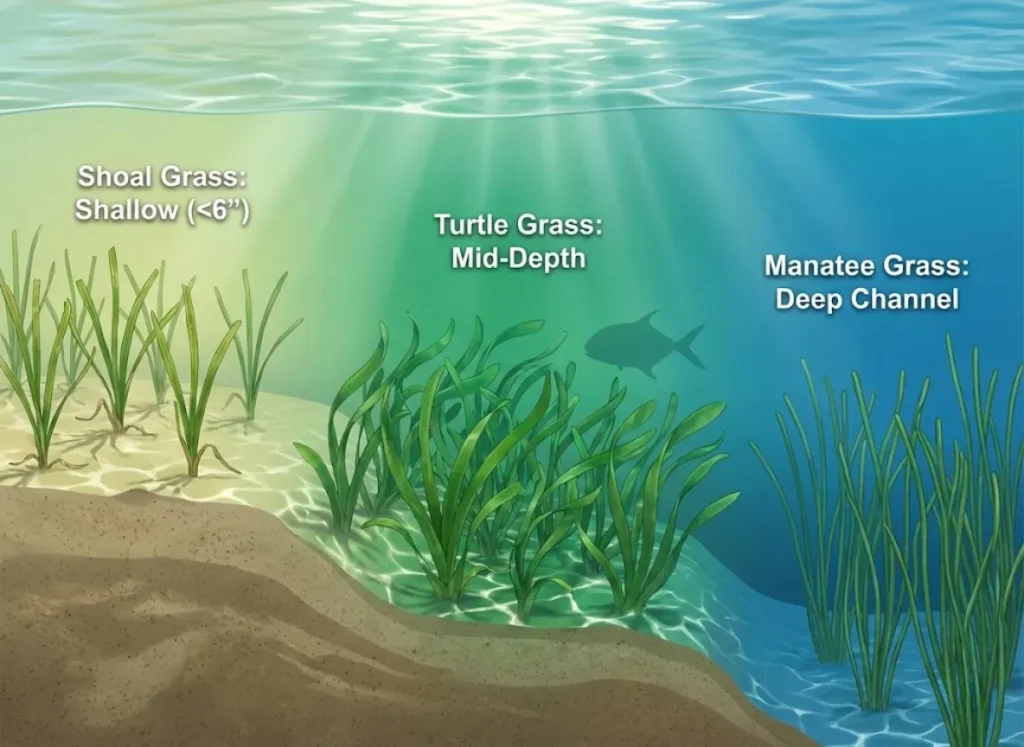
Understanding these distinct species zonation patterns allows you to navigate safely. Halodule zones strictly require lightweight skiffs. If you are in a heavier bay boat, these areas are off-limits.
Beyond navigation, the transition lines—or ecotones—between these grass types are primary ambush points. Predators like Snook, Redfish, and Jack Crevalle patrol these edges waiting for prey to cross from the safety of the thick Thalassia into the open.
Holding position in these currents without destroying the bottom requires specific tools. A high-thrust trolling motor is essential for maintaining a stealthy drift or holding on a grass line without dropping an anchor that could tear up the benthic layer.
Pro-Tip: If you are running on plane and the water color shifts from dark green (Thalassia) to a pale, yellowish-green (Halodule), shut down immediately. You are running out of water.
For a deeper scientific look at these species, review the Florida Department of Environmental Protection seagrass profiles, which validate the specific depth tolerances of these plants.
How does sediment physics determine wading safety and stealth?
The bottom may hold you in place, but the physics of the sediment can turn a wade into a trap. Knowing what you are stepping on is as important as knowing what you are casting at.
Oolitic Sand vs. Pluff Mud
In the Bahamas or Mexico, you will often find Oolitic sand—round calcium carbonate grains that pack firmly. This is a dream for wading. However, near mangroves, salt marshes, or in the Indian River Lagoon, you encounter terrigenous “Pluff” Mud.
This decaying organic matter acts as a non-Newtonian fluid. It liquifies under the pressure of a step, but when you try to lift your foot, it solidifies, creating a powerful vacuum seal. This vacuum force exerts multi-directional stress on your gear. Standard zip-up booties often fail here because the suction bursts the zippers. You need rigid, lace-up boots for mechanical security.
Wading in thigh-deep mudflats burns calories exponentially faster than walking on sand. This physical toll drastically shortens your effective fishing day, making route planning essential.
Stealth and Camouflage
The sediment also dictates your stealth. Oolitic sand has high reflectivity (albedo). Bonefish here lighten their pigment to blend in, rendering them nearly invisible to standard grey lenses. You need high-contrast copper or amber tints to spot them.
Conversely, on coral rubble, the challenge is acoustic. Hard boot soles on coral create a grinding noise that transmits through the water column, spooking fish from distinct distances. In these shallow-water marine habitats, quietness is your primary weapon.
To handle these environments, you must rely on breathable fly fishing waders that are durable enough to resist abrasion from coral but flexible enough to allow you to extract your legs from deep mud without tearing seams.
For geological context, the USGS analysis of reef sediment composition details how these carbonate sands and muds form in reef environments.
How does the hydrodynamic engine control the ecosystem?
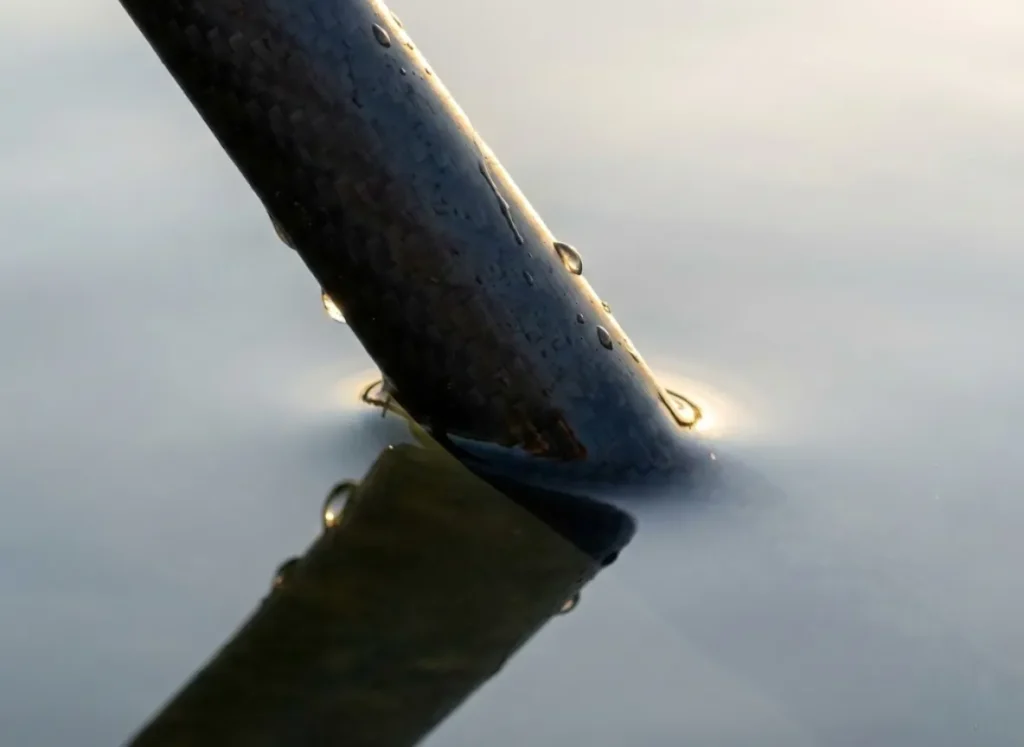
The tide delivers the water, but the volume and velocity of that water determine your access. You must use the “Rule of Twelfths” to calculate your windows of opportunity in the intertidal zone.
How does the Rule of Twelfths dictate skiff range and safety?
The Rule of Twelfths is a tidal estimation method stating that the flow of water is not linear. It moves in a bell curve:
- Hour 1: 1/12th of the volume moves.
- Hour 2: 2/12ths of the volume moves.
- Hours 3 & 4: 3/12ths of the volume moves (Peak Flow).
- Hour 5: 2/12ths of the volume moves.
- Hour 6: 1/12th of the volume moves.
The “Danger Zone” lies in hours 3 and 4. During this window, 50% of the total water volume moves in just two hours. Currents are strongest, and water depth changes occur rapidly.
Stranding Risk
If you push a skiff with a 7-inch draft onto a shallow tidal flat during the start of the outgoing tide (Hour 1), you might feel safe. But by Hour 3, the water will drain aggressively. If you haven’t accounted for this acceleration, you will be stranded dry on the silt until the next cycle. A lighter skiff provides a wider margin of error, but mathematical awareness is your best safety device.
Wading Safety and Feeding Windows
For the wading angler, the incoming tide presents a serious risk. If you walk out to a sandbar during Hour 1 of the incoming, you must retreat during Hour 2. Waiting for the peak flow of Hour 3 risks entrapment or a forced swim in heavy current.
Predators exploit this physics. They ride the velocity surge of the “3/12ths” period to access fiddler crabs and bivalves deep in the mangrove roots or cord-grasses. This creates a prime interception point for anglers who understand fishing by the moon and how lunar phases amplify these tidal ranges.
For precise definitions of these zones, the National Academies classification of intertidal areas establishes the scientific boundaries affected by these movements.
How do physiological constraints drive target acquisition?
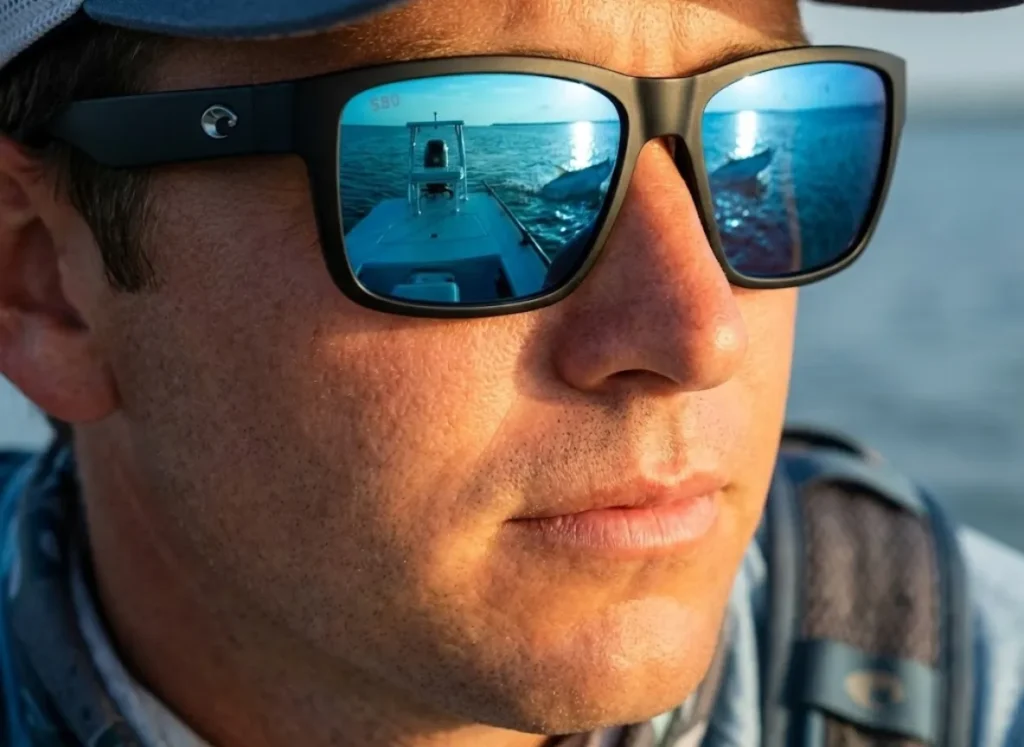
Fish do not move randomly. Their behavior is a direct response to their biological limitations—specifically their need for dissolved oxygen and stable temperatures.
Why does hypoxia force Tarpon to roll at the surface?
Tarpon (Megalops atlanticus) are facultative air breathers. They possess a vascularized swim bladder that allows them to absorb atmospheric oxygen. This is an evolutionary adaptation for surviving in hypoxia (low oxygen levels) often found in backwaters or lagoons.
The “Oxygen Sag” typically occurs at dawn, after a night of plant respiration, or in stagnant areas where salinity flux is low. When oxygen levels drop, tarpon are forced to “roll” at the surface to gulp air. This is not a display; it is a survival mechanism. This roll is often the only visual cue you will get in dark, brackish water.
Optical and Gear Requirements
Because this rolling behavior often happens in low-light conditions (dawn or dusk), you cannot rely on dark lenses. High-VLT (Visible Light Transmission) lenses, such as Yellow or Sunrise Silver polarized fishing sunglasses, are mandatory to spot the subtle break on the surface.
Once spotted, the window to present the fly is tight—often just seconds. You need a Fast-Action rod that loads quickly with minimal false casting. A slow rod will cost you the shot. Conversely, in high-oxygen environments like ocean passes, tarpon may stay deep, requiring dredging tactics rather than surface sightfishing.
A PubMed Central study on Tarpon air breathing validates this hypoxic response, confirming that the roll is a physiological necessity you can exploit.
How do thermal and visual constraints dictate Bonefish and Permit tactics?
While Tarpon are ruled by oxygen, Permit and Bonefish are slaves to temperature and light.
Thermal Sensitivity
Permit are stenothermic, meaning they tolerate a very narrow range of temperatures. They are intolerant of cold drops. If a cold front drops the flat’s temperature by just a few degrees, Permit will abandon the shallows for the thermal stability of deep channels. Your skiff’s temperature gauge is a hunting tool. Look for pockets of water 1-2 degrees warmer; that is where the fish will be. Other species like Sea Trout and Redfish in salt marshes exhibit similar, though less extreme, responses.
Chromatophore Response
Bonefish possess a mirror-like camouflage system. Their scales reflect their surroundings. Over dark turtle grass, they appear dark green. Over white sand or coral rubble, they appear pale grey. This makes them incredibly difficult to see.
Grey lenses flatten contrast, making them useless here. You need Copper or Brown tints to filter blue light and enhance the separation between the fish and the bottom. Wind chop adds another layer of complexity by creating “visual noise” that camouflages movement. You often need to cast into the wind to reach them, which necessitates understanding rod action and power to punch a heavy fly line through the breeze without spooking the fish.
Pro-Tip: When scanning for bonefish, stop looking for the whole fish. Look for the shadow on the lagoon bottom or the flash of a tail from a tailing fish. The fish itself is designed to disappear.
Refer to the St. Johns River Water Management District lagoon research for context on how temperature and salinity affect the distribution of these lagoon species.
Why is the flat considered a high-yield economic and climate asset?
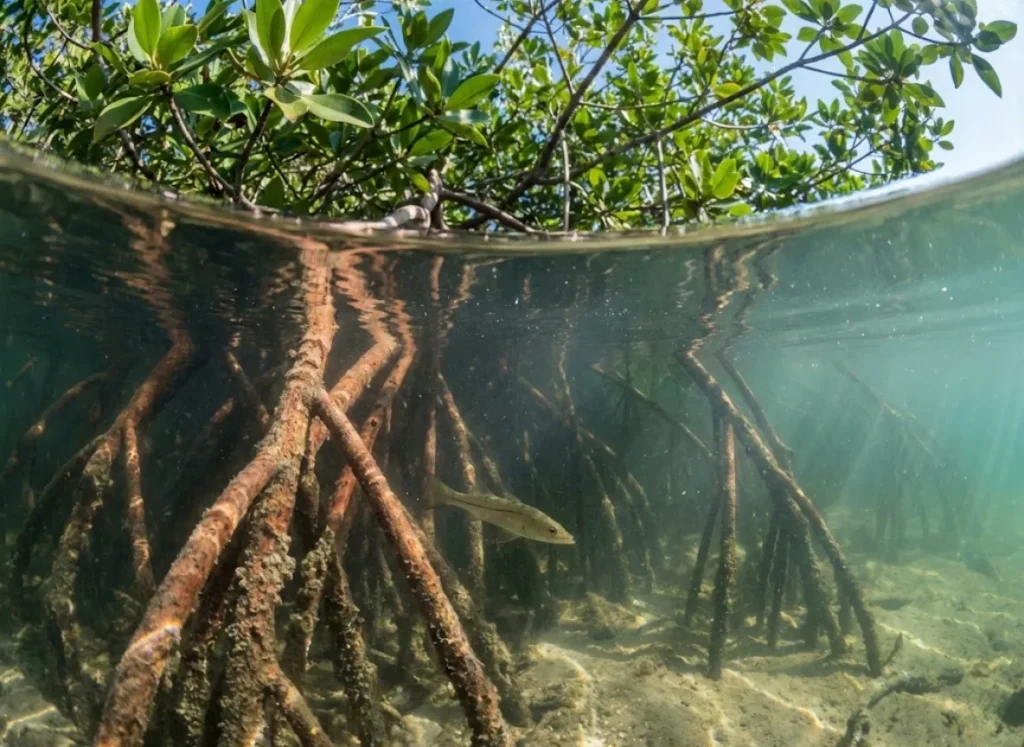
The flats are not just a playground; they are a bank vault of biodiversity and climate resilience. As anglers, we must understand the asset we are interacting with.
What is the hidden value of “Blue Carbon” and the recreational fishery?
“Blue Carbon” refers to the carbon captured by coastal ecosystems like mangroves, salt marshes, and seagrasses. These environments sequester carbon at rates significantly higher than terrestrial forests. Seagrass meadows store approximately 140 Megagrams of Carbon per hectare, while mangroves can store up to 1,000 tons per hectare, acting as a massive carbon sink.
| Economic and Blue Carbon Value of Coastal Assets | ||
|---|---|---|
| Asset / Region | Annual Economic Contribution (Fishery GDP) | Blue Carbon Sequestration Rate & Value |
| Bahamas (Bonefish Fishery) | $169 Million (Derived from angler expenditures) | Dependent on Seagrass/Mangrove health |
| Florida Keys (Flats Fishery) | >$465 Million (Annual economic impact) | Dependent on Seagrass/Mangrove health |
| Seagrass Meadows | $190 Billion Global Value (Total ecosystem services); $224/ha/year (Nutrient cycling only) | 140 Mg Carbon/ha (Approx. 3x rate of terrestrial forests) |
| Mangrove Forests | $6 – $42 Billion Annual Loss (Global cost of destruction) | Up to 1,000 Tons Carbon/ha |
The Economic Engine
Beyond the climate value, the fishery itself is a massive economic driver. In the Florida Keys and Bahamas alone, the recreational bonefish fishery contributes hundreds of millions annually. This gives a single living bonefish a recurring economic value that far exceeds its value as food.
The destruction of these habitats results in billions of dollars in lost coastal protection and fishery collapse due to coastal erosion and storm surges. The high cost of skiffs, guides, and travel creates a financial engine that funds local habitat protection. By understanding fish conservation for anglers, you transform from a passive consumer of the resource into an investor in its longevity.
For a global perspective, the World Bank overview of Blue Carbon provides the economic data backing these ecosystems.
Final Thoughts
Mastering the flats requires more than a double-haul cast. It demands an understanding of the benthic reality beneath your feet and the hydrodynamic engine that moves the water. It requires you to recognize that a tarpon’s roll is a cry for oxygen and a permit’s retreat is a flight from cold.
- Ecological Alignment: Match your draft and boots to the grass and mud.
- Tidal Physics: Respect the Rule of Twelfths to stay safe and find feeding windows.
- Biological Imperative: Let physiology dictate your tactics.
- Stewardship: Protect the asset that protects the coast.
Deepen your understanding of these coastal ecosystems by exploring our guide to Ethical Catch & Release to ensure your impact on the flats remains positive.
FAQ – Frequently Asked Questions
What is the best polarized lens color for flats fishing?
Copper, Amber, or Brown base tints are superior. They filter blue light to enhance contrast, allowing you to distinguish green or brown fish from the sea floor, whereas grey lenses flatten this contrast.
Why do I need special boots for mud flats?
Pluff mud creates a powerful suction vacuum that can pull zip-up booties off your feet. Lace-up boots provide the mechanical security needed to break this seal and protect ankles from uneven terrain often found in soft-bottom habitats.
How shallow can a flats skiff really go?
Technical poling skiffs can float in 5-7 inches of water. However, traversing areas with Halodule seagrass often requires drafts under 6 inches to avoid damaging the habitat with the hull or propeller.
What does Blue Carbon mean for anglers?
It refers to the massive amount of carbon stored by seagrass beds and mangroves. It proves that healthy flats are not just fishing grounds but critical climate assets, increasing the importance of conservation efforts.
Risk Disclaimer: Fishing, boating, and all related outdoor activities involve inherent risks that
can lead to injury. The information provided on Master Fishing Mag is for educational and informational purposes
only. While we strive for accuracy, the information, techniques, and advice on gear and safety are not a substitute
for your own best judgment, local knowledge, and adherence to official regulations. Fishing regulations, including
seasons, size limits, and species restrictions, change frequently and vary by location. Always consult the latest
official regulations from your local fish and wildlife agency before heading out. Proper handling of hooks, knives,
and other sharp equipment is essential for safety. Furthermore, be aware of local fish consumption advisories. By
using this website, you agree that you are solely responsible for your own safety and for complying with all
applicable laws. Any reliance you place on our content is strictly at your own risk. Master Fishing Mag and its
authors will not be held liable for any injury, damage, or loss sustained in connection with the use of the
information herein.
Affiliate Disclosure: We are a participant in the Amazon Services LLC Associates Program, an
affiliate advertising program designed to provide a means for us to earn advertising fees by advertising and linking
to Amazon.com. As an Amazon Associate, we earn from qualifying purchases. We also participate in other affiliate
programs and may receive a commission on products purchased through our links, at no extra cost to you. Additional
terms are found in the terms of service.