
In this article
The jacket that failed you last season probably wasn’t lying about being waterproof. It kept water out for its first dozen trips, then the tape lifted off a shoulder seam and the rain found the needle holes underneath. That’s the pattern anglers keep running into, and it’s why choosing the best rain gear for fishing has less to do with the number printed on the tag than with how the thing is put together. Ask anyone who has burned through two budget suits in back-to-back seasons before finally paying for taped seams, and you’ll get the same answer: the fabric almost never quits first.
Below are the picks that hold up by fishing style, the honest verdict on the cheap stuff, and the places every set of rain gear eventually gives out, with the rest of your on-water kit covered in our guide to fishing apparel and sun protection.
Here’s the short version, sorted by how you actually fish.
| How You Fish | The Pick | What Sets It Apart |
|---|---|---|
| Most anglers, most conditions | Simms Challenger Jacket | 100% taped seams, fishing-specific cut |
| Boat and bank, men’s | HUK Storm Jacket | 10K membrane, sealed critical seams |
| Boat and bank, women’s fit | Grundéns Women’s Weather Watch Jacket | Commercial-grade women’s fishing cut |
| A handful of wet trips a year | KastKing HydroSense Essential Rain Suit | Sealed-seam two-piece at the entry tier |
| Packable backup in the boat | Frogg Toggs Pilot II Guide Bib | Genuinely waterproof, durability is the tradeoff |
| Wading and fly fishing | Riverruns Fishing Wading Jacket | Short cut made to sit over waders |
| Kayak fishing | NRS Riptide Paddling Jacket | Paddle-cut hood and shoulders |
| Cold and wet, all day | AFTCO Hydronaut Insulated Bib | 30,000mm rating plus 140gsm insulation |
| Offshore and serious weather | WindRider Pro Foul Weather Gear | Two-piece system, reinforced knees |
What the Waterproof Rating on the Tag Actually Promises
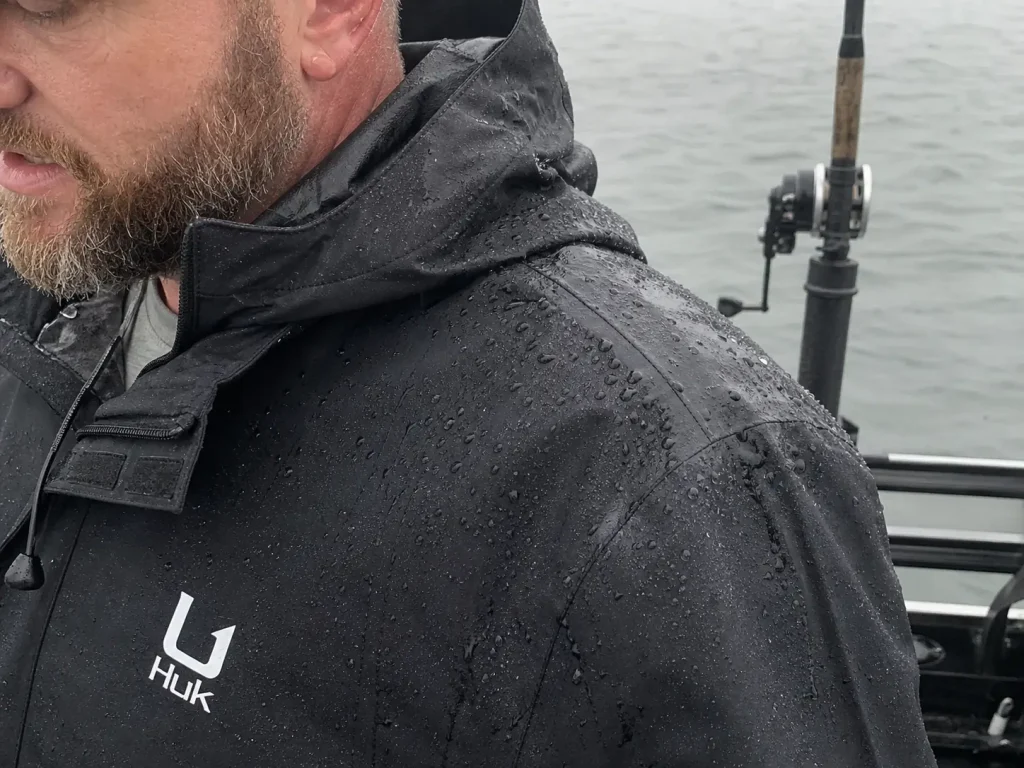
Most anglers shop rain gear the same way: line up two jackets, compare the numbers on the hangtag, buy the bigger one. Then they get soaked anyway and decide the number was marketing. It wasn’t. The number is real and it measures something specific, but it only describes one of the three ways water gets to your skin.
Waterproof vs. Water-Resistant, in Plain Terms
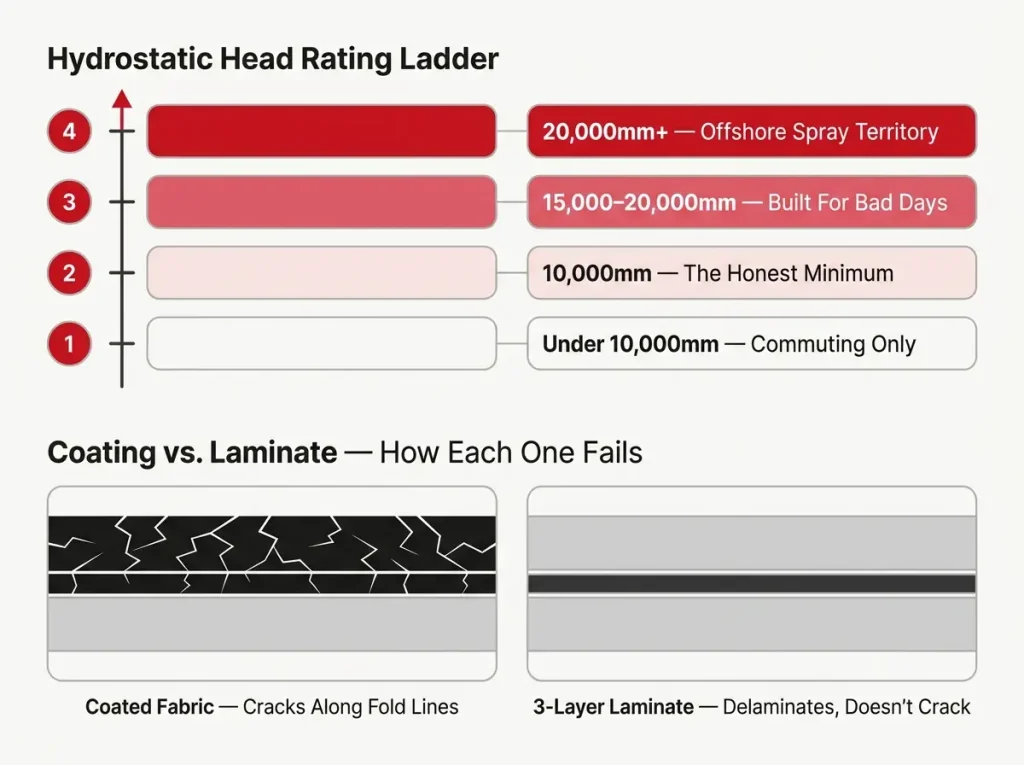
That number on the tag is a hydrostatic head rating, and it comes from a lab test where a column of water sits on the fabric until the fabric gives up. A 10,000mm rating means a ten-meter column of water sat on that material before it leaked. It’s a pressure test, not a time test, which is why it tells you nothing about how long the jacket lasts.
For fishing, 10,000mm is the working floor. Below that, whatever the tag says, you own a water-resistant shell. That’s genuinely fine for the walk from the truck to the boat, or for a shower that blows through in ten minutes. It is not fine for a six-hour soak with wind driving the rain sideways into your chest.
Push into 15,000mm to 20,000mm and you’re in the range built for prolonged exposure, which describes almost every serious rain day on the water. Above that, ratings like 20K waterproof and 30K waterproof start showing up on offshore and cold-weather gear, where spray hits with real force and you’re sitting in it for hours instead of minutes.
Here’s the part the tag never mentions: pressure is exactly what you apply to rain gear without thinking about it. An elbow braced on a wet gunwale, a knee pressed into the deck while you unhook a fish, a pack strap cinched over a shoulder, a seat you’ve been sitting in for four hours. Each of those concentrates force on a small patch of fabric. A cheap coating that tested at 8,000mm on a flat lab plate does not survive your full weight on a wet cooler lid.
What 10K, 20K and 30K Actually Mean on the Water
Rough translation, using the way anglers actually spend their days:
- Under 10,000mm: commuting gear. Keeps a drizzle off during the drive and the walk down to the ramp.
- 10,000mm: the honest minimum. Handles steady rain for a full day if the construction underneath is decent.
- 15,000mm to 20,000mm: built for the days you’d normally cancel. Wind-driven rain, hours of it, sitting still.
- 20,000mm and up: offshore spray, big water, running through chop. This is where foul weather gear lives.
Chasing a bigger number past that point buys you very little. A 30K jacket with cheap construction still leaks at the seams, and it leaks in exactly the same spots a 10K jacket does.
Coatings, Laminates and Why They Fail Differently
Two different things get called “waterproof fabric,” and they break in two different ways.
A coating is a layer of polyurethane or PVC applied to the inside face of the fabric, like paint. It’s cheap, it works immediately, and it has a limited life. Coatings crack. They go chalky and start flaking off in sheets, usually along fold lines first.
A laminate is a breathable membrane bonded between fabric layers. Gore-Tex is the name everyone knows, but 3-layer nylon builds and Toray fabric laminates cover most of the mid and upper tiers now. Laminates don’t crack, they delaminate: the bond between layers lets go and the face fabric starts separating from the membrane, which shows up as bubbling or a crinkly feel in the affected panel.
There’s one more term worth getting right, because anglers use it wrong constantly in forums. Taped seams and “sealed seams” get treated as synonyms. They aren’t.
Taping means a strip of heat-bonded tape is applied over the stitch line on the inside of the garment, physically covering the holes. Sealing sometimes means that, and sometimes means a liquid sealant brushed over the stitching, which wears off.
If a listing says taped, that’s the real thing. If it just says water-resistant seams, assume nothing is covering those holes. The membrane side of this story is covered in more depth in our breakdown of why waterproof breathable fabrics still leave you wet.
Breathability Is the Half of the Spec Sheet Nobody Reads
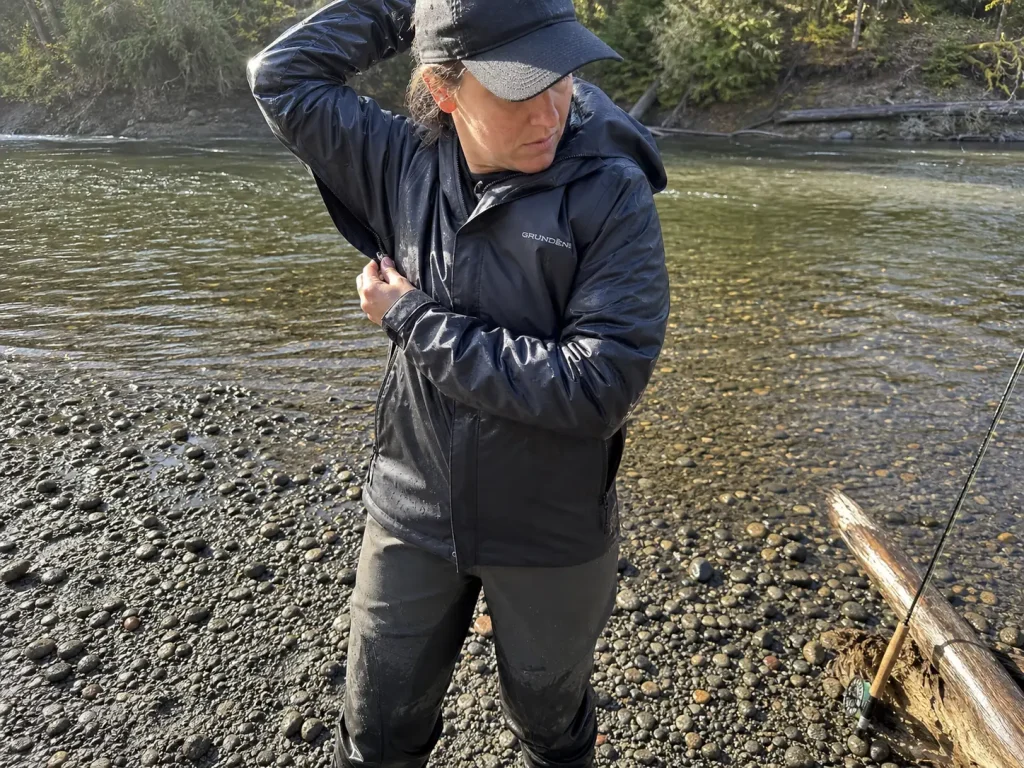
Buy purely on the waterproof number and you will eventually stand on a bank, bone dry on the outside, soaked through on the inside, wondering how a jacket that expensive leaked. It didn’t leak. You sweated out, which is the community’s blunt term for getting as wet from your own perspiration as you would have from the rain.
MVTR, or Why Breathable Isn’t a Yes-or-No Thing
Breathability has its own number, and almost nobody prints it on a hangtag. It’s MVTR, moisture vapor transmission rate, measured in grams of water vapor that pass through a square meter of fabric in 24 hours. The tiers break down like this:
- 5,000 to 10,000 g/m²/24h: low-output use. Standing on a dock, sitting in a boat seat, walking to the water.
- 10,000 to 15,000: active use. Rowing, wading upstream, working a bank, fighting fish.
- 20,000 and up: sustained aerobic effort.
Most fishing lands squarely in that middle band, and most budget rain gear tests in the bottom one. That gap is the entire explanation for the “waterproof but soaked” experience.
Now the part that reframes the whole conversation. Above roughly 70% humidity, breathable membrane performance drops between 40 and 60 percent. The mechanism is simple: a membrane moves vapor by exploiting the difference in vapor pressure between the humid air inside your jacket and the drier air outside. When the outside air is already saturated, that difference collapses, and the membrane has nothing to work with.
Read that again in context. Humid air is rainy air. The exact conditions that make you reach for the jacket are the conditions that cut its breathability roughly in half.
This is true of premium gear too. Anyone who tells you their Gore-Tex shell breathes the same in an August thunderstorm as it does on a cold, dry October morning is selling something.
Wetting Out Is Not a Leak
Here’s the single most common misdiagnosis in the sport. A jacket starts feeling cold and clammy inside. The angler concludes it’s leaking and starts shopping. Nine times out of ten the membrane is working perfectly and the outer face fabric has wetted out.
Every waterproof shell has a DWR finish, a durable water repellent treatment on the outermost fabric, and its job is to make water bead and roll off. DWR wears away with abrasion, sunscreen, fish slime and washing. Once it’s gone, the face fabric soaks up water like a sponge. The membrane underneath still blocks liquid water, so nothing is technically getting through, but a saturated outer layer feels cold against your arms and shuts down breathability completely, because vapor can’t cross a wall of water.
The tell is visual. Look at your sleeves in the rain. Beading means the DWR is alive.
Dark, spreading patches where the fabric has gone from light to soaked means it’s done, and the fix is a wash and a re-treatment, not a new jacket. There’s a whole section on that below.
Pit Zips and Shoulders Beat the mm Number
If you handed a veteran two jackets and told them to pick blind, most would check the underarms before they checked the tag. Pit zips let you dump heat on demand, which is the only reliable answer to the humidity problem above. Articulated shoulders let you make a full casting stroke without the hem climbing your ribs. A hood that turns with your head instead of blocking your peripheral vision is what keeps you from throwing it back the first time you need to check a rod.
Cuffs and collars deserve the same scrutiny. Water finds the gaps, and it finds them at the wrists first, because your hands are usually higher than your elbows when you’re working a rod. A jacket with a 20,000mm rating and a sloppy elastic cuff will put more water on your forearm than a 10,000mm jacket with a proper adjustable closure.
Check the front zipper too. A storm flap covering the main zip is the difference between a jacket that handles wind-driven rain and one that seeps down the centerline all afternoon, and it costs the manufacturer almost nothing to include.
Open the pit zips before you feel hot, not after. Once you’ve built up a sweat layer inside the shell, the humidity in there is already high enough that the membrane can’t clear it, and you’ll stay damp for the rest of the day no matter what you do. Venting early costs nothing and it’s the difference between comfortable and miserable at hour four.
Where Cheap Rain Gear Actually Fails
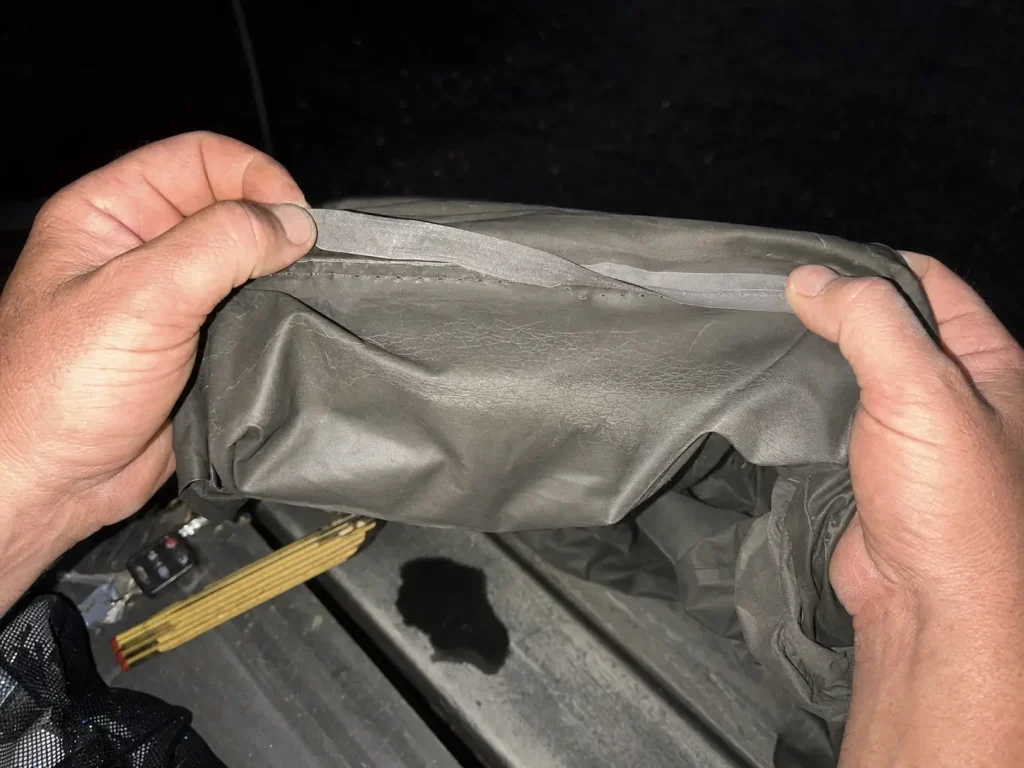
This is the section the rest of the internet skips. Every roundup will tell you budget gear doesn’t last. Almost none of them tell you where it comes apart, which is a shame, because the failure points are predictable enough that you can inspect for them and stretch the life of whatever you already own.
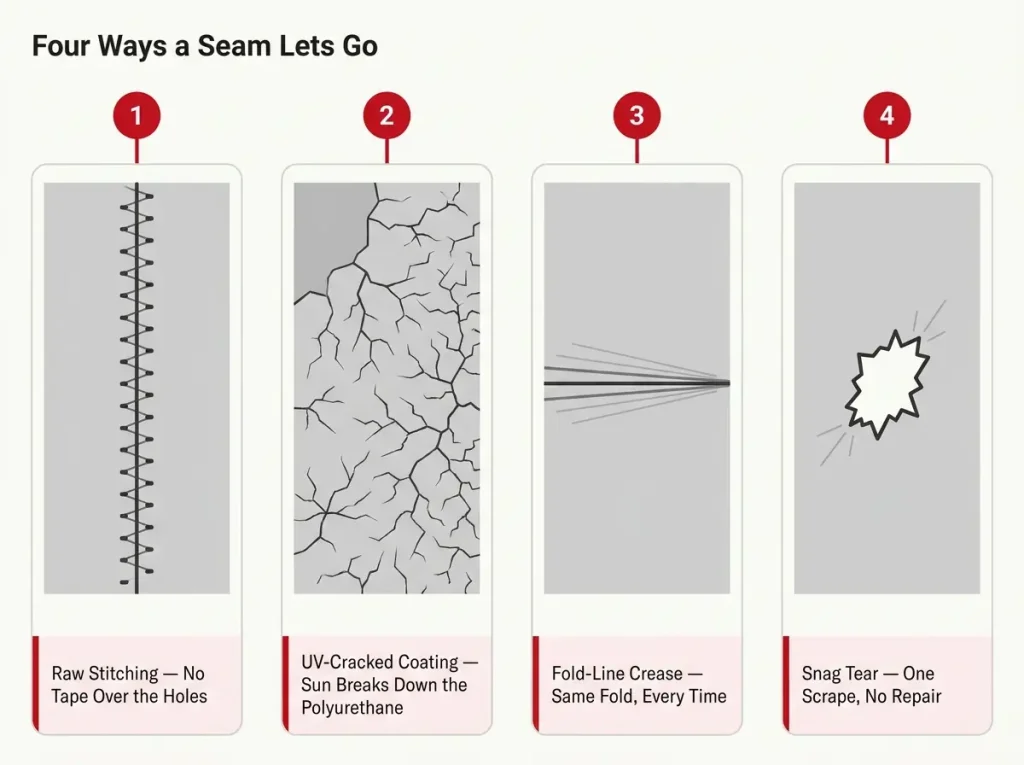
Cheap rain gear almost never fails at the fabric. It fails at the construction, and it fails in four specific places.
Every Stitch Is a Hole
Sewing two pieces of waterproof fabric together punches a line of needle holes through material specifically engineered to have no holes in it. That’s not a flaw in the design, that’s just what a needle does. The question is what happens next.
On mid-tier and better gear, a strip of heat-bonded seam sealing tape gets pressed over that stitch line on the inside, covering the holes. On entry-tier gear, either nothing goes over them, or a liquid sealant gets brushed on that wears through in a season.
The holes that go first are the ones under load. Shoulder seams carry the weight of the whole garment plus anything on your back. The crotch seam on bibs flexes every time you step over a gunwale or push off a bank. Those are the two spots to check first on any suit you’re suspicious about, and they’re the two spots where water starts showing up before you notice a single scratch on the fabric.
Sun Does More Damage Than Rain
Fishing is one of the highest UV-exposure activities per hour that anyone does for fun. You’re on an open surface with water reflecting light back up at you from below, often for entire days, often in summer. Rain gear sits in a bag through most of that and comes out for the worst weather, but plenty of it lives clipped to a seat back or draped over a console in full sun.
UV breaks down polyurethane and PVC coatings. The chemistry doesn’t much care whether the coating is on an entry-tier suit or a premium one, but thicker, better-made coatings and laminates have more margin. The visible progression is consistent: the coating goes slightly tacky, then chalky, then it develops a fine crack network, then it flakes. Once you can see the cracks, water is already coming through.
UV also degrades the adhesive holding seam tape down. That’s why tape lifts at the shoulders on old gear even when the fabric itself still looks fine. The tape didn’t fail; the glue did.
The Way You Store It Decides How Long It Lasts
More budget rain gear is finished off by storage than by weather. The pattern is always the same. It’s raining when you pack up, the suit goes into a bag or a hatch soaking wet and folded, and it stays there until the next trip. Sometimes for weeks.
Two things happen. Moisture sits against the coating and works on it. And the fold lines become permanent stress creases, which is precisely where coatings crack first.
Pull an old suit out of a boat locker and check the fold lines before you check anything else. You’ll usually find the damage there before you find it anywhere else.
The fourth failure point is snagging, and it’s the one that separates lightweight nonwoven fabrics from heavier woven ones. Brush, hook points, boat hardware, a cleat, the edge of a trailer fender. Higher denier woven nylon takes a scrape and shows a scuff. Light nonwoven material takes the same scrape and opens a hole, and once there’s a tear, there’s no repairing your way back to waterproof.
Never fold rain gear along the same lines twice. Hang it if you can, and if you have to stuff it into a bag, stuff it loosely and randomly instead of folding it neatly. A stuffed jacket has a hundred shallow creases that move around; a folded one has four deep ones in the same place every time, and those are the four lines that crack.
So what does the price step actually buy? Between the entry tier and the mid tier, the honest answer is not a better-sounding fabric name. It’s tape over the critical seams and a laminate construction instead of a brushed-on coating.
That’s it. You are paying, mostly, for somebody to cover the holes they just made.
None of which means budget gear is a scam. It means it has a short and fairly predictable service life, and that the right question isn’t which suit is best but how many wet days a year you actually fish. Which brings us to the brand everyone asks about.
Is Frogg Toggs Really Waterproof? Here’s the Honest Answer
Yes. Frogg Toggs gear keeps water out, and the reviews back that up rather than contradict it. Across hundreds of public retailer reviews, the brand’s rain lines average roughly 4.2 to 4.8 stars, and the recurring praise is specifically about waterproofing: it holds up in heavy rain, it does what it claims, people are surprised by how well it works for what it costs.
The tradeoff shows up in a completely different column. Those same review pools flag the material as prone to tearing over time. That’s the honest verdict, and it lines up exactly with the failure modes above: the fabric’s waterproofing is real, and its resistance to snagging is not.
Best Packable Backup: Frogg Toggs Pilot II Guide Bib
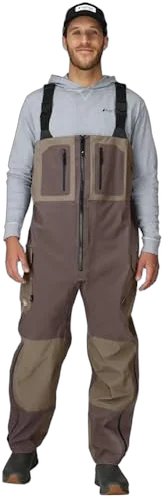
The Frogg Toggs Pilot II Guide Bib is the clean test case for everything in the previous section. The nonwoven material is genuinely waterproof and it breathes better than a rubberized suit, which is why the brand built a following in the first place. It’s also thin, and thin nonwoven fabric is what tears when a treble hook catches it or you back into a cleat.
Who it’s right for: anyone who fishes a handful of wet days a year, anyone who wants something packable stashed in a boat locker for the squall nobody forecast, and anyone fishing open water where there’s nothing to snag on. In those roles it’s hard to beat and the value is real.
Who should skip it: anglers putting in twenty-plus days a year in real weather, and anyone who fishes tight brush, wooded banks, or a deck full of hardware. You’ll open a hole in it, and a hole is not repairable back to waterproof.
The women’s versions of both the Pilot II and the Classic All-Sport suit were out of stock across every listing checked while this was written, so the pick above is the men’s bib.
How Often You Fish in the Rain Should Set Your Budget
Every roundup on this topic assumes you already know your fishing style and are ready to spend serious money. Almost nobody gives the beginner the one piece of guidance that actually matters, which is that the right tier is a function of days on the water, not of ambition.
The Two-Question Test Before You Spend
Question one: how many days a year do you fish in genuine rain? Not overcast, not a passing shower. Rain that lasts.
Question two: are you snagging on brush and boat hardware, or standing in open water?
The durability data lines up cleanly with those two answers. Fish a handful of wet days a season and store your gear properly, and entry-tier rain gear will stretch three to four seasons. That’s real value and it’s not a compromise. Fish twenty-plus days a year in real weather, and the same gear starts leaking inside one to two seasons. At that rate you buy it three times over the life of one mid-tier suit, and you spend a lot of days damp in between.
The dividing line, in round numbers, is roughly where the $80 to $150 category begins. That’s the tier where seam tape over the critical seams stops being an upgrade and becomes standard. Below it you’re buying a garment with a service life; above it you’re buying one with a maintenance schedule.
Which means buying the premium pick when you fish eight days a year is exactly as poor a decision as buying the cheapest suit when you fish sixty.
Where the Entry Tier Genuinely Works
There is a real, honest case for starting cheap. If you’re new, you don’t yet know whether you’ll end up a bank angler, a kayak angler or a boat angler, and those three want meaningfully different cuts. Spending big before you know that is how people end up with a beautiful jacket that’s wrong for how they actually fish.
Best Budget Pick: KastKing HydroSense Essential Rain Suit
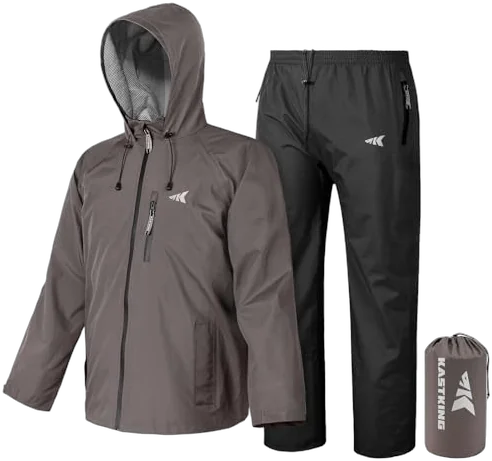
The KastKing HydroSense Essential Rain Suit gets the nod here because it’s a full two-piece set with sealed seams, which is more construction than most gear at this level bothers with. The pants matter more than people expect. A jacket alone leaves you sitting in a wet boat seat with water running off the hem straight onto your thighs, and wet legs will end a day faster than wet arms.
Be realistic about what you’re getting. Breathability at this tier sits in the low-output band, so venting and a proper base layer do a lot of the work. Store it dry and unfolded and it will serve an occasional angler for years. Wear it forty days a season and you’ll be shopping again next spring, exactly as the numbers above predict.
The Rain Jacket Most Anglers Should Just Buy
If you fish enough that rain gear is part of your regular kit rather than an emergency purchase, there’s a default worth naming, and the reason is boring and structural rather than exciting.
Best Overall: Simms Challenger Jacket
What Fully Taped Seams Change
Read the fine print on most mid-tier rain gear and you’ll find the phrase “critical seams taped.” Critical means the shoulders and the main torso seams. It does not mean the pockets, the hood attachment, the cuff panels or the hem. Those are the secondary seams, and on a long wet day they are exactly where a slow, unglamorous seep starts.
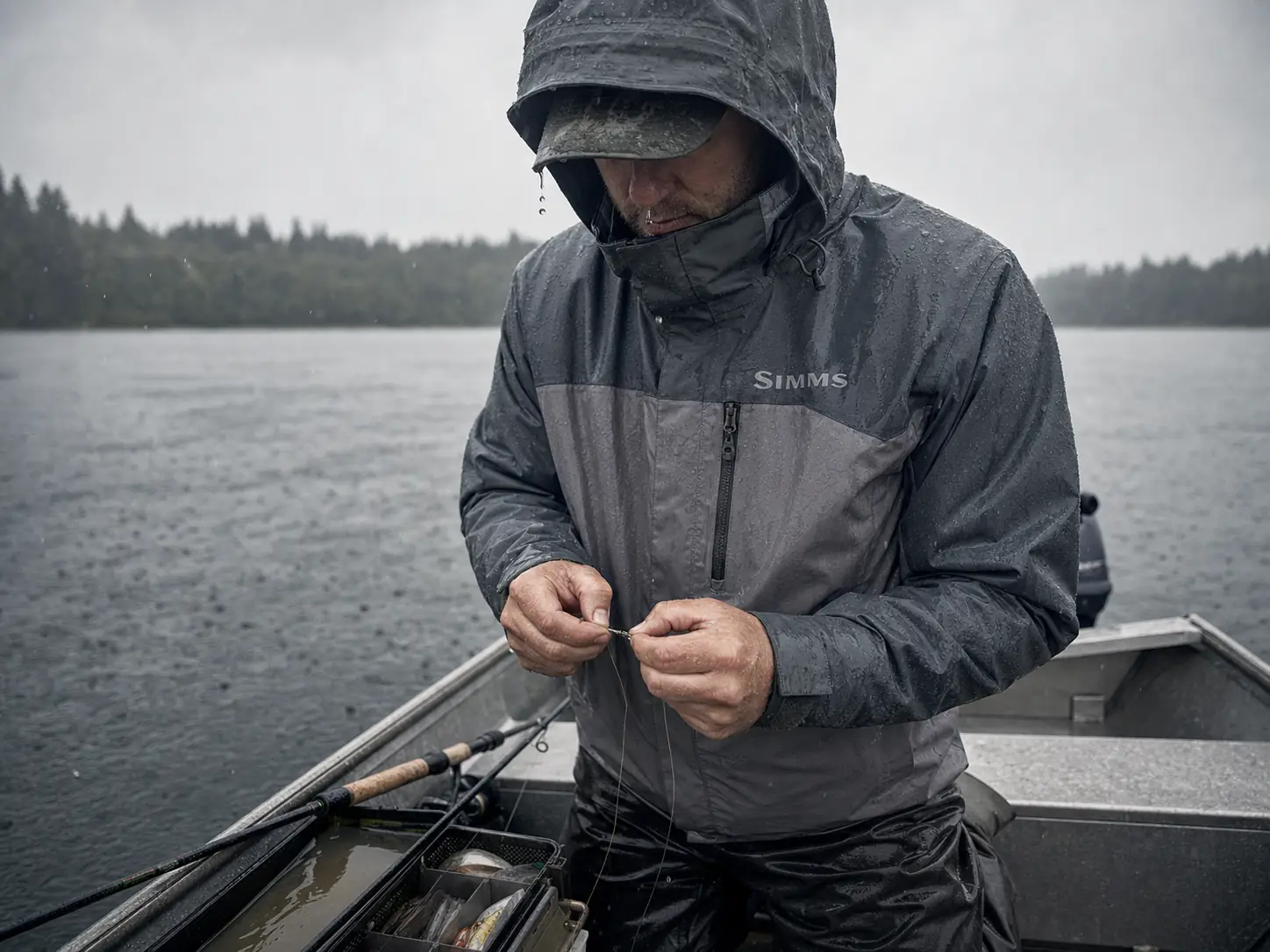
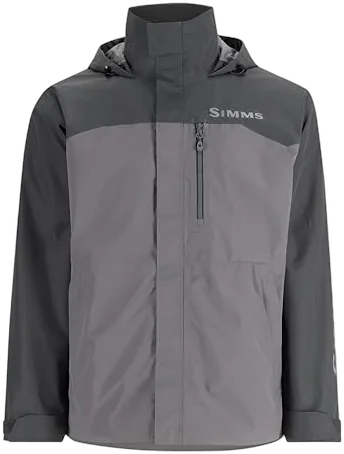
The Simms Challenger Jacket (men’s · women’s) tapes all of them. Combined with a QuadraLam two-layer waterproof-breathable build and water-resistant YKK zippers, that removes the failure mode that ends most jackets before the fabric is anywhere near worn out. It’s not glamorous and it doesn’t photograph well, but it’s the difference that shows up in year three.
The Fit That Makes It a Fishing Jacket
Fishing cuts differ from hiking cuts in ways that matter once you’re actually casting. The torso runs a little longer so the hem doesn’t ride up over your waist when you reach. The shoulders are cut with room for a fleece or a puffy underneath, because rain and cold arrive together often enough. The storm hood has a real brim and adjusts so it moves with your head instead of swinging around it.
The honest downside: on a hot, humid, rainy day it will still feel damp inside, because everything does once the outside air is saturated. And if you fish eight days a year, this is more jacket than your calendar justifies. The suit two sections up will serve you better and you’ll never notice the difference.
Best Rain Gear for Boat and Bank Fishing
Boat and bank anglers face a version of the problem that has less to do with rain falling and more to do with everything else going on. Spray comes at you sideways off the bow. Apparent wind at twenty knots turns a warm drizzle into a cold one. And you spend long stretches sitting completely still, which is when a damp layer stops being an annoyance and starts pulling heat out of you.
Spray, Wind and Sitting Still
The design priorities shift accordingly. A high collar and an adjustable hood do more here than a slightly better MVTR number, because most of what soaks a boat angler arrives horizontally. That’s doubly true on the salt, where saltwater spray leaves a residue that suppresses the outer finish faster than rain alone, and it’s why a cold front rolling through in April can make a run home feel colder than the thermometer says.
Cuffs that actually close keep spray from running up your sleeve when you reach out to net a fish. And a jacket long enough to cover your seat while you’re sitting saves you the specific misery of a wet backside two hours into a six-hour trip. Anyone trolling for hours at a stretch feels this one first, since you’re stationary in the seat while the boat does the work.
The Safety Features That Aren’t Optional
Two features on a boat jacket earn their place before any of the comfort ones.
The first is reflective piping. Rain means low visibility, and low visibility with boat traffic on the same water is the situation where being seen matters. Reflective elements are cheap to add and most decent fishing rain gear now includes them.
The second is a D-ring or attachment point for an engine cut-off switch lanyard, which most anglers still call the ECOS. Since April 2021, the U.S. Coast Guard’s engine cut-off switch requirement has applied to most recreational boat operators. Actual compliance is still under 20 percent in states that require it. A lanyard clipped to your jacket or belt costs almost nothing and stops the motor if you go over, which on a wet, slick deck is not a remote scenario.
Clip the cut-off lanyard to your rain jacket, not to your belt loop. On a wet day you’ll shed and re-layer a couple of times, and a lanyard attached to a layer you keep taking off is a lanyard you eventually stop clipping. The jacket stays on all day, so that’s where the habit sticks.
Best Boat Jacket: HUK Storm Jacket
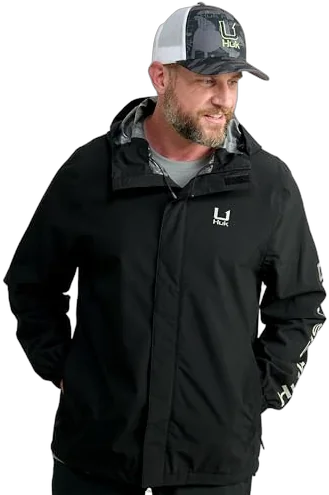
The HUK Storm Jacket sits in the sweet spot for anglers who’ve outgrown a starter suit but aren’t fishing tournaments. The two-layer 10K membrane clears the working floor discussed earlier, and the critical seams are taped, which is the construction step that matters most. Understand what “critical” leaves out, though. Pockets and hood attachments are still stitched, so on a genuinely brutal all-day soak you may find a slow seep the Simms doesn’t produce.
The women’s version of the Storm Jacket was out of stock across every listing checked while this was written, so the pick below covers the women’s-specific fit instead.
Best Women’s Fit: Grundéns Women’s Weather Watch Jacket
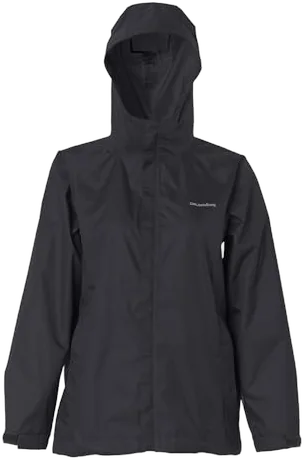
The Grundéns Women’s Weather Watch Jacket comes out of a commercial fishing heritage, and it shows in the details that matter for freedom of movement. Women’s-specific fishing rain gear is still thin on the ground, and far too much of what’s sold as women’s fit is a men’s pattern scaled down, which puts the shoulder seam in the wrong place and binds the moment you start casting. This one is cut properly.
The waterproof-breathable PU laminate puts it in the same construction family as the mid-tier men’s options rather than the coated entry tier, and the DWR finish on the nylon face fabric is a wear item you can restore, which is covered further down.
Best Rain Gear for Wading, Fly Fishing and Kayaks
Wading and paddling change the geometry of the problem completely, and it’s the reason a general-purpose rain jacket often disappoints anglers who do either.
Why a Wading Jacket Is Cut Short
Standing thigh-deep in a river in a full-length rain jacket is a specific kind of mistake you only make once. The hem sits below your wading belt, water sheets off the jacket and runs straight down into the gap, and now you have a soaked shirt tail and a jacket wicking river water upward.
A wading jacket solves this by ending at roughly your natural waist, above where the belt sits. Water runs off the hem and falls outside your waders instead of inside them. The other differences follow from the same logic: high hand-warmer pockets that clear the water line, a shorter cuff design that lets you reach into current without funneling water down your sleeve, and often a fold-away hood since a hood blocks the peripheral vision you need for footing. If you’re still sorting out the wader side of the setup, our comparison of stockingfoot versus bootfoot waders covers how that choice interacts with the rest of the system.
Best Wading Jacket: Riverruns Fishing Wading Jacket
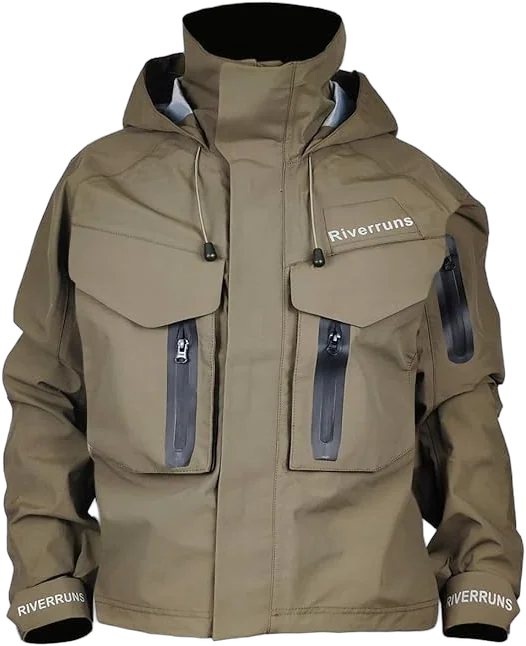
The Riverruns Fishing Wading Jacket is the practical answer for anglers who wade a few times a season and can’t justify a flagship wading shell. It gets the cut right, which is most of the job, and the waterproof-breathable shell handles a normal rain day. Push it into all-day driving rain over multiple seasons and you’ll find its limits, in the same places every entry-tier garment finds them.
What Paddling Adds to the Problem
Kayak fishing stacks a second set of demands on top of the first. Every paddle stroke rotates your shoulders through a full range of motion, which a stiff jacket resists all day long. You’re also sitting at water level, so spray comes from below as well as above, and the cockpit collects whatever runs off you.
That’s why paddling jackets are built differently: shorter and more articulated through the shoulder, often with adjustable neck and wrist gaskets to keep water out during a roll or a wet re-entry, and with a hood cut small enough that it doesn’t grab wind or block the sightline you need for a stroke. Sitting low also means visibility to other boats is limited, which makes the safety considerations in our guide to kayak fishing safety protocols worth reading before your first wet paddle.
Best for Kayaks: NRS Riptide Paddling Jacket
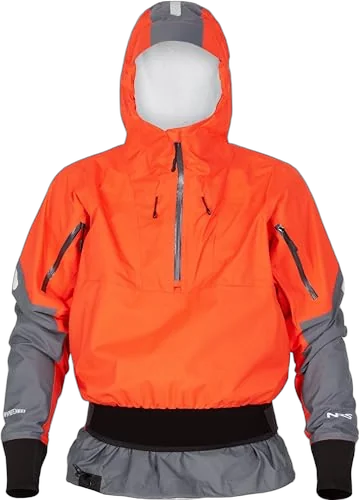
The NRS Riptide Paddling Jacket is built by a company that makes paddling gear first and everything else second, and the HyproTex 2.5 fabric sits in a sensible place for the effort level involved. The half-length zip is a deliberate compromise: less protection than a full dry top, considerably less to fight with when you want to vent, which suits anglers who paddle to a spot and then fish rather than run whitewater all day. This one is a men’s cut; the women’s Riptide was unavailable at the time of writing.
Best Rain Gear for Cold Days and Offshore Runs
Rain plus cold is where gear choice stops being about comfort. A damp layer at 70 degrees is annoying. The same damp layer at 45 degrees with wind on open water pulls heat out of you faster than you can replace it, and the decisions get made for you once you’re cold enough to stop thinking clearly.
Cold Water Changes the Math
Cold weather fishing has a number attached to it that most anglers never learn. The U.S. Coast Guard defines cold water as 59°F (15°C) or below, which catches far more of the fishing calendar than most anglers expect. Spring and fall water sits in that range across most of the country even when the air feels pleasant.
The reason the number matters is the timeline. As the National Weather Service explains, cold water immersion becomes a serious risk long before hypothermia sets in. The first minutes are the problem: cold shock triggers an involuntary gasp and a spike in breathing rate, and a gasp underwater ends the situation before hypothermia has begun. NOAA’s cold water safety and survival guide walks through what those first minutes look like in more detail.
Which leads to the honest thing about rain gear that no product page says: almost none of it has built-in buoyancy, and a soaked insulated bib is heavy. Wearing your flotation, rather than having it stowed under a seat, is what decides the outcome, because cold shock removes the window in which you’d go find it. If you’re weighing options there, our breakdown of auto versus manual inflatable life jackets covers which style suits which kind of fishing.
One more sobering number worth naming plainly rather than dressing up: alcohol at or above 0.10% BAC is present in 41 percent of boating fatalities that happen while fishing, roughly double the rate in general recreational boating. Cold, wet, low-visibility conditions plus alcohol is the pattern, and it’s worth knowing before a long wet day turns into a long wet evening.
Insulated Bibs vs. a Two-Piece System
Two approaches work here, and they suit different anglers.
An insulated bib puts waterproofing and warmth in one garment. The upside is simplicity and no gap at the waist. The downside is that you’ve committed to a temperature range, and if the afternoon warms up you’re carrying insulation you can’t shed.
A two-piece uninsulated foul weather gear system separates the jobs. The shell handles water and wind, and you dial warmth with layering underneath. It’s more flexible across a wider temperature band and it’s the approach most offshore anglers land on, because a day that starts at 40 degrees can end at 65.
Best Cold-Weather Bib: AFTCO Hydronaut Insulated Bib
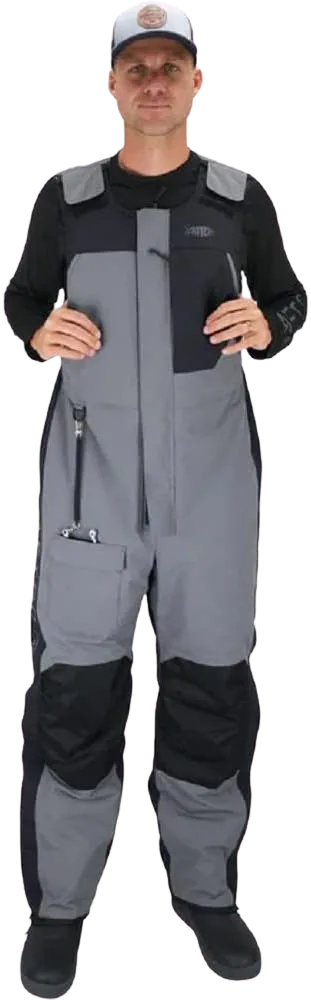
The AFTCO Hydronaut Insulated Bib is the crossover pick for anglers whose rain days and cold days are the same days. The 30,000mm rating puts it well past what any freshwater rain event demands, which matters less for the rain itself than for the pressure points discussed earlier: kneeling on a wet deck, sitting for hours, leaning into a rail. The 140gsm insulation is a real winter weight rather than a token liner.
Know the limit going in. This is committed cold-weather gear. Wear it on a mild wet day and you’ll overheat inside an hour, and no amount of venting fixes insulation you can’t take off.
Best Offshore System: WindRider Pro Foul Weather Gear
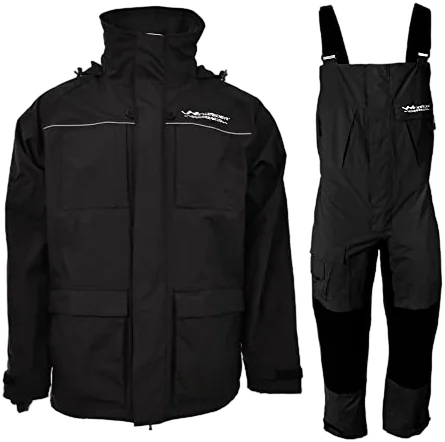
The WindRider Pro Foul Weather Gear covers the two-piece approach for anglers who don’t want to spend flagship money to stay dry on a long run. The reinforced knees matter more than they sound like they should. Kneeling is what bibs do most, and the knee is where abrasion plus pressure plus a wet non-skid deck all meet.
Being clear-eyed about it: this is a DWR coating rather than a premium laminate, so it belongs in the same maintenance conversation as everything else at the mid tier. Re-treat it and it stays functional; ignore it and it wets out inside two seasons.
What Goes Under the Jacket, and How to Make Any of It Last
Everything above is about the shell. What decides whether a rainy day is tolerable or grim is usually happening underneath it, and what decides whether that shell is still working in three years is happening in your garage.
The Layer That Decides Your Day
The single most repeated piece of advice from anglers who fish a lot of wet weather has nothing to do with the jacket: wear a synthetic or merino base layer underneath, regardless of what your shell is rated. The reasoning follows directly from the humidity problem earlier. On a rainy day the membrane can’t clear vapor efficiently, so some moisture is going to end up on your skin no matter what you paid. A base layer moves that moisture off your skin and keeps an insulating air gap intact even when it’s damp. That’s the whole job of moisture management: not keeping you perfectly dry, which nothing does, but keeping the water that does arrive away from your skin.
Cotton does the opposite. It holds water against you, loses all insulating value when wet, and takes hours to dry. A cotton t-shirt under a flagship shell will make you colder than a synthetic tee under the cheapest suit on the rack. Our guide to building a fishing base layer system covers weights and materials for different seasons.
Then there’s the interface problem where the jacket meets everything else. Over waders, a short hem sits above the belt. Over bibs, the jacket goes outside so runoff sheets down past the waist. Hands and feet get forgotten and then ruin days: fishing gloves that keep enough dexterity to tie knots when wet are worth more on a cold rainy morning than another 5,000mm on your jacket rating, and wool-blend socks keep working when they’re damp while cotton ones turn into cold sponges.
Wash It More Than You Think
Here’s the piece of maintenance advice that sounds wrong the first time you hear it. Wash your rain gear every 10 to 15 uses, following the manufacturer’s instructions on the tag.
Most anglers wash rain gear roughly never, on the theory that washing wears it out. The opposite is true. Fish slime, sunscreen, salt, sweat and general grime accumulate on the face fabric and actively suppress the DWR finish. That’s what makes gear wet out early.
A wash with a technical cleaner such as Nikwax Tech Wash strips the contamination and restores much of the beading on its own. Skip regular detergent, which leaves surfactant residue behind that attracts water rather than shedding it. Worth knowing while you’re shopping for either: PFAS-free DWR chemistry is now the industry standard, and the newer formulas need re-treating a little more often than the older ones did.
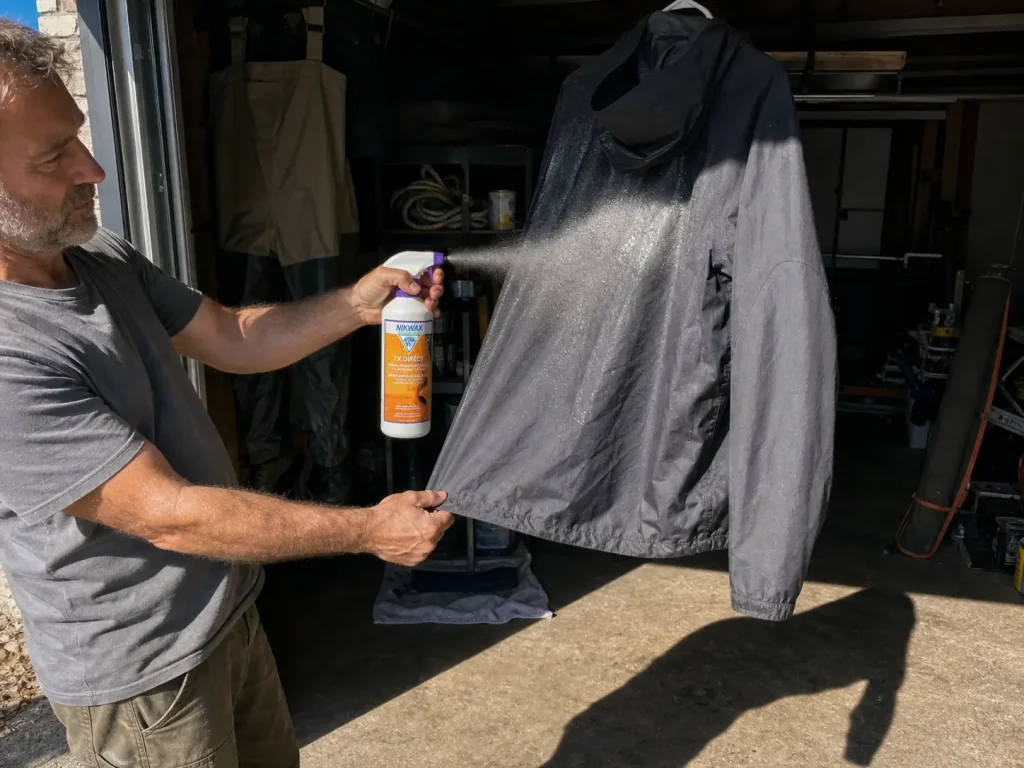
Re-treat the DWR once or twice a season on gear you use regularly. A spray-on treatment like Nikwax TX.Direct goes on a clean, damp garment, takes about ten minutes of work, and restores water repellency on the outer fabric without affecting breathability. That combination of washing plus re-waterproofing is the entire maintenance routine. It’s the single highest-return thing you can do for a jacket you already own, and it does more for your comfort than most upgrades.
The Bead Test
You don’t need to guess whether your gear needs attention. Take the jacket outside, run water over a sleeve and watch what happens.
If the water pulls into round beads and rolls off, the DWR is alive and there’s nothing to do. If the fabric darkens and the water spreads into a flat patch, it’s wetting out and it’s time for a wash and a re-treatment. Test both sleeves, the shoulders and the seat area on bibs. Those wear at different rates, and shoulders usually go first from pack straps and sun.
Run the bead test in March, before the season rather than during it. Finding out your DWR is gone on the first cold rainy morning of spring means you fish that day damp; finding out in the garage means you wash and reproof on a weeknight and never think about it again.
Drying and storage close the loop. Hang rain gear until it’s completely dry before it goes away, including the inside, and hang it somewhere with air movement rather than in a sealed tote. Damp storage grows mildew on the face fabric and works on coatings from the inside, and the same principles that apply to drying waders properly apply here.
Run the numbers on all of that and the cost per season picture shifts. Entry-tier gear gives you one to two seasons under heavy use, or three to four under light use with good storage. A mid-tier taped-seam jacket, washed and re-treated a couple of times a year, reasonably runs five seasons or more. The gap narrows considerably once maintenance enters the equation, which is a strange thing for an article full of affiliate links to point out, but it’s true: half the people reading this need a bottle of reproofer, not a new jacket.
Conclusion
Three things worth carrying out of all this.
Nearly all fishing rain gear keeps water out on day one. What price buys is where and when it stops. Tape over every seam instead of just the main ones is the specific difference that shows up in year three, and it’s worth more than any number on a hangtag.
Your calendar picks your tier, not your ambition. A handful of wet trips a year and well-stored entry-tier gear will serve you for three or four seasons. Twenty-plus wet days a year and that same gear leaks by season two, which is when taped seams stop being an upgrade and start being the baseline.
Feeling wet inside almost never means a leak. It means the face fabric wetted out or you sweated out, and both are fixed with a base layer, a wash and a fresh coat of DWR rather than a purchase.
Staying dry on the water is mostly a maintenance habit, not a purchase. Before you buy anything, go pull the jacket you already own off its hook, take it outside and run water over the sleeves. If it beads, you have better gear than you thought. If it soaks in, a wash and a reproof on a weeknight will buy back more fishable rainy days than most upgrades would.
Frequently Asked Questions
01What should you wear for fishing in the rain?
Wear a synthetic or merino base layer, a taped-seam waterproof jacket rated at least 10,000mm, and rain bibs or pants. Add gloves that still allow knot tying and wool-blend socks. Skip cotton entirely, since it holds water against your skin all day.
02Is Frogg Toggs really waterproof?
Yes. Reviews across hundreds of buyers average 4.2 to 4.8 stars specifically for waterproofing, and the gear keeps rain out as claimed. The real tradeoff is durability: the lightweight nonwoven fabric tears more easily than heavier woven nylon around hooks and brush.
03What is the best rated rain gear for fishing?
The Simms Challenger Jacket earns the broadest consensus as a general-purpose pick because every seam is taped rather than only the critical ones. The best rating for you depends on fishing style, though: kayak, wade and offshore anglers each need a different cut.
04What is the best thing to fish in the rain?
Rain stains the water and pushes fish shallower and more active, so search baits that cover water quickly tend to shine. Moving presentations generally beat slow finesse work while it is actually raining, especially as runoff colors things up.
05How long should fishing rain gear last?
Entry-tier gear lasts one to two seasons under heavy use, or three to four seasons for occasional anglers who store it dry and unfolded. Mid-tier taped-seam gear reasonably runs five seasons or more with washing and periodic DWR re-treatment.
06Do I need rain pants or are bibs better for fishing?
Bibs win for boat fishing and anywhere spray is involved, because they remove the waist gap where water gets in when you bend or sit. Rain pants pack smaller and vent better, which suits bank anglers and warm-weather trips.
07Why does my waterproof jacket feel wet inside?
Usually the outer fabric has wetted out rather than leaked. Once the DWR finish wears off, the face fabric saturates and blocks breathability, so trapped sweat has nowhere to go. Wash the garment and re-treat it rather than replacing it.
Risk Disclaimer: Fishing, boating, and all related outdoor activities involve inherent risks that
can lead to injury. The information provided on Master Fishing Mag is for educational and informational purposes
only. While we strive for accuracy, the information, techniques, and advice on gear and safety are not a substitute
for your own best judgment, local knowledge, and adherence to official regulations. Fishing regulations, including
seasons, size limits, and species restrictions, change frequently and vary by location. Always consult the latest
official regulations from your local fish and wildlife agency before heading out. Proper handling of hooks, knives,
and other sharp equipment is essential for safety. Furthermore, be aware of local fish consumption advisories. By
using this website, you agree that you are solely responsible for your own safety and for complying with all
applicable laws. Any reliance you place on our content is strictly at your own risk. Master Fishing Mag and its
authors will not be held liable for any injury, damage, or loss sustained in connection with the use of the
information herein.
Affiliate Disclosure: We are a participant in the Amazon Services LLC Associates Program, an
affiliate advertising program designed to provide a means for us to earn advertising fees by advertising and linking
to Amazon.com. As an Amazon Associate, we earn from qualifying purchases. We also participate in other affiliate
programs and may receive a commission on products purchased through our links, at no extra cost to you. Additional
terms are found in the terms of service.