

In this article
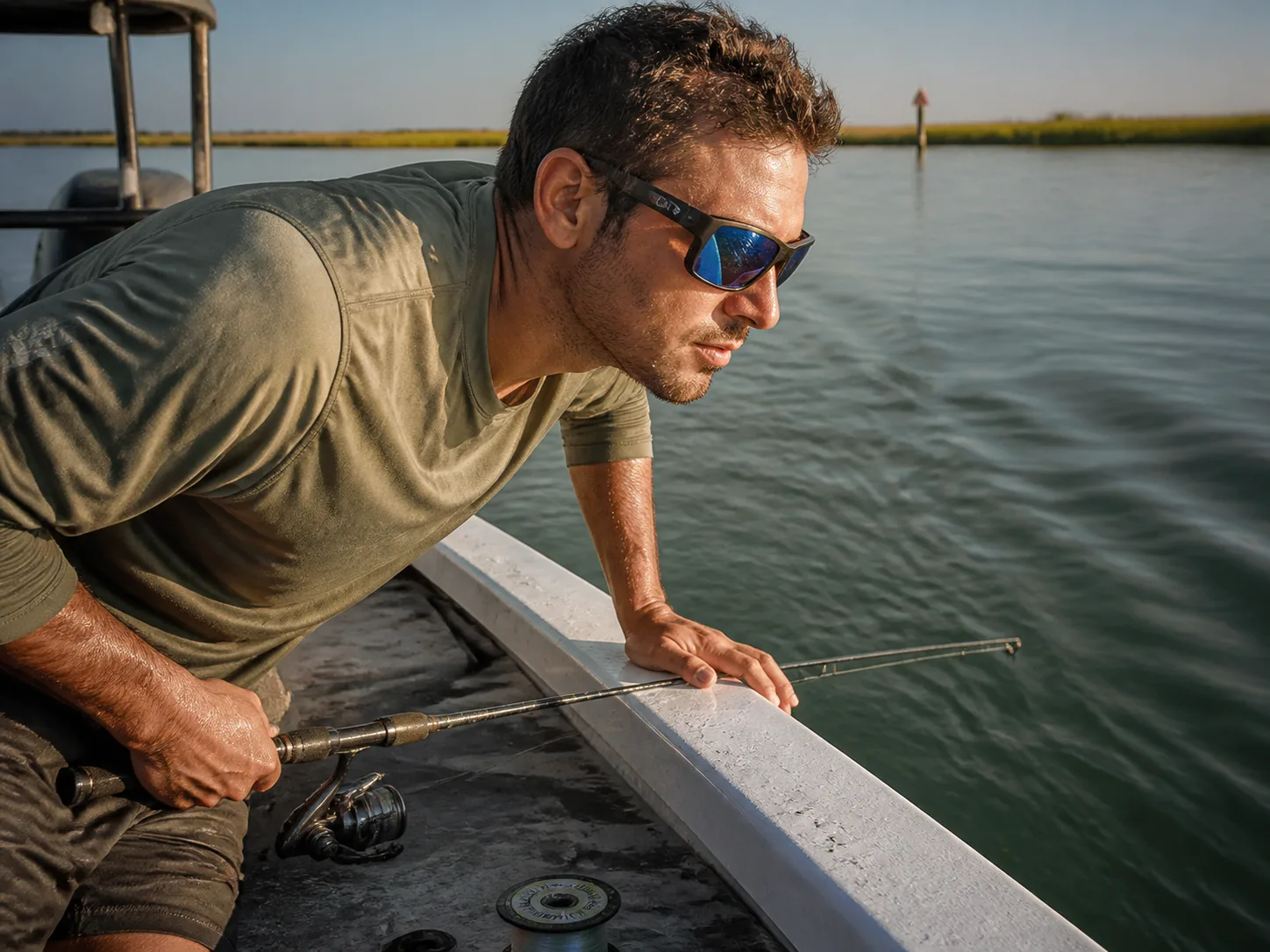
You are leaning over the gunwale, tracking a shadow that’s been holding off the edge of a drop-off, and you cock your head a few degrees to get a cleaner line down into the water. The glare snaps back on like somebody flipped a switch. That is not your lenses failing and it is not a bad pair, and the anglers who understand what just happened stop blaming their glasses. The whole thing comes down to one piece of optics with a name: the transmission axis. Here’s what that axis actually is in polarized sunglasses, why the physics puts it vertical, why a small head tilt breaks the glare blocking more than it feels like it should, and what separates a genuinely good lens from one that only says polarized on the box.
What Glare Off the Water Actually Is
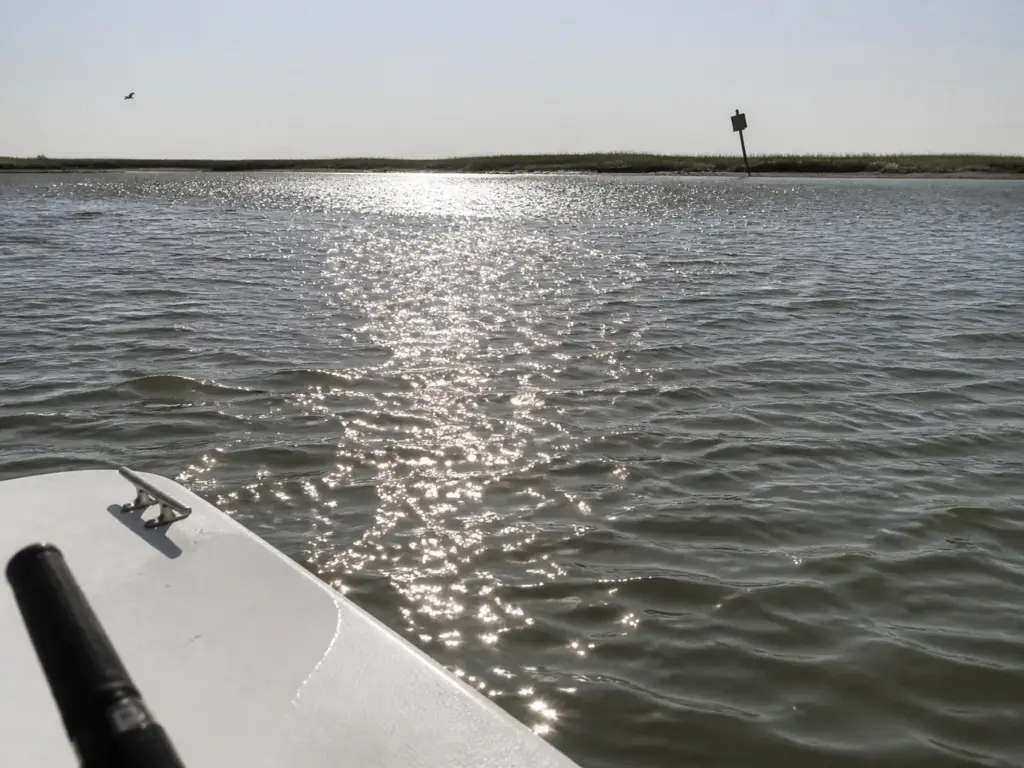
Every angler has squinted at a flat silver sheet of water and decided the problem was too much sun. It isn’t. Ordinary sunlight is unpolarized light, meaning its electric field oscillates in every orientation at once, all mixed together at random. A plain dark lens can only dim that mess evenly, which is why sunglasses without a polarizing film make a bright day into a dim bright day and nothing more.
Reflection is what changes the picture. When light bounces off a flat horizontal surface, the reflected portion comes back preferentially oriented in the horizontal polarization plane. Water does it, wet rock does it, a car hood does it, a polished tile floor does it. Same mechanism every time, because the surface itself is what sorts the light.
That sorting is the whole opening. Surface glare is not just brighter light, it’s oriented light, and orientation is the one property a filter can select on. If you’ve ever wanted to prove this to yourself in ten seconds, the Exploratorium’s classic polarized-light demonstration shows exactly why rotating a lens 90 degrees brings glare back.
The practical payoff shows up the first time you put a real pair on over a shallow flat. A submerged log appears out of what looked like blank mirror, and the rest of the scene doesn’t go dark, because the lens threw away one narrow band of light instead of dimming everything. That is the whole basis of sight fishing in shallow water: strip out the water glare and the structure underneath resolves. That’s also why chasing darker and darker tints is the wrong move when you can’t see into the water. The fix isn’t less light. It’s less of one orientation of light, and that’s a completely separate control. Worth knowing where this piece sits in the bigger picture too, since how sunglasses fit into the rest of your on-water sun protection changes what you should spend on first.
Why the Transmission Axis Runs Vertical
The transmission axis is the one orientation of light the lens agrees to let through. Everything oscillating perpendicular to that axis gets absorbed inside the film. So the design question is short: which orientation do you want to keep, and which one do you want gone?
Glare off horizontal surfaces is horizontally polarized. Set the axis 90 degrees away from that, which means straight up and down, and you absorb the glare band while passing most of the rest of the scene. That’s it. Nobody picked vertical polarization because it looked good on a spec sheet or because it flattered a frame shape. It’s a 90-degree relationship to a physical fact about reflection, and it’s the reason the same lens that flattens boat glare on a glassy lake also handles driving glare off wet asphalt and snow glare off an open field. All three are horizontal reflectors, which is why one axis orientation covers all of them. This is optics doing exactly what it says on the tin, not marketing, the same way the same light-and-water physics that governs UPF fabric ratings is measurable rather than promotional.
Both lenses in a pair share that same vertical axis, and that’s not a detail to gloss over. Mismatched axes between your left and right eye would give you two different brightness readings of the same water, which the brain hates. It reads as eye strain long before you can name what’s wrong.
The register test takes four seconds. Hold the pair up to any reflective surface in the store, a display case, a phone, a waxed floor, and rotate them 90 degrees. Glare vanishes, returns, vanishes. That is the axis doing its job, live, in your hands, before you spend a cent.
Brewster’s Angle and the 53-Degree Glare Band

There is a specific geometry where water quits being partly reflective and turns into a near-perfect mirror pointed at your face. It has a name and a number, and knowing roughly where it sits changes how you position the boat, not just what you wear.
Brewster’s angle is the angle of incidence at which the reflected light becomes almost completely polarized. The formula is θ_B = arctan(n₂/n₁), and at Brewster’s angle the reflected ray becomes completely polarized perpendicular to the plane of incidence. Plug in water’s refractive index of 1.333, the same number that governs refraction when light bends on its way into the water, and you land at roughly 53 degrees. That figure isn’t a rounded guess either. Idaho State University’s physics department demonstrates why light reflecting off water peaks in polarization at around 53 degrees with a bench setup you could reproduce with a laser pointer and a bowl.
Here’s the part that flips your intuition. At that angle the reflection is 100% polarized in the horizontal plane, which is the exact orientation your vertical axis was built to absorb. So the geometry that produces your worst glare is also the geometry where your lenses perform their absolute best. The two peaks land in the same place.
Read it practically. Low-angle light early and late, plus mid-morning sun on flat water, is when the numbers stack up, and it explains why glare shifts as you move across the water instead of sitting there constant. You cannot move the sun. You can move which direction you’re looking, and repositioning the boat so the glare band falls off your line of sight beats any lens upgrade you could buy. That is reading water at the level above bottom composition and current seams: reading where the light is working against you. Anglers who like this flavor of explanation usually get along with the same optics logic that drives how color reads underwater, which runs on the same light-in-water behavior.
What Is Actually Inside a Polarized Lens
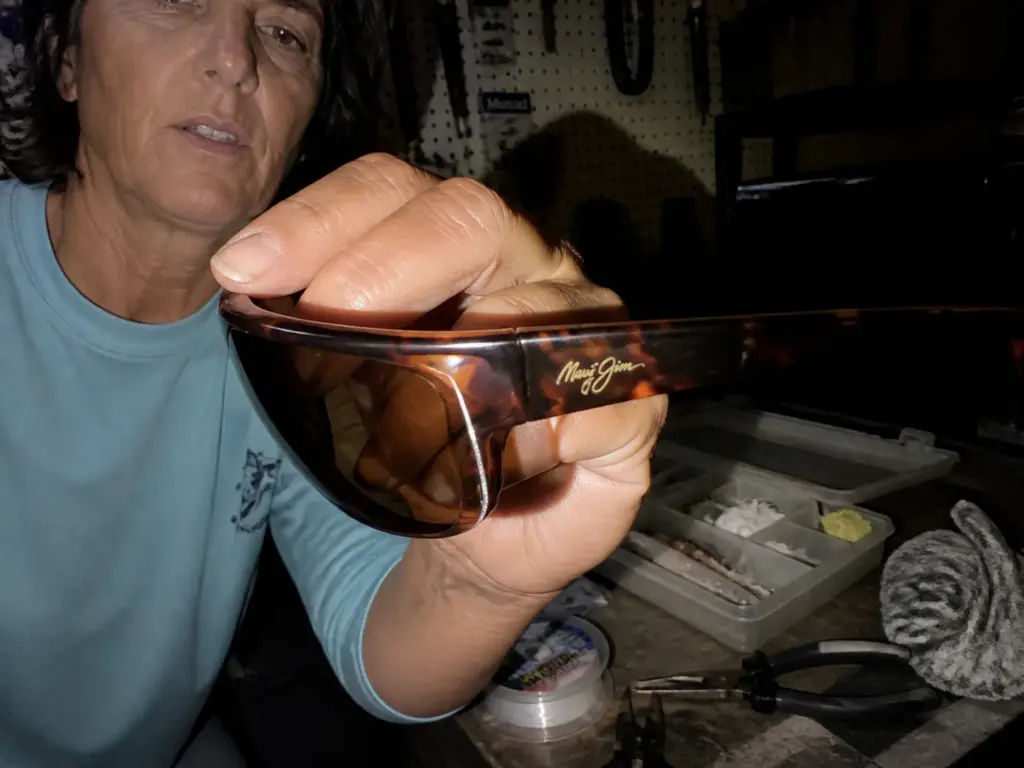
Anglers argue glass versus poly like that’s the polarization decision. It isn’t. The part doing the actual work is a stretched sheet thinner than a page, buried in the middle of the stack, and it’s the same idea in a gas-station pair and a flagship fishing pair. What differs is how well it was made.
The Stretched Film That Does the Work
The polarizer is a polyvinyl alcohol sheet, PVA for short. During manufacturing it gets stretched to four to six times its original length, which pulls its long-chain molecules into a consistent grain running one direction. Research on PVA polarizing film manufacturing shows the stretching process is what aligns the molecules that actually block glare, and that alignment is the entire mechanism.
Then the film is doped with iodine, which makes those aligned chains conductive along the grain. Light oscillating along that grain drives current in the chains and gets absorbed as heat. Light oscillating perpendicular to it has nothing to push against, so it passes. That’s your polarizing film, and it comes out around 30 micrometers thick, laminated between TAC protective layers before it ever meets the lens material.
Sit with the numbers for a second. The functional component of a premium fishing lens is a 30-micrometer layer you could not pick out of the stack with your fingernail. Everything else in there is packaging for it.
Why Glass vs. Poly Is a Separate Question
Lens material governs optical clarity, weight, scratch resistance and impact resistance. Those are durability and comfort variables. None of them is a glare-blocking variable, because the glare blocking already happened inside the film.
Glass versus poly is still a real decision worth having an opinion on. Glass reads sharper and shrugs off scratches, poly is lighter on your face all day and takes a hit from a flying jig without shattering. Anglers use that shorthand constantly precisely because the trade-off is felt on the boat, hour eight, when the frames start to weigh something. Just don’t file it under polarization quality, because it lives in a different drawer. If you want that decision resolved rather than described, the sibling breakdown of which lens material actually earns the upcharge on the water picks a side.
Why Tilting Your Head Brings the Glare Back
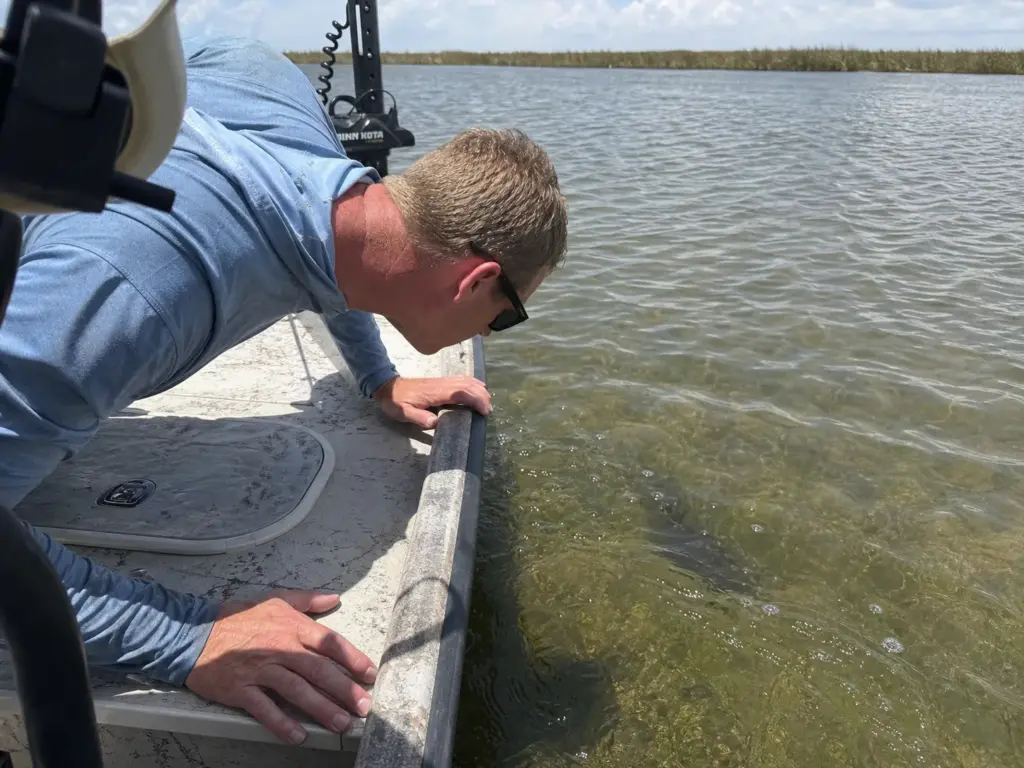
Back to the gunwale, with the math this time. You leaned, you tilted, the glare came back. The glasses did not change. The geometry did, and it’s the most under-explained thing in polarized eyewear.
Malus’s Law in One Sentence
Malus’s Law says I = I₀cos²θ, where θ is the angle between the lens’s transmission axis and the incoming light’s polarization plane. At 0 degrees of mismatch your lens sits perfectly crossed to the glare band and absorbs nearly all of it. At 90 degrees of mismatch the axis is lined up with the glare and you get essentially no blocking at all.
The number that matters isn’t either endpoint, though. It’s the shape of the curve between them. Because the relationship is cosine-squared rather than linear, the loss does not track your tilt proportionally. Lean 30 degrees and you have not given up 30 percent of anything. You’ve given up a chunk that lands well past where your gut expects, which is exactly why the effect reads as sudden rather than gradual. Your head moves smoothly and the water flips.
What This Means When You Are Leaning Over the Gunwale
Your lens axis is bolted to your face. The glare band is bolted to the water. Tilt your head and only one of those two rotates, so the mismatch angle opens up and Malus’s Law starts charging you for it immediately. Nothing about the lens degraded. The relationship between two orientations changed, and the lens has no way to know you moved.
This is the single most common misread in polarized eyewear. Anglers describe it as the lens losing its polarization, sometimes on a pair three weeks old, and go looking for a warranty claim or a replacement. The pair is fine. The head moved. Once you’ve heard the mechanism you can’t unhear it, and you start catching yourself doing it.
Keep your head level with the horizon and move your eyes down instead of cocking your skull to peer at an angle. Same view into the water, axis stays where it belongs. It feels wrong for about a week and then it becomes the way you look at water.
Be honest about the limit though. You cannot dodge this entirely. Sight-fishing sometimes demands an awkward head position, poling a flat or leaning off a bow to get a look under an overhanging branch, and there is no posture trick that keeps the axis aligned while your skull is at 40 degrees. The trade is real. You just want to be making it on purpose instead of wondering why the water went silver. And once the glare is handled, the next variable in seeing fish is the tint that helps you pick out fish once the glare is handled, which is a different lever entirely.
Why Your Fish Finder Screen Goes Black
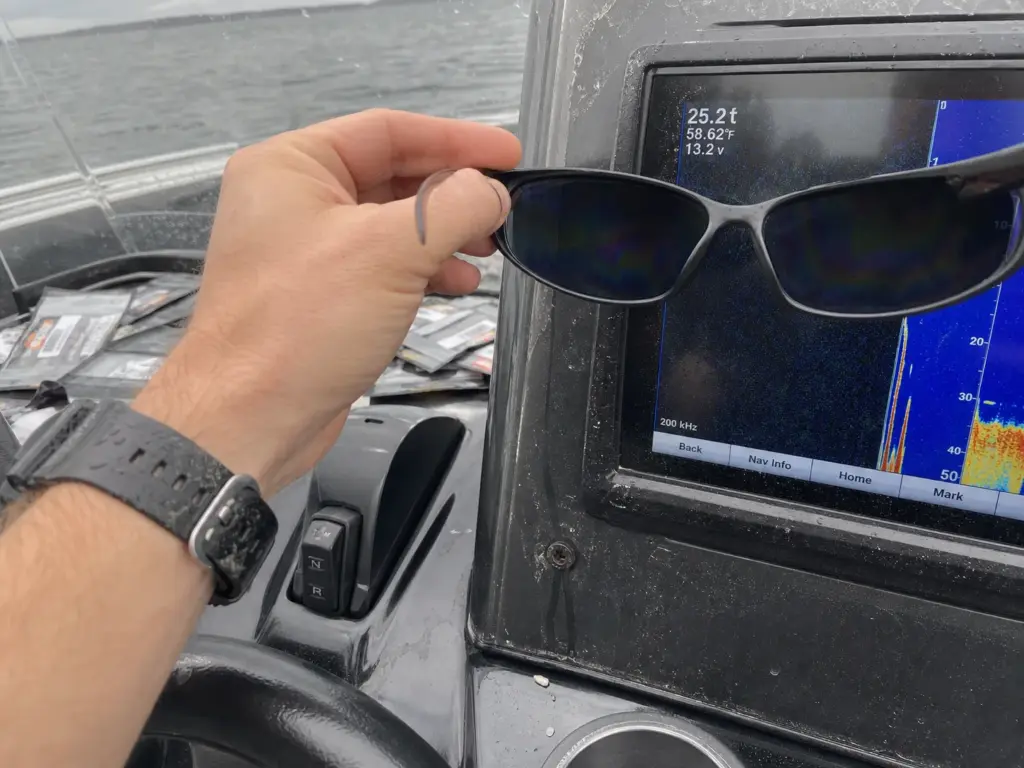
The first time it happens at the helm you assume the electronics died. Screen’s dark, or worse, it’s throwing rainbow blotches across the sonar returns like an oil slick. You tap it. You check the power. Nothing’s broken. Your glasses and your screen are both polarizing filters, and you just crossed them.
LCD displays don’t reflect ambient light to make an image, they generate their own, and LCD displays emit their own polarized light through an internal filter as a working part of how the panel produces a picture at all. So the light leaving your fish finder screen already has an orientation baked into it before it reaches your face.
When that screen’s polarization axis and your lens axis land near 90 degrees apart, the two filters cross and cancel. The screen dims toward black. The rainbow version happens when layers in the display or in the lens stack stress different wavelengths by different amounts, so the cancellation lands unevenly across the color range. It’s the same axis-mismatch physics as the glare mechanism, just running in reverse. On the water, crossed axes are the feature. At the helm, crossed axes are the problem.
Before you call the unit dead, tilt your head about 90 degrees or just lift the glasses off your nose. If the screen comes back, it was never a hardware fault, and you just saved yourself a service call and a very awkward phone conversation.
The useful wrinkle is that this varies by unit. Some marine electronics are deliberately built so their screen polarization plays better with polarized eyewear, which makes it a purchase variable rather than a law you’re stuck with. If your screen fights you in direct sun for reasons beyond the axis, the full rundown on getting a readable screen in direct sun covers the rest of the failure modes.
What Polarization Cannot Do
This is the part the marketing copy walks past. Polarized lenses do one job extremely well and a second job not at all, and knowing exactly where that line sits will keep you from spending real money on a problem lenses were never able to solve.
The mechanism removes light that arrives via specular reflection off the surface. That is the entire trick. It adds zero light-gathering power, it doesn’t brighten anything, and it does nothing whatsoever to help light punch down through the water column and come back to your eye. Take away the surface glare and what’s underneath becomes visible only if the light was already making it out.
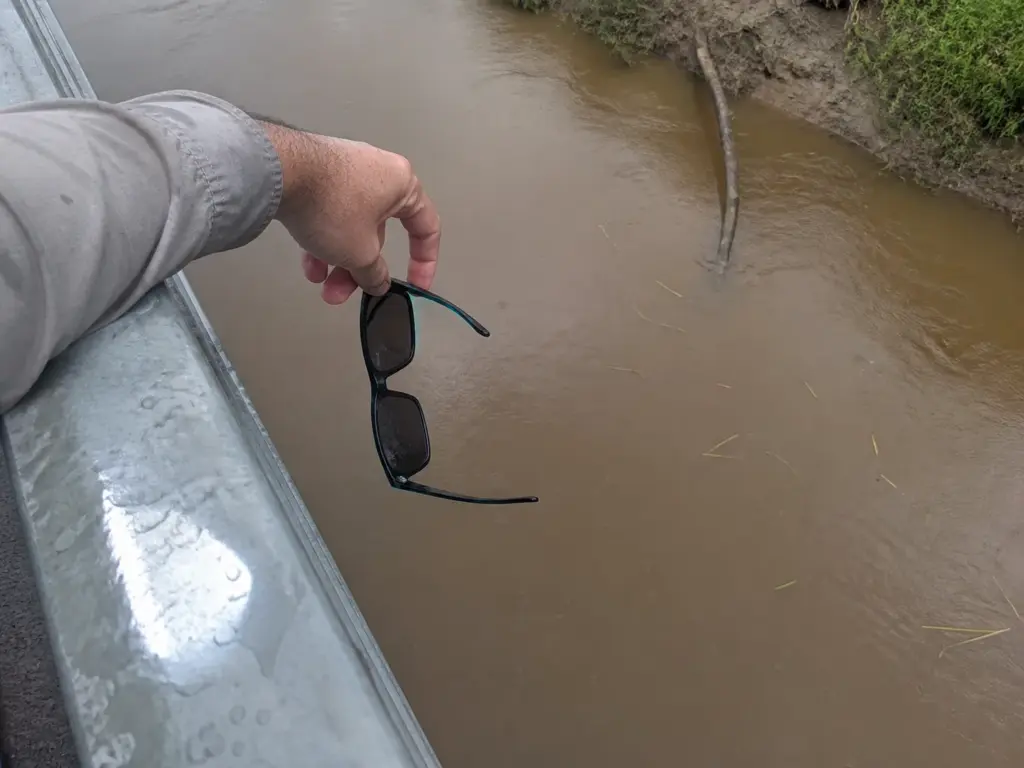
In turbid or stained water, the limiting factor lives below the surface, not on it. Suspended sediment and organic particles scatter and absorb light on the way down and on the way back, which is a completely different physical problem from a horizontally polarized reflection. No lens at any price restores that, because there’s no oriented light to filter out. The information isn’t reaching you to begin with.
Depth runs into the same ceiling. Past a certain point the light returning from the bottom has been scattered too many times to resolve into anything, glare or no glare. You’re not looking through a dirty window that a better filter would clean. You’re looking at a place where the signal ran out.
On chocolate-milk water two days after a hard rain, the upgrade that helps is electronics or a different stretch of water. Anyone selling you lenses to fix that is selling you the wrong tool, and no amount of extinction ratio is going to argue with suspended clay.
Hold onto that boundary, because it’s the same gap that shows up all over fishing gear: a spec that’s technically true, doing far less than the copy implies. The same gap between spec-sheet marketing and what the physics actually delivers runs through rod blanks too, and once you start reading gear this way it’s hard to stop.
How to Tell a Good Polarized Lens From a Label
Polarized on the box is a yes-or-no claim, and it’s usually true. It just tells you nothing about how well. The number that answers that question has a name, it almost never makes it onto the packaging, and there’s a four-second test that gets you most of the way there regardless.
Extinction Ratio Is the Number Nobody Prints
Extinction ratio measures how completely the film blocks light on the rejected axis. Put plainly: with your axis perfectly aligned and everything working the way it should, how much glare still leaks through? A perfect polarizer would leak none. Real ones leak some, and the spread between a well-made film and a cheap one is wide.
A weakly stretched or poorly doped PVA sheet has a lower extinction ratio, so glare bleeds through even though the label is technically accurate and the pair genuinely is polarized. That’s the honest answer to why cheap polarized lenses feel flat on the water while the label matches the premium polarized lenses word for word. Nothing was misrepresented. The film just isn’t as good, and the packaging has no way to say so.
Now the myth worth correcting, because anglers repeat it constantly. Independent lens testing finds UV protection is often roughly equivalent between cheap and expensive polarized sunglasses. The cheap ones are generally not leaving your eyes exposed. The real price and quality gap sits in polarization efficiency and lens material, not UV blocking. People default to the UV version of the story because it sounds like a safety issue and safety arguments win, but the actual difference you’ll feel on the water is performance. The same gap between a protection label and measured performance shows up in UPF-rated fabric, where a rating on a tag and a garment’s real behavior after twenty washes are two different conversations.
The Blackout Test You Can Run at the Register
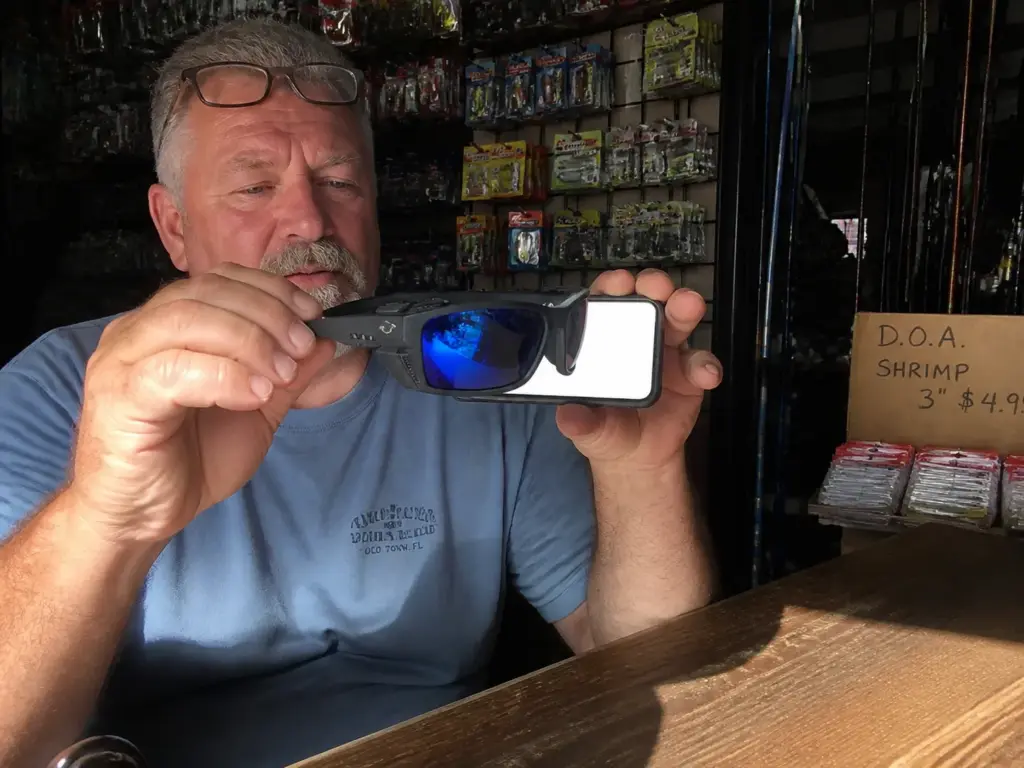
Hold the glasses up to an LCD screen, your phone works fine, and rotate them slowly. If the screen goes fully black at some point in the rotation, the lenses are genuinely polarized. Anglers call this the blackout test and it’s been passed around tackle shops long enough that most counter staff will hand you their phone if you ask.
Know what it proves and what it doesn’t. It proves the polarization is real and functional. It does not grade the extinction ratio, so a pair that blacks out beautifully can still leak glare on the water. Treat it as a floor check, not a report card.
Run a second check while you’re there. Look at a reflective surface, a car hood in the lot, a puddle, the tile floor under your feet, and rotate the lenses. Glare should visibly return and disappear as you turn them. If nothing changes at any rotation, walk away, because whatever is in that lens isn’t doing the job the box claims.
Where the Money Actually Goes
At the top of the extinction-ratio range you get lenses like the Costa Del Mar King Tide 8, built on 580G glass with the standard vertical transmission axis and a film made well enough that very little leaks through on the rejected axis. Point to it as a reference for what the ceiling looks like rather than as a blanket recommendation, because plenty of anglers are better served spending that money on a second rod.
The other thing worth seeing clearly is that tint and axis are separate variables that fishing content loves to blend together. A lens family like the Maui Jim Southern Cross comes in several tints, and those tints genuinely deliver contrast enhancement, changing which colors read against a weedbed and how quickly you go from scanning to spotting fish. What they do not change is the glare blocking, because the axis and the film behind it are identical across the options. Picking a tint is a real decision. It is not the glare decision, and treating it as one is how anglers end up with an amber lens they chose for the wrong reason.
For budgeting: genuinely high-extinction-ratio fishing lenses generally run $80 to $250 depending on lens material and brand. A functional polarized pair that passes the blackout test can be had well under $30 and it will honestly be fine as a backup in the glovebox. Extinction-ratio performance and durability are what fall off sharply below that $80 mark, and that’s the part you feel on hour six of a bright day.
The Short Version
The axis runs vertical because glare off water runs horizontal. That single 90-degree relationship is the entire mechanism, and everything else in this article is a consequence of it.
Keep your head level with the horizon and move your eyes, not your skull. Malus’s Law charges more for a small tilt than it feels like it should, and that one habit buys you back more visibility than any upgrade on the shelf.
Polarized on the box is a floor, not a grade. Run the blackout test, accept that it only proves the film exists, then judge the rest on lens material and build quality.
Next time you’re out and the water goes flat silver on you, straighten your head before you blame the glasses. Then hunt for the angle where it opens back up. It’s usually only a few degrees away.
Frequently Asked Questions
01Along what axis are polarized sunglasses polarized?
Vertically. The transmission axis runs up and down through the lens. That orientation is chosen because glare reflecting off horizontal surfaces like water, wet roads and snow comes back horizontally polarized, so a vertical axis sits 90 degrees to it and absorbs nearly all of it.
02Why does glare come back when I tilt my head?
Tilting rotates the lens’s fixed vertical axis out of alignment with the horizontal glare band. Malus’s Law (I = I₀cos²θ) governs the falloff, and because the curve is cosine-squared, a modest tilt costs more glare control than it feels like it should.
03Why does my fish finder screen go black through polarized sunglasses?
LCD screens emit their own polarized light, and when the screen’s axis crosses your lens axis near 90 degrees the two filters cancel each other. Tilt your head or lift the glasses and the display comes right back. The unit is not broken.
04Do expensive polarized sunglasses block more UV than cheap ones?
Usually not. Independent lens testing finds UV protection is often equivalent across price tiers. The real difference is extinction ratio, meaning how completely the polarizing film blocks the rejected axis, plus lens material and coating quality.
05Does lens tint affect how much glare is blocked?
No. Tint changes visible light transmission and contrast, meaning what colors and detail you see once the glare is gone. The glare blocking itself comes from the transmission axis, which is identical across a manufacturer’s tint options.
Risk Disclaimer: Fishing, boating, and all related outdoor activities involve inherent risks that
can lead to injury. The information provided on Master Fishing Mag is for educational and informational purposes
only. While we strive for accuracy, the information, techniques, and advice on gear and safety are not a substitute
for your own best judgment, local knowledge, and adherence to official regulations. Fishing regulations, including
seasons, size limits, and species restrictions, change frequently and vary by location. Always consult the latest
official regulations from your local fish and wildlife agency before heading out. Proper handling of hooks, knives,
and other sharp equipment is essential for safety. Furthermore, be aware of local fish consumption advisories. By
using this website, you agree that you are solely responsible for your own safety and for complying with all
applicable laws. Any reliance you place on our content is strictly at your own risk. Master Fishing Mag and its
authors will not be held liable for any injury, damage, or loss sustained in connection with the use of the
information herein.
Affiliate Disclosure: We are a participant in the Amazon Services LLC Associates Program, an
affiliate advertising program designed to provide a means for us to earn advertising fees by advertising and linking
to Amazon.com. As an Amazon Associate, we earn from qualifying purchases. We also participate in other affiliate
programs and may receive a commission on products purchased through our links, at no extra cost to you. Additional
terms are found in the terms of service.