In this article
A flat line on your sonar screen is often a lie. You might be drifting over a steep drop-off, watching your screen display a smooth, continuous bottom, while trophy walleye holding tight to the slope remain completely invisible to your electronics.
This isn’t a hardware malfunction. It is a simple hydro-acoustic geometry problem caused by how sound moves through water.
I have spent decades on the water, transitioning from a confused novice angler staring at pixelated blobs to a student of how sonar signal processing actually works. I learned the hard way that a transducer is not a video camera. It is an acoustic flashlight. Like any light source, it casts shadows where targets can hide.
To see what others miss, you have to stop looking at the screen as a picture. You need to start interpreting it as a map of sound pressure. In this guide, we will strip away the marketing jargon found on transducer pages. We will look at the simple fish finder geometry that dictates your success, helping you turn theoretical knowledge into a filled livewell.
What defines the shape of your sonar beam?
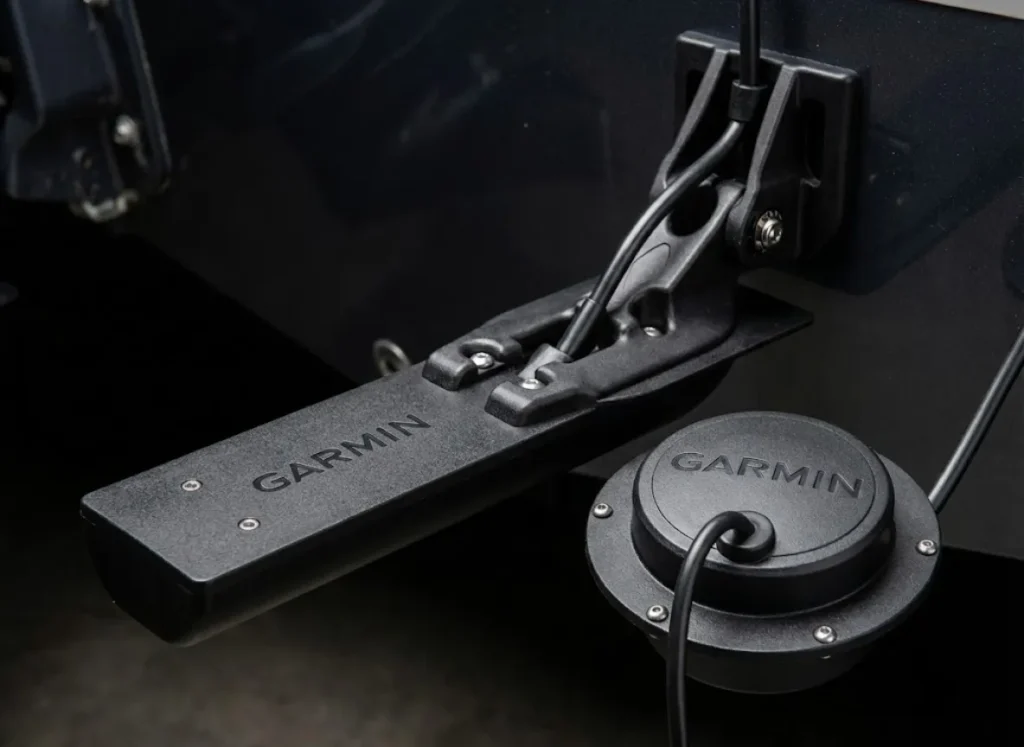
Before we can read the screen, we have to understand the shape of the “ping” leaving the boat. Many fresh water anglers assume the sonar cone is a perfect triangle with hard edges.
In reality, sound waves in water behave more like a flashlight beam in a foggy room. The light is intense in the center, but it fades gradually at the edges. Whether you use transom-mounted transducers or a thru-hull transducer, the physics of the conical shape remain the same.
How does frequency determine beam width?
The relationship between your operating frequency (kHz) and your beam width is a simple trade-off. Think of it like a seesaw: when the frequency goes down, the beam gets wider. When the frequency goes up, the beam gets narrower.
Low frequency transducers, such as 50 kHz or 83 kHz, act like a floodlight. They create a wide cone angle, usually around 45-degree cone to 60°, which is great for searching large areas of the water column.
High frequency transducers, like 200 kHz or 455 kHz, act like a spotlight. They create a narrow, focused beam, often just a 20-degree cone or even an 8-degree cone. This provides high precision but covers less ground. Standard operating procedures for hydroacoustic surveys define these frequency relationships as the foundation of underwater detection.
Transducer crystal size matters here, too. To get a narrow beam with a low frequency, your transducer would need to be the size of a dinner plate. That is impractical for most plastic recreational boats.
This means you have to make a choice. Deep water penetration usually sacrifices detail, while mastering the nuances of a CHIRP cone allows for a middle ground. You must visualize this constantly. Use the wide stated cone angle to find the neighborhood, but switch to the narrow lens to find the house.
What is the -3dB point and why does it matter?
Since the “beam” doesn’t have a hard edge, manufacturers of marine electronics need a standard way to measure it. They use something called the -3dB point, or minus 3 decibels.
The stated cone angle listed on your box, like 20 degrees, isn’t where the sound stops. It is simply the point where the sound is half as strong as it is in the center. Sound energy does exist outside this effective cone edge, but it is considered too weak to rely on for consistent fish arches.
The USGS Hydroacoustics glossary provides the technical definition of this measurement. This ensures you can compare different brands, whether it’s a Garmin GT52HW, an Airmar TM165HW, or a Raymarine unit, fairly.
This matters because energy leaking beyond this boundary can create confusion. These are called side lobes. In shallow water, if your sensitivity (or gain) settings are too high, these weak outer beams can cause side-lobe interference, picking up targets you aren’t actually looking at. This creates “ghost” returns. Understanding this limit is essential for interpreting fish finder arches and structure correctly, so you don’t mistake noise for a fish directly under the boat.
Pro-Tip: If your sensitivity is set too low, your effective cone angle shrinks. The edges of the beam become too weak to register a return, making your view narrower than the box says. If you are searching for fish, bump the sensitivity up slightly past the “clear” setting to widen your view.
How do you calculate actual bottom coverage?
Knowing the angle is useful, but knowing how wide the circle is on the bottom diameter is practical. We need to move from abstract transducer specs to the actual circular coverage area.
Sonar Beam Coverage Comparison
Comparing 20° vs 60° beam widths across different target depths and their efficiency multipliers.
20° Narrow Beam
Diameter: ~7.1 ft
Surface Area: 39 sq ft
60° Wide Beam
Diameter: ~23.1 ft
Surface Area: 419 sq ft
20° Narrow Beam
Diameter: ~14.1 ft
Surface Area: 156 sq ft
60° Wide Beam
Diameter: ~46.2 ft
Surface Area: 1,675 sq ft
20° Narrow Beam
Diameter: ~21.2 ft
Surface Area: 352 sq ft
60° Wide Beam
Diameter: ~69.3 ft
Surface Area: 3,769 sq ft
What is the formula for cone diameter?
You don’t need a fish finder coverage calculator or complex tangent formulas while you are steering the boat. Instead, rely on a simple rule of thumb: the 1/3 vs. 1/1 Rule.
A standard 20-degree cone angle covers a circle on the bottom that is roughly one-third of your depth. If you are in 30 feet of water, you are seeing a circle on the bottom that is only 10 feet wide.
In contrast, a wide 60° beam covers a circle roughly equal to the depth. That’s a 1-to-1 ratio. So, in 30 feet of water, you see a 30-foot wide circle.
NOAA hydrographic survey specifications outline the geometric requirements for this coverage to ensure no spots are missed during mapping. This is critical when optimizing your trolling for freshwater fish. If you use a narrow beam sonar in shallow water, you might troll right past a school of fish without ever knowing they were there.
Why is surface area more important than diameter?
The width of the circle grows steadily as you get deeper, but the surface area (total square footage) grows much faster. This catches many average anglers off guard.
Let’s compare a narrow beam to a wide beam at 30 feet deep. The narrow beam covers about 88 square feet. The wide beam covers about 940 square feet.
The wide beam doesn’t just cover three times the width. It covers more than 10 times the total area.
USGS study design guidelines emphasize the importance of calculating sampling volume because this massive footprint creates a loss of detail. Sonar returns from that massive 940-square-foot area are all mixed together. The wide beam is your tool for choosing a fishing spot with high probability, effectively finding the haystack. The narrow beam allows you to find the needle.
What is the Acoustic Dead Zone and how does it hide fish?
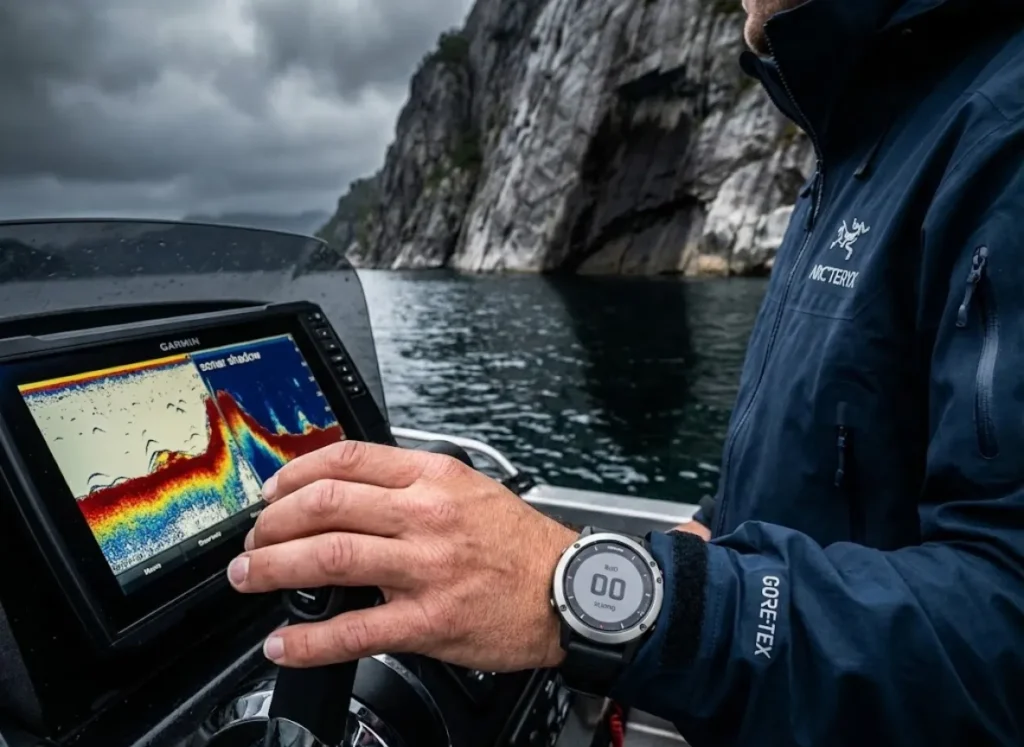
We have established how the beam works on flat ground. However, fish love structure, and structure usually means slopes. This is where fishfinders view faces its greatest failure: the dead zone geometry.
How does the “First Return” principle create blind spots?
Sonar displays calculate depth based on the First Return. This is the very first strong echo to bounce back to the single element transducer.
Imagine your boat is positioned over a steep slope. The wide edge of your cone-shaped pattern hits the high point of the slope (the uphill side) first. The center of the beam has to travel further to hit the deeper water directly below the boat.
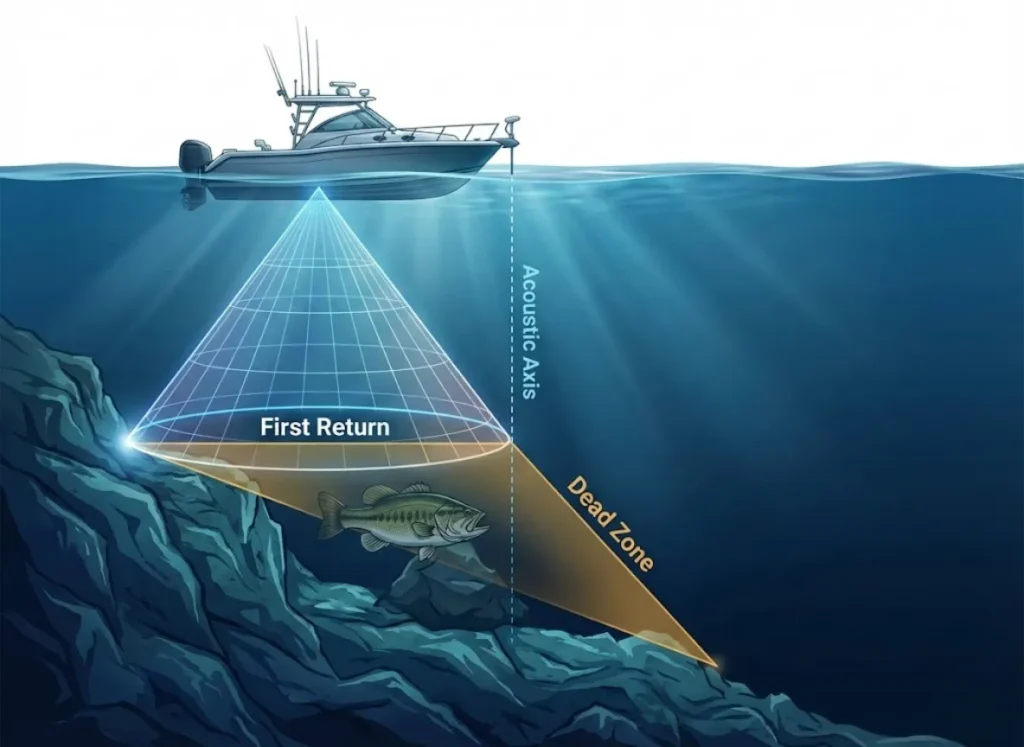
The unit instantly draws the bottom at that shallowest depth. It assumes the bottom is flat at that level. Consequently, any fish swimming in the deeper water directly beneath the boat are masked by the drawn bottom line.
This creates a triangular blind spot known as the acoustic dead zone. Research published in the ICES Journal of Marine Science quantifies the acoustic dead zone effect, confirming that fish in fish-holding areas tight to a drop-off are often physically inside this shadow. They appear as part of the bottom structure rather than distinct fish echoes. This is frequently the case when fishing heavy cover where bass often hide, leading anglers to believe a spot is barren when it is actually stacked with fish.
How do you calculate the height of the dead zone on a slope?
We can skip the complex trigonometry and look at the real-world results of this slope geometry problem. The height of this blind spot is determined by your depth and how steep the slope is.
Let’s look at a scenario. You are over a steep drop-off in 50 feet of water. If you use a wide 60° beam, that blind spot can be over 13 feet high.
This means a school of fish suspending 10 feet off the bottom would be completely invisible to you.
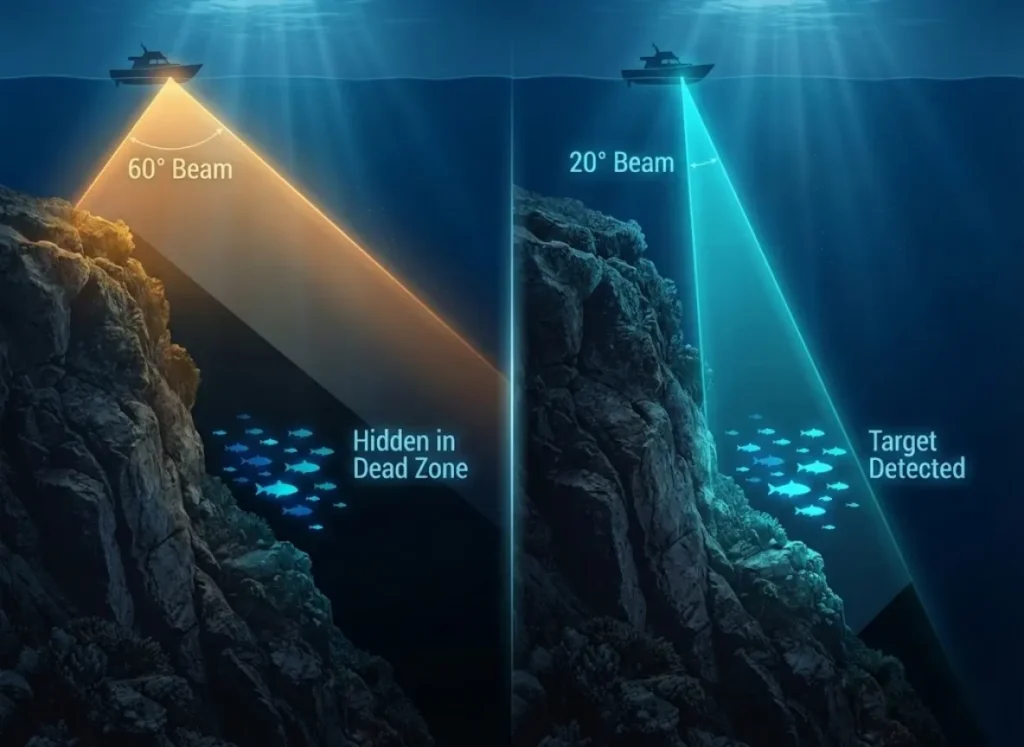
If you switch to a narrow 20-degree cone in the same spot, that dead zone shrinks to about 3 feet. This massive difference is why narrow beams are mandatory for fish-holding structure. NOAA’s Standard Ocean Mapping Protocol discusses the limitations of beam width on uneven terrain, reinforcing that clarity is lost without beam discipline.
Pro-Tip: If you are targeting late summer walleye near deep structure and your bottom return looks unusually “thick” or fuzzy on the screen, you are likely seeing the effects of a dead zone. Switch to your narrowest beam immediately to see if that “fuzz” separates into distinct fish targets.
How do specific transducer technologies affect resolution?
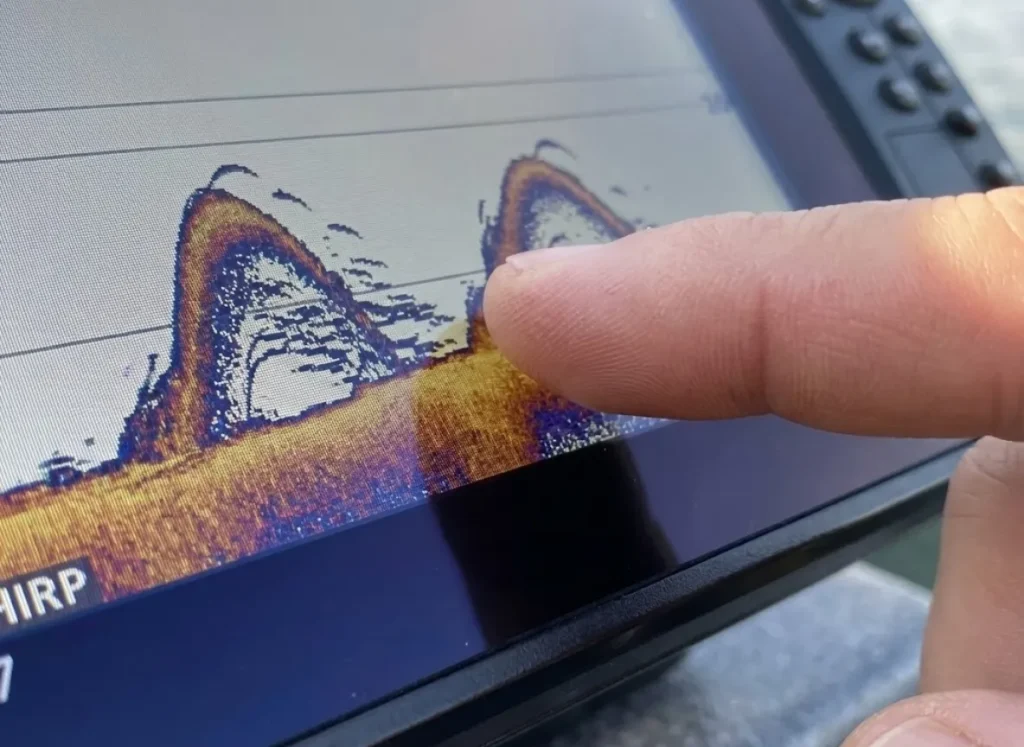
We can’t change the laws of physics, but modern technology helps us interpret the data. High-end processors found in Lowrance fishfinder/chartplotter installations and CHIRP sonar are vital for working around these geometric limits.
How does CHIRP improve target separation?
Traditional sonar uses a single “ping” or pulse. CHIRP (Compressed High-Intensity Radiated Pulse) is different. It sweeps across a range of frequencies, for example, from 150 to 240 kHz.
Instead of yelling one note, it sings a quick scale. This allows the processor to isolate targets based on frequency changes, not just the timing of the echo.
The primary benefit is target resolution, or separation. High-end CHIRP units, like those using MEGA DI+ transducers, can separate targets that are just half an inch apart. Standard sonar might merge them into a single blob. The Discovery of Sound in the Sea (DOSITS) project explains the physics of this pulse compression, highlighting how it cuts through noise.
While CHIRP cannot fix the geometric Dead Zone caused by a slope, it helps distinguish a fish that is hovering just above the danger zone. It also provides better clarity for identifying thermoclines and depth layers, ensuring you aren’t fishing below the active life zone.
Conclusion
True competence in fishing isn’t about buying the most expensive screen. It is about understanding the physics of the transducer mounted to your transom.
Remember the Area Multiplier. A wide beam covers ten times the water of a narrow beam. This makes it excellent for searching but poor for pinpointing sharp returns.
Respect the Dead Zone. On a steep slope, a wide beam can lie to you about the bottom 10 feet of the water column.
Geometry beats technology every time. No amount of pixel resolution can fix the physics of a “First Return.” Your boat positioning and your willingness to switch beams are the most powerful tools you have. Next time you are on the water, experiment by passing over the same drop-off with both wide and narrow beams. You might just see the “empty” water come alive.
FAQ – Frequently Asked Questions about Transducer Beam Geometry
How wide is a 20-degree sonar cone at 30 feet of depth?
At 30 feet, a 20-degree cone covers a circle about 10 feet wide. For a quick estimate on the water, use the 1/3 Rule: 20-degree coverage is roughly one-third of your depth.
Why do fish disappear from my screen when I go over a drop-off?
This is caused by the Acoustic Dead Zone. The edge of your wide sonar cone hits the high side of the slope first. The unit draws the bottom at that depth, hiding everything deeper in the shadow.
Does a wider cone angle always find more fish?
No. While wider cones cover more area, they reduce detail. They also create much larger blind spots near the bottom. Wide cones are best for suspended fish. Narrow cones are better for fish near the bottom.
What is the difference between 83 kHz and 200 kHz beams?
83 kHz typically produces a wide beam (often 60°) for maximum coverage but lower detail. 200 kHz produces a narrow beam (often 20°) for high detail and better separation of fish from the bottom.
Risk Disclaimer: Fishing, boating, and all related outdoor activities involve inherent risks that
can lead to injury. The information provided on Master Fishing Mag is for educational and informational purposes
only. While we strive for accuracy, the information, techniques, and advice on gear and safety are not a substitute
for your own best judgment, local knowledge, and adherence to official regulations. Fishing regulations, including
seasons, size limits, and species restrictions, change frequently and vary by location. Always consult the latest
official regulations from your local fish and wildlife agency before heading out. Proper handling of hooks, knives,
and other sharp equipment is essential for safety. Furthermore, be aware of local fish consumption advisories. By
using this website, you agree that you are solely responsible for your own safety and for complying with all
applicable laws. Any reliance you place on our content is strictly at your own risk. Master Fishing Mag and its
authors will not be held liable for any injury, damage, or loss sustained in connection with the use of the
information herein.
Affiliate Disclosure: We are a participant in the Amazon Services LLC Associates Program, an
affiliate advertising program designed to provide a means for us to earn advertising fees by advertising and linking
to Amazon.com. As an Amazon Associate, we earn from qualifying purchases. We also participate in other affiliate
programs and may receive a commission on products purchased through our links, at no extra cost to you. Additional
terms are found in the terms of service.