

In this article
The pause is the trigger. You rip the rod tip, stop the retrieve cold, and expect your jerkbait to freeze right in the predator’s face. In that split second, a bass decides to eat.
But instead of hovering, your expensive lure rockets toward the surface like a cork. The strike zone closes, and the fish turns away.
This isn’t bad luck. It is a failure of the physics of fishing lures.
Most manufacturers tune their lures for a laboratory baseline—typically 70°F water. They ignore the dynamic reality of the lakes you actually fish. To master the water column and maximize depth, you must stop treating water as a constant. You need to start manipulating the variables of material density and mass, understanding the true mechanics of lures.
This guide moves beyond guessing to true angling optimization. We are going to calculate, test, and adjust your tackle to make sure it stays exactly where the fish are.
The Physics of Suspension: Why Do “Suspending” Lures Float or Sink?
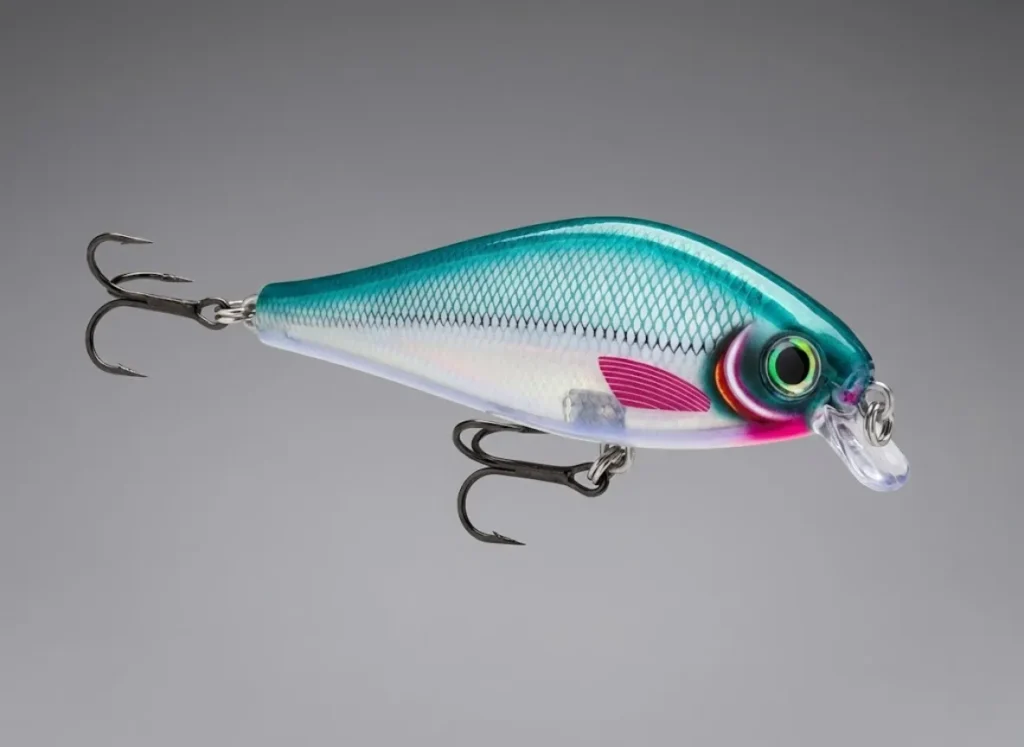
We need to strip away the marketing terms and look at how your lure acts in the water. A lure doesn’t “know” it’s supposed to suspend; it simply reacts to the forces around it, governed by classical mechanics.
What is the Secret to Neutral Buoyancy?
The primary goal is Neutral Buoyancy. This creates a state of perfect balance where the lure neither rises nor sinks.
Think of it like a balance scale. On one side, you have gravity pulling the lure down. On the other side, you have the upward buoyant force pushing the lure up. For a lure to suspend, the water pushing up must exactly match the weight of the lure pulling down.
Simply put, the average weight of your lure system (body + hooks + ballast) must exactly match the weight of the surrounding water it swims in. This is the core of Archimedes’ principle.
If the lure is lighter than the water, it possesses positive buoyancy and floats. If it is heavier, the object sinks.
As anglers, we cannot easily change the size of a hard plastic bait made of ABS plastic or balsa wood without destroying it. Therefore, we must change its weight. By consulting the principles of buoyancy and stability used in ship design and marine science, we learn that adding denser hardware (like tungsten or heavier steel) allows us to balance the equation.
Pro-Tip: Always tune your lure with the snap or split ring you intend to fish with attached. Even that tiny amount of metal adds to the total weight and changes how the lure behaves.
This is the first step in mastering general lure tuning techniques, ensuring your bait doesn’t just swim straight, but sits at the correct depth.
How Does Water Temperature Change Things?
Here is where it gets tricky. You might have a lure that suspends perfectly in your swimming pool in July, but floats rapidly in December.
Water is not static. Its “thickness,” or fluid density, changes significantly based on the water temperature. Fresh water density reaches its maximum at approximately 39.2°F (4°C). At this temperature, water molecules are packed tightest together.
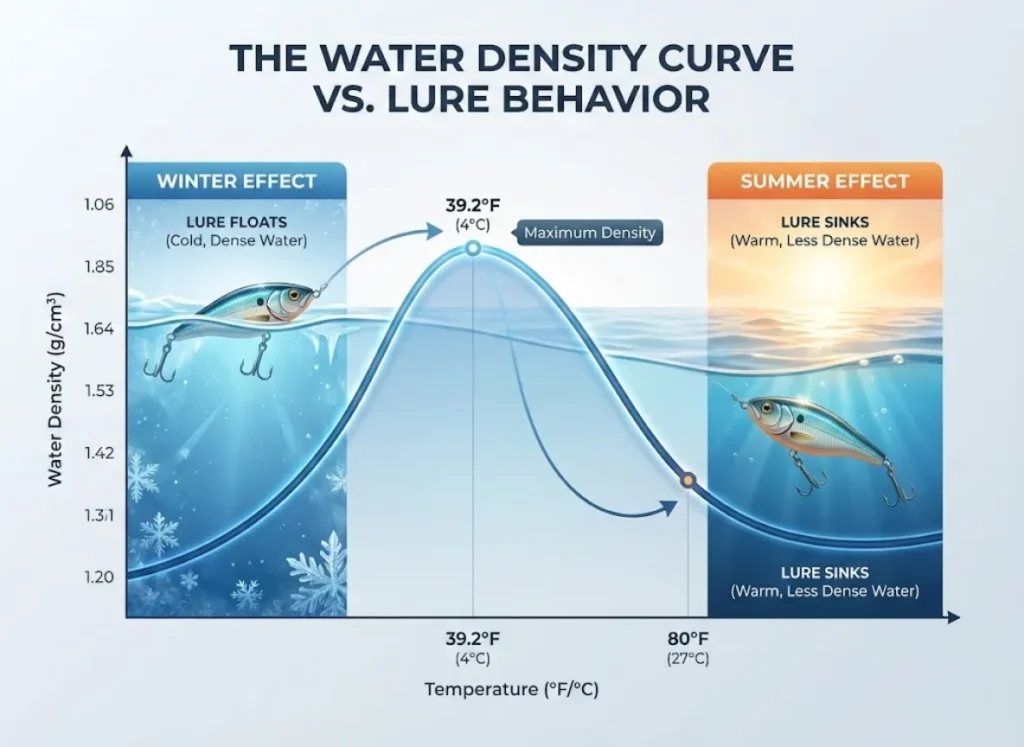
As water warms toward summer temperatures (e.g., 80°F), it expands and becomes lighter and less dense.
The Winter Effect: A lure tuned for 70°F takes up the same amount of space (volume) in 40°F water. However, because the cold water is denser, it is heavier. This heavy water exerts a stronger buoyant force on the lure. Consequently, “suspending” jerkbaits often behave like high-floaters in the pre-spawn cold due to this cold water buoyancy shift.
The Summer Effect: Conversely, a lure tuned specifically for winter will sink in warm water. The lighter summer water simply cannot hold the lure up.
According to authoritative water density temperature dependence data, these shifts are predictable. Understanding this concept is as vital as understanding how thermoclines affect fishing depth, as both are driven by the relationship between temperature and density.
The “Bucket Method”: How to Calculate and Test Lure Buoyancy?
Since we cannot easily do the math on an oddly shaped lure body to determine its specific gravity, we rely on testing. We move from the whiteboard to the workbench.
What is the Step-by-Step Process for the “Archimedes Dunk Test”?
This process, essentially a practical water displacement method, eliminates the manufacturing mistakes—the “Lemon Factor”—that exist even in high-end lures.
- Prepare the Environment: Fill a clear container—a bucket works, though a lab beaker adds precision. Crucially, the water must be the same temperature as the lake you plan to fish. If you are fishing early spring waters, use ice to chill your test water to 45°F–50°F.
- Submerge and Clear: Place the lure in the water. Shake it vigorously underwater to remove air bubbles trapped in split rings and hook hangers. These bubbles act like little fishing floats and will mess up your test.
- Watch the Movement: Push the lure down and watch the rise rate.
- Fast Rise: The water is pushing up too hard. You need significant weight (hook upgrade).
- Dead Suspend: The lure does not move up or down. Ideal for lethargic, cold-water fish with slow fish metabolism.
- Slow Rise: The lure rises about 1 foot every 3 seconds. Often preferred for active summer predators.
- Sinks: The lure is too heavy. Reduce weight by using lighter wire hooks or removing the nose split ring.
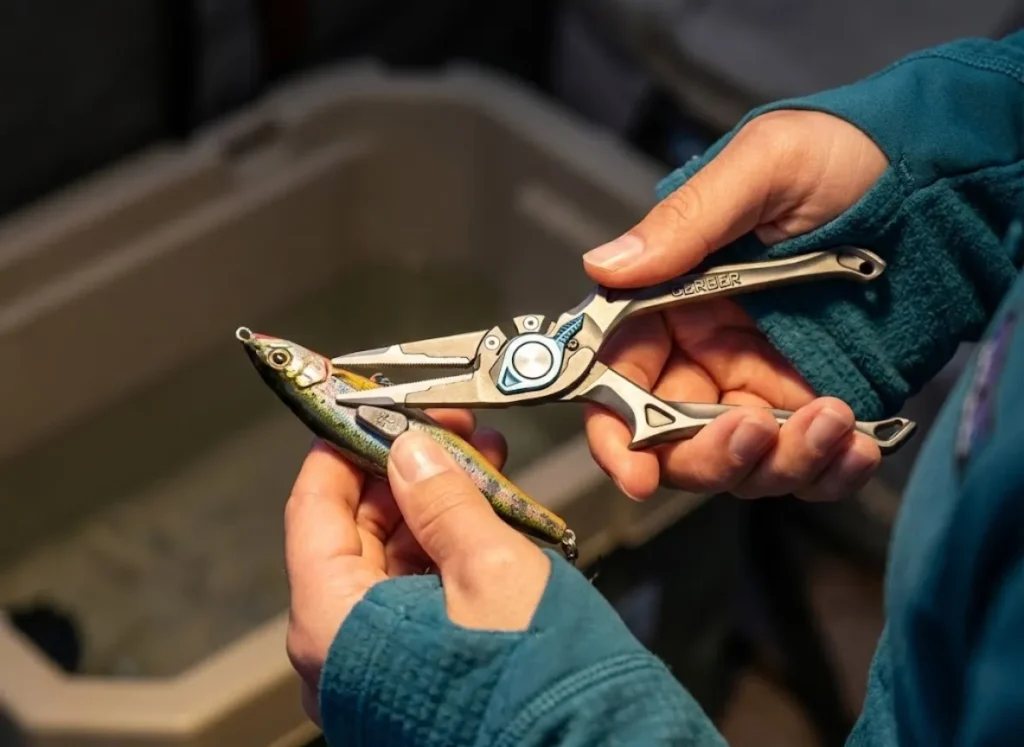
This experimental determination of buoyancy is the only way to be sure. To do this precisely, you will need a few items from your kit of essential fishing tools, specifically a digital gram scale capable of measuring tiny fractions of a gram.
How Can You Use Hook Weights for Tuning?
Swapping out hooks is the easiest way to add or remove weight. This is basic terminal tackle engineering. However, hook sizes are rarely standard across brands.
A standard Gamakatsu Round Bend #6 might weigh approximately 0.35g. By comparison, a Mustad Triple Grip #4 can weigh 0.65g.
Fishing Hook Tuning & Weight Guide
Comparison of popular treble hooks for jerkbait suspension and sink rate optimization.
Style & Build
Triple Grip (2X Short). Increases hook gap without adding excessive weight.
Tuning Application
Standard swap for Megabass 110s; ideal for maintaining suspension with better hooksets.
Style & Build
4X Strong. Extreme weight designed for high-stress applications and heavy-duty fish.
Tuning Application
Rapid sink rates. Drastically shifts Center of Gravity; creates a fast “sinker” effect.
Style & Build
Standard Wire. Very light wire for maximum buoyancy.
Tuning Application
Ideal for summer or warm water to prevent sinking and maintain high action.
Style & Build
Round Bend. Slightly heavier than Gamakatsu equivalent.
Tuning Application
Excellent for subtle suspension tuning when a lure is just slightly too buoyant.
Style & Build
Medium Heavy. A specialized intermediate size that provides strength without bulk.
Tuning Application
Excellent intermediate tuner; adds moderate weight to stabilize high-buoyancy lures.
This 0.30g difference is massive. It is often enough to shift a lure from a “high floater” to a “slow sinker” without ruining the bait’s profile with lead tape.
For Micro-Tuning (very small adjustments), use adhesive lead or tungsten strips (Storm Suspendots) placed along the belly. For Heavy Duty Applications, such as creating a sinking lure for deep water catfishing, swap to 4X strong hooks. These are thick and heavy, adding significant weight. Some custom builders even use tungsten powder mixed with epoxy to fine-tune cedar or balsa wood baits.
Referencing standard data regarding materials helps us understand why steel thickness matters. It is essential to keep a personal log of hook weights so you can plan the swap before you cut the old hooks off with your nose pliers.
Pro-Tip: If you upgrade to heavier hooks to fix the rise rate, ensure they don’t tangle with each other. This is known as “hook fouling.” You can usually go one size up (e.g., #6 to #4) on the front hook without issues, but check the spacing carefully.
This connects directly to the science of hook sizes, where shape and weight intersect.
Advanced Tuning: Controlling Rise Rate and Action
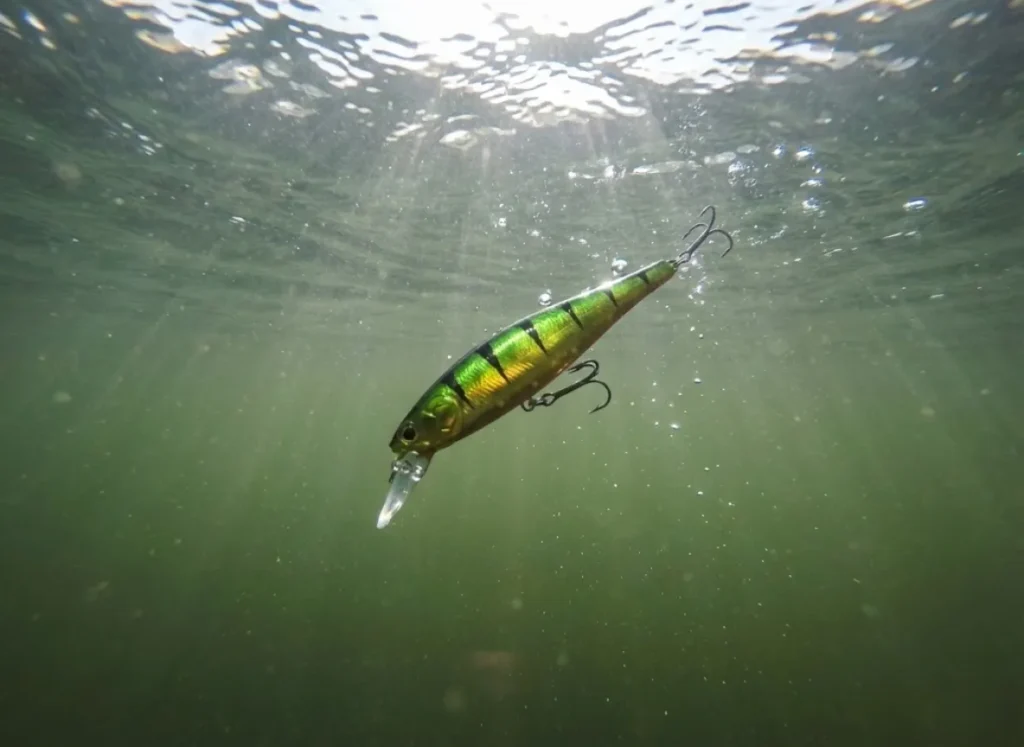
We have managed the vertical movement (floating vs. sinking). Now we must look at “Trim”—the angle of attack and how the lure sits in the water.
How Do Balance Points Work?
Every lure has a Center of Gravity (CG), which is the balance point where most of the weight is. It also has a Center of Buoyancy, which is usually the air chamber inside that wants to float.
When you place weights low in the belly, you lower the Center of Gravity. This acts like the keel on a cargo ship. It creates a strong ability to stay upright. This keeps the lure swimming straight with a tight action amplitude. This is superior for cold-front conditions when fish are picky.
However, we can play with this balance for specific presentation at depth:
- Nose-Down Trim: Upgrading only the front hook moves the weight forward along the longitudinal axis. When paused, the lure hangs nose-down, mimicking a dying shad struggling toward the bottom.
- Tail-Down Trim: Weighting the rear hook moves the weight back. This stops the tail from kicking as wide, but it can help the lure fly straighter during a cast, improving casting distance.
- Hunting Action: By using lighter belly hooks, you raise the Center of Gravity. This makes the lure less stable. It may “hunt” or wander erratically at high speeds, which helps trigger a bite.
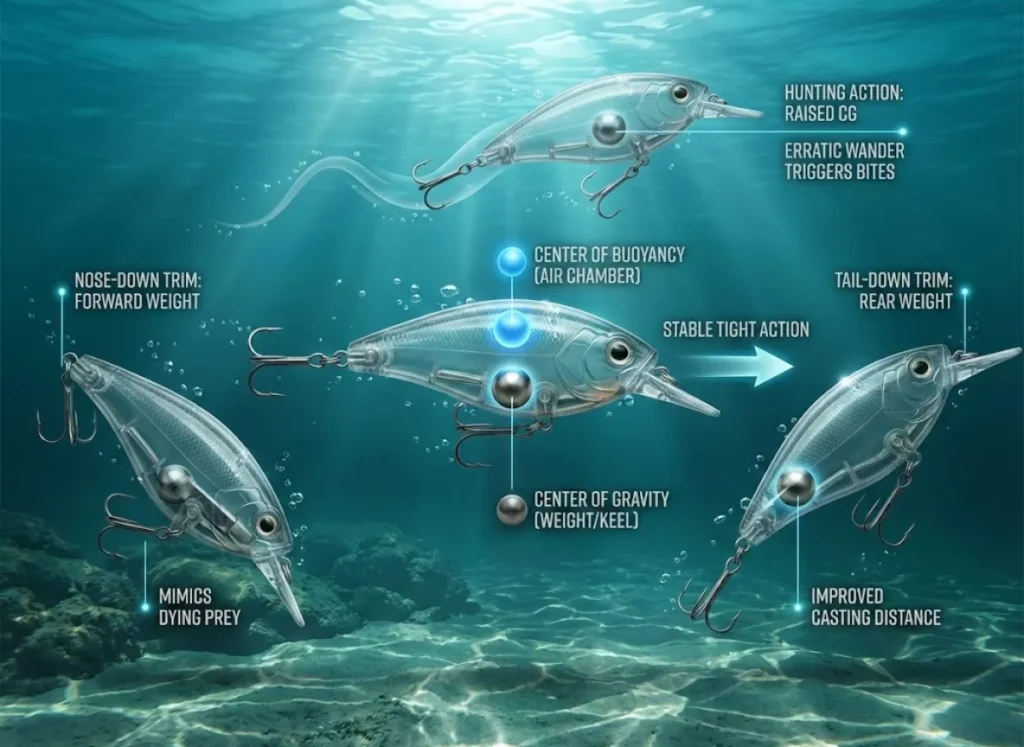
Understanding the principles of stability allows you to customize not just the depth, but the attitude of the bait. This concept is similar to crankbait hydrodynamics, where bill angle forces the lure to dive against hydrodynamic drag.
The Bottom Line
Lure performance is not magic; it is simple math and fluid dynamics. Remember these three realities:
- Buoyancy is Relative: A lure is never permanently “suspending.” Its state depends entirely on the water temperature and fluid density.
- Cold Water requires Weight: As water cools and gets thicker (approaching 39°F), you must add weight to prevent the lure from floating due to increased buoyant forces.
- Precision is King: A tiny variance is the difference between a perfect suspension and a lure that floats away from the fish.
Stop accepting “out of the box” performance as the limit. Take your tackle to the test tank, do the work, and engineer your success. Share your tuning on site results in the comments below—I’d love to hear what combinations worked for your local waters.
FAQ – Frequently Asked Questions about Lure Buoyancy
Why does my suspending jerkbait float in the winter?
Cold water is denser and thicker than warm water. This pushes up harder on the lure, creating a stronger upward force. To fix this, you must add weight (heavier hooks or adhesive strips) to match the heavy winter water.
How much weight do I need to add to make a lure suspend?
It usually takes very small adjustments, often just a fraction of a gram. Start with an Archimedes Dunk Test using water at the same temperature as your lake. Add adhesive dots one by one until the lure hovers.
Does fluorocarbon line affect lure sink rate?
Yes. Because of its material density, fluorocarbon sinks and helps counteract buoyancy. The weight of the line will drag the nose of the lure down, helping it get deeper. Monofilament floats and will pull the lure up.
Can I use lead tape instead of specific fishing weights?
Yes, high-density golf lead tape is an excellent, cheap alternative for tuning lures. You can cut it to the exact size you need and flatten it along the lure’s belly to minimize hydrodynamic resistance so it doesn’t affect the swimming action.
Risk Disclaimer: Fishing, boating, and all related outdoor activities involve inherent risks that
can lead to injury. The information provided on Master Fishing Mag is for educational and informational purposes
only. While we strive for accuracy, the information, techniques, and advice on gear and safety are not a substitute
for your own best judgment, local knowledge, and adherence to official regulations. Fishing regulations, including
seasons, size limits, and species restrictions, change frequently and vary by location. Always consult the latest
official regulations from your local fish and wildlife agency before heading out. Proper handling of hooks, knives,
and other sharp equipment is essential for safety. Furthermore, be aware of local fish consumption advisories. By
using this website, you agree that you are solely responsible for your own safety and for complying with all
applicable laws. Any reliance you place on our content is strictly at your own risk. Master Fishing Mag and its
authors will not be held liable for any injury, damage, or loss sustained in connection with the use of the
information herein.
Affiliate Disclosure: We are a participant in the Amazon Services LLC Associates Program, an
affiliate advertising program designed to provide a means for us to earn advertising fees by advertising and linking
to Amazon.com. As an Amazon Associate, we earn from qualifying purchases. We also participate in other affiliate
programs and may receive a commission on products purchased through our links, at no extra cost to you. Additional
terms are found in the terms of service.