
In this article
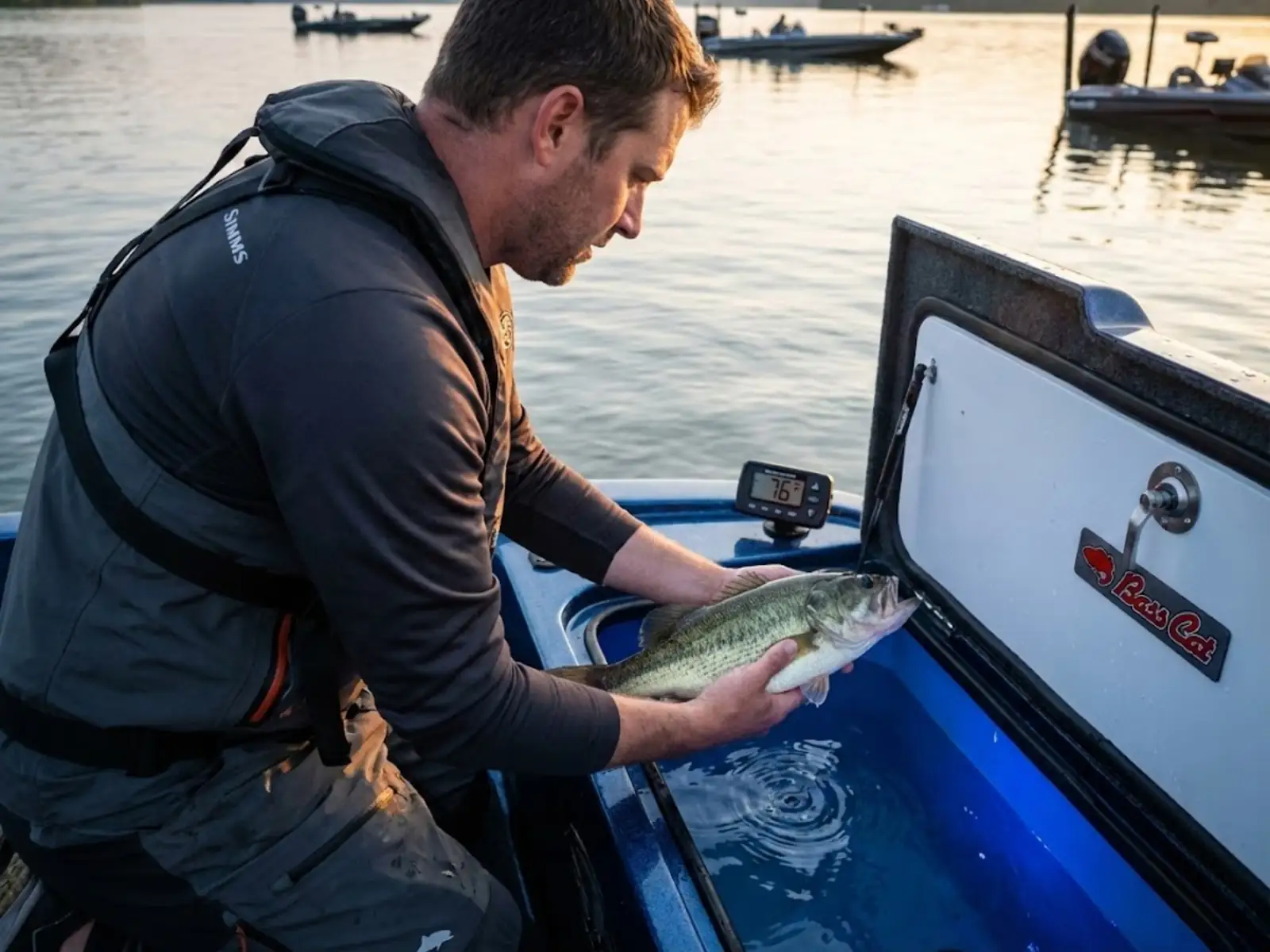
The weigh-in line moved fast at Wheeler Lake. Stetson Blaylock swung his bag onto the scale, and as the numbers settled, his heart sank—4 ounces deducted for a dead fish. In 1997, Dalton Bobo brought enough weight to the Bassmaster Classic stage to win. A single dead fish cost him the title by one ounce. That penalty didn’t just take $100,000 from his pocket—it changed the trajectory of his entire career.
After two decades of competitive bass fishing and more tournament weigh-ins than I can count, I’ve learned this truth: the livewell isn’t just a tank. It’s the vault protecting your paycheck. And most anglers are unknowingly killing their equity before they ever reach the stage.
Here’s the complete system for keeping every bass alive—from the moment it hits the deck until you walk off that stage.
⚡ Quick Answer: Tournament fish die from three biological failures: thermal stress above 84°F, oxygen starvation below 5.5 ppm, and barotrauma from deep catches. Prevent all three by cooling your livewell 8-10°F below lake temperature, running pumps on continuous recirculate, treating water with G-Juice, and fizzing any fish that won’t submerge. The 4-ounce dead fish penalty has decided championships—Dalton Bobo lost the 1997 Classic by 1 ounce after a single dead fish.
The Biology of Tournament Fish Death
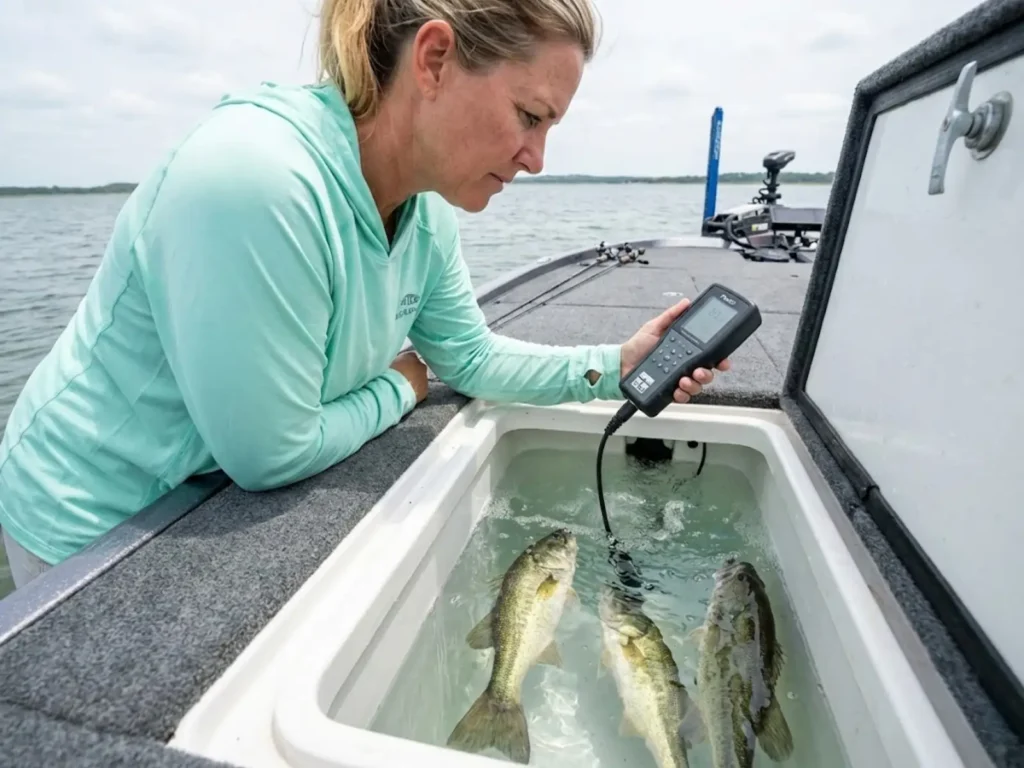
Tournament fish mortality isn’t random bad luck. It’s predictable biology that you can control once you understand what’s happening inside that livewell.
The 84°F Red Line: Where Survival Becomes Impossible
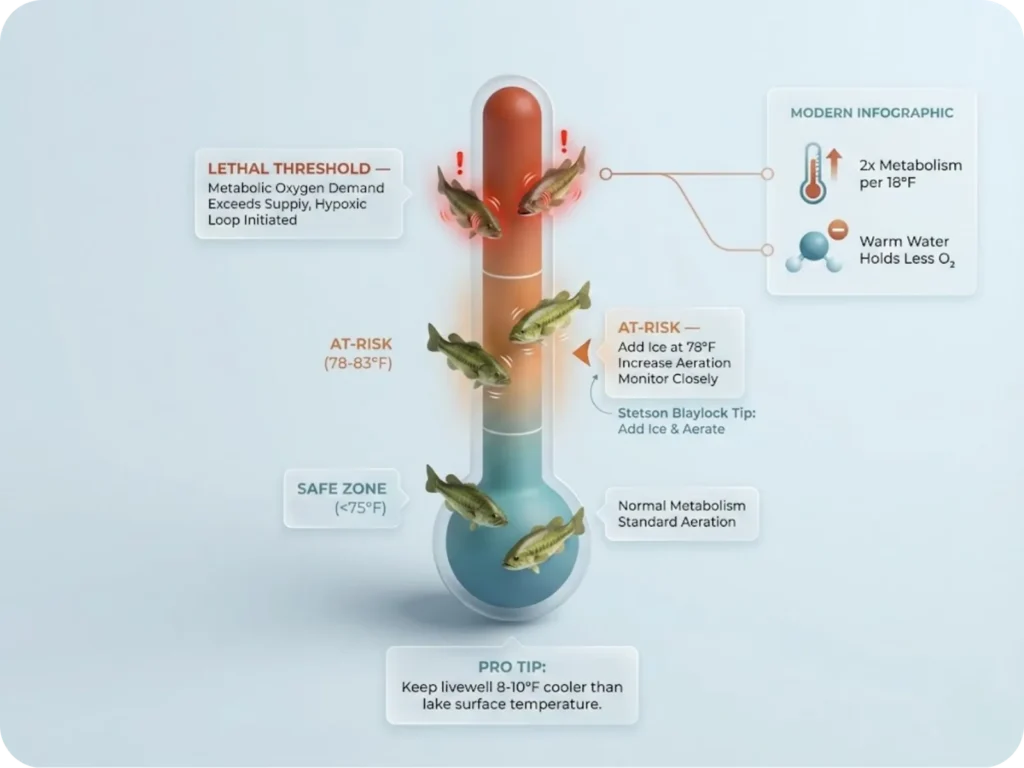
Mississippi State University established 84°F as the critical thermal maximum for largemouth bass. Above this temperature, the fish’s metabolism outpaces the gills’ ability to extract oxygen—even in perfectly saturated water.
Here’s why that number matters so much. Bass are cold-blooded, and their metabolic rate roughly doubles with every 18°F rise in water temperature. A fish sitting in 85°F water is burning fuel—and consuming oxygen—at nearly twice the rate of a bass in 70°F water.
The cruel paradox: warm water physically holds less dissolved gas than cold water. So you’ve got a fish with double the oxygen demand sitting in water with reduced oxygen supply. That convergence creates the hypoxic loop that standard aerators can’t break.
Pro tip: Stetson Blaylock starts adding ice the moment his livewell hits 78°F—not 84°F. By the time your gauge reads 84, your fish have already been cooking for an hour. Get ahead of it.
The goal isn’t making water cold enough to shock the fish when you release them. You want to keep your livewell 8-10 degrees cooler than lake surface temperature. That modest cooling drops your fish’s metabolism to a manageable rate where fish metabolism responds dramatically to water temperature changes.
Hypoxia: The Silent Killer Hiding in Your Livewell
Bass need a minimum of 5.5 ppm dissolved oxygen to survive. They thrive at 8.5 ppm. When levels drop below that floor, the fish switches to anaerobic metabolism, and the biological cascade starts.
Without enough oxygen, bass produce lactic acid. That acid lowers blood pH. Low blood pH reduces the blood’s ability to bind oxygen through what biologists call the Bohr Effect. This creates a vicious cycle: the fish needs more oxygen to clear the lactate, but its acidic blood can’t absorb what’s available.
This explains delayed tournament mortality—fish that swim away at the release boat but die within 24 hours. Their blood chemistry was already damaged before they left your hands. For a deeper understanding of dissolved oxygen levels, the science is straightforward: manage your oxygen, and you manage survival.
Barotrauma: The Deep-Water Death Sentence
Bass are physoclistous—they have a closed swim bladder that can’t “burp” excess air like a catfish or gar. When you pull a fish from below 20 feet, the gas in that bladder expands as pressure drops.
The expanding bladder crushes the kidneys and heart. It forces the stomach out through the mouth. The fish floats belly-up, gills partially exposed to air, slime coat baking against the livewell lid. Without intervention, these fish face 100% mortality.
The bitter irony: deep structure produces the biggest bass in summer. Your money fish from the best spots become the most fragile. Understanding how barotrauma affects sport fish during rapid ascent helps you recognize when intervention is mandatory.
The Five Mistakes That Kill Tournament Bass
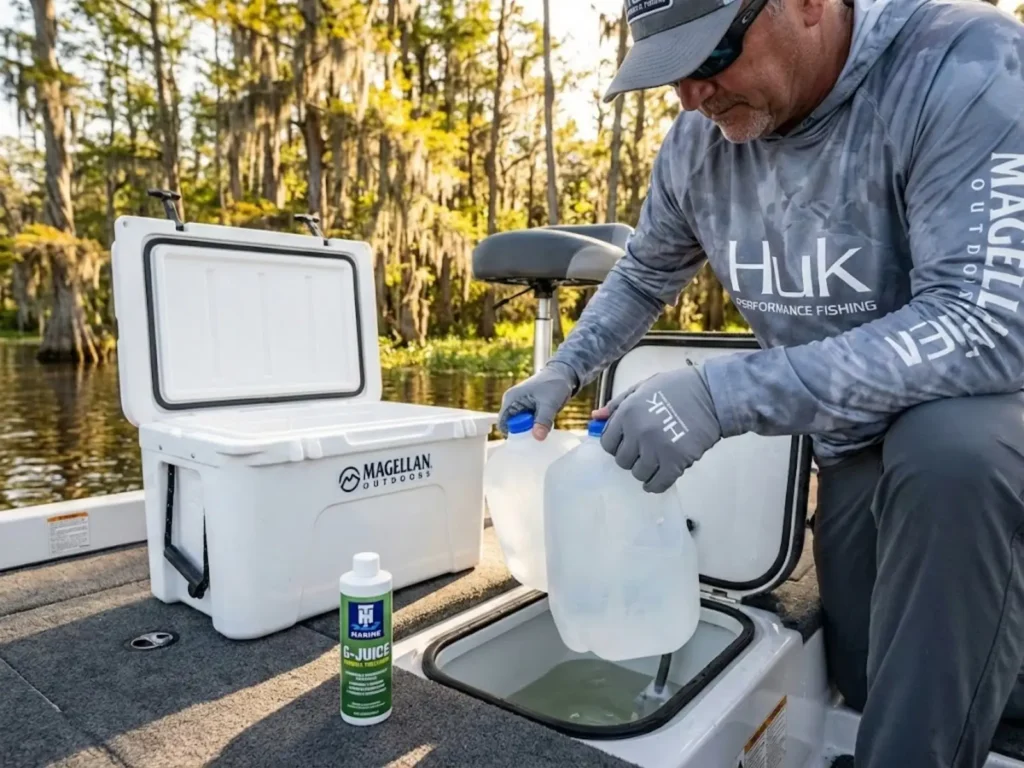
Every dead fish at weigh-in traces back to preventable errors. Here are the five that cost anglers the most money.
Mistake #1: Using Municipal Ice (The Chlorine Burn)
Bass have effectively zero chlorine tolerance—less than 0.003 mg/L before damage begins. Municipal tap water used to make ice often contains 1-4 mg/L chlorine. That’s a thousand times the lethal concentration.
Chlorine causes acute gill necrosis. The delicate lamellae structures responsible for gas exchange swell and burst. A fish with burned gills suffocates even in highly oxygenated water because the tissue that transfers oxygen is destroyed.
A Texas study documented 89% delayed mortality in fish exposed to chlorinated release tubes. Most anglers never consider that the ice from their home freezer could be killing their catch. According to SEAFWA research on release tube mortality, water source matters as much as temperature.
The fix: freeze jugs of well water or dechlorinated water the night before. G-Juice neutralizes chlorine instantly—add it before your first fish hits the tank.
Mistake #2: The Oxygenator + Salt Death Trap
The Oxygenator uses electrolysis to generate nano-bubbles of oxygen. It’s effective technology. The problem starts when anglers follow old advice that “salt helps stressed fish.”
Here’s the chemistry disaster: electrolysis splits salt molecules (NaCl), releasing free chlorine gas into your livewell. You’ve turned your life-support system into a gas chamber. Fish die rapidly, often bleaching white.
Texas Parks & Wildlife biologist Todd Driscoll issued specific warnings about this interaction. As he told reporters, “The device actually separates the water molecules and produces lethal chlorine gas if used with salt.” The biologist warnings about Oxygenator and salt combinations are clear: never combine these products.
The fix: if you run an Oxygenator, use G-Juice instead of salt. It contains different electrolyte compounds that don’t create chlorine.
Mistake #3: Running the Wrong Pump Setting
“Fill” mode pumps in fresh surface water—often 88°F+ in summer. You’re adding hot water faster than ice can cool it. Every minute on Fill defeats your livewell temperature management.
The correct protocol: fill your livewell early in the morning when water is coolest. Add ice and G-Juice. Then switch to Recirculate. This aerates your conditioned water without introducing new heat or ammonia from surface runoff.
Aaron Martens, one of the all-time greats, ran his pumps on continuous—not timer—once he had more than 10 pounds of fish. “Recirculate with a venturi intake,” he advised, “and you keep that water moving without bringing in junk from the lake.” A proper livewell setup and pump operation covers Flow-Rite systems and intake modifications in detail.
Pro tip: The fish care protocol starts before launch. Fill livewells at the first stop of the day, treat the water, add ice, switch to Recirculate. If you wait until noon to start managing temperature, you’re already behind.
Mistake #4: Deck Contact (The Slime Coat Catastrophe)
The mucous coat on a bass takes 2-3 weeks to regenerate once stripped. Dry carpet, hot deck metal, and coarse rubber destroy this protective layer instantly.
A fish with damaged slime coat is vulnerable to Saprolegnia fungus and “Red Sore Disease” long after the tournament ends. Aaron Martens put it bluntly: “If you bounce a fish in the bottom of the boat where your feet go… there’s a good chance you probably kill that fish.” The science behind fish slime coat function explains why this protective barrier matters so much.
Large fish suffer disproportionately. Mississippi State data showed bass over 18 inches had 29% mortality compared to 9% for smaller fish. Your biggest bass—the ones that swing tournaments—need the most careful handling. Wet hands only. Rubber-coated nets. Never touch carpet.
Mistake #5: Ignoring the Floater (Barotrauma Denial)
A floating fish is a fish with over-expanded swim bladder. It can’t reach the aerated water column. Its gills dry against the lid. Bacterial infection begins.
Many anglers hope the fish will “recover” on its own. It won’t. Without intervention, a floater becomes a guaranteed 4-ounce penalty.
Watch for warning signs: fish caught deeper than 20 feet, stomach protruding from mouth, inability to maintain neutral buoyancy. If a fish can’t submerge within 30 seconds, you need to fizz it.
The Fizzing Procedure: Venting Barotrauma Bass
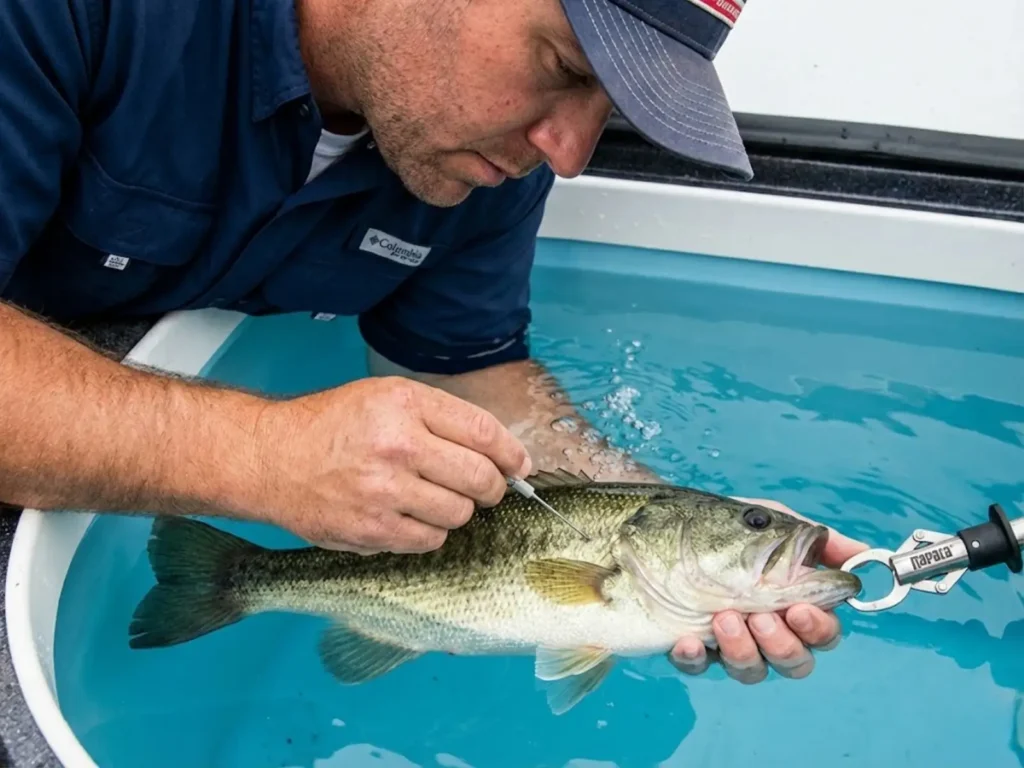
Fizzing sounds intimidating—you’re puncturing a fish with a needle. But the alternative is a dead fish. Here’s how to do it right.
When Fizzing Is Necessary
You need to fizz any vented fish that won’t submerge on its own within 30 seconds, especially if caught from depths greater than 20 feet. Visible symptoms include floating on its side, stomach in throat, and the inability to swim down.
Some tournament-fishing organizations require officials to perform the procedure. But knowing the technique yourself saves fish between catches.
The Correct Technique (John Crews Method)
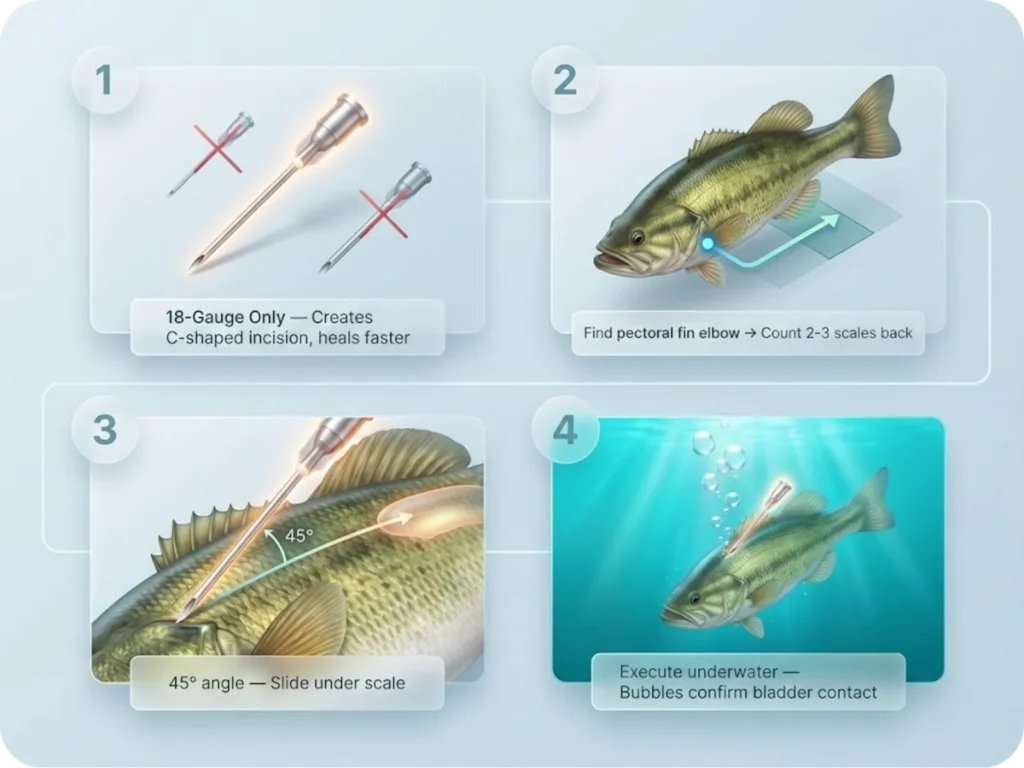
The tool matters. Use an 18-gauge needle specifically—larger needles cause hemorrhage, smaller needles fail to vent viscous gas. The 18-gauge creates a “C-shaped” incision that heals faster than ragged holes from improper tools.
Find the pectoral fin. Draw an imaginary line from the “elbow” of that fin straight back. Count 2-3 scales behind the fin. That’s your pectoral fin insertion point.
Insert the needle at a 45-degree angle, sliding under the scale. You’ll hear a hiss or see bubbles escaping. Gently squeeze the fish’s belly until it reaches neutral buoyancy. Execute the procedure underwater when possible—seeing bubbles confirms you’ve hit the bladder.
The Arkansas Game and Fish Commission fizzing guidelines provide official state agency protocol for this fizzing technique.
What Can Go Wrong
Insert too deep and you’ll puncture vital organs—the bladder sits just beneath the scales. Hit the wrong location and you damage kidney or liver. If a fish doesn’t stop bubbling, you may have punctured gut rather than bladder.
When in doubt, leave the fish submerged in cold, aerated water and monitor. A floating fish might still survive if water conditions are optimal. A fish with internal hemorrhage won’t.
The Chemical Arsenal: Livewell Additives That Work
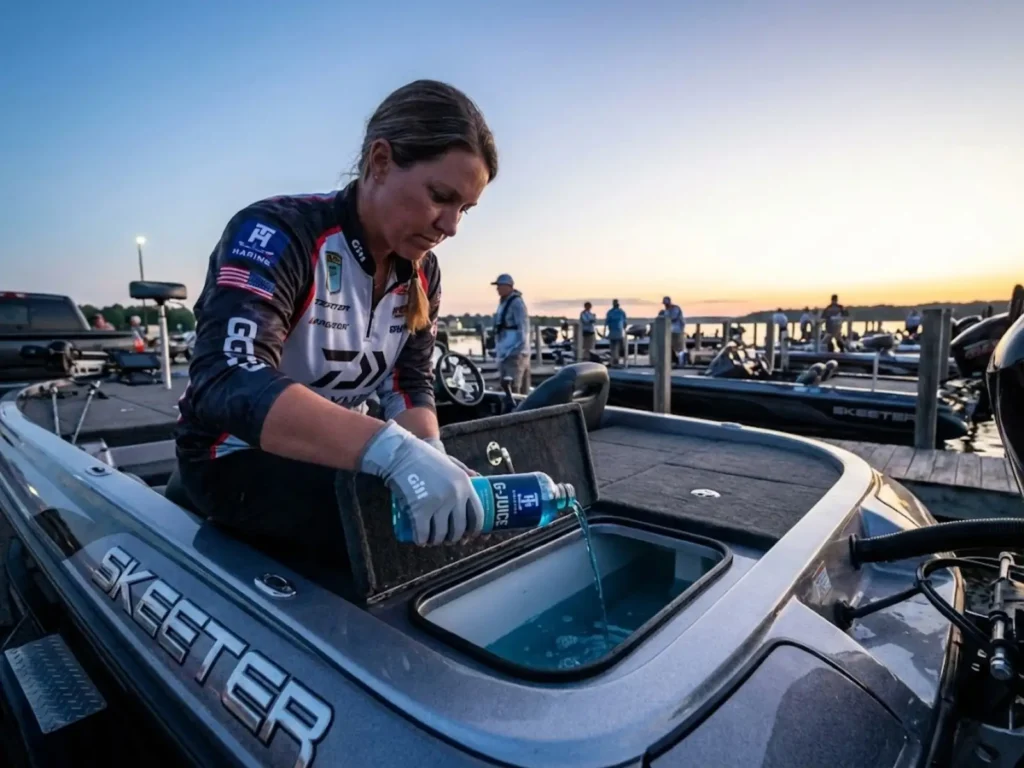
Not all livewell additives deliver what they promise. Here’s what the science supports.
G-Juice: The Industry Standard
T-H Marine G-Juice solves three problems at once. It neutralizes chlorine from municipal ice. It hardens the slime coat damaged by handling. It supplies electrolytes that help the fish manage osmoregulation under stress.
Unlike granular salt that takes time to dissolve and can burn tissue if a fish eats a granule, liquid G-Juice activates instantly. And critically, it doesn’t interact dangerously with Oxygenator systems—it uses different electrolyte chemistry than table salt.
Understanding the cortisol stress response in caught fish explains why electrolyte supplementation helps reduce fish stress.
The Hydrogen Peroxide Gamble
Some anglers use hydrogen peroxide to “add oxygen.” The chemistry is correct—H₂O₂ releases oxygen when it breaks down. But the biology is dangerous.
Hydrogen peroxide is an oxidizer. Overdose it and you burn gill filaments. A fish with burned gills can’t transfer oxygen regardless of how saturated the water is. You’ve created the problem you were trying to solve.
High risk, low reward. Proper mechanical aeration with a venturi intake does the job without the danger. Skip the peroxide.
Pro tip: Treat your livewell water immediately after filling—before your first fish goes in. G-Juice works preventatively. Adding it after fish have already been exposed to chlorinated ice is playing catch-up.
The Regulatory Trap: Culling Laws That End Tournaments
The rules vary by state, and ignorance doesn’t protect you from disqualification.
The Standard Rule: Cull and Penalty
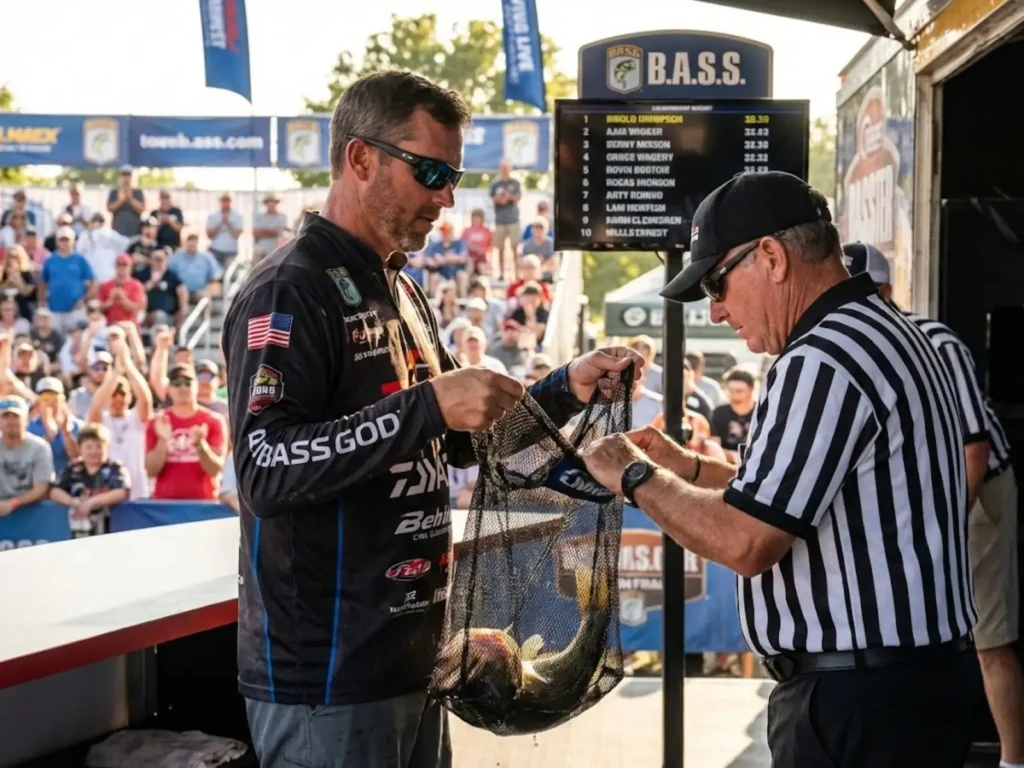
Under B.A.S.S. and Bass Pro Tour rules, a dead fish costs you 4 ounces deducted from your total weight. You can still weigh the fish, but it’s typically disqualified from Big Bass prizes.
The standard approach: if a fish dies, you take the dead fish penalty but can cull it to make room for a live replacement. The 4-ounce hit is painful, but you’re still in the tournament.
The Minnesota/Wisconsin Trap
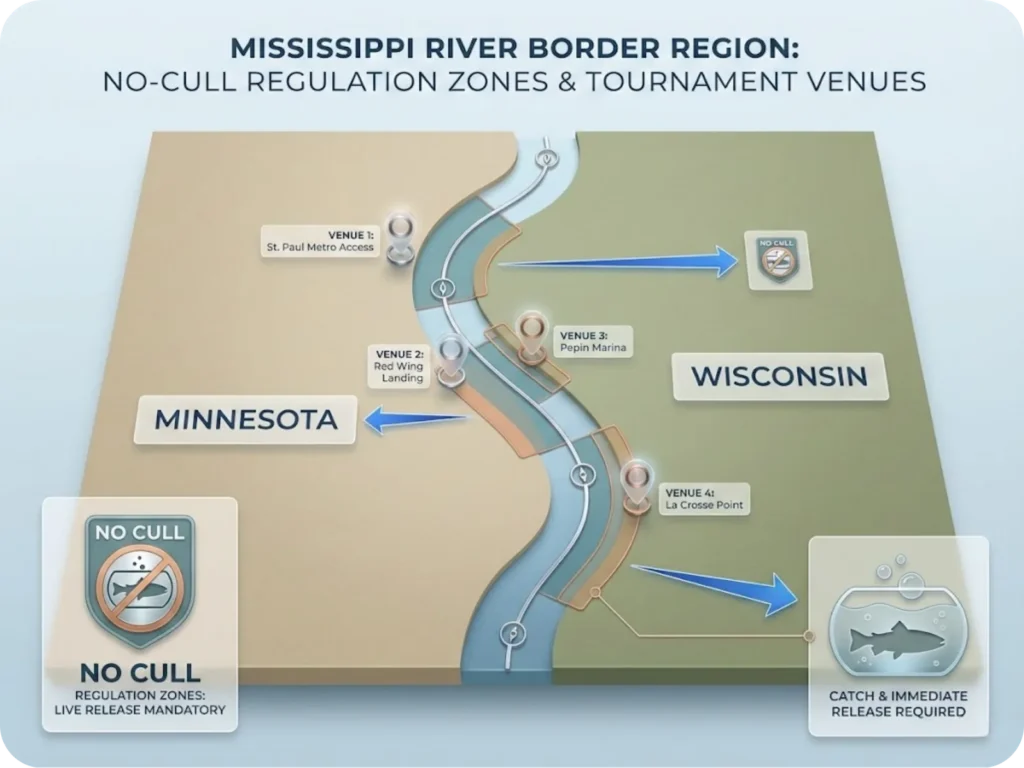
On the Mississippi River and border waters between Minnesota and Wisconsin, it is illegal to cull a fish that’s been “reduced to possession.” Minnesota fishing regulations on possession limits spell it out clearly. The Wisconsin DNR enforces similar restrictions.
Picture this scenario: you have 5 fish in your livewell. One dies. You catch a 6-pound giant—your 6th fish. Under this rule, you cannot release the dead fish. You cannot keep the 6th fish. You’re forced to throw back the upgrade.
Out-of-state anglers fall into this culling bans trap every season. Before any summertime tournament outside your home waters, research local regulations.
The Dollar Math: What Dead Fish Really Cost
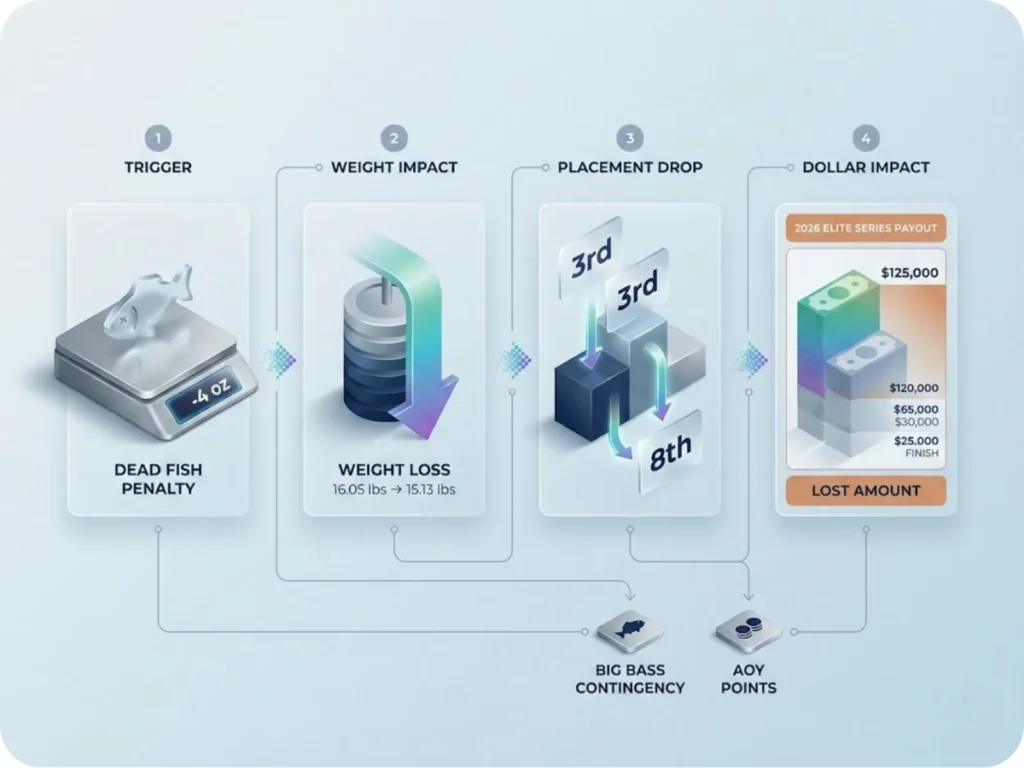
Dalton Bobo’s dead fish at the 1997 Classic cost him an inflation-adjusted $250,000 in immediate prize money. The “Classic Champion” endorsement premium would have multiplied that over his career.
Modern Bassmaster Elite Series payouts run from $15,000 at the bottom to $125,000 at the top. A dead fish penalty doesn’t just cost 4 ounces—it costs the exponential difference between finishing positions. Add lost Big Bass contingencies and Progressive Bassmaster Angler of Year points, and the true cost compounds across an entire season.
Understanding proper science-based catch and release practices connects tournament fish survival to conservation outcomes. Both depend on keeping fish alive.
Conclusion
Tournament fish care is a system, not a collection of tips. The physics are straightforward: keep water below 84°F, maintain 5.5+ ppm dissolved oxygen, eliminate chlorine exposure, and handle bass like the investments they are.
The anglers who treat livewell management as a scientific discipline—cooling water proactively, running recirculate aerator pumps continuously, fizzing deep-water fish immediately—don’t lose money to preventable penalties.
Before your next event, run through the checklist: dechlorinated ice ready, G-Juice dosed, pump set to recirculate, 18-gauge needle in the tackle box. When you’re standing at the scales with a limit of healthy bass, you’ll know exactly why.
FAQ
How much ice should I put in my livewell?
Add ice in small increments to cool water 8-10°F below lake surface temperature—not to make it cold. Frozen gallon jugs provide controlled cooling without temperature shock. Add more throughout the day whenever your livewell temperature exceeds 78°F.
What is the penalty for a dead fish in Bassmaster tournaments?
The standard dead fish penalty is 4 ounces (0.25 lb) deducted from your total weight. The fish can still be weighed but is usually disqualified from Big Bass prizes. In 1997, Dalton Bobo lost the Bassmaster Classic by 1 ounce after a single dead fish penalty.
Can you use salt in a livewell with an Oxygenator?
No—this combination is lethal. The Oxygenator’s electrolysis process splits salt molecules, releasing chlorine gas into the water. Texas Parks & Wildlife biologists have documented mass fish kills from this mistake. Use G-Juice instead.
When should I fizz a bass?
Fizz immediately when a fish cannot submerge on its own within 30 seconds, especially if caught from depths greater than 20 feet. Warning signs include floating on its side, stomach protruding from mouth, and inability to maintain neutral buoyancy.
Is it legal to cull a dead fish in all states?
No. Minnesota and Wisconsin border waters on the Mississippi River prohibit culling fish that have been reduced to possession. If a fish dies, you cannot remove it to make room for a replacement—the dead fish must stay in your limit.
Risk Disclaimer: Fishing, boating, and all related outdoor activities involve inherent risks that
can lead to injury. The information provided on Master Fishing Mag is for educational and informational purposes
only. While we strive for accuracy, the information, techniques, and advice on gear and safety are not a substitute
for your own best judgment, local knowledge, and adherence to official regulations. Fishing regulations, including
seasons, size limits, and species restrictions, change frequently and vary by location. Always consult the latest
official regulations from your local fish and wildlife agency before heading out. Proper handling of hooks, knives,
and other sharp equipment is essential for safety. Furthermore, be aware of local fish consumption advisories. By
using this website, you agree that you are solely responsible for your own safety and for complying with all
applicable laws. Any reliance you place on our content is strictly at your own risk. Master Fishing Mag and its
authors will not be held liable for any injury, damage, or loss sustained in connection with the use of the
information herein.
Affiliate Disclosure: We are a participant in the Amazon Services LLC Associates Program, an
affiliate advertising program designed to provide a means for us to earn advertising fees by advertising and linking
to Amazon.com. As an Amazon Associate, we earn from qualifying purchases. We also participate in other affiliate
programs and may receive a commission on products purchased through our links, at no extra cost to you. Additional
terms are found in the terms of service.