

In this article
The water you cast into is not a static backdrop; it is a master throttle that dictates the speed of life itself. A Largemouth Bass in 40°F water is a fundamentally different organism than the same fish in 75°F water. Its heart beats slower, its nervous system function processes frames at a fraction of the speed, and its energy metabolism crawls.
I learned this the hard way decades ago, grinding the banks of a winter reservoir, forcing power techniques on freshwater fish that were physically incapable of chasing them. It wasn’t until I stopped fishing by “feel” and started fishing by physics that my catch rates stabilized.
True fishing intelligence isn’t about luck. It is about aligning your mechanical inputs with the fish’s biological reality. We are moving beyond the guesswork of lure selection and focusing on the biological engine beneath the surface. This is your science-to-strategy guide for turning a thermometer reading into a precise, calculated presentation.
The Biological Engine: Understanding the Ectotherm
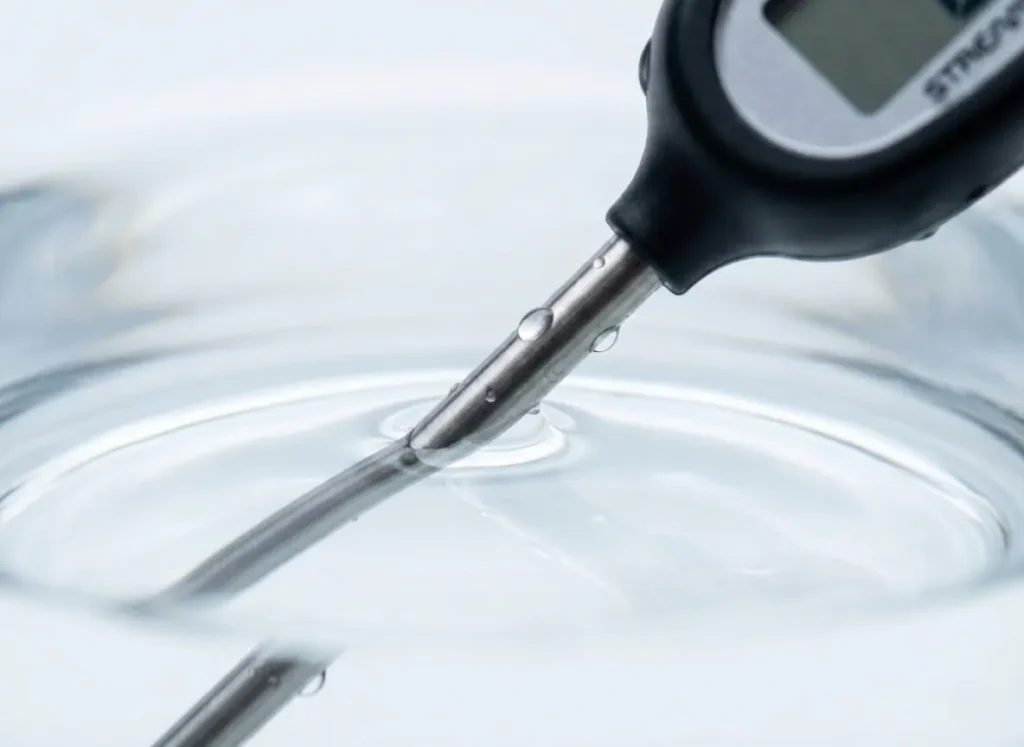
To catch the fish, you must first understand the machine. We often attribute human traits to fish—calling them “lazy” or “picky”—but these are anthropomorphic errors. Fish species are poikilothermic ectotherms. This biological definition means they cannot regulate their internal temperature; they assume the thermal state of their environment.
How does the Q10 Coefficient dictate fish speed?
Because a fish matches its environment, its biochemistry is enslaved by the Q10 temperature coefficient. This is a biological rule stating that for every 10°C increase (18°F) in temperature, biochemical reaction rates roughly double. This concept, known as metabolic rate doubles, applies to every system in the fish’s body: heart rate, muscle contraction speed, and even the firing rate of neurons in the optic tectum.
When water cools by 10°C, the fish’s “engine” is mechanically governed to run at 50% capacity. This is why measurements of maximum metabolic rate are critical for anglers to understand. A fast-moving crankbait in cold water may not just be unappealing; it may be a physical blur that the fish’s muscles cannot intercept.
Conversely, as water drops from 70°F to 52°F, the “Halving Effect” kicks in. The fish isn’t making a conscious choice to be lethargic; it is physiologically incapable of sustaining high-speed pursuit. This connects directly to the Standard Metabolic Rate (SMR), or the cost of idling. In winter, standard metabolic rates drop, allowing fish to survive months with minimal caloric intake. Understanding these fundamental cold-blooded fish temperature rules is the first step in calibrating your presentation.
Pro-Tip: If you are fishing water below 50°F, utilize “reaction baits” that deflect off cover, but pause them immediately after the collision. The deflection triggers the reflex, but the pause allows the slowed physiology of the fish to catch up to the lure.
What is Aerobic Scope and why is it the ‘Performance Window’?
Aerobic Scope (AS)—sometimes called aerobic metabolic scope—is the mathematical difference between the fish’s maximum output (Maximum Metabolic Rate or MMR) and its resting cost (SMR). Think of this metabolic scope as the fish’s “disposable income” of energy. This is the fuel available for feeding, swimming performance, fighting current, and spawning.
This performance follows a dome-shaped curve. Performance peaks at an optimal temperature—the “Golden Zone” typically between 65-75°F for warmwater species like Smallmouth Bass and Bluegill—where the gap between maintenance cost and maximum output is widest.
However, outside this window, constraints appear. In winter, the “Cold Constraint” lowers the ceiling because muscles simply cannot contract fast enough. In the heat of summer, the “Heat Constraint” raises the floor (SMR). The cost of living becomes so high that the scope is squeezed from the bottom up. Research on the critical thermal maximum of stream fishes shows us where neurological function begins to fail, often referred to as the Critical Thermal Maximum (CTM).
A fish outside its preferred temperature range isn’t refusing to bite out of stubbornness; it is “energetically bankrupt.” Knowing the largemouth bass facts and biology surrounding their specific optimal zones helps you predict when they will feed aggressively and when they are simply surviving near their lower avoidance limit.
The Oxygen-Temperature Squeeze
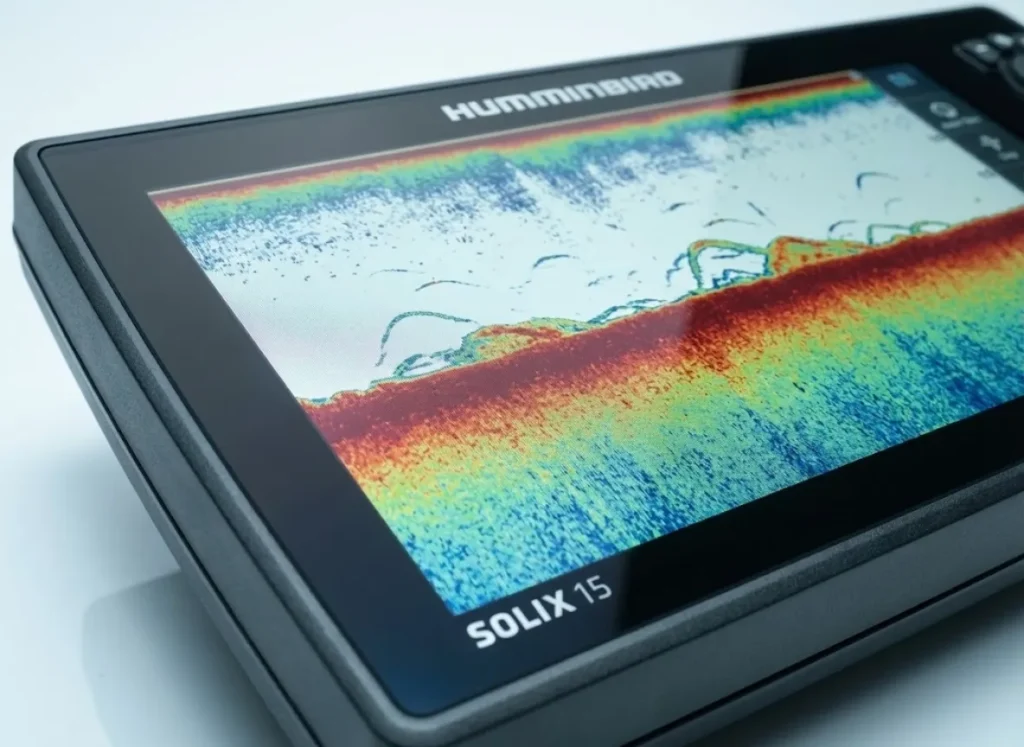
While temperature sets the metabolic demand for energy, the environment must supply the oxidizer to burn it. This leads to the summer crisis known as the “Squeeze.”
How does the ‘Summer Squeeze’ alter fish location?
Henry’s Law dictates that as water temperature increases, its ability to hold Dissolved Oxygen (DO) decreases. This creates a dangerous paradox for the fish. High environmental temperatures drive the fish’s metabolic demand for oxygen to its peak, exactly when the water oxygen concentrations are at their lowest.
Fish respond by abandoning food-rich but oxygen-poor shallows. They seek temperature breaks, current, or deep basins where oxygen is more stable. This is not a preference; it is a survival requirement. In stagnant areas without vegetation or wind to provide an oxygen source, we often see summer fish kills caused by low water oxygen.
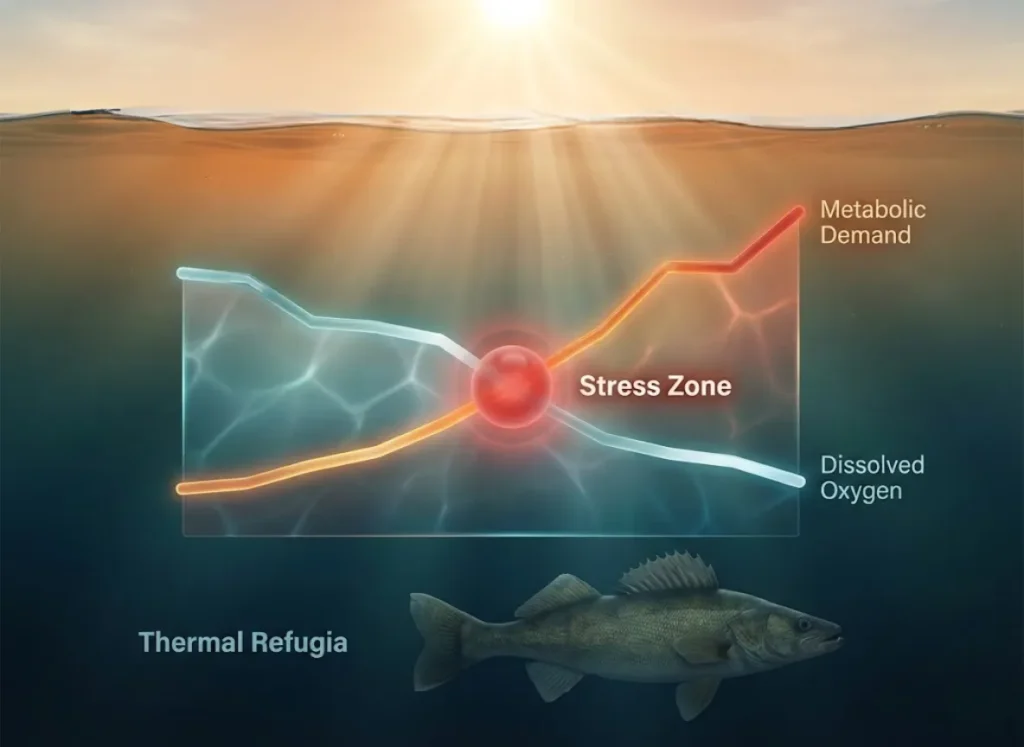
The squeeze is particularly brutal for trophy fish due to Allometric Scaling. Large fish have a worse gill-surface-area-to-body-mass ratio than smaller fish. A 5lb Walleye stresses much faster than a 1lb “eater” in 85°F water. This forces trophy hunters to fish deeper or at night.
These large fish retreat to Thermal Refugia—specific zones like spring seeps or deep ledges where they can balance their metabolic checkbook. Aerobic scope tests over a range of temperatures highlight how narrow these habitable zones can become for salmonid species like Chinook Salmon and Coho Salmon. To find them, you must understand how thermoclines explained for fishing depth function to trap cool, oxygenated water.
Digestion Dynamics: The Hidden Clock
Once a fish locates a comfortable zone, the next variable determines if it is hungry: the speed of its gut. We often ask, “What are they eating?” but the more important question for recreational angling strategy is, “How often are they eating?”
How does temperature warp the digestion timeline?
Gastric Evacuation Rate (GER) is the speed at which food clears the stomach, triggering the return of appetite. The data for Centrarchids (like bass and Black Crappie) is striking. At 80°F, a meal clears in approximately 20 hours, leading to a daily feeding cycle. At 50°F, that same meal takes 72 to 120 hours to digest.
This means a cold-water bass may only feed once every 4 or 5 days. The anomaly is even more extreme in other species like Muskellunge (Muskie) and Northern Pike. Research on the daily ration of a top carnivore indicates that Pike may take up to 12 days to digest a large meal in near-freezing water.
Fish Digestion Time vs. Water Temperature
Estimated metabolic processing speed based on thermal conditions for major game fish species.
80°F (Summer Peak)
~20 Hours: High metabolic rate. Fish empty stomachs daily, creating multiple feeding windows.
65°F (Transition)
~30 Hours: Processing speed decreases by 50% compared to summer peaks.
45°F (Winter/Cold)
~100+ Hours: Estimated 72–120 hours. Feeding occurs infrequently, roughly every 3–5 days.
80°F (Summer Peak)
Bioenergetic Squeeze: Metabolism is stressed. Fish go deep or suspend to manage high metabolic costs.
65°F (Transition)
~18–24 Hours: Optimal range. Supports active nightly feeding patterns and rapid recovery.
45°F (Winter/Cold)
Metabolic Slowing: Metabolism halves for every 10°C drop (Q10 rule). Feeding slows significantly.
80°F (Summer Peak)
Thermal Stress: Outside the optimum 55–65°F range. Feeding often ceases in extreme surface heat.
65°F (Transition)
~48 Hours: Standard feeding frequency is approximately every 2 days in this optimal range.
45°F (Winter/Cold)
~12 Days: Rare, opportunistic feeding only. Digestion becomes the primary physiological bottleneck.
When a fish has a full stomach, blood flow diverts to the gut to aid digestion (alkalytic tide). This physically limits the aerobic scope available for chasing new prey. In winter, statistically speaking, 80-90% of the fish populations are likely in a digestive stupor on any given day.
Consequently, cold water angling relies less on “Feeding Strikes” (hunger) and more on “Reaction Strikes” (reflex). Understanding this helps in the strategic analysis of Northern Pike facts, shifting your mindset from “matching the hatch” to triggering a biological impulse.
The Metabolic Lure Cadence Masterclass
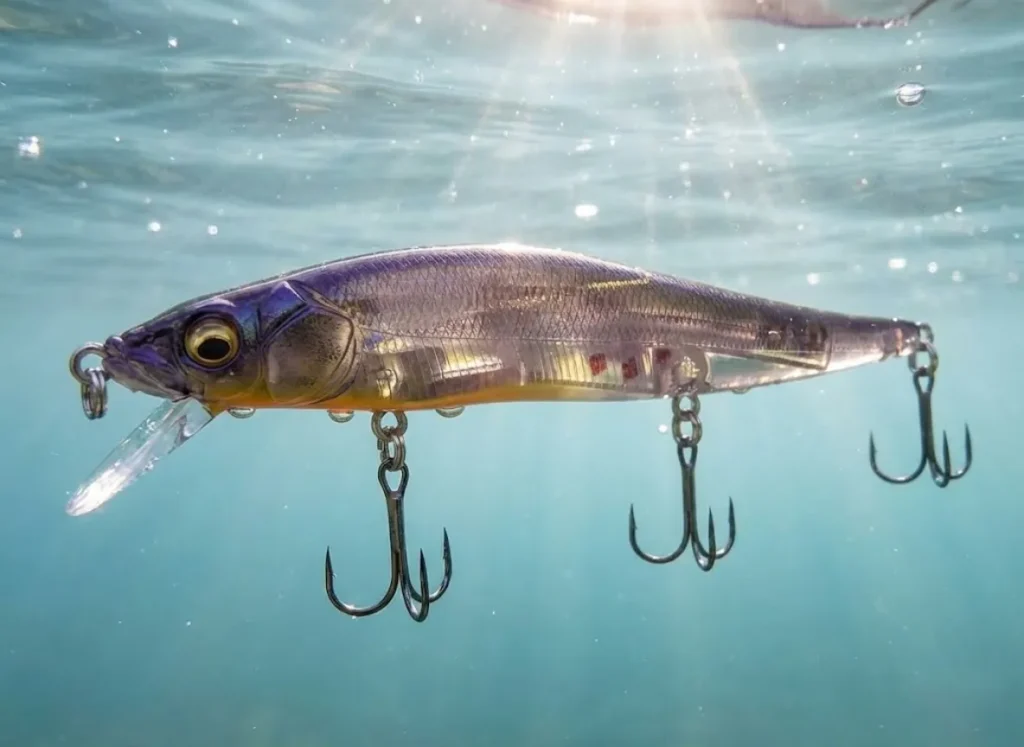
With the biological constraints mapped, we can now translate this data into a specific lure presentation speed using the Metabolic Lure Cadence Calculator.
How do you calculate pause duration for cold water?
In water temperatures below 45°F, you must employ the “Coma Cadence.” When fishing winter suspending jerkbaits, the required pause is between 8 and 15 seconds. This feels like an eternity to the angler, but it is necessary.
Cold fish suffer from a Visual Processing Delay. They need seconds just to resolve the image of the lure and initiate the muscle command to approach. If the lure moves before this process completes, the fish aborts. In extreme cold, we use the “Deadstick” technique, leaving a bait motionless for 30-60 seconds. This simulates “free energy” that requires zero chase cost.
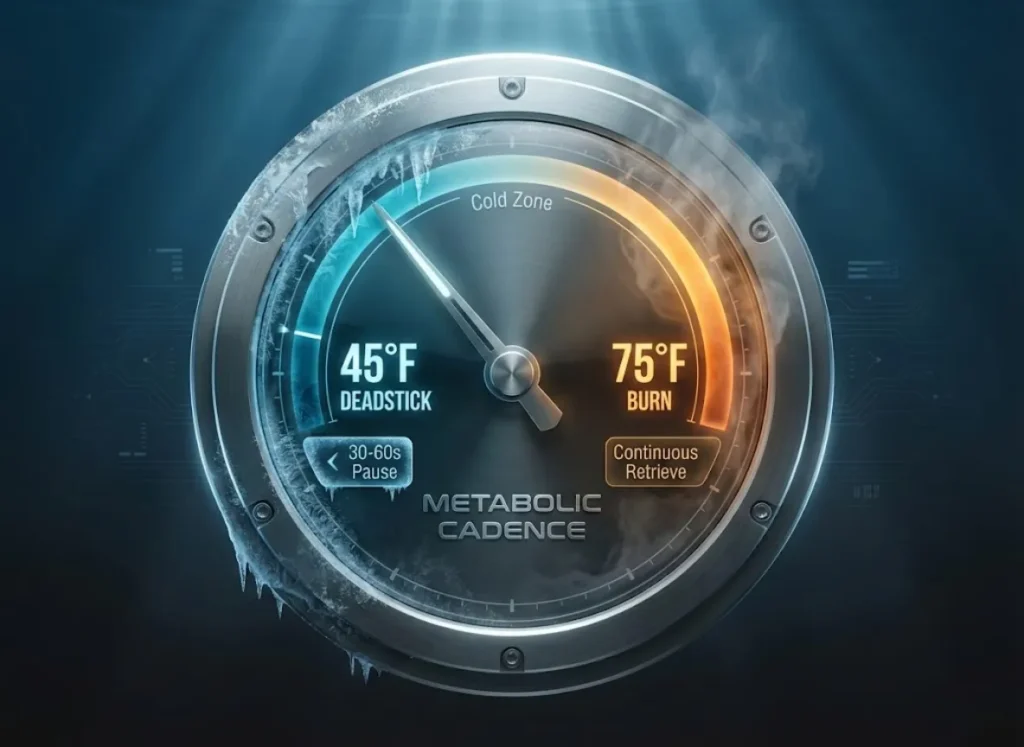
Contrast this with the “Burn” technique used in 65-75°F water. Fast movement triggers the high-energy predatory reflex (MMR engagement). The “Energy Equation” is simple: Net Energy equals Caloric Value minus Chase Cost. In winter, the chase cost must be near zero for the math to work.
A good rule of thumb for low and slow winter presentations is to cut retrieval speed by 50% for every 10°F drop in water temperature below the optimum. Studies on the effects of temperature on feeding and digestive processes confirm that metabolic rate drives the energy cost of capture. This is the core principle behind the winter trout fishing blueprint, where cadence is often the only difference between success and failure for Rainbow Trout or Brown Trout.
Pro-Tip: Don’t count “1-Mississippi” in your head; you will rush it. Watch the seconds tick by on your watch or sonar screen to ensure you are actually pausing for the full 15 seconds.
Conservation Physiology: The Ethical Thermometer
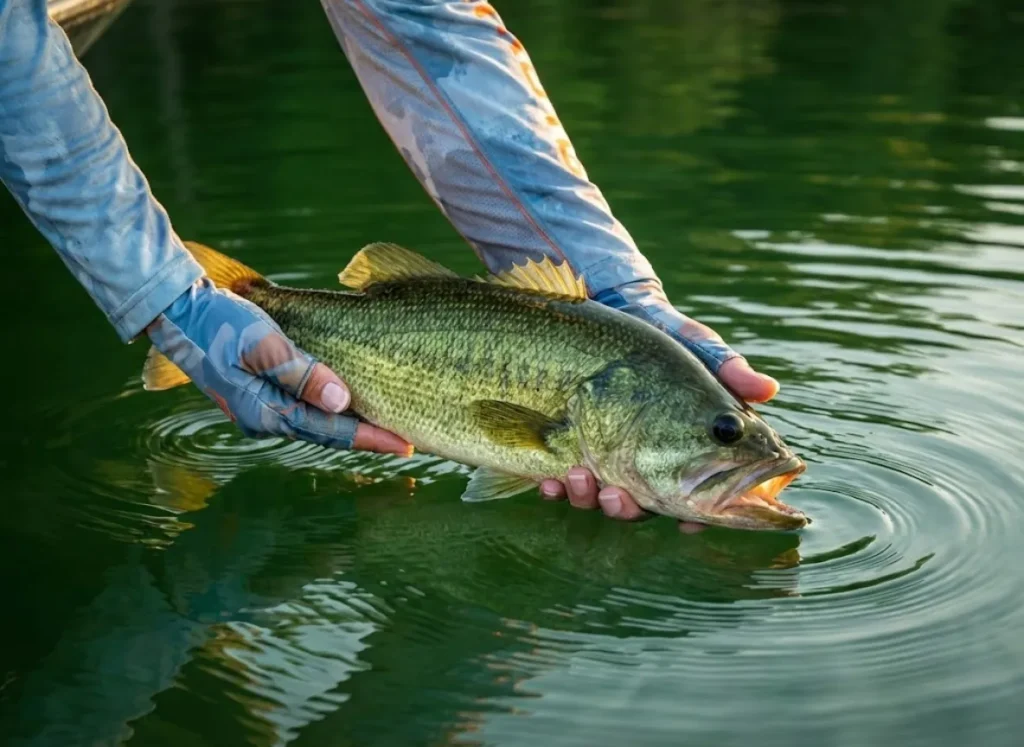
Pushing fish to their limit has consequences. As anglers, we must know when the metabolic engine overheats to practice ethical fish husbandry and stewardship.
At what temperature does catch-and-release become lethal?
Many states implement “Hoot Owl” restrictions, closing fishing after 2 PM when water hits 73°F. This is primarily to protect Salmonid fish like Brook Trout and Steelhead. Physiological stressors in trout skyrocket at 68°F (20°C). Angling for them above 70°F carries a high mortality risk, regardless of how gently you handle them.
For warmwater species like Channel Catfish or Flathead Catfish, the threshold is higher, but not infinite. Bass care and handling guidelines suggest that mortality remains low until 84°F. Above this, delayed mortality from hypoxia increases significantly.
The mechanism of death is lactic acid buildup combined with low oxygen solubility. The fish literally cannot breathe fast enough to recover its acid-base balance after the fight.
In high heat, minimize air exposure to zero—gills dry instantly in the summer sun. Utilize pro livewell use for aeration and temperature management if you are keeping fish for a tournament. In these moments, exercise the “Thermometer Veto.” If the environmental temperature is too hot, the ethical angler targets a more tolerant species like Yellow Perch or simply stops fishing.
Putting It All Together
We have broken down the aquatic environment into its thermal components.
- Temperature is the Throttle: The Q10 coefficient doubles metabolic speed for every 10°C rise, dictating reaction time.
- Digestion is the Timer: Feeding windows shift from “Daily” (Summer) to “Weekly” (Winter) due to enzymatic slowdown.
- Oxygen is the Limit: Large predatory fish are forced deep in summer by the “Oxygen Squeeze.”
- Cadence is the Key: Adjusting your pause time is not a stylistic choice; it is a biological requirement.
Next time you hit the water, don’t just check the weather forecast—check the water temperature log. Use these metabolic principles to align your presentation with the fish’s reality.
FAQ – Frequently Asked Questions
What is the best water temperature for Largemouth Bass fishing?
The optimal metabolic window for Largemouth Bass is between 65°F and 75°F (18-24°C). In this range, their Aerobic Scope is maximized, leading to aggressive chasing and frequent feeding.
Do fish stop eating in the winter?
Fish do not stop eating entirely, but their digestion slows drastically, leading to very infrequent feeding windows. A Northern Pike, for example, may only need to feed once every 12 days in 39°F water.
How does water temperature affect dissolved oxygen levels?
Water temperature and dissolved oxygen (DO) have an inverse relationship: as water gets warmer, it holds less oxygen. This creates a Summer Squeeze where high metabolic demand requires more oxygen than the warm water can provide.
How long should I pause a jerkbait in 45 degree water?
In water temperatures between 40°F and 45°F, a pause of 8 to 15 seconds is recommended. The fish’s slowed metabolism and visual processing require this extra time to detect, analyze, and strike the lure.
Risk Disclaimer: Fishing, boating, and all related outdoor activities involve inherent risks that
can lead to injury. The information provided on Master Fishing Mag is for educational and informational purposes
only. While we strive for accuracy, the information, techniques, and advice on gear and safety are not a substitute
for your own best judgment, local knowledge, and adherence to official regulations. Fishing regulations, including
seasons, size limits, and species restrictions, change frequently and vary by location. Always consult the latest
official regulations from your local fish and wildlife agency before heading out. Proper handling of hooks, knives,
and other sharp equipment is essential for safety. Furthermore, be aware of local fish consumption advisories. By
using this website, you agree that you are solely responsible for your own safety and for complying with all
applicable laws. Any reliance you place on our content is strictly at your own risk. Master Fishing Mag and its
authors will not be held liable for any injury, damage, or loss sustained in connection with the use of the
information herein.
Affiliate Disclosure: We are a participant in the Amazon Services LLC Associates Program, an
affiliate advertising program designed to provide a means for us to earn advertising fees by advertising and linking
to Amazon.com. As an Amazon Associate, we earn from qualifying purchases. We also participate in other affiliate
programs and may receive a commission on products purchased through our links, at no extra cost to you. Additional
terms are found in the terms of service.