
In this article
You’ve got 15 feet of water, a green-tinted column that ate your chartreuse worm last Tuesday, and now — same lake, same spot, first warm afternoon of the week — not a single tap in two hours. You cycle through the box. Green pumpkin. Watermelon. Junebug. Nothing. The water hasn’t changed. The light has. And that’s what no one told you.
I’ve stood on the bow of that same boat more times than I care to count. Here’s what most anglers never get: soft plastic color selection by water clarity isn’t a guessing game. It’s physics with a rod in your hand.
⚡ Quick Answer: Match your soft plastic color to what the water actually does to light, not to what sold well at the tackle shop. In ultra-clear water (Secchi depth above 12 ft), go translucent and natural — Watermelon, Smoke, or Morning Dawn. In stained, mesotrophic water (Secchi 4–8 ft), Green Pumpkin is the dominant choice because it sits inside the chlorophyll transmission window where green light persists longest. In murky water (Secchi below 3 ft), abandon “match the hatch” entirely — fish a solid Black and Blue for silhouette, or Chartreuse for its fluorescent emission advantage. Below your Secchi depth multiplied by four, color stops mattering — switch to profile and vibration.
| Water Clarity Fishing Strategy Guide | ||||
|---|---|---|---|---|
| Clarity Zone | Secchi Depth | Dominant Optical Effect | Go-To Colors | Strategy Logic |
| Ultra-Clear | 12+ ft | Blue-shift; bass scrutinize from 26 m | Watermelon, Smoke, Ghost, Morning Dawn | Translucency and naturalism — no opaque profiles |
| Stained / Mesotrophic | 4–8 ft | Chlorophyll green-shift window | Green Pumpkin, Watermelon Red Flake, Junebug | Hit both the 535 nm and 614 nm cone peaks simultaneously |
| Murky / Eutrophic | <3 ft | Mie scattering destroys color info | Black and Blue, Chartreuse, White | Contrast over color — silhouette or fluorescent emission |
| Low-Light / Overcast | Any | Surface luminance drops 60–80% | Dark solids, fluorescent accents | Treat as one zone murkier than measured clarity |
The Water Column as a Spectral Filter
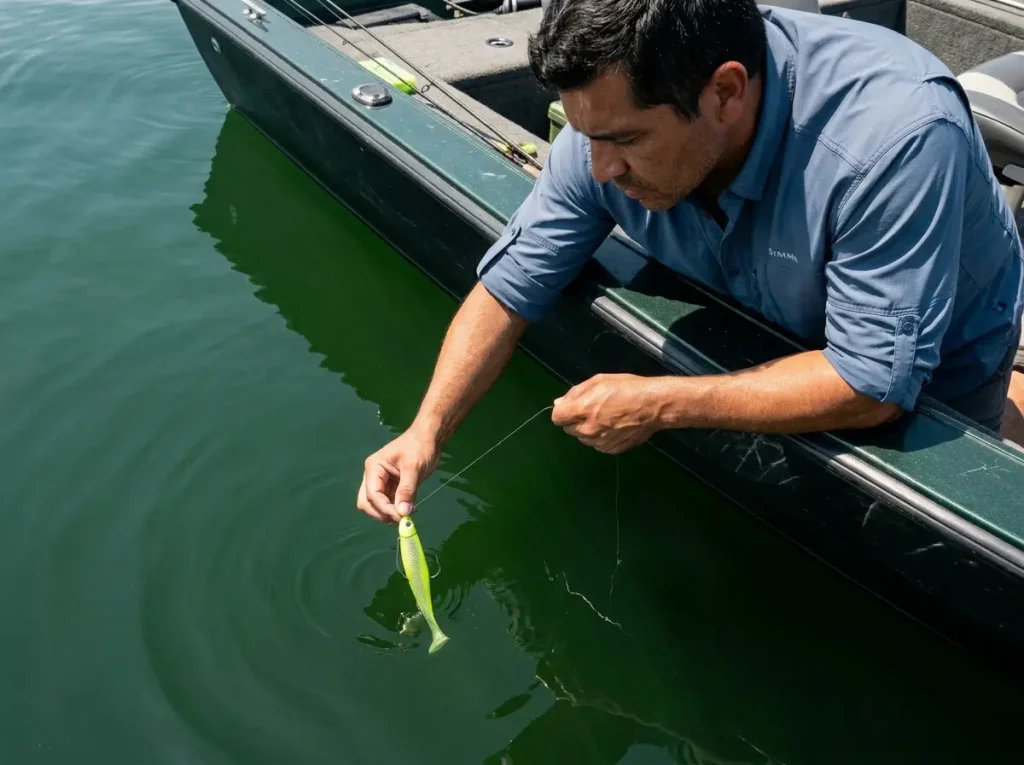
Water doesn’t just hold your lure. It destroys specific wavelengths before they reach the fish’s eye. That physical reality is the foundation of everything.
Red light, sitting at 620–750 nm, is absorbed within the first few meters of depth by the molecular vibration of water itself. By the time your red crawfish drops past 10 feet in a typical lake, it reads as grey-black to anything down there. Orange fades to brown. Yellow washes close to white. These aren’t opinions — they’re the documented behavior of wavelength absorption rates across depth, validated by NOAA’s light and color depth factsheet.
What survives? In most American bass lakes, green light (495–570 nm) is the last man standing. This happens because chlorophyll-a — the biological engine of algal productivity — absorbs blue and red wavelengths, leaving a transmission window right in the green range. That window is exactly why Green Pumpkin and Watermelon aren’t clichés. They’re aligned to the most persistent spectral frequency in freshwater.
To understand how light attenuation changes what a fish can actually see, you have to think about the water column the same way a lens designer thinks about glass: every material has a transmission curve. Productive bass water has a green peak. Tannic water has a red-brown shift. Clear oligotrophic water has a blue bias. All three demand different color logic.
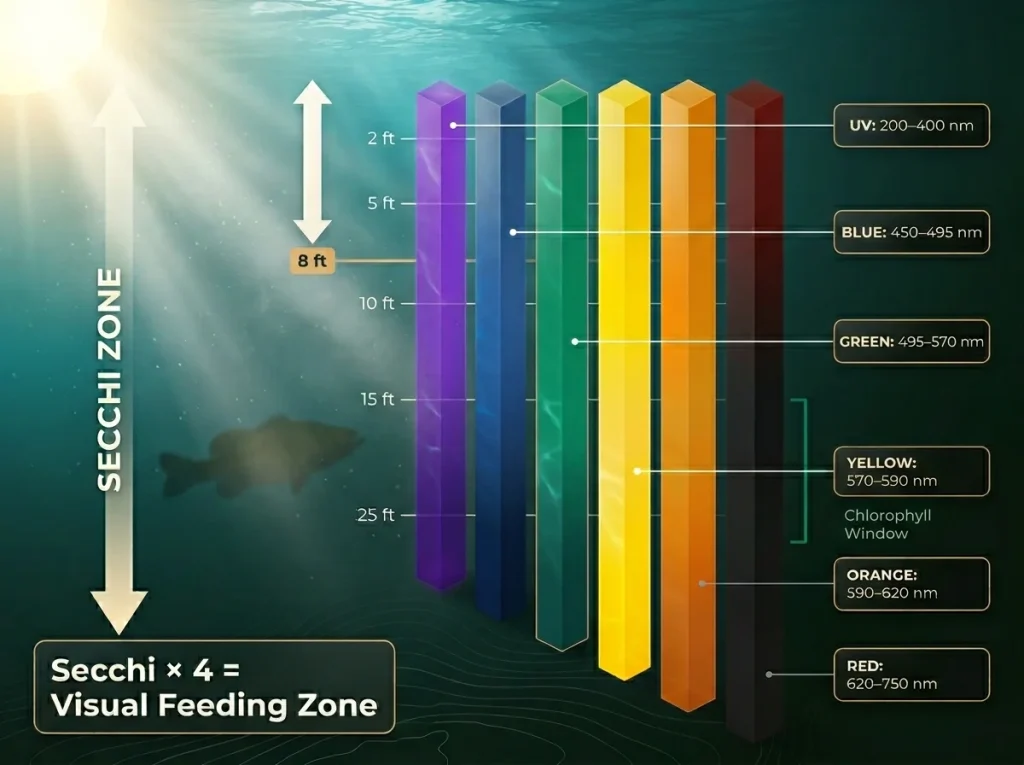
Pro tip: Before you rig anything, hold a white jig over the side and count the feet until it disappears. That’s your Secchi depth right there, close enough. Multiply by four — that’s your visual feeding zone. Below that number, color selection is a coin flip. Match profile and action instead.
Red, Green, and the Chlorophyll Window
The reason Green Pumpkin produces in so many bass lakes has nothing to do with tradition and everything to do with chlorophyll-a absorption. At approximately 430 nm (blue) and 680 nm (far red), chlorophyll pulls those wavelengths out of the water column, leaving the 495–570 nm green corridor as the dominant ambient light in most productive lakes. Green Pumpkin sits squarely inside that window.
If you don’t know what type of water you’re on — tannic, algal, or genuinely clear — default to Watermelon. It covers the widest range of spectral absorption conditions without missing badly in any of them. It’s the hedge that actually has science behind it.
Blue Water, Brown Water — Does Clarity Type Change the Math?
Yes, and this distinction matters more than most anglers realize.
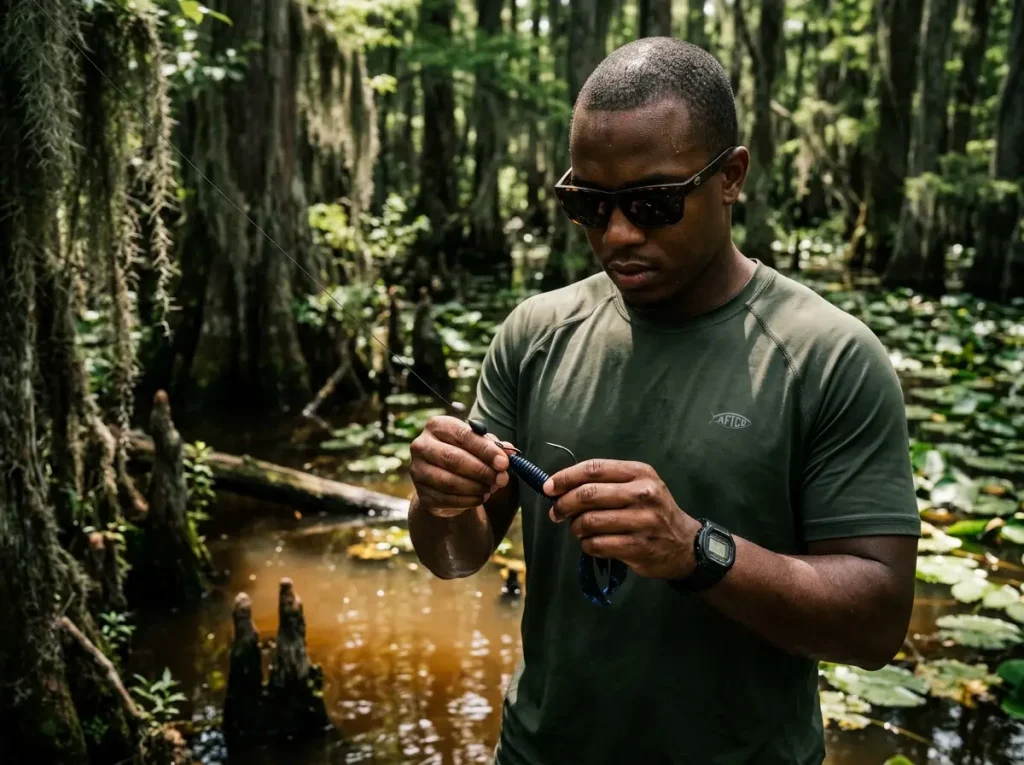
Tannic water — the tea-colored stain you find in swampy reservoirs and coastal rivers — is not the same as green-stained algal water. Tannins leach from decomposing vegetation and shift the ambient light field toward red-brown, not green. In that environment, Junebug and Plum outperform Green Pumpkin because they maintain silhouette through a red-shifted transmission window. On a glacial spring creek with clear blue-shift conditions, you flip entirely — subtle blues and purples persist where they’d vanish in a eutrophic lake.
Don’t confuse stain type. An angler fishing a tannin-stained coastal swamp and an angler fishing a Florida algal reservoir are operating in fundamentally different optical environments, even if the Secchi disk reads the same. I’ve watched guys bomb out on tannic swamp lakes with Green Pumpkin because nobody told them that’s a different game entirely.
How Deep Is Deep Enough to Lose Color?
Keith Jones, Research Director at Berkley, put the number at Secchi depth × 4. That’s your visual feeding zone — the depth range where a bass can actually use its eyes to identify color and shape.
Below that line, you’re fishing vibration and displacement, not color. A bulkier profile that pushes more water activates the lateral line more effectively than any color change you can make. This is where anglers waste the most time switching hue when they should be switching bait profile entirely. The fish isn’t confused about your color choice — it literally can’t see it.
Bass Vision — A Dichromatic Reality Anglers Ignore
The bass you’re targeting cannot see the way you do. It has two types of cone cells — a single cone peaking at 535 nm (green) and a twin cone peaking at 614 nm (red). That’s it. No blue-sensitive cone exists.
What this means practically: blue and black are nearly identical to a bass. Peer-reviewed research on largemouth bass color vision showed that bass in behavioral trials identified red targets correctly over 80% of the time and green targets 75% of the time. But when asked to distinguish blue from black, accuracy fell to near-chance — 48% versus 40%. They’re basically guessing.
Chartreuse-yellow is barely distinguishable from white under bright-light conditions, not because it isn’t bright, but because the bass’s cone system can’t split that spectral difference cleanly in high light.
Understanding how bass sensory systems prioritize visual and lateral line input changes how you approach every color decision. The fish is not evaluating your lure through human eyes. It’s running two-cone hardware tuned for green-and-red discrimination. Design your presentations around that biology, not around the color chart at the tackle counter.
Pro tip: “Dark in dirty, natural in clear” works because it’s tracking real biology. The bass brain responds to contrast against the scattering background — it’s not reading the color name on the bag.
The Two Cones That Run the Show
The green cone (535 nm) fires hardest on Green Pumpkin, Watermelon, and most natural-profile colors. The red cone (614 nm) responds to red flakes, craw orange, and red accent patterns. That’s it. Two triggers. Everything else works through contrast or fluorescence, not true color recognition.
Micah Frazier and Brent Ehrler have both said they cover roughly 90% of their soft plastic fishing with Green Pumpkin or Black and Blue. That’s not a personal preference call — it’s biology made practical. Green hits the 535 nm cone directly. Black and Blue delivers maximum contrast silhouette. Everything else in a 50-color box is handling edge cases that don’t come up as often as you think.
The A1/A2 Shift — Why Red Works Better in Stained Water (Biologically)
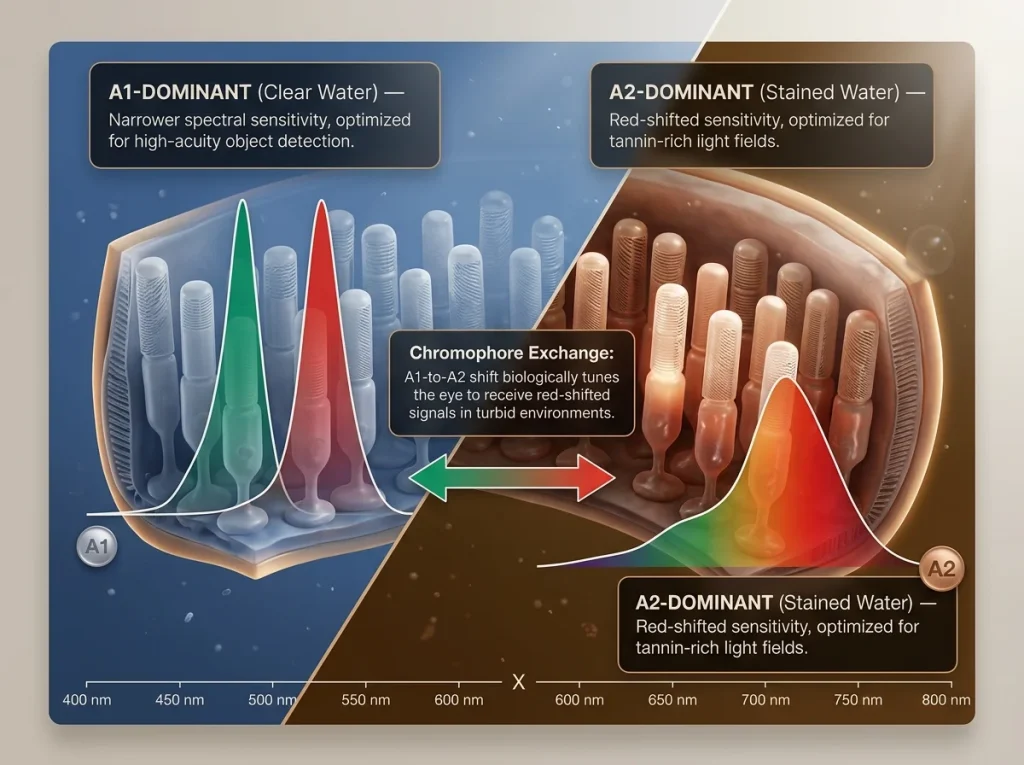
Here’s the piece no competitor article mentions: bass vision is not fixed. The bass retina uses a chromophore exchange system — Vitamin A1 (retinal) to Vitamin A2 (3,4-didehydroretinal) — that physically red-shifts its spectral sensitivity in response to ambient environmental conditions.
A bass living in a tannin-stained swamp has literally shifted its cone sensitivity toward red and orange wavelengths. The fish has better red vision than the same species in a clear reservoir. This is why red and orange craw patterns in stained spring water aren’t folklore. You’re not tricking the fish with a trigger color — you’re feeding it a signal that its visual hardware has been biologically tuned to receive.
Low-Light Vision and the Silhouette Principle
At dawn and dusk — and through the night — the bass switches from cone-dependent color vision to rod-dominant scotopic vision. Rod cells peak at approximately 528 nm and are roughly five times more sensitive than human rods under similar conditions.
In low light, the bass stops distinguishing color. It detects movement, contrast against ambient glow, and silhouette shape. Dark solids — Black, Junebug, Black and Blue — excel because they create maximum silhouette against whatever ambient luminance exists at the surface. Fluorescent accents help, even in near-darkness, because they convert available UV into visible emission.
Snell’s Window reinforces this. A bass looking upward sees the entire above-water world compressed into a 97-degree cone. Outside that cone, it sees only a mirror reflection of the bottom. A dark lure silhouetted against the bright surface window can pull a strike from a fish that hasn’t smelled or felt the bait at all. This is why big black swimbaits move fish in clear water after dark when nothing else touches a bite — the silhouette reads clean even when the water is gin clear.
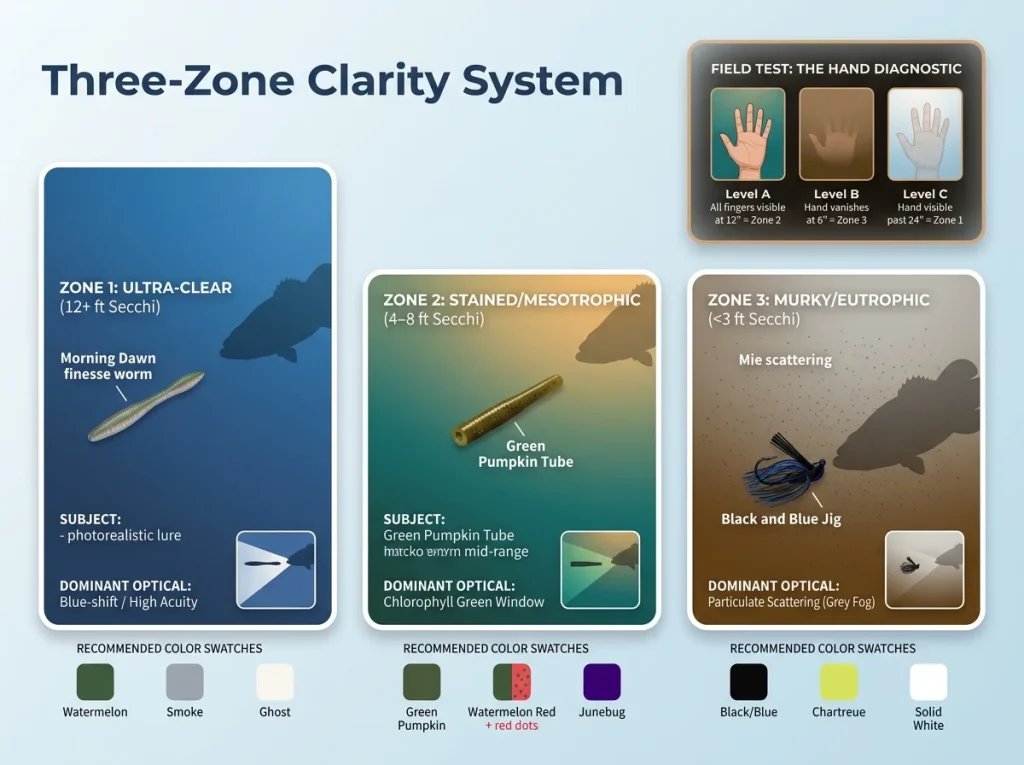
Reading Turbidity — The Three-Zone Clarity System
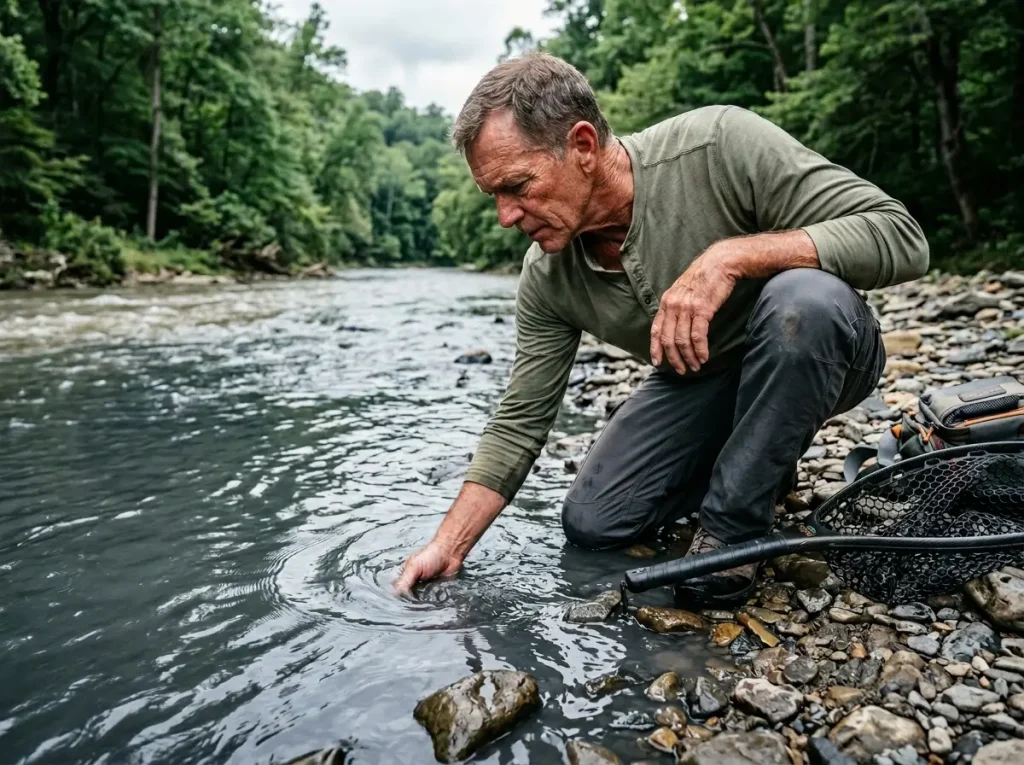
Forget vague descriptions like “a little stained” or “pretty muddy.” Diagnose the water. Three optical zones, three different playbooks.
Zone 1 — Ultra-Clear (Secchi above 12 ft): Bass can detect a lure from up to 26 meters. They have time to inspect it, reject unnatural textures, detect hook gaps, and spook from opaque profiles. Translucency and naturalism are mandatory. Use Watermelon, Smoke, Ghost, or Morning Dawn. Anything opaque reads as wrong at distance.
Zone 2 — Stained/Mesotrophic (Secchi 4–8 ft): The sweet spot where most bass lakes live most of the season. Green light dominates. Contrast matters alongside natural hue. Green Pumpkin with Watermelon Red Flake is the dual-frequency play — green hits the 535 nm cone, the red flake hits the 614 nm cone. Two biological triggers in one bait.
Zone 3 — Murky/Eutrophic (Secchi below 3 ft): Mie scattering dominates. Suspended particles scatter all visible wavelengths roughly equally, creating a grey “fog” that destroys color information. The physics behind lure contrast in turbid water is straightforward: in this zone, color accuracy is gone. Silhouette and optical contrast theory are the only variables worth thinking about.
How water clarity shifts dramatically after rain events is something anglers deal with constantly but rarely recalibrate for fast enough. The SC DNR water clarity tutorial explaining Secchi disk measurement is worth reading once — understanding what Secchi depth actually measures changes how you read conditions on the water.
Pro tip: Dip your hand in palm-up, fingers spread. See all five fingers at 12 inches — you’re in Zone 2. Hand disappears at 6 inches — you’re in Zone 3. Go black or fluorescent, stop overthinking it.
Ultra-Clear — Translucency, Natural Profile, and the “Don’t Spook Them” Mandate
In clear water, bass scrutinize from a distance. They’re looking for the micro-contrast that breaks up a profile without screaming “artificial.” Salt-and-pepper flake or purple-blue flake provides exactly that. Translucent plastics allow light to pass through the lure body the same way it passes through the semi-transparent tissues of juvenile shad and grass shrimp.
Air pockets in old plastics, visible hook gaps, and sloppy rigging are rejection triggers in clear water — and they happen before color even enters the equation. I’ve seen fish follow a perfectly colored drop shot for six feet, then peel off at the last second because of a hook point showing through the tail. Get your presentations tight. The color is the last thing that matters in clear water.
Stained Water — Green Pumpkin and the Red-Flake Trigger
Watermelon Red Flake does something Green Pumpkin alone doesn’t: the red flash creates a biological resonance spike against the 614 nm twin cone. You’re hitting green and red simultaneously — the only two cones the bass actually has — with a single bait.
In heavy tannin stain, shift from Green Pumpkin to Junebug or Plum. They maintain silhouette depth while persisting through the red-shifted transmission window that tannic water creates. Don’t mistake green-stained algal water for tea-colored tannic water — they require opposite color logic, and confusing them will cost you fish. Guides in tannic swamp fisheries have run Green Pumpkin against Junebug side by side. Junebug wins by a margin that’s hard to argue with.
Murky Water — The Contrast-Over-Color Principle
Below 3 feet of Secchi depth, “match the hatch” is a waste of time. The fish can’t resolve color well enough to care.
Solid black absorbs all available light — zero reflectance, maximum contrast differential against the scattering grey background. White does the opposite: maximum reflectance, a horizontal flash that can outperform black in some muddy river cuts where the bass is oriented horizontally to its prey. Chartreuse operates through fluorescent emission, not reflection — more on that shortly.
The rule is contrast over color. Pick the profile that creates the sharpest difference between lure and background, regardless of what that color “matches.” If you’re still trying to figure out what the forage looks like at Secchi 2 ft, you’re solving the wrong problem.
Fluorescence — The Science Behind the Glow
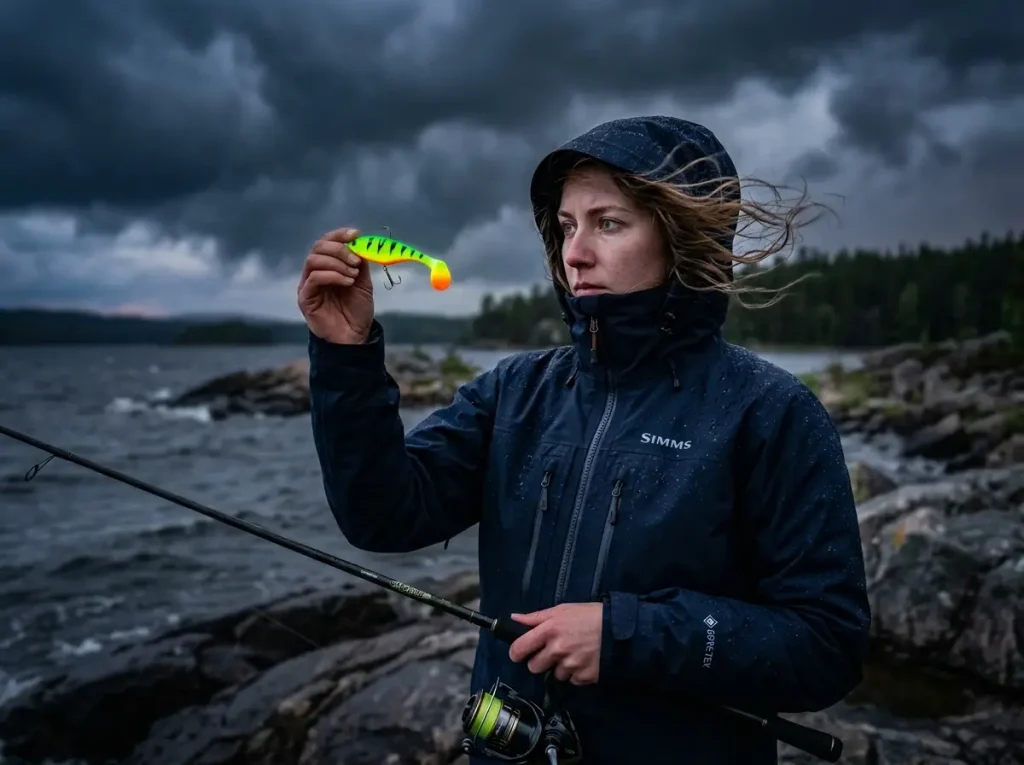
Standard pigments reflect light. Fluorescent pigments do something different: they absorb UV, blue, and green photons, then re-emit them as longer-wavelength visible light through the Stokes shift. A fluorescent lure isn’t just reflecting ambient light — it’s generating its own optical signal.
A U.S. Navy underwater color visibility study quantified this precisely. In extremely murky water (Secchi below 1 m), fluorescent orange and red-orange were the most visible colors tested — maximum horizontal visibility of 1.5–1.8 meters versus roughly 0.8 meters for non-fluorescent equivalents. In moderately turbid water, all fluorescent shades beat their non-fluorescent counterparts. In clear water, fluorescent green took over — laboratory tests showed it had a five-fold luminance advantage over non-fluorescent red.
Chartreuse is fluorescent green-yellow. Its effectiveness in muddy water has nothing to do with tradition — it’s the Stokes shift converting available green and yellow photons into an emission signal that standard pigments cannot produce.
Pro tip: Under a UV flashlight at night, check your plastics. If they glow, they’re fluorescent — reserve those for murky and low-light conditions. If they don’t respond to UV, they’re standard pigment — use them for clear-water finesse work where fluorescence becomes a liability.
How fluorescent and dark silhouette colors perform in low-light conditions follows the same physics. Fluorescence can’t save you in deep clear water because the long-wavelength orange emission gets absorbed by the water column before it reaches an observer at distance. Below 15 feet of clear water, fluorescent orange fails. Fluorescent green persists longer because its emission wavelength sits closer to the green transmission window.
The Stokes Shift — Why Fluorescent Colors Are Brighter Than Real Life
A standard pigment can only be as bright as the light hitting it. A fluorescent pigment converts short-wavelength photons into long-wavelength visible emission. When light penetration drops below 5% per meter, a fluorescent lure generates its own signal rather than depending on what’s left of the ambient field. The limit: once that emitted light is itself absorbed by the water column — which happens in clear, deep water — the advantage collapses. Fluorescent orange at 20 feet in clear water is just a color. In muddy shallows, it’s an optical powerplant.
Which Fluorescent Colors Win in Which Water
Extremely murky: fluorescent orange and red-orange. Moderately turbid: any fluorescent shade — Chartreuse and Firetiger lead. Clear shallow: fluorescent green. Clear deep: drop fluorescent orange entirely; fluorescent green’s emission wavelength sits closer to the water’s transmission window and survives longer. The uv light conversion advantage only works when the emitted signal can actually reach the fish’s eye — depth strips that away faster than most anglers account for.
When Fluorescence Hurts You
On pressured clear-water fisheries, fluorescent colors read as alarm signals. Under direct mid-day sun in 15 feet of gin-clear water, a chartreuse worm near the surface creates visual noise that a cautious bass won’t commit to. Fluorescence is an attractor in low-visibility, a liability in high-visibility. I’ve watched tournament anglers switch off chartreuse around 10 AM on clear-water lakes and immediately start getting bit. The water didn’t change — the sun angle did.
Seasonal and Environmental Variables — The Final Layer
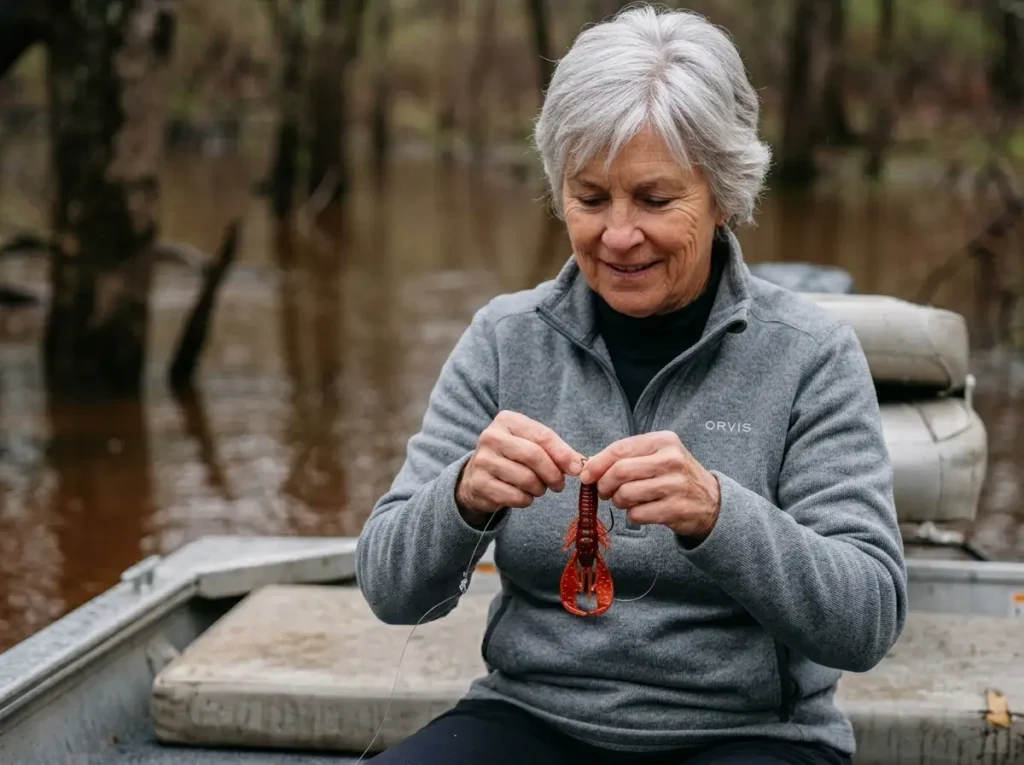
The clarity-based color framework is the foundation. Seasonal and environmental variables are the adjustments you make on top of it.
Sun angle: Mid-day direct light provides maximum penetration. Translucent, muted colors — California 420, Smoke — look most lifelike when light is passing through them. Overcast and cloud cover cut surface luminance by 60–80%, even in nominally clear water. Revert to murky-water logic when the sky closes: darker profiles, contrasting choices. How water clarity shifts dramatically after rain events is real-time clarity management — recalibrate every 30 minutes on actively rising rivers.
Spring: Stained water from snowmelt, enhanced red sensitivity from the A1/A2 chromophore shift, and crawfish in active molt phase. Three converging signals, all pointing toward red and orange craw patterns. This isn’t superstition — it’s the biology and optics arriving at the same answer simultaneously.
Fall: Bass orient to migrating shad. Shad are silvery and semi-translucent in the 495–570 nm range — almost photomimetic of the green transmission window. Pearl whites and silver flakes are the correct call. In stained fall water post-turnover, Watermelon Seed or Albino adds just enough contrast to break up the profile without losing the baitfish silhouette.
Pro tip: The Golden Hour Rule — in the first and last 45 minutes of daylight, treat any water as one clarity zone murkier than it actually is. Rods dominate bass vision during crepuscular periods, and contrast and silhouette outrank color accuracy when cones are suppressed.
Sunny vs. Overcast — One Toggle Changes the Whole Box
Under direct sun, light passes through translucent plastics — that’s what creates the lifelike semi-transparency of real baitfish. Under heavy overcast, that same lure reads pale and vague. Shift one clarity zone darker when the sky closes. Most anglers make this adjustment eventually, but they do it based on a hunch rather than understanding why. Now you know why.
Spring Crawfish Patterns and the Red-Shift Logic
The trifecta: red and orange forage (crawfish molting), ambient red-shift in stained spring water, and A1/A2 chromophore tuning that enhances red sensitivity in cold-stressed bass. All three layers compound each other. Red and orange craw patterns in turbid spring water are not confidence picks — they’re convergence events where biology and optics arrive at the same answer. Understanding how to detect subtle bites on soft plastics matters too — spring fish often take a craw incredibly soft, and if you’re not tuned in to the bite, you’ll swap color when the problem is feel.
Fall Shad Patterns and the Case for Pearl and White
Pearl and silver-flake plastics are photomimetic — they reflect and scatter light in the same spectral range as shad scales. In clear fall water, naturalism beats everything. In stained fall water post-turnover, Watermelon Seed or Albino adds just enough contrast without sacrificing the baitfish silhouette. The shad schools themselves tell you what the fish are looking at — match that body shape and that translucency before you start dialing the color.
The 5-Color Analytical Angler’s Arsenal
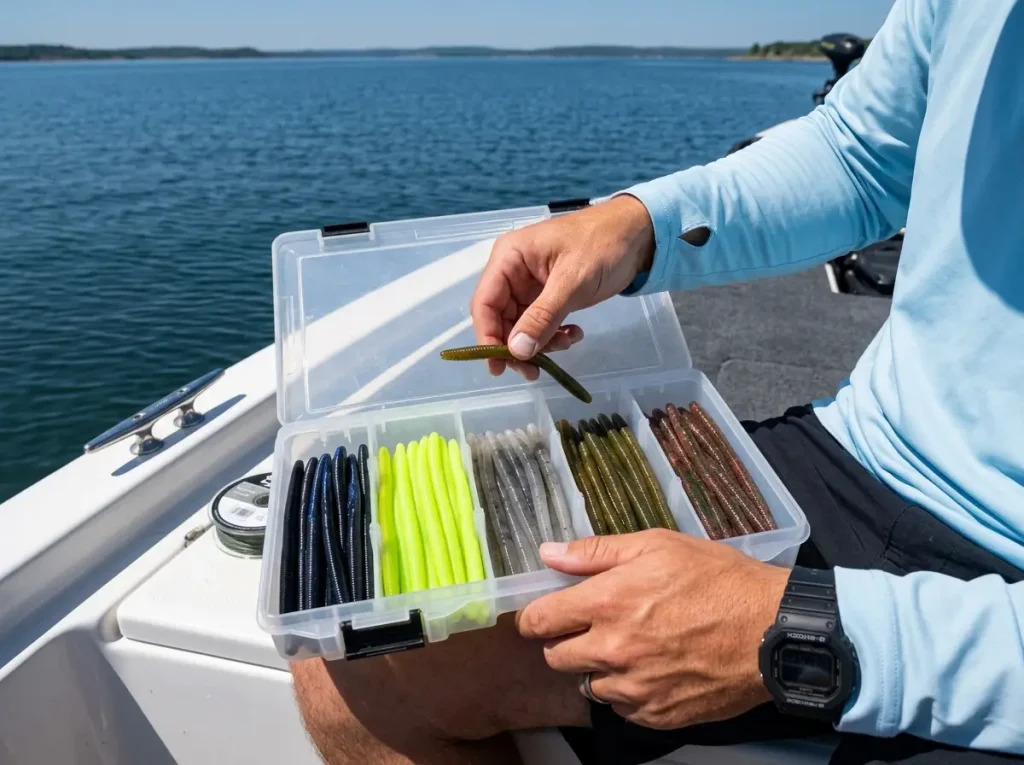
Mike Iaconelli advocates cutting to 4–6 essential colors. That’s not minimalism — it’s physics. Only five spectral archetypes cover the vast majority of clarity-zone scenarios with no redundancy.
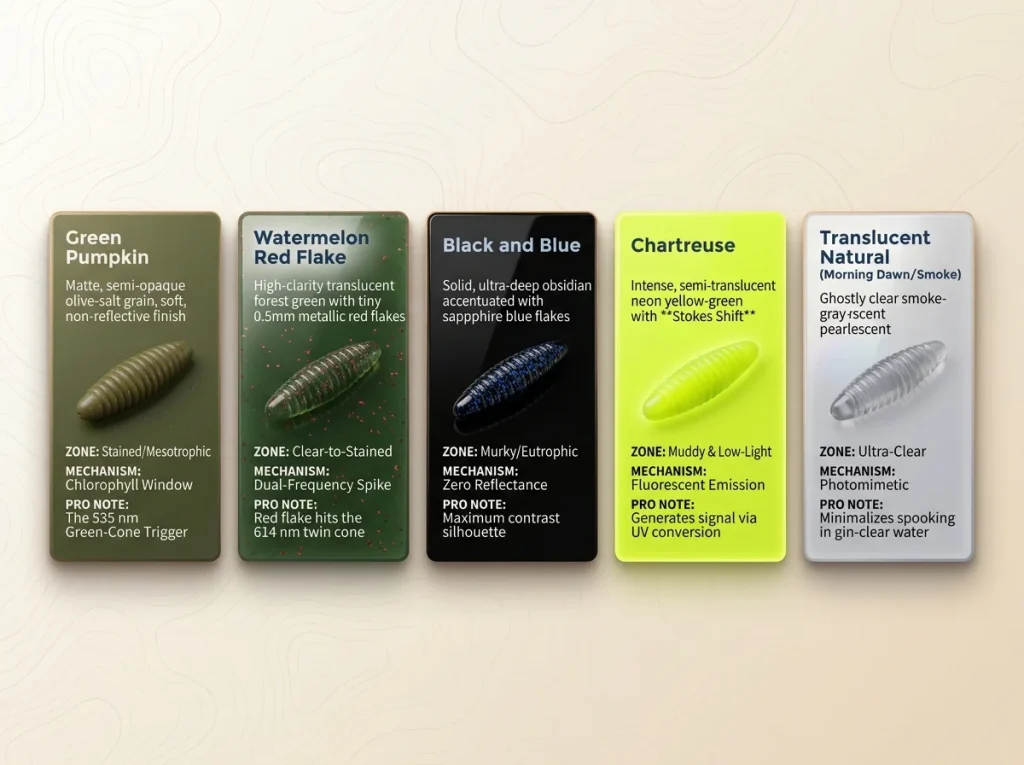
Color 1 — Green Pumpkin: The stained-water workhorse. Sits in the chlorophyll transmission window, directly stimulates the 535 nm green cone. The only situations where it fails are ultra-clear (too opaque) and extreme murky (too subtle). Everything else is Green Pumpkin territory.
Color 2 — Watermelon Red Flake: Bridges clear-to-stained water. The red flake adds the 614 nm red-cone trigger as a micro-contrast element. One bait, two biological frequencies.
Color 3 — Black and Blue: The murky-water silhouette standard. Zero-reflectance profile against scattering grey background. The blue accent persists as a contrasting frequency at shorter wavelengths that survive Mie-scattering environments better than red or orange.
Color 4 — Chartreuse (Fluorescent): Muddy water and low-light attractor. The Stokes shift gives it emission capability that no standard pigment can match. This is not a confidence color — it’s a physics choice.
Color 5 — Translucent Natural (Smoke, Watermelon, Morning Dawn): Ultra-clear and high-pressure applications where the bass’s ability to scrutinize from distance makes spooking the primary failure mode.
How lure selection integrates color, cover, and seasonal patterns builds on this framework. The five archetypes cover the physics. Seasonal patterns and cover context tell you how to fish them.
Pro tip: Don’t carry 50 colors. Carry one example of each archetype in 3 sizes and 2 profiles — straight-tail and creature. Every other color in the box is a version of one of these five. Sort them into those categories before your next trip and you’ll stop making decisions at the boat ramp.
Why Green Pumpkin Is the Default — Not a Cliché
It sits inside the chlorophyll transmission window (495–570 nm) and fires the 535 nm green cone directly. The only conditions where it fails: ultra-clear (too opaque to pass inspection) and pitch-murky (too subtle to generate contrast). Those are the two extremes. Everything in between is Green Pumpkin territory. If someone on the water is smoking you and you don’t know why, bet Green Pumpkin before you bet anything else.
Black and Blue — The Physics of a Zero-Reflectance Profile
Black absorbs all visible wavelengths — zero reflectance, maximum contrast against the scattering grey background. The blue accent provides a highlight frequency at shorter wavelengths that survive particulate scattering better than red or orange. Below 3 feet of Secchi depth, any “matches the hatch” strategy assumes the bass can see well enough to care. It can’t. Solid black is the correct call.
When to Break the System — Edge Cases and Overrides
Tournament-pressured clear fisheries produce fish that key on micro-differences. Morning Dawn or California 420 can outperform Watermelon because they pass closer inspection. During the spawn, profile and presentation cadence outrank color — the bass is responding to territorial intrusion, not prey. At night, rod cells dominate and color is largely irrelevant. Dark solids and vibration are the only two variables that matter. These are edge cases, not new rules — the five archetypes handle 90% of what you’ll face.
Conclusion
Three things to walk away with:
Water is a spectral filter, not a backdrop. Every color you tie on is physically modified by depth, particles, and dissolved organics before a bass ever sees it. Know your Secchi depth — it determines your color options, period.
Bass have two cones, not three. Green (535 nm) and Red (614 nm). Blue registers essentially as black. Chartreuse reads as near-white in bright light. Design your presentations around the hardware the fish is actually running.
The 5-archetype system covers 90% of scenarios. Green Pumpkin, Watermelon Red Flake, Black and Blue, Chartreuse, and one translucent natural. If your situation isn’t covered by one of those, you’re in a weather or forage edge case — not a new-color situation.
On your next trip, take 60 seconds to check your Secchi depth before you rig up. If you don’t have a disk, use a white jig and count the feet until it disappears. Multiply by four. That’s your visual feeding zone. Pick your color off the physics.
FAQ
What color soft plastic is best for clear water?
In ultra-clear water (Secchi above 12 ft), translucent naturals are the correct call — Watermelon, Smoke, or Morning Dawn patterns that let light pass through the lure body, mimicking the semi-transparent profile of real baitfish. Bass in clear water inspect from distance and have enough visual acuity to reject anything opaque or out of place.
Does water depth change lure color?
Yes, directly and predictably. Red disappears within a few meters, orange fades to brown, yellow washes near-white, and green is the last color to survive in most freshwater environments. Below your Secchi depth multiplied by four, lure color selection is largely irrelevant — the bass shifts to lateral line detection, and profile and vibration become the primary triggers.
What colors do bass see best?
Bass are dichromats — cone peaks at 535 nm (green) and 614 nm (red). They see green and red most accurately. Blue is nearly indistinguishable from black. Chartreuse-yellow is barely distinguished from white under bright light. Rod cells vs cone cells toggle determines whether color or silhouette is the dominant stimulus.
Do fish see color at night?
Not meaningfully. At night, rod cells dominate and cones are suppressed. Bass shift to scotopic vision where contrast vs mimicry flips entirely — contrast wins. Dark solids like Black and Junebug produce maximum silhouette against whatever ambient glow exists at the surface. Flashy colors underperform in true darkness.
Why does chartreuse work in muddy water if bass can’t see color well?
Chartreuse is fluorescent. It converts UV and green photons into a longer-wavelength visible emission via the Stokes shift — that’s what uv light and fluorescent pigment interaction produces. In murky water, a chartreuse lure is generating its own optical signal rather than depending on reflected ambient light. That’s the mechanism behind the folklore. The fish sees a glow, not a color.
Risk Disclaimer: Fishing, boating, and all related outdoor activities involve inherent risks that
can lead to injury. The information provided on Master Fishing Mag is for educational and informational purposes
only. While we strive for accuracy, the information, techniques, and advice on gear and safety are not a substitute
for your own best judgment, local knowledge, and adherence to official regulations. Fishing regulations, including
seasons, size limits, and species restrictions, change frequently and vary by location. Always consult the latest
official regulations from your local fish and wildlife agency before heading out. Proper handling of hooks, knives,
and other sharp equipment is essential for safety. Furthermore, be aware of local fish consumption advisories. By
using this website, you agree that you are solely responsible for your own safety and for complying with all
applicable laws. Any reliance you place on our content is strictly at your own risk. Master Fishing Mag and its
authors will not be held liable for any injury, damage, or loss sustained in connection with the use of the
information herein.
Affiliate Disclosure: We are a participant in the Amazon Services LLC Associates Program, an
affiliate advertising program designed to provide a means for us to earn advertising fees by advertising and linking
to Amazon.com. As an Amazon Associate, we earn from qualifying purchases. We also participate in other affiliate
programs and may receive a commission on products purchased through our links, at no extra cost to you. Additional
terms are found in the terms of service.