
In this article
The hub was so hot I could smell it from the driver’s seat. Two-hour haul down I-90, 65 mph the whole way, and I backed straight into the water without thinking twice. That’s the day the vacuum effect stopped being something I’d read about. Inside three seconds, my freshly packed grease turned milky white. A hundred bucks in bearings. A ruined afternoon. A lesson that stuck permanently.
If you’ve been trailering long enough, you have a version of that story. The goal of this guide is to make sure you don’t get a worse one — the kind that starts with a hub getting too hot at highway speed, or a hull listing off bunks at a crowded public ramp.
This is a boat trailer maintenance loading guide built from first principles: the thermal dynamics that destroy hubs, the metallurgy that decides whether your frame survives saltwater, and the ramp protocol that protects your hull, your rig, and the concrete under your tires.
⚡ Quick Answer: Let your hub cool 15–20 minutes before backing into water after any haul over an hour. Check your tongue weight — keep it between 6–10% of gross trailer weight to prevent trailer sway. Use aluminum-alloy anodes in any water type; zinc goes inert in fresh water. At the ramp, skip the engine thrust and walk the boat on with a bow line. Those four habits cover 80% of the mechanical and safety problems this guide addresses.
Understanding Towing Physics and Weight Distribution
Most trailer problems start in the driveway, not at the ramp. Before you pull out, you need to understand what forces are acting on your rig — because getting it wrong doesn’t give you a second chance at highway speed.
The most important number to know is your GVWR — Gross Vehicle Weight Rating — the maximum your trailer is legally rated to carry. That includes the hull, engine, fuel (roughly six pounds per gallon), water, and gear. A practical rule: load to no more than 85% of GVWR to keep a real safety margin. For tandem-axle trailers, the GVWR is typically twice the GAWR (Gross Axle Weight Rating), which matters because the two numbers aren’t interchangeable when you’re calculating load.
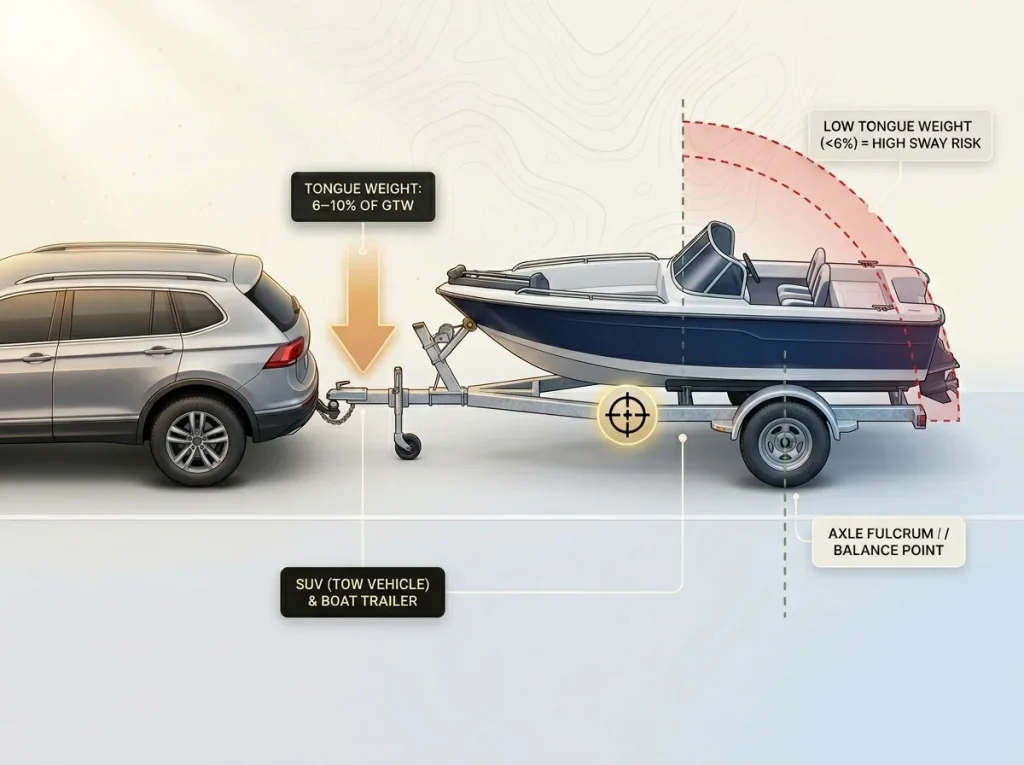
Tongue weight is where most people get into trouble. The target range for boat trailers is 6–10% of the Gross Trailer Weight — lower than cargo trailers because outboard and sterndrive engines shift the center of gravity aft. Drop below 6% and your center of gravity moves behind the axle. That’s the pendulum that creates trailer sway — lateral oscillation that amplifies with crosswinds or passing trucks and can become uncontrollable fast. Push above 10% and you’re levering the front wheels of your tow vehicle off the pavement, which kills your steering geometry. The physics don’t care how experienced you are.
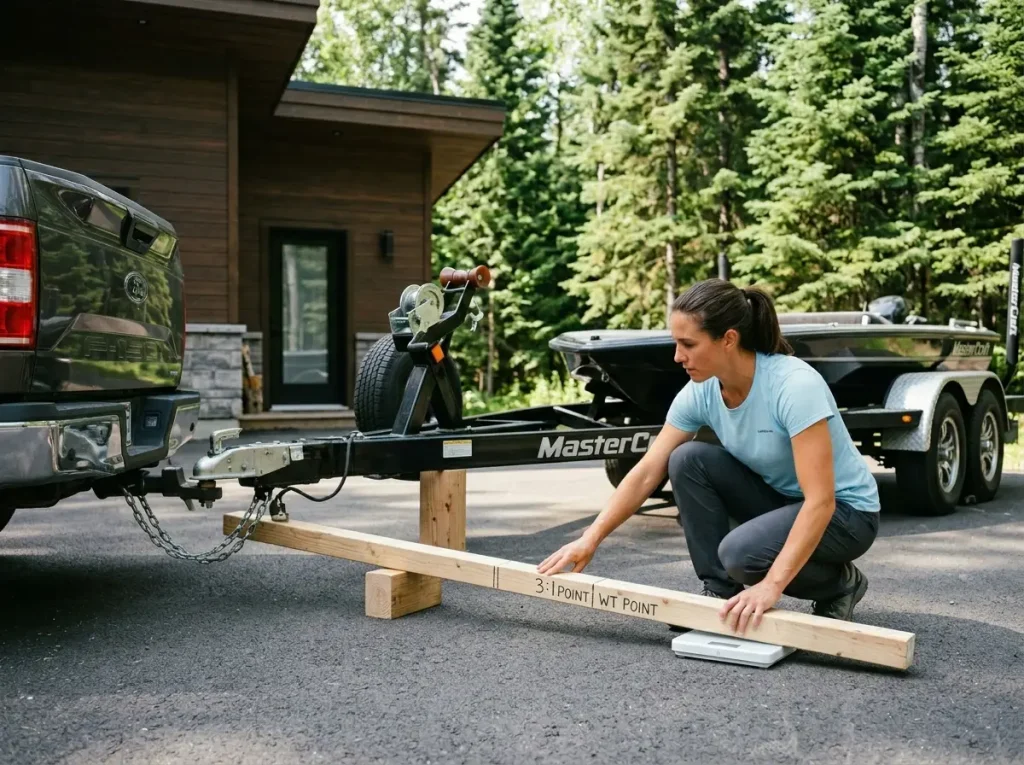
To verify tongue weight without a commercial scale, use the 3:1 lever method: on a 3,000 lb rig with a bathroom scale and a 3-foot piece of pipe, a scale reading of 100 lbs translates to 300 lbs of tongue weight (10%). Carry a bathroom scale in the truck bed — it’s a 90-second check that eliminates guesswork before every trip. Your hull geometry and total trailered weight directly determine where this calculation lands, so if you’re shopping boats, build tongue weight into the decision.
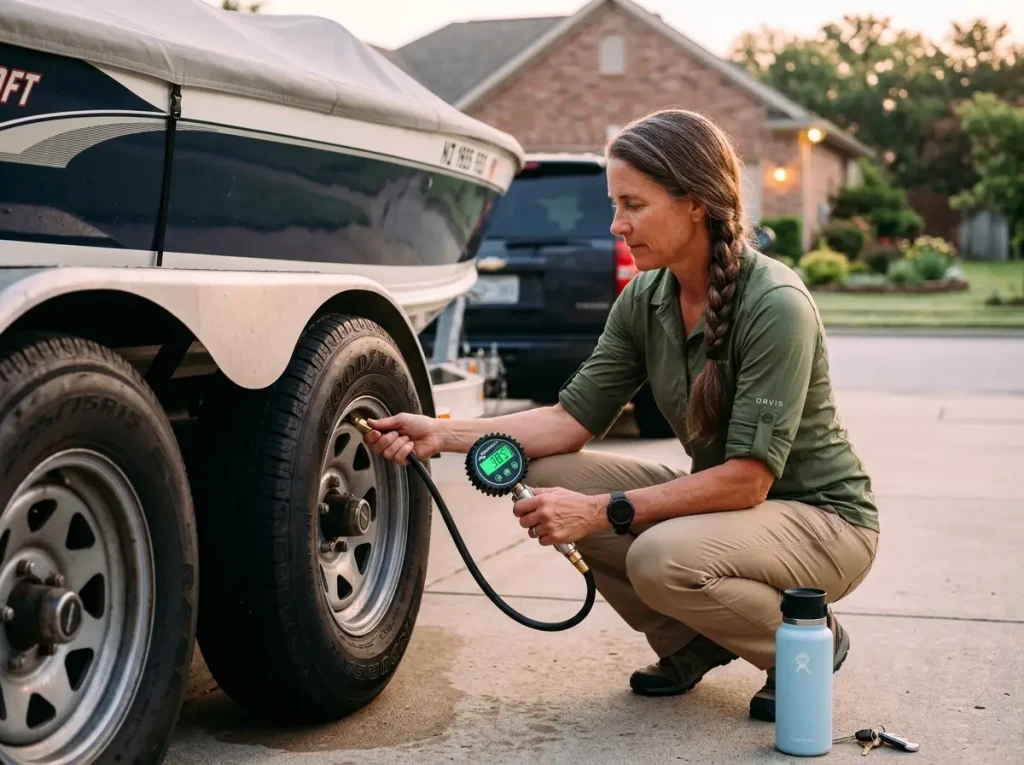
Your tire pressure matters more than most people acknowledge. ST-rated trailer tires have stiffer sidewalls than LT-rated truck tires — engineered specifically for lateral stiffness under load. Never substitute LT tires on a boat trailer. Check cold pressure against the sidewall maximum before each trip; 65 PSI is common, but verify your spec. Underinflation is the most common cause of tire failure, and a blowout at 65 mph on a tandem rig is not a situation you want to improvise through.
Pro-Tip: The best load bias target is 60/40 front-to-rear. Unequal distribution causes uneven tire wear that’s invisible until tire failure — inspect both sides, not just the driver’s side.
The Thermal Vacuum — Why Wheel Bearings Fail at the Ramp
Here’s what’s actually happening inside your hub when you back down the ramp after a long haul. This is the one piece of knowledge that will save you real money if you internalize it.
The Physics of the Vacuum Effect
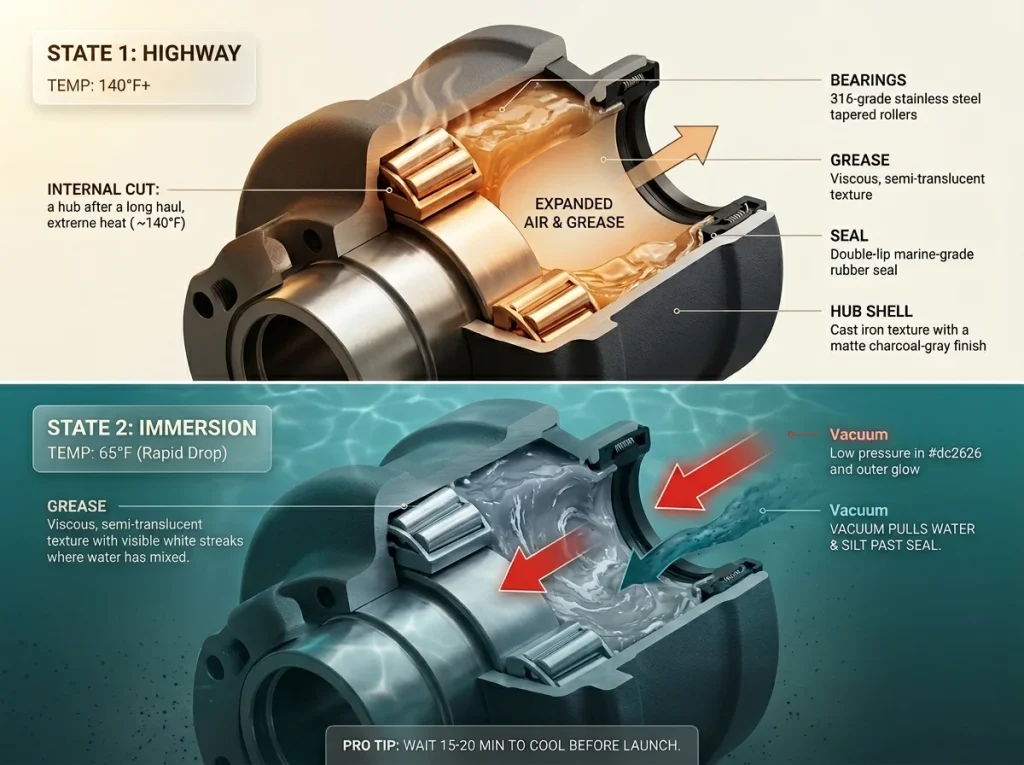
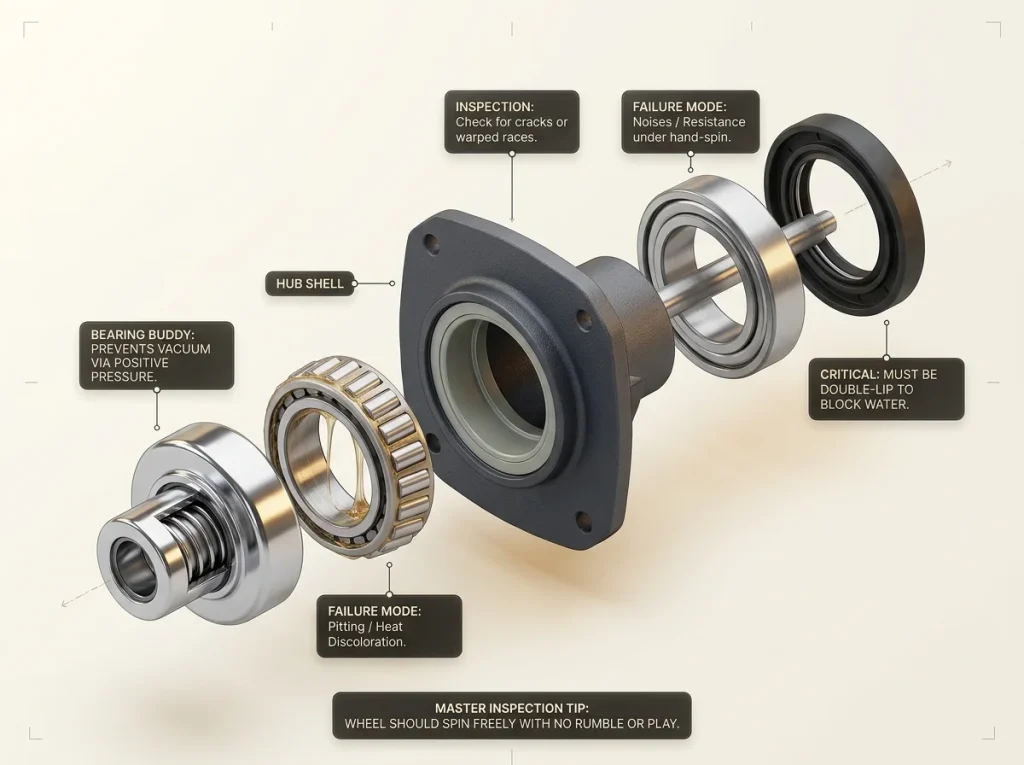
At 65 mph, the tapered rollers inside your hub generate heat through friction. That heat expands both the air and the grease inside the housing. When you immediately back into cold water, the hub cools rapidly. Rapid cooling means rapid contraction — pressure drops fast, creating a vacuum. If your grease seal isn’t a double-lip marine grade design, or if the hub isn’t pressurized by a spring-loaded piston like a Bearing Buddy, that vacuum pulls water and silt directly past the seal.
The fix is simple: give the hubs 15–20 minutes to cool before immersion on any haul over one hour. That’s it. The vacuum effect stops being a threat once the temperature differential is gone. It costs nothing and saves you from the most preventable mechanical failure in trailering.
Here’s the part that catches experienced boaters off guard: if you live close to the ramp and only run short 20-minute trips, you actually have a bearing problem too — in reverse. Short trips never heat the hub enough to evaporate accumulated internal moisture, so rust builds from the inside out. Long-haul trailers at least dry out their hubs. Short-trip boats sit wet.
Diagnosing and Monitoring Bearing Health
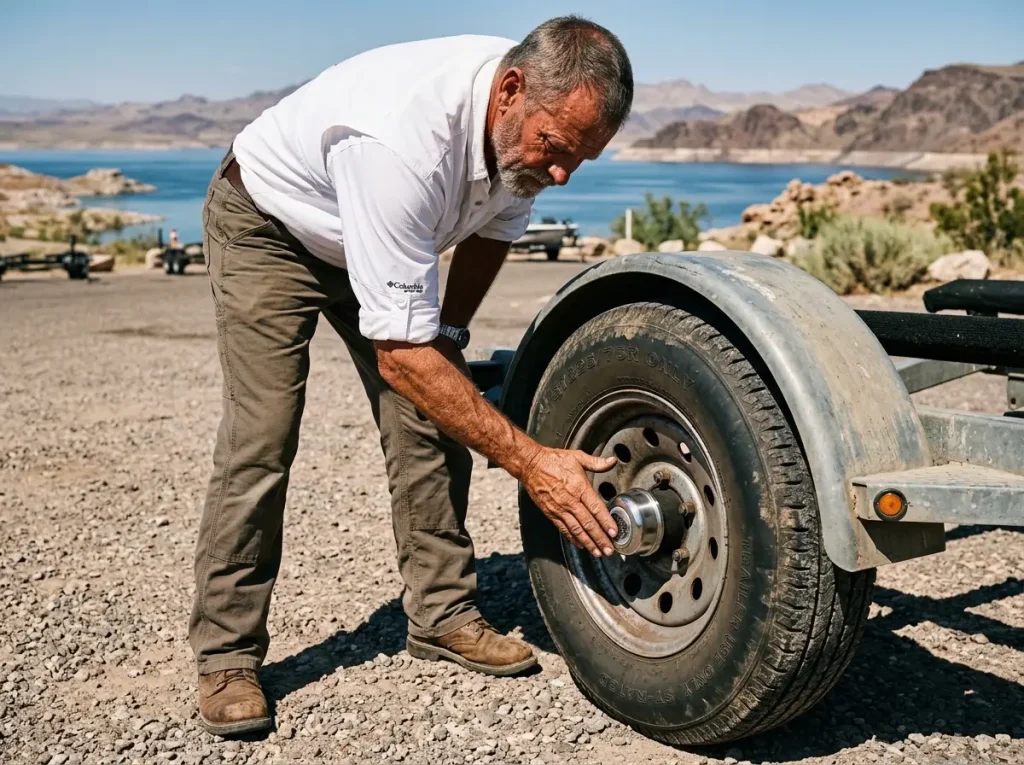
The tactile heat check is your most useful diagnostic tool and it takes three seconds. Before you back into the water, walk to each hub and press your palm to the housing. A healthy hub should feel about like a cup of coffee — warm but not painful. Hotter than that means there’s friction happening that shouldn’t be, and you stop right there.
Audible diagnosis comes next. A rumble or growl from a hub during turns or on deceleration means microscopic pitting on the bearing rollers is announcing itself. That’s not a problem you drive home on and deal with later. Spin each hub by hand before every trip — roughness or resistance under your fingers tells you more than a visual inspection ever will.
When you pull the hub for repack, milky grease means water got in. Plan a full repack regardless of visual condition every 12 months, and learn what fresh marine grease feels like compared to the contaminated version. Understanding how grease viscosity and tribology determine component longevity applies directly to hub maintenance — the degradation chemistry is the same.
Bearing Protection Systems Compared
Standard dust caps offer zero protection against the vacuum effect. They’re just there to keep grit out under normal road conditions — not to counteract internal pressure cycles.
The Bearing Buddy spring-loaded piston maintains positive internal pressure continuously, which mechanically prevents vacuum-driven water intrusion. It’s a retrofit that fits most standard trailer hubs and is worth doing before you replace another set of bearings. EZ-Lube hubs take a different approach: a grease fitting runs through the spindle, letting you grease bearings without pulling the wheel. Convenient, but it doesn’t replace annual repack — you’re pushing grease in without inspecting what’s already there.
Rebuild every two seasons. Replace seals, rollers, and races — don’t rely on how the outer components look. The failure is always inside.
Corrosion Science — Metallurgy Decides What Survives Saltwater
Saltwater isn’t just water. It’s an electrolyte, and every piece of dissimilar metal on your trailer is part of a slow electrical circuit that’s spending your components. You don’t need a chemistry degree to manage this — you just need to know which metals you’re combining and what the consequences are.
Galvanic Corrosion and the Dissimilar Metals Problem
Galvanic corrosion happens when two different metals share an electrical path through water. The more active metal — the anode — gives up electrons to protect the more noble metal — the cathode. In saltwater, that process runs fast. Fresh water slows it. The galvanic series runs from magnesium (most active) through zinc, aluminum, steel, stainless steel, and up to titanium (most noble). Every common boat trailer material sits somewhere on that ladder.
The most hazardous combination you’ll find on a poorly built or poorly maintained trailer is an aluminum frame bolted directly to a steel hitch. Aluminum sits above steel in the galvanic series, but the contact area and the path through any moisture means the aluminum starts oxidizing at the joint. A dielectric barrier — a rubber bushing or non-conductive spacer — breaks the electrical path. Most trailer manufacturers include this. If yours doesn’t, it’s a simple fix with a hardware store gasket.
For hardware, the 304 vs. 316 stainless distinction is not a marketing story. 316 stainless contains molybdenum, which resists chloride pitting — the specific attack mechanism that saltwater uses against stainless surfaces. 304 doesn’t resist it nearly as well. Buy 316 for anything that sees salt. When you’re buying “stainless” hardware at a marine supply or hardware store, carry a magnet. If it sticks, the iron content is too high for saltwater use. Stainless that sticks to a magnet isn’t really stainless in the way you need it to be. This is the same galvanic corrosion sequence that destroys trailer hardware through your rods, reels, and terminal tackle — the chemistry doesn’t change by environment.
Anode Selection by Water Type
Most decisions about sacrificial anodes are made wrong because boaters don’t change their anodes when they change water bodies.
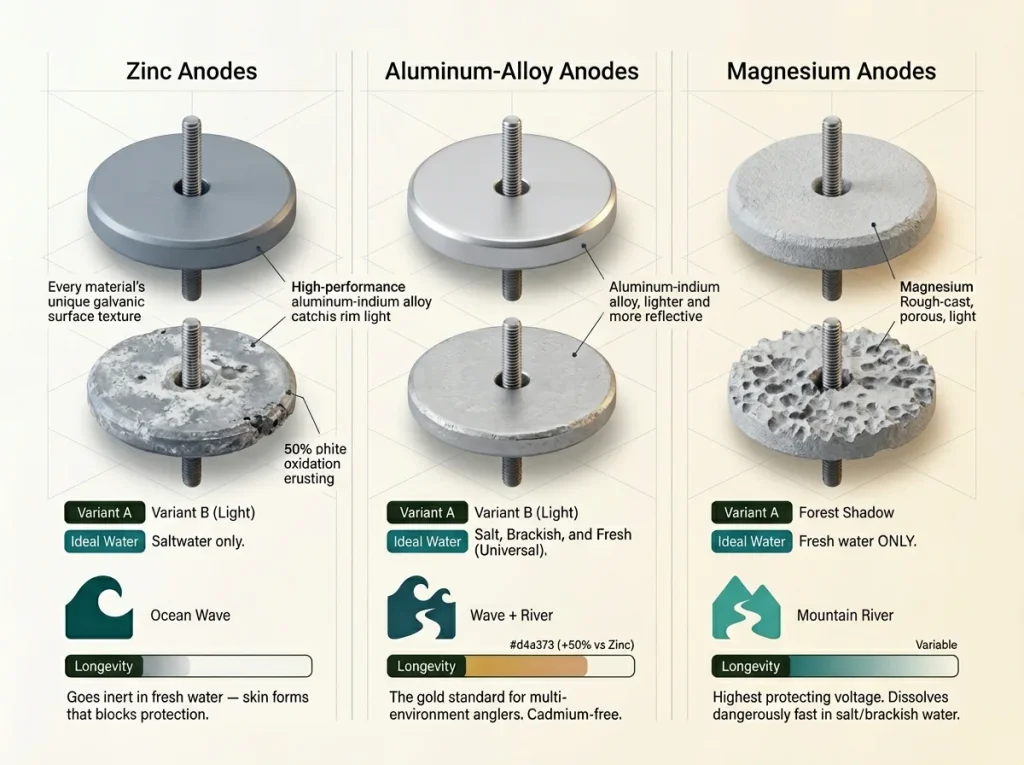
Zinc anodes are the traditional saltwater standard and they work — in saltwater. In fresh water, zinc forms an insulating oxide layer that blocks further oxidation, which means it stops protecting. It’s not consuming, but it’s also not doing anything. Aluminum-alloy anodes are the practical choice for anyone who fishes multiple water types: effective in salt, brackish, and fresh water, lasting roughly 50% longer than zinc without the toxic cadmium that some zinc formulations contain. Magnesium anodes are strictly freshwater — highest protective potential, but they dissolve prematurely in saltwater before they can do any useful work.
Replace anodes when they’re 50% consumed. Inspect annually or every 100 hours of use. Don’t wait for the anode to disappear entirely — at that point, the structure it was protecting is already exposed.
A note on aluminum frames: they’re naturally protected by an aluminum oxide layer, but that doesn’t mean they’re invincible. Any drilled hole, cut edge, or weld that breaks through the oxide layer needs attention — cold-galvanizing spray covers these spots and restores the sacrificial barrier. The environmental impacts of corrosion byproducts at marine vessel operations are significant enough that cadmium-containing anodes are increasingly regulated in certain jurisdictions. Aluminum-alloy anodes solve this problem by design.
Frame, Fastener, and Wiring Corrosion Prevention
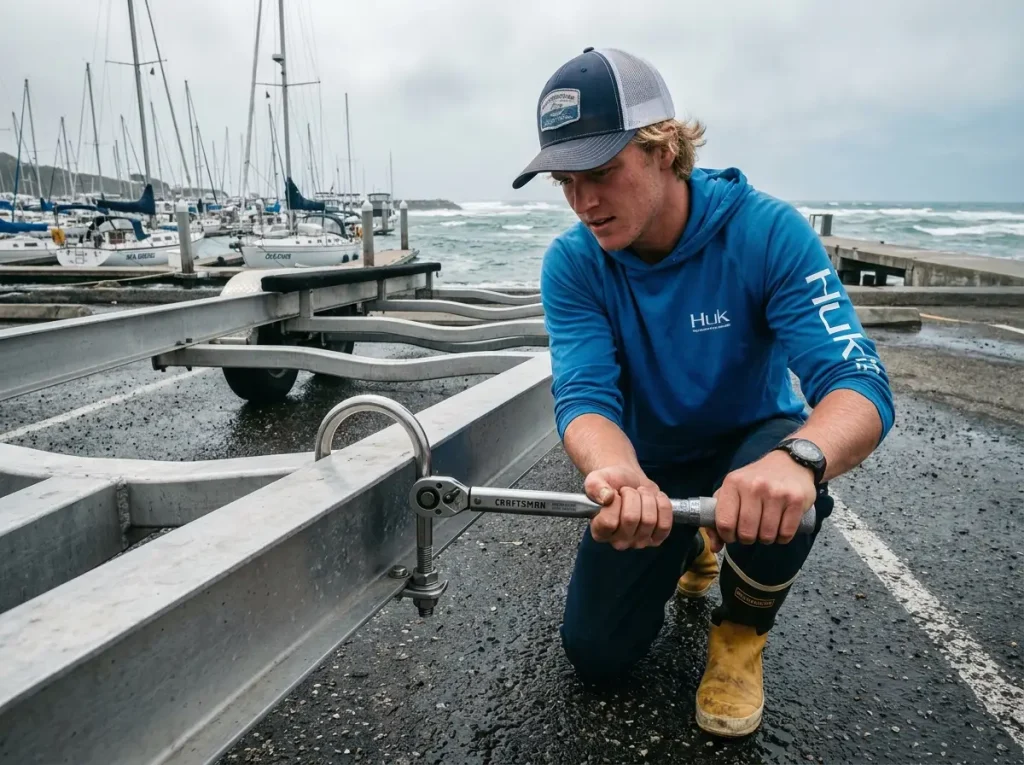
Replace any rusted Grade 5 carbon steel bolts with 316-grade stainless. Chloride-induced stress corrosion cracking is how carbon steel fasteners fail — not from rust visible on the surface, but from internal cracking under sustained load in a chloride environment. Re-torque U-bolts after the first 500 miles of use as hardware settles; typical spec is 25–35 ft-lbs, but check your manufacturer’s figure.
The weak point in LED lighting systems isn’t the housing — it’s the wire-to-housing solder joint. Thermal cycling cracks solder over time, and saltwater wicks up wire strands through capillary wicking past the housing seal even when the housing itself looks intact. Use heat-shrink adhesive-lined connectors at every junction and apply dielectric grease before closing the connection. Run a dedicated white ground wire from the tow vehicle plug to each fixture — this bypasses the high-resistance paths that corroded trailer frames create in the ground circuit.
Pre-Trip Maintenance Checklist — The Analytical Angler’s Protocol
This isn’t a generic list. This is the specific sequence that catches failures before they strand you.
Mechanical Systems Verification
Check cold tire pressure against the sidewall maximum — don’t check after highway miles, when heat has raised the reading. Inspect the sidewalls for dry rot, which shows up as surface crazing where UV inhibitors have broken down. A tire can look inflated and still be six months from a catastrophic sidewall failure.
Run your hand over every hub before launch. Any hub hotter than ambient temperature from the last trip means you investigate before entering the water. Verify the coupler is fully seated on the ball, the clip pin is through the receiver, and safety chains are crossed under the tongue — if the trailer separates from the vehicle, crossed chains cradle the coupler instead of letting it drag.
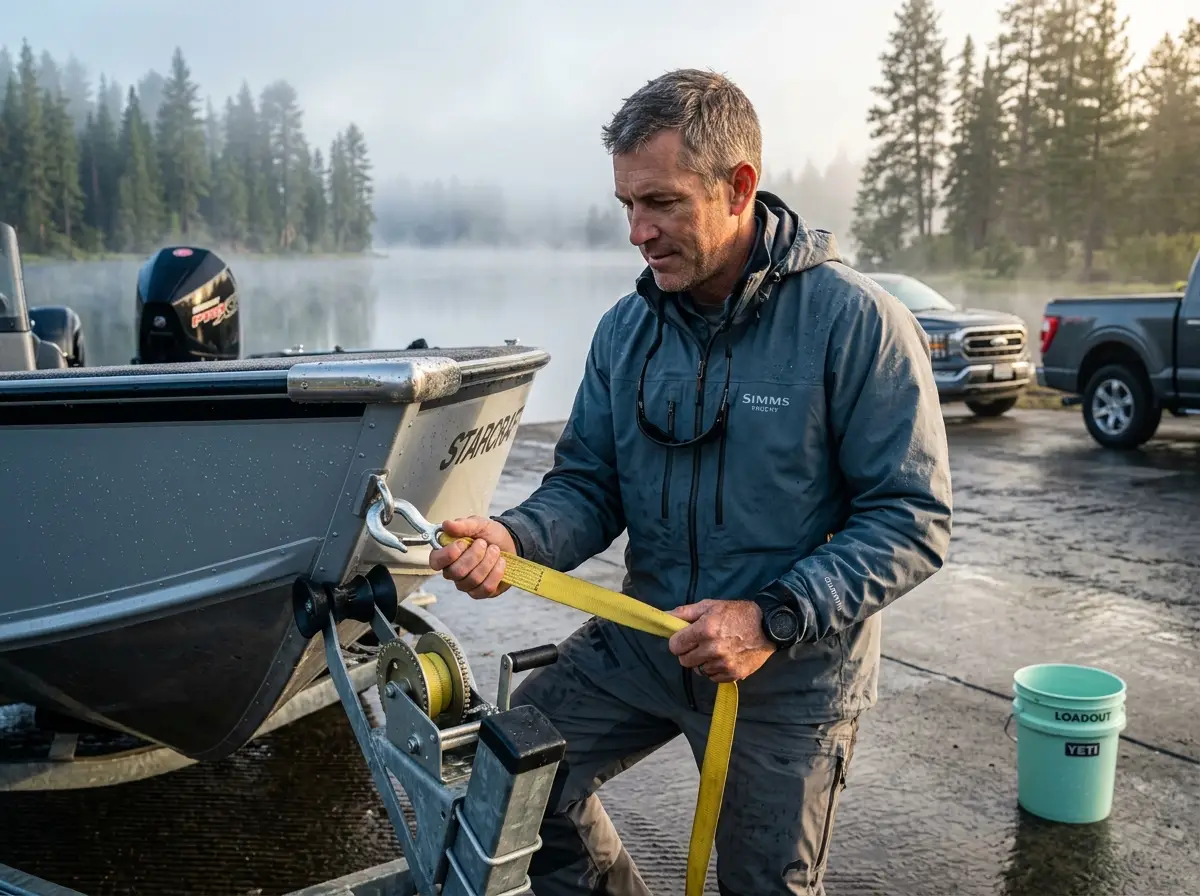
The breakaway cable needs a pull test every trip. Slack or fraying means you’re relying on a system that won’t work when you need it. Check the winch strap for fraying and UV degradation at both the hook end and where the strap loads against the drum edge — that’s where most wear concentrates. A secondary bow strap or chain provides real retention if the winch strap fails mid-highway. Don’t rely on the winch alone.
Pro-Tip: Keep a laminated pre-trip checklist in the truck. You’ll miss something on your third trip of a long weekend when you’re tired and eager to launch. A $2 laminated card prevents a catastrophic loss.
Electrical and Lighting Systems
Run a full light test — tail, brake, and turn signals — before every trip. Have someone walk behind the trailer while you operate the controls. Condensation inside a submersible LED housing means the seal has failed; replace it, don’t dry it out and reinstall it. The failure repeats.
Spray 4-pin or 7-pin connectors with CRC 6-56 or equivalent before each use. Pin oxidation creates voltage drop that shows up as dim or intermittent lights that pass your driveway test and fail at the ramp inspection. LED systems don’t need spare bulbs — carry a spare complete connector instead.
Bunk and Guide Hardware Inspection
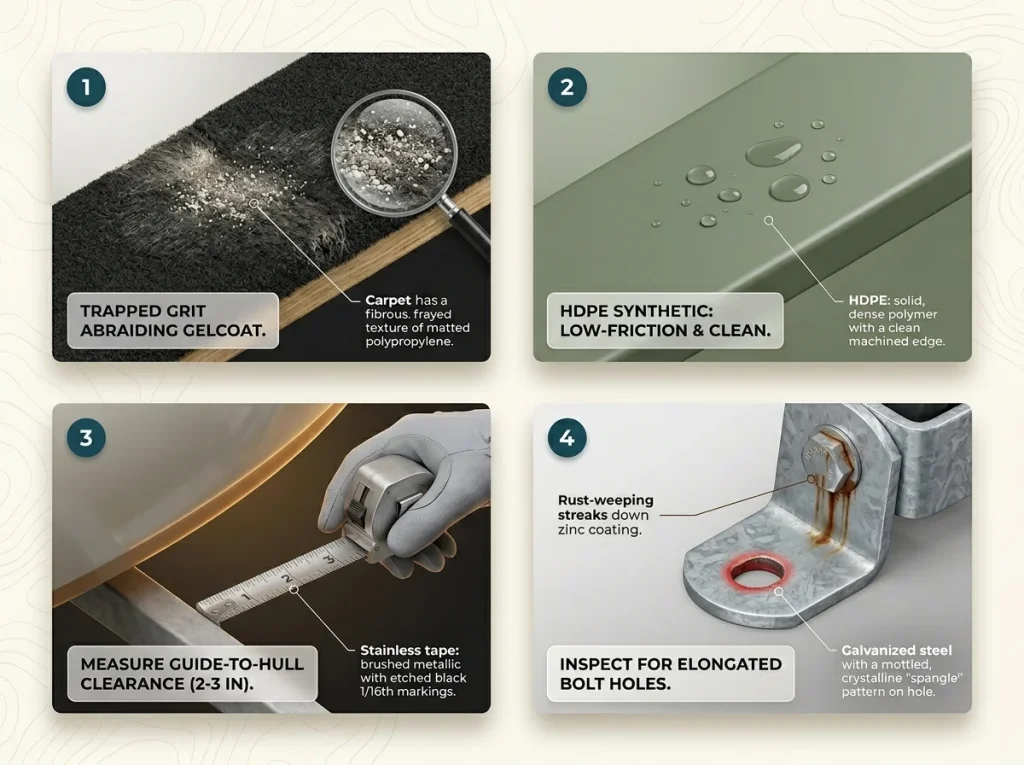
Saturated bunk carpet is a hull damage mechanism. Polypropylene carpet traps silica and abrasive grit from the ramp and acts like sandpaper on gelcoat during loading and retrieval. Wet carpet is significantly rougher than HDPE synthetic bunk material — HDPE slides close to polished concrete, while wet carpet loaded with ramp grit is more like dragging across gravel. The practical result: HDPE reduces winch force by over 30% and eliminates hull abrasion from trapped grit.
The trade-off with HDPE: the hull can slide forward off the trailer with minimal gradient before the trailer is properly positioned in the water. If you switch to HDPE synthetic bunks, never disconnect the bow strap until the trailer is at proper launch depth and you have tension on the bow line. Check guide roller bolts for elongated holes — the sign of repeated off-center loading under load.
Applying the same post-trip protocol that protects your reels and rods applies equally to your trailer hardware after saltwater exposure.
The Ramp Protocol — Loading and Launching Without Power
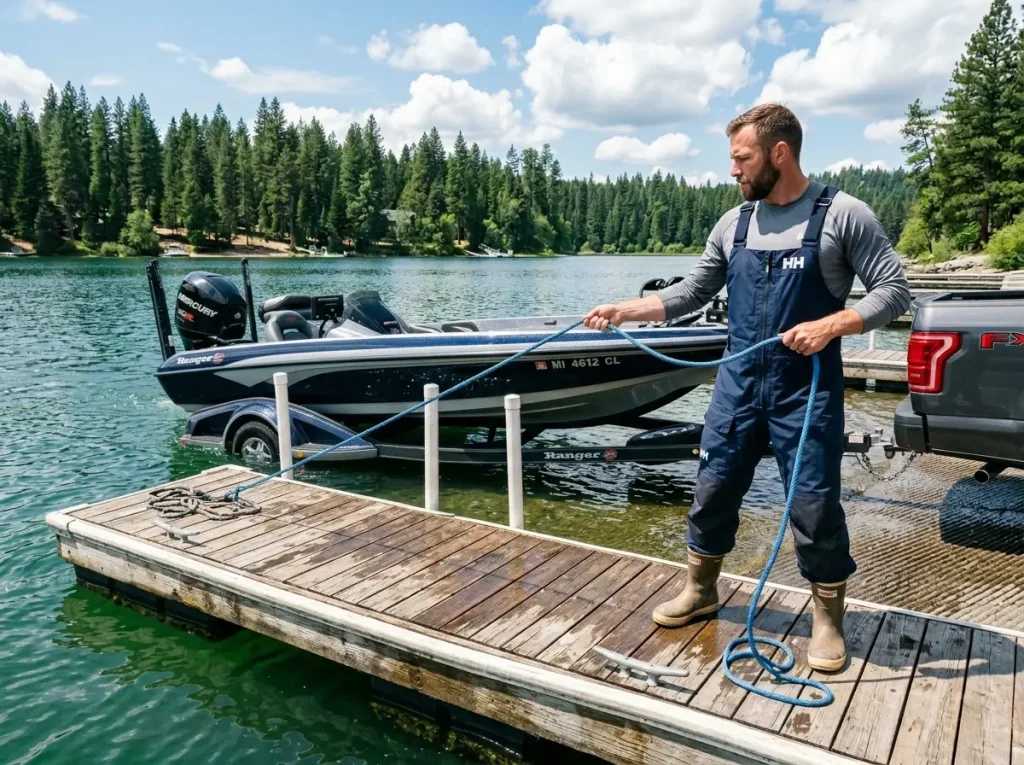
The ramp is where most boaters reveal how little they’ve thought about the physics. A competent launch sequence is a mechanical problem solved with positioning and bow line management — not with engine thrust.
Pre-Launch Staging and Orientation
Stage in the parking lot, not on the ramp. Remove every tie-down, connect the bow line, and verify the drain plug is seated before you back toward the water. The ramp belongs to the next person in line, not to your staging operation.
Back at a 10–15° offset angle to the dock or water’s edge — it gives you a visual reference point for your trailer wheels relative to the ramp edge. Target immersion depth is trailer bunks submerged 12–18 inches at the stern; the hull should begin to float without winch pressure at that depth. Keep the winch strap tight until the bow line handler has the line and the boat is floating. A two-person launch is significantly cleaner than a solo attempt at any exposed or current-affected ramp.
The Float-On and Walk-and-Guide Loading Method
Float-on loading is exactly what it sounds like: back until the hull floats free of the bunks, then walk the boat forward by the bow line. The hull self-centers on the guides through water buoyancy and the guide geometry — hydrodynamic centering does the alignment work once you’re close. Your job is positioning and tension on the bow line, not horsepower.
For retrieval, the bow line and guide rails do the lateral alignment. The winch handles the final 10% of mechanical work — the last few feet of pulling the hull onto the bunks past flotation. A 25-foot bow line keeps you in control at the stern of the ramp without stepping into the water. Check the drain plug immediately once the hull is on the trailer, before engaging the winch strap. Lock the coupler and safety chains before flushing the outboard — don’t flush an outboard while the trailer is on the jack alone without the hitch safety chain connected.
Pro-Tip: When you back the trailer, use a fixed reference point on the water surface — a dock corner, a piling, a buoy. Staring at the trailer in your mirror is harder than tracking a fixed point on either side. Your lateral accuracy doubles immediately.
The Power Loading Problem — Conservation and Infrastructure
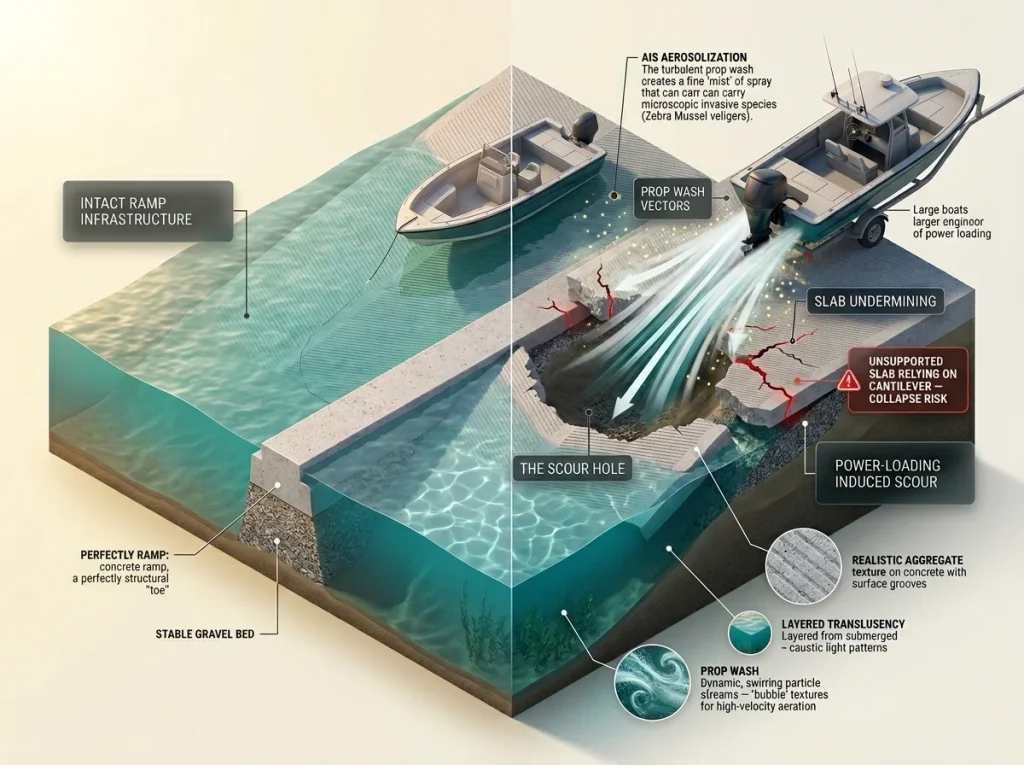
Power loading means using engine thrust to drive the hull onto the trailer bunks. Every time someone does it, the prop wash excavates the substrate at the toe of the ramp — the horizontal section where ramp meets water. Those excavations become scour holes. Scour holes undermine the concrete slab. Slab undermining causes ramp collapse under trailer weight, which is documented specifically enough that the Oregon State Marine Board has banned power loading at multiple ramps due to documented ramp erosion impacts from power loading.
Your registration fees fund ramp reconstruction. Power loading creates the damage those funds pay to fix. It’s a round-trip you’re funding yourself.
Beyond the infrastructure argument: power loading accelerates gearcase seal wear. Engine thrust at low or static speed generates cavitation that impairs the lower unit. And the prop wash component is an invasive species transfer vector — the aerosolized spray can carry zebra mussel veligers and other AIS from the landing area to adjacent trailers and equipment. That’s how prop wash at the ramp spreads aquatic invasive species between water bodies through indirect contact.
The float-on method takes the same time and none of those consequences.
Post-Launch Decontamination — The Ramp-to-Road Protocol
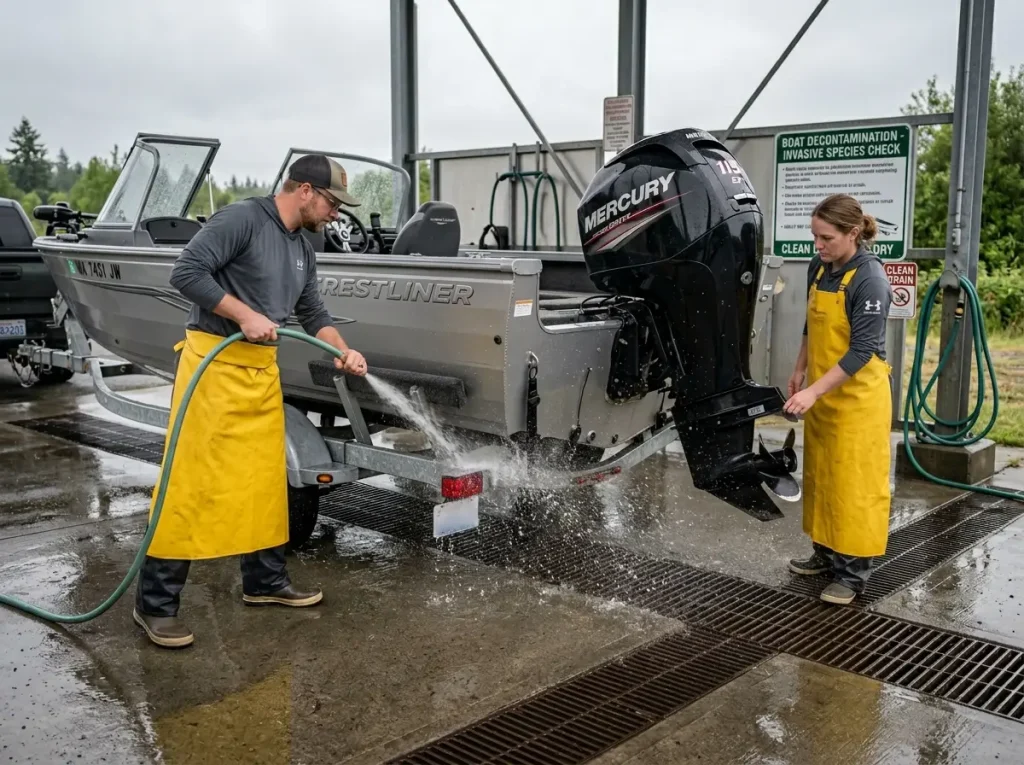
The hour after you leave the water matters as much as anything that happens during the trip. Salt chemistry doesn’t stop because the hull is out of the water — it keeps working on every wet surface until you interrupt it.
Freshwater Flushing Protocol
Minimum 60 seconds of continuous freshwater per section — frame, hubs, bunks, guides. Don’t rush it. Direct the hose at the hub housing specifically; the water needs to reach the seal face to dissolve salt crystal accumulation at the gap. Flush frame cross-members on the upper and lower surfaces both — water pools inside rectangular tube sections and accelerates internal corrosion from contact you can’t see.
Rotate guide rollers manually while flushing. Grit traps between the roller and the spindle on both sides. Your flush muffs on the outboard are a separate protocol — minimum five minutes post-saltwater on the engine cooling system. Don’t run the engine flush and trailer flush simultaneously and call the job done in three minutes.
Pro-Tip: Mount a permanent freshwater hose at your home rinse station. Post-trip rinsing should happen automatically, not only when you remember to connect a hose. Convenience drives behavior; behavior drives condition.
Invasive Species Decontamination
The standard inspect-clean-dry protocol is the legal requirement in most states, but it’s worth understanding what you’re actually doing. Aquatic invasive species — zebra mussels, New Zealand mudsnails, Eurasian milfoil — transfer via bunks, hull, bilge, live wells, and cooling water. Zebra mussel veligers are microscopic; visual inspection confirms nothing about high-risk zones.
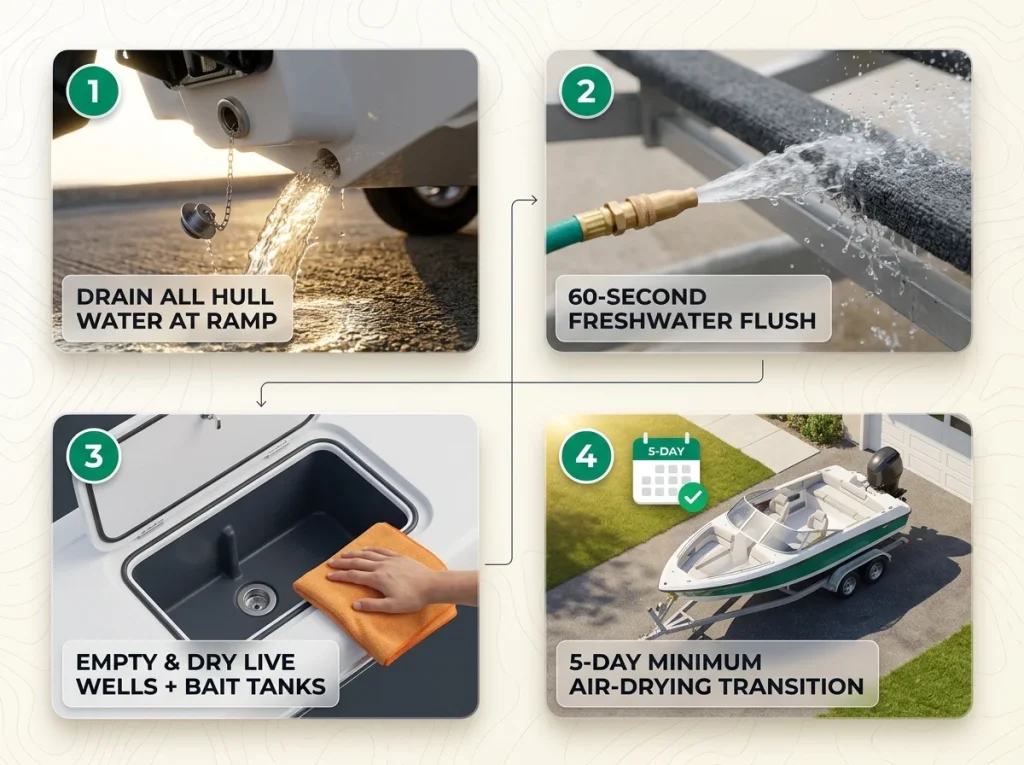
Drain everything — bilge, live well, any water storage — before leaving the ramp. That’s not optional in most jurisdictions, and it’s the right call regardless. If you’re moving between water bodies within a week, allow a minimum five-day dry time for hull, bunks, and trailer. Thermal treatment (140°F water for 10 minutes) decontaminates faster than drying for high-risk situations. The full hull decontamination protocol for high-risk AIS zones covers what you do when simple drying isn’t sufficient.
Never transfer bait water between water bodies. This is the simplest AIS transfer mechanism most anglers don’t think about.
Seasonal Storage and Annual Overhaul
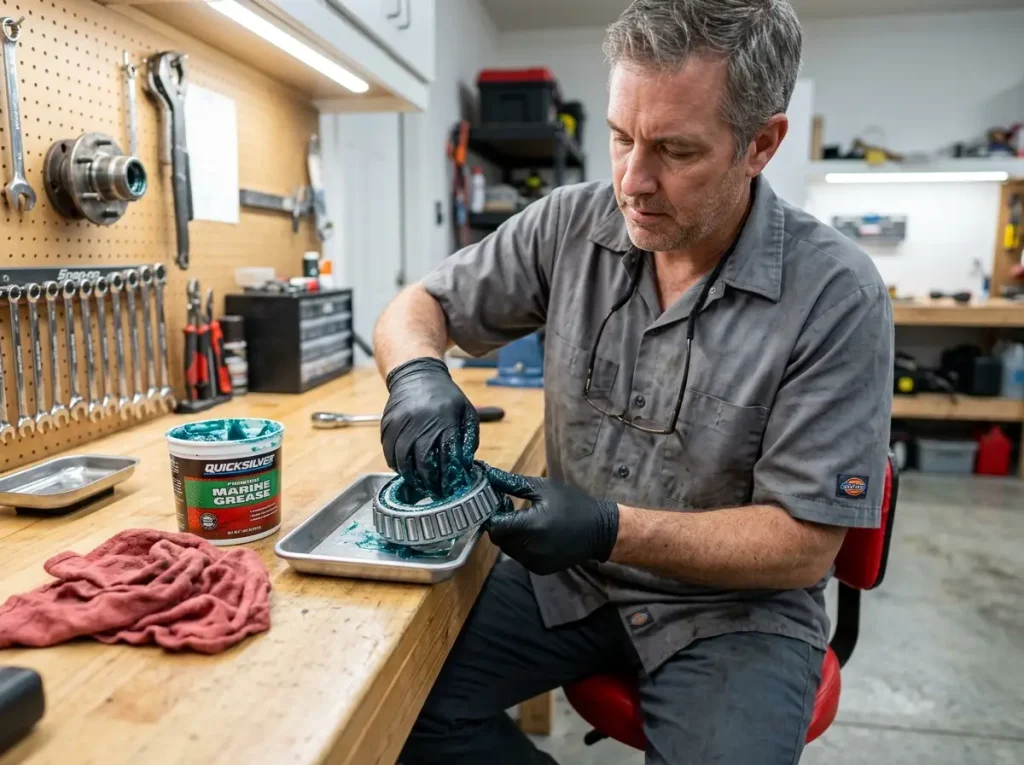
The off-season is when deferred maintenance compounds. Every problem you ignore before storage is a worse problem when you commission in spring.
End-of-Season Disassembly and Inspection
Full bearing repack means pulling the wheels, pulling the hub, cleaning races and rollers with solvent, inspecting for pitting or brinelling, and repacking with marine-grade calcium sulfonate complex grease. Calcium sulfonate outperforms standard lithium grease in high-temperature, high-humidity environments — it resists water washout better and operates cleanly at higher temperatures. The automotive lithium grease in the parts store isn’t a substitute.
Inspect the galvanized frame for bare metal at welds, drilled holes, and cut edges — anywhere the zinc coating is compromised. Treat those spots with cold-galvanizing spray before storage. Repair now costs pennies; repair in spring after oxidation has worked through the steel costs significantly more.
Don’t tarp the trailer with wet carpet bunks underneath. The enclosed space traps moisture — the “sauna effect” that also blisters gelcoat on stored hulls. Store uncovered where ventilation is possible. Tire storage: inflate to roughly 20% above normal operating pressure to slow sidewall dry-rot, and block tires off the ground if extended storage is planned.
Your winch strap should be replaced every 3–4 seasons regardless of appearance. UV destroys nylon and polyester progressively in ways that aren’t visible until the strap fails under load. Pair trailer storage with the outboard winterization protocol that complements trailer storage — both systems need attention, and doing them together means nothing gets missed in the rush of fall layup.
Spring Pre-Season Commissioning Checklist
Run an electrical continuity test before the first trip. Corrosion accumulates in connectors and ground paths over winter without any visual signal. A multimeter between the trailer frame and tow vehicle ground verifies the circuit works or tells you where it doesn’t.
Spin every hub by hand. Any roughness or resistance means moisture absorbed over winter — deal with it before the season, not after a trip that leaves you stranded. Re-torque all U-bolts, axle hardware, and coupler ball mounting — hardware settles in the off-season. Lubricate every pivot point: safety chain hooks, coupler latch, guide roller spindles. Don’t forget the tongue jack screw — salt residue from the previous season seizes the mechanism effectively given enough time.
Verify bunk contact against the hull on both sides. Equal pressure distribution matters for hull stress during transport; if one side shows more contact wear than the other, the bunk alignment needs adjustment before you put highway miles on it.
Conclusion
Three things determine whether your trailer is an asset or a liability, and none of them are complicated.
Let the hub cool. Fifteen minutes before the ramp is the single highest-value habit in trailer maintenance. It stops the vacuum effect cold. No vacuum, no water intrusion, no milky grease, no ruined rollers.
Match your anode to your water type. Zinc in fresh water doesn’t protect anything. Aluminum-alloy anodes work in every water type and last 50% longer. Using the wrong anode is identical to using no anode at all.
Get off the throttle at the ramp. The walk-and-guide method takes the same time, protects the ramp, doesn’t spread invasives, and doesn’t erode your gearcase seals. Power loading has no advantages. It only has consequences.
On your next launch day, after you back down the ramp, walk to each hub and press your palm to the housing. That three-second check tells you more about your trailer’s mechanical condition than any inspection checklist. If a hub is hotter than that cup of coffee, your next bearing failure already has a start date.
FAQ
How deep should I back my boat trailer into the water?
Back until the bunks are submerged 12–18 inches at the stern and the hull begins to float free on its own buoyancy. If you’re still cranking the winch hard when the bunks are already underwater, either the ramp angle is too gradual or you’re not deep enough. The float-on point is when winch pressure becomes minimal — not zero, but light.
What is the best grease for boat trailer wheel bearings?
Marine-grade calcium sulfonate complex grease outperforms standard lithium in the trailer hub environment. It resists water washout better and holds up at the temperatures hub assemblies actually reach in highway service. Standard automotive lithium grease emulsifies faster in the presence of moisture — which is exactly the substance you’re trying to exclude. Don’t use what’s cheap or convenient; use what’s rated for the application.
How do I stop my boat trailer from rusting in saltwater?
Layer the defense: aluminum-alloy sacrificial anodes on the frame hardware, 316-grade stainless fasteners replacing any carbon steel, immediate freshwater flush post-launch, cold-galvanizing spray on any damaged zinc coating areas, and dielectric grease on every electrical connection. Treat it as an ongoing chemical management problem, not a single cleaning event.
Should I unhook the winch strap before backing into the ramp?
No. Keep the winch strap engaged until the trailer is fully at launch depth and the bow line handler has the line under tension. On HDPE synthetic bunks especially, the hull will slide forward with very little incline — with or without a ramp grade. Maintain the strap until you have control of the bow. Sequence matters: bow line tension first, winch strap second.
What causes trailer sway and how do I fix it on the road?
Trailer sway is almost always a tongue weight problem — specifically, tongue weight below 6% of gross trailer weight shifts the center of gravity behind the axle and creates the pendulum that amplifies lateral forces. If it starts while you’re moving, ease off the throttle only — braking can make it worse by shifting weight rearward. Long-term fix: verify tongue weight with a scale and redistribute gear or ballast forward. A weight-distributing hitch is worth the investment on larger rigs where tongue weight is riding the edge of the range.
Risk Disclaimer: Fishing, boating, and all related outdoor activities involve inherent risks that
can lead to injury. The information provided on Master Fishing Mag is for educational and informational purposes
only. While we strive for accuracy, the information, techniques, and advice on gear and safety are not a substitute
for your own best judgment, local knowledge, and adherence to official regulations. Fishing regulations, including
seasons, size limits, and species restrictions, change frequently and vary by location. Always consult the latest
official regulations from your local fish and wildlife agency before heading out. Proper handling of hooks, knives,
and other sharp equipment is essential for safety. Furthermore, be aware of local fish consumption advisories. By
using this website, you agree that you are solely responsible for your own safety and for complying with all
applicable laws. Any reliance you place on our content is strictly at your own risk. Master Fishing Mag and its
authors will not be held liable for any injury, damage, or loss sustained in connection with the use of the
information herein.
Affiliate Disclosure: We are a participant in the Amazon Services LLC Associates Program, an
affiliate advertising program designed to provide a means for us to earn advertising fees by advertising and linking
to Amazon.com. As an Amazon Associate, we earn from qualifying purchases. We also participate in other affiliate
programs and may receive a commission on products purchased through our links, at no extra cost to you. Additional
terms are found in the terms of service.