In this article
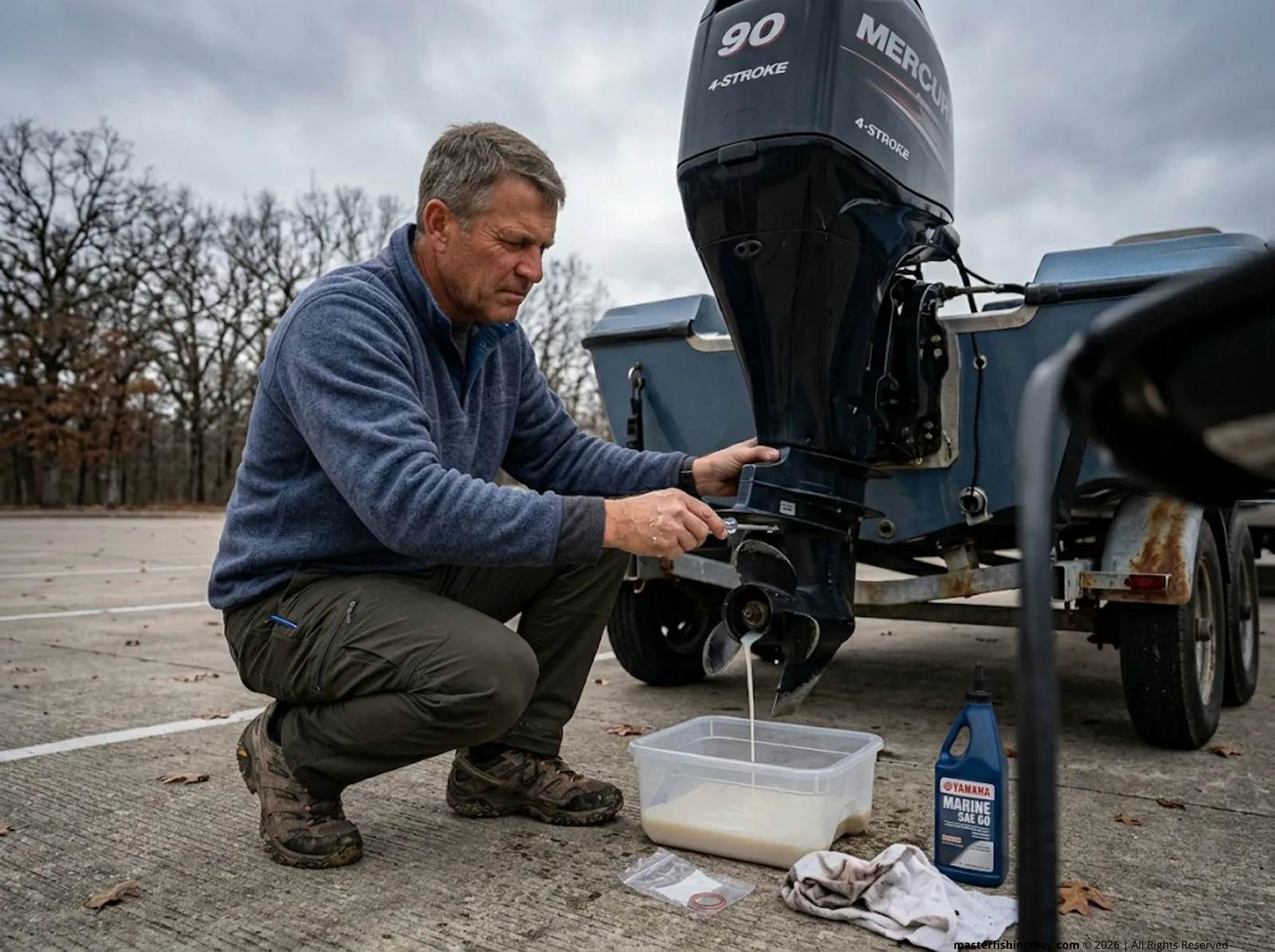
The gear lube that drained from my F150 that October morning was the color of chocolate milk—thick, off-white, unmistakably wrong. I’d been “winterizing” that motor for three seasons. I’d done every step on every list I’d ever read. What I hadn’t done was actually read the oil before I trusted the seal. By spring, the gearcase had cracked along the lower unit housing—two inches of hairline fracture from water that froze inside. That repair was $1,400. The correct drain-and-fill with a new crush washer would have been $22 in parts and forty minutes of my time.
I tell that story to every angler who asks me about outboard winterization, because it contains the lesson most people only learn once—and learn expensively. The difference between a motor that comes back clean in March and one that needs a gearcase before it ever throws a lure is seldom about doing more steps. It’s about understanding what you’re actually protecting against: the physics of thermal expansion, the chemistry of fuel degradation, and the electrochemical reality of galvanic corrosion. Treat those three threats correctly, and the motor comes back. Miss them, and you’re writing checks to a marine shop.
This is the protocol that covers what those three-paragraph winterization lists leave out.
| Marine Engine & Fuel Service Specifications | ||
|---|---|---|
| Service Item | Specification | Note |
| Yamaha drain plug torque | 20–25 ft-lb | Single-use copper crush washer required |
| Mercury Quickstor ratio | 1 oz per 5 gallons | Run at operating temperature after adding |
| Mercury 4-stroke oil | 25W-40 or 10W-30 | Quicksilver designation required |
| Fuel tank fill target | 95% capacity | Leaves 5% for thermal expansion; minimizes air exchange |
| E10 phase separation at 32°F | 0.40% water by volume | Below this threshold, separation is triggered |
| Lead-acid battery — fully charged freezing point | -76°F | Discharged battery freezes at 32°F |
| VST filter replacement interval | Every 300 hours | Bowl drain: annually |
⚡ Quick Answer: Effective outboard winterization requires three things working together: store the engine vertically so cooling passages drain by gravity, fill the fuel tank to 95% capacity and run stabilizer through the VST at operating temperature, and drain the gearcase lube immediately—because the color tells you whether you have a failed seal that will destroy the unit over winter. Disconnect the battery and put it on a smart float charger. Do not skip the gearcase lube inspection. That one step alone has saved more motors than all the stabilizer ever sold.
The Physics Behind Why Outboards Crack in Winter
Here’s where people go wrong before they ever pick up a tool. They think winterization is about adding chemicals. It’s not. The first threat is mechanical, and it’s indifferent to how much stabilizer you bought.
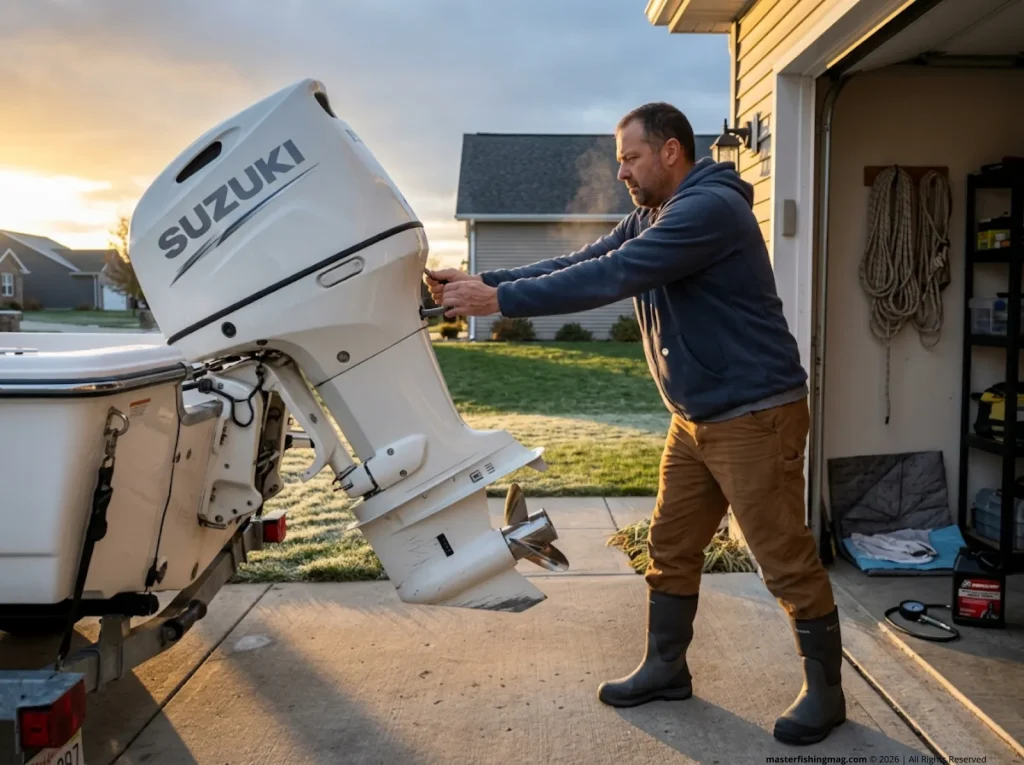
Water expands 9% when it freezes. Inside confined aluminum cooling passages, that expansion generates internal pressure well beyond what cast aluminum can handle. The gearcase cracks. The block cracks. And it doesn’t take a Wisconsin winter to do it—NOAA data shows freeze events reaching 25°F or lower in northern Florida, coastal Georgia, and the Sacramento Valley multiple times per decade. The analytical angler doesn’t bet $1,400 in cracked lower unit repair on a 10-year weather average.
The part most people miss: outboard self-draining is conditional, not guaranteed. The design assumes the engine is stored vertically. Store it tilted up at even 30 degrees, and you’ve created a trapped low point in the port-side cooling jacket where gravity can’t pull water toward the exhaust hub. The water stays there all winter. Storing an entire boat rig? The same physics that crack engine blocks also damage unprotected marine electronics during freezing storage.
After the final flush, lower the motor to the fully vertical position and give it 15 to 20 minutes of passive drainage before you tilt it back up for storage. That’s it. That’s the step most written guides skip because it’s boring. It’s also the step that separates a $22 winterization from a $1,400 spring surprise.
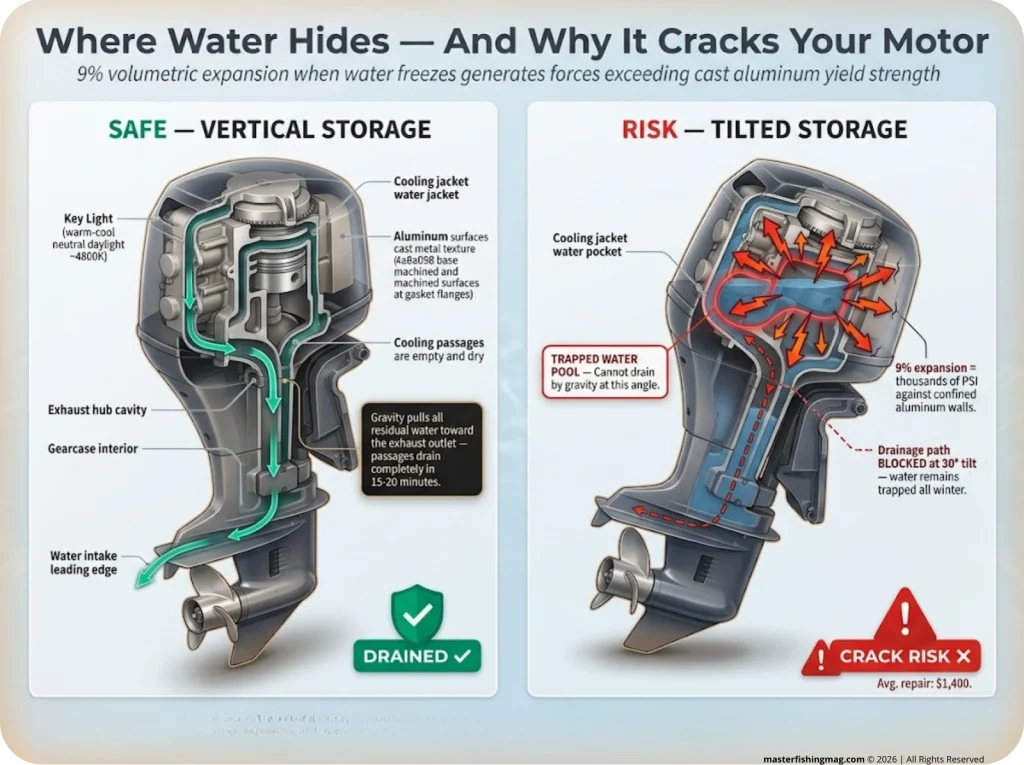
Pro Tip: Touch the tell-tale water stream during the final flush. If it’s hot to the touch or running weak, the water pump impeller is failing. Fix it now. A failing impeller in March means the engine overheats on the first trip of the season—usually on a Friday before a tournament.
Fuel System Chemistry — Why “Add Stabilizer” Is Incomplete Advice
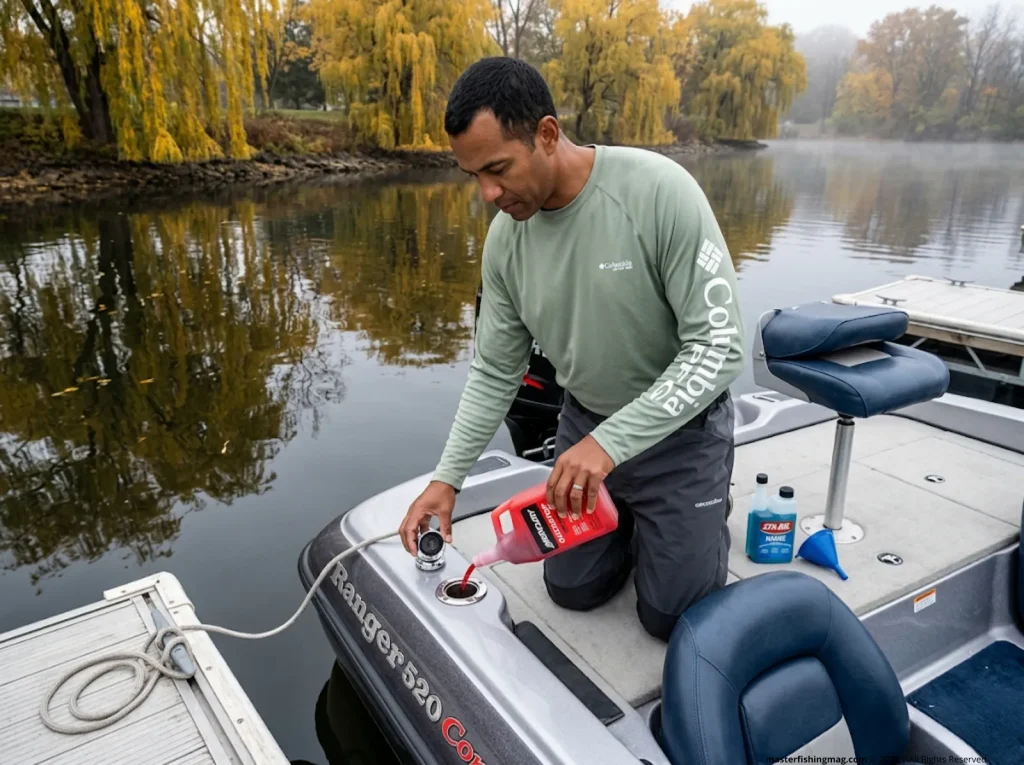 Mercury Quickstor stabilizer into bass boat fuel tank before winter storage, marina background” class=”wp-image-11745″/>
Every winterization article says “add stabilizer.” That’s correct and deeply incomplete. Here’s what they don’t tell you.
Ethanol is hygroscopic—its molecular structure actively pulls water vapor from the atmosphere through any vented tank. E10 fuel can hold about 0.5% water by volume at 60°F. Drop the storage temperature to 32°F, and that tolerance falls to 0.4%. Once moisture content exceeds the threshold, the ethanol detaches from the gasoline and bonds with the water. The resulting bottom-of-tank layer is non-combustible and highly corrosive. That separation also strips 1 to 1.5 octane units from the remaining fuel, which causes ring damage and engine knock on the first spring startup. Neither is a small problem.
The mechanism nobody writes about is the vapor pressure “pump” effect. During diurnal temperature cycles, rising daytime heat causes fuel to off-gas through the tank vent. At night, the cooling system draws moisture-laden air back in. A half-full tank running this cycle can reach moisture saturation within 30 to 90 days. The fix is simple and counterintuitive to most boaters: fill the tank to 95% capacity before storage. That leaves minimal headspace for air exchange while still giving the fuel room to expand thermally. EPA ethanol fuel blend specifications and regulatory standards confirm the composition of E10 and why ethanol-free marine fuel is the professional recommendation for seasonal storage.
The stabilizer-to-fuel ratio for Mercury Quickstor is 1 oz per 5 gallons. Add it to the main tank—then run the engine.
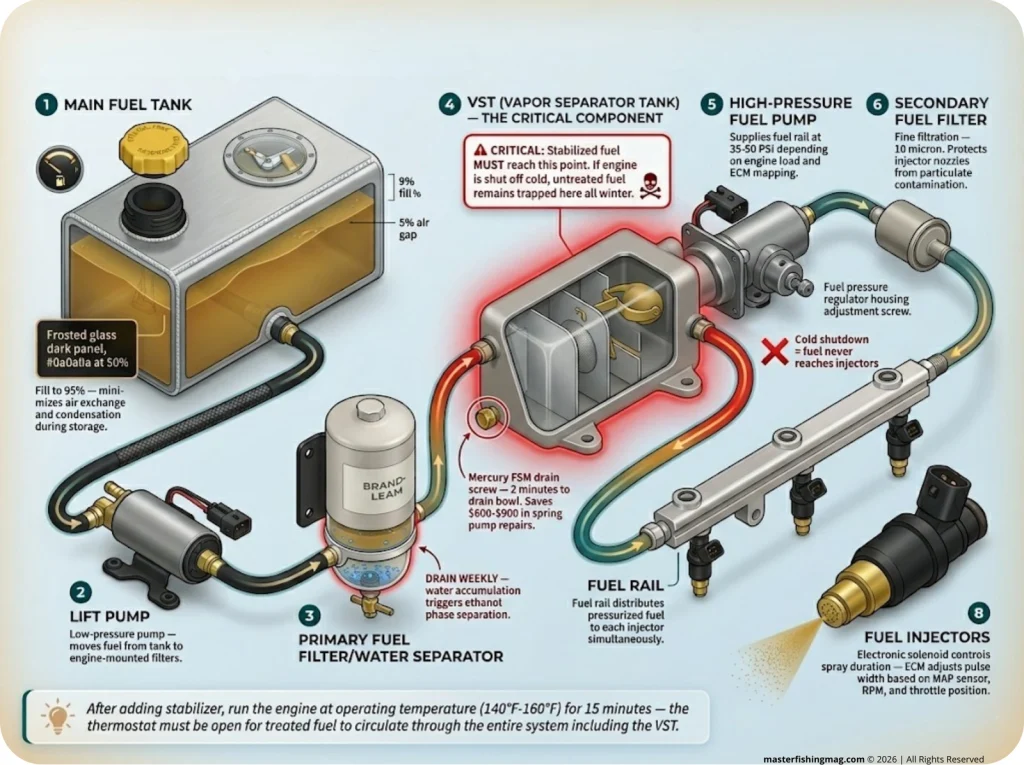
Pro Tip: Run the engine at operating temperature for 15 minutes after adding stabilizer, not idle. The thermostat in most 4-stroke outboards opens at 140°F to 160°F. Below that temperature, it stays closed and freshwater never reaches the internal cylinder head cooling passages. A cold flush clears some passages; an operating-temperature flush clears all of them.
The VST — The Step Everyone Misses
If you add stabilizer and shut the motor off without running it to operating temperature, you have not stabilized the Vapor Separator Tank. The VST holds a pressurized fuel reservoir completely separate from the main tank—and that reservoir still has old, untreated fuel in it.
By spring, that fuel has varnished. The high-pressure pump intake screen is coated black. The engine turns over, runs rough for a minute, then dies. The owner blames the stabilizer. The stabilizer is fine. The VST was never treated. For Mercury models equipped with the FSM (Fuel Supply Module), there’s a dedicated drain screw on the side of the unit. Two minutes to drain the bowl. Savings versus a new high-pressure pump assembly: $600 to $900. Fuel stabilization is only half the equation — the other half is protecting electronics from moisture damage during the same storage window. Replace the VST filter every 300 hours, drain the bowl annually.
The Gearcase — Reading the Oil Before It Damages Your Motor
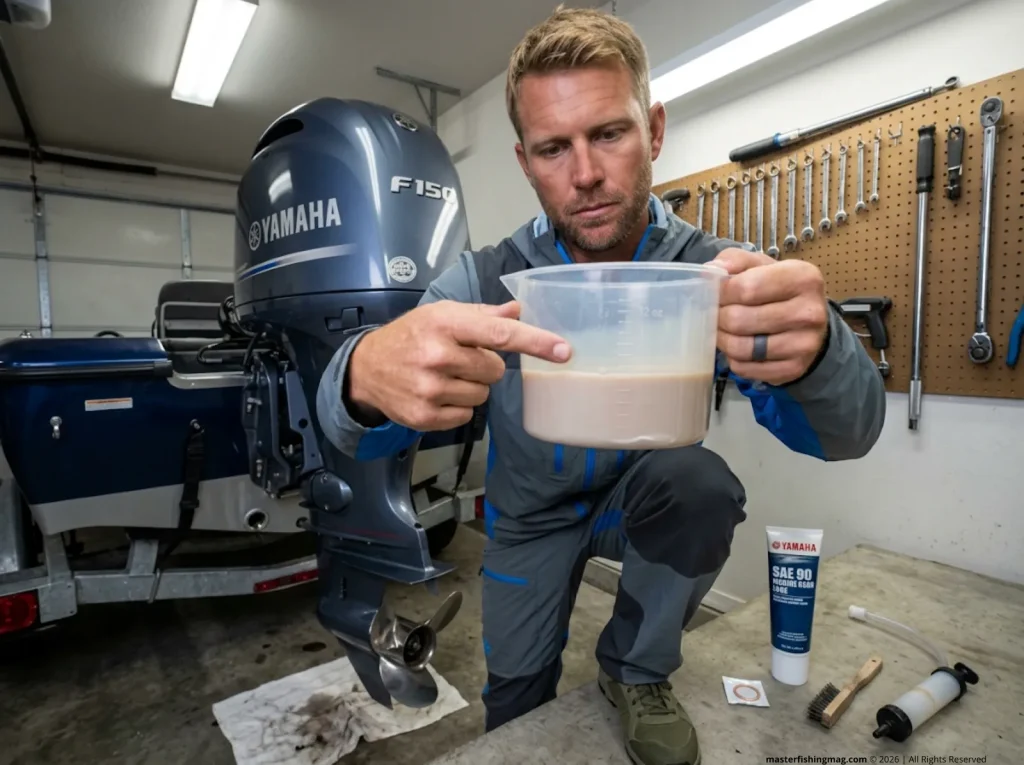
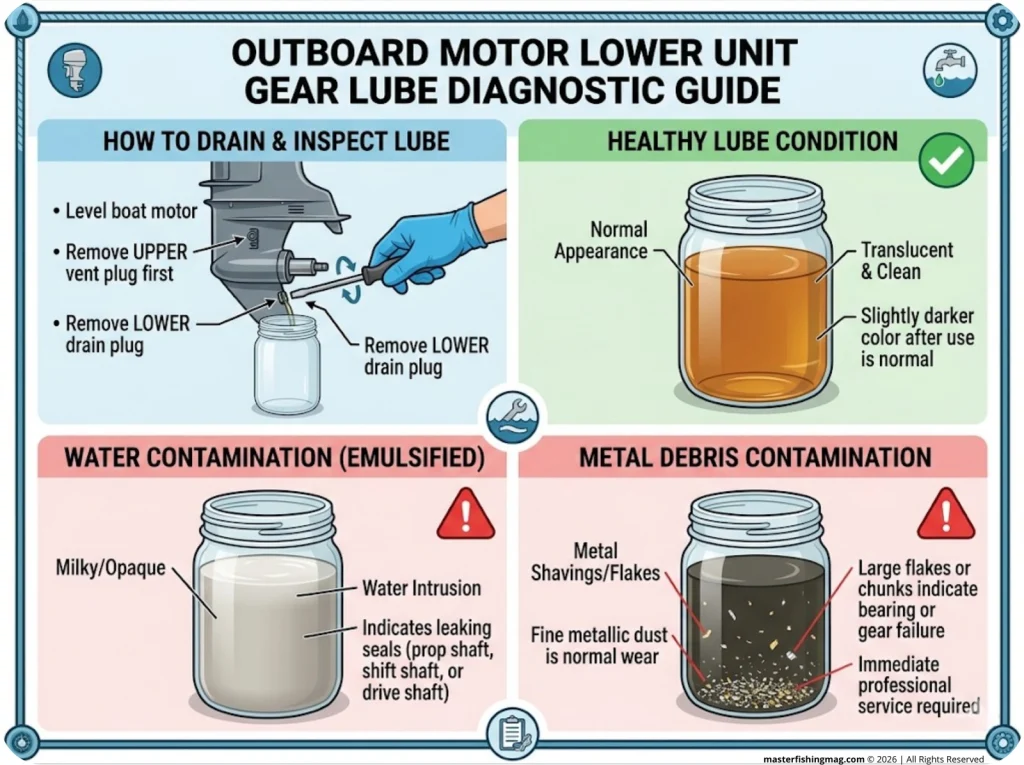
Pull the drain plug on your lower unit and catch what comes out in a clear container. Hold it up to natural light. Read it. This thirty-second step tells you more about your motor’s winter readiness than any checklist.
Amber or dark brown: Healthy oil with normal wear metals. Service it, refill it, you’re done.
Milky white (“chocolate milk”): Water is in the gearcase. This is a failed propeller shaft seal or shift shaft seal, and it is not a “wait and see” situation. Water contaminated gear lube left in a sub-32°F gearcase will freeze, expand 9%, and crack the housing. There is no category between “some milkiness” and “failed seal.” Any white emulsification means you have water intrusion through a compromised seal.
Metallic flakes visible to the naked eye: Stop. The motor needs professional inspection before storage—a cracked gear or failing bearing will not survive a freeze cycle.
The most common cause of seal failure is monofilament fishing line. Line wraps around the propeller shaft and melts into the rubber seals during operation—a causal chain that almost no competitor article explains. Properly disposing of monofilament line after every trip is the single cheapest insurance policy against propeller shaft seal failure.
If the drain sample is milky, pressure test the gearcase to 10 PSI with a hand-operated gear lube pressure tester (available through Yamaha and Mercury dealers, or aftermarket for approximately $60). Hold pressure for three minutes. Any drop locates the leaking seal. Replace the seal, then refill correctly: pump oil from the bottom drain hole until it exits the top vent hole. Wait five minutes after the first appearance of oil at the vent—that pause lets air bubbles escape before final sealing.
For Yamaha models, torque specs are non-negotiable: drain plug to 20–25 ft-lb, new copper crush washer every single time. Reused crush washers are the leading cause of the slow weep-seep leaks anglers blame on everything except their refill procedure.
Pro Tip: If the motor is out of warranty and has more than 400 hours, replace both shaft seals as preventive maintenance regardless of the oil sample result. The cost difference between two shaft seals and a new gearcase housing is not a close call.
Engine Fogging — The 4-Stroke Debate, Settled
 Mercury Storage Seal at lake dock before winter storage” class=”wp-image-11749″/>
The argument goes like this: “4-strokes have a wet sump, so the cylinder walls stay oiled. You don’t need to fog them.” This is partially true and critically incomplete.
During operation, yes, oil is everywhere. After shutdown, the oil film on cylinder walls drains back to the sump over weeks. By spring, exposed aluminum cylinder bores are subject to micro-oxidation and moisture pitting—a cumulative degradation mode that shortens engine life. The same corrosion chemistry that attacks exposed cylinder walls also accelerates galvanic degradation on all unprotected marine metal surfaces. It’s not a single-winter failure. It’s a total cost of ownership problem, and the analytical angler thinks in those terms.
The real question for 4-stroke EFI engines is not whether to fog—it’s how to fog safely given the EFI architecture. Here’s where brand matters.
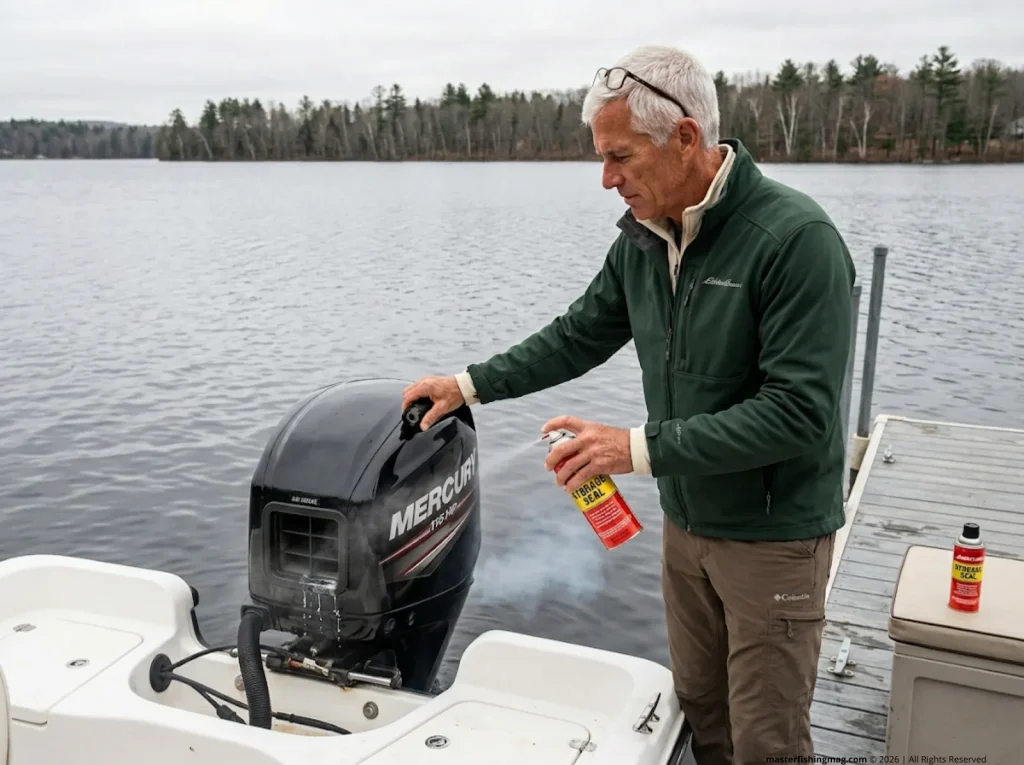
Mercury 4-stroke: Spray Mercury Storage Seal into the air intake while the engine runs at idle until it stalls. The stall is intentional—it confirms the pistons parked with oil vapor on the cylinder walls.
Yamaha 4-stroke: Follow OEM manual specifications. Ring Free PLUS applied at winterization dose serves as a secondary ring protectant and prevents carbon buildup during extended storage. Inspect internal anodes on F115 and F150 models.
Suzuki EFI — and this is the one that matters: Do not spray fogging oil into the air intake. The Lean Burn system depends on an uncontaminated MAP (Manifold Absolute Pressure) sensor for accurate air-to-fuel calculations. Fogging oil coating the MAP sensor membrane causes it to misread intake pressure—rich running, black-sooted plugs, and injector fouling by April. The correct Suzuki protocol: remove spark plugs, spray 2 to 3 seconds of fogging oil directly into each cylinder, disconnect the lanyard, crank the starter for 1 to 2 seconds to distribute the film, reinstall or replace plugs.
Every angler who learned to fog an outboard from their father learned on a carbureted 2-stroke. The intake architecture is completely different. The MAP sensor doesn’t care about tradition.
Pro Tip: Run the engine at idle, not high RPM, during fogging. High air velocity through the intake at elevated RPM reduces dwell time for the fogging oil mist and produces a thinner coating on the cylinder walls. Idle speed fogging is more effective.
Battery Chemistry and the Case for Disconnection
A fully charged lead-acid battery freezes at approximately −76°F. A discharged battery freezes at 32°F. That is not a marginal difference. It is the difference between the battery surviving a hard frost and cracking its casing.
As voltage drops during self-discharge, lead sulfate crystals form on the battery plates—this is sulfation. Below roughly 12.4 volts, sulfation begins. Below 11.8 volts, it becomes permanent. The plates are being chemically destroyed. Lead-acid marine batteries self-discharge at approximately 3 to 4% per month at 77°F, faster in warmer storage, faster with any parasitic draw from connected electronics. A battery disconnected in the fall, stored in an unheated garage at 15°F, and connected to nothing is not being stored—it’s being slowly depleted.
The four-step winter storage protocol:
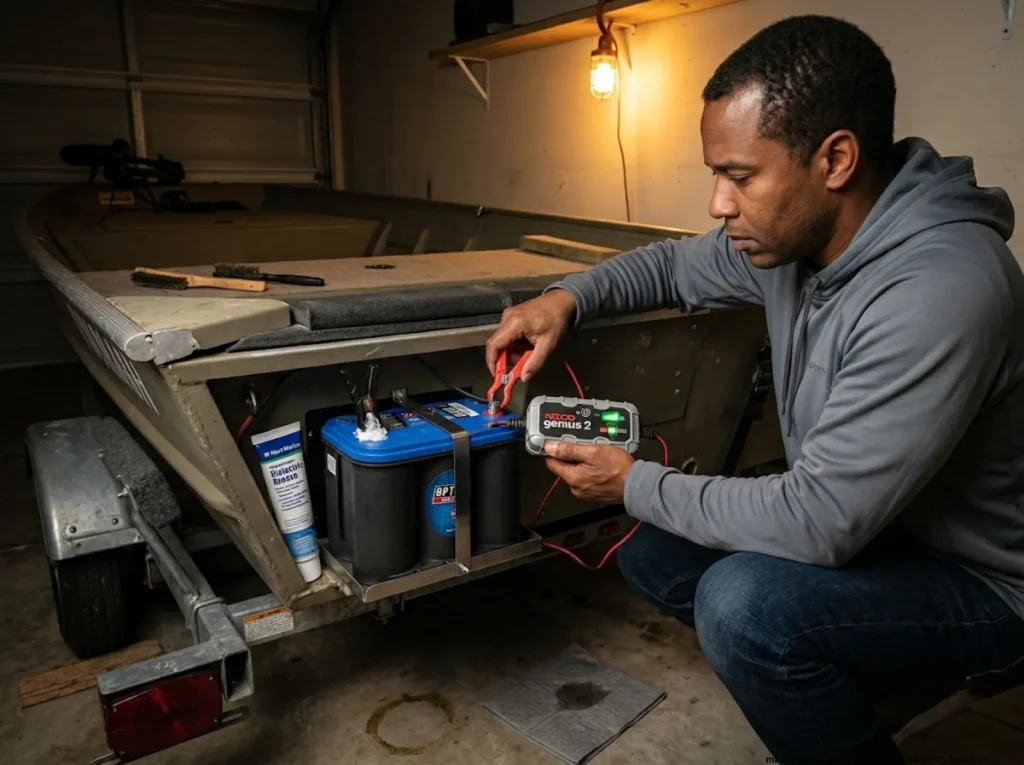
- Disconnect: Negative terminal first to prevent accidental short-circuit.
- Terminal care: Wire brush plus dielectric grease on both terminals. “Green fuzz” is zinc carbonate corrosion that increases internal resistance and accelerates plate wear.
- Charge and float: Connect to a smart maintenance charger at 0.75 to 1.5 amps. A standard automotive trickle charger cannot detect full charge and will overcharge. ABYC E-10 standards for marine battery storage and maintenance govern this spec.
- Environment: 40°F to 80°F, dry. The “don’t store batteries on concrete” myth dates to pre-1950s hard rubber battery cases. Modern polypropylene cases are thermally stable on concrete.
A dead spring battery is almost always the result of what happened the previous fall — the full failure analysis. If you’ve already made the switch to lithium, lithium trolling motor batteries have fundamentally different winter storage requirements — no sulfation risk, but their own cold-temperature considerations.
If no power outlet is available in your storage location, fully charge the battery to 12.7 volts before disconnect and check voltage in January. Below 12.4 volts, bring it inside and recharge.
The Hidden Steps — Internal Anodes, Grease Points, and Environmental Compliance
Most anglers know to check the external anode on the gearcase skeg. Almost none inspect the internal ones. This is the step no competitor article in the top results mentions.
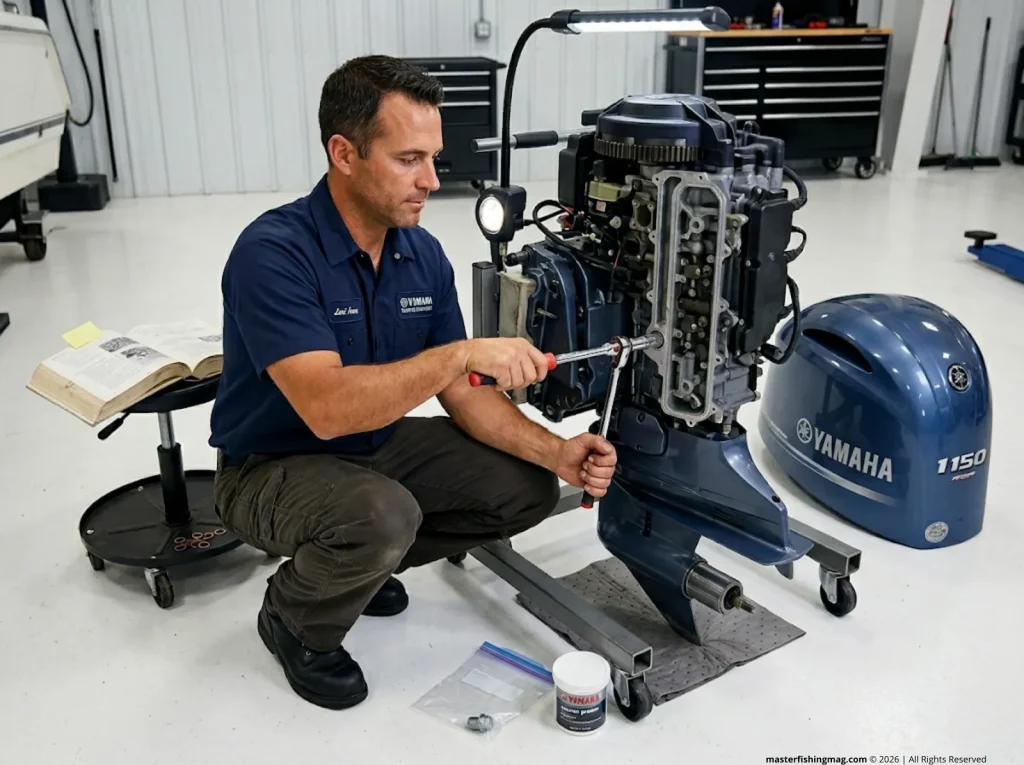
Yamaha F115 and F150 models contain zinc sacrificial plugs inside the water jacket passages of the cylinder head—completely separate from the external anodes visible on the skeg. These are in the service manual, not the consumer-facing annual service checklist. If they reach 50% consumption, the electrolysis attacks the aluminum block from the inside out. At 75% or more loss, galvanic scarring of adjacent aluminum may already be occurring. Replace them annually. Galvanic corrosion operates on the same electrochemical principles whether it’s attacking your reel body or your engine’s cylinder head.
The complete grease schedule that most anglers skip: tilt/trim pivot points, steering cable end fittings, throttle and shift cable barrel-ends (a drop of engine oil here prevents the cable jacket from cracking at the swage fitting), and engine mount bolts with anti-seize compound. Without anti-seize, galvanic corrosion welds steel bolts to aluminum engine mounts. Extraction eventually requires drilling.
On environmental compliance: used engine oil and gear lube must be collected and recycled at authorized centers. If you’re flushing raw-water cooling passages, use propylene glycol (pink antifreeze)—not ethylene glycol. Ethylene glycol is toxic to aquatic invertebrates and prohibited at Clean Marina facilities. EPA Clean Marina best management practices for waste oil and antifreeze disposal governs these requirements in all 50 states. Oil-absorbent pads should be in place during any lower unit oil change to capture drips.
Use winter lay-up as a compliance checkpoint: inspect fire extinguisher charge (needle in the green) and expiration date. USCG-approved extinguishers are required aboard all motorized vessels.
Conclusion
Three things determine whether your motor comes back healthy in spring.
First, your engine drains correctly only when it’s vertical. Store it tilted, and you store the water that cracks it. The self-draining design is contingent on position—this is physics, not opinion.
Second, “add stabilizer” is the beginning of the fuel stabilization protocol, not the end. Fill to 95%, run 15 minutes at operating temperature, and drain the VST on applicable Mercury models. If the stabilized fuel never circulates through the injector system, the VST varnishes and the bill is yours in spring.
Third, read the lower unit oil before you refill it. Chocolate milk means a failed seal. Metallic flakes mean gear failure. Neither is a wait-and-see situation. Refill milky gear lube, freeze the water inside it, and you’ll pay for a new gearcase instead of a $22 crush washer.
Pull the drain plugs on your lower unit before the temperature drops and read what comes out. That one diagnostic tells you more about your motor’s winter readiness than any checklist ever written.
Outboard Motor Winterization FAQ
Do I need to winterize my outboard if I keep it inside a heated garage?
If your garage stays reliably above 32°F throughout winter, block cracking is not a risk—but fuel degradation is. Ethanol-blended fuel begins phase separation within 30 to 90 days regardless of air temperature if the tank is partially full and untreated. Stabilize the fuel, fill to 95% capacity, and service the gearcase lube regardless of storage temperature.
Can I use automotive 10W-30 oil in my 4-stroke outboard?
No. Marine 4-stroke outboards operate in wet sump environments with specific corrosion exposure and cooling requirements. Automotive oils lack the marine-specific corrosion inhibitor package. Mercury specifies 25W-40 or 10W-30 with the Quicksilver designation; Yamaha specifies Yamalube 4-stroke engine oil. Using automotive oil in a boat engine voids warranty coverage and risks internal bearing corrosion during storage.
What happens if I don’t fog my 4-stroke outboard?
Nothing catastrophic this winter, most likely—but progressively across several seasons. The oil film on cylinder walls drains back to the sump over weeks of storage. The exposed aluminum bore is then subject to micro-oxidation and moisture pitting, increasing ring seal degradation and accelerating compression loss. The cost of fogging oil is measured in dollars; the cost of ignoring it is measured in engine hours lost.
How long can stabilized fuel safely sit in my outboard’s tank?
With a quality fuel stabilizer—Sta-Bil Marine, Mercury Quickstor—applied at the correct ratio and the tank filled to 95% capacity with ethanol-free fuel, treated fuel remains stable for 12 to 24 months. With E10, even treated fuel confidence degrades significantly after 90 days. The professional recommendation: ethanol-free fuel for all marine engines in seasonal lay-up.
Is the milky color in my gear lube always a sign of seal failure?
Yes. Any milkiness indicates active water intrusion through a compromised propeller shaft seal, shift shaft seal, or drain plug crush washer that was reused. Water-contaminated gear lube left in a sub-32°F gearcase will freeze, expand approximately 9%, and crack the housing. Pressure test to 10 PSI to locate the seal, replace it, and refill with fresh SAE 90 before storage.
Risk Disclaimer: Fishing, boating, and all related outdoor activities involve inherent risks that
can lead to injury. The information provided on Master Fishing Mag is for educational and informational purposes
only. While we strive for accuracy, the information, techniques, and advice on gear and safety are not a substitute
for your own best judgment, local knowledge, and adherence to official regulations. Fishing regulations, including
seasons, size limits, and species restrictions, change frequently and vary by location. Always consult the latest
official regulations from your local fish and wildlife agency before heading out. Proper handling of hooks, knives,
and other sharp equipment is essential for safety. Furthermore, be aware of local fish consumption advisories. By
using this website, you agree that you are solely responsible for your own safety and for complying with all
applicable laws. Any reliance you place on our content is strictly at your own risk. Master Fishing Mag and its
authors will not be held liable for any injury, damage, or loss sustained in connection with the use of the
information herein.
Affiliate Disclosure: We are a participant in the Amazon Services LLC Associates Program, an
affiliate advertising program designed to provide a means for us to earn advertising fees by advertising and linking
to Amazon.com. As an Amazon Associate, we earn from qualifying purchases. We also participate in other affiliate
programs and may receive a commission on products purchased through our links, at no extra cost to you. Additional
terms are found in the terms of service.