
In this article
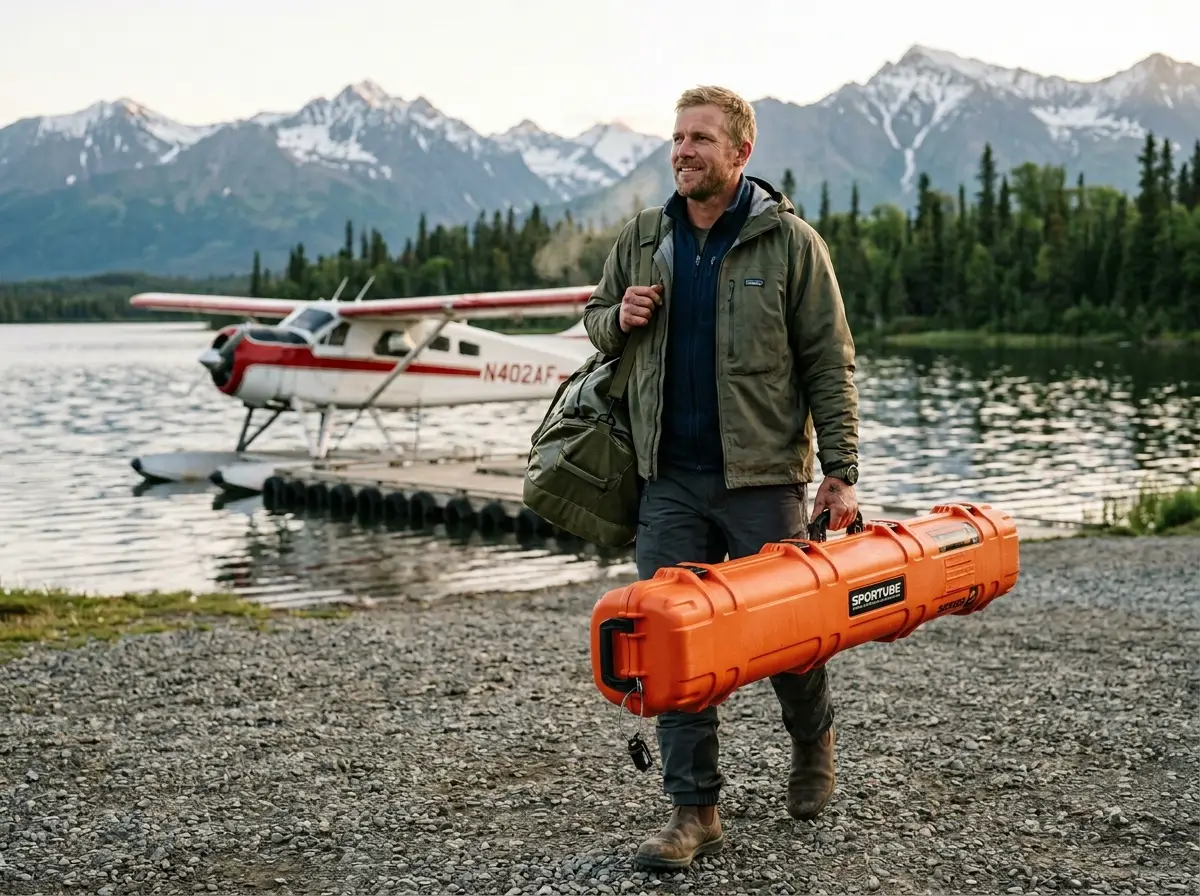
The cap was off the Sportube before I even pulled it off the carousel in Anchorage. The tip section of my 9-weight — built by hand over three weekends — was in four pieces inside a case that showed zero external damage. That trip had taken eight months to plan and a non-refundable floatplane deposit. The fish were still up there.
After years guiding saltwater flats, I can tell you the problem is almost never the case itself. It’s the physics inside — and most anglers have no idea how their rods are actually being destroyed.
⚡ Quick Answer: Most fishing rods break during air travel not because cases fail to protect them from outside crushing, but because the rod tip moves forward at impact velocity and slams into the end cap — a phenomenon called inertial impact. HDPE cases (like the Sportube series) are the only materials that reliably absorb this force without failing; PVC shatters under the same conditions, especially in cold cargo holds. Pack rod tips against butt sections in a tip-to-butt orientation, fill both ends with non-compressible material, and use foam pool noodle spacers to isolate guides from adjacent blanks. For airline rules, design your setup around the smallest aircraft on your itinerary — not the biggest.
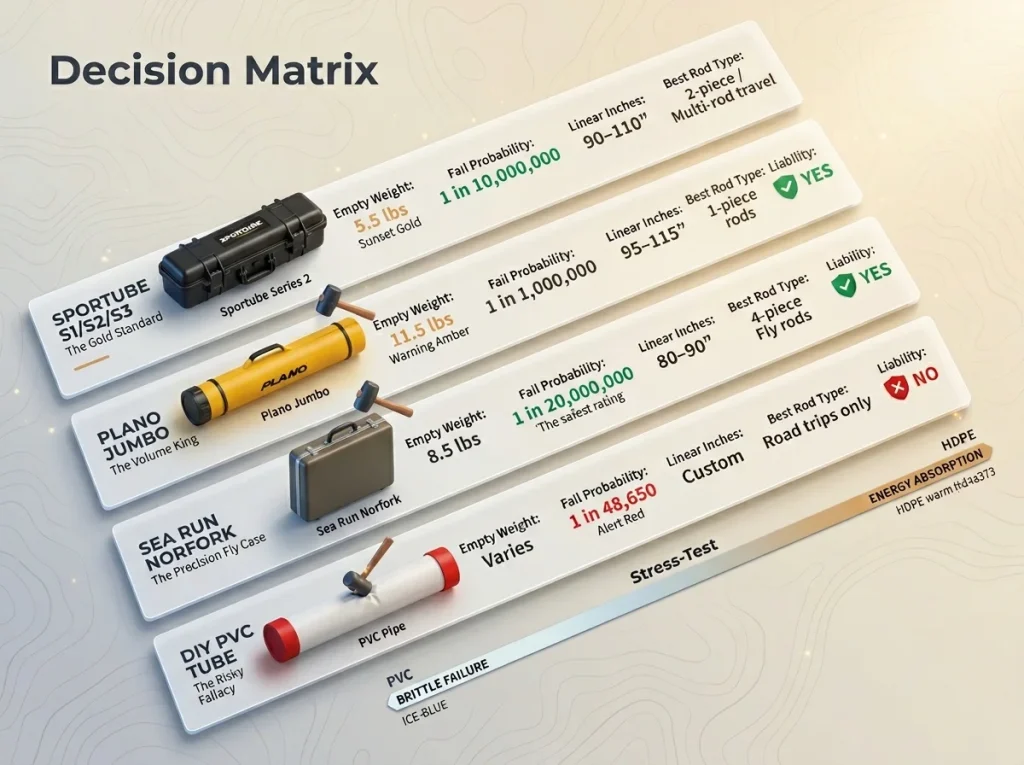
| Fishing Rod Travel Case Comparison | |||||
|---|---|---|---|---|---|
| Case | Material | Linear In. (Empty) | Weight (Empty) | Best For | Airline Liability? |
| Sportube Series 2 | HDPE | ~90–110 in. | 5.5 lbs | 4–6 rods, multi-rod travel | ✅ Yes |
| Plano Guide Jumbo | Blow-mold | ~95–115 in. | 11–12 lbs | 1-piece rods, volume | ✅ Yes |
| Sea Run Norfork | ABS Double-Wall | ~80–90 in. | ~8–9 lbs | 4-piece fly rods only | ✅ Yes |
| DIY PVC Tube | PVC | Varies | Varies | Road trips only | ❌ No |
Why High-Modulus Graphite Rods Break in Transit (It’s Not Crush — It’s Physics)
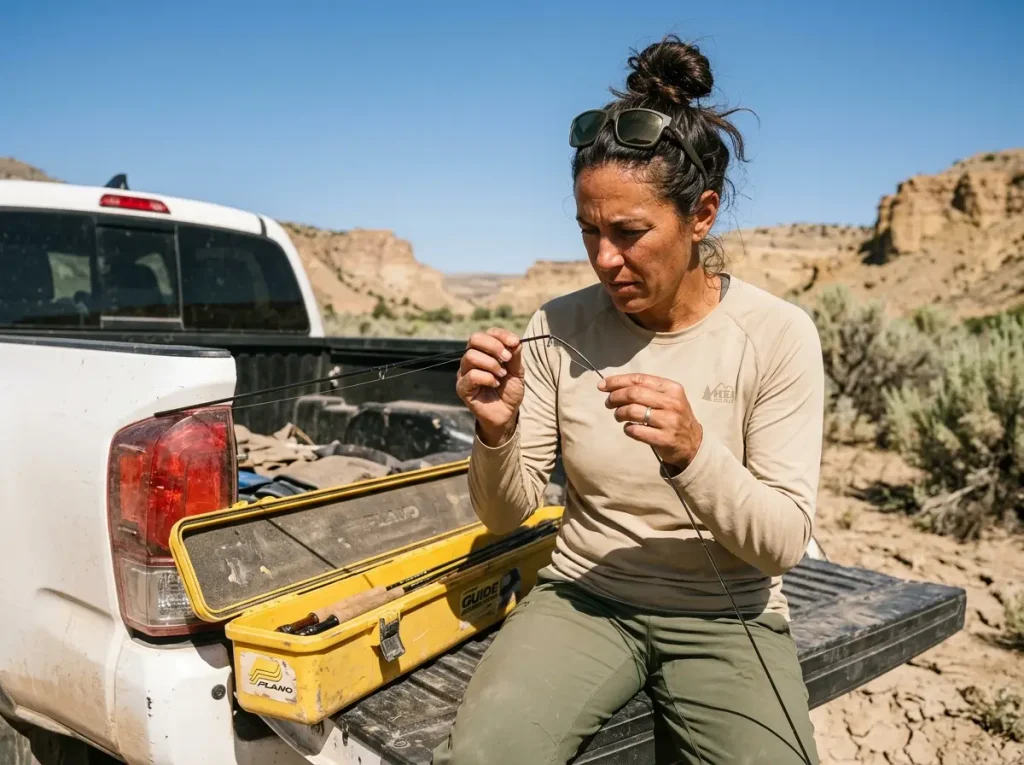
Here’s where everyone gets it wrong. You buy a hard case, lock it shut, and assume the battle is won. It isn’t.
High-modulus graphite rods are built to feel everything — a bite through sixty feet of water, a current seam, the difference between structure and weeds. That sensitivity comes from a composite structure that’s genuinely fragile under short-duration, high-impulse impact. The same thing that makes a modern rod transmit information makes it snap when hit wrong.
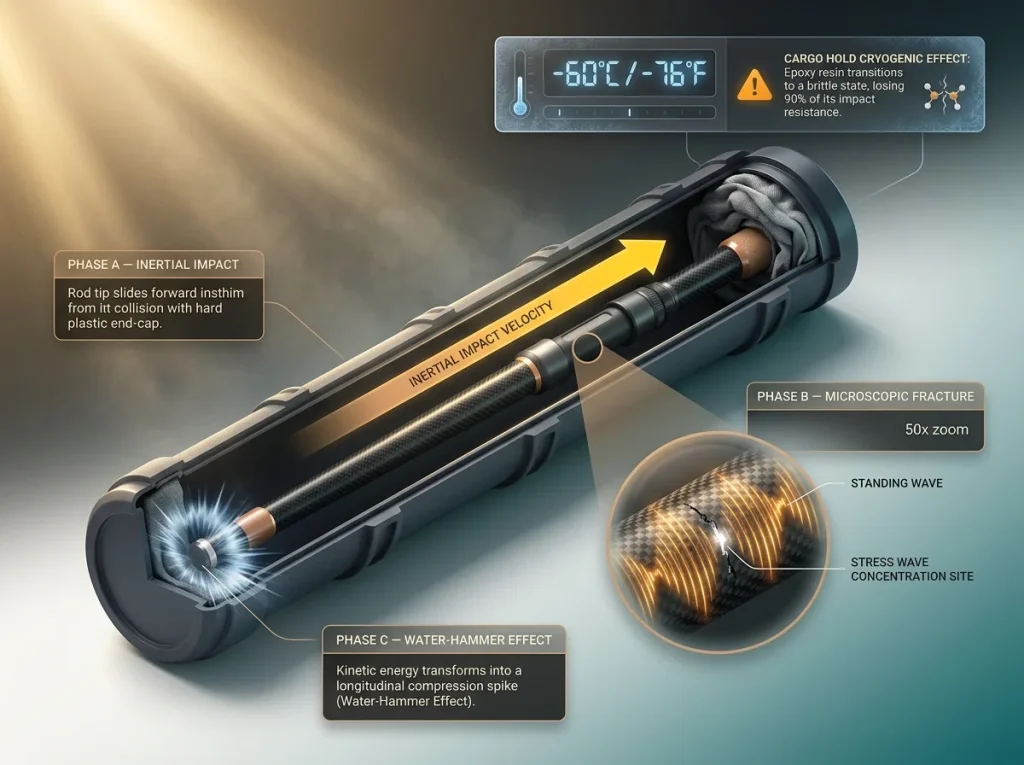
When a case drops on a baggage cart, the case stops. The rods inside don’t. The tip section — lowest mass, smallest cross-section — keeps moving until it hits the end cap. The force generates what engineers call a water-hammer effect: a compression spike traveling the length of the blank. If there’s a microscopic scratch anywhere — from a hook, from guides rubbing on a previous trip — the energy concentrates there. That’s why rods sometimes explode on the first cast after a flight. The travel broke them. The cast just finished the job.
This stress wave propagation mechanism, documented through stress wave propagation in damaged composite rods, explains what most buyers never consider. Padding mid-rod and sealing the ends are two completely different engineering tasks. You need both.
Temperature compounds every problem. Cargo holds on regional jets can drop well below -40°F. At those temperatures, the epoxy resin binding graphite fibers goes brittle. PVC does the same — it stops flexing and starts cracking. HDPE keeps its flexibility down to -100°F. That gap is the difference between a working rod and expensive splinters at the launch ramp.
High-modulus graphite has replaced fiberglass in most premium blanks because of the sensitivity and weight advantages — but that transition imposed a real cost in high-modulus fragility. Understanding why high-modulus rods are uniquely fragile compared to older fiberglass blanks will sharpen every decision you make about cases and packing.
I’ve seen tip sections broken inside pristine Plano tubes with zero external damage. That’s the water-hammer effect. Entirely preventable by building the right internal suspension system before you close the lid.
If you want to see the pool noodle isolation system built in real time, that video above is the clearest demonstration I’ve found. Watch it before you pack your next case.
The Airline Rules That Will Strand Your Gear (Carrier-by-Carrier Breakdown)
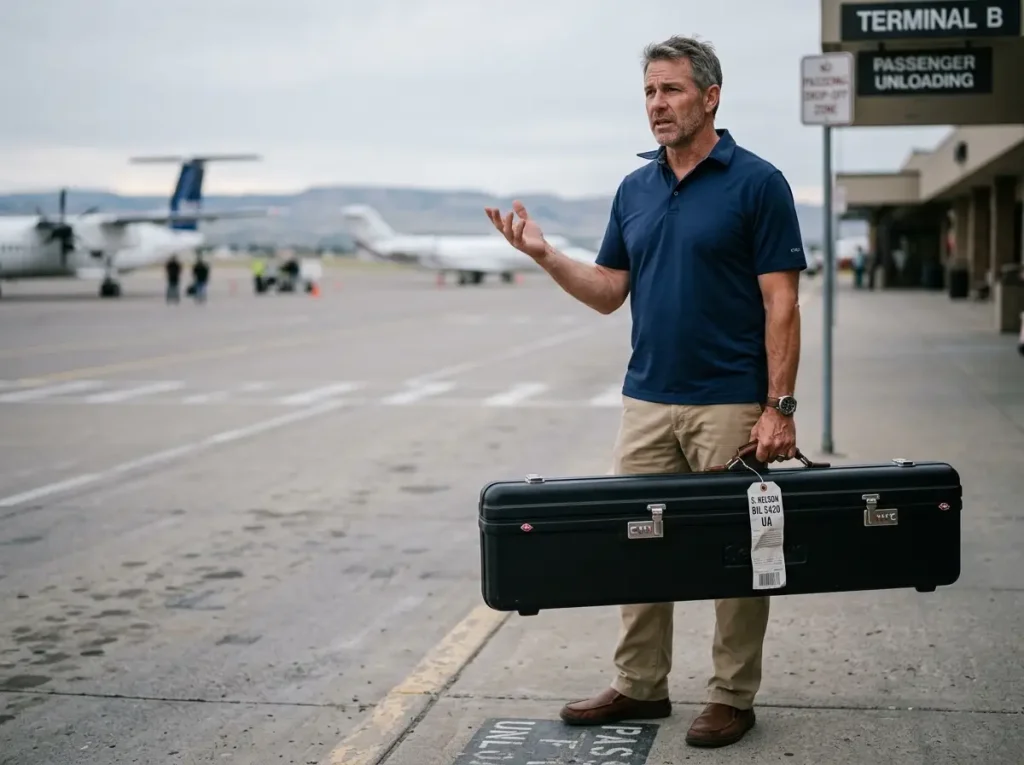
The check-in counter is where trips end before they start — not from damage, but from dimensional math nobody ran at home.
Most Tier-1 carriers — American, Delta, United, Southwest, Alaska — use a 115-inch linear inches limit (length + width + height). That sounds generous until you run the numbers. A Plano Guide Series Jumbo at full extension already pushes 95–100 inches before anything is packed inside. Factor in diameter, and you’re suddenly doing the calculation that should have happened before booking.
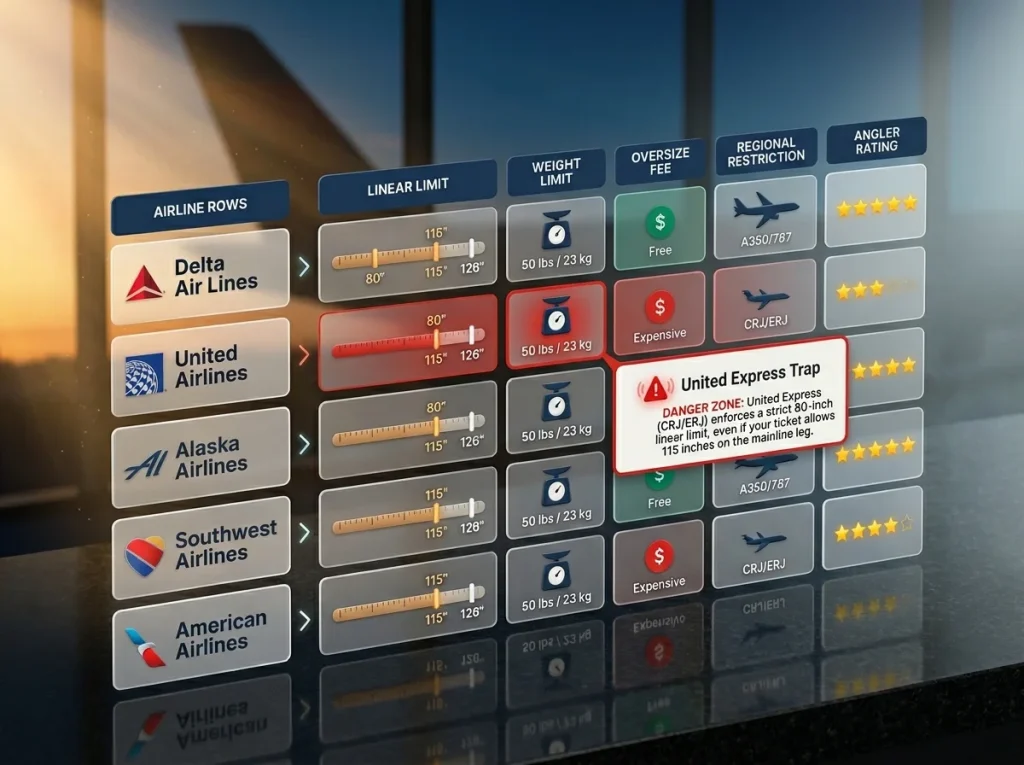
The part that strands anglers is the regional aircraft trap. United mainline allows 115 linear inches. United Express — the CRJ and ERJ jets that run connecting legs — enforces 80 inches. An angler flies Chicago to Denver without a problem, then watches their Sportube Series 3 get rejected at the gate for the Denver-to-Jackson Hole hop. That discrepancy, documented on United Airlines sports equipment and regional aircraft size restrictions, is the most hazardous scenario in rod travel logistics. Check the operating carrier for every segment, not just the ticket-issuing airline.
Southwest waives oversize fees for fishing equipment and counts a rod case plus tackle box as one item. American allows fishing gear up to 115 inches without oversize fees. Allegiant caps at 80 linear inches total — effectively prohibiting most rod tubes. Cross-reference the complete 2026 checklist for traveling with fishing gear before you book, and check what aircraft type is operating every leg of your route.
A Plano Jumbo Airliner runs 11–12 pounds empty — 22–24% of a 50-lb allowance before one rod or reel goes in. A Sportube Series 2 comes in around 5.5 pounds empty. That gap matters at the scale. Weight management is part of airline regulation compliance — not just an afterthought.
Pro tip: Weigh your case empty before every trip. Then weigh it fully packed. The difference between “this works” and “this goes back in the car” is one kitchen scale at home instead of a $200 overweight fee at the airport.
Material Science — What Your Case Is Actually Made Of and What It Can Survive
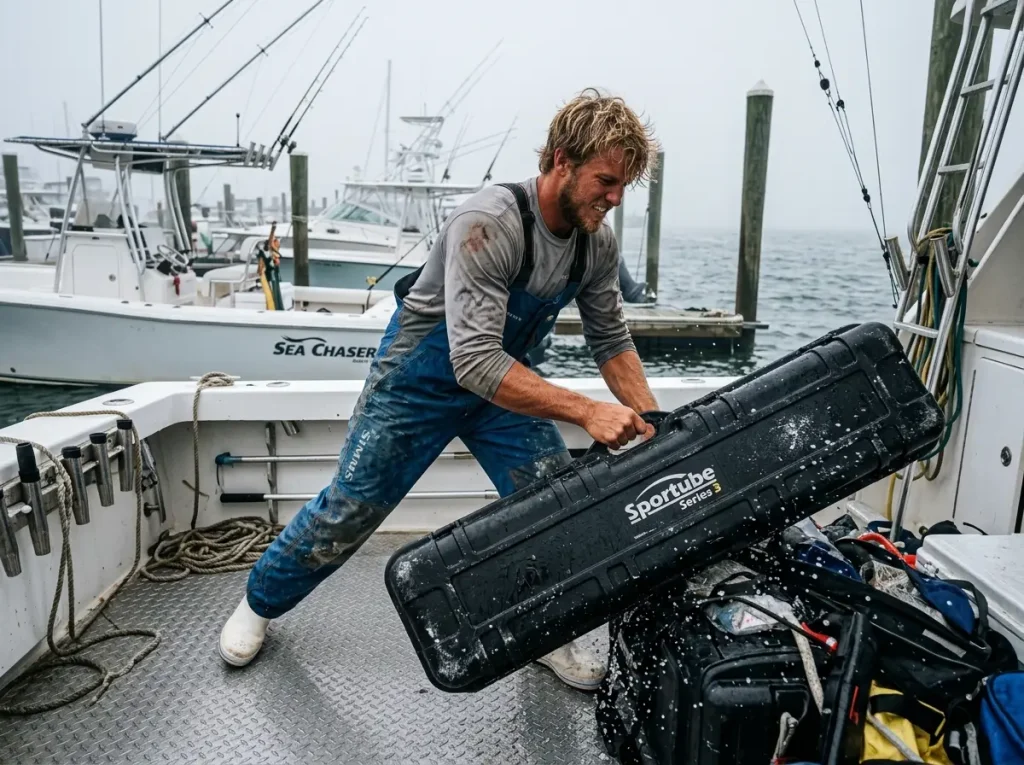
HDPE — The Engineering Standard for Air Travel
HDPE (High-Density Polyethylene) is the material the Sportube series is built from, and there’s a straightforward reason guides keep buying it. When a case hits a baggage cart, HDPE flexes. It absorbs energy through deformation and comes back. PVC doesn’t do that — PVC stores energy and then releases it all at once by cracking.
In comparative testing, HDPE is roughly 2,500 times more resistant to fatigue cracking than PVC. It holds structural integrity from -100°F to +250°F, which means it handles both cryogenic cargo holds and 110°F tarmac heat without changing behavior. The square profile of the Sportube is a practical bonus: large stripper guides on heavy saltwater rods can’t compress against adjacent rods the way they do inside round tubes, where the geometry forces things together.
For airline liability coverage, the rule is the same regardless of which carrier: damage claims require a hard-sided case. There’s a catch worth knowing. Some high-density plastics can flex under pressure, crush the rods inside, and return to their original shape without showing outward damage — meaning the claims agent sees no external trauma. Photograph the exterior of your case at check-in and at baggage claim, timestamped. That photo is your only evidence if the claims conversation gets complicated.
ABS Double-Wall — Precision Protection for Fly Fishing Sections
The Sea Run Norfork Expedition uses ABS double-wall construction, and the engineering logic behind it is worth understanding. When an impact hits the outer shell, the force has to cross an air gap to reach the inner wall. That gap attenuates the energy significantly before it ever reaches the rod sections nested in closed-cell foam inside.
Three stainless-steel TSA-compliant combination locks eliminate the pin-misplacement problem that affects Sportube users. The case opens like a briefcase, with each rod section in its own compartment — no longitudinal sliding possible, which is where tube cases lose.
The limitation is real: Sea Run is built for 4-piece fly rods with sections under roughly 24 inches. It won’t work for 2-piece spinning or casting rods or any rod over 7 feet. It solves a specific problem exceptionally well. For fly anglers with multi-piece rods traveling on the water, there’s nothing better at this price point.
PVC — The DIY Fallacy (Anti-Sell)
PVC pipe is cheap. That’s the entire argument for it. The counter-argument doesn’t take long.
HDPE vs. PVC impact resistance data from Piedmont Plastics puts the statistical failure rates side by side: PVC fails at roughly 1 in 48,650 events; HDPE fails at 1 in 10,000,000. At cold temperatures — which cargo holds reach routinely — PVC loses up to 90% of its impact resistance and transitions from flexible to brittle. A PVC tube that would survive a drop at room temperature may shatter on a baggage cart in winter.
The “Schedule 40 is good enough” myth doesn’t hold up to the failure probability math. If your trip is worth booking a flight, your rod is worth protecting properly. The same brittleness physics that apply to PVC cases apply to the graphite inside them — understanding the material science behind rod blank fragility makes the case selection decision much easier.
I carried PVC for years. A guide friend finally sat down with me and walked through the failure probability comparison. I replaced every tube within a month.
Pro tip: If you inherit a PVC tube or already own one, it’s fine for road trips. It’s not fine for air travel where cargo holds get cold, drops happen at speed, and you’re far from home when it fails.
Packing Protocol — Building the Internal Suspension System
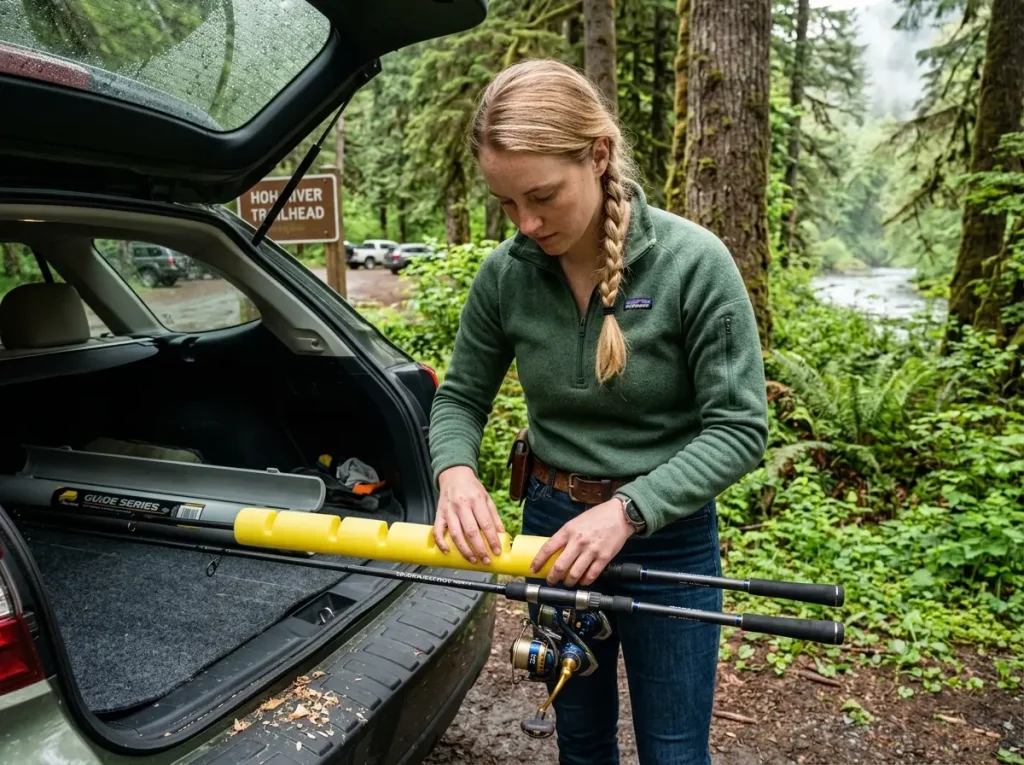
The Pool Noodle Isolation System
The ceramic inserts in rod guides are harder than graphite. When rods vibrate against each other inside a case — which happens constantly on conveyor belts and in cargo holds — those guide inserts act like glass cutters on adjacent blanks. The scoring is microscopic and invisible. But it’s there, and it becomes the exact location where stress waves concentrate and blanks fail.
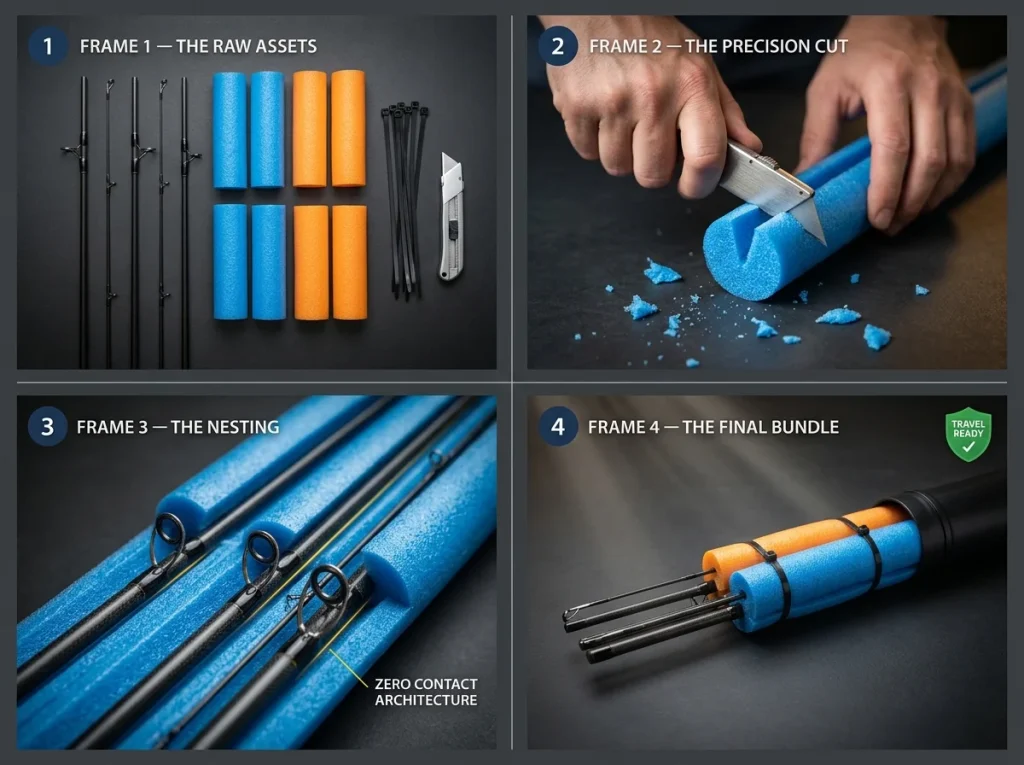
Foam pool noodle sections solve this. Cut grooves into the foam that match your rod blank diameters, nest the rods so no blank or guide touches an adjacent rod, and zip-tie the bundle to prevent migration. For high-modulus rods (IM8 and above), keep each rod in its sock before noodling. The sock adds a second layer of abrasion isolation. Color-code your noodle sections — red for tips, green for butts — so you can repack correctly after a TSA inspection without thinking about it.
The whole system takes about ten minutes to build the first time. After that it’s a consistent ritual before every trip. The pool noodle costs $2. The rod costs $400.
Inertial Damping at Tips and Butts (The Critical End-Cap Protocol)
The tip-to-butt orientation is non-negotiable. Pair delicate tip sections against heavy butt sections in the bundle. Any compression force on the bundle hits the most resilient end first.
What matters equally, and what most packing guides skip: both ends of the tube must be filled with non-compressible material. Rolled socks, dense foam, tightly bundled wading leaders. Not loose clothes. If your rods can slide even an inch longitudinally inside the tube, the deceleration inertia at impact is enough to generate the water-hammer fracture at the tip even inside an otherwise well-packed case.
For heavy offshore rods with large roller guides, slit 1-1/4-inch vinyl tubing and zip-tie it from the foregrip through the first three guides. This creates a “second skin” that absorbs abrasion. Clean salt out from under it after saltwater trips — moisture trapped against the blank corrodes finishes and damages epoxy over time.
Always remove reels before casing rods. Reels add longitudinal impact mass that amplifies deceleration force on the butt section. More practically: reels are the most theft-attractive component in the case, and they’re the easiest thing to carry separately.
Pro tip: Even with perfect packing, detect travel damage before it fails on a fish — run a coin-tap test on every blank after a flight before you make your first cast. A dead sound means delamination. A clear ring means you’re good.
Engineering for the TSA Inspection Variable
TSA regulations for fishing rods in checked and carry-on bags are clear: rods are permitted in checked baggage. The practical problem is agents unpacking a carefully engineered rod bundle and repacking it wrong. That’s the most common cause of travel breakage — not impact.
Some anglers use clear acrylic tubes to make contents visually verifiable without opening the case at all. That solves most of the problem before it starts.
Use TSA-compliant cable locks, not padlocks. Padlocks get cut and the case rides unsecured the rest of the way. Cable locks let an agent re-secure the case themselves after inspection.
A laminated repacking instruction card with a noodle orientation diagram and your contact information inside the tube costs less than a dollar. First trip to the Keys: padlock, no card, lock cut, rods repacked badly. Second trip: cable lock, laminated diagram, relocked by the agent themselves. The card works.
Case Selection by Trip Type — The MasterFishingMag Decision Matrix
The Sportube Series 1, 2, and 3 — Volume and Adaptability
The Sportube Series 2 is the right call for most multi-rod traveling anglers: 4–6 rods, roughly 5.5 pounds empty, HDPE construction, square profile for saltwater guides. The Exact Fit System telescopes to the rod length and locks with a wire pin. That pin is the system’s one real weakness — TSA agents misplace it regularly. Carry two spare pins in your carry-on. If the case telescopes loose during handling, it can collapse on the contents.
Series 1 works for 1–2 rods on minimalist trips. Series 3 handles 10-plus rods or heavy offshore gear at the cost of a larger linear footprint — verify airline limits before committing to it on a routed trip with regional connections. The hard-shell impact ratings on all three models are verified for aviation use in HDPE construction.
Plano Guide Series — When Volume Beats Weight
The Plano Guide Series Jumbo Airliner (Model 6508) handles volume and one-piece rod length better than anything else at its price point. Four-and-a-half-inch diameter, blow-molded thick-wall construction, and length options that accommodate 9-foot one-piece rods that won’t fit in a Sportube.
The tradeoffs are real. Eleven to twelve pounds empty. Round profile that rolls in truck beds — carry a foam chock or rope if you’re throwing it in a vehicle. No internal organizational dividers, so your sectional storage discipline matters more here than in a Sea Run or purpose-built fly case. But for volume and one-piece rod capacity, there’s nothing handier off the shelf.
The High-Performance Multi-Piece Travel Rod Alternative (Anti-Sell on Expensive Cases)
Nobody talks about this, and it’s overdue: a well-made 4-piece travel rod may be a smarter investment than a $500 hard case.
Modern multi-piece rods with advanced carbon fiber ferrule alignment have closed most of the sensitivity and power-curve gap between 4-piece and 1-piece equivalents. A 7’6″ rod that breaks into four sections fits in a 32-inch tube — classifiable as a standard checked bag with no oversize fees and no baggage carousel exposure at all. The investment math runs roughly $500 for a premium hard case versus $250 for a quality 4-piece travel rod with zero logistics overhead.
This isn’t the answer for custom-built 1-piece rods, surf rods over 10 feet, or highly specific actions that don’t translate to ferrule geometry. But for the angler doing 4–5 destination trips a year on commercial flights? Understand what you actually sacrifice with a multi-piece rod first — then make the call on the case.
A guide I know in the Keys ran a 4-piece custom travel setup for two full seasons. Told me he stopped thinking about gear logistics entirely. He just thought about fishing instead.
Theft, Loss, and the “Defense in Depth” Carry-On Strategy
Anti-Theft Case Strategy
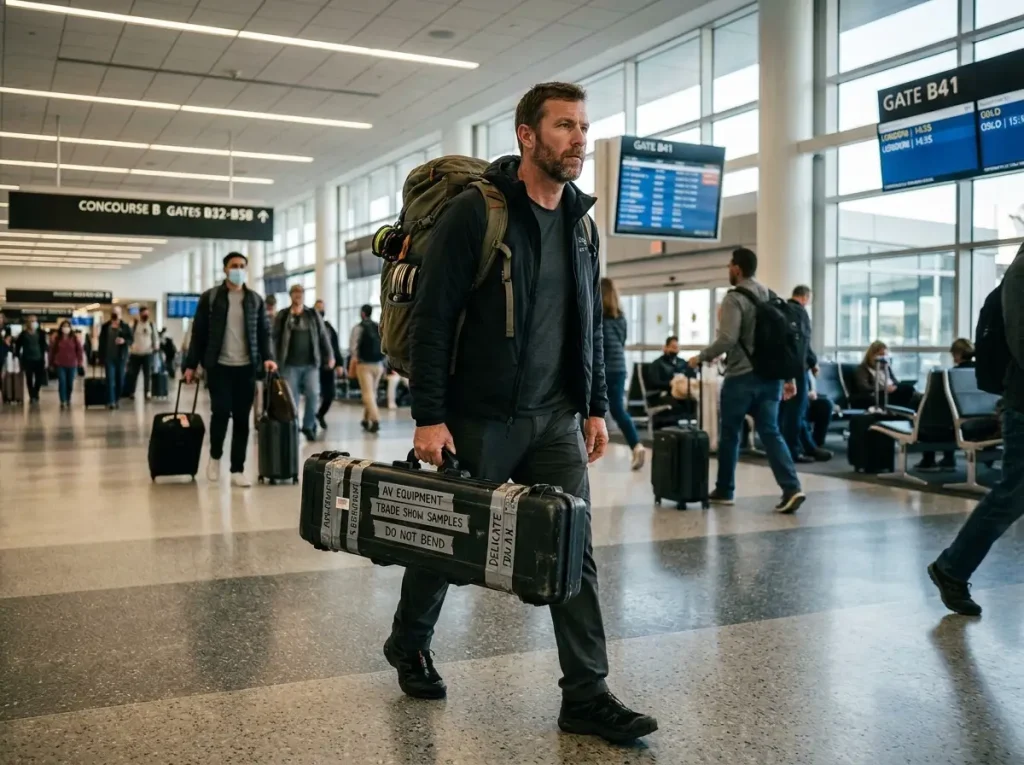
Sportube orange and Plano yellow are identifiable at fifty feet as fishing gear. Baggage handlers at destination airports — Anchorage, Key West, Bozeman — know the economics of fishing trips. A bright brand-colored tube is a target.
Matte black tubes blend with standard luggage. “Trade Show Samples” or “AV Equipment” labels reduce targeting. Photograph the exterior of the case on the check-in scale with a timestamped shot before every checked bag separation. Airlines require visible exterior damage for any claim — that photo is your only documentation if there’s damage the case absorbed internally without showing outward trauma.
What rod manufacturers actually cover — and why travel damage rarely qualifies makes for uncomfortable reading before a trip, but it’s worth knowing before you need it. Airline liability and manufacturer warranty have the same gap — neither covers impact damage that doesn’t show on the exterior.
The Reel-as-Carry-On Rule
Reels are the most valuable, most easily resold component of a fishing kit. They ride in hand luggage. Period. TSA-compliant, lightweight, and if the checked tube takes a total loss, you still have the ability to fish.
The defense-in-depth principle here: a 4-piece travel rod carried as a carry-on personal item plus your reels in a hand bag means you can fish even if every piece of checked gear disappears. For destination trips where the fishing is the entire point, that redundancy is worth planning for. Transporting expensive rods and reels as a single checked bundle is the riskiest version of this equation.
Shipping as a Superior Alternative
For many professional guides, the airline baggage system is the last resort. FedEx and UPS shipping direct to the lodge runs $65–120 cross-country for a Sportube Series 2, with declared value coverage up to $2,500 and digital tracking. Ship 4–5 days early. Confirm receipt with the lodge before boarding. The limitation: not practical for last-minute bookings or international destinations where customs adds uncertainty.
Pro tip: Call the lodge before booking the shipment. Most have a receiving protocol and prefer holding gear before you arrive — it’s one less variable on a long travel day.
Conclusion
Three things decide whether your rod survives air travel:
Material decides survival. HDPE absorbs; PVC shatters. The physics don’t negotiate based on price. A $25 PVC tube fails roughly 200 times more often than HDPE under real aviation conditions, and cold cargo holds make that gap worse.
Internal packing is the second armor. The case stops; your rods don’t. Non-compressible end-packing and guide isolation with pool noodle spacers prevent the inertial damage that even a perfect hard case can’t stop alone.
The logistics trap is avoidable. Know your smallest aircraft’s limit before your biggest flight departs. Know what airline operates every leg — not just the one that issued your ticket. And when the case math doesn’t work, a quality multi-piece travel rod eliminates the baggage problem entirely.
Before your next destination trip, pull your current case and weigh it empty. Then do the full math: case weight, rod weight, reel weight, tackle, wet gear, six days of supplies. That calculation tells you more about your actual risk than any gear review will.
FAQ
Can I take a fishing rod case on a plane as checked luggage?
Yes. Most major airlines accept rod cases as checked bags when total linear inches (length + width + height) stay under 115 inches and weight stays under 50 lbs. The critical exception is regional commuter aircraft operating under mainline brands — United Express enforces an 80-inch linear limit that strands many cases designed for mainline flights.
What is the best hard case for fishing rods for air travel?
For most anglers with 2-piece spinning or casting rods, the Sportube Series 2 offers the best weight-to-protection ratio in HDPE construction. For 4-piece fly rods, the Sea Run Norfork Expedition’s double-wall ABS and briefcase-style interior eliminates the sliding damage risk common in tube cases. For 1-piece rods over 8 feet, the Plano Guide Series Jumbo is one of the only readily available solutions.
How do I pack a fishing rod so it doesn’t break in a hard case?
Orient rod tips against adjacent butt sections for maximum crush-force distribution. Use grooved foam pool noodle sections to prevent guide-to-blank contact. Fill both ends of the tube with non-compressible material — dense foam or rolled socks — to stop any longitudinal sliding. That last step prevents the inertial water-hammer fracture at the tip, which is the most common form of in-case travel breakage.
Does PVC pipe protect fishing rods for air travel?
No — not reliably. PVC undergoes structural failure under high-velocity impact and becomes significantly more brittle at the temperatures found in cargo holds. Statistical failure probability data shows PVC falls apart at 1 in 48,650 events compared to 1 in 10,000,000 for HDPE. For any destination trip, PVC is a false economy.
How do I protect my rod tips during air travel?
Pair the tip section against an adjacent rod’s butt in the bundle — this is tip-to-butt orientation. Pack both ends of the case with non-compressible material so no longitudinal sliding is possible. These two steps together prevent the deceleration inertia injury at the tip that causes most travel breakage. A tip protector cap adds a third layer, but only if the tip can’t slide into the end cap in the first place.
Risk Disclaimer: Fishing, boating, and all related outdoor activities involve inherent risks that
can lead to injury. The information provided on Master Fishing Mag is for educational and informational purposes
only. While we strive for accuracy, the information, techniques, and advice on gear and safety are not a substitute
for your own best judgment, local knowledge, and adherence to official regulations. Fishing regulations, including
seasons, size limits, and species restrictions, change frequently and vary by location. Always consult the latest
official regulations from your local fish and wildlife agency before heading out. Proper handling of hooks, knives,
and other sharp equipment is essential for safety. Furthermore, be aware of local fish consumption advisories. By
using this website, you agree that you are solely responsible for your own safety and for complying with all
applicable laws. Any reliance you place on our content is strictly at your own risk. Master Fishing Mag and its
authors will not be held liable for any injury, damage, or loss sustained in connection with the use of the
information herein.
Affiliate Disclosure: We are a participant in the Amazon Services LLC Associates Program, an
affiliate advertising program designed to provide a means for us to earn advertising fees by advertising and linking
to Amazon.com. As an Amazon Associate, we earn from qualifying purchases. We also participate in other affiliate
programs and may receive a commission on products purchased through our links, at no extra cost to you. Additional
terms are found in the terms of service.