
In this article
Open a waterlogged tackle bag after an offshore run and you already know the smell. That chemical sweetness isn’t fish or brine — it’s your PU coating dissolving from the inside out. It starts with a soft tackiness on the lining. Then your pliers rust in two days. Then you’re buying a new bag. That stink is chemistry talking. And chemistry has a fix — if you catch it in time.
I’ve watched this play out with expensive bags that should have lasted a decade. The salt doesn’t care what you paid. It’s working on three fronts simultaneously: abrading your DWR layer with crystallized sodium chloride, pulling water through your zipper tape via capillary action, and running a slow hydrolysis clock on your polyurethane coatings from the moment moisture makes contact. Miss one front, and you lose the bag.
This guide gives you a tiered protocol — Surface Chemistry (DWR), Structural Seals (seam grip), and Mechanical Integrity (zipper maintenance) — and tells you when a bag is too far gone to save. Because wasting $20 on a spray won’t fix hydrolysis. That’s the honest version of this conversation.
⚡ Quick Answer: To waterproof a fishing bag, first check the interior coating — if it’s sticky or smells chemical, the bag is past saving. If the coating is intact, clean with Nikwax Tech Wash (never household detergent), apply Nikwax TX.Direct spray-on DWR to the wet exterior, then seal the zipper tape with silicone seam sealer to block capillary wicking. Store with zippers closed, below 40% relative humidity. Reapply DWR every 5–10 saltwater outings.
| Waterproofing Treatment & Material Compatibility Guide | |||
|---|---|---|---|
| Treatment Tier | Best For | Material Compatibility | HH Rating Impact |
| DWR Spray (Nikwax TX.Direct) | 600D Polyester, Nylon | Fabric-only; not PVC/TPU | Restores 500–1,500 mm |
| Silicone Seam Sealer | Seams + zipper tape | All; bonds best on PU-coated | Blocks capillary ingress |
| Paraffin/Beeswax | Zipper teeth | YKK AquaSeal, coil zippers | Mechanical seal only |
| Bag replacement (TPU/welded) | Failed PU coating | N/A — structural buy decision | 10,000–20,000+ mm |
Why “Waterproof” Bags Fail in Salt (Three Ways It Gets In)
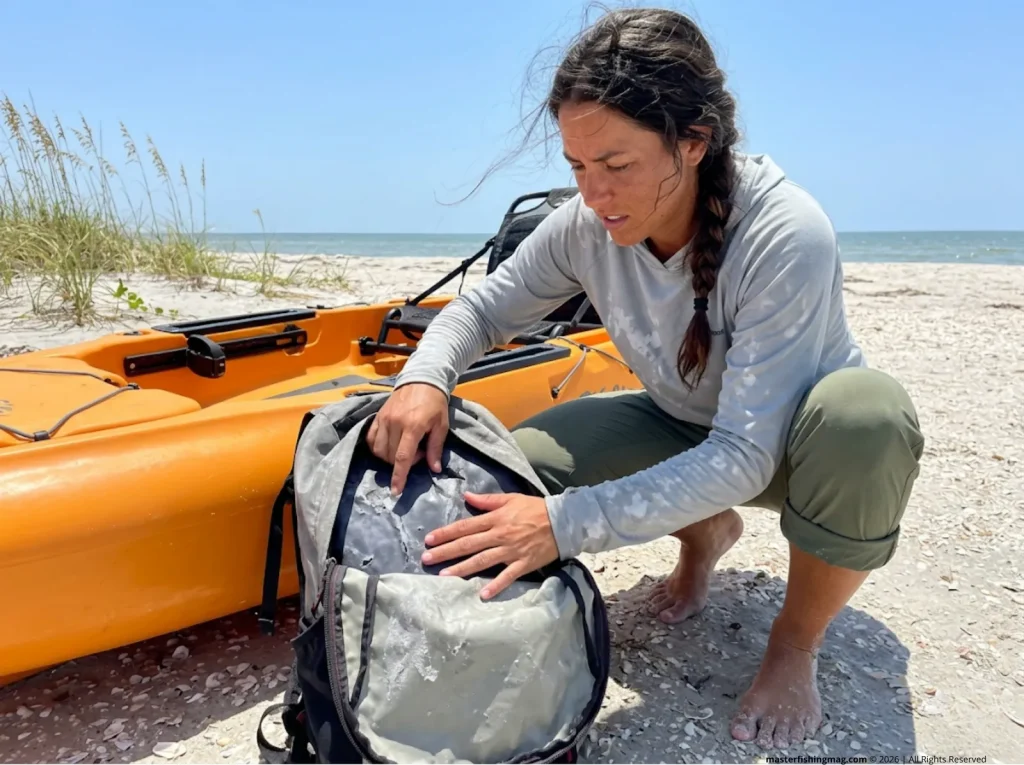
Here’s where most anglers get it wrong: they treat bag failure as one problem. It’s three problems running in parallel, and you need to know each one before you can stop any of them.
The Salt Crystal Abrasion Mechanism
Saltwater spray hits the bag, you move on, it dries. What’s left behind isn’t just residue — it’s concentrated NaCl crystals with sharp, hard edges. Every time you open a pocket, stuff the bag in a hatch, or carry it across a rocky shoreline, those crystals work like microscopic sandpaper grinding against the DWR layer and the underlying membrane. Over time, the effective thickness of the waterproof barrier drops and micro-punctures appear, reducing the bag’s hydrostatic head rating.
The zipper fabric tape is the worst surface for this. Military-funded research on PU-coated fabric hydrolytic stability documents how surface roughness compounds under fouling conditions — and your zipper tape gets the highest concentration of salt deposits of any surface on the bag. Salt crystals abrade waterproof membranes faster there than anywhere else.
Pro-Tip: After every saltwater outing, run clean water over the zipper tape specifically — not just the bag surface. Work the slider back and forth during the rinse to flush salt from the internal elements. That tape is your weakest link, and it costs nothing to flush it.
Capillary Action and DWR Failure
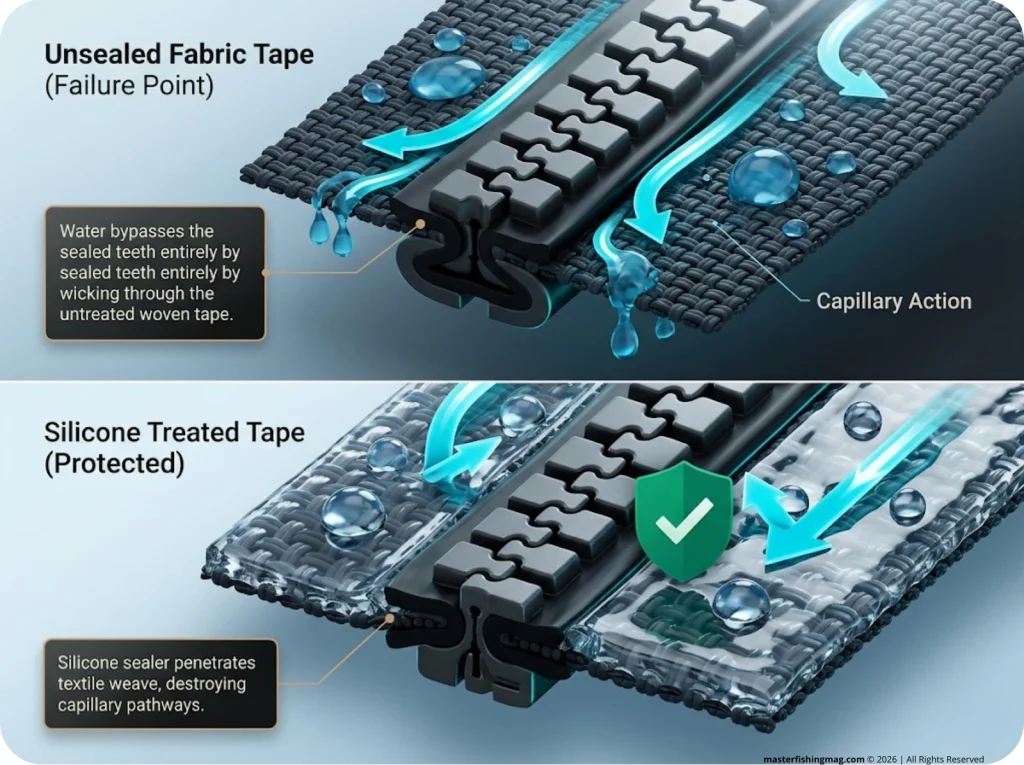
This one catches people off guard. DWR lowers the surface tension of the fabric, so water beads and rolls off. Salt is hygroscopic — it actively pulls water from the air and holds it against the fabric. Once salt residue sits on a bag, it creates a chemical bridge between ambient moisture and the weave. From there, capillary action takes over: the adhesive forces between water and the salt-fouled fabric overcome the hydrophobic DWR barrier, and the outer fabric saturates.
Anglers call this “wetting out.” What’s actually happening is that a hydrostatic bridge forms across the membrane’s micro-pores — and the membrane itself may still be structurally intact. The chemistry is defeated, not the fabric. A fouled or salted zipper tape holds water on its surface dramatically longer than clean tape, making capillary ingress near-certain once the salt builds up. Understanding how waterproof membranes and DWR finishes actually work together matters here, because the fix for wetting out is different from the fix for a compromised membrane.
Polyurethane Hydrolysis — the Irreversible Clock
This is the one you can’t fix. PU coatings are polymers with hard segments that provide strength and soft segments that provide flexibility. When water molecules react with the ester linkages in the coating, those chains fragment. The process is accelerated by heat, humidity, and salt acting as a catalyst and humectant.
Polyester-based PU can fail in as little as 42–70 days of continuous immersion in warm water. Polyether-based PU is far more resistant and is the smarter choice for marine gear. The diagnosis is simple: run a finger across the interior lining. If it feels sticky or pulls, or if you catch a chemical “old sock” smell — that’s terminal hydrolytic degradation. No topical spray rebuilds a delaminated PU coating. The bond between coating and base fabric is gone.
Reading Your Bag’s Waterproof Rating (HH Numbers That Actually Matter)
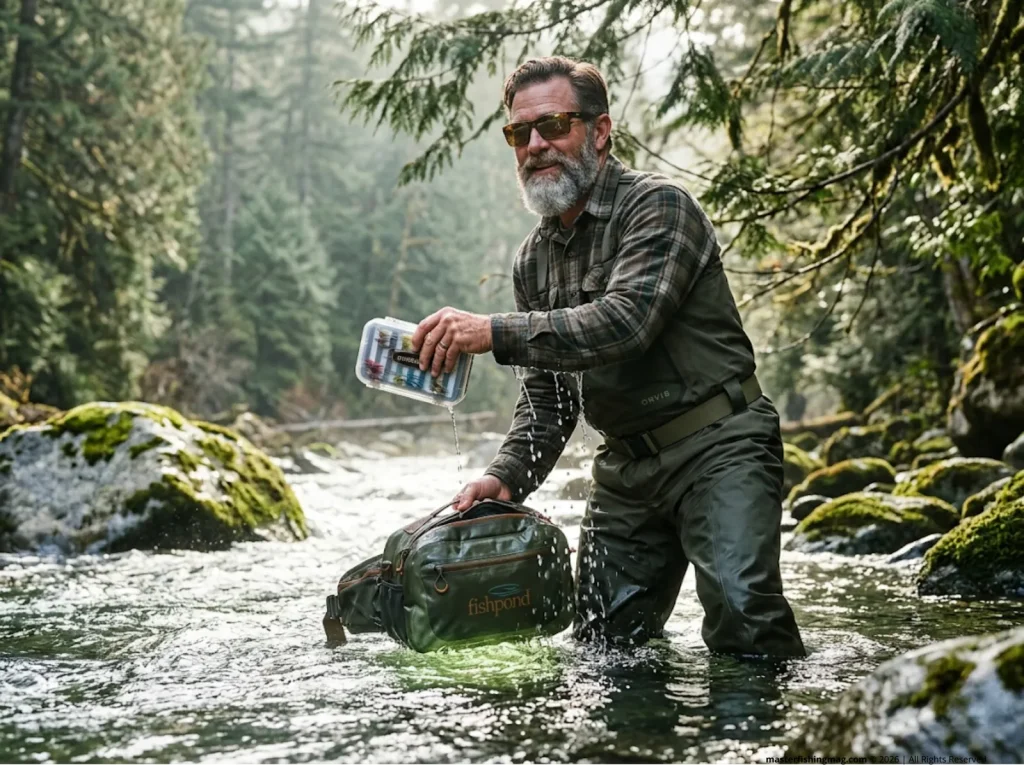
The number printed on a hang tag tells you something, but not what most people think it tells them.
What the HH Number Actually Measures
Hydrostatic head is measured in millimeters — it’s the height of a vertical water column the fabric can hold before moisture penetrates, tested against standardized lab methods like ISO 811 or ASTM D751. A fabric rated at 1,500 mm holds a 1.5-meter column of still, static water before failing.
Here’s the detail that matters in the field: those tests measure static pressure, meaning water sitting still. A wind-driven raindrop at 40 mph hits localized surface pressure that can exceed rated limits on many “waterproof” fabrics. And when you set a 20-lb tackle box inside a bag on a wet deck, the pressure at the base can push past 10,000 mmH₂O. Your base panel needs a substantially higher rating than your upper panels.
Pro-Tip: The floor of your bag needs a minimum 10,000 mm HH for serious boat use. If you’re kneeling on it during a float trip, that floor rating disappears fast.
HH Benchmarks for Specific Angling Scenarios
| Waterproof Ratings for Angling Gear | ||
|---|---|---|
| Rating (mm) | Protection Level | Best Angling Use |
| 0–1,000 | Water-resistant only | Casual freshwater, light drizzle |
| 1,000–1,500 | Minimum “waterproof” | Standard tackle bags, moderate rain |
| 2,000–5,000 | Reliable rain protection | Shore fishing, heavy rain |
| 10,000–15,000 | Moderate pressure waterproof | Kayak fishing, boat spray |
| 20,000+ | Submersible potential | Offshore bags, extreme conditions |
Treat 1,500 mm as the absolute floor for tackle storage. For kayak or boat use where salt spray and wave wash are constant, 10,000 mm minimum. PVC-coated fabrics run 8,000–10,000 mm. Welded-seam TPU bags reach 10,000–20,000+ mm. Standard 600D polyester with a factory PU coat sits at 1,000–3,000 mm before any DWR restoration.
Does a DWR Spray Actually Restore HH?
Straight answer: no. DWR treatments restore the surface energy of the outer fabric — they don’t rebuild the membrane’s structural HH rating. Aqueous DWR like Nikwax TX.Direct uses C0 fluorochemistry to lower surface energy. Silicone-based treatments (like Granger’s Fabsil) create a physical repellent barrier. Neither one re-bonds a delaminated coating. On a bag in good structural shape, though, a proper DWR application can bring functional water-resistant behavior back to near-factory spec — which is exactly what peer-reviewed data on PFAS fate from DWR-treated clothing in aquatic environments examines for the environmental side of that equation.
Choosing the Right Bag Material Before You Buy (Or Before You Give Up)
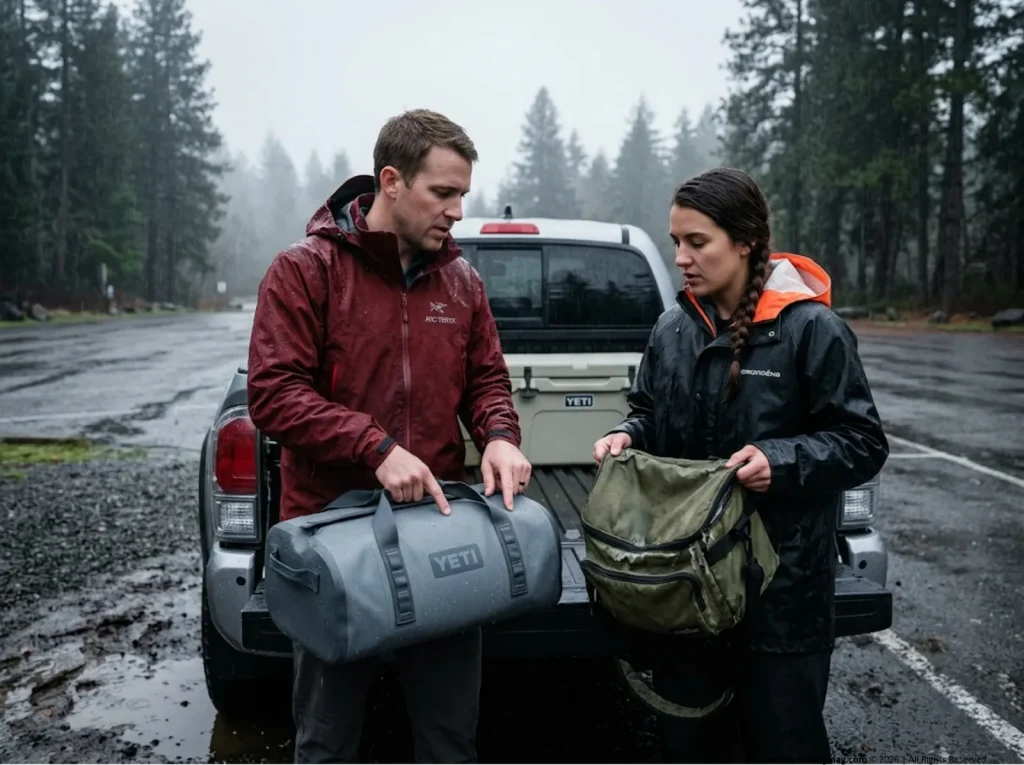
The restoration protocol only works if your bag’s base material is still worth restoring.
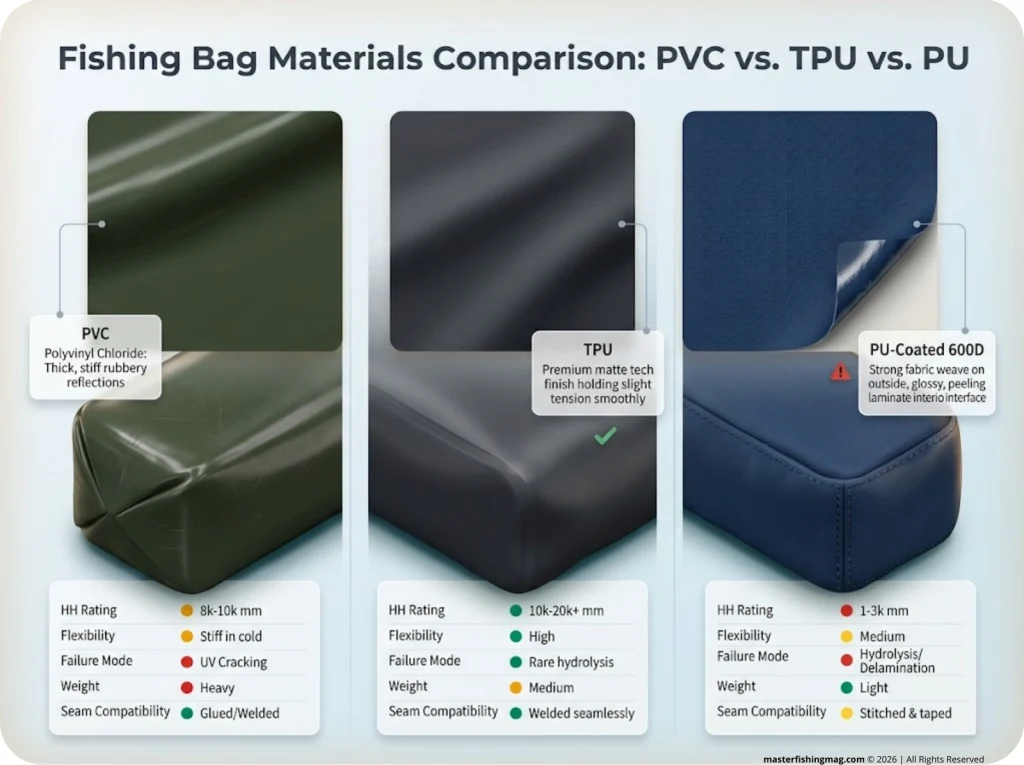
PVC vs. TPU vs. PU-Coated Polyester — What Each Fails At
PVC runs 8,000–10,000 mm HH with excellent salt-water corrosion resistance and chemical resistance. It’s heavy (500–800 g/m²) and stiffens in cold temperatures. Its terminal failure is UV-driven cracking — the surface gets brittle and splits. UV-inhibitors in the formulation extend this, but they don’t stop it.
TPU is the technical step above PVC. It stays flexible in cold, supports heat-welded seams that are molecularly fused with zero needle holes, and runs 10,000–20,000+ mm HH at 300–500 g/m². Rare hydrolysis failure occurs under extreme sustained exposure. This is the material what separates a fishing pack worth keeping from one that’s already failing you.
PU-coated 600D polyester is lighter (150–300 g/m²), the most common construction in mid-range tackle bags, and the specific target of this restoration guide. Its failure mode is delamination and peeling — which is exactly what the three-tier protocol addresses, provided the coating hasn’t already crossed into terminal hydrolysis.
The “Tacky Test” — How to Diagnose Your Bag in 30 Seconds
Run a finger along the interior lining. Sticky texture, visible peeling, or a chemical odor confirms active hydrolysis. The repair window is closed. No DWR spray changes what’s happening at the molecular level — the coating’s bond to the base fabric has failed.
The anti-sell here is intentional: save your $20 for bags that pass the test. For a bag that fails the tacky test, plan for a TPU-laminated replacement with welded seams. If the exterior DWR is wetting out but the interior passes clean, you are a good candidate for restoration. That’s the distinction that saves you money.
Seam Construction and the Welded Seam Advantage
Stitching creates holes. That’s physics. The question is how those holes are managed. Taped seams use heat-applied waterproof tape over stitching — the adhesive degrades in 3–5 years from heat and humidity. Heat-welded seams fuse layers thermally at the molecular level and are stronger than the base fabric, entirely hole-free. PU glue over stitching is the entry-level approach and the most prone to hydrolysis at the seam line — which is often the first place a bag leaks.
For saltwater use, welded seams aren’t a luxury feature. They’re the only seam construction that doesn’t introduce failure points into a waterproof system.
The 3-Tier Restoration Protocol (Surface, Seam, Zipper)
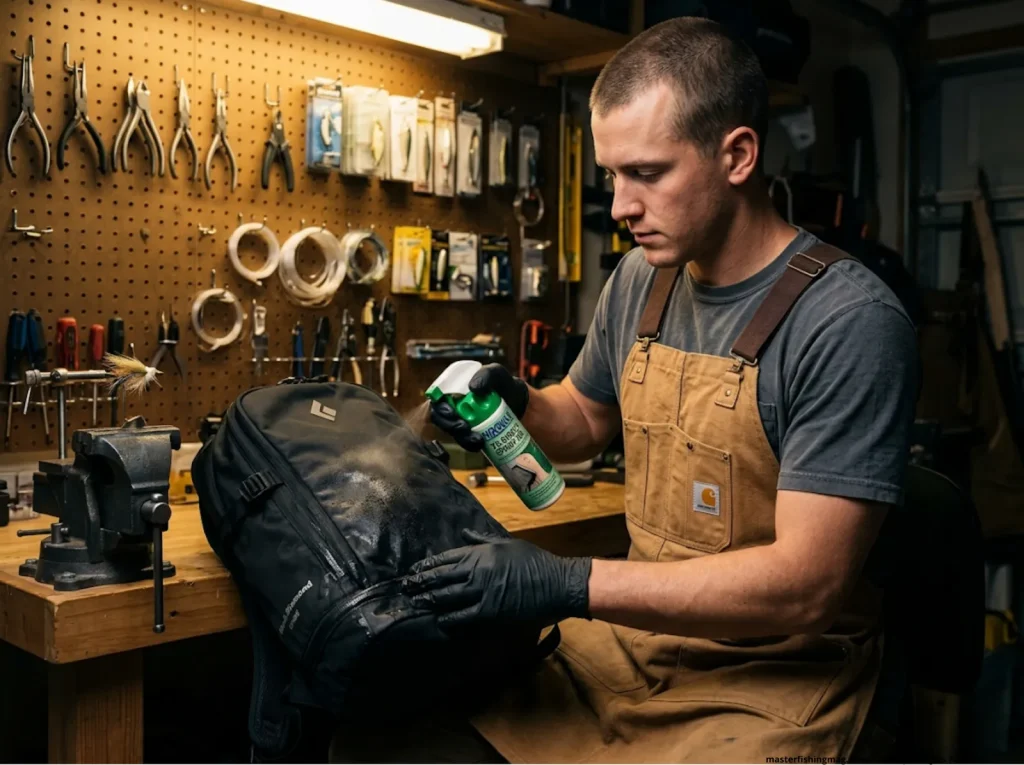
This is the repair most people skip half of. All three tiers matter, and the sequence matters.
Tier 1 — Fresh Water De-Salination (The Non-Negotiable First Step)
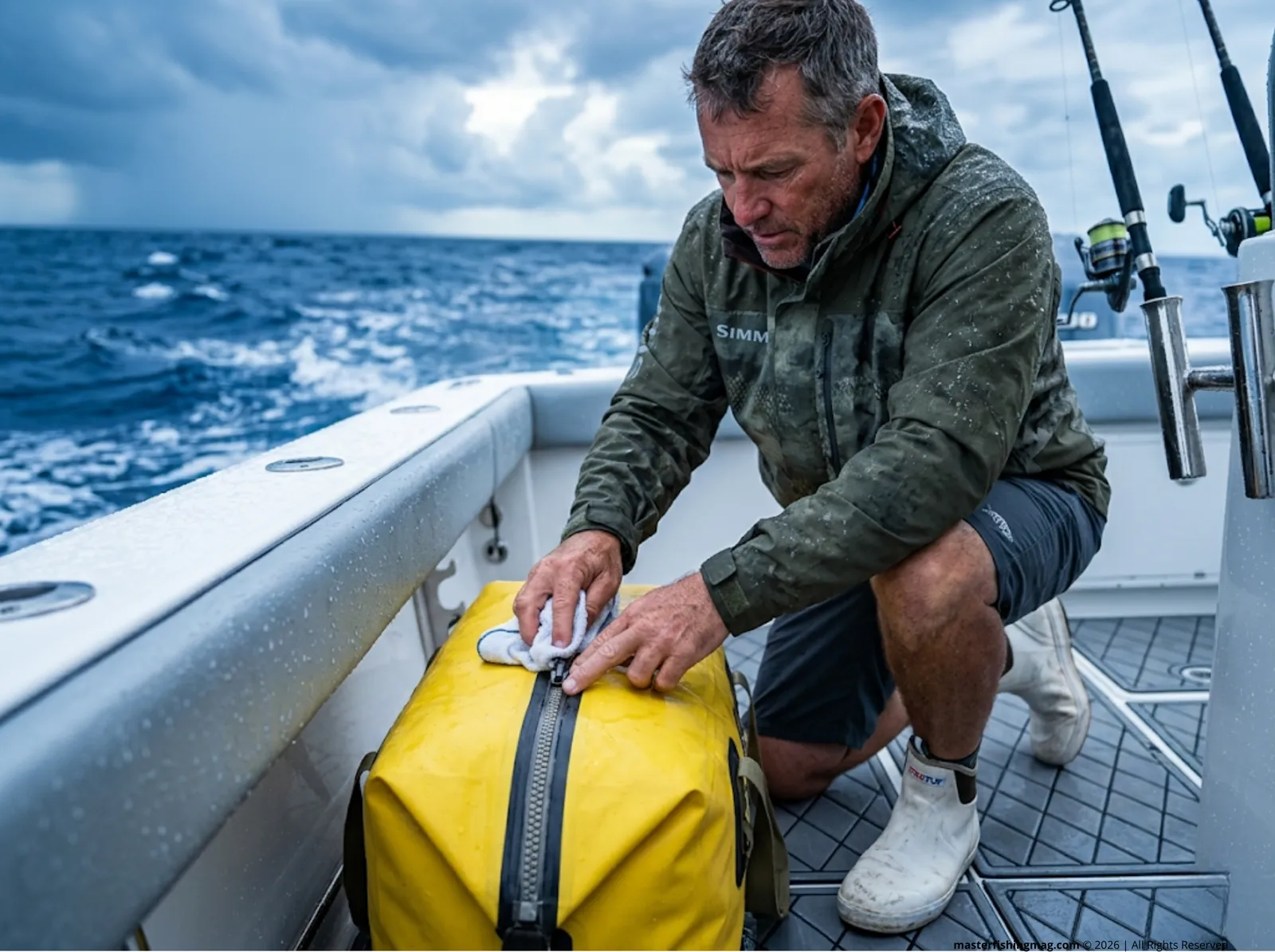
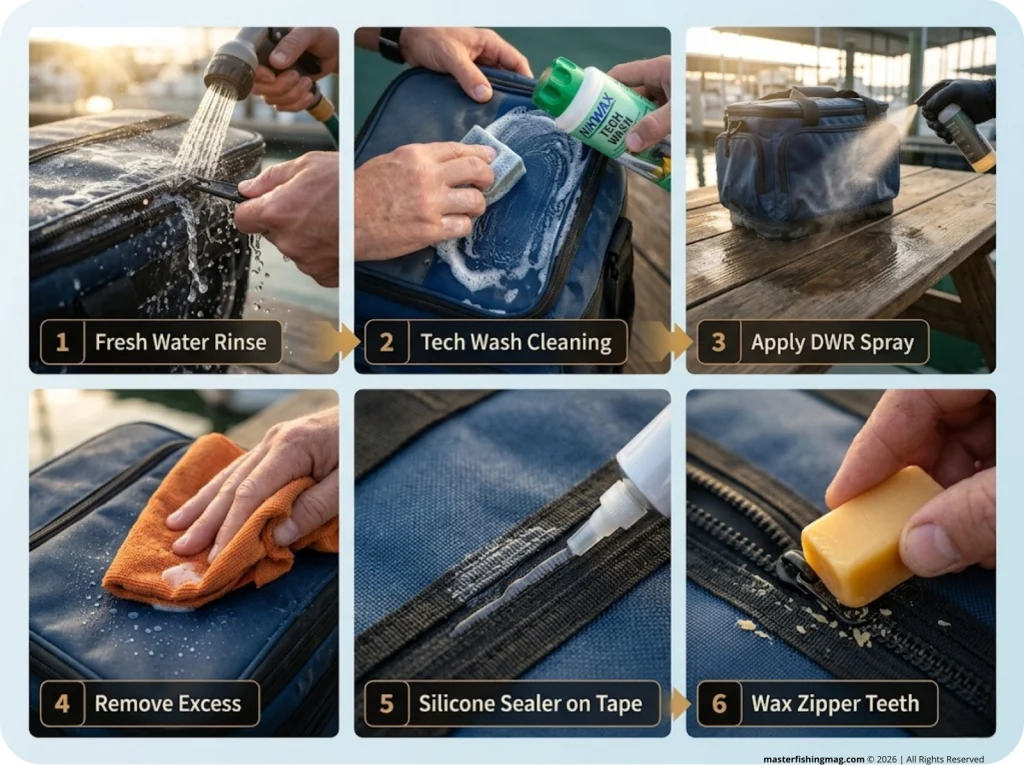
This step happens after every saltwater outing. Non-negotiable. Rinse the bag thoroughly with fresh water. Work the zipper slider back and forth during the rinse — the internal elements trap salt and need flushing. Focus more time on the zipper tape than the bag body. The tape is where salt concentrates and where the damage compounds fastest.
Never power-wash. High pressure forces salt crystals deeper into the fiber structure and can delaminate the interior coating. Air dry in shade. Direct UV exposure accelerates PU degradation and causes TPU to harden prematurely. Store with zippers completely closed — leaving a YKK AquaSeal zipper open deforms the sealing lips over time, and that damage is permanent. Storage humidity matters too: below 40% RH is the threshold that keeps accelerated hydrolysis in check.
Tier 2 — DWR Restoration and Surface Hardening
The signal you need this step: water no longer beads on the bag exterior. It soaks in instead of rolling off. Your DWR is done.
Clean first with Nikwax Tech Wash or a technical equivalent. Never conventional detergent — hydrophilic surfactants destroy DWR effectiveness and any new application you try to add won’t bond properly. Apply Nikwax TX.Direct Spray-On to a clean, wet bag. Hit the base panels and seam areas harder — that’s where pressure concentrates. Wipe excess with a damp cloth and air dry. Avoid heat-drying older PU-coated bags; the tumble dryer runs hot enough to push the hydrolysis clock forward.
If you’re also working through wader maintenance at the same fishing camp, the same DWR reactivation sequence applies to fishing waders after salt — same products, same order, same logic.
On chemical choices: select C0 (PFC-free) chemistries whenever available. Silicone or wax-based C0 treatments eliminate PFAS release into marine environments. Granger’s Fabsil Gold is C0. Nikwax TX.Direct is fluorocarbon-free. Avoid aerosol sprays using Toluene or Heptane as solvent carriers — they’re classified reproductive toxins (H361) and CNS/kidney damagers (H373), and they carry no performance advantage over water-based alternatives.
Tier 3 — Zipper Maintenance and Seam Sealing
Most anglers spray the bag, call it done, and wonder why it still leaks. The zipper tape is where the water is actually getting in.
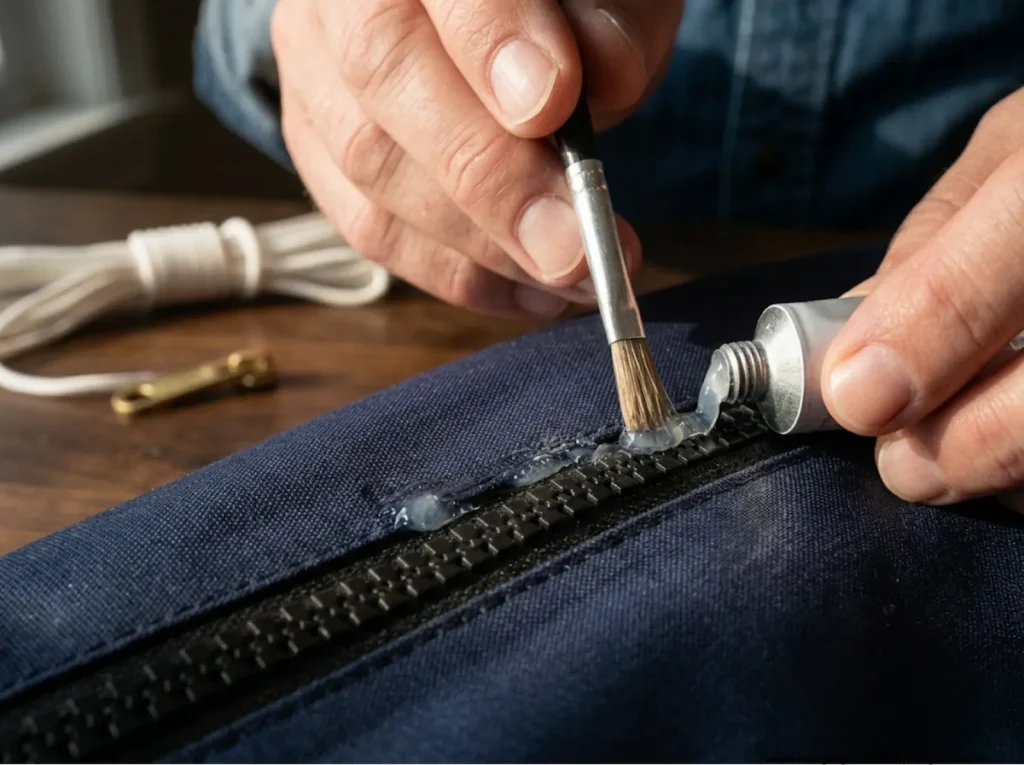
Apply silicone-based seam sealer to the fabric tape on both sides of each zipper. This is the fix for capillary action in zipper fabric tapes — blocking the pathway that routes water into the bag interior regardless of how well sealed the zipper teeth are. Apply to a clean, dry surface and allow 24 hours to cure before water exposure.
For the zipper elements themselves, apply paraffin wax or a specialized lubricant after cleaning. For YKK AquaSeal W-seal/closed-end zippers, apply lubricant specifically to the top-seal docking end to maintain tight gasket contact. Per YKK Americas’ official AquaSeal zipper care protocol, always move the slider slowly and vertically — angular pulling is the leading cause of element mis-engagement and permanent seal damage.
Pro-Tip: The mechanical rule on AquaSeal zippers is: slow and straight. Yanking them sideways rounds off the precision-machined sealing lips over time. Once those are gone, the zipper leaks regardless of how clean it is.
The Zipper Science Most Anglers Skip
Most content on bag waterproofing says “spray the zipper.” That’s wrong, or at least incomplete. Here’s why zippers actually fail.
How YKK AquaSeal Actually Works (And Where It Fails)
YKK AquaSeal uses VISLON® technology with a rubberized gasket between elements, tested to 0.3 bar (approximately 3,000 mm HH) per unit. That’s solid engineering. But that rating assumes clean, properly lubricated teeth. A single salt crystal lodged between elements breaks gasket contact. The slider’s sealing lips are precision-machined to fractions of a millimeter — repeated salt crystallization in zippers rounds them off permanently, and no amount of lubrication brings back geometry that’s been abraded away.
Conventional petroleum-based lubricants also swell the gasket material. Use the manufacturer-specified lubricant or paraffin wax. Anything else is a problem you’re creating on a schedule.
The Capillary Action Problem Nobody Mentions
Here’s the thing guides don’t put in the brochure: the zipper teeth are usually not where water enters the bag. The fabric tape holding the teeth is commonly manufactured from standard woven nylon — no waterproofing of its own. Water hits the tape surface, capillary action pulls it through the weave, and it travels directly into the bag interior, bypassing the sealed zipper elements entirely.
The capillary wicking test methodology for waterproof fabric evaluation from textile testing lab ChiuVention documents exactly how this failure mode works. A fouled or salted zipper tape holds water against the surface far longer than clean tape, making capillary ingress almost automatic under heavy salt load.
The fix is the seam sealer on the tape. It’s the repair the complete post-trip gear washing protocol that keeps your zippers intact longer addresses directly, and it’s the one step that almost nobody who writes about bag waterproofing bothers to explain.
Roll-Top vs. Zipper Closures — The Mechanical Argument
Roll-top closures eliminate the zipper problem by replacing mechanical failure points with a sealed fold. Three to four folds minimum with secured folded ends, on a submersion-rated body, can achieve functional waterproofing well above what any zipper system can maintain. The trade-off is access speed and compartment versatility — impractical for a multi-pocket tackle bag. For a single compartment protecting electronics or reels on a kayak day, the roll-top is the right call.
Pro-Tip: If you’re building a dry kit for electronics inside a larger bag, a nested roll-top dry bag inside the main compartment beats any zipper system for that purpose. You get the access of the main bag with true submersion protection for the gear that can’t get wet.
Environmental Stewardship — The Chemistry You’re Washing Into the Water

This matters more than the marketing language on the product label.
PFOA Chemistry — What “Waterproof Spray” Is Actually Made Of
Traditional DWR treatments used long-chain C8 fluorocarbons containing PFOA (perfluorooctanoic acid). These are persistent bioaccumulative toxins — they don’t break down, they accumulate in marine environments, and they enter the aquatic food chain. They’ve been linked to liver damage and immune suppression in wildlife and humans. Many cheap aerosol sprays still use C8 chemistry or C6 alternatives that still carry environmental concerns.
Long-chain PFAS (C8) compounds release persistent bioaccumulative toxins during normal washing and use — the kind of pollution that happens while you’re standing at the dock. Look for “PFOA-free” or “fluorocarbon-free (PFC-free)” on the label. Those indicate C0.
PFAS-Free Alternatives — Performance Trade-Offs
C0 treatments — silicone or wax-based — provide solid water beading and repellency but don’t repel oils or stains as well as fluorinated chemistries, and they require more frequent reapplication. For almost every angling scenario, C0 is the practical call. Nikwax TX.Direct is fluorocarbon-free. Granger’s Fabsil Gold is C0. Both outperform the aerosol alternatives on water resistance while keeping your chemistry out of the water column.
If you want the peer-reviewed evidence on how these chemicals move through aquatic environments, peer-reviewed data on PFAS persistence from DWR clothing in aquatic environments covers it thoroughly. The numbers aren’t ambiguous.
Safe Application Practices (Avoiding Solvent Exposure)
Aerosol sprays using Toluene or Heptane as carriers are flammable (H225), classified as CNS and kidney damagers (H373), reproductive toxins (H361), and toxic to aquatic life with long-lasting effects (H411). Apply outdoors with maximum ventilation, wear nitrile gloves, and avoid proximity to sparks. Never treat gear waterside — runoff goes directly into the water column. The switch to water-based DWR products like Nikwax or Grangers eliminates solvent exposure entirely, and connects to the broader saltwater corrosion prevention system for all your marine gear.
Conclusion
Three things to keep with this after you close the article.
Salt attacks your bag on three fronts simultaneously: crystal abrasion at the surface, capillary wicking through the zipper tape, and slow PU hydrolysis in the interior coating. Address all three or you’re only delaying the loss.
The tacky test tells the truth. Sticky lining and a chemical smell means the coating has broken down at the molecular level. Put the spray down and plan for a TPU-laminated replacement with welded seams. The spray is not a fix for that problem.
DWR restoration works on bags that deserve it. Technical wash — not detergent — followed by spray-on DWR, followed by seam sealer on the zipper tape. That sequence, on a bag with intact structural integrity, adds years to the gear. Skip the sequence or change the order and you’ve wasted the product.
On your next post-trip rinse, run a finger along the interior lining before you do anything else. What you feel in 10 seconds tells you more about your bag’s future than any rating printed on the label.
FAQ
Can you make a regular tackle bag waterproof?
Yes, if the bag’s PU coating is intact and not delaminating. Apply a technical cleaner followed by a DWR spray like Nikwax TX.Direct on the exterior, and seal the zipper tape with silicone seam sealer on both sides. A bag in good structural condition can reach functional water-resistant protection equivalent to 1,500–2,000 mm HH with this treatment. The tacky test confirms whether you’re in that window.
What is the best waterproof spray for fishing bags?
Nikwax TX.Direct Spray-On is the most technically sound option — fluorocarbon-free, applied wet, and doesn’t require heat curing that can damage older PU coatings. Granger’s Fabsil Gold is a strong alternative for heavier silicone grease-adjacent treatment. Avoid aerosol sprays with Toluene or Heptane solvents — they’re toxic, they carry environmental risk in marine settings, and they offer no durability advantage over water-based options.
How do you seal seams on a fishing bag?
Apply silicone-based seam sealing to the exterior seam line and, critically, to the fabric tape on both sides of any zipper. The zipper tape is woven fabric with no built-in waterproofing — capillary action draws water through it regardless of how well-sealed the zipper teeth are. Clean and dry the surface first, then allow a full 24-hour cure before water exposure.
How often should I re-apply DWR to my fishing bag?
For saltwater use: every 5–10 outings, or whenever water stops beading and starts soaking in on the exterior. Always de-salt first with a fresh water rinse, then clean with a technical wash before any DWR application. Applying DWR over salt residue or detergent residue renders the treatment useless. The surface has to be clean for the chemistry to bond.
When is a fishing bag too far gone to waterproof?
When the interior shows tactile stickiness, visible peeling, or a chemical or acetone odor. That’s terminal polyurethane hydrolysis — the coating has broken down structurally and no topical treatment re-bonds it to the base fabric. Cut your losses on that bag. Invest in a welded-seam TPU-laminated replacement with genuine mechanical seals, and start the maintenance protocol from day one on the new gear.
Risk Disclaimer: Fishing, boating, and all related outdoor activities involve inherent risks that
can lead to injury. The information provided on Master Fishing Mag is for educational and informational purposes
only. While we strive for accuracy, the information, techniques, and advice on gear and safety are not a substitute
for your own best judgment, local knowledge, and adherence to official regulations. Fishing regulations, including
seasons, size limits, and species restrictions, change frequently and vary by location. Always consult the latest
official regulations from your local fish and wildlife agency before heading out. Proper handling of hooks, knives,
and other sharp equipment is essential for safety. Furthermore, be aware of local fish consumption advisories. By
using this website, you agree that you are solely responsible for your own safety and for complying with all
applicable laws. Any reliance you place on our content is strictly at your own risk. Master Fishing Mag and its
authors will not be held liable for any injury, damage, or loss sustained in connection with the use of the
information herein.
Affiliate Disclosure: We are a participant in the Amazon Services LLC Associates Program, an
affiliate advertising program designed to provide a means for us to earn advertising fees by advertising and linking
to Amazon.com. As an Amazon Associate, we earn from qualifying purchases. We also participate in other affiliate
programs and may receive a commission on products purchased through our links, at no extra cost to you. Additional
terms are found in the terms of service.